
Judge, 1921-10-01 · page 25 of 36
Judge — October 1, 1921 — page 25: what you’re looking at
What you’re looking at
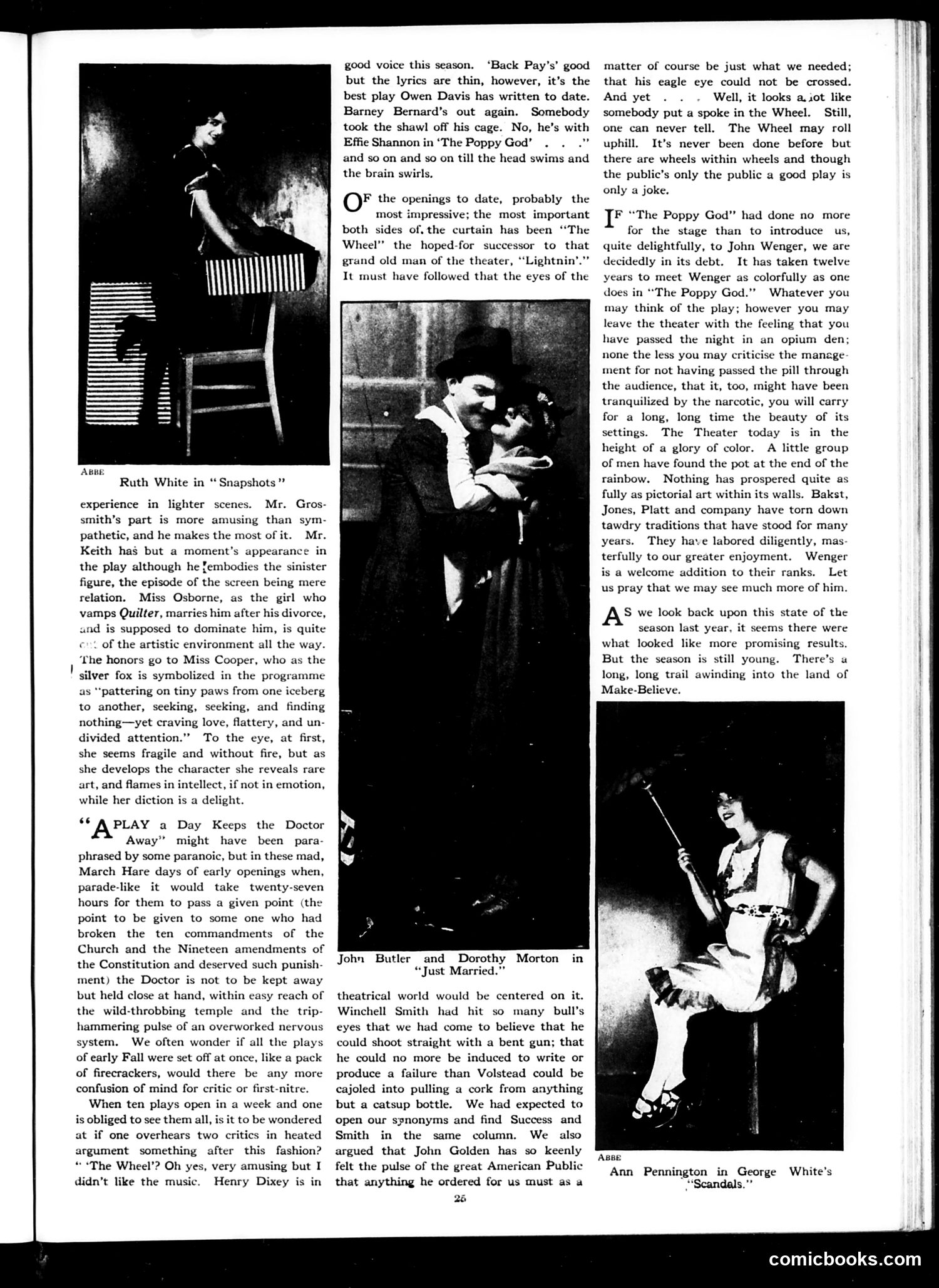
This is a theater criticism page from Judge magazine reviewing Broadway openings. The critic discusses several plays including "The Wheel" (by celebrated playwright Winchell Smith), "The Poppy God," and "Just Married." The main point is satirical commentary on the overwhelming number of theatrical openings—the critic jokes that ten plays opening weekly creates such exhaustion that critics become delirious, arguing nonsensically about shows. The opening phrase "A Play a Day Keeps the Doctor Away" parodies the familiar health adage. The photographs show scenes from productions: Ruth White in "Snapshots," and John Butler with Dorothy Morton in "Just Married." The critic praises performer John Wenger's debut in "The Poppy God" and expresses surprise that "The Wheel," despite being from reliably successful producer Winchell Smith, appears to have "a spoke in" it—meaning it may not succeed despite high expectations.
📄 Transcribed text from this page (OCR, searchable)
Machine-transcribed from the original scan — historical spelling and the odd misread are preserved.
| Un Ruth White in “Snapshots” experience in lighter scenes. Mr. smith’s part is more amusing than sym- pathetic, and he makes the most of it. Mr. Keith has but a moment’s appearance in the play although he [embodies the sinister figure, the episode of the screen being mere relation. Miss Osborne, as the girl who vamps Quilter, marries him after his divorce, and is supposed to dominate him, is quite c.. of the artistic environment all the way. Gros- ‘he honors go to Miss Cooper, who as the silver fox is symbolized in the programme as “pattering on tiny paws from one iceberg to another, seeking, seeking, and finding nothing—yet craving love, flattery, and un- divided attention.” To the eye, at first, she seems fragile and without fire, but as she develops the character she reveals rare art, and flames in intellect, if not in emotion, while her diction is a delight. ** A PLAY a Day Keeps the Doctor Away” might have been para- phrased by some paranoic, but in these mad, March Hare days of early openings when, parade-like it would take twenty-seven hours for them to pass a given point (the point to be given to some one who had broken the ten commandments of the Church and the Nineteen amendments of the Constitution and deserved such punish- ment) the Doctor is not to be kept away but held close at hand, within easy reach of the wild-throbbing temple and the trip- hammering pulse of an overworked nervous system. We often wonder if all the plays of early Fall were set off at once, like a pack of firecrackers, would there be any more confusion of mind for critic or first-nitre. When ten plays open in a week and one is obliged to see them all, is it to be wondered at if one overhears two critics in heated argument something after this fashion? “ ‘The Wheel’? Oh yes, very amusing but I didn’t like the music. Henry Dixey is in good voice this season. ‘Back Pay’s’ good but the lyrics are thin, however, it’s the best play Owen Davis has written to date. Barney Bernard’s out again. Somebody took the shawl off his cage. No, he’s with Effie Shannon in ‘The Poppy God’ . . .” and so on and so on till the head swims and the brain swirls. OF the openings to date, probably the most impressive; the most important both sides ofthe curtain has been “The Wheel” the hoped-for successor to that grand old man of the theater, ‘Lightnin’. It must have followed that the eyes of the Butler and Dorothy Morton in John “Just Married.” theatrical world would be centered on it. Winchell Smith had hit so many bull's eyes that we had come to believe that he could shoot straight with a bent gun; that he could no more be induced to write or produce a failure than Volstead could be cajoled into pulling a cork from anything but a catsup bottle. We had expected to open our spnonyms and find Success and Smith in the same column. We also argued that John Golden has so keenly felt the pulse of the great American Public that anything he ordered for us must as a matter of course be just what we needed; that his eagle eye could not be crossed. And yet Well, it looks a. jot like somebody put a spoke in the Wheel. Still, one can never tell. The Wheel may roll uphill, It’s never been done before but there are wheels within wheels and though the public’s only the public a good play is only a joke. rE “The Poppy God” had done no more for the stage than to introduce us, quite delightfully, to John Wenger, we are decidedly in its debt. It has taken twelve years to meet Wenger as colorfully as one does in “The Poppy God.” Whatever you may think of the play; however you may leave the theater with the feeling that you have passed the night in an opium den; none the less you may criticise the manage. ment for not having passed the pill through the audience, that it, too, might have been tranquilized by the narcotic, you will carry for a long, long time the beauty of its settings. The Theater today is in the height of a glory of color. A little group of men have found the pot at the end of the rainbow. Nothing has prospered quite as fully as pictorial art within its walls. Bakst, Jones, Platt and company have torn down tawdry traditions that have stood for many They have labored diligently, mas- terfully to our greater enjoyment. Wenger is a welcome addition to their ranks. Let us pray that we may see much more of him. years. S we look back upon this state of the season last year, it seems there were what looked like more promising results. But the season is still young. There’s a long, long trail awinding into the land of Make-Believe. Ann Pennington in George White's comicbooks.com