
Judge, 1921-10-01 · page 7 of 36
Judge — October 1, 1921 — page 7: what you’re looking at
What you’re looking at
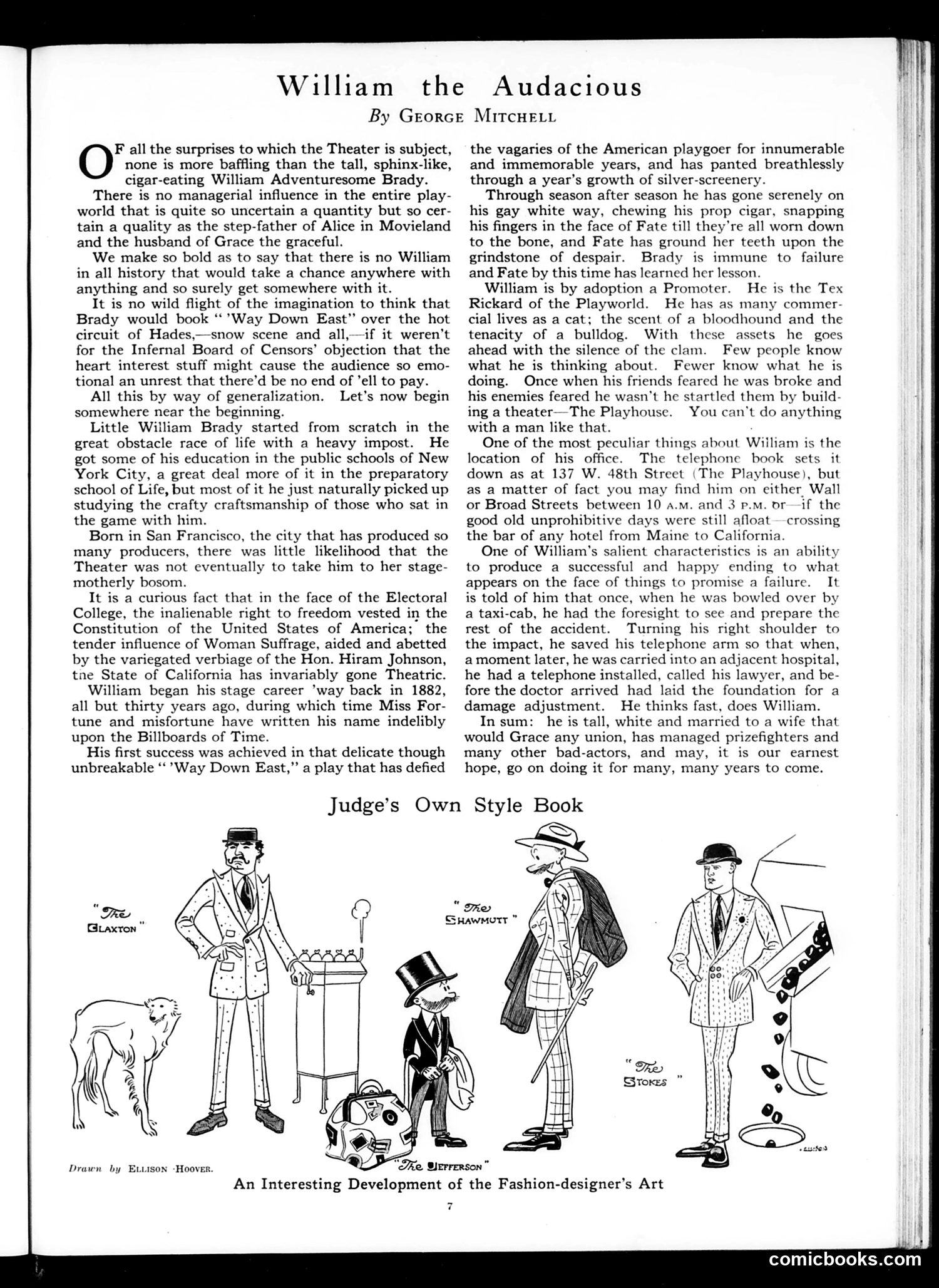
This page profiles William Brady, a prominent American theater producer and promoter active since 1882. The article praises Brady as an audacious, fearless showman who produced successful plays like "Way Down East" and built The Playhouse theater on 48th Street in New York. The satire targets Brady's mysterious business methods—his office location is officially listed but he's perpetually found elsewhere (Wall Street, hotel bars). The cartoons below, titled "Judge's Own Style Book," appear unrelated—they illustrate fashion designer caricatures with exaggerated clothing styles by Ellison Hoover, labeled "The Glaxton," "The Shawmutt," "The Jefferson," and "The Storks." The comedy rests on Brady's reputation as an eccentric risk-taker who defies logic yet consistently succeeds, earning comparison to boxing promoter Tex Rickard.
📄 Transcribed text from this page (OCR, searchable)
Machine-transcribed from the original scan — historical spelling and the odd misread are preserved.
William the Audacious By Greorce MitcHELL none is more baffling than the tall, sphinx-like, cigar-eating William Adventuresome Brady. There is no managerial influence in the entire play- world that is quite so uncertain a quantity but so cer- tain a quality as the step-father of Alice in Movieland and the husband of Grace the graceful. We make so bold as to say that there is no William in all history that would take a chance anywhere with anything and so surely get somewhere with it. It is no wild flight of the imagination to think that Brady would book ‘*’Way Down East” over the hot circuit of Hades,—snow scene and all,—if it weren't for the Infernal Board of Censors’ objection that the heart interest stuff might cause the audience so emo- tional an unrest that there’d be no end of ’ell to pay. All this by way of generalization. Let's now begin somewhere near the beginning. Little William Brady started from scratch in the great obstacle race of life with a heavy impost. He got some of his education in the public schools of New York City, a great deal more of it in the preparatory school of Life, but most of it he just naturally picked up studying the crafty craftsmanship of those who sat in the game with him. Born in San Francisco, the city that has produced so many producers, there was little likelihood that the Theater was not eventually to take him to her stage- motherly bosom. It is a curious fact that in the face of the Electoral College, the inalienable right to freedom vested in the Constitution of the United States of America; the tender influence of Woman Suffrage, aided and abetted by the variegated verbiage of the Hon. Hiram Johnson, tne State of California has invariably gone Theatric. William began his stage career ’way back in 1882, all but thirty years ago, during which time Miss For- tune and misfortune have written his name indelibly upon the Billboards of Time. His first success was achieved in that delicate though unbreakable ‘‘’Way Down East,” a play that has defied O’ all the surprises to which the Theater is subject, the vagaries of the American playgoer for innumerable and immemorable years, and has panted breathlessly through a year’s growth of silver-screenery. Through season after season he has gone serenely on his gay white way, chewing his prop cigar, snapping his fingers in the face of Fate till they’re all worn down to the bone, and Fate has ground her teeth upon the grindstone of despair. Brady is immune to failure and Fate by this time has learned her lesson. William is by adoption a Promoter. He is the Tex Rickard of the Playworld. He has as many commer- cial lives as a cat; the scent of a bloodhound and the tenacity of a bulldog. With these assets he goes ahead with the silence of the clam. Few people know what he is thinking about. Fewer know what he is doing. Once when his friends feared he was broke and his enemies feared he wasn't he startled them by build- ing a theater—The Playhouse. You can’t do anything with a man like that. One of the most peculiar things about William is the location of his office. The telephone book sets it down as at 137 W. 48th Street (The Playhouse), but as a matter of fact you may find him on either Wall or Broad Streets between 10 a.m. and 3 p.m. or—if the good old unprohibitive days were still afloat crossing the bar of any hotel from Maine to California. One of William's salient characteristics is an ability to produce a successful and happy ending to what appears on the face of things to promise a failure. It is told of him that once, when he was bowled over by a taxi-cab, he had the foresight to see and prepare the rest of the accident. Turning his right shoulder to the impact, he saved his telephone arm so that when, a moment later, he was carried into an adjacent hospital, he had a telephone installed, called his lawyer, and be- fore the doctor arrived had laid the foundation for a damage adjustment. He thinks fast, does William. In sum: he is tall, white and married to a wife that would Grace any union, has managed prizefighters and many other bad-actors, and may, it is our earnest hope, go on doing it for many, many years to come. Judge’s Own Style Book Drawn by Et.ison -Hoover. “The SIEFFERSON” An Interesting Development of the Fashion-designer’s Art comicbooks.com