
A complete issue · 36 pages · 1921
Judge — June 11, 1921
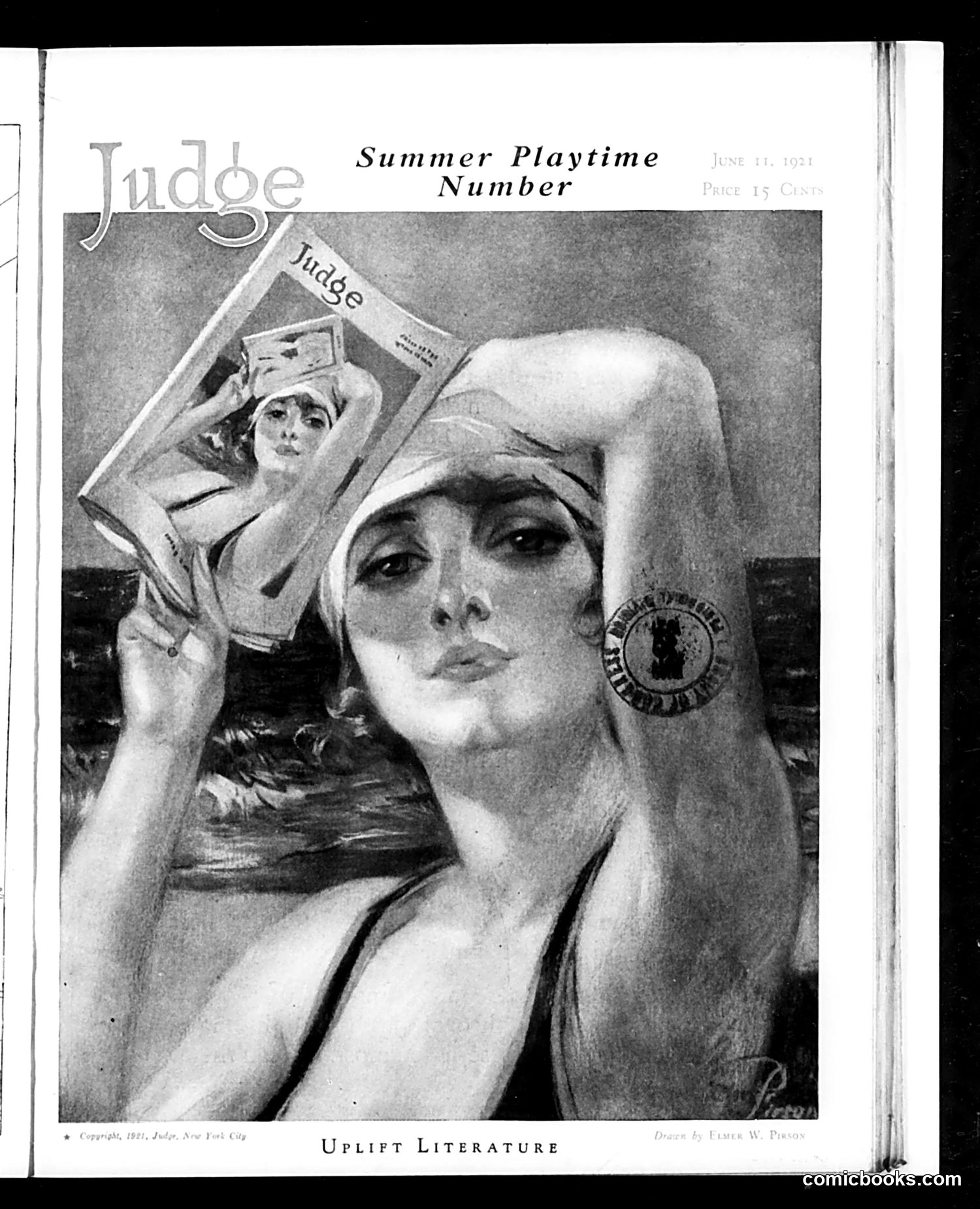
This is primarily a cover image rather than a political cartoon. It shows a young woman in 1920s beach attire (swimming costume and bathing cap) holding up a Judge magazine, which she's apparently reading. The image appears to be self-promotional—advertising the magazine itself as summer reading material. The satire is gentle and typical of early 1920s humor: the joke seems to be about women's leisure time and beach culture during the "Summer Playtime" season. The woman gazes at her own image reflected in the magazine she holds, creating a playful meta-reference. This reflects the era's evolving attitudes toward women's public recreation and the growing consumer culture targeting female readers with lifestyle magazines.
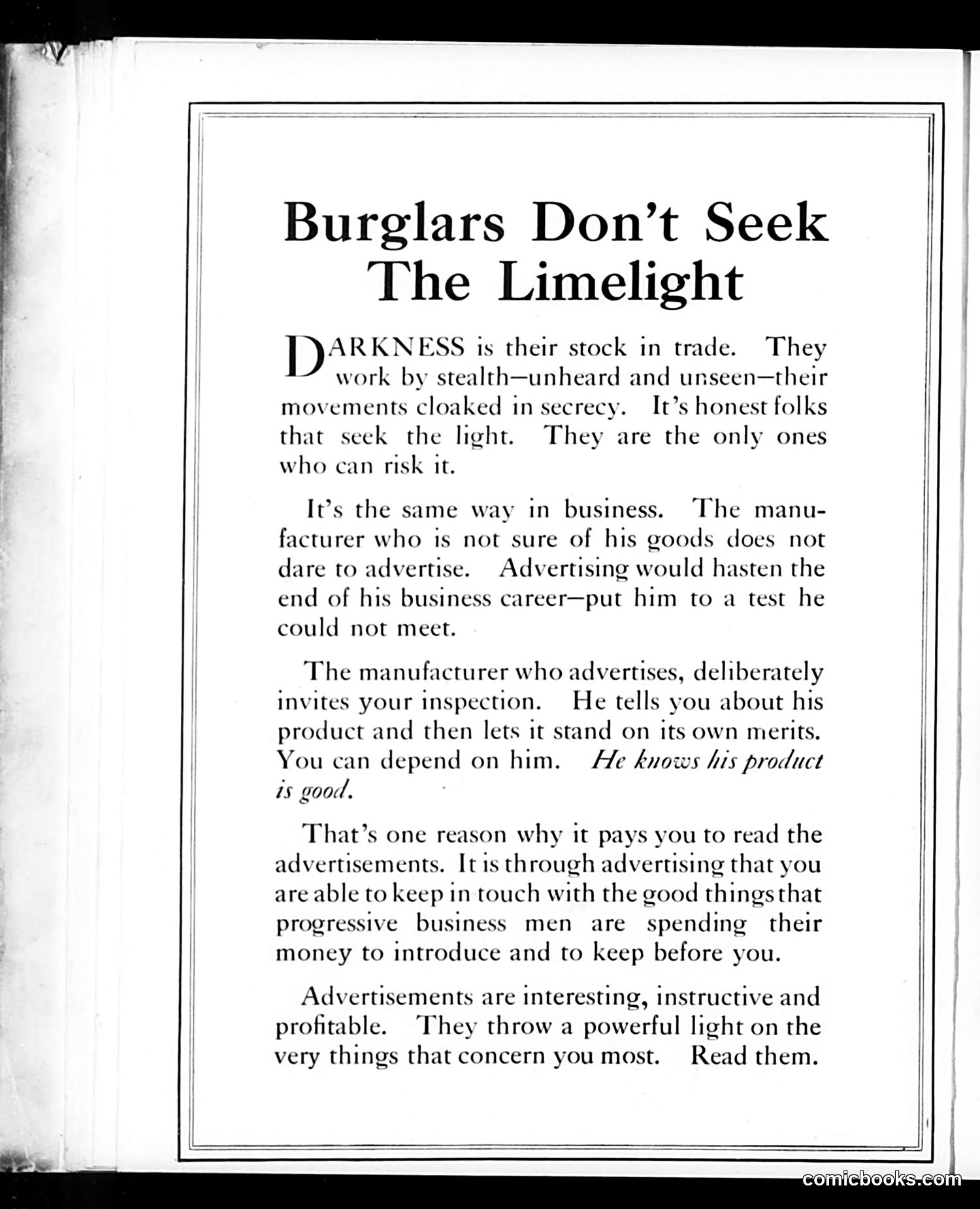
This is an essay-style advertisement, not a political cartoon. It uses an extended metaphor comparing business ethics to criminal behavior: just as burglars work in darkness and secrecy, dishonest manufacturers avoid advertising because they fear scrutiny. Conversely, legitimate businesses openly advertise, inviting inspection and standing behind their products. The piece argues that advertisements serve consumers by illuminating trustworthy goods and innovations. The "limelight" represents transparency and honesty—only businesses confident in their quality can afford public exposure. This reflects early 20th-century attitudes about advertising's moral function: in an era of patent medicines and dubious products, advertising was positioned as a consumer protection mechanism, signaling manufacturer confidence and integrity.
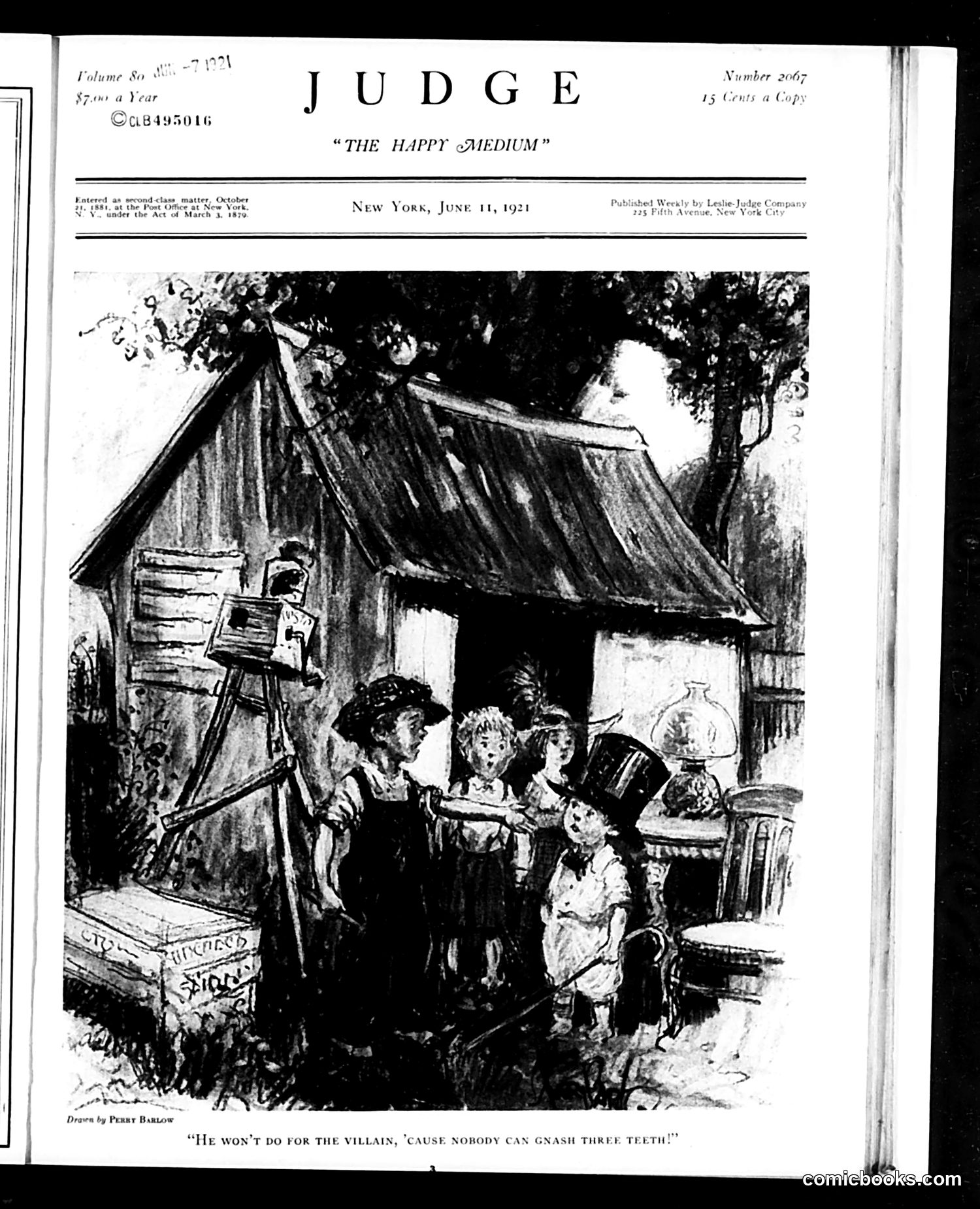
**The Cartoon:** This illustration by Perry Barlow depicts a traveling medicine show or circus tent. A showman operates what appears to be a movie camera or projection device on a tripod, while children and onlookers gather outside a ramshackle tent structure. **The Caption & Satire:** The caption reads: "He won't do for the villain, 'cause nobody can gnash three teeth!'" This is a joke about casting for a theatrical or film production. The humor lies in the absurd requirement that a villain actor possess enough teeth to gnash them dramatically—a visual performance element considered essential to portraying an evil character. It satirizes the artificial conventions of early entertainment and theatrical melodrama, where exaggerated physical expressions were crucial to conveying character type.
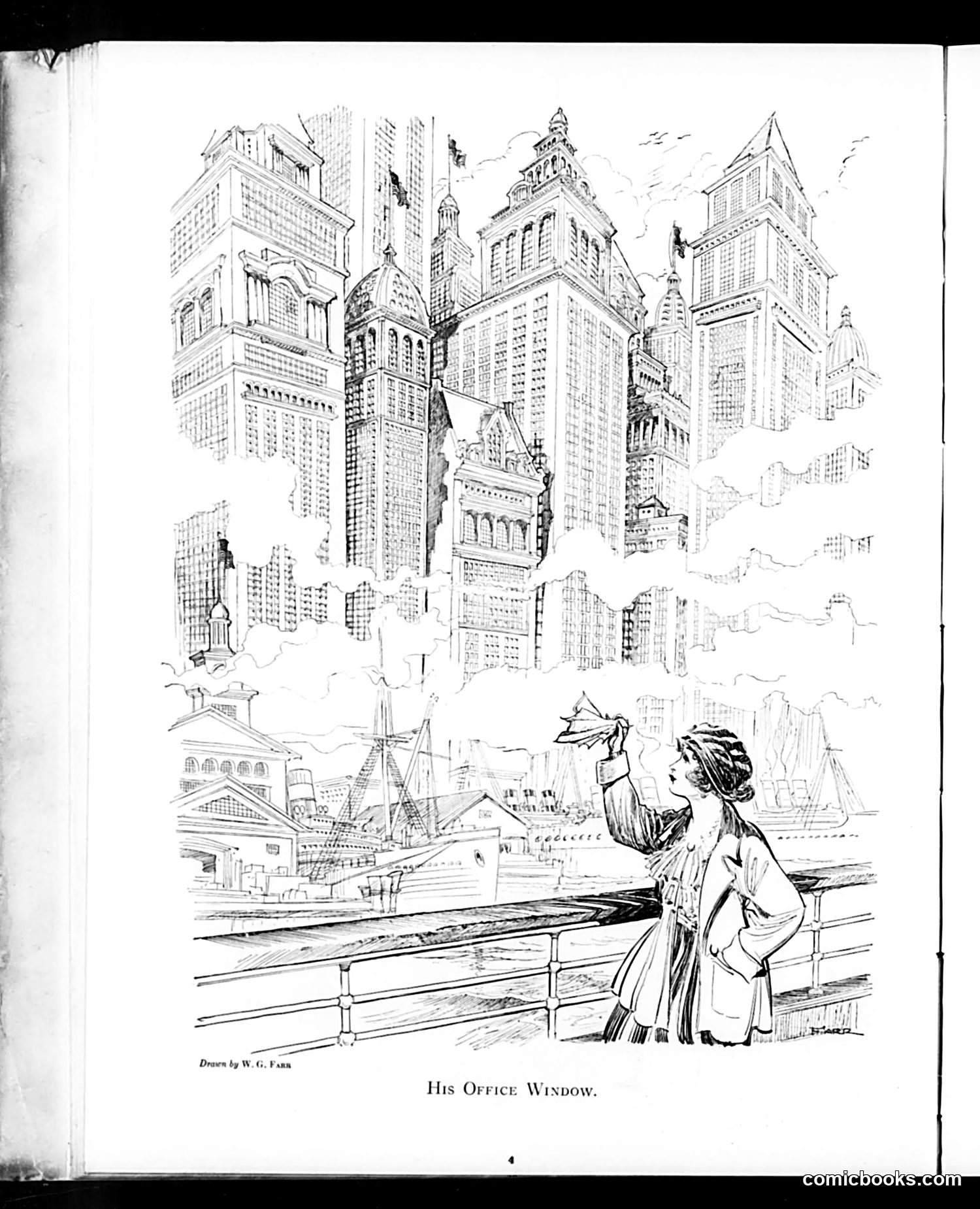
This illustration shows a woman gazing from a waterfront pier toward an idealized Manhattan skyline dominated by towering skyscrapers and historic buildings. The title "His Office Window" suggests she's contemplating a man's workplace among those impressive structures—likely depicting the fantasy or aspiration of marrying a successful businessman with an office in a prominent downtown building. The romantic, somewhat wistful composition reflects early 20th-century attitudes about masculine professional success and feminine aspiration. The drawing celebrates urban modernity and commercial achievement while playing on conventional gender roles—the woman admires the man's worldly accomplishment from an external vantage point. This reflects Judge magazine's satirical commentary on contemporary social dynamics and romantic expectations.
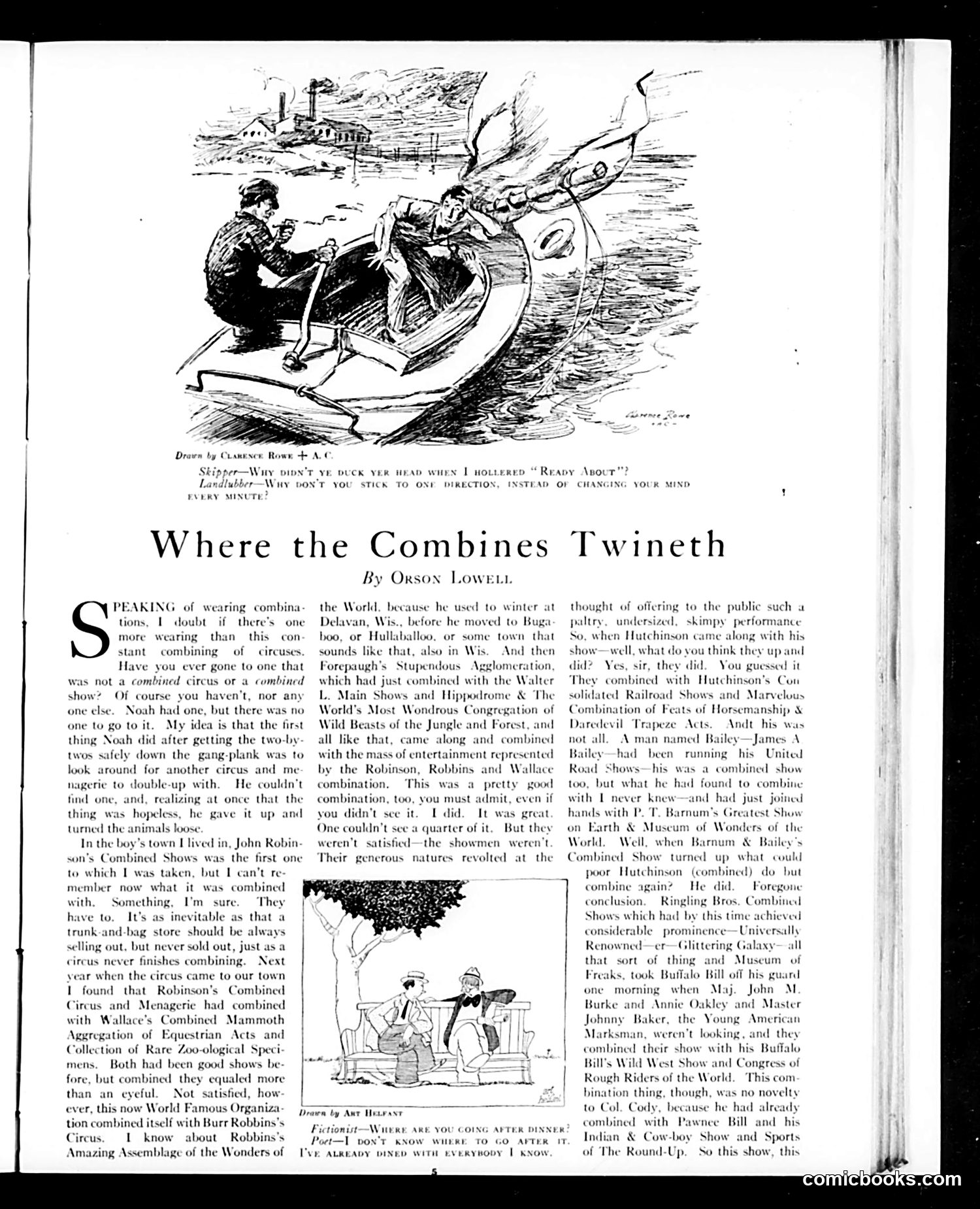
This article satirizes the proliferation of combined circus shows in America. The author argues that circus operators kept merging their acts to create larger spectacles, but audiences were dissatisfied—they wanted quality performances, not just quantity. The top cartoon depicts a showman and performer in a boat, with dialogue mocking the constant format changes of combined shows ("Why didn't ye duck yer head when I hollered 'Ready About'?"). The text references specific combined circuses: Robinson's Combined Circus merged with Wallace's Mammoth Aggregation and others. The article humorously traces how these combinations proliferated, culminating in increasingly unwieldy shows. The satire suggests that circus operators' obsession with mergers and expansion ultimately failed to impress audiences seeking genuine entertainment over mere spectacle.
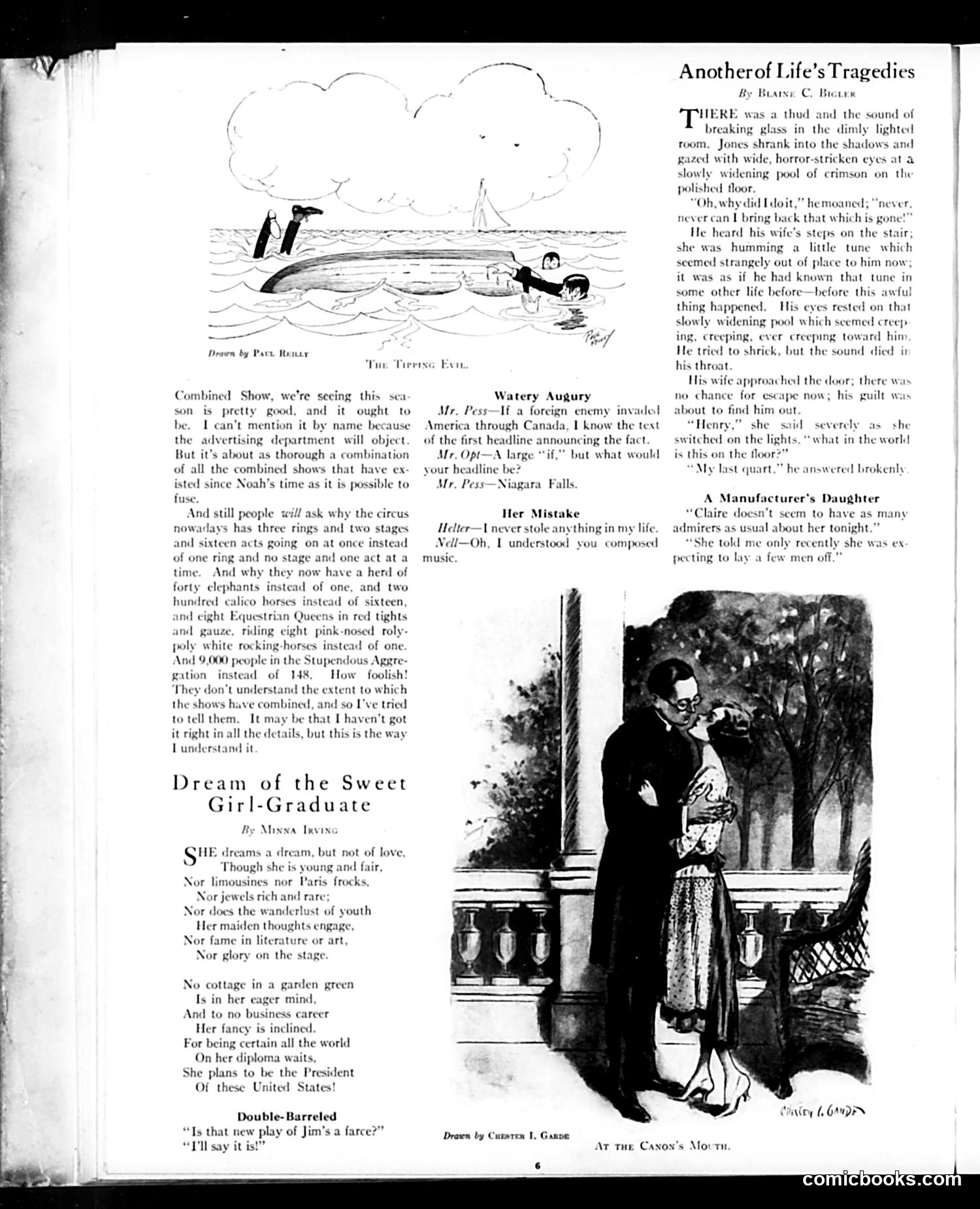
This page contains several short humorous pieces rather than political cartoons. "Another of Life's Tragedies" depicts a domestic drama: a man discovers his wife's infidelity through a broken vase and her suspicious behavior. The humor comes from the melodramatic presentation of this ordinary marital crisis. "Watery Augury" is a brief joke about combining circus acts and comparing them to Niagara Falls—likely satirizing the era's trend of increasingly spectacular entertainment combining multiple shows. The other pieces—"Her Mistake," "A Manufacturer's Daughter," and "Dream of the Sweet Girl Graduate"—appear to be humorous social commentary on women's aspirations and courtship, typical of Judge's satirical approach to contemporary American life. The magazine uses exaggeration for comedic effect.
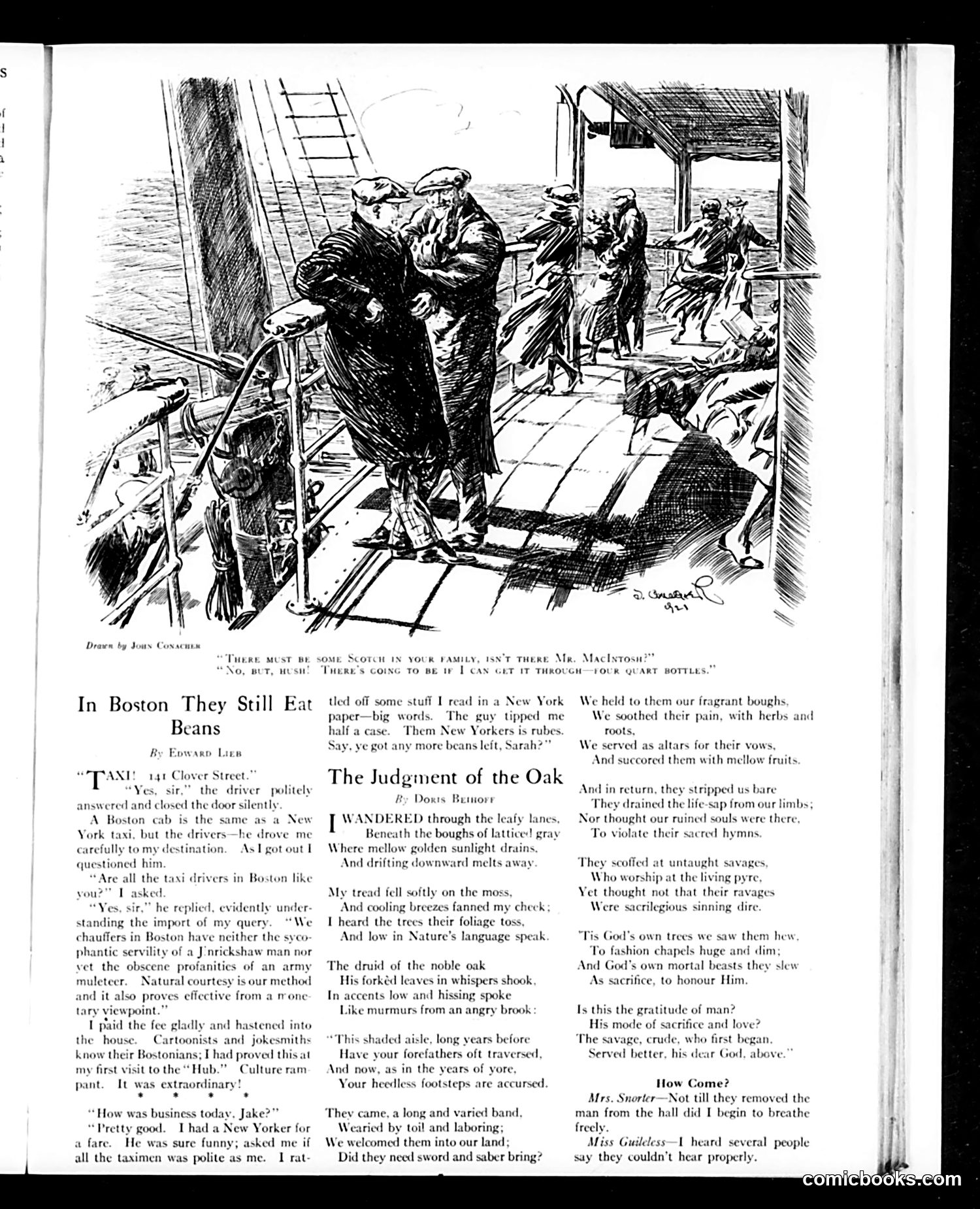
**The Cartoon (top):** Drawn by John Coxscomb, this depicts a scene aboard a ship where two men in the foreground discuss family genealogy. One insists there's "Scotch in your family," while the other counters he can get it "through your quart bottles"—a crude joke equating Scottish ancestry with whisky consumption. The maritime setting and period dress suggest this is historical satire about ethnic stereotyping. **"In Boston They Still Eat Beans":** This story satirizes Boston's reputation for both baked beans and intellectual superiority. A Boston taxi driver, asked if all local cabbies are polite, recites highbrow phrases he read in a New York paper to impress a New York passenger into tipping "half a case" of alcohol. The joke: sophisticated Boston culture is performative—the driver admits New Yorkers are "rubes" who fall for it. **"The Judgment of the Oak":** A romantic poem (likely satirical) where an oak tree laments European colonists who destroyed Native American lands and resources while claiming moral superiority.
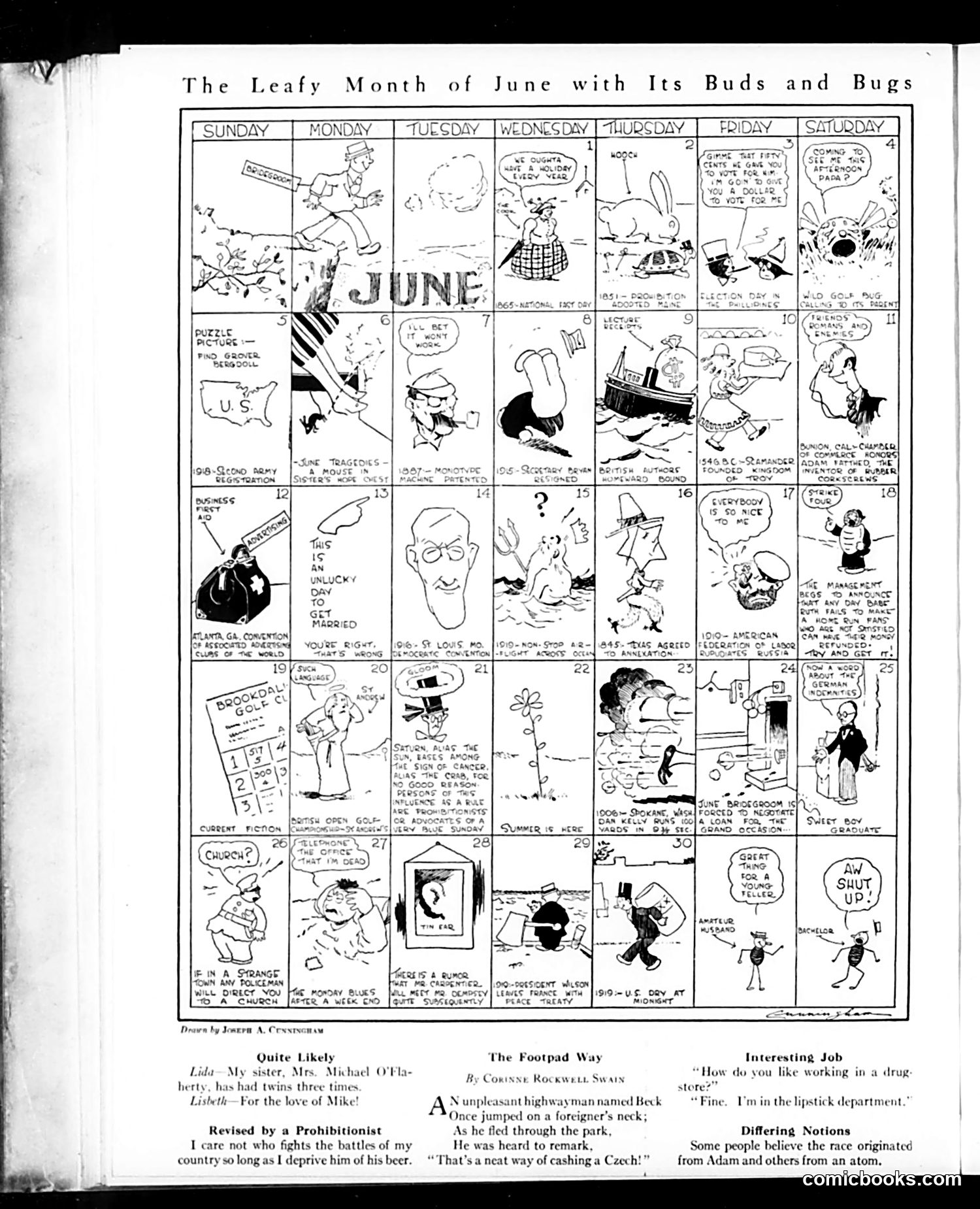
This is a calendar-comic strip for June, a common Judge magazine feature. Each day contains small satirical vignettes touching on contemporary issues: **Political/Social References:** - "D.O.-Second Navy Registration" (June 3): References U.S. military preparedness debates - "Annexation" (June 15): Likely refers to ongoing imperial expansion debates - "Prohibition" (bottom text): A prohibitionist complains he can't deprive soldiers of beer—mocking temperance advocates' priorities during wartime **The humor** relies on wordplay and topical commentary rather than coherent narratives. For instance, the "Czech" joke plays on phonetic similarity ("cashing a Czech" sounds like "cashing a check"). **For modern readers:** This reflects pre-WWI American anxieties about military readiness, prohibition debates, and casual ethnic humor typical of the era. The magazine assumed readers followed current events closely enough to catch these quick references.
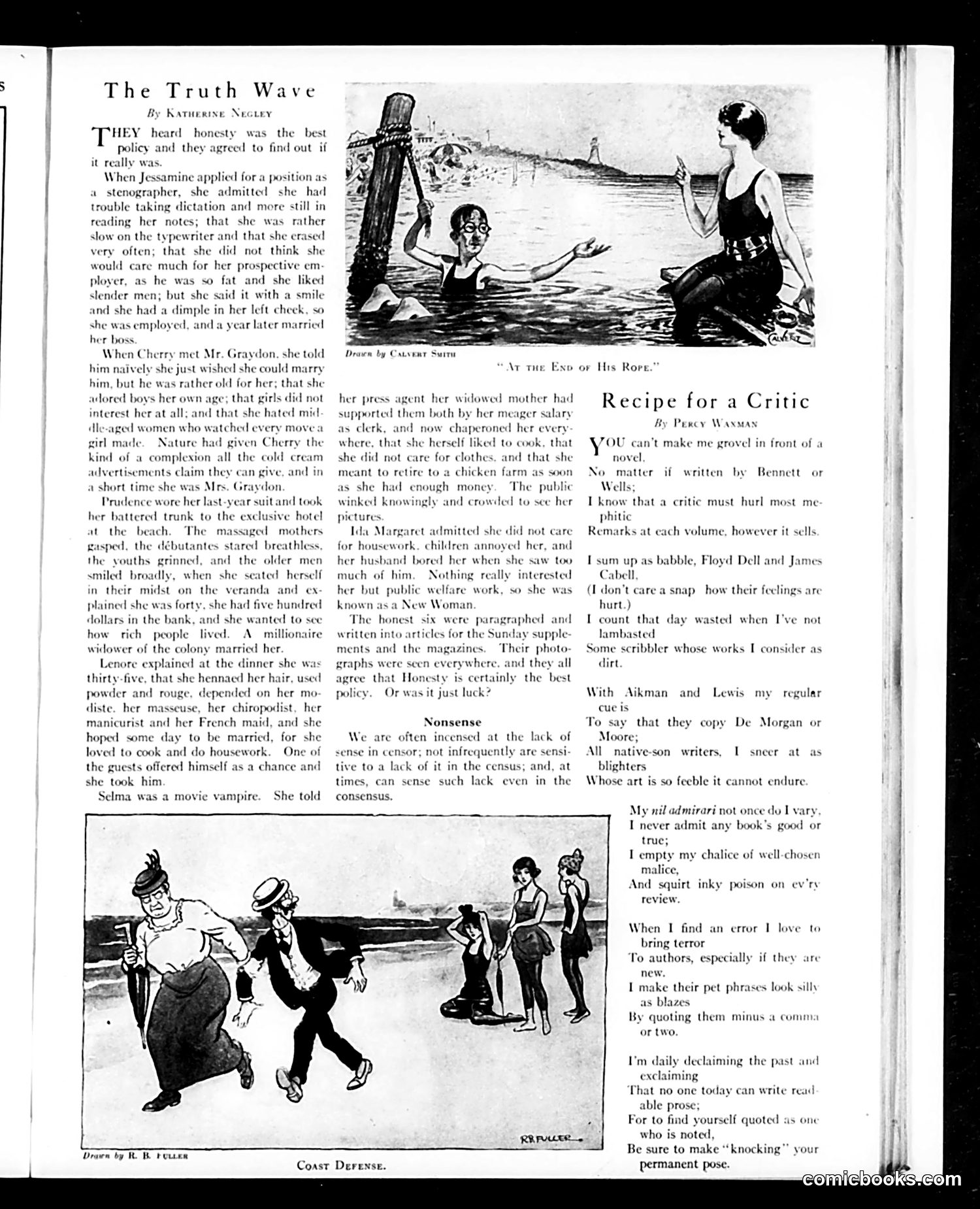
"The Truth Wave" satirizes the paradox that honesty can succeed through social convention rather than merit. Six women candidly admit serious flaws—poor work skills, age, poverty, vanity, domestic disinterest, or infidelity concerns—yet each lands a wealthy husband. The joke: their honesty, delivered with charm or attractiveness, becomes *marketable* rather than genuinely valued. Society rewards the *performance* of honesty (especially by appealing women) while remaining indifferent to actual competence or character. The accompanying illustrations show these women succeeding despite their admissions, highlighting the hypocrisy: people claim to value honesty but really respond to appearance and charm. "Recipe for a Critic" mocks literary critics as contrarian snobs who dismiss all books as bad regardless of merit, copy established critics blindly, and find satisfaction only in negativity. It's satire of critical arrogance—the assumption that harsh judgment proves sophistication. Both pieces target early 20th-century pretension and gap between stated values and actual behavior.
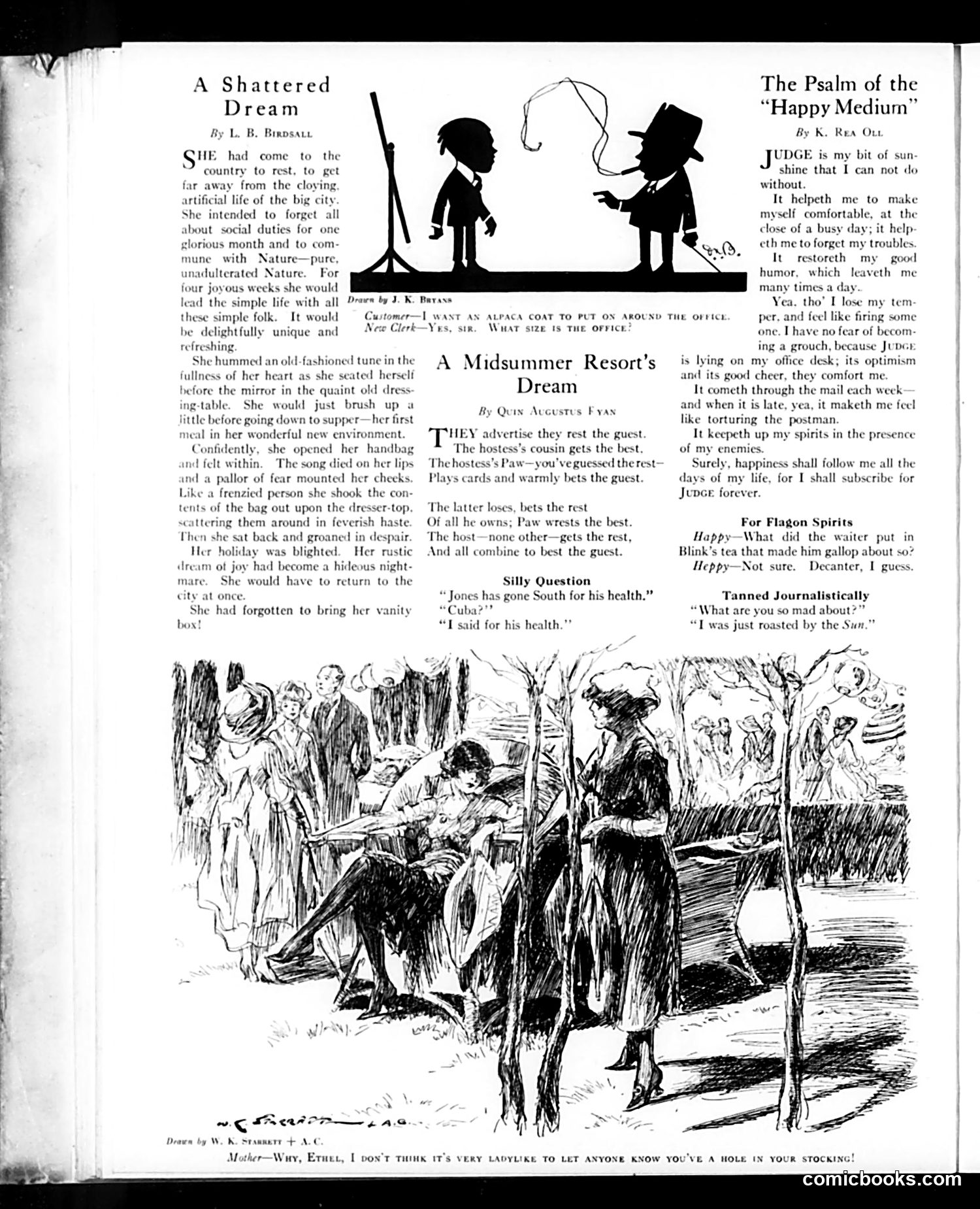
This page contains several satirical pieces typical of early 20th-century American humor: **"A Shattered Dream"** mocks upper-class women's fantasies of "simple country living." The joke: a city woman escapes to the countryside seeking nature and simplicity, but her vacation is ruined—she forgot her vanity box. The satire targets the hypocrisy of wealthy urbanites who romanticize rural life while remaining utterly dependent on luxury goods. **"A Midsummer Resort's Dream"** is a cynical verse about vacation hospitality, depicting how resort hosts systematically fleece guests through card games and betting, with everyone conspiring "to best the guest." **"The Psalm of the Happy Medium"** is self-promotional copy praising Judge magazine itself as mood-boosting reading material—gentle satire of advertising language. The remaining items are brief comic quips about forgetfulness, health, and social etiquette. The large illustration depicts what appears to be a resort or leisure setting with multiple figures. The overall tone reflects Judge's typical satirical focus on upper-class pretension and social absurdity.
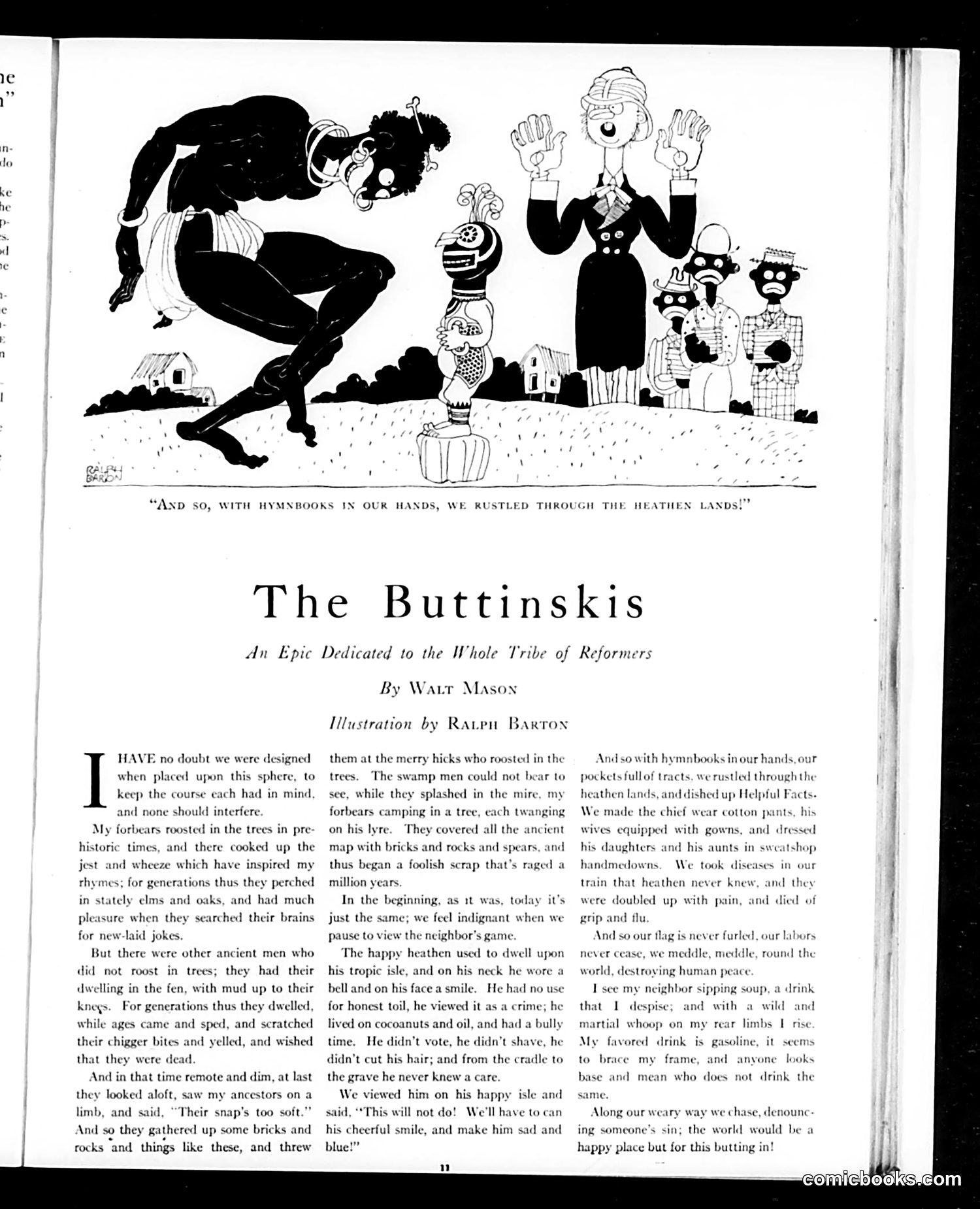
This poem by Walt Mason, illustrated by Ralph Barton, satirizes American missionary and reform movements—particularly early 20th-century interventionism disguised as benevolence. **The satire's target:** Religious reformers and do-gooders who impose their values on other cultures under the guise of "civilization." The "heathen" on his tropical island lives contentedly without toil, voting, or shaving—until well-meaning Americans arrive with hymnbooks and "Helpful Facts." **The ironic critique:** The poem reveals that these interventions actually *harm* indigenous peoples by introducing disease, labor exploitation (sweatshop clothing), and moral anxiety. The "helpful" reformers themselves are hypocritical busybodies ("Buttinskis") who meddle in others' affairs while ignoring their own moral failings (drinking gasoline, judging neighbors). **Historical context:** This likely critiques American missionary colonialism and Progressive Era paternalism toward "backward" peoples—the same impulses driving U.S. imperialism. Mason's message: meddling destroys "human peace" more effectively than the supposed sins being corrected.
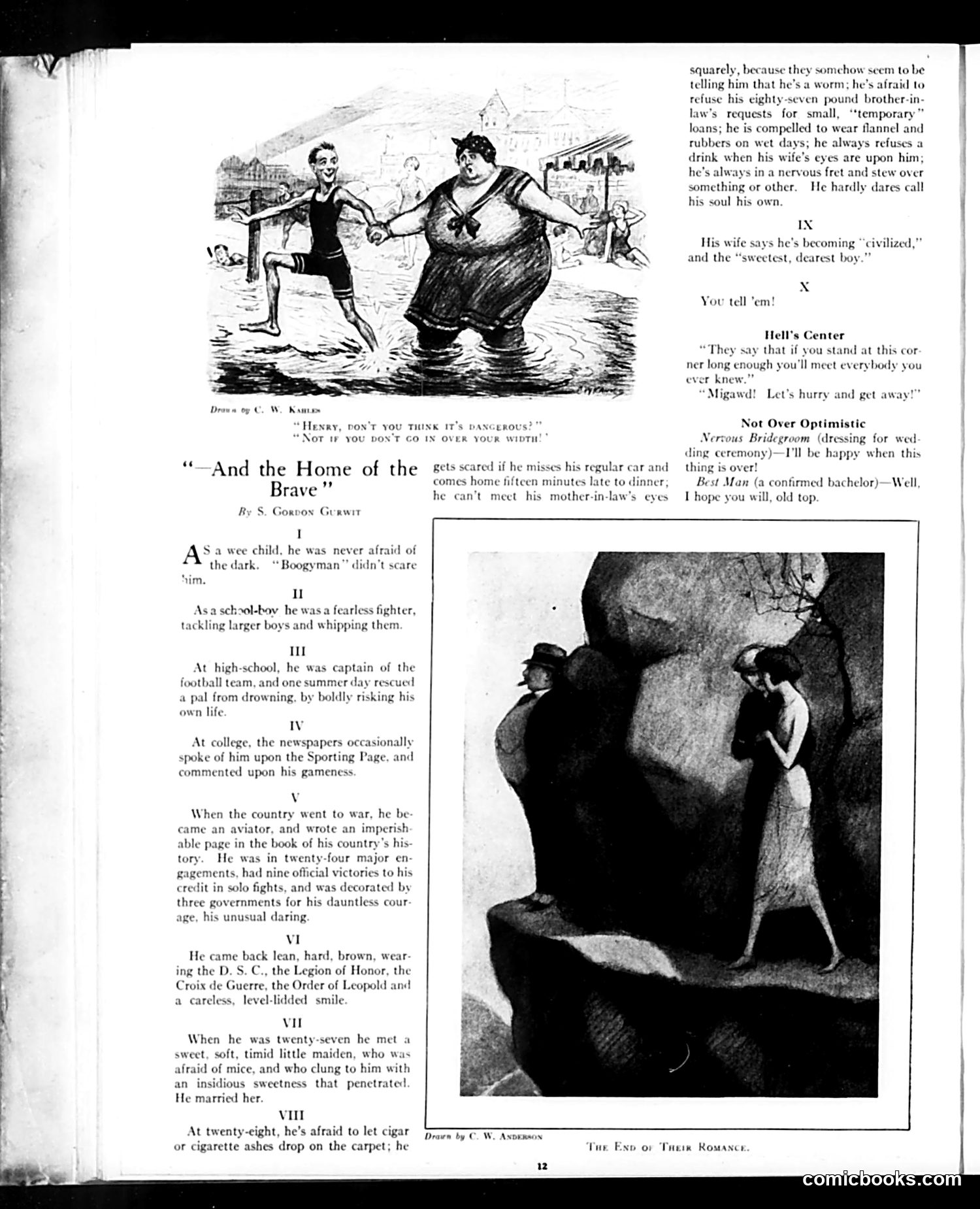
This story by S. Gordon Gurwit satirizes the transformation of a fearless man through marriage. The narrative traces a decorated WWI aviator—brave as a child, fighter, rescuer, and soldier with military honors (D.S.C., Legion of Honor, Croix de Guerre)—who becomes timid and hen-pecked after marrying a "sweet, soft, timid little maiden." By age twenty-eight, this decorated war hero fears carpet stains, missing dinner, his mother-in-law's judgment, refusing loans, and his wife's disapproval. The satire's point: marriage to a conventional, timid woman "civilizes" him into complete subjugation, stripping away his independence and courage. The accompanying illustrations and brief jokes reinforce this theme—a nervous bridegroom dreading his wedding, a woman fearful of swimming—mocking both female timidity and its emasculating effect on men. The satire critiques Victorian gender dynamics where marriage transforms masculine boldness into domestic anxiety.
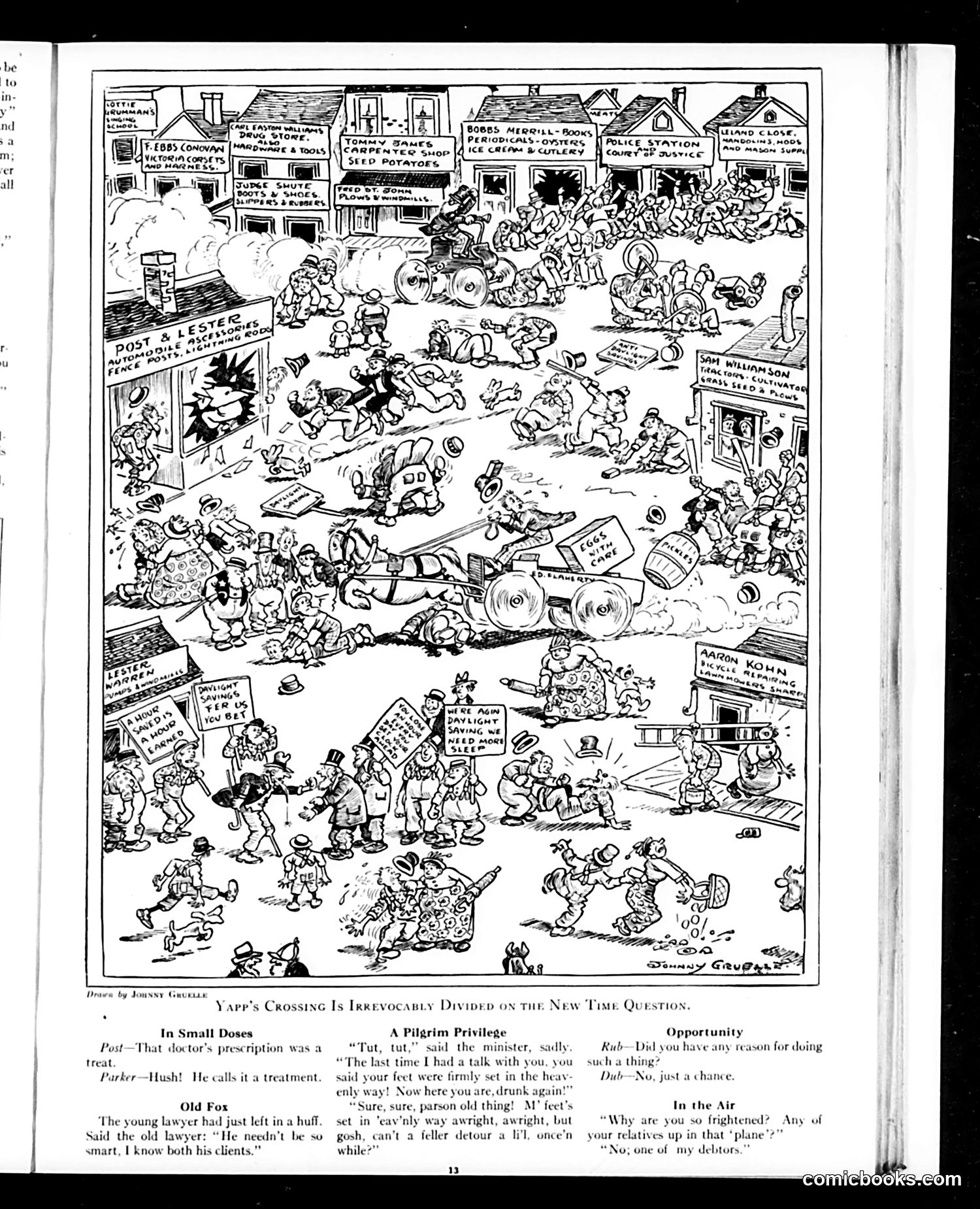
This page from Judge contains a large cartoon titled "Yapp's Crossing Is Irrevocably Divided on the New Time Question" along with several brief comic vignettes below. The main cartoon satirizes America's adoption of Daylight Saving Time—note references to "we are again daylight saving we used more" visible in the street scene. The chaotic street illustration, crowded with numerous figures and businesses, suggests social confusion and disagreement over the time change. The title's phrase about being "irrevocably divided" indicates public controversy over this policy. Below are unrelated short jokes: "In Small Doses" about a doctor's prescription being called a "treatment," "Old Fox" about a cynical lawyer, "A Pilgrim Privilege" about a drunk man defending his deviation from righteousness, "Opportunity" (unclear meaning), and "In the Air" making dark humor about owing money to someone in an airplane. The cartoons reflect early-20th-century American anxieties about modernization and government intervention in daily life.
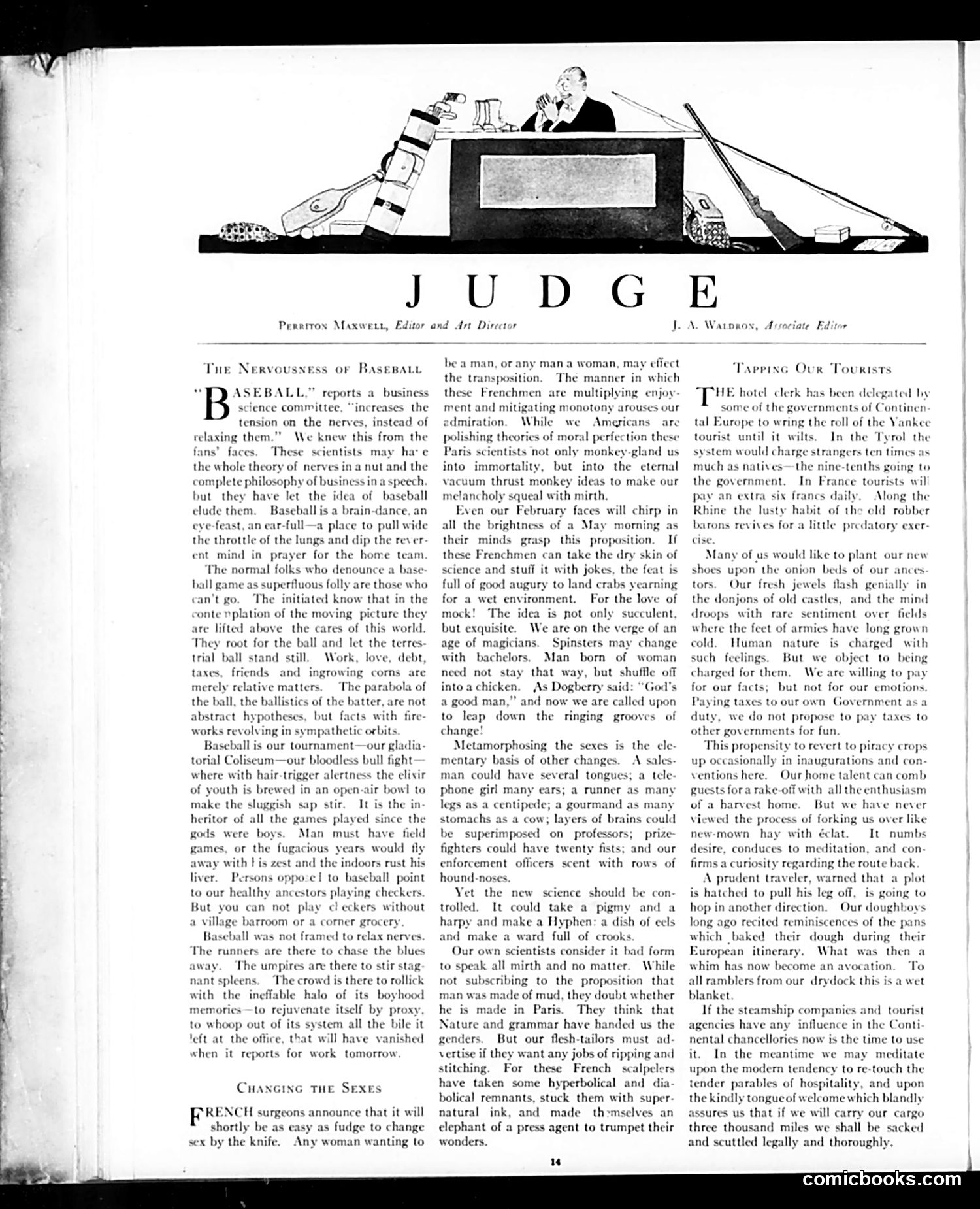
This page contains two satirical essays typical of Judge magazine's social commentary. **"The Nervousness of Baseball"** defends baseball against scientists claiming it increases nervous tension. The author argues baseball is actually therapeutic—a "brain-dance" and "gladsatorial Coliseum" that allows working men to escape daily drudgery (work, debt, taxes) and reconnect with boyhood joy. The satire critiques both overly serious scientists and the American obsession with productivity and moral perfection. **"Changing the Sexes"** mocks French surgical advances in sex-change procedures. The author sarcastically celebrates this as evidence that fun-loving French scientists outpace moralistic Americans in improving life. The piece humorously escalates the concept—if sex-change is possible, why not giving salesmen multiple tongues, phone girls extra legs, or professors layered brains? The satire targets both naive technological optimism and American prudishness toward French innovation and pleasure. Both essays use exaggerated praise to critique American society's excessive seriousness and work ethic.
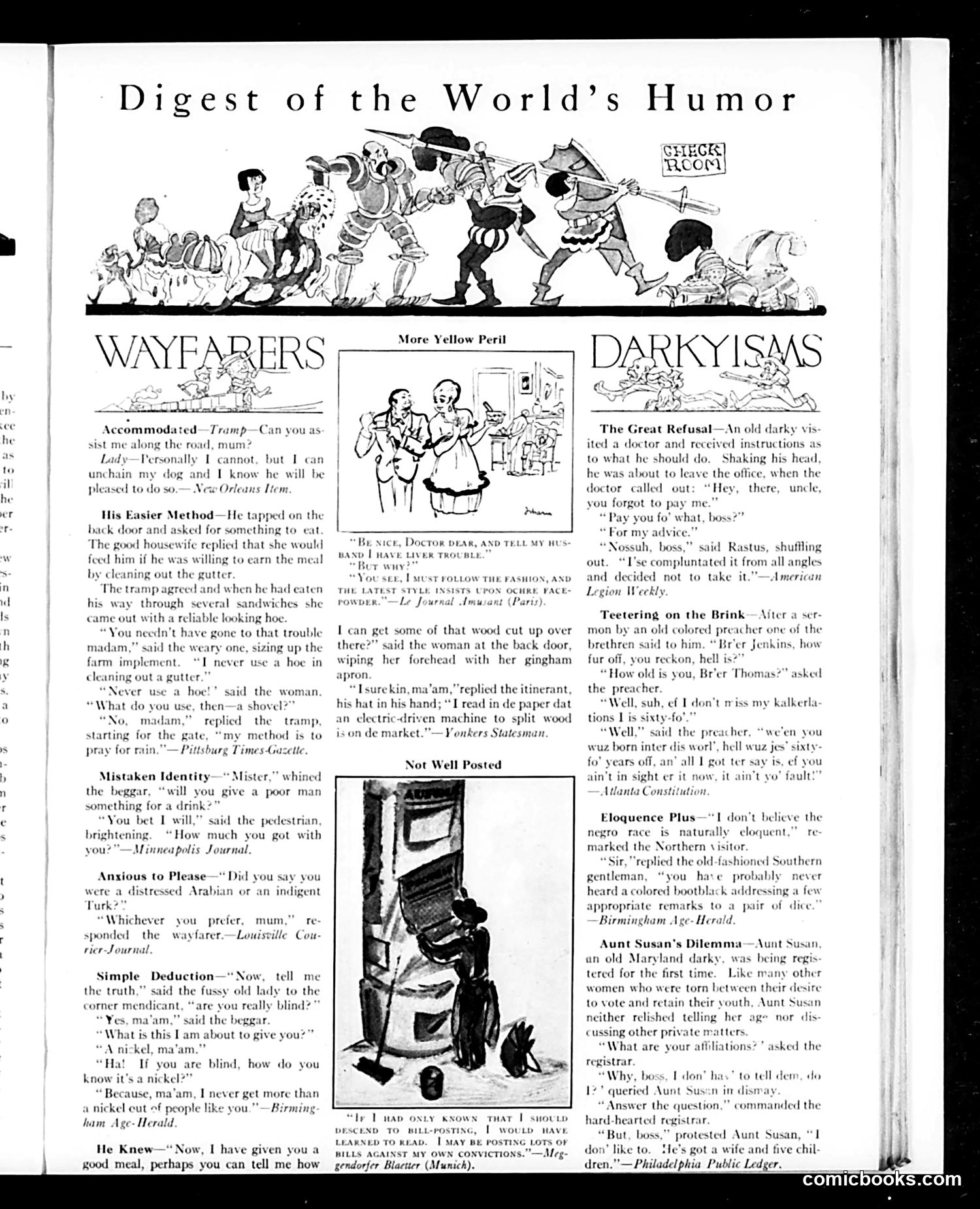
This page collects brief humorous anecdotes from various newspapers, typical of Judge magazine's format. Most jokes involve **tramps and poor people**, reflecting Depression-era humor about economic hardship. The recurring figure is the clever **beggar or vagrant** who outwits middle-class people through wordplay or logic—a sympathetic-if-comic character type common in early 20th-century American humor. Several anecdotes feature **African American dialect humor** (labeled "darky"), reflecting the period's casual racism. These jokes use stereotyped speech patterns and present Black characters as simple or superstitious—offensive by modern standards but normalized in this era's mainstream publications. The "Not Well Posted" cartoon shows someone bill-posting (displaying advertisements), likely satirizing commercial culture or labor practices. Overall, the page reflects pre-WWII American humor standards: sympathetic toward the poor, casually racist, and focused on clever word-tricks rather than visual gags.
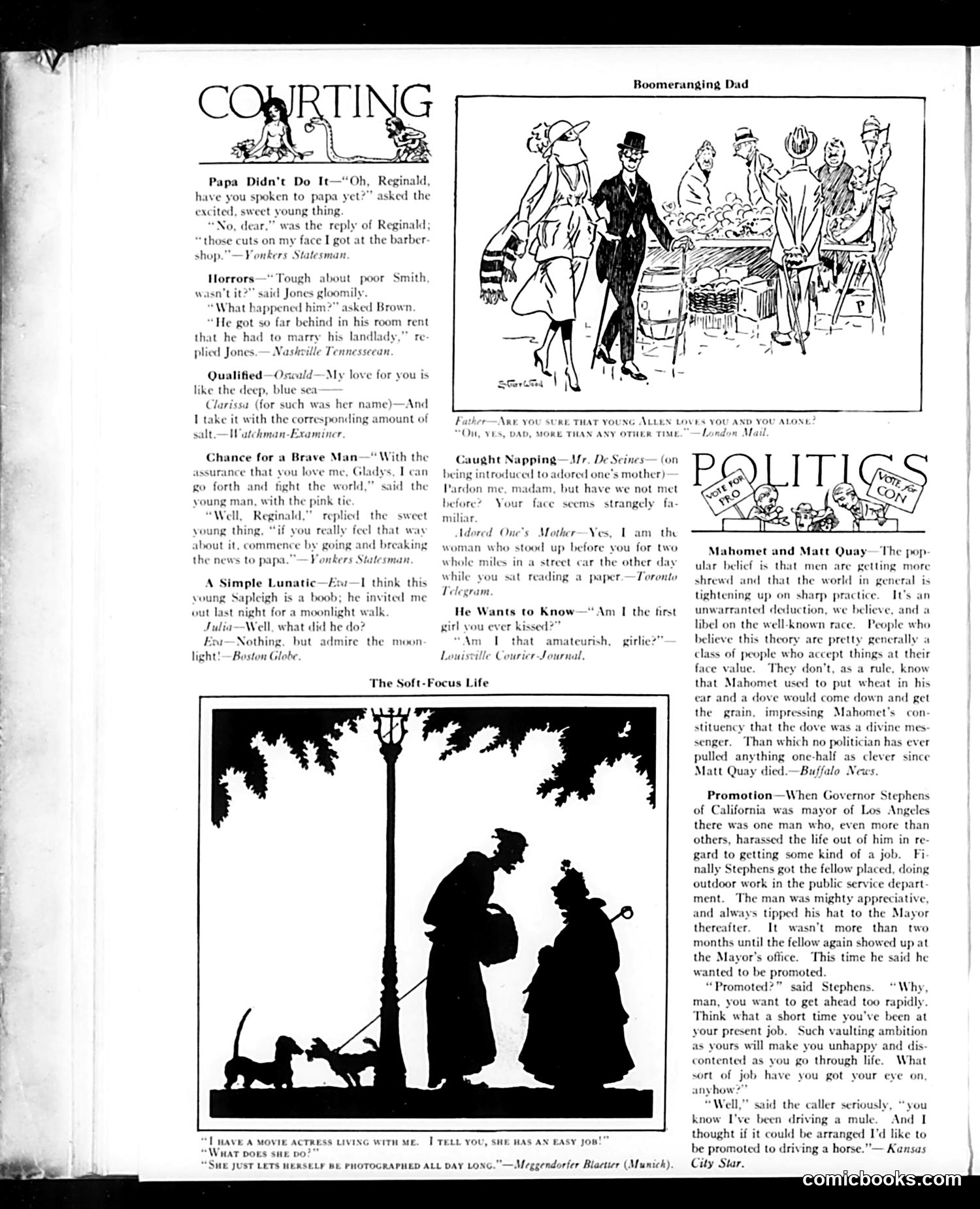
This page contains brief humorous anecdotes and jokes typical of early 20th-century American satirical magazines, plus commentary on contemporary politics. **The cartoons/jokes** are mostly domestic humor: a young woman reassuring her father about a suitor's devotion; a man injured at the barber; romantic misunderstandings; and a silhouette illustration about "soft focus" photography (likely mocking romantic or artistic pretension). **The political content** appears in the "Politics" section: commentary on Mahomet and Matt Quay (a Pennsylvania Republican politician known for machine politics and questionable ethics). The writer defends politicians against claims they're becoming shrewd—sarcastically citing Quay as evidence politicians haven't matched historical manipulation. The "Promotion" story about California Governor Stephens humorously depicts bureaucratic advancement and ingratitude. **For modern readers**: These jokes rely on early 1900s social conventions (courtship formality, servant hierarchies, political corruption as accepted reality) that now feel quaint. The satire targets romantic pretension, political cynicism, and social climbing rather than urgent issues.
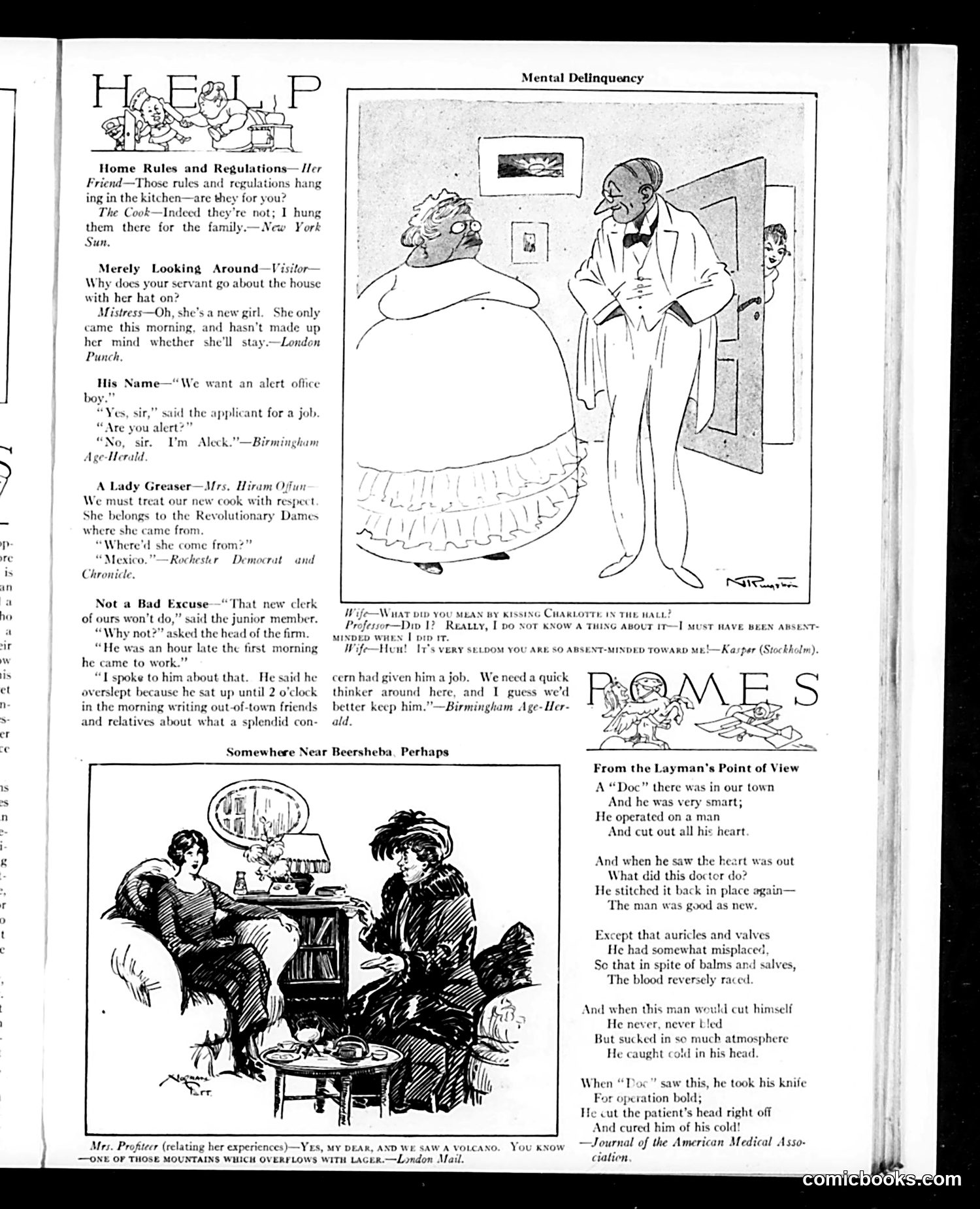
This page from *Judge* magazine collects brief humorous anecdotes and cartoons satirizing early 20th-century domestic life and social pretension. The top cartoon "Mental Delinquency" mocks a pompous professor caught kissing a woman (Charlotte) in a hallway, who claims absent-mindedness as his excuse—playing on the stereotype of the befuddled academic. The text snippets below ridicule class anxieties: a cook who "belongs to the Revolutionary Dames" despite being Mexican; a servant unsure whether to stay after arriving same-day; an applicant named "Aleck" (implying smartness/impertinence); and a clerk excused for tardiness because he was writing enthusiastically about his job. The bottom section includes a cartoon of two women gossiping about a volcano "which overflows with lager" (beer)—likely satirizing wartime profiteering or exaggeration. The poem "From the Layman's Point of View" darkly parodies incompetent surgery, where a doctor botches a heart operation, leaving the patient unable to bleed but catching colds in his head, culminating in amputation as "cure." Overall, the page satirizes class pretension, domestic servants, and professional incompetence.
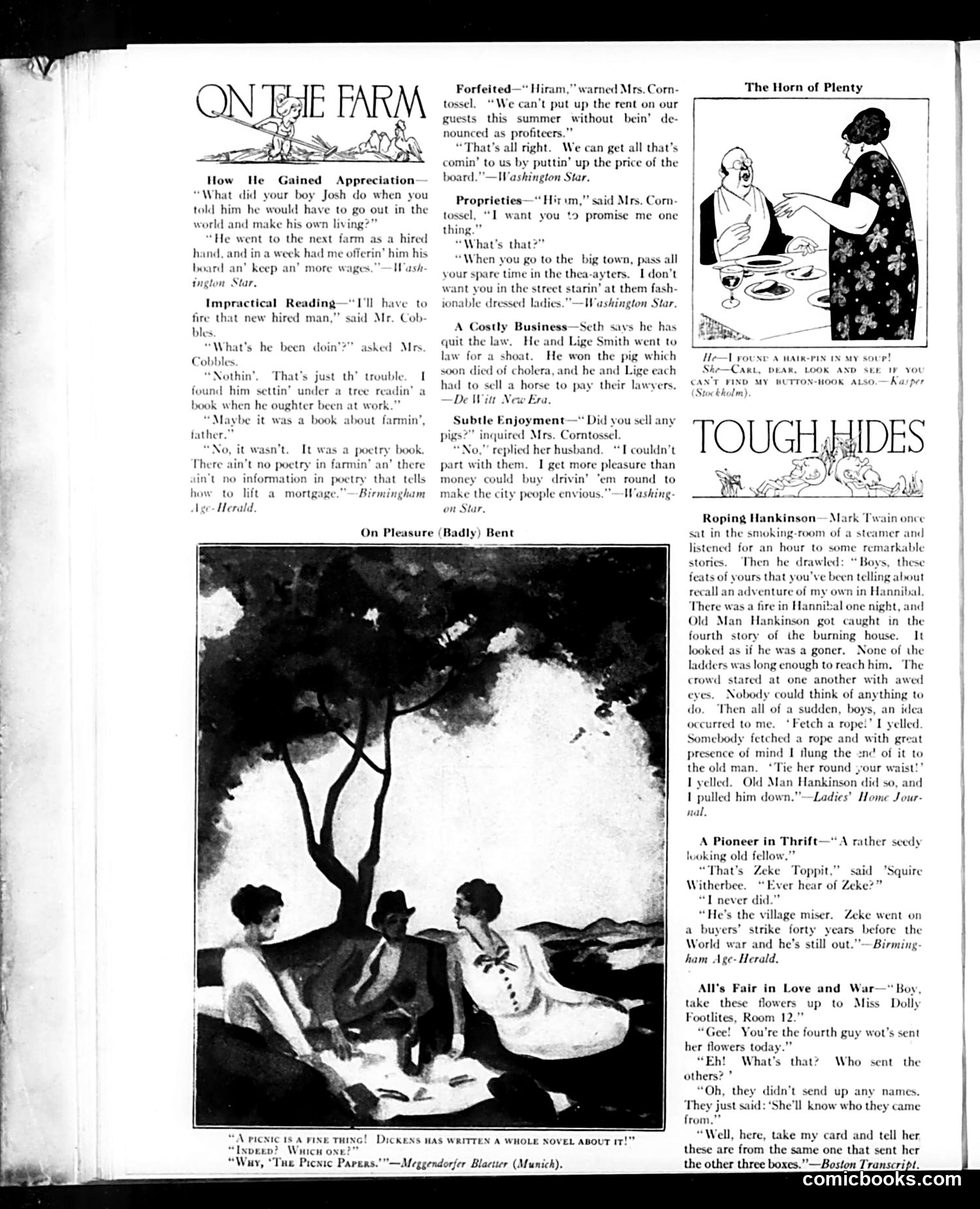
This page from **Judge** magazine contains rural humor anecdotes and satirical cartoons typical of early 20th-century American comedy. **Main content:** Short jokes about farm life, mostly featuring characters named Hiram and Mrs. Corntossel. The humor targets rustic ignorance (a hired man reading poetry instead of working), wartime profiteering (raising boarding prices while claiming not to be a "profiteer"), and rural simplicity (a farmer enjoying driving pigs around to make city people envious). **The center photograph** titled "On Pleasure (Badly) Bent" shows three people relaxing beneath a tree—illustrating the idle leisure that one anecdote criticizes. **Lower sections** include Mark Twain anecdotes, a "Pioneer in Thrift" story about a village miser, and romantic humor about flowers being sent to a woman by multiple admirers. The satire mocks rural attitudes while also poking fun at city pretensions and wartime economic behavior—typical Judge magazine fare blending gentle pastoral comedy with social commentary.
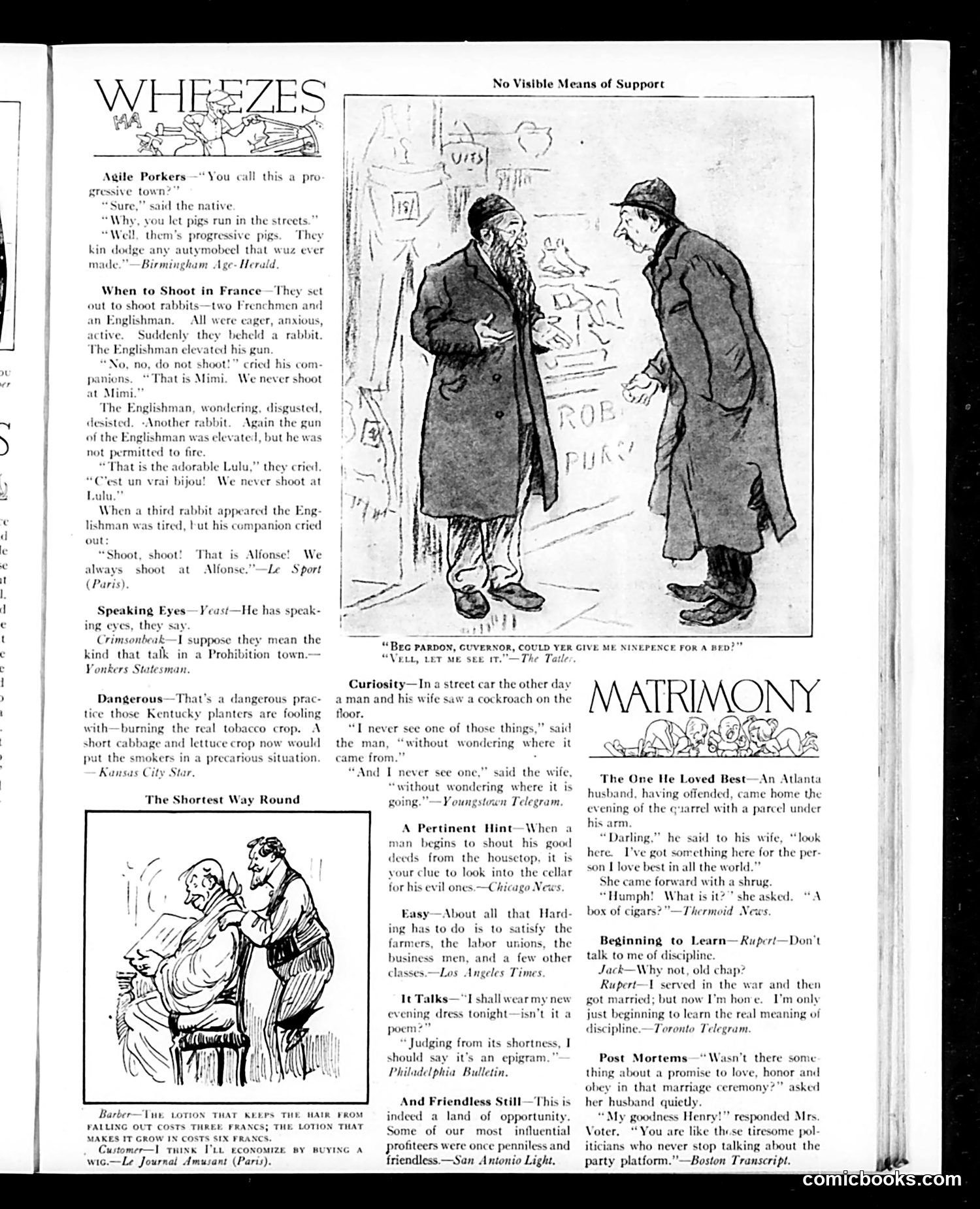
This page from Judge magazine contains multiple satirical shorts typical of the era. The main cartoon, "No Visible Means of Support," depicts two men examining a wall covered with sketches and graffiti. The caption suggests commentary on unemployment or vagrancy—the "visible means of support" phrase references legal concerns about people without obvious employment. The surrounding text includes numerous brief humorous anecdotes mocking contemporary social issues: Progressive politics (pigs dodging automobiles), French sentimentality about pet rabbits versus English practicality, Prohibition-era speakeasies, Warren G. Harding's political challenges managing different interest groups, and gender dynamics in marriage. The "Shortest Way Round" cartoon appears to show a homeless person soliciting money from a well-dressed gentleman, likely satirizing poverty or charitable attitudes. Overall, the page reflects early 1920s American concerns: urbanization, changing social mores, Prohibition, politics, and evolving gender relations—presented through Judge's characteristic acerbic humor targeting multiple constituencies.
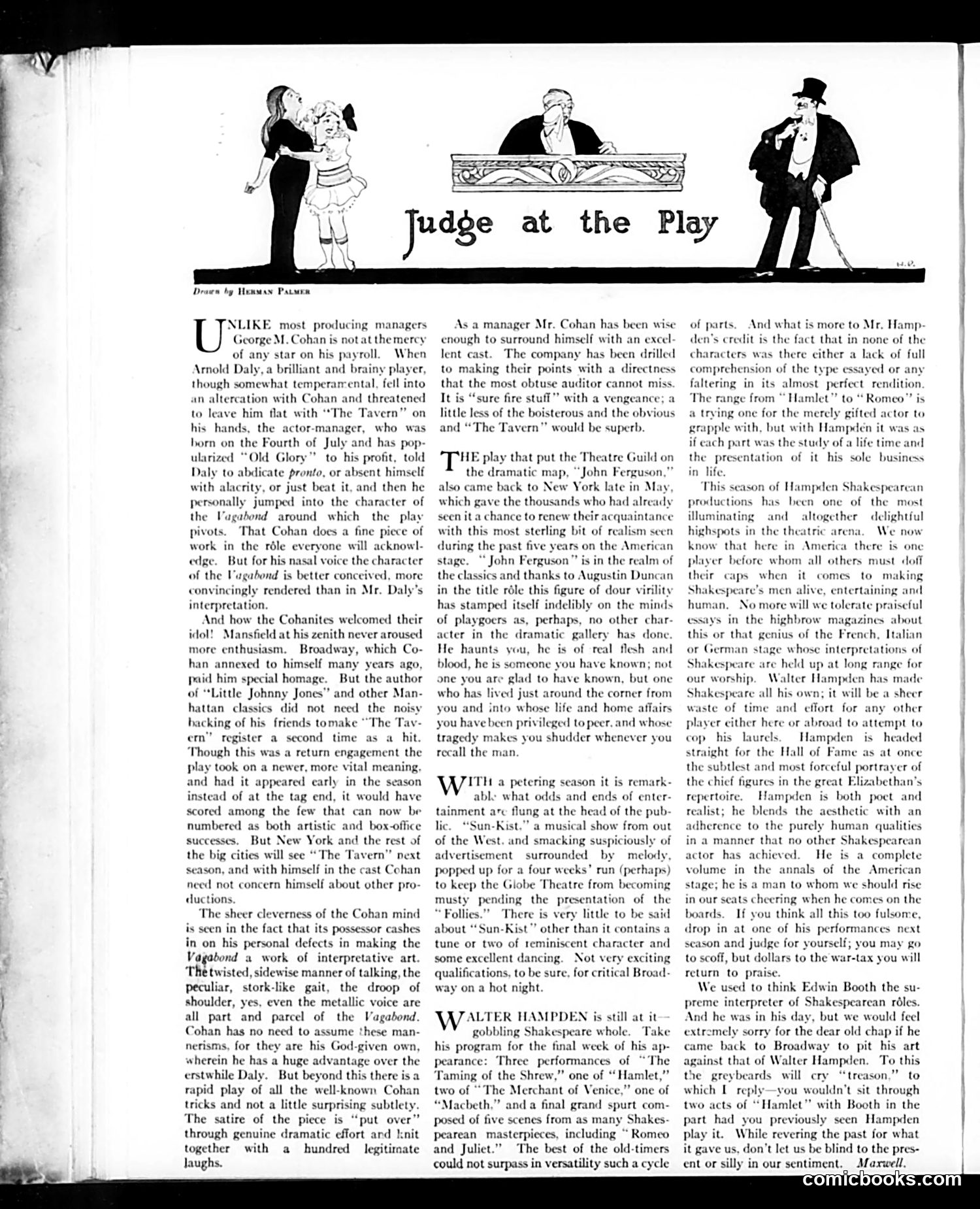
This page contains theatrical criticism by Herman Palmer for *Judge* magazine, focusing on Broadway productions rather than political satire. The cartoon header shows a judge presiding over theater-related scenes. The column praises **George M. Cohan**, the famous American playwright-performer, for stepping into the lead role of *The Tavern* after actor Arnold Daly quit. Palmer argues Cohan turned a potential disaster into triumph, noting that Cohan's personal mannerisms—his nasal voice, awkward gait, and metallic delivery—paradoxically enhance his character portrayal as "the Vagabond." Palmer also reviews *John Ferguson*, a Theater Guild production starring Augustin Duncan, praising its realism and emotional impact. The criticism is non-partisan entertainment journalism typical of *Judge*'s theatrical coverage, celebrating Cohan's star power and Broadway's commercial success during the era. No political figures or commentary appear present.
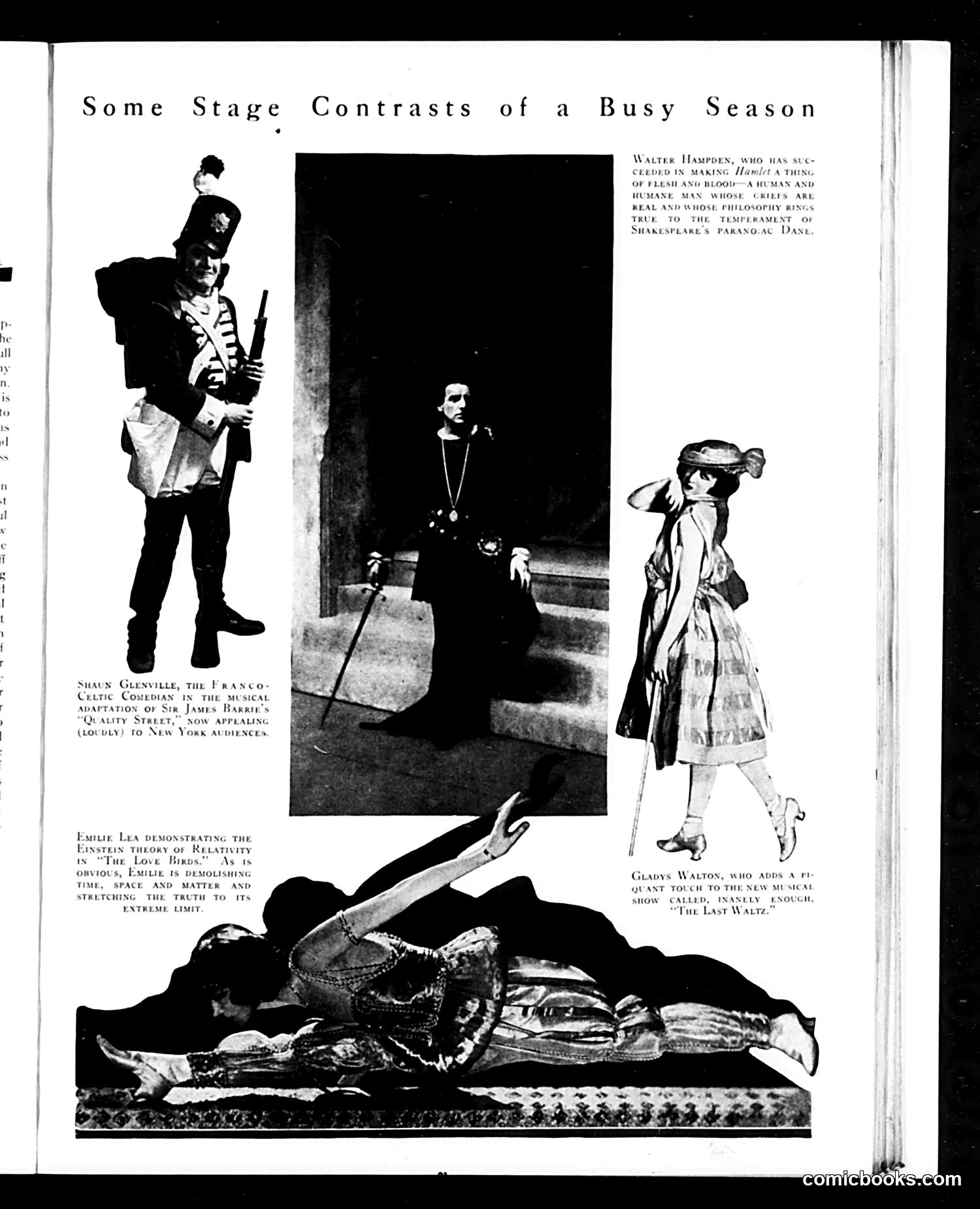
This is a theatrical review page featuring four performers and productions currently on New York stages. The page showcases contrasting dramatic styles: **Shaun Glenville** appears in a comedic Franco-Celtic character role from the stage adaptation of James Barrie's "Quality Street." **Emilie Lea** is shown demonstrating "Einstein's theory of relativity" in "The Love Birds"—the satire suggests she's stretching credibility by demolishing "time, space and matter" (a jest about exaggeration in theatrical performance). **Walter Hampden** has successfully made *Hamlet* into flesh-and-blood drama, bringing humaneness to Shakespeare's tragic prince. **Gladys Walton** adds a "piquant touch" to the musical "The Last Waltz." The page contrasts serious dramatic work against lighter comedic fare, reflecting the "busy season" of theatrical production. The Einstein reference is a topical contemporary joke about relativity theory.
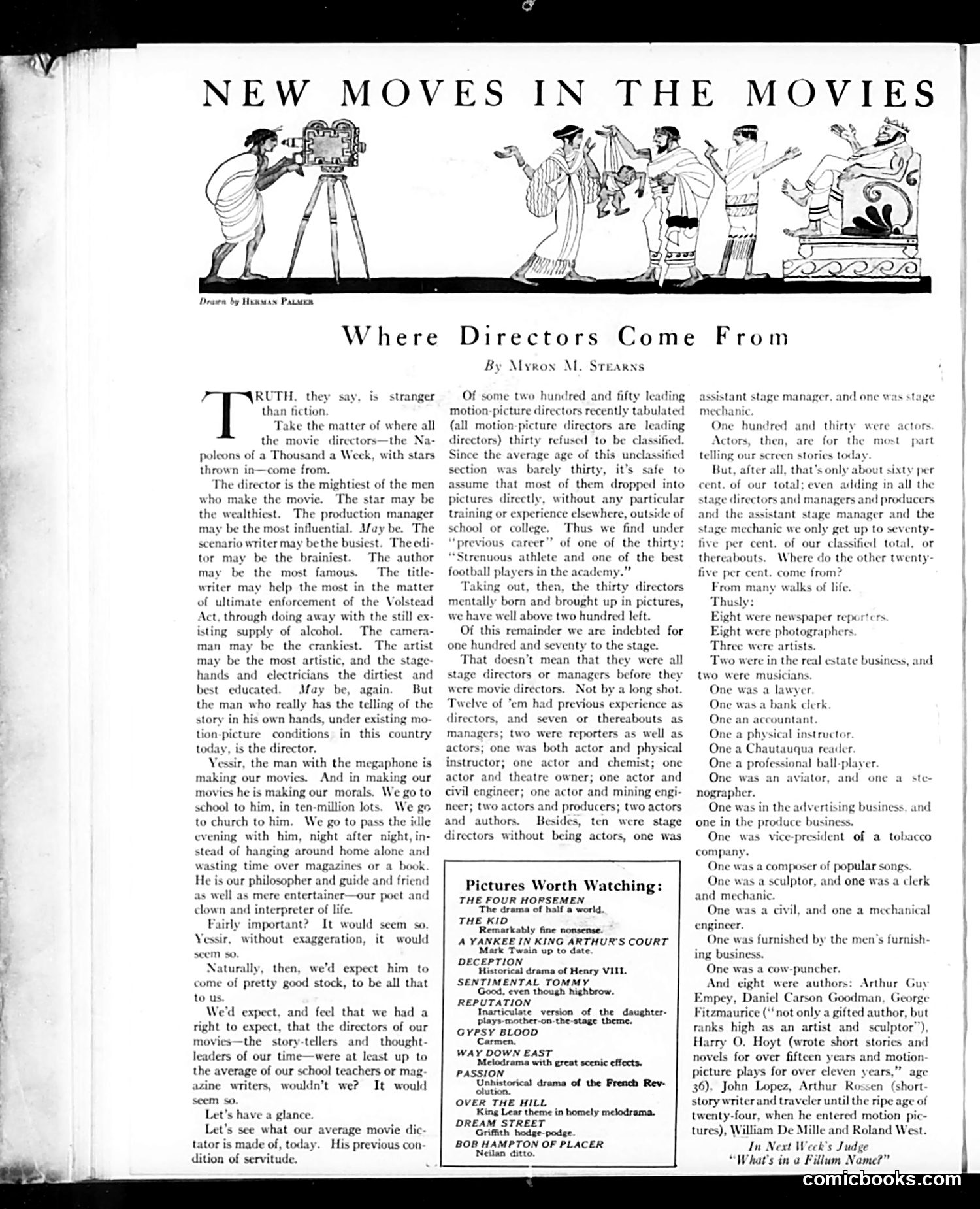
This article and Herman Palmer's cartoon satirize the humble origins of 1920s movie directors. The text reports that of 250 leading motion-picture directors studied, most came from theatrical backgrounds—170 from the stage—rather than formal training or educated professions. The cartoon illustrates this point through visual types: a film cameraman, various theatrical performers in exaggerated costumes and poses, and a director gesturing dramatically from an elevated platform. Palmer's drawings emphasize the theatrical, often lowbrow character of these backgrounds. The article's satirical thrust is clear: film directors—who now function as America's moral educators and cultural authorities—come from surprisingly modest, entertainment-focused backgrounds rather than intellectual or respectable professions. The author's rhetorical strategy ("Fairly important?") underscores the irony that these "Napoleons" of cinema, who shape public morality through film, largely lack the educated pedigree one might expect from such culturally influential figures.
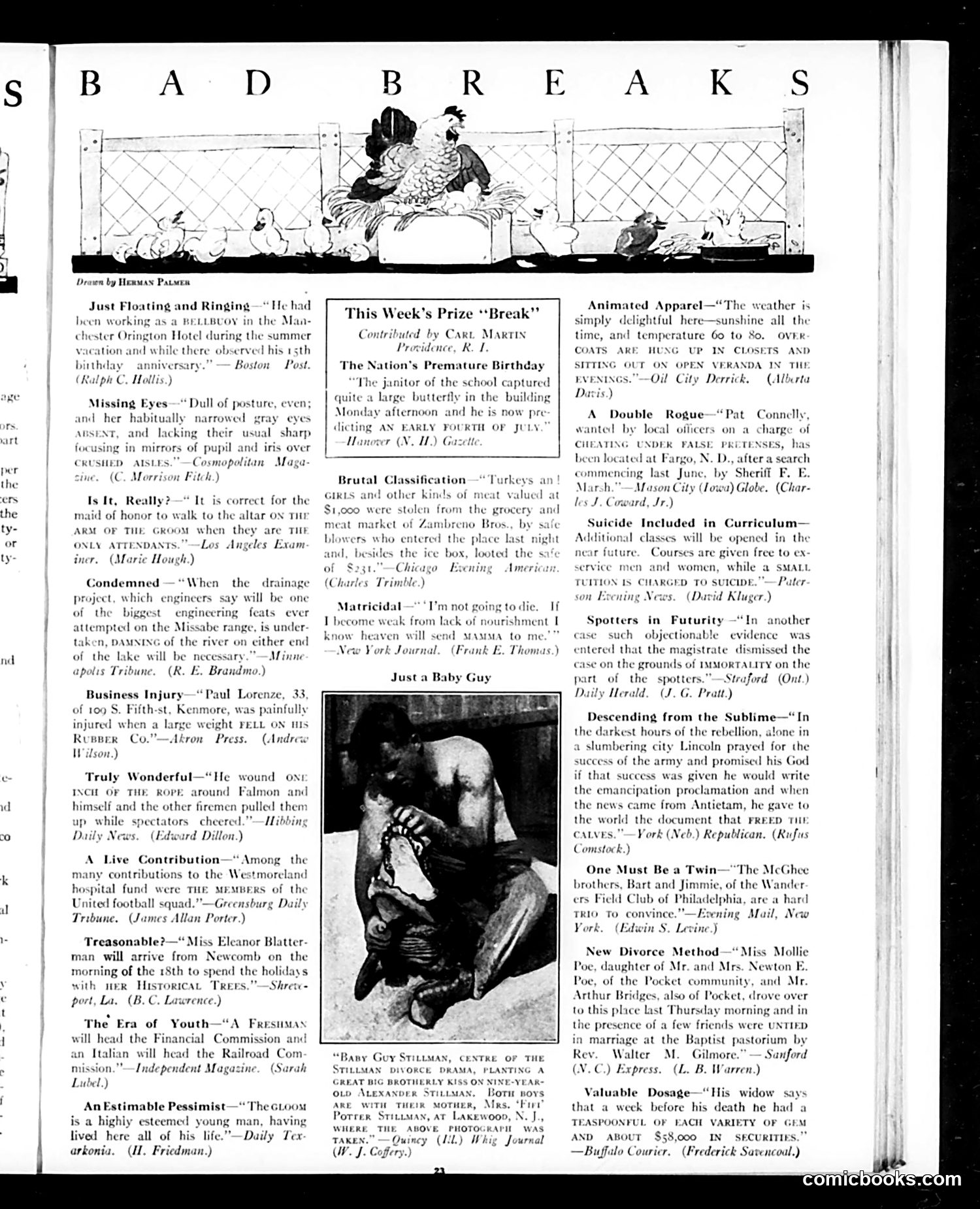
This page from Judge magazine presents a collection of humorous newspaper "breaks"—absurd or unintentionally funny excerpts from newspapers. The cartoons and text mock journalistic errors and peculiar news stories. The top cartoon depicts a farmyard scene with poultry, illustrating "Just Floating and Ringing," a story about a bellboy's birthday celebration. The central photograph shows "Baby Guy Stillman" kissing his younger half-brother during the famous Stillman divorce case—a high-society scandal involving custody disputes. This tabloid-worthy story is presented as contemporary gossip fodder. The page's humor derives from compilations of genuine newspaper snippets containing embarrassing typos, awkward phrasing, or disturbing subject matter presented matter-of-factly. Examples include reports of theft, a "Matricidal" quote about filial duty, and a dark reference to suicide education. Judge used these excerpts to satirize both careless journalism and the oddities of American life during this era.
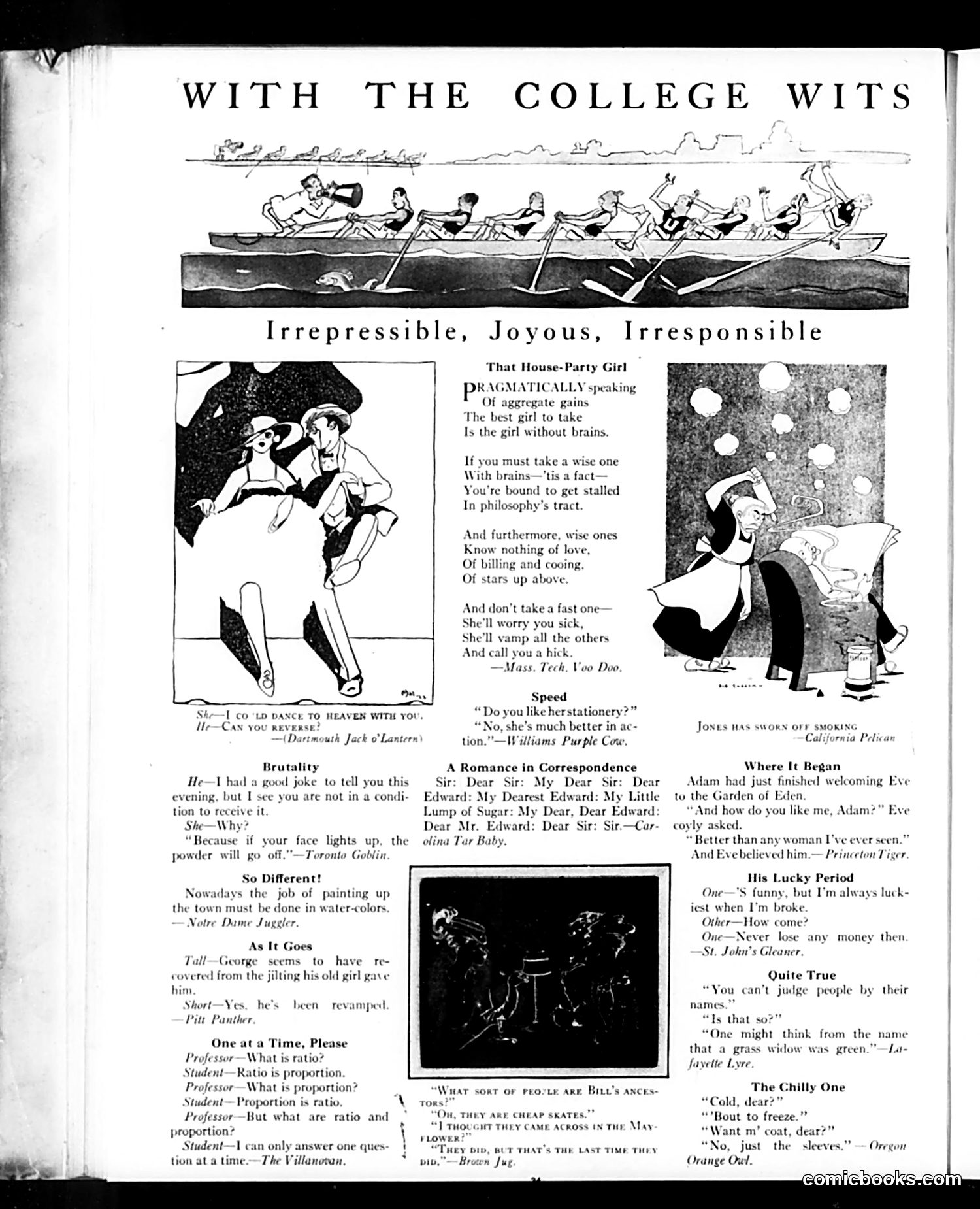
This page collects humorous quips from college and university newspapers of the 1920s era, satirizing student life and romantic attitudes. The header illustration shows a rowing crew, establishing the "college" theme. The content mocks prevailing attitudes toward women and courtship. "That House-Party Girl" sardonically argues that unintelligent women make better romantic partners than intelligent ones, who are depicted as boring and sexually unresponsive. Other jokes ridicule romantic awkwardness, overly formal correspondence, and the absurdity of collegiate logic-chopping. The page also includes physical humor (a powder-based joke about facial expressions), wordplay about proportion and ratio, and observations about broke students and romantic misunderstandings. The overall tone reflects 1920s college culture: casual misogyny, emphasis on superficial romance, and genteel satire aimed at undergraduates' pretensions and social anxieties. The material represents period attitudes now widely considered offensive.
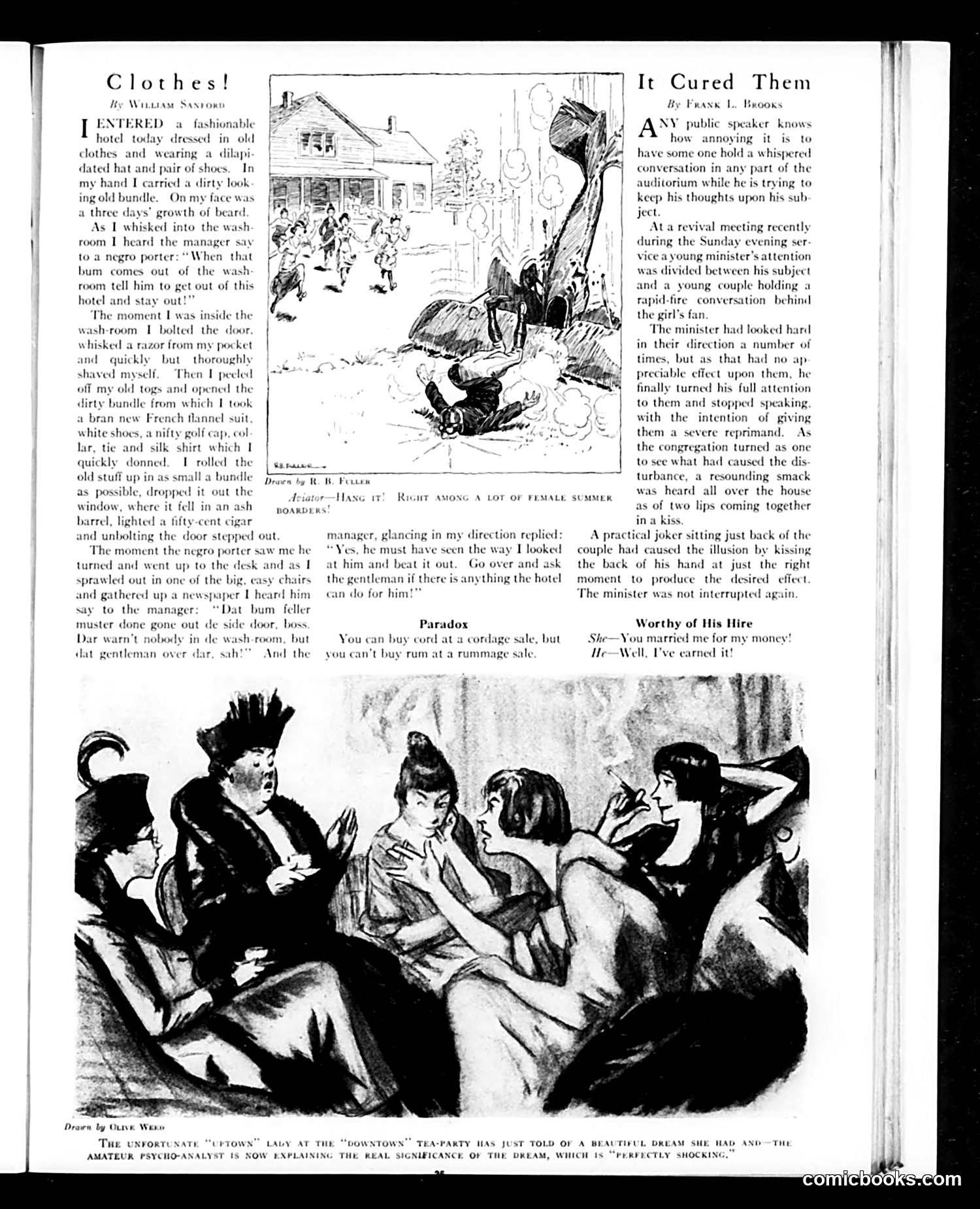
This page contains three separate humorous pieces typical of early 20th-century American satire: **"Clothes!"** satirizes class prejudice. A well-dressed man entering a hotel is mistaken for a vagrant because of his shabby appearance and is ordered out. After shaving and changing into fine clothes, the same porter doesn't recognize him—illustrating how superficial appearance determines social treatment. **"It Cured Them"** jokes about disruptive whispering during a church service. A young couple's loud kissing noise during revival meeting unexpectedly silences them—the "cure" being public embarrassment rather than the minister's intended rebuke. **"Worthy of His Hire"** is a brief exchange where a woman married for money is told her husband has "earned it"—wordplay suggesting he's justified his fortune through her companionship. The bottom cartoon (caption visible) appears to satirize amateur psychology, mocking how people interpret dreams with manufactured "shocking" significance. All pieces mock vanity, social pretension, and human weakness—standard Judge magazine fare.
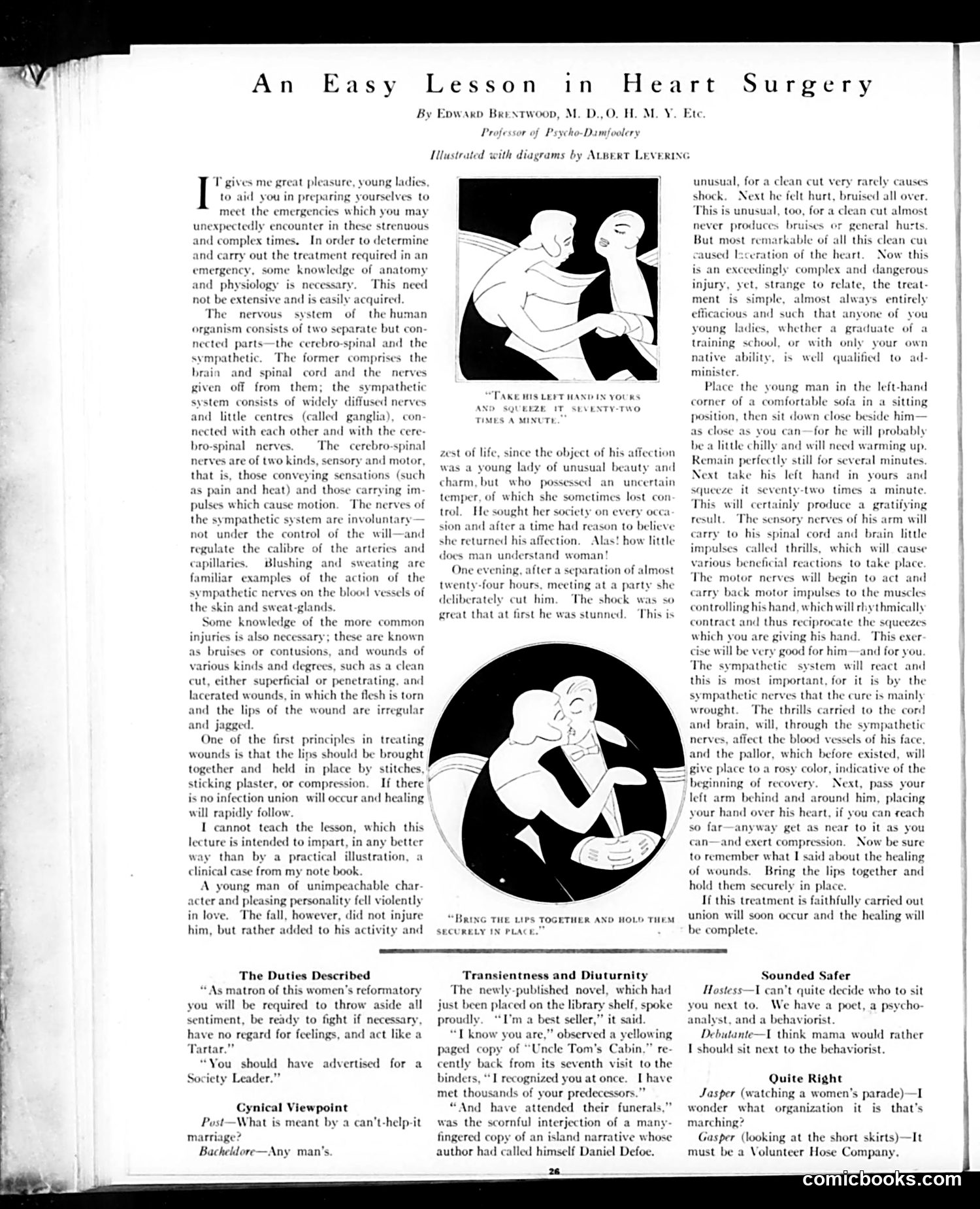
This page satirizes medical instruction through a mock-serious article ostensibly teaching first aid. The humor lies in the absurd premise: Dr. Edward Brentwood lectures young ladies on treating emergencies, using as his example a young man who suffered severe emotional—not physical—injury. The "patient" was cut (socially snubbed) by his beloved at a party, causing such shock that his heart "lacerated." The "surgical treatment" involves the woman squeezing his hand repeatedly and holding his heart in place—a literal, comedic interpretation of emotional recovery through affection. The accompanying illustrations depict these stages literally and sentimentally. The satire mocks both overwrought Victorian romance and the era's tendency to medicalize emotional distress, while the "first aid" framing ridicules pseudo-scientific self-help literature popular at the time.
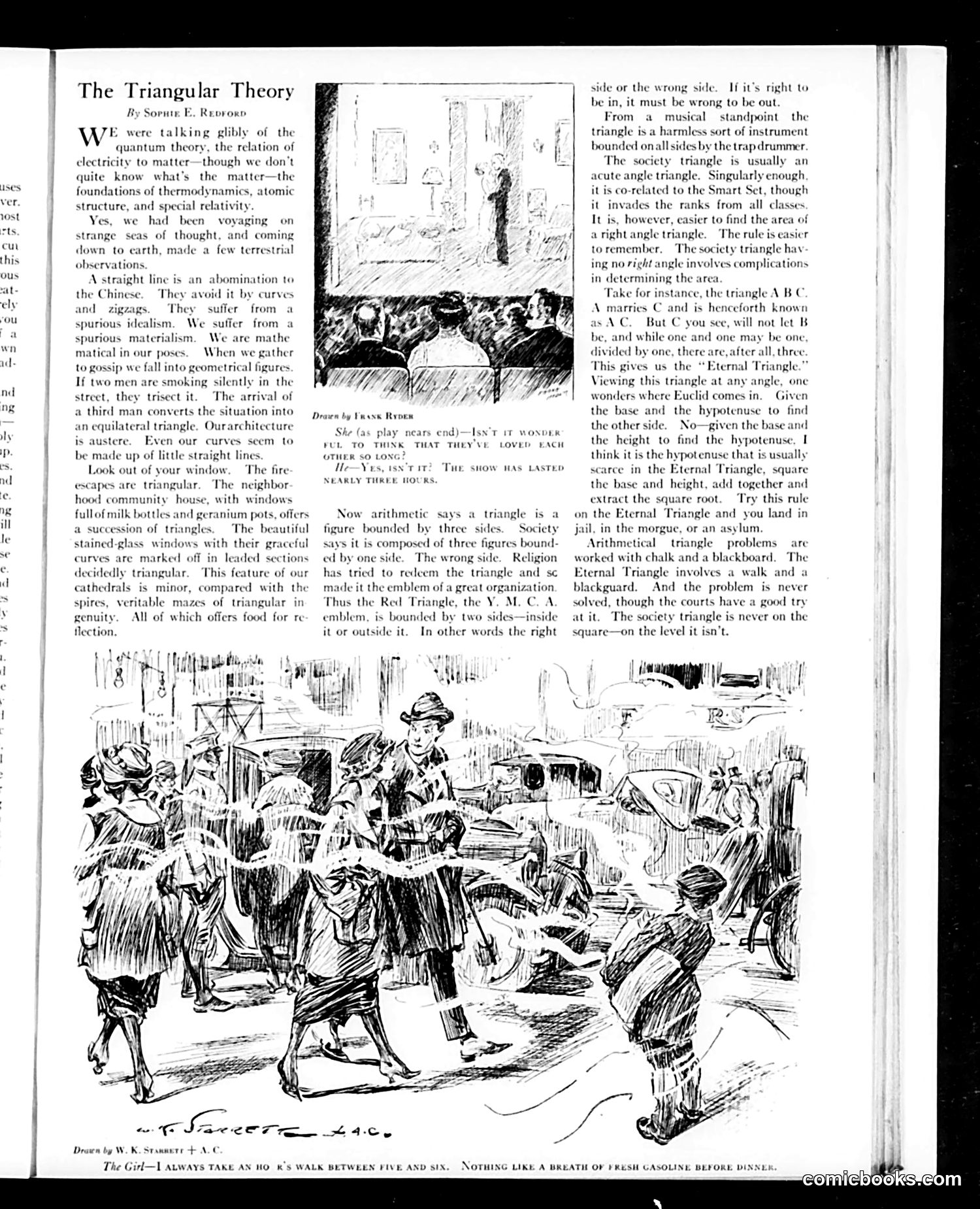
This page satirizes American society's obsession with geometric order and social hierarchies through the extended metaphor of the triangle. The main article mocks how Americans impose triangular geometry everywhere—architecture, fire escapes, social structures—contrasting this with Chinese preference for curves. The satire targets pseudo-intellectual materialism and the era's fascination with mathematical/scientific frameworks applied to life. The "Eternal Triangle" reference refers to the classic adultery scandal: a married couple (A and C) plus a third party forming an insoluble romantic problem. The text jokes that while mathematical triangles have clean solutions, the social version lands people "in jail, in the morgue, or an asylum"—suggesting divorce scandals and crimes of passion were common courtroom fixtures. The lower cartoon depicts casual street life, captioned with flirtation dialogue, mocking modern courtship rituals. The gasoline reference appears to reference automobiles enabling modern socializing and romantic encounters.
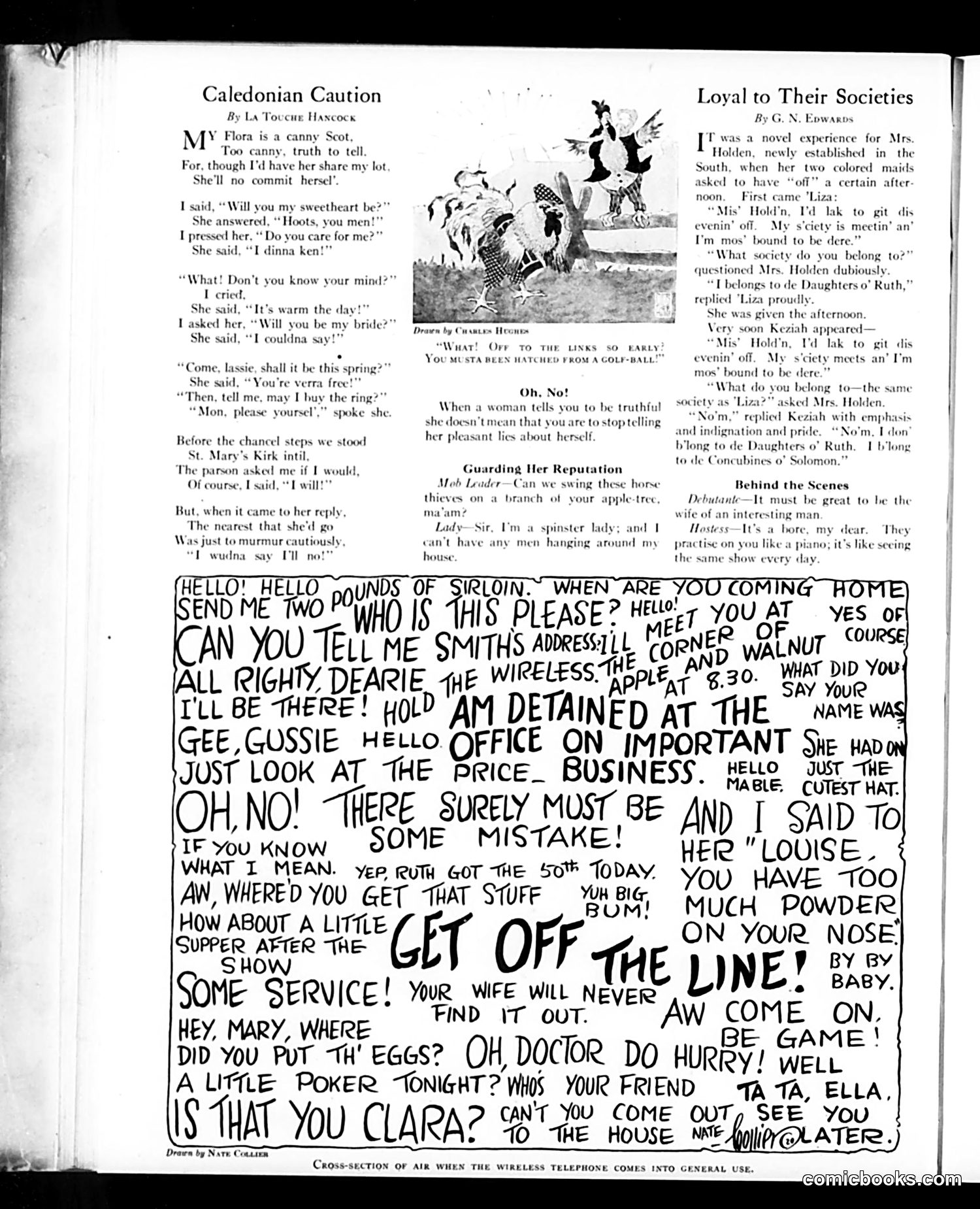
This page contains three distinct satirical pieces about emerging social technologies and gender dynamics in early 20th-century America. **Top sections** present humorous poems about romantic hesitation: "Caledonian Caution" mocks Scottish reticence through a woman who won't commit to marriage, while "Loyal to Their Societies" depicts Black domestic servants prioritizing their social organizations over work obligations—satirizing both their autonomy and the employers' assumptions of control. **The large central cartoon** depicts the chaos of wireless telephone adoption. The overlapping speech bubbles show multiple simultaneous conversations—people making plans, gossiping, flirting, and conducting business all at once. The satire targets the disruptive social impact of this new technology: lack of privacy, interrupted conversations, and the cacophony of modern communication replacing previous social order. **Lower vignettes** mock debutante culture and domestic life, suggesting the tedium of social performance and marriage. The overall theme: new technologies and social changes are destabilizing traditional social hierarchies and creating confusion.
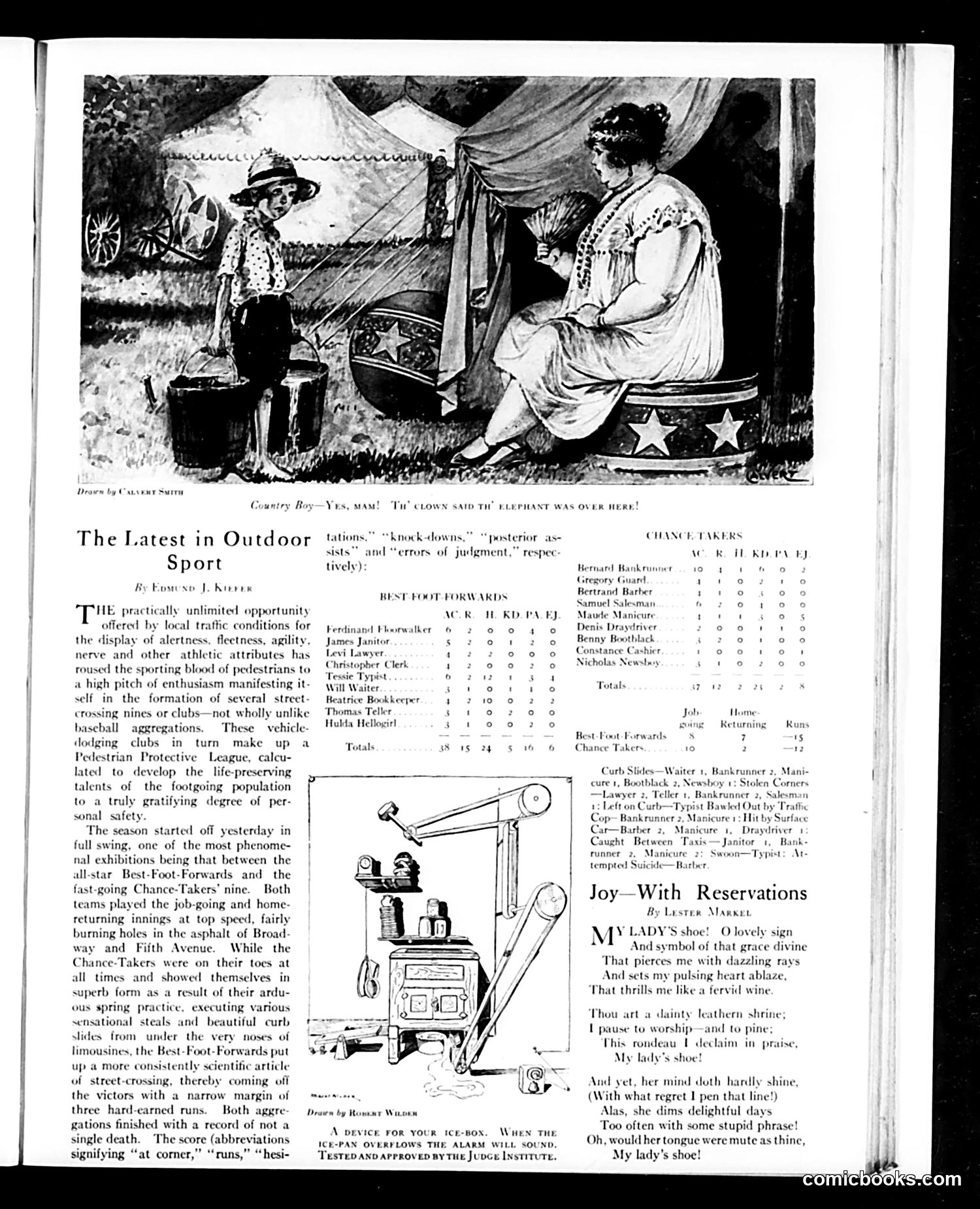
**The Top Cartoon:** "Country Boy" depicts a circus scene where a rural visitor reports seeing an elephant. The joke plays on the country person's naïveté—circuses were exotic urban entertainment, and the "clown" mentioned likely refers to something the unsophisticated visitor misidentified. This satirizes the gap between rural and urban sophistication. **"The Latest in Outdoor Sport":** This is the page's main satire. It mockingly frames pedestrian street-crossing in busy cities (Broadway and Fifth Avenue are mentioned) as competitive "baseball" between teams like "Best-Foot-Forwards" and "Chance-Takers." The humor mocks the genuine danger of urban traffic—pedestrians must dodge vehicles with athletic skill and nerve. The accompanying diagram shows a mechanical ice-pan safety device, suggesting real concern about street hazards. The satire critiques both urban traffic chaos and the Pedestrian Protective League's earnest but absurd attempts to formalize pedestrian safety. **"Joy—With Reservations":** A sentimental poem about a lady's shoe that undercuts itself—the speaker praises her elegance, then admits "her mind doth hardly shine" and her speech is foolish. It satirizes romantic idealization of women while revealing shallow character.
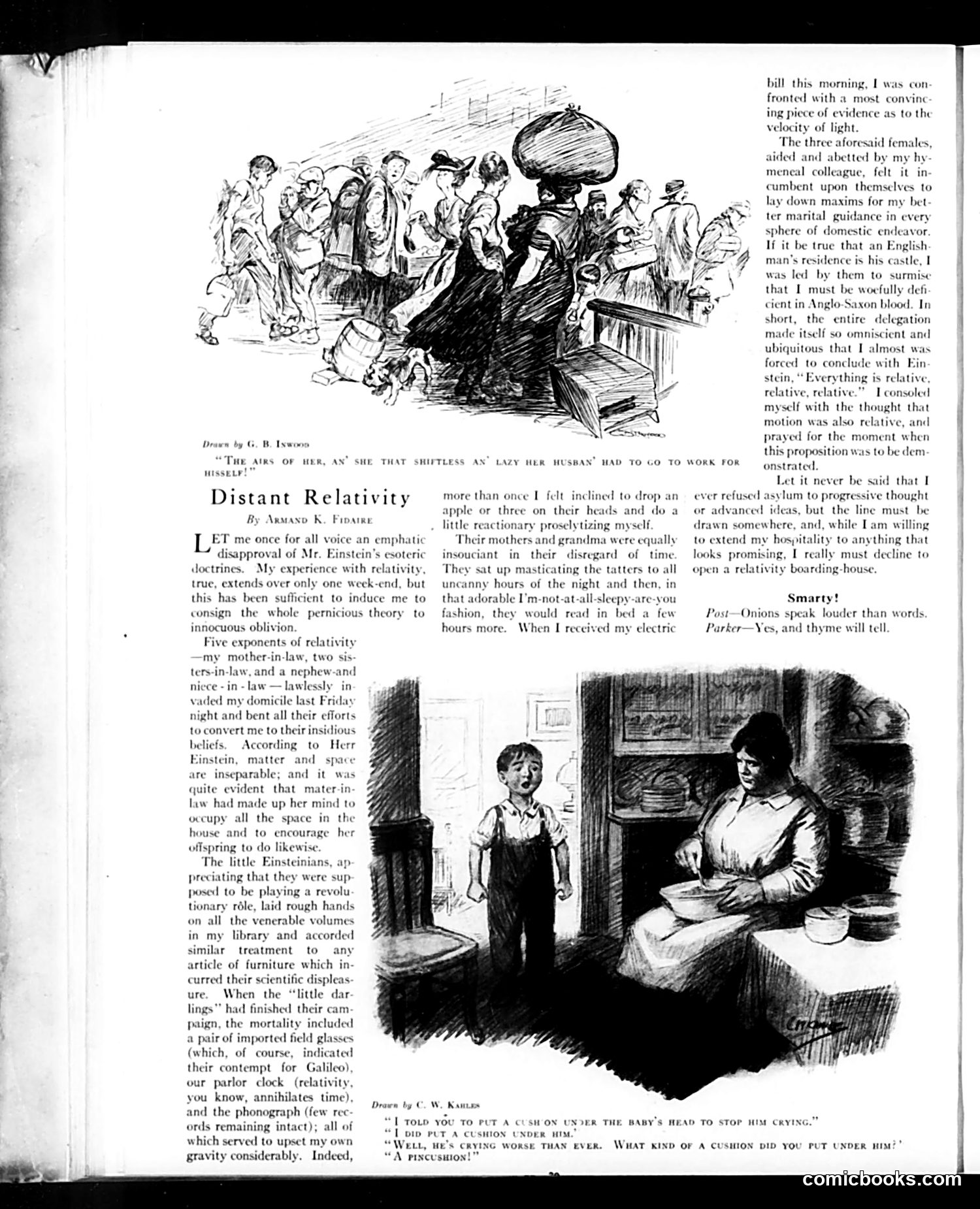
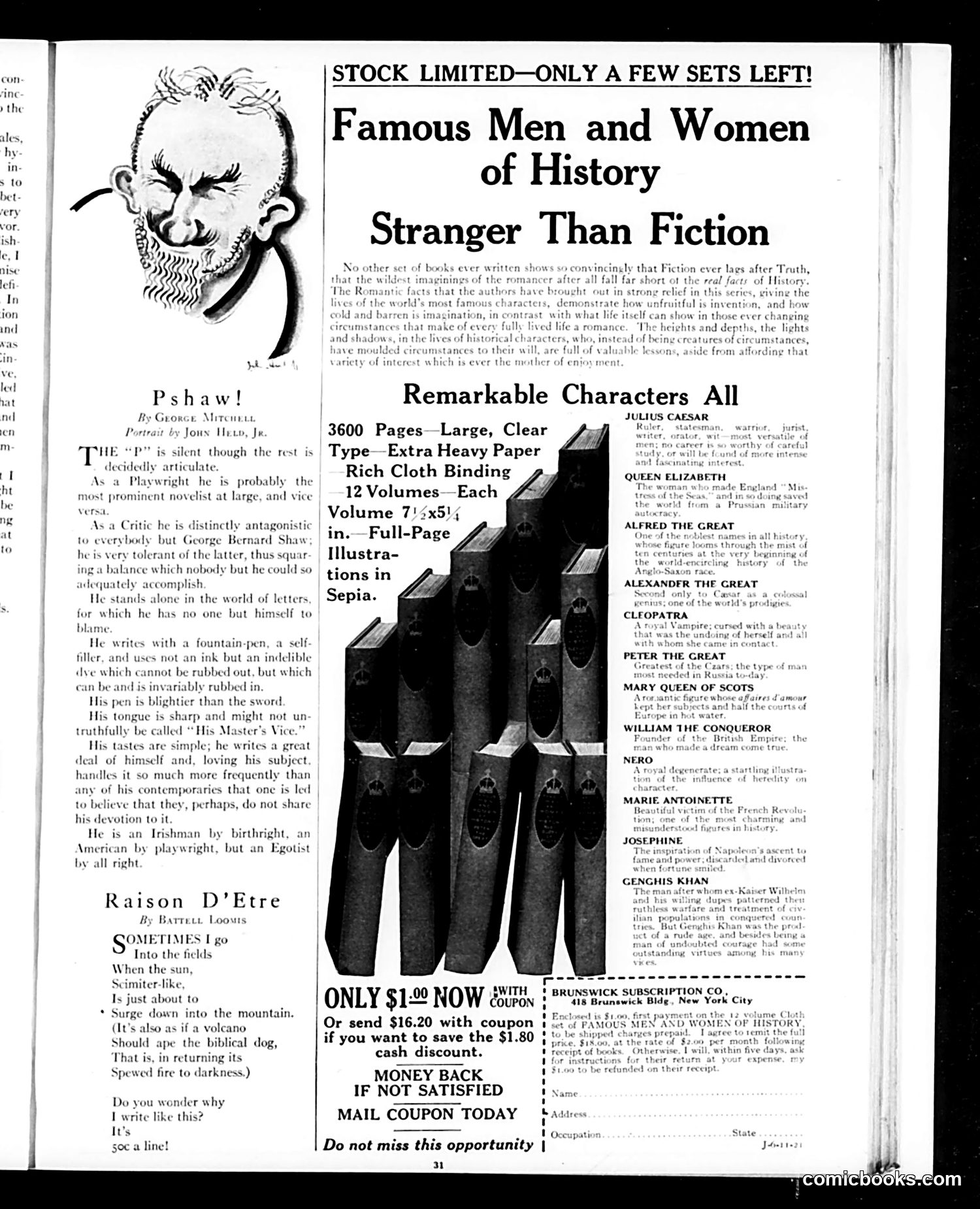
This page combines literary satire with book advertising. The left side features two pieces mocking literary pretension: **"Pshaw!"** is a caricature (likely of George Bernard Shaw, given the text's references) satirizing an arrogant Irish-American playwright-critic. The satire targets his self-absorption, antagonism toward other writers, and conviction that only he deserves admiration. Phrases like "His pen is blightier than the sword" mock his oversized ego and influence. **"Raison D'Etre"** parodies overwrought poetic affectation—the deliberately obscure nature writing and self-aware punchline ("It's 50c a line!") mock magazine contributors who produce affected, worthless poetry. The right side is a **book advertisement** for a 12-volume encyclopedia of famous historical figures, emphasizing entertainment value: "Stranger Than Fiction" promises that real history exceeds invented stories. The price ($1.00 with coupon, regular $2.80) and subscription format target middle-class readers seeking self-improvement and cultural knowledge.
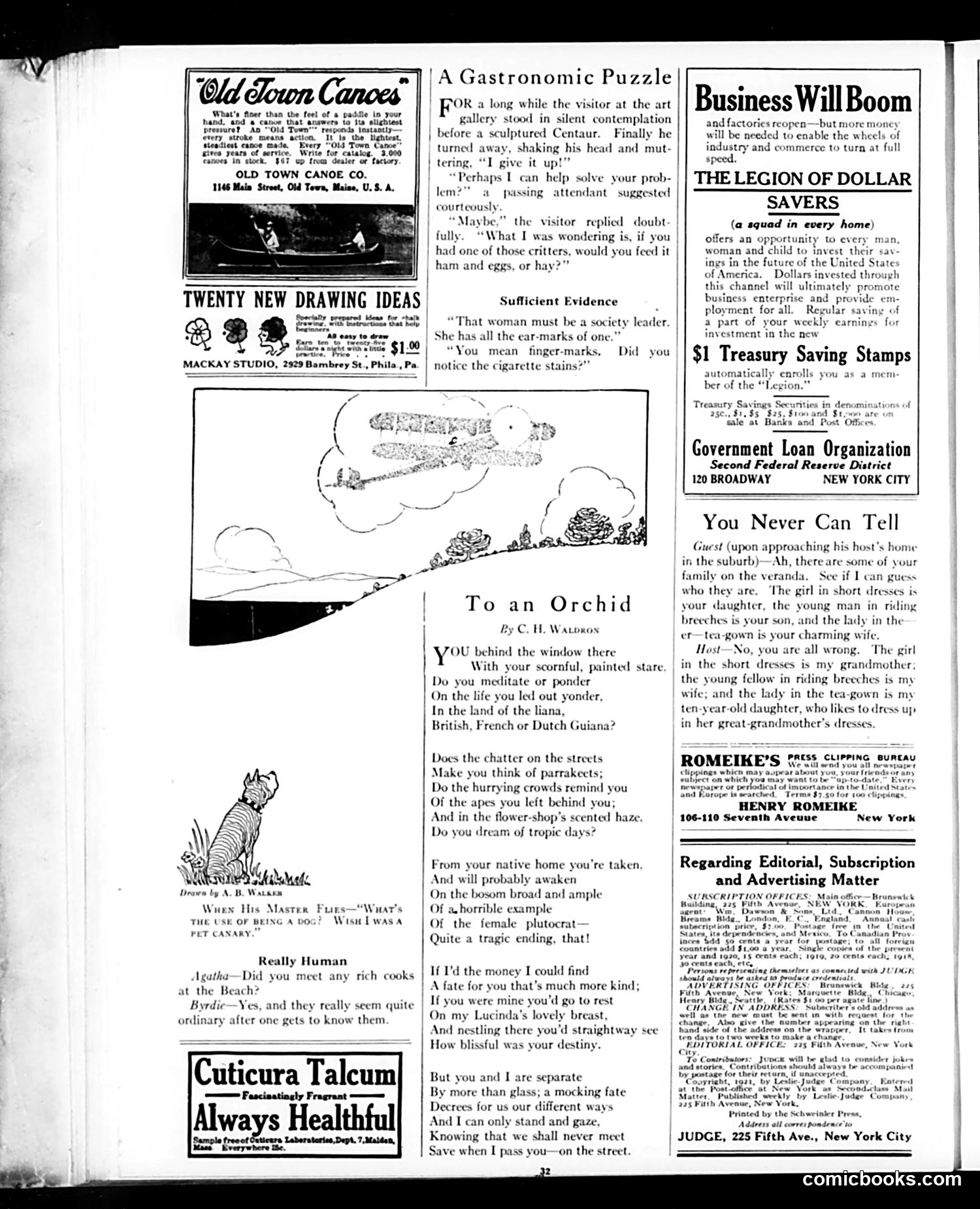
This page is primarily **advertising and light humor** rather than political satire. The main joke content includes: A "Gastronomic Puzzle" (an art gallery visitor puzzled about how to feed a sculptured Centaur—animal or human?); "Sufficient Evidence" (mocking a society woman via cigarette stains); and various humorous vignettes like "Really Human" (guests mistaking family members' identities based on clothing). The most substantial content is a sentimental poem "To an Orchid" by C.H. Waldron, imagining the orchid's tropical origins and thwarted romantic fate. **Advertisements dominate**: Old Town Canoes, Mackay Studio drawing instruction, Cuticura Talc powder, and notably the **"Legion of Dollar Savers"**—a Treasury Savings Stamps campaign encouraging Americans (women and children especially) to invest in government bonds for post-WWI economic recovery. The page reflects early 1920s concerns: industrial reconstruction, women's financial participation, and leisure culture (canoes, beach visits). The humor is gently satirical rather than pointed—mocking surface social pretenses rather than attacking institutions.
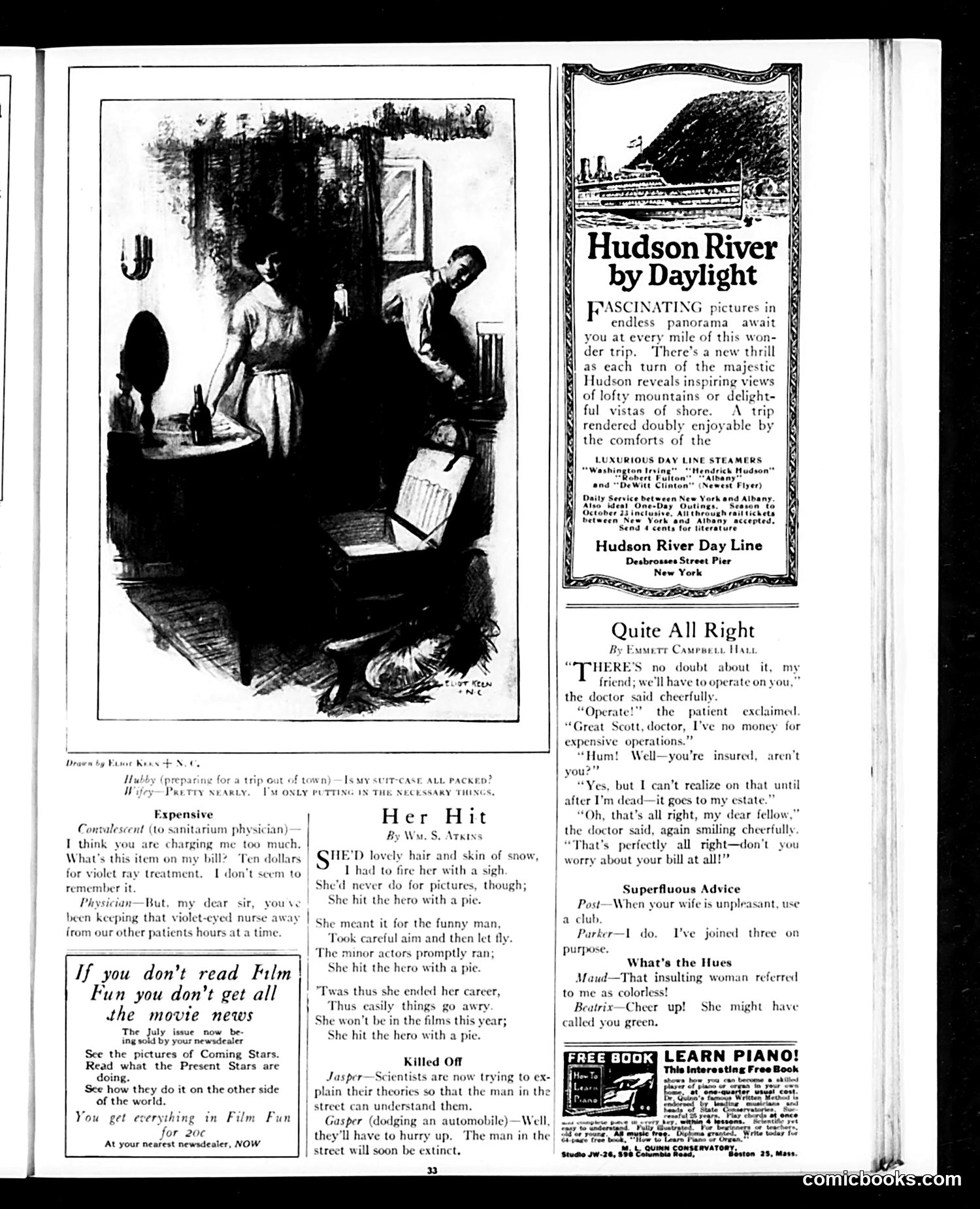
This page from *Judge* (a satirical magazine) contains multiple short humor pieces typical of early 20th-century American comedy: **Left cartoon**: A domestic scene where a wife packing for a trip claims she's only bringing "necessary things"—while her husband observes a massive pile of luggage. The satire targets the common stereotype of wives overpacking. **"Her Hit"**: A verse mocking silent film production, where a minor actress accidentally (or deliberately) hits the male lead with a pie instead of the intended comic extra. The joke plays on the chaos of early cinema and physical comedy's unpredictability. **"Expensive"**: A patient disputes medical billing for violet-ray treatment (an actual early medical practice), complaining the doctor keeps his nurse away from other patients. The satire critiques inflated medical costs. **"Quite All Right"**: Dark humor about a doctor reassuring an uninsured patient—he can operate since the patient's life insurance will cover the bill after death. The page is primarily humorous social commentary rather than political satire, reflecting early 1900s concerns about consumer spending, medical costs, and domestic life.
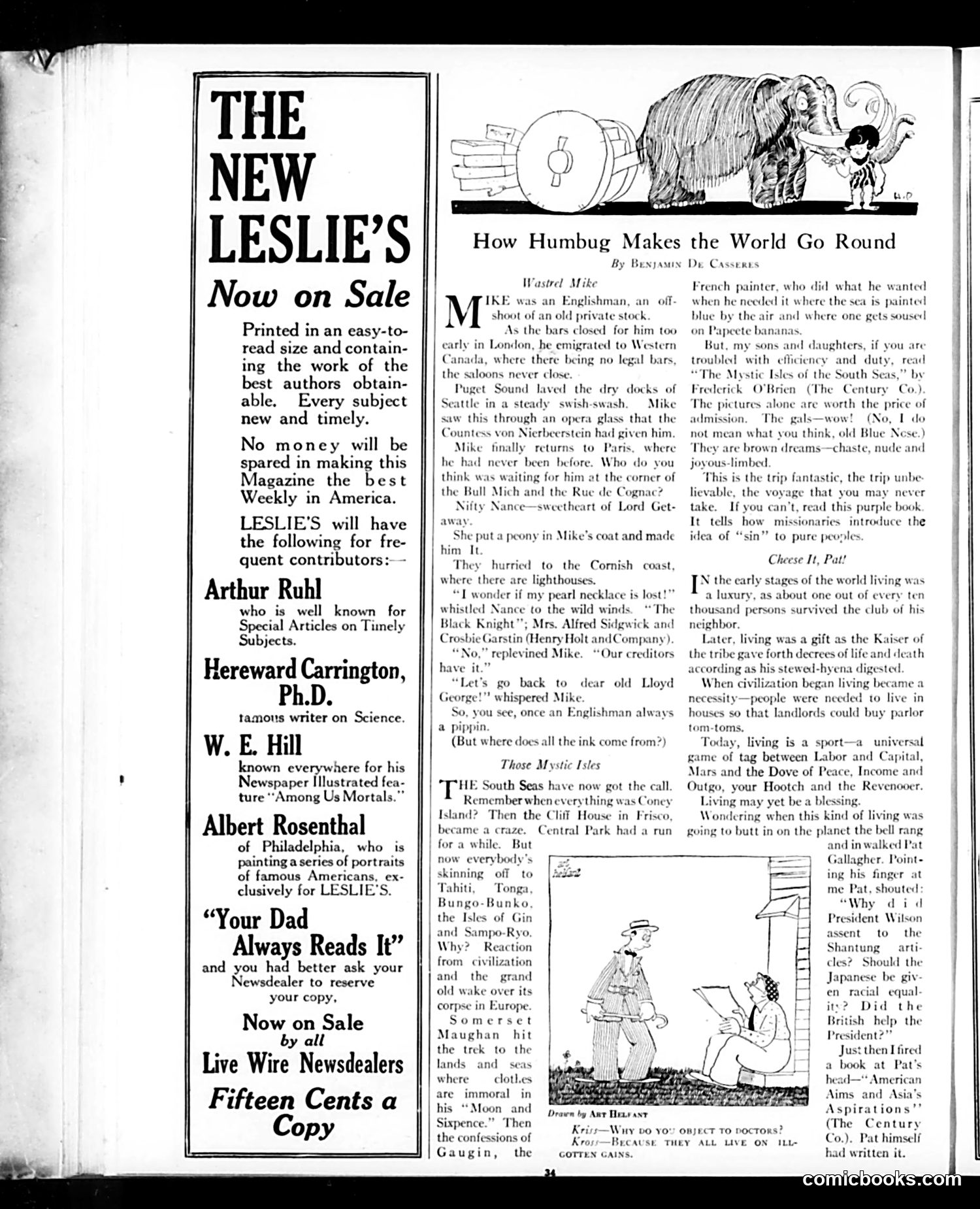
This page is primarily **advertising for Leslie's Magazine** alongside two unrelated literary pieces. The left column promotes Leslie's as a revitalized weekly publication, highlighting contributors like W.E. Hill (a cartoonist known for "Among Us Mortals") and featuring portraits by Albert Rosenthal. It's a straightforward magazine advertisement. The right side contains two short satirical stories: 1. **"How Humbug Makes the World Go Round"**: A comedic tale mocking wealthy expatriates and frivolous travel. "Wastrel Mike," an English drifter, and his girlfriend "Nifty Nance" chase fashionable destinations (London, Seattle, Paris), each briefly trendy before the next fad emerges. The satire targets the shallow materialism and debt-ridden lifestyle of the leisure class. 2. **"Cheese It, Pat!"**: Social commentary on how "living" (surviving/making a living) evolved from luxury to necessity to modern competitive "sport" between Labor, Capital, and government (the "Revenooer" = revenue agent/tax collector). It mocks contemporary economic struggle. Both pieces critique post-WWI American excess and economic anxiety.

This is a government advertisement, not a satirical cartoon. It promotes Treasury Savings Stamps as part of a "Legion of Dollar Savers" program, positioning small regular savings as patriotic investment in American economic recovery. The ad appears to date from the post-WWI era (likely early 1920s), when the government encouraged citizens to invest in Treasury securities to fuel industrial expansion and employment. The messaging conflates personal thrift with national economic health—suggesting that individual savers collectively fund business growth. The "Legion" framing echoes the American Legion (a veterans' organization founded 1919), creating a sense of civic duty and organized collective action. For modern readers: this represents early government savings bond marketing, before Social Security and modern banking, when personal savings were presented as both patriotic duty and economic engine.
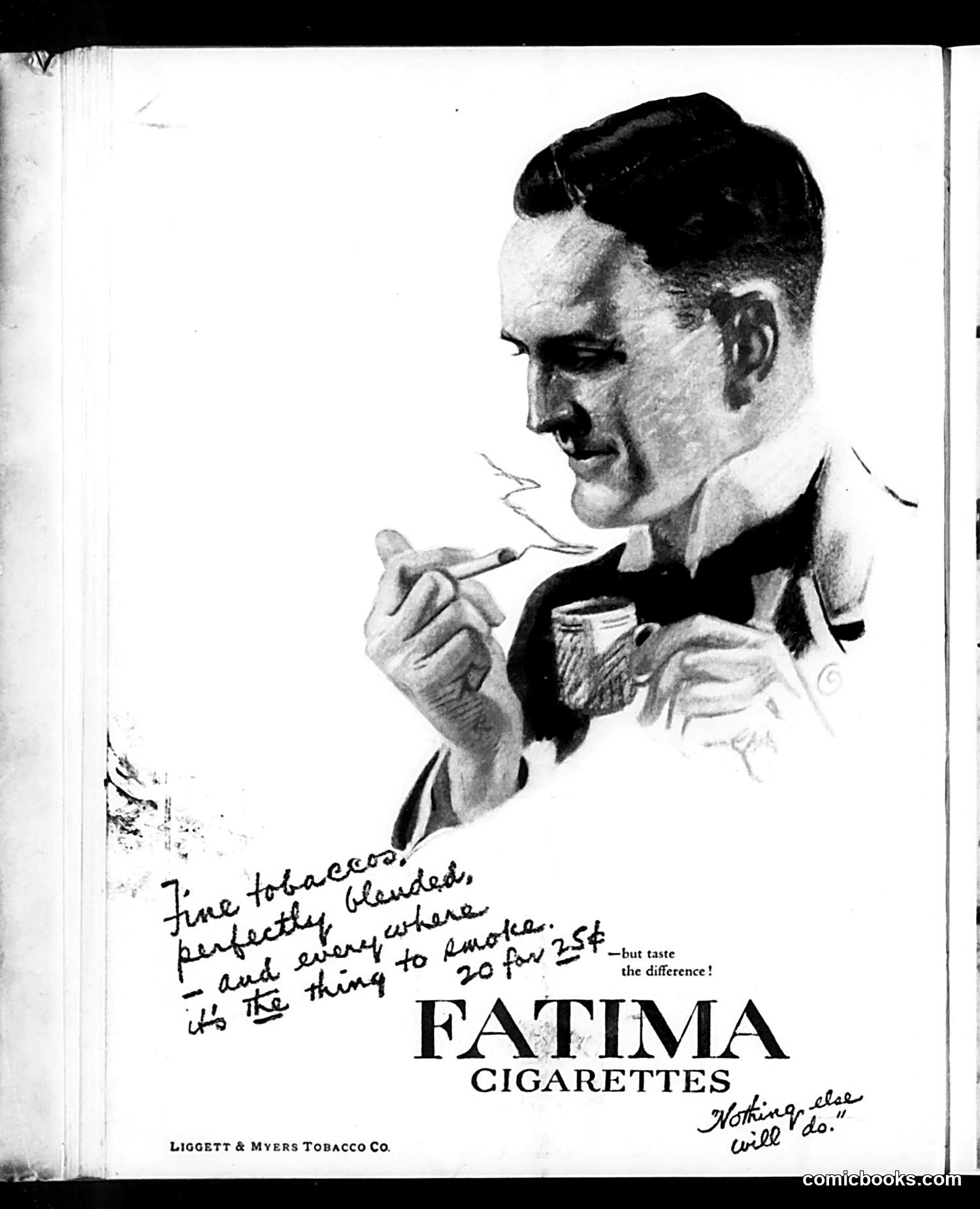
This is a **cigarette advertisement**, not political satire or editorial content from Judge magazine. The image shows a man in formal attire (tuxedo with bow tie) smoking a cigarette, rendered in profile. The handwritten-style text reads: "Fine tobacco perfectly blended, and every shred of it's the thing to smoke. 20 for 25¢—but taste the difference!" **Fatima Cigarettes** (by Liggett & Myers Tobacco Co.) is promoting their product using a well-dressed gentleman as an aspirational figure—a common early 20th-century advertising strategy associating smoking with sophistication and class status. The emphasis on "fine tobacco" and "perfect blending" appeals to quality-conscious consumers, while the competitive pricing (20 cigarettes for a quarter) highlights affordability. This reflects the pre-regulation era when cigarette advertising appeared freely in publications without health warnings.