
Judge, 1921-06-11 · page 9 of 36
Judge — June 11, 1921 — page 9: what you’re looking at
What you’re looking at
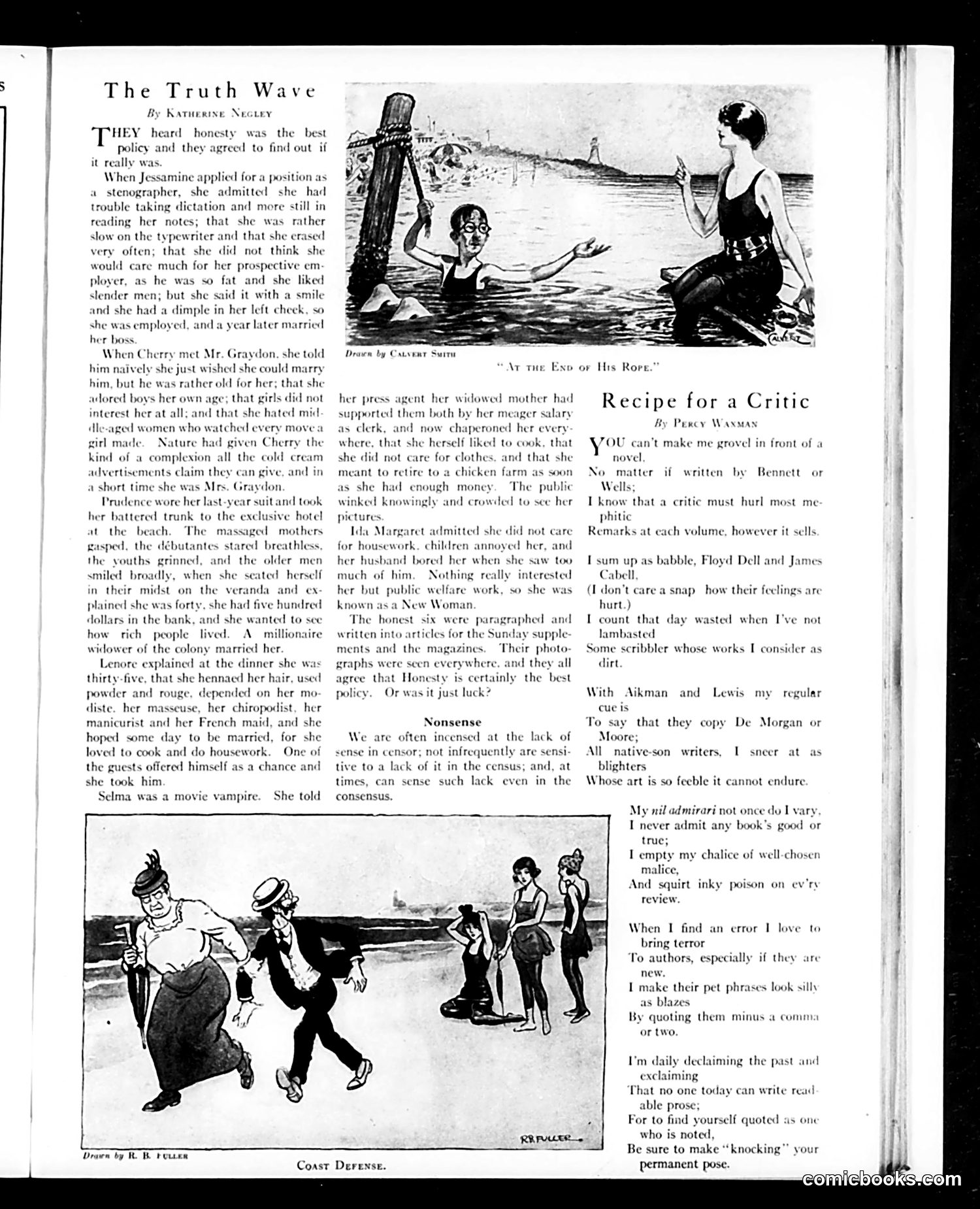
"The Truth Wave" satirizes the paradox that honesty can succeed through social convention rather than merit. Six women candidly admit serious flaws—poor work skills, age, poverty, vanity, domestic disinterest, or infidelity concerns—yet each lands a wealthy husband. The joke: their honesty, delivered with charm or attractiveness, becomes *marketable* rather than genuinely valued. Society rewards the *performance* of honesty (especially by appealing women) while remaining indifferent to actual competence or character. The accompanying illustrations show these women succeeding despite their admissions, highlighting the hypocrisy: people claim to value honesty but really respond to appearance and charm. "Recipe for a Critic" mocks literary critics as contrarian snobs who dismiss all books as bad regardless of merit, copy established critics blindly, and find satisfaction only in negativity. It's satire of critical arrogance—the assumption that harsh judgment proves sophistication. Both pieces target early 20th-century pretension and gap between stated values and actual behavior.
📄 Transcribed text from this page (OCR, searchable)
Machine-transcribed from the original scan — historical spelling and the odd misread are preserved.
Tm The Truth Wave By Katuerine Nectey HEY heard honesty was the best policy and they agreed to find out if it really was. When Jessamine applied for a position as stenographer, she admitted she had uble taking dictation and more still in ding her notes; that she was rather yw on the typewriter and that she erased very often; that she did not think she would care much for her prospective em ployer, as he was so fat and she liked slender men; but she said it with a smile and she had a dimple in her left cheek, so she was employed, and a year later married her boss. When Cherry met Mr. Graydon, she told him naively she just wished she could marry him, but he was rather old for her; that she adored boys her own age; that girls did not interest her at all; and that she hated mid dle-aged women who watched every move a girl made. Nature had given Cherry the kind of a complexion all the cold cream Advertisements claim they can give, and in a short time she was Mrs. Graydon Prudence wore her last-year suitand took her battered trunk to the exclusive hotel at the beach. The massaged mothers gasped, the débutantes stared breathless the vouths grinned, and the older men smiled broadly, when she seated herself in their midst on the veranda and ex plained she was forty, she had five hundred dollars in the bank, and she wanted to see how rich people lived. A millionaire widower of the colony married her Lenore explained at the dinner she was thirty-five, that she hennaed her hair, used powder and rouge, depended on her mo diste. her masseuse, her chiropodist, her manicurist and her French maid, and she hoped some day to be married, for she loved to cook and do housework. One of the guests offered himself as a chance and she took him Selma was a movie vampire. She told Drown by ROB Feuer Coast Der Drawer by Catvent Sumi \r tHe Exo or His Rove.” her press agent her widowed mother had supported them both by her meager salary as clerk, and now chaperoned her every where, that she herself liked to cook, that she did not care for clothes. and that she meant to retire to a chicken farm as soon as she had enough money. The public winked knowingly and crowded to sce her res Ida Margaret admitted she did not care for housework. children annoyed her, and her husband bored her when she saw too much of him, Nothing really interested her but public welfare work, so she was known as a New Woman The honest six were parag written into articles for the Su ments and the magazines. Their photo aphed and lay supple graphs were seen everywhere, and they all agree that Honesty is certainly the best policy. Or was it just luck? Nonsense We are often incensed at the lack of not infrequently are sensi sense in cen tive to a lack of it in the census; and, at times, can sense such lack even in the consensus, Rare | Recipe for a Critic By Percy Waxman ZOU can't make me grovel in front of a novel No matter if written by Bennett or Wells; I know that a critic must hurl most me phitic Remarks at cach volume, however it sells. I sum up as babble, Floyd Dell and James Cabell (don’t carea snap how their feelings are hurt.) I count that day wasted when I've not lambasted Some scribbler whose works I consider as dirt With Aikman and Lewis my regular cucts To say that they copy De Morgan or Moore; Ml native-son writers, [ sneer at as blighters Whose art is so feeble it cannot endure. My nil admirari not once du I vary Ta ] I never admit any book’s good or truc; I empt malice, And squirt inky poison on ev'ry my chalice of well-choser revie! When I find an error I love to bring terror To authors, especially if they are nev I make their pet phrases look silly as blazes By quoting them minus a comma or two. I'm daily declaiming the past a exclaiming Phat no one today can write read able prose; ; For to find yourself quoted as one who is noted, Be sure to make ‘“‘knocking” your permanent pose.