
Judge, 1921-06-11 · page 22 of 36
Judge — June 11, 1921 — page 22: what you’re looking at
What you’re looking at
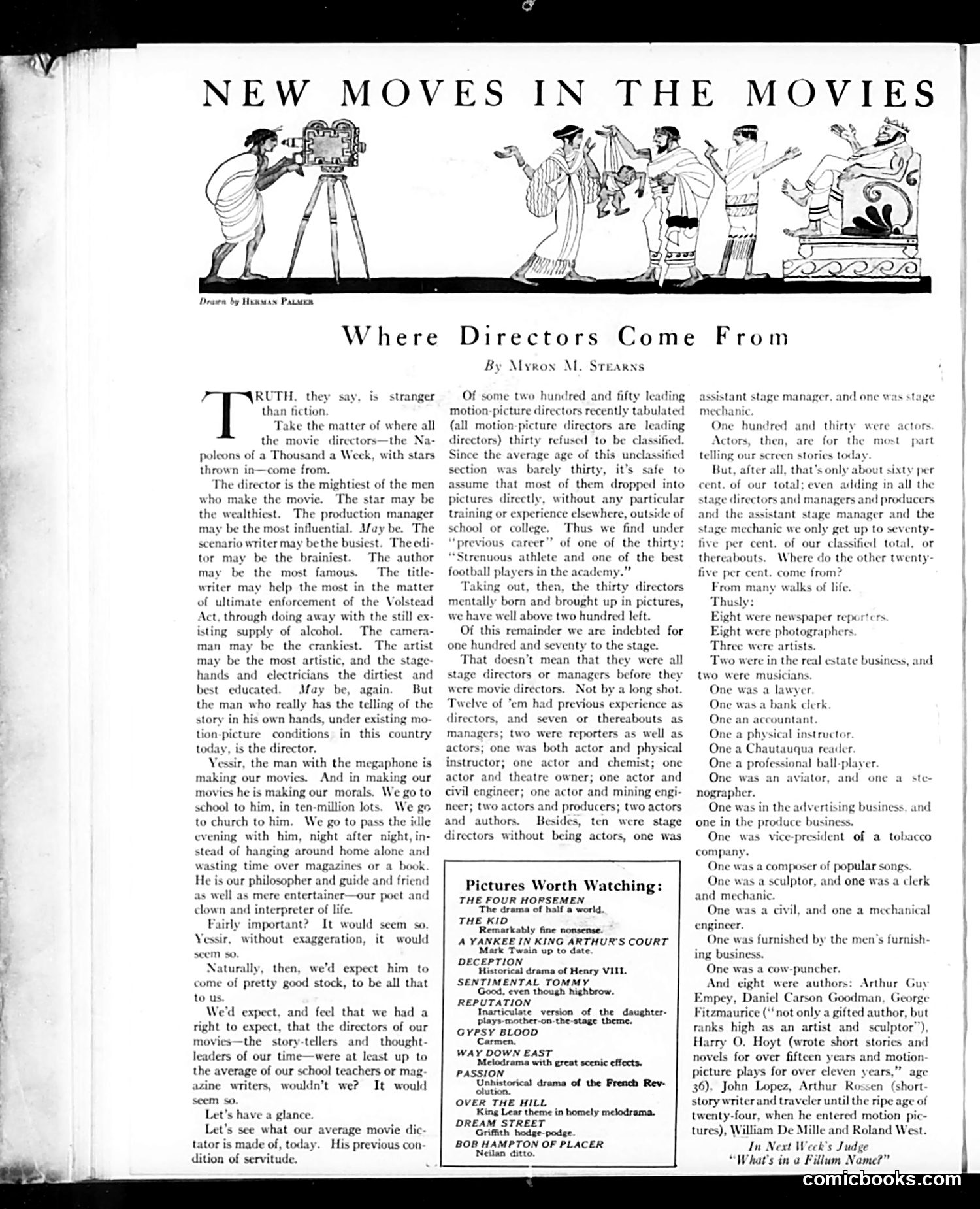
This article and Herman Palmer's cartoon satirize the humble origins of 1920s movie directors. The text reports that of 250 leading motion-picture directors studied, most came from theatrical backgrounds—170 from the stage—rather than formal training or educated professions. The cartoon illustrates this point through visual types: a film cameraman, various theatrical performers in exaggerated costumes and poses, and a director gesturing dramatically from an elevated platform. Palmer's drawings emphasize the theatrical, often lowbrow character of these backgrounds. The article's satirical thrust is clear: film directors—who now function as America's moral educators and cultural authorities—come from surprisingly modest, entertainment-focused backgrounds rather than intellectual or respectable professions. The author's rhetorical strategy ("Fairly important?") underscores the irony that these "Napoleons" of cinema, who shape public morality through film, largely lack the educated pedigree one might expect from such culturally influential figures.
📄 Transcribed text from this page (OCR, searchable)
Machine-transcribed from the original scan — historical spelling and the odd misread are preserved.
NEW MOVES IN THE MOVIE Drwea by Hewstas Parson Where RUTH. they say, is stranger than fiction. Take the matter of where all the movie directors—the Na- polcons of a Thousand a Week, with stars thrown in—come from. The director is the mightiest of the men who make the movie. The star may be the wealthiest. The production manager may be the most influential. May be. The scenario writer may be the busiest. The edi- tor may be the brainiest. The author may be the most famous. The title- writer may help the most in the matter of ultimate enforcement of the Volstead Act, through doing away with the still ex: isting supply of alcohol. The camera man may be the crankiest. The artist may be the most artistic, and the stage- hands and electricians the dirtiest and best educated. May be, again. But the man who really has the telling of the story in his own hands, under existing mo- tion-picture conditions in this country today, is the director. Yessir, the man with the megaphone is making our movies. And in making our movies he is making our morals. We go to school to him, in ten-million lots. We go to church to him. We go to pass the idle evening with him, night after night, in- stead of hanging around home alone and wasting time over magazines or a book. He is our philosopher and guide and friend as well as mere entertainer—our poet and clown and interpreter of life. Fairly important? It would seem so. Yessir, without exaggeration, it would seem so. Naturally, then, we'd expect him to come of pretty good stock, to be all that ) us. We'd expect, and feel that we had a right to expect, that the directors of our movies—the story-tellers and thought- leaders of our time—were at least up to the average of our school teachers or mag- azine writers, wouldn’t we? It would seem so, Let's have a glance. Let’s see what our average movie dic- tator is made of, today. His previous con dition of servitude. Directors Come By Myron M. Stearns Of some two hundred and fifty leading motion-picture directors recenUy tabulated (all motion-picture directors are leading directors) thirty refused to be classified. Since the average age of this unclassified section was barely thirty, it’s safe to assume that most of them dropped into pictures directly, without any particular training or experience elsewhere, outside of school or college. Thus we find under “previous career” of one of the thirty: “Strenuous athlete and one of the best football players in the academy.” Taking out, thea, the thirty directors mentally born and brought up in pictures, we have well above two hundred left. Of this remainder we are indebted for one hundred and seventy to the stage. That doesn’t mean that they were all stage directors or managers before they were movie directors. Not by a long shot. Twelve of ‘em had previous experience as directors, and seven or thereabouts as managers; two were reporters as well as actors; one was both actor and physical instructor; one actor and chemist; one actor and theatre owner; one actor and civil engineer; one actor and mining engi- neer; two actors and producers; two actors and authors. Besides, ten were stage directors without being actors, one was Pictures Worth Watching: THE FOUR HORSEMEN The drama of half a world. THE KID Remarkably fine nonsense. A YANKEE IN KING ARTHUR'S COURT Mark Twain up to date. DECEPTION Historical drama of Henry VIII. SENTIMENTAL TOMMY Good, even though highbrow. REPUTATION Inarticulate version of the daughter- plays-mother-on-the-stage theme. GYPSY BLOOD Carmen. WAY DOWN EAST Melodrama with great scenic effects. PASSION Unhistorical drama of the French Rev- olution. OVER THE HILL King Lear theme in homely melodrama. DREAM STREET Griffith hodge-podge. BOR HAMPTON OF PLACER Neilan ditto. From assistant stage manager, and one was sta mechanic One hundred and thirty were actors: Actors, then, are for the most part telling our screen stories today But, after all, that’s only about sixty per cent. of our total; even adding in all the e directors and managers and producers and the assistant stage manager and the stage mechanic we only get up to seventy- five per cent. of our classified total, or thereabouts. Where do the other twenty- five per cent. come from? From many walks of life. Thusly: Eight were newspaper report Eight were photographers Three were artists. Two were in the real estate business, and two were musicians. One was a lawyer One was a bank clerk One an accountant One a physical instructor One a Chautauqua reader. One a professional ball-player. One was an aviator, and one a ste- nographer. One was in the advertising business, a one in the produce business. One was vice-president of a tobacco company. One was a composer of popular songs. One was a sculptor, and one was a clerk and mechanic. One was a civil, and one a mechanical engineer. One was furnished by the men’s furnish- ing business. One was a cow-puncher. And eight were authors: Arthur Guy Empey, Daniel Carson Goodman, George Fitzmaurice (“not only a gifted author, but ranks high as an artist and sculptor”), Harry O. Hoyt (wrote short stories and novels for over fifteen years and motion picture plays for over eleven years,” age 36), John Lopez, Arthur Rossen (short story writerand traveler until the ripe age of twenty-four, when he entered motion pic- tures), William De Mille and Roland West. In Next Week's Judge “What's in a Fillum Name?” icbooks