
Judge, 1921-06-11 · page 20 of 36
Judge — June 11, 1921 — page 20: what you’re looking at
What you’re looking at
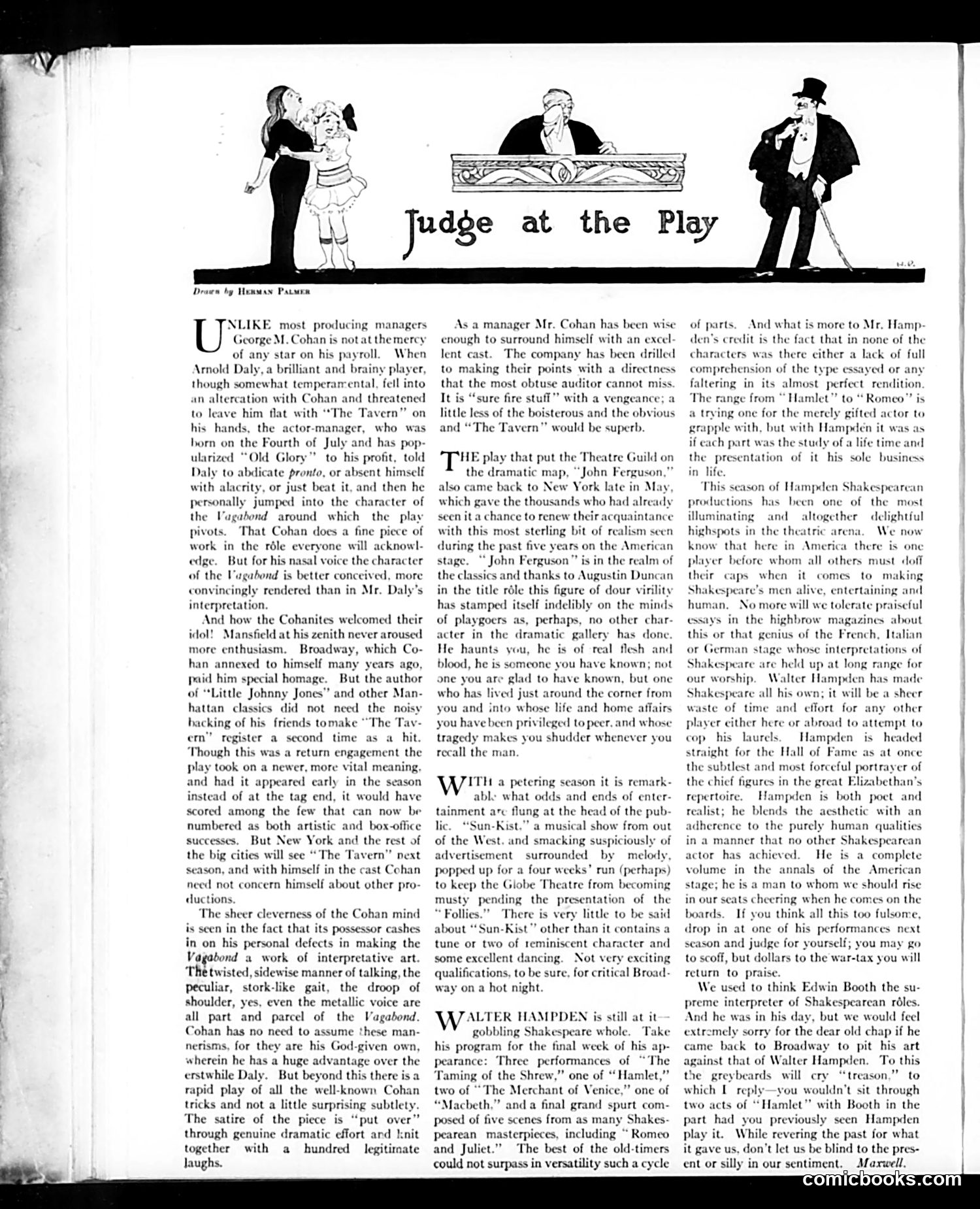
This page contains theatrical criticism by Herman Palmer for *Judge* magazine, focusing on Broadway productions rather than political satire. The cartoon header shows a judge presiding over theater-related scenes. The column praises **George M. Cohan**, the famous American playwright-performer, for stepping into the lead role of *The Tavern* after actor Arnold Daly quit. Palmer argues Cohan turned a potential disaster into triumph, noting that Cohan's personal mannerisms—his nasal voice, awkward gait, and metallic delivery—paradoxically enhance his character portrayal as "the Vagabond." Palmer also reviews *John Ferguson*, a Theater Guild production starring Augustin Duncan, praising its realism and emotional impact. The criticism is non-partisan entertainment journalism typical of *Judge*'s theatrical coverage, celebrating Cohan's star power and Broadway's commercial success during the era. No political figures or commentary appear present.
📄 Transcribed text from this page (OCR, searchable)
Machine-transcribed from the original scan — historical spelling and the odd misread are preserved.
Drven by Hensas Parson NLIKE most producing managers George M. Cohan is not at the mercy of any star on his payroll. When Arnold Daly, a brilliant and brainy player, though somewhat temperamental, fell into an altercation with Cohan and threatened to leave him flat with ‘The Tavern” on his hands, the actor-manager, who was horn on the Fourth of July and has pop- ularized “Old Glory” to his profit, told Daly to abdicate pronto, or absent himself with alacrity, or just beat it, and then he personally jumped into the character of the Vagabond around which the play pivots. That Cohan does a fine piece of work in the réle everyone will acknowl- edge. But for his nasal voice the character of the Vagabond is better conceived, more convincingly rendered than in Mr. Daly's interpretation. And how the Cohanites welcomed their idol! Mansfield at his zenith never aroused more enthusiasm. Broadway, which Co- han annexed to himself many years ago, id him special homage. But the author “Little Johnny Jones” and other Man- hattan classics did not need the noisy hacking of his friends tomake “The Tav- em” register a second time as a hit. ‘Though this was a return engagement the play took on a newer, more vital meaning. and had it appeared early in the season instead of at the tag end, it would have scored among the few that can now be numbered as both artistic and box-office successes. But New York and the rest of the big cities will see “The Tavern” next season, and with himself in the cast Cohan need not concern himself about other pro- ductions. The sheer cleverness of the Cohan mind is seen in the fact that its possessor cashes in on his personal defects in making the Vagabond a work of interpretative art. ‘The twisted, sidewise manner of talking, the peculiar, stork-like gait, the droop of shoulder, yes, even the metallic voice are all part and parcel of the Vagabond. Cohan has no need to assume these man- nerisms, for they are his God-given own, wherein he has a huge advantage over the erstwhile Dal But beyond this there is a rapid play of all the well-known Cohan tricks and not a little surprising subtlety. The satire of the piece is “put over” through genuine dramatic effort and knit together laughs. with a hundred legitimate As a manager Mr. Cohan has been wise enough to surround himself with an excel lent cast. The company has been drilled to making their points with a directness that the most obtuse auditor cannot miss. It is “sure fire stuff” with a vengeance; little less of the boisterous and the obvious and “The Tavern” would be superb. THE play that put the Theatre Guild on the dramatic map, “John Ferguson,” also came back to New York late in May which gave the thousands who had already seen ita chance to renew their acquaintance with this most sterling bit of realism seen during the past five years on the American stage. “ John Ferguson” is in the realm of the classics and thanks to Augustin Duncan in the title rdle this figure of dour virility has stamped itself indelibly on the minc of playgoers as, perhaps, no other char- acter in the dramatic gallery has done. He haunts you, he is of real flesh and blood, he is someone you have known; not one you are glad to have known, but one who has lived just around the corner from you and into whose life and home affairs you have been privileged to peer. and whose tragedy makes you shudder whenever you recall the man. ITH a petering season it is remark- able what odds and ends of enter- tainment are flung at the head of the pub- lic. “Sun-Kist.”” a musical show from out of the West. and smacking suspiciously of advertisement surrounded by melody, popped up for a four weeks’ run (perhaps) to keep the Globe Theatre from becoming musty pending the presentation of the “Follies.” There is very little to be said about “Sun-Kist” other than it contains a tune or two of reminiscent character and some excellent dancing. Not very exciting qualifications, to be sure, for critical Broad- way on a hot night Witt 2R HAMPDEN is still at it gobbling Shakespeare whole. Take his program for the final week of his ap- pearance: Three performances of “The Taming of the Shrew,” one of “Hamlet,” two of “The Merchant of Venice,” one of “Macbeth,” and a final grand spurt com- posed of five scenes from as many Shakes- pearean masterpieces, including “ Romeo and Juliet.” The best of the old-timers could not surpass in versatility such a cycle of parts. And what is more to Mr. Hamp. den’s credit is the fact that in none of th characters was there cither a lack of full comprehension of the type essayed or any faltering in its almost perfect rendition. The range from “ Hamlet” to “ Romeo” is a trying one for the merely gifted actor to grapple with, but with Hampden it was as if each part was the study of a life time and the presentation of it his sole business in on of Hampden Shakespearean one of the most productions has beer illuminating and altogether delightful highspots in the theatrie ar We now know that here in America there is one player before whom all others must doff their caps when it making Shakespeare’s men alive, entertaining and human. No more will we tolerate praiseful essays in the highbrow magazines about this or that genius of the French, Italian or German stage whose interpretations of Shakespeare are held up at long range for our worship. Walter Hampden has made Shakespeare all his own; it will be a sheer waste of time and effort for any other player cither here or abroad to attempt to cop his laurels. Hampden is headed straight for the Hall of Fame as at once the subtlest and most forceful portrayer of the chief figures in the great Elizabethan’s repertoire. Hampden is both poet and realist; he blends the aesthetic with an adherence to the purely human qualities in a manner that no other Shakespearean actor has achieved. He is a complete volume in the annals of the American ge; he is a man to whom we should rise comes to sta in our seats cheering when he comes on the boards. If you think all this too fulsome, drop in at one of his performances next season and judge for yourself; you may go to scoff, but dollars to the war-tax you will return to praise. We used to think Edwin Booth the su- preme interpreter of Shakespearean réles. And he was in his day, but we would feel extremely sorry for the dear old chap if he came back to Broadway to pit his art against that of Walter Hampden. To this the greybeards will cry “treason,” to which [ reply—you wouldn't sit through two acts of “Hamlet” with Booth in the part had you previously seen Hampden play it. While revering the past for what it gave us, don’t Iet us be blind to the pres- ent or silly in our sentiment. Maxwell. Ccomicbooks