
Judge, 1921-06-11 · page 7 of 36
Judge — June 11, 1921 — page 7: what you’re looking at
What you’re looking at
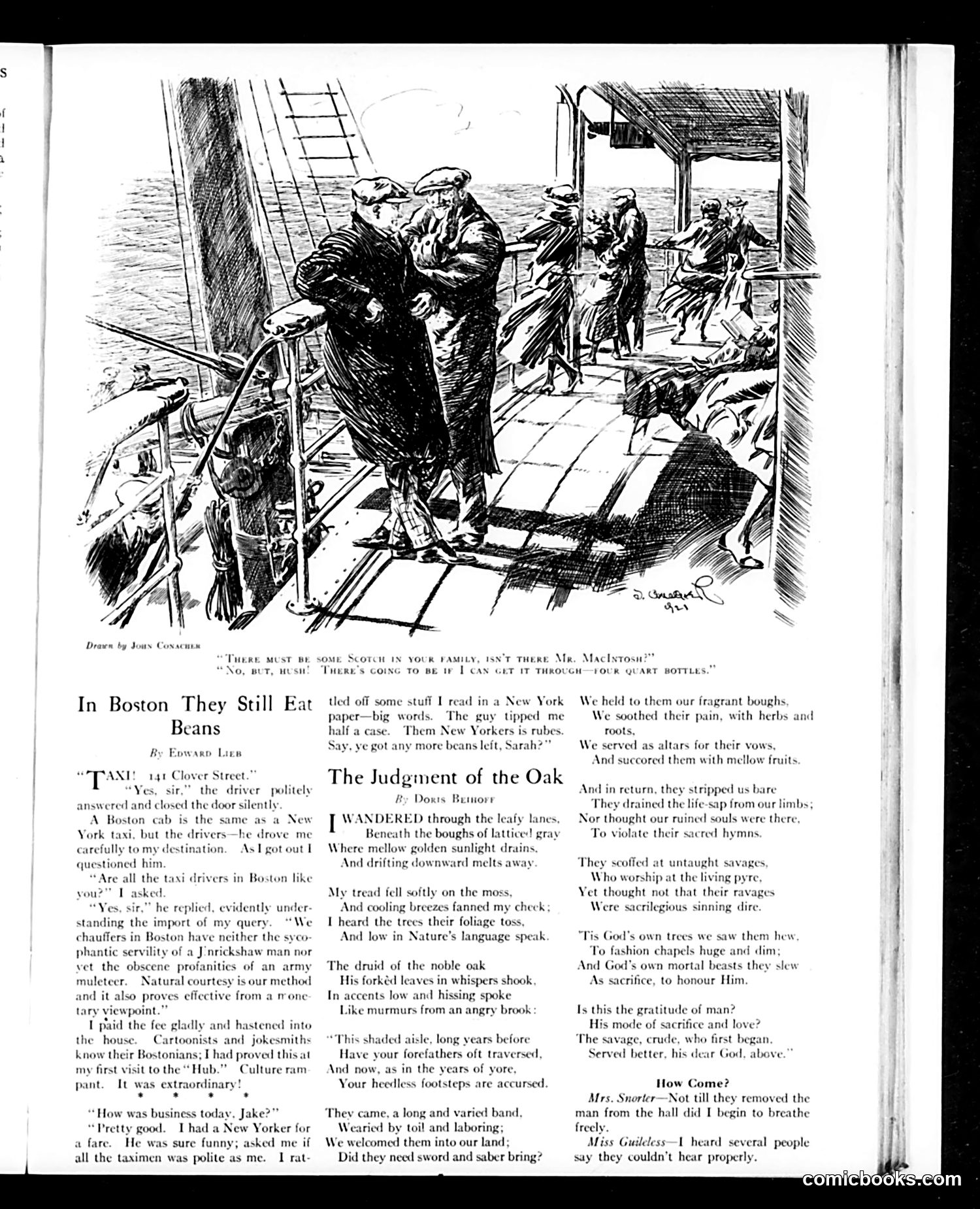
**The Cartoon (top):** Drawn by John Coxscomb, this depicts a scene aboard a ship where two men in the foreground discuss family genealogy. One insists there's "Scotch in your family," while the other counters he can get it "through your quart bottles"—a crude joke equating Scottish ancestry with whisky consumption. The maritime setting and period dress suggest this is historical satire about ethnic stereotyping. **"In Boston They Still Eat Beans":** This story satirizes Boston's reputation for both baked beans and intellectual superiority. A Boston taxi driver, asked if all local cabbies are polite, recites highbrow phrases he read in a New York paper to impress a New York passenger into tipping "half a case" of alcohol. The joke: sophisticated Boston culture is performative—the driver admits New Yorkers are "rubes" who fall for it. **"The Judgment of the Oak":** A romantic poem (likely satirical) where an oak tree laments European colonists who destroyed Native American lands and resources while claiming moral superiority.
📄 Transcribed text from this page (OCR, searchable)
Machine-transcribed from the original scan — historical spelling and the odd misread are preserved.
Draven by Joux Coxscunx THere MUST BE “No, put, uesit In Boston They Still Eat Beans Ry Eowarp Lies AXI! 141 Clover Street.” “Yes, sir,” the driver politely answered and closed the door silently A Boston cab is the same a New York taxi, but the drivers—he drove me carefully to my destination. As IT got out questioned him. “Are all the taxi drivers in Boston like ked you?” “Yes, sir.” he replied, evidently under standing the import of query. “We chauffers in Boston have neither the syco- phantic servility nrickshaw man nor vet the obscene profanitic an army muletecr. Natural courtesy is our method and it also proves effective from a wpoint.” id the fee gladly and hastened into the house. Cartoonists and jokesmiths know their Bostonians; I had proved this at my first visit to the “Hub.” Culture ram pant. [It was extraordinary! ne “How was business today. Jake? “Pretty good. I had a New Yorker for a fare. He was sure funny; asked me if all the taximen was polite as me. I rat some SCOTCH IN YOUR FAMILY There's Conc To Be If 1 CAN GeT IT THROVG! isn't THERE Ma tled off some stuff I read in a New York paper—big words. The guy tipped me half a case. Them New Yorkers is rubes. Say, ye got any more beans left, Sarah?” The Judgment of the Oak Ry Doxts Betnorr I WANDERED through the leafy lanes, Beneath the boughs of lattice:! gray Where mellow golden sunlight drains. And drifting downward melts away My tread fell softly on the moss, ‘And cooling breezes fanned my cheek ; I heard the trees their foliage toss, And low in Nature's language speak The druid of the noble oak His forkéd leaves in whispers shook In accents low and hissing spoke Like murmurs from an angry brook “This shaded aisle, long years before Have your fe thers oft traversed, And now, as in the years of yore, Your heedless footsteps are accursed. ‘They came, a long and varied band, Wearied by toil and laboring; We welcomed them into our land; Did they need sword and saber bring? MacIntosn?” H—FOUR QUART BOTTLES.” We held to them our fragrant boughs. We soothed their pain, with herbs and roots, We served as altars for their vows, And succored them with mellow fruits, an na And in return, they stripped us bare They drained the life-sap from our limbs; Nor thought our ruined souls were there To violate their sacred hymns. They scoffed at untaught savages. Who worship at the living pyre, ; Yet thought not that their ravages Were sacrilegious sinning dire. ‘Tis God's own trees we saw them hew To fashion chapels huge and dim; / And God’s own mortal beasts they slew As sacrifice, to honour Him. Is this the gratitude of man? His mode of sacrifice and love? The s , crude, who first began Served better, his dear God, above How Come? Mrs. Snorter—Not till they removed the man from the hall did I begin to breathe freely. Miss Guileless—1 heard several people } say they couldn’t hear properly.