
A complete issue · 32 pages · 1920
Judge — October 16, 1920
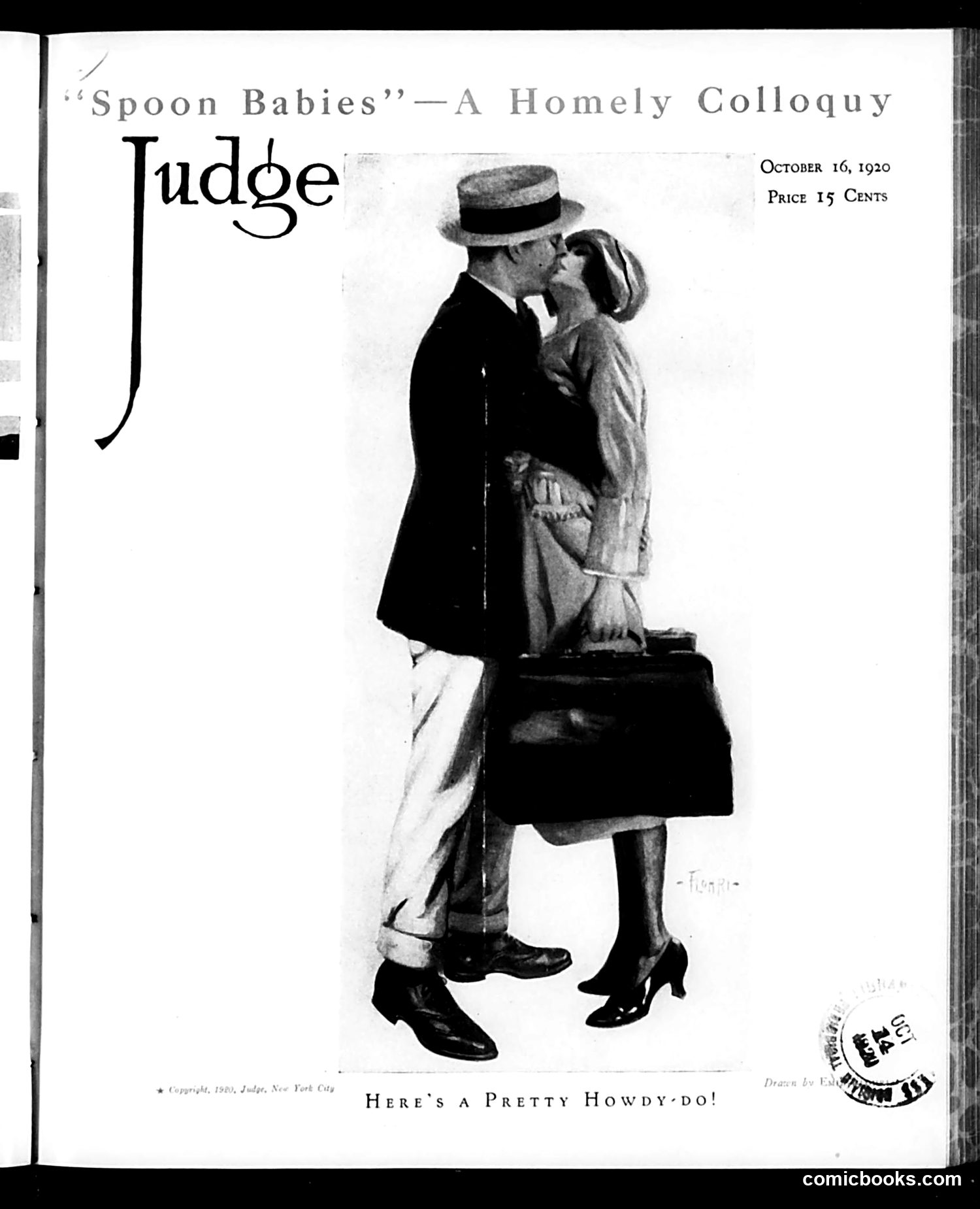
This Judge magazine cover from October 16, 1920 features a romantic illustration titled "Here's a Pretty Howdy-do!" The cartoon depicts a well-dressed man in a straw hat and dark suit kissing a woman while holding a suitcase, suggesting a clandestine romantic encounter or affair. The subtitle "Spoon Babies" was period slang for courting couples (to "spoon" meant to cuddle or romance). The "homely colloquy" framing treats their intimate moment as casual domestic humor. The illustration appears designed as lighthearted social satire about modern courtship and romantic behavior, typical of Judge's humor targeting contemporary social conventions and relationships during the 1920s Jazz Age.
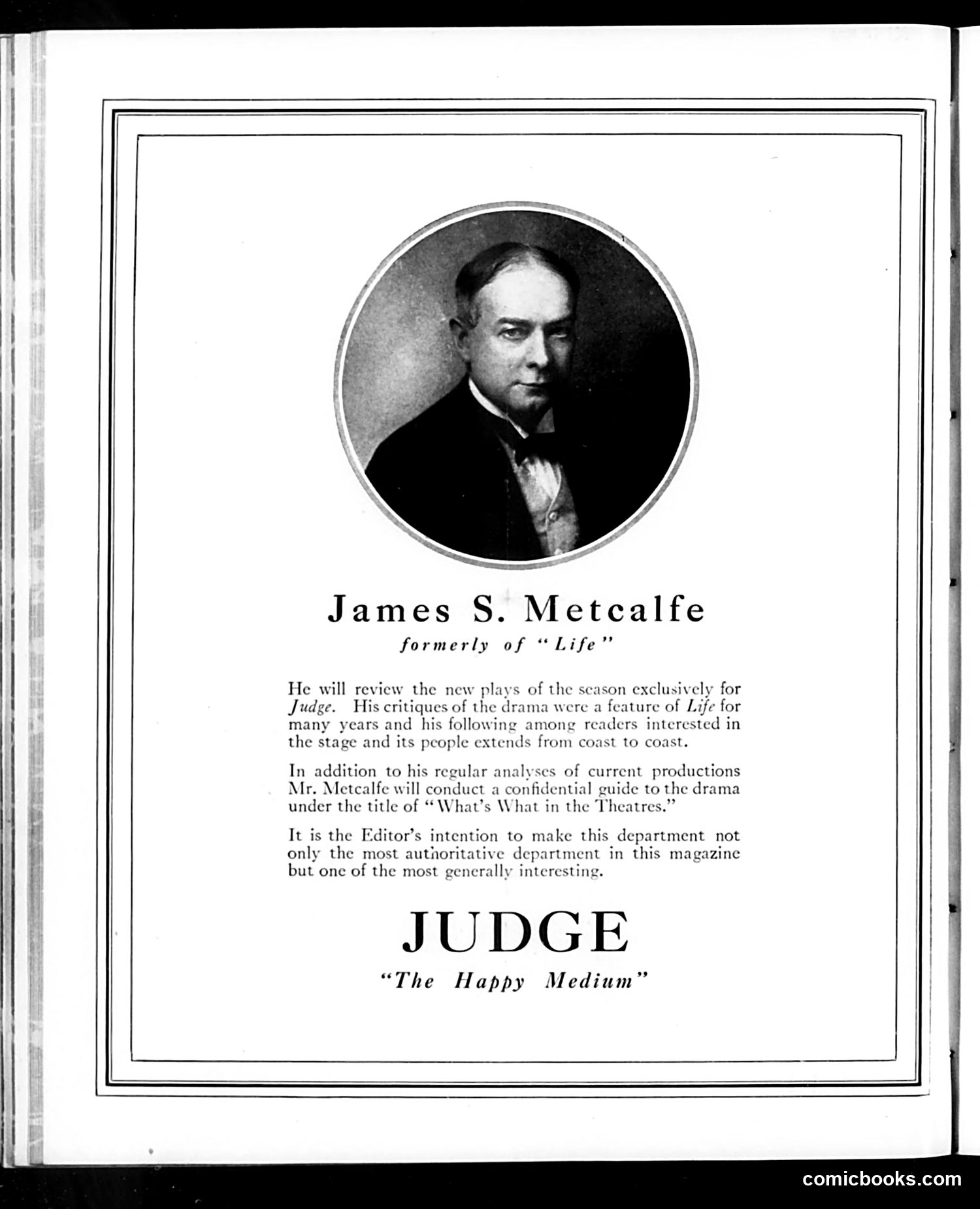
This page is primarily **an advertisement for Judge magazine itself**, not a political cartoon. It features a portrait of **James S. Metcalfe**, formerly a drama critic for *Life* magazine, announcing his move to *Judge*. The text explains that Metcalfe will now provide exclusive theatrical reviews for *Judge* and conduct a confidential guide called "What's What in the Theatres." The editor emphasizes this theatrical criticism department will be both authoritative and "generally interesting" to readers. The tagline at bottom—"The Happy Medium"—is a pun on *Judge*'s role as a middle-ground publication between serious criticism and popular entertainment. This is essentially **trade promotion**, not satire or political commentary.
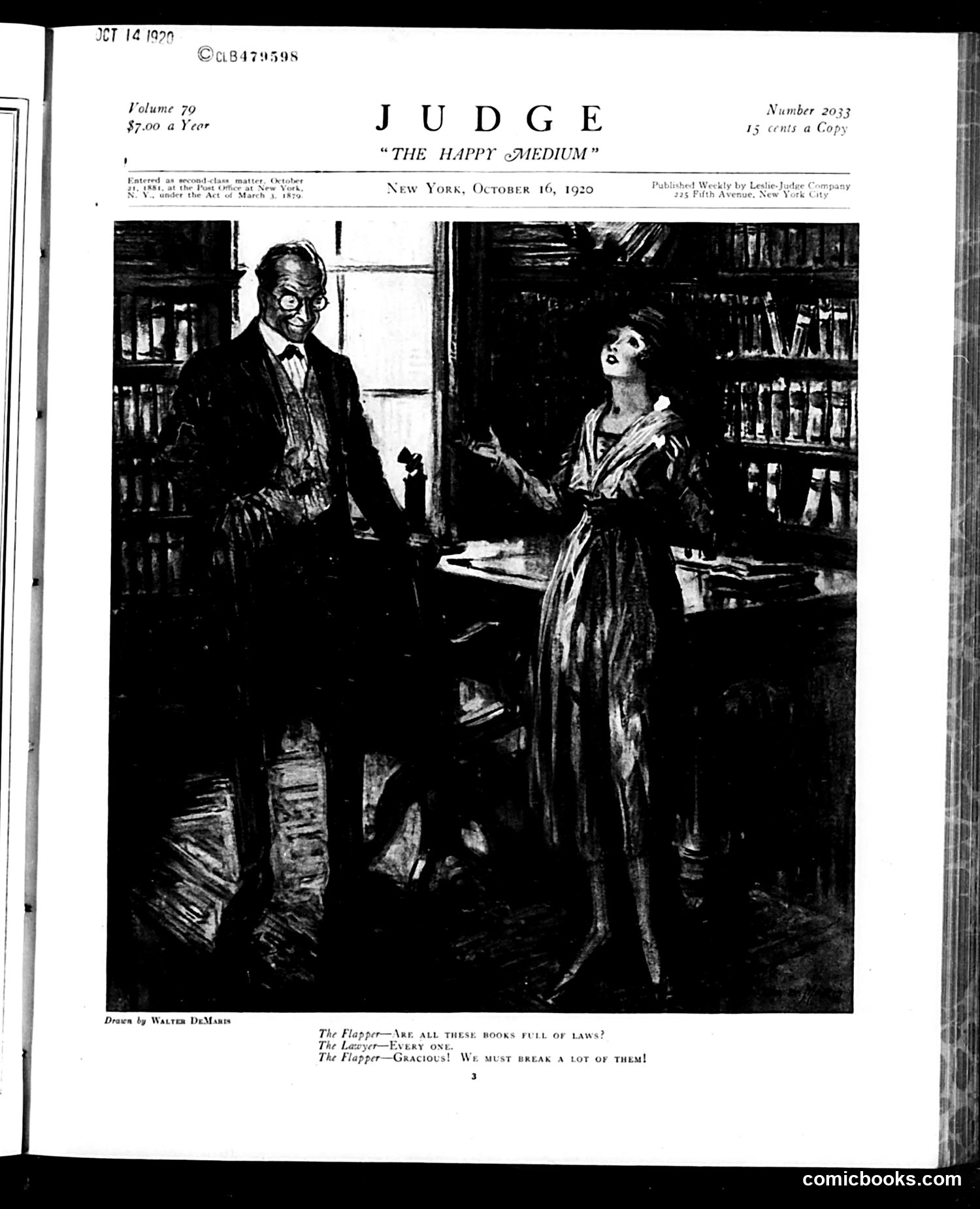
This cartoon depicts a library scene with three characters debating legal matters. The dialogue identifies them by role rather than name: - **The Flapper**: A young woman in fashionable dress, representing modern youth culture - **The Lawyer**: A stern older man in formal attire - **The Flappers' statement**: "Are all these books full of laws?" The satire appears to mock the disconnect between legal complexity and common sense. The lawyer's response—"Every one"—and the flapper's reaction—"Gracious! We must break a lot of them!"—suggests ironic commentary on how Byzantine legal codes make lawbreaking nearly inevitable for ordinary people, even the innocent. Published just days before the 1929 stock market crash, this reflects pre-Depression anxieties about regulatory overreach and legal absurdity.
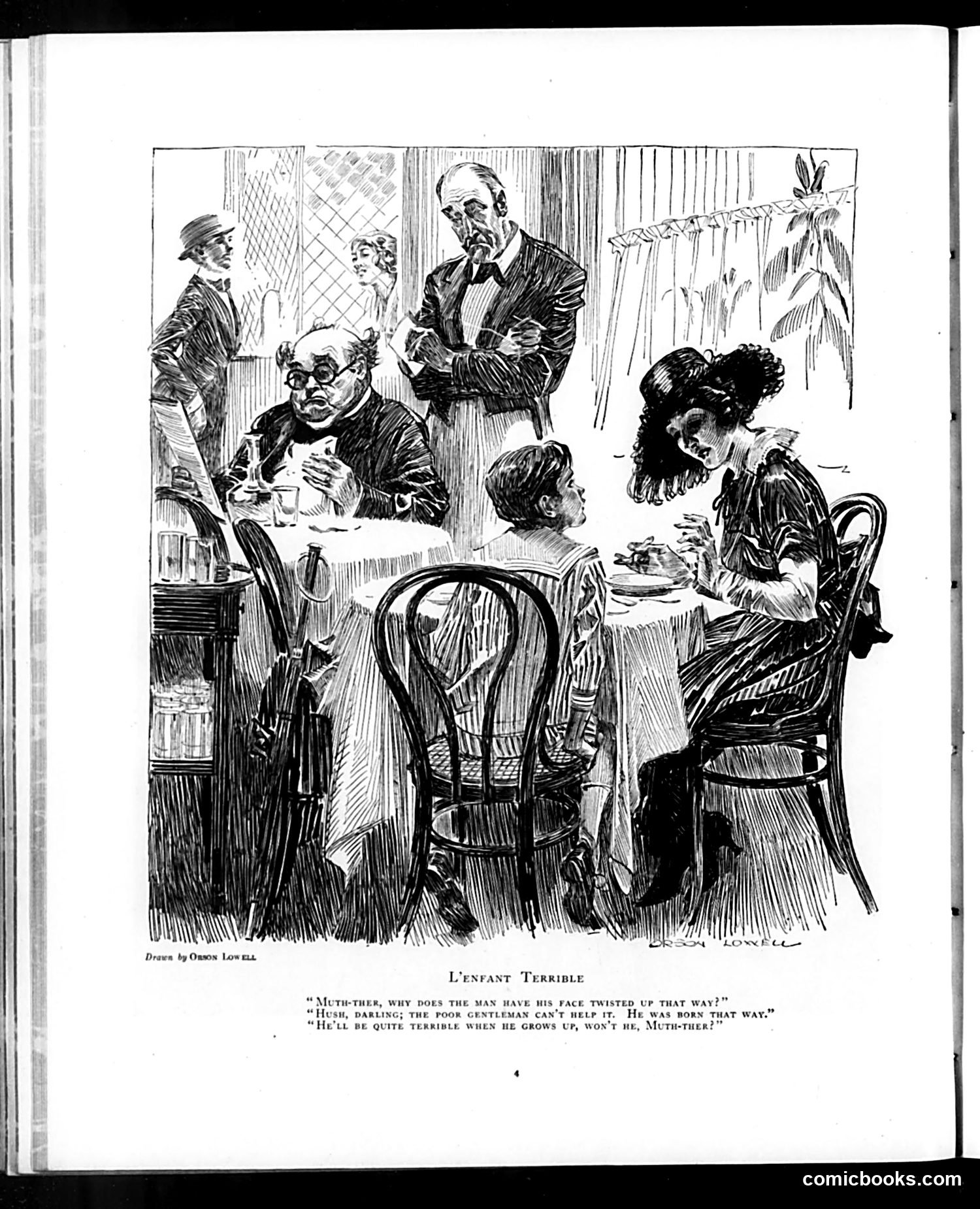
This sketch satirizes social hypocrisy regarding physical disability and appearance. The title refers to a "terrible child" (French phrase for an embarrassingly candid youngster). The scene depicts a dinner party where a well-dressed man with a severely twisted or disfigured face is present. A child openly asks the mother why the man's face is "twisted up that way." The mother's response—"Hush, darling; the poor gentleman can't help it. He'll be quite terrible when he grows up, won't he, Mutter-there?"—reveals the cartoon's point: adults claim to pity the disabled while making cruel, condescending remarks themselves. The satire targets Victorian-era genteel society's hypocrisy: publicly condemning children's honest observations while engaging in private mockery of those with visible disabilities.
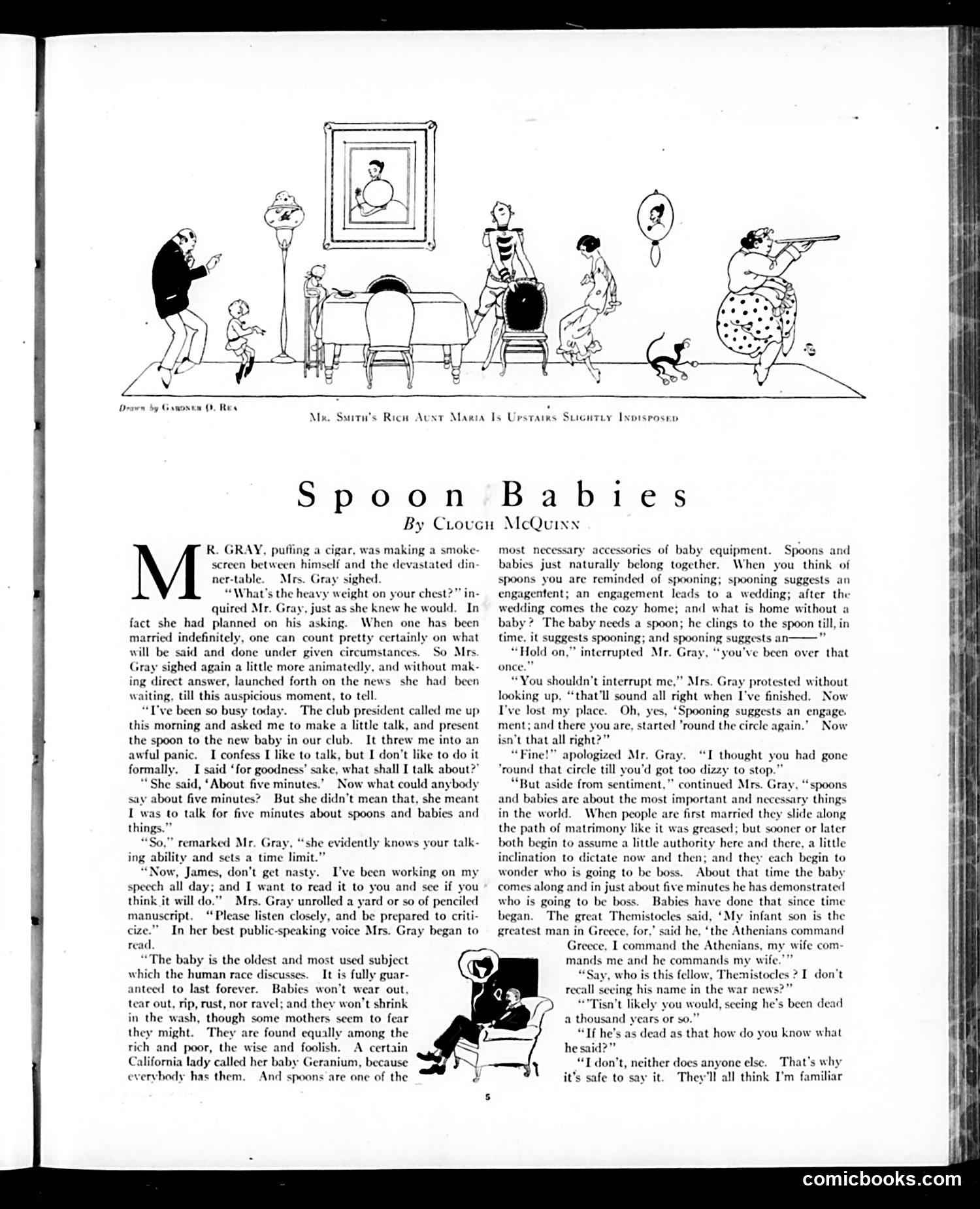
This humorous piece satirizes upper-class social conventions around courtship and marriage. Mr. Gray has been pestered by his wife to give a speech about "spoons and babies" at a club—apparently a euphemistic topic connecting engagement gifts (spoons) with inevitable married life and children. The cartoon at top shows a chaotic domestic scene, likely illustrating the disruption babies cause to household order. The satire targets how spoons became conventionally associated with engagements and how society assumes marriage inevitably leads to babies. The joke plays on Mrs. Gray's insistence that Mr. Gray discuss this delicate topic publicly, and his reluctant, awkward compliance. It's essentially mocking Victorian-era social pretense around reproduction and domestic life.
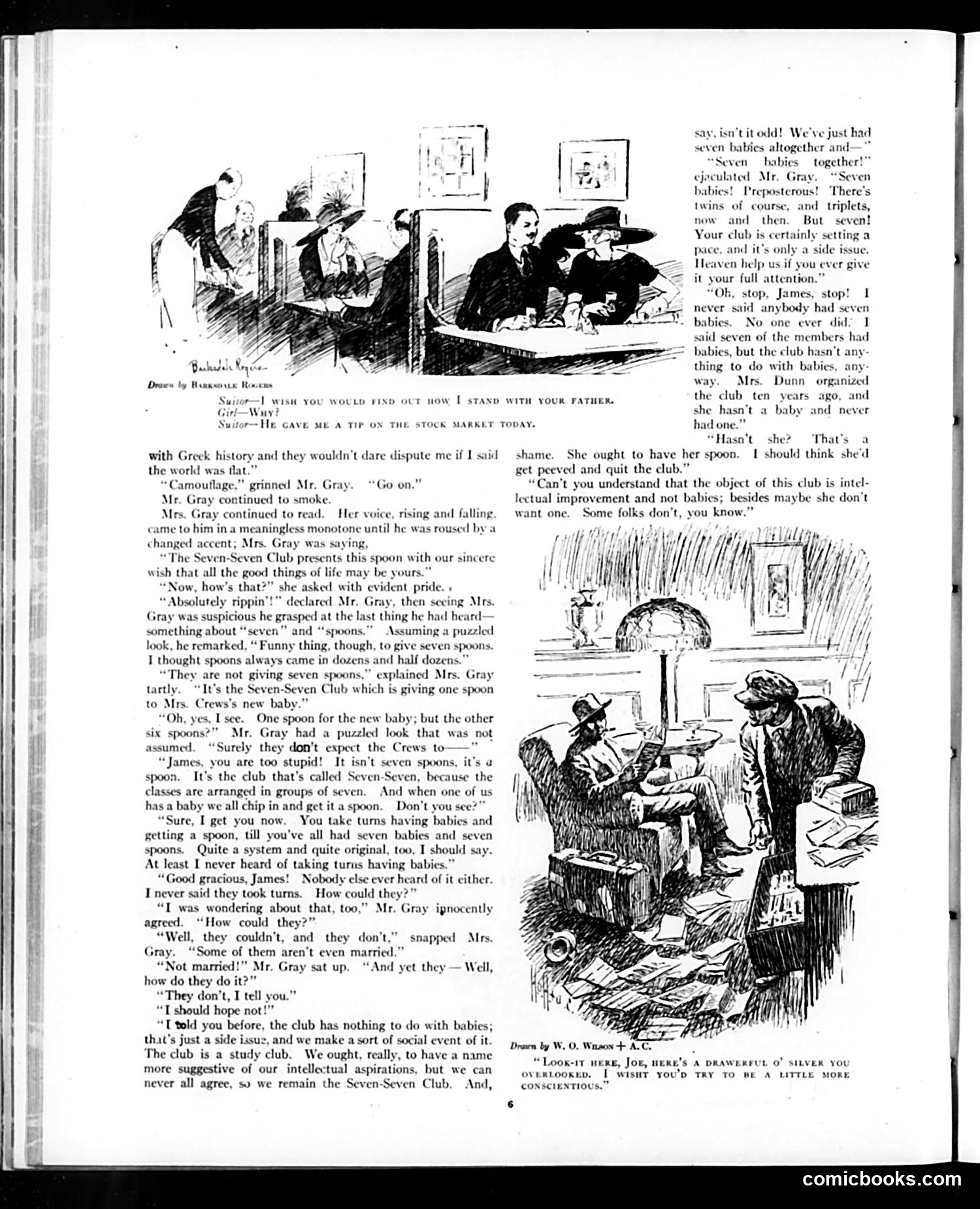
This page from Judge magazine satirizes the "Seven-Seven Club," a women's social organization. The humor centers on a naming/purpose confusion: the club is called "Seven-Seven" because members are arranged in groups of seven, and when a member has a baby, she receives one silver spoon. Mr. Gray mistakenly believes the club distributes seven spoons per baby, leading to confusion about whether members are having multiple children. The joke escalates when he realizes the club's actual purpose is intellectual self-improvement, not baby-related gifts. The cartoon illustrates the marital dynamic: Mr. Gray appears bewildered by his wife's club activities, a common Judge theme mocking both women's organizations and husbands' befuddlement over their wives' social endeavors. The satire gently ridicules both the club's pretensions and gender misunderstandings.
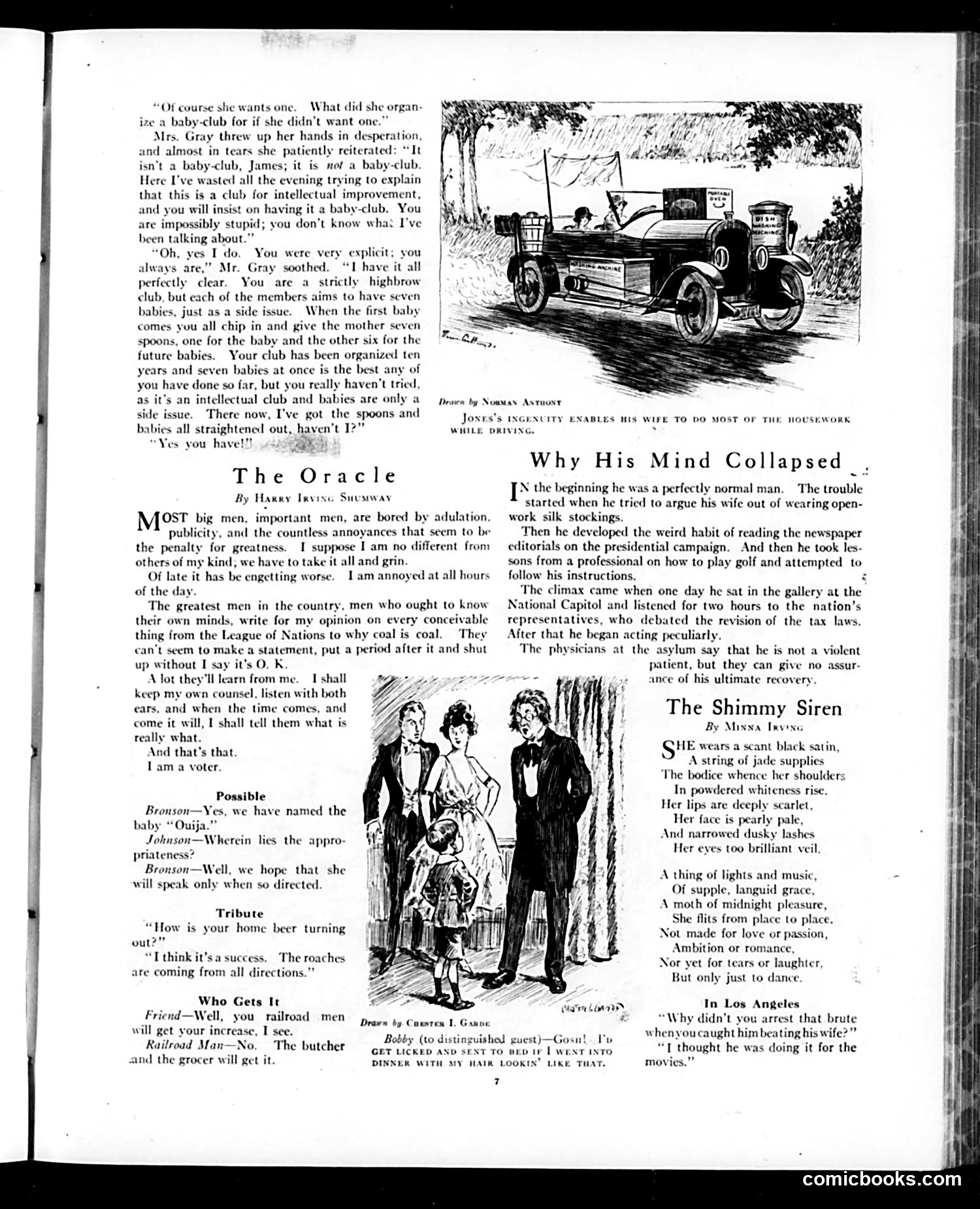
This page contains several satirical pieces reflecting early 20th-century American social anxieties: **The main domestic cartoon** depicts a husband misunderstanding his wife's "intellectual improvement club"—he insists it's actually a "baby club" because members give silver spoons as gifts. The satire targets masculine obtuseness and women's emerging social organizations, suggesting men cannot comprehend female intellectual pursuits without reducing them to domestic/reproductive functions. **"Why His Mind Collapsed"** humorously chronicles male mental breakdown from accumulated modern irritations: arguing with wives about fashion, reading presidential campaign editorials, taking golf lessons, and listening to Congressional tax debates. It satirizes masculine fragility when confronted with everyday domestic friction and political/social complexity. **"The Shimmy Siren"** is a poem describing a flapper dancer in sexually suggestive terms—"shimmy" was a scandalous 1920s dance. It reflects contemporary moral panic about modern women's sexual liberation and entertainment culture. The page overall satirizes gender tensions, women's changing social roles, and masculine anxieties about modernity.
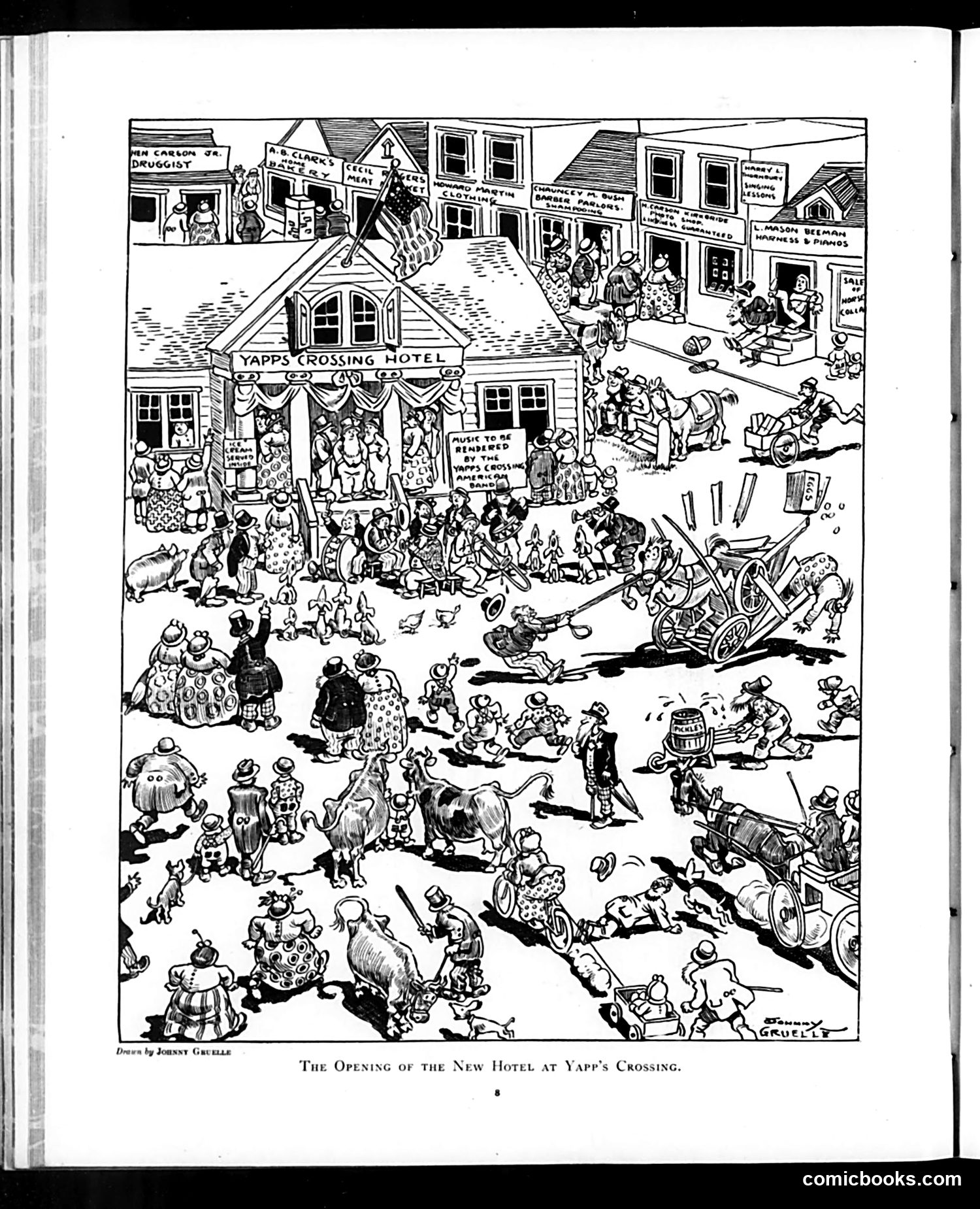
This is a bustling satirical scene depicting the grand opening of a new hotel at a rural crossroads. The illustration shows chaos and pandemonium—crowds of people, animals (including cattle and pigs), overturned carriages, bicycles, and general mayhem surrounding the "Yapp's Crossing Hotel." The satire appears to mock the pretensions of opening a fancy establishment in a remote location, with the "refined" hotel utterly overwhelmed by rustic crowds, livestock, and accidents. The contrast between the hotel's aspirations (evident from its formal appearance) and the actual clientele and disorder suggests ridicule of misplaced ambitions or poor business judgment. The drawing is credited to Johnny Gruelle, a notable illustrator of the era. Without knowing the specific date or location of Yapp's Crossing, the exact historical reference remains unclear, though this type of rural-versus-refined satire was common in Judge magazine.
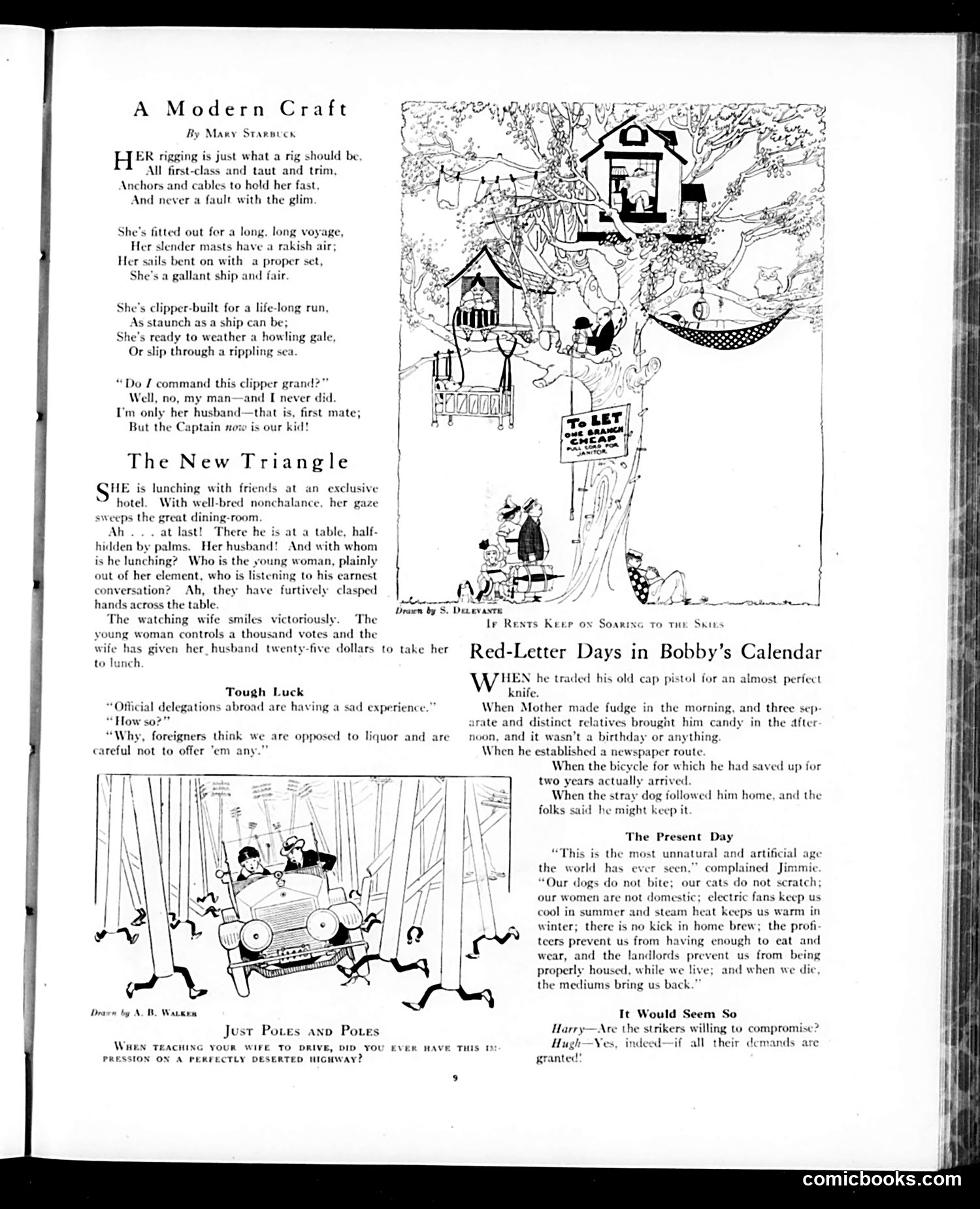
This page contains several satirical pieces reflecting 1920s American social attitudes: **"A Modern Craft"** celebrates a woman commanding a ship—but the twist is she's actually just the captain's wife whose young son now commands the vessel. It humorously inverts traditional gender and authority roles. **"The New Triangle"** satirizes modern marriage anxieties. A wife deliberately gives her husband money to lunch with a younger woman, believing this will make the woman less threatening. The "triangle" (love affair tension) is defused through monetary control—a joke about wives wielding financial power. **"Tough Luck"** mocks American Prohibition era diplomacy: foreign officials avoid serving alcohol to U.S. delegations, mistakenly believing Americans oppose drinking. **"Just Poles and Poles"** (cartoon): depicts chaotic driving instruction, likely poking fun at wives learning to drive—a new phenomenon in the 1920s. **"Red-Letter Days in Bobby's Calendar"** nostalgically lists childhood milestones, contrasted with **"The Present Day,"** which complains modernization has eliminated authentic experience—no dangerous dogs, no domestic women, even bootleg alcohol ("home brew") disappoints.
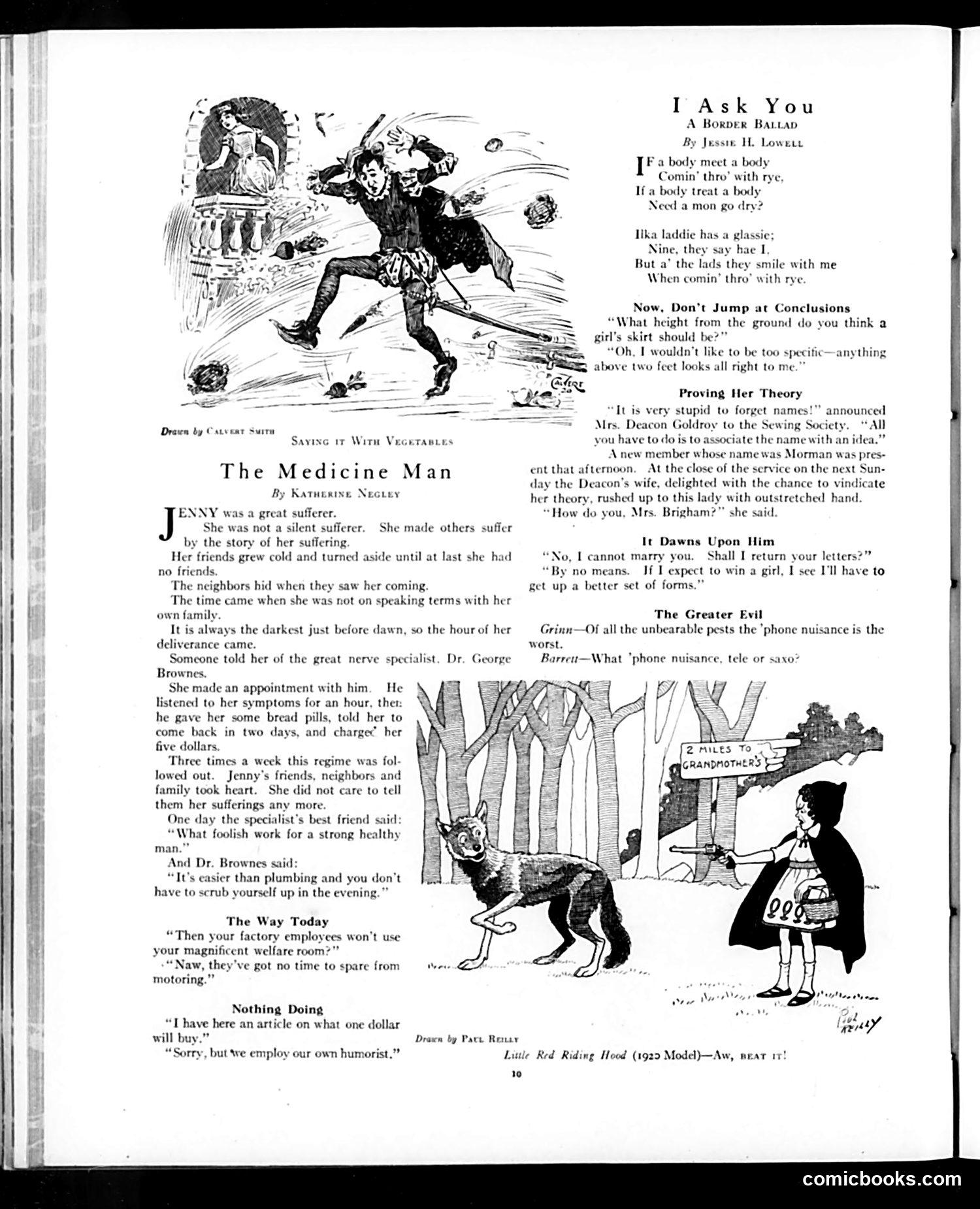
This Judge magazine page contains satirical commentary on 1920s social issues: **"I Ask You"** parodies Scottish dialect poetry, using risqué wordplay about alcohol ("rye") and dating to mock Prohibition-era hypocrisy and flirtation. **"The Medicine Man"** mocks both hypochondria and medical fraud—a woman's chronic complaining alienates everyone until a nerve specialist (Dr. Brownes) profits from her with fake "bread pills," revealing quack medicine's prevalence and cynicism. **Minor humor pieces** target period concerns: skirt lengths (1920s hemlines were controversial), Prohibition enforcement, and telephone nuisances (new technology anxieties). **"Little Red Riding Hood (1922 Model)"** shows a modern girl confidently rejecting danger, satirizing both the classic tale and changing attitudes toward young women's independence. The cartoons reflect Jazz Age anxieties about modernity, medical charlatans, technology, and women's evolving social roles.
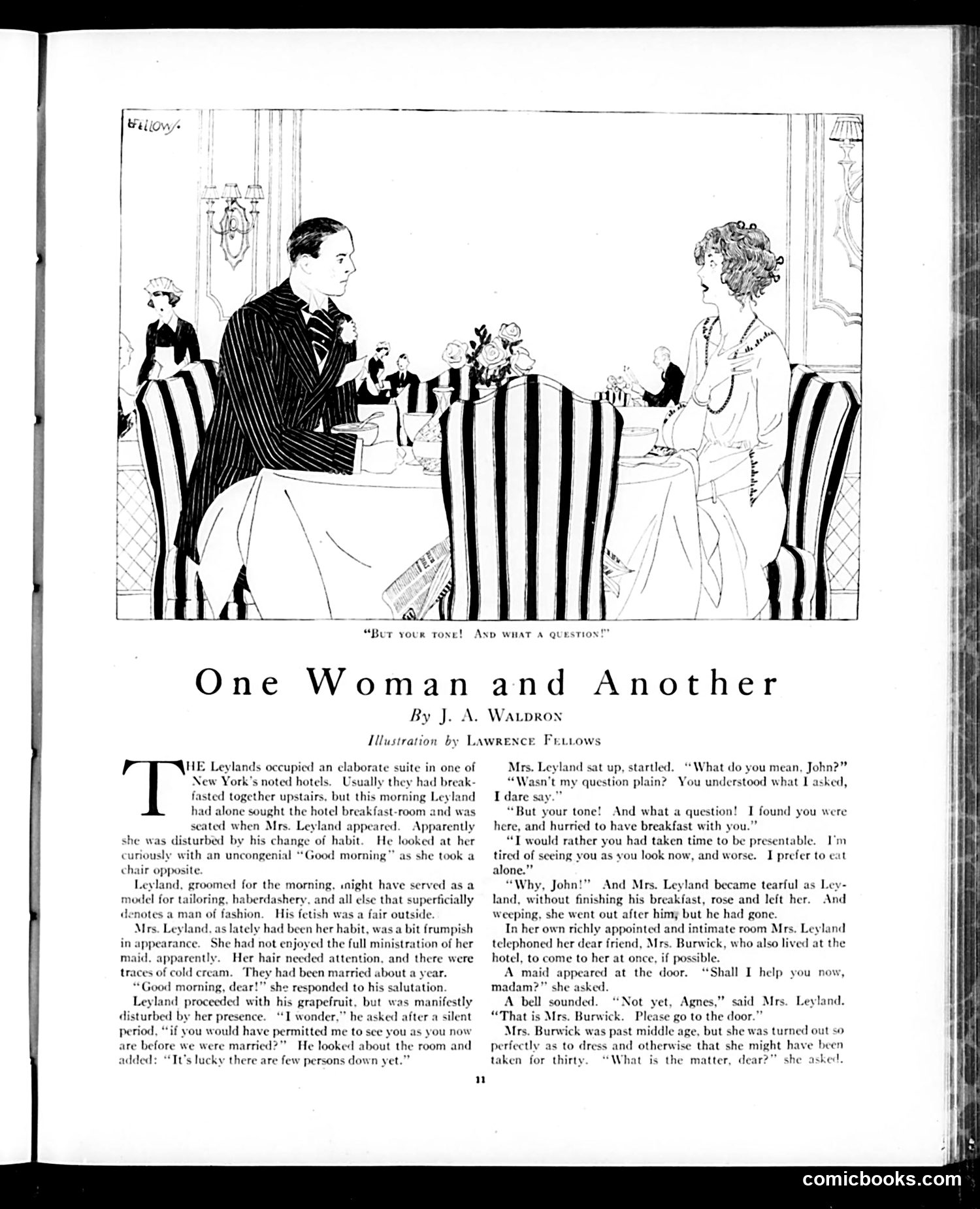
This 1920s short story with illustration satirizes changing gender dynamics in marriage. The plot shows a husband (Leyland) criticizing his wife's appearance at breakfast—she's "frumpish" with "cold cream" traces—while he remains immaculately groomed. His complaint about her looking presentable "before we were married" suggests wives' post-marital neglect of appearance. The satire cuts both ways: Leyland appears shallow and superficial (his "fetish was a fair outside"), yet the story also mocks the wife for letting her grooming slip. The cartoon's title and setup—one woman (the neglected wife) and another (her well-maintained friend Mrs. Burwick, "turned out so perfectly")—implies judgment about feminine standards. For modern readers, this reflects anxieties about wives abandoning pre-marital effort. The piece critiques both spouses: husbands for valuing appearance over substance, and wives for supposedly surrendering to domestic comfort. It's a snapshot of early 20th-century marital expectations and gender tensions.
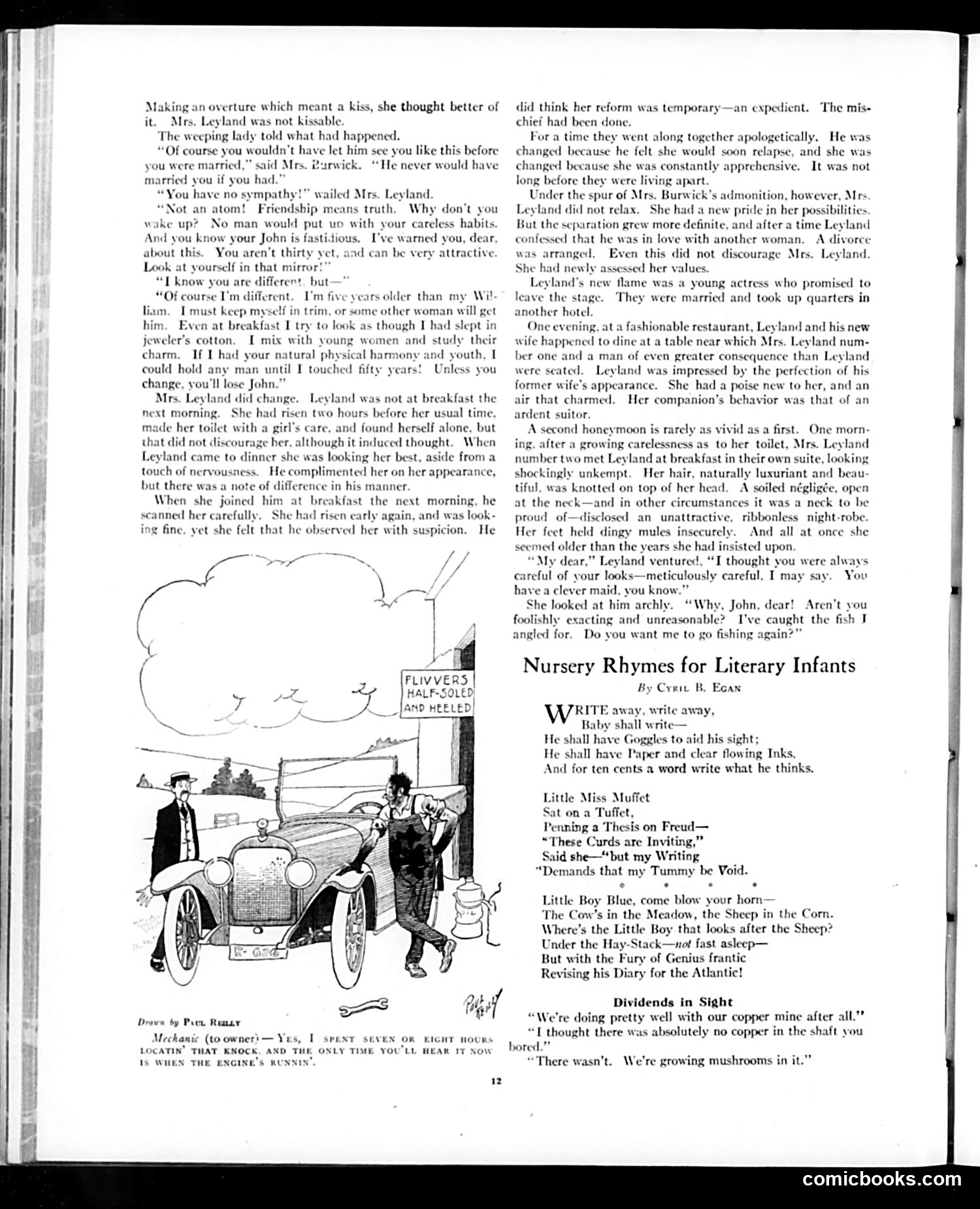
This page contains a satirical short story about marriage and female appearance, illustrated with a cartoon showing a mechanic and car owner. **The Main Story's Satire:** The narrative mocks both marital dynamics and women's self-presentation. Mrs. Leyland neglects her appearance, causing marital problems. A friend advises her to maintain attractiveness to keep her husband. She reforms temporarily, but the husband assumes it's temporary and grows suspicious anyway. Eventually they divorce. Ironically, when he remarries a younger actress who *also* becomes unkempt, he notices his ex-wife (now well-maintained with a new suitor) and regrets his choice. **The Satire's Point:** The story critiques both male fickleness and the exhausting performance women must maintain in marriage—damned if they do, damned if they don't. It suggests women's value is tied to appearance and that male attention is fickle regardless. **The Cartoon:** Shows a mechanic claiming he spent hours locating a car's knock—only audible when the engine runs. It's a classic "shaggy dog" joke about wasted effort and mechanic incompetence.
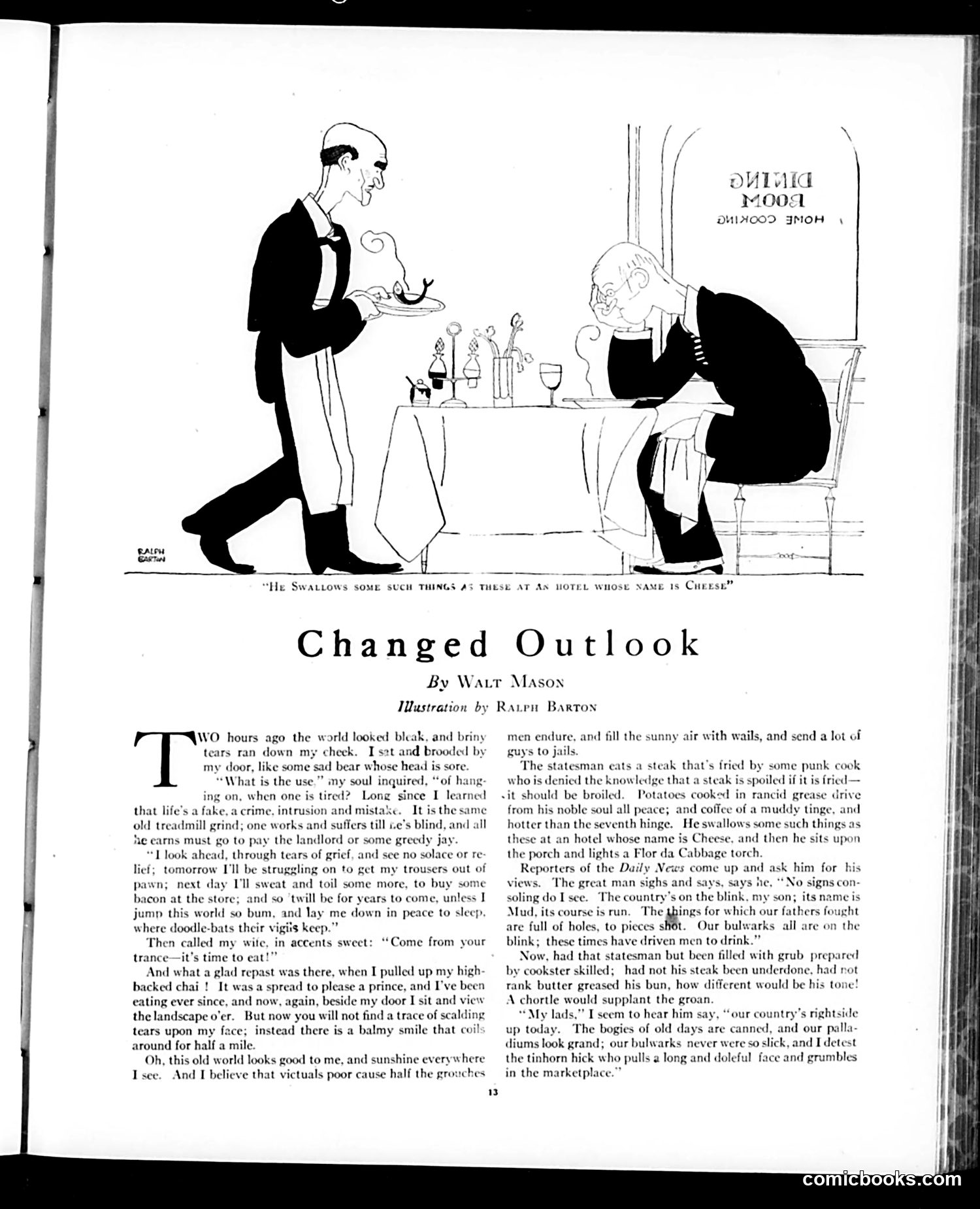
This is a humorous two-part story by Walt Mason with illustrations by Ralph Barton, not primarily political satire. **The Narrative:** A man falls into despair about life's hardships—working to pay rent, struggling in poverty. He contemplates suicide. His wife calls him to dinner, and a good meal completely transforms his mood and outlook. **The Secondary Point:** The story then pivots to mock a statesman who, despite his important position, is miserable because he eats poorly (at a hotel called "Cheese," getting underdone steak and rancid grease). This pessimistic politician tells reporters the country is ruined. The implication: if he ate well-prepared food, he'd be optimistic. **The Satire:** The joke targets both the depression-era notion that poverty breeds despair, and the idea that politicians' gloomy pronouncements about national decline stem not from actual conditions but from personal discomfort—specifically, bad digestion. It's social commentary wrapped in domestic humor: our mood and perspective depend more on comfort than circumstances.
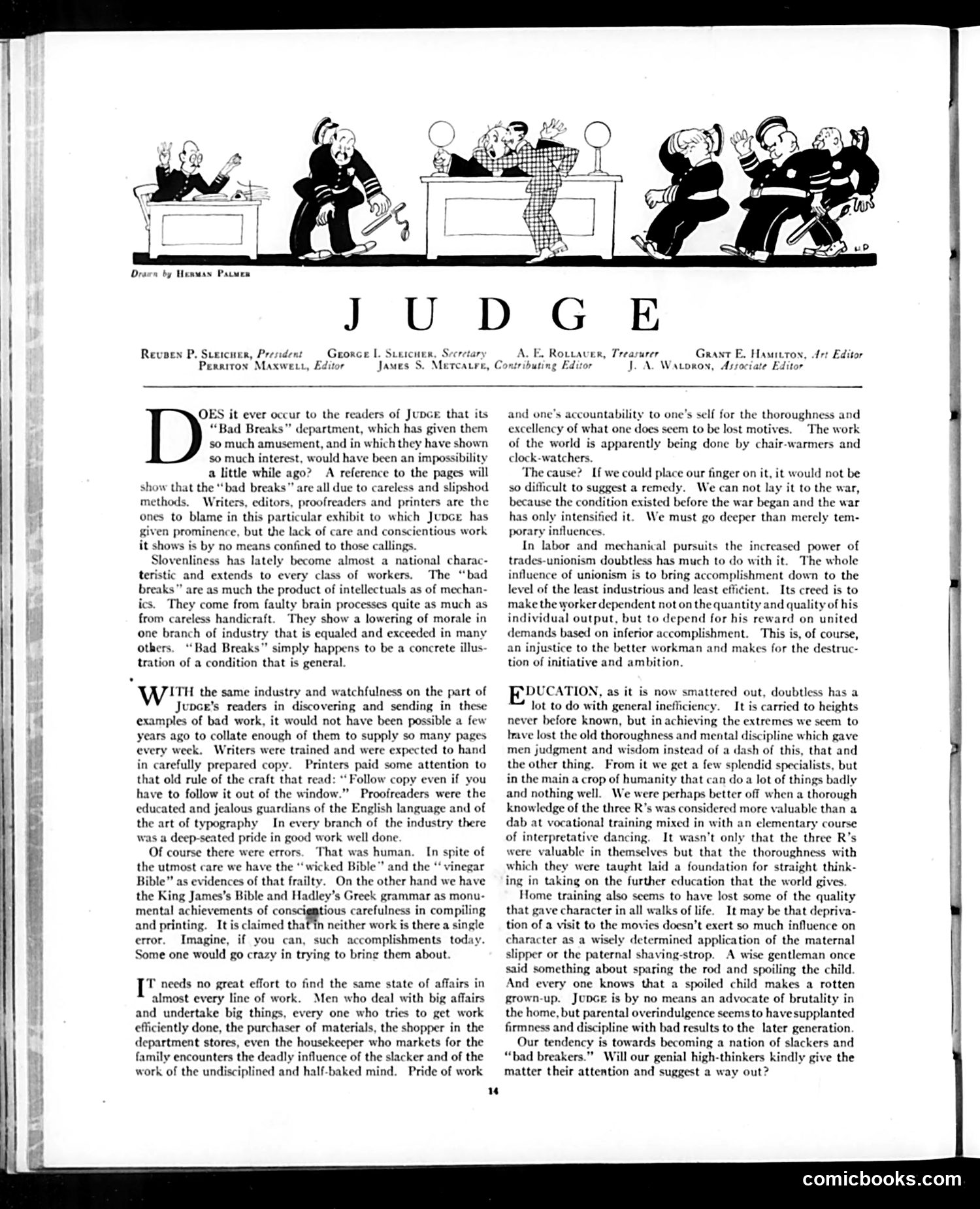
This is primarily an **editorial/opinion piece**, not a cartoon page. The small illustration at the top by Herman Palmer shows generic office and courtroom scenes depicting careless workers and poor conduct. The text criticizes widespread **slovenliness and lack of craftsmanship** in American society. The editorial laments that "bad breaks" (errors in printed materials) now provide enough material for a regular Judge department—something impossible years earlier. The author blames this decline on: - Loss of professional pride and discipline across all industries - **Trade unionism**, which allegedly drags standards down to the least efficient worker - General moral decline affecting intellectuals and laborers equally The piece argues this predates World War I (though the war has "intensified" it) and references historical examples of meticulous printing (King James Bible) versus modern carelessness. The underlying message reflects **conservative anxiety about labor organizing and modern work culture**, framing unionization as destructive to quality and individual accountability.
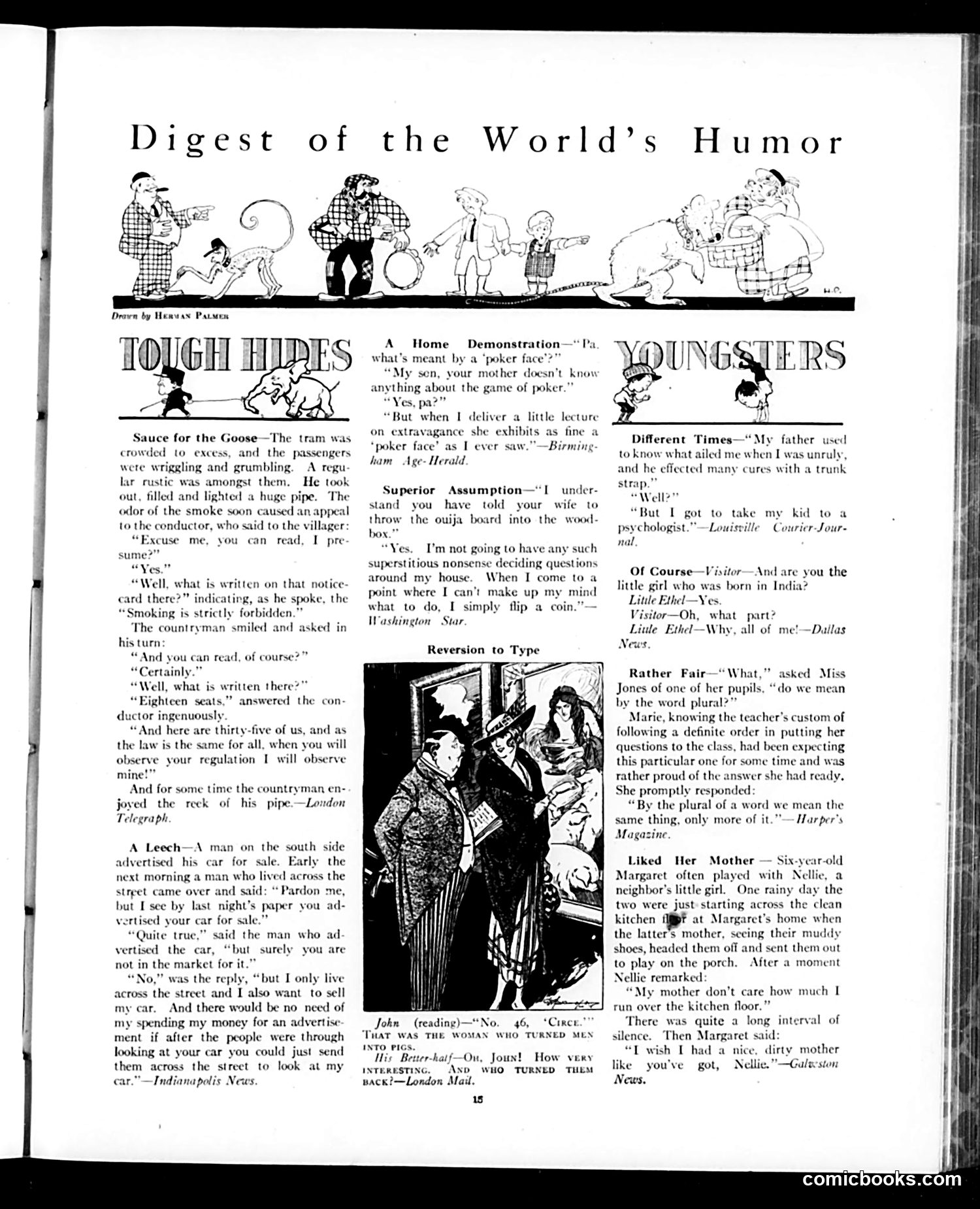
This page collects brief humorous anecdotes typical of early 20th-century American humor magazines. The jokes reflect period social attitudes and concerns: **Key themes:** - **Class/rural mockery**: "Sauce for the Goose" depicts a rustic villager outwitting an urban conductor—a common trope playing on supposed country simpleton stereotypes. - **Gender roles**: "Superior Assumption" and "A Home Demonstration" joke about wives and their supposed superstitions or extravagance—reflecting contemporary attitudes about women's irrationality. - **Discipline nostalgia**: "Different Times" contrasts old-fashioned trunk-strap punishment with modern psychology, suggesting masculine concern about softening parental authority. - **Domestic humor**: "Liked Her Mother" depicts a child preferring a less strict neighbor, playing on anxieties about parenting standards. The illustration at top, drawn by Herman Palmer, shows generic comedic characters. Overall, this represents mainstream 1920s-era humor emphasizing social hierarchies, gender stereotypes, and nostalgic masculinity.
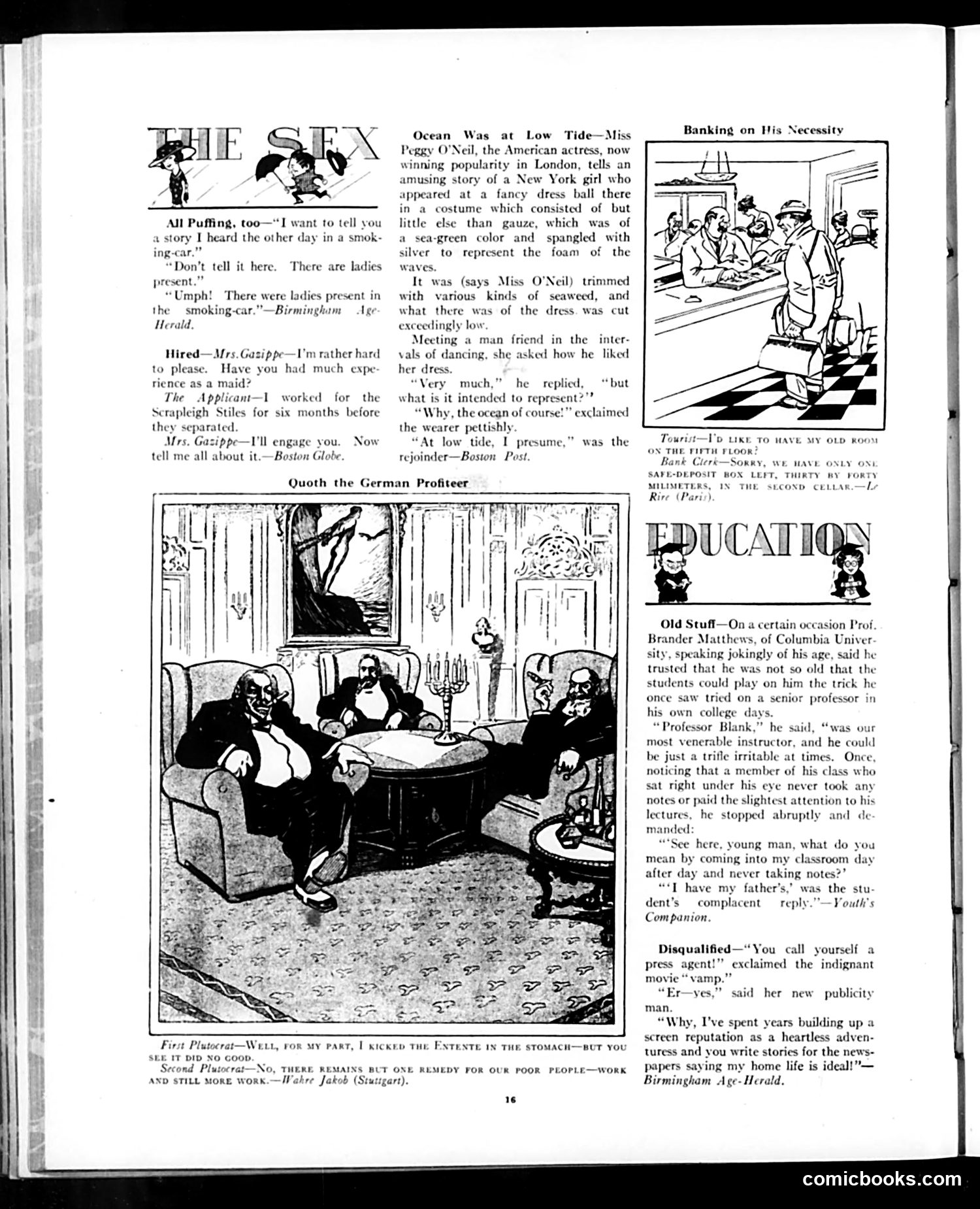
This cartoon satirizes German economic policy during World War I. Two wealthy German industrialists (plutocrats) discuss their nation's war efforts. The first says he "kicked the Entente in the stomach"—referring to Germany's military aggression against the Allied powers (Britain, France, Russia). The second responds that while the attack failed ("it did no good"), there's "one remedy for our poor people—work." The satire targets German leadership's response to war: rather than admit military failure or economic hardship, they blame workers and demand increased labor. It's an American publication mocking German wartime propaganda that portrayed sacrifice and work as solutions to problems caused by failed military strategy. The cartoon reflects American-Allied sentiment during WWI, portraying German elites as callous and delusional about their nation's prospects.
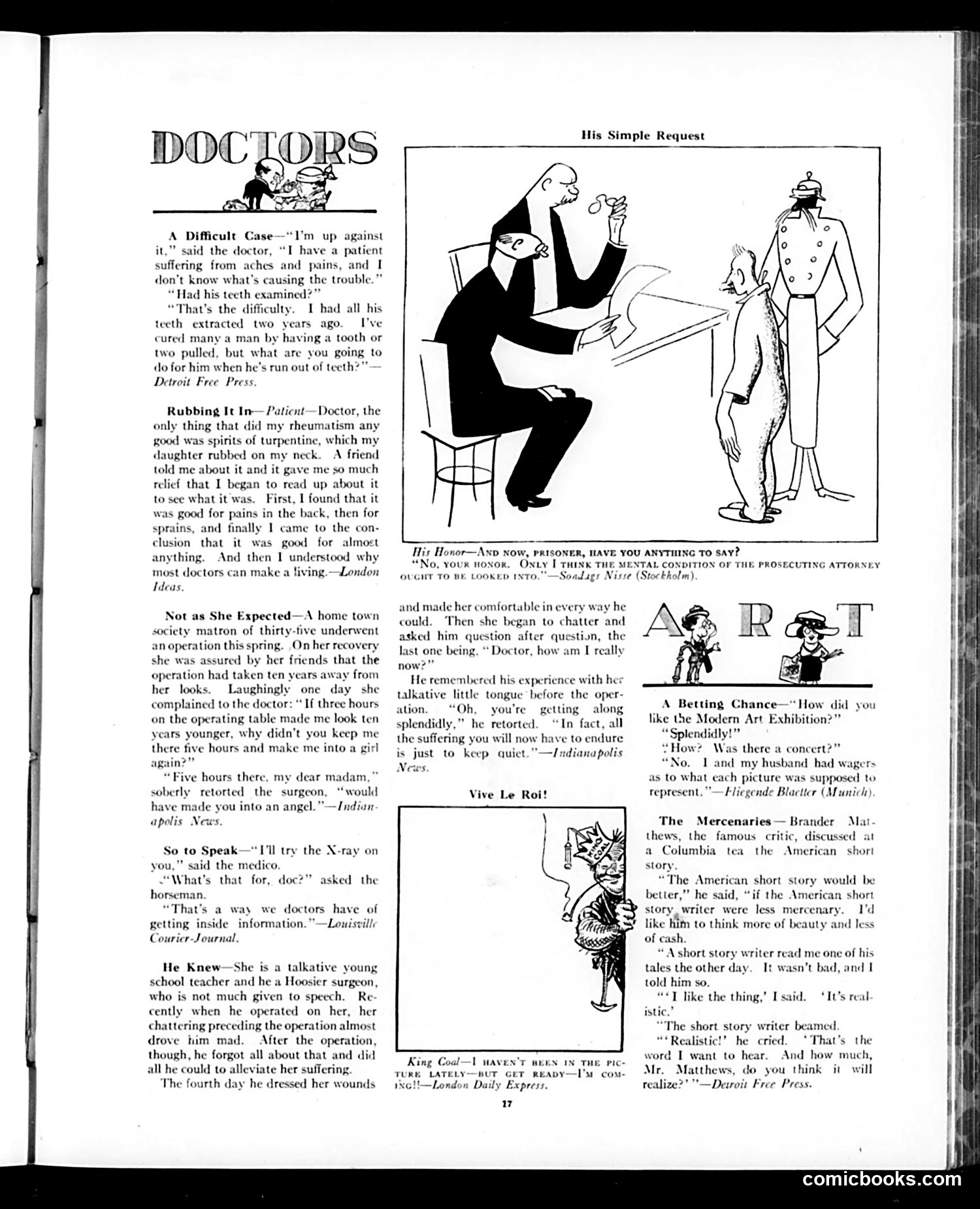
This Judge magazine page collects humorous anecdotes about doctors and medical practice, reflecting early 20th-century attitudes toward healthcare. **Key jokes:** - **"A Difficult Case"**: Satirizes over-extraction of teeth as a cure-all remedy. Doctors pulled teeth for various ailments, but the practice became absurd when patients ran out of teeth. - **"He Knew"**: A talkative female schoolteacher is silenced post-surgery by a taciturn surgeon who tells her to stay quiet to avoid suffering—dark humor about controlling women's speech. - **"His Simple Request"**: A prisoner requests only that a prosecutor's mental state be "looked into," implying the prosecutor is mentally unfit. - **"The Mercenaries"**: Critic Brander Matthews laments American writers prioritize profit over artistic beauty. A writer's only concern about his story is its commercial value, not its quality. The cartoons mock medical quackery, gender dynamics, and literary commercialism of the era.
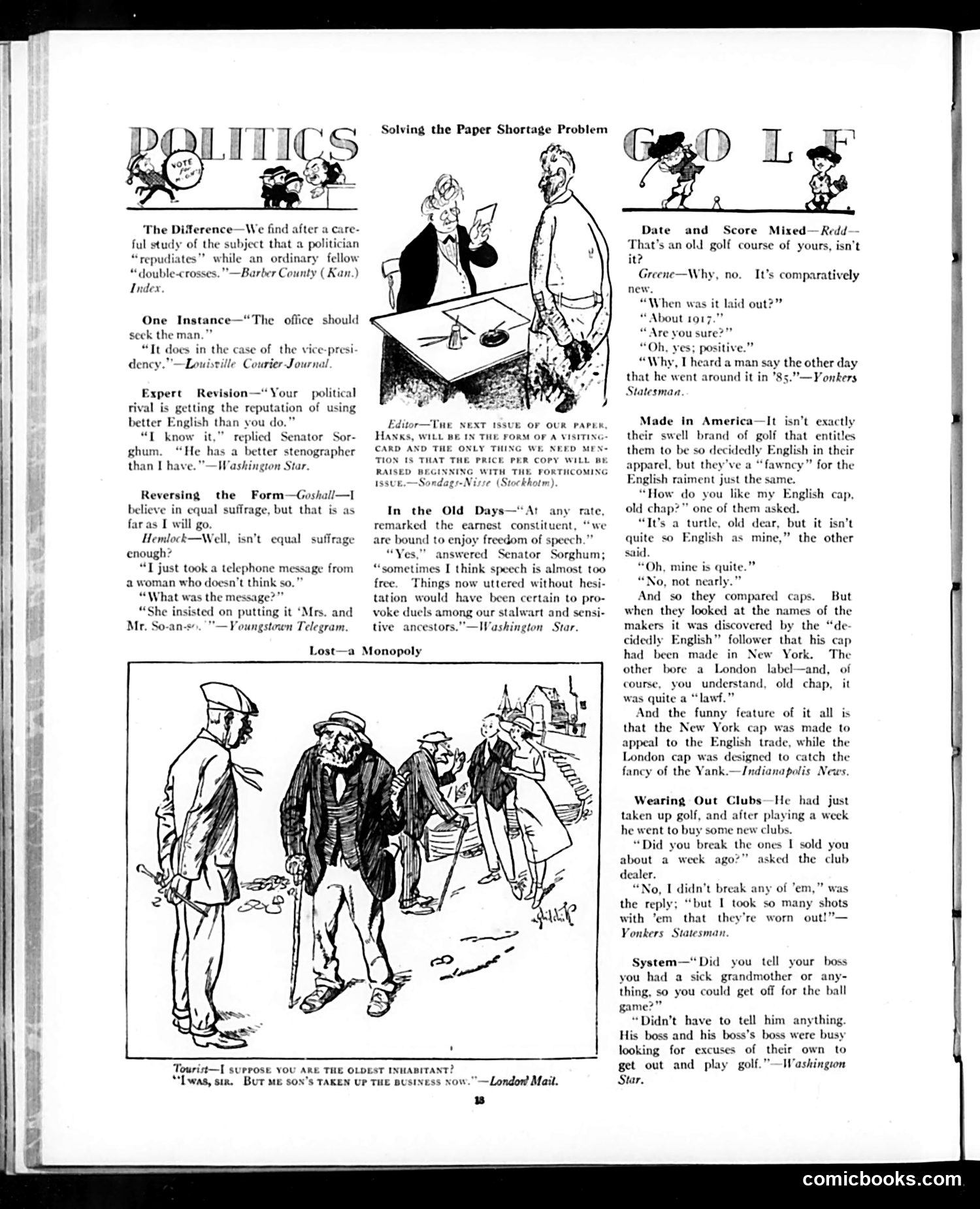
This Judge magazine page from approximately 1917-1920 contains brief satirical items mocking American politicians and social pretensions. **Political humor** targets Senator Sorghum (a generic politician name) on his poor English and stenographer dependence, and critiques free speech advocates who simultaneously regret ancestors' dueling culture. A Vice President quip suggests incompetence. **Social satire** ridicules: American anglophilia (people buying English-branded caps actually made in New York while Londoners buy American-made caps labeled London); newlyweds obsessing over marital etiquette; and the paper shortage (editors joking they'll shrink the publication to visiting-card size). **Golf humor** dominates the right side—confusion about course age, worn-out clubs from overuse, and bosses skipping work for golf. The overall thrust: American social climbers aping English fashion, politicians lacking substance, and golf's grip on all social classes. The cartoons use visual caricature and working-class dialogue to mock pretension and modern absurdities.
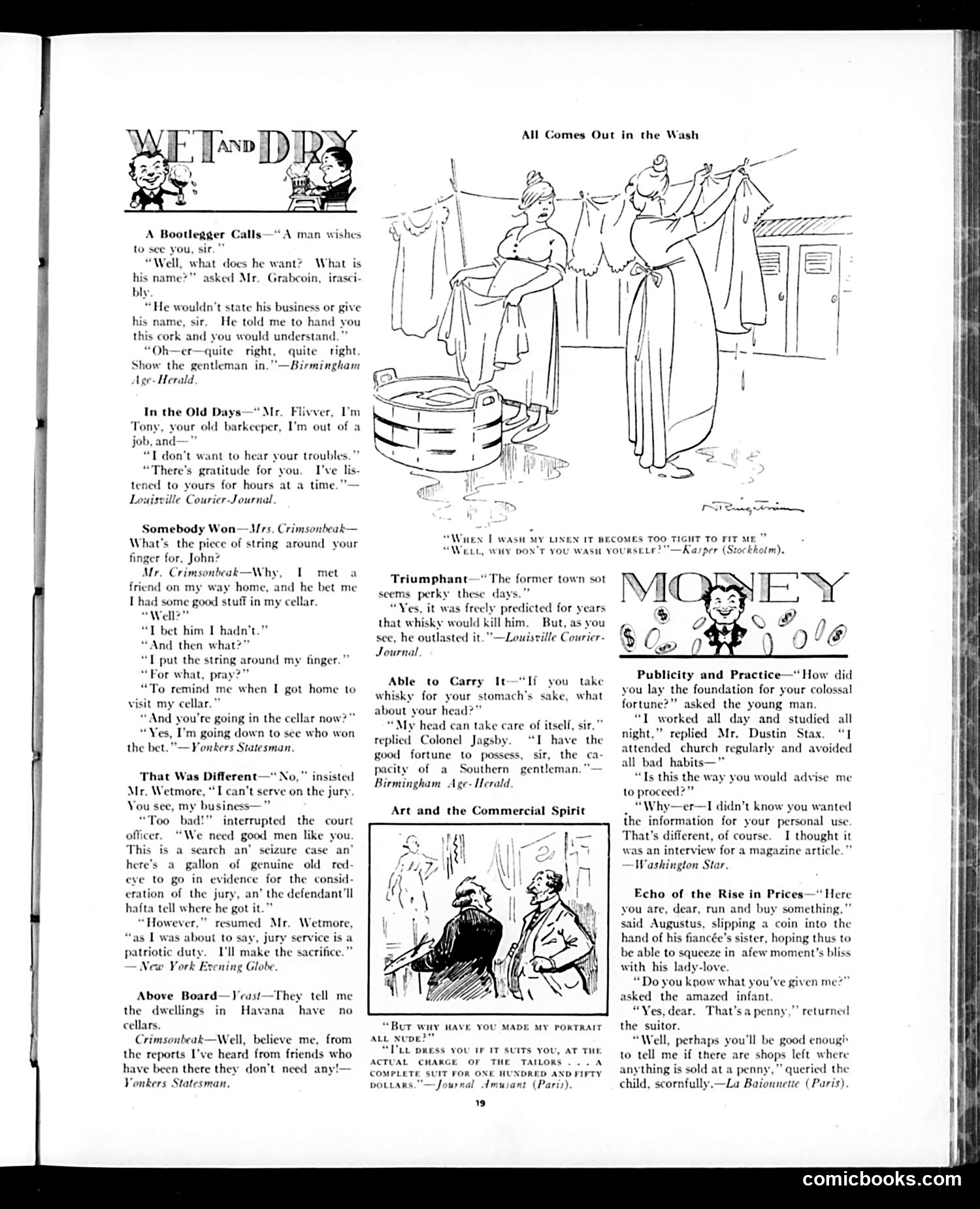
This page collects short humorous anecdotes satirizing Prohibition-era America and post-WWI economic conditions. **Key targets:** - **Bootlegging** ("A Bootlegger Calls"): Mocks how widespread illegal alcohol sales had become—a businessman casually receives a bootlegger using coded language (a cork). - **Prohibition hypocrisy** (multiple pieces): Characters hide alcohol in cellars and justify drinking, suggesting widespread law-breaking among respectable citizens. - **Jury corruption** ("That Was Different"): A man refuses jury duty citing business conflicts, then eagerly accepts when alcohol is offered as evidence—satirizing how Prohibition enforcement was compromised. - **Post-war inflation** ("Echo of the Rise in Prices"): A father gives his child a penny for shopping, but the child notes nothing costs that little anymore—commenting on severe price increases following WWI. The cartoons collectively portray Prohibition as unenforceable and widely ignored by ordinary Americans, while highlighting economic hardship from inflation.
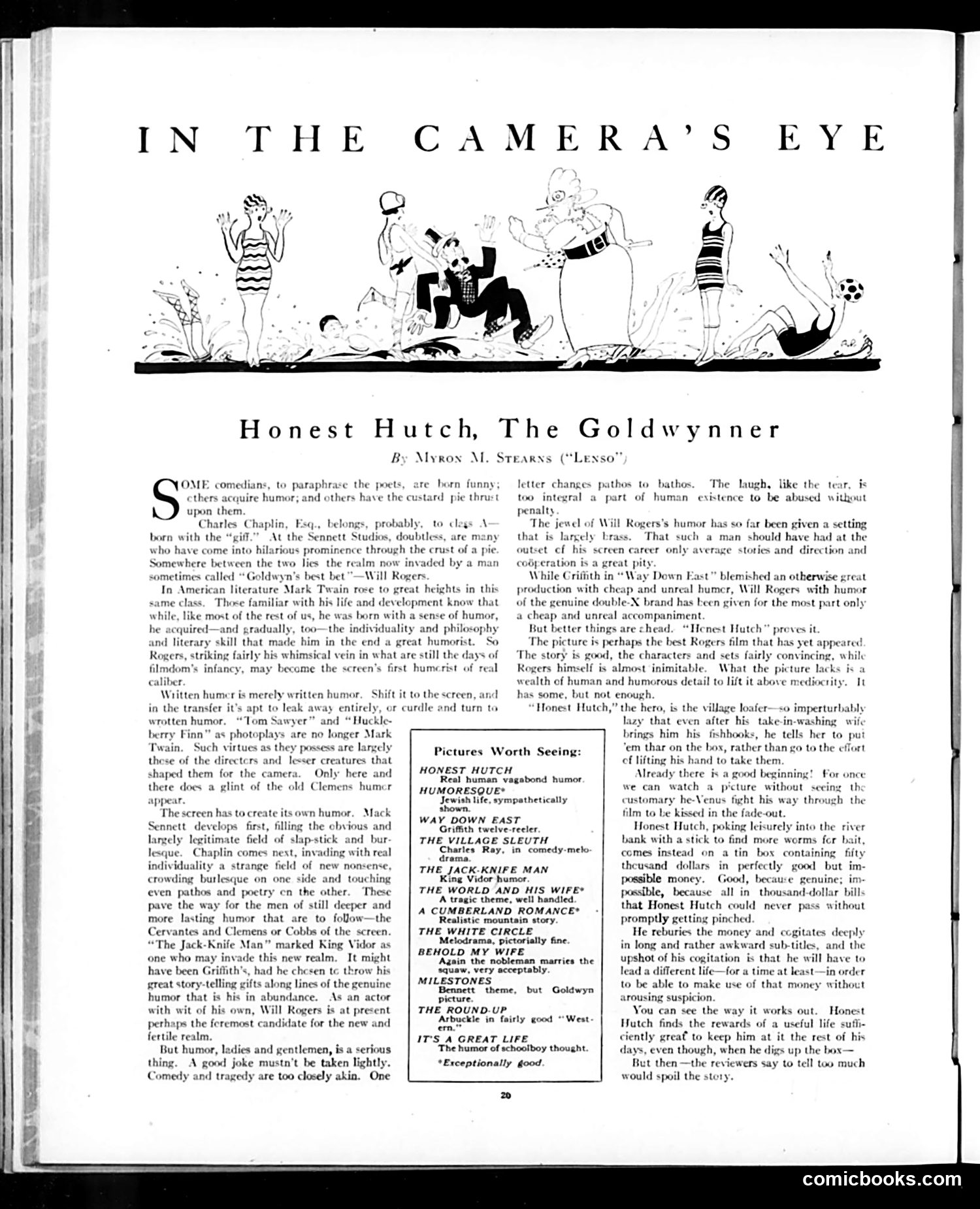
This is a film review by Myron M. Stearns praising Will Rogers's new picture "Honest Hutch." The article compares Rogers to Charles Chaplin and Mark Twain, arguing Rogers possesses genuine written humor that translates successfully to screen—unlike most comedians whose wit gets lost in adaptation. The cartoon header illustrates the film's premise: Rogers plays a village loafer so lazy he won't even pick up fishing hooks his wife brings him. The surrounding vignettes show typical slapstick and physical comedy scenes. The review's main point: while Rogers's earlier Goldwyn films suffered from cheap plots and poor direction, "Honest Hutch" finally provides worthy material matching his talent. The film succeeds because its story and characters are "fairly convincing," though the reviewer notes it still lacks the rich human detail that would elevate it beyond mediocrity. The article positions Rogers as potentially becoming cinema's greatest humorist—a serious literary figure rather than mere slapstick performer.
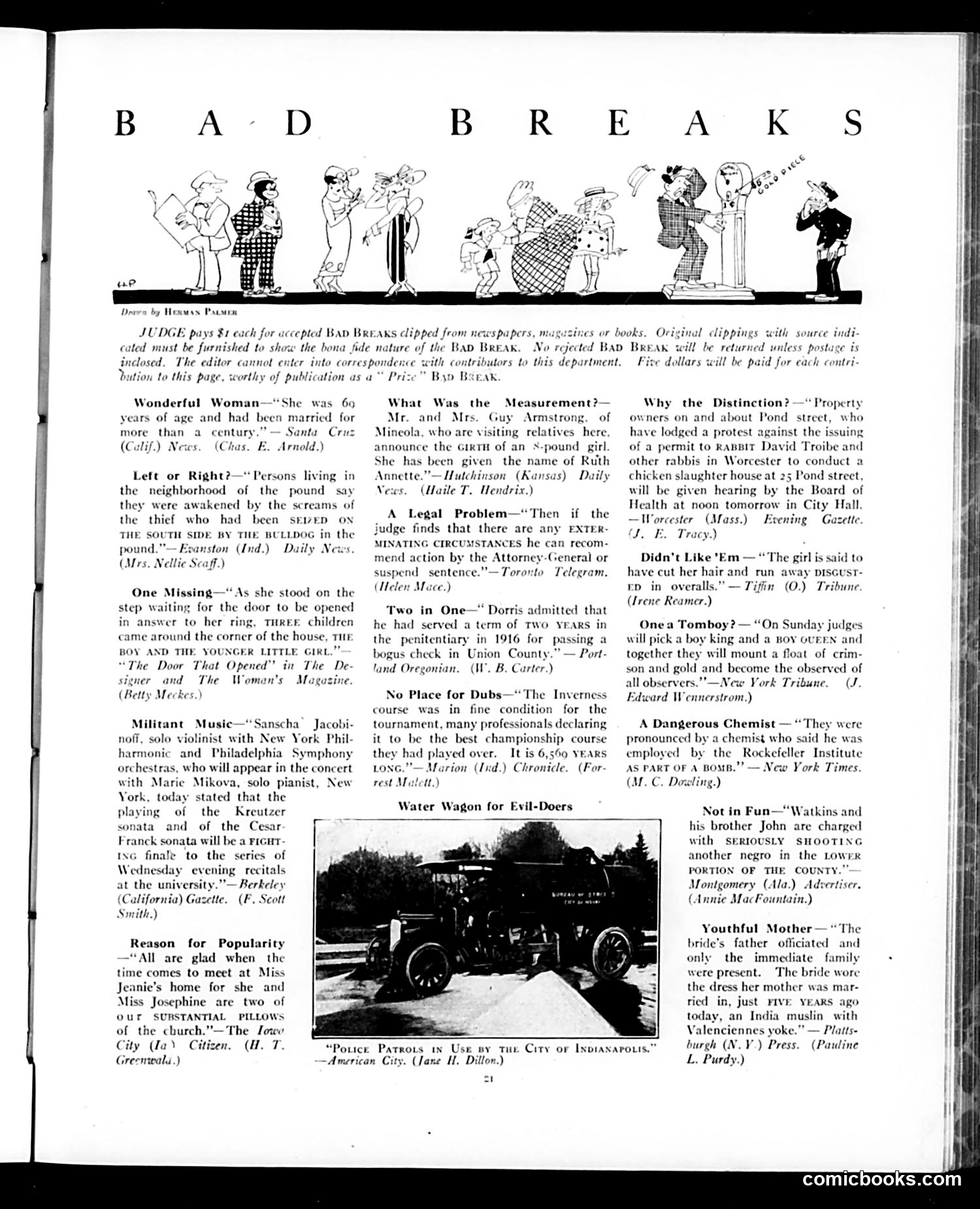
This page features Judge magazine's "Bad Breaks" column—a humor feature purchasing amusing newspaper clippings readers submitted ($1 per accepted item). The cartoons above the column depict various everyday mishaps and absurdities. The content consists of brief, humorous "mistakes" clipped from actual newspapers, highlighting unintentionally funny passages. For example: a woman who'd been married "more than a century"; a theft alarming "the south side by the bulldog in the pound"; a chemist allegedly employed "as part of a bomb." The humor relies on the innocent absurdity of these real newspaper errors—double meanings, logical impossibilities, or grammatical confusion that created unintended comedy. This was early 20th-century consumer-generated content, where readers scanned publications for material Judge's editors deemed funny enough to print and pay for. The column represents satirical journalism's lighter side, mocking not public figures but everyday media's humorous gaffes.
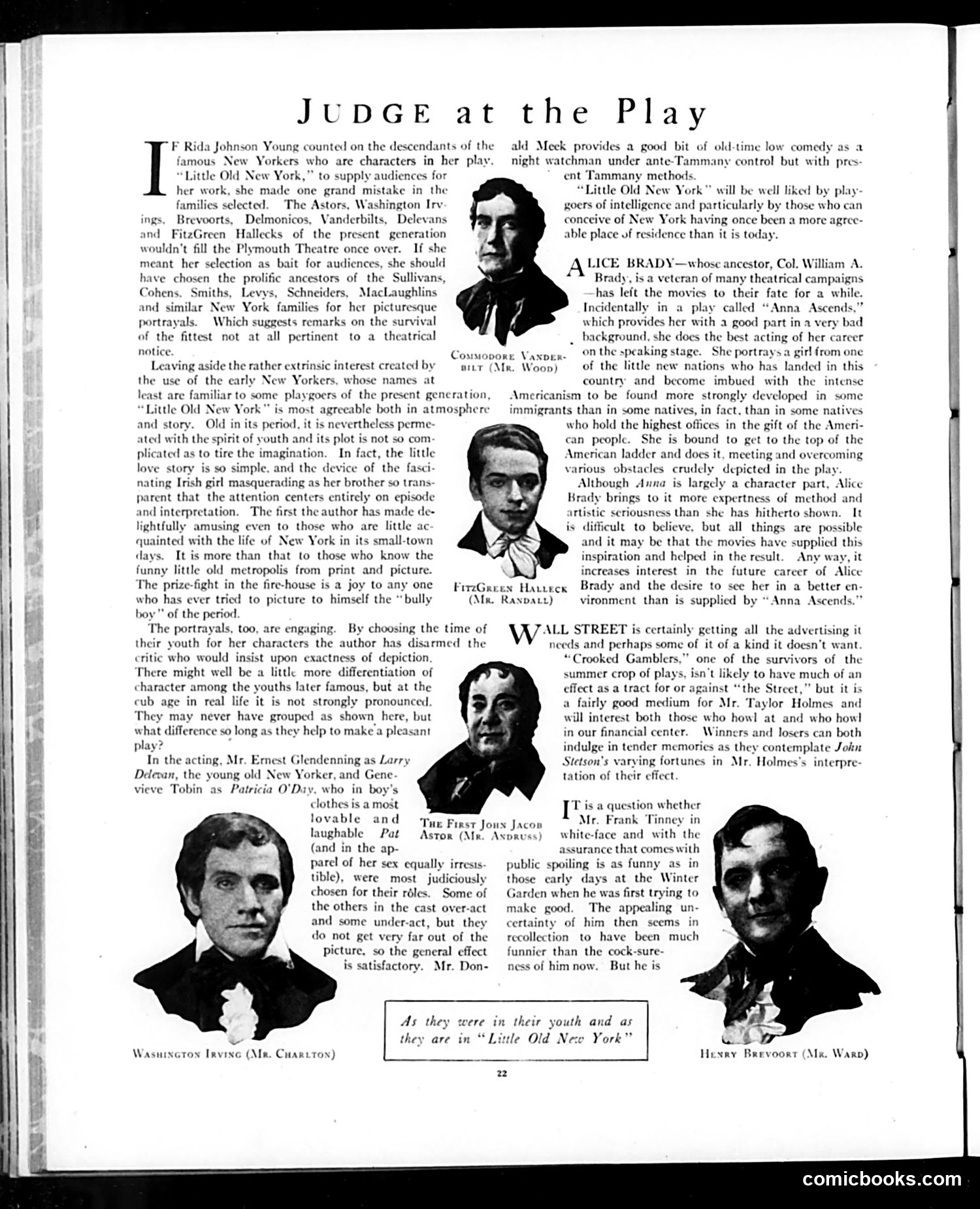
This is a theater review page from *Judge* magazine critiquing "Little Old New York," a stage play by Rida Johnson Young. The review is illustrated with headshots of cast members. The satire targets the playwright's casting choices. Young apparently sought to attract wealthy audiences by casting descendants of famous old New York families (Astors, Vanderbilts, Brevoorts), but the critic suggests she should have instead featured descendants of working-class Irish, Jewish, and immigrant families (Sullivans, Cohens, Levys, Schneiders) who actually comprised old New York's population. This mocks the play's historical inauthenticity while jabbing at both the playwright's commercial calculation and New York's class hierarchies. The review itself praises the simple plot, the charming performances (particularly Genevieve Tobin as Patricia O'Day), and the play's nostalgic recreation of early New York street life. The critic appreciates the work despite its social pretensions.
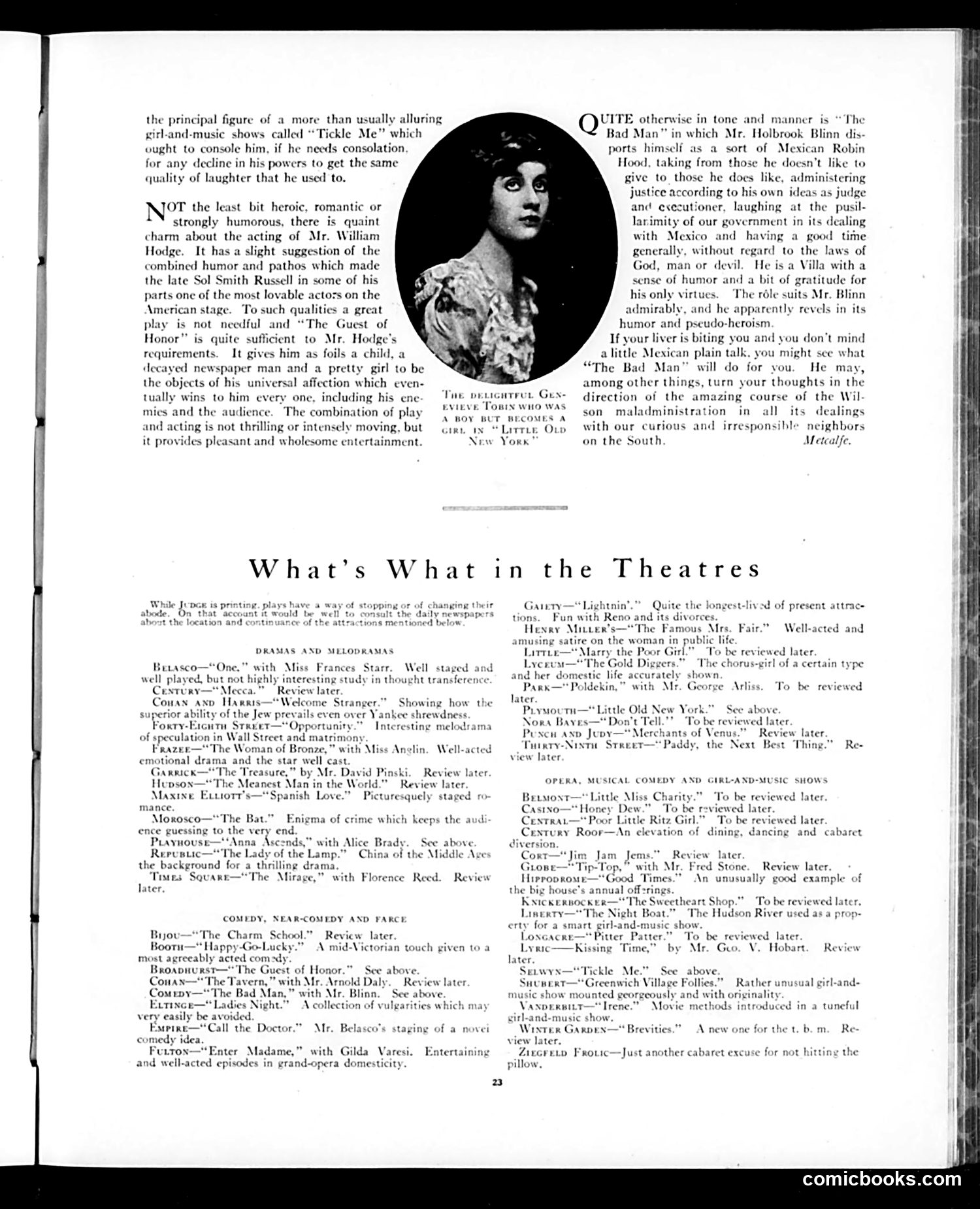
This page reviews **"The Bad Man,"** a theatrical production starring Holbrook Blinn. The satire targets the **Wilson administration's foreign policy toward Mexico**—a major contemporary controversy. The review characterizes Blinn's character as a "Mexican Robin Hood" who dispenses vigilante justice while mocking the U.S. government's perceived weakness ("pusillanimity") in dealing with Mexico. The critic sarcastically suggests the play might "turn your thoughts in the direction of the amazing course of the Wilson maladministration." This references real tensions: the Mexican Revolution (1910-1920) created border instability, and President Wilson's Mexico policy—initially non-interventionist, later militaristic—was widely debated. The play apparently exploited public frustration with government impotence, positioning an outlaw antihero as more effective than official channels. The accompanying photograph shows the "delightful Genevieve Tobin," the female lead. The satire appeals to audiences who found entertainment in critiquing government incompetence through popular theater.
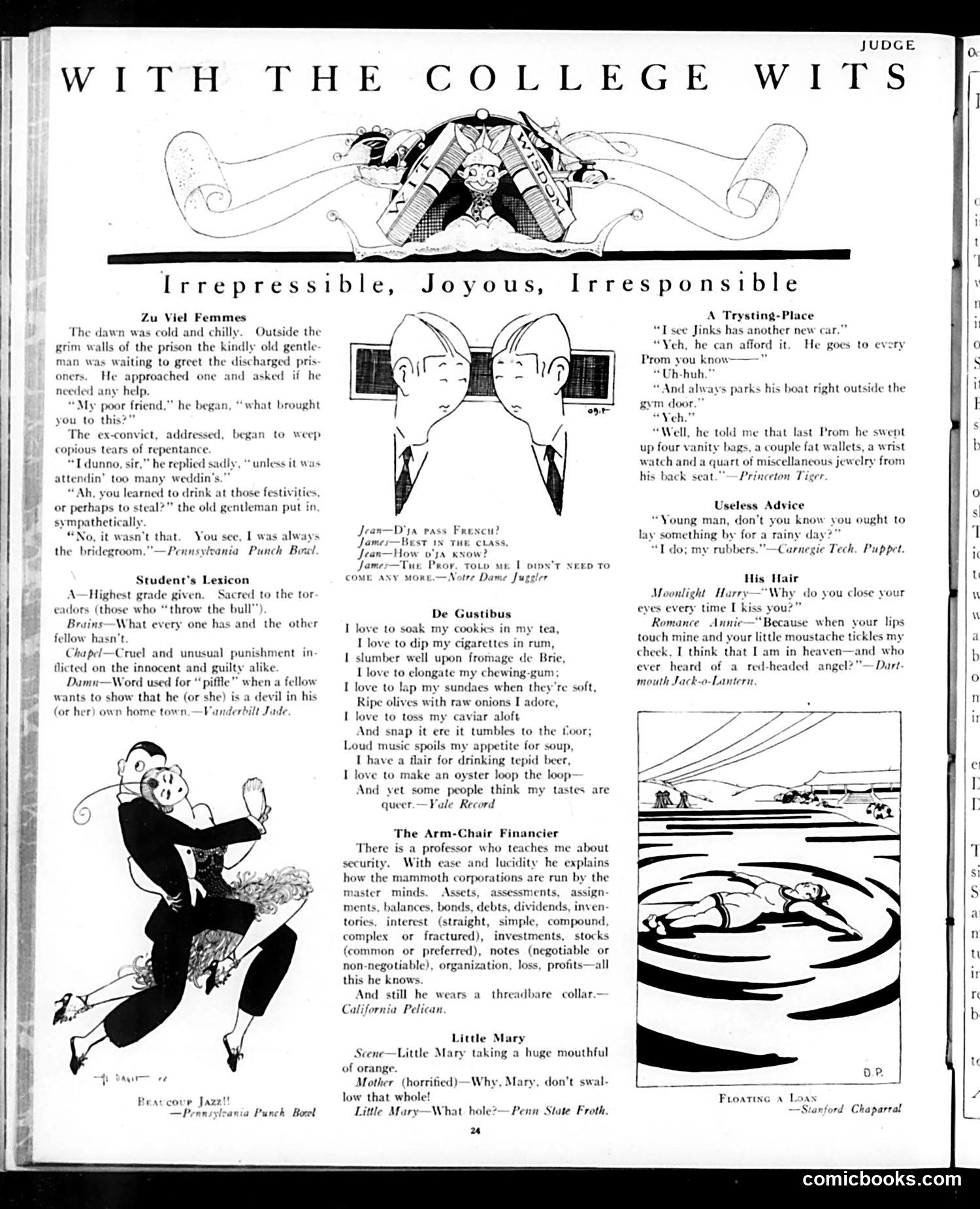
This page collects humorous pieces targeting college life and student culture circa the 1920s. Key features: **"Zu Viel Femmes"** satirizes a reformed convict who admits he attended "too many weddin's" as a bridegroom—the joke being he married repeatedly, apparently for money or theft opportunities. **"Student's Lexicon"** mocks college slang and behavior through mock definitions (e.g., "Chapel" as "cruel punishment," "Damn" as affectation of devilry). **"De Gustibus"** ridicules affected/pretentious tastes—someone claims bizarre food combinations aren't "queer" (odd). **"The Arm-Chair Financier"** lampoons a professor who fluently discusses complex finance while wearing shabby clothing—exposing the gap between intellectual posturing and actual prosperity. Other pieces joke about student romance, theft at proms, and childish logic. The overall message: college students are pretentious, morally questionable, and their sophistication is performative rather than genuine. The satire targets upper-class collegiate culture's superficiality.
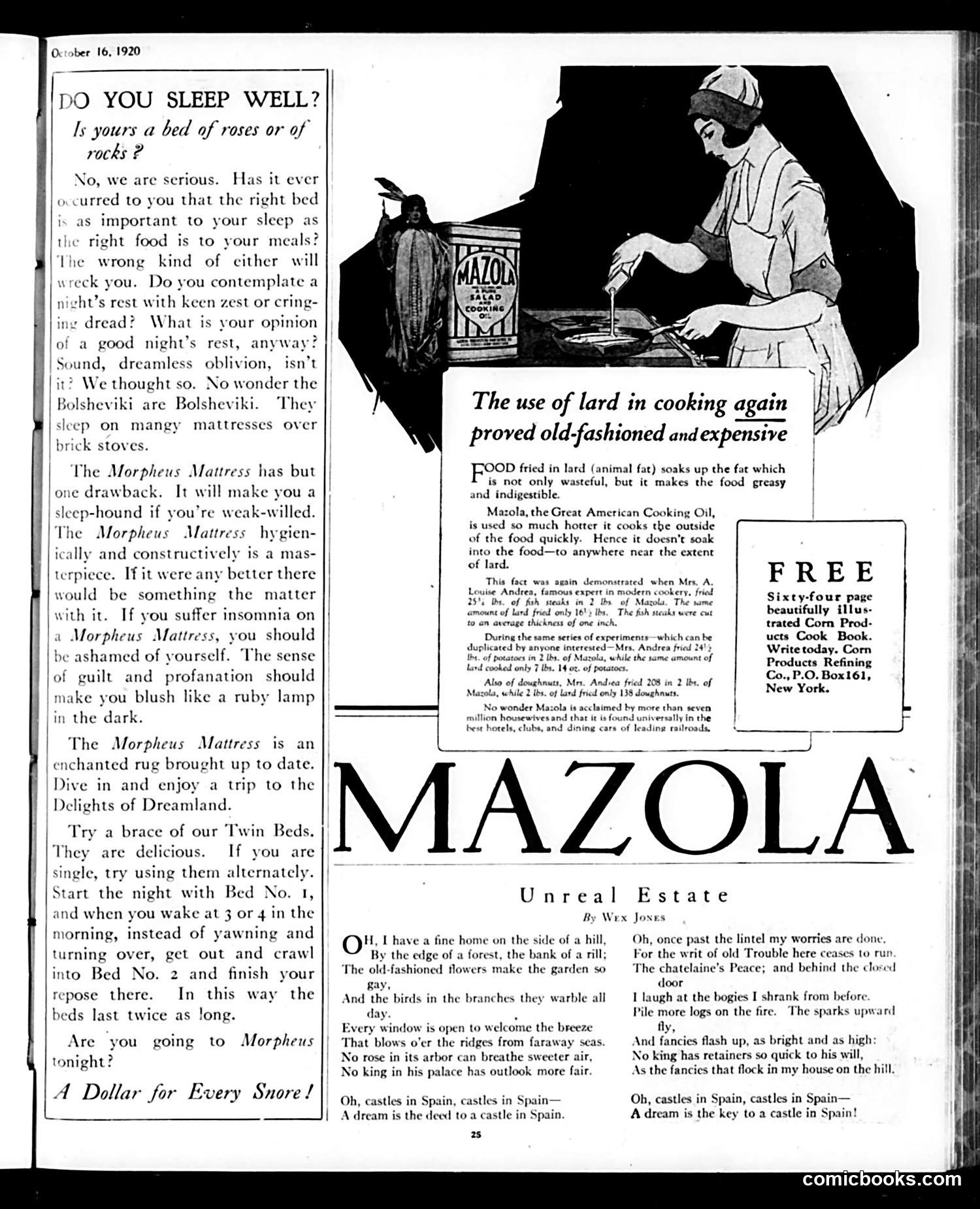
This page is primarily **advertisements** mixed with light editorial content, not political satire. The **Morpheus Mattress ad** (left) includes a jab at Bolsheviks—then a contemporary Cold War anxiety—sarcastically noting they "sleep on mangy mattresses over brick stoves," implying Soviet conditions are inferior to American comfort. This reflects 1920s anti-communist sentiment following the Russian Revolution (1917). The **Mazola cooking oil ad** (center-right) demonstrates product superiority through a cooking expert's experiments, showing Mazola fries more food with less oil than lard—a practical efficiency argument for modern American housewives. The **"Unreal Estate" poem** (bottom) is whimsical verse about an idealized dream home—escapist fantasy rather than satire. Overall, this is a typical 1920s magazine page mixing commercial advertising with casual anti-communist references and lifestyle content, rather than pointed political commentary.
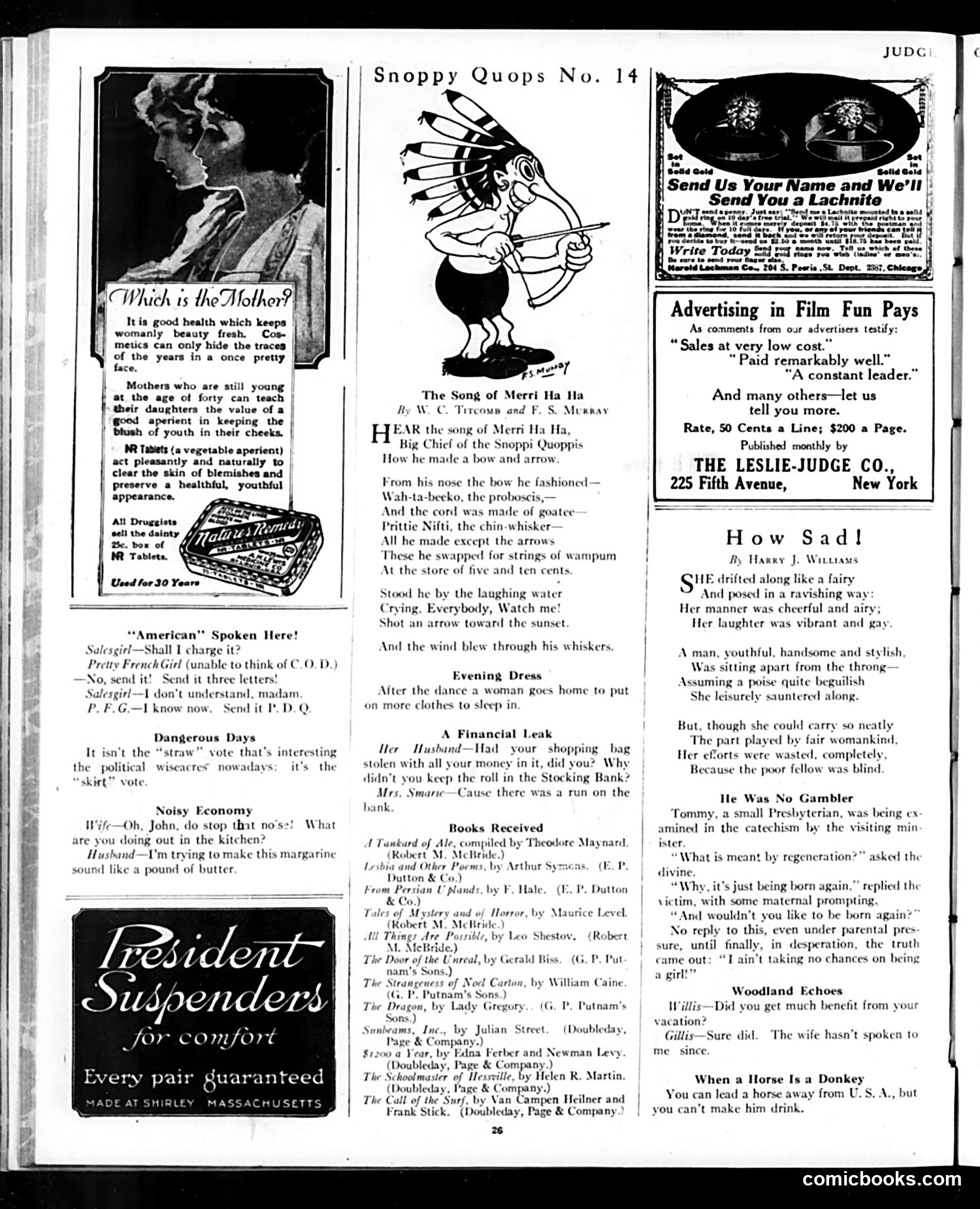
This page from *Judge* magazine contains several short satirical pieces typical of early 20th-century American humor: **"Which is the Mother?"** is an advertisement disguised as social commentary, suggesting that good health (achieved through their product, MR Tablets) keeps women young-looking better than cosmetics—a pitch targeting women's anxieties about aging. **"American Spoken Here!"** mocks French immigrants' difficulty with English through a pun: a French salesgirl misunderstands "C.O.D." (cash on delivery) as abbreviations to spell out letter-by-letter. **"Dangerous Days"** and **"Noisy Economy"** are brief jokes about women's newfound political power (the "skirt vote"—women's suffrage was recent) and domestic penny-pinching during economically uncertain times. **"Snoppy Quops"** is whimsical nonsense verse about a Native American caricature, typical of the era's casual stereotyping. The remaining pieces are light domestic humor and a book review section. The page is primarily advertising and filler content.
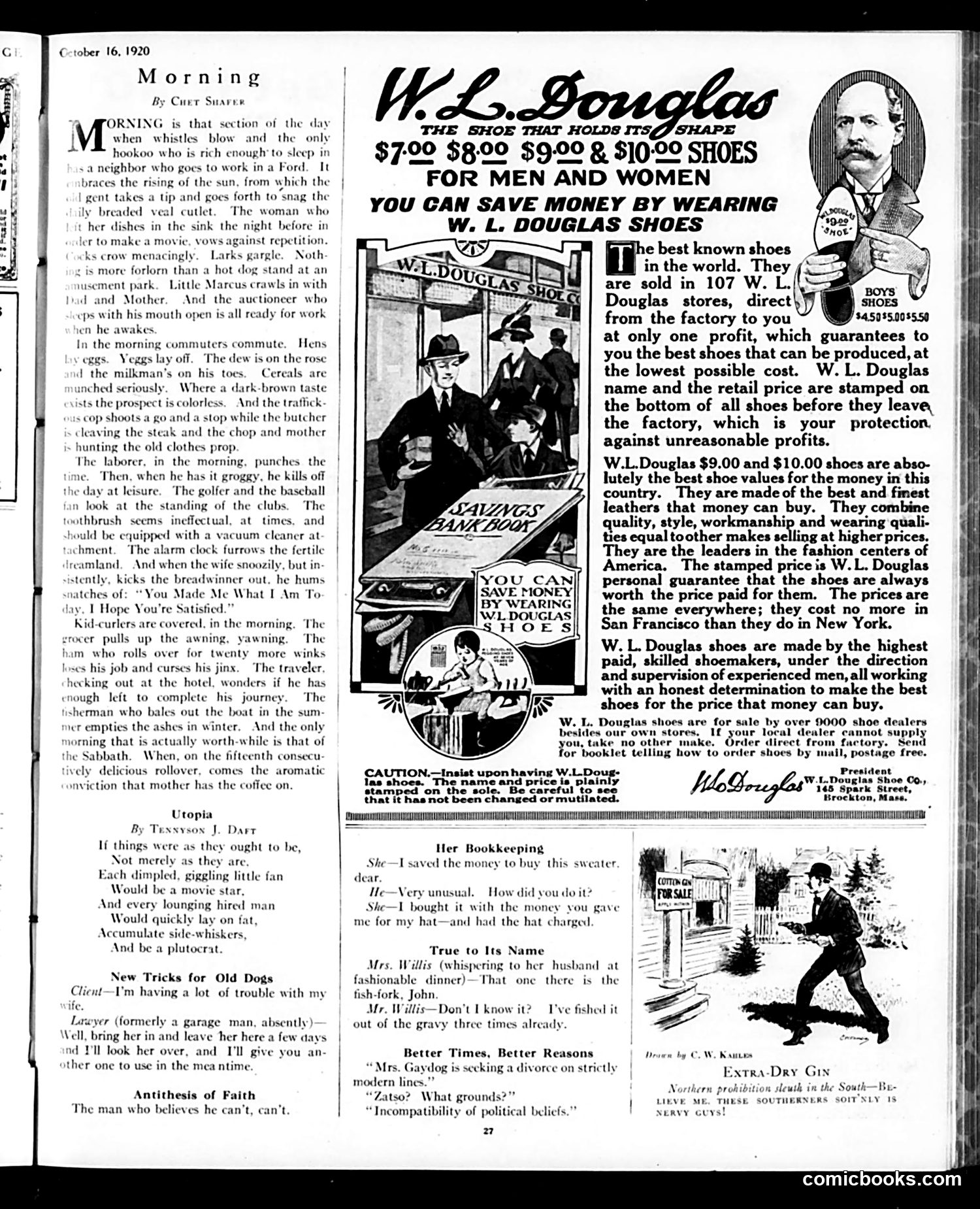
This page is primarily **advertising** for W.L. Douglas shoes, occupying the majority of the space. The ad emphasizes direct factory-to-consumer sales and price transparency—key marketing messages for the era. The editorial content consists of three brief humor pieces: **"Morning"** by Curt Shafer is a whimsical sketch of daily working-class routines—commuters, laborers, housewives—depicting ordinary people's early starts with gentle mockery. **"Utopia"** by Tennyson J. Darr is light satirical verse about an inverted world where working people become wealthy ("plutocrats"). **Brief jokes** include a lawyer who formerly worked as a mechanic offering marital "repairs" (contemporary humor about professional status), and a woman's bookkeeping excuse. The page reflects 1920 concerns: class mobility, labor routines, and consumerism. The advertising dominates, suggesting the magazine relied heavily on commercial revenue. No major political figures or events are satirized on this particular page—it's largely lifestyle humor and commerce.
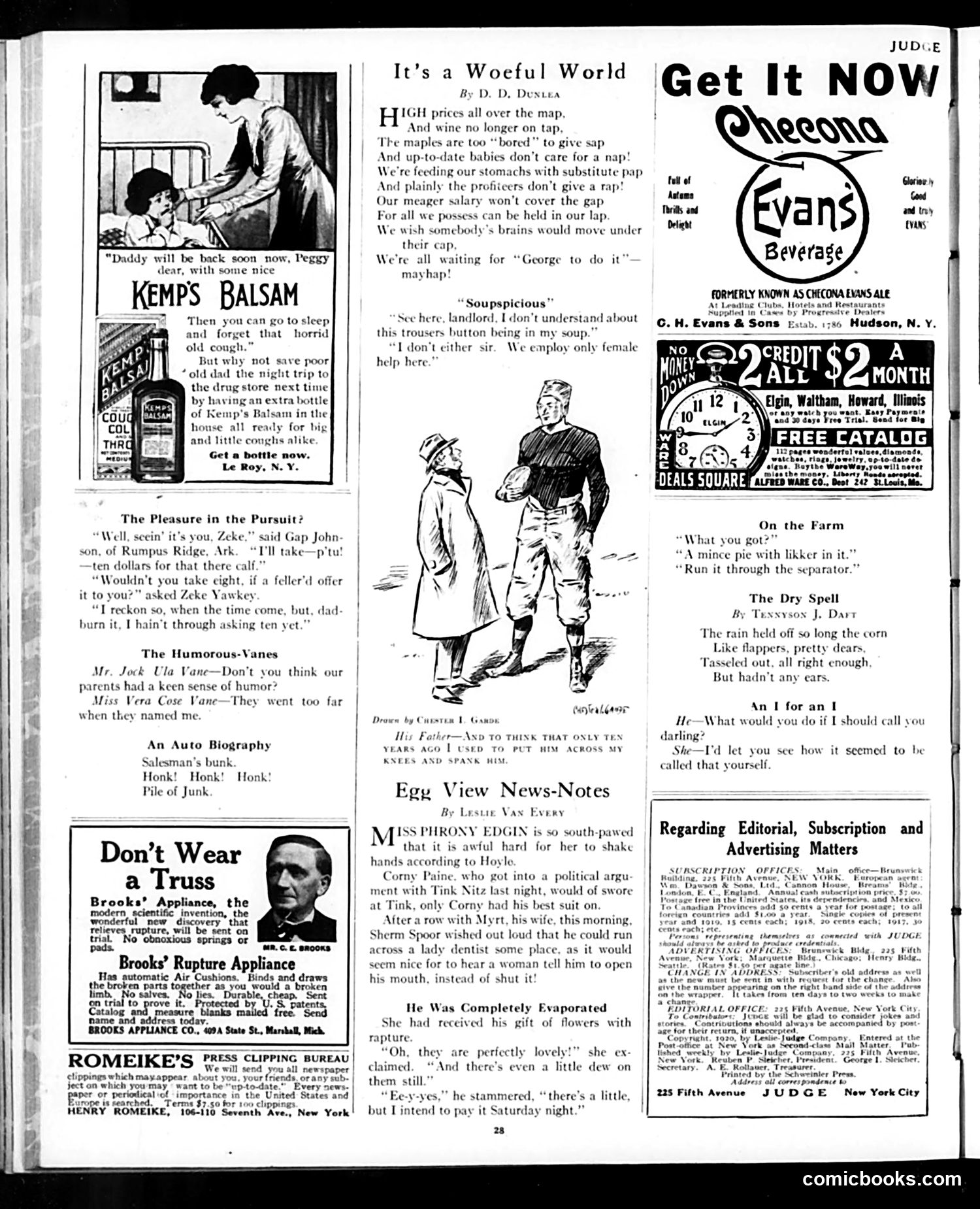
This page from *Judge* magazine is primarily **advertising and humor content**, not political cartoons. Key pieces: **"It's a Woeful World"** - A poem satirizing post-WWI economic hardship: high prices, food rationing ("substitute pap"), meager wages, and profiteering. References "George" (likely Prime Minister Lloyd George) as hoped-for solution. **Visual jokes** include puns on names ("Vera Cose Vane"/"very close vein") and rural humor ("The Pleasure in the Pursuit" features dialect-heavy haggling over a calf). **The advertisements** sell patent medicines and appliances now considered dubious—Kemp's Balsam for coughs, Brooks' Rupture Appliance for hernias—reflecting early 20th-century medical marketing practices. The **"Egg View News-Notes"** section offers brief social observations, including one about a left-handed woman struggling with handshake etiquette. Overall, this reflects economic anxiety of the 1920s-30s mixed with period-typical advertising and gentle domestic humor.
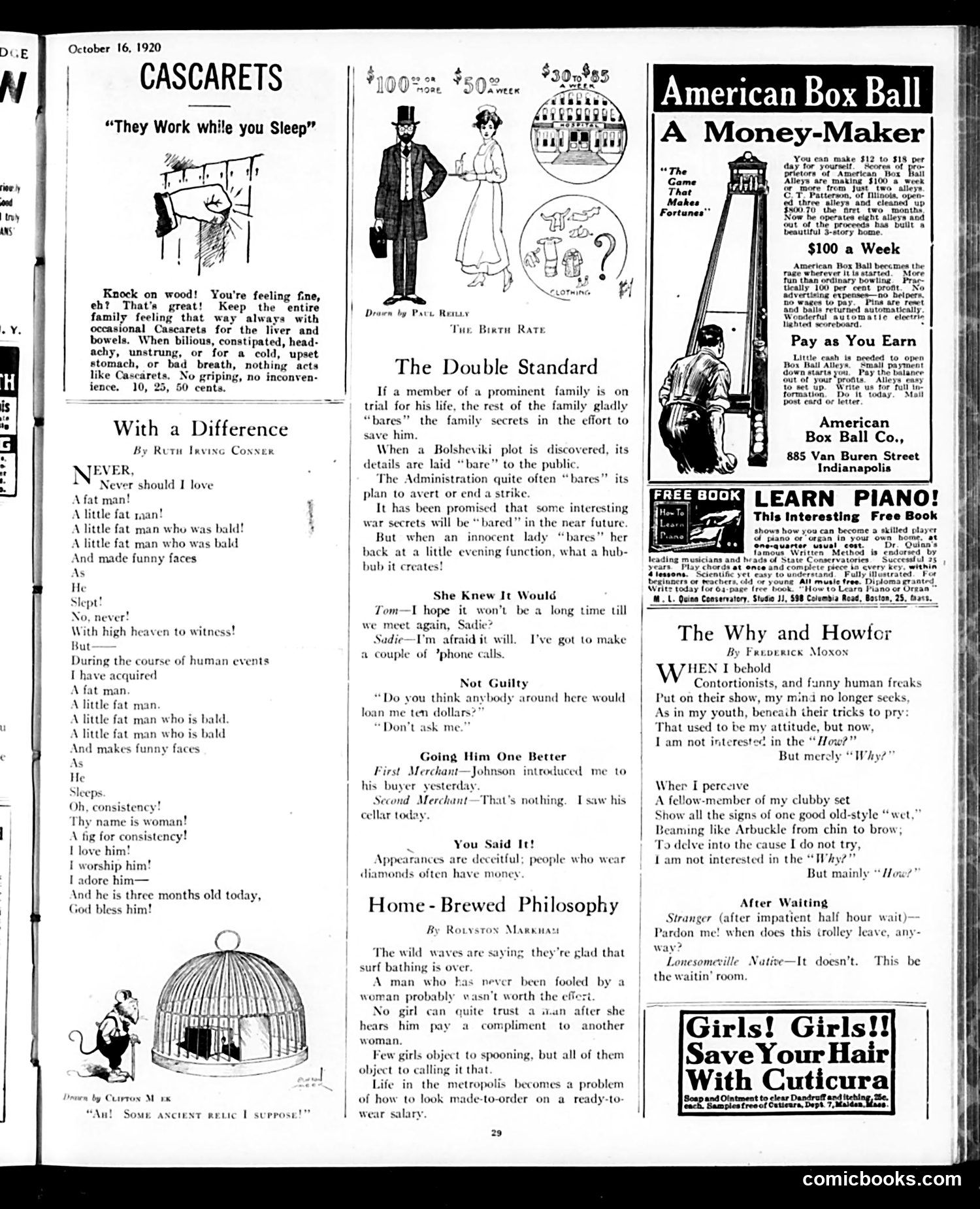
This page contains mostly **advertisements and light humor pieces** rather than political satire. The notable content includes: **"With a Difference"** by Ruth Irving Conner — a humorous poem about a woman who swore never to love a bald, fat man who makes funny faces, but then has a three-month-old son fitting that exact description. The joke plays on the contradiction between pre-motherhood declarations and post-motherhood reality. **"The Double Standard"** — satirizes hypocrisy about exposure. The piece notes that society readily "bares" family secrets to save lives, government secrets during strikes, and war secrets—yet society scandalized by an innocent woman displaying her back at an evening function. This likely references 1920s debates over women's fashion becoming less modest. **"Home-Brewed Philosophy"** offers cynical observations on modern life and relationships. The advertisements dominate: Cascarets laxative, American Box Ball (bowling alleys as business opportunity), and a free piano instruction book. These reveal what 1920 consumers were being marketed to. No major political figures or events are caricatured on this page.
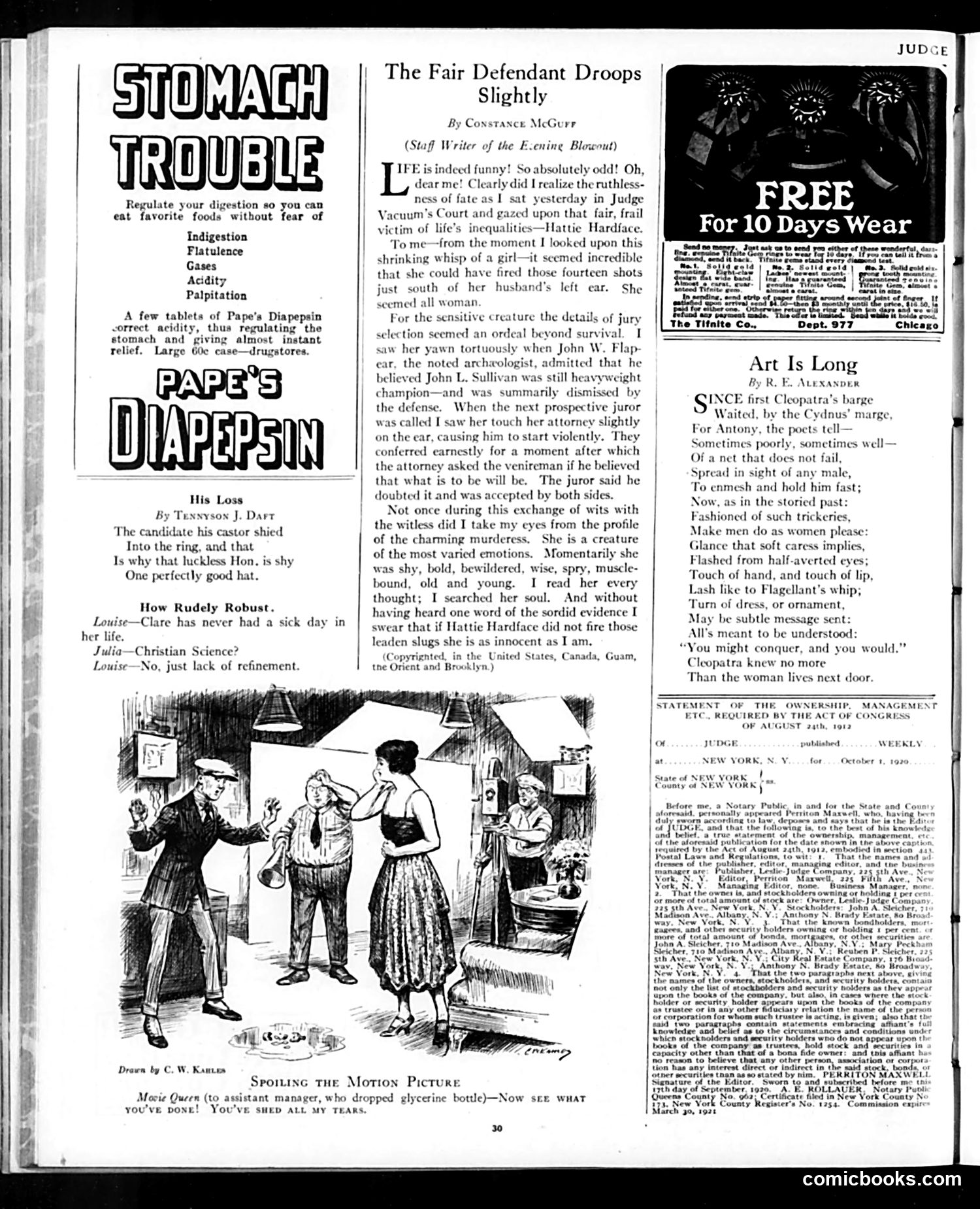
This page contains several satirical pieces typical of early-20th-century American humor: **"The Fair Defendant Droops Slightly"** is a courtroom satire. A female defendant named Hattie Hardface—apparently accused of shooting her husband—is described with mock-sympathy as a "shrinking wisp of a girl," despite having allegedly fired "fourteen shots" at him. The satire mocks courtroom sentimentality and jurors' susceptibility to a defendant's appearance and demeanor over evidence. The narration ironically claims innocent conviction based purely on her emotional expressions during jury selection. **"Spoiling the Motion Picture"** is a brief visual gag about early film production, showing a movie queen's emotional manipulation—she's upset an assistant dropped her glycerin bottle (used to simulate tears on camera), sarcastically claiming he's "shed all my tears." **"Art Is Long"** is a poem comparing Cleopatra's seductive powers to those of ordinary modern women, suggesting feminine manipulation is timeless. The page is primarily satirical content with period advertisements for digestive aids.
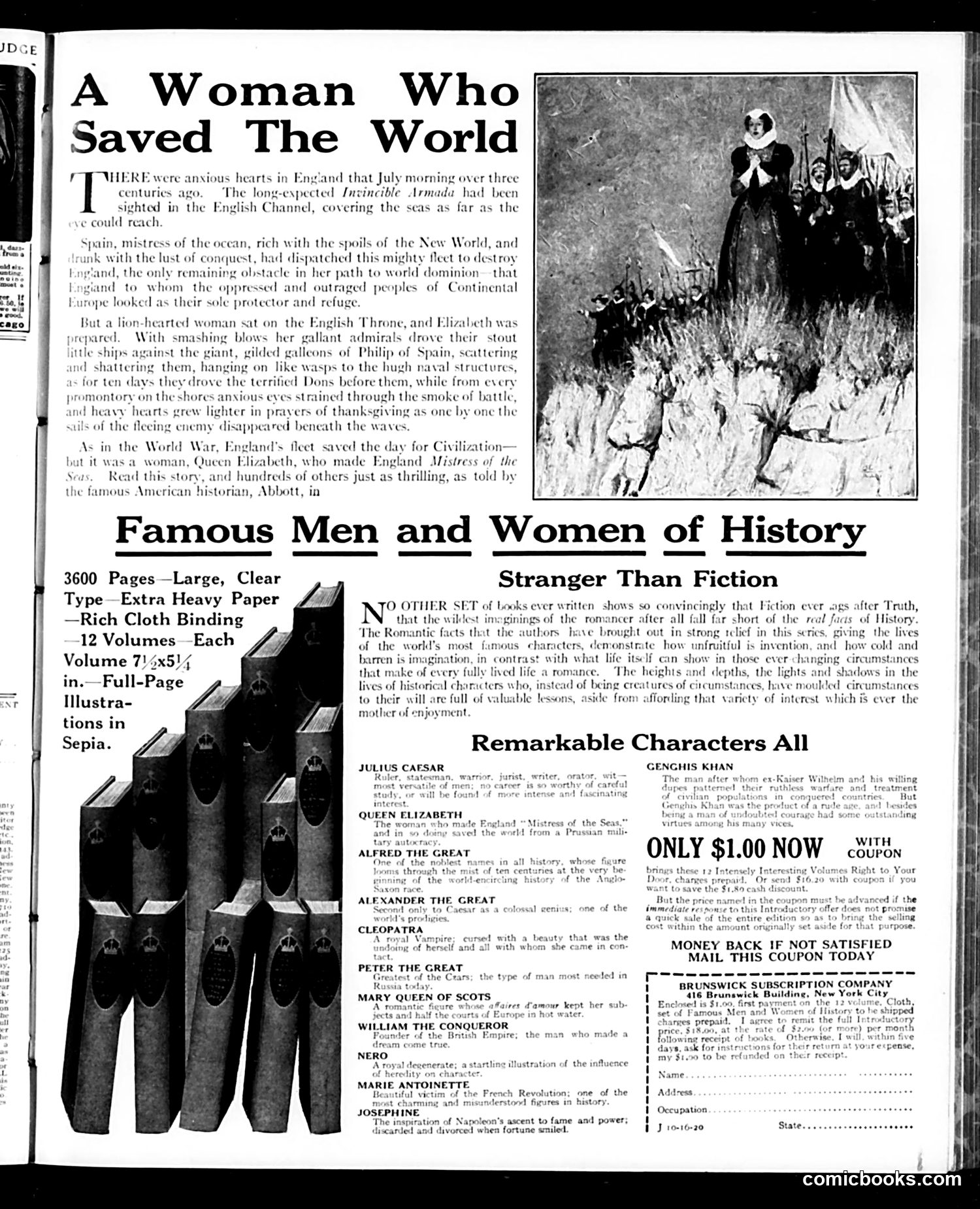
This page combines historical narrative with period advertising. The top article celebrates Queen Elizabeth I's role in defeating the Spanish Armada (1588), framing her as a woman who "saved the world" by enabling England's naval victory. The text draws an explicit parallel to World War I, suggesting women's historical importance to civilization's survival. The bulk of the page advertises a 12-volume encyclopedia set, *Famous Men and Women of History*, published by Brunswick Subscription Company. The marketing emphasizes that real history surpasses fiction in drama and interest. Listed figures include Julius Caesar, Queen Elizabeth, Alexander the Great, Cleopatra, Peter the Great, Mary Queen of Scots, William the Conqueror, and others. **The satire/point**: This appears to be straightforward historical promotion rather than satire—it celebrates women's historical agency while selling educational materials, likely appealing to post-WWI American readers valuing both history and women's contributions.
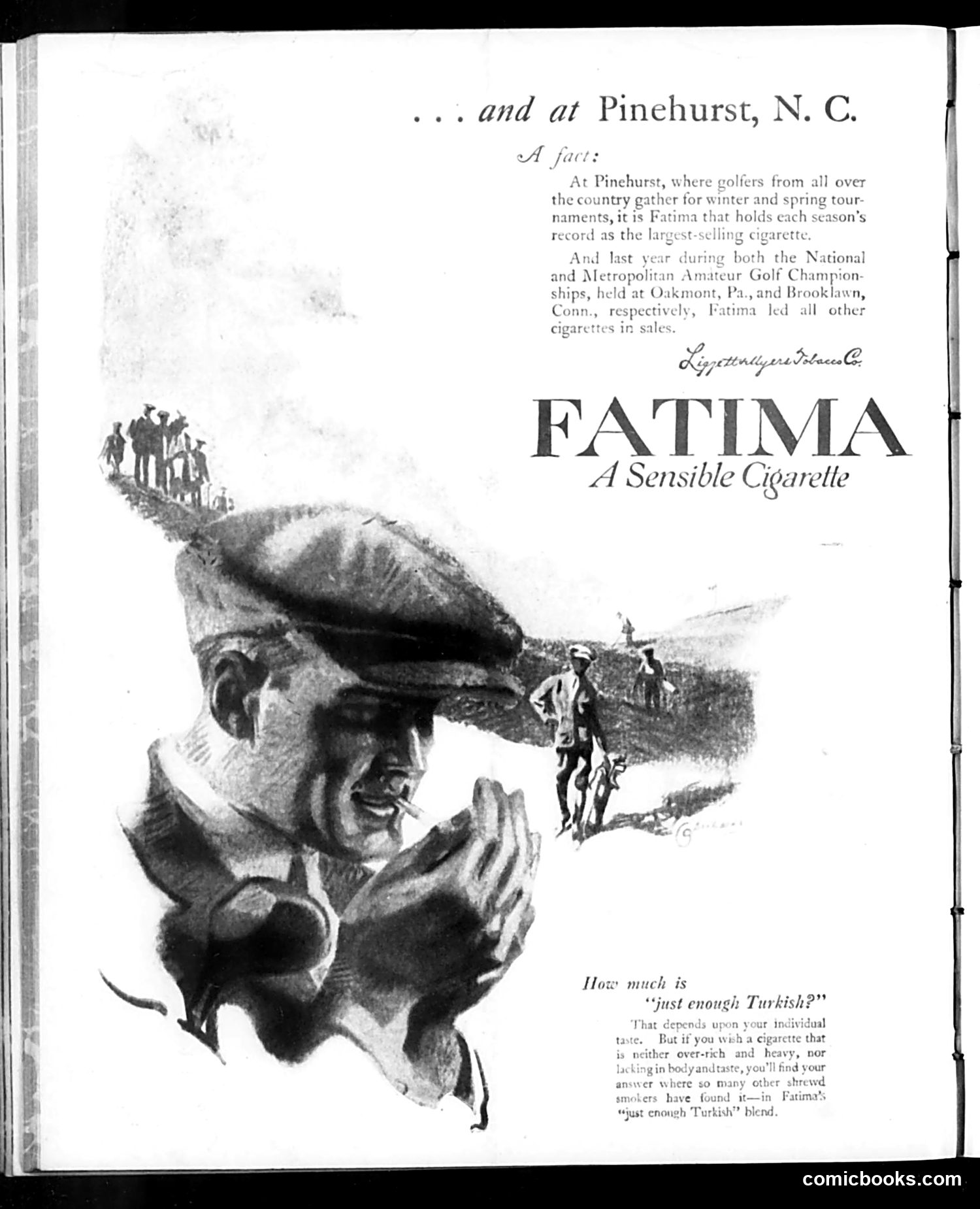
This is a **cigarette advertisement**, not political satire. It promotes Fatima brand cigarettes as "A Sensible Cigarette" by leveraging golf's popularity. The ad claims that at Pinehurst, North Carolina—a prestigious golf resort where wealthy golfers gathered—Fatima outsold all competitors during tournaments (the National Amateur and Metropolitan Amateur Championships at Oakmont, PA and Brooklawn, CT). The illustration shows a golfer in period dress (appears early 20th century). The tagline "just enough Turkish?" addresses the cigarette's blend, positioning Fatima as balanced—not too heavy or rich like some Turkish blends, but sophisticated enough for discerning smokers. This uses aspirational marketing: associating the product with wealthy, leisured golfers to suggest social status and good taste. It's representative of early advertising strategy targeting educated, affluent consumers.