
Judge, 1920-10-16 · page 12 of 32
Judge — October 16, 1920 — page 12: what you’re looking at
What you’re looking at
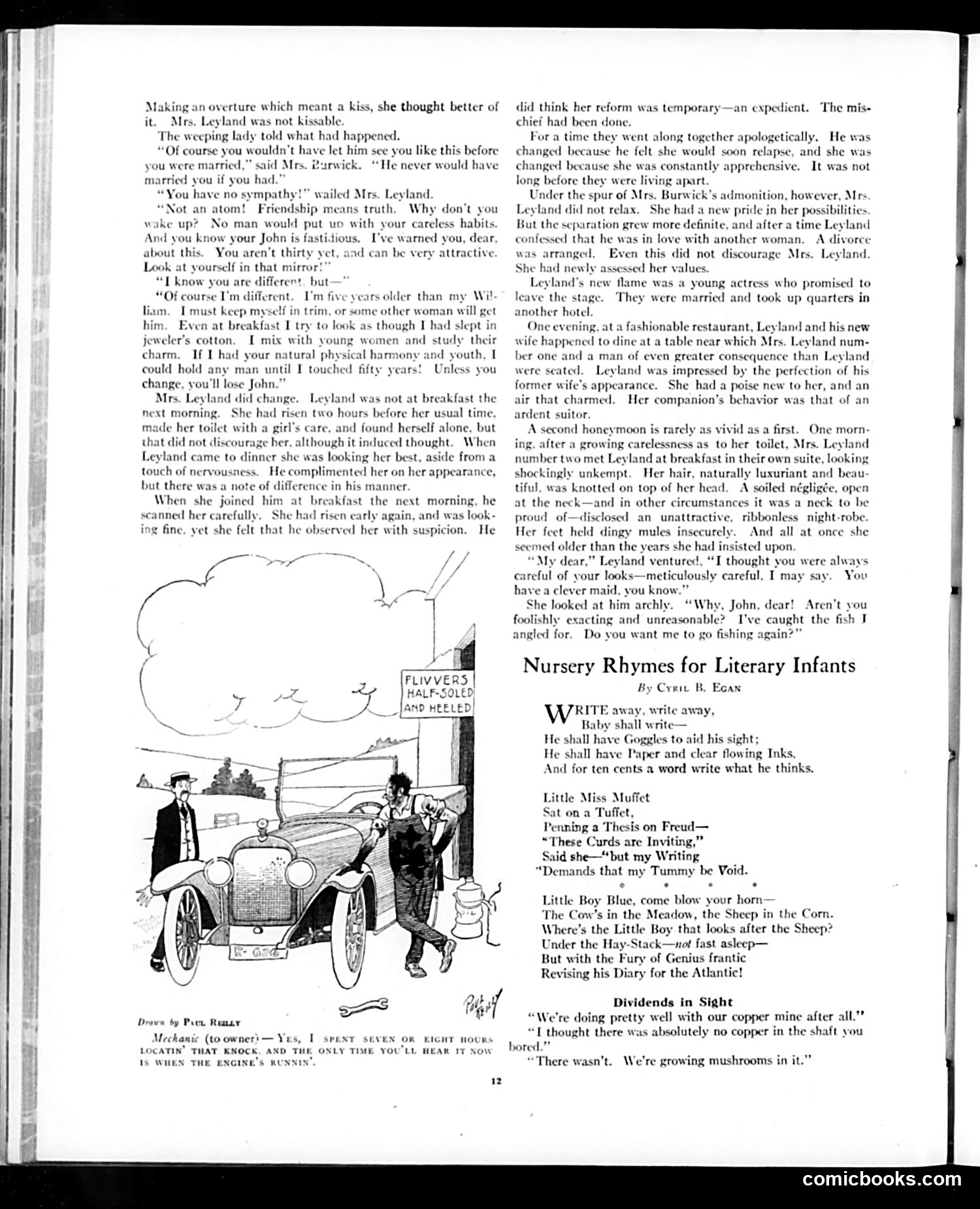
This page contains a satirical short story about marriage and female appearance, illustrated with a cartoon showing a mechanic and car owner. **The Main Story's Satire:** The narrative mocks both marital dynamics and women's self-presentation. Mrs. Leyland neglects her appearance, causing marital problems. A friend advises her to maintain attractiveness to keep her husband. She reforms temporarily, but the husband assumes it's temporary and grows suspicious anyway. Eventually they divorce. Ironically, when he remarries a younger actress who *also* becomes unkempt, he notices his ex-wife (now well-maintained with a new suitor) and regrets his choice. **The Satire's Point:** The story critiques both male fickleness and the exhausting performance women must maintain in marriage—damned if they do, damned if they don't. It suggests women's value is tied to appearance and that male attention is fickle regardless. **The Cartoon:** Shows a mechanic claiming he spent hours locating a car's knock—only audible when the engine runs. It's a classic "shaggy dog" joke about wasted effort and mechanic incompetence.
📄 Transcribed text from this page (OCR, searchable)
Machine-transcribed from the original scan — historical spelling and the odd misread are preserved.
Making an overture which meant a kiss, she thought better of it. Mrs. Leyland was not kissable. The weeping lady told what had happened. “Of course you wouldn't have let him see you like this before rwick. “He never would have you were married,” said Mrs. 2. married you if you had “You have no sympathy!” wailed Mrs. Leyland. “Not an atom! endship means truth. Why don’t you wake up? No man would put uo with your careless habits. And you know your John is fastidious. I've warned you, dear, about this. You aren’t thirty yet, and can be very attractive. Look at yourself in that mirror!” “I know you are differen. but “Of course I'm different. I'm five years older than my Wi!- liam. I must keep myself in trim, or some other woman will get him. Even at breakfast I try to look as though I had slept in jeweler’s cotton. I mix with young women and study their charm. If I had your natural physical harmony and youth, I could hold any man until I touched fifty years! Unless you change, you'll lose John.” Mrs. Leyland did change. Leyland was not at breakfast the next morning. She had risen two hours before her usual time, rade her toilet with a girl's care, and found herself alone, but that did not discourage her, although it induced thought. When Leyland came to dinner she was looking her best, aside from a touch of nervousness. He complimented her on her appearance, but there was a note of difference in his manner. When she ned him at breakfast the next morning, he scanned her carefully. She had risen early again, and was look- ing fine, yet she felt that he observed her with suspicion. He FLIVVERS HALF-SOLED, AND HEELED| Draws by Pocw Rumer Mechanic (to owner) — Yes, I srext SEVEN OR EIGHT HOURS LOCATIN’ THAT KNOCK, AND THE ONLY TIME YOU'LL HEAR tT Now 1S WHEN THE ENGINE'S RUNNIN’. did think her reform was temporary—an expedient. The mis- chief had been done. For a time they went along together apologe ly. He was changed because he felt she would soon relapse, and she was changed because she was constantly apprehensive. It was not long before they were living apart Under the spur of Mrs. Burwick’s admonition, however, Mrs Leyland did not relax. She had a new pride in her possibilities But the separation grew more definite, and after a time Leyland confessed that he was in love with another woman. A divorce was arranged. Even this did not discourage Mrs. Leyland. She had newly assessed her values. Leyland’s new flame was a young actress who promised to leave the stage. They were married and took up quarters in another hotel. One evening, at a fashionable restaurant, Leyland and his new wife happened to dine at a table near which Mrs, Leyland num- ber one and a man of even greater consequence than Leyland were seated. Leyland was impressed by the perfection of his former wife's appearance. She had a poise new to her, and an air that charmed. Her companion’s be ior was that of an ardent suitor. A second honeymoon is rarely as vivid a ing, after a growing carelessness as to her toilet, Mrs. Leyland number two met Leyland at breakfast in their own suite, looking shockingly unkempt. Her hair, naturally luxuriant and beau- tiful. was knotted on top of her head. A soiled négligée, open at the neck—and in other circumstances it was a neck to be proud of—disclosed an unattractive, ribbonless night-robe. Her feet held dingy mules insecurely. And all at once she seemed older than the years she had insisted upon. “My dear,” Leyland ventured, “I thought you were always careful of your looks—meticulously careful, T may say. You have a clever maid, you know.”” She looked at him archly. “Why. foolishly exacting and unreasonable? I'v angled for. Do you want me to go fishing a first. One morn- John, dear! Aren't you ught the fish I in?” Nursery Rhymes for Literary Infants By Cyrit B. Ecan RITE away, write away, Baby shall write— He shall have Goggles to is 8 He shall have Paper and clear flowing Inks, And for ten cents a word write what he thinks. Little Miss Muffet tona Tuffet nning a Thesis on Freud— I “These Curds are Inviting,” Said she—but my Writing “Demands that my Tummy be Void. ° . . ° Little Boy Blue, come blow your horn— The Cow’s in the Meadow, the Sheep in the Corn. Where’s the Little Boy that looks after the Sheep? Under the Hay-Stack—not fast asleep— But with the Fury of Genius frantic Revising his Diary for the Atlantic! Dividends in Sight ving pretty well with our copper mine after all.’’ “T thought there was absolutely no copper in the shaft you bored.” “There wasn’t. We're growing mushrooms in it.”” comicbooks.com