
Judge, 1920-10-16 · page 14 of 32
Judge — October 16, 1920 — page 14: what you’re looking at
What you’re looking at
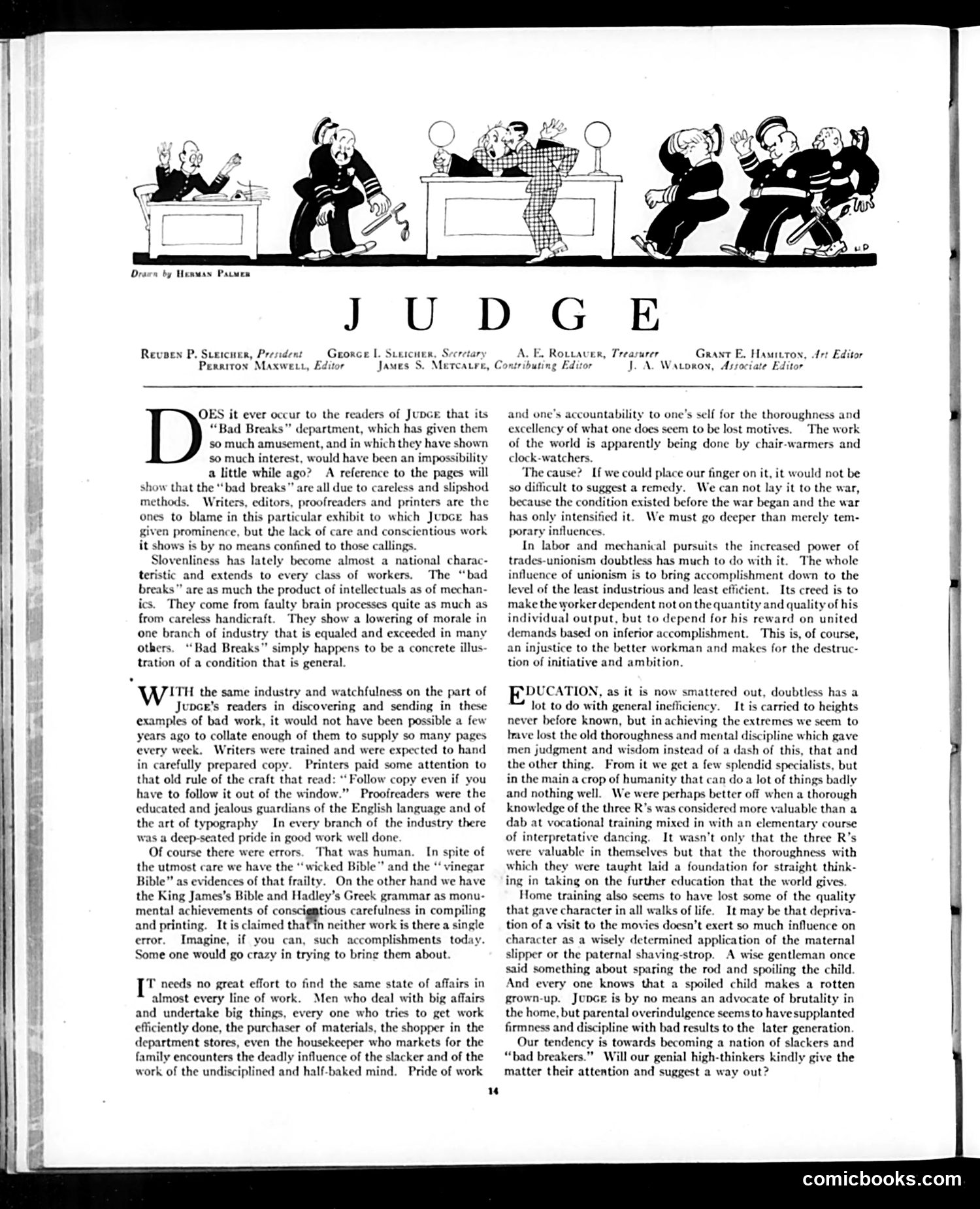
This is primarily an **editorial/opinion piece**, not a cartoon page. The small illustration at the top by Herman Palmer shows generic office and courtroom scenes depicting careless workers and poor conduct. The text criticizes widespread **slovenliness and lack of craftsmanship** in American society. The editorial laments that "bad breaks" (errors in printed materials) now provide enough material for a regular Judge department—something impossible years earlier. The author blames this decline on: - Loss of professional pride and discipline across all industries - **Trade unionism**, which allegedly drags standards down to the least efficient worker - General moral decline affecting intellectuals and laborers equally The piece argues this predates World War I (though the war has "intensified" it) and references historical examples of meticulous printing (King James Bible) versus modern carelessness. The underlying message reflects **conservative anxiety about labor organizing and modern work culture**, framing unionization as destructive to quality and individual accountability.
📄 Transcribed text from this page (OCR, searchable)
Machine-transcribed from the original scan — historical spelling and the odd misread are preserved.
Drawn by Henwas Patwen | Revaen P. Srercuer, President Gerorce I. Srescurr, Sreretary A. FE. Rovtaver, Treasurer Grant E. Hamitros, frt Editor | | eRRITON Maxwent, Edi James S. Metcarre, Contributing Editor J. A. Watoron, Associate Editor OES it ever occur to the readers of Jupce that its and one’s accountability to one’s self for the thoroughness and “Bad Breaks” department, which has given them _ excellency of what one does seem to be lost motives. The work so much amusement, and in which they have shown of the world is apparently being done by chair-warmers and so much interest, would have been an impossibility clock-watchers. a little while ago? A reference to the pages will The cause? If we could place our finger on it, it would not be show that the “bad breaks” are all due to careless and slipshod so difficult to suggest a remedy. We can not lay it to the war, methods. Writers, editors, proofreaders and printers are the _ because the condition existed before the war began and the war | ones to blame in this particular exhibit to which Jupce has has only intensified it. We must go deeper than merely tem- 1 given prominence, but the lack of care and conscientious work porary influences. it shows is by no means confined to those callings. In labor and mechanical pursuits the increased power of Slovenliness has lately become almost a national charac- _ trades-unionism doubtless has much to do with it. The whole teristic and extends to every class of workers. The “bad | breaks” are as much the product of intellectuals as of mechan- | ics. They come from faulty brain processes quite as much as \ from careless handicraft. They show a lowering of morale in one branch of industry that is equaled and exceeded in many others. “Bad Breaks” simply happens to be a concrete illus- tration of a condition that is general. ITH the same industry and watchfulness on the part of Jupce’s readers in discovering and sending in these examples of bad work, it would not have been possible a few years ago to collate enough of them to supply so many pages every week, Writers were trained and were expected to hand in carefully prepared copy. Printers paid some attention to that old rule of the craft that read: *‘ Follow copy even if you have to follow it out of the window.” Proofreaders were the educated and jealous guardians of the English language and of the art of typography In every branch of the industry there was a deep-seated pride in good work well done. Of course there were errors. That was human. In spite of the utmost care we have the ‘wicked Bible” and the ‘‘ vinegar Bible” as evidences of that frailty. On the other hand we have the King James’s Bible and Hadley’s Greek grammar as monu- mental achievements of conscigmtious carefulness in compiling and printing. It is claimed thafin neither work is there a single error. Imagine, if you can, such accomplishments today. Some one would go crazy in trying to bring them about. T needs no great effort to find the same state of affairs in almost every line of work. Men who deal with big affairs and undertake big things, every one who tries to get work efficiently done, the purchaser of materials, the shopper in the department stores, even the housekeeper who markets for the family encounters the deadly influence of the slacker and of the work of the undisciplined and half-baked mind. Pride of work influence of unionism is to bring accomplishment down to the level of the least industrious and least efficient. Its creed is to make the worker dependent not on the quantity and quality of his individual output, but to depend for his reward on united demands based on inferior accomplishment. This is, of course, an injustice to the better workman and makes for the destruc- tion of initiative and ambition. DUCATION, as it is now s lot to do with general ineffic ttered out, doubtless has a ency. It is carried to heights never before known, but in achieving the extremes we scem to trave lost the old thoroughness and mental discipline which gave men judgment and wisdom instead of a dash of this, that and the other thing. From it we get a few splendid specialists, but in the main a crop of humanity that can do a lot of things badly and nothing well. We were perhaps better off when a thorough knowledge of the three s considered more valuable than a dab at vocational training mixed in with an elementary course of interpretative dancing. It wasn’t only that the three R’s were valuable in themselves but that the thoroughness with which they were taught laid a foundation for straight think- ing in taking on the further education that the world give Home training also seems to have lost some of the quality that gave character in all walks of life. It may be that depriva- tion of a visit to the movies doesn’t exert so much influence on character as a wisely determined application of the maternal slipper or the paternal shaving-strop. A wise gentleman once said something about sparing the rod and spoiling the child. And every one knows that a spoiled child makes a rotten grown-up. Jupce is by no means an advocate of brutality in the home, but parental overindulgence seems to have supplanted firmness and discipline with bad results to the later generation. Our tendency is towards becoming a nation of slackers and “bad breakers.” Will our genial high-thinkers kindly give the matter their attention and suggest a way out? R’sw comicbooks.com