
Judge, 1920-10-16 · page 17 of 32
Judge — October 16, 1920 — page 17: what you’re looking at
What you’re looking at
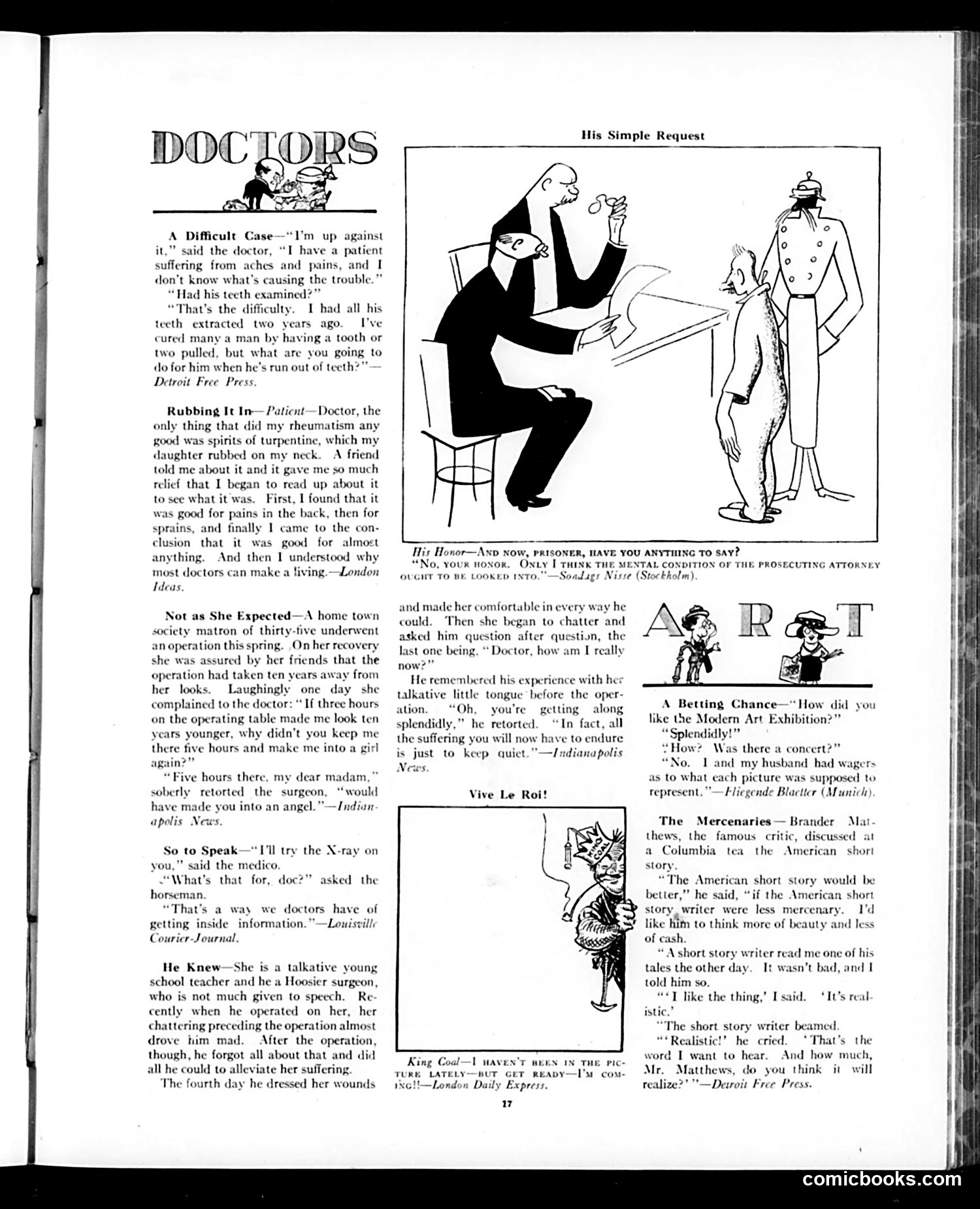
This Judge magazine page collects humorous anecdotes about doctors and medical practice, reflecting early 20th-century attitudes toward healthcare. **Key jokes:** - **"A Difficult Case"**: Satirizes over-extraction of teeth as a cure-all remedy. Doctors pulled teeth for various ailments, but the practice became absurd when patients ran out of teeth. - **"He Knew"**: A talkative female schoolteacher is silenced post-surgery by a taciturn surgeon who tells her to stay quiet to avoid suffering—dark humor about controlling women's speech. - **"His Simple Request"**: A prisoner requests only that a prosecutor's mental state be "looked into," implying the prosecutor is mentally unfit. - **"The Mercenaries"**: Critic Brander Matthews laments American writers prioritize profit over artistic beauty. A writer's only concern about his story is its commercial value, not its quality. The cartoons mock medical quackery, gender dynamics, and literary commercialism of the era.
📄 Transcribed text from this page (OCR, searchable)
Machine-transcribed from the original scan — historical spelling and the odd misread are preserved.
A Difficult C I’m up against it,” said the doctor, “I have a patient suffering from aches and pains, and I don’t know what's causing the trouble.” “Had his teeth examined?” “That's the difficulty, I had all his teeth extracted two years ago. I've cured many a man by having a tooth or two pulled, but what are you going to do for him when he’s run out of teeth?””— Detroit Free Press. Rubbing It In— Patient—Doctor, the only thing that did my rheumatism any good was spirits of turpentine, which my daughter rubbed on my neck. A friend told me about it and it gave me s0 much relief that I began to read up about it to see what it was. First, I found that it was good for pains in the back, then for sprains, and finally I came to the con- clusion that it s good for almost anything. And then I understood why most doctors can make a tiving.—London Ideas Not as She Expected—A home town society matron of thirty-five underwent an operation this spring. On her recovery she was assured by her friends that the operation had taken ten years away from her looks. Laughingl. complained to the doctor: “ If three hours on the operating table made me look ten years younger, why didn’t you keep me there five hours and make me into a girl again?” ve hours there, my dear madam,” soberly retorted the surgeon, “would have mi you into an angel. ""—Indian apolis So to Speak—“I'll try the X-ray on you,” said the medico. “What's that for, doc?” horsen “That's a way getting inside information.” Courier-Journal, asked the we doctors have Louise He Knew—She is a talkative young school teacher and he a Hoosier surgeon, who is not much given to speech. Re- cently when he operated on her, her chattering preceding the operation almost drove him mad. After the operation, though, he forgot all about that and did all he could to alleviate her suffering. The fourth day he dressed her wounds His Simple Request L His Honor—Axpv Now, PRISONER, HAVE YOU ANYTHING TO SAY? “No, YouR HONOR. OUGHT TO BE LOOKED INTO. and made her comfortable in every way he could. Then she began to chatter and asked him question after question, the last one being, “ Doctor, how am I really now?" He remembered his experience with her talka little tongue before the oper- ation, “Oh, you're getting along splendidly,” he retorted. “In fact, all the suffering you will now have to endure is just to keep quiet.” —Iudianupolis N Vive Le Roi! T MAVEN’? BEEN IN THE Pic RUT GET READY—I’s come « Daily Express. aw King Co TURE LATELY 1ee!!—Lond ONLy [THINK THE MENTAL CONDITION OF THE PROSECUTING ATTORNEY ~Soadags Nisse (Stockholm) A Betting Chance—" How like the Modern Art Exhibition “ Splendidly!” How? Was there a concert?” No. 1 and my husband had wagers as to what each picture was supposed to represent, Fliegende Blactter (Munich) Mercenaries — Brander M. famous critic, discussed American short The thews, the a Columbia tea the story he American short story would be better,” he said, “if the American short story writer were less mercenary. I'd like him to think more of beauty and less of cash. A short story writer read me one of his tales the other day. It wasn’t bad, and I told him so, “*T like the thing,’ I said. istic.” “The short story writer beamed “*Realistic!’ he cried. That's the word T want to hear. And how much, Mr. Matthews, do you think it will realize?’ "'—Desroit Free Press. “It’s real