
Judge, 1920-10-16 · page 22 of 32
Judge — October 16, 1920 — page 22: what you’re looking at
What you’re looking at
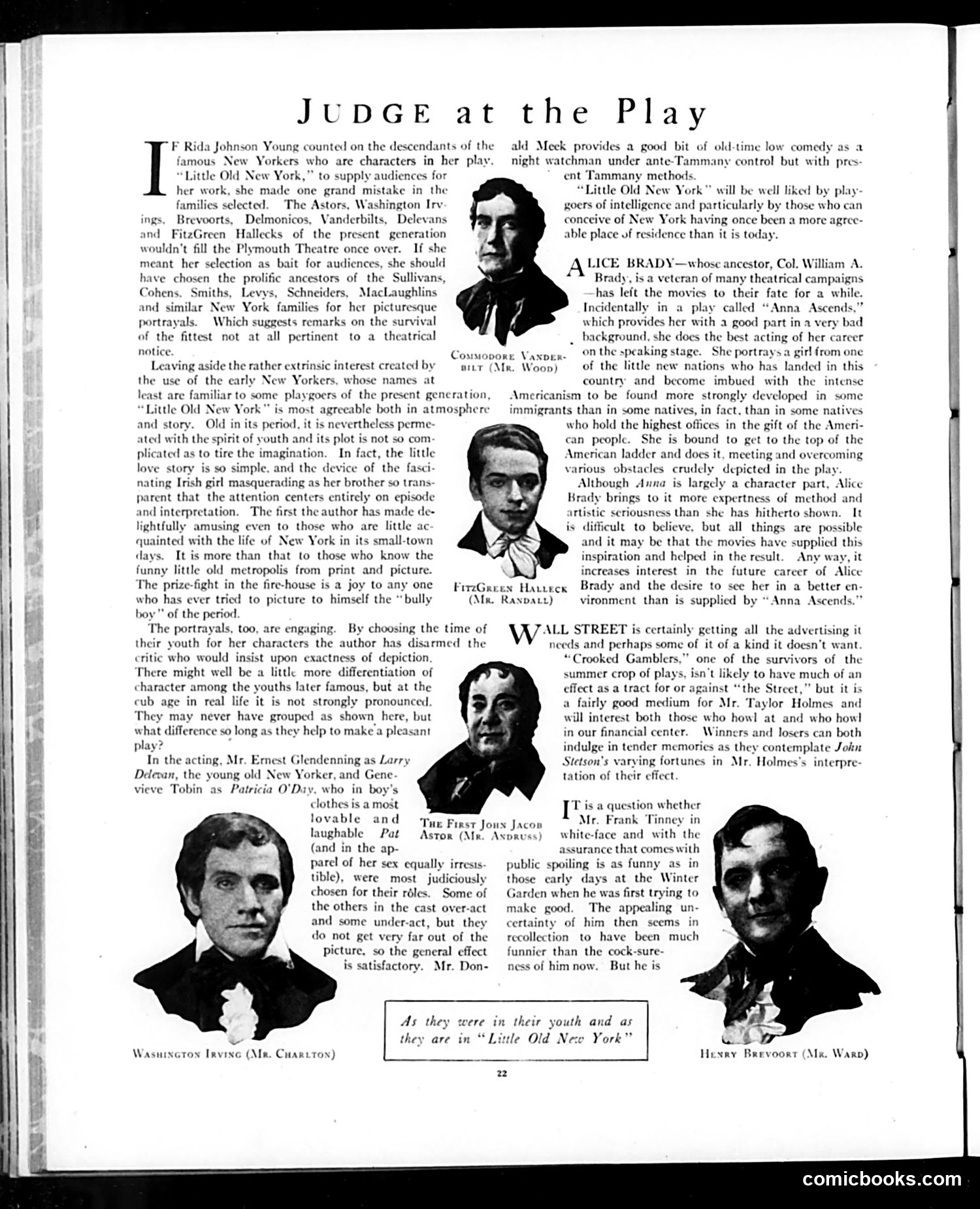
This is a theater review page from *Judge* magazine critiquing "Little Old New York," a stage play by Rida Johnson Young. The review is illustrated with headshots of cast members. The satire targets the playwright's casting choices. Young apparently sought to attract wealthy audiences by casting descendants of famous old New York families (Astors, Vanderbilts, Brevoorts), but the critic suggests she should have instead featured descendants of working-class Irish, Jewish, and immigrant families (Sullivans, Cohens, Levys, Schneiders) who actually comprised old New York's population. This mocks the play's historical inauthenticity while jabbing at both the playwright's commercial calculation and New York's class hierarchies. The review itself praises the simple plot, the charming performances (particularly Genevieve Tobin as Patricia O'Day), and the play's nostalgic recreation of early New York street life. The critic appreciates the work despite its social pretensions.
📄 Transcribed text from this page (OCR, searchable)
Machine-transcribed from the original scan — historical spelling and the odd misread are preserved.
Little Old New York,” to supply audiences for her work, she made one grand mistake in the families selected. The Astors, Washington Irv Brevoorts, Delmonicos, Vanderbilts, Dele FitzGreen Hallecks of the present generation Idn’t fill the Plymouth Theatre once over. meant her selection as bait for audiences, she should have chosen the prolific ancestors of the Sullivans, Cohens, Smiths, Levys, Schneiders, MacLaughlins and similar New York families for her picturesque ings, and ans wou | the use of the early New Yorkers, whose names at least are familiar to some and story. Old in its period, it is nevertheless perme- ated with the spirit of youth and its plot is not so com plicated as to tire the imagination. In fact, the litle love story is so simple, and the device of the f. nating Irish girl masquerading as her brother so trans- parent that the attention centers entirely on episode and interpretation. The first the author has made de- lightfully amusing even to those who are litue ac quainted with the life of New York in its small-town days. It is more than that to those who know the funny little old metropolis from print and picture. The prize-fight in the fire-house is a joy to any one who has ever tried to picture to himself the “bully i boy” of the period. rhe portrayals, too, are engaging. By choosing the time of their youth for her characters the author has disarmed the critic who would insist upon exactness of depiction There might well be a little more differentiation of character among the youths later famous, but at the cub age in real life it is not strongly pronounced. They may never have grouped as shown here, but Hl what difference so long as they help to make’a pleasant play? . tc In the acting, Mr. Ernest Glendenning as Larry Delevan, the young old New Yorker, and Gene. vieve Tobin as Patricia O'Day, who in boy’s clothes is a most lovable and laughable Pat (and in the ap- parel of her sex equally ci Astor (Mx. irresis, tible), were most judiciously chosen for their réles. Some of the others in the cast over-act and some under-act, but they do not get very far out of the picture, so the general effect is satisfactory. Mr. Don- Wasuixeros Irvine (Mx. Cuarttox) JUDGE at the Play F Rida Johnson Young counted on the descendants of the famous New Yorkers who are characters in her play. Ifshe ff playgoers of the present generation, Little Old New York” is most agreeable both in atmosphere FimGrrex Harteck (Mr. Ranpatt) Tue First Joux Jacon ald Meek provides a good bit of old-time low comedy as a night watchman under ante-Tammany control but with pres ent Tammany methods. “Little Old New York” will be well liked by play- goers of intelligence and particularly by those who can conceive of New York having once been a more agree- able place of residence than it is today. A LICE BRADY—whose ancestor, Col. William A. +> Brady, i theatrical campaigns has left the movies to their fate for a while. Incidentally in a play called “Anna Ascends,”” portrayals. Which suggests remarks on the survival which provides her with a good part ina very bad of the fittest not at all pertinent to a theatrical . background, she does the best acting of her carcer notic Coumovore Vaxpere onthe speaking stage. She portrays a girl from one Leaving aside the rather extrinsic interest created by attr (Mr. Woop) of the little new nations who has landed in this country and become imbued Americanism to be found more stron; immigrants than in some natives act, than in some natives who hold the highest offices in the gift of the Ameri- can people. She is bound to get to the top of the American ladder and does it, meeting and overcoming various obstacles crudely depicted in the play. Although Anna is largely a character part, Alice Brady brings to it more expertness of method and irtistic seriousness than she has hitherto shown. It is difficult to believe, but all things are possible and it may be that the movies have supplied this inspiration and helped in the result. Any way, i increases interest in the future career of Alice Brady and the desire to see her in a better en- vironment than is supplied by “Anna Ascends.” with the intense gly developed in some ALL STREET is certainly getting all the advertising it needs and perhaps some of it of a kind it doesn’t want “Crooked Gamblers,” one of the survivors of the summer crop of plays, isn’t likely to have much of an effect as a tract for or against “the Street,” but it is a fairly good medium for Mr. Taylor Holmes and will interest both those who howl at and who howl in our financial center. Winners and losers can both indulge in tender memories as they contemplate John Stetson's varying fortunes in Mr, Holmes’s interpre- tation of their ¢ T is a question whether Mr. Frank Tinney in white-face and with the assurance that comes with public spoiling is as funny as in those early days at the Winter Garden when he was first trying to make good. The appealing un- certainty of him then seems in recollection to have been much funnier than the cock-sure- ness of him now. But he is Axpruss) as Hexay Brevoort (Mx comicbooks.com