
A complete issue · 36 pages · 1920
Judge — August 14, 1920
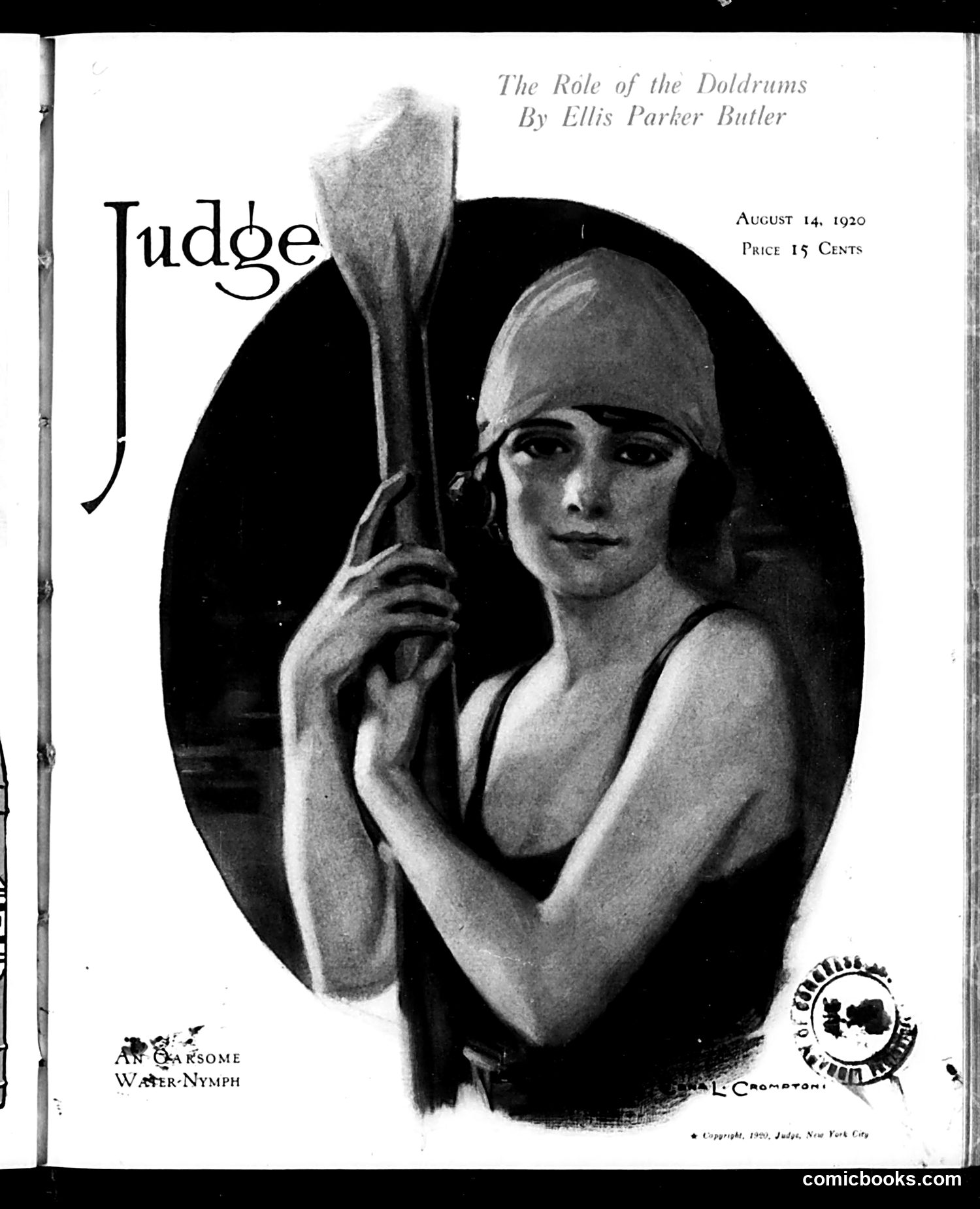
This cover features "The Role of the Doldrums" by Ellis Parker Butler. The image depicts a figure in swimming attire and cap holding an oar, styled as "Somewater-Nymph" (visible at bottom left). The title references the "doldrums"—a nautical term for calm, windless waters where ships stall. Given the August 1920 date, this likely satirizes the post-WWI period's economic or political stagnation. The oar-wielding figure suggests futile effort to move forward without progress—commentary on America's sluggish conditions following the war. The aquatic/nautical imagery reinforces the "stuck" metaphor. The satire targets whatever "doldrums" were concerning Americans in mid-1920.
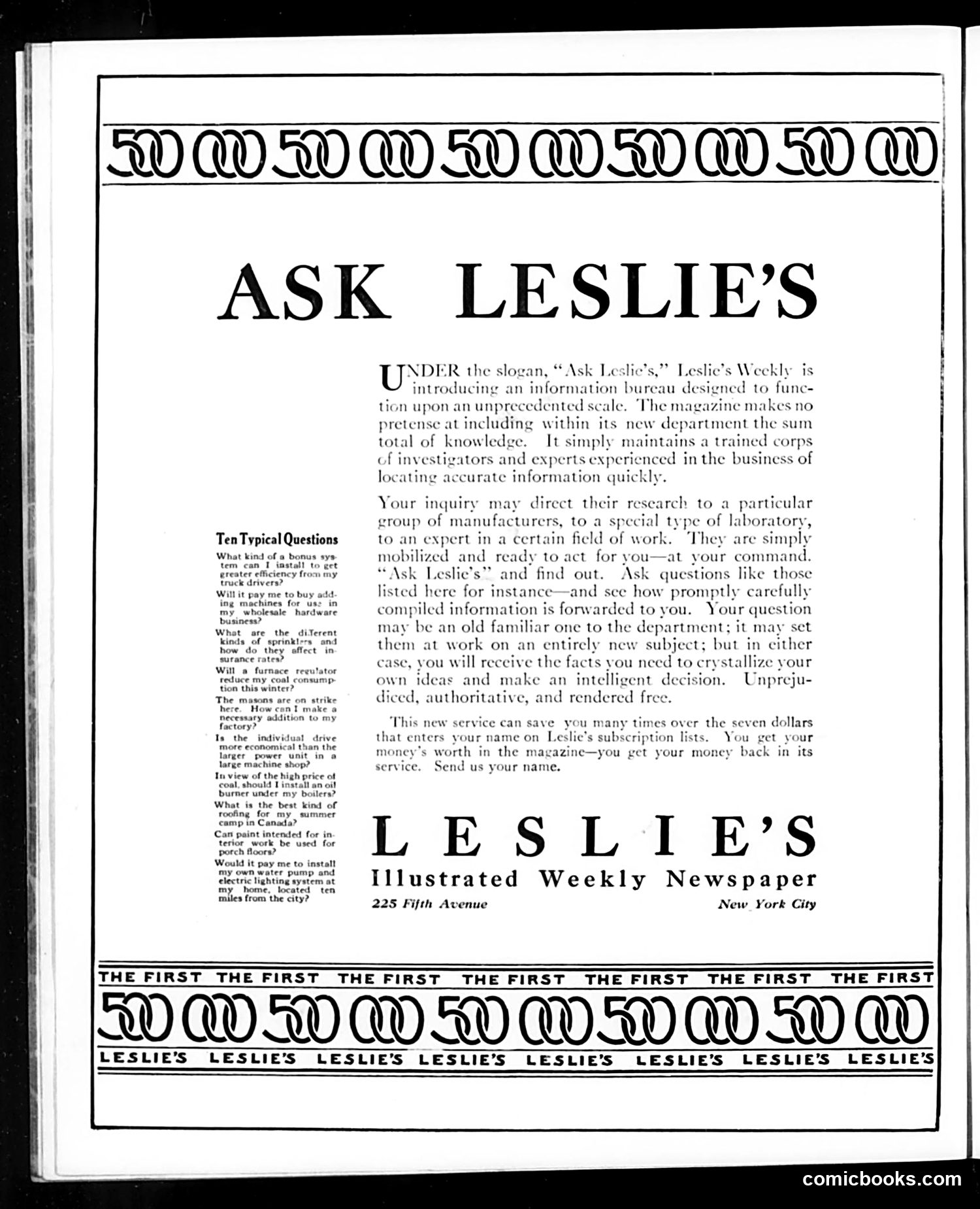
This page is primarily **advertising**, not political satire. It promotes Leslie's Weekly's new "Ask Leslie's" information bureau—a customer service feature designed to answer reader inquiries on various topics. The ad lists "Ten Typical Questions" readers might ask, covering practical matters like installing equipment, business advice, and home improvements. The service promises quick, expert research across multiple fields. The humor is mild and promotional rather than satirical: the novelty of offering such a comprehensive information service was apparently noteworthy enough to advertise. The decorative borders and prominent typography emphasize this as a significant new feature for Leslie's Illustrated Weekly Newspaper. There are no identifiable political figures or social commentary present on this page.
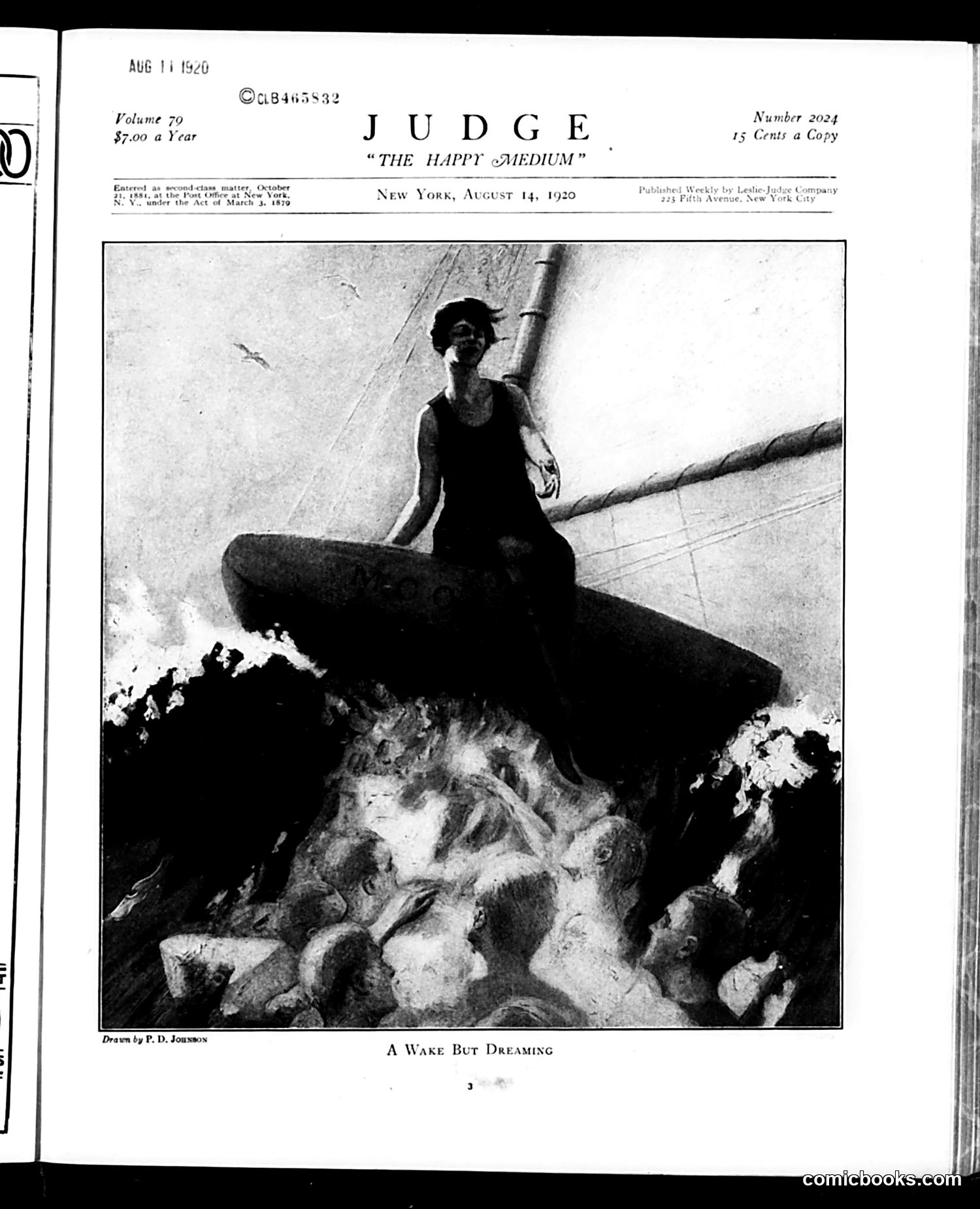
This surreal illustration by P.D. Johnson depicts a woman perched atop a large cylindrical object, gazing downward at a chaotic mass of distorted faces below her. The title "A Wake But Dreaming" suggests a commentary on post-World War I disillusionment or social confusion. The composition likely satirizes public consciousness during the immediate post-war period—a time of conflicting emotions and uncertainty about America's future. The woman's elevated, detached position contrasts with the churning crowd below, possibly representing different social classes or political factions. Without additional context about specific August 1920 events, the exact target of satire remains unclear, though it likely addresses contemporary anxieties about social disorder or failed ideals following the Great War.
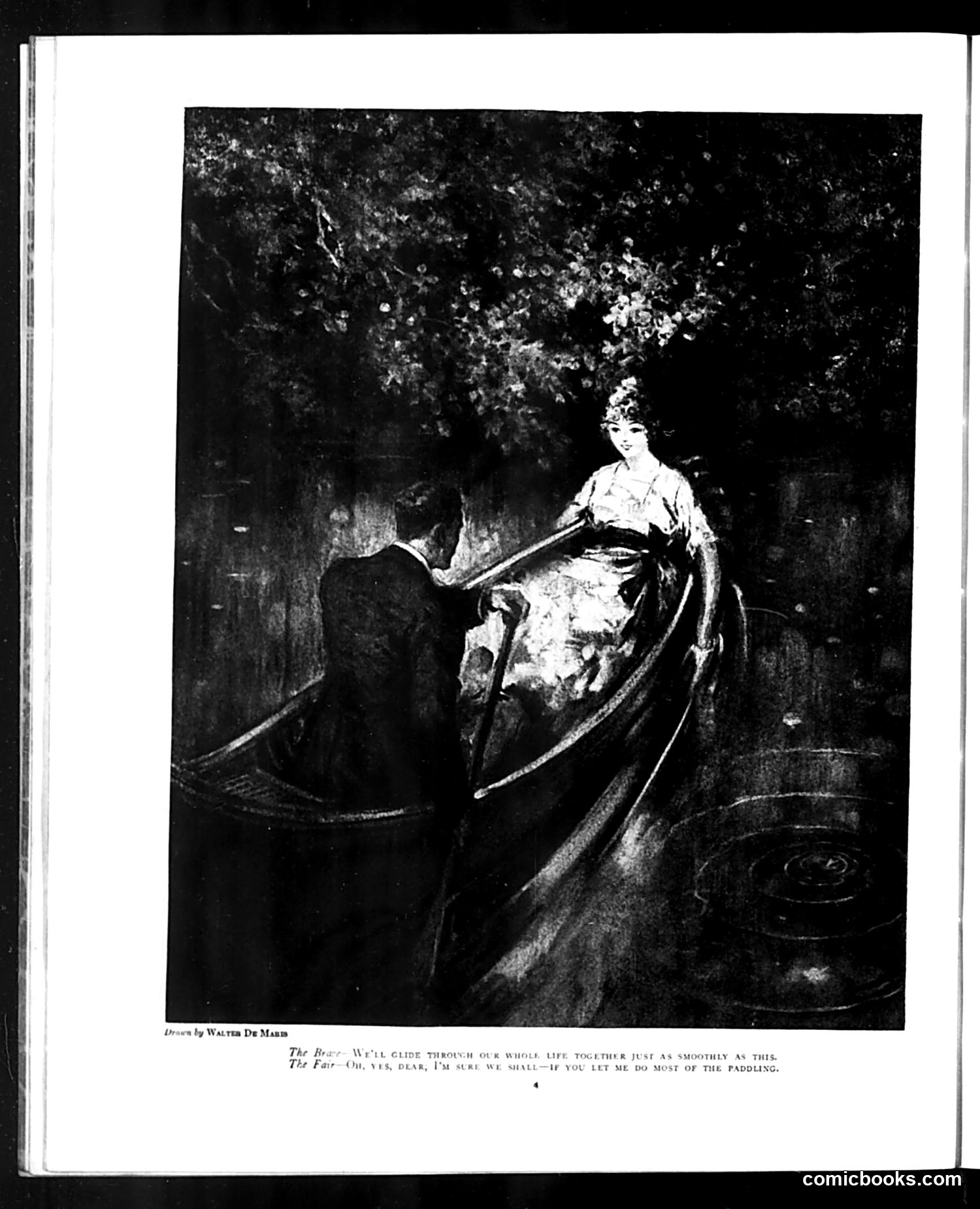
This appears to be a romantic scene from an early 20th-century theatrical or literary adaptation, illustrated by Walter De Maris. The image shows a couple in a gondola—a man in dark formal dress poling the boat while a woman in light, elegant clothing reclines. The caption dialogue reads: "The Boat: 'We'll glide through our whole life together just as smoothly as this.' The Fair One: 'Yes, dear, I'm sure we shall—if you let me do most of the paddling.'" The satire targets gender dynamics in marriage, humorously suggesting the woman will bear the real burden of effort despite the man's romantic declaration. It's a gentle jab at masculine overconfidence and domestic inequality—presenting the "fair one" as wiser about marital realities than her sentimental suitor.
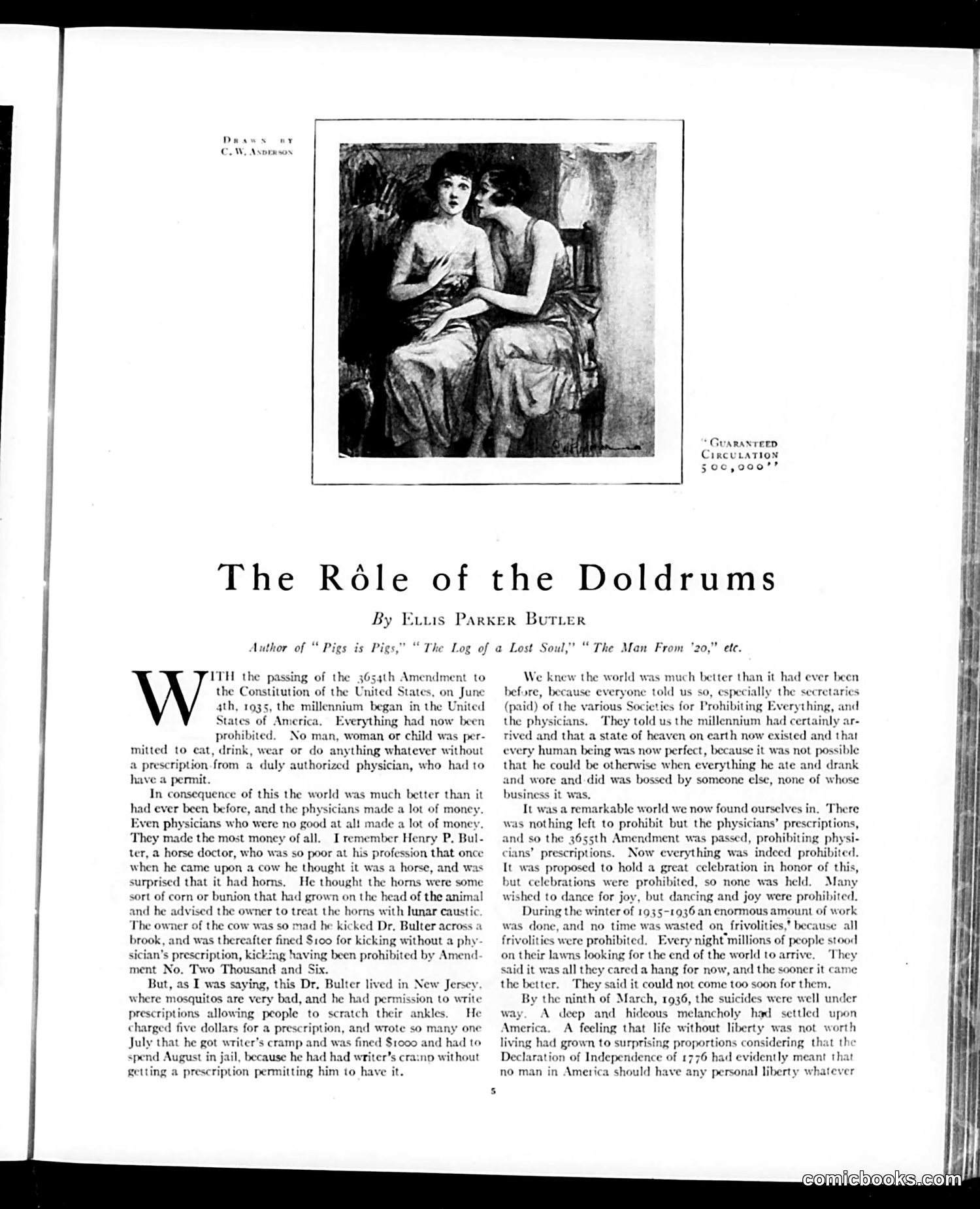
This article by Ellis Parker Butler satirizes Prohibition's unintended consequences following the 18th Amendment (1919). The accompanying illustration appears to show two women in an intimate domestic scene, likely representing the era's social disruption. Butler's narrative mocks how Prohibition supposedly created a "better world"—yet physicians lost income from prescriptions, celebrations were banned, and people became depressed. He describes absurd outcomes: Dr. Balter was kicked by a cow after losing his prescription business; frivolities were prohibited; suicides increased. The satire's central point: Prohibition's promise of moral improvement instead produced widespread unhappiness, economic hardship for professionals, and a "deep and hideous melancholy" settling over America—the "doldrums" of the title. Butler argues the cure proved worse than the disease.
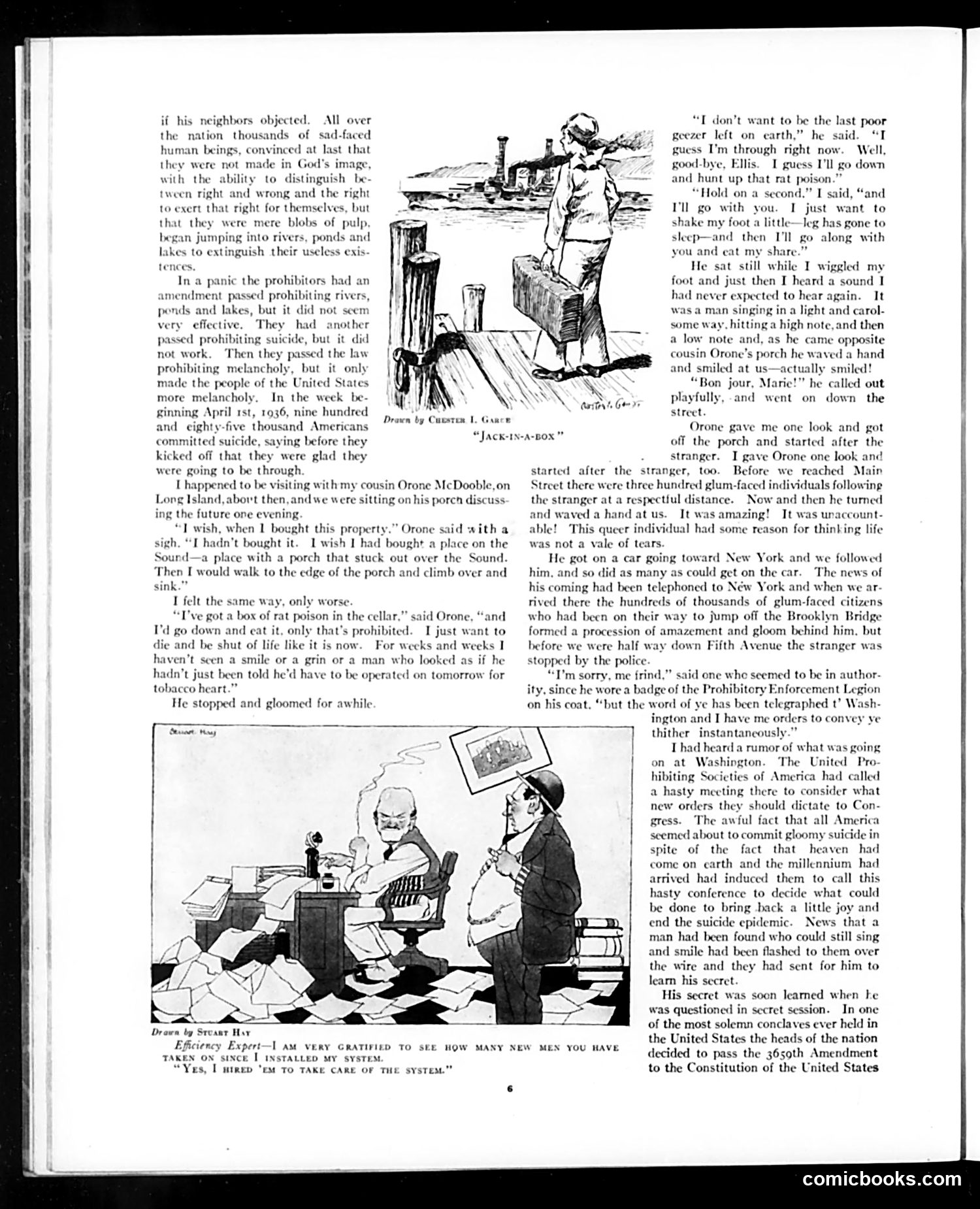
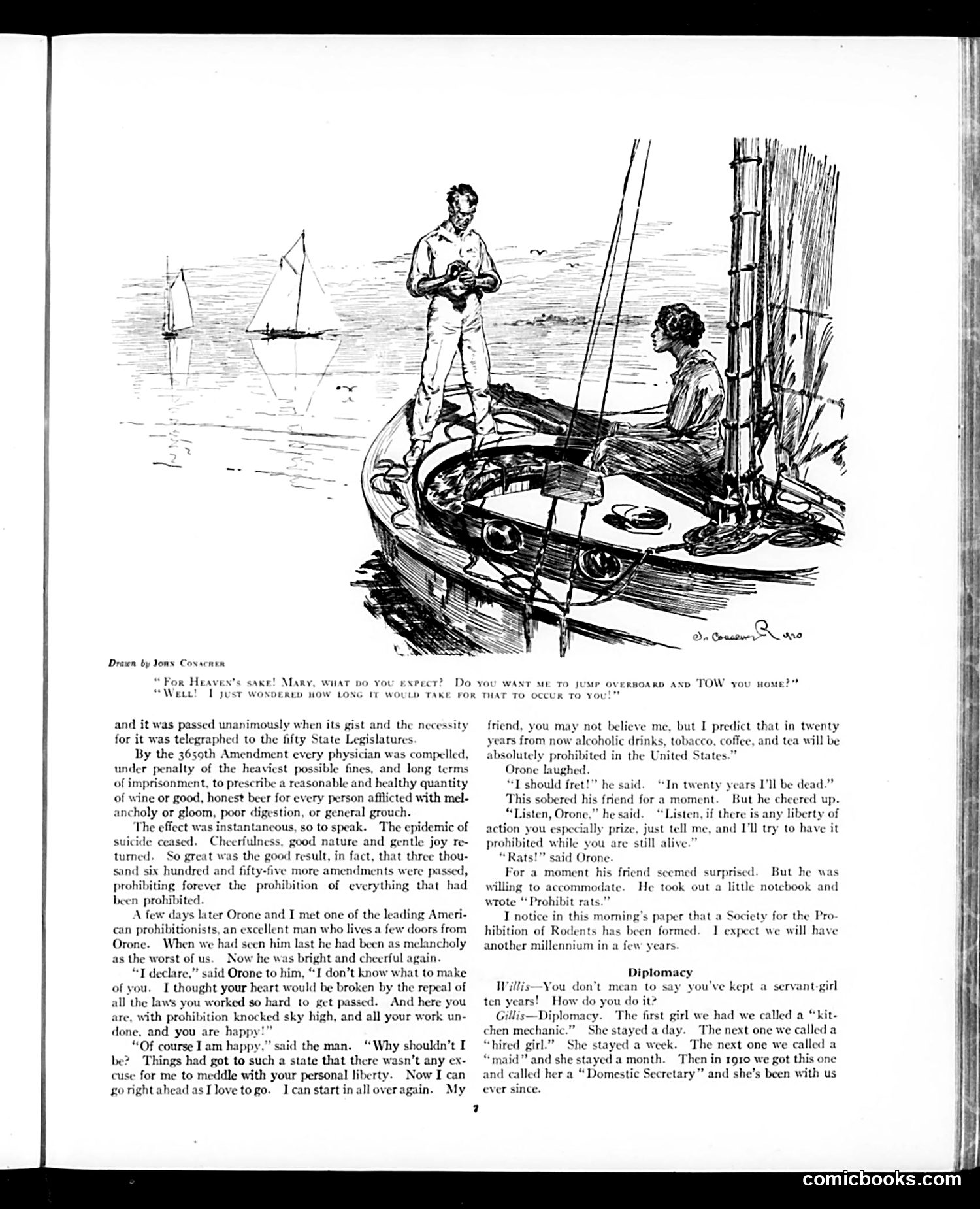
This page satirizes **Prohibition and the impulse to legislate morality**. The main story imagines a future where the 3,650th Amendment mandates doctors prescribe alcohol/beer for depression—ending suicide. This succeeds so well that 3,655 more amendments then prohibit everything previously prohibited, creating absurd bureaucratic reversal. A staunch prohibitionist character then admits he's happy because restrictions gave him purpose; now he can "start in all over again" finding new things to ban. His friend predicts alcohol, tobacco, coffee, and tea will be prohibited within twenty years. The joke culminates when they form a "Society for the Prohibition of Rodents"—mocking how prohibitionists will always find something to regulate. **The satire targets**: the self-perpetuating nature of moral crusades, prohibitionists' inability to accept personal liberty, and how restrictions ironically give activists renewed purpose. The secondary cartoon about "Diplomacy" jokes that renaming "servant-girl" to fancier titles ("Domestic Secretary") makes the job prestigious enough to retain employees—a lighter observation on euphemism's social power.
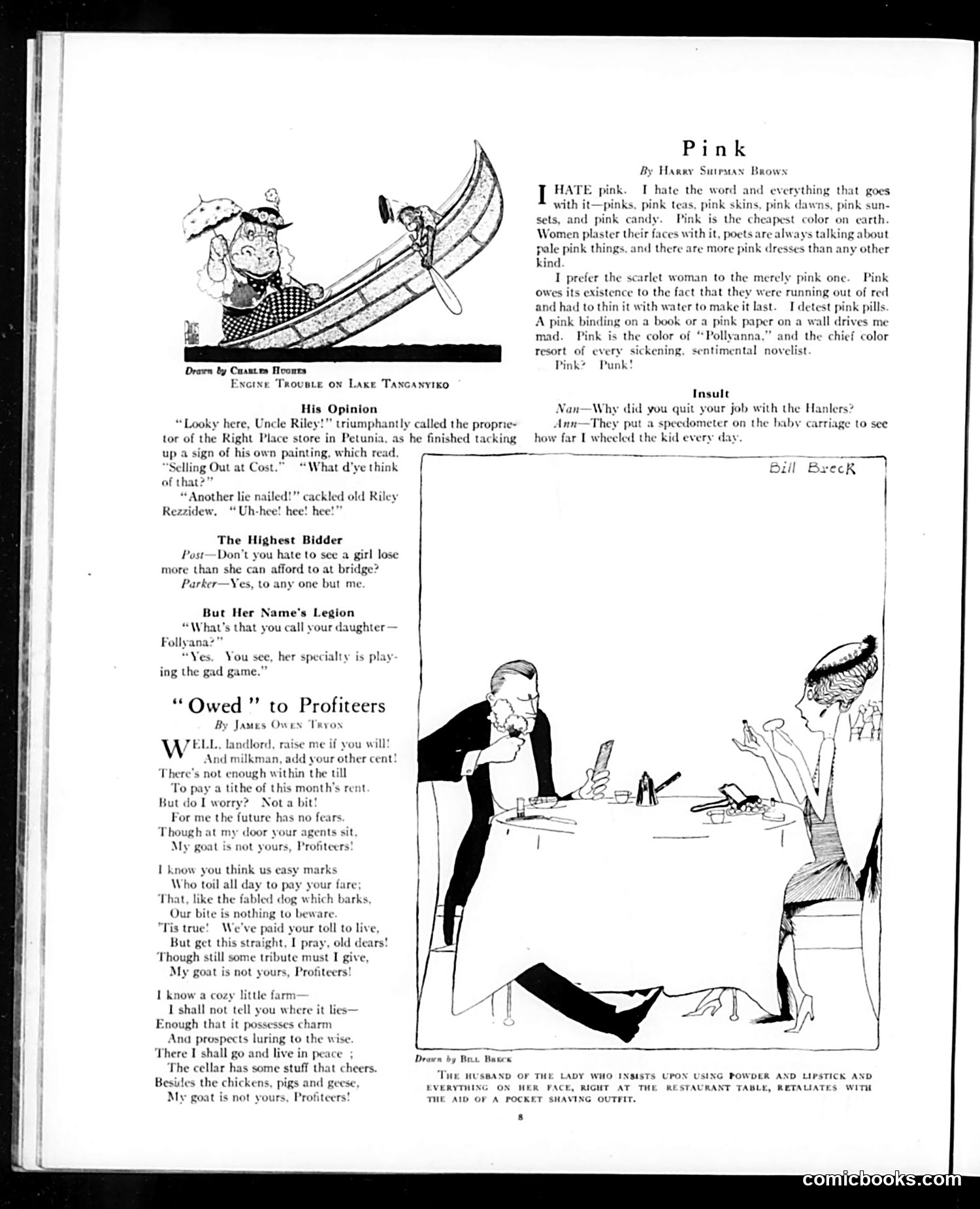
This page contains three satirical pieces reflecting post-WWI American anxieties: **"Owed to Profiteers"** (poem by James Owen): A working-class narrator defies landlords, milkmen, and other creditors demanding payment during apparent inflation/economic hardship. He asserts independence through hidden assets (a secret farm, preserved food) and refuses to let profiteers break his spirit—a jab at businesses exploiting ordinary people during economic strain. **"Pink"** (essay by Harvey Sutsman Brown): A curmudgeonly rant against the color pink and its cultural associations with sentimentality, cheapness, and weak femininity. References "Pollyanna" (the saccharine optimistic heroine). This reflects early 20th-century masculine anxiety about perceived cultural "softness." **The cartoon** (by Bill Breck): Depicts a husband using a pocket shaving kit at a restaurant table while his wife applies makeup—satirizing the hypocrisy of public grooming standards. The caption notes the husband "retaliates," suggesting gendered double standards about public appearance maintenance. The page reflects working-class economic frustration and gender-role anxieties of the era.
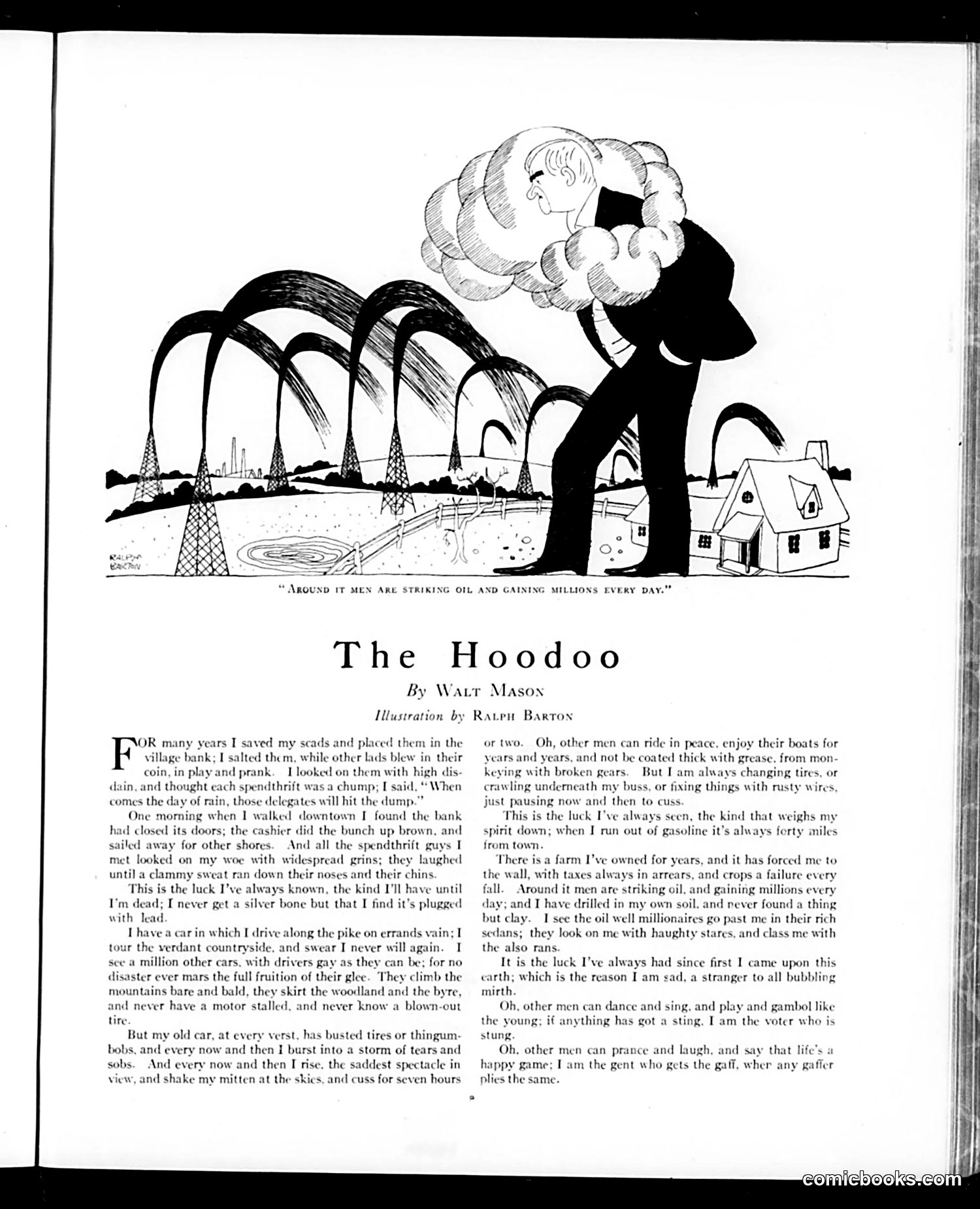
This is a humorous poem with accompanying illustration satirizing the inequities of early 20th-century American capitalism, likely during an oil boom period. **The Setup:** The narrator represents the "unlucky everyman"—prudent, hardworking, moral—who saves money while spendthrifts squander theirs. Yet his caution backfires: his bank fails, his car perpetually breaks down, his farm yields nothing while neighboring oil wells nearby strike it rich daily. **The Satire's Point:** The illustration shows a giant figure looming over an oil-field landscape, captioned "around it men are striking oil and gaining millions every day." The satire mocks the notion that success derives from virtue or effort. Instead, it's pure chance ("hoodoo" = bad luck or curse). Disciplined savers lose everything; reckless speculators and lucky landowners get wealthy overnight through no merit. **For Modern Readers:** This reflects real historical frustrations during the oil boom—arbitrary wealth distribution and the inadequacy of traditional virtues in navigating chaotic capitalist markets.
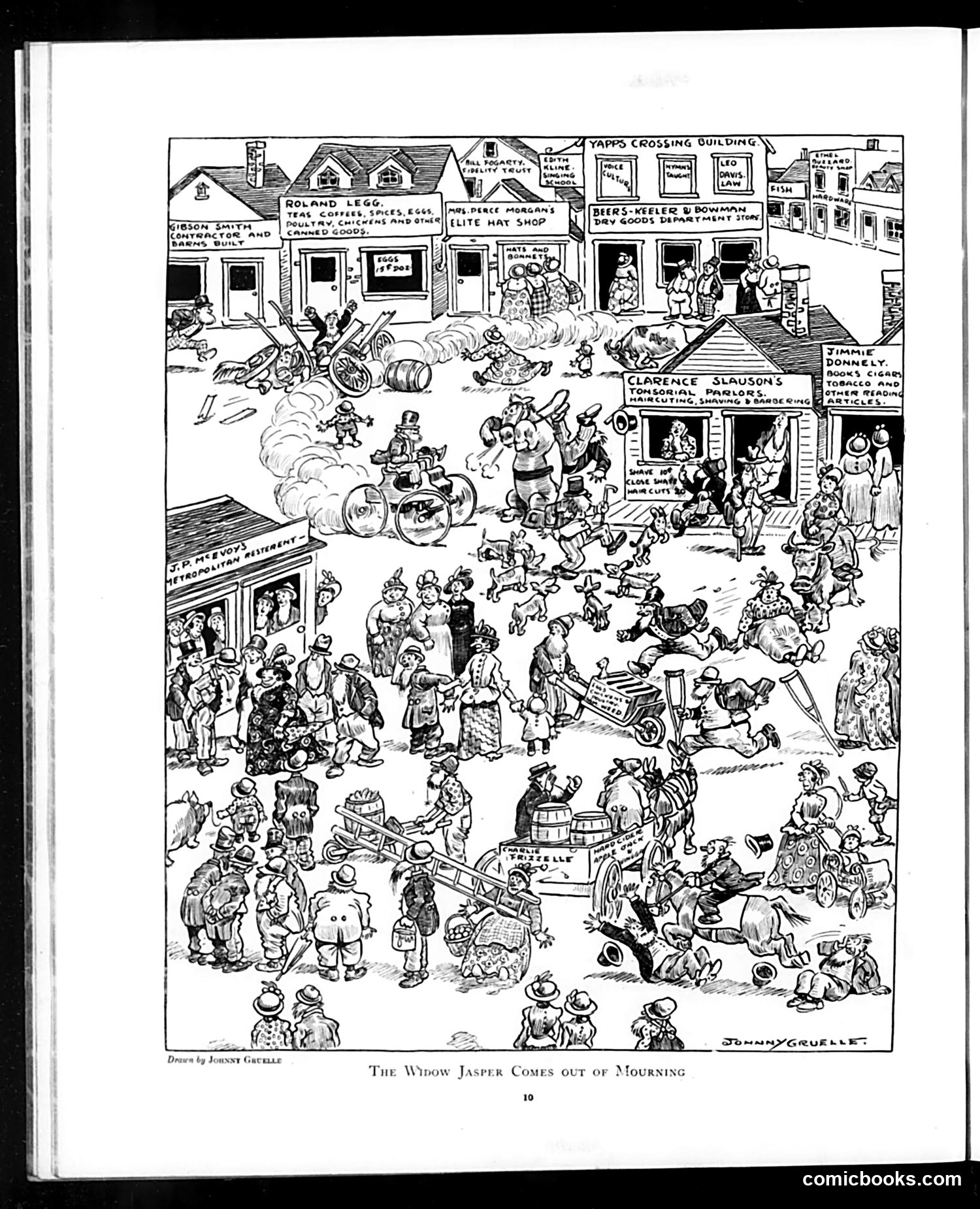
This is a crowded street scene depicting a woman (Widow Jasper) emerging from mourning period—likely a widow who has completed the customary social observance following her husband's death and is now resuming public social life. The cartoon satirizes small-town American life, showing various shops and businesses (hat shop, dry goods store, etc.) with townsfolk gathered to observe this social moment. The humor appears to rest on the spectacle and gossip surrounding a widow's return to society—a significant social marker in this era when mourning dress and withdrawal were obligatory customs. The detailed street scene with numerous figures suggests the communal, gossipy nature of small-town observation. The caption's tone implies mild satire of Victorian social conventions around mourning and how communities marked such transitions. The artist is credited as Johnny Gruelle.
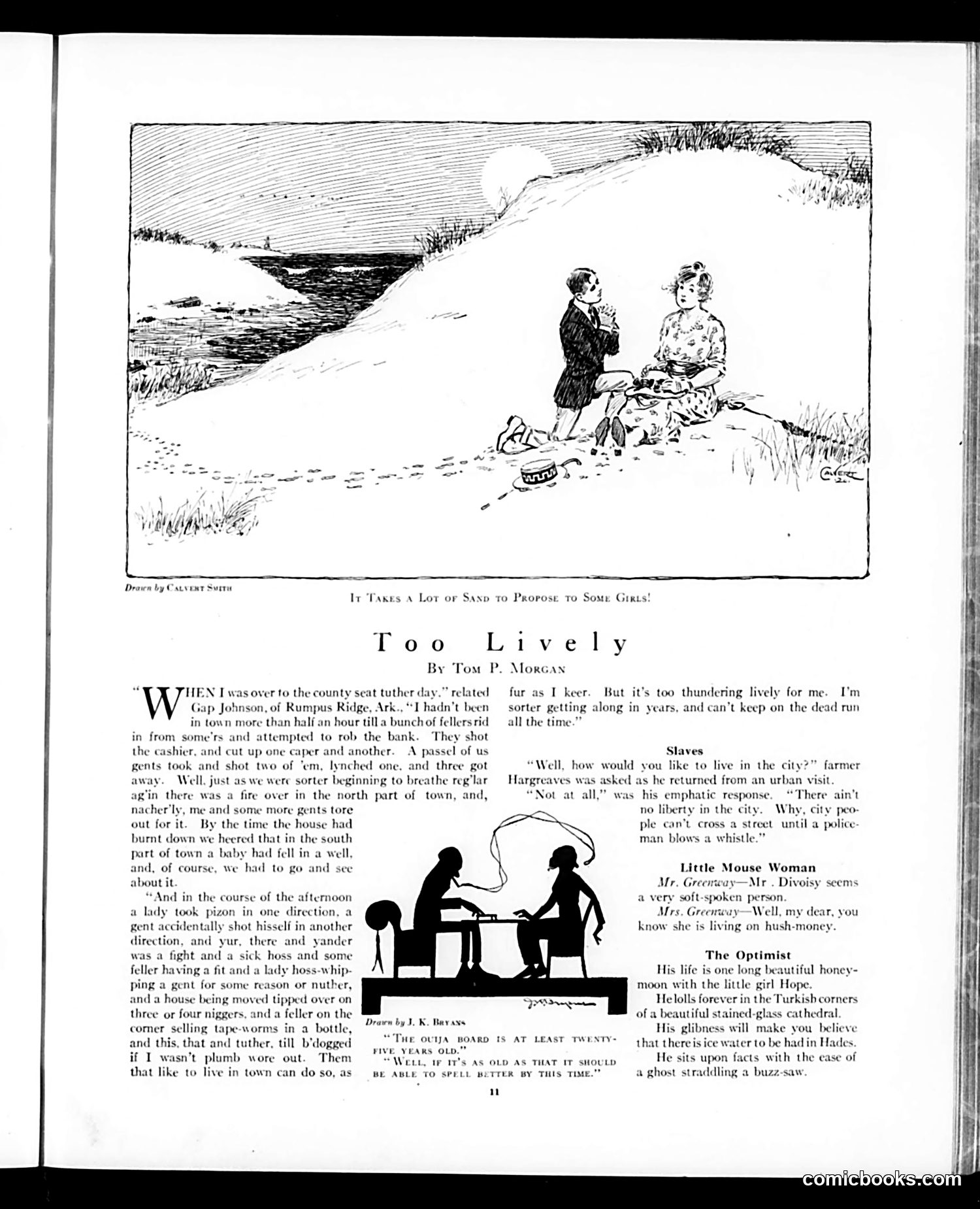
**"Too Lively"** presents a humorous contrast between rural and urban life. Gap Johnson, an Arkansas farmer, recounts a chaotic day at the county seat featuring bank robbery, lynching, fire, poisoning, shootings, and various disasters—yet he finds city life *too* hectic. The satire mocks rural attitudes: what constitutes genuine danger and excitement in frontier towns (violent crime, accidents) versus urban "restrictions" (police authority, civic order). **"Slaves"** depicts a farmer rejecting city living because "city people can't cross a street until a policeman blows a whistle"—satirizing how rural Americans viewed urban regulation as oppressive, missing the irony that frontier life involved actual lawlessness and mob violence (the lynching mentioned casually above). The page's other brief character sketches ("Little Mouse Woman," "The Optimist") are typical Judge magazine humor—cynical observations about contemporary society and gender relations, with minimal political content visible here.
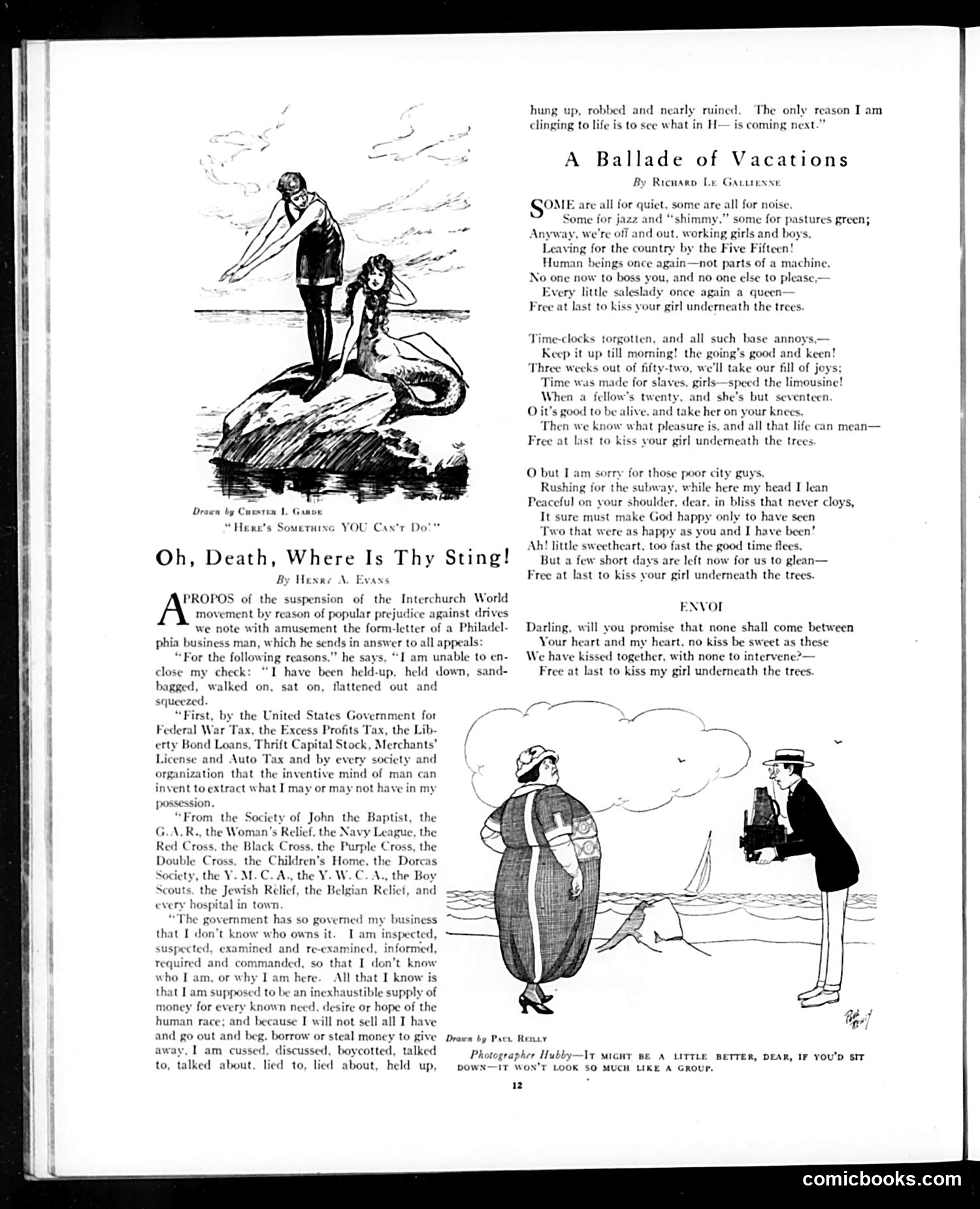
This page contains two distinct pieces reflecting post-WWI American sentiment: **"Oh, Death, Where Is Thy Sting!"** is a satirical piece featuring a businessman's form-letter refusing charitable donations. The humor—and complaint—lies in his exhaustive list of organizations and government taxes extracting money: Federal War Tax, Liberty Bond Loans, the Red Cross, Y.M.C.A., Belgian Relief, and numerous others. The satire targets the explosive proliferation of fundraising campaigns and government levies following World War I, suggesting donors are being bled dry by endless appeals. The title's ironic reference to death reflects his claim he's barely "clinging to life." **"A Ballade of Vacations"** by Richard Le Gallienne is a romantic poem celebrating working-class vacation time—a respite from industrial labor ("no one...to boss you"). The repeated refrain "Free at last to kiss your girl underneath the trees" emphasizes vacation as liberation from mechanized work life. The accompanying cartoon shows a woman photographer posing subjects, with text suggesting they should "sit down" to look less like "a group"—a gentle joke about photography composition. Together, these pieces reflect 1920s anxieties about taxation, charitable fatigue, and the desire for authentic human connection outside industrial constraints.
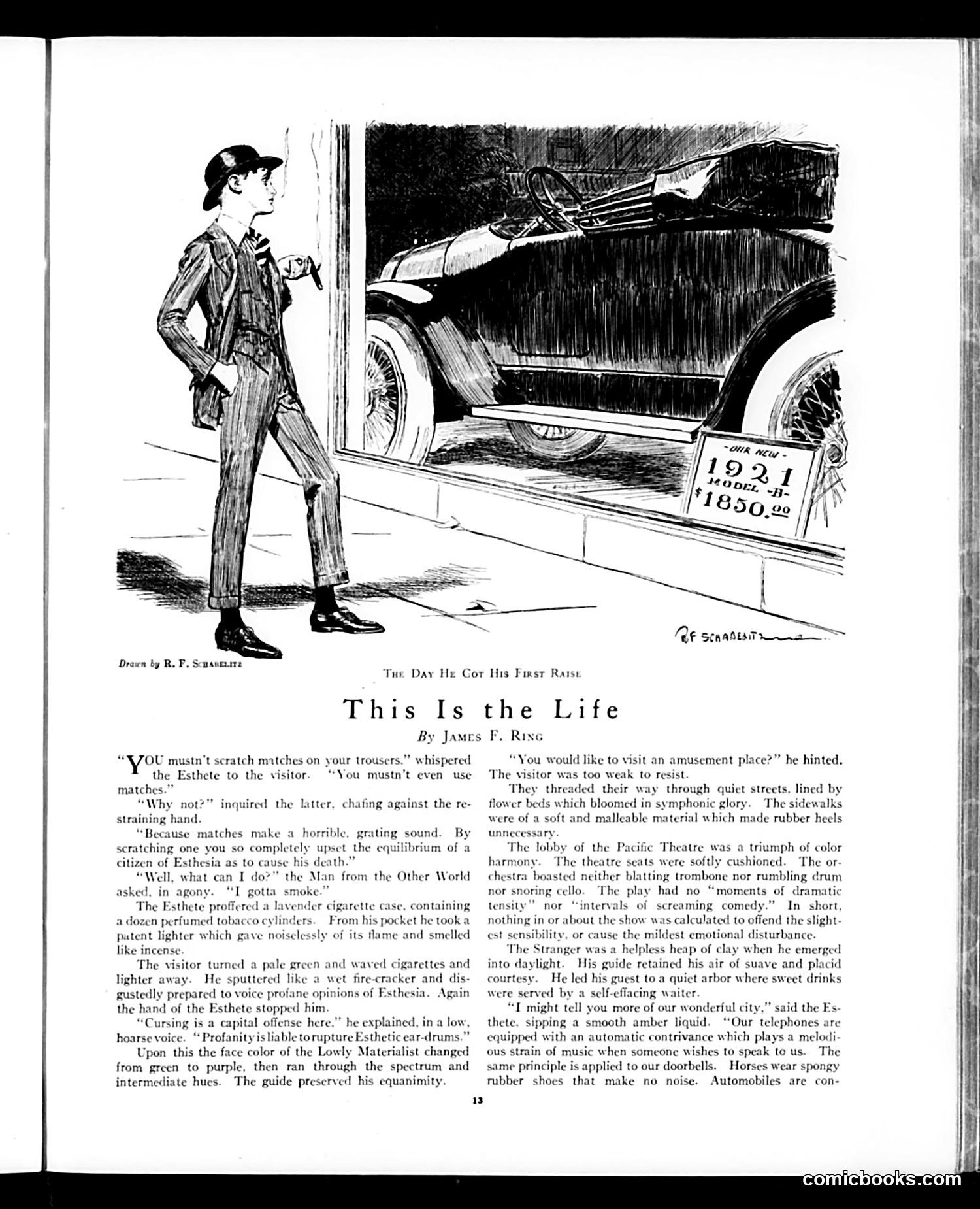
This is a satirical story mocking "Aesthetes"—late 19th/early 20th-century cultural elitists obsessed with refined beauty and sensory perfection at the expense of practicality. The cartoon shows a young man admiring an expensive automobile (priced at $1850—substantial for the era), captioning it "The Day He Got His First Raise." The accompanying story by James F. Ring depicts a visitor encountering an absurdly precious Esthetist who forbids matches (too loud), cursing (damages ears), and takes him to a theater deliberately stripped of all dramatic tension or emotional engagement. Everything is muted, cushioned, and pointless—horses wear rubber shoes, telephones play music instead of ringing. The satire targets the Aesthetic movement's extreme rejection of utility and emotion in favor of "art for art's sake." The joke: this hyper-refined lifestyle is paralyzing and ridiculous. The ordinary "Man from the Other World" is driven nearly mad by rules designed to preserve delicate sensibilities, exposing the movement as impractical and life-denying.
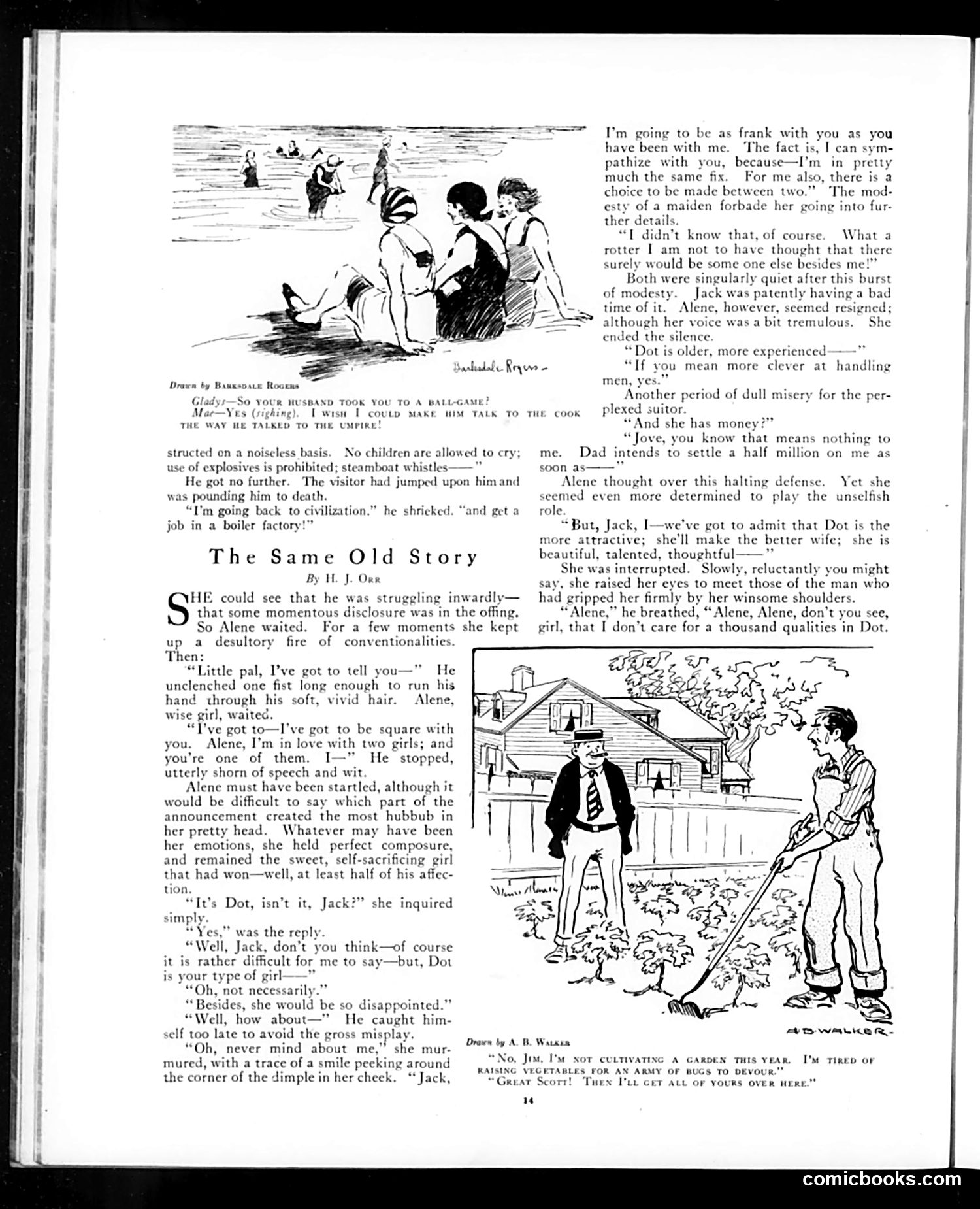
This page contains two separate humorous stories typical of early 20th-century American magazines. **Top cartoon** ("The Same Old Story"): A domestic comedy about a man confessing he's in love with two women—Alene and Dot. The satire targets Victorian romantic sentimentality: both parties respond with exaggerated selflessness, each insisting the other pursue their rival. The joke exposes how conventional courtship rhetoric masks selfishness—both claim to sacrifice while actually hoping the other will step aside. **Bottom cartoon**: A brief exchange between a man and woman about gardening. The woman has abandoned vegetable gardening because insects consume the crops. The man jokes he'll "get all of yours over here"—suggesting he'll similarly profit from her abandoned effort. It's mild domestic humor about shared neighborhood problems. Both stories exemplify the magazine's satirical approach to middle-class romantic and domestic life, using exaggerated politeness and understated irony to mock social conventions of the era.
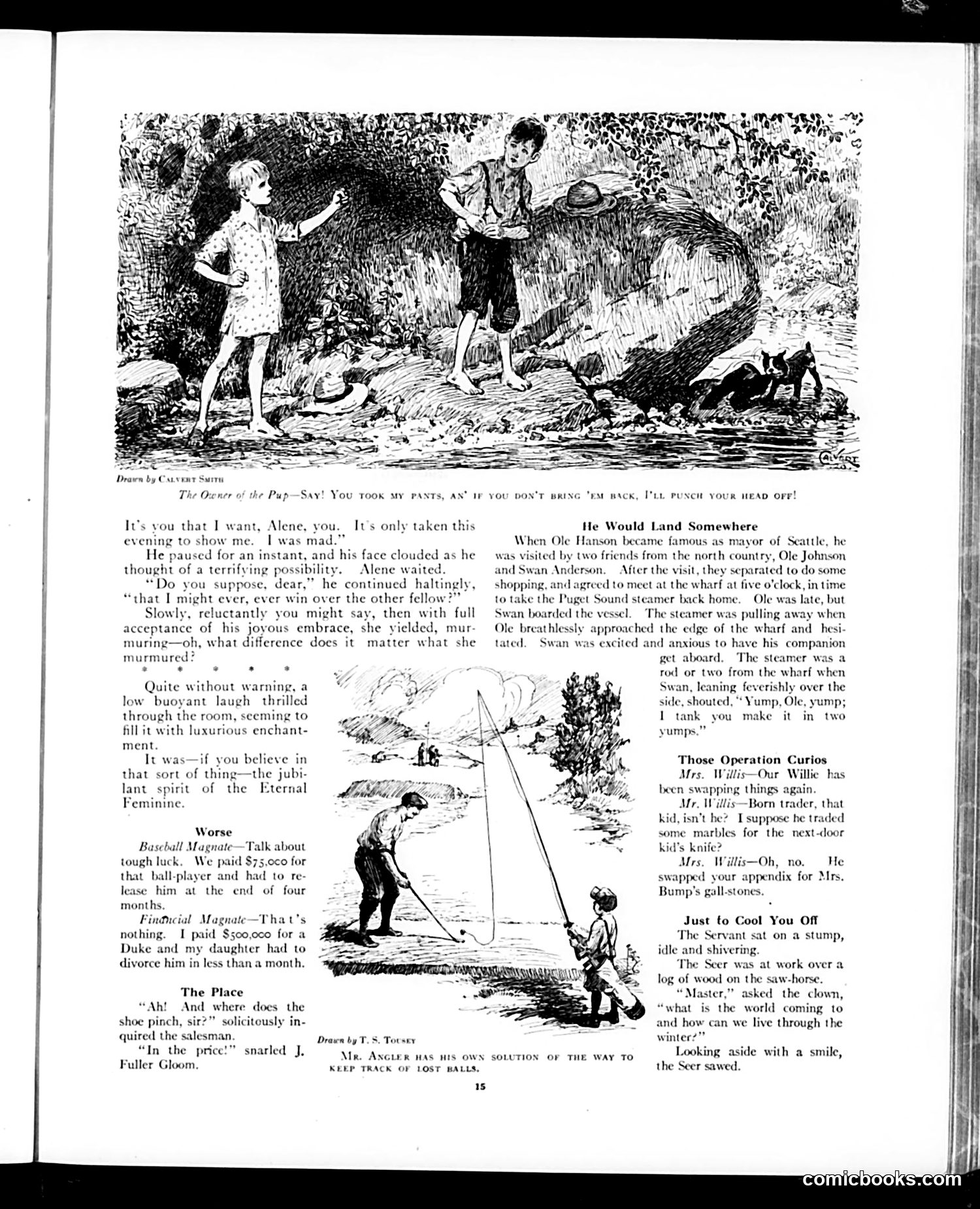
This page contains multiple satirical vignettes typical of early 20th-century American humor: **Top cartoon**: A domestic scene where a man and woman resolve romantic tension. The satire appears to mock romantic melodrama and the "eternal feminine" trope—suggesting women's emotional power over men is both mysterious and ultimately trivial. **"Worse" section**: Two brief jokes lampooning wealthy men's financial losses—one about a baseball team wasting money on a player, another about a wealthy man spending $500,000 on a duke his daughter divorces within a month. The satire targets nouveau riche excess and foolish aristocratic marriages. **"The Place" joke**: A simple pun about shoe-fitting where "the price pinches" rather than the shoe itself. **Middle cartoon**: Depicts an angler retrieving golf balls from water, satirizing golfers' carelessness or incompetence at the sport. **"Ole Hanson" story**: A humorous anecdote about Seattle's mayor and his Scandinavian-accented friends, playing on ethnic stereotypes of Swedish/Norwegian immigrants. **Remaining sections**: Brief domestic humor mocking modern anxieties and trading behaviors. Overall: Lighthearted social satire targeting wealth, romance, and contemporary American life.
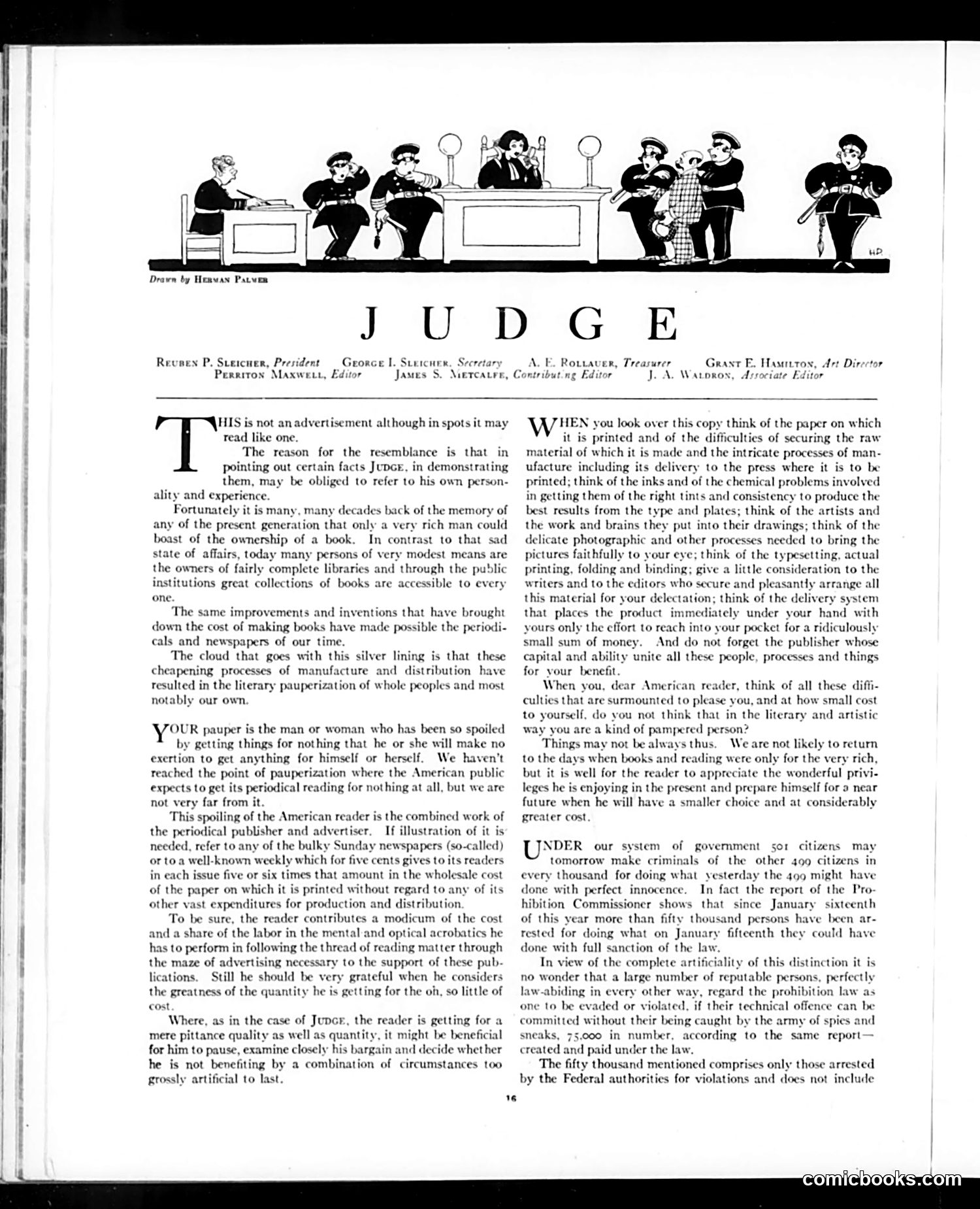
This is a **title/masthead page** for *Judge* magazine, not a political cartoon. The small illustration at top shows the magazine's editorial staff seated at a desk—a visual representation of the publication's leadership. The lengthy text is the magazine's **editorial statement** addressing reader expectations. The core argument: *Judge* offers exceptional quality (writing, art, printing) at remarkably low cost, subsidized by advertisers. The editors warn readers not to become spoiled by cheap periodicals (particularly Sunday newspapers) that train the public to expect quality content for nothing. The satire targets both **publishers** (who exploit readers with ad-heavy, low-quality content) and **American readers** themselves, whom the editors characterize as having become "paupers" accustomed to undeserved bargains. The piece argues this artificial pricing model cannot last. This reflects early-20th-century concerns about **mass media economics** and the tension between commercial viability and editorial integrity.
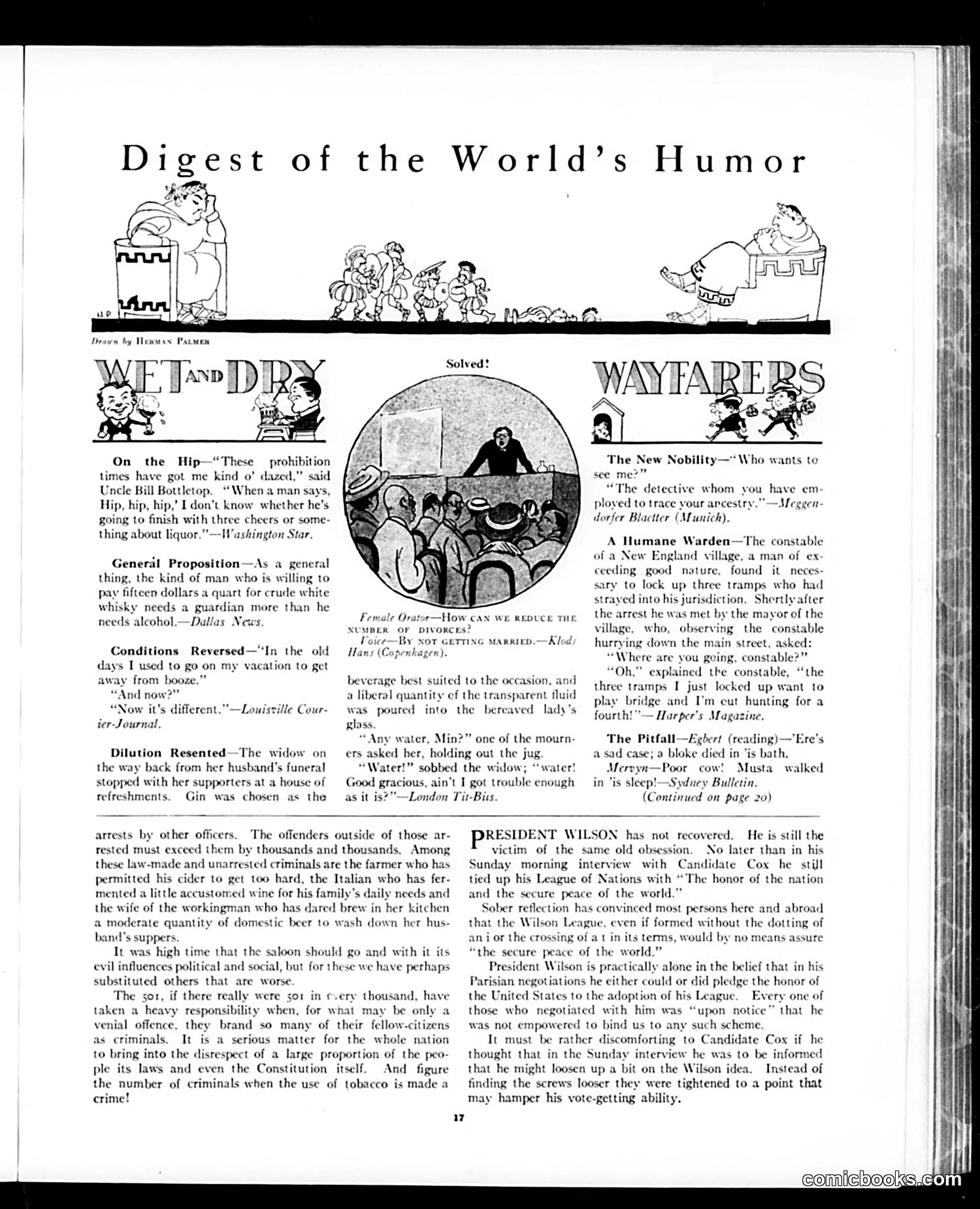
This page from *Judge* magazine is a humor digest mixing jokes about **Prohibition** (the 1920-1933 alcohol ban) with political commentary on President Wilson. The cartoons and brief jokes mock Prohibition's enforcement absurdities—people obtaining illegal liquor, the distinction between "crude whisky" and medicinal alcohol, and the irony of avoiding alcohol on vacation versus seeking it during Prohibition. One joke shows a widow choosing gin over water at her husband's funeral. The longer editorial at bottom attacks **President Wilson** for his fixation on the League of Nations, arguing he inflexibly tied it to "honor" and "secure peace" during Paris peace negotiations (likely post-WWI). The writer suggests Wilson's obsession was counterproductive and that the League itself wouldn't guarantee peace—a skeptical view common among American isolationists opposing Wilson's internationalism. The "Female Orator" cartoon ironically solves divorce reduction: hire detectives to trace ancestry (mocking new social-climbing obsession with genealogy as status symbol).
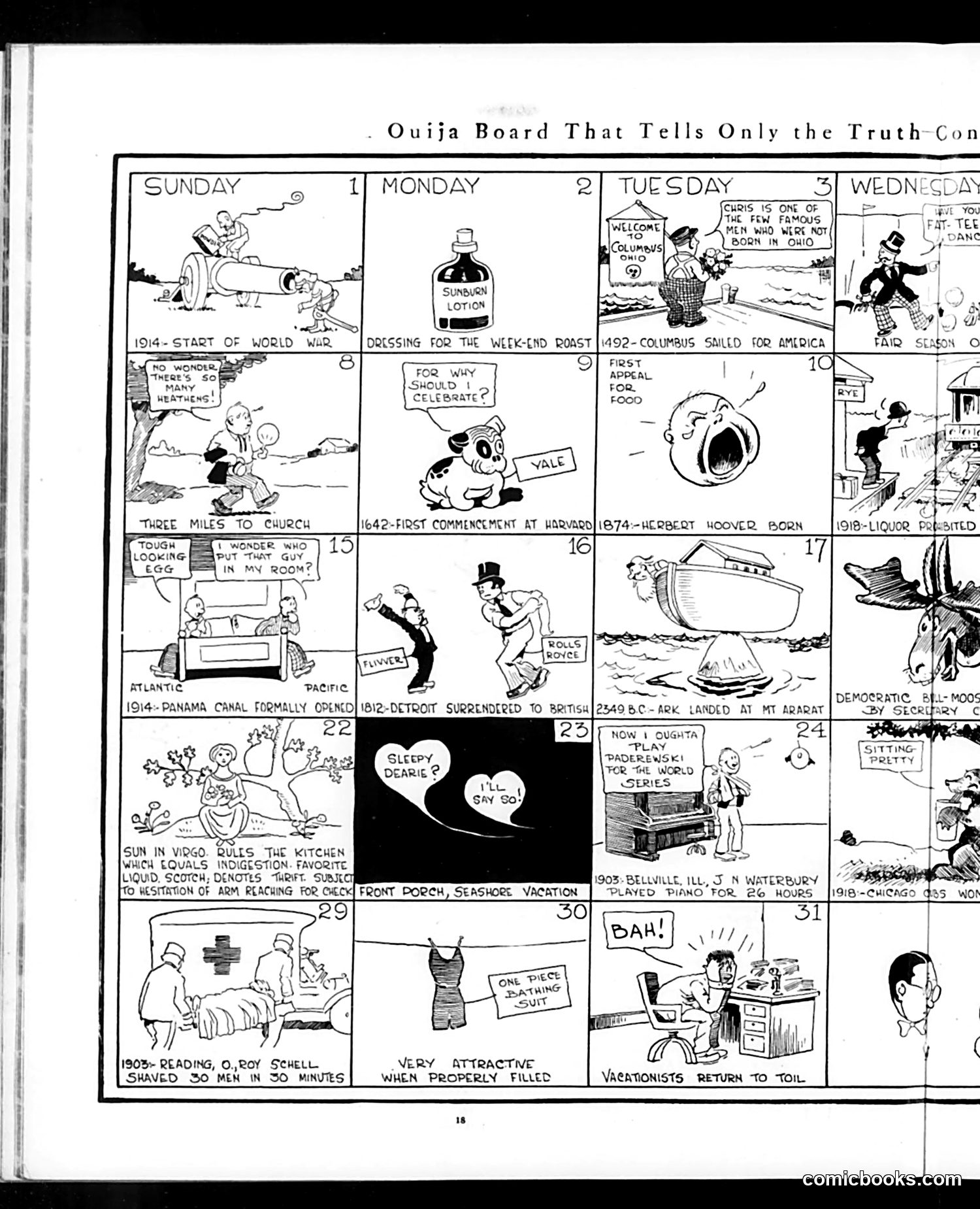
This satirical page presents a calendar of historical events paired with astrological interpretations and humorous commentary. The joke is that a "truthful" Ouija board pairs significant historical dates with trivial, absurd, or irreverent observations. For example: - **Sunday (1914)**: World War I's start is accompanied by a silly astrological reading about Virgo ruling the kitchen and causing indigestion - **Monday (1642)**: Harvard's founding is mocked with references to Yale - **Tuesday (1492)**: Columbus's voyage gets a quip about "Fair Season" - Other entries mock famous figures like Hoover and Paderewski The satire ridicules both pseudoscientific astrology and the pretense of objective truth-telling. By juxtaposing solemn historical events with frivolous commentary, the cartoon suggests that much contemporary "truth-telling"—whether astrological readings or news commentary—is equally meaningless. This reflects *Judge* magazine's satirical skepticism toward popular fads and public discourse of the era.
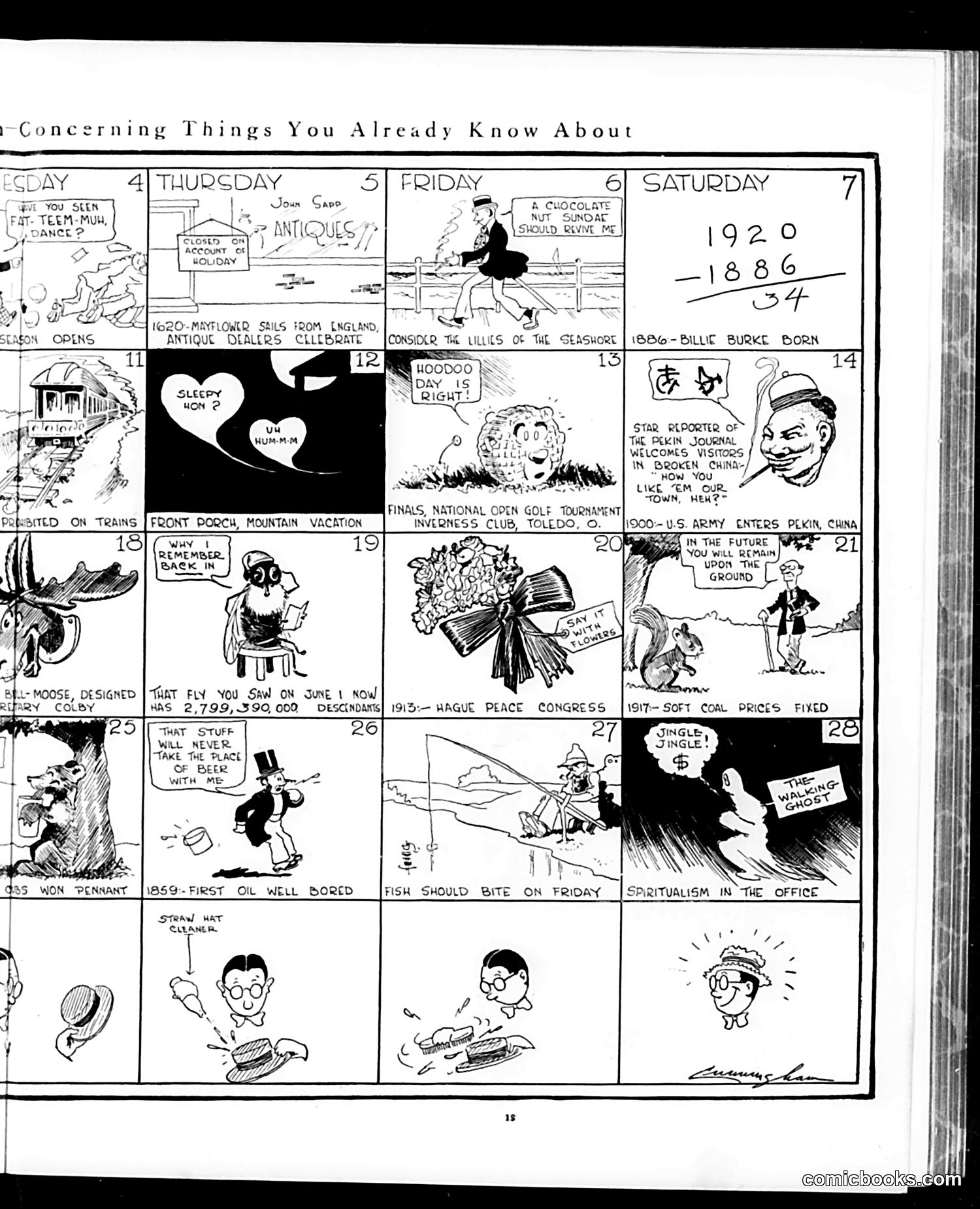
This is a satirical weekly calendar page from Judge magazine presenting current events through humorous commentary. The strips reference early 1900s topics: **Visible references include:** - Mayflower antique ships from England celebrating - A national golf tournament at Inverness Club, Toledo - U.S. Army entering Peking (Beijing), China - A moose design with 2.7+ billion descendants - Theodore Roosevelt's "Bull Moose" political party (implied by moose reference) - Oil well drilling - Spiritualism and office séances (popular pseudoscience of the era) **The humor relies on:** Juxtaposing mundane domestic events (straw hat cleaning, fishing) with major historical happenings. The "things you already know about" format suggests satirizing how newspapers over-covered obvious news. The bottom panels show slapstick physical comedy—a man getting hit with objects—typical Judge humor unrelated to the calendar's political content. Without clearer OCR, some specific references remain unclear, but the page mixes genuine 1910s-era events with absurdist commentary.
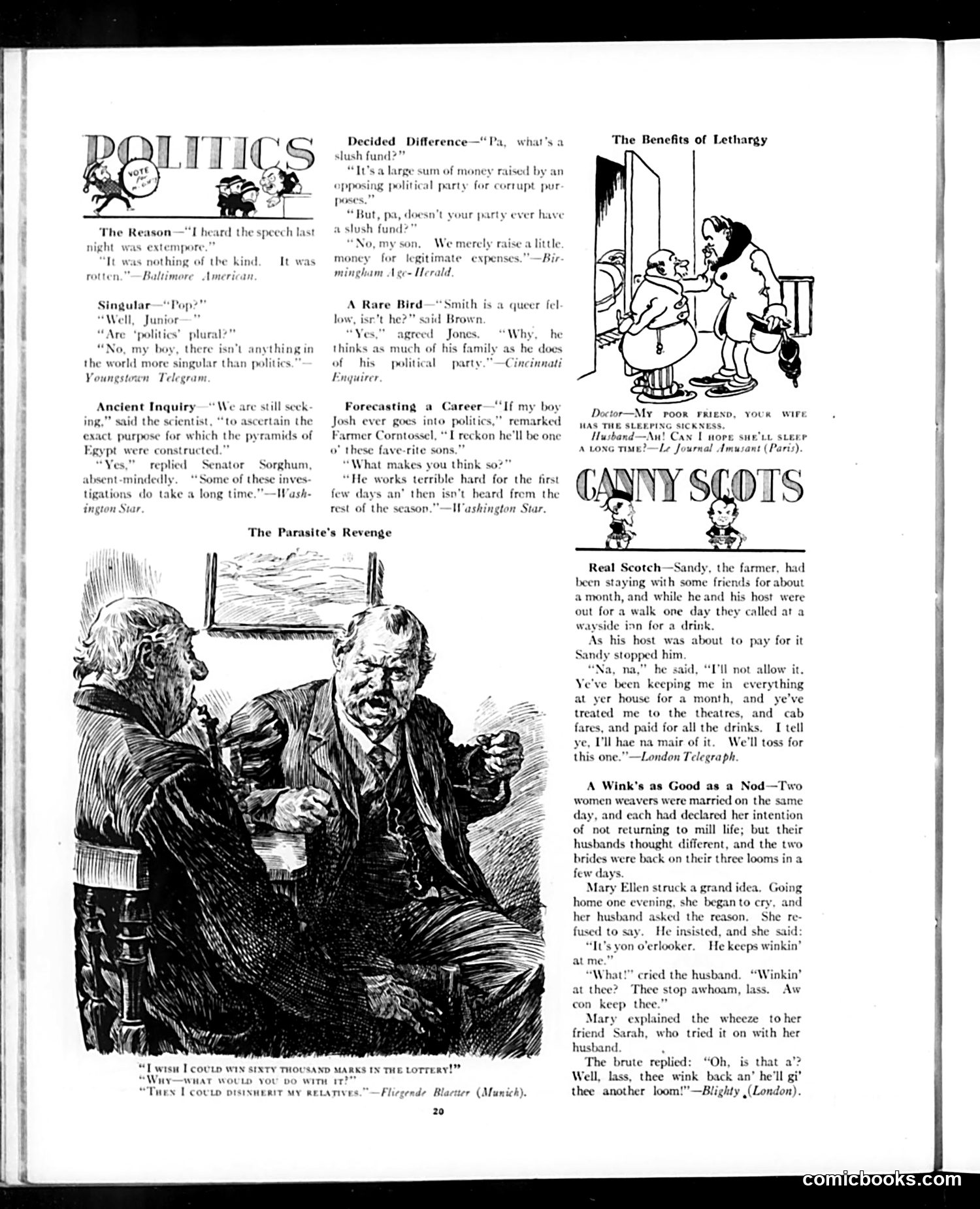
This page collects brief satirical jokes about American politics and social life, typical of Judge's humor style. **Political satire sections** mock politicians' hypocrisy: a father distinguishes between his party's "legitimate expenses" and the opposition's corrupt "slush fund"—implying both engage in the same practice. Another joke portrays a politician who works hard only the first few days, then disappears. A senator absent-mindedly compares pyramids to political investigations that "take a long time"—suggesting government incompetence. **Social humor** includes a piece on a Scottish farmer's pride (refusing hospitality payments), and two tales of working-class women using deception on their husbands—one faking emotional distress to avoid mill work, another exploiting her husband's jealousy to gain job advancement. **The cartoon** shows two men in what appears to be a financial or legal dispute, illustrating "The Parasite's Revenge." The overall tone reflects early 20th-century skepticism toward politicians and class-based humor common to the era.
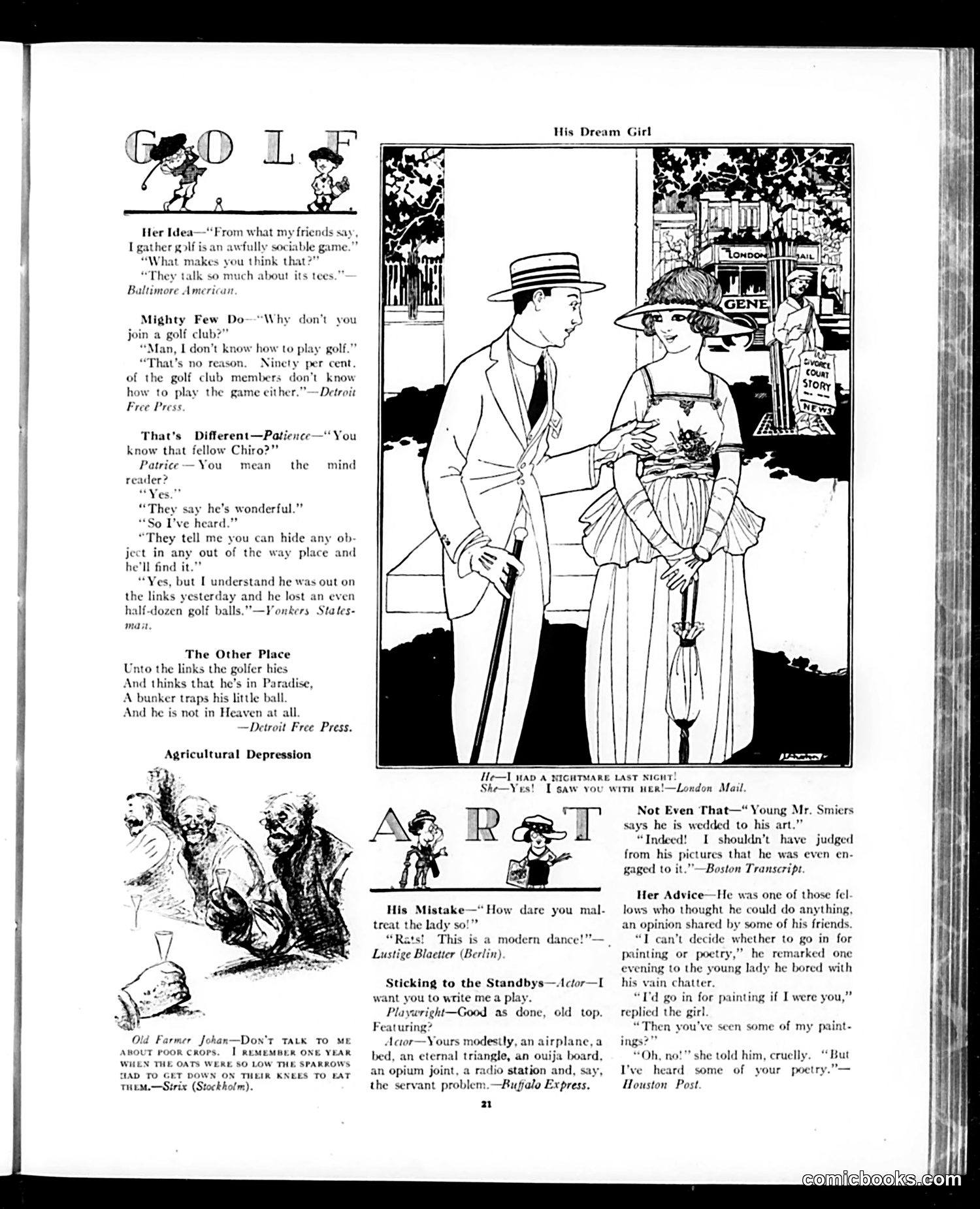
This page collects brief satirical jokes typical of 1920s Judge magazine. The main illustration, "His Dream Girl," shows a well-dressed couple at what appears to be a London shop; the caption reveals she claims she saw him there, though he'd claimed to have a nightmare—a marital misunderstanding joke. The surrounding text consists of short quips mocking: 1. **Golf culture**: Multiple jokes attack golf's popularity despite players' incompetence. The humor suggests golf's appeal is purely social ("talk so much about its tees"), and even club members don't actually know how to play. 2. **Artists' pretension**: A young artist cannot choose between painting and poetry; a woman advises painting—because she's heard his *poetry* is terrible. 3. **Generic theatrical formulas**: A playwright promises to include "an airplane, a bed, eternal triangle, opium joint, radio station"—mocking formulaic modern drama. The page reflects Jazz Age skepticism toward both new leisure activities (golf) and contemporary artistic trends.
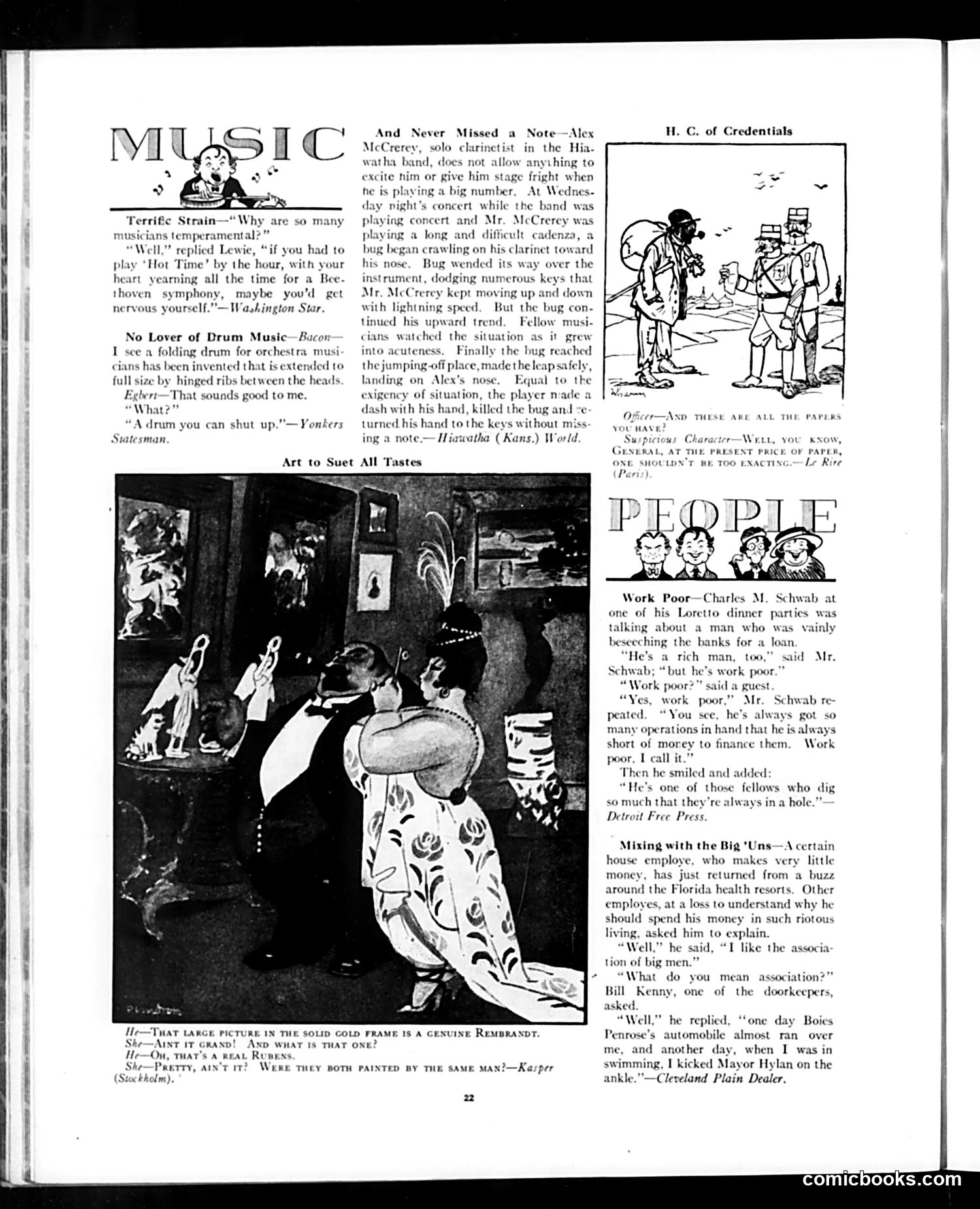
This page contains several brief humorous anecdotes satirizing American social types and pretensions circa 1910s-1920s. The main cartoon depicts a couple viewing paintings in a gallery, debating whether artworks are genuine Rembrandts or Rubens—a joke about art snobbery and how wealthy people casually discuss Old Masters without real knowledge. The text pieces mock: 1. **Musicians' temperament**: complaints about playing popular songs instead of serious classical music 2. **A clarinetist's composure**: praising a musician who killed a bug crawling on his instrument without missing a note 3. **Charles Schwab's "work poor" concept**: a wealthy industrialist's term for rich men perpetually short of cash due to overextended business operations 4. **Social climbing**: a working-class employee bragging about "mixing with big men"—his only credentials being near-accidents with prominent Philadelphia and New York politicians (Boies Penrose, Mayor Hylan) The humor targets pretension, snobbery, and working-class aspiration through irony and understatement typical of Judge's satirical style.
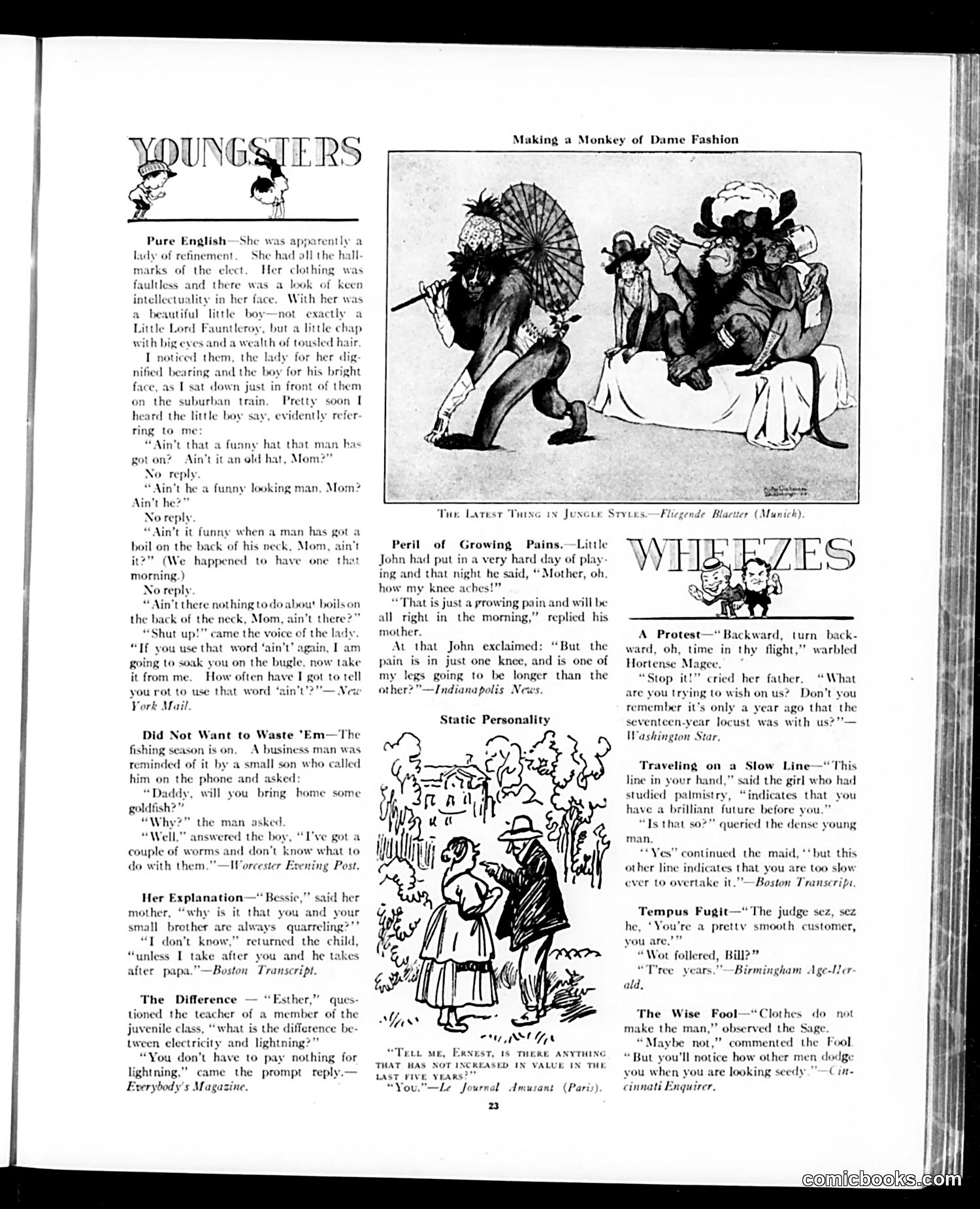
This page from Judge magazine contains several short humorous anecdotes and illustrations satirizing early-20th-century American social life. The main cartoon, "Making a Monkey of Dame Fashion," mocks women's jungle-themed fashion trends—likely referencing the exotic "Oriental" and animal-print styles popular in that era. The exaggerated illustrations show women in elaborate costumes, satirizing how fashion trends make women look ridiculous. The written anecdotes mock various social issues: a refined English lady's hypocrisy (she corrects a child's grammar while being rude herself); children's innocent but awkward observations about adults; and working-class humor about boils, goldfish, and electricity. The "Static Personality" cartoon and various one-liners satirize pretentiousness, superstition (palm reading), and class differences. The final joke about clothes suggests that appearance matters despite the sage's claim that "clothes do not make the man"—exposing hypocrisy in social attitudes. Overall, Judge uses gentle ridicule to comment on fashion excess, social pretension, and generational differences in Edwardian America.
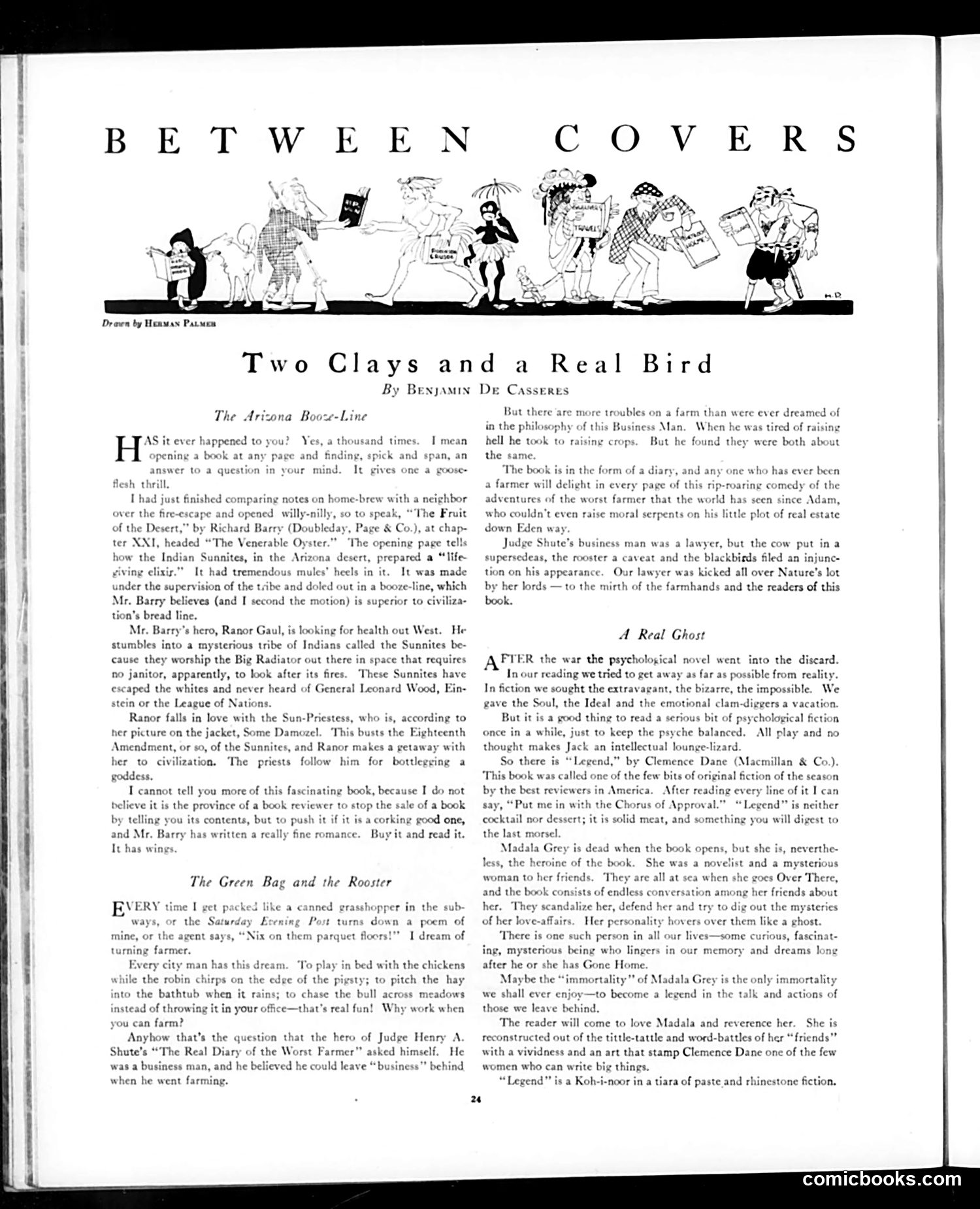
This page reviews three books with satirical commentary typical of Judge magazine's style: **"Two Clays and a Real Bird"** by Benjamin De Casseres mocks Richard Barry's novel about a businessman seeking health in the Arizona desert who encounters a mystical Native American tribe ("Sunnites") and a "Sun-Priestess." The satire targets romanticized portrayals of the Southwest and naive urban professionals attempting to escape civilization. **"The Green Bag and the Rooster"** reviews Judge Henry Shute's diary-format comedy about a business lawyer who attempts farming, only to discover rural life presents unexpected legal and practical complications—a cow files injunctions, the rooster becomes a "caveat." The humor satirizes white-collar professionals' naive assumptions about farming. **"A Real Ghost"** discusses Clemence Dane's psychological novel, noting the postwar shift away from realistic fiction toward the fantastical and emotional. The cartoon header depicts various characters representing these literary scenarios in a line-up style, drawn by Herman Palmer. The page uses these book reviews to mock urban pretension and unrealistic escapism fantasies.
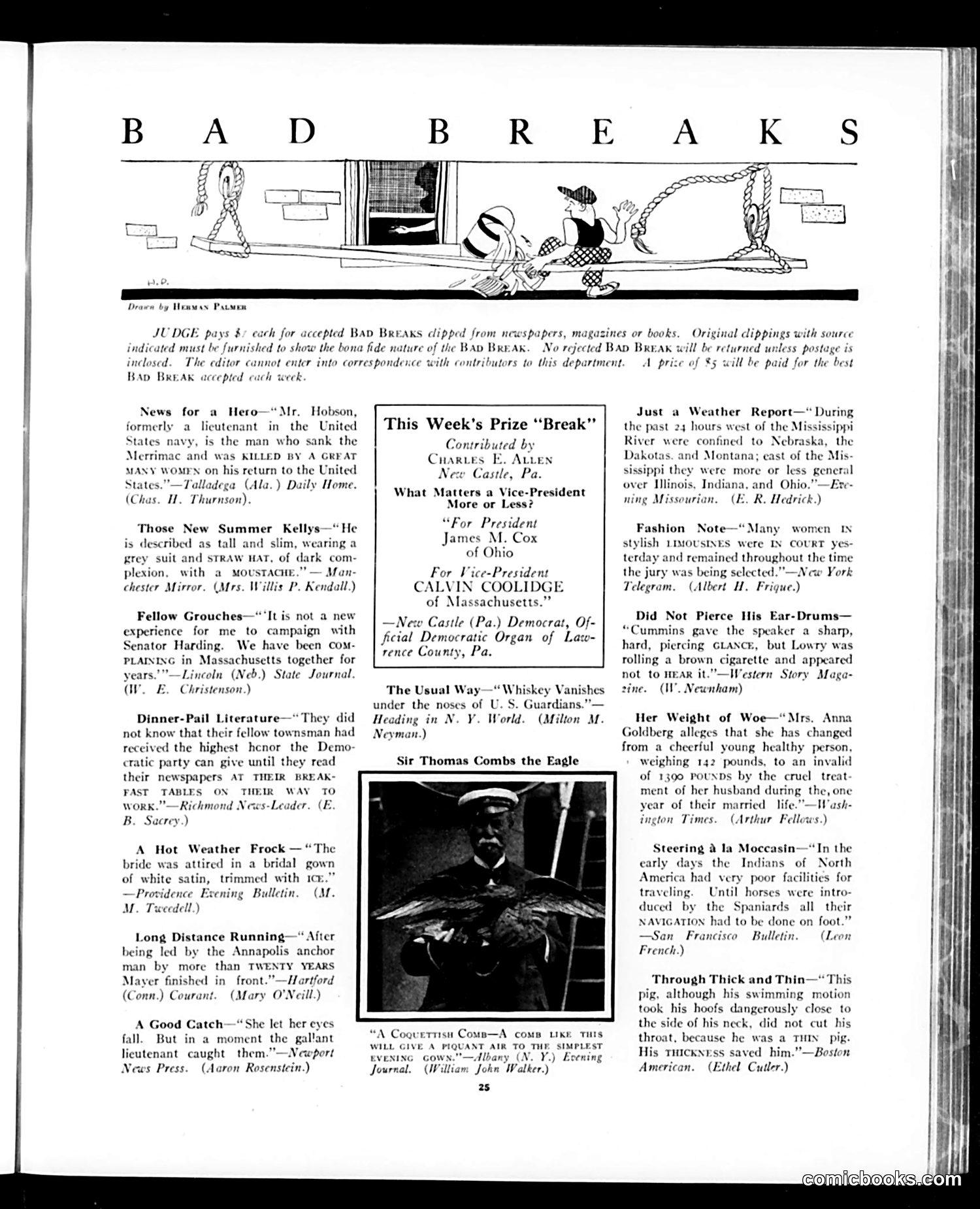
This page showcases Judge's popular "Bad Breaks" department—humorous newspaper printing errors and absurd phrasing. Readers submitted clipped quotes where unfortunate word choices created unintended comedy. Examples include: a naval hero "KILLED BY A GREAT MANY WOMEN" (meaning romantically pursued); a bride's gown "trimmed with ICE" (meant "lace"); a political announcement implying vice-president Calvin Coolidge matters little ("More or Less"); and a woman weighing "1300 POUNDS" (likely "130"). The featured break, by Charles E. Allen, mocks the Democratic Party's 1920 ticket (James Cox for president, Coolidge for vice-president)—though Coolidge was actually Republican, making the error doubly absurd. The page reflects early 20th-century humor emphasizing linguistic mishaps and typographical comedy—entertainment derived from close reading of newspapers themselves.
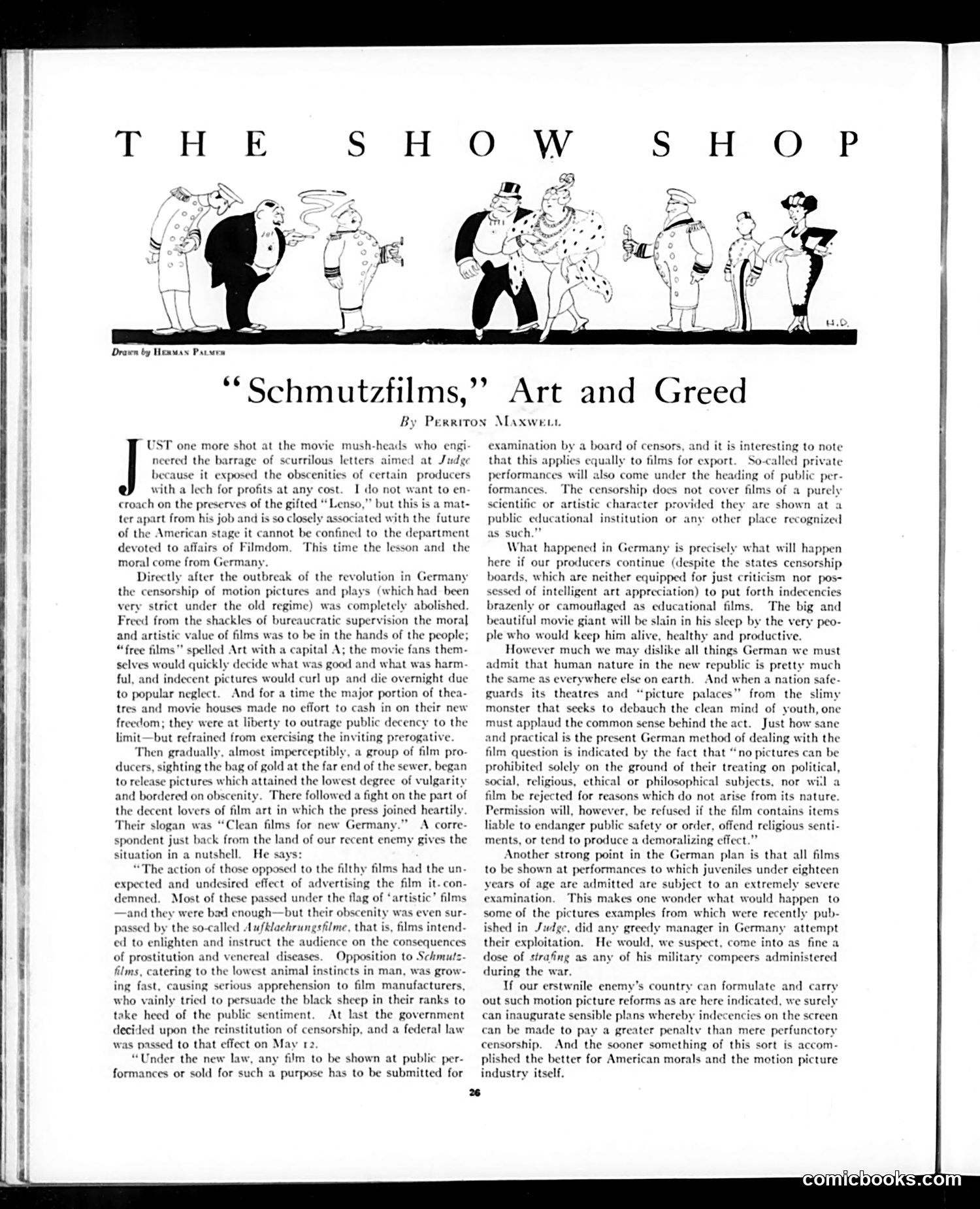
This article uses Germany's recent experience as a cautionary tale for American film producers. After Germany's 1918 revolution abolished film censorship, producers initially exercised restraint. However, they gradually released increasingly vulgar content—including "Schmutzfilms" (literally "filth films") about prostitution and venereal disease—purely for profit. Public outcry forced Germany to reinstate government censorship in May 1921. The author warns American producers: if they continue releasing indecent films under the guise of "art" or "education," American audiences will similarly demand strict federal censorship, destroying the film industry's freedom and profitability. The cartoon's figures appear to represent various film industry types—producers, actors, and showmen—illustrating the range of people involved in this morally questionable enterprise. The satire targets producers' greed masquerading as artistic merit.
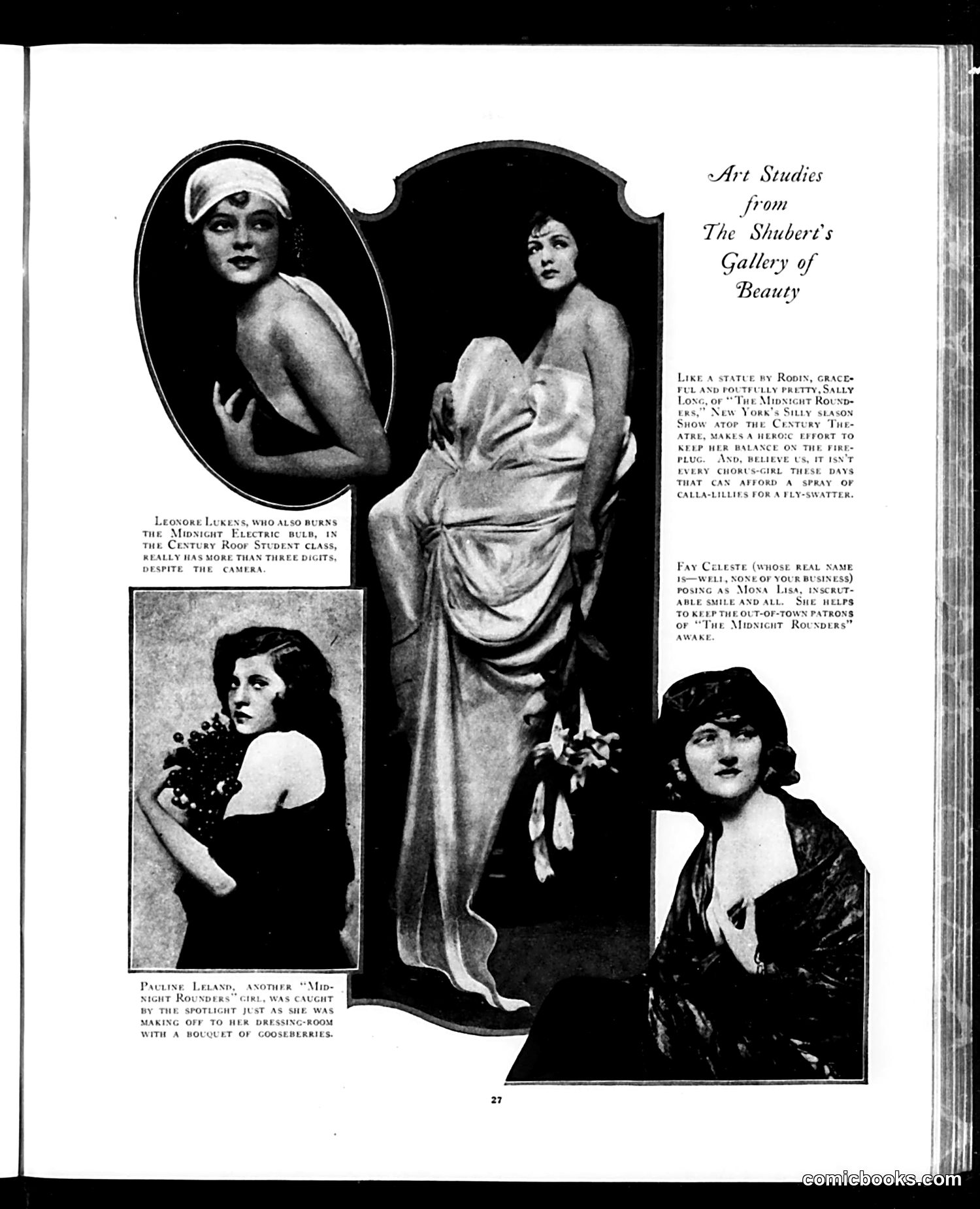
This page celebrates chorus girls from "The Midnight Rounders," a Broadway show at the Century Theatre. It's not satire but rather admiring commentary on the performers—a common Judge magazine feature showcasing theatrical beauty. The four named actresses (Sally Long, Leonore Lukens, Fay Celeste, and Pauline Leland) are presented as artistic subjects, with accompanying photographs. The captions use mock-serious, flowery language typical of art criticism ("like a statue by Rodin") applied to these dancers, creating gentle humor through absurdist contrast. The jokes are light: one girl can "afford" expensive calla lilies for a fly-swatter; another "really has more than three digits" (toes); one poses as the Mona Lisa to keep audiences entertained. The final caption humorously catches Pauline sneaking away with gooseberries. This reflects early-1900s attitudes toward Broadway chorus girls as objects of aesthetic appreciation and mild ridicule.
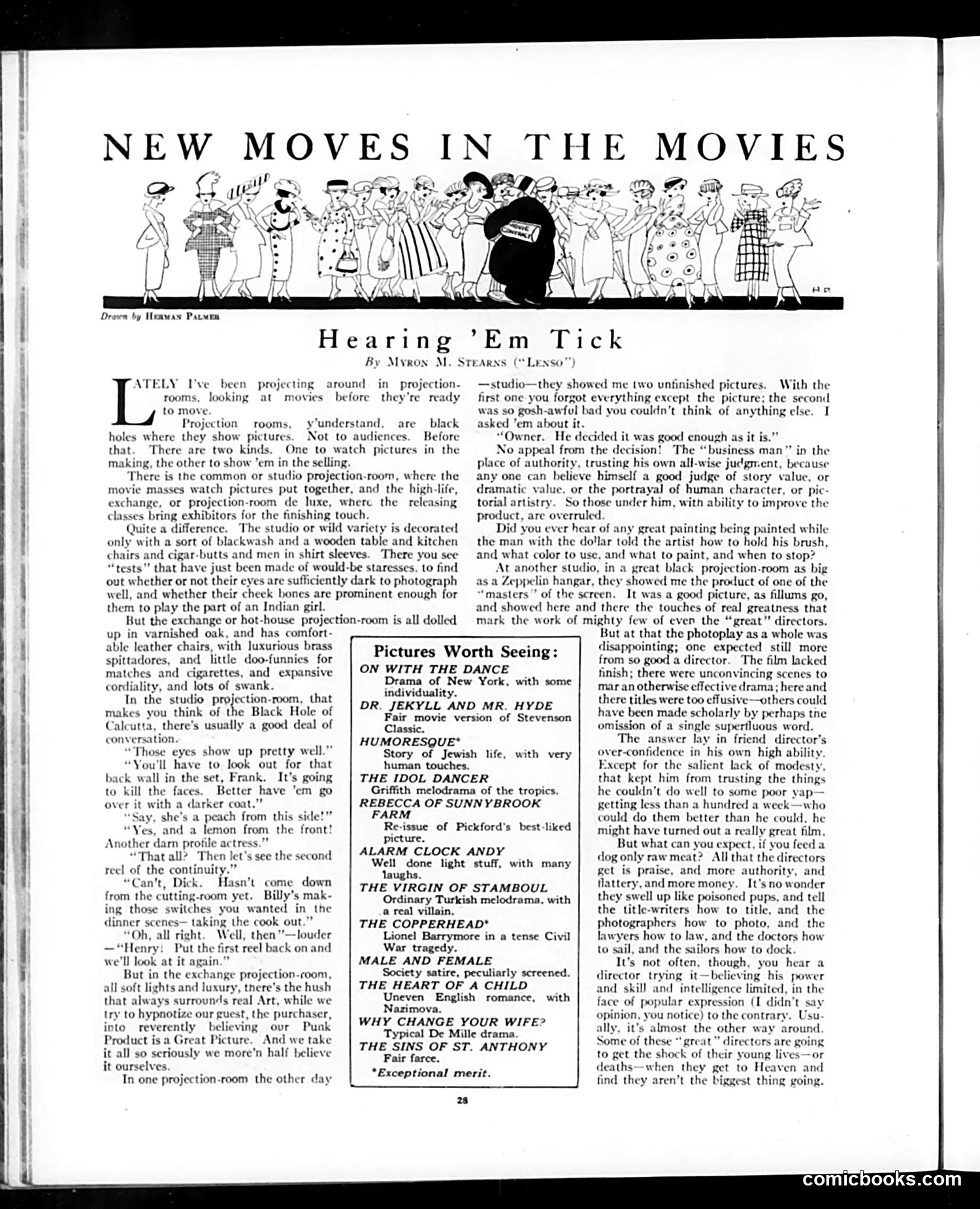
This page is a film criticism column by Myron M. Stearns discussing cinema projection rooms and film quality. The header illustration shows stylized figures in 1920s-30s fashion, with one notably larger dark figure among them—likely satirizing film industry pretension or an outsized personality. The column critiques studio preview rooms, contrasting luxurious executive screening spaces with humble "test" rooms. Stearns humorously describes how studios use previews to gauge audience reaction, with anecdotes about frank audience feedback ("Say, she's a peach from this side!"). The satirical point: despite expensive facilities and executive authority, studios often misjudge their own films' quality. Stearns suggests even powerful directors can't reliably predict audience response, mocking industry confidence and the gap between intention and execution in filmmaking.
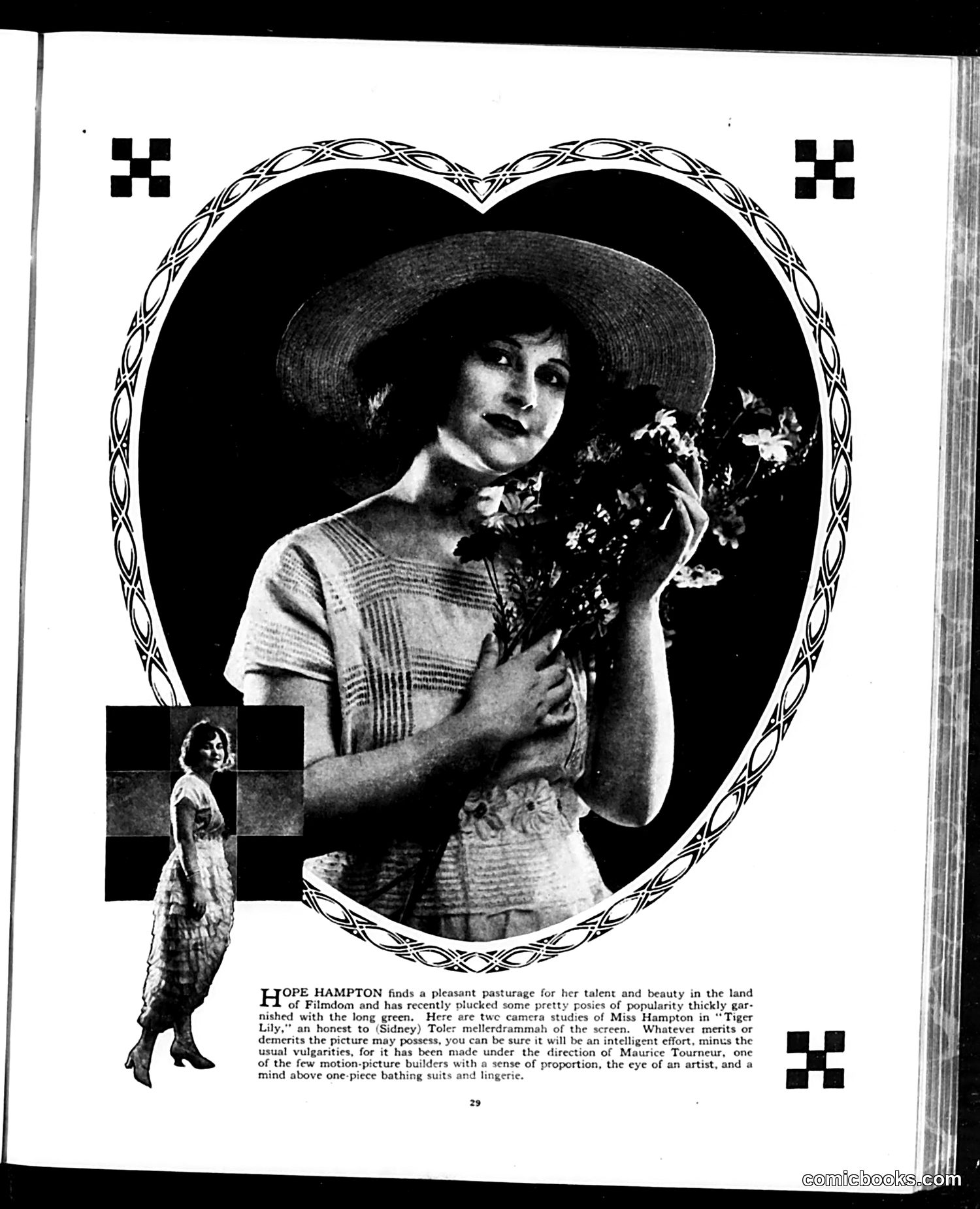
This page celebrates actress **Hope Hampton** and her film career in early Hollywood. The text praises her success in the movie industry ("Filmdom"), noting she's earned popularity and money ("long green"). The two photographs showcase her in the film **"Tiger Lily,"** described as a melodrama. The text backhands the film industry generally—sarcastically praising director **Maurice Tourneur** for making an "intelligent effort" *without* "vulgarities," implying most films rely on lowbrow content like "one-piece bathing suits and lingerie" rather than artistic merit. The satire targets Hollywood's reputation for shallow entertainment and exploitation, while crediting Tourneur as an exception who maintains artistic standards. This reflects Judge magazine's upper-class editorial perspective skeptical of mass entertainment and female objectification in early cinema.
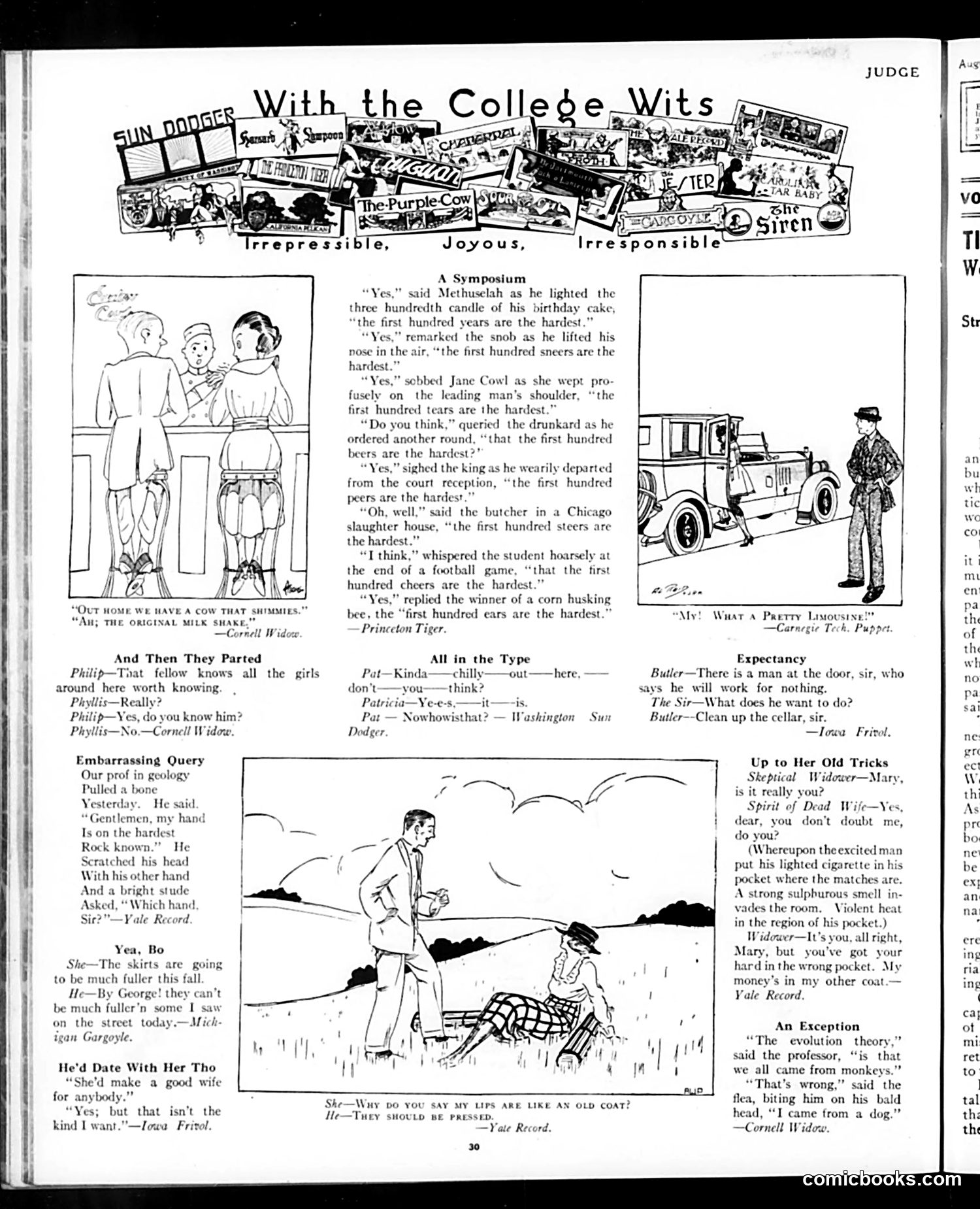
This is a college humor page from Judge magazine, featuring jokes and cartoons sourced from various university publications (Cornell Widow, Yale Record, Iowa Frivol, etc.). The content reflects early 20th-century collegiate humor with no overt political content. The jokes center on predictable student-life themes: awkward dating ("Pat" and "Patricia's" stilted conversation), domestic comedy (the "cow that shimmies"/milk shake reference), and gentle ribbing of authority (a geology professor's embarrassing moment). The cartoons show simple domestic or social situations—a couple at home, a man in a field, a truck driver. The humor relies on wordplay, puns, and double meanings ("the first hundred years are the hardest" repeated across various professions), which was typical of collegiate magazines of this era. Nothing here targets specific political figures or events—it's simply light satire of everyday life, courtship, and academic settings aimed at college-aged readers.
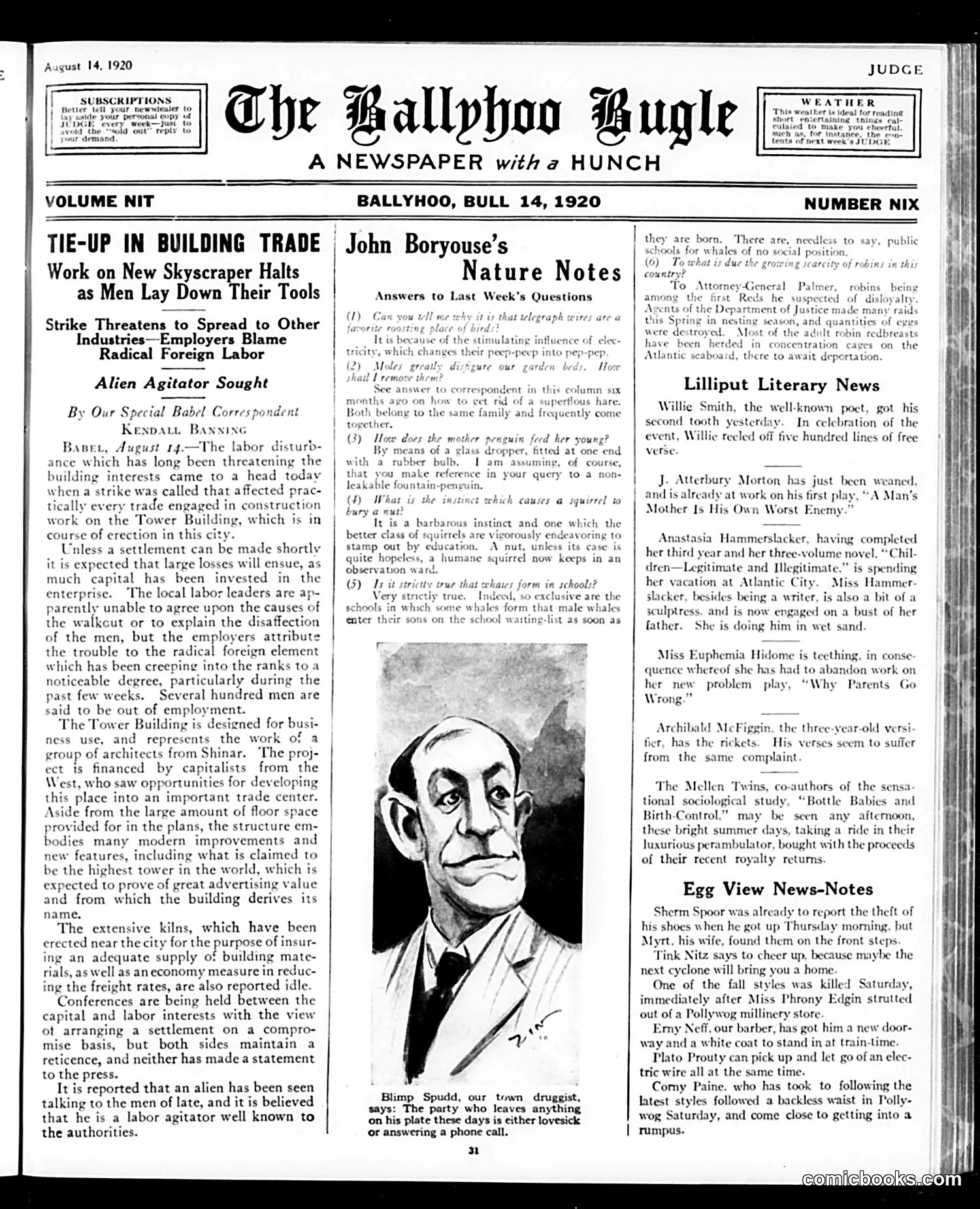
This is a **satirical fake newspaper** page from Judge magazine (August 14, 1920) parodying labor unrest and xenophobia of the post-WWI era. **Main content:** The large article "Tie-Up in Building Trade" mocks contemporary labor strikes by attributing them to "radical foreign" and "alien" agitators rather than legitimate worker grievances. This reflects 1920s fears of communist/anarchist infiltration—a real anxiety during the "Red Scare" period. **The cartoon:** Shows "Blimp Spudd," a town druggist, making a joke about food waste being a sign someone is either lovesick or avoiding a phone call—trivializing serious economic concerns. **The satire's point:** Judge ridicules both labor activists (portrayed as foreign troublemakers) and the authorities' tendency to blame external "radical" elements rather than address actual workplace conditions. The fake newspaper format allows safe mockery of anti-immigrant hysteria without directly endorsing it. The "Lilliput Literary News" section continues the satire, making absurd claims about minor local celebrities.
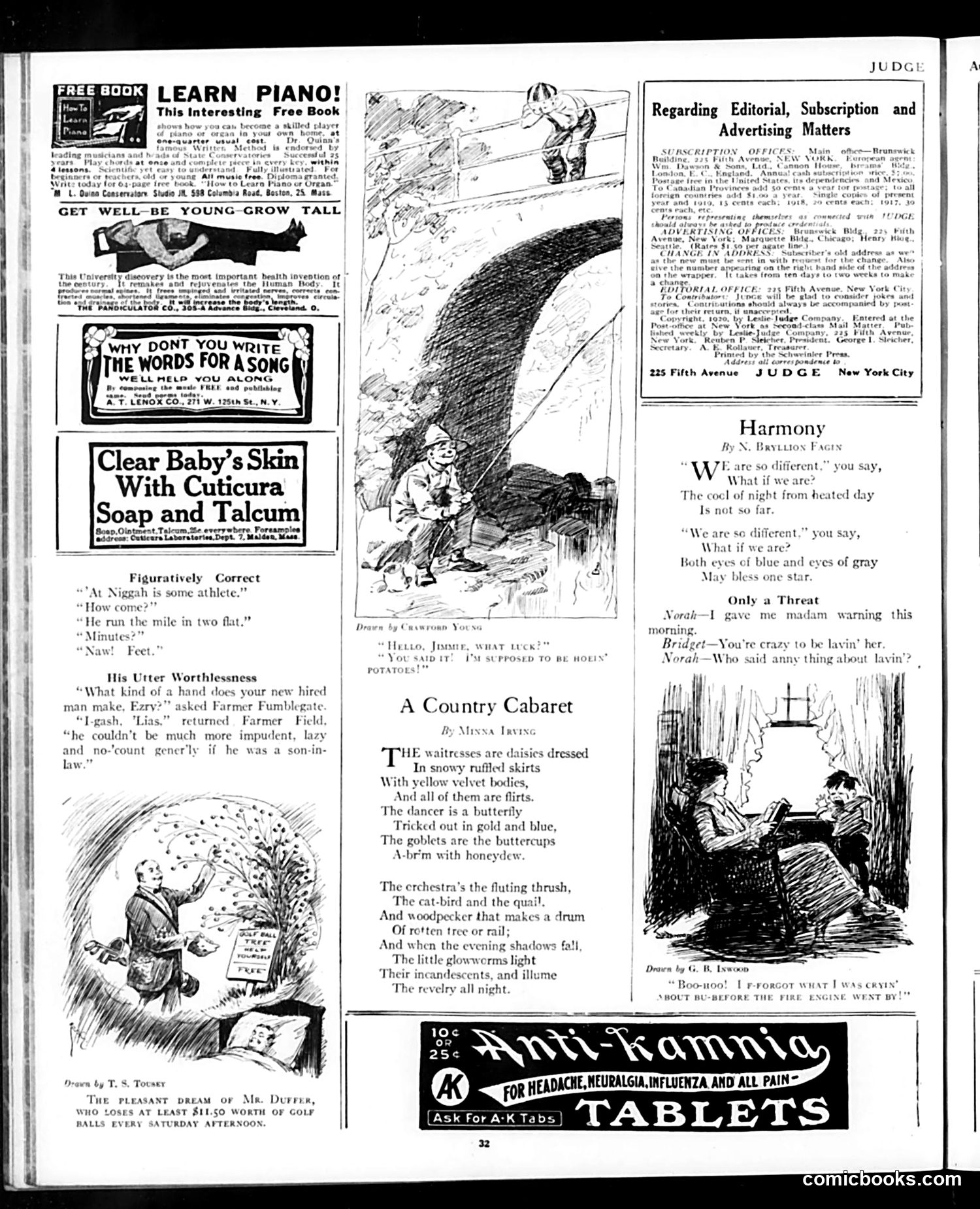
This page is primarily **advertising and literary content** rather than political satire. The main cartoons are humorous vignettes: **"Figuratively Correct"** mocks imprecise rural dialect and grammar ("At Niggah is some athlete," "Naw! Feet"). The joke targets how farmers and working-class speakers mangled standard English. **"His Utter Worthlessness"** depicts a conversation between two farmers evaluating a hired hand's poor work ethic—a common rural complaint about lazy workers. The illustrated sections include a poem "A Country Cabaret" romanticizing rustic entertainment, and dialogue exchanges labeled "Harmony" and "Only a Threat" featuring Irish-American characters (Norah, Bridget) using stereotypical dialect. **The satire is class-based rather than political**: Judge ridicules rural/working-class speech patterns and incompetence. The page reflects early 20th-century middle-class attitudes toward rural America and immigrants, treating their dialects as comic material. This reflects the magazine's general audience—urban, educated, and somewhat condescending toward rural or immigrant populations.
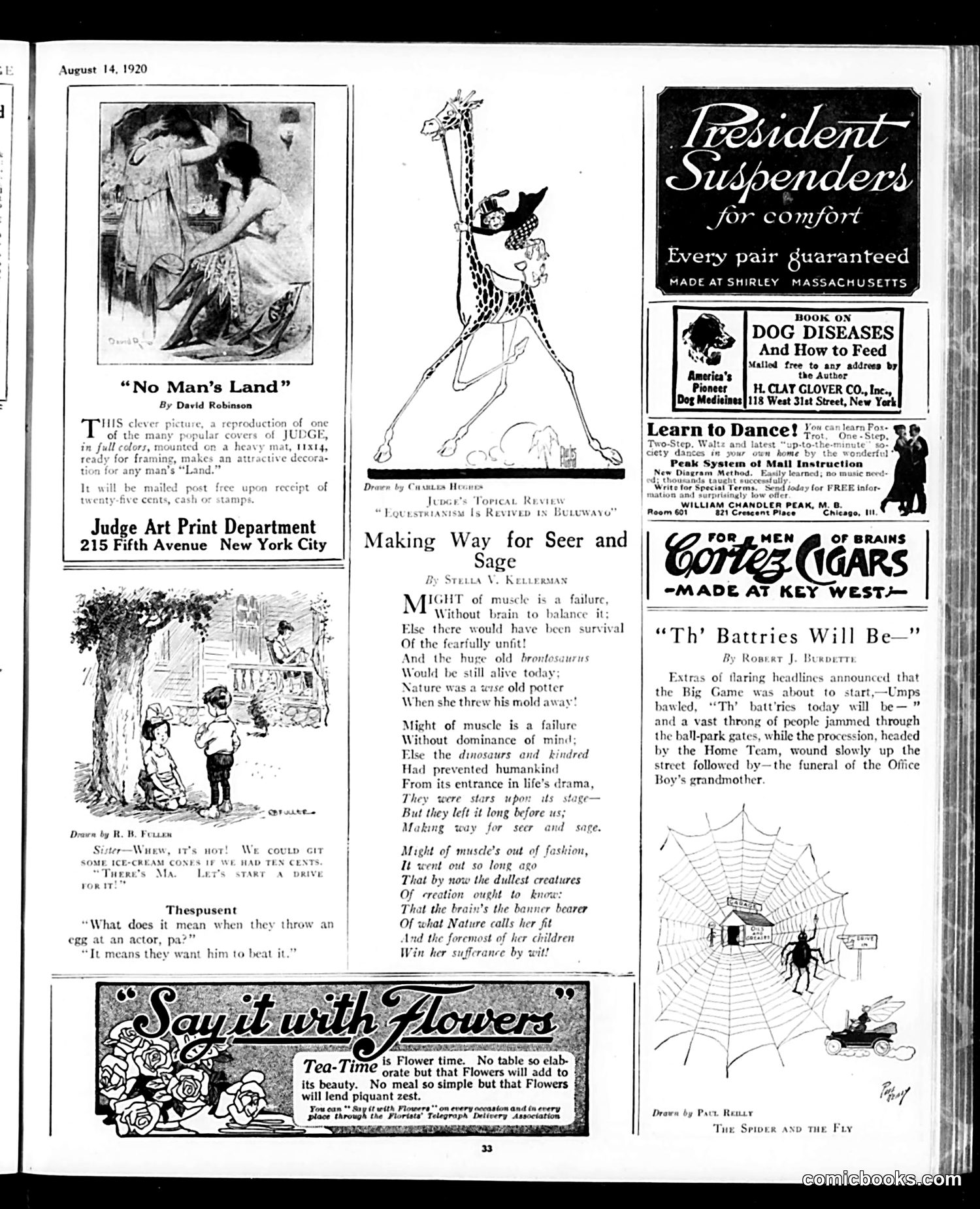
This page mixes advertisements with satirical content typical of Judge magazine's format. **"No Man's Land"** (top left) appears to be a framed art reproduction advertisement from Judge's print department, unrelated to satire. **"Making Way for Seer and Sage"** (center) is a poem by Stella V. Kellerman presenting evolutionary philosophy: muscles and physical might are "out of fashion"; the brain and intellect represent nature's true "fitness" and progress. This reflects early 20th-century enthusiasm for scientific rationalism and intellectual advancement over mere physical strength—a common modernist trope. **"Th' Batteries Will Be—"** (right) satirizes public attention to trivial matters: at a baseball game, crowds eagerly await the "batteries" (pitcher and catcher), while simultaneously indifferent to a funeral procession—the Office Boy's grandmother—passing by. The joke mocks shallow entertainment priorities and social callousness. The remaining content consists of period advertisements (suspenders, dog medicine, cigars, dance lessons, flowers).
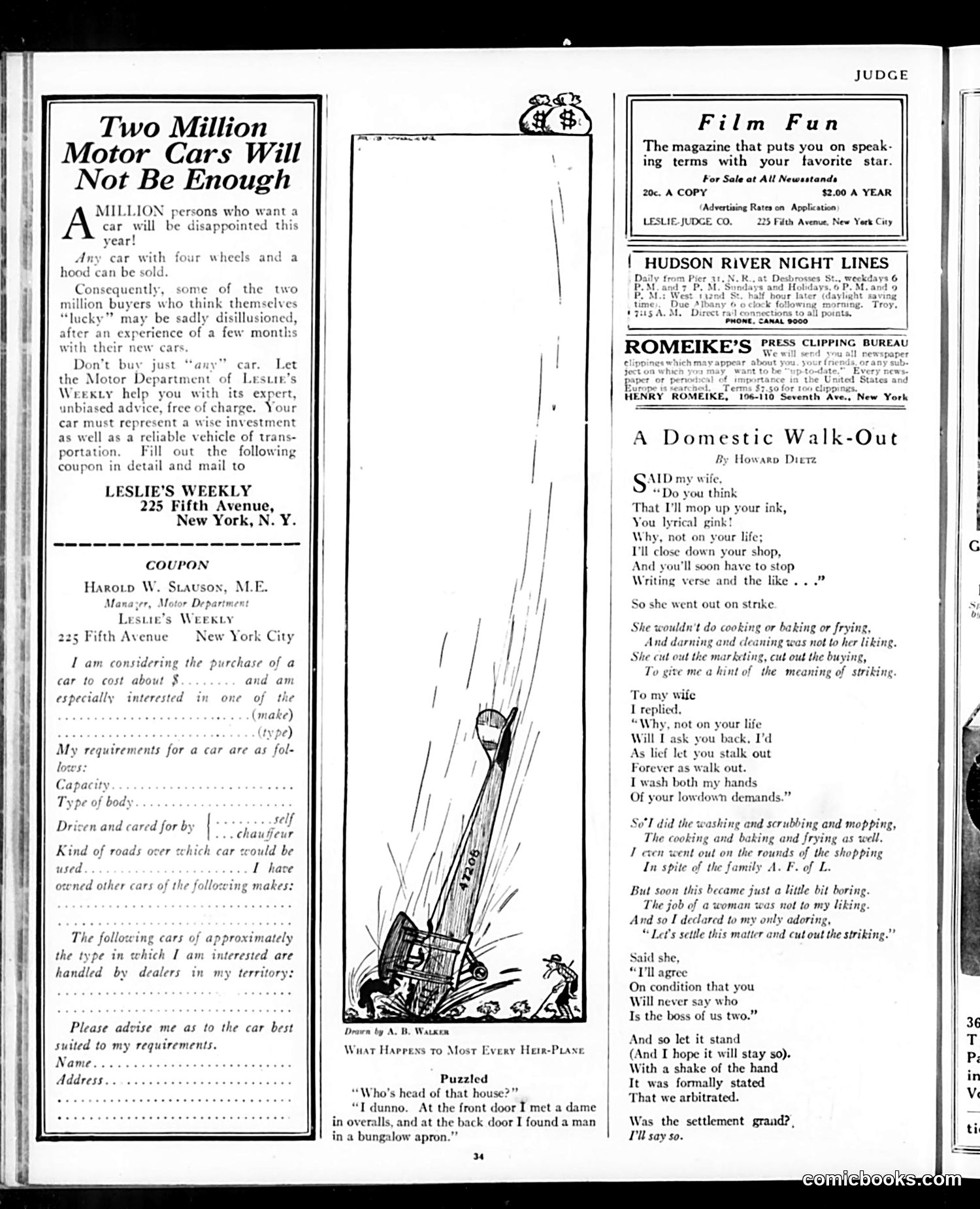
This page contains two distinct pieces of satirical content: **"Two Million Motor Cars Will Not Be Enough"** is an advertisement disguised as editorial advice. It satirizes the post-WWI automobile boom and consumer culture—millions want cars, but supply is limited. The joke: any vehicle sells regardless of quality. Leslie's Weekly offers to help readers make "wise" purchases, though the real humor mocks both consumer desperation and the magazine's commercial self-interest. **"A Domestic Walk-Out"** by Howard Dietz is a poem satirizing labor strikes (likely referencing 1920s labor activism and the AFL) by applying strike language to marriage. The wife demands respect and refuses domestic work; the husband claims indifference. The resolution—they "arbitrate" with an unspoken agreement about who actually holds power—mocks both marital dynamics and labor negotiations. The ambiguous ending suggests traditional power structures persist despite surface compromise. Both pieces reflect Jazz Age anxieties about changing social hierarchies: consumer choice, women's roles, and labor rights.
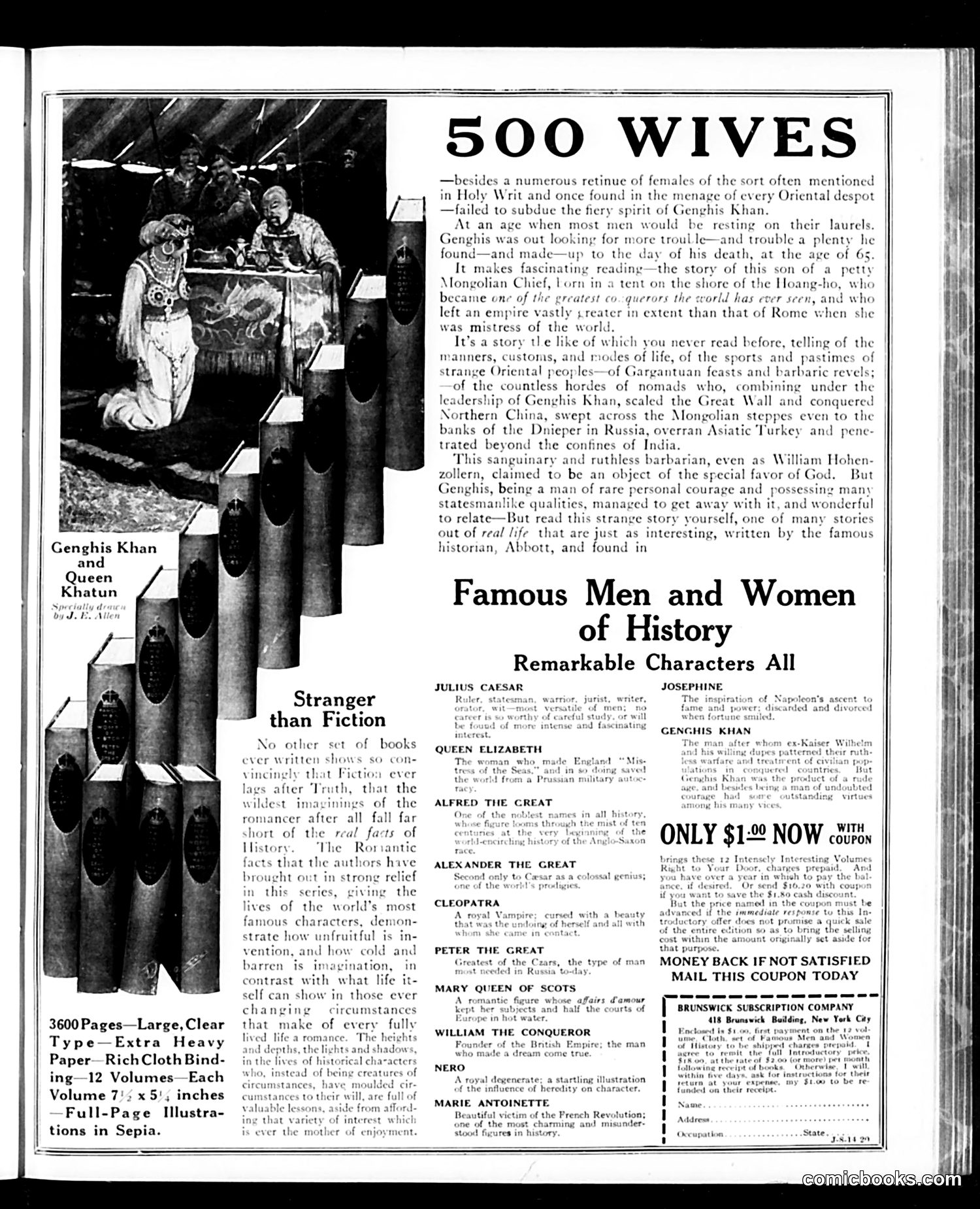
This page is primarily **advertising**, not political satire. It promotes a 12-volume encyclopedia set titled "Famous Men and Women of History," published by Brunswick Subscription Company. The left side features an illustration labeled "Genghis Khan and Queen Khatun" (likely a romanticized depiction). The ad's main text emphasizes that real history is "stranger than fiction," highlighting Genghis Khan as an example: a tent-born Mongol who built an empire larger than Rome's and possessed 500 wives. The advertisement targets readers seeking educational material by arguing that authentic historical narratives are more fascinating than invented stories. It lists famous historical figures included (Julius Caesar, Queen Elizabeth, Alfred the Great, Cleopatra, etc.) and emphasizes the set's physical quality: 3,600 pages, large type, cloth binding, twelve volumes with sepia illustrations. The "$1.00 NOW WITH COUPON" offer and "MONEY BACK IF NOT SATISFIED" guarantee were typical early 20th-century direct-mail sales tactics designed to overcome consumer hesitation about mail-order purchases.
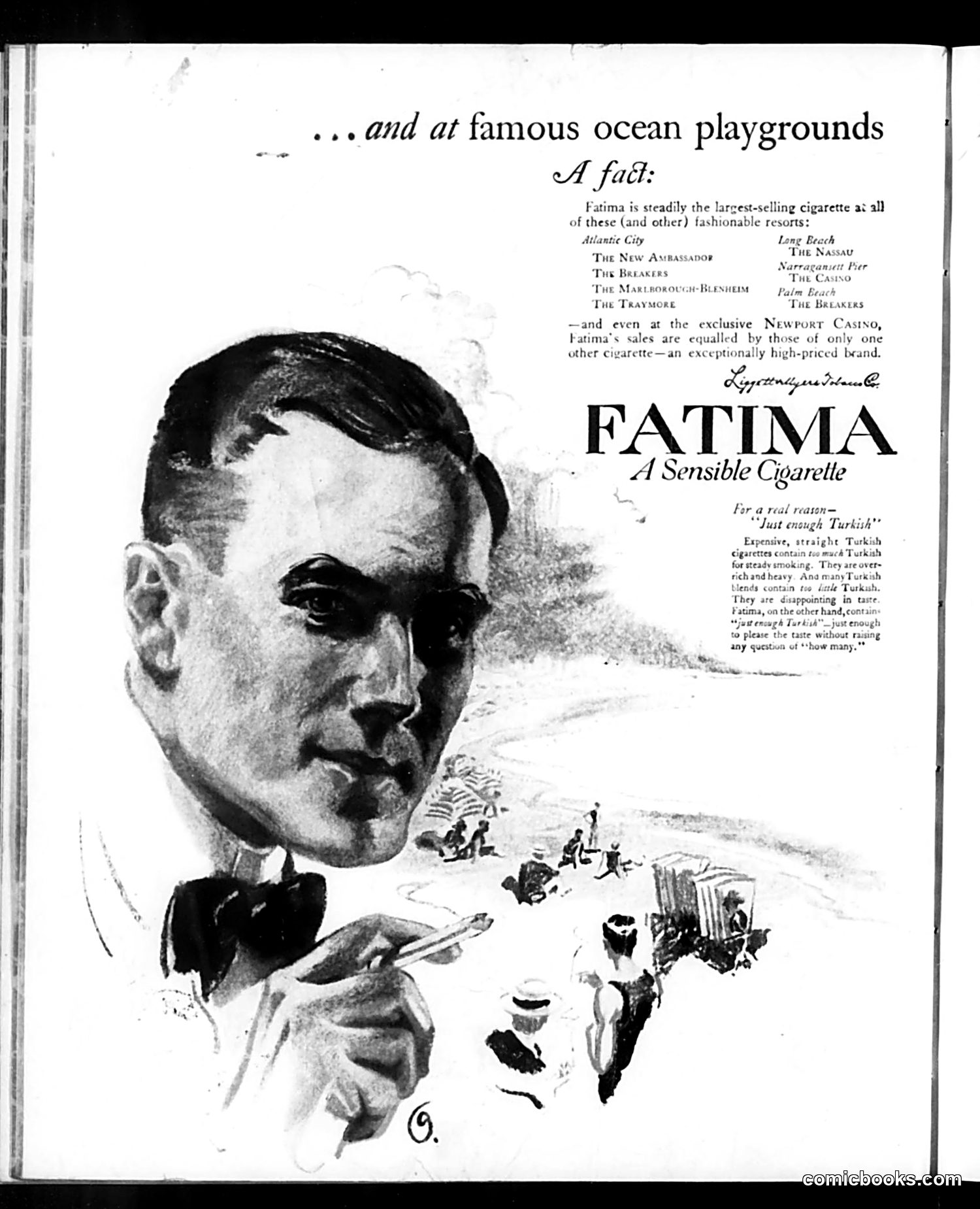
This is a **cigarette advertisement**, not political satire. The page promotes Fatima cigarettes using the testimonial strategy common in early 20th-century advertising. The illustrated figure appears to be a fashionable gentleman at a beach resort, depicted in caricature style typical of Judge magazine's visual approach. The ad claims Fatima is the best-selling cigarette at exclusive American resorts (Atlantic City, Long Beach, Newport Casino, etc.). The marketing pitch emphasizes "Just enough Turkish"—positioning Fatima as a sensible middle ground. Competitors' cigarettes are criticized as either too heavy (containing excessive Turkish tobacco) or disappointing (containing insufficient Turkish blend). This reflects the era's perception of Turkish tobacco as a luxury ingredient. The ad targets affluent resort-goers, leveraging aspirational appeal rather than addressing health or social concerns about smoking.