
Judge, 1920-08-14 · page 13 of 36
Judge — August 14, 1920 — page 13: what you’re looking at
What you’re looking at
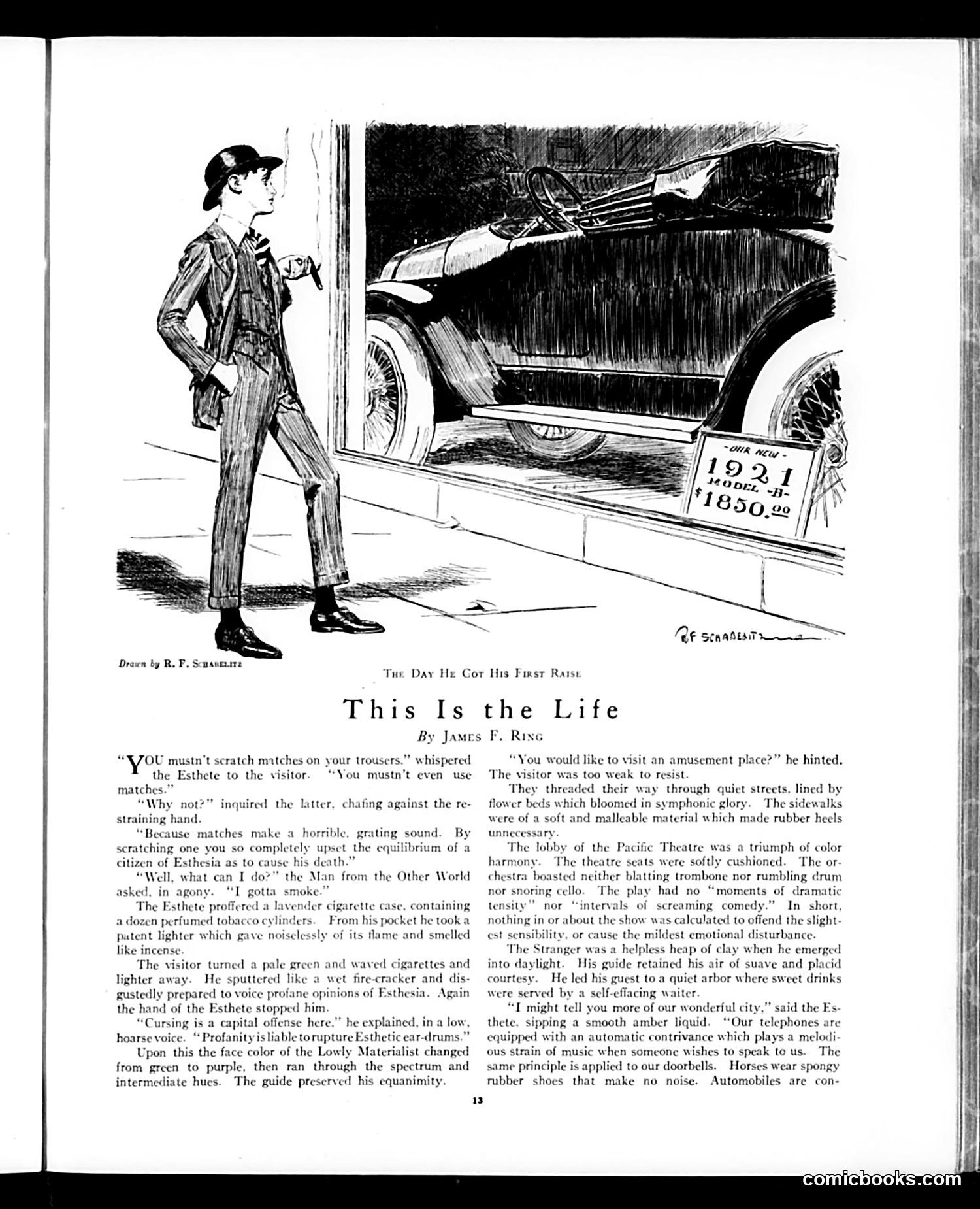
This is a satirical story mocking "Aesthetes"—late 19th/early 20th-century cultural elitists obsessed with refined beauty and sensory perfection at the expense of practicality. The cartoon shows a young man admiring an expensive automobile (priced at $1850—substantial for the era), captioning it "The Day He Got His First Raise." The accompanying story by James F. Ring depicts a visitor encountering an absurdly precious Esthetist who forbids matches (too loud), cursing (damages ears), and takes him to a theater deliberately stripped of all dramatic tension or emotional engagement. Everything is muted, cushioned, and pointless—horses wear rubber shoes, telephones play music instead of ringing. The satire targets the Aesthetic movement's extreme rejection of utility and emotion in favor of "art for art's sake." The joke: this hyper-refined lifestyle is paralyzing and ridiculous. The ordinary "Man from the Other World" is driven nearly mad by rules designed to preserve delicate sensibilities, exposing the movement as impractical and life-denying.
📄 Transcribed text from this page (OCR, searchable)
Machine-transcribed from the original scan — historical spelling and the odd misread are preserved.
Drawn by R. P. Scuanruare 2 r = OF ScnahesTx a Tur Day He Cor His First Raise This Is the Life By James F. Rixc ‘OU mustn't scratch matches on your trousers.” whispered the Esthete to the visitor. ‘You mustn't even use matches.” “Why not?” inquired the latter, chafing against the re- ining hand. “Because matches make a horrible, grating sound. By scratching one you so completely upset the equilibrium of a citizen of Esthesia as to cause his death.” “Well, what can I do?” the Man from the Other World . in agony. “I gotta smoke.” The Esthete proffered a lavender cigarette case, containing a dozen perfumed tobacco cylinders. From his pocket he took a patent lighter which gave noiselessly of its flame and smelled like incense The visitor turned a pale green and waved cigarettes and lighter away. He sputtered like a wet fire-cracker and dis- gustedly prepared to voice profane opinions of Esthesia. Again the hand of the Esthete stopped him “Cursing is a capital offense here.” he explained, in a low, hoarse voice. “ Profanity is liable to rupture Esthetic ear-drums.” Upon this the face color of the Lowly Materialist changed from green to purple, then ran through the spectrum and intermediate hues. he guide preserved his equanimity. “You would like to visit an amusement place?” he hinted. The visitor too weak to resist They threaded their way through quiet streets. lined by flower beds which bloomed in symphonic glory. The sidewalks were of a soft and malleable material which made rubber heels unnecessary. The lobby of the Pacific Theatre was a triumph of color harmony. The theatre seats were softly cushioned. The or- chestra boasted neither blatting trombone nor rumbling drum nor snoring cello. The play had no “moments of dramatic tensity” nor “intervals of screaming comedy.” In_ short, nothing in or about the show was calculated to offend the slight- est sensibility, or cause the mildest emotional disturbance. The Stranger was a helpless heap of clay when he emerged into daylight. His guide retained his air of suave and placid courte He led his guest to a quict arbor where sweet drinks were served by a self-effacing waiter: “T might tell you more of our wonderful city,” said the Es- thete. sipping a smooth amber liquid. ‘Our telephones are equipped with an automatic contrivance which pl: ous strain of music when someone wishes to speak to us. same principle is applied to our doorbells. Horses wear spongy rubber shoes that make no noise. Automobiles are con-