
Judge, 1920-08-14 · page 7 of 36
Judge — August 14, 1920 — page 7: what you’re looking at
What you’re looking at
This page satirizes **Prohibition and the impulse to legislate morality**. The main story imagines a future where the 3,650th Amendment mandates doctors prescribe alcohol/beer for depression—ending suicide. This succeeds so well that 3,655 more amendments then prohibit everything previously prohibited, creating absurd bureaucratic reversal. A staunch prohibitionist character then admits he's happy because restrictions gave him purpose; now he can "start in all over again" finding new things to ban. His friend predicts alcohol, tobacco, coffee, and tea will be prohibited within twenty years. The joke culminates when they form a "Society for the Prohibition of Rodents"—mocking how prohibitionists will always find something to regulate. **The satire targets**: the self-perpetuating nature of moral crusades, prohibitionists' inability to accept personal liberty, and how restrictions ironically give activists renewed purpose. The secondary cartoon about "Diplomacy" jokes that renaming "servant-girl" to fancier titles ("Domestic Secretary") makes the job prestigious enough to retain employees—a lighter observation on euphemism's social power.
📄 Transcribed text from this page (OCR, searchable)
Machine-transcribed from the original scan — historical spelling and the odd misread are preserved.
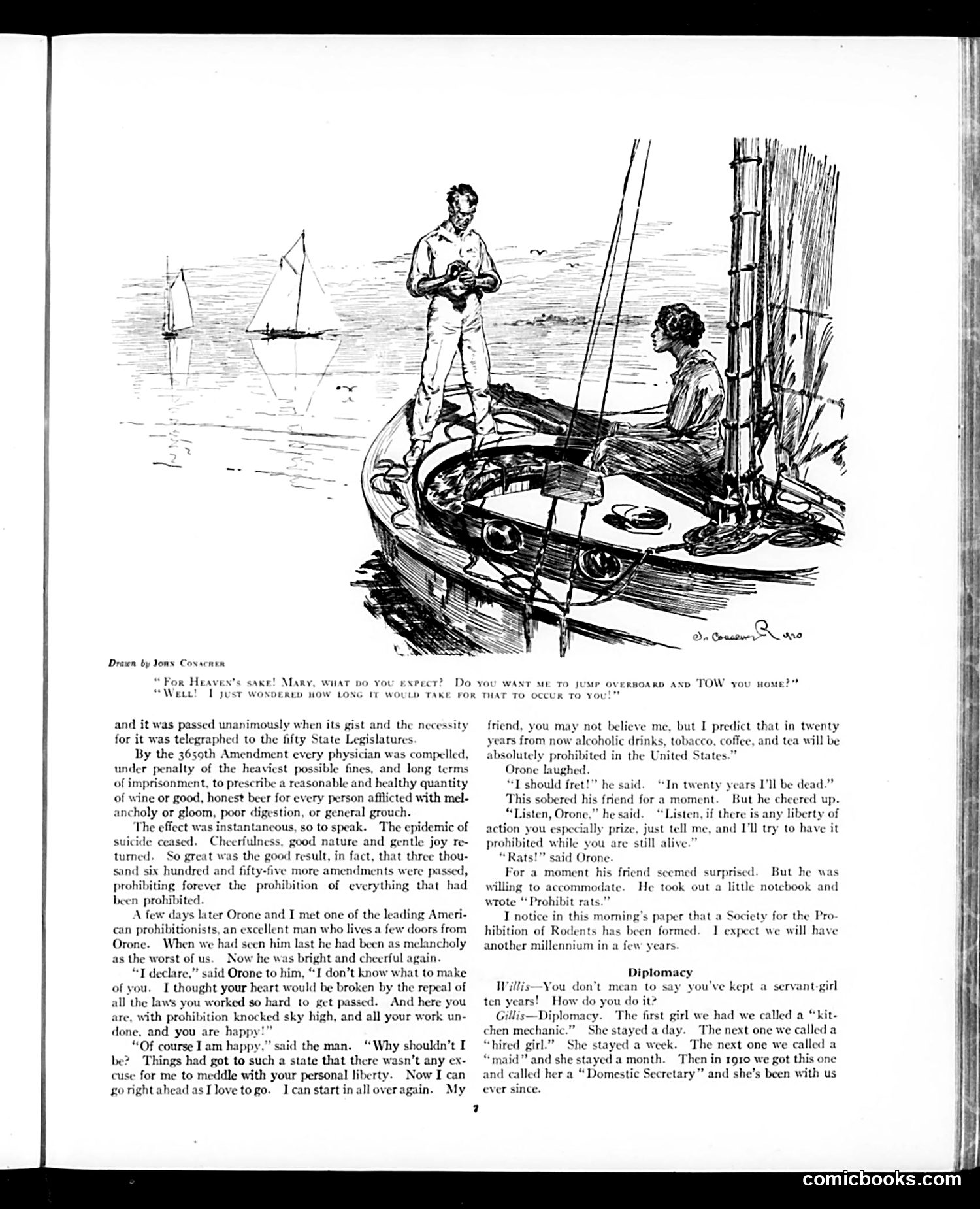
Drawn by Jonx Coxscnen “For Heaves's sake! Mary, witat po you expect? “Wet! | just wonperep NOW LONG Ir wot and it was passed unanimously when its gist and the necessity for it was telegraphed to the fifty State Legislatures. By the 3650th Amendment every phy in was compelled, under penalty of the heaviest possible fines, and long terms of imprisonment, to prescribe a reasonable and healthy quantity of wine or good, honest beer for every person afflicted with mel- ancholy or gloom, poor digestion, or general grouch. The effect w stantancous, so to speak. The epidemic of suicide ceased. Cheerfulness, good nature and gentle joy re- tured. So great was the good result, in fact, that three thou- sand six hundred and fifty-five more amendments were passed, prohibiting forever the prohibition of everything that had been prohibited. A few days later Orone and I met one of the leading Ameri- can prohibitionists, an excellent man who lives a few doors from Orone. When we had scen him last he had been as melancholy as the worst of us. Now he was bright and cheerful again. “T declare,” said Orone to him, “I don’t know what to make of you. I thought your heart would be broken by the repeal of all the laws you worked so hard to get passed. And here you are, with prohibition knocked sky high, and all your work un- done, and you are happy “Of course Iam happy.” said the man. “Why shouldn’t I Things had got to such a state that there wasn’t any ex- Now I can My De? cuse for me to meddle with your personal liberty. go right ahead asT love togo. I can start in all over again. ) TAKE FOR THAT TO OCCUR TO YOL Do you WANT Mr To juMP OveRBOARD AND TOW you ome?" friend, you may not believe me, but I predict that in twenty years from now alcoholic drinks, tobacco, coffee, and tea will be absolutely prohibited in the United States.” Orone laughed “T should fret!” he said. “In twenty years I'll be dead.” This sobered his friend for a moment. But he cheered up. “Listen, Orone,” he said. .isten, if there is any liberty of action you especially prize, just tell me, and I'll try to have it prohibited while you are still alive.” “Rats!” said Orone. ‘or a moment his friend seemed surprised. But he was willing to accommodate. He took out a little notebook and wrote “Prohibit rats.” I notice in this moming’s paper that a Society for the Pro: hibition of Rodents has been formed. I expect we will have another millennium in a few years. Diplomacy Willis—You don’t mean to say you've kept a servant-girl How do you do it? Gillis—Diplomacy. he first girl we had we called a “kit- chen mechanic.” She stayed a day. The next one we called a “hired girl.” She stayed a week. The next one we called a “maid” and she stayed a month. Then in 1910 we got this one and called her a “Domestic Secretary” and she’s been with us ever since. comicbooks.com