
Judge, 1920-08-14 · page 11 of 36
Judge — August 14, 1920 — page 11: what you’re looking at
What you’re looking at
**"Too Lively"** presents a humorous contrast between rural and urban life. Gap Johnson, an Arkansas farmer, recounts a chaotic day at the county seat featuring bank robbery, lynching, fire, poisoning, shootings, and various disasters—yet he finds city life *too* hectic. The satire mocks rural attitudes: what constitutes genuine danger and excitement in frontier towns (violent crime, accidents) versus urban "restrictions" (police authority, civic order). **"Slaves"** depicts a farmer rejecting city living because "city people can't cross a street until a policeman blows a whistle"—satirizing how rural Americans viewed urban regulation as oppressive, missing the irony that frontier life involved actual lawlessness and mob violence (the lynching mentioned casually above). The page's other brief character sketches ("Little Mouse Woman," "The Optimist") are typical Judge magazine humor—cynical observations about contemporary society and gender relations, with minimal political content visible here.
📄 Transcribed text from this page (OCR, searchable)
Machine-transcribed from the original scan — historical spelling and the odd misread are preserved.
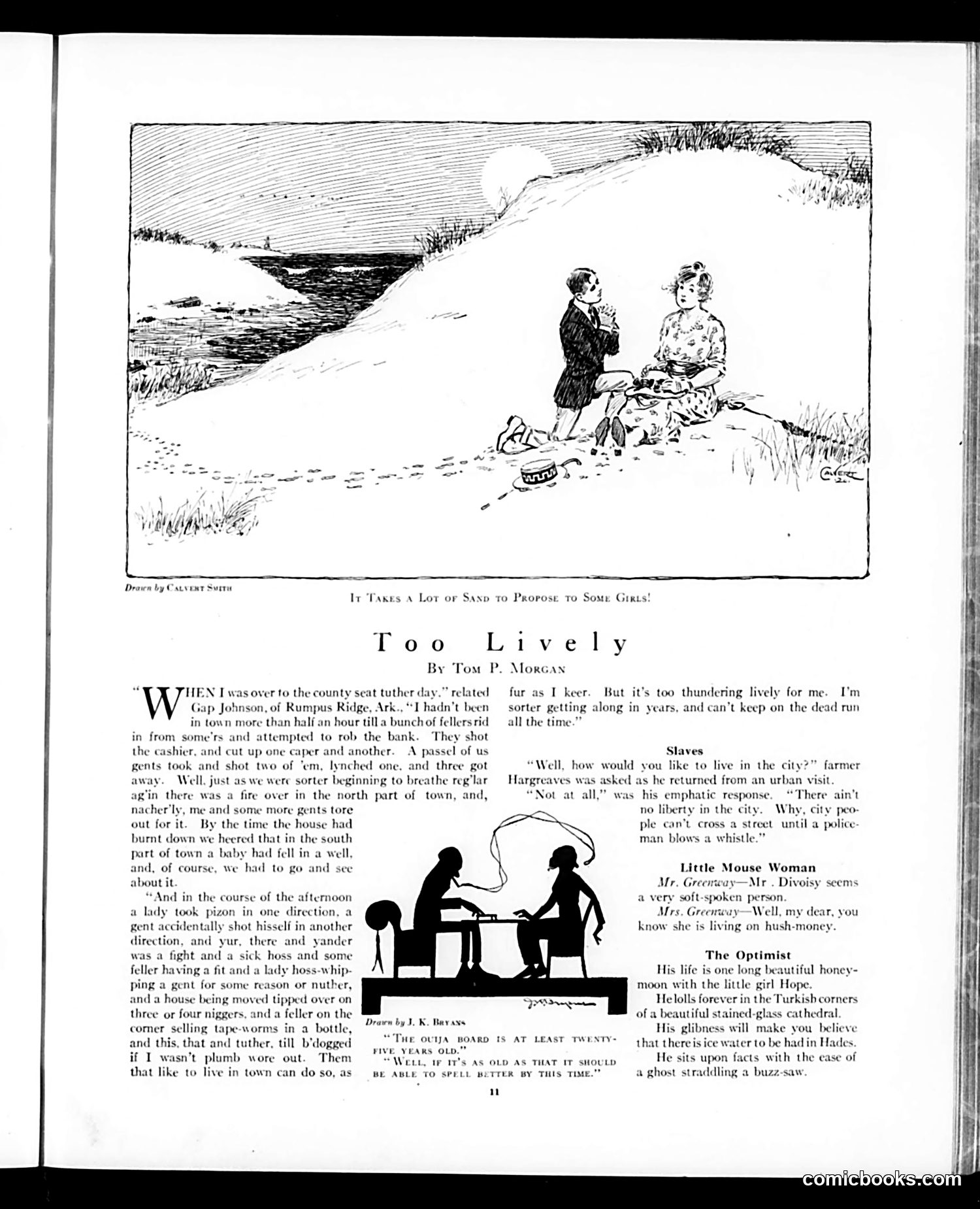
{ty WAY NY AAA EL Drawn by Csevent Svere Ir Taxes a Lor or Saxp to Prorose to Some Girts! Too Lively By Tom P. Morcan related fur as I keer. But it’s too thundering lively for me. I’m along in years, and can’t keep on the dead run HEN I was over to the county seat tuther day Gap Johnson, of Rumpus Ridge, Ark.,“T hadn't been — sorter getting in town more than half an hour till a bunch of fellersrid all the time.”” in from some’rs and attempted to rob the bank. They shot the cashier, and cut up one caper and another. A passel of us Slaves gents took and shot two of ‘em, lynched one, and three got “Well, how would you like to live in the city?” farmer away. Well, just as we were sorter beginning to breathe reg’lar — Hargreaves was asked as he returned from an urban visit. n there was a fire over in the north part of town, and, “Not at all,” was his emphatic response. “There ain't no liberty in the city. Why, city peo- et until a police nacher'ly, me and some more gents tore out for it. By the time the house had burnt down we heered that in the south part of town a baby had fell in a well, and, of course, we had to go and see about it “And in the course of the afternoon a lady took pizon in one direction, a gent accidentally shot hisself in another direction, and yur, there and yander was a fight and a sick hoss and some feller having a fit and a lady hoss-whiy ping a gent for some reason or nuther, and a house being moved tipped over on three or four niggers, and a feller on the corner selling tape-worms in a bottle, stre ple can't cross a man blows a whistle.” Little Mouse Woman Mr. Greenway—Mr . Divoisy seems a very soft-spoken person Mrs. Greenway—Well, my dear, you know she is living on hush-money. The Optimist His life is one long beautiful honey- moon with the little girl Hope. He lolls forever in the Turkish corners of a beautiful stained-glass cathedral His glibness will make you believe Se Draven by JK. Bavass and this, that and tuther, till b’dogged eyes OUIA HOARD IS AT LEAST TWENTY" that thereis ice water to be had in Hades ’ 7 EARS OLD. 4 z T wasn’t plumb wore out. Them HAV ELL. ITrP a AG OLO AB TTUAT IF SUOULD He sits upon facts with the ease of that like to live in town can do so, aS Be ABLE TO SPELL BETTER BY THIS TIME.” a ghost straddling a buzz-saw