
Judge, 1920-08-14 · page 16 of 36
Judge — August 14, 1920 — page 16: what you’re looking at
What you’re looking at
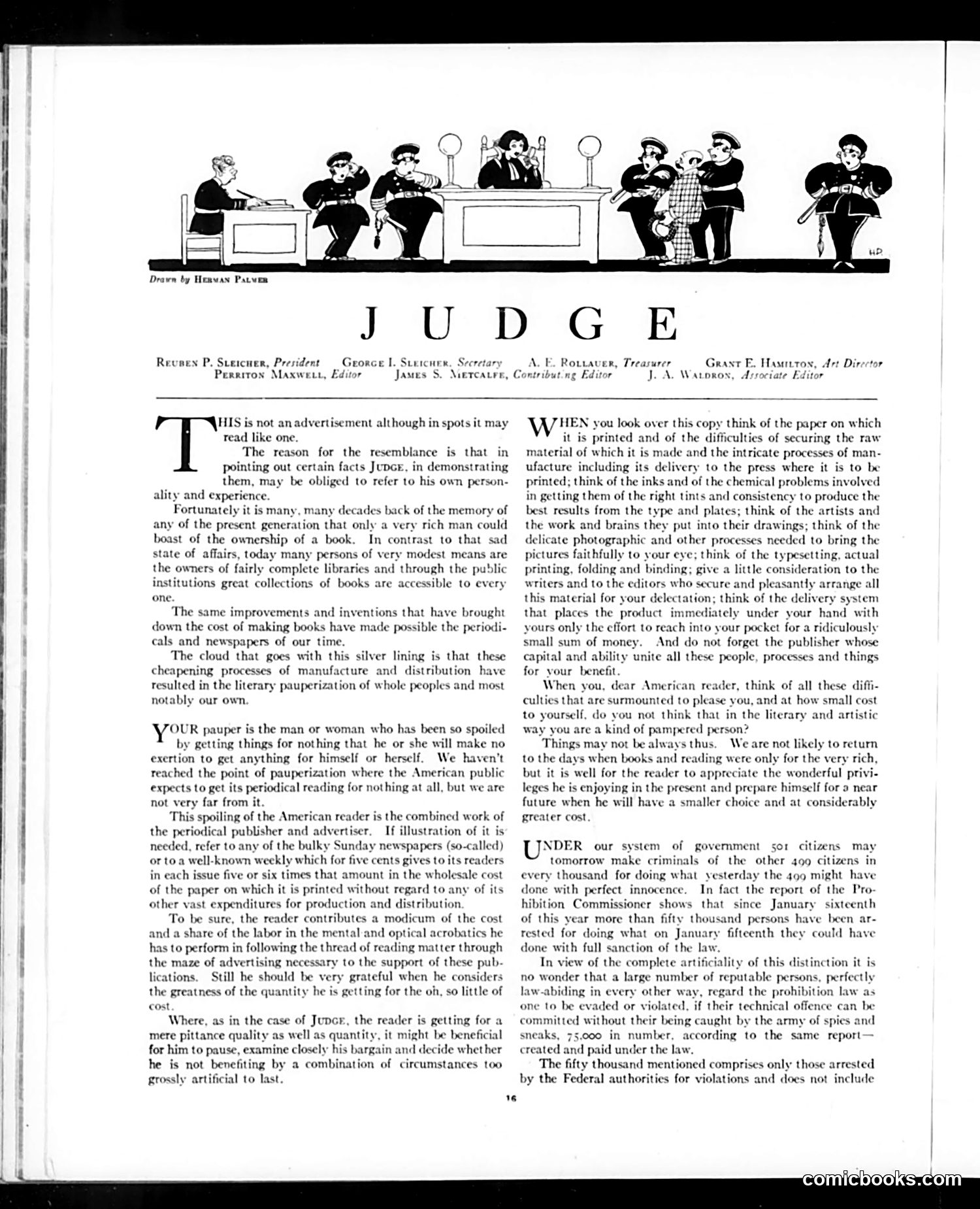
This is a **title/masthead page** for *Judge* magazine, not a political cartoon. The small illustration at top shows the magazine's editorial staff seated at a desk—a visual representation of the publication's leadership. The lengthy text is the magazine's **editorial statement** addressing reader expectations. The core argument: *Judge* offers exceptional quality (writing, art, printing) at remarkably low cost, subsidized by advertisers. The editors warn readers not to become spoiled by cheap periodicals (particularly Sunday newspapers) that train the public to expect quality content for nothing. The satire targets both **publishers** (who exploit readers with ad-heavy, low-quality content) and **American readers** themselves, whom the editors characterize as having become "paupers" accustomed to undeserved bargains. The piece argues this artificial pricing model cannot last. This reflects early-20th-century concerns about **mass media economics** and the tension between commercial viability and editorial integrity.
📄 Transcribed text from this page (OCR, searchable)
Machine-transcribed from the original scan — historical spelling and the odd misread are preserved.
Drawn by Heavas Patwen JUDGE lent Georce I. Sterner. Secret Jastes S. Metcatre, C Revnen P. Sreicner, Presi Perrtron Maxwent, Editor A. E. Routaver, Treasurer Grast E. Hystiero ng Editor Jo A. Watpros, Asrociate B HIS is not an advertisement although in spots it may read like one. The reason for the resemblance is that in pointing out certain facts Jupce, in demonstrating them, may be obliged to refer to his own person- ality and experience. Fortunately it is many, many decades back of the memory of any of the present generation that only a very rich man could boast of the ownership of a book. In contrast to that sad state of affairs, today many persons of very modest means are the owners of fairly complete libraries and through the public institutions great collections of books are accessible to every one. The same improvements and inventions that have brought down the cost of making books have made possible the periodi- cals and newspapers of our time. The cloud that goes with this silver lining is that these cheapening processes of manufacture and distribution have resulted in the literary pauperization of whole peoples and most notably our own. ‘OUR pauper is the man or woman who has been so spoiled by getting things for nothing that he or she will make no exertion to get anything for himself or herself. We haven't reached the point of pauperization where the American public expects to get its periodical reading for nothing at all, but we are not very far from it. This spoiling of the American reader is the combined work of the periodical publisher and advertiser. If illustration of it is needed, refer to any of the bulky Sunday newspapers (so-called) or toa well-known weekly which for five cents gives to its readers in each issue five or six times that amount in the wholesale cost of the paper on which it is printed without regard to any of its other vast expenditures for production and distribution, To be sure, the reader contributes a modicum of the cost and a share of the labor in the mental and optical acrobatics he has to perform in following the thread of reading matter through the maze of advertising necessary to the support of these pub- lications. Still he should be very grateful when he considers the greatness of the quantity he is getting for the oh, so little of cost Where, as in the case of Jupcr, the reader is getting for a mere pittance quality as well as quantity, it might be beneficial for him to pause, examine closely his bargain and decide whether he is not benefiting by a combination of circumstances too grossly artificial to last. HEN you look over this copy think of the paper on which it is printed and of the difficulties of securing the raw material of which it is made and the intricate processes of man- ufacture including its delivery to the press where it is to be printed; think of the inks and of the chemical problems involved in getting them of the right tints and consistency to produce the best results from the type and plates; think of the artists and the work and brains they put into their drawings; think of the delicate photographic and other processes needed to bring the pictures faithfully to your eye; think of the typesetting, actual printing, folding and binding; give a little consideration to the writers and to the editors who secure and pleasantly arrange all this material for your delectation; think of the delivery system that places the product immediately under your hand with yours only the effort to reach into your pocket for a ridiculously small sum of money. And do not forget the publisher whose capital and ability unite all these people, processes and things for your benefit. When you, dear American reader, think of all these diffi- culties that are surmounted to please you, and at how small cost to yourself, do you not think that in the literary and artistic way you are a kind of pampered person? Things may not be always thus. We are not likely to return to the days when books and reading were only for the very rich, but it is well for the reader to appreciate the wonderful privi- leges he is enjoying in the present and prepare himself for a near future when he will have a smaller choice and at considerably greater cost UNDER our system of government 501 citizens may tomorrow make criminals of the other 409 citizens in every thousand for doing what yesterday the 499 might have done with perfect innocence. In fact the report of the Pro- hibition Commissioner shows that since January sixteenth of this year more than fifty thousand persons have been ar- rested for doing what on January fifteenth they could hav done with full sanction of the law. In view of the complete artificiality of this distinct no wonder that a large number of reputable persons, perfectly law-abiding in every other way, regard the prohibition law as one to be evaded or violated, if their technical offence can be committed without their being caught by the army of spies and sneaks, 75.000 in number, according to the same report— created and paid under the law. The fifty thousand mentioned comprises only those arrested by the Federal authorities for violations and does not include nit is