
Judge, 1920-08-14 · page 9 of 36
Judge — August 14, 1920 — page 9: what you’re looking at
What you’re looking at
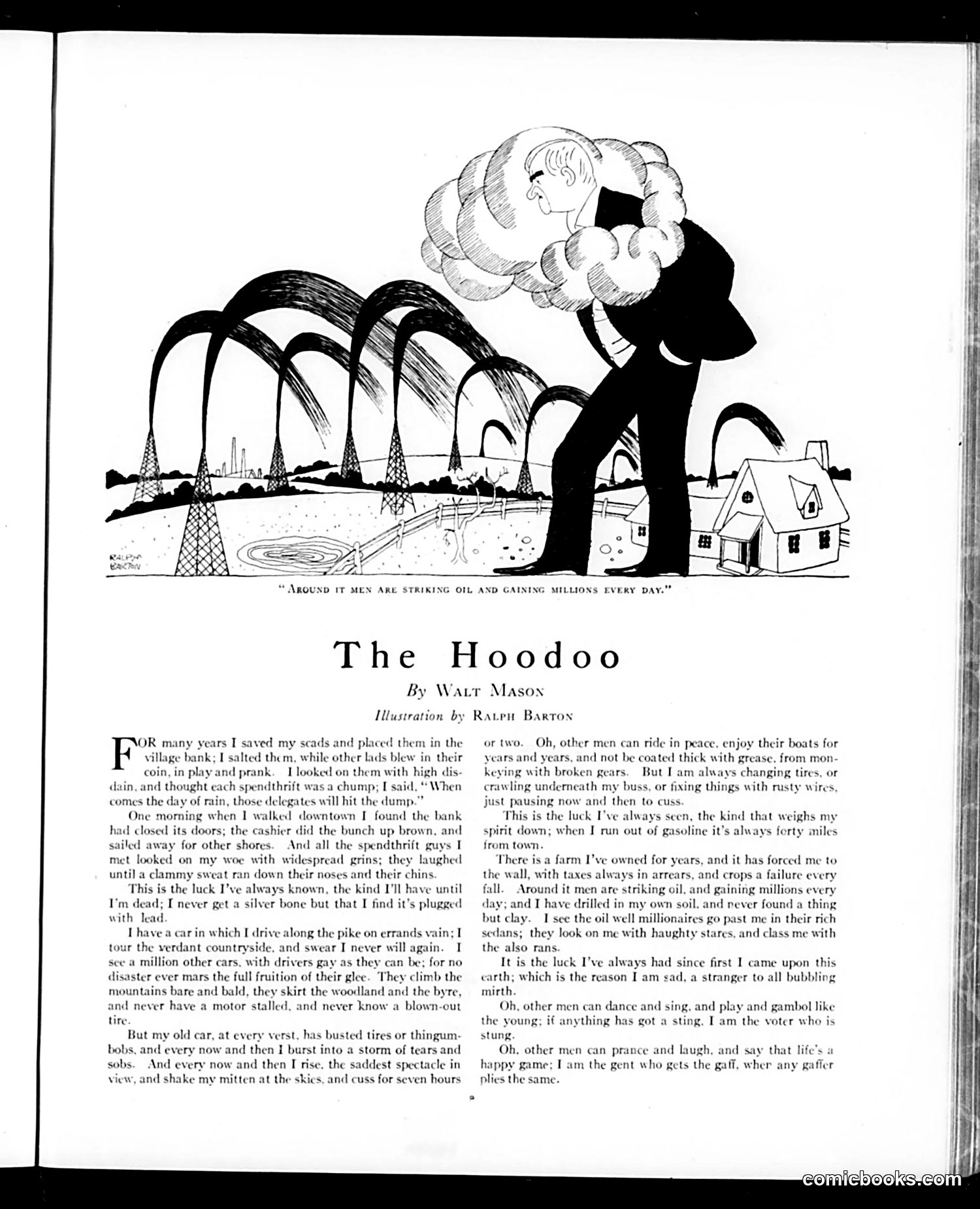
This is a humorous poem with accompanying illustration satirizing the inequities of early 20th-century American capitalism, likely during an oil boom period. **The Setup:** The narrator represents the "unlucky everyman"—prudent, hardworking, moral—who saves money while spendthrifts squander theirs. Yet his caution backfires: his bank fails, his car perpetually breaks down, his farm yields nothing while neighboring oil wells nearby strike it rich daily. **The Satire's Point:** The illustration shows a giant figure looming over an oil-field landscape, captioned "around it men are striking oil and gaining millions every day." The satire mocks the notion that success derives from virtue or effort. Instead, it's pure chance ("hoodoo" = bad luck or curse). Disciplined savers lose everything; reckless speculators and lucky landowners get wealthy overnight through no merit. **For Modern Readers:** This reflects real historical frustrations during the oil boom—arbitrary wealth distribution and the inadequacy of traditional virtues in navigating chaotic capitalist markets.
📄 Transcribed text from this page (OCR, searchable)
Machine-transcribed from the original scan — historical spelling and the odd misread are preserved.
AROUND IT MEN ARE STRIKING OIL AND GAINING MILLIONS EVERY DAY The Hoodoo By Watt Mason Mlustration by Raven Bartox OR many years I saved my scads and placed them in the bank; I salted them, while other lads blew in their coin, in play and prank. I looked on them with high dis dain, and thought each spendthrift was a chump; I said. “ When comes the day of rain, those delegates will hit the dump.” One morning when I walked downtown I found the bank had closed its doors; the cashier did the bunch up brown, and sailed away for other shores. And all the spendthrift guys I met looked on my woe with widespread grins; they laughed until a clammy sweat ran down their noses and their chins This is the luck I’ve always known, the kind I'll have until I'm dead; I never get a silver bone but that I find it’s plugged with lead I have a car in which I drive along the pike on errands vain; I tour the verdant countryside, and swear I never will again. I see a million other cars, with drivers gay as they can be; for no disaster ever mars the full fruition of their glee. They climb the mountains bare and bald, they skirt the woodland and the byte, and never have a motor stalled, and never know a blown-out villag tire: But my old car, at every verst, has busted tires or thingum bobs, and every now and then I burst into a storm of tears and sobs. And every now and then I rise, the saddest spectacle in view, and shake my mitten at the skies, and cuss for seven hours or two. Oh, other men can ride in peace, enjoy their boats for years and years, and not be coated thick with grease, from me ving with broken gears. But Iam always changing tires, or crawling underneath my buss, or fixing things with rusty wires. just pausing now and then to cuss This is the luck I’ve always seen, the kind that weighs my spirit down; when I run out of gasoline it’s always forty miles trom town There is a farm I’ve owned for years, and it has forced me to the wall, with taxes always in arrears, and crops a failure every fall. Around it men are striking oil, and gaining millions every day; and T have drilled in my own soil, and never found a thing but ¢ I see the oil well millionaires go past me in their rich sedans; they look on me with haughty stares, and class me with the also rans. It is the luck I’ve always had since first I came upon this carth; which is the reason I am sad, a stranger to all bubbling mirth Oh, other men can dance and sing, and play and gambol like the young; if anything has got a sting. I am the voter who is stung. Oh, other men can prance and laugh, and say that li happy game; I am the gent who gets the gaff, wher any gafier plies the same.