
Judge, 1920-08-14 · page 5 of 36
Judge — August 14, 1920 — page 5: what you’re looking at
What you’re looking at
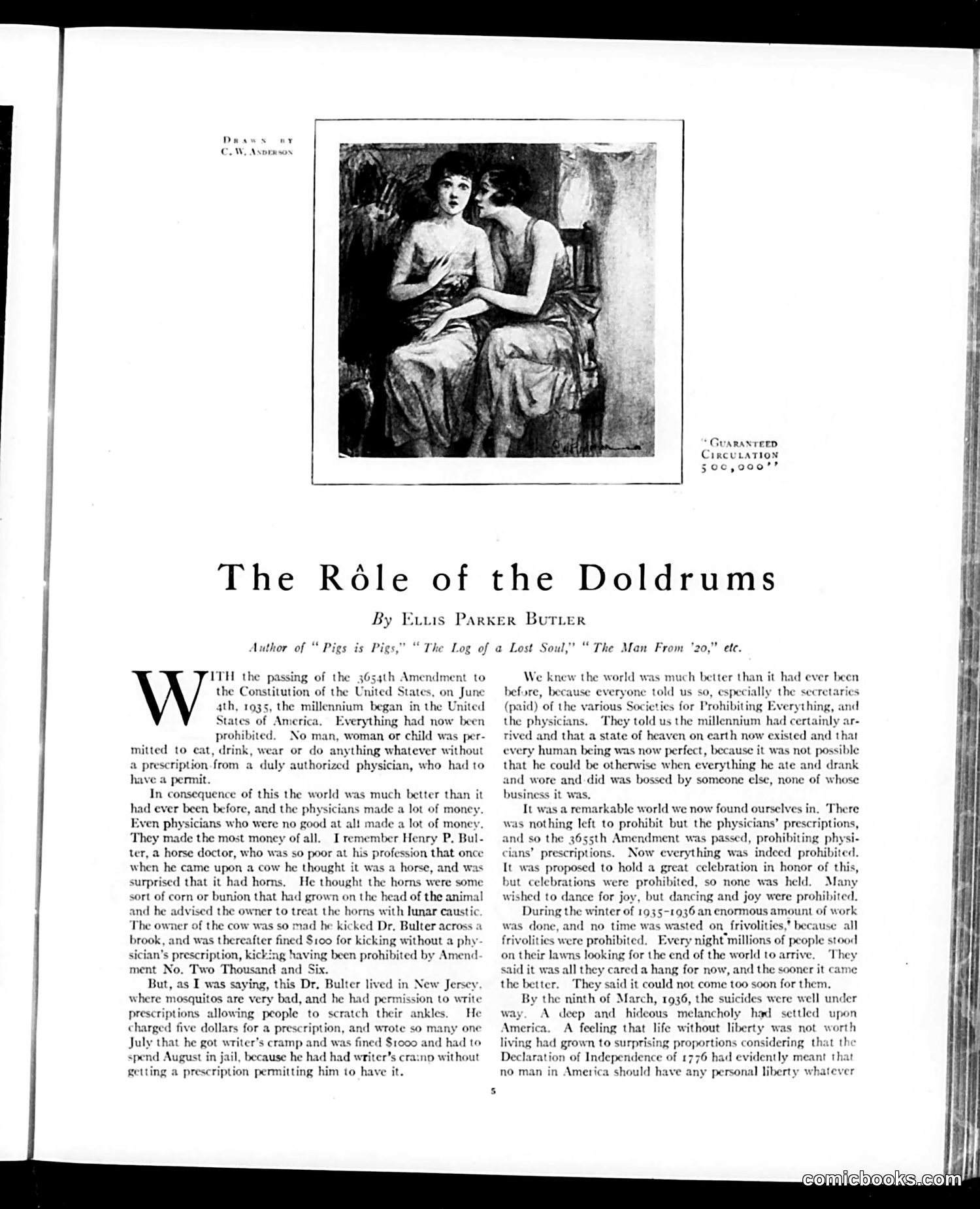
This article by Ellis Parker Butler satirizes Prohibition's unintended consequences following the 18th Amendment (1919). The accompanying illustration appears to show two women in an intimate domestic scene, likely representing the era's social disruption. Butler's narrative mocks how Prohibition supposedly created a "better world"—yet physicians lost income from prescriptions, celebrations were banned, and people became depressed. He describes absurd outcomes: Dr. Balter was kicked by a cow after losing his prescription business; frivolities were prohibited; suicides increased. The satire's central point: Prohibition's promise of moral improvement instead produced widespread unhappiness, economic hardship for professionals, and a "deep and hideous melancholy" settling over America—the "doldrums" of the title. Butler argues the cure proved worse than the disease.
📄 Transcribed text from this page (OCR, searchable)
Machine-transcribed from the original scan — historical spelling and the odd misread are preserved.
Draws ny C.W, Avresox * GUARANTEED. CircuLation 50c,000°" ( The Rodle of the Doldrums VLLIS By Author of “ Pigs is Pi, ITH the passing of the 3654th Amendment to the Constitution of the United States, on June ath, 1935, the millennium began in the United States of America. Everything had now been prohibited. No man, woman or child was per- mitted to cat, drink, wear or do anything whatever without a prescription-from a duly authorized physician, who had to have a permit. In consequence of this the world was much better than it had ever been before, and the physicians made a lot of mon iven physicians who were no good at al! made a lot of money. They made the most moncy of all. I remember Henry P. Bul- ter, a horse doctor, who was so poor at his profession that once when he came upon a cow he thought it was a horse, and was surprised that it had horns. He thought the horns were some sort of corn or bunion that had grown on the head of the animal and he advised the owner to treat the horns with lunar caustic The owner of the cow was so mad he kicked Dr, Bulter across a nd was thereafter fined $100 for kicking without a phy having been prohibited by Amend ix. But, as I was saying, this Dr, Bulter lived in New Jersey where mosquitos are very bad, and he had permission to write prescriptions allowing people to scratch their ankles. He charged five dollars for a prescription, and wrote so many one July that he got writer’s cramp and was fined $1000 and had to brool sician’s prescription, kick ment No. Two Thousand and § spend August in jail, because he had had writer’s cra:np without getting a prescription permitting him to have it. Parker Butter ” “The Log of a Lost Sout,’ “The Man From '20,” ete. We knew the world was much better than it had ever been before, because everyone told us so, especially the secretaries (paid) of the various Socicties for Prohibiting Everything, the physicians. They told us the millennium had certainly rived and that a state of heaven on earth now existed and t every human being was now perfect, because it was not possible that he could be otherwise when everything he ate and drank and wore and did was bossed by someone else, none of whose business it was, It was a remarkable world we now found ourselves in, There was nothing left to prohibit but the physicians’ prescriptions, and so the 365sth Amendment was passed, prohibiting physi- cians’ prescriptions. Now everything was indeed prohibited. It was proposed to hold a great celebration in honor of this, but celebrations were prohibited, so none was held. Many wished to dance for joy, but dancing and joy were prohibited. During the winter of 1935-1936 an cnormous amount of work was done, and no time was wasted on_frivolities,’ because all frivolities were prohibited. Every night'millions of people stood on their lawns looking for the end of the world to arrive. Th said it was all they cared a hang for now, and the sooner it ca the better. They said it could not come too soon for them. By the ninth of March, 1936, the suicides were well under way. A deep and hideous melancholy had settled upon America. A feeling that life without liberty was not worth living had grown to surprising proportions considering that the Declaration of Independence of 1776 had evidently meant that no man in America should have any personal liberty whatever