
Judge, 1920-08-14 · page 26 of 36
Judge — August 14, 1920 — page 26: what you’re looking at
What you’re looking at
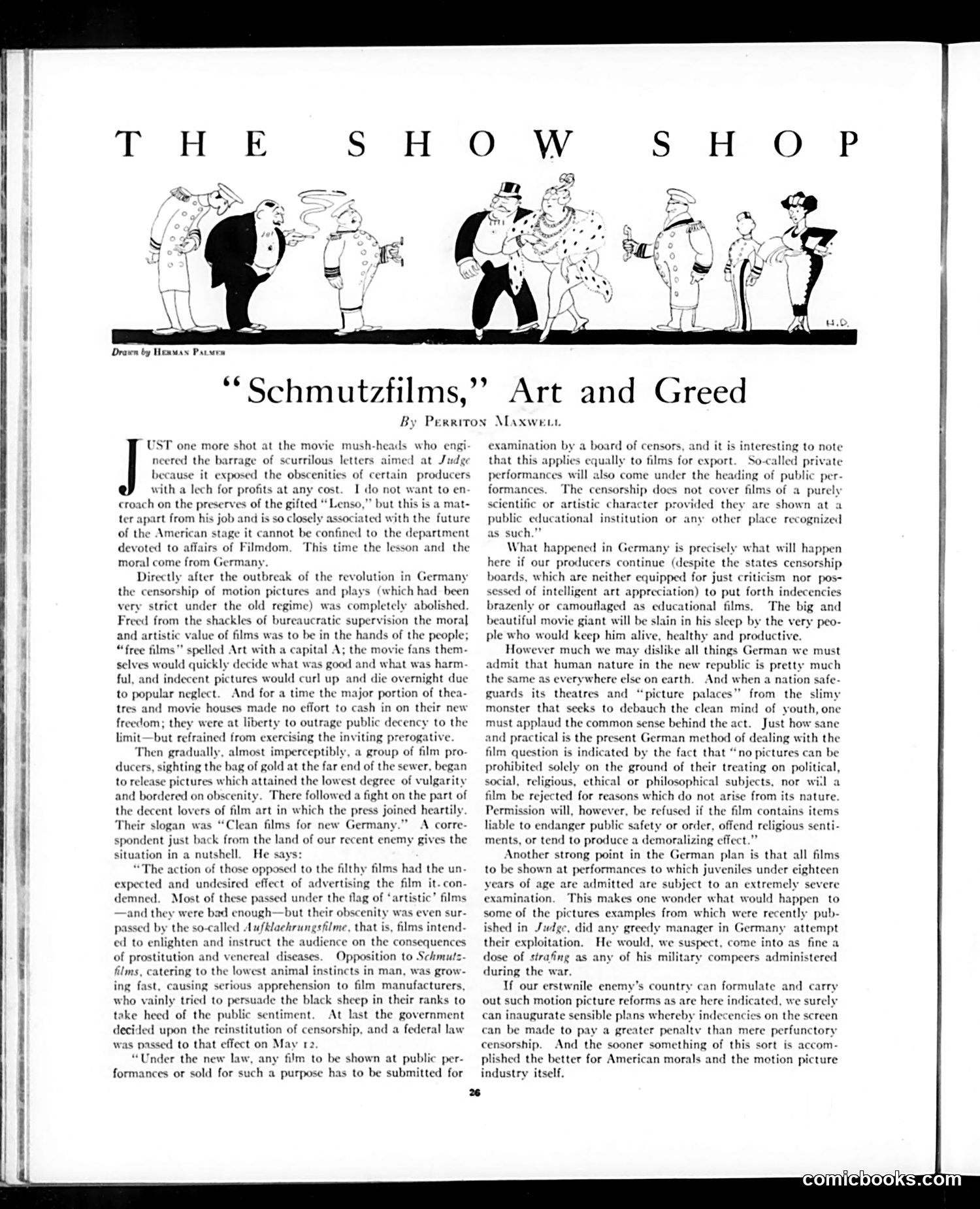
This article uses Germany's recent experience as a cautionary tale for American film producers. After Germany's 1918 revolution abolished film censorship, producers initially exercised restraint. However, they gradually released increasingly vulgar content—including "Schmutzfilms" (literally "filth films") about prostitution and venereal disease—purely for profit. Public outcry forced Germany to reinstate government censorship in May 1921. The author warns American producers: if they continue releasing indecent films under the guise of "art" or "education," American audiences will similarly demand strict federal censorship, destroying the film industry's freedom and profitability. The cartoon's figures appear to represent various film industry types—producers, actors, and showmen—illustrating the range of people involved in this morally questionable enterprise. The satire targets producers' greed masquerading as artistic merit.
📄 Transcribed text from this page (OCR, searchable)
Machine-transcribed from the original scan — historical spelling and the odd misread are preserved.
Drawn by Hexwas Pavwen “*Schmutzfilms,’ > Art and Greed By Perriton Maxweut. UST one more shot at the movie mush-heads who engi neered the barrage of scurrilous letters aimed at Judge because it exposed the obscenities of certain producers with a lech for profits at any cost. I do not want to en croach on the preserves of the gifted “Lenso,” but this is a mat- ter apart from his job and is so closely associated with the future of the American stage it cannot be confined to the department devoted to affairs of Filmdom. This time the lesson and the moral come from Germany. Directly after the outbreak of the revolution in Germany the censorship of motion pictures and plays (which had been very strict under the old regime) was completely abolished. Freed from the shackles of bureaucratic supervision the moral and artistic value of films was to be in the hands of the people; “free films” spelled Art with a capital A; the movie fans them- elves would quickly decide what was good and what was harm- ful, and indecent pictures would curl up and die overnight due to popular neglect. And for a time the major portion of thea- tres and movie houses made no effort to cash in on their new freedom; they were at liberty to outrage public decency to the limit—but refrained from exercising the inviting prerogative. Then gradually, almost imperceptibly, a group of film pro- ducers, sighting the bag of gold at the far end of the sewer, began to release pictures which attained the lowest degree of vulgarity and bordered on obscenity. There followed a fight on the part of the decent lovers of film art in which the press joined heartily Their slogan was “Clean films for new Germany.” <A corre- spondent just back from the land of our recent enemy gives the situation in a nutshell. He says: “The action of those opposed to the filthy films had the un- expected and undesired effect of advertising the film it. con- demned. Most of these passed under the flag of ‘artistic’ films —and they were bad enough—but their obscenity was even sur- passed by the so-called Aufklachrungsfilme, that is, films intend- ed to enlighten and instruct the audience on the consequences of prostitution and venereal diseases. Opposition to Schmu films, catering to the lowest animal instincts in man, was grow- ing fast, causing serious apprehension to film manufacturers, who vainly tried to persuade the black sheep in their ranks to take heed of the public sentiment. At last the government decided upon the reinstitution of censorship, and a federal law was passed to that effect on May “Under the new law, any film to be shown at public per- formances or sold for such a purpose has to be submitted for examination by a board of censors, and it is interesting to note that this applies equally to films for export. So-called private performances will also come under the heading of public per- formances. The censorship docs not cover films of a purely scientific or artistic character provided they are shown at a public educational institution or any other place recognized as such.” What happened in Germany is precisely what will happen here if our producers continue (despite the states censorship boards, which are neither equipped for just criticism nor pos- sessed of intelligent art appreciation) to put forth indecencies brazenly or camouflaged as educational films. The big and beautiful movie giant will be slain in his sleep by the very peo- ple who would keep him alive, healthy and productive. However much we may dislike all things German we must admit that human nature in the new republic is pretty much the same as everywhere else on earth. And when a nation safe- guards its theatres and “picture palaces” from the slimy monster that seeks to debauch the clean mind of youth, one must applaud the common sense behind the act. Just how sane and practical is the present German method of dealing with the film question is indicated by the fact that “no pictures can be prohibited solely on the ground of their treating on political, social, religious, ethical or philosophical subjects, nor will a film be rejected for reasons which do not arise from its nature. Permission will, however, be refused if the film contains items liable to endanger public safety or order, offend religious senti- ments, or tend to produce a demoralizing effect.” Another strong point in the German plan is that all films to be shown at performances to which juveniles under eighteen years of age are admitted are subject to an extremely severe examination. This makes one wonder what would happen to some of the pictures examples from which were recently pub- ished in Judge, did any greedy manager in Germany attempt their exploitation, He would, we suspect, come into as fine dose of strafing as any of his military compeers administered during the war, If our erstwnile enemy’s country can formulate and carry out such motion picture reforms as are here indicated, we surely can inaugurate sensible plans whereby indecencies on the screen n be made to pay a greater penalty than mere perfunctory censorship. And the sooner something of this sort is accom- plished the better for American morals and the motion picture industry itself.