
A complete issue · 36 pages · 1920
Judge — April 24, 1920
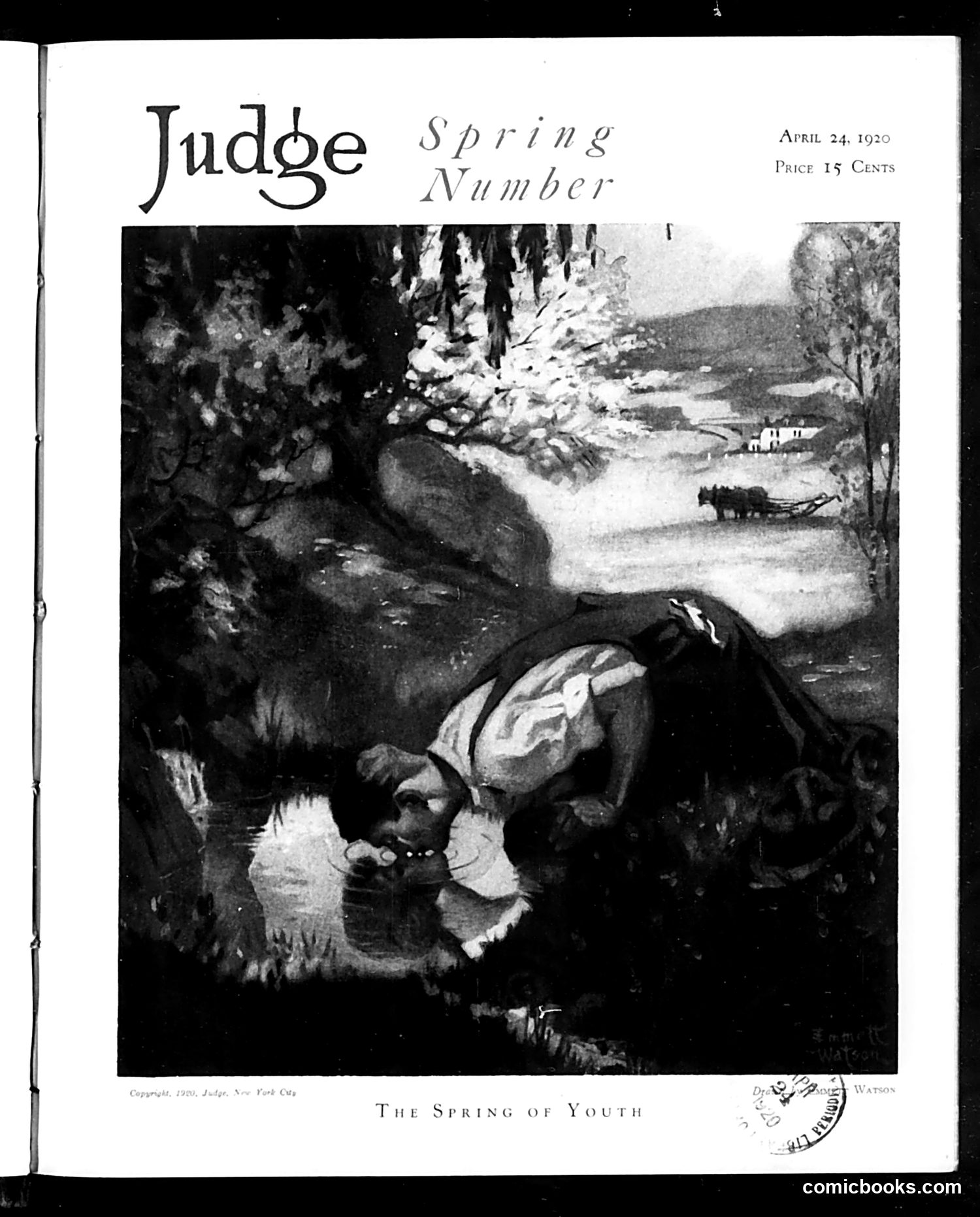
This cover illustration, titled "The Spring of Youth," depicts a woman in classical dress kneeling by a stream in a pastoral landscape. The image appears to be allegorical rather than politically satirical—personifying "Spring" as a youthful female figure engaging with nature's rejuvenating waters. The soft-focus romantic style and classical subject matter suggest this cover celebrates spring's traditional association with renewal and rebirth. The distant landscape with a cottage and workers indicates an idealized rural setting. Without additional text or captions on this page fragment, the specific satirical message remains unclear. The cover may simply be decorative artwork for this spring edition rather than commentary on contemporary 1920 political events.
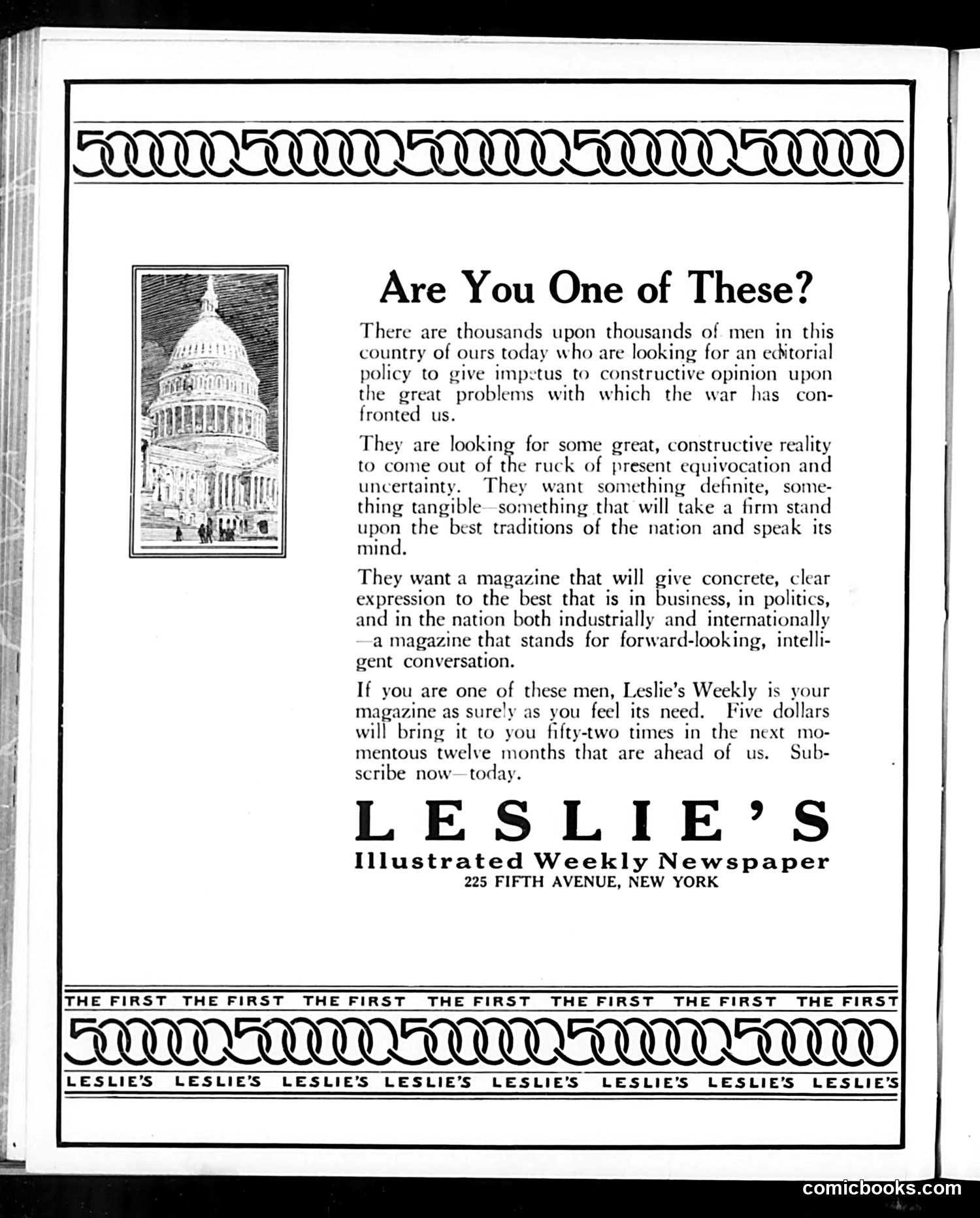
This page is primarily an **advertisement for Leslie's Weekly**, not political satire. The ad addresses men seeking substantive analysis of post-war issues—likely referring to World War I and its aftermath. The Capitol building image symbolizes American government and authority. The ad targets educated readers ("men in this country") who want serious journalism addressing "great problems" and "present equivocation and uncertainty." It promises content grounded in "best traditions of the nation" rather than sensationalism. The pitch emphasizes Leslie's as a magazine for "forward-looking, intelligent conversation" covering business, politics, and international affairs. At five dollars for 52 issues over twelve months, it's positioned as essential reading for thoughtful citizens navigating post-war America. This reflects early-20th-century magazine marketing to elite, politically-engaged audiences.
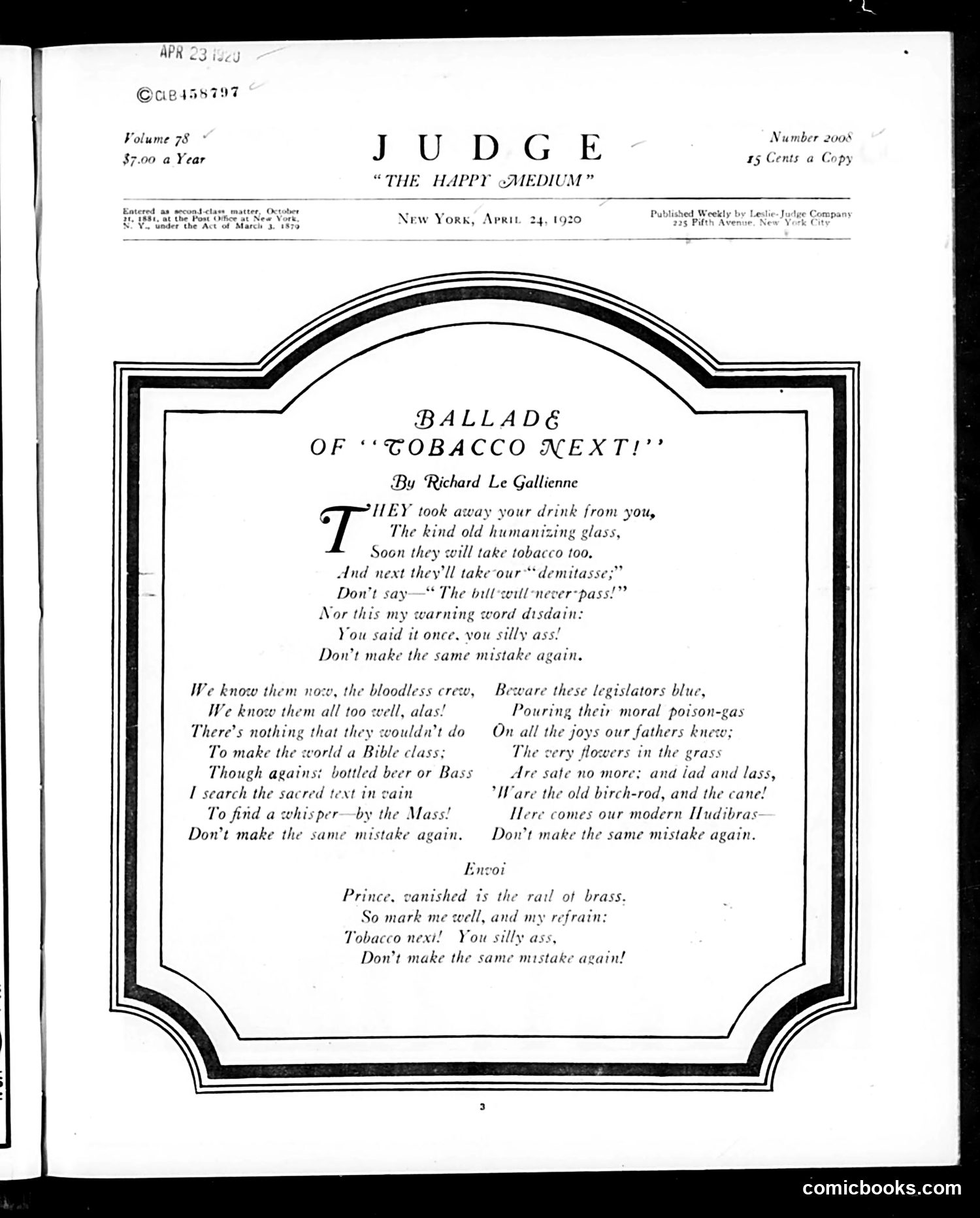
This is a satirical ballad by Richard Le Gallienne titled "Tobacco Next!" published in Judge magazine on April 24, 1920. The poem mocks Prohibition-era reformers who successfully banned alcohol and now threaten tobacco. The satire criticizes these "legislators" as hypocritical crusaders ("bloodless crew") intent on imposing moral restrictions on ordinary citizens. References include drinking glasses being taken away, mentions of "demitasse" (small coffee cups), and historical prohibitions (beer, cider). The poem warns that after alcohol prohibition, tobacco will be next—predicting an endless cycle of government-enforced moral regulation. The "Hudibras" reference invokes a 17th-century mock-heroic poem, comparing these reformers to ridiculous zealots. The refrain "Don't make the same mistake again" sarcastically suggests Americans should have learned from Prohibition's failures before supporting further restrictions on personal behavior.
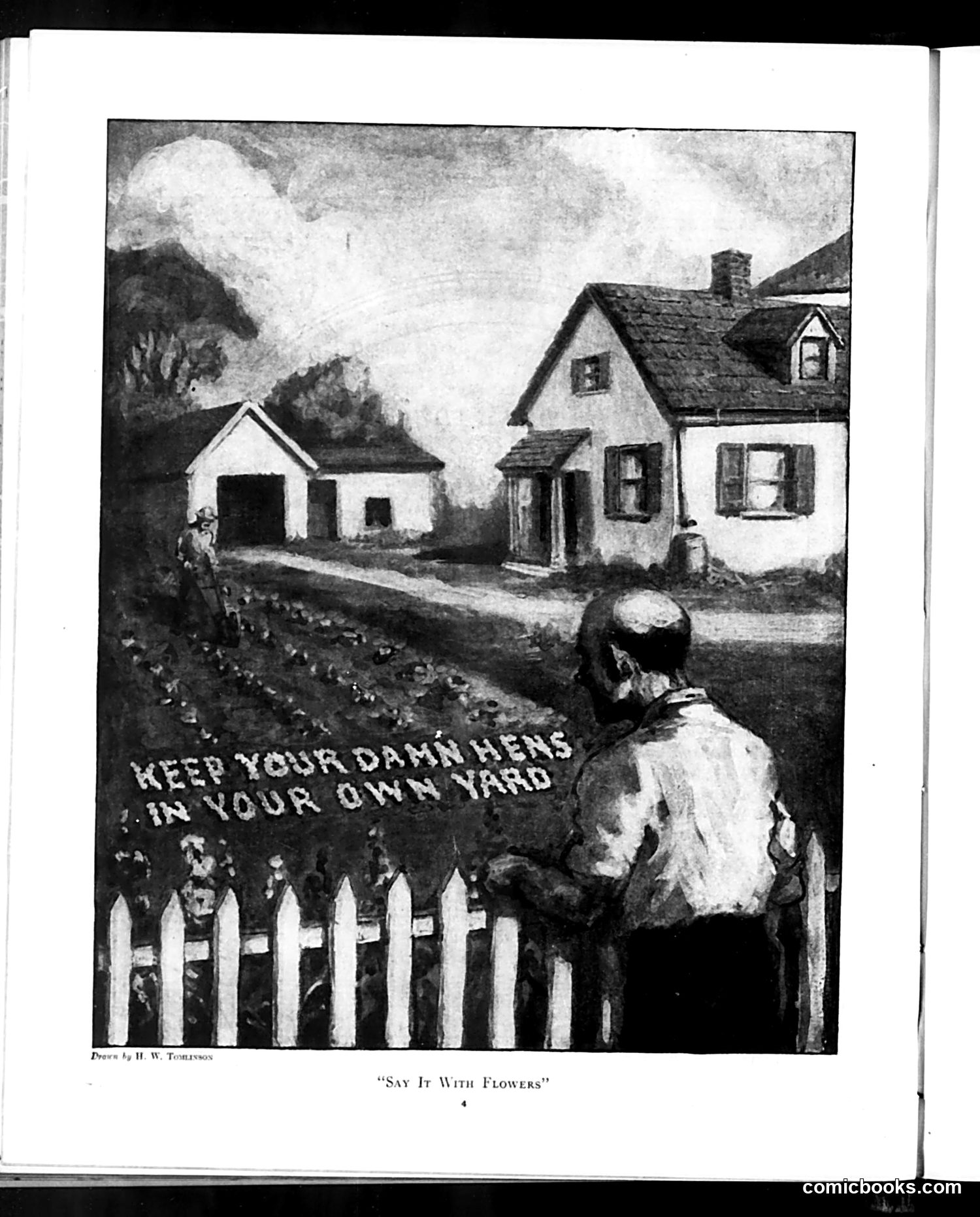
This cartoon depicts a homeowner being advised to "Keep Your Damn Hens in Your Own Yard"—a neighbor complaint about roaming poultry. The title "Say It With Flowers" is ironic: rather than delivering harsh criticism directly (the genteel euphemism of giving flowers), the neighbor is delivering blunt, profane criticism instead. The satire likely comments on post-WWI suburban tensions and class anxieties. Keeping chickens in one's yard was common during this era, especially during wartime (when food self-sufficiency was encouraged), but increasingly seen as uncouth by those aspiring to suburban propriety. The cartoon mocks both the neighbor's rudeness and the pretension of "polite" society trying to enforce middle-class standards on working-class residents.
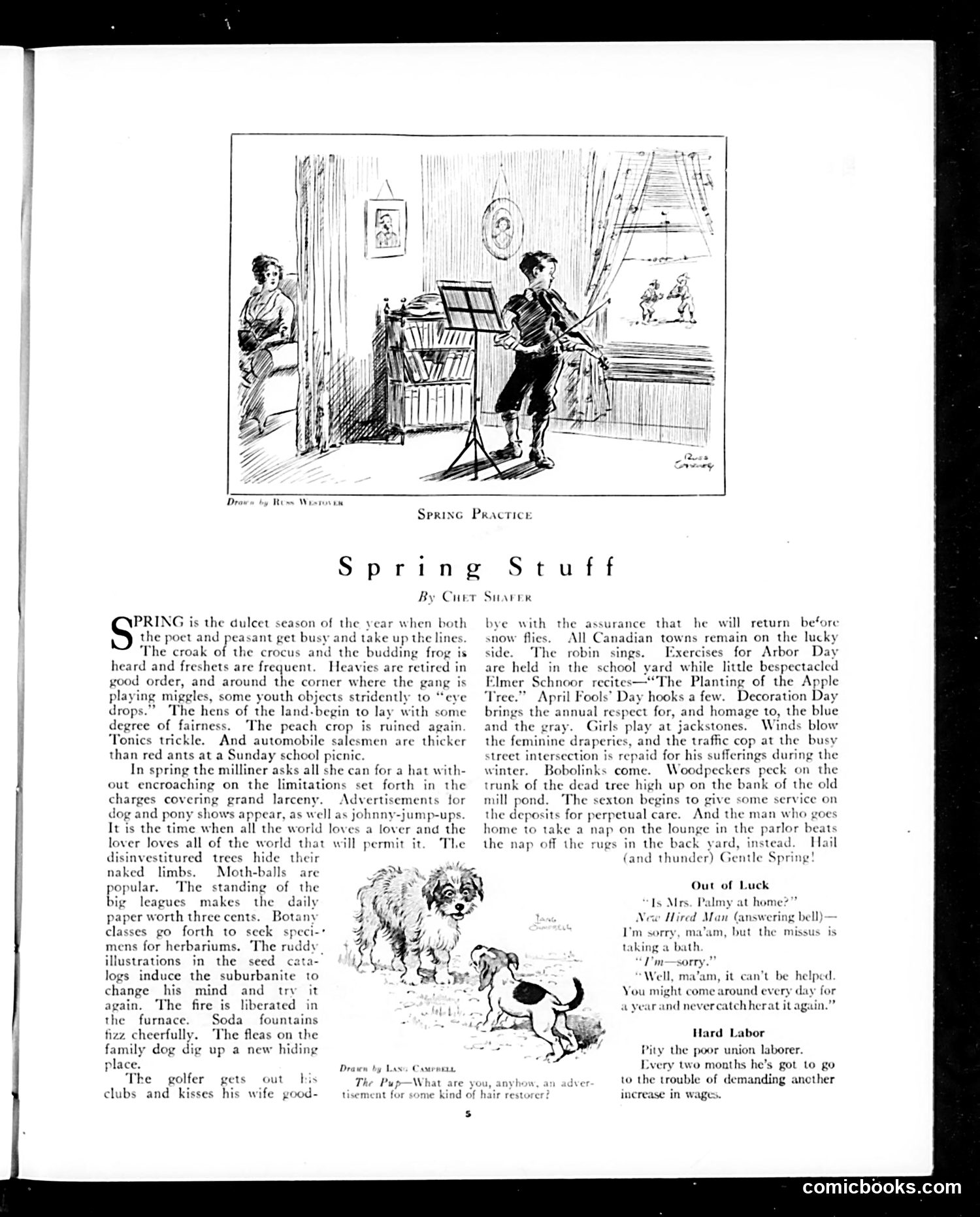
This page contains a humorous essay about spring activities rather than political satire. The main cartoon ("Spring Practice") depicts a young person practicing violin while an adult watches—likely satirizing how spring's arrival brings renewed focus on domestic activities and self-improvement routines after winter. The accompanying text celebrates spring's return: budding nature, children's outdoor games (jackstones, tag), robin songs, and school performances. Two comic vignettes mock small domestic scenarios: one about a missing missus and hair restorer advertisement, another about a union laborer demanding wage increases. The overall tone is gentle social humor about middle-class spring rituals rather than sharp political commentary. The dog illustrations by Lou Campbell add whimsical accompaniment to the seasonal, domestic theme.
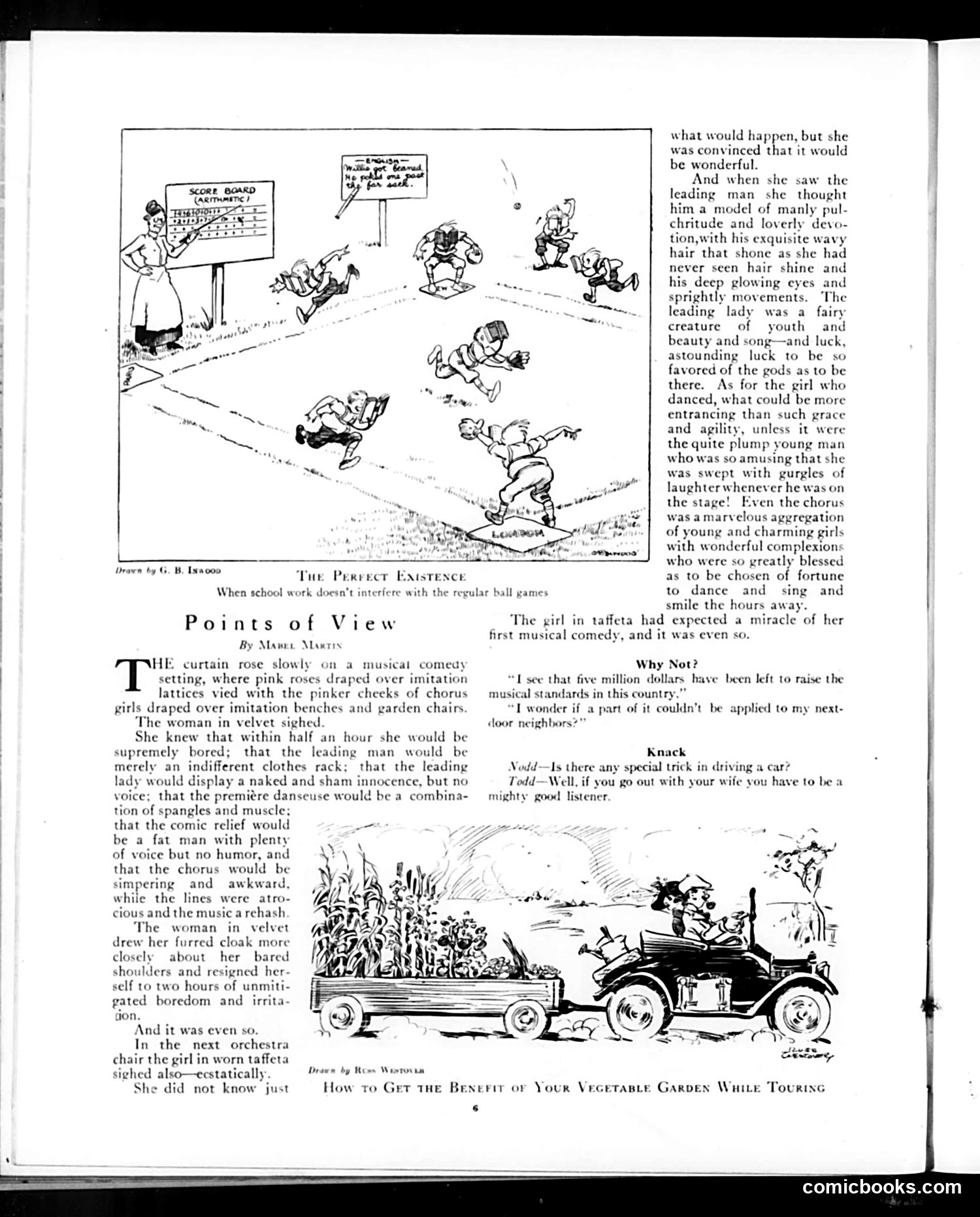
The top cartoon, titled "The Perfect Existence," depicts schoolchildren playing outdoors while a teacher points to a scoreboard. The satire comments on how children prefer unstructured play and games to formal classroom instruction—a critique of rigid educational systems that interfere with children's natural activities. Below, "Points of View" by Marie Martin describes a theatrical musical comedy, satirizing the disconnect between what the woman in charge *expects* the performance will be versus what actually occurs—suggesting pretension versus reality in entertainment. The "Why Not?" joke and "Knack" cartoon appear to be unrelated humor pieces about automobiles and marital dynamics, typical of Judge's miscellaneous comic content. The overall page represents early 20th-century satire on education, theater, and domestic life.
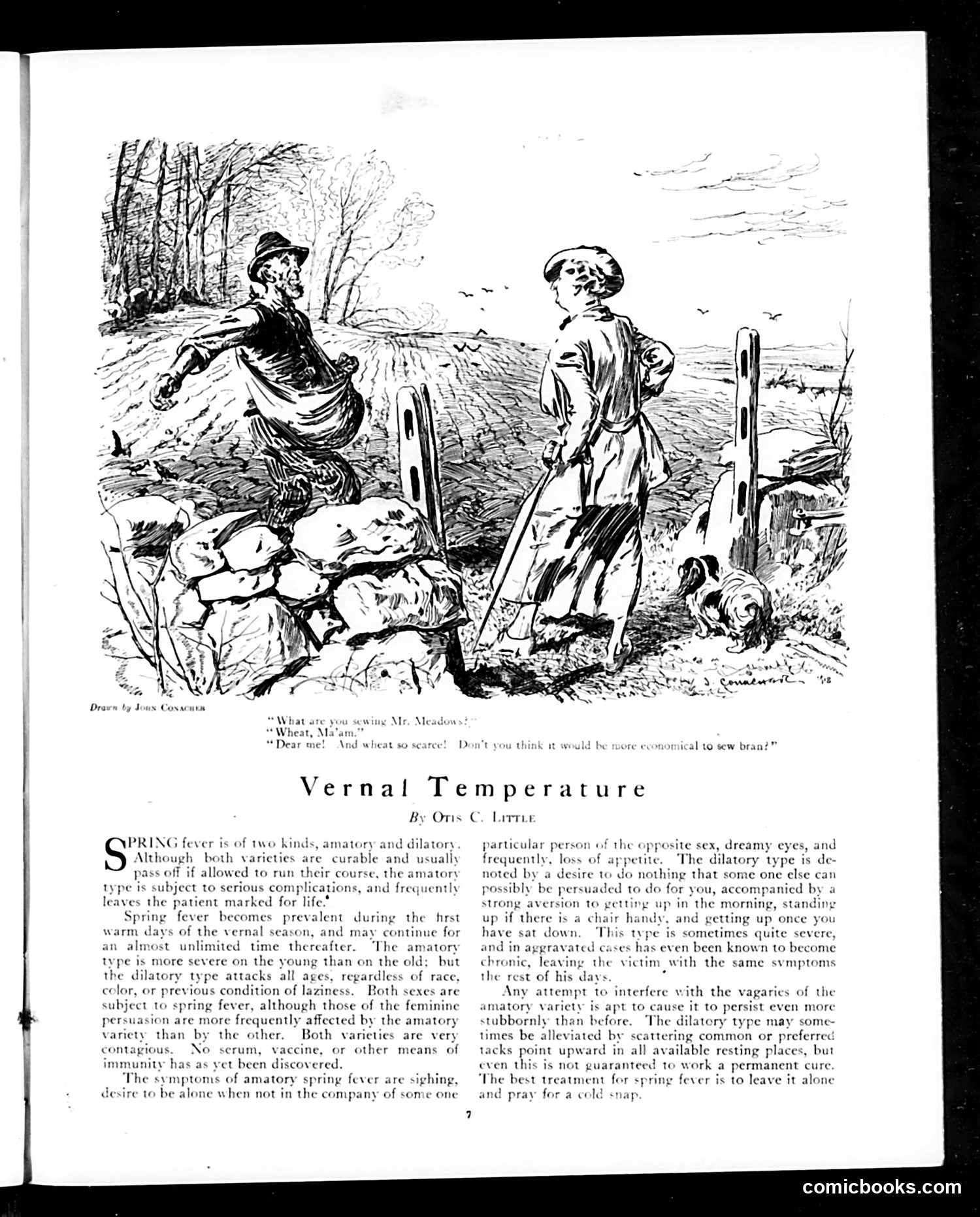
The cartoon depicts a rural couple in a cemetery or field with grave markers. The woman asks Mr. Meadows why he's sewing wheat, sarcastically suggesting he sew bran instead since wheat is scarce—implying his work is wasteful or foolish. The accompanying article humorously defines "spring fever" as two types: **amatory** (romantic infatuation, affecting the young and women especially) and **dilatory** (laziness and lethargy). The satire targets the season's universal affliction: spring's arrival causes either lovesick distraction or unmotivated idleness. The joke's premise—that both are contagious, incurable conditions deserving sympathy—mocks how people blame seasonal change for romantic folly or work avoidance. The cartoon's domestic scene likely illustrates the dilatory type: a man absurdly occupied with pointless labor while his exasperated wife questions his judgment, embodying spring's power to render people temporarily irrational or unmotivated.
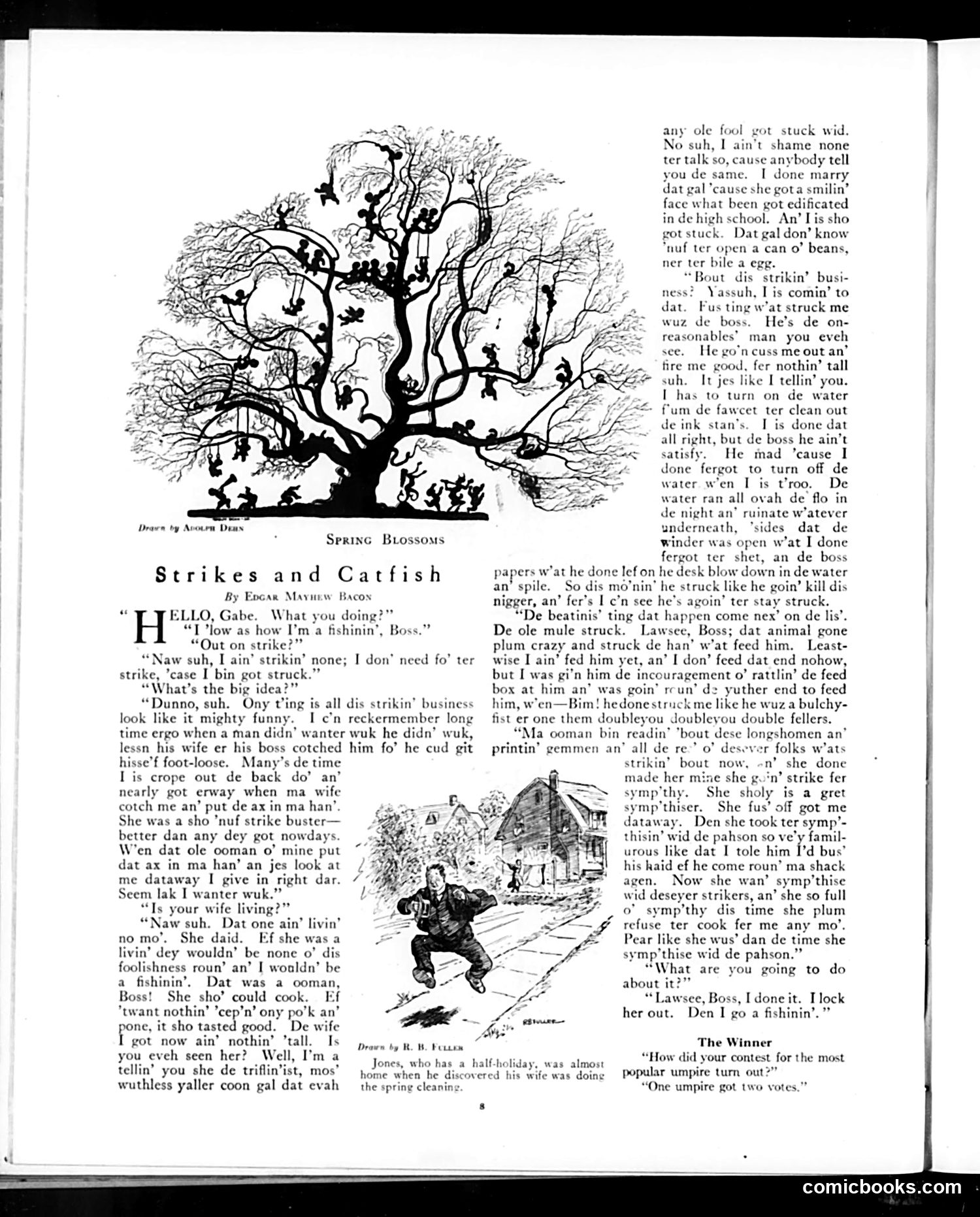
This story, written in heavily stereotyped dialect, satirizes labor strikes through a Black character named Gabe who compares actual workplace strikes to personal misfortunes he's endured. The satire works by treating serious labor activism as absurdly trivial compared to domestic troubles. Gabe explains that his boss's unreasonable behavior, his mule's refusal to work, his wife's sympathies with striking workers (inspired by news of longshoremen and printers striking), and his wife's refusal to cook are all "strikes"—suggesting that strikes themselves are mere whining and irresponsibility rather than legitimate labor grievances. The cartoon mocks both labor organizers and the working poor by equating organized labor activism with domestic chaos and personal incompetence. It's anti-labor propaganda dressed as humor, using racist caricature to delegitimize strike movements popular during this era. The umpire caption below is unrelated.
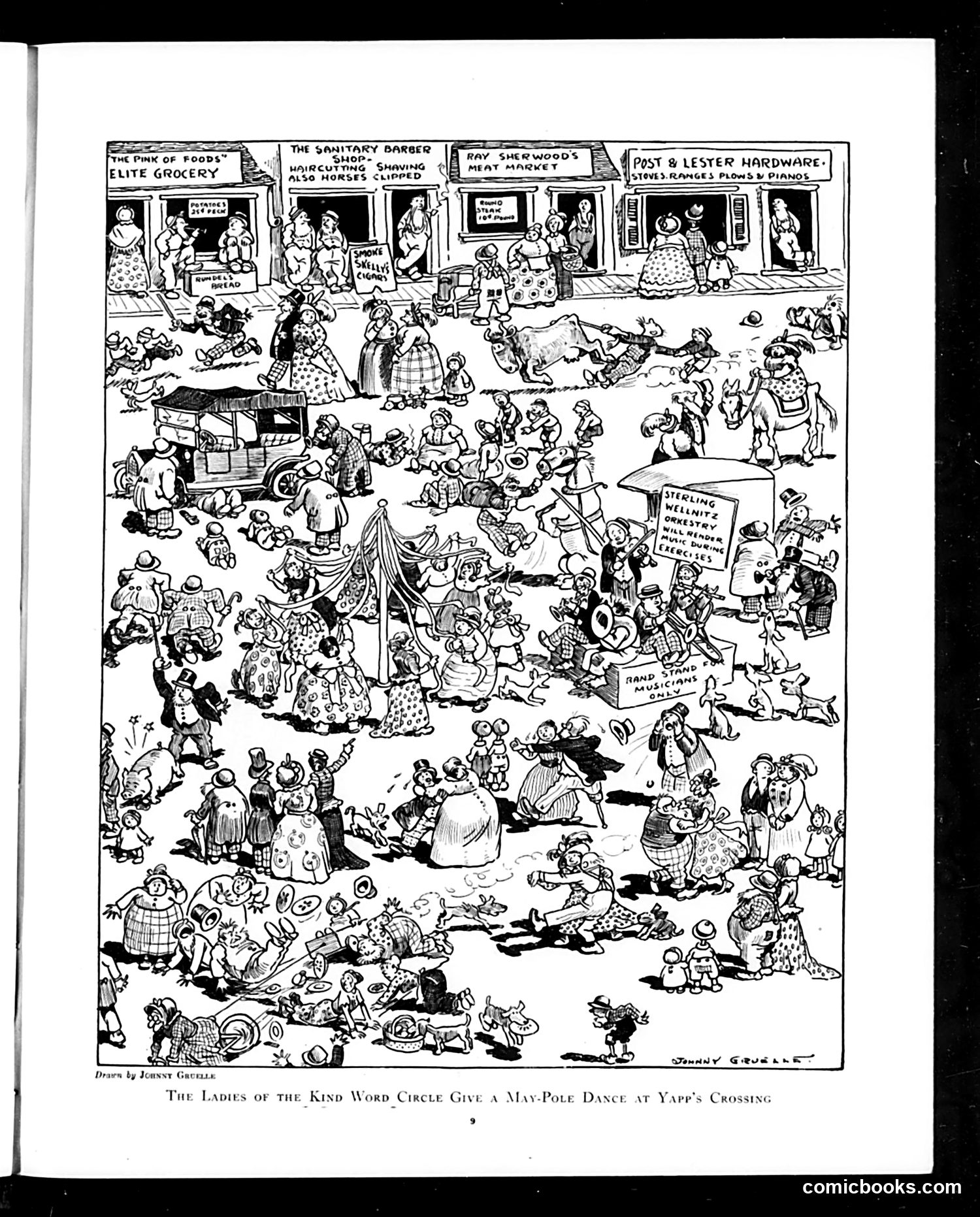
This is a "Where's Waldo?"-style crowded street scene satirizing small-town American life, likely early 20th century. The storefronts visible include "Elite Grocery," "The Sanitary Barber," "Ray Sherwood's Meat Market," and "Post & Lester Hardware"—typical rural commercial establishments. The caption references "The Ladies of the Kind Word Circle" giving a "May-Pole Dance at Yapp's Crossing," suggesting a community social event. The satire appears to mock the chaotic collision of rural gentility and commercialism: well-dressed ladies attempting refined entertainment (the May-pole dance) amid bustling marketplace activity, livestock, children, and general disorder. The joke likely critiques the contrast between small-town pretensions toward sophistication and the messy, unrefined reality of rural commerce and community life. The artist captures both the earnest aspirations and inherent contradictions of small-town American society.
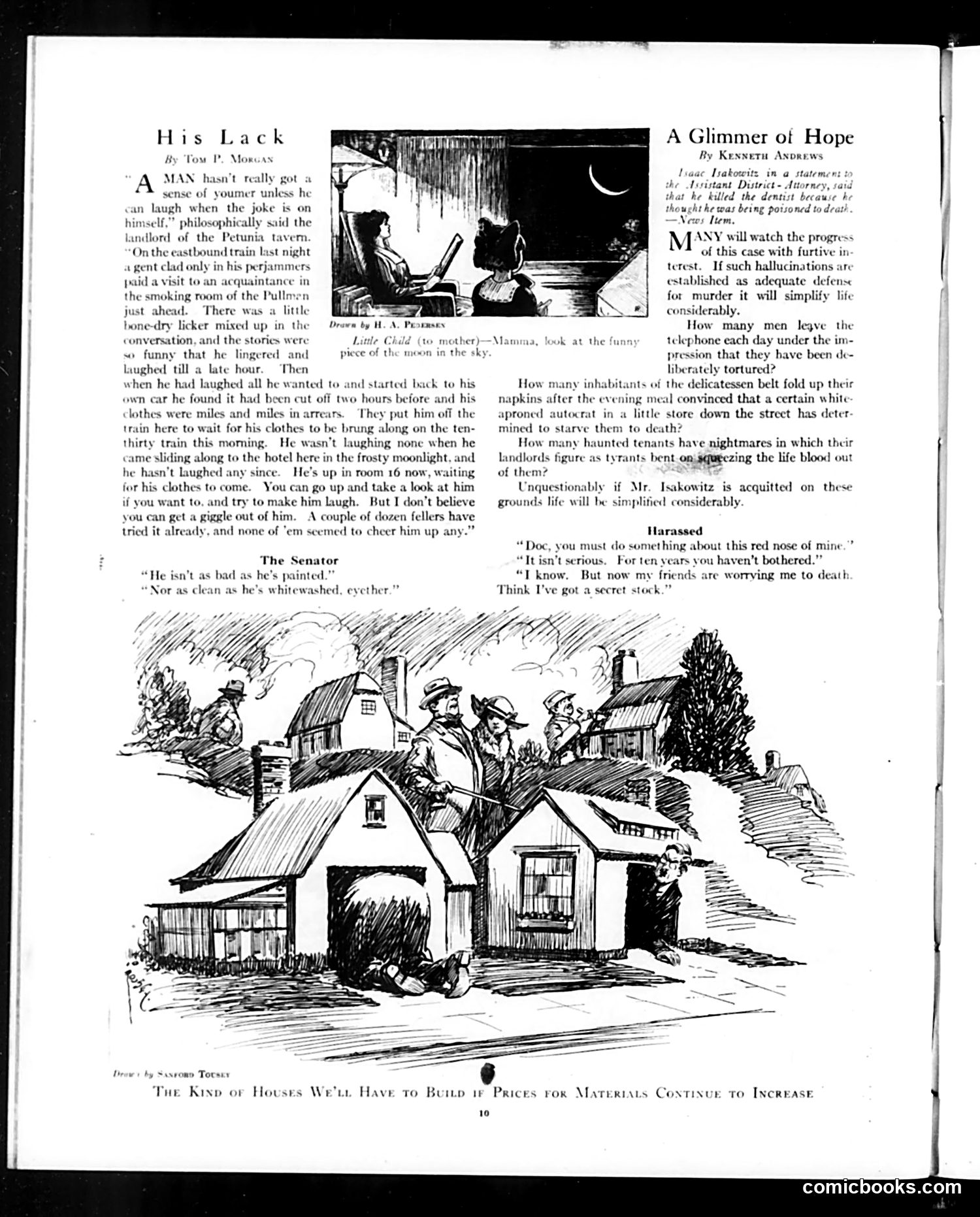
This page contains three separate satirical pieces typical of Judge's social commentary: **"His Lack"** mocks a man who laughed so hard on a train that he became separated from his clothes, arriving at a hotel in pajamas in freezing weather. The irony: his predicament has eliminated his sense of humor entirely. The satire targets how misfortune strips away levity. **"The Senator"** offers a brief political jab: a senator is "painted" badly but also morally "whitewashed"—suggesting politicians present false public images while concealing corruption. **"A Glimmer of Hope"** references an actual crime: Isaac Isakowitz, who killed a dentist, claimed he was poisoned. The satire darkly suggests that if delusion becomes a valid murder defense, many anxious urbanites (paranoid about restaurants, landlords, doctors) could similarly claim justified homicide. It's biting commentary on urban paranoia and legal absurdity. The bottom illustration depicts modest houses, captioning concerns about rising material costs—economic anxiety of the era.
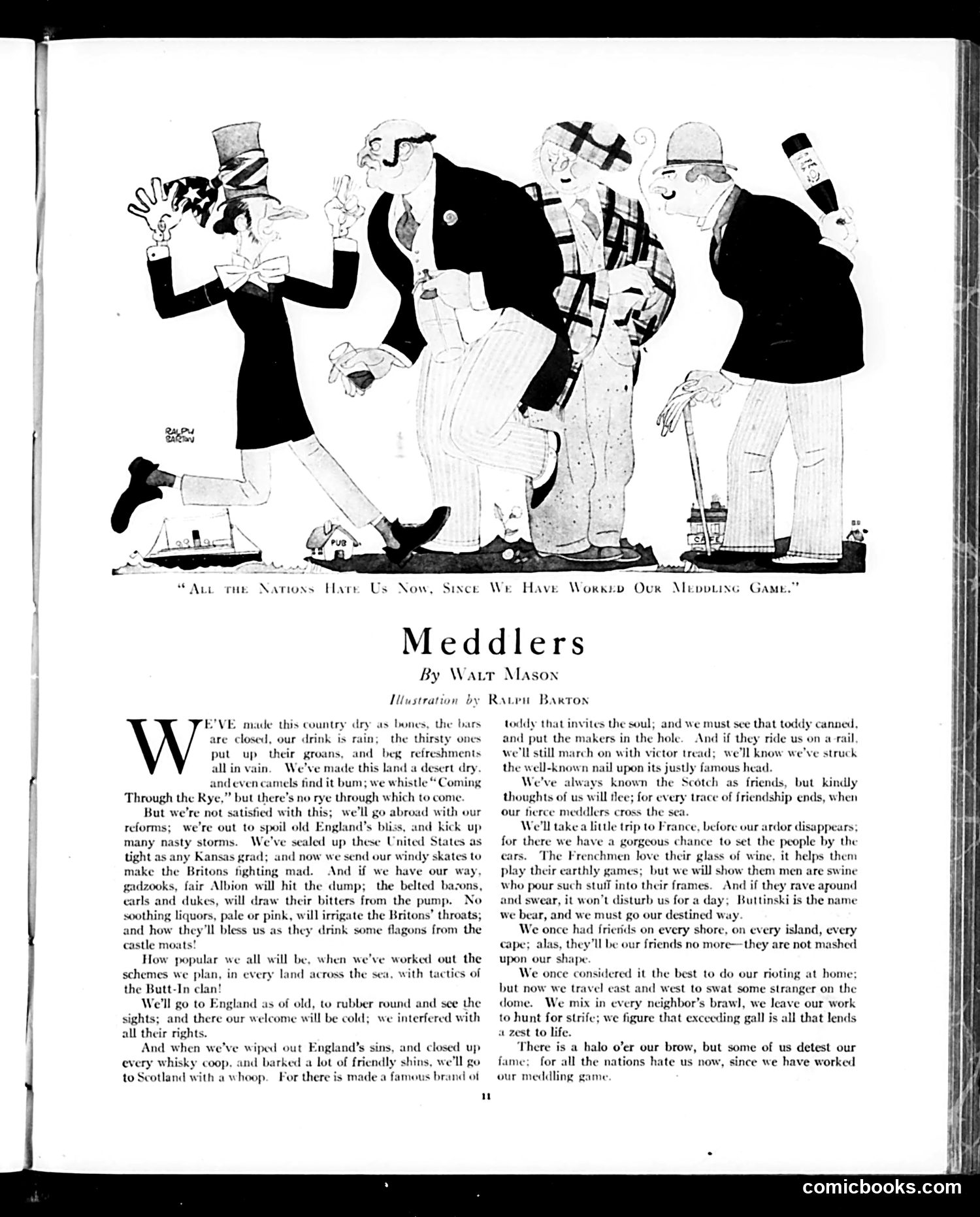
This satirical poem and cartoon criticize American interventionism, particularly Prohibition. The piece lampoons Americans who export their moral reforms abroad, especially to Britain and other nations. **Key targets:** - **American Prohibitionists**: The "Butt-In clan" (a play on "Buttinski") who imposed alcohol bans domestically and now seek to export these policies internationally - **British, Scottish, and French**: Depicted as annoyed by American meddling in their sovereign practices (drinking whisky, brandy, wine) **The satire's point:** By forcing Prohibition at home, Americans have become globally unpopular "meddlers" interfering in other nations' affairs and customs. The cartoon shows elaborately caricatured figures representing these nationalities, all seemingly irritated. **Historical context:** This likely dates to the 1920s Prohibition era, when American temperance activists genuinely did campaign internationally. The author suggests such intervention damages American diplomatic relationships and cultural standing—we're now globally despised for our self-righteous moralizing.
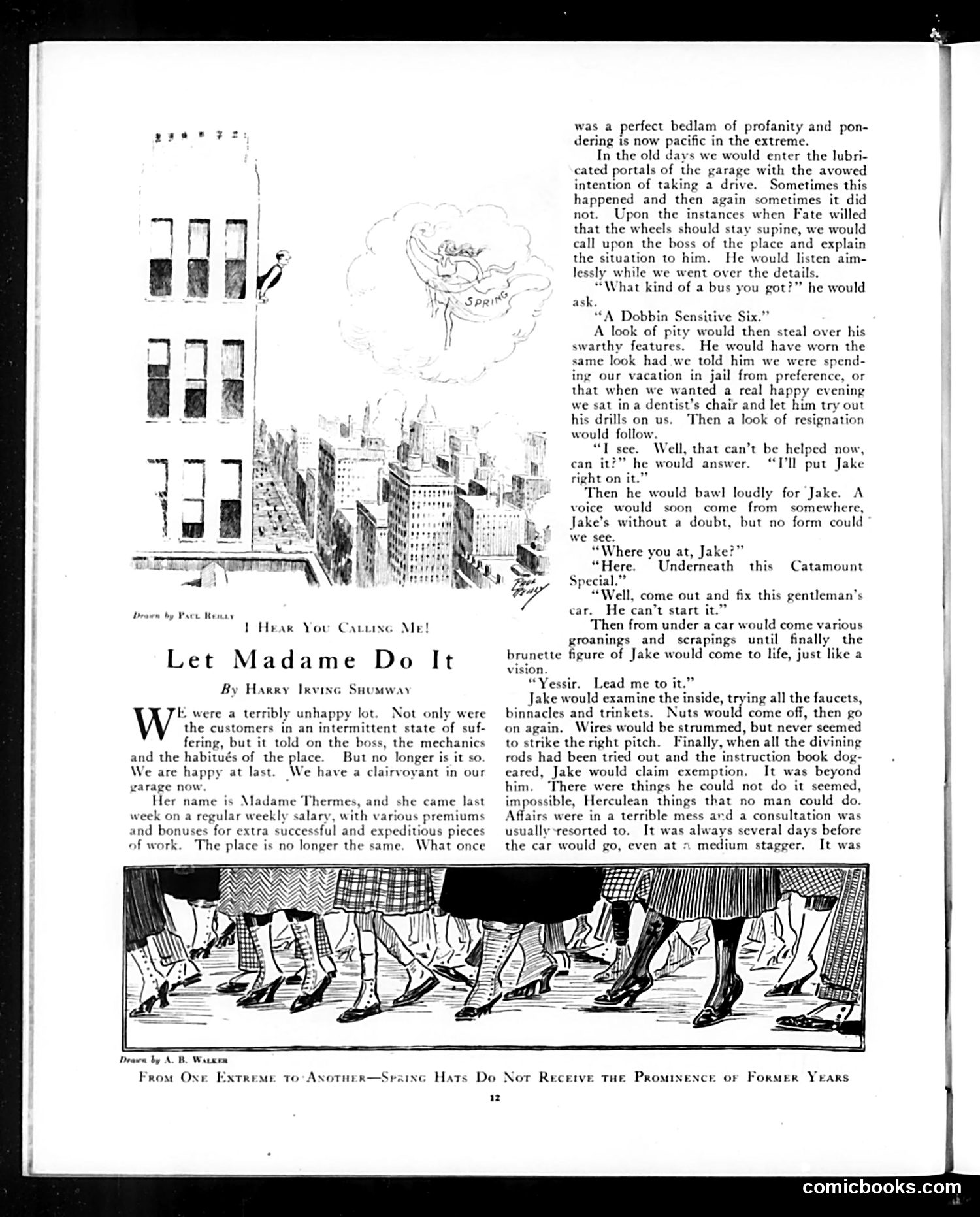
This is a humorous short story satirizing early automotive repair shops and their notoriously incompetent mechanics. The narrative mocks the frustration customers experienced when mechanics couldn't diagnose car problems. The joke centers on introducing "Madame Thermes," a clairvoyant hired as a garage employee to resolve the chaos. The story implicitly ridicules both the garage's mechanical ineptitude (mechanics like "Jake" who randomly try faucets and trinkets without understanding cars) and the desperation that would drive an owner to hire a fortune-teller rather than competent technicians. The bottom illustration shows women's shoes/feet, likely illustrating fashionable spring hat styles mentioned in its caption — a separate satirical item about changing fashion trends. The piece reflects 1920s anxieties about automobile reliability and the gap between automotive technology and repair-shop competence.
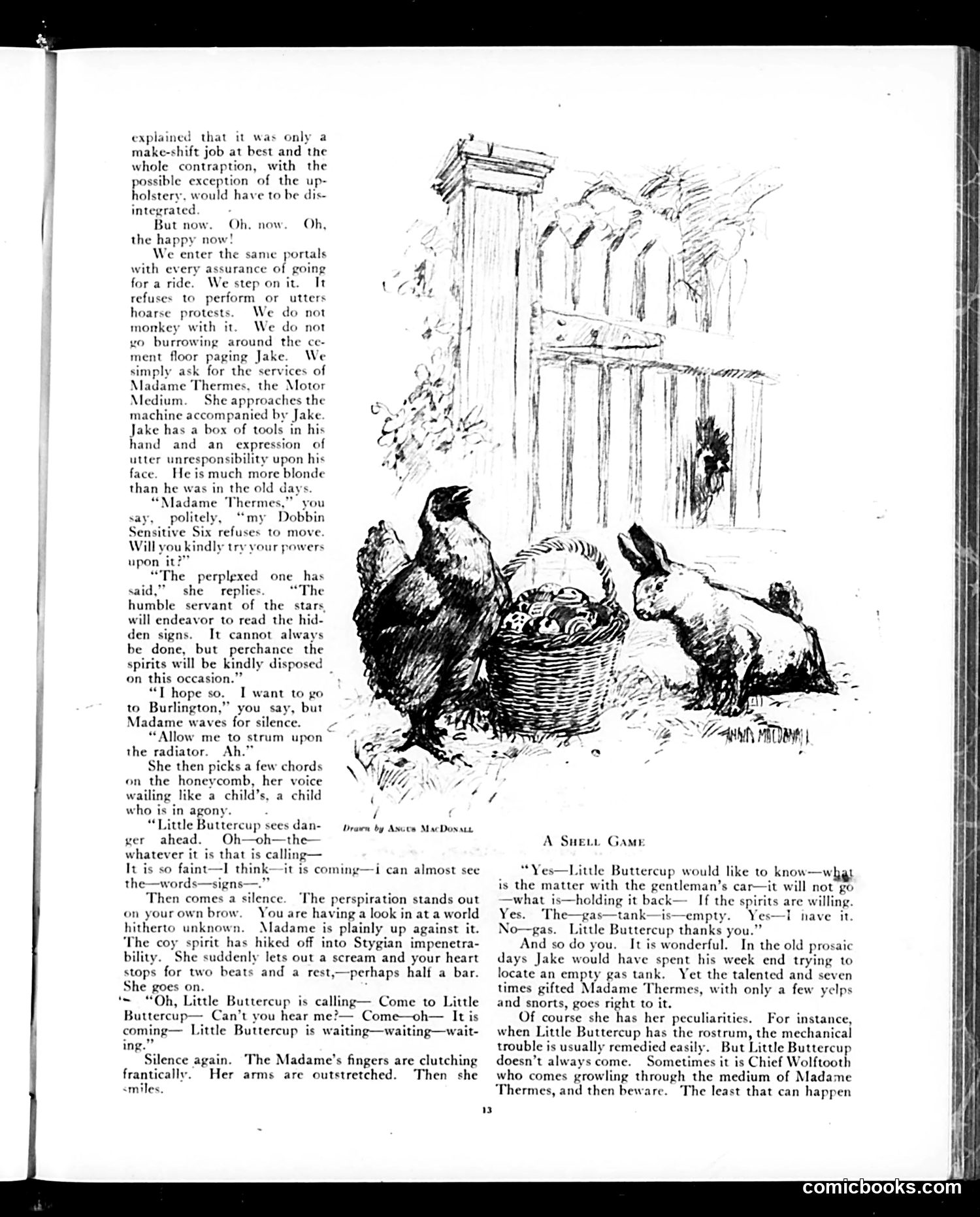
This cartoon satirizes the early 20th-century craze for spiritualism and mediums, particularly targeting the gullible wealthy who hired "psychics" to solve mundane problems. The setup: A car owner's automobile breaks down. Rather than having the mechanic Jake simply repair it, they consult "Madame Thermes, the Motor Medium"—a fake spiritualist who dramatically "communes" with spirits like "Little Buttercup" to diagnose the problem. The joke: Madame's elaborate supernatural theatrics ("wailing like a child's," strumming the radiator like a harp, channeling spirit guides) eventually reveal the obvious solution—the gas tank is empty. What Jake could have discovered through actual mechanical work, the "medium" accomplishes through theatrical mysticism, yet the owner considers her "wonderful." The satire targets both spiritualist fraud and the wealthy's willingness to pay for expensive nonsense when practical solutions exist. The title "Shell Game" reinforces the con-artist theme: an elaborate illusion masking a simple trick.
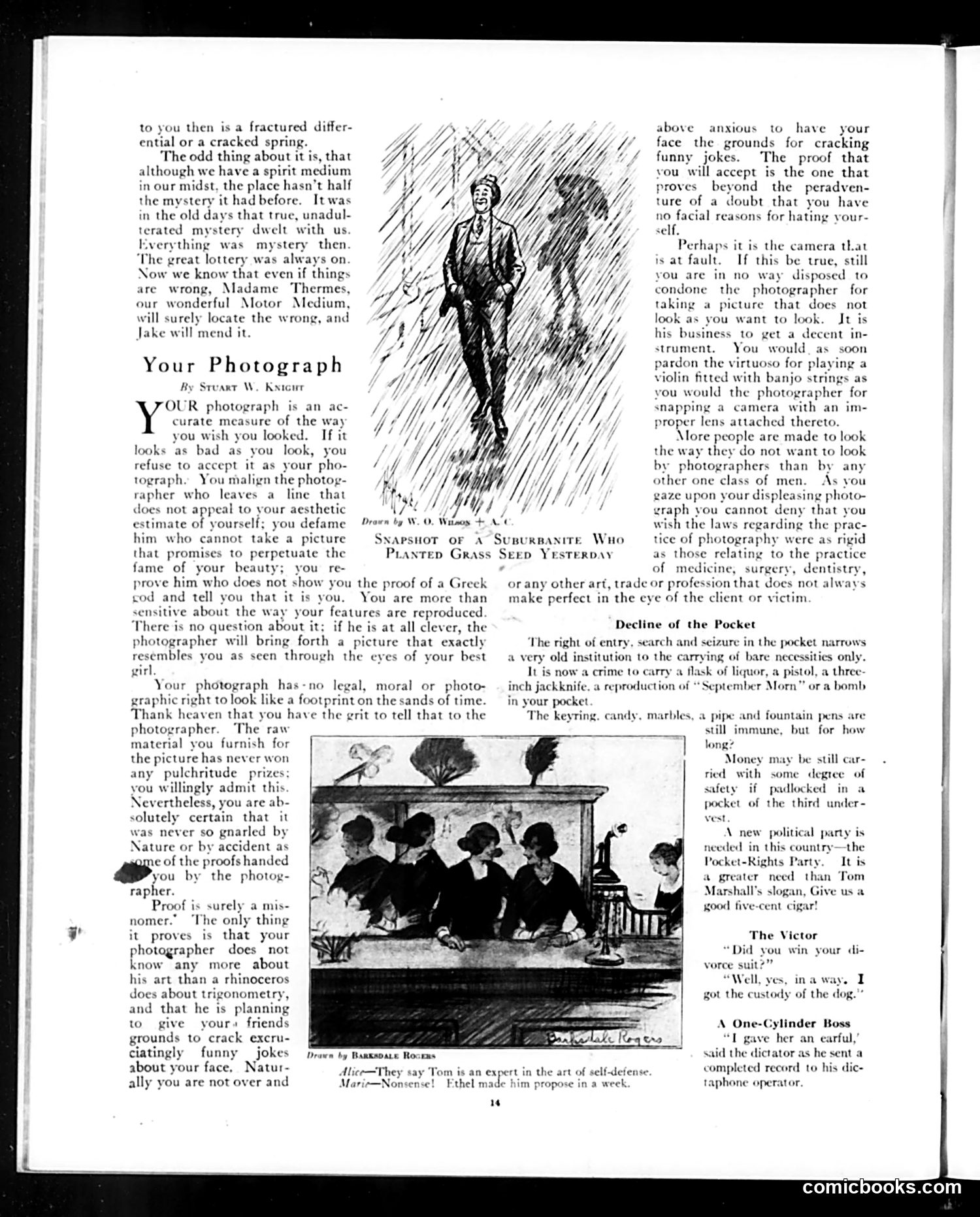
This page contains satirical commentary on two topics relevant to early 20th-century American life: **"Your Photograph"** mocks the vanity of portrait subjects. The essay argues that people judge photographs not by artistic merit but by whether they flatter appearance. The writer notes photographers cannot win—subjects blame them for unflattering images while praising flattering ones, demanding standards photographers cannot meet. The satire suggests people are unreasonable about their appearance and quick to blame the photographer rather than accept reality. **"Decline of the Pocket"** references Prohibition-era restrictions. It humorously catalogs items now illegal to carry—flasks (alcohol), pistols, jackknives, and notably "September Morn" (a famous 1912 nude painting frequently censored). The piece suggests civil liberties are eroding as everyday pocket items become contraband, sardonically noting only innocent items like keyrings and candy remain legal. Both pieces target American hypocrisy and changing social restrictions of the Prohibition period.
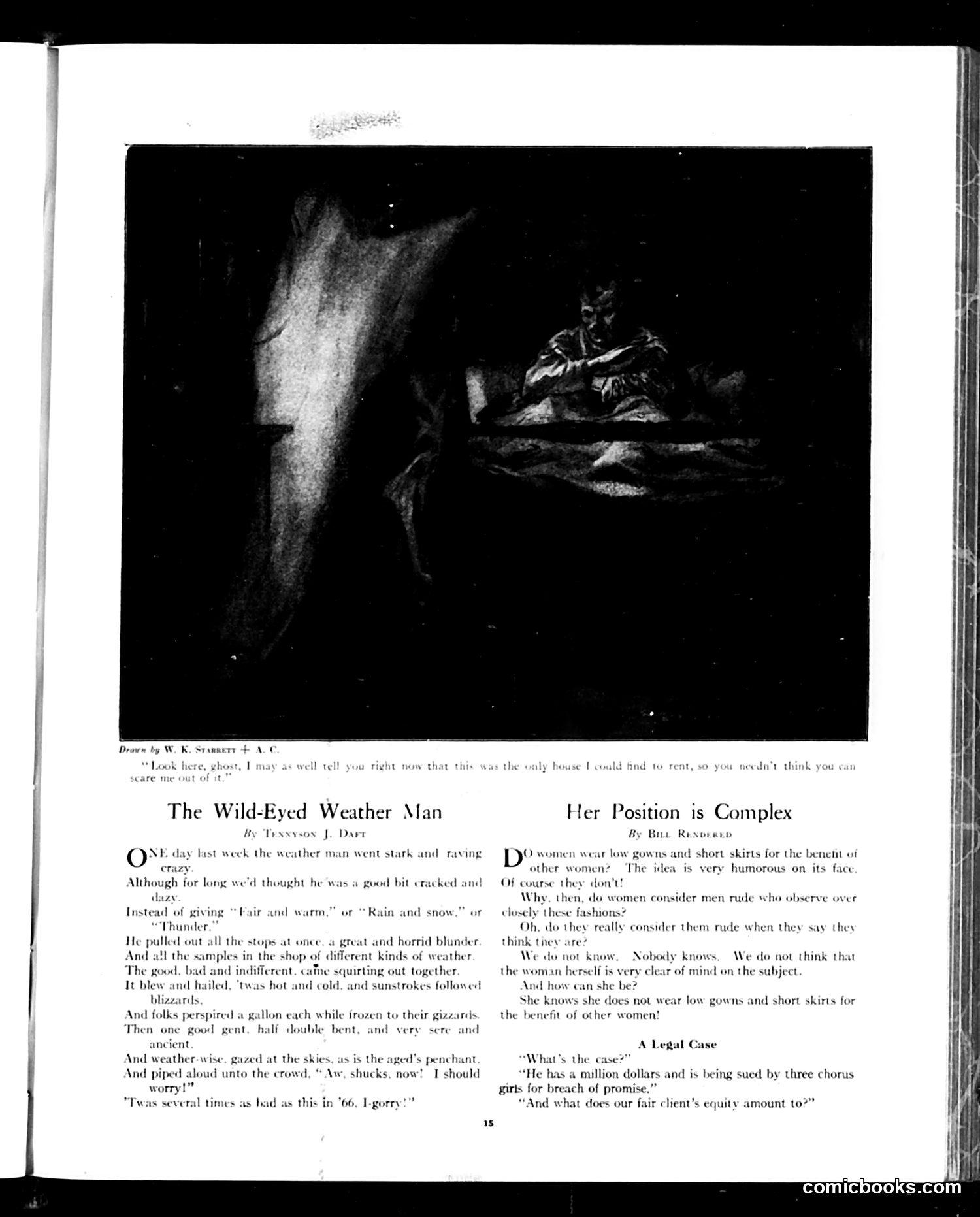
This page contains three short satirical pieces typical of early 20th-century American humor magazines. **"The Wild-Eyed Weather Man"** mocks a meteorologist who dramatically overstates weather predictions, cycling through contradictory forecasts (heat, cold, rain, snow, thunder) with theatrical flair. The joke plays on the perennial unreliability of weather forecasters and their tendency toward exaggeration. **"Her Position is Complex"** satirizes female fashion hypocrisy—women wear revealing clothing but resent men's attention to it. The piece highlights the logical contradiction: if women don't dress for male attention, why object to being observed? **"A Legal Case"** is a brief joke about breach-of-promise litigation, where a wealthy man faces suit from chorus girls. The humor derives from the legal absurdity of quantifying emotional damages in such cases. All three exemplify Judge's style: punching at social pretension, gender contradictions, and legal/professional incompetence through ironic observation rather than elaborate visual satire.
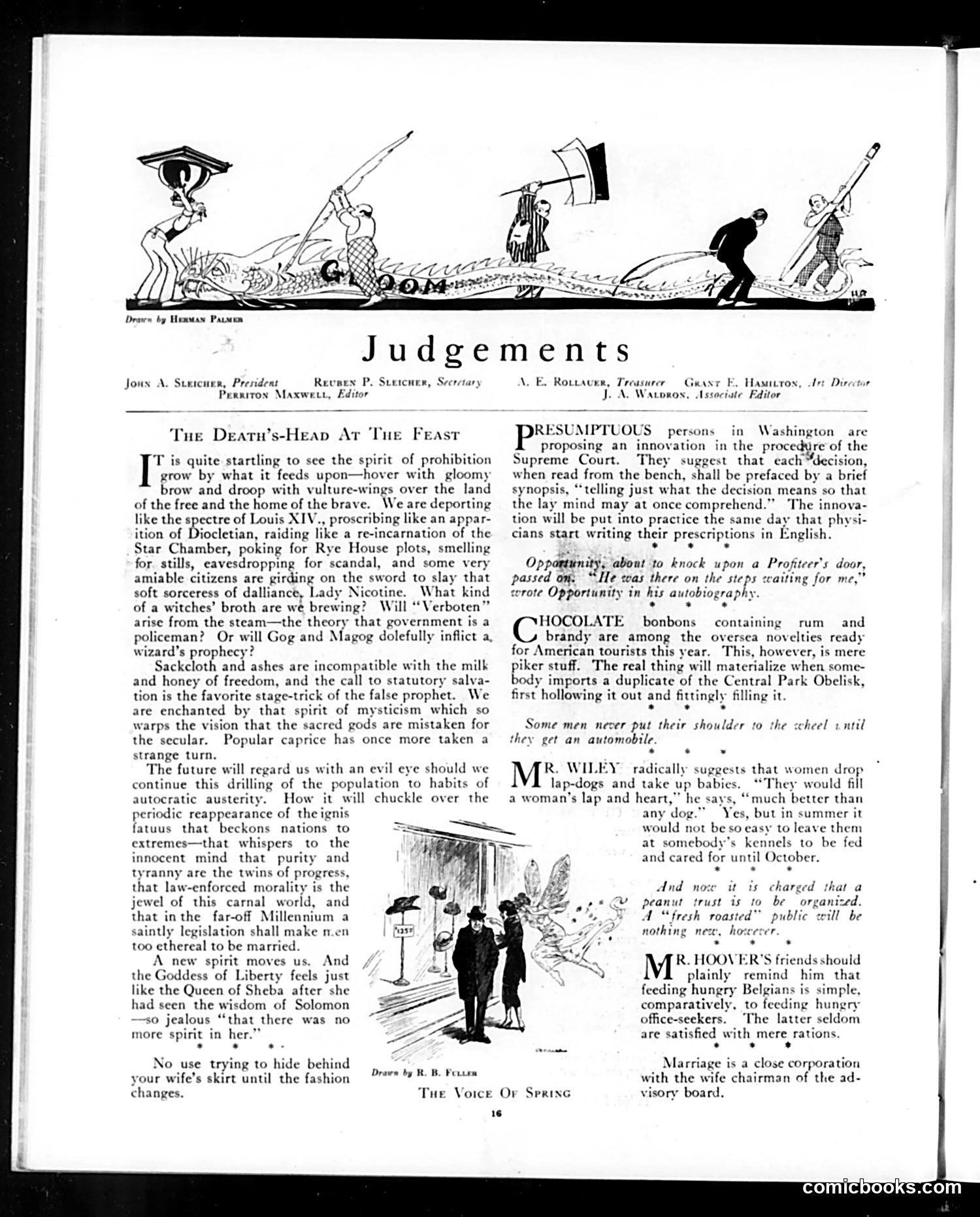
This Judge magazine page satirizes American social trends circa 1920, particularly **Prohibition and government overreach**. **Main Editorial ("The Death's-Head at the Feast")**: Attacks prohibition's expansion, comparing its enforcement to authoritarian regimes (Louis XIV, Diocletian, Star Chamber). The author warns that aggressive moral legislation—banning alcohol and tobacco—represents dangerous government paternalism that contradicts freedom and will eventually provoke public backlash. **Political Context**: Post-WWI America was implementing Prohibition (1920-1933). Judge's conservative editors opposed this as tyrannical social engineering. **Brief Satirical Items**: - Supreme Court justices should write decisions in plain English (mocking their obscurity) - Chocolate bonbons smuggled into America - Mr. Wiley's absurd suggestion women replace lap-dogs with babies - A peanut trust organizing - Hoover's Belgian relief efforts being easier than feeding hungry Americans **Overall Tone**: Elitist mockery of Prohibition zealots and government busybodies through wit rather than anger.
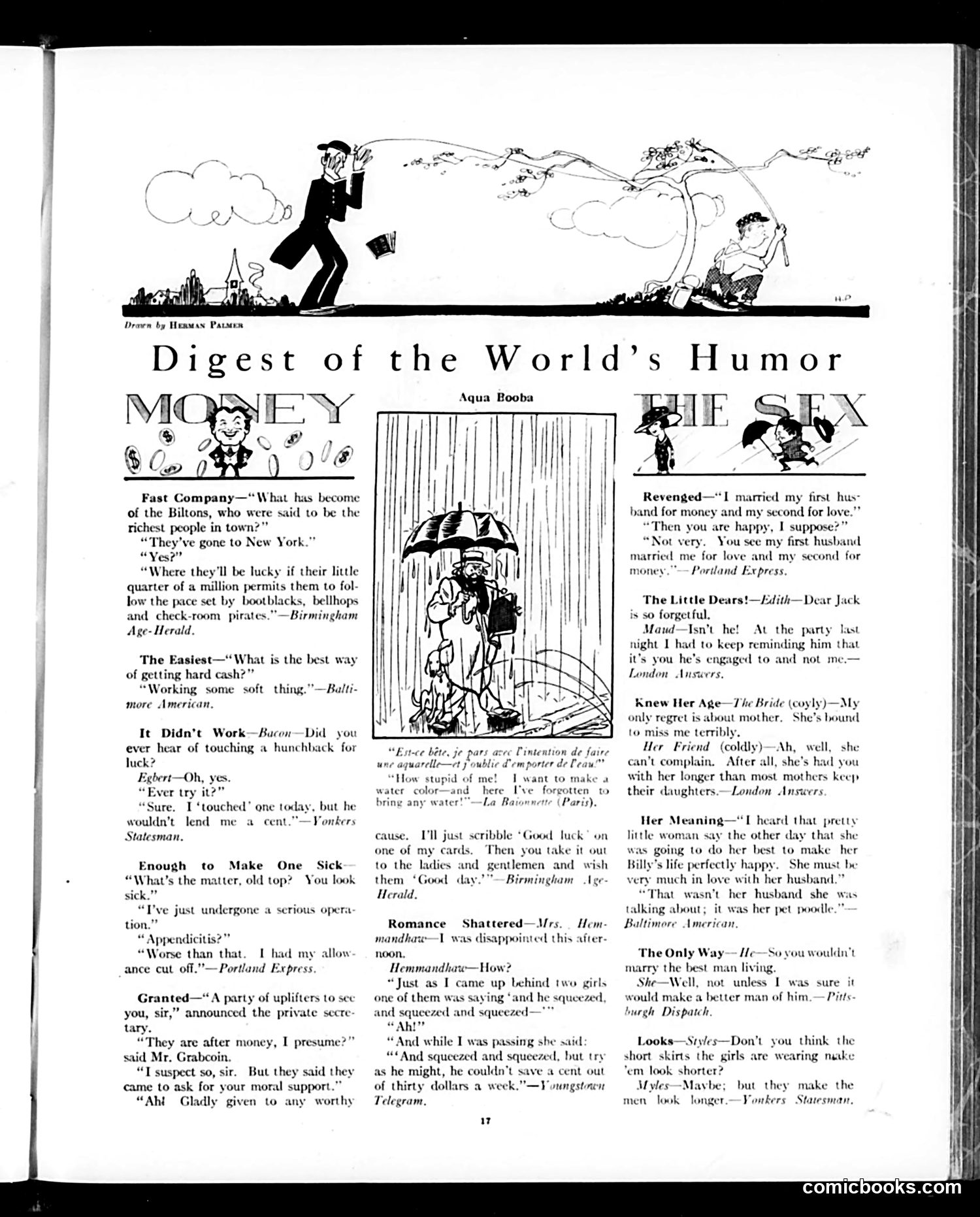
This is a humor digest page from *Judge* magazine, featuring short jokes and witticisms organized by topic (Money, Sex, etc.). The illustration at top shows a businessman striding confidently leftward while a child sits idle rightward—likely representing themes of ambition versus idleness. The jokes reflect early 20th-century American social anxieties: wealthy families losing fortunes in New York; the difficulty of earning money; the tension between romantic love and financial security in marriage; and generational differences (young women's behavior, particularly regarding dating and propriety). The "Aqua Booba" section includes a French anecdote about an artist forgetting water while attempting watercolor—representing absent-minded intellectuals. Overall, the page satirizes contemporary middle-class concerns: money troubles, marital dynamics, changing social mores around courtship, and class mobility. The humor relies on recognizable situations and mild social commentary rather than political targets.
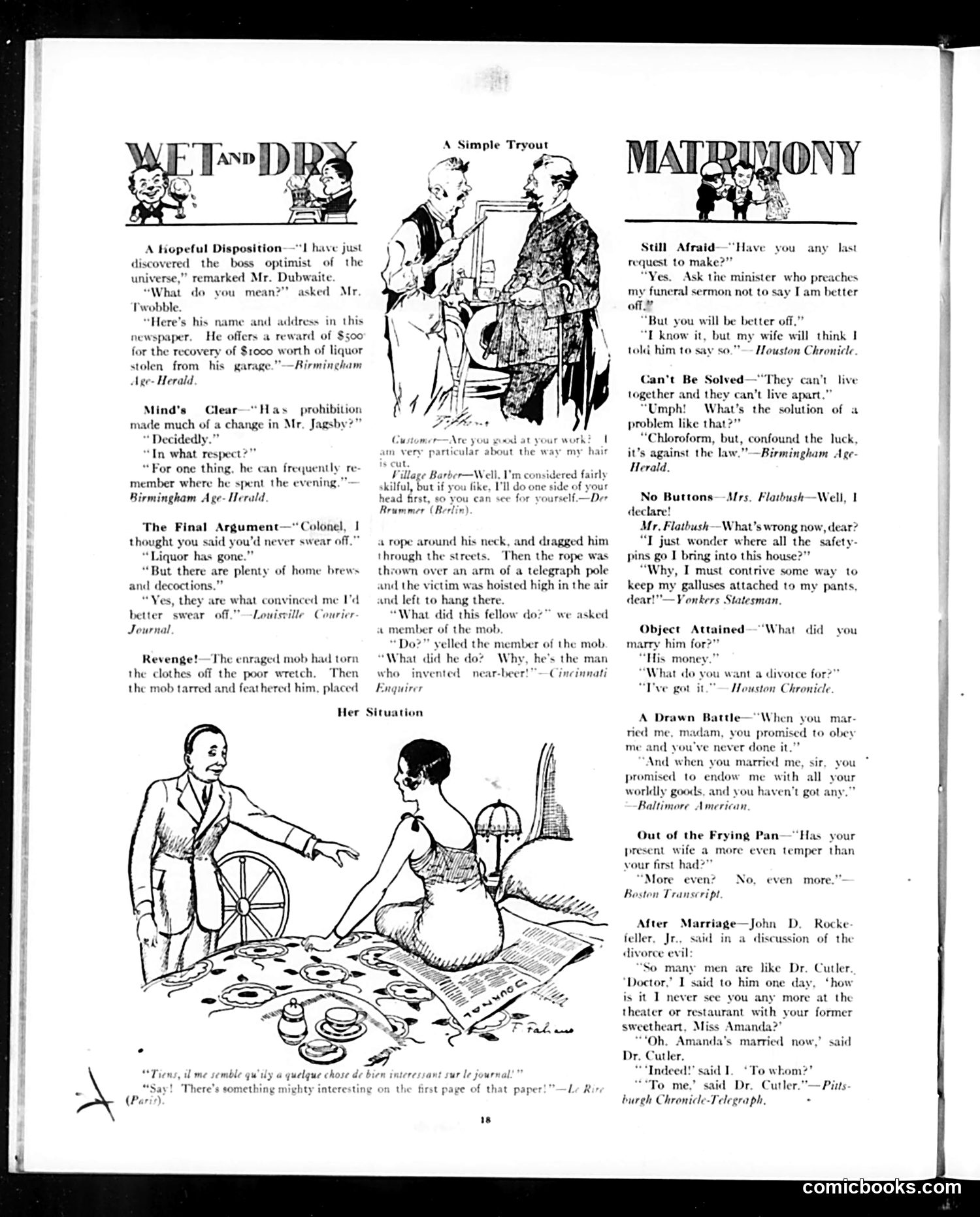
This page from *Judge* magazine contains humorous short anecdotes satirizing early 20th-century American life, with particular focus on **Prohibition-era themes**. The jokes mock: - **Prohibition's failures**: A man offers $500 reward for $1,000 of stolen liquor from his garage, exposing widespread illegal alcohol stockpiling. Another joke notes a man now remembers where he spent evenings—because he's stopped drinking. - **Domestic friction**: Multiple jokes depict marriage as conflict: couples who "can't live together and can't live apart," wives who break promises of obedience, husbands with no worldly goods to provide. - **Class anxiety**: A mob lynches an inventor of "near-beer" (non-alcoholic substitute), suggesting working-class anger at Prohibition substitutes. The cartoons use everyday scenarios (a barber offering to practice on a customer's hair; a woman surrounded by household items) to illustrate social absurdities. Overall, the page reflects *Judge*'s satirical approach: poking fun at Prohibition enforcement, marriage troubles, and the gap between social promises and reality.
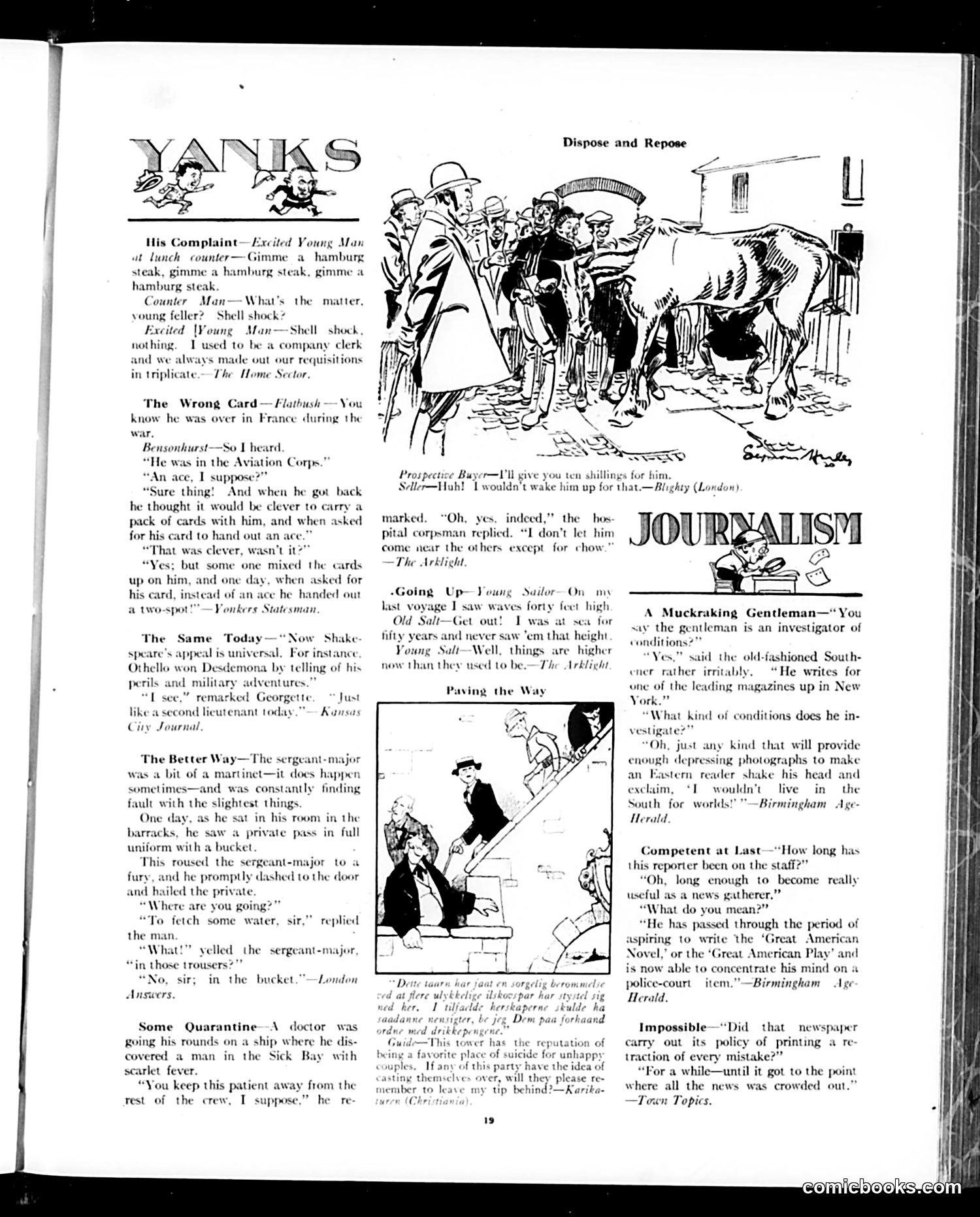
This page contains multiple short humorous anecdotes satirizing post-WWI American life and journalism. Key pieces include: **"His Complaint"**: A diner's nervous repetition of "hamburg steak" is attributed to shell shock from military service, mocking how Americans diagnosed war trauma. **"The Wrong Card"**: An aviator returns from France claiming ace status but embarrassingly hands out a "two-spot" playing card instead of an ace of spades—a joke about deflated military pretensions. **"The Same Today"**: Shakespeare's Othello is compared to a second lieutenant seducing women with war stories—satirizing how soldiers leveraged military service for romantic advantage. **"The Better Way"**: A sergeant-major fusses over a private carrying water in a bucket while in uniform, mocking military pedantry. **Journalism section**: Several quips mock muckraking journalists investigating Southern conditions for Northern magazines, and a reporter finally becoming "useful" after abandoning literary aspirations for police-court reporting. The overall tone ridicules post-war adjustment, military pomposity, and sensationalist journalism.
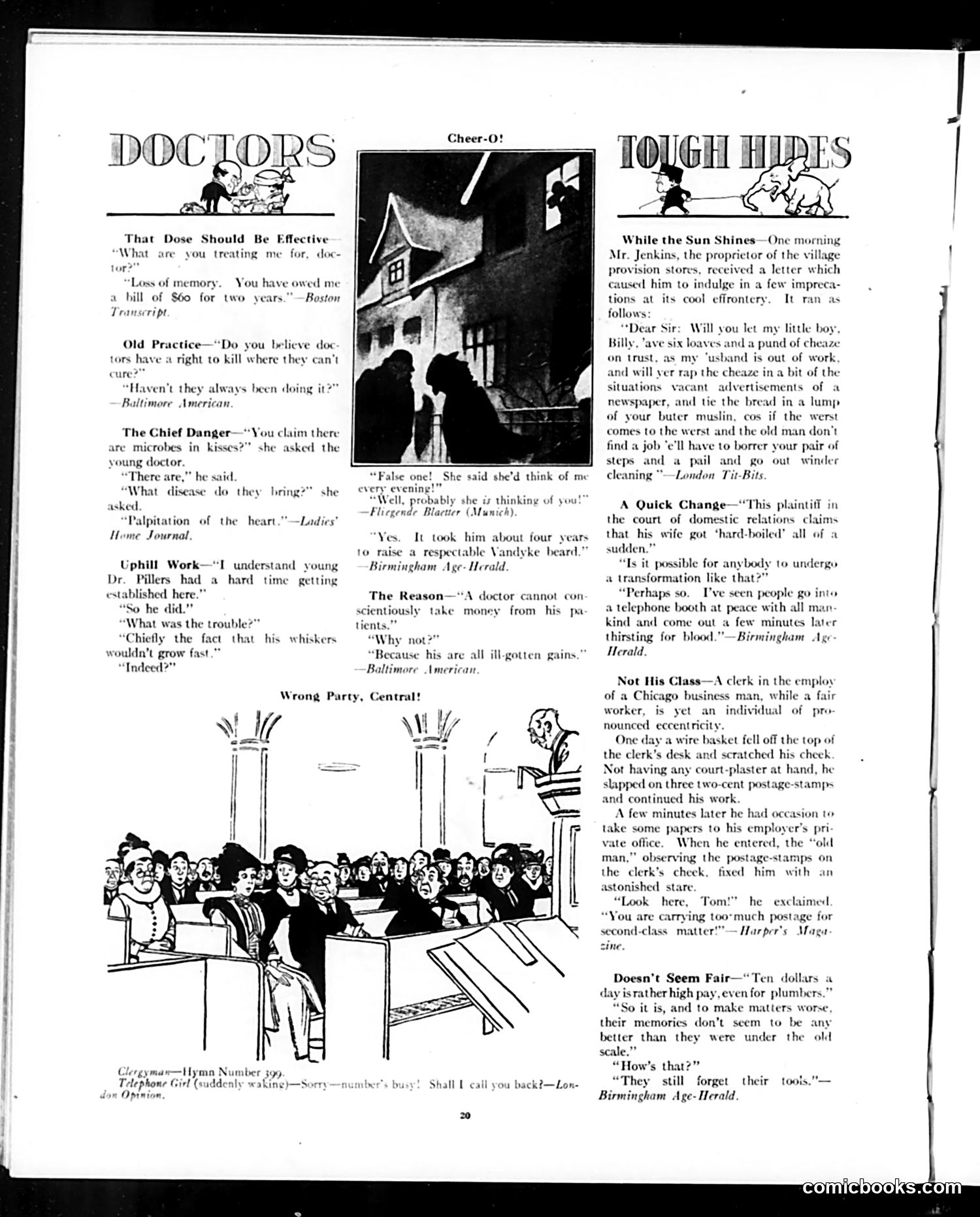
This page contains multiple short humorous pieces satirizing doctors, clergy, and working-class life in early 20th-century America. **The "Doctors" column** features brief jokes mocking medical practitioners: one about a doctor treating a patient's unpaid bill as "loss of memory," another questioning whether doctors kill patients they can't cure, and jokes about a young doctor unable to grow a respectable beard (needed for professional credibility then). **"Tough Hides"** presents anecdotes about ordinary people. "White the Sun Shines" mocks a poor family's shameless credit request to a grocer, written in exaggerated working-class dialect. "Not His Class" jokes about a Chicago clerk's eccentricity—using postage stamps as court-plaster on his cheek, prompting his boss's quip about "second-class matter." Another story ridicules plumbers for forgetting their tools despite high wages. **The cartoon** shows a courtroom packed with spectators, labeled "Wrong Party, Central!"—likely satirizing telephone operators' notorious tendency to connect callers to wrong numbers. The humor reflects period class attitudes, occupational stereotypes, and growing frustration with modern services.
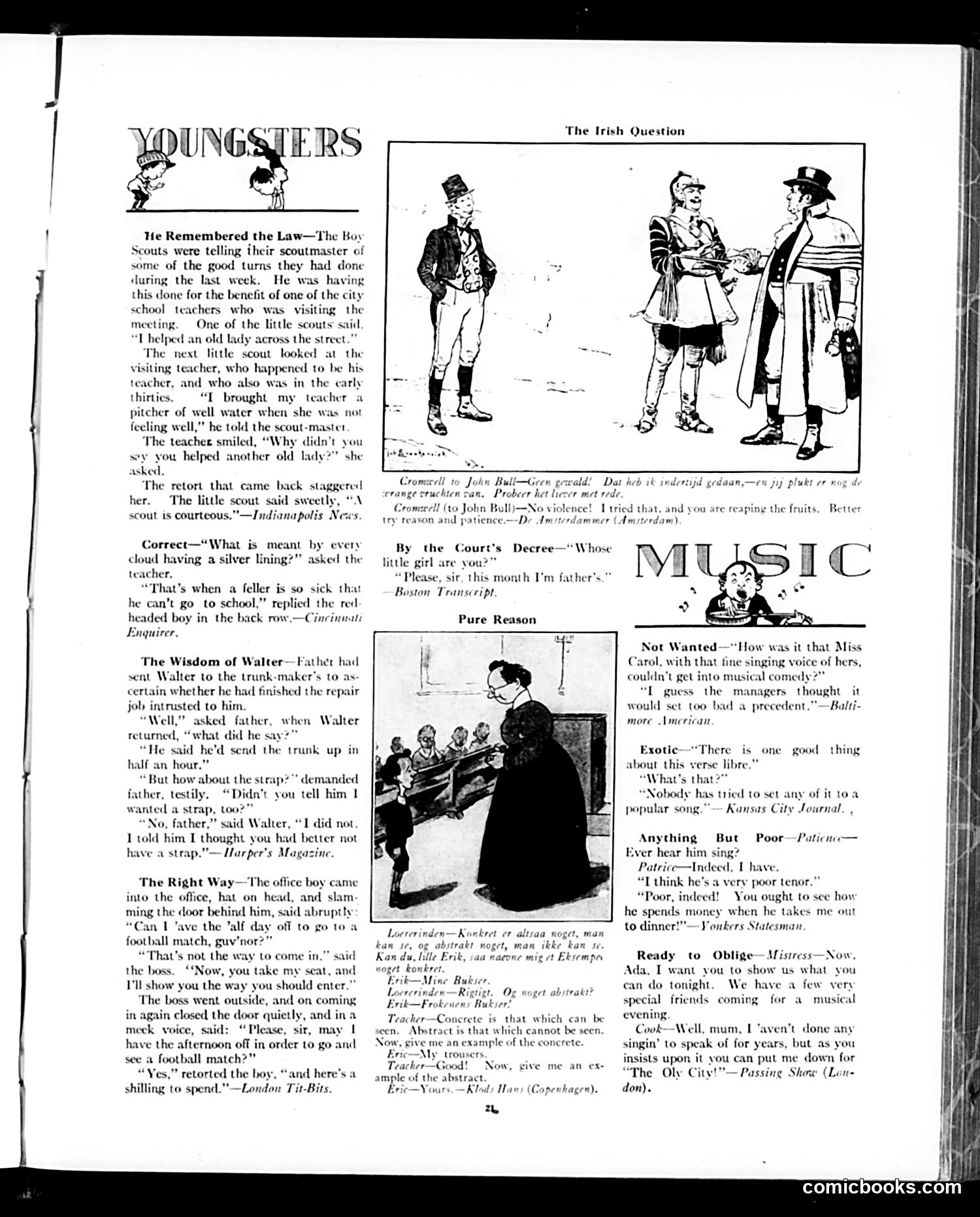
This page from Judge contains multiple satirical vignettes typical of early 20th-century American humor magazines. **"The Irish Question" cartoon** depicts what appears to be Irish and British figures in political discussion, likely referencing the ongoing Irish independence debate of that era. The specific dialogue is unclear from the OCR, but the title indicates commentary on Britain's fraught relationship with Ireland. **The remaining content** consists of short humorous anecdotes rather than political cartoons: - **Boy Scout joke**: A young scout tactfully insults his teacher by calling her "old," exploiting the phrase "a scout is courteous" - **School joke**: A student defines "silver lining" as missing school due to illness - **Various other brief jokes** about workplace etiquette, fathers and sons, and romantic miscommunication These pieces showcase Judge's formula: punchy one-liners and gentle social satire targeting workplace dynamics, class relationships, and gender interactions—reflecting middle-class American anxieties of the period rather than serious political critique.
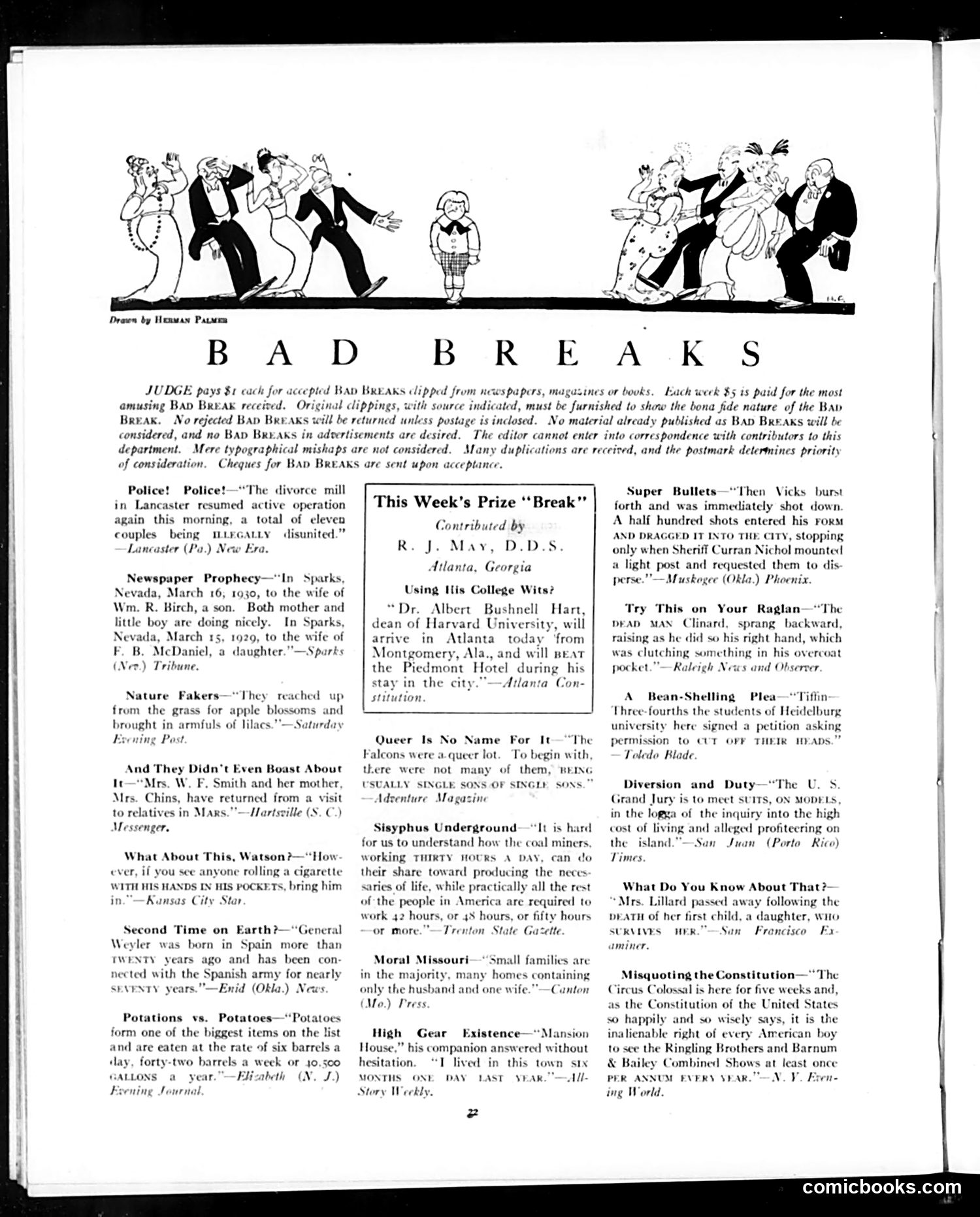
This page features "Bad Breaks"—Judge magazine's humorous column spotlighting absurd newspaper typos and logical errors. The cartoon at top (by Herman Palfrey) illustrates the concept: respectable adults flanking a confused child, suggesting how these printed mistakes create nonsensical situations. The column collects real clippings from newspapers with unintentional humor—contradictions like a prophecy dated one year in the future but referencing events from the past, or coal miners supposedly working "thirty hours a day." Other examples include geographic impossibilities ("Mars"), impossible timelines (someone connected to the Spanish army for 70 years despite being only 20+ years old), and grammatical absurdities (rolling cigarettes "with hands in pockets"). The weekly prize break came from an Atlanta dentist who noted Harvard's dean would "beat" (instead of "stay at") the Piedmont Hotel—a malapropism suggesting violence rather than lodging. This reflects early-20th-century American humor: mocking newspapers' carelessness while celebrating linguistic mistakes as entertainment.
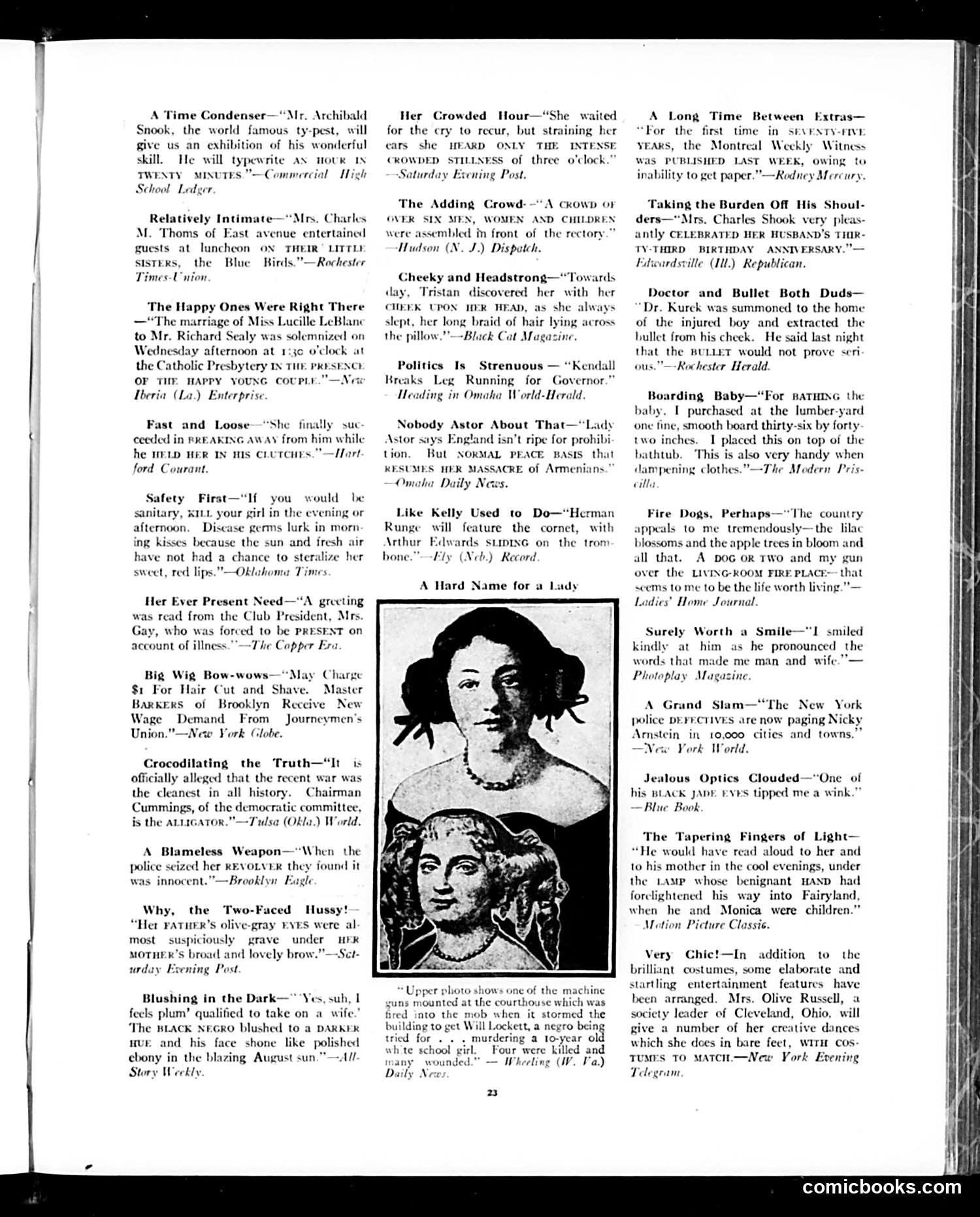
This page from *Judge* collects humorous newspaper printing errors and awkward phrasing—a recurring feature exposing journalistic absurdities to satirize the press itself. Notable examples include: "Kill your girl in the evening" (safety advice garbled); "The BLACK NEGRO blushed to a DARKER hue" (racist language highlighting editorial carelessness); and a woman with "her CHEEK UPON HER HEAD" (nonsensical anatomy). The centered photograph with caption "A Hard Name for a Lady" appears to mock an unfortunate surname, though specifics are unclear. The satire's point: newspapers' careless editing produces unintentionally offensive or absurd statements. By republishing these errors with bold capitalization marking the worst phrases, *Judge* ridicules both editorial incompetence and—in several cases—the casual racism and sexism embedded in contemporary journalism. The humor is partly about the newspapers' failure, partly about the problematic assumptions the errors reveal.
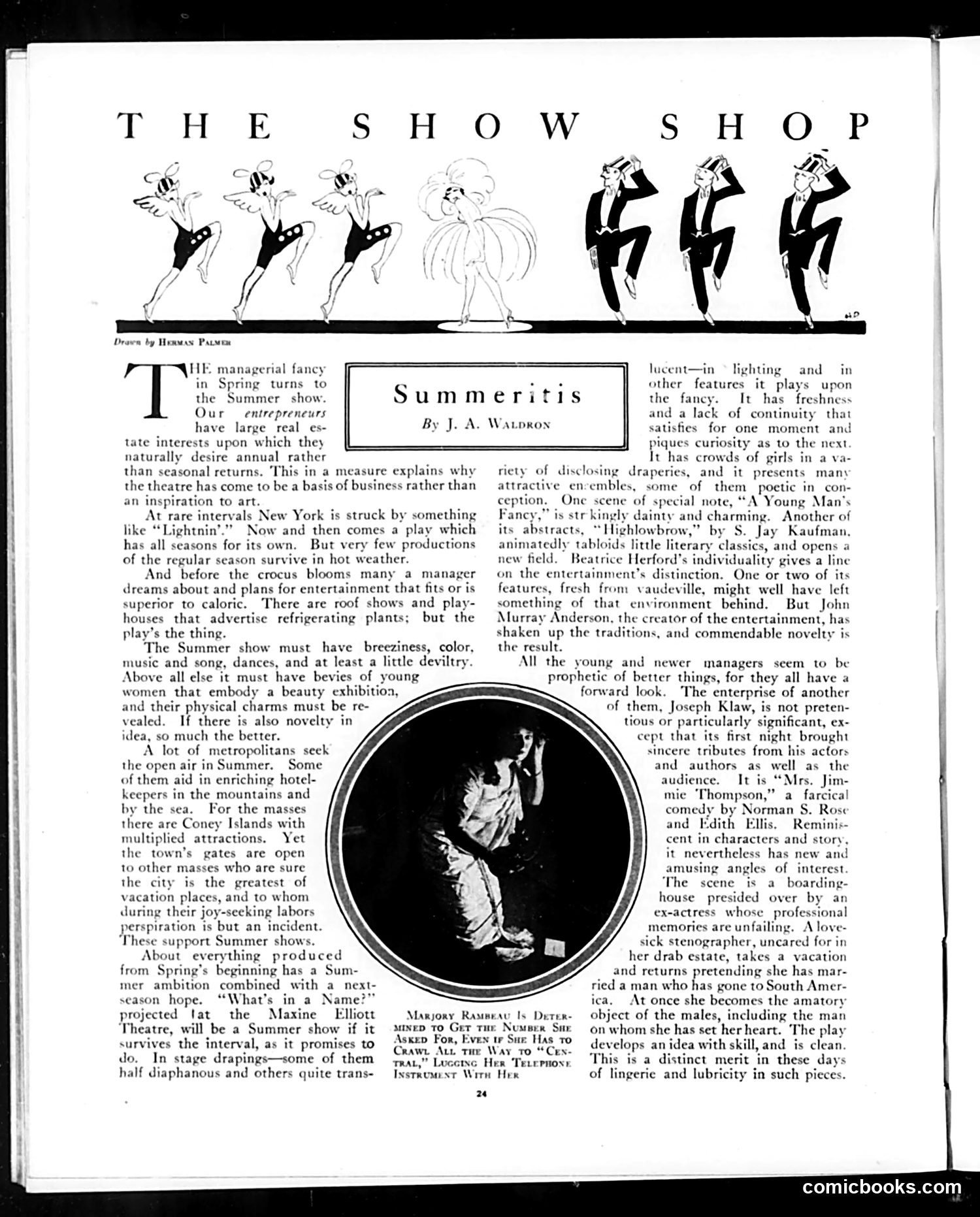
This page from *Judge* magazine features theater criticism by J.A. Waldron reviewing summer Broadway productions. The cartoon at top, drawn by Herman Paulos, satirizes the contrast between the "Summer show" aesthetic: dancers in skimpy costumes (left) versus formally-dressed male performers (right), illustrating the era's formula for seasonal entertainment. The text critiques how theater has become a commercial enterprise rather than an art form. Waldron argues that summer shows must feature "breeziness, color, music and song" and crucially, "bevies of young women" displaying physical beauty—not for artistic merit but because working-class audiences seeking vacation and relief from heat will pay to see them. He reviews specific productions like *Summeritis* and *Mrs. Jimmie Thompson*, praising their novelty while acknowledging they prioritize spectacle and young female performers over serious dramatic content. The satire highlights how theatrical economics, not artistic vision, drive what gets produced.
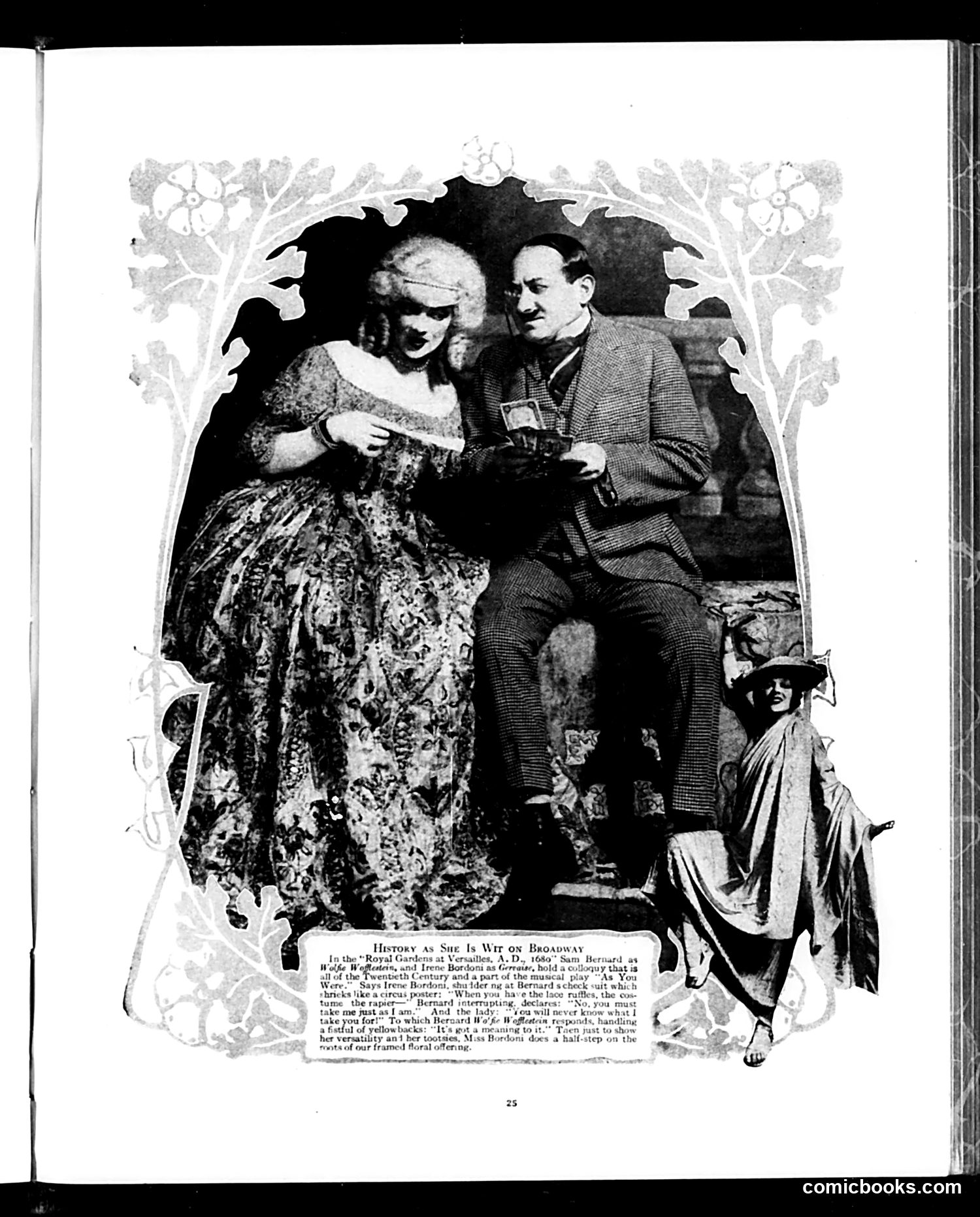
This page shows a theatrical scene set in "the Royal Gardens at Versailles, A.D. 1660." The caption indicates Sam Bernard (a male performer) plays a character named "Hocus," while Irene Bordoni portrays "Germaine." The satire appears to mock theatrical melodrama and romantic comedies of the era—specifically their absurd plots and exaggerated dialogue about love and deception. The ornate, decorative border treatment and classical setting suggest the magazine is parodying the pretentiousness of Broadway productions that borrowed heavily from European farce traditions. The joke seems to target both the theatrical conventions and perhaps the performers' abilities to deliver such overwrought material convincingly.
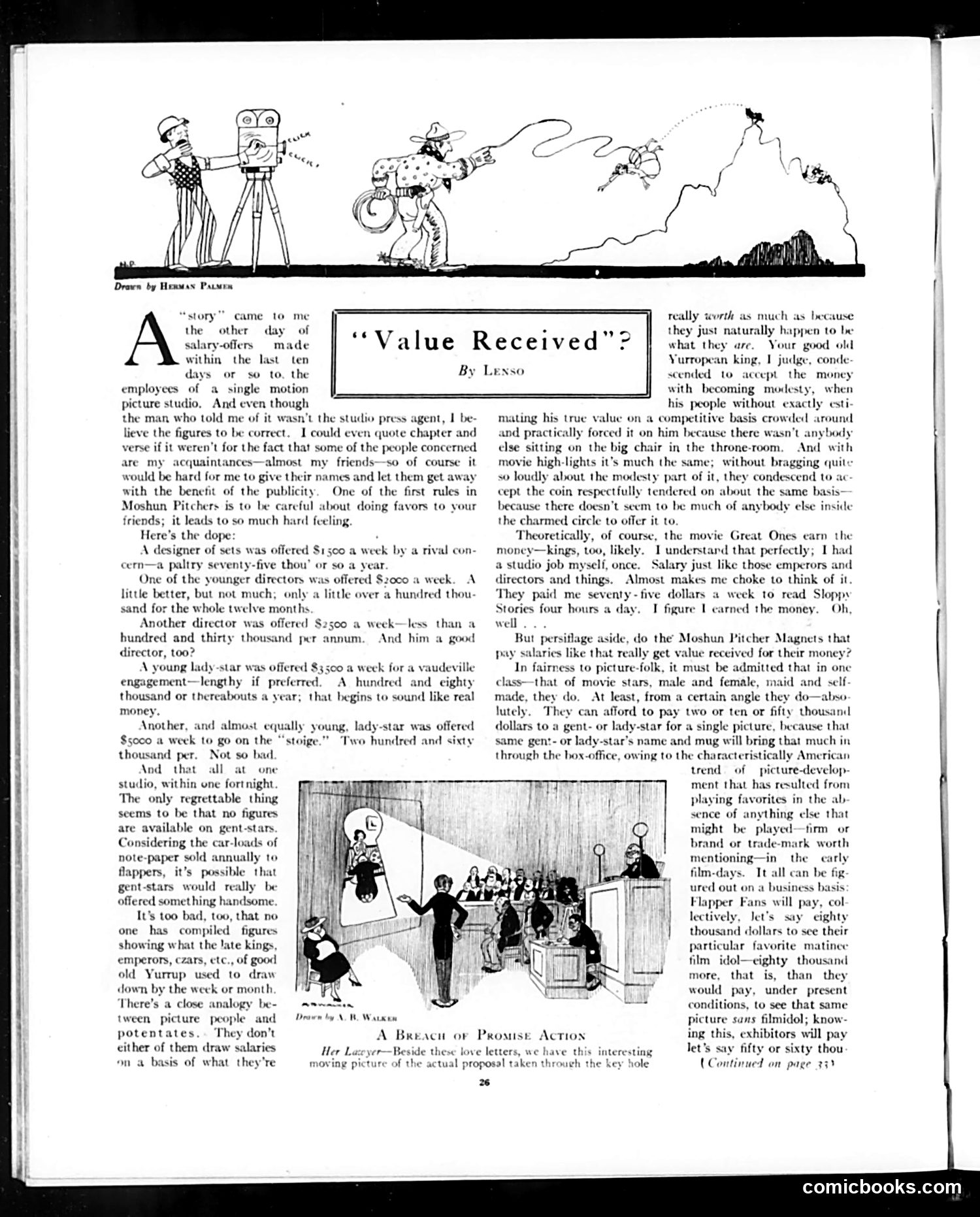
This article by Lenso satirizes Hollywood salary inflation in the silent film era. The author lists absurd weekly salaries offered to studio employees—$1,500 for a set designer, $2,000-$3,500 for directors and stars—then compares movie executives' spending to European monarchs who paid nobles simply because no one else could fill the role. The satire's central point: neither kings nor studio heads pay based on actual merit or competitive value. Both pay exorbitant sums because there's literally no alternative candidate available. The author notes he personally earned seventy-five dollars weekly reading pulp stories, which he considers overpayment—yet studios hand out thousands regardless. The accompanying cartoon depicts a film producer using a lasso to rope in talent, visualizing how studios "capture" employees. The satire mocks both Hollywood's wasteful spending habits and the arbitrary nature of entertainment industry compensation during the 1920s film boom.
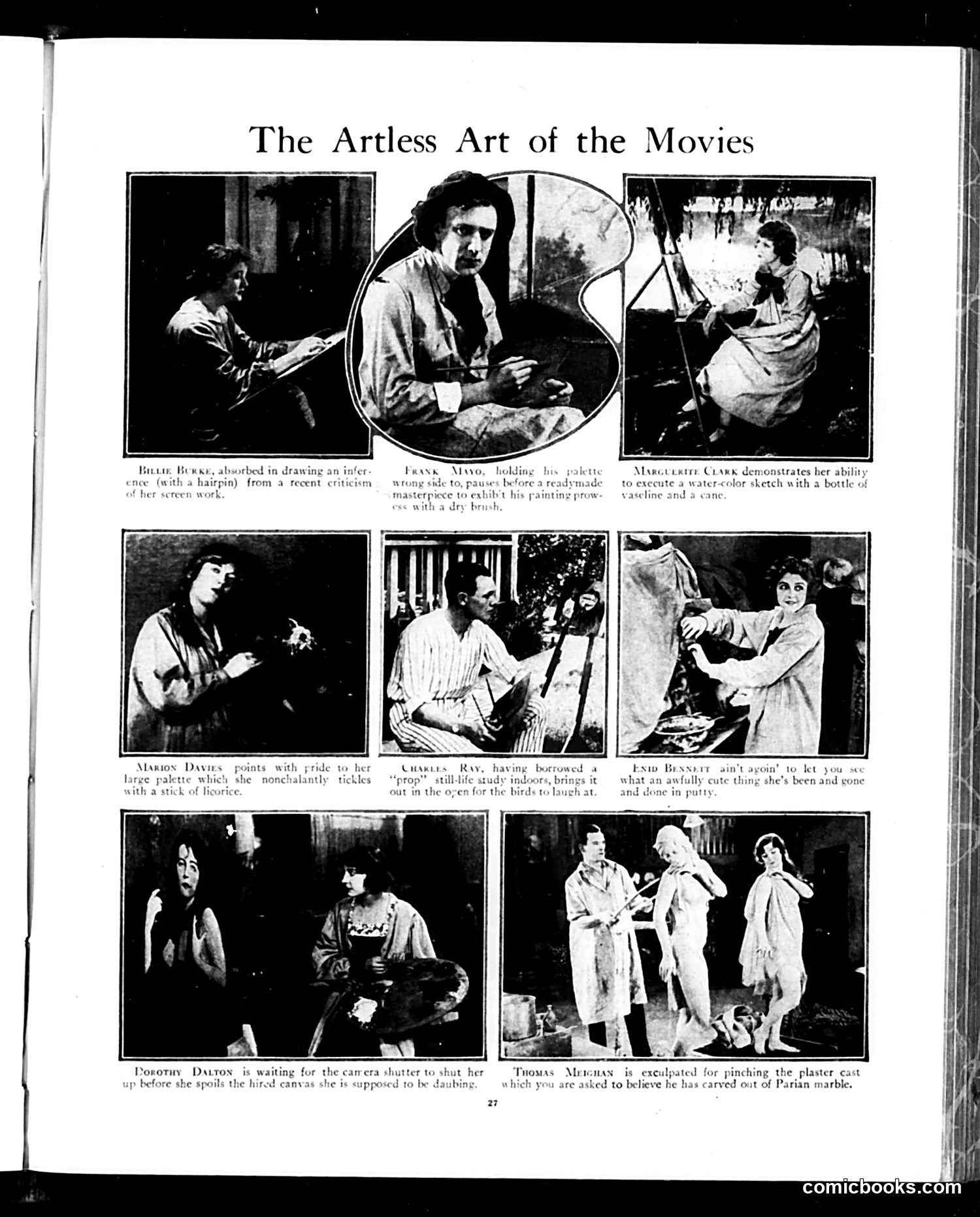
This page satirizes early cinema's pretensions to high art. The title mockingly suggests movies lack genuine artistry, and the photos show film actors awkwardly attempting to demonstrate "artistic" skills—painting, sculpting, and drawing—for the camera. The captions highlight the absurdity: actors pause mid-performance to exhibit fake artistic credentials (holding palettes "wrong," borrowing studio props, pretending to carve plaster as marble). The satire targets both Hollywood's social climbing (wanting to appear cultured) and cinema's artificiality generally—audiences are asked to believe transparent fabrications presented as authentic artistry. This reflects 1920s cultural tensions: movies were still considered low entertainment by elites, and the industry fought this perception through elaborate fakery. Judge's satire exposes this desperation as precisely the opposite of genuine artistic credibility.
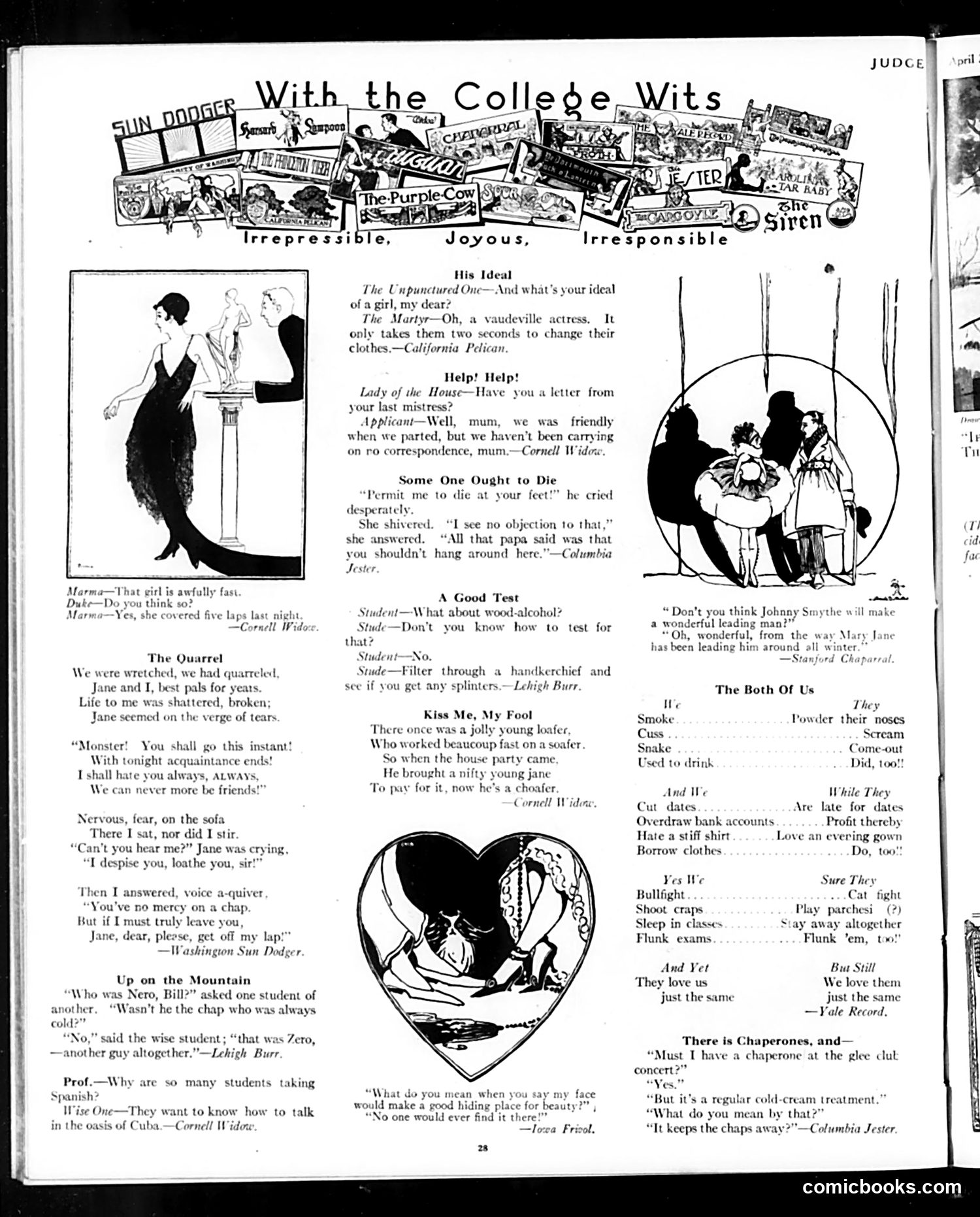
This is a humor compilation page from Judge magazine featuring college-themed jokes and satirical quips, likely from the 1910s-1920s based on the style. The content mocks college students and dating conventions of the era: **Key themes:** - Young men pursuing women with dramatic (and rejected) romantic gestures - College girls' changing social behavior—smoking, staying out late, "fast" conduct - Domestic servants being interviewed for employment with questionable references - Student pranks and foolish behavior (testing wood alcohol, etc.) - Dating complications and the emerging freedom of young women **The satire targets:** - Theatrical romantic pretension ("Permit me to die at your feet") - Hypocrisy between genders (what young men and women claim to do versus what they actually do) - Generational anxiety about modern youth breaking social rules The cartoons and jokes are sourced from college humor publications (Cornell Widow, Columbia Jester, etc.), representing a popular early 20th-century format: colleges had their own satirical magazines that Judge republished. The humor reflects period anxieties about changing courtship norms and youth independence.
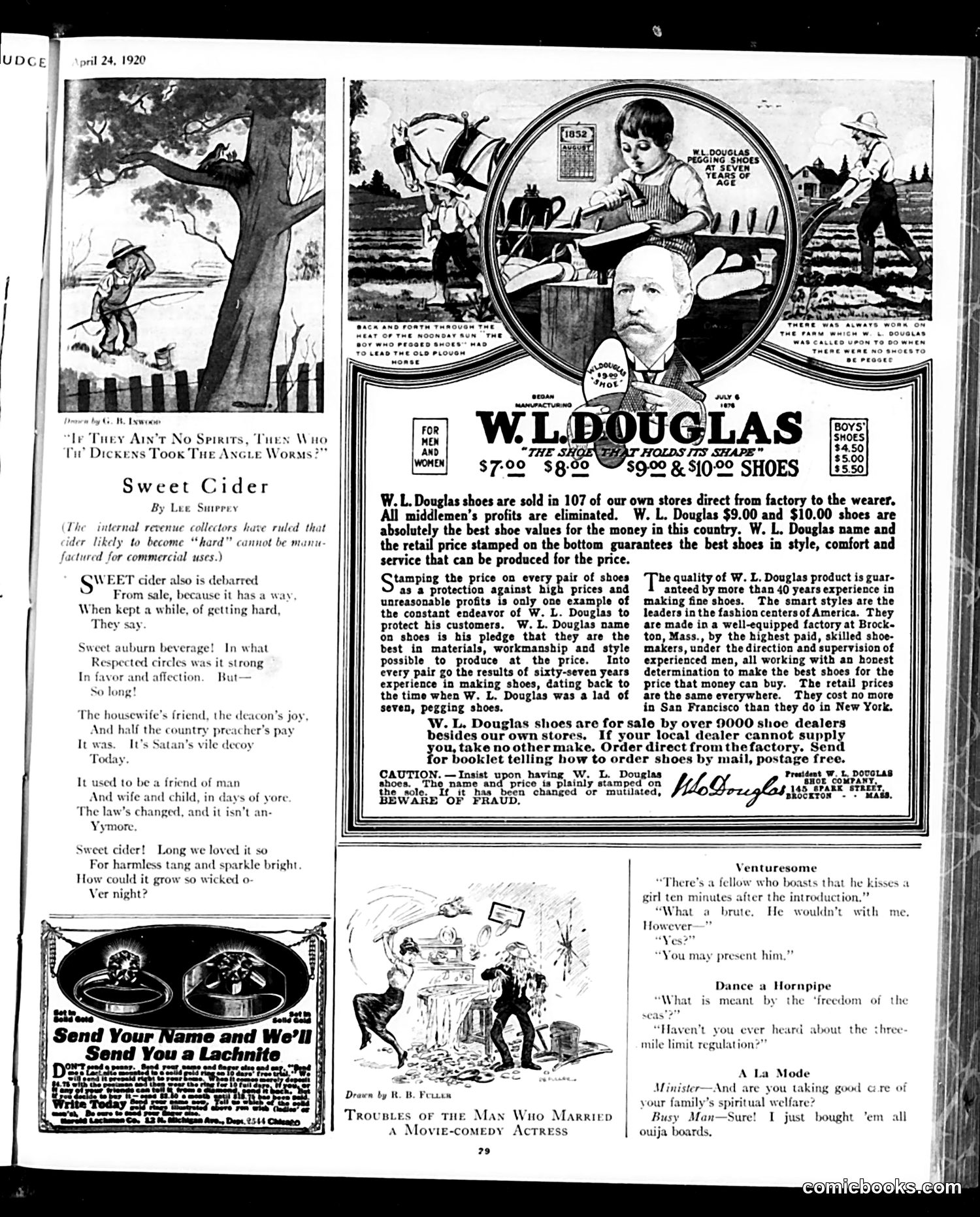
This page contains primarily **advertising and light humor** rather than political satire. The dominant content is a W.L. Douglas shoe advertisement emphasizing direct factory-to-consumer sales and anti-profiteering claims. The editorial content consists of: 1. **"Sweet Cider" (poem by Lee Surrey)**: A satirical lament about Prohibition enforcement. The Internal Revenue Service ruled that sweet cider—which naturally ferments into alcohol—cannot be legally manufactured. The poem mourns the loss of this once-acceptable beverage, now classified alongside "hard" (alcoholic) cider as contraband. This reflects the early Prohibition era's (1920) strict enforcement even against incidental fermentation. 2. **Brief comic exchanges** (bottom right): Short jokes about kissing etiquette, maritime law, and spiritual welfare—typical Judge magazine filler humor with no deeper political meaning. The page reflects 1920 America: Prohibition's recent passage (January 1920) and the culture clash it created around previously legal products.
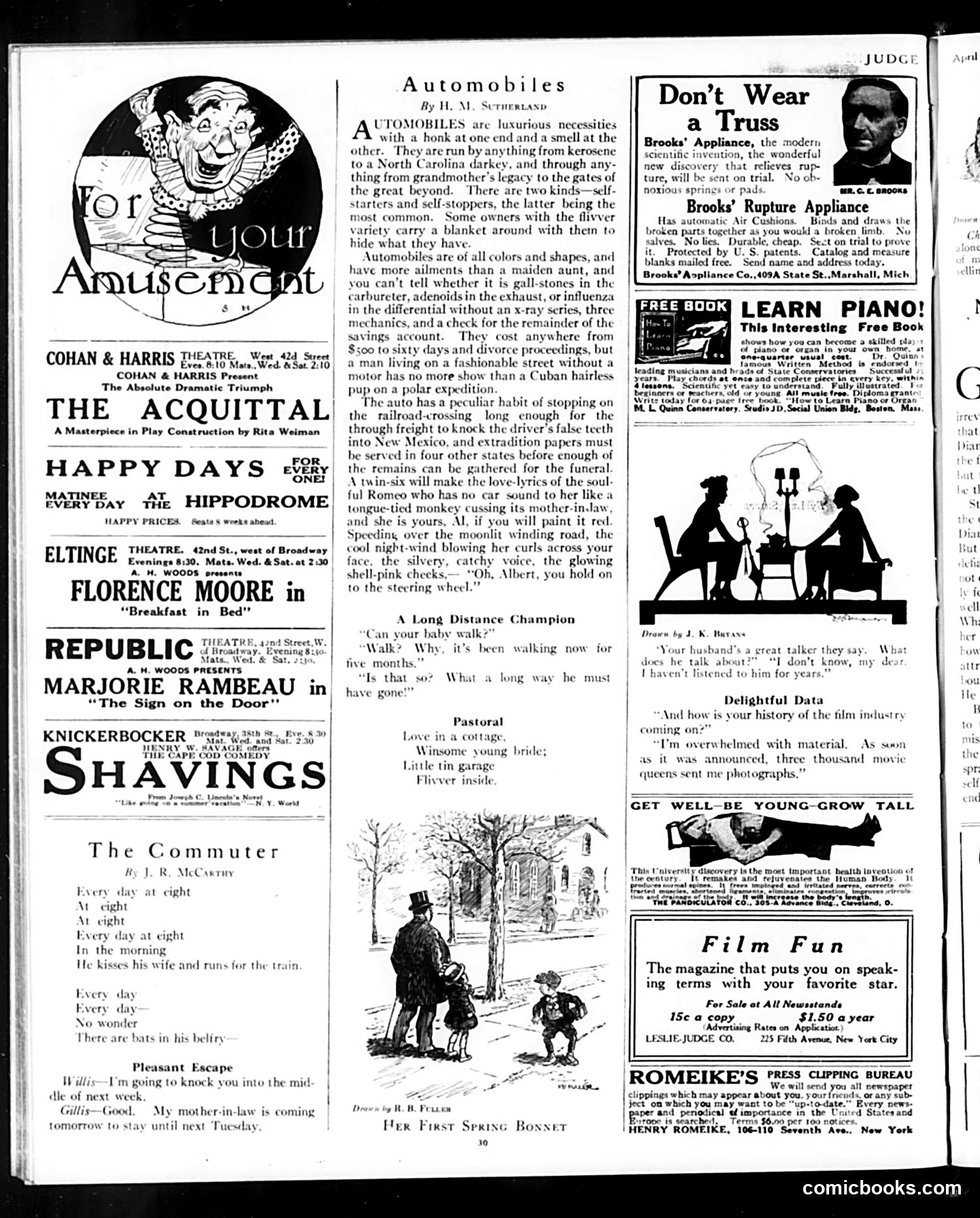
This page is primarily **advertising and theater listings** with minimal editorial content. The notable satirical pieces are brief: **"Automobiles" by H.M. Sutherland**: A humorous essay mocking the automobile as a luxury "necessity" prone to breaking down. It satirizes both the expense and unreliability of early cars, and darkly jokes about fatal railroad crossing accidents. The tone suggests cars were still novelties causing both social anxiety (needing one to be respectable) and actual danger. **"The Commuter" poem**: Light satire on the repetitive, exhausting daily routine of working men commuting by train—"every day at eight...no wonder there are bats in his belly." **"Pleasant Escape" joke**: A brief gag about welcoming a mother-in-law's visit as preferable to the commuter's grind. The page is overwhelmingly dominated by **theater advertisements** (Cohan & Harris, Hippodrome, etc.) and **patent medicine ads** (Brooks' Rupture Appliance, Learn Piano), typical of Judge's era revenue model.
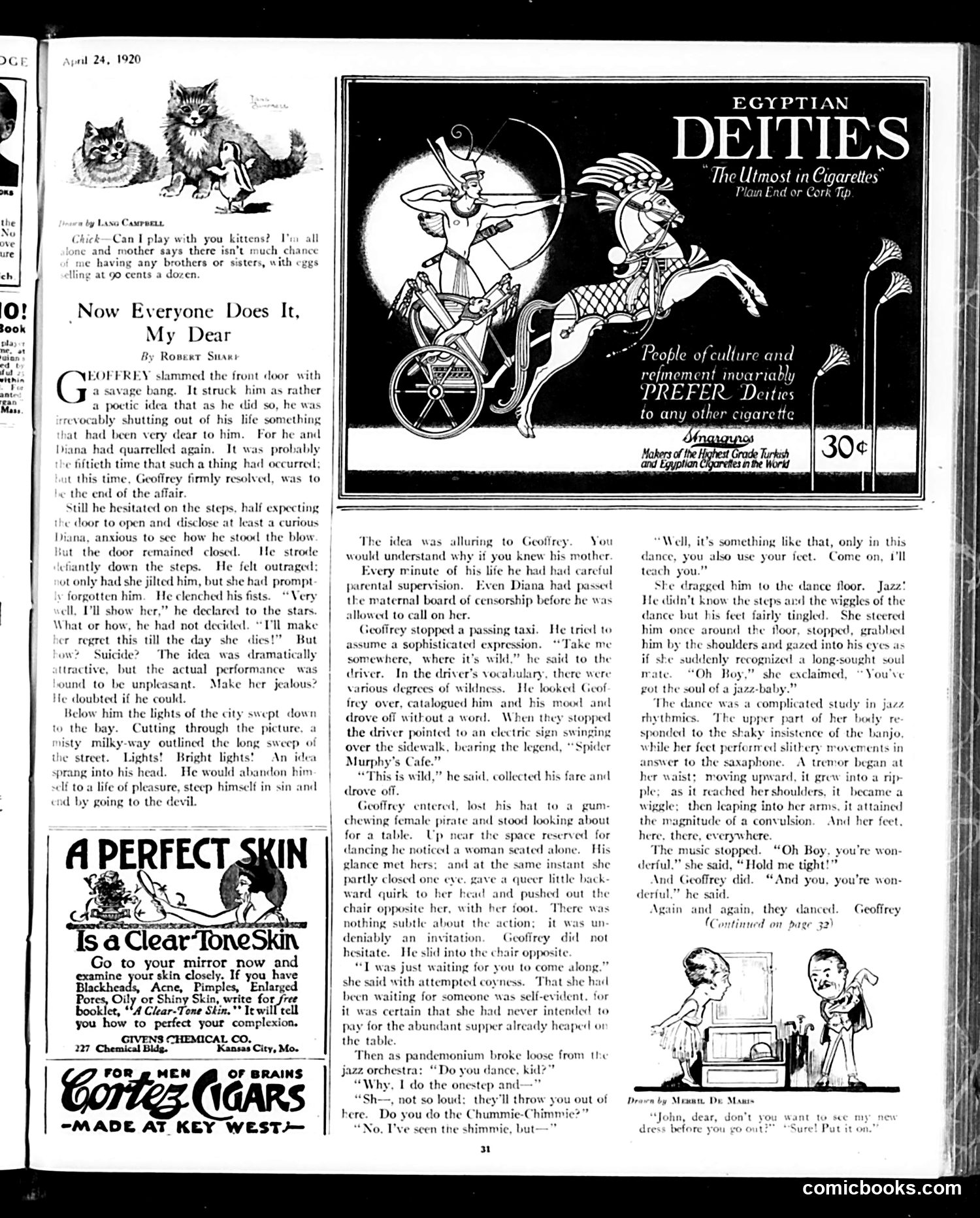
This page contains a serialized short story ("Now Everyone Does It, My Dear" by Robert Shain) about a young man named Geoffrey who quarrels with his girlfriend Diana and impulsively decides to "go to the devil" by visiting a jazz nightclub called Spider Murphy's Cafe. The story satirizes post-WWI youth culture and the "New Woman" of the 1920s. Geoffrey's rebellion against his overprotective mother and conventional courtship is portrayed as laughably tame—his idea of wild debauchery is a mere visit to a jazz club, where he's immediately propositioned by an unsubtle woman at a table. The humor lies in Geoffrey's naiveté and the contrast between his dramatic resolve to shock society and the mundane reality of what passes for "wickedness" in the era. The accompanying advertisements (skin cream, cigars) and cartoon sketch of kittens are typical Judge filler content. The Egyptian Deities cigarette ad uses orientalist imagery common to 1920s marketing.
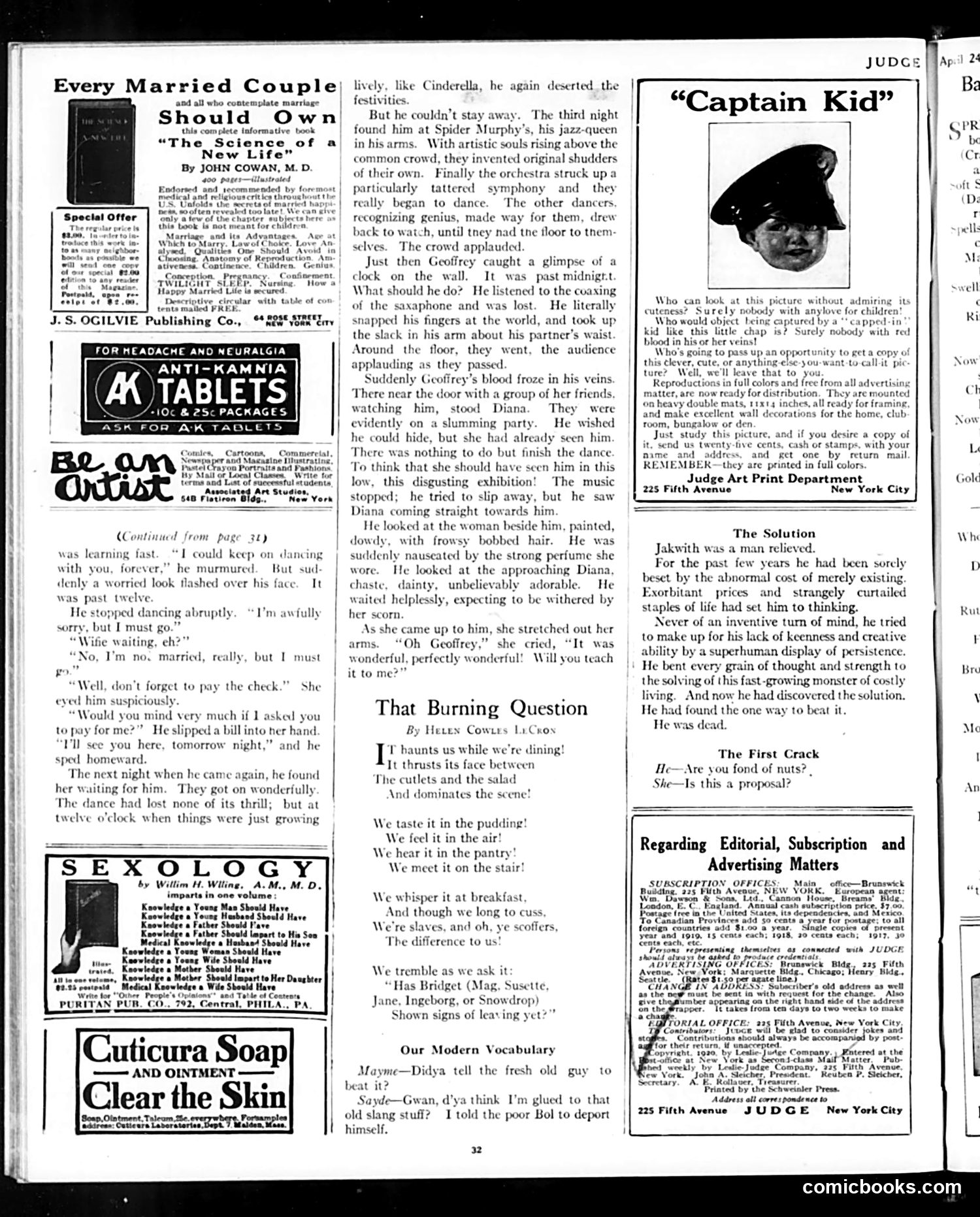
This page from *Judge* magazine contains a morality tale about a man named Geoffrey caught between two women. The narrative criticizes modern jazz-age behavior: Geoffrey, engaged to the respectable Diana, frequents dance halls with a painted, "dowdy" woman—described as "low" and "disgusting." When Diana discovers him in this "exhibition," the story expects her condemnation. Instead, she asks him to teach her the dance, subverting expectations. The satire targets early 1920s social anxieties about jazz culture, "flappers," and loosening moral standards. Geoffrey's secret life and the woman's appearance (bobbed hair, heavy makeup) represent the perceived degradation of modern youth. The twist ending—Diana's enthusiasm rather than outrage—likely mocks both hypocritical moralism and the inevitability of changing social norms, suggesting even "chaste" women are drawn to jazz-age excitement.
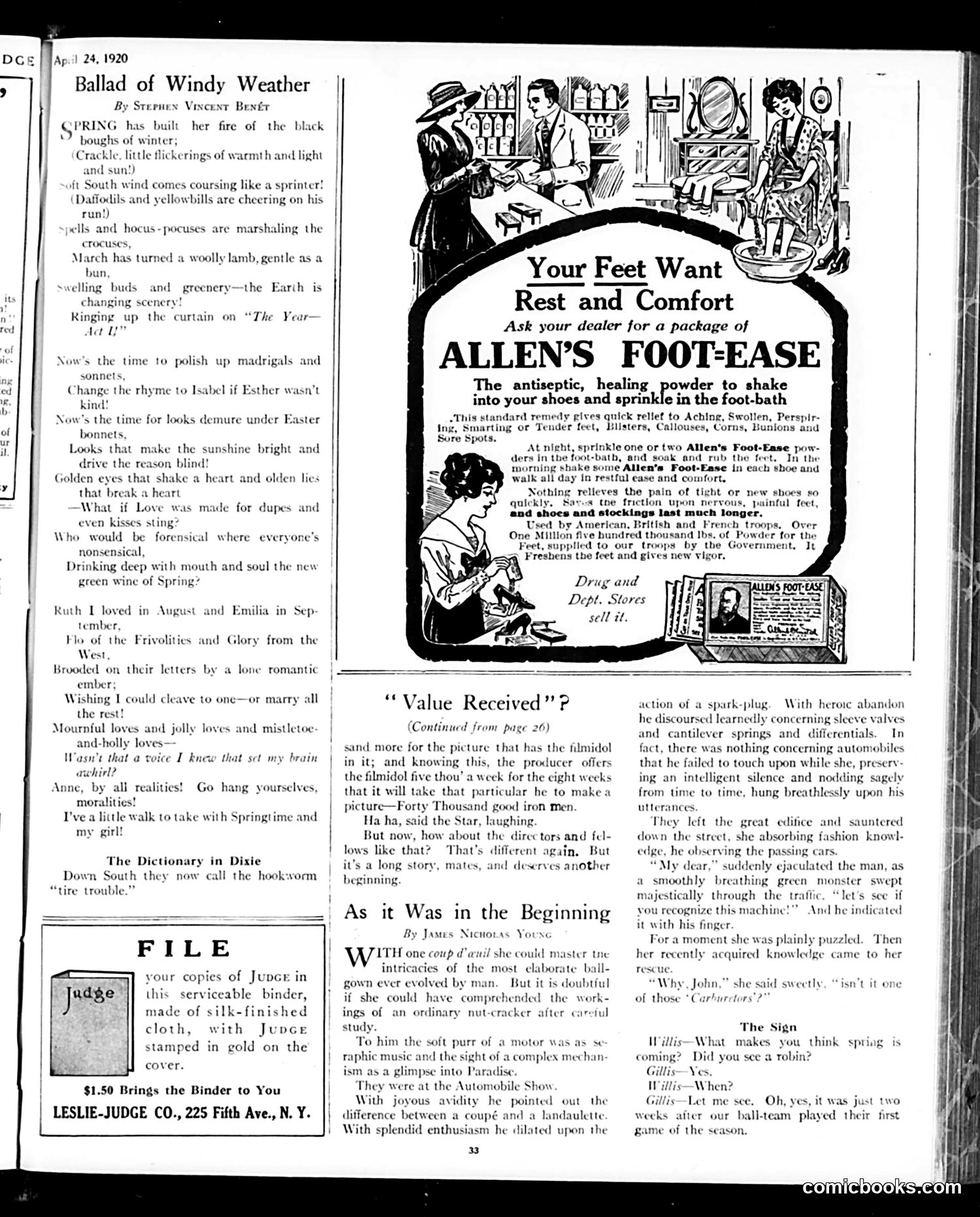
This page combines poetry, advertising, and short fiction typical of Judge's satirical weekly format. **Main Content:** - **"Ballad of Windy Weather"** by Vincent Benet: A lighthearted spring poem celebrating romance and youthful flirtation. The speaker romantically recalls past loves (Ruth, Emilia, Flo, Glory, Anne) while anticipating a walk with his current springtime companion—humorous for its fickle, serial romanticism. - **"The Dictionary in Dixie"**: A brief joke mocking Southern dialectal speech, calling a hookworm infection "tire trouble"—likely commentary on regional ignorance or rural hardship. - **Allen's Foot-Ease Advertisement**: A full-page ad promoting antifungal foot powder, with celebrity endorsement claims (used by American/British/French troops). - **"Value Received" and "As it Was in the Beginning"**: Short fiction stories continuing from previous pages. The page reflects 1920s consumer culture, romantic sentimentality, and regional humor typical of Judge's audience.
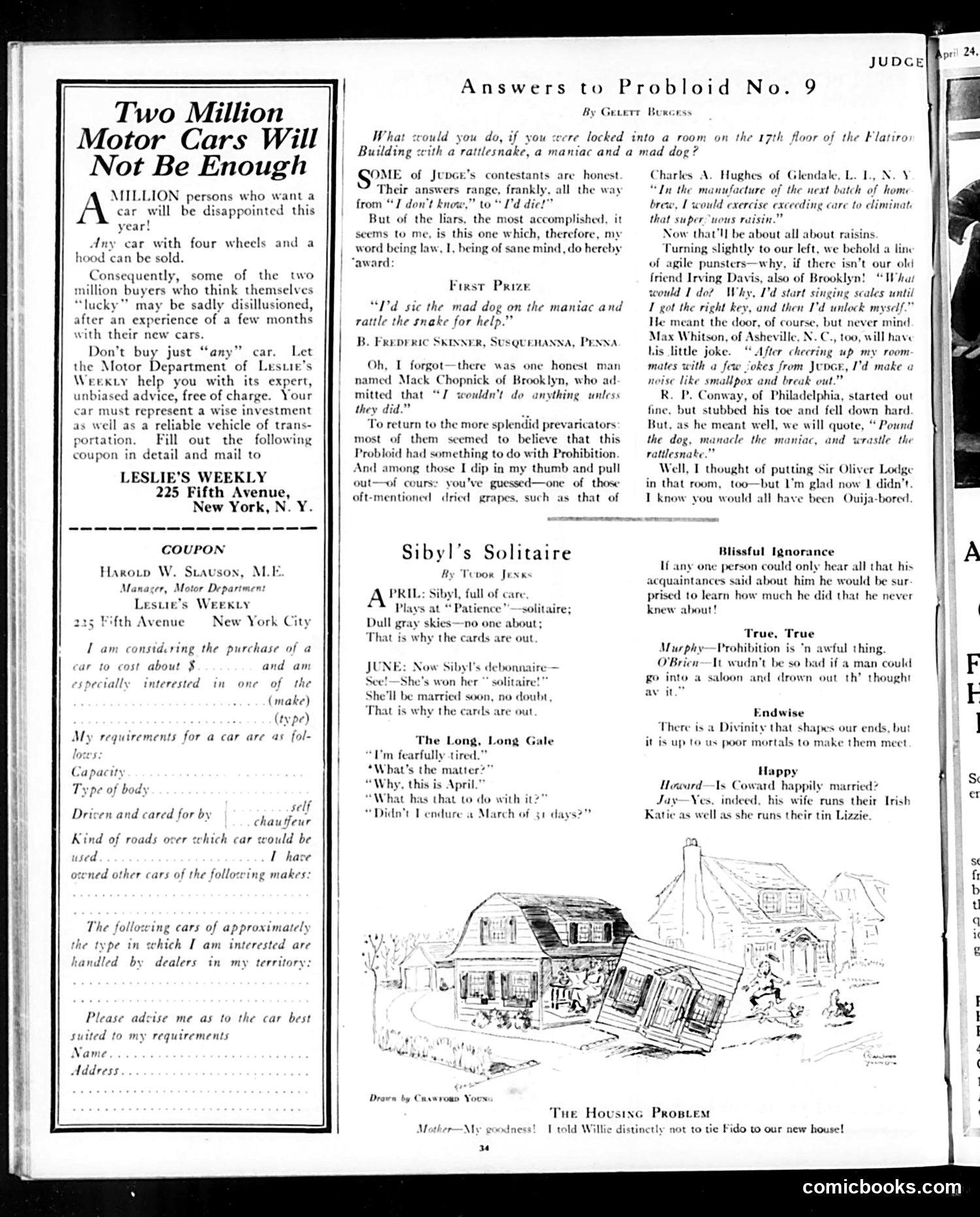
This page from *Judge* magazine contains several satirical pieces reflecting 1920s concerns: **"Two Million Motor Cars"** is an advertisement disguised as editorial content, targeting aspirational car buyers. The satire suggests that Americans will buy any automobile simply because cars are scarce and desirable—even unreliable ones. **"Answers to Probloid No. 9"** is a humor contest where readers solve an absurd hypothetical (trapped in a room with a rattlesnake, maniac, and mad dog). Judge publishes the cleverest answers. The winning entry plays on the incongruity of asking a dog for help. References to "dried grapes" and "home brew" mock Prohibition-era alcohol, suggesting some contestants bizarrely connected the puzzle to bootlegging. **"Sibyl's Solitaire"** and **"The Long, Long Gale"** are light verse pieces about everyday frustrations—card games and seasonal fatigue. The page reflects 1920s consumer culture, Prohibition humor, and the magazine's format mixing advertisements, humor contests, and light satirical poetry.
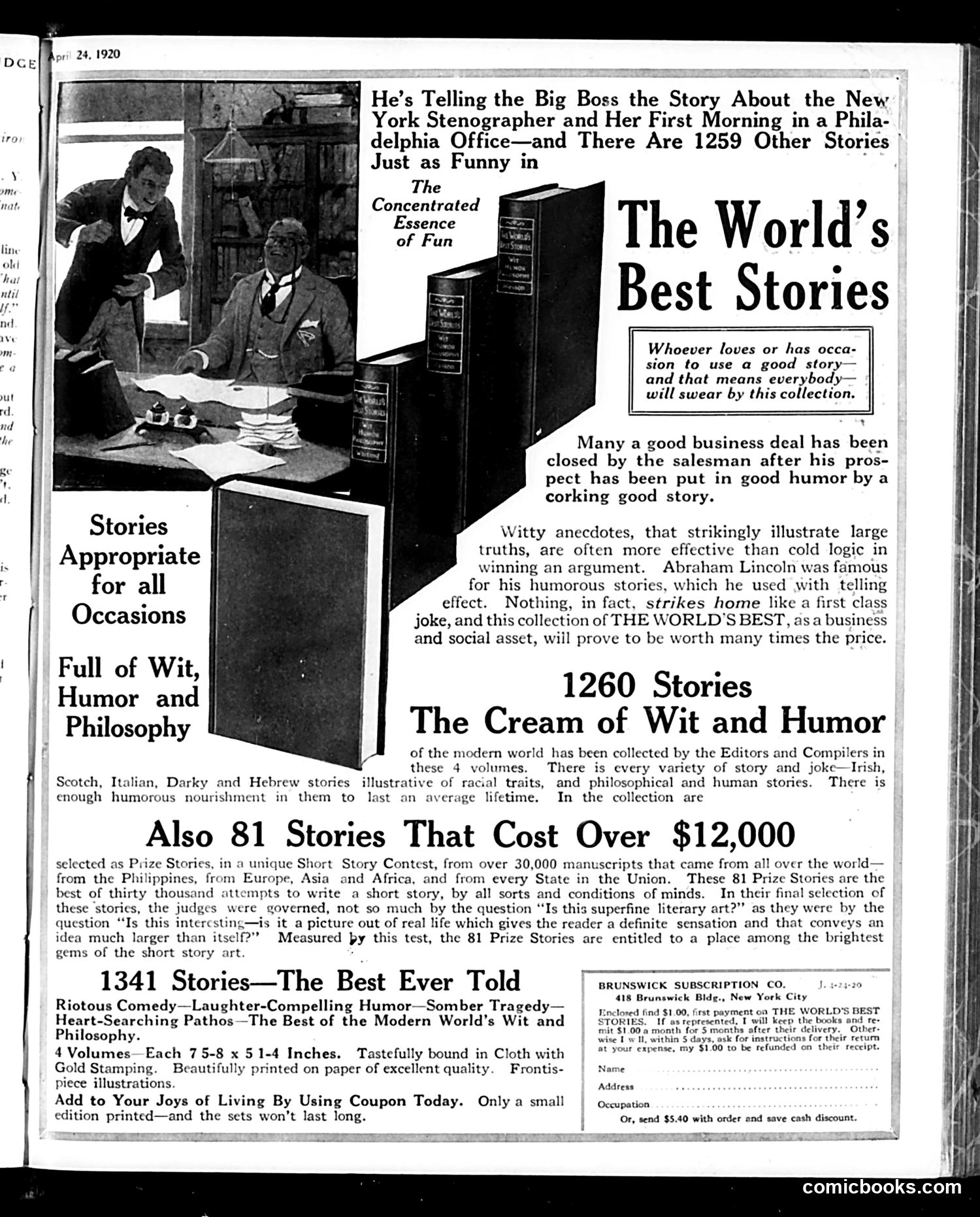
This page is primarily a commercial advertisement for a four-volume story collection, not political satire. The small illustration at top left shows a businessman telling an anecdote to his boss—a visual reference to the advertisement's central sales pitch: that well-told stories are valuable business tools for closing deals and winning arguments. The text emphasizes the collection's practical utility, invoking Abraham Lincoln's famous use of humorous anecdotes as persuasive rhetoric. The ad explicitly lists story categories including "Irish, Scotch, Italian, Darky and Hebrew stories"—period terminology reflecting early 20th-century ethnic humor stereotypes that were then considered entertainment staples. The 1,341 stories promised represent "riotous comedy" through "somber tragedy," marketed as nourishment "to last an average lifetime." The subscription offer costs $1 initially, then $1 monthly installments.
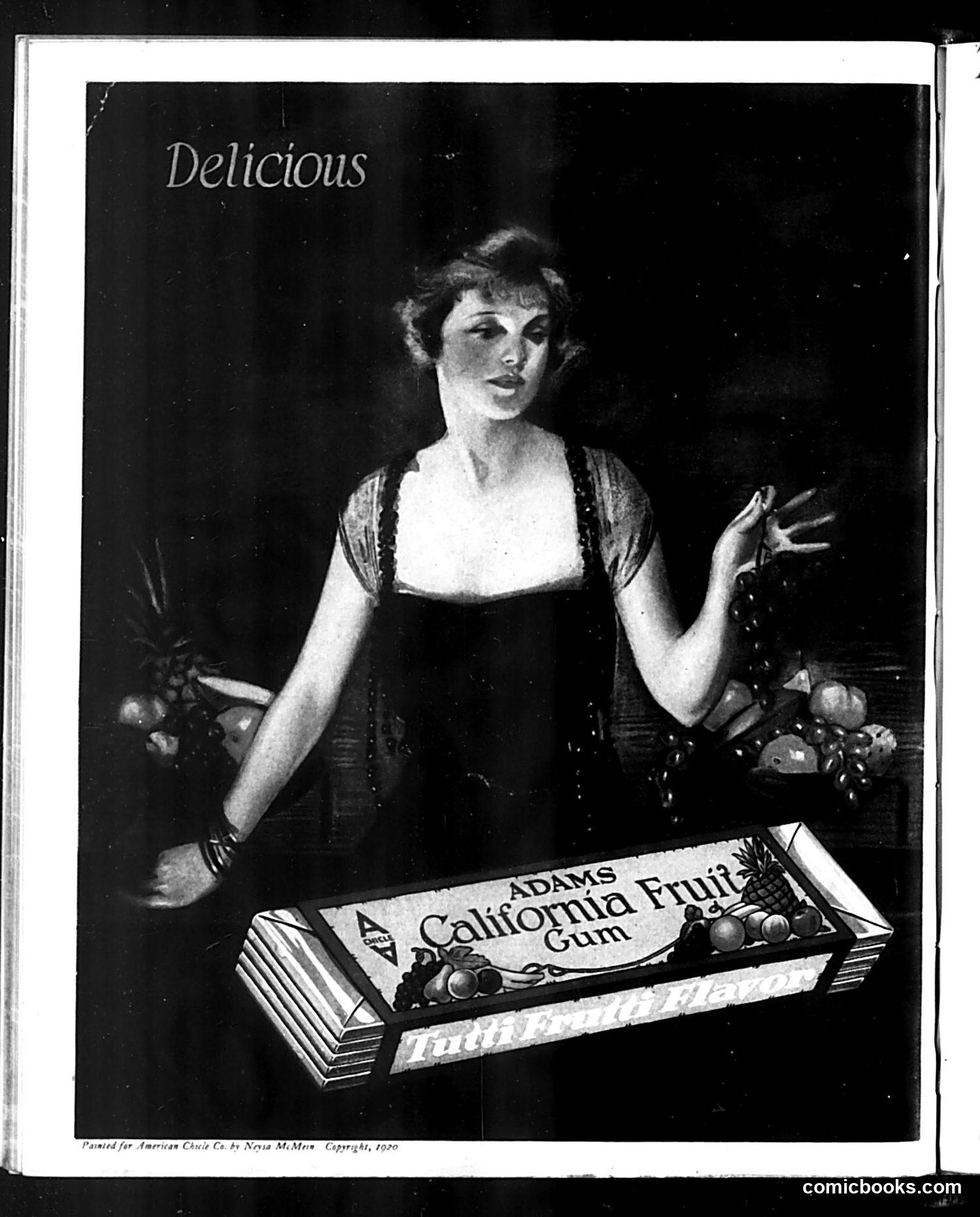
This appears to be an **advertisement rather than editorial content**. The page shows a woman in classical dress presenting an "Adams California Fruit Gum" product box. The word "Delicious" at top suggests this is a product endorsement. The image uses classical or theatrical styling—the woman's pose and costume suggest artistic refinement—to market chewing gum. This was typical early 20th-century advertising strategy: associating consumer products with elegance, culture, and aspirational lifestyle. The copyright line indicates this was "Painted for American Chicle Co. by Nona M.Moe, Copyright, 1926," confirming it's a commercial advertisement, not satire or political commentary. Judge magazine, while primarily satirical, carried advertisements like this to fund publication.