
A complete issue · 44 pages · 1920
Judge — February 14, 1920
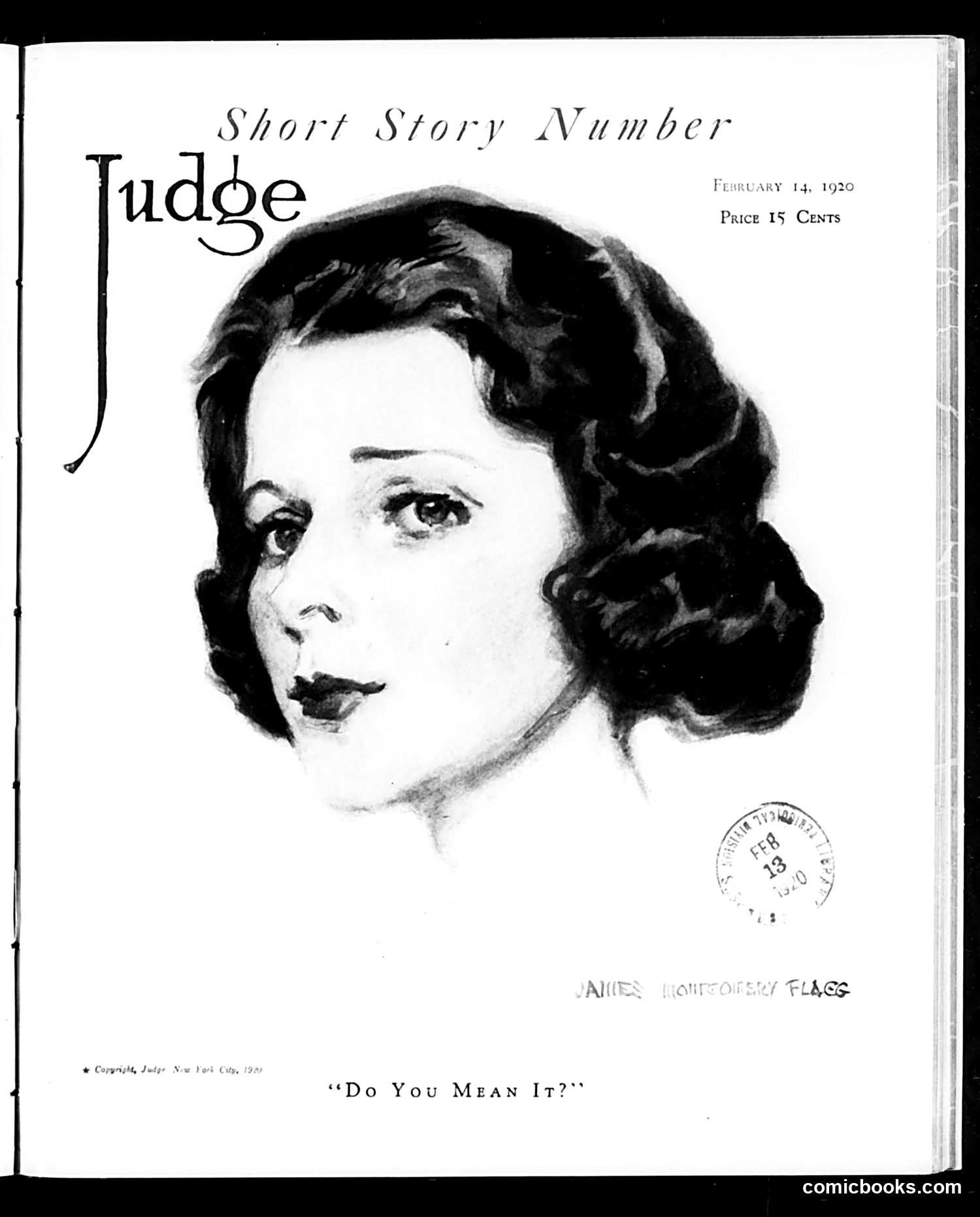
This cover features a portrait illustration of a woman with 1920s styling (bobbed hair, defined makeup) accompanying the headline "Do You Mean It?" The illustration appears to be James Montgomery Flagg's work, a prominent commercial artist of the era. The phrase "Do You Mean It?" suggests romantic or relationship humor typical of Valentine's Day content (the issue date is February 14). Without additional interior text visible, the specific satire is unclear. However, given Judge's focus on political and social commentary, this likely comments on contemporary women's roles, dating customs, or social attitudes of the Jazz Age era. The ambiguous question could reference women's changing social positions or romantic expectations in 1920s America.
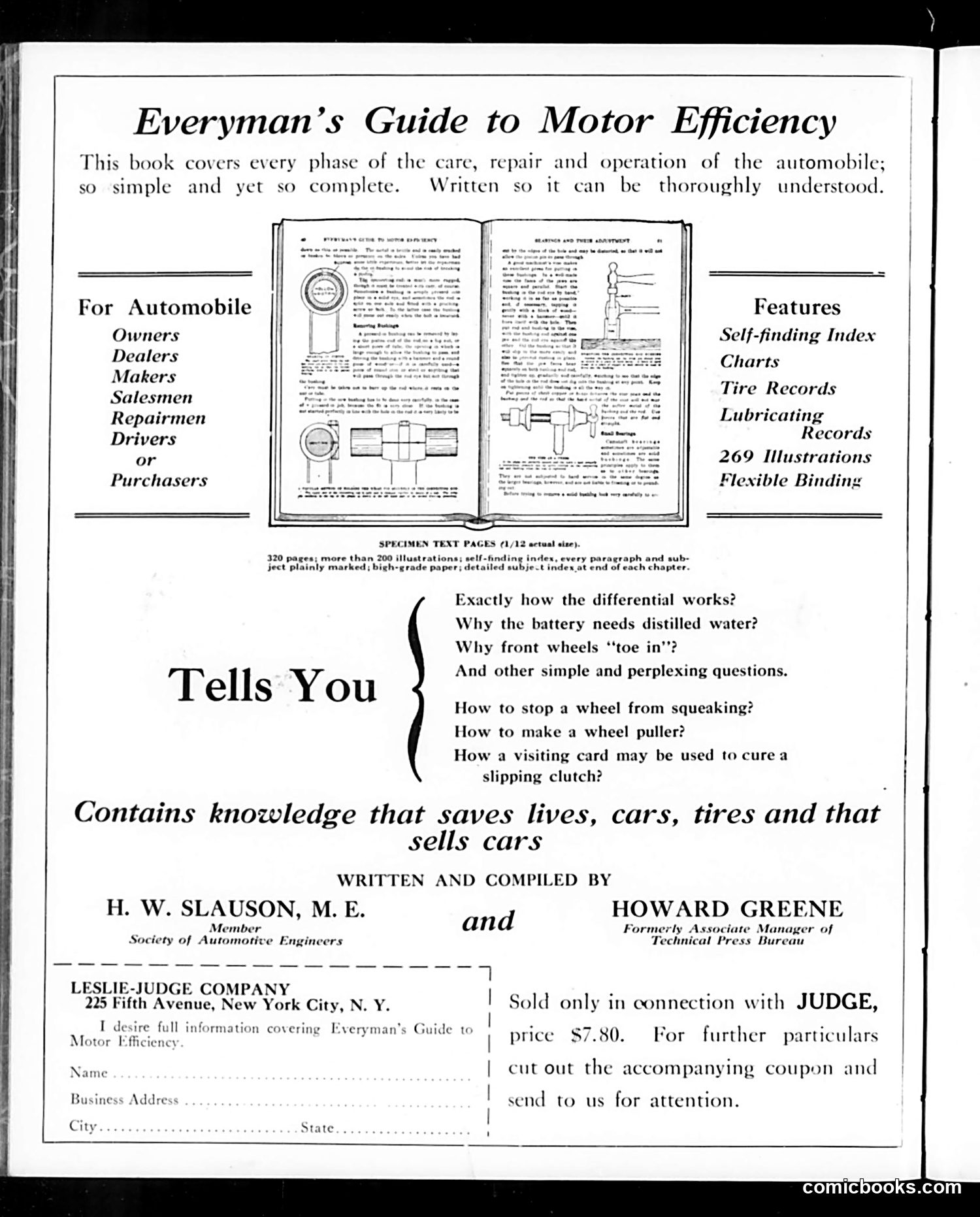
This page is **primarily an advertisement**, not political satire or a cartoon. It promotes "Everyman's Guide to Motor Efficiency," a technical manual about automobiles published by Leslie-Judge Company in New York. The ad targets multiple audiences—car owners, dealers, salesmen, and mechanics—emphasizing practical automotive knowledge. It highlights features like 269 illustrations, charts for tire and lubrication records, and explanations of mechanical concepts (differentials, batteries, wheel alignment). The copy promises to answer practical questions: how to fix squeaking wheels, make a wheel puller, or repair a slipping clutch. The final tagline claims this knowledge "saves lives, cars, tires and that sells cars"—positioning automotive competence as both a safety and commercial benefit. No political message or satire is evident on this page.
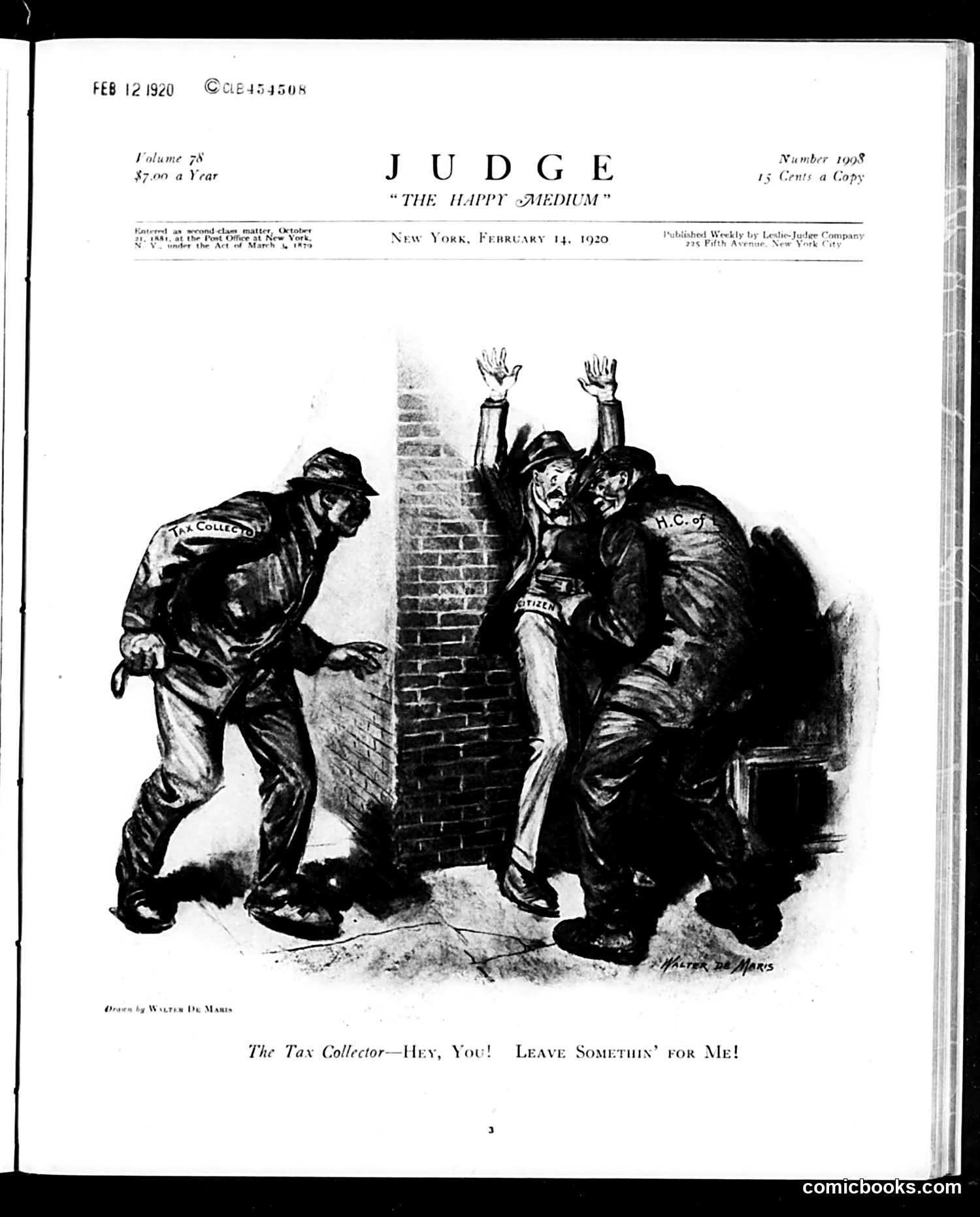
This 1920 cartoon satirizes post-World War I tax collection. The figure on the left labeled "Collector" represents federal tax authorities, while the two figures on the right—labeled "Sheriff" and "H.C.of" (likely "H.C. of [County]")—appear to represent state and local tax officials. The cartoon depicts these government representatives literally robbing a citizen against a brick wall, with the federal collector demanding the victim "leave somethin'" for the other officials to collect. The satire critiques overlapping taxation by multiple government levels, suggesting citizens were being stripped bare by competing tax demands from federal, state, and local authorities—a common complaint during the post-war period of high taxation.
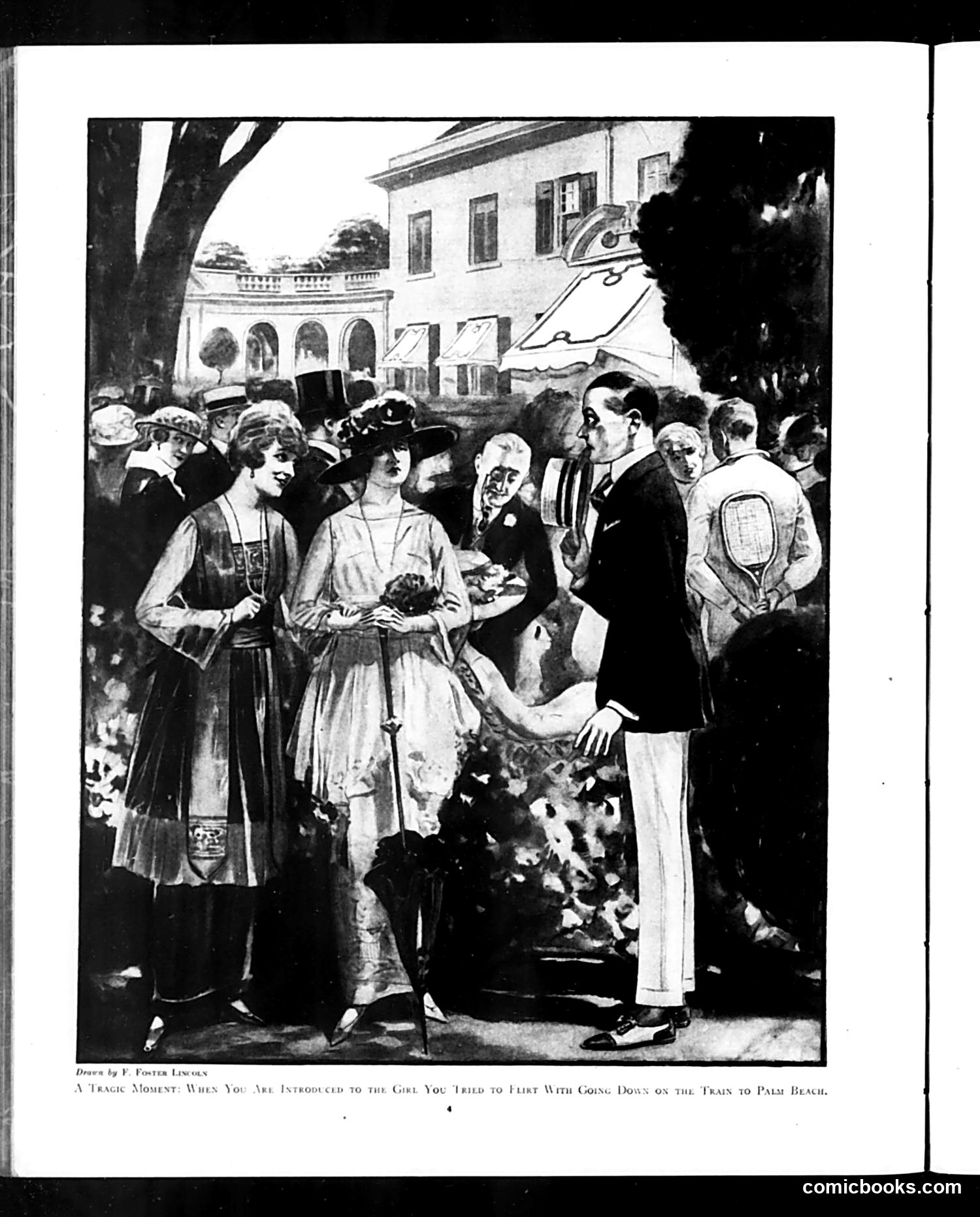
This illustration by F. Foster Lincoln depicts a social awkwardness scenario at what appears to be an elegant estate gathering. The caption reads: "A Tragic Moment. When You Are Introduced to the Girl You Tried to Flirt With Going Down on the Train to Palm Beach." The satire targets the embarrassment of upper-class social encounters. A well-dressed man is being introduced to a woman he previously attempted to flirt with during a train journey to the fashionable Palm Beach resort destination. The humor lies in the uncomfortable collision of his prior attempted seduction with formal social propriety—he must now acknowledge her respectfully in front of witnesses after his earlier casual flirtation. The cartoon mocks the pretensions and social anxieties of wealthy leisure travelers, a recurring Judge magazine theme.
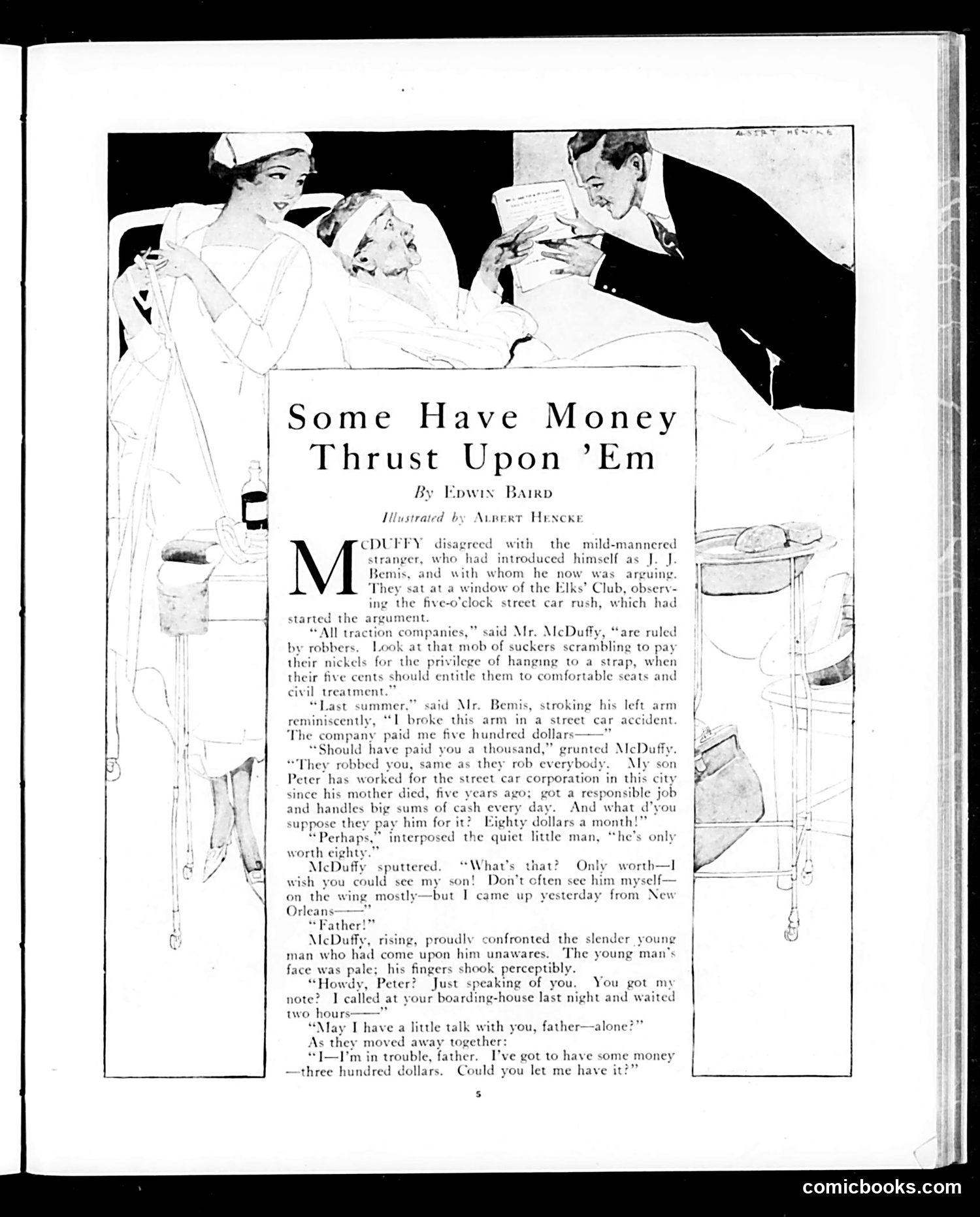
This story illustrated by Albert Hencke depicts a social commentary on wealth disparity and class conflict. Mr. McDuffy, a well-dressed man at the Elks Club, argues with a stranger (J.J. Bemis) about traction company workers. McDuffy defends corporate practices, claiming workers should accept low wages (eighty dollars monthly) for their jobs. The narrative becomes personal when Bemis reveals his son Peter works for the street car company and needs three hundred dollars urgently. The satire critiques wealthy men like McDuffy who rationalize workers' poverty while remaining indifferent to individual hardship. The title suggests wealth arbitrarily benefits some while others struggle—a commentary on early 20th-century labor conditions and class inequality.
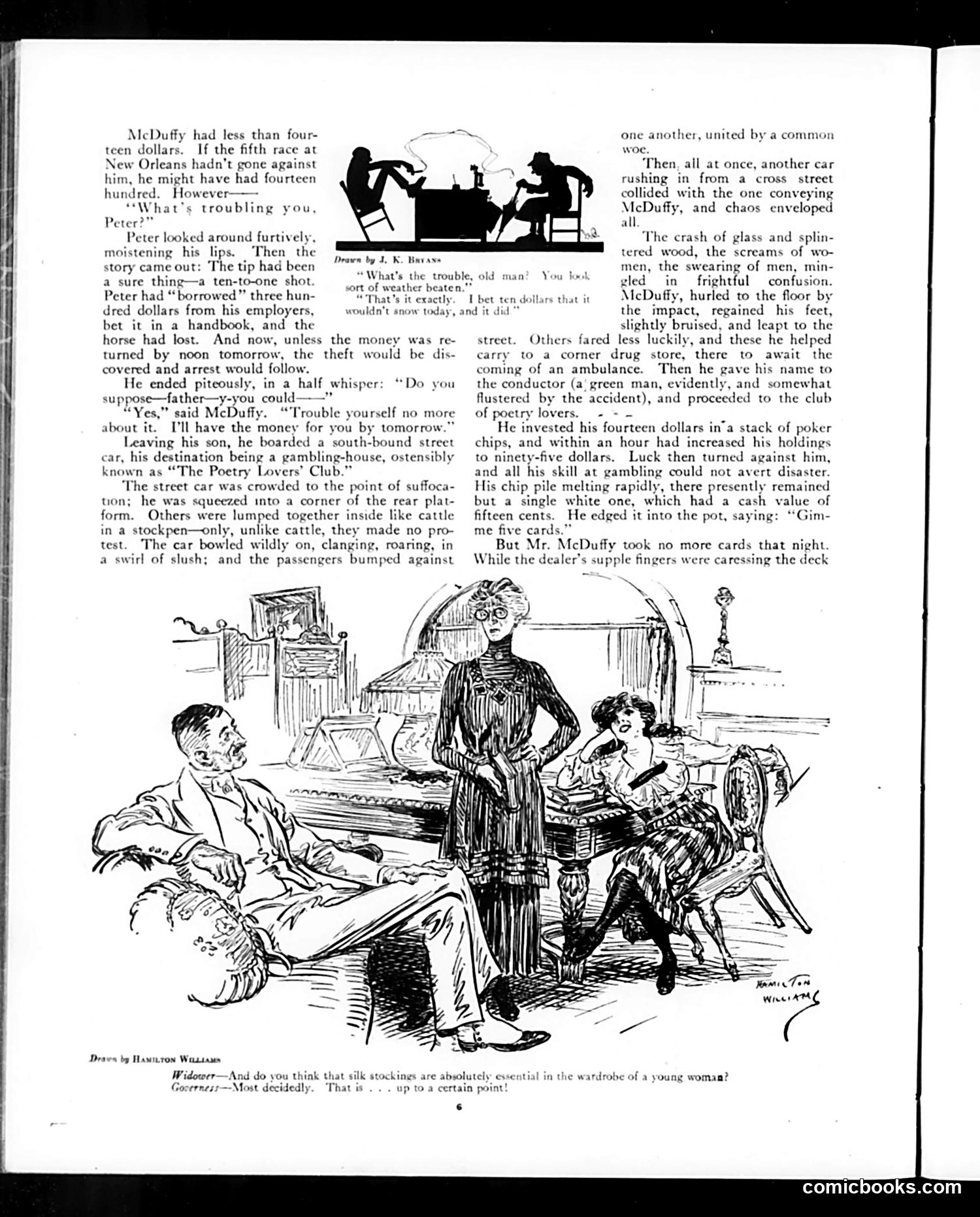
**Top Cartoon (J.K. Bryans):** Depicts two men in conversation—one weather-beaten, one well-dressed. The dialogue concerns borrowed money and a lost horse, establishing a comedic scenario about financial misfortune and broken promises between acquaintances. **Bottom Cartoon (Hamilton Williams):** Shows a domestic scene with a woman (likely a wife or governess) discussing silk stockings with two men. The caption addresses whether silk stockings are "essential" to a young woman's wardrobe—a humorous commentary on 1920s fashion debates and women's consumer expectations. The main narrative concerns Mr. McDuffy's misadventures: borrowing money, surviving a street-car accident, and losing his poker winnings. It's a morality tale satirizing luck, desperation, and poor financial judgment among working or middle-class men.
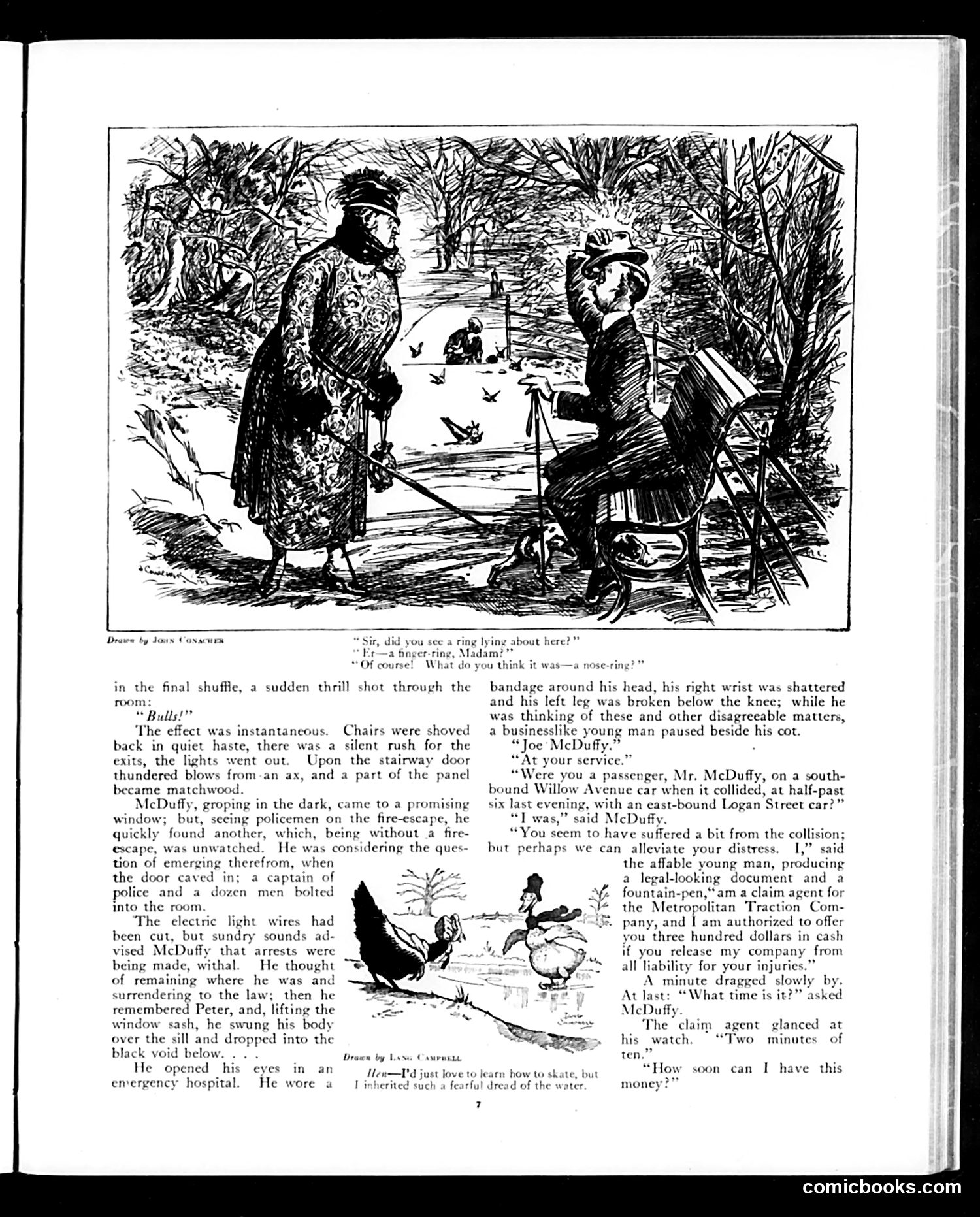
This page satirizes the opportunistic tactics of insurance claim agents. The narrative follows Joe McDuffy, who survives a streetcar collision but is severely injured. While recovering in a hospital, a claim agent from the Metropolitan Traction Company approaches him with a settlement offer: $300 in cash in exchange for releasing the company from all liability. The satire targets the company's strategy of exploiting vulnerable accident victims. By offering quick cash while McDuffy is incapacitated and in pain, the agent pressures him into accepting far less than he might deserve. McDuffy's desperate question—"How soon can I have this money?"—reveals how financial desperation trumps his ability to negotiate fairly. The upper cartoon (drawn by John Coxacien) provides context: a fire alarm causes chaos at what appears to be a public venue, suggesting the broader accident-prone conditions of urban life that benefit insurance companies. The satire critiques corporate greed and the exploitation of injured working-class people.
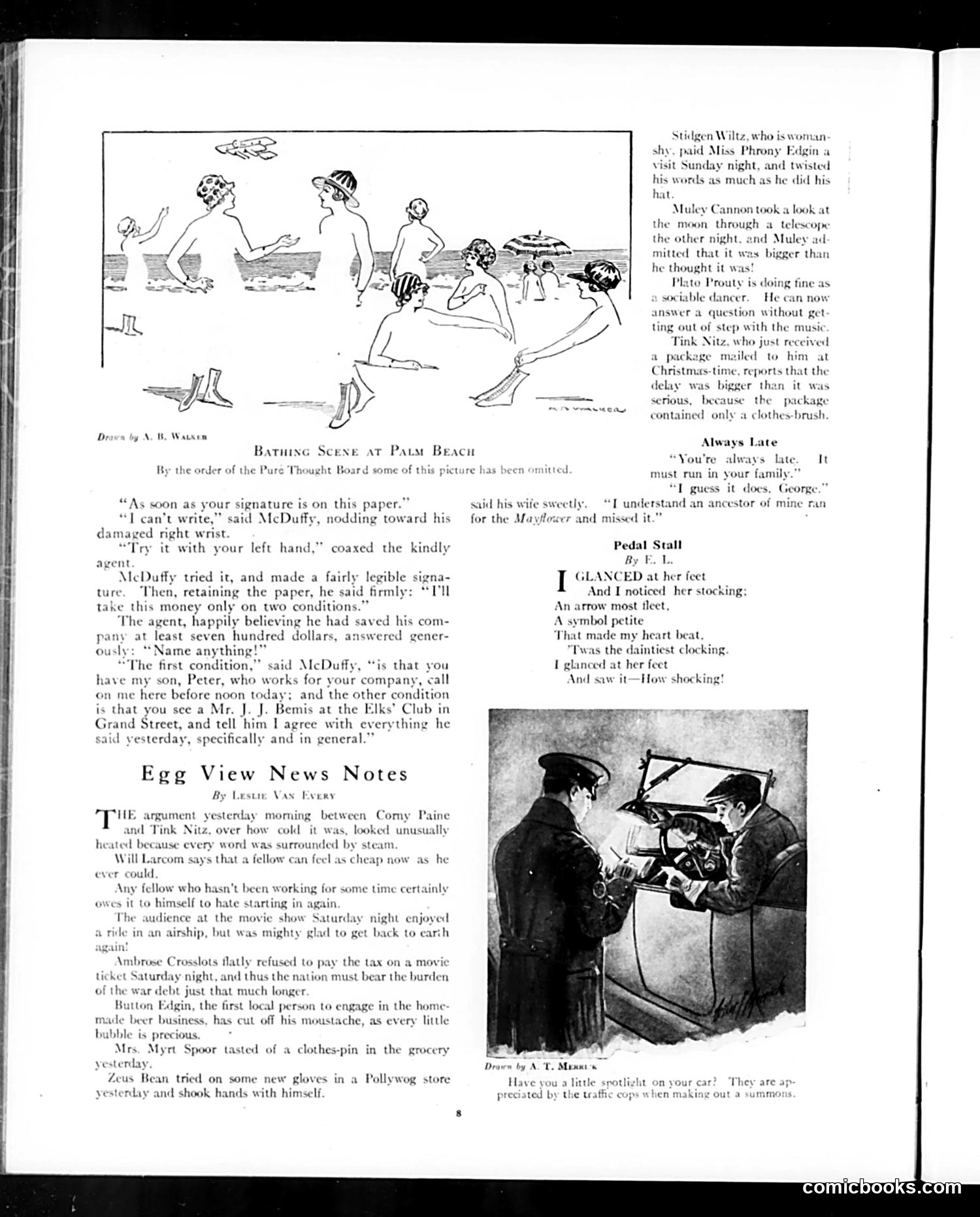
This page from *Judge* contains several satirical pieces typical of early 20th-century American humor: **Main cartoon** ("Bathing Scene at Palm Beach"): Depicts wealthy beachgoers in swimming attire. The accompanying dialogue shows McDuffy, a man with an injured right wrist, being pressured to sign an insurance or business document. He agrees only after demanding his employer's son visit and a Mr. Bemis be contacted about yesterday's conversation—absurd conditions that mock both bureaucratic procedures and working-class cunning. **"Egg View News Notes"**: A gossip column listing trivial local happenings (people shaking hands with gloves, arguing about cold weather, refusing movie taxes). The satire targets small-town pettiness and society's obsession with inconsequential details. **"Pedal Stall"**: Verse about noticing a woman's stocking with an "arrow" pattern—likely an early hosiery design. The "shocking" revelation appears to be modest by modern standards but represented risqué humor for the era. These pieces exemplify *Judge's* satirical approach: mocking bureaucracy, provincial gossip, and social conventions through everyday scenarios.
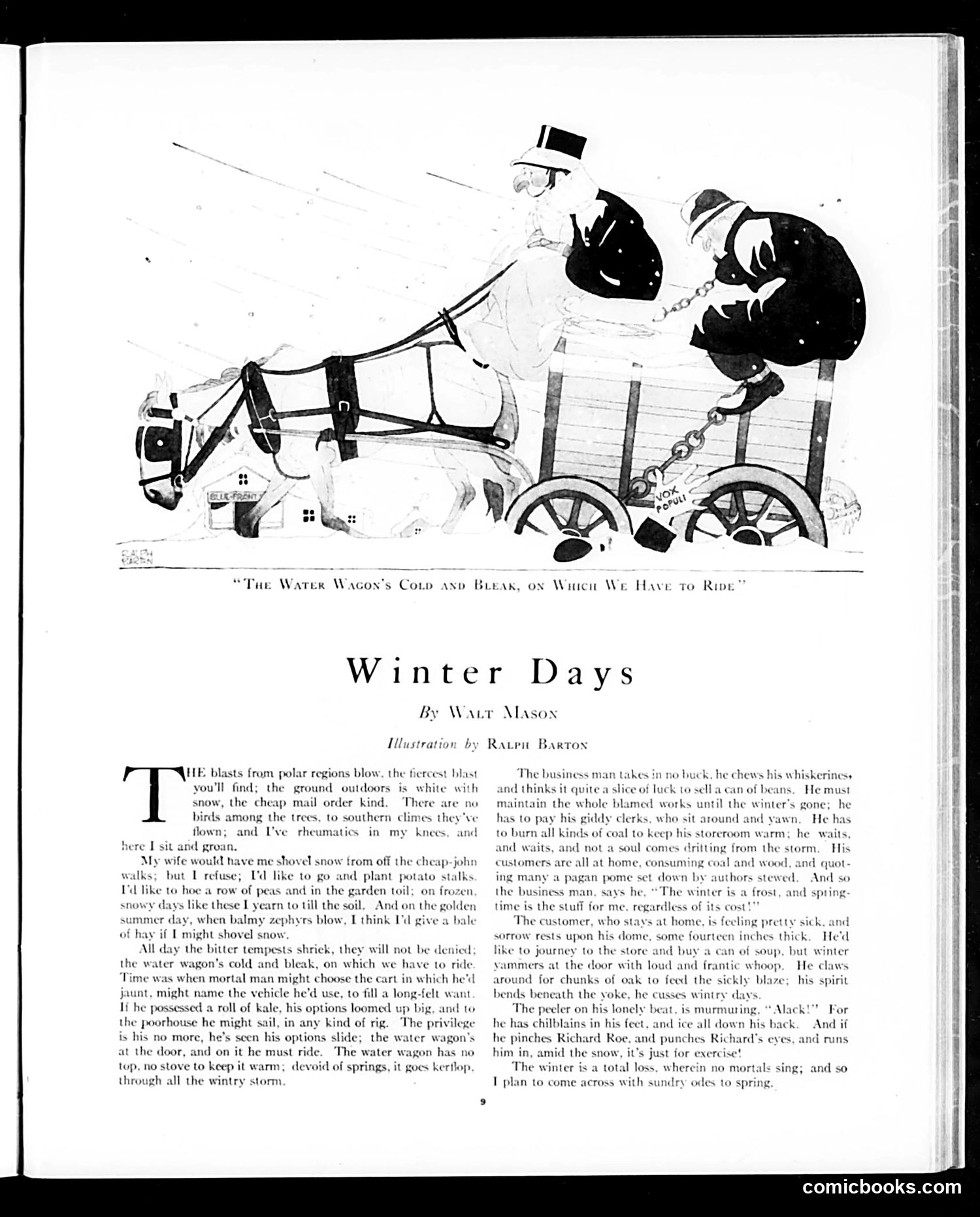
This is an illustrated humorous essay by Walt Mason about winter hardships, with a cartoon caption showing two well-dressed men riding uncomfortably on an open water wagon through snow. **The Satire:** Mason complains that winter forces everyone—rich and poor alike—onto the same inadequate "water wagon" (a municipal supply vehicle), eliminating class distinctions. The cartoon illustrates this democratic misery: two gentlemen in top hats must endure the cold, jolting ride together. **The Social Commentary:** The essay catalogs winter's indignities across social classes—businessmen losing customers and profits, sick customers trapped at home, police officers suffering chilblains—all united in winter's "total loss." The irony is that wealth normally separates people, but winter's hardships are inescapably universal. **For Modern Readers:** This reflects pre-modern winter conditions when there was no central heating, when commerce literally froze, and when basic transportation (water delivery wagons) was uncomfortable and exposed to elements. The "cheap mail order" snow and grumbling tone capture period complaints about unavoidable winter suffering.
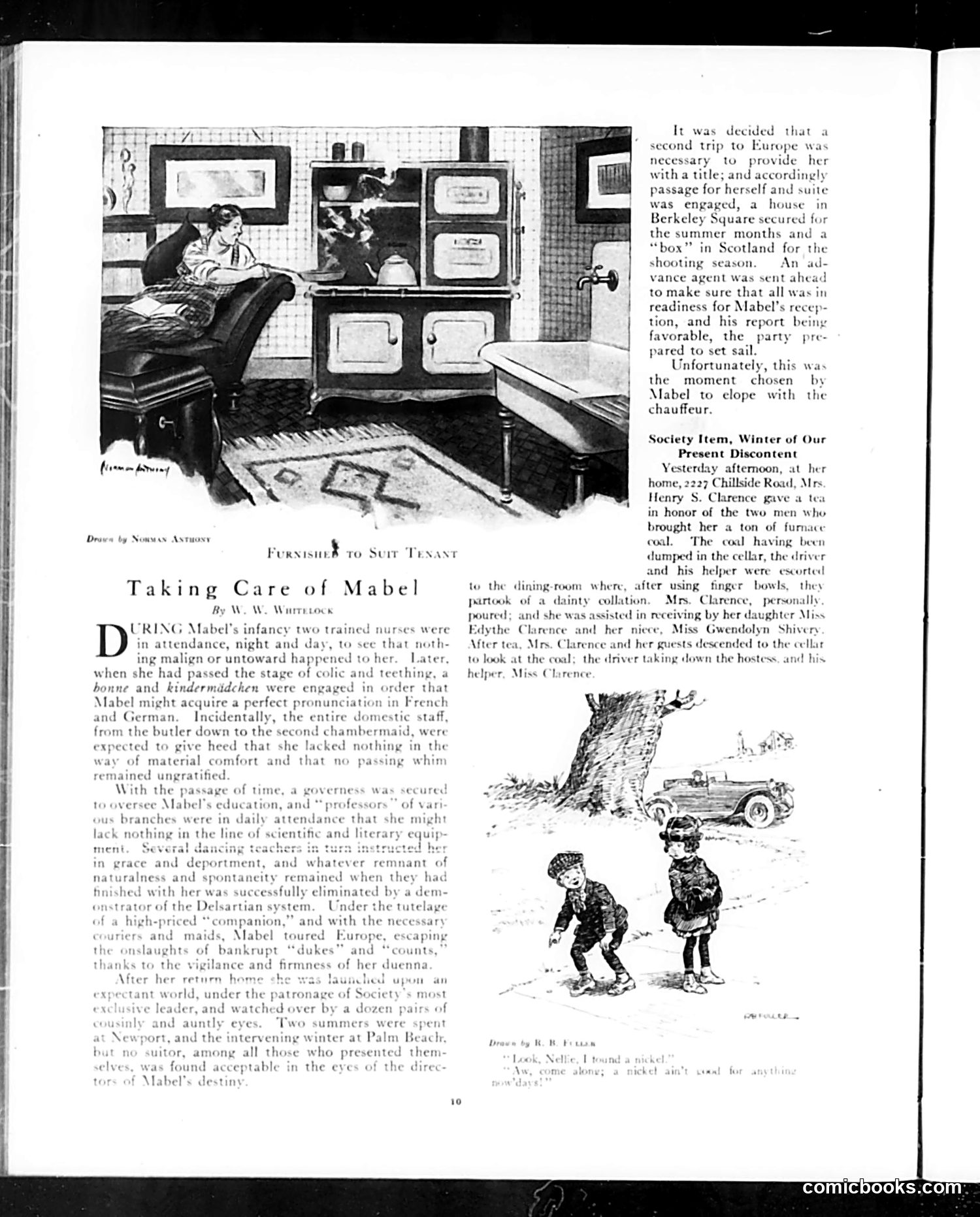
This story satirizes wealthy American families' obsessive efforts to groom daughters for European "society." The narrative mocks the absurd expense and pretension: Mabel receives two live-in nurses, dancing teachers, and governesses to perfect her French and German pronunciation. Her parents then book an entire London townhouse and Scottish shooting lodge merely to secure her a title through a European season—the traditional (and expensive) upper-class debutante ritual. The satire's punchline: all this investment collapses when Mabel elopes with the chauffeur, suggesting such elaborate social climbing is both futile and ridiculous. The accompanying joke about Mrs. Clarence serving coal-delivery workers tea in the dining room reinforces the theme: genuine human decency matters more than pretentious social performance.
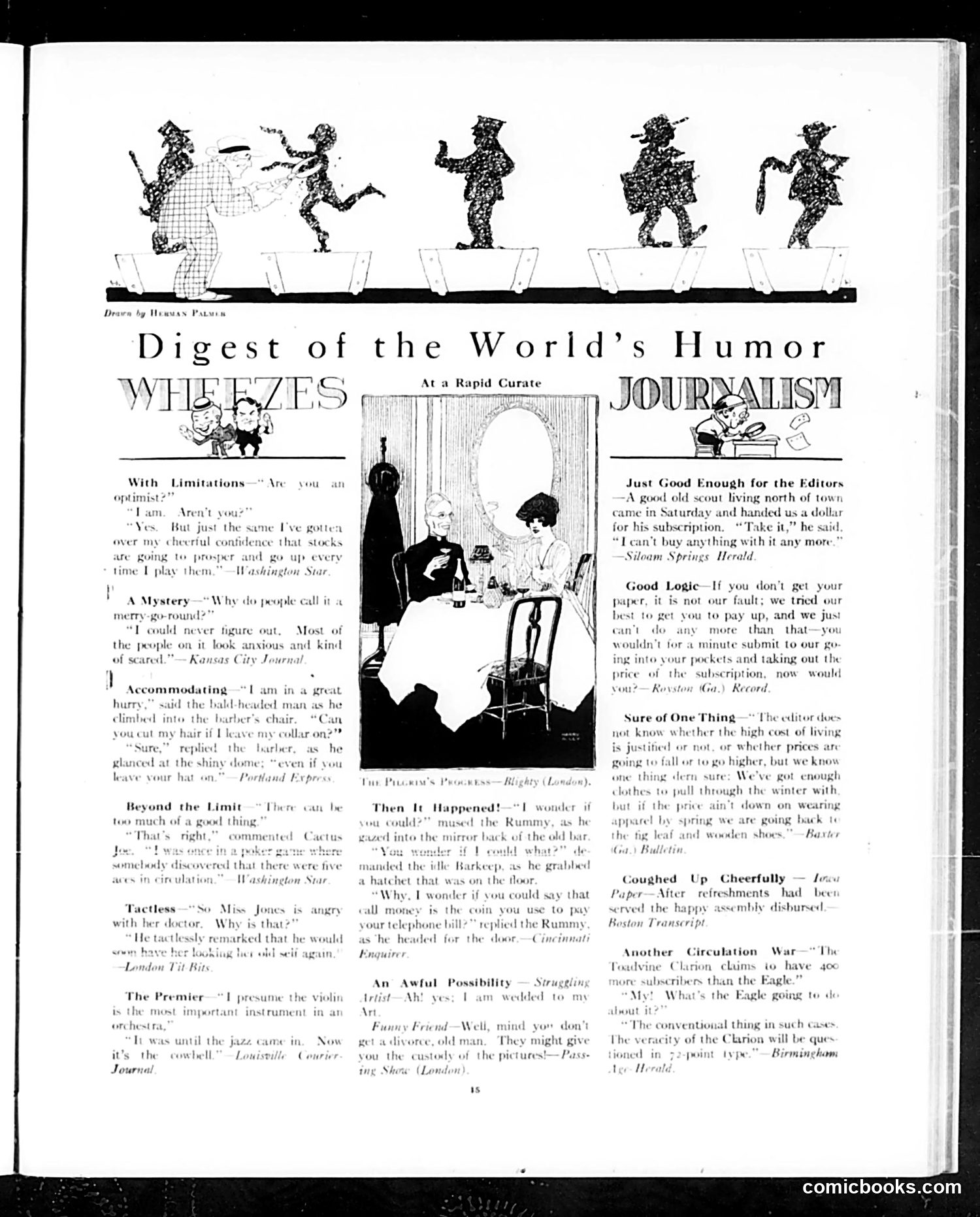
This is a **humor digest page** collecting jokes and witticisms from various sources, not a single unified cartoon. The page demonstrates early 20th-century American satirical humor targeting everyday frustrations. The jokes mock common social situations: an optimist's forced cheerfulness despite market anxieties ("With Limitations"), marital tension between patients and doctors, barber shop philosophy, and—notably—**newspaper circulation wars** between competing local publications (the Clarion versus the Eagle competing for subscribers). The central illustration shows a domestic scene, likely depicting one of the anecdotes. The humor is gentle and observational rather than biting—poking fun at human nature, optimism despite economic worries, and professional rivalries. **Key context for modern readers:** This reflects pre-Depression anxiety about financial stability and captures how local newspapers actively competed for subscriptions, treating circulation numbers as matters of pride and editorial concern—a detail that underscores journalism's former economic vitality and competitive intensity.
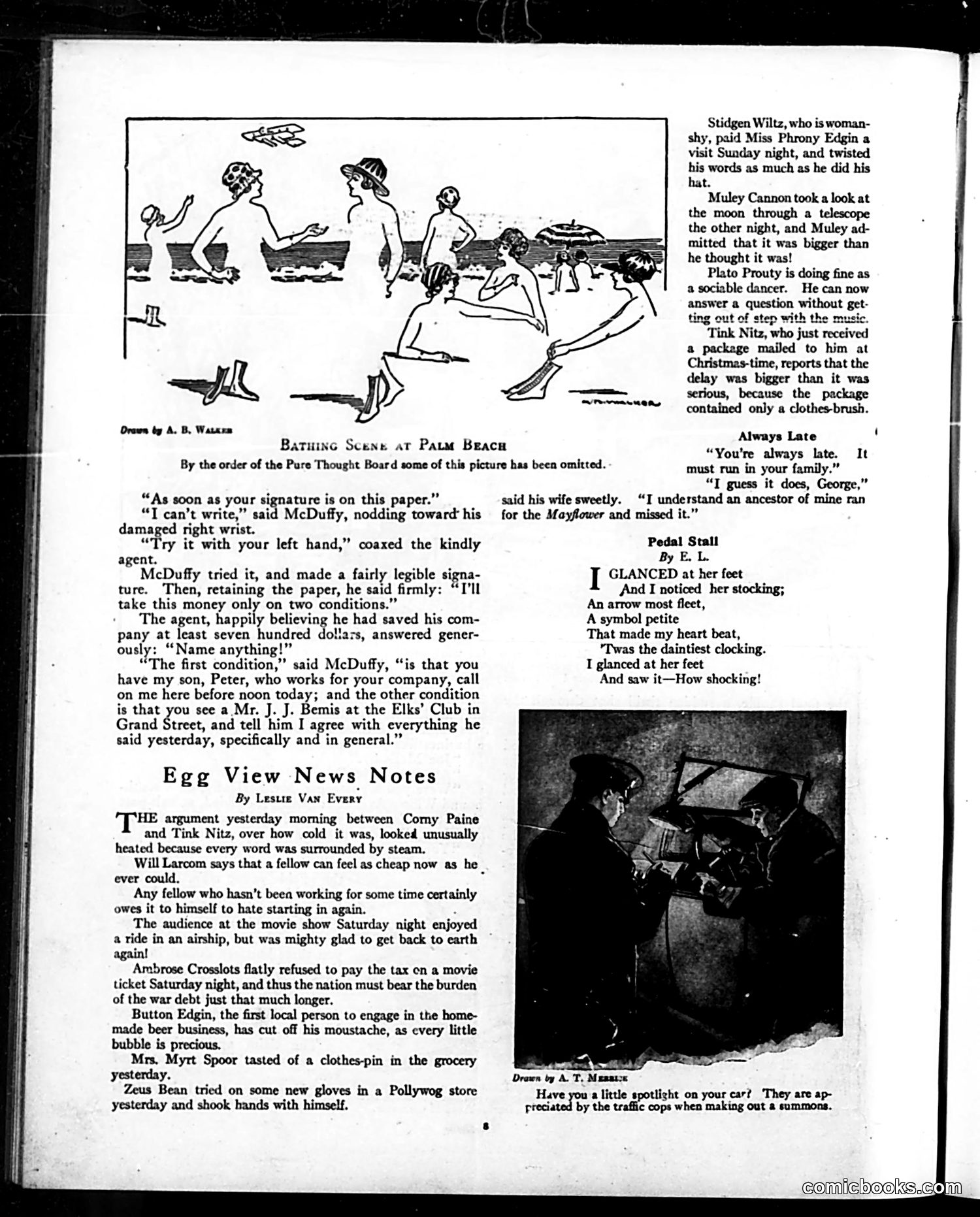
## Main Cartoon: "Bathing Scene at Palm Beach" This is a humorous illustration of beachgoers, captioned with a satirical note: "By the order of the Pure Thought Board some of this picture has been omitted." This references the real censorship board that reviewed entertainment for "moral" content in the 1920s-30s. The joke mocks prudish censorship by suggesting risqué elements were removed from a simple beach scene—implying the censors saw impropriety everywhere. ## Text Stories The page contains light satirical vignettes about small-town characters and their everyday foibles: a man with a broken wrist signing documents, arguments about cold weather, people avoiding taxes, and romantic misadventures. These are gentle humor pieces typical of Judge's style. ## Notable Element "Always Late" presents a tired joke format where a wife's chronic tardiness supposedly runs in her family—her ancestor "ran for the Mayflower and missed it," conflating modern punctuality problems with colonial history. The overall tone is gentle, domestic satire reflecting post-WWI American small-town life.
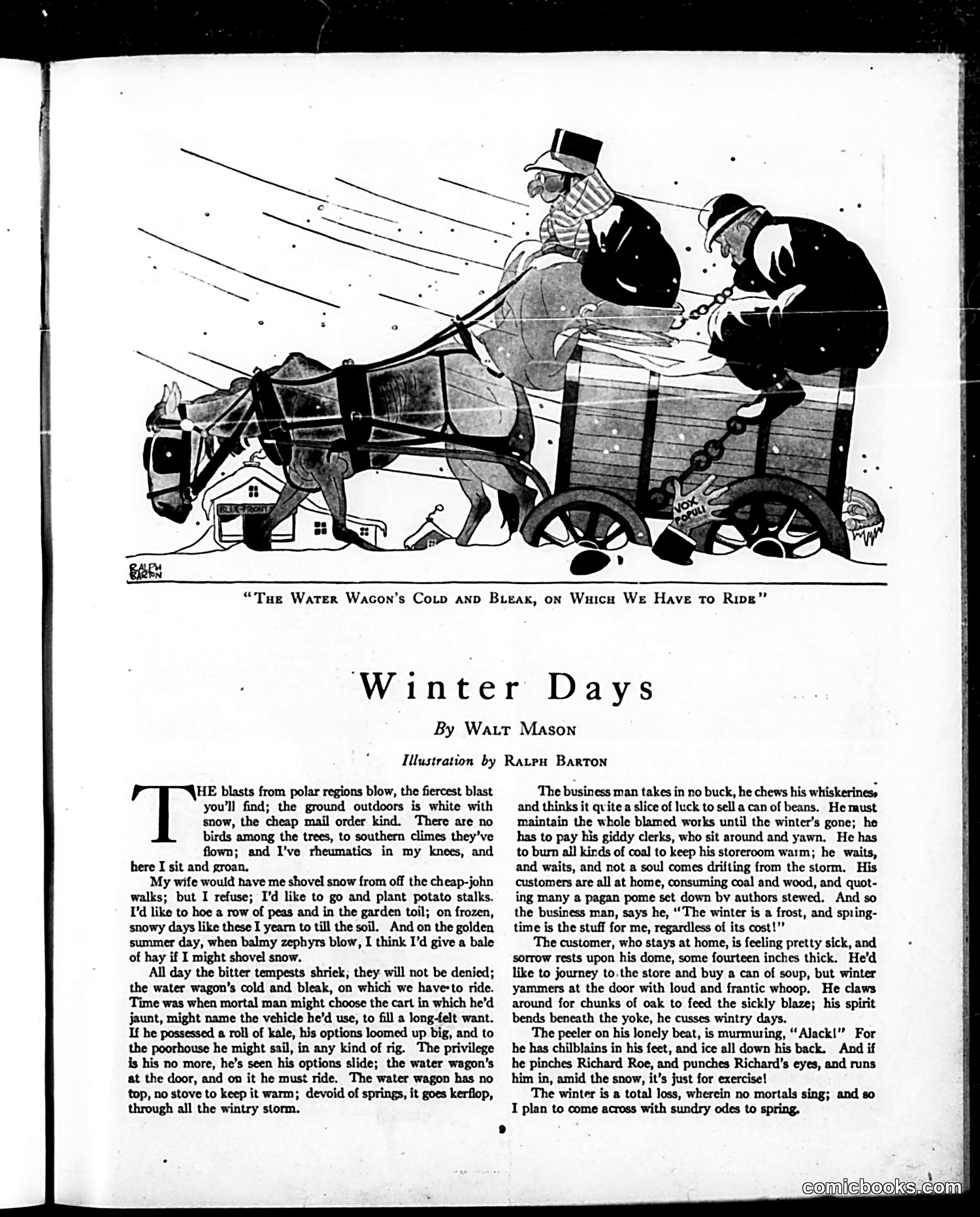
This is a humorous poem with accompanying illustration about winter hardships in early 20th-century America. The cartoon depicts three men riding uncomfortably on an exposed, springless "water wagon" (a vehicle for delivering water) during a snowstorm—illustrating the poem's central metaphor: winter forces everyone onto this miserable shared conveyance. The satire mocks how winter affects different classes: businessmen lose customers (people stay home), workers can't get proper jobs, and even police officers resort to making arrests just for activity. The poem's narrator complains of rheumatics and forced idleness while longing for spring work. The "water wagon" represents winter's leveling effect—rich or poor, everyone suffers equally in the cold, jolting ride. The recurring complaint about lack of choice ("options slide") suggests broader frustrations about loss of individual agency during harsh seasons, when survival takes priority over preference.
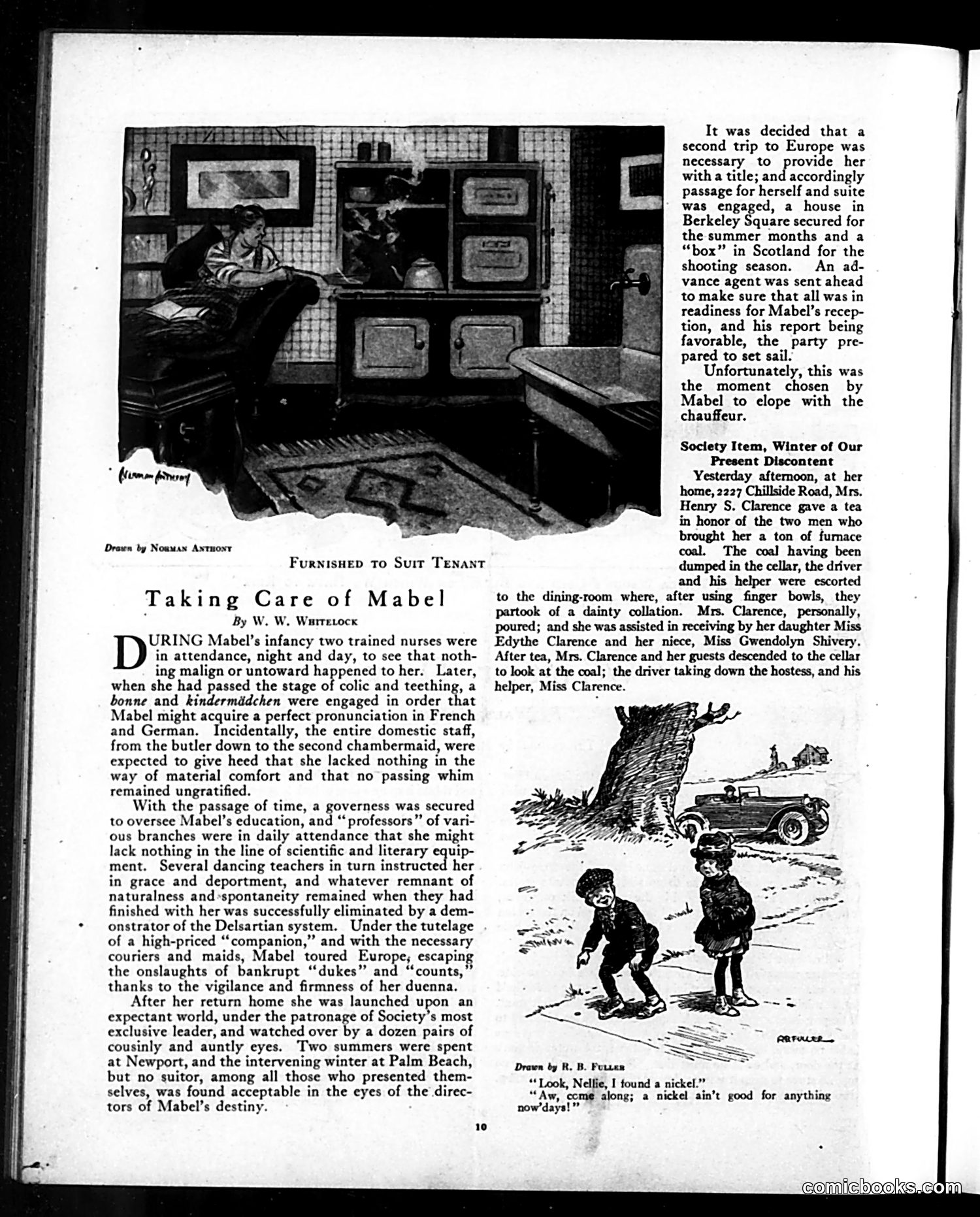
This page satirizes wealthy American society's obsessive control over their daughters' lives. "Taking Care of Mabel" mocks the elaborate, expense-sparing efforts—trained nurses, foreign governesses, dancing instructors, European tours, a chaperone securing European nobility—all designed to land Mabel a titled husband. The joke's punchline: she elopes with the *chauffeur*, defeating the entire enterprise. The secondary item, "Society Item," extends the satire by inverting class hierarchies. A wealthy woman (Mrs. Clarence) now hosts a formal tea *honoring* coal delivery men, treating them as honored guests with finger bowls and cellar tours—absurdly elevating working-class laborers to society status. This appears to comment on wartime or economic shifts that scrambled traditional class distinctions. The small cartoon below depicts children finding a nickel worthless—likely referencing inflation or economic depreciation, with children's casual dismissal highlighting how currency lost value.
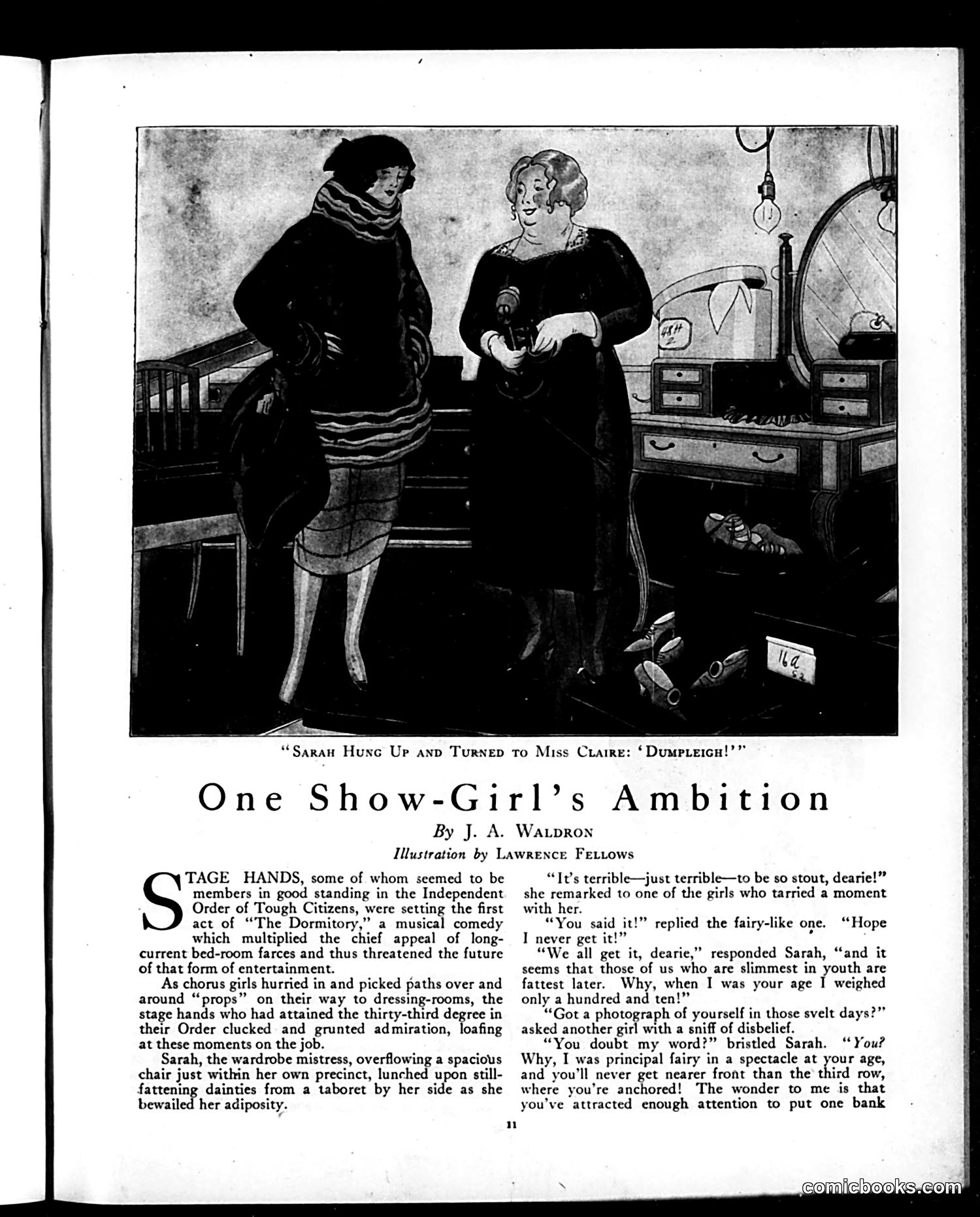
This is a comedic story (not a political cartoon) from *Judge* magazine about theatrical life. The illustration shows a scene backstage during a musical comedy called "The Dormitory." The humor centers on Sarah, the wardrobe mistress—an overweight older woman—reminiscing about her youth as a "principal fairy" (a featured dancer in theatrical spectacles). A young chorus girl doubts Sarah's claim, asking for photographic proof of her slimmer past. Sarah bristles, boasting that she was once a principal performer while the chorus girl is relegated to the back row and will "never get nearer front." The satire mocks both the vanity of aging showgirls clinging to past glory and the hierarchies within theatrical companies. It also plays on contemporary anxieties about aging, weight, and female ambition in entertainment—suggesting that even principal performers end up as aging, heavyset costume attendants, a cautionary tale about show business.
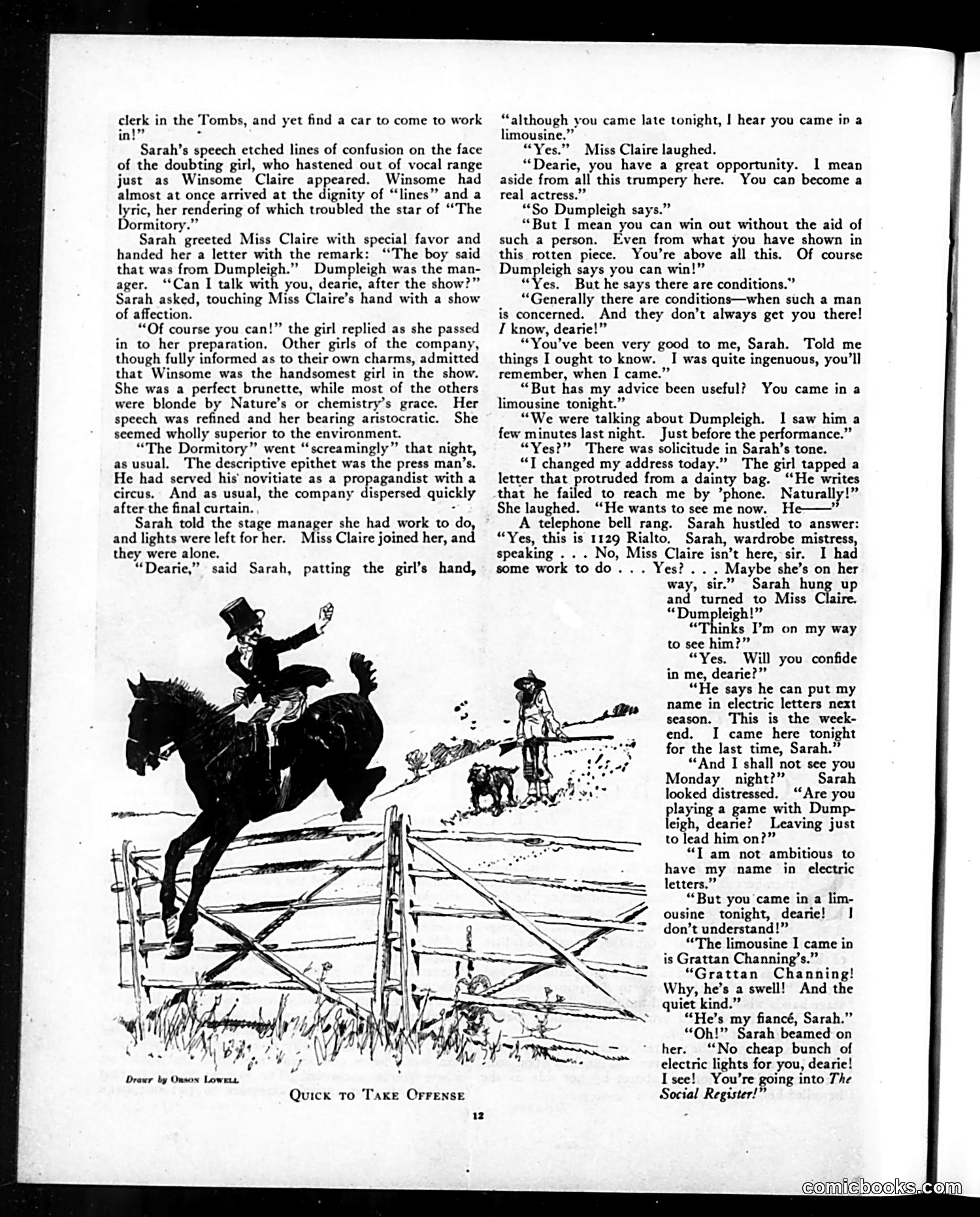
This page depicts a backstage theatre scene between Sarah (a wardrobe mistress) and Winsome Claire (an ambitious young actress). The satirical point appears to concern social climbing and romantic opportunism in early 20th-century theatre. Sarah confronts Claire about arriving in a limousine, initially suspecting the stage manager Dumpleigh (who controls casting) is exploiting her with promises of stardom. Claire reveals she actually came in Grattan Channing's limousine—Channing is her fiancé, described as "a swell" (wealthy man) of high social standing. The cartoon's title "Quick to Take Offense" and the horse-and-rider illustration suggest someone (likely Dumpleigh, implied) misinterpreting Claire's departure as rejection, reacting defensively. The satire mocks theatre-world power dynamics, where young actresses navigate between patronage by theatre managers and wealthy suitors—and the managers' wounded pride when actresses escape their influence through advantageous marriages.
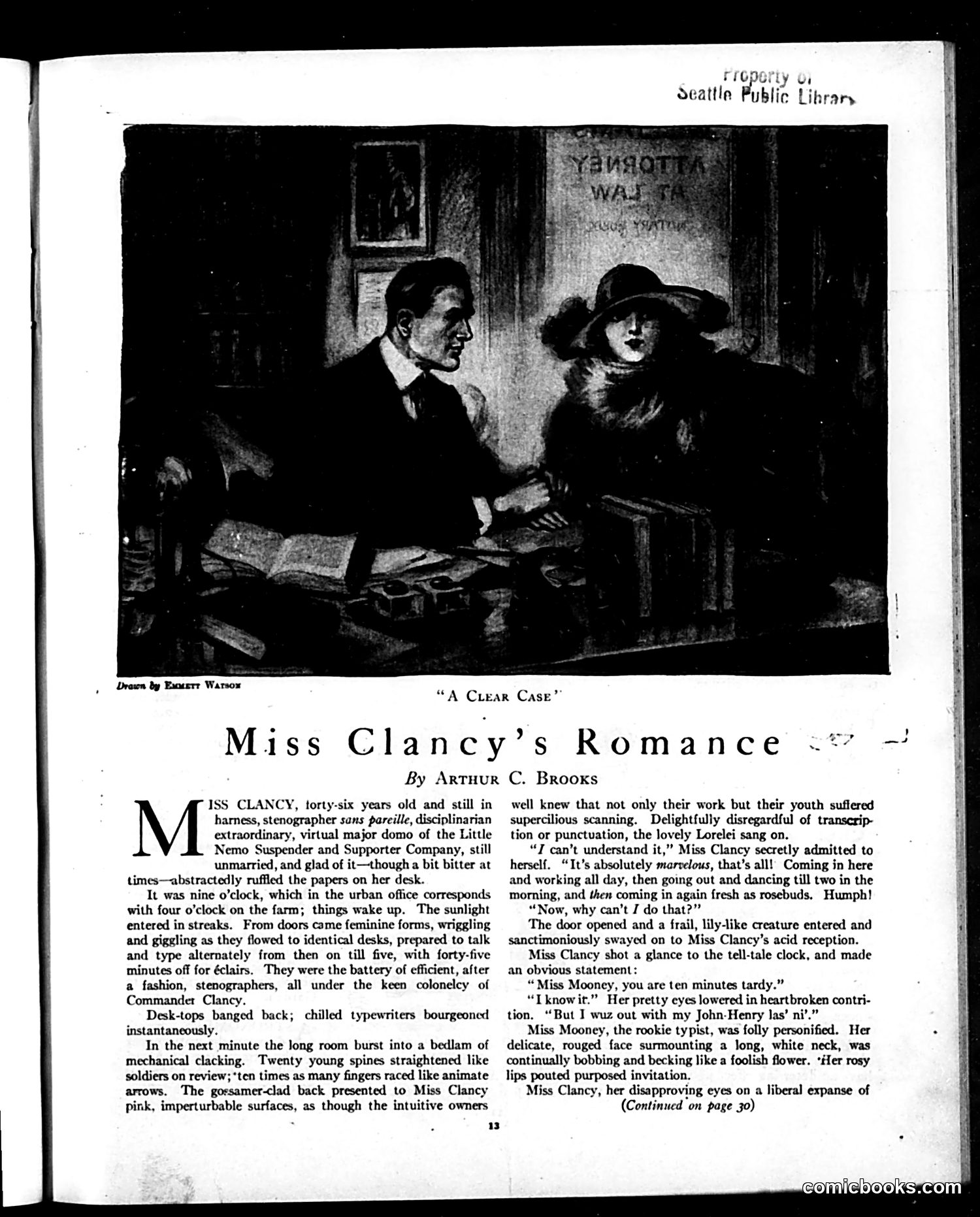
This is the opening of a serialized short story satirizing early-20th-century office culture. Miss Clancy, a stern, unmarried 46-year-old stenographer and office manager at the "Little Nemo Suspender and Supporter Company," runs her department with rigid discipline. The satire targets the generational divide: Miss Clancy is bitter and exhausted by her regimented work life, while her young female employees (typists and stenographers) arrive fresh and energetic despite dancing until 2 a.m. the night before. The story mocks Miss Clancy's disapproval of youth's resilience and social freedoms, particularly when the young typist Miss Mooney arrives late, having been out with her boyfriend. The drawing shows what appears to be Miss Clancy confronting an employee. The humor lies in the contrast between rigid, joyless work discipline and the younger generation's ability to balance nightlife with employment.
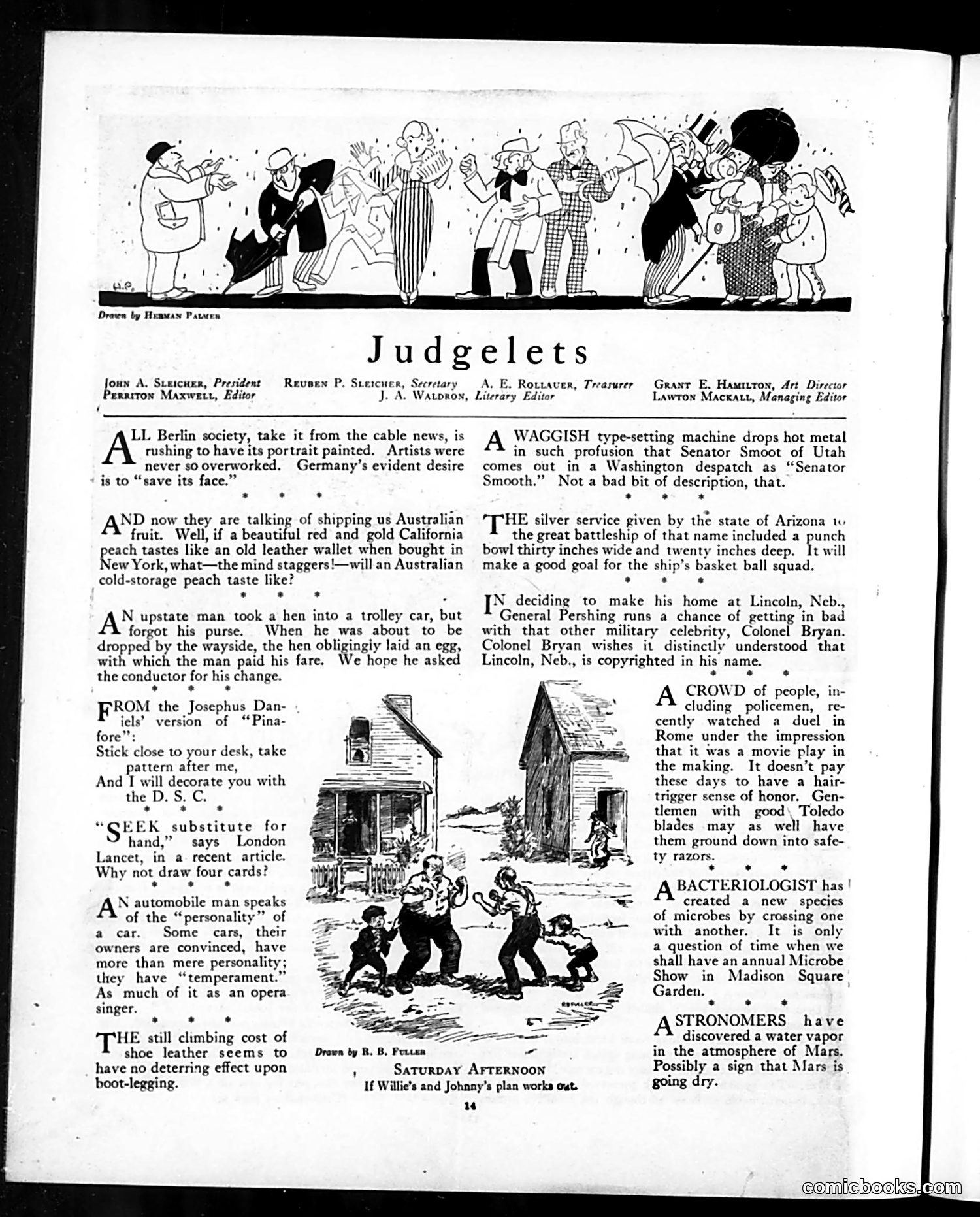
This is a **humor/editorial column** page from *Judge* magazine, not primarily a political cartoon. The page features short satirical commentary on current events, with two illustrations. **Key references:** - **Berlin society portrait-painting**: Jokes about Germany's post-WWI desire to restore its reputation ("save its face") - **Australian fruit shipping**: Mocks California's poor-quality produce exports - **Senator Smoot/typesetting error**: Puns on Utah Senator Reed Smoot's name being misspelled as "Smooth" by a printing machine - **Arizona battleship silver service**: Jokes about an oversized punch bowl gift - **General Pershing vs. Colonel Bryan in Lincoln, Nebraska**: References Pershing's choice to relocate, humorously suggesting Bryan (likely William Jennings Bryan) has claimed Lincoln as his intellectual property - **Rome duel mistaken for movie**: Satirizes public confusion between real violence and cinema The illustrations show everyday scenes (a rural house, children playing) that likely accompany specific short items. The humor is lightweight, topical commentary typical of 1920s satirical magazines.
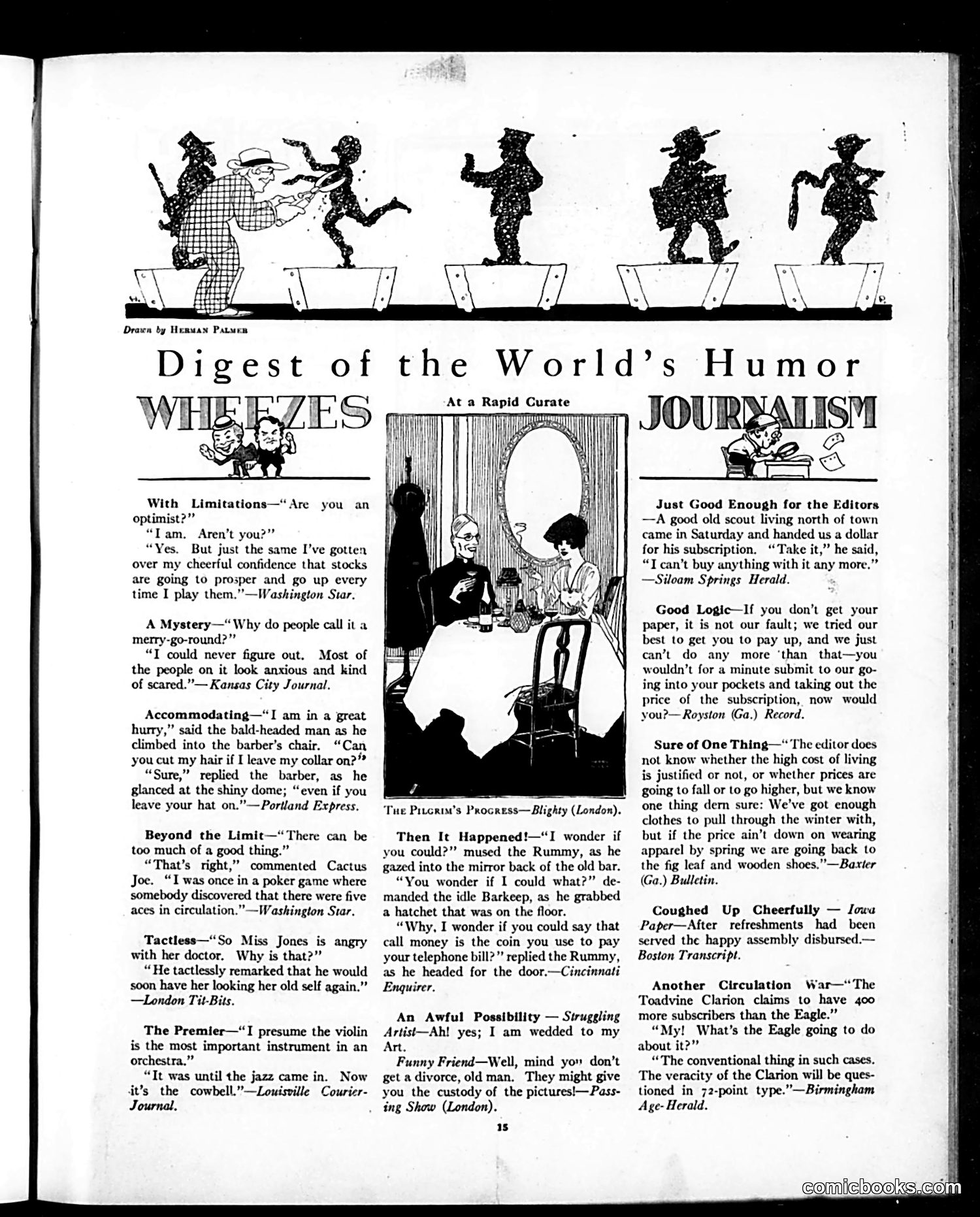
This page from *Judge* collects brief humorous anecdotes from newspapers nationwide, a common magazine feature. The silhouette cartoon at top shows vaudeville or circus performers on a stage. The jokes reflect early 20th-century anxieties: stock market volatility ("optimist" joke), the decline of classical music replaced by jazz ("cowbell"), and especially the cost of living crisis. Multiple items mock newspaper economics—editors claiming they lack funds, circulation wars fought through accusations of dishonesty ("veracity questioned in 72-point type"), and subscription complaints during inflation. The barber joke plays on baldness humor; the poker joke involves impossible card hands. One cartoon shows a domestic dispute about telephone bills. Overall, this reflects post-WWI American concerns about economics, modernization, and newspaper industry competition.
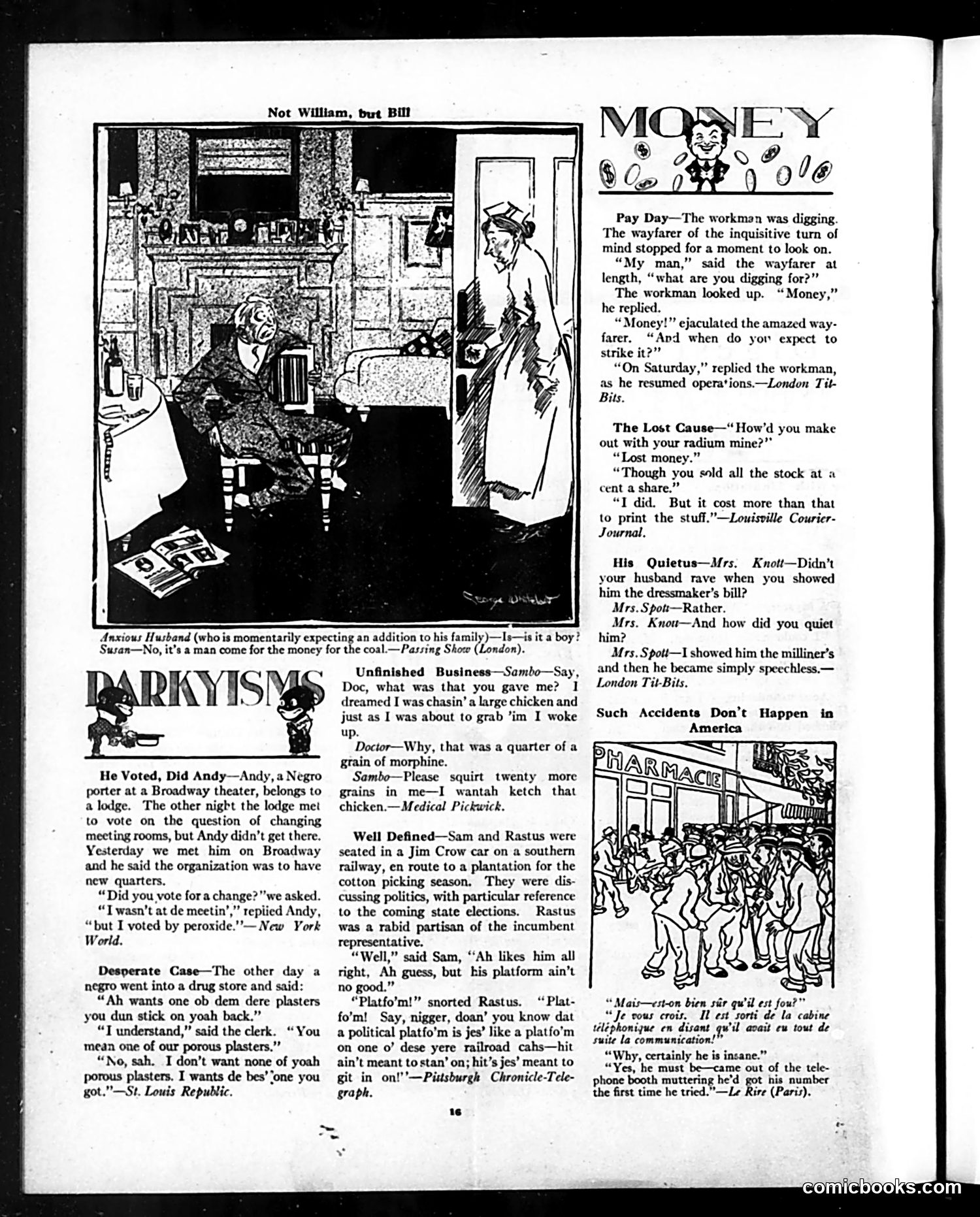
This page from the satirical magazine **Judge** contains several humor pieces, predominantly using racist stereotypes of Black Americans common to early 20th-century publications. The "Darkisms" section consists of dialect jokes portraying Black characters as ignorant or foolish. "He Voted, Did Andy" mocks a Black theater porter for claiming to vote "by peroxide" (likely referencing lightening skin). "Desperate Case" depicts a Black man confusing "porous plasters" with an unknown remedy. "Well Defined" shows two men in a segregated ("Jim Crow") railroad car, with one making a crude joke about political platforms. The upper cartoon shows an anxious husband learning his visitor is a coal collector—a joke about working-class financial hardship. Other brief items mock radium stock schemes and a husband's reaction to clothing bills—typical genteel humor for Judge's audience. The final item is a French newspaper excerpt about someone acting insane after a telephone call—commenting on early telephone technology's strangeness. The page reflects period attitudes that would be considered deeply offensive today.
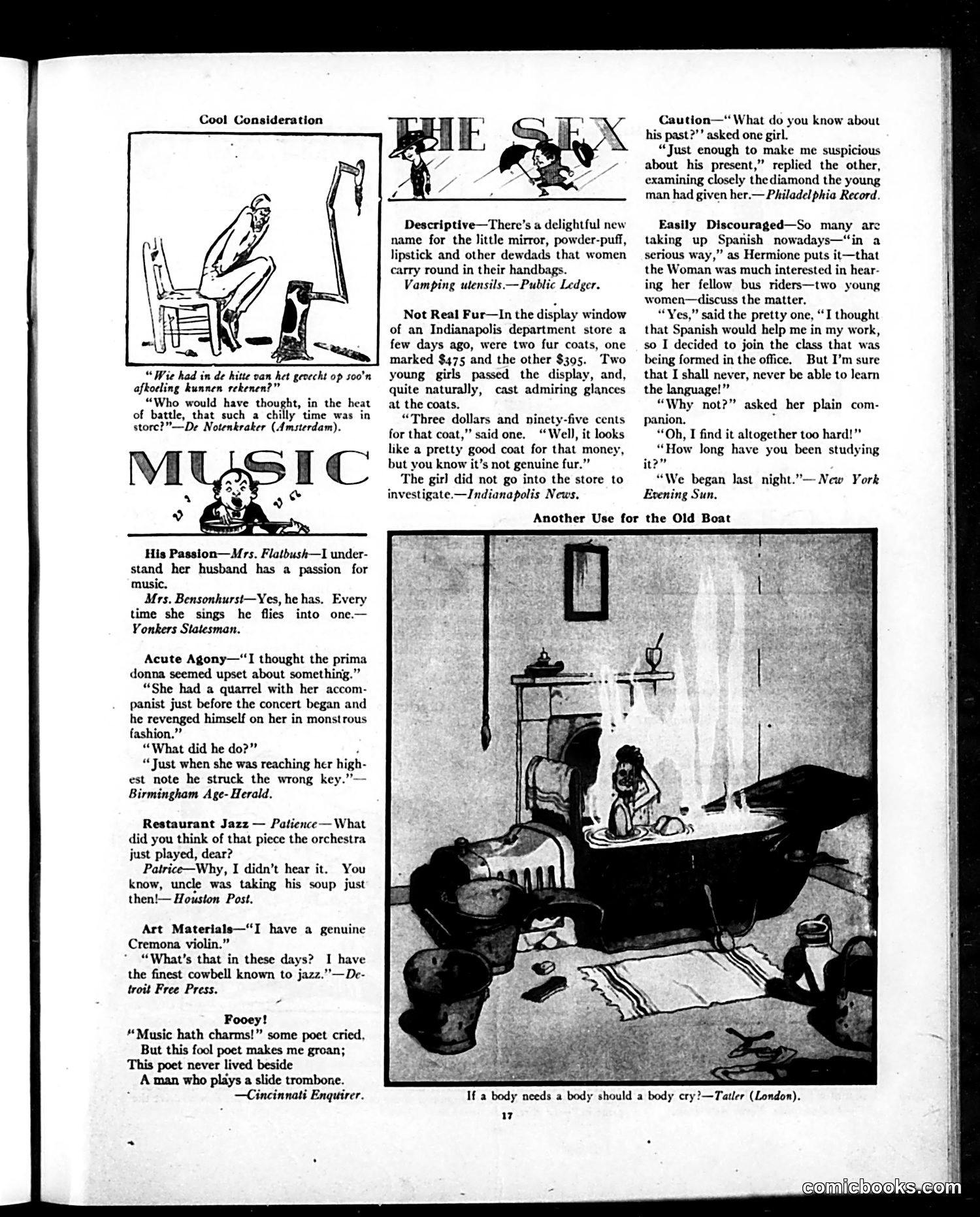
This page collects brief humorous anecdotes and jokes typical of early 20th-century American humor magazines. The content reflects period attitudes and social situations: **"Cool Consideration"** opens with a Dutch-language quote about finding relief during battle—likely referencing WWI, which was contemporary to Judge's publication. **Music-related jokes** dominate: husbands fleeing wives' singing, accompanists sabotaging prima donnas by hitting wrong keys, restaurant diners unable to hear orchestras over soup-slurping, and complaints about slide trombone neighbors. These reflect Jazz Age anxieties about modern music and domestic friction. **The cartoon "Another Use for the Old Boat"** shows a woman in a bathtub fashioned from a boat—a Depression-era joke about repurposing discarded items. **"Vamping utensils"** sarcastically refers to women's cosmetics and compact mirrors as tools of seduction—reflecting period anxieties about female sexuality and the "flapper" era. **"Easily Discouraged"** mocks a woman abandoning Spanish lessons after one night, suggesting limited female commitment to self-improvement. The page exemplifies Judge's satirical commentary on contemporary manners, gender relations, and consumer culture.
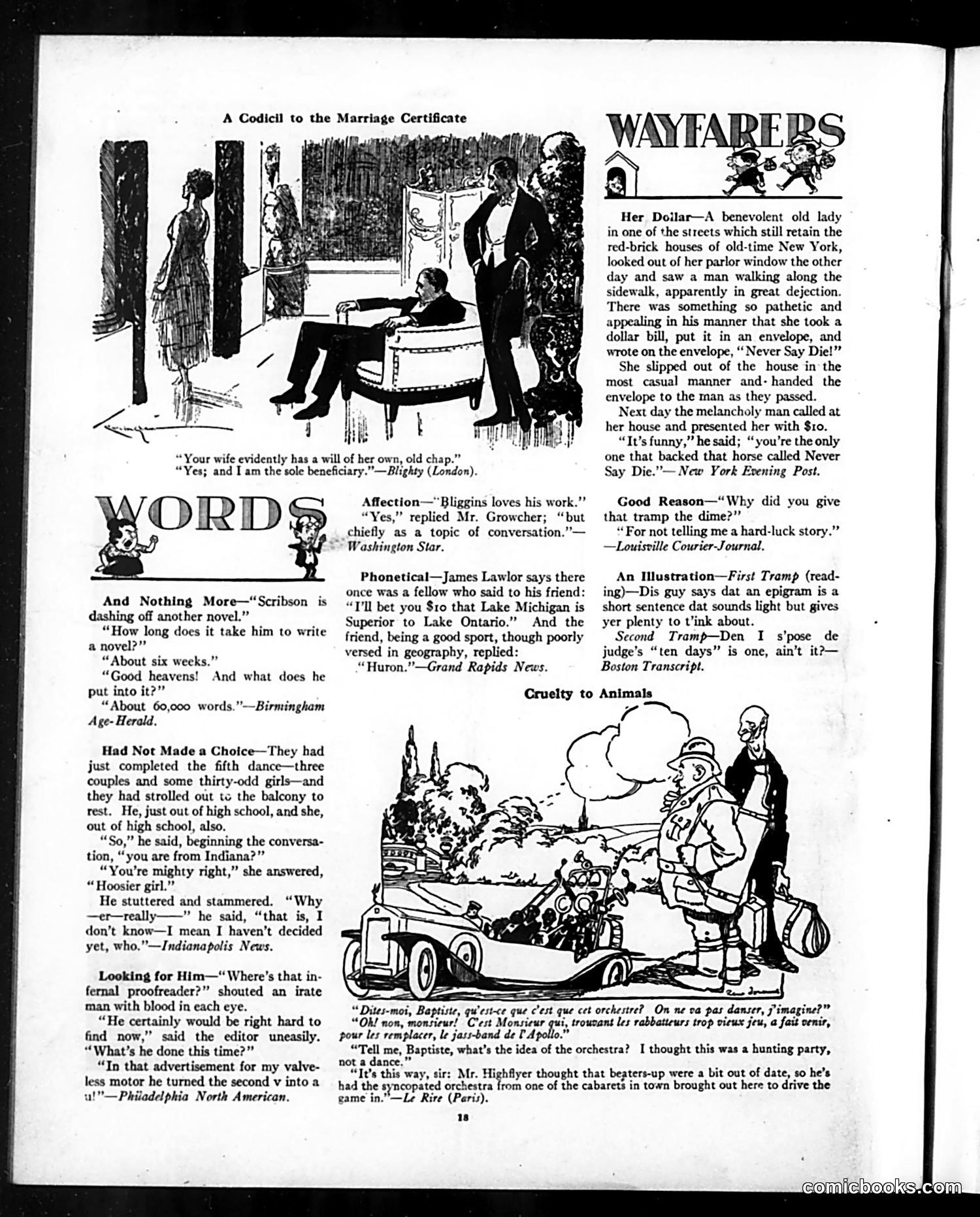
This page from the satirical magazine *Judge* collects brief humorous anecdotes and one cartoon, all mocking various social pretensions and absurdities of the era. The main cartoon, "Cruelty to Animals," satirizes wealthy affectation. A French gentleman expects traditional hunting beaters (working-class men who drive game toward hunters), but a Mr. Highflyer has instead hired a "syncopated orchestra" from a cabaret—treating live musicians as if they were hunting equipment. The joke ridicules how the rich thoughtlessly substitute trendy novelties (jazz orchestras) for practical purposes, and the absurd notion that modern music could replace actual hunting labor. The surrounding text anecdotes mock marital power dynamics, hasty novel-writing, workplace incompetence (a proofreader's errors), and working-class philosophizing. Throughout, the satire targets middle and upper-class pretension, workplace folly, and romantic awkwardness. The French caption and source (*Le Rire*, a Parisian magazine) indicates *Judge*'s international satirical scope.
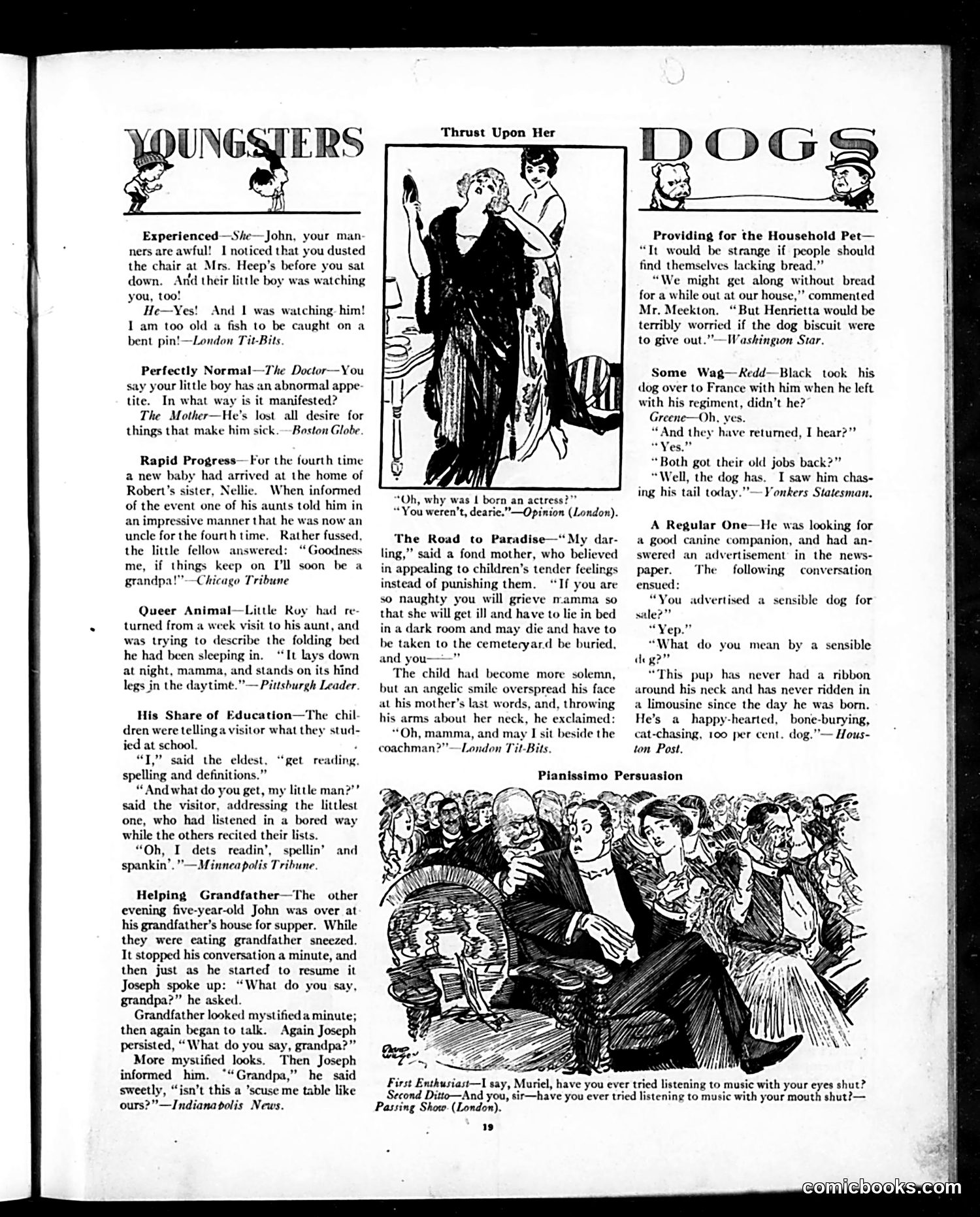
This page collects brief humorous anecdotes organized into three sections: "Youngsters," "Dogs," and "Pianissimo Persuasion." The jokes target middle-class social conventions and children's logic. In "Youngsters," children innocently expose adult hypocrisy—a boy catches his father dusting before sitting (suggesting pretense), and a child asks grandfather to say "excuse me" at table, imitating parental etiquette lessons. The "Dogs" section satirizes pet-obsessed household priorities. One joke reveals a family would sacrifice bread for dog biscuits, mocking middle-class indulgence toward animals. Another contrasts a dog's simple contentment with human pretension—the dog still chases its tail while its owner lost his job in France (likely referencing post-WWI unemployment). "Pianissimo Persuasion" (bottom cartoon) remains partially cut off but depicts a crowded social gathering. Throughout, the satire mocks Victorian/Edwardian gentility, class anxieties, and the gap between stated values and actual behavior—Judge's typical targets for educated, urbane readers.
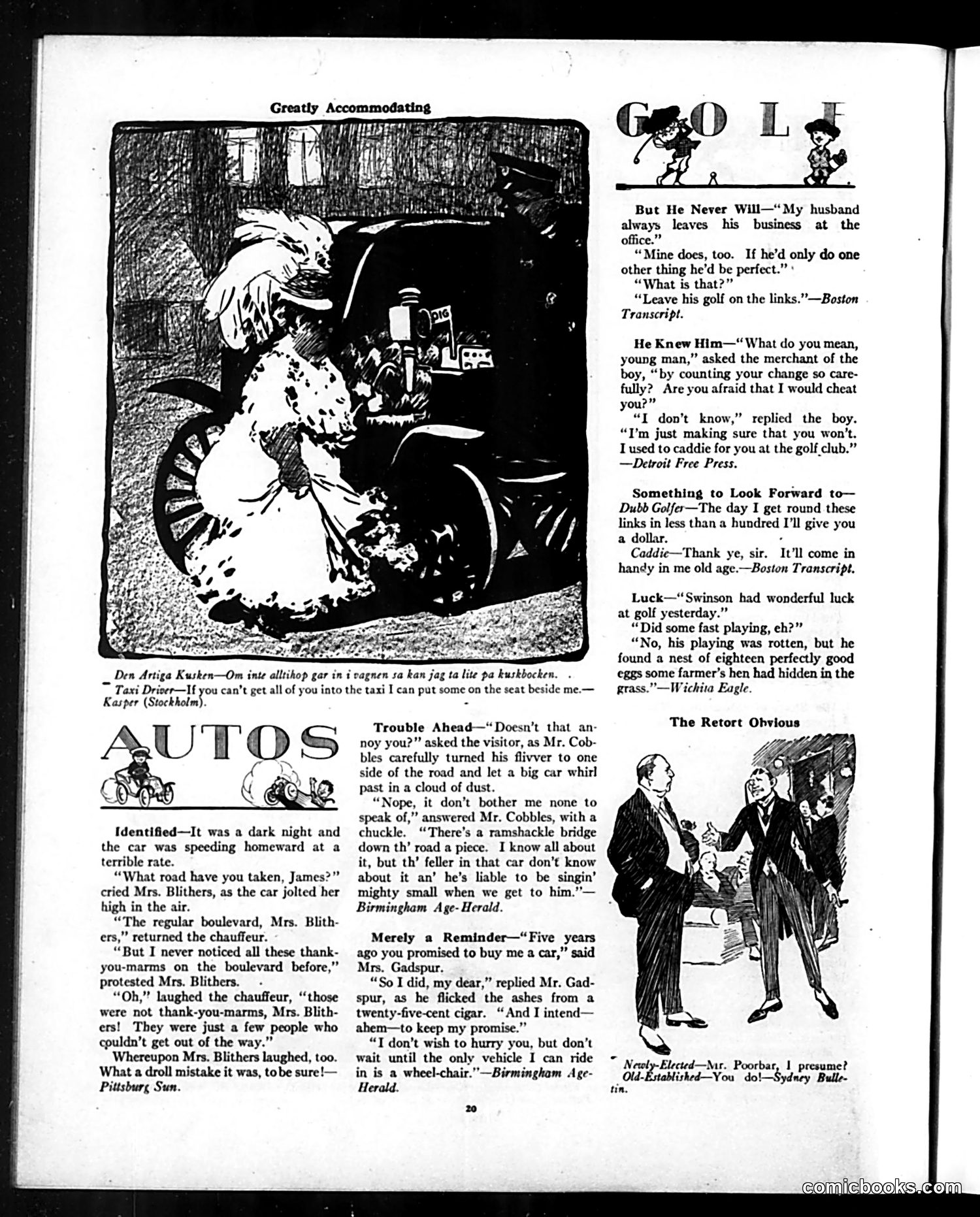
This page contains multiple short humorous anecdotes about early automobiles and golf, reflecting early 20th-century concerns about new technology and leisure pursuits. **The main cartoon** (top left) shows a woman being violently jostled in a taxi, illustrating the rough condition of early automobiles and roads—a common complaint of the era. **The anecdotes mock**: - **Reckless drivers** ("Trouble Ahead," "Identified") who endanger pedestrians and each other on primitive roads - **Broken promises** about buying cars (husbands perpetually delay, wives age waiting) - **Golf obsession** among the wealthy, portrayed as all-consuming and ridiculous - **Class dynamics**: caddies remember wealthy men's dishonesty; working-class men outwit rich drivers **"The Retort Obvious"** (bottom right) depicts a newly-elected official confronting an established politician—likely satirizing political pretension. The humor assumes readers share anxiety about automobiles, understand golf culture, and appreciate schadenfreude about the wealthy's inconveniences. The tone is lighthearted rather than biting social criticism.
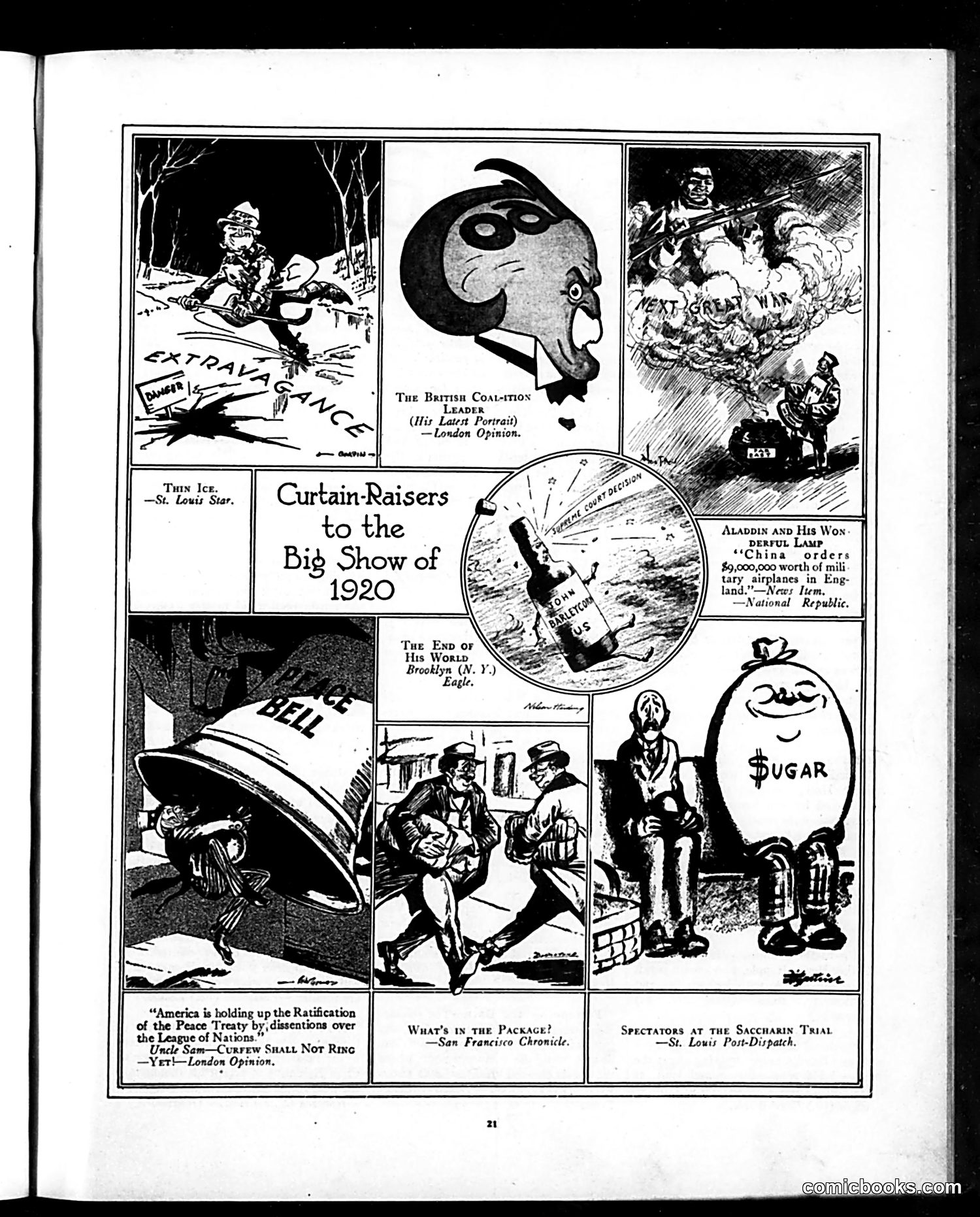
This page satirizes major American political issues of 1920: **Top center**: "The British Coalition Leader" caricatures appear to mock British political leadership during post-WWI negotiations. **Central panels** reference the **League of Nations debate**—the U.S. Senate's refusal to ratify the Treaty of Versailles over disagreements about League membership. "Uncle Sam" (America) holds up ratification while other nations wait impatiently. **"The End of His World"** shows a falling bottle labeled "Dry"—likely commenting on **Prohibition's passage** in 1920, depicted as catastrophic. **"What's in the Package?"** and **"Spectators at the Saccharin Trial"** reference lesser-known 1920 scandals or legal proceedings (saccharin likely involved food/health regulations). The cartoons use exaggerated caricature and visual metaphors typical of early 20th-century political satire, criticizing American isolationism, domestic policy changes, and contemporary scandals with biting humor targeting both politicians and public figures.
This page is not a political cartoon but rather a **humor column** featuring unintentional comic errors clipped from real newspapers and magazines. The publication pays readers $1–$5 for submitting these "bad breaks"—embarrassing typos, grammatical mistakes, or nonsensical phrasings that create unintended double meanings or absurdities. Examples include: - A woman's "EXTRA CHINS were also TRIMMED" (implying weight loss surgery) - A butcher's foot "slipped" while lifting "NINETEEN HUNDRED pownDs" of beef, breaking his thumb - A man "HANGING in the golden bird cage" (suggesting death rather than decoration) - Saying someone "NEVER hear the talk" (unclear but clearly garbled) The humor relies on readers recognizing how careless newspaper editing produces laughable sentences. This was a popular early-20th-century satirical feature mocking the quality of American journalism and written communication generally.
This page from *Judge* magazine consists entirely of satirical "breaks"—humorous misquotations or literal misinterpretations of newspaper text clippings. The magazine's technique was to reprint excerpts from newspapers with key words capitalized, then add sarcastically congratulatory headlines that mock the unintentional absurdity. Examples include: a story where a woman's accidental death brings "joy for the author," medical advice using ice on skin, a child "three years of age" who was "married," and absurd contradictions like actors waiting weeks for movie snowshoes that never come. The prize submission, "Mother's Needle Eyes and Father's Lapse," humorously literalizes descriptions through capitalized misreadings. The satire targets newspapers' careless writing and unintentional double meanings rather than political figures or events. It's essentially early 20th-century media criticism through comedic deconstruction.
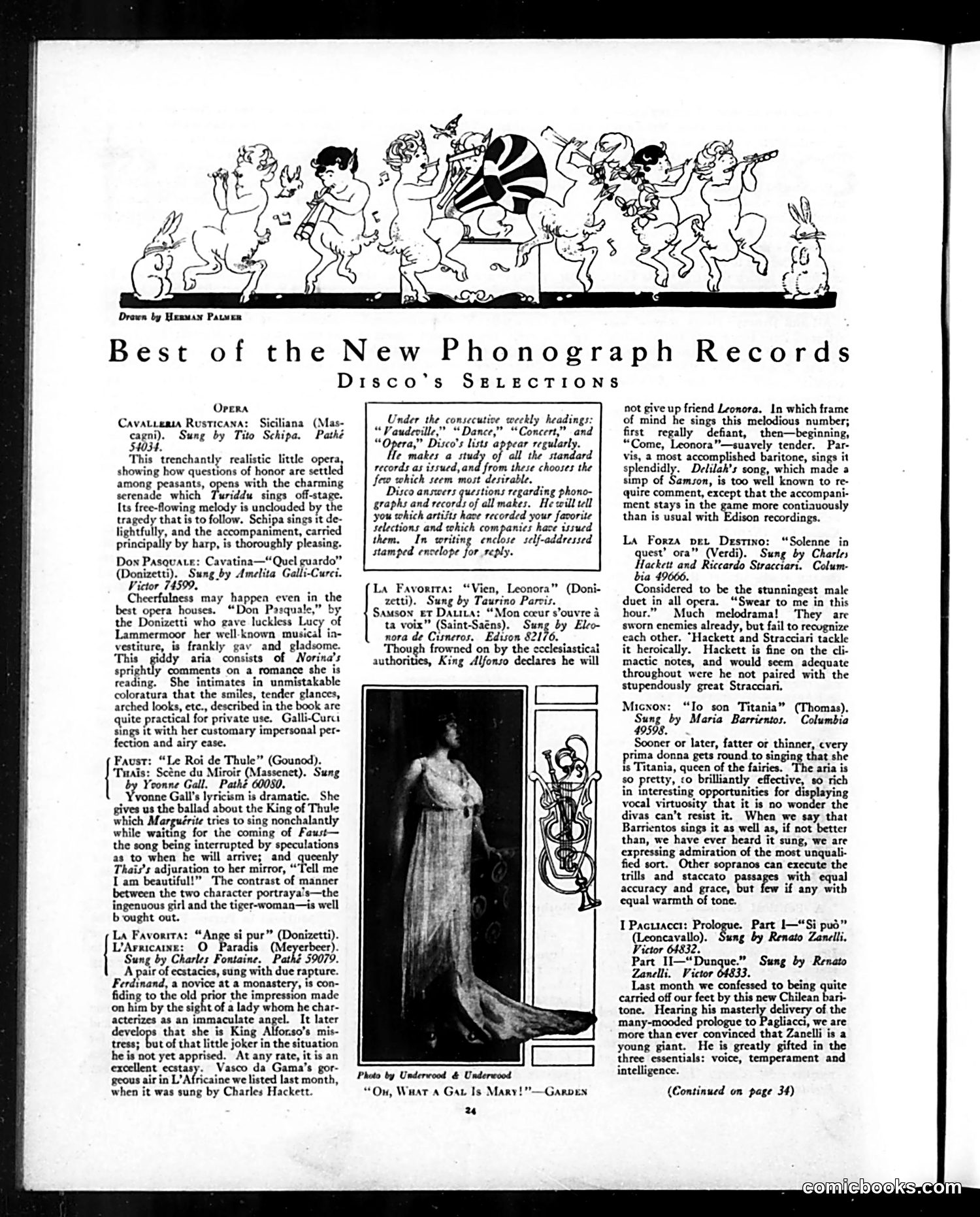
This page is primarily a **music review column**, not political satire. It features Herman Palmer's decorative header illustration—a whimsical line drawing of cherubs and creatures dancing—but this is ornamental, not satirical. The content reviews phonograph recordings of classical opera selections, organized by composer and aria. "Disco" (the column's author) evaluates performances by singers like Tito Schipa and Amelita Galli-Curci, discussing vocal technique, emotional delivery, and recording quality. The single photograph shows a woman in classical dress, captioned "'On, What a Gal Is Mary!'—Garden," likely referring to soprano Mary Garden. **For modern context**: This reflects early 20th-century popular culture's enthusiasm for operatic recordings as home entertainment—the phonograph was cutting-edge technology. The detailed, knowledgeable criticism suggests opera held mainstream cultural prestige among Judge's educated readership.
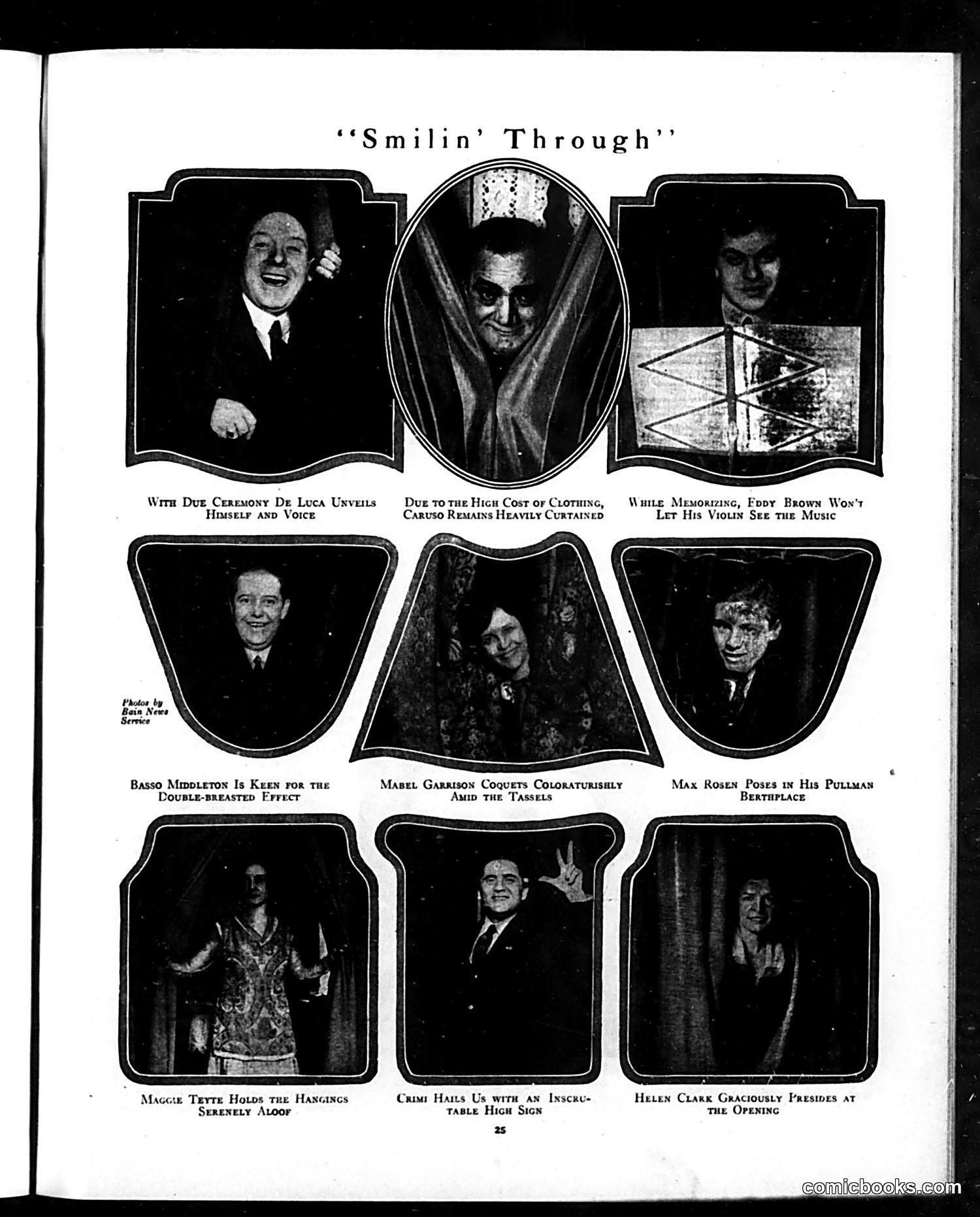
This page satirizes what appears to be a theatrical or operatic production (likely the play "Smilin' Through"). The captions mock various performers and production aspects through humorous observations: The satire targets opera/theater personalities of the era—Caruso (keeping costs down by remaining heavily curtained), Basso Middleton (for his physique), and various other performers. The humor relies on physical comedy and professional vanity: Fody Brown won't let audiences see his violin playing; Max Rosen poses artificially; Maggie Teyye holds hangings "serenely aloof." The central joke appears to be theatrical pretension and cost-cutting measures masquerading as artistic choices. References to "high cost of clothing" and curtains being "heavily curtained" suggest mocking the gap between grand operatic ambitions and practical financial constraints. Without clearer identification of the specific 1920s production, precise historical context remains unclear, though this targets recognizable entertainment figures of that period.
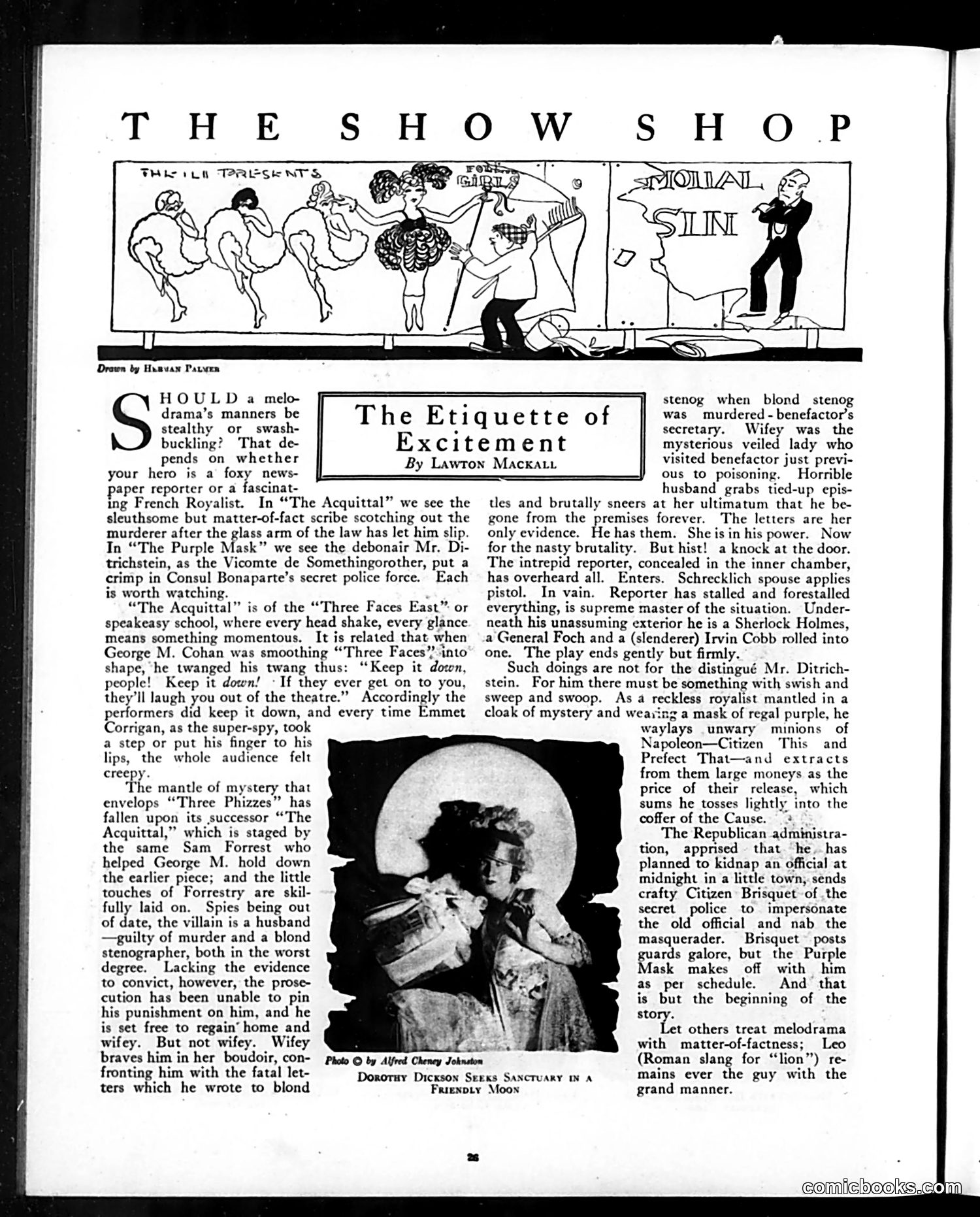
This page reviews two theatrical productions, contrasting their dramatic styles. "The Acquittal" follows the "speakeasy school" of spy melodrama—subtle, with meaningful glances and whispers—exemplified by George M. Cohan's "Three Faces East." The villain is a murderous husband; a dogged newspaper reporter concealed backstage ultimately exposes him, playing detective-hero. "The Purple Mask" features actor (likely) Ditrichstein as a royalist swashbuckler outwitting Napoleonic agents. The piece satirizes how different genres demand different approaches: straightforward journalism-style detection versus elaborate masked adventure. The cartoon at top illustrates theatrical spectacle—chorus girls, elaborate costumes, and performers—capturing the "show" of theater itself. The photograph shows actress Dorothy Dickson in a romantic scene, exemplifying the melodramatic excitement these productions offered 1920s audiences.
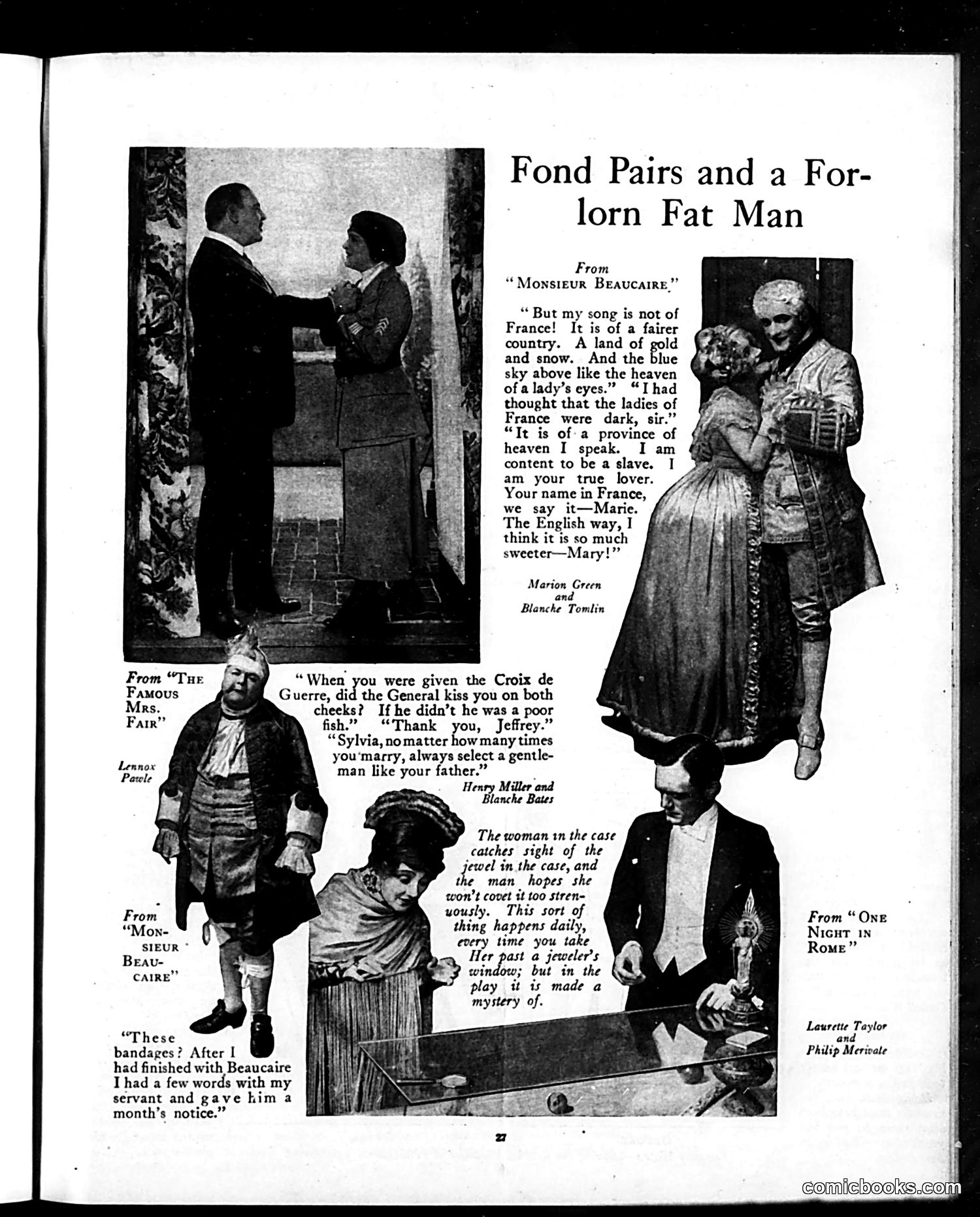
This Judge page collects theatrical scenes and quoted dialogue from contemporary stage productions, particularly "Monsieur Beaucaire." The layout showcases romantic exchanges and comic situations from popular plays of the era. The title's "forlorn fat man" likely refers to the character in the lower left (from "Monsieur Beaucaire"), who appears to be a servant or comic figure contrasted with the romantic couples shown above. The humor derives from juxtaposing sentimental romantic scenes—declarations of love, wartime romance ("Croix de Guerre"), marriage advice—with comedic moments like the fat man's dismissal of his servant over bandages. The page essentially functions as **theater promotion**, allowing Judge's readers to enjoy witty stage dialogue and recognize popular actors (Marion Green, Henry Miller, Laurette Taylor, et al.). It celebrates contemporary theatrical taste without obvious political satire—rather, it's entertainment commentary aimed at the theater-going public.
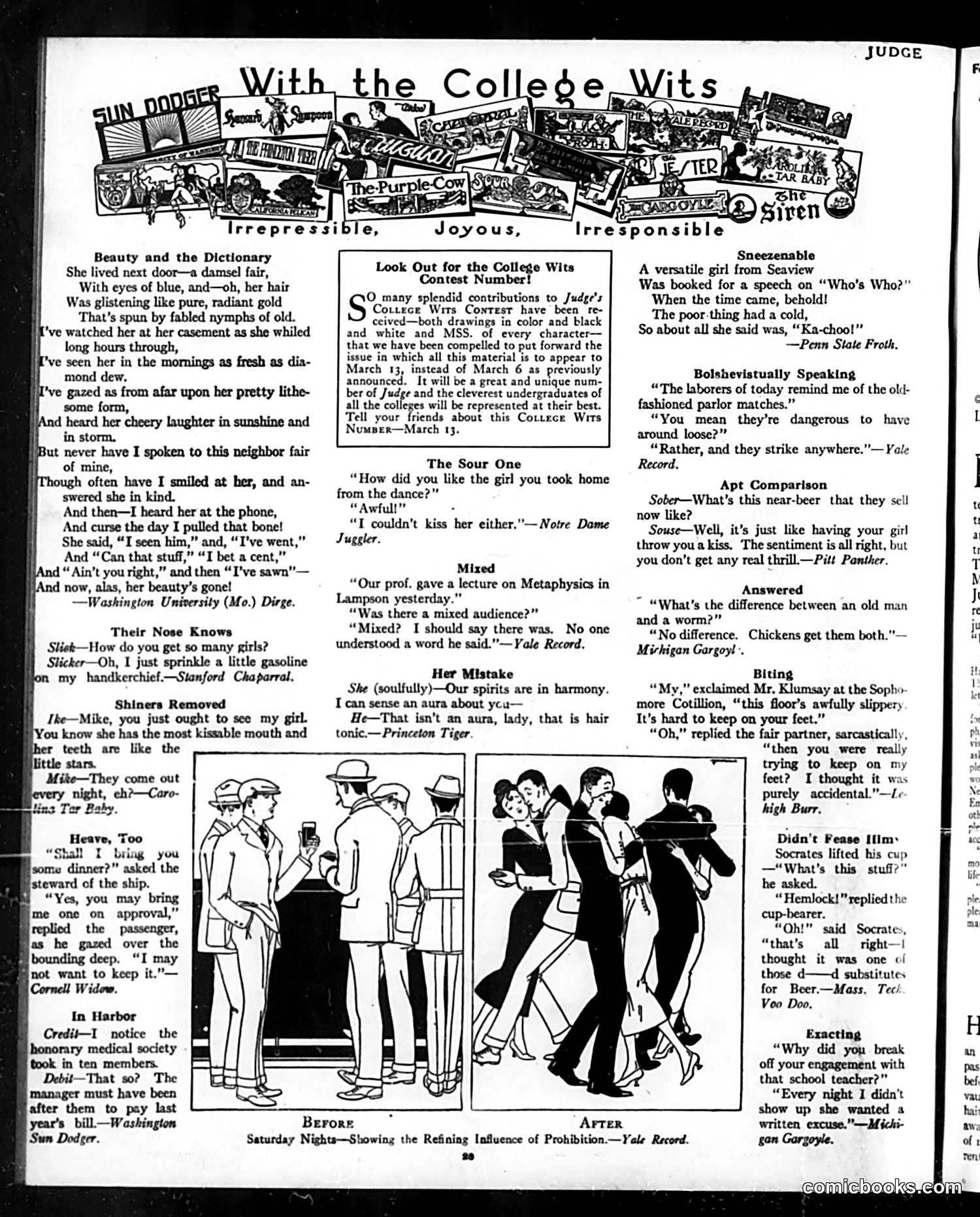
This page showcases humor contributions from college undergraduates to Judge magazine's ongoing contest. The content reflects 1920s college culture through brief jokes and witty observations. The central cartoon depicts "Before" and "After" scenes of prohibition's effects—showing men drinking openly at bars (left) versus secretly in dimly-lit settings (right), satirizing how Prohibition failed to stop drinking but merely drove it underground. Individual jokes target familiar college themes: romantic disappointment, dating mishaps, and student pranks. References to "near-beer," "hemlock," and "substitutes for Beer" mock Prohibition-era alcohol restrictions. The "Bolshevistually Speaking" joke about "laborers" and "parlor matches" that "strike anywhere" makes a topical jab at labor unrest and communist fears of the era. The overall tone is lighthearted mockery of college life, Prohibition enforcement, and contemporary social anxieties—typical of Judge's satirical approach to American culture.
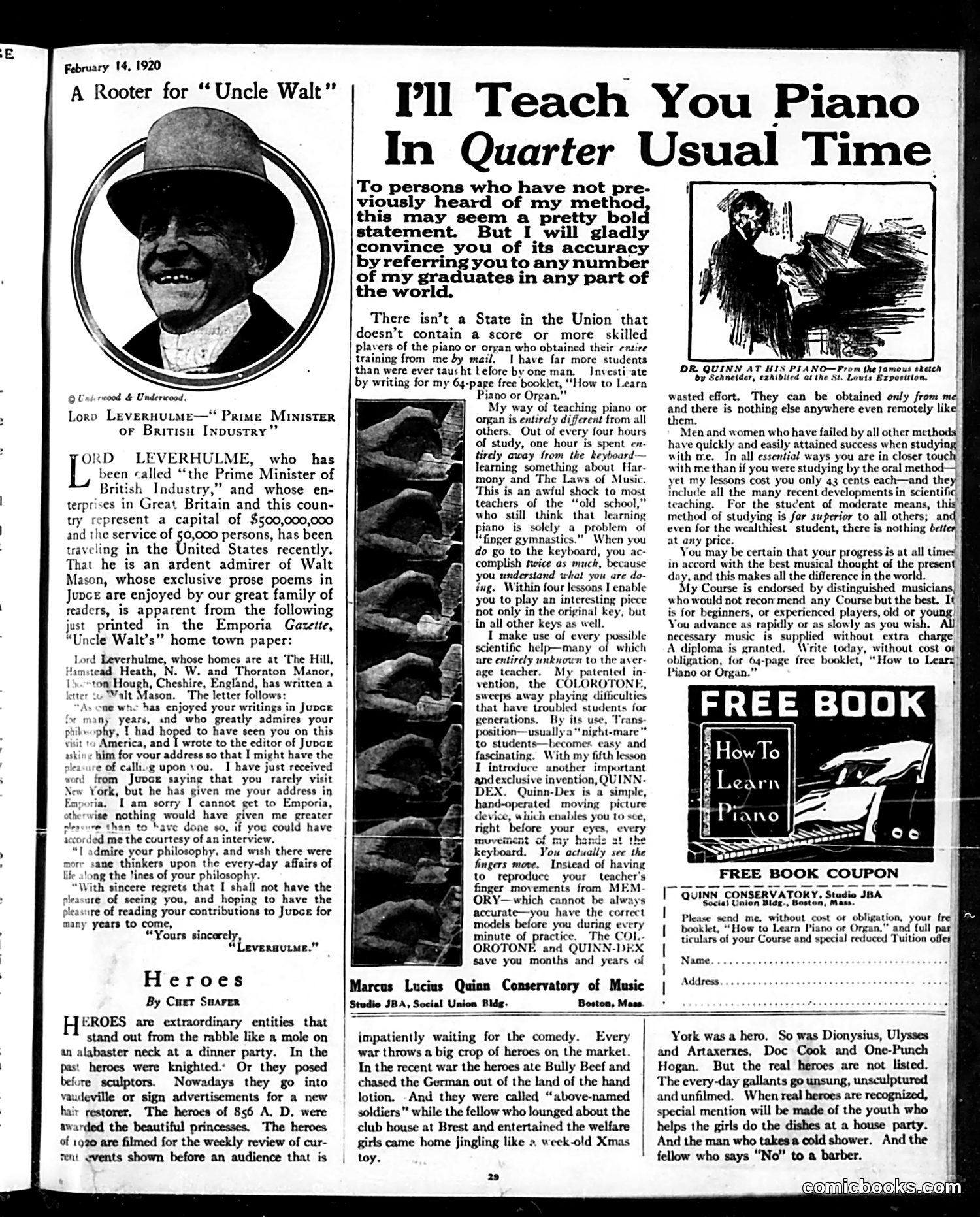
This page combines advertising with light social commentary. The main feature celebrates Lord Leverhulme, a wealthy British industrialist, endorsing Walt Mason—a popular newspaper poet whose verse appeared in *Judge*. Leverhulme's letter praises Mason's "philosophy" on everyday affairs, framed as noteworthy because a powerful industrialist publicly admires the poet's wisdom. The "Heroes" section satirizes how modern (1920s) celebrity differs from historical heroism. Rather than being knighted or awarded princesses, contemporary heroes "go into vaudeville or sign advertisements for a new hair restorer"—mocking how celebrities commercialize themselves. The bulk of the page is a piano instruction advertisement by Marcus Lucius Quinn, claiming to teach piano in one-quarter the usual time via mail. It's typical period advertising hyperbole, emphasizing his "patented invention" and scientific methods.
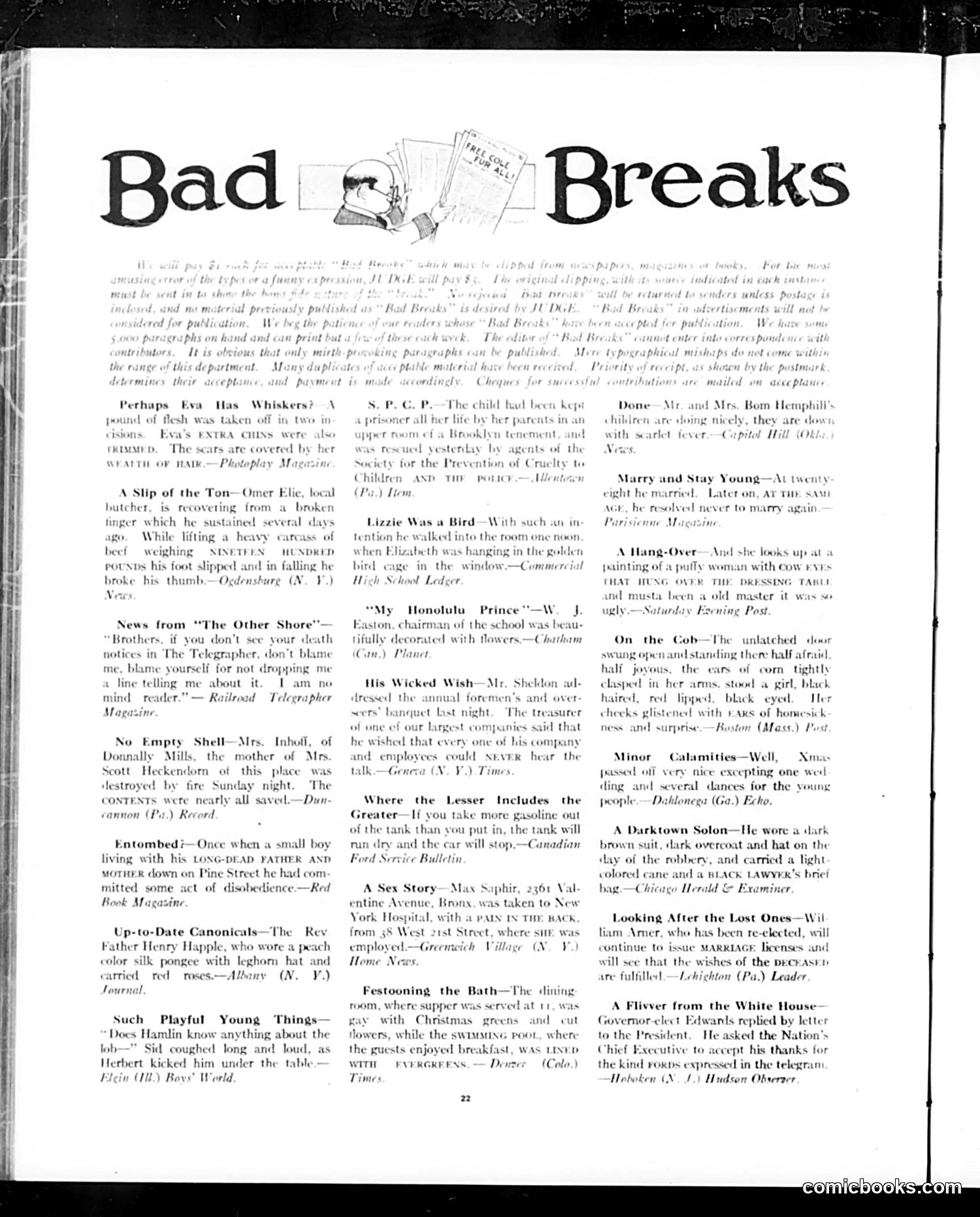
This is a "Bad Breaks" humor column—a regular Judge feature collecting amusing, embarrassing, or ironic news clippings from provincial American newspapers. The page doesn't contain political cartoons but rather brief comedic anecdotes culled from small-town papers. The humor mines class and regional stereotypes: a butcher's accident, a reverend's fashionable outfit ("peach silk pongee"), a servant girl's melodramatic romance "On the Cob," and a "Darktown Solon" (racial caricature). The column satirizes small-town life, provincial naïveté, and newspaper writing quality itself—many items feature garbled syntax or unintentionally funny phrasings the editors exploit. For modern readers: this represents 1920s-era satirical humor targeting rural America and immigrants, with casual racism. The "bad breaks" are ordinary people's misfortunes treated as entertainment for urban Judge readers.
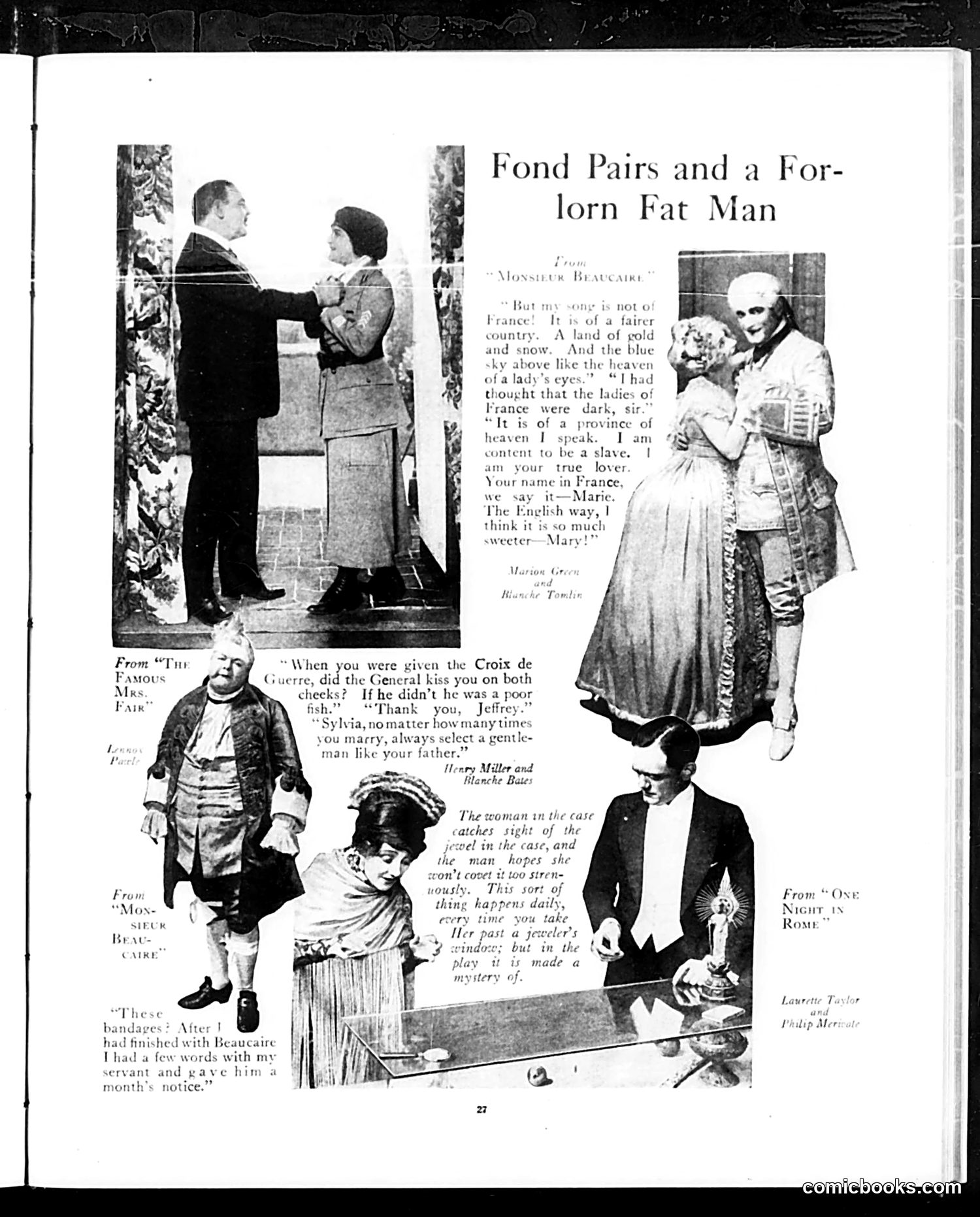
This page satirizes romantic comedies of the silent film era through illustrated scenes and quoted dialogue. The content appears drawn from multiple theatrical productions or films, each depicting romantic scenarios between male and female characters. The satire targets conventional romantic tropes: passionate foreign suitors (note the French lover praising his lady's eyes), wealthy gentlemen selecting appropriate partners, and love triangles involving "the woman in the case." The title's reference to a "forlorn fat man" suggests mockery of a comedic character type—likely the rejected suitor or bumbling outsider observing these romantic entanglements. The quoted dialogue emphasizes melodramatic sentiment and predictable plot devices common to period entertainment. By collecting these scenes together, Judge ridicules the formulaic nature of contemporary romantic storytelling—the repetitive gentleman-and-lady dynamics, the emphasis on social propriety, and the standardized emotional declarations that dominated popular theater and early cinema. The humor relies on audiences recognizing these familiar theatrical clichés.
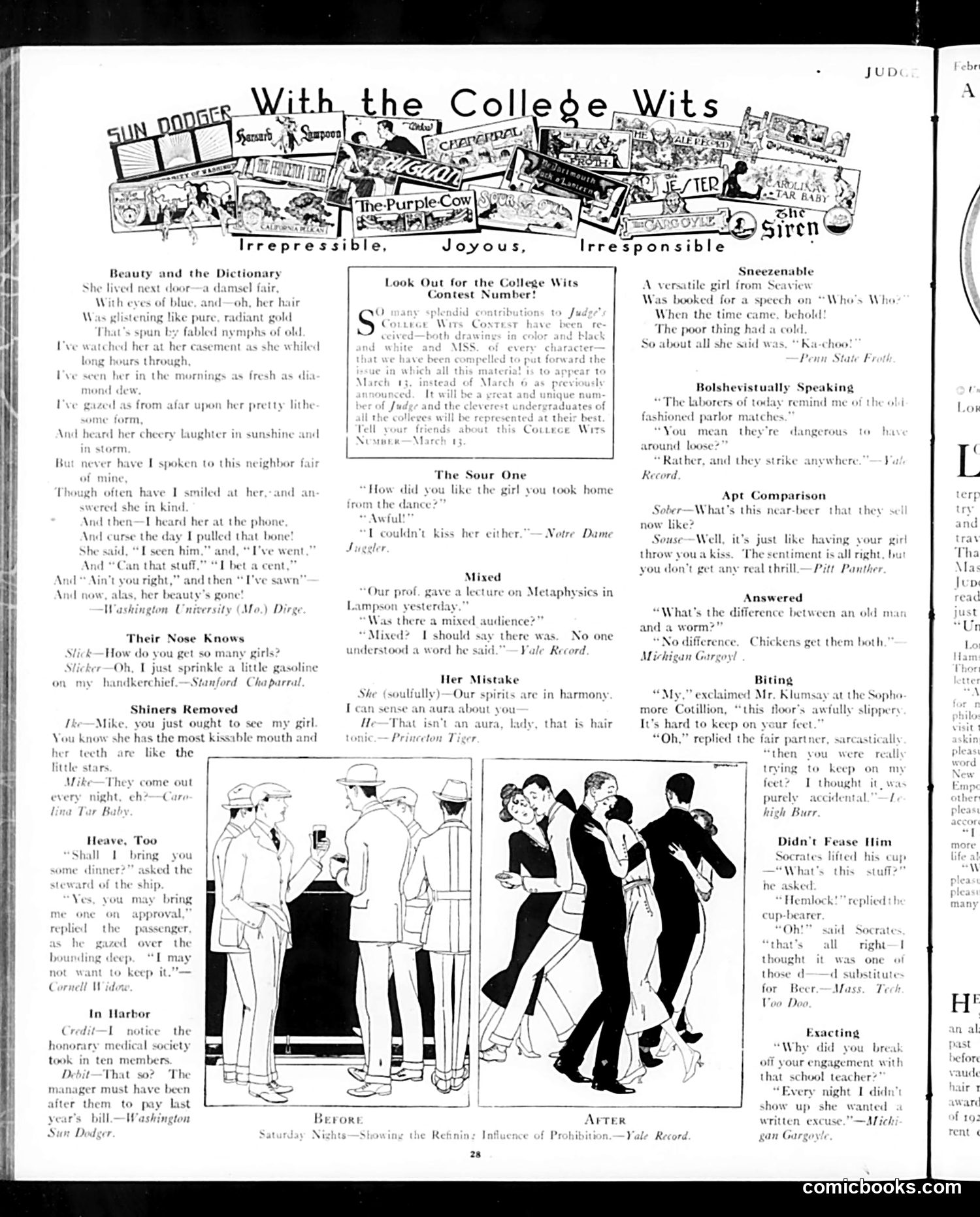
This page collects short humorous anecdotes and jokes from college life, presented as a contest for readers to submit their own witty college observations. The cartoons illustrate typical college social scenarios. The two illustrated panels show: **(left)** men in formal wear at what appears to be a social gathering or dance, and **(right)** men in tuxedos dancing together or in close physical contact, likely depicting comedic misunderstandings or awkward social situations. The accompanying jokes mock college life stereotypes: the intellectually pretentious professor nobody understands, dating mishaps, prohibition-era "near-beer," and relationship drama. References to "Bolshevistually Speaking" suggest post-WWI anxieties about radical politics infiltrating academia. The humor is gentle, focused on romantic entanglements and social awkwardness rather than sharp political satire—typical of Judge's lighter collegiate humor section aimed at educated, upper-class readers of the era.
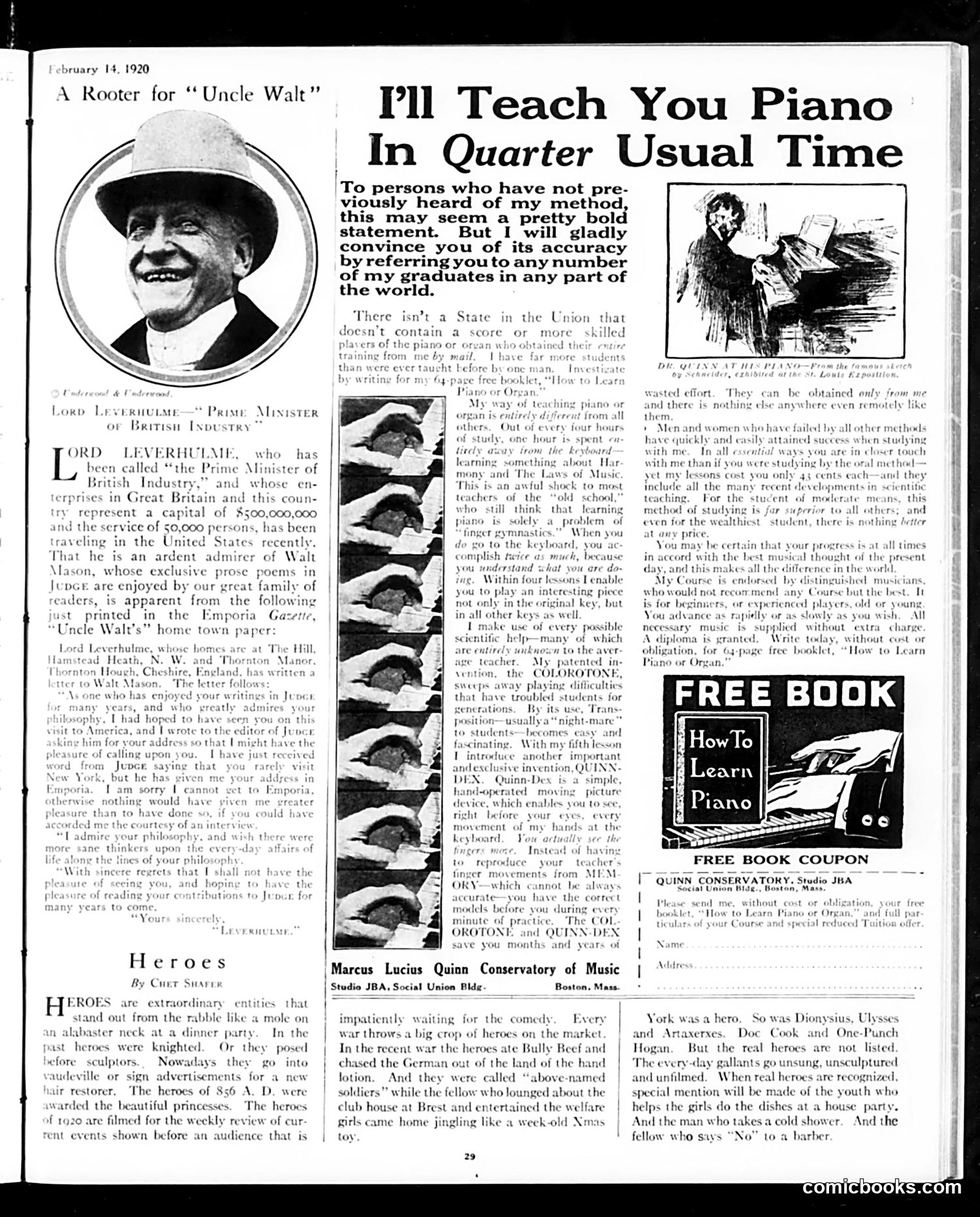
This page combines advertisement with social commentary. The top features Lord Leverhulme, a British industrialist worth $500 million, endorsing Walt Mason's poetry published in the Emporia Gazette—a notable cross-Atlantic admiration of American popular culture. The main satire appears in the "Heroes" section by Chet Shafer. It contrasts historical heroes (knighted warriors, sculpted figures) with modern 1920s "heroes"—soldiers from the recent World War I. The piece mocks how actual heroism goes unrecognized: the "real heroes" aren't the combat soldiers but everyday men doing mundane tasks (helping with dishes, taking cold showers, saying "no" to a barber). It's a cynical commentary on how wartime creates false celebrity heroes while genuine, unglamorous decency remains invisible and unsculptured. The piano instruction ad for Quinn Conservatory fills the remaining space.
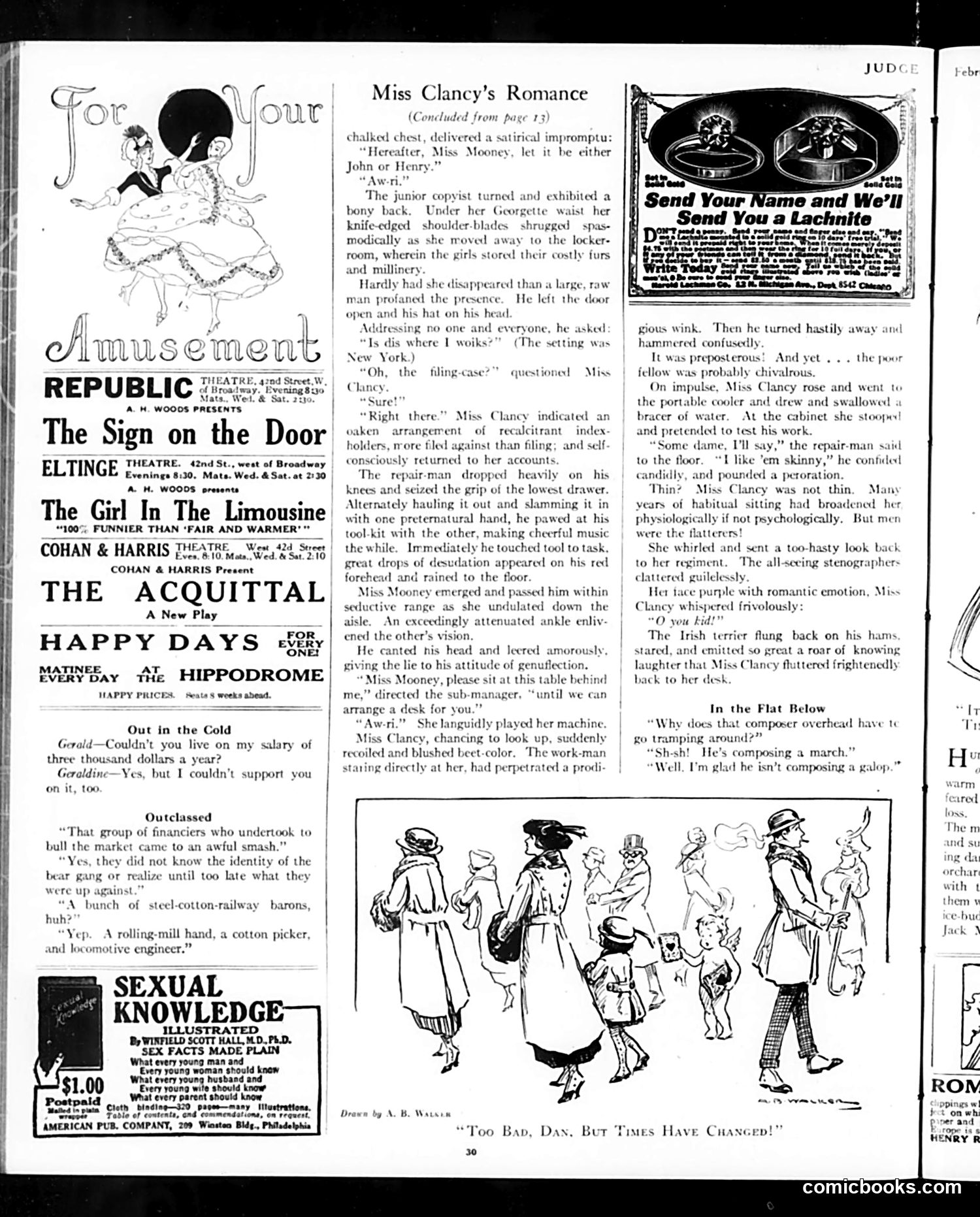
This page concludes a serialized story about office dynamics in what appears to be an early 20th-century workplace. The narrative depicts a flirtation between Miss Clancy (an office worker) and a repair man making unwanted advances—he winks at her while working, and later compliments another woman (Miss Mooney) to Miss Clancy, calling her "skinny." The humor derives from class and gender dynamics typical of the era: the working-class repair man's crude flirtatiousness contrasts with office etiquette, while Miss Clancy's conflicted reaction (initially offended, then reconsidering him as "probably chivalrous") reflects period attitudes about romance and propriety. The surrounding advertisements—including one for "Sexual Knowledge" and theater listings—and humorous dialogue snippets ("Out in the Cold," "Outclassed") represent typical Judge magazine content: satirizing modern life, relationships, and class distinctions for educated readers.
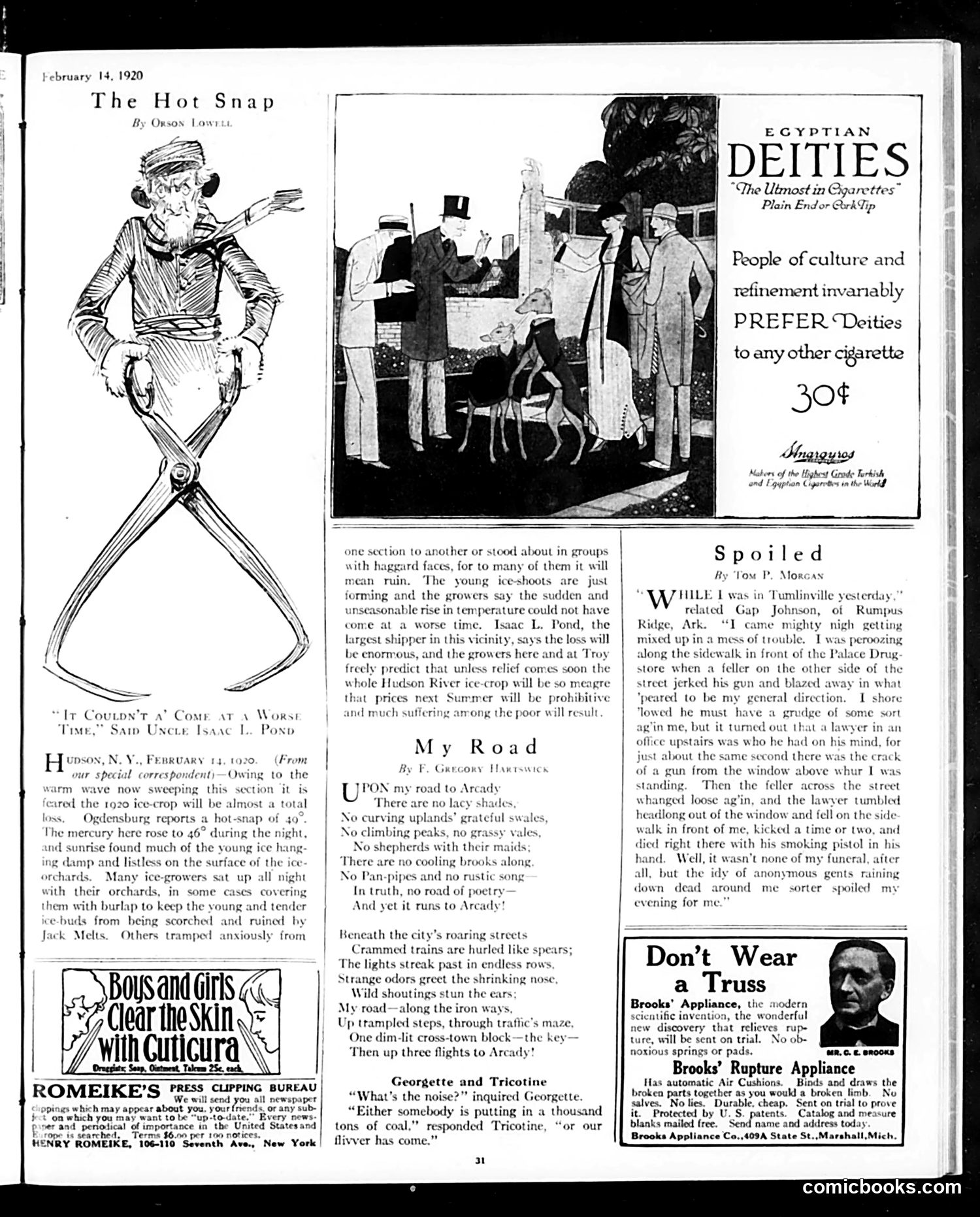
**The Main Cartoon:** The left illustration by Osos Lowell depicts Uncle Isaac L. Pond (identified in accompanying text as Hudson River's largest ice shipper) suspended uncomfortably in an oversized ice tong or hook, expressing dismay at an unseasonable warm spell. **The Context & Satire:** The cartoon satirizes the 1920 ice crisis affecting the Hudson River ice harvest. A February warm snap threatened to destroy the young ice crop before it could be properly harvested and stored—devastating for ice suppliers and poor consumers who depended on ice for food preservation before widespread refrigeration. Pond's predicament visually represents the "tight squeeze" ice growers faced: warm weather would ruin their entire season's profits. The irony is darkly humorous—the man profiting from ice is literally trapped by the very commodity he depends upon. **Historical Note:** Natural ice harvesting was a major American industry until electric refrigeration became widespread in the 1920s-30s.
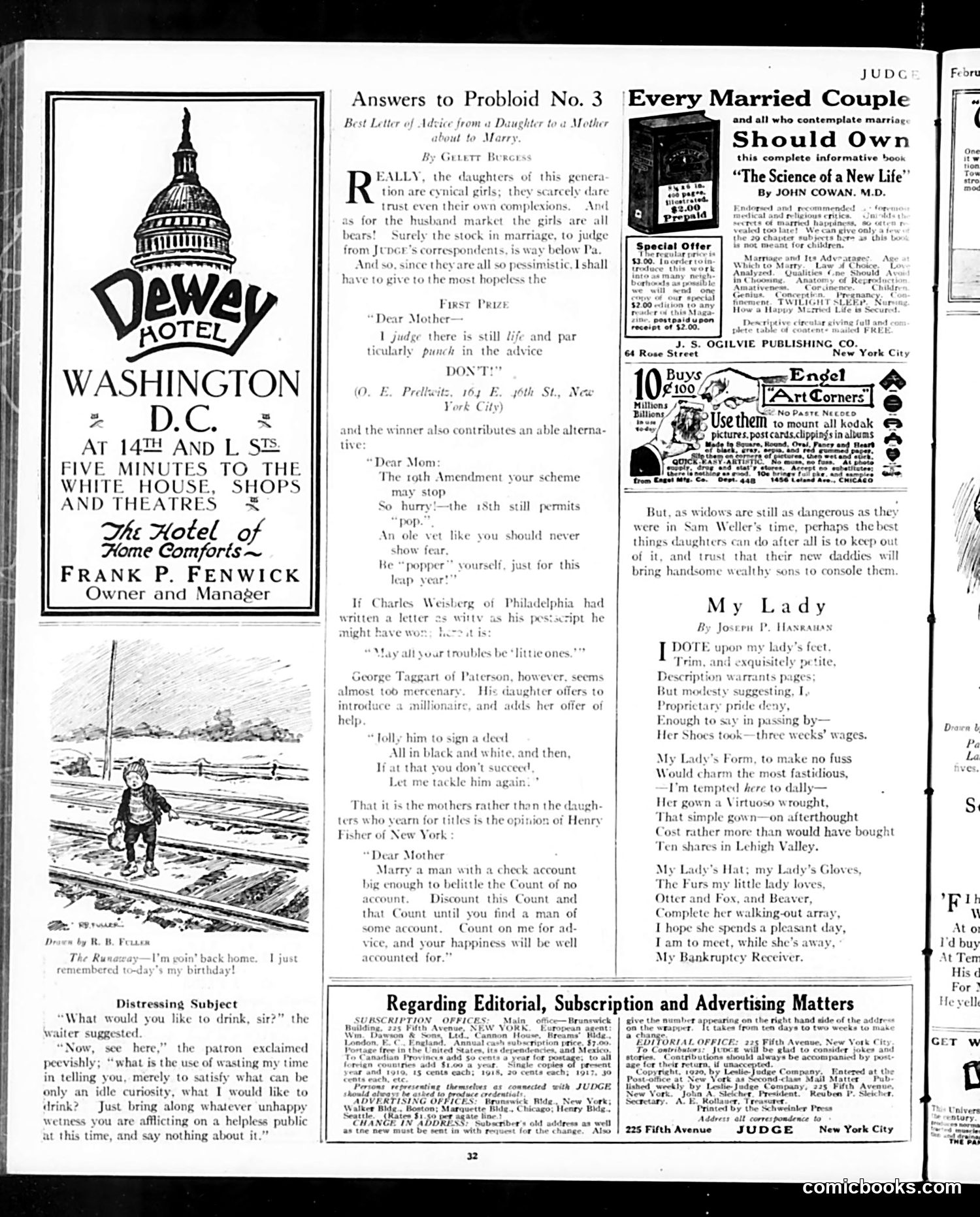
This page contains **advertisements and advice columns** rather than political cartoons. The main content is "Answers to Probloid No. 3"—a humorously cynical advice column where daughters write to their mother about her remarriage. The satire targets **women's materialism and marriage pragmatism**. One daughter suggests marrying quickly under the 18th Amendment (likely Prohibition-era context), another advises the mother to marry a wealthy man with a "check account" large enough to "belittle the Count of no account." A poem titled "My Lady" mocks **wealthy women's expensive tastes**—her shoes cost three weeks' wages, her dress cost more than stock shares—leaving the narrator facing bankruptcy. The humor suggests upper-class women are financial drains on their husbands. The overall tone is cynical about marriage as a financial transaction, with daughters viewing potential stepfathers primarily as sources of wealth rather than romantic partners. The satire implies this pragmatism is characteristic of "this generation" of daughters.
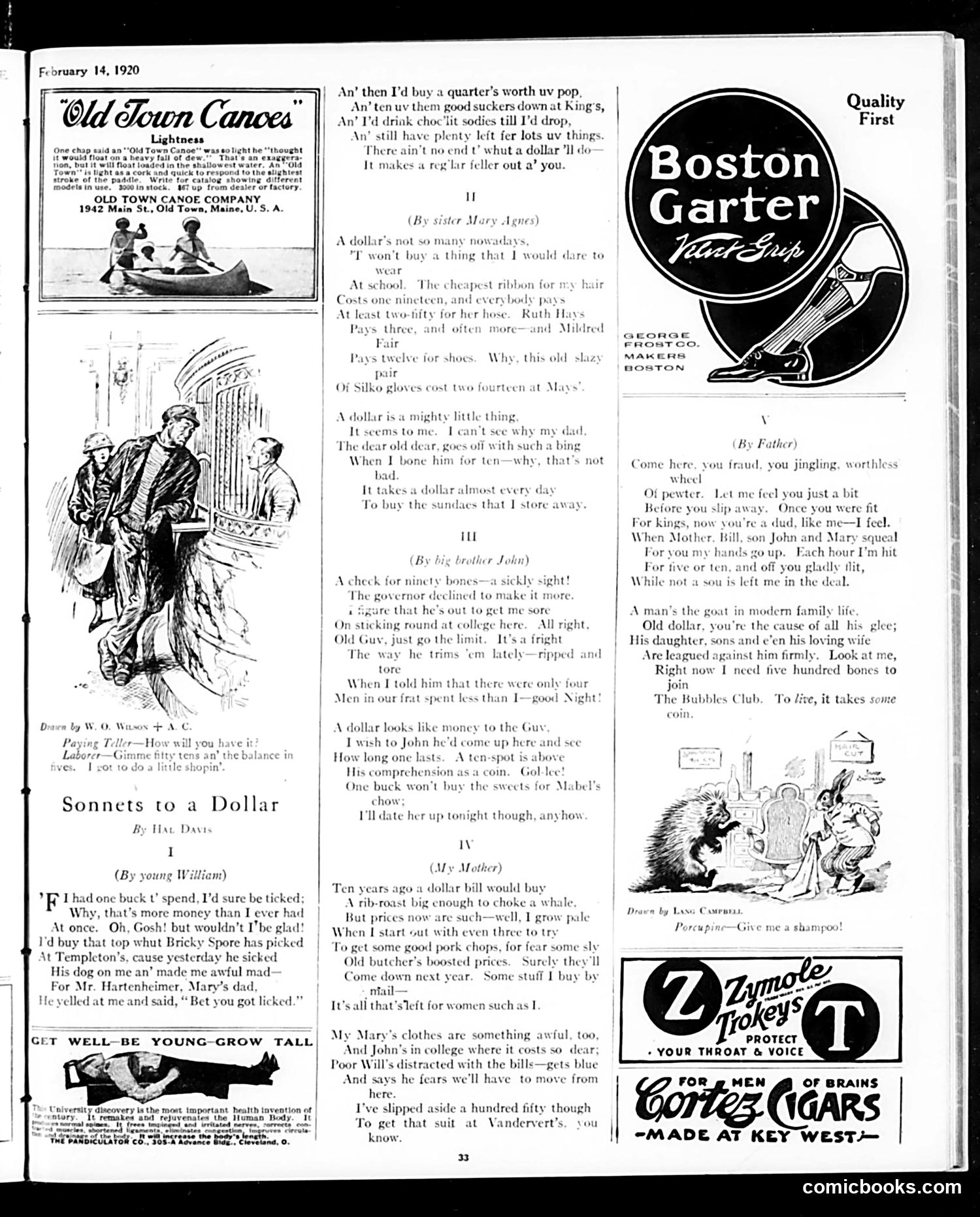
This poem sequence by Hal Davis uses multiple voices—a boy, his sister, mother, and father—to satirize post-World War I inflation and changing consumer values. Each speaker reveals how a single dollar has lost purchasing power. The **boy** imagines candy and sodas; the **sister** complains school clothes are unaffordable; the **mother** laments that meat prices have soared (a rib roast that once fed a family now costs prohibitively); and the **father** portrays himself as financially victimized by wife and children's demands, needing "$500 bones to join the Bubbles Club." The satire targets **economic hardship** following the war and the **gendered dynamics** of family spending—women and children depicted as frivolous consumers draining the male breadwinner. The repeated emphasis on what a dollar *cannot* buy underscores **serious inflation** affecting 1920 American households, though filtered through humor and caricature.
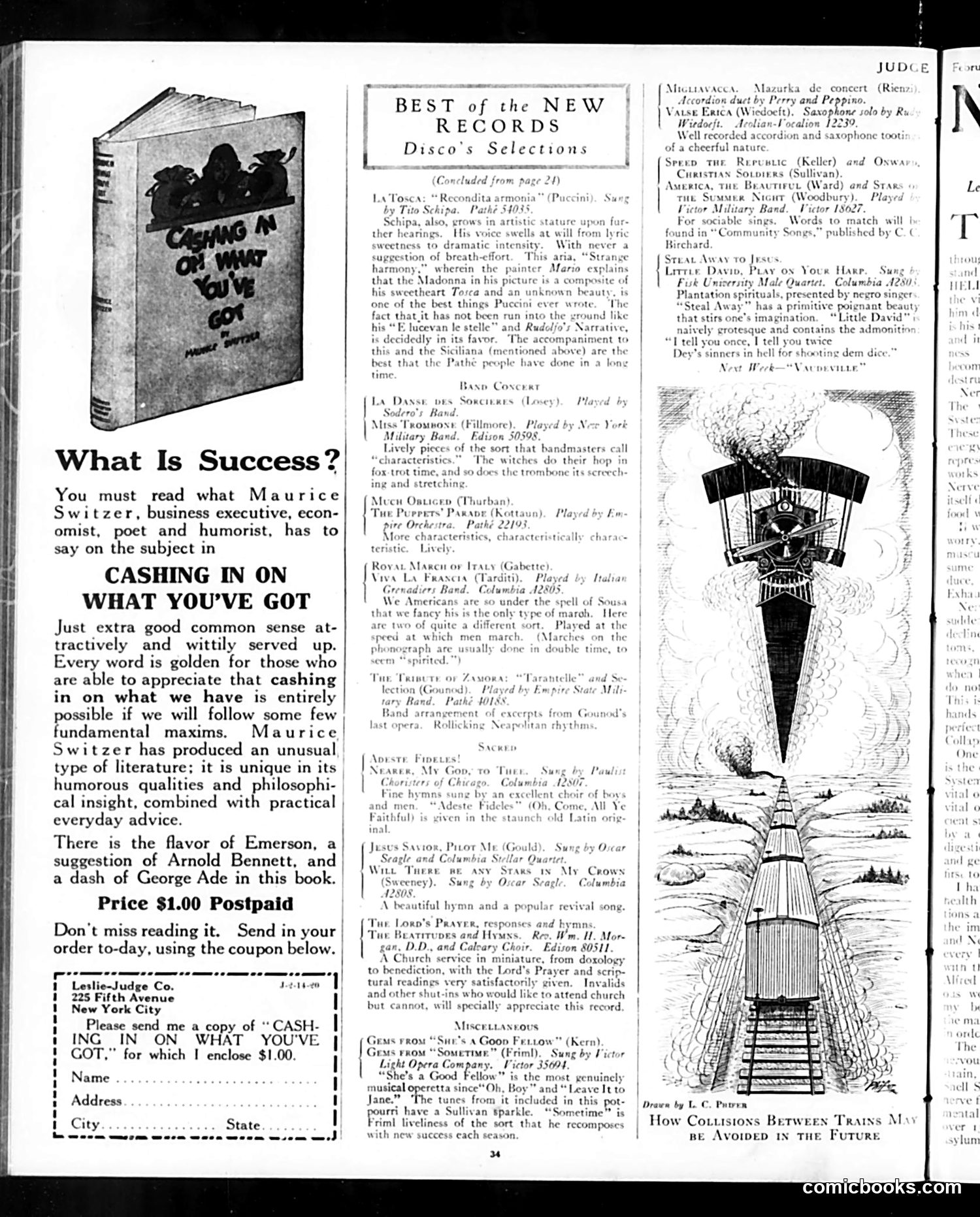
This is primarily a **record review and book advertisement page** from Judge magazine, not a political cartoon. The main content consists of: 1. **Record Reviews**: "Best of the New Records" - Disco's selections of popular phonograph recordings, featuring opera arias (Puccini), military band pieces, and religious hymns. 2. **Book Advertisement**: A prominent ad for Maurice Switzer's book *"Cashing In On What You've Got"* ($1.00), described as business/self-help advice written with humor in the style of Emerson, Arnold Bennett, and George Ade. 3. **Train Illustration**: An architectural drawing titled "How Collisions Between Trains May Be Avoided in the Future" - appears to be speculative/futuristic commentary on railway safety. The page reflects 1920s consumer culture: phonograph records were popular entertainment, self-help literature was commercially viable, and technological innovation was a topic of public fascination. No specific political satire is evident on this page.
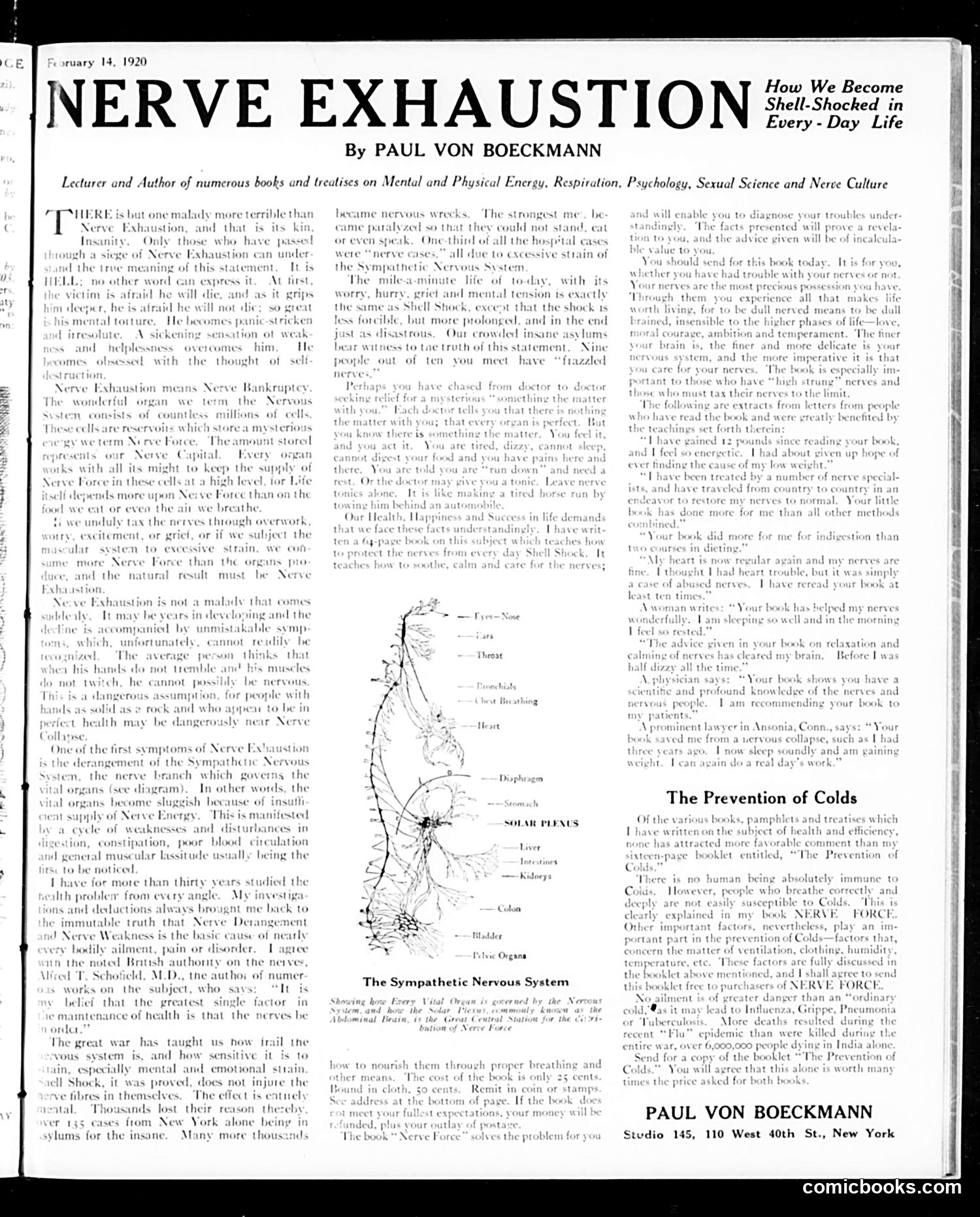
This page is primarily an **advertisement masquerading as editorial content**—a common practice in early-20th-century magazines. Paul von Boeckmann, a self-proclaimed health lecturer, promotes his book "Nerve Force" by claiming that "Nerve Exhaustion" causes modern ailments. The piece references **post-WWI "shell shock"** (trauma from war), connecting it to everyday civilian stress—a topical reference given the war's recent end. The anatomical diagram of the "Sympathetic Nervous System" lends pseudo-scientific authority to claims that weak nerves cause digestion problems, poor circulation, and other complaints. The testimonials praising the book's curative powers appear designed to convince readers they're suffering from this condition and need Boeckmann's solution. A sidebar on "The Prevention of Colds" further markets the book as a health manual. This represents **medical pseudoscience marketing** common in the era, exploiting anxiety about modern life and lingering war trauma to sell dubious self-help literature.
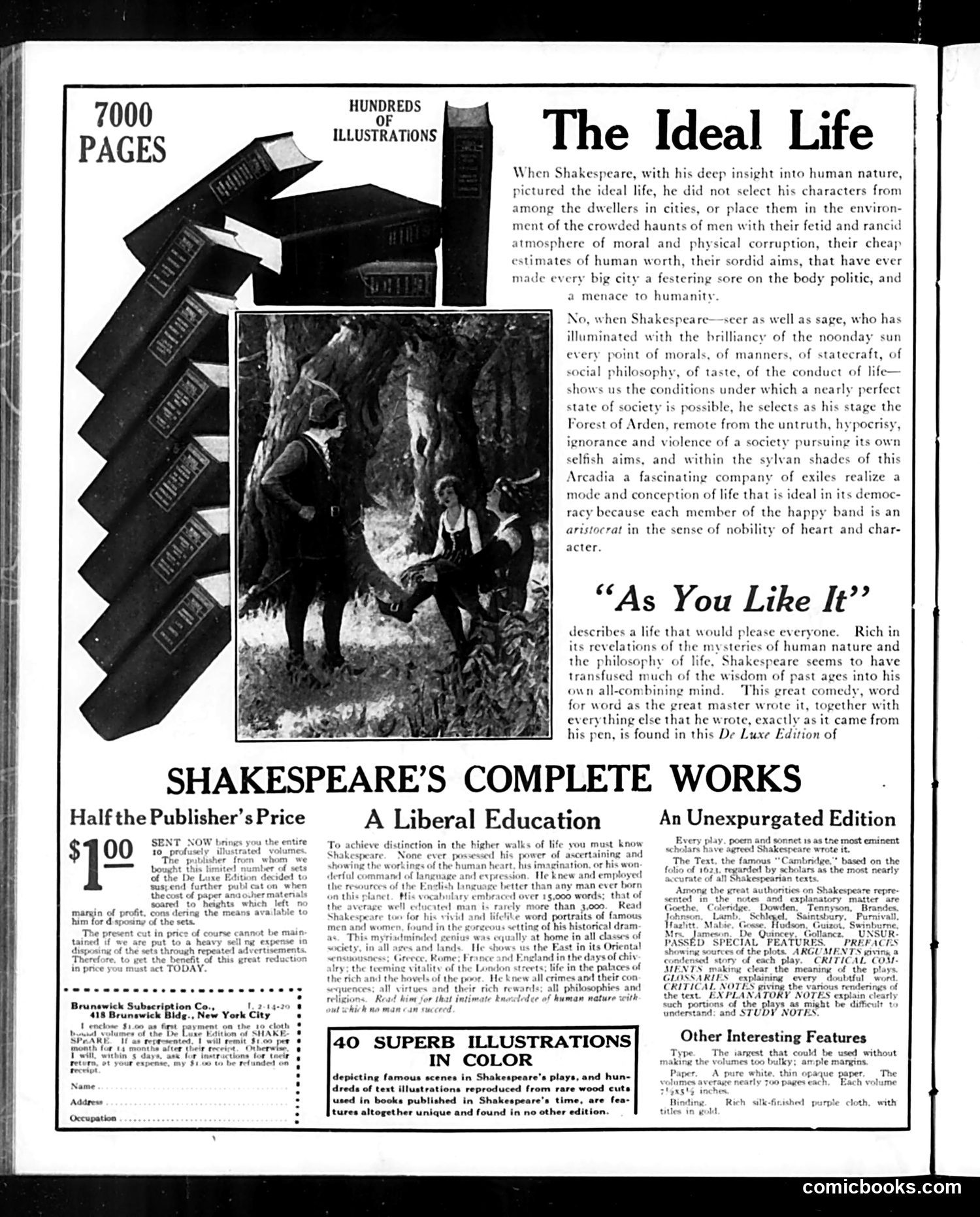
This is primarily **a full-page advertisement** for a deluxe edition of Shakespeare's complete works, not a political cartoon. The advertisement uses an essay about Shakespeare's *As You Like It* to market the product. The text argues that Shakespeare's ideal society—the Forest of Arden—exists remote from corrupt cities, depicting a community of noble-hearted exiles living in harmony. This romanticized vision of rural virtue versus urban moral decay was a common 19th-century cultural trope. The pitch emphasizes the edition's comprehensiveness (7,000 pages, hundreds of illustrations, 40 color plates, critical notes, glossaries) and positions owning it as achieving "a liberal education." The half-price offer and subscription details appear at bottom left. The illustration shows a forest scene consistent with *As You Like It*'s pastoral setting. This reflects early 20th-century marketing that positioned classic literature as both culturally elevating and economically accessible to middle-class readers.