
Judge, 1920-02-14 · page 28 of 44
Judge — February 14, 1920 — page 28: what you’re looking at
What you’re looking at
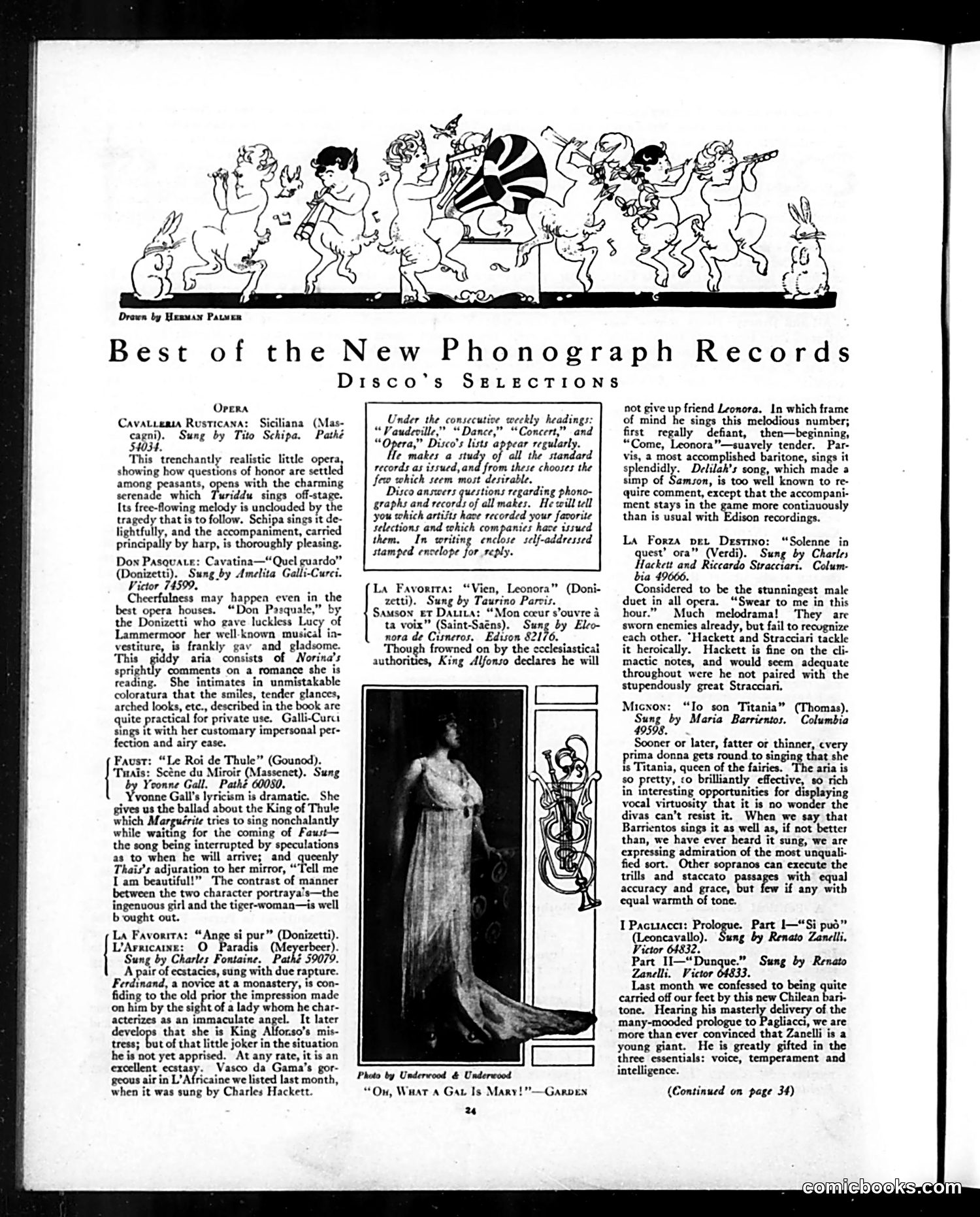
This page is primarily a **music review column**, not political satire. It features Herman Palmer's decorative header illustration—a whimsical line drawing of cherubs and creatures dancing—but this is ornamental, not satirical. The content reviews phonograph recordings of classical opera selections, organized by composer and aria. "Disco" (the column's author) evaluates performances by singers like Tito Schipa and Amelita Galli-Curci, discussing vocal technique, emotional delivery, and recording quality. The single photograph shows a woman in classical dress, captioned "'On, What a Gal Is Mary!'—Garden," likely referring to soprano Mary Garden. **For modern context**: This reflects early 20th-century popular culture's enthusiasm for operatic recordings as home entertainment—the phonograph was cutting-edge technology. The detailed, knowledgeable criticism suggests opera held mainstream cultural prestige among Judge's educated readership.
📄 Transcribed text from this page (OCR, searchable)
Machine-transcribed from the original scan — historical spelling and the odd misread are preserved.
Drown by Heamax Pauwen Best of the New Phonograph Records Disco's Orera Cavatrema Rusticana: Siciliana (Mas- cagni). Sung by Tito Schipa. Pathe 54034. This trenchantly realistic little opera, showing how questions of honor are settled among peasants, opens with the charming serenade which’ Turiddu sings off-stage. Its free-flowing melody is unclouded by the tragedy that is to follow. Schipa sings it de- lightfully, and the accompaniment, carried principally by harp, is thoroughly pleasing. Dow Pasquate: Cavatina—“ Quel guardo” (Donizetti). Sung by Amelita Galli-Curci. Victor 74599. Cheerfulness may happen even in the best opera houses. “Don Pasquale,” by the Donizetti who gave luckless Lucy of Lammermoor her well-known musical in- vestiture, is frankly gay and gladsome. This giddy aria consists of Norina’s sprightly comments on a romance she is reading. She intimates in unmistakable coloratura that the smiles, tender glances, arched looks, etc., described in the book are quite practical for private use. Galli-Curut sings it with her customary impersonal per- fection and airy ease. Faust: “Le Roi de Thule” (Gounod). ‘Tuais: Scéne du Miroir (Massenet). Sung Yoonne Gall. Pathé 60050. ‘vonne Gall’s lyricism is dramatic. She gives us the ballad about the King of Thule which Marguérite tries to sing nonchalantly while waiting for the coming of Faust— the song being interrupted by speculations as to when he will arrive; and gucenly Thais’s adjuration to her mirror, “Tell me I am beautiful!” The contrast of manner between the two character portraya’s—the ingenuous girl and the tiger-woman—is well b ought out. La Favorrra: “Ange id ant (Donizetti). L’Avricarxe: O Paradis (Meyerbeer). Sung by Charles Fontaine. Pathé 59079. A pair of ecstacies, sung with due rapture. Ferdinand, a novice at a monastery, is con- fiding to the old prior the impression made on him by the sight of a lady whom he char- acterizes as an immaculate angel. It later Savers that she is King Alforso’s mis- tress; but of that little joker in the situation he is not yet apprised. At any rate, it is an excellent ecstasy. Vasco da Gama’s gor- geous air in L’Africaine we listed last month, when it was sung by Charles Hackett. Under the consecutive weekly headings: Vaudeville,” “Dance,” “Concert,” and a,” Disco's lists appear regularly. He makes a study of all the standard records as isswed,and from these chooses the few which seem most desirable. Disco answers questions regarding phono- graphs and records of all makes. He will tell you which artists have recorded your facorite selections and which companies have issued them. In writing enclose self-addressed stamped encelope for reply. La Favorrta: “Vien, Leonora” (Doni- zetti). Sung by Taurino Paris. Sasson et Datita: “Mon coeur s’ouvre 4 ta voix” (Saint-Saéns). Sung by Eleo- nora de Cisneros. Edison 82176. Though frowned on by the ecclesiastical authorities, King Alfonso declares he will Photo by Underwood & Underwood “On, Waat a Gat Is Mary!"—Garven 24 SELECTIONS not give up friend Leonora. In which frame of mind he sings this melodious number; first regally defiant, then—beginning, “Come, Leonora”—suavely tender. Par- vis, a most accomplished baritone, sings it splendidly. Delilah’s song, which made a simp of Samson, is too well known to re- quire comment, except that the accompani- ment stays in the game more contiauously than is usual with Edison recordings. La Forza pet Destino: “Solenne in ype ora” (Verdi). Sung by Charles Hackett and Riccardo Stracciari. Colum- bia 49666. Considered to be the stunningest male duet in all opera. “Swear to me in this hour.” Much melodrama! ‘They are sworn enemies already, but fail to recugnize each other. “Hackett and Stracciari tackle it heroically. Hackett is fine on the cli- mactic notes, and would seem adequate throughout were he not paired with the stupendously great Stracciari, Micxox: “Io son Titania” (Thomas). Sung. by Maria Barrientos. Columbia Sooner or later, fatter or thinner, cvery rima donna gets round to singing that she is Titania, queen of the fairies. The ai so pretty, co brilliantly effective, so in interesting opportunities for displaying vocal virtuosity that it is no wonder the divas can’t resist it. When we say that Barrientos sings it as well as, if not better than, we have ever heard it sung, we are expressing admiration of the most unquali- barf ah Other sopranos can execute the trills and staccato penn with al accuracy and grace, but few if aapteih equal warmth of tone. I Pacuracct: Prologue. Part I—“Si puo” (Leoncavallo). Sung by Renato Zanelli. Victor 64831 Part II—“Dunque.” Sung by Renato Zanelli. Victor 64833. Last month we confessed to being quite carried off our feet by this new Chilean bari- tone. Hearing his masterly delivery of the many-mooded prologue to Pagliacci, we are more than ever convinced that Zanelli is a young giant. He is greatly gifted in the three essentials: voice, temperament and intelligence. (Continued om page 34)