
Judge, 1920-02-14 · page 5 of 44
Judge — February 14, 1920 — page 5: what you’re looking at
What you’re looking at
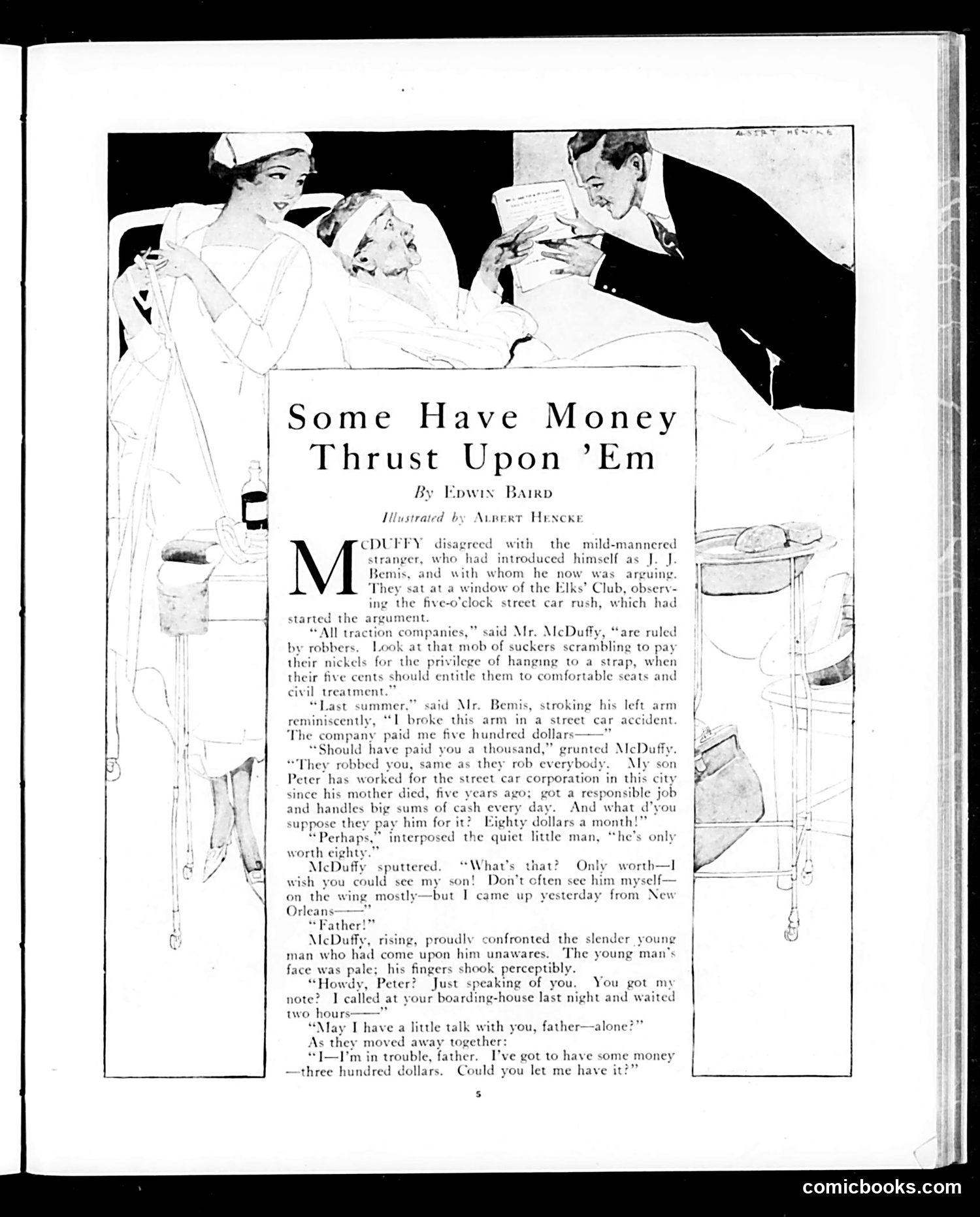
This story illustrated by Albert Hencke depicts a social commentary on wealth disparity and class conflict. Mr. McDuffy, a well-dressed man at the Elks Club, argues with a stranger (J.J. Bemis) about traction company workers. McDuffy defends corporate practices, claiming workers should accept low wages (eighty dollars monthly) for their jobs. The narrative becomes personal when Bemis reveals his son Peter works for the street car company and needs three hundred dollars urgently. The satire critiques wealthy men like McDuffy who rationalize workers' poverty while remaining indifferent to individual hardship. The title suggests wealth arbitrarily benefits some while others struggle—a commentary on early 20th-century labor conditions and class inequality.
📄 Transcribed text from this page (OCR, searchable)
Machine-transcribed from the original scan — historical spelling and the odd misread are preserved.
ih) @ eee j Sioime Have Money | | Thrust Upon ’Em } By Epwix Barro Illustrated by Avnert HenxcKt CDUFFY disagreed with the mild-mannered stranger, who had introduced himself as J. J Bemis, and with whom he now was arguing They sat at a window of the Elks’ Club, observ- ing the five-o’clock street car rush, which had started the argument “All traction companies,” said Mr. McDuffy, “are ruled by robbers. | that mob of suckers scrambling to pay their nickels for the privilege of hanging to a strap, when their five cents should entitle them to comfortable seats and civil treatment.” “Last summer,” said Mr. Bemis, stroking his left arm reminiscently, “I broke this arm in a street car accident ‘The company paid me five hundred dollars” “Should have paid you a thousand,” grunted McDuffy. “They robbed you, same as they rob everybody. My s Peter has worked for the street corporation in this cit since his mother died, five years ago; got a responsible job and handles big sums of cash every And what d’you suppose they pay him for it? Eighty dollars a montt “Perhaps,” interposed the quiet little man, “he’s o} worth eighty.” McDuffy sputtered. “What's that?) Only worth—I wish you could sce my son! Don’t often see him myself- on the wing mostly—but I came up yesterday m New Orleans— “Father!” McDuffy, rising, proudly confronted the slender young man who had come upon him unawares. ‘The young man’s face was pale; his fingers shook perceptibly. ‘Howdy, Peter? Just speaking of you. You got my note? I called at your boarding-house last night and waited two hours—— ay I have a litde talk with you, father—alone? As they moved away together: *I—I'm in trouble, father. I’ve got to have some r —three hundred dollars. Could you let me have it s comicbooks.com