
Judge, 1920-02-14 · page 6 of 44
Judge — February 14, 1920 — page 6: what you’re looking at
What you’re looking at
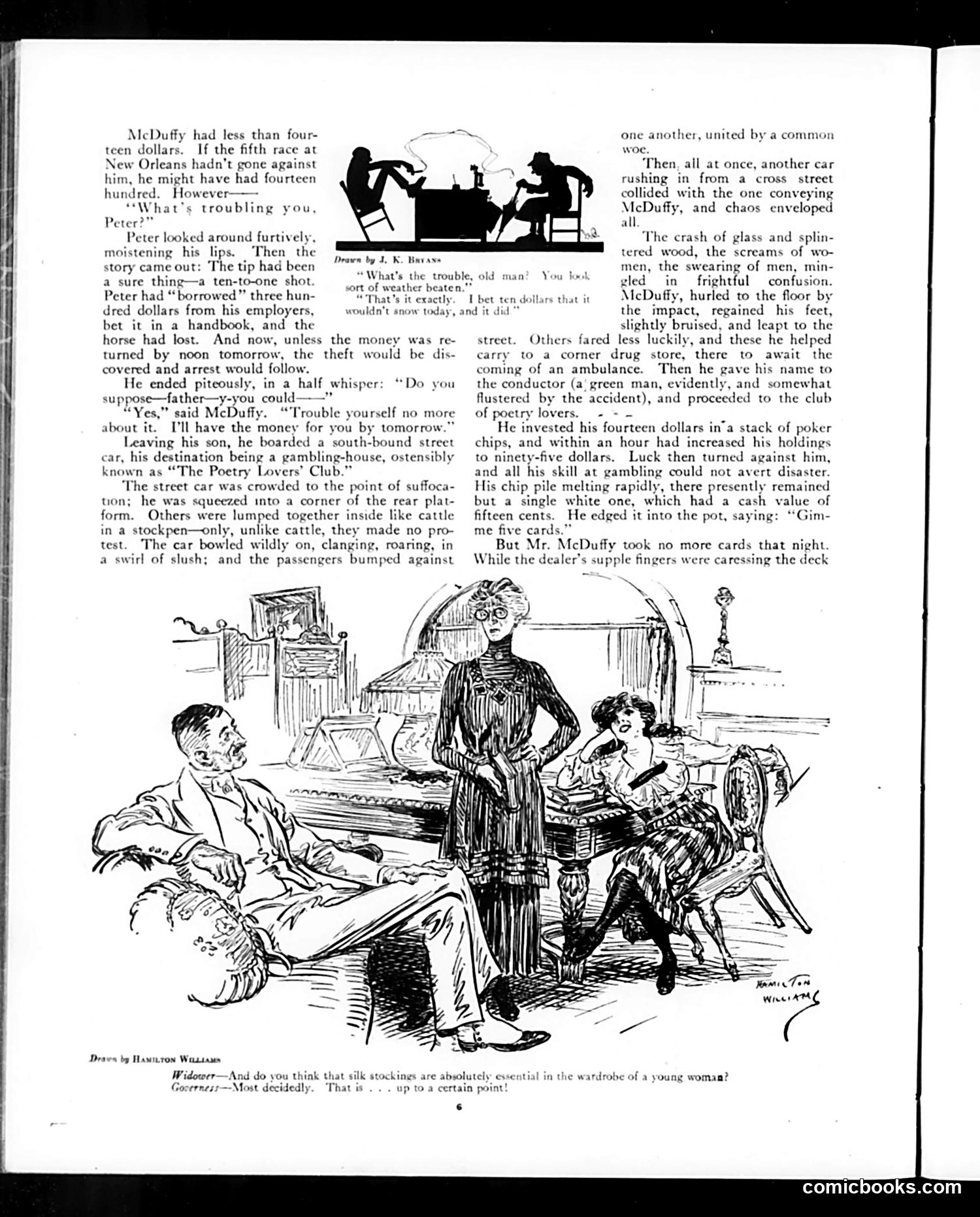
**Top Cartoon (J.K. Bryans):** Depicts two men in conversation—one weather-beaten, one well-dressed. The dialogue concerns borrowed money and a lost horse, establishing a comedic scenario about financial misfortune and broken promises between acquaintances. **Bottom Cartoon (Hamilton Williams):** Shows a domestic scene with a woman (likely a wife or governess) discussing silk stockings with two men. The caption addresses whether silk stockings are "essential" to a young woman's wardrobe—a humorous commentary on 1920s fashion debates and women's consumer expectations. The main narrative concerns Mr. McDuffy's misadventures: borrowing money, surviving a street-car accident, and losing his poker winnings. It's a morality tale satirizing luck, desperation, and poor financial judgment among working or middle-class men.
📄 Transcribed text from this page (OCR, searchable)
Machine-transcribed from the original scan — historical spelling and the odd misread are preserved.
McDuffy had less than four- teen dollars. If the fifth race at New Orleans hadn't gone against him, he might have had fourteen hundred. However—— “What's troubling you, Peter?” Peter looked around furtively, moistening his lips. Then the story came out: The tip had been a sure thing—a ten-to-one shot. Peter had “borrowed” three hun- dred dollars from his employers, bet it in a handbook, and the horse had lost. And now, unless the money was re- turned by noon tomorrow, the theft would be dis- covered and arrest would follow. He ended piteously, in a half whisper suppose—father—y-you could——” “Yes,” said McDuffy. “Trouble yourself no more about it. I'll have the money for you by tomorrow.” Leaving his son, he boarded a south-bound street car, his destination being a gambling-house, ostensibly known as “The Poetry Lovers’ Club.” ‘The street car was crowded to the point of suffoca- tion; he was squeezed into a corner of the rear plat- form. Others were lumped together inside like cattle in a stockpen—only, unlike cattle, they made no pro- test. The car bowled wildly on, clanging, roaring, in a swirl of slush; and the passengers bumped against Drawn by J. K. Bur aye “That's it exactly Dean by Hawi.ron Wauitases Widower—And do you Governess—Most decidedly “What's the trouble, old man? Y sort of weather beaten.” I bet ten dollars that it wouldn't snow today, and it did.” hink that silk stockings are absolutely essenti T up to a certain point! one another, united by a common woe. ‘Then, all at once, another car rushing in from a cross street collided with the one conveying McDuffy, and chaos enveloped all The crash of glass and splin- tered wood, the screams of wo- men, the swearing of men, min- gled in frightful confusion. McDuffy, hurled to the floor by the impact, regained his feet, slightly bruised, and leapt to the Others fared less luckily, and these he helped carry to a corner drug store, there to await the coming of an ambulance. Then he gave his name to the conductor (a' green man, evidently, and somewhat flustered by the accident), and proceeded to the club of poetry lovers. - - - He invested his fourteen dollars in’a stack of poker chips, and within an hour had increased his holdings to ninety-five dollars. Luck then turned against him, and all his skill at gambling could not avert disaster. His chip pile melting rapidly, there presently remained but a single white one, which had a cash value of fifteen cents. He edged it into the pot, saying: ““Gim- street. me five cards.” But Mr. McDuffy took no more cards that night. While the dealer’s supple fingers were caressing the deck lin the wardrobe of a young woman? comicbooks.com