
A complete issue · 36 pages · 1919
Judge — December 13, 1919
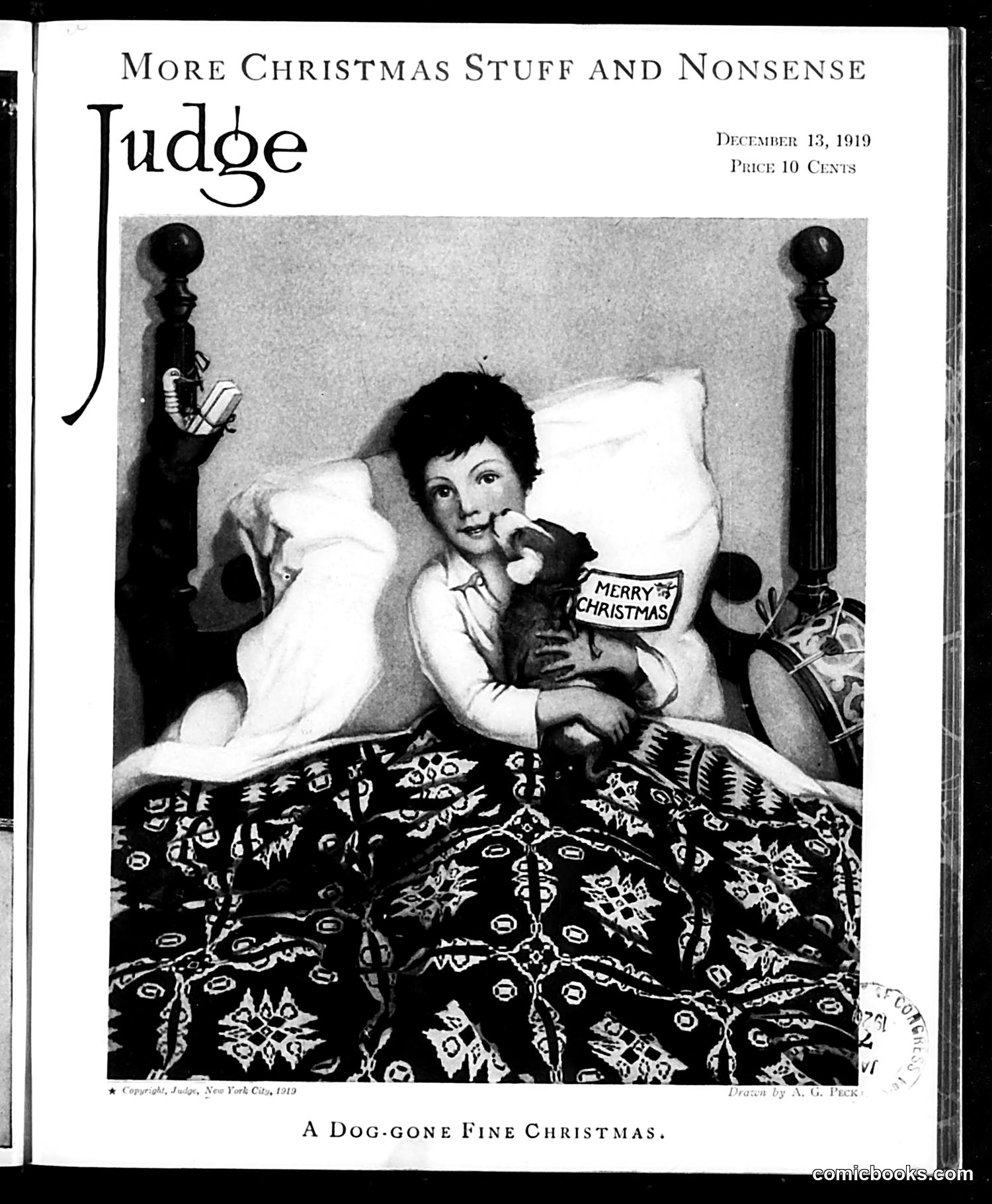
This page from Judge magazine features a humorous Christmas illustration titled "A Dog-gone Fine Christmas." The image shows a woman in bed with a small dog holding a "Merry Christmas" card. The satire appears to play on the phrase "dog-gone" (a mild exclamation) combined with the literal presence of a dog as a Christmas gift or companion. The joke likely satirizes either: the popularity of dogs as Christmas presents among wealthy households, or perhaps comments on domestic life during the post-WWI period. The woman's expression suggests bemused acceptance of the dog as her Christmas gift—possibly gentle social commentary on what constitutes an acceptable holiday present. The ornate bedding and bedroom setting indicate an upper-class household.
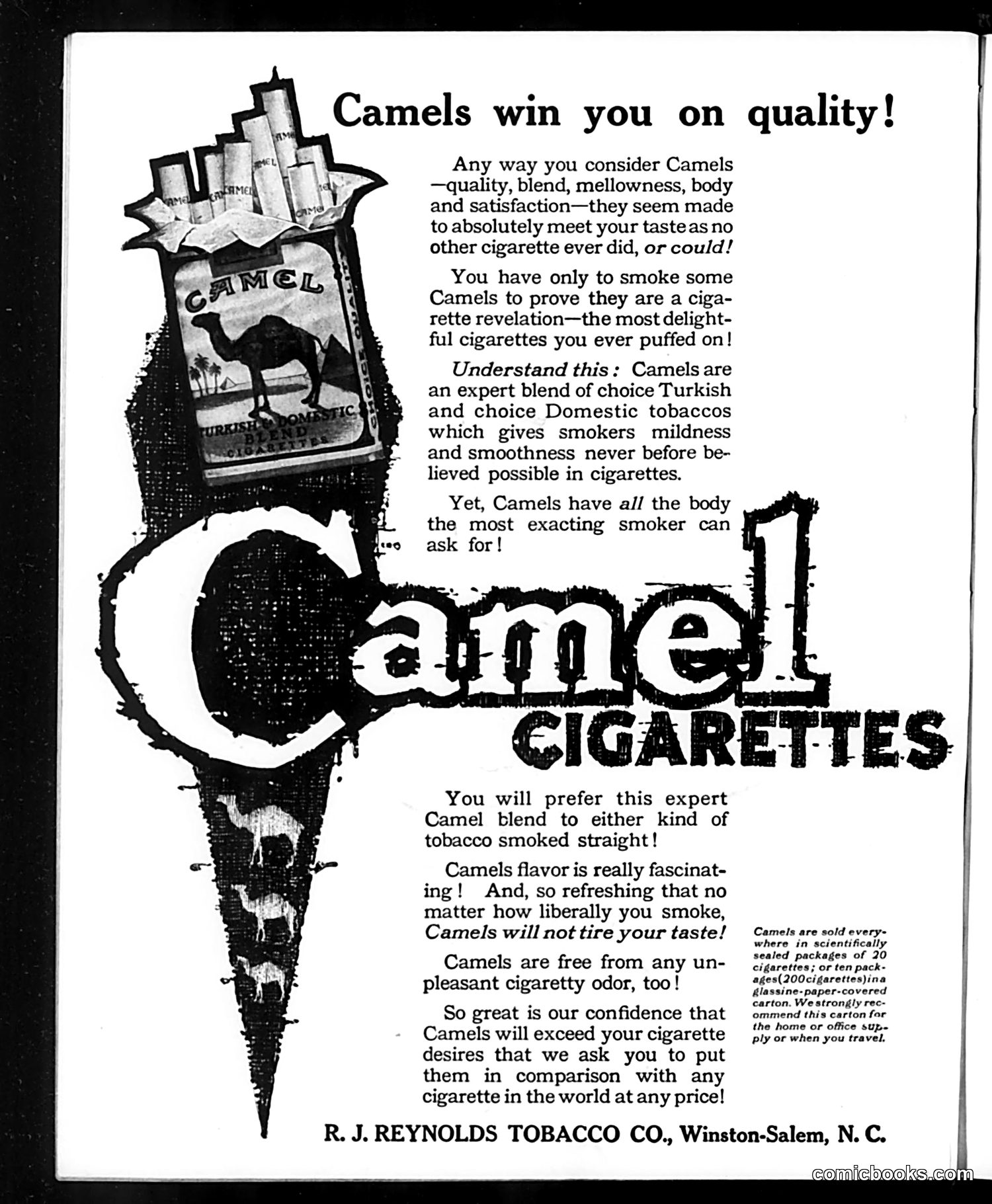
This is **not a satirical cartoon** but a **genuine cigarette advertisement** for Camel brand cigarettes, published by R. J. Reynolds Tobacco Company of Winston-Salem, North Carolina. The ad makes health and quality claims typical of early 20th-century tobacco marketing—boasting that Camels use a Turkish and domestic tobacco blend providing "millness and smoothness," won't "tire your taste," and are "free from any unpleasant cigarette odor." The camel imagery and references to Turkish tobacco were marketing devices capitalizing on exotic appeal. By modern standards, the unsubstantiated health claims and absence of health warnings are striking—this predates tobacco regulation and the surgeon general's health warnings required from 1966 onward.
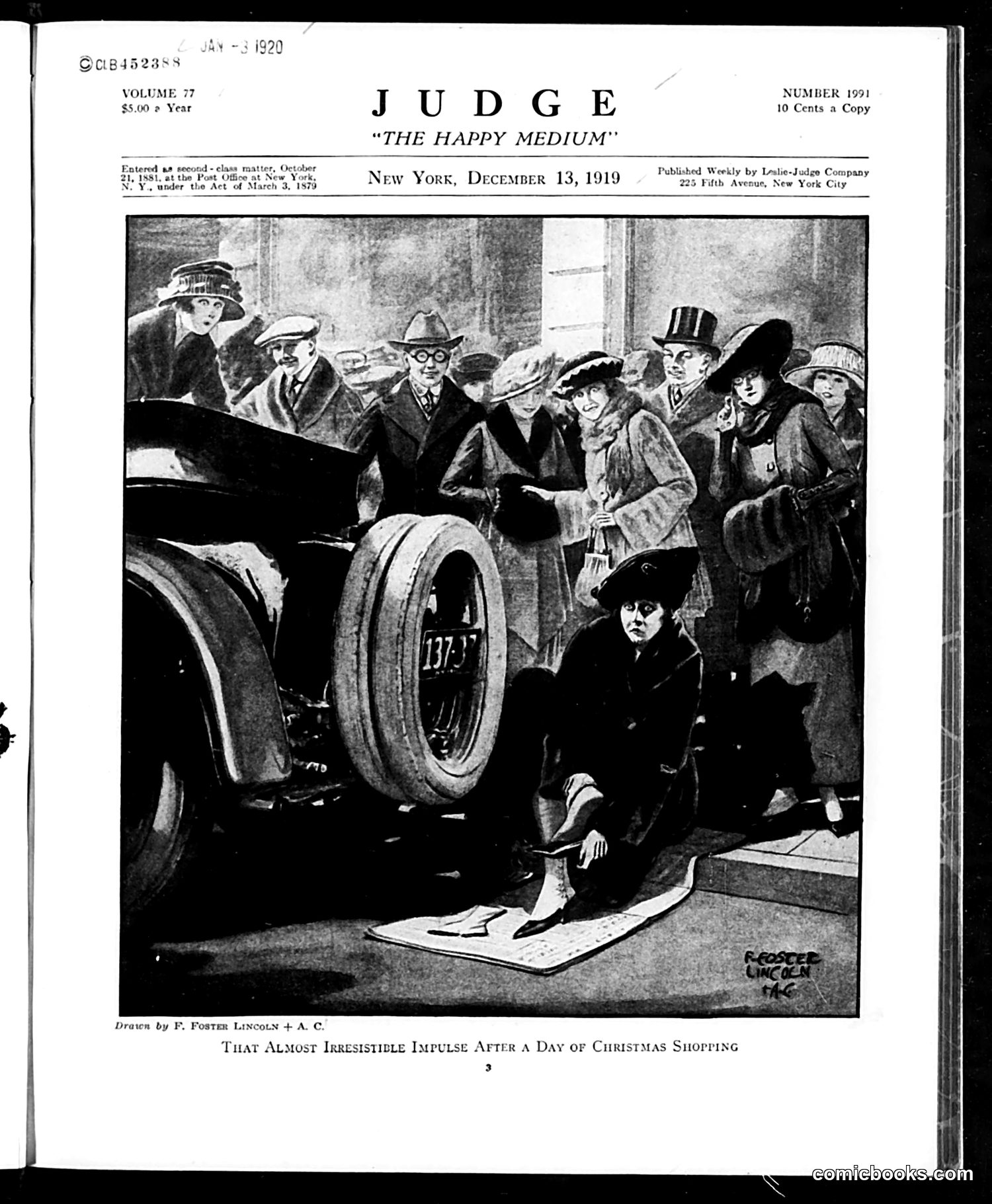
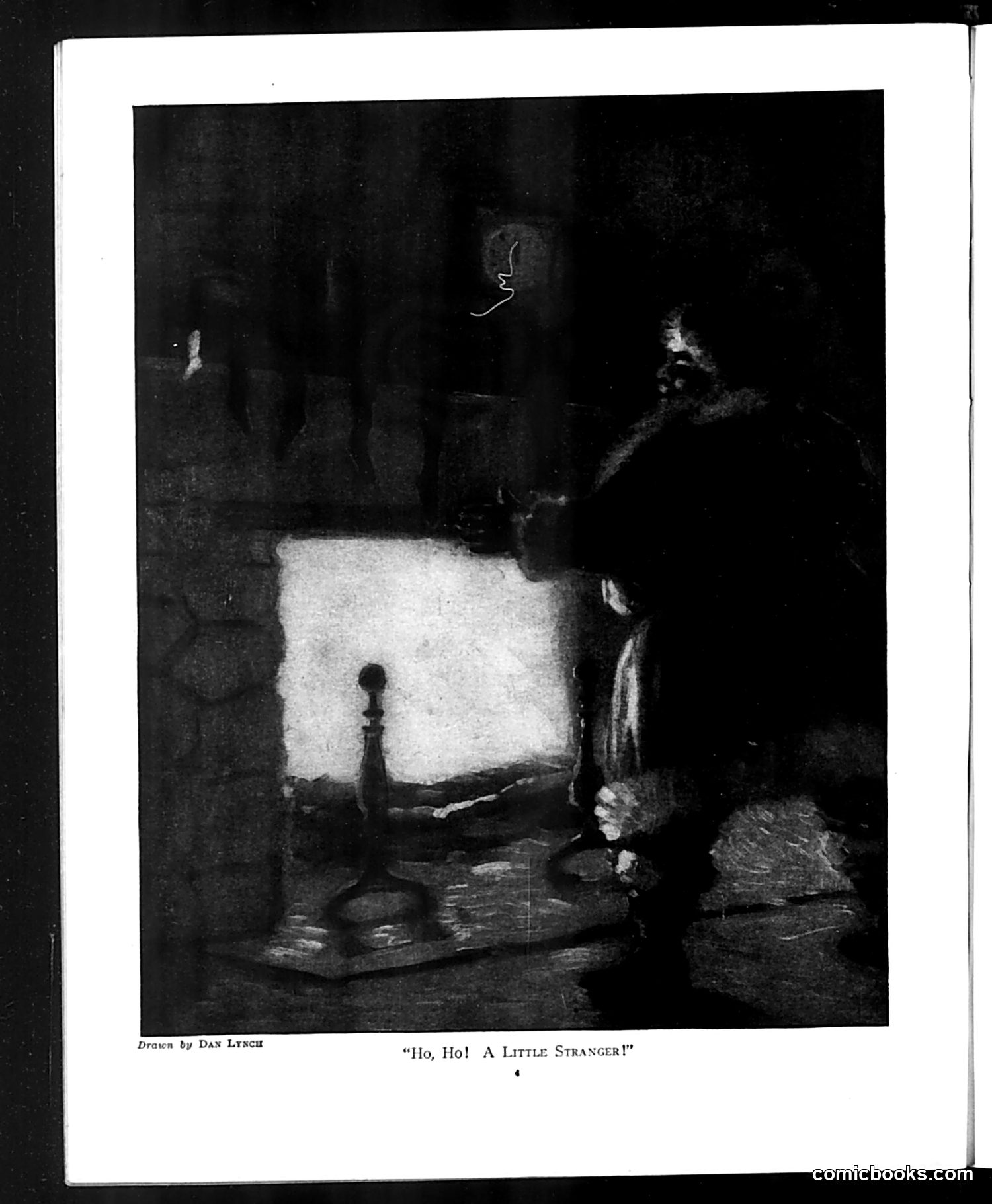
This drawing by Dan Lynch appears to depict a domestic scene with a figure entering through a doorway, encountering what seems to be a glowing or illuminated rectangular object (possibly a window or light source). The title's exclamation suggests surprise or discovery of an unexpected visitor or arrival. Without additional context from the surrounding pages of this Judge magazine issue, I cannot definitively identify the specific political figures or social commentary intended. The image quality and dramatic lighting make precise details difficult to discern. This could reference a contemporary political event, social scandal, or domestic situation that would have been recognizable to Judge's 1890s-1920s readership, but the specific reference remains unclear from this page alone.
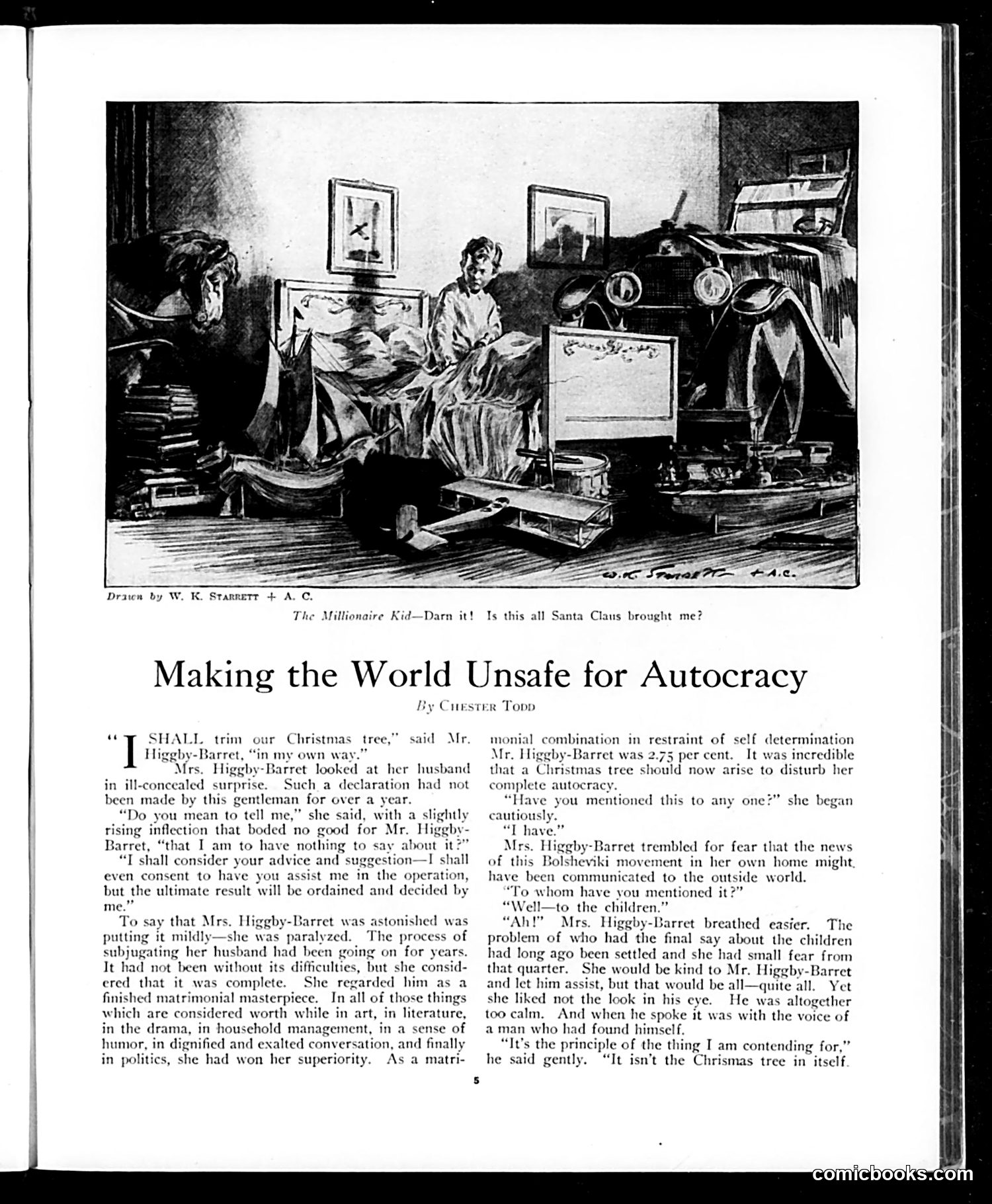
This satirical story by Chester Todd critiques wealthy industrialists' authoritarianism in domestic life. The illustration shows a wealthy household scene where Mr. Higgby-Barrett insists on absolute control—even dictating how the family Christmas tree should be decorated, against his wife's wishes. The title's irony is sharp: while America fought World War I against autocracy abroad (referencing Woodrow Wilson's rhetoric about making "the world safe for democracy"), wealthy men like Higgby-Barrett practiced domestic autocracy at home, controlling their wives' autonomy completely. Mrs. Higgby-Barrett has long resisted this control. The story satirizes how privilege and patriarchal authority reinforce each other, suggesting that true democratic values require challenging "autocracy" within the household itself.
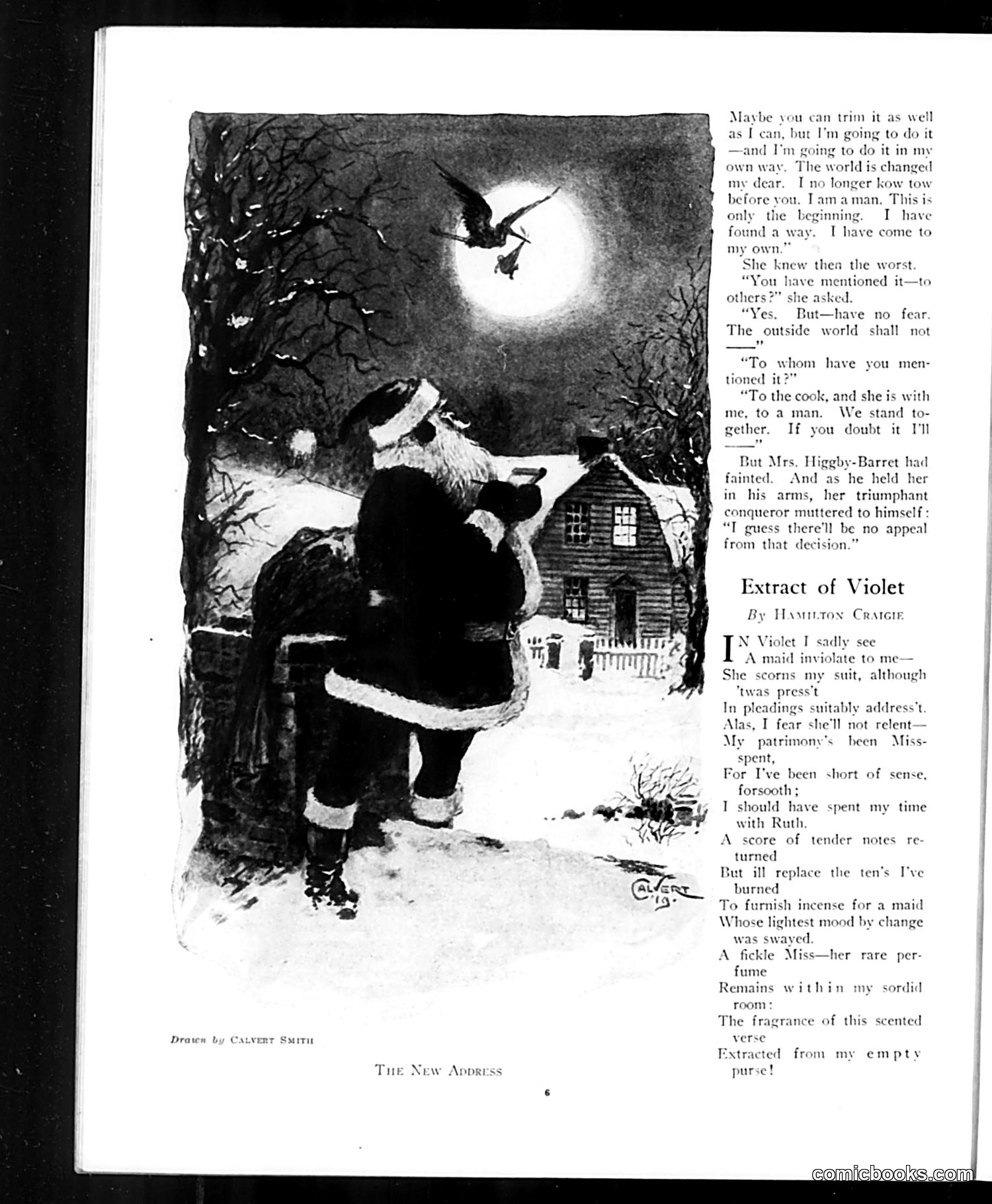
This page contains two distinct literary works rather than political cartoons: 1. **"The New Address"** - An illustrated story segment (drawn by Calvert Smith) depicting a dramatic nighttime scene with a man in formal dress confronting a woman outdoors near a house, with a bird flying overhead. The accompanying dialogue shows a man asserting independence and defiance against social convention. 2. **"Extract of Violet"** by Hamilton Craigie - A poem about a maid named Violet who has spurned the narrator's romantic advances, preferring someone else. The poem expresses wounded pride over her rejection. Neither appears to contain political satire. Instead, these are literary and illustrative pieces typical of Judge magazine's broader cultural content—focusing on domestic drama, romance, and social manners rather than topical commentary.
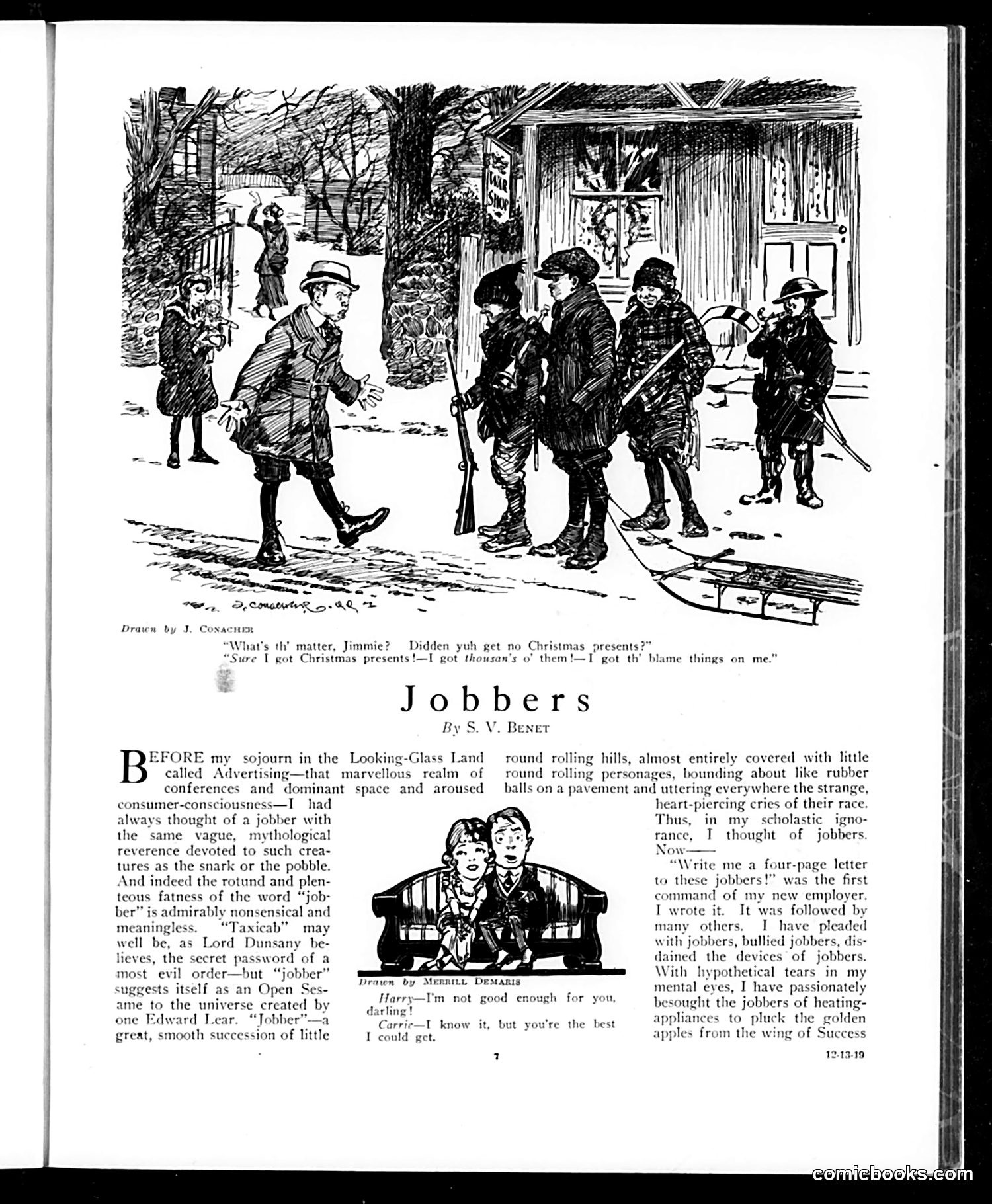
This page contains two pieces of satirical content about "jobbers"—wholesale distributors or middlemen in the advertising and retail supply chain. **Top cartoon:** Shows children discussing Christmas presents. One child complains he received "thousands" of blame-worthy items, satirizing how jobbers become convenient scapegoats for business problems. **Main article:** S.V. Benet's essay treats jobbers as mythical, incomprehensible figures (comparing them to creatures from Lewis Carroll and Edward Lear). The author describes them as mysterious "round rolling personages" inhabiting an advertising underworld. The accompanying illustration shows a conversation between business associates about jobbers' inadequacy—one admits jobbers aren't "good enough" but represent "the best I could get." **The satire:** Jobbers were essential but unglamorous middlemen whom retailers and advertisers blamed for supply problems, delays, or quality issues. Judge ridicules this scapegoating by portraying jobbers as either mythical nonsense-creatures or as necessary evils deserving sympathy—the actual targets of business frustration remain largely invisible.
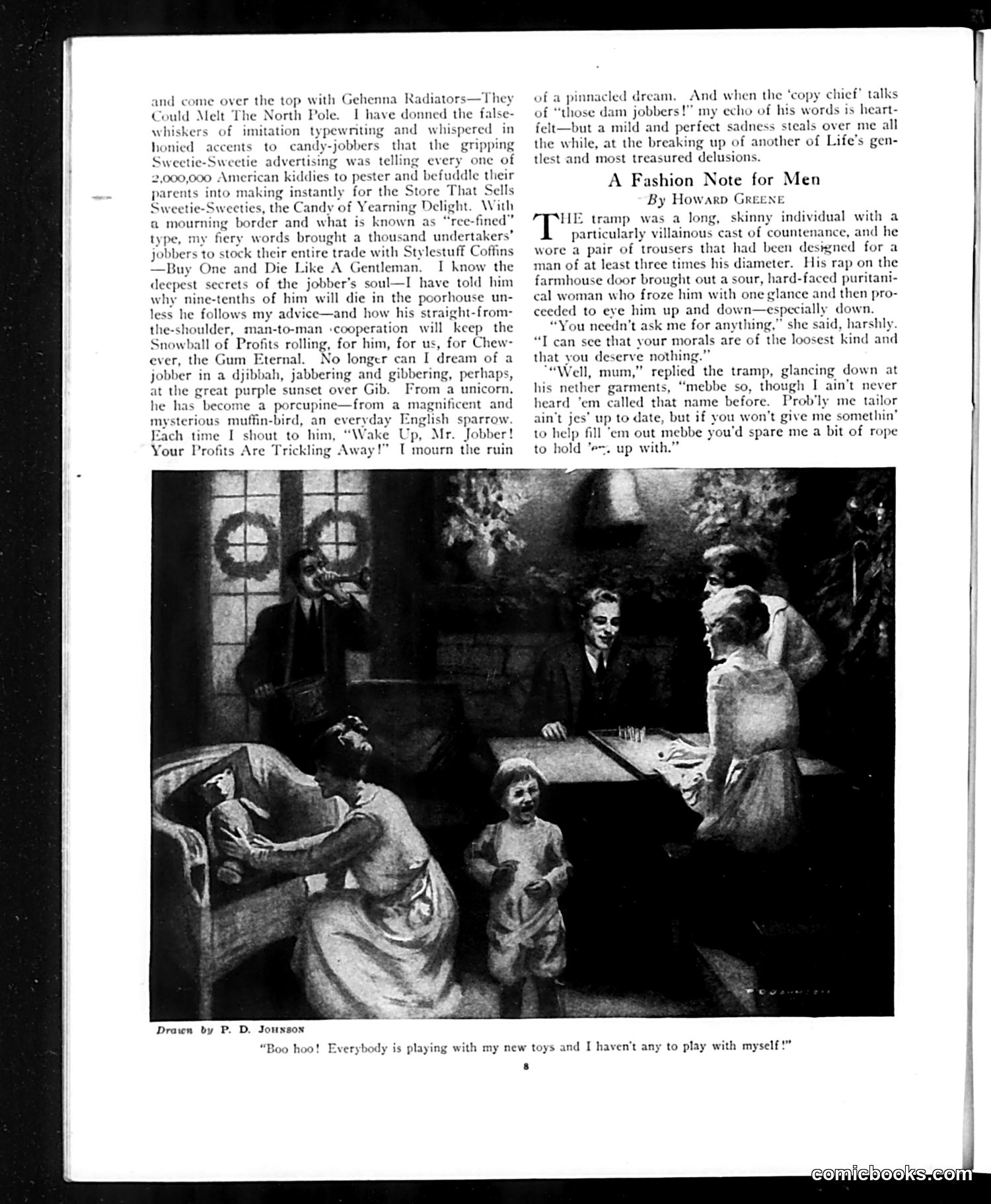
This page contains two satirical pieces: **Upper section:** A cynical commentary on advertising and marketing tactics. The unnamed author boasts of manipulating consumers—particularly children—through deceptive "Sweetie-Sweeties" candy advertising, then cynically reveals how he exploits salesmen and middlemen ("jobbers") with motivational rhetoric about profits. The satire targets predatory advertising practices and the hollow salesmanship of the era, mocking both advertisers' manipulation and their own delusions about success. **Lower section ("A Fashion Note for Men"):** A humorous sketch by P.D. Johnson about a shabby tramp whose comically oversized trousers become the subject of a farmwoman's moral judgment. The joke hinges on the tramp reinterpreting her criticism of his "morals" as commentary on his ill-fitting clothes—a clever verbal deflection. The cartoon mocks both the woman's sanctimoniousness and class-based assumptions about poverty and appearance. Both pieces reflect early 20th-century satirical humor targeting commercialism, hypocrisy, and social pretension.
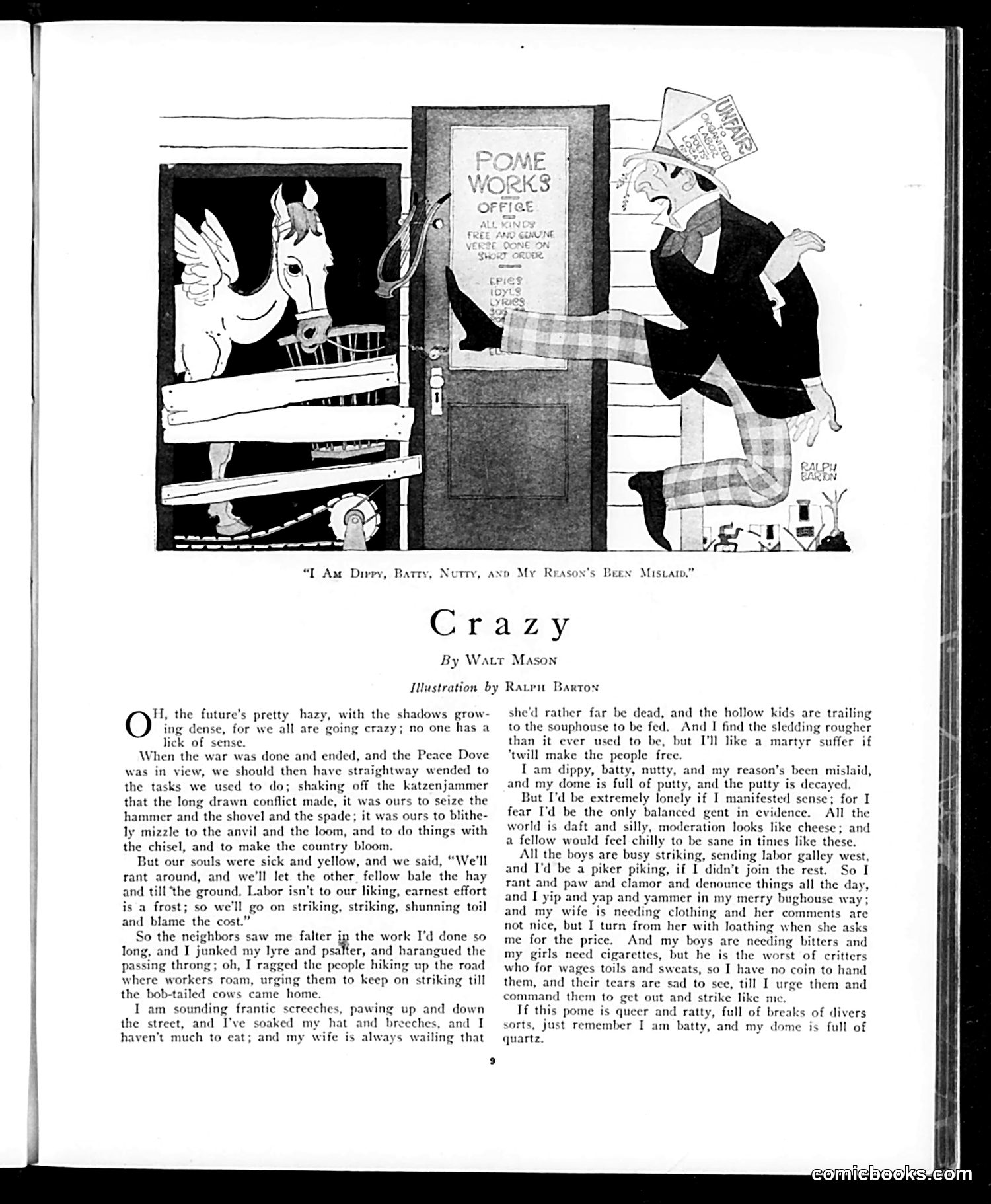
This 1920s satirical piece mocks post-WWI labor radicalism and strikes. The illustration shows a disheveled man outside "Pomeworks Office" accosting passersby—likely depicting a labor agitator. The poem's narrator abandoned productive work to encourage striking, embracing idleness while his family starves ("hollow kids...trailing to the souphouse"). He admits he's "dippy, batty, nutty"—literally crazy—and celebrates this madness, claiming sanity would make him lonely in an era gone mad. The satire targets striking workers as delusional fanatics who harm their own families through ideological zealotry. The repeated "strike, strike" refrain and the narrator's gleeful acceptance of poverty and his wife's suffering mock labor activism as irrational extremism. The cartoon suggests strikers prioritize abstract principles ("make the people free") over basic family welfare—a common conservative argument against the era's labor movements.
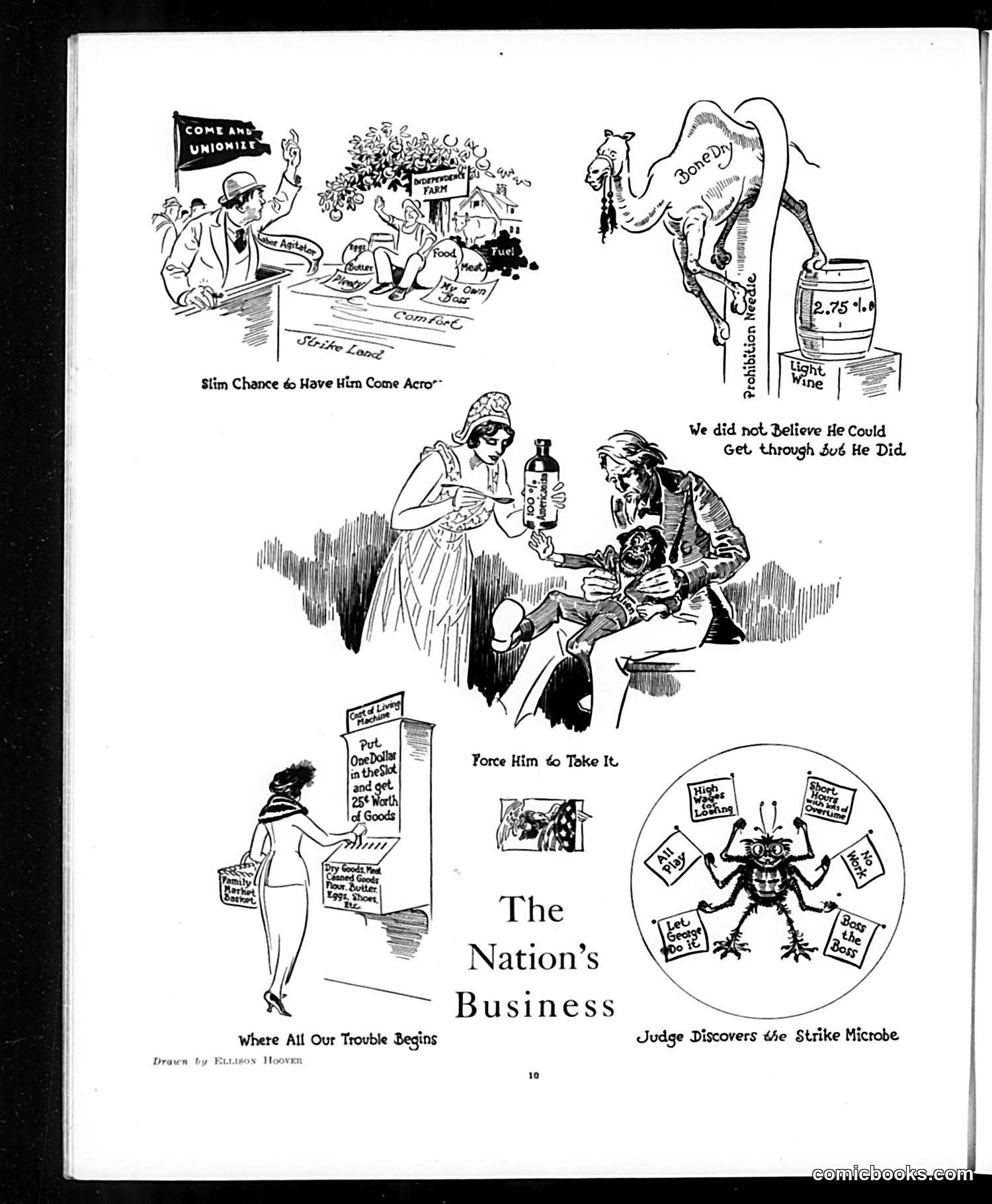
This Judge magazine page uses cartoons to satirize American social problems of the Prohibition era (1920s-1930s). The top-left cartoon mocks labor unions ("Come and Unionize"), depicting strike organizers offering workers false comfort amid poverty. The top-right shows a camel labeled "Bored" being tempted with alcohol—likely symbolizing how Prohibition drives people toward vice. The center cartoon depicts forced alcohol consumption, referencing how Prohibition created dangerous black-market drinking. The bottom-left warns about unchecked commerce exploiting workers. The final circular cartoon depicts a bug surrounded by labels representing various social ills—"the strike microbe"—suggesting strikes cause widespread economic damage. The cartoons collectively argue that labor unrest, Prohibition's failure, and unregulated business practices represent interconnected threats to the nation's stability and prosperity.
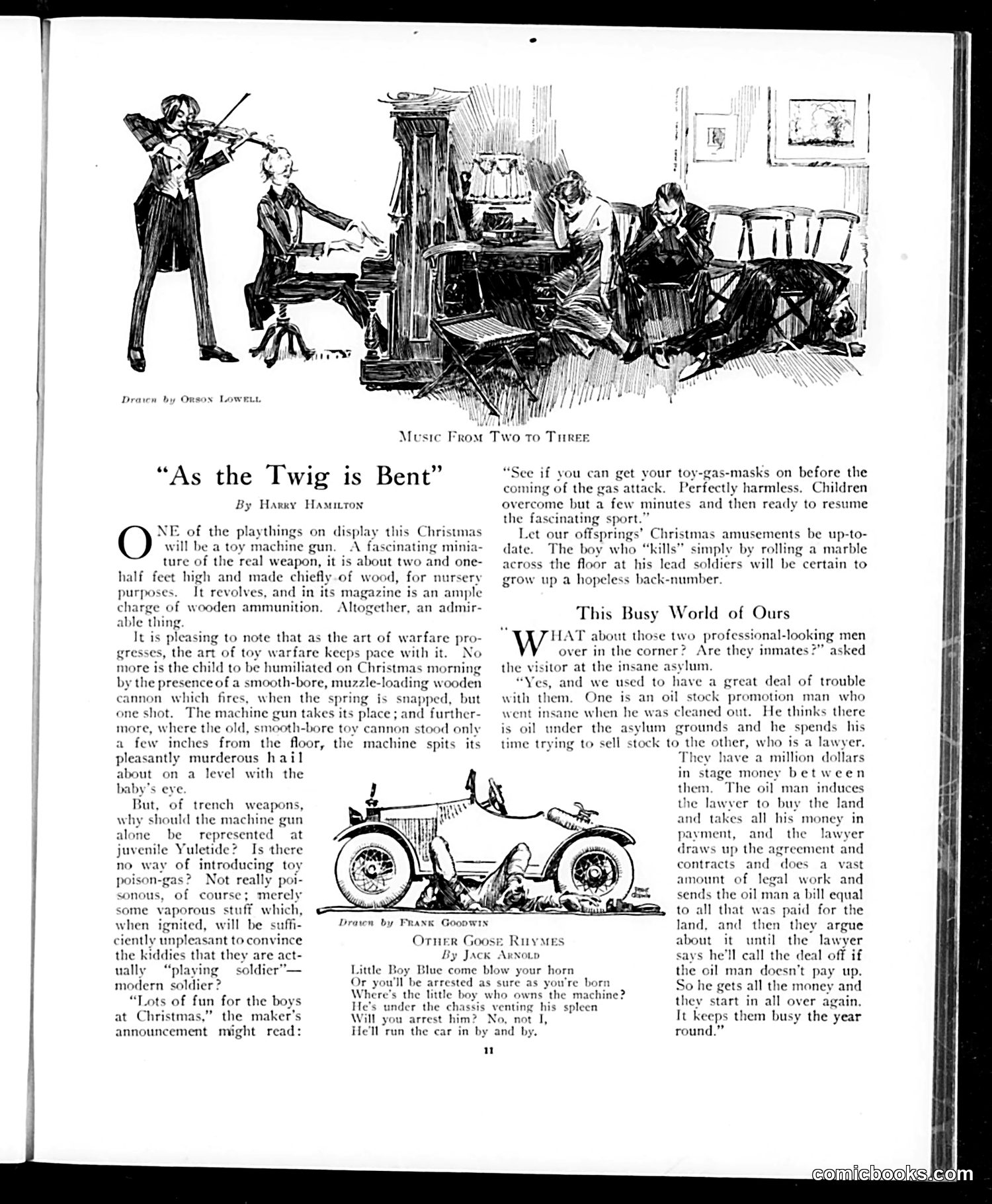
This page satirizes the commercialization of warfare toys for children. The main article criticizes toy manufacturers for marketing increasingly realistic military weapons—specifically a toy machine gun—to young children at Christmas. The author sarcastically suggests adding toy poison-gas masks and other trench warfare equipment to make children's play more "modern" and militaristic. The satire's point: as actual warfare becomes more mechanized and brutal (the text references machine guns and poison gas, suggesting WWI-era combat), toy manufacturers eagerly mirror these innovations, essentially training children to normalize industrial-scale killing. The "Other Goose Rhymes" cartoon below offers complementary satire, depicting a child ("Little Boy Blue") operating a car, with the law unable to stop him—suggesting the chaotic, lawless nature of modern society. The final anecdote mocks capitalism: two asylum inmates—an oil promoter and lawyer—perpetually swindle each other with worthless schemes, finding purpose in the endless cycle. All three pieces critique unchecked commercialism and militarization in American society.
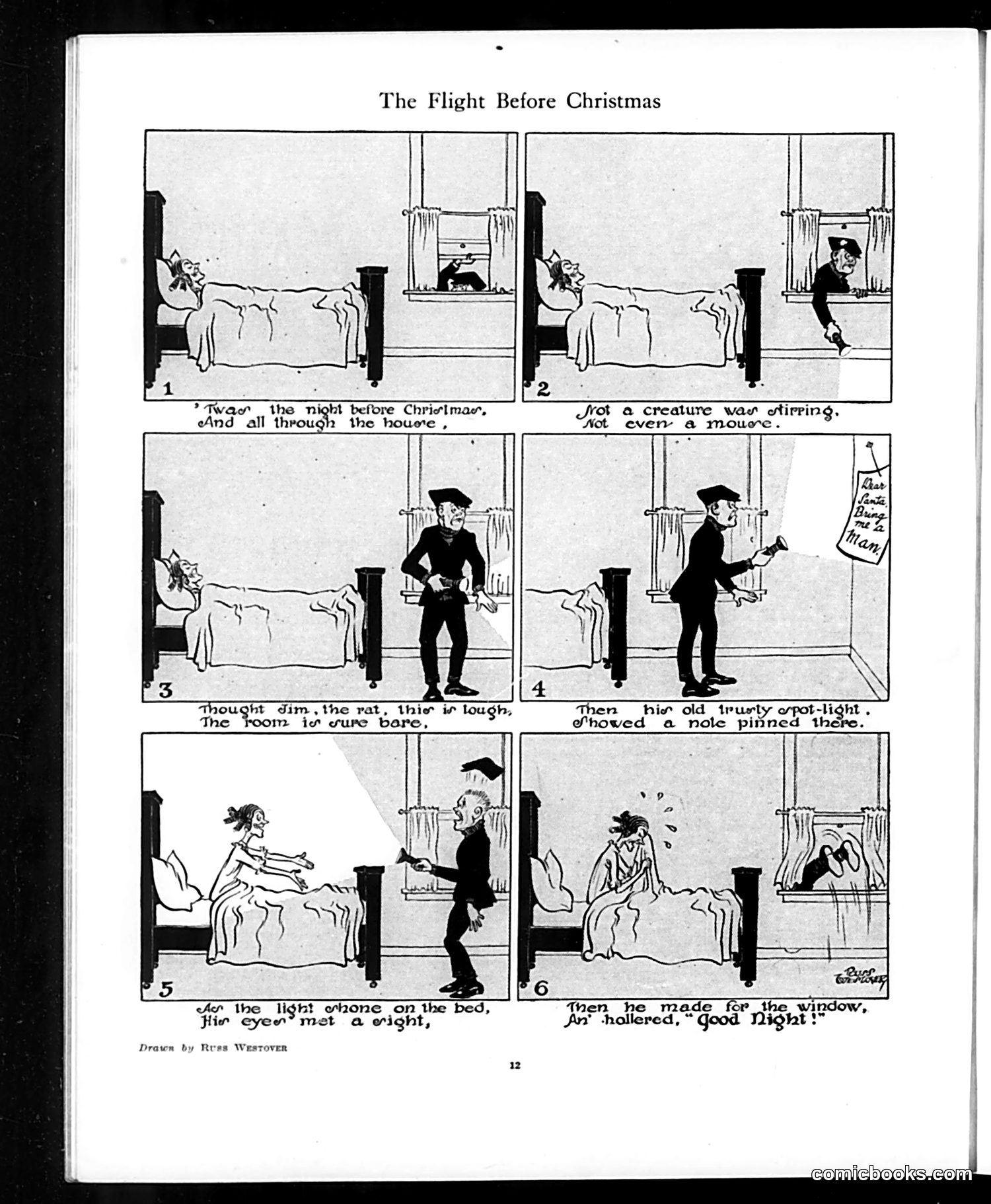
This is a humorous parody of "The Night Before Christmas" (Clement Clarke Moore's famous poem). The comic follows a burglar or thief breaking into a home on Christmas Eve, rather than Santa Claus. The six-panel sequence shows: the thief entering a quiet house, discovering it's empty, encountering what appears to be a rat, using a spotlight to investigate, and ultimately fleeing when caught or discovered, shouting "Good Night!" The joke plays on the poem's opening lines ("'Twas the night before Christmas, / Not a creature was stirring...") by substituting a criminal for Santa—suggesting homes are vulnerable on Christmas Eve, or satirizing the contrast between Christmas ideals and criminal reality. The "bare" room and "pinned hole" suggest economic hardship, possibly commenting on 1920s-era poverty during the holiday season.
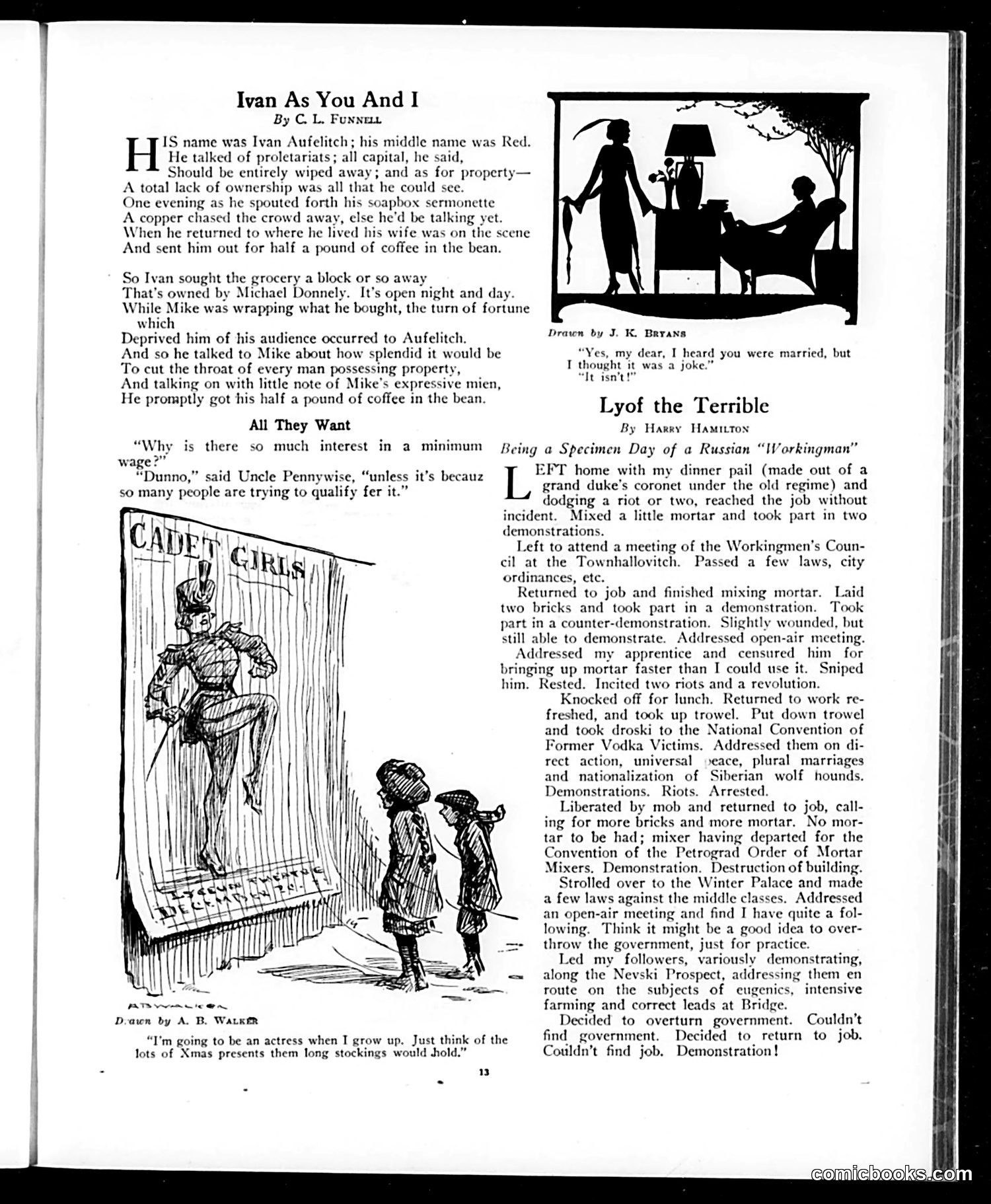
**"Ivan As You and I"** mocks radical communists/socialists. Ivan Aufelitch espouses revolutionary rhetoric—eliminating capital and private property—yet ironically depends on capitalist commerce. A police dispersal silences his street preaching, but he pragmatically accepts his wife's order to buy coffee from a grocer (Michael Donnely, likely representing working-class capitalism). While advocating throat-cutting violence against property owners, he politely completes a transaction with one. The satire: radicals are hypocrites whose ideology crumbles when confronted with everyday economic reality. **"Lyof the Terrible"** satirizes post-revolutionary Russian workers as chaotic and directionless. The narrator's day cycles absurdly: construction work interrupted by constant political meetings, demonstrations, riots, and revolutionary activities—accomplishing nothing. He incites revolutions casually ("just for practice"), addresses crowds on random topics (wolf hounds, bridge strategy), and ends unable to find either government or employment. The satire targets Russian Bolshevism as anarchic tumult masquerading as governance—all activity, no actual progress.
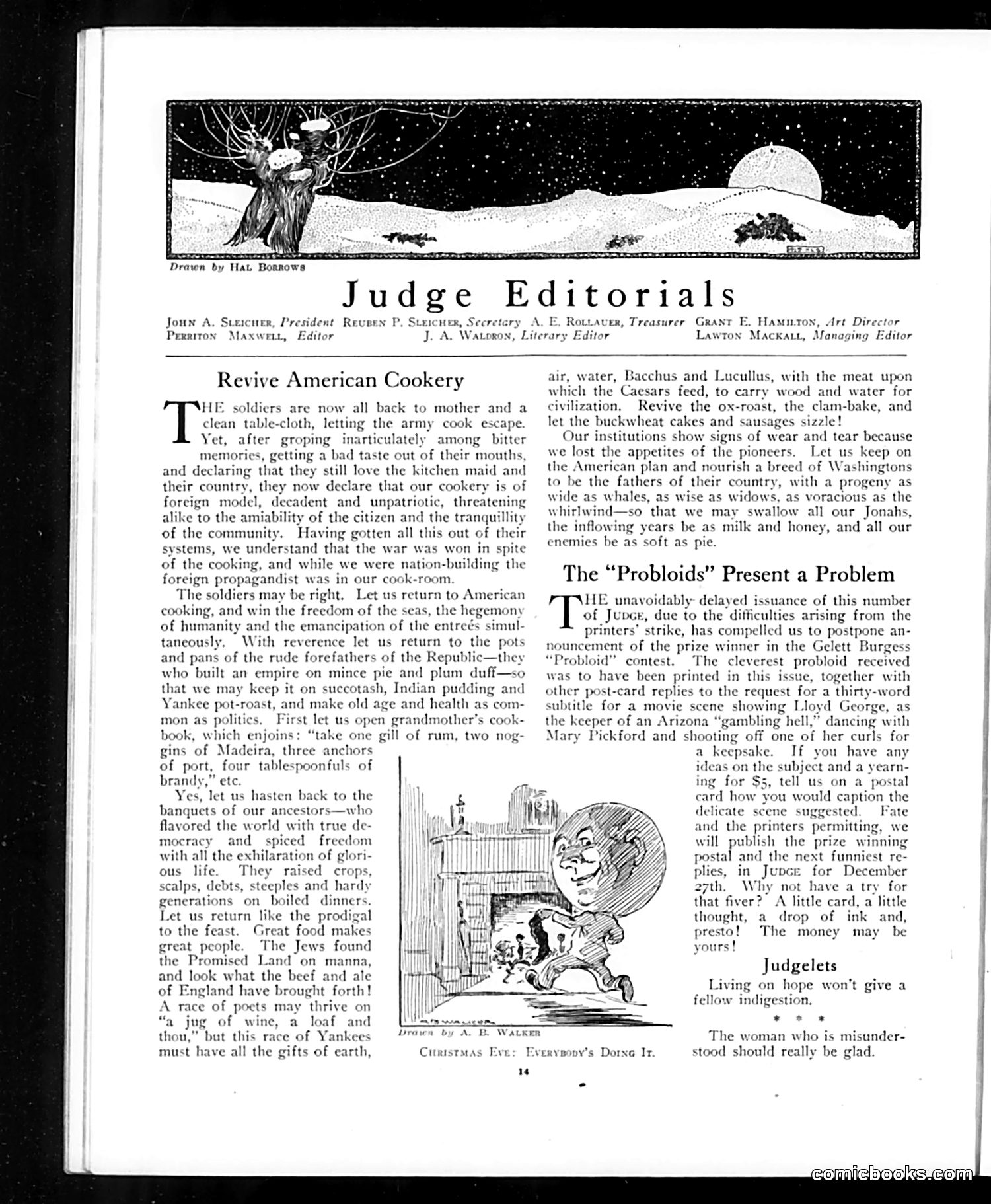
This page contains two editorial pieces from post-WWI America (the soldiers' return is mentioned). **"Revive American Cookery"** satirizes returning soldiers who complain about Army food while simultaneously declaring American cuisine inferior and "foreign" in character. The editorial mocks their nostalgia for "grandmother's cookbook" recipes (which humorously include absurd amounts of alcohol), arguing that hearty American food—succotash, Indian pudding, pot roast—built the nation and should sustain it. The satire targets both the soldiers' ingratitude and xenophobic attitudes about cooking. **"The 'Probloids' Present a Problem"** announces a delayed contest run by humorist Gelett Burgess involving Lloyd George and Mary Pickford in a movie scene. A printers' strike delayed publication, so the prize announcement is postponed. Readers are invited to submit thirty-word subtitles for the film scene, competing for a five-dollar prize. The cartoon illustration (credited to J.A.B. Walton) shows a figure in period dress, likely representing traditional American values or ancestors.
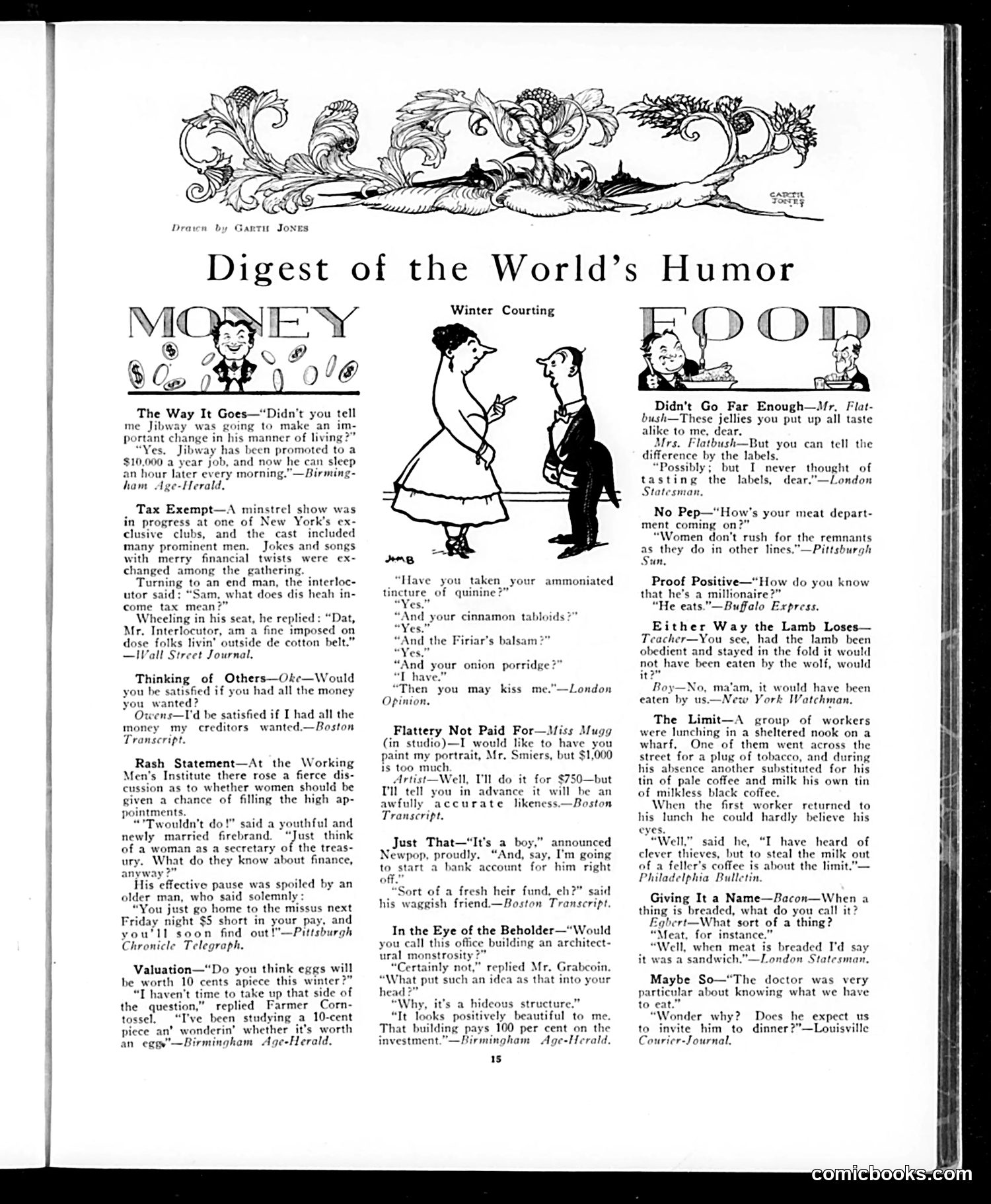
This page collects brief humorous anecdotes from various American newspapers, arranged around illustrations. The jokes target early 20th-century social anxieties: workplace hierarchies ("The Way It Goes"), income taxation (a minstrel-show joke suggesting only wealthy Southern cotton-belt residents pay taxes), marital finances, and class pretensions. The "Winter Courting" cartoon depicts a courtship ritual of medicinal preparations before kissing. Other pieces mock financial obsession ("In the Eye of the Beholder"—a building is beautiful only because it's profitable), workplace gender debates, and domestic life. The recurring theme is financial self-interest overriding sentiment or propriety. The page reflects Judge's satirical focus on American consumer culture, taxation debates, and gender relations of the era.
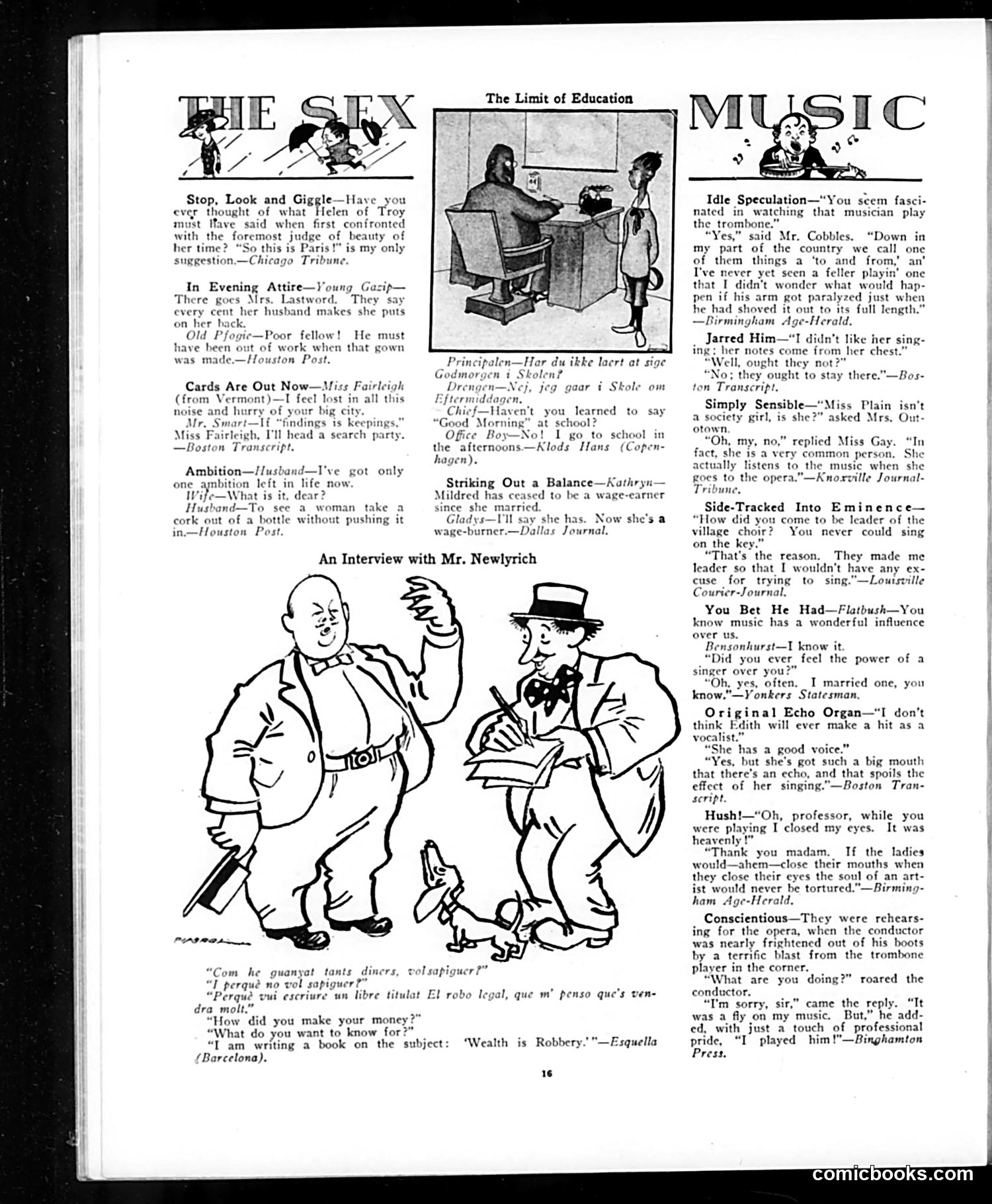
This page from *Judge* magazine presents satirical vignettes mocking musical ignorance and pretension in early 20th-century America. **"An Interview with Mr. Newlyrich"** (center cartoon) depicts a newly wealthy man—identifiable by his exaggerated features and ostentatious clothing—speaking with what appears to be an artist or writer. The Spanish dialogue references wealth and robbery, suggesting satire of nouveau riche figures who acquired money through questionable means and now affect cultural sophistication they lack. The surrounding anecdotes ridicule various characters: rural people confused by orchestral instruments (the trombone "to and fro"); tone-deaf singers; women prioritizing appearance over musical talent; and even conductors losing composure during rehearsals. **The satire's point**: Despite education's promise, Americans—particularly the newly rich and socially ambitious—remain culturally illiterate about music. They attend operas and concerts as status symbols while remaining fundamentally ignorant, their pretensions exposed through humorous dialogues. The page mocks both genuine musical incompetence and the affectation of cultural refinement.
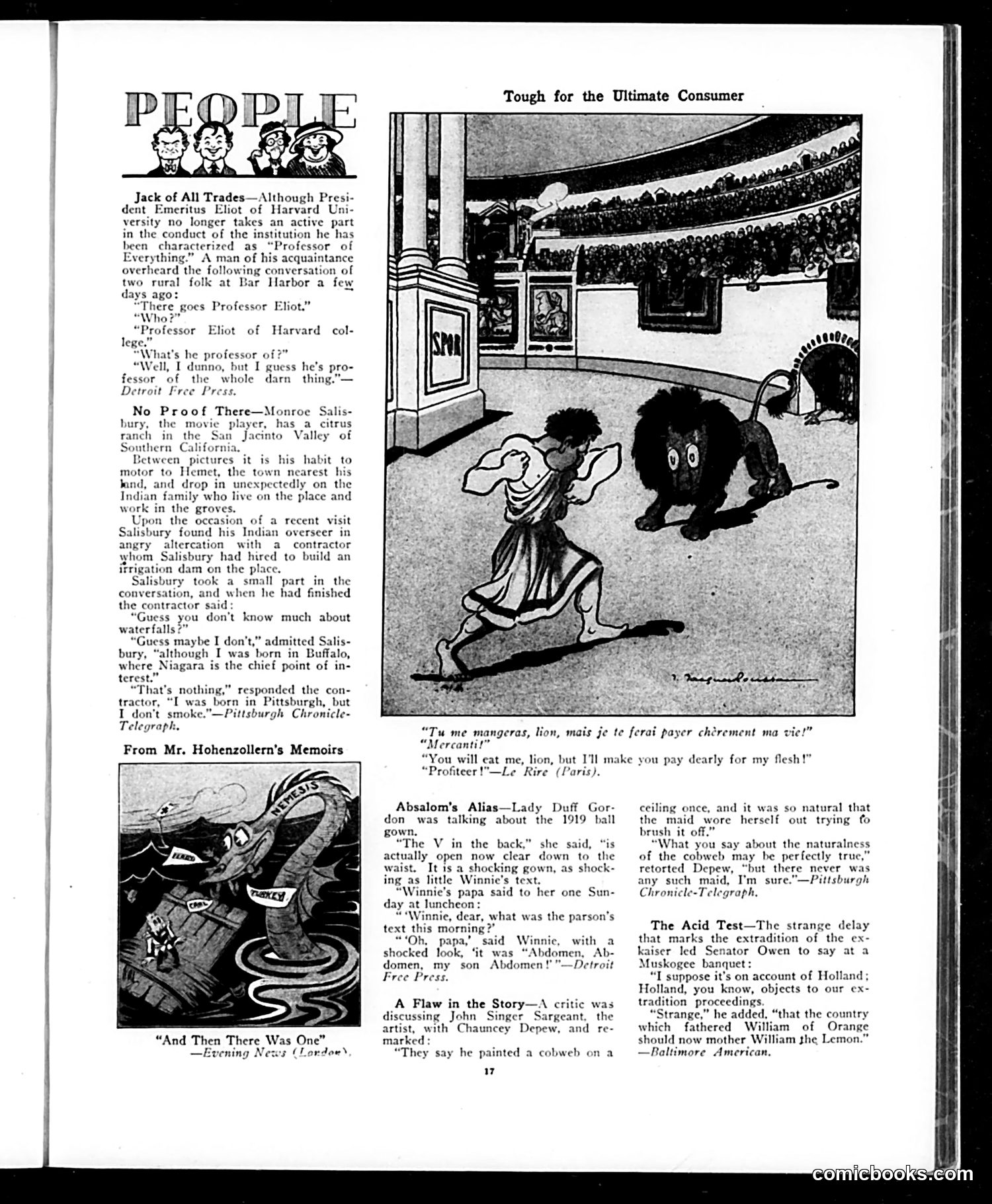
This page contains several brief satirical anecdotes typical of Judge's humor circa the 1920s. The main cartoon depicts a lion and woman in what appears to be a Roman arena, illustrating a French dialogue about the consumer paying dearly for goods—likely post-WWI satire on inflation or profiteering. The text items mock various public figures: - **President Eliot of Harvard** is portrayed as so universally knowledgeable he's called "Professor of Everything"—satire on academic overreach or pomposity. - **Monroe Salisbury** (movie actor) is the butt of a joke about not knowing waterfalls, undermining his claimed expertise. - **Lady Duff Gordon's** anecdote mocks revealing 1919 fashion ("V" necklines) by suggesting a child misheard "Abdomen" as religious text—social commentary on scandalous dress. - The final joke about **"William the Lemon"** (the Kaiser in Dutch exile) sarcastically criticizes Holland's reluctance to extradite him post-WWI. The humor targets elites, profiteers, and contemporary social changes through gentle ridicule rather than aggressive political commentary.
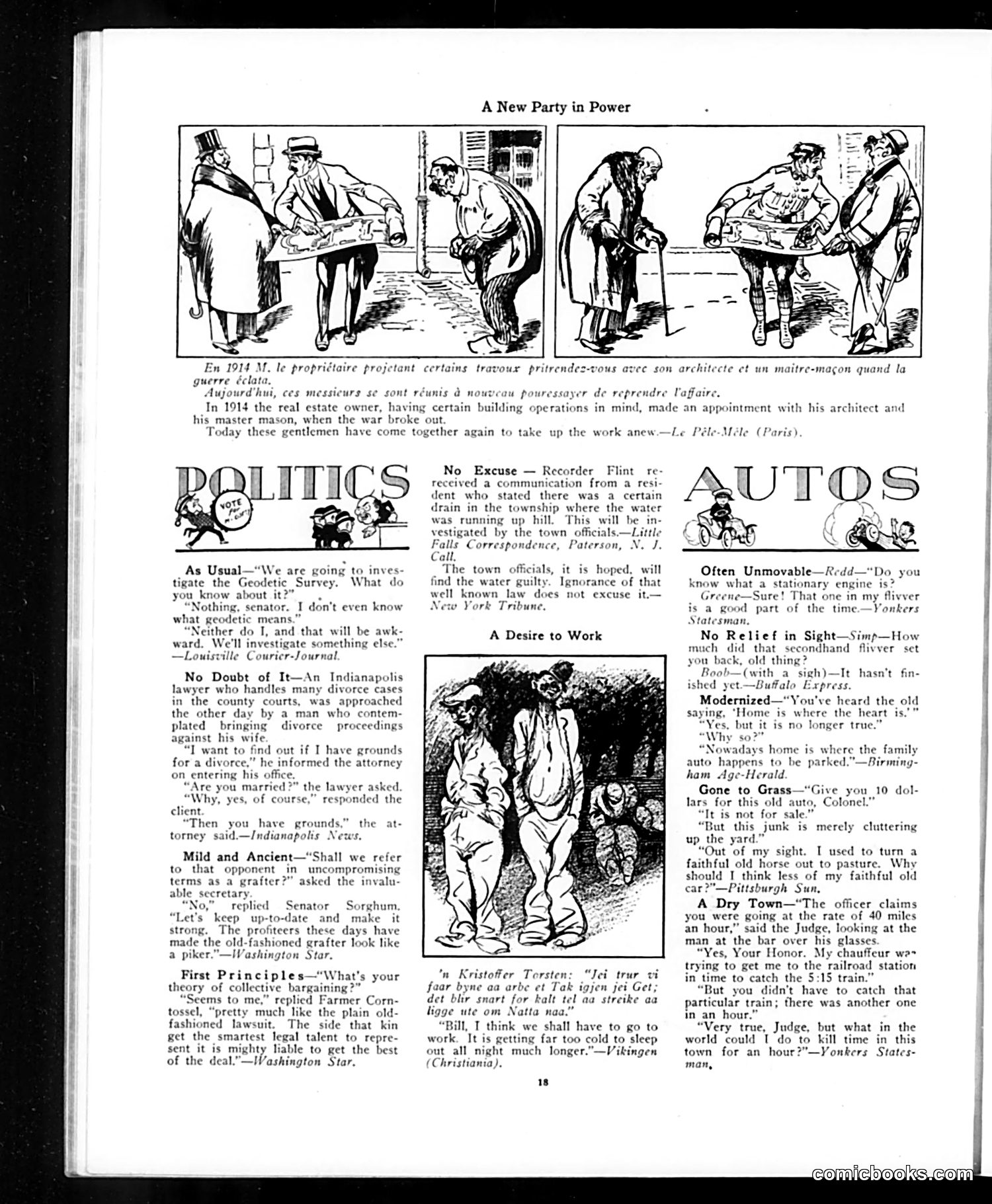
The top cartoon depicts businessmen and industrialists—represented as a new political force—literally taking over government operations during World War I. The French caption explains that in 1914, real estate owners planning construction work consulted architects and masons; now these same businessmen are gathered to "take up the work anew," suggesting industrialists have seized control of wartime policy. The satirical sections below mock American political incompetence: senators admitting ignorance before investigating subjects, lawyers exploiting divorce cases, and officials excusing water running "up hill" due to ignorance of law. The humor targets governmental corruption, legal manipulation, and bureaucratic absurdity during the war period. The automobile jokes at bottom reflect post-war American car culture becoming commonplace, with various "autos" creating new social problems and comic situations.
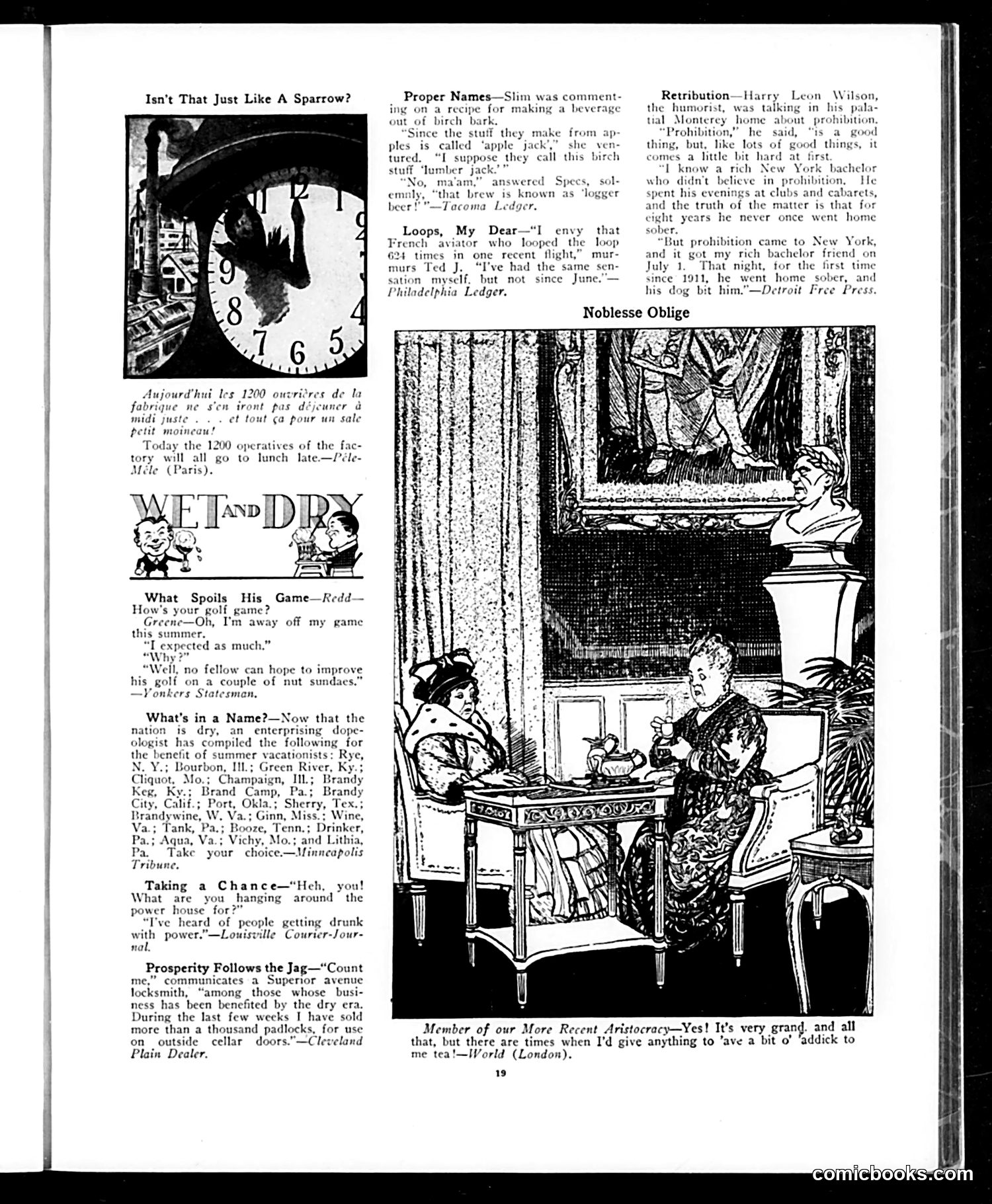
This page from Judge (likely 1920s, given Prohibition references) contains multiple satirical short jokes about American social life during Prohibition: **"Proper Names"** and **"What's in a Name?"** mock Prohibition-era slang. With alcohol banned, Americans created clever names for homemade drinks—"apple jack" from apples, "lumber jack" from birch bark. The humor lies in citizens' ingenuity circumventing dry laws. **"Loops, My Dear"** uses an aviation feat as metaphor for drunkenness—the speaker experienced the same disorientation as a pilot looping the loop, but "not since June" (when Prohibition began). **"Retribution"** features humorist Harry Leon Wilson describing a wealthy bachelor forced sober by Prohibition for the first time in years—depicting the law's impact on the privileged classes who previously drank freely. **"Noblesse Oblige"** shows a wealthy person lamenting they'd trade their grand lifestyle for simple pleasures like fish (addick/haddock)—mocking how even aristocrats felt constrained by Prohibition's deprivations. The overall theme: Prohibition disrupted American life across all classes, from working-class ingenuity to wealthy indulgence.
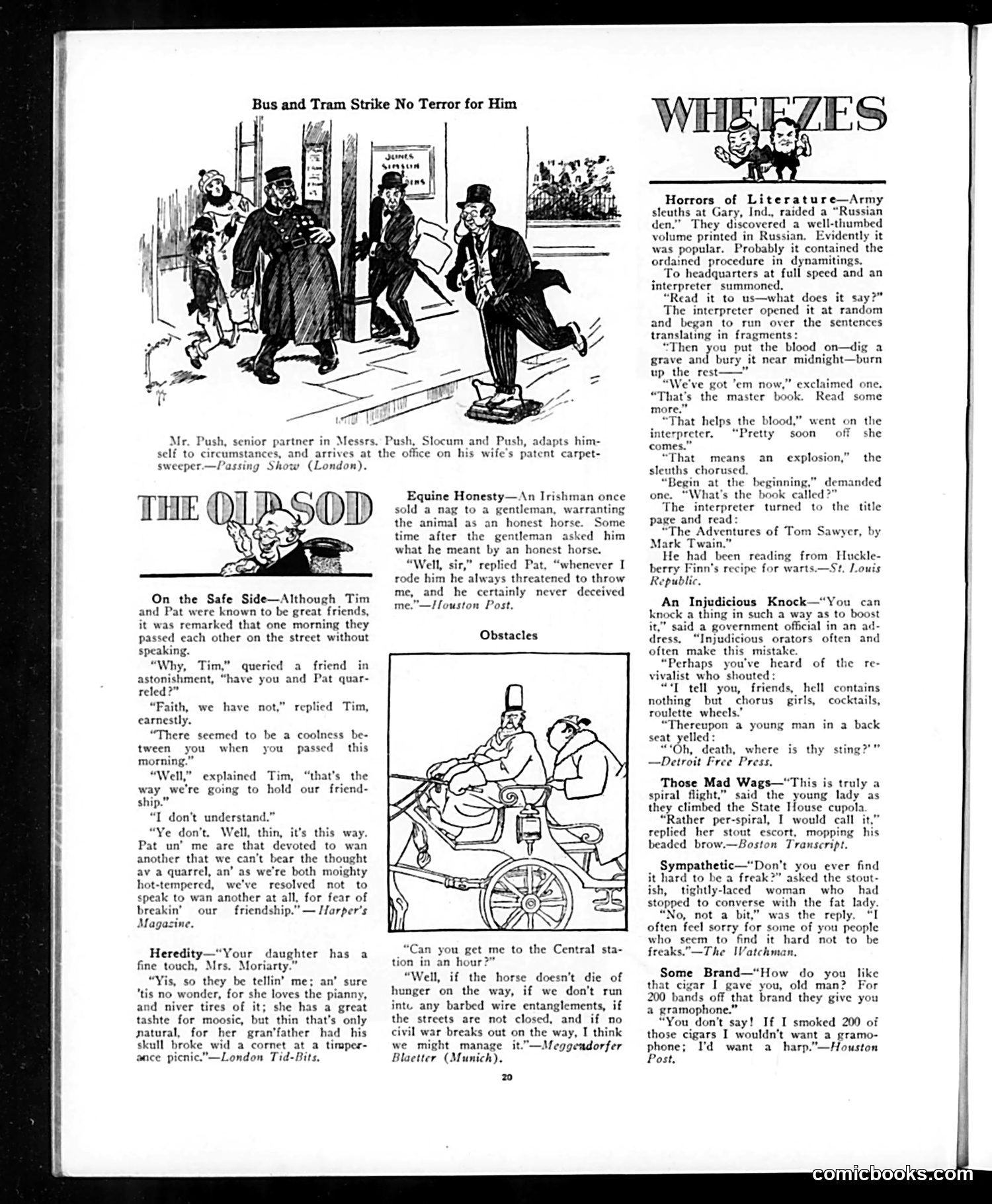
This page from Judge (American satirical magazine) contains multiple brief humorous items typical of early 20th-century humor magazines: **Main cartoon**: "Mr. Push" arrives at his office via his wife's patent carpet-sweeper during a bus and tram strike—satirizing adaptability and perhaps entrepreneurial spirit during labor disruptions. **"Horrors of Literature"** mocks overzealous authorities: Army investigators raid a "Russian den," discover a Russian-language book, and assume it contains dynamite instructions. The interpreter reveals it's actually *Tom Sawyer/Huckleberry Finn*—a recipe for wart removal. The joke targets anti-immigrant paranoia and Red Scare hysteria circa WWI era, when Russian publications were viewed with deep suspicion. **Other items** include Irish dialect humor ("On the Safe Side"), puns, and wordplay typical of the era's comedy standards. The "Horrors of Literature" piece is the most historically revealing, exposing contemporary American anxiety about Russian immigrants and radical threats.
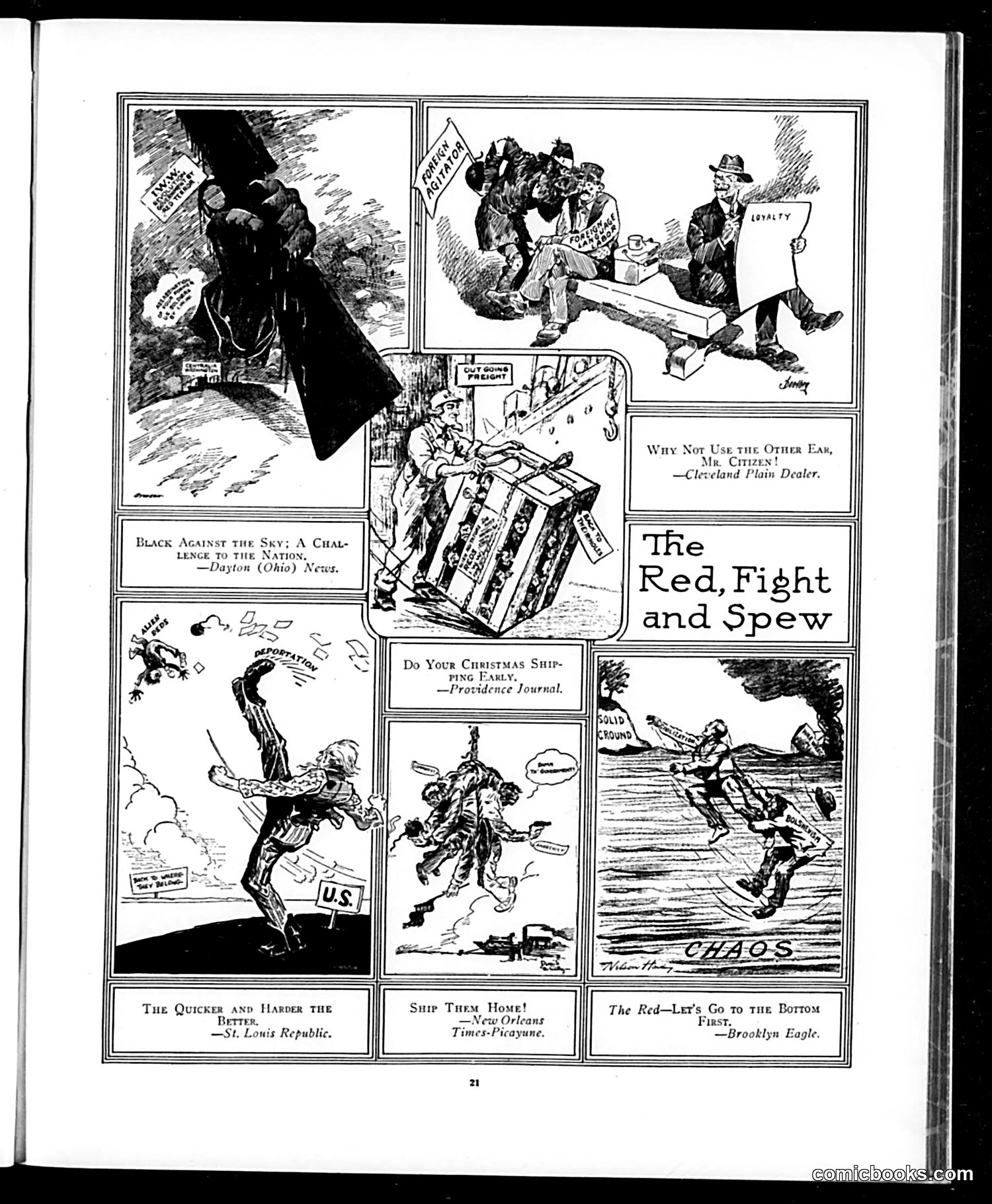
This page collects editorial cartoons addressing World War I themes circa 1917-1918. The central title, "The Red, Fight and Spew," references Bolshevism (the "Red" threat), military conflict, and propaganda/misinformation. Key cartoons shown: - **"Black Against the Sky"**: Depicts a dark figure (likely Germany or militarism) looming over America - **"Loyalty"** (top right): Shows figures divided over patriotic duty, satirizing internal dissent during wartime - **Shipping/logistics cartoons**: Address U.S. economic preparedness and supply chain issues - **"Chaos" scene** (bottom right): Depicts American citizens in disarray, suggesting social disruption The captions from various newspapers indicate these cartoons satirize American unpreparedness, divided loyalties, profiteering, and the confusion surrounding U.S. entry into WWI. The collection critiques both government failures and public confusion about the war effort.
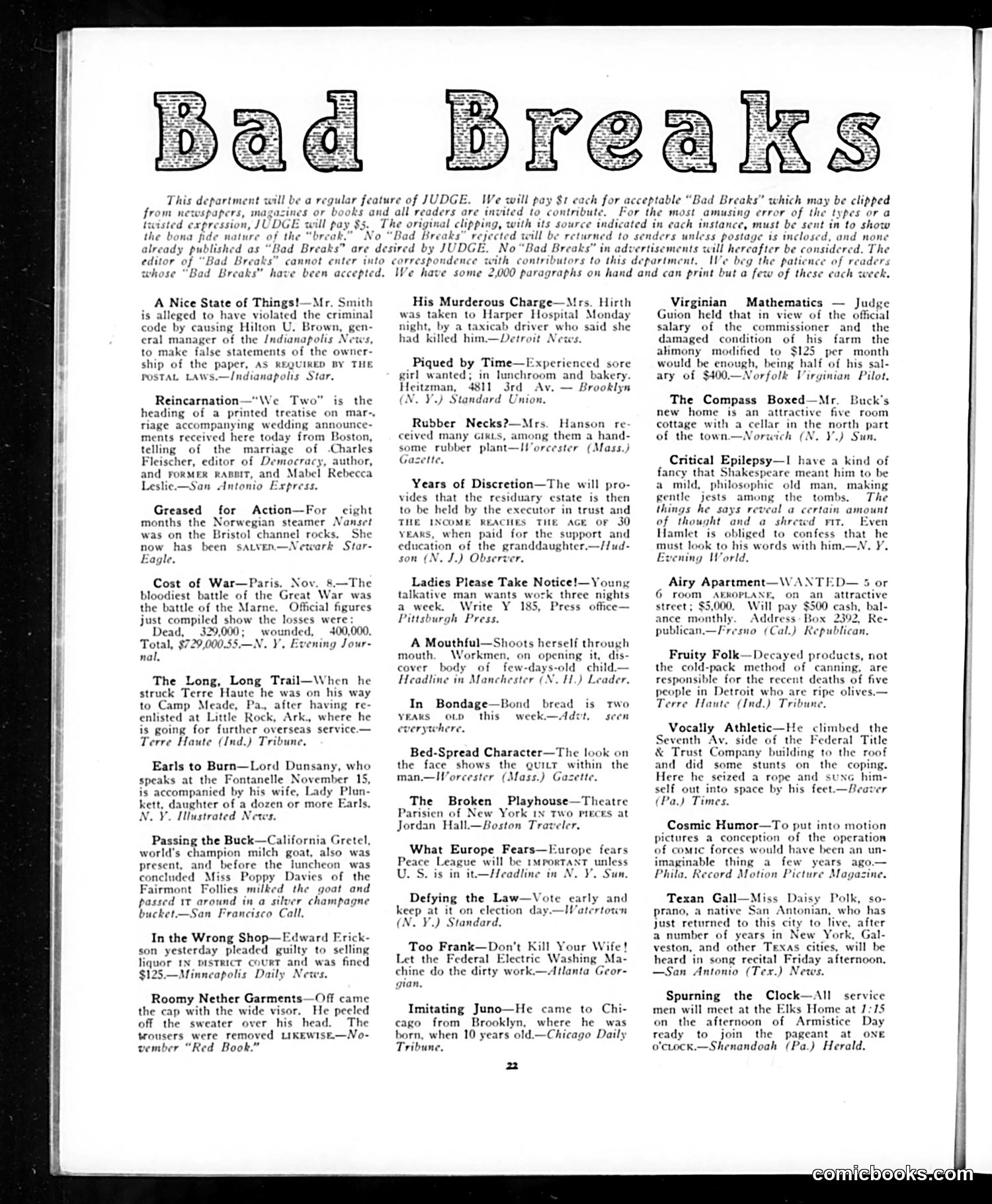
This page from *Judge* magazine features a humor column collecting amusing newspaper headlines and classified ads—not political cartoons. The "Bad Breaks" department showcases unintentional comic effects created by poor headline writing, misplaced modifiers, and unfortunate word choices in real newspapers. Examples include: a headline about a woman "killing" her taxi driver (meaning she criticized him harshly), an ad for "experienced sore girl" (likely "store girl"), and a playhouse described as being "in two pieces" (damaged, not literally bisected). The humor derives from the incongruity between intended and accidental meanings. The introductory text explains this is a regular *Judge* feature soliciting reader submissions of amusing newspaper clippings—social commentary through linguistic mishap rather than explicit political satire. It reflects early-20th-century entertainment emphasizing wordplay and newspaper absurdities.
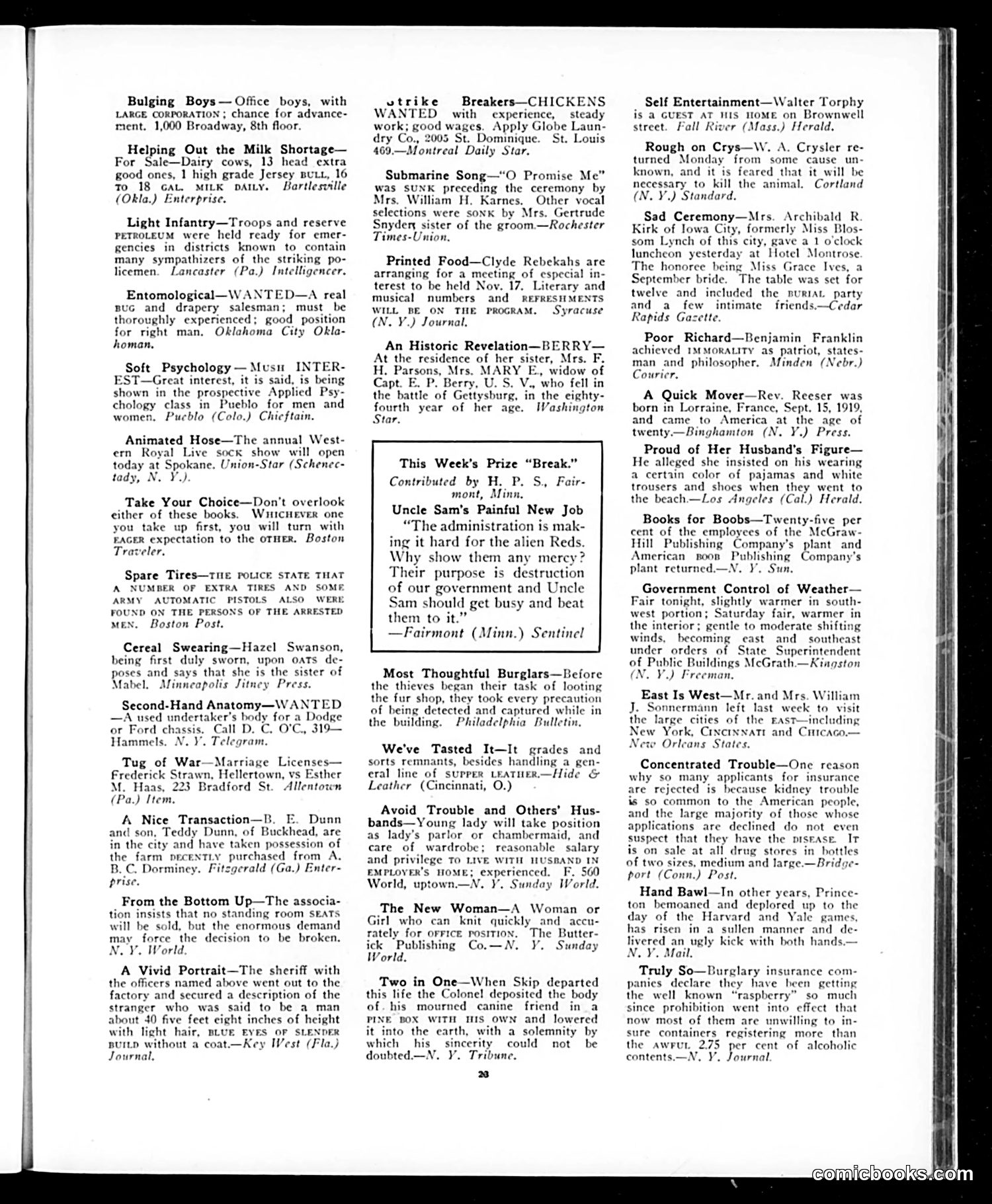
This page is primarily **classified advertisements and newspaper excerpts**, not political cartoons. Judge's editors collected humorous "unintentional comedy" from newspapers—absurd or accidentally suggestive want ads and headlines. The humor works through **double meanings and unfortunate word choices**: - "Bulging Boys" (office boys who will "advance") - "Helping Out the Milk Shortage" (selling dairy cows) - "Light Infantry" (petroleum reserves described militarily) - "Spare Tires" (police finding extra tires and pistols on arrested men) The featured prize "Break" satirizes **Red Scare hysteria**—a Fairmont, Minnesota newspaper advocates Uncle Sam should violently eliminate "alien Reds" before they destroy the government, presented as if this extreme position is reasonable policy. The overall effect mocks both **newspaper carelessness** and the **paranoid anti-communist sentiment** of the post-WWI era (likely early 1920s). Rather than drawn cartoons, Judge uses editorial selection to reveal society's absurdities.
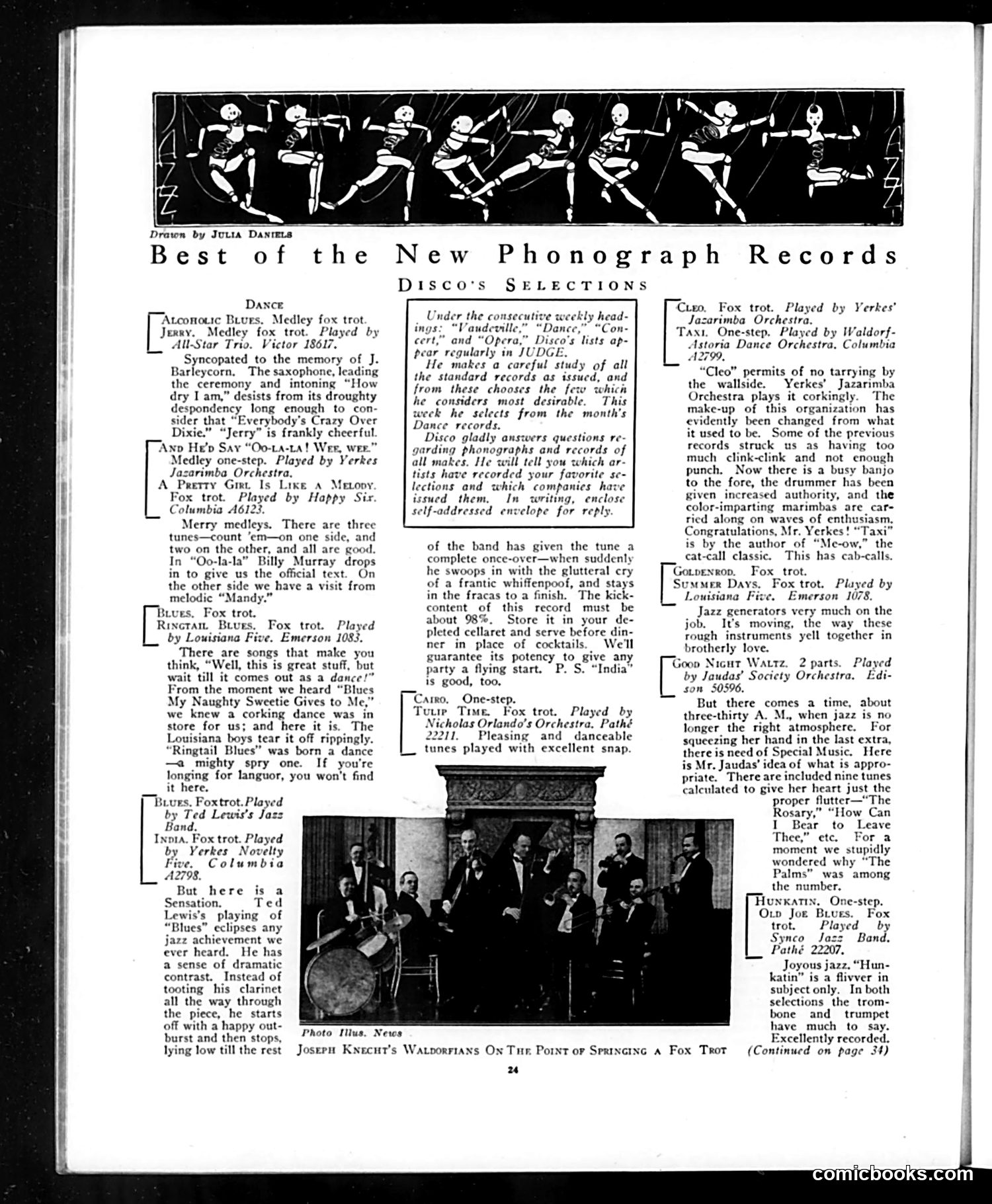
This page reviews jazz and dance records—not political cartoons. The header illustration by Julia Daniels shows skeleton figures dancing the fox trot, a visual pun reflecting the "Roaring Twenties" jazz craze. The content is a record guide by "Disco" evaluating phonograph releases from labels like Victor, Columbia, and Pathé. Reviews praise energetic dance numbers: fox trots, one-steps, and medleys performed by groups like Ted Lewis's Jazz Band and the Louisiana Five. Notable is a reference to Prohibition's aftermath—one review jokes about storing a record "in your depleted cellaret and serve before dinner in place of cocktails," suggesting alcohol scarcity. Another mentions "How dry I am," a Prohibition-era song. The page reflects 1920s consumer culture: middle-class Americans purchasing recorded music for home dancing, the jazz boom, and social anxieties about modern entertainment displacing traditional leisure.
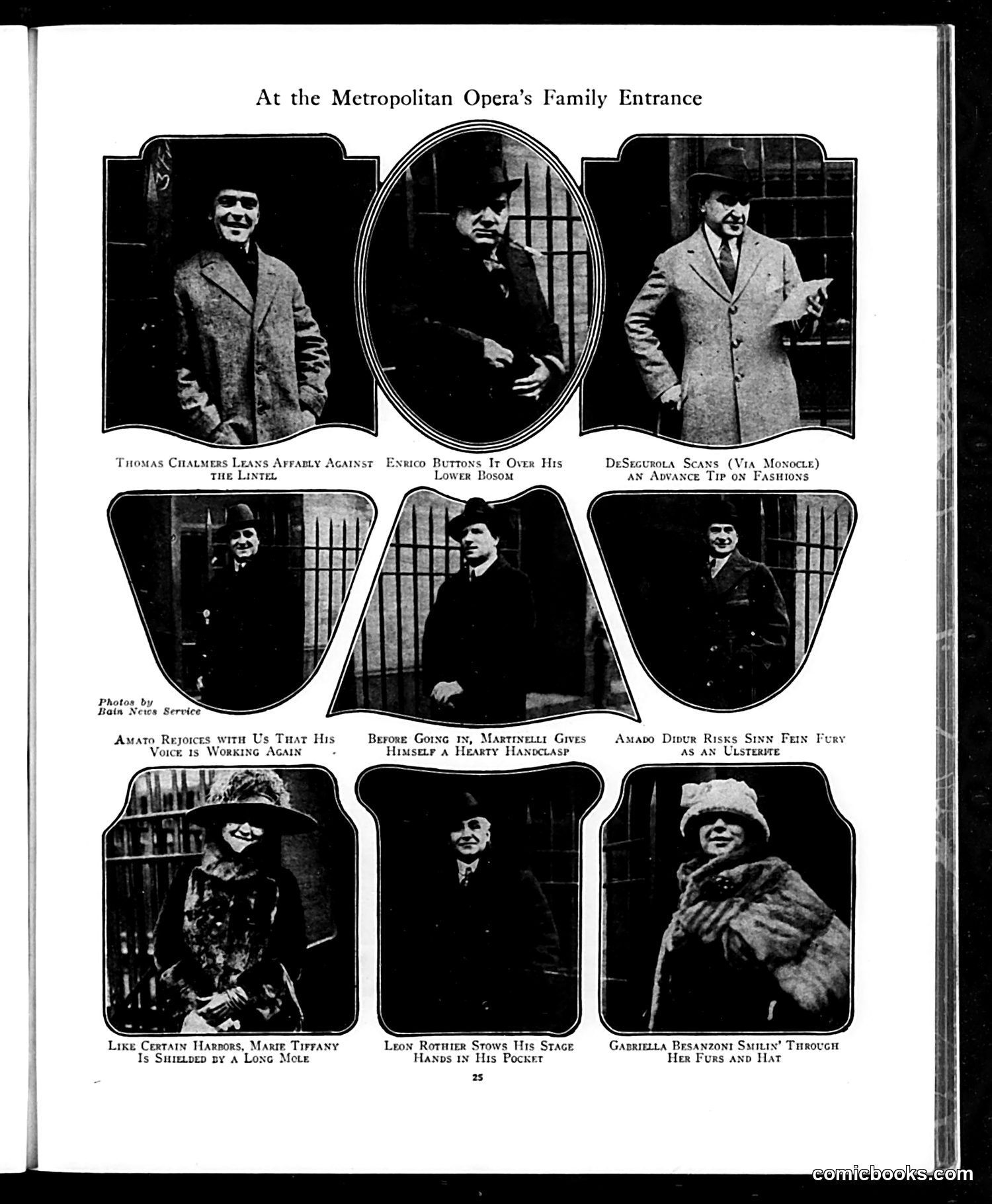
This page consists of nine photographs with humorous captions depicting famous opera singers and personalities arriving at the Metropolitan Opera in New York. Rather than a political cartoon, it's a celebrity gossip feature typical of Judge magazine. The captions use playful, exaggerated descriptions of the arrivals—like Thomas Chalmers "leaning affably against the lintel" or Enrico Caruso "buttoning it over his lower bosom." These mock-dignified descriptions poke fun at opera world pretensions and celebrities' self-importance. References to "Sinn Féin" (Irish independence movement) and mentions of furs suggest these were prominent public figures whose fashion choices and political associations warranted commentary. The overall tone is lighthearted mockery of high-society opera culture rather than serious political satire.
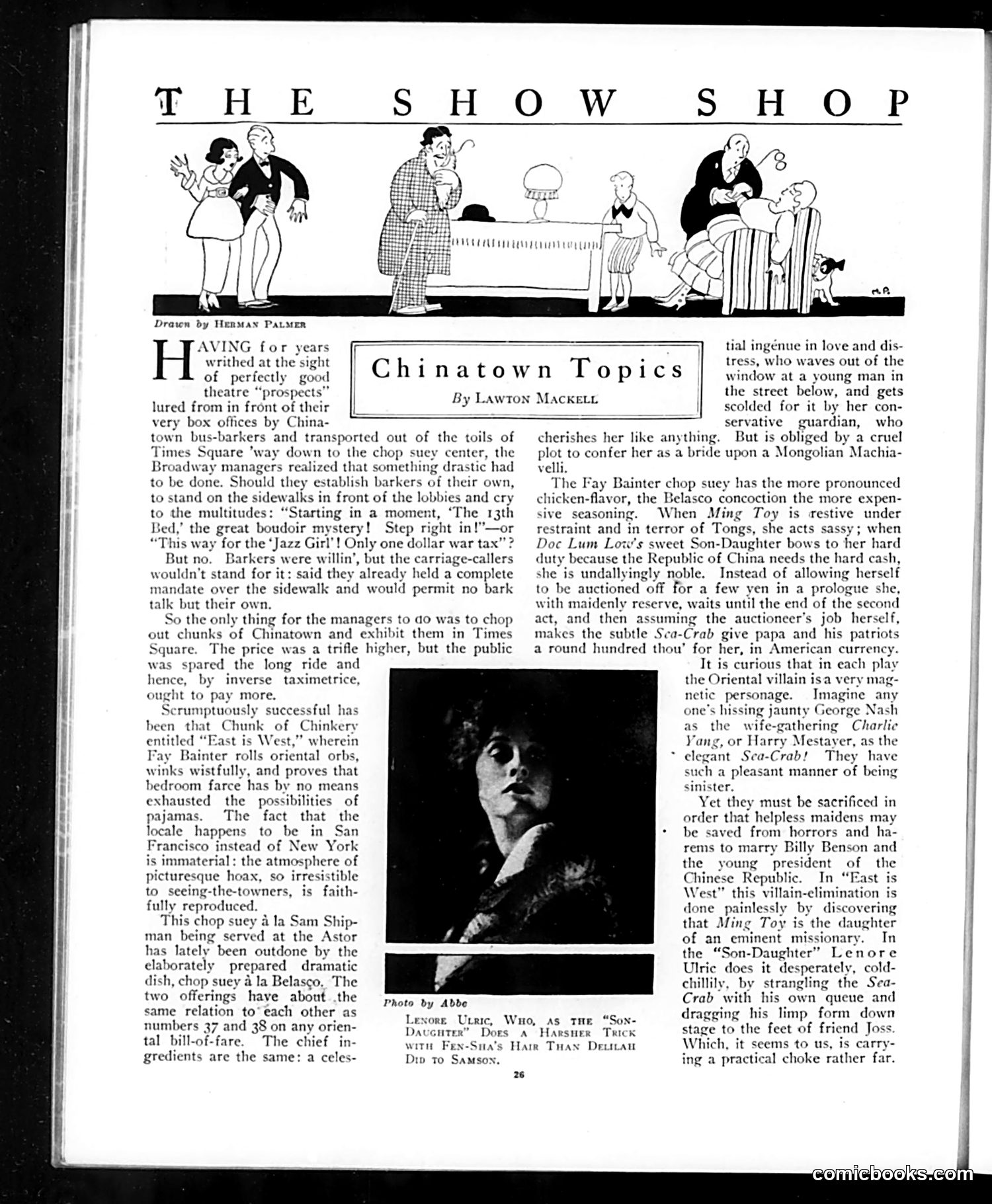
This article satirizes Broadway's exploitation of Chinatown as exotic entertainment. The piece discusses two theatrical productions—"East is West" (starring Fay Bainter) and "The Son-Daughter" (starring Lenore Ulric)—which present melodramatic "chop suey" plays set in Chinatown for Times Square audiences. The satire critiques how Broadway packages Chinatown as picturesque spectacle for "seeing-the-towners" without authentic cultural representation. Both plays follow identical formulas: a helpless Oriental ingénue caught between duty to China and romance with an American man, requiring rescue from evil Chinese villains. The author (Lawton Mackell) mocks the convenient plot resolutions—discovering the heroine is actually a missionary's daughter, or having her strangle the villain herself—as laughably contrived devices to justify happy endings with American suitors and preserve audience comfort with racist hierarchies.
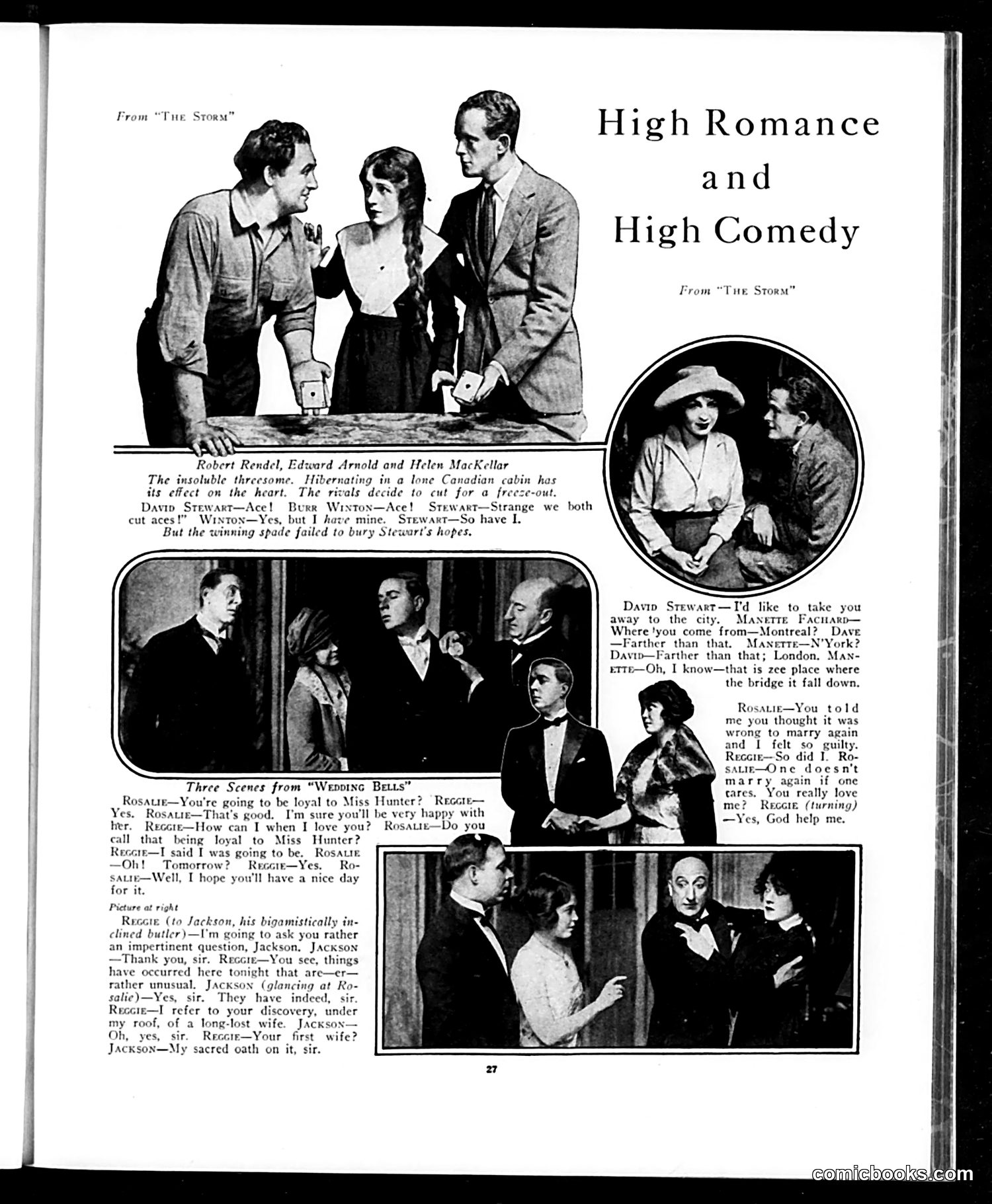
This page showcases scenes from two theatrical productions: "The Storm" and "Wedding Bells." The content presents dramatic and comedic moments from stage plays rather than political satire. **The Storm** features a love triangle in a Canadian cabin where two male rivals (David Stewart and Burr Wixton) cut cards to resolve their romantic competition over a woman (Helen MacKellar). The humor derives from their simultaneous discovery that both drew aces—a stalemate in their contest. **Wedding Bells** presents marital complications: a man (Reggie) confesses conflicting loyalties between his fiancée (Miss Hunter) and another woman (Rosalie), while another character (also named Reggie) discusses with his butler Jackson the awkward revelation of a long-lost first wife. These are theatrical review excerpts typical of Judge's entertainment coverage. The "satire" is mild situational comedy about romance and marriage confusion rather than political commentary. The page documents early 20th-century stage drama conventions and comedic scenarios popular with Judge's readers.
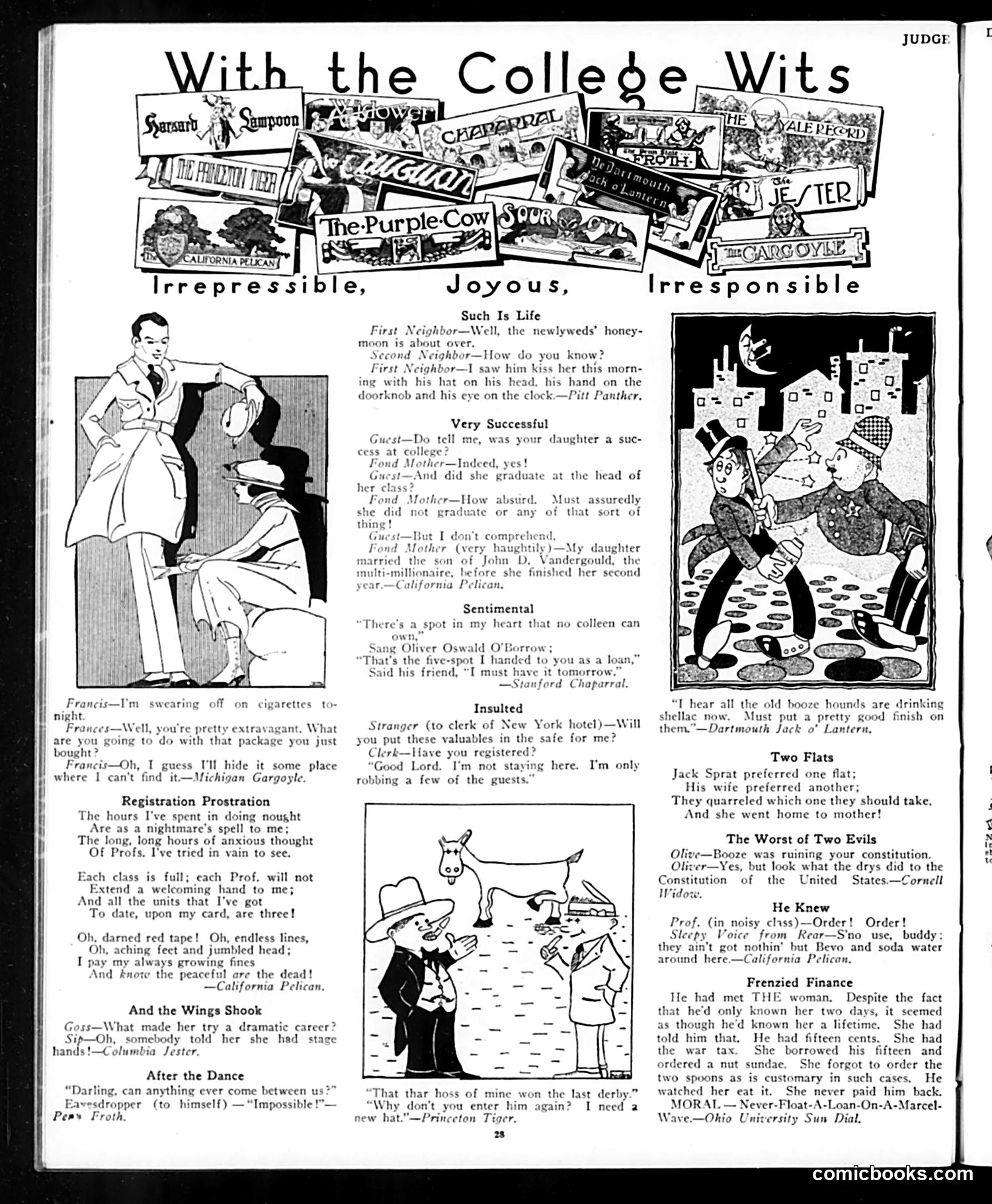
This page collects humorous short jokes and verses from various college newspapers, reflecting 1920s campus life and social anxieties. **Key themes:** - **Registration chaos**: "Registration Prostration" satirizes the bureaucratic nightmare of college enrollment—endless lines, unavailable professors, accumulating fines. - **Dating/romance**: Multiple jokes about courtship awkwardness ("After the Dance," "Frenzied Finance") and newlywed disillusionment, with the final story mocking a woman who accepts a man's courtship gifts and borrowed money without reciprocating affection. - **Prohibition**: Several jokes reference "Bevo" (non-alcoholic beer) and "booze hounds," reflecting the dry era (Prohibition was 1920-1933). - **Gender dynamics**: The humor often targets women's behavior—dramatic aspirations, financial manipulation, superficiality. The cartoons are minor illustrations accompanying these brief comedic pieces from college publications like *California Pelican*, *Michigan Gargoyle*, and *Princeton Tiger*. The overall tone is light collegiate satire aimed at Judge's educated readership.
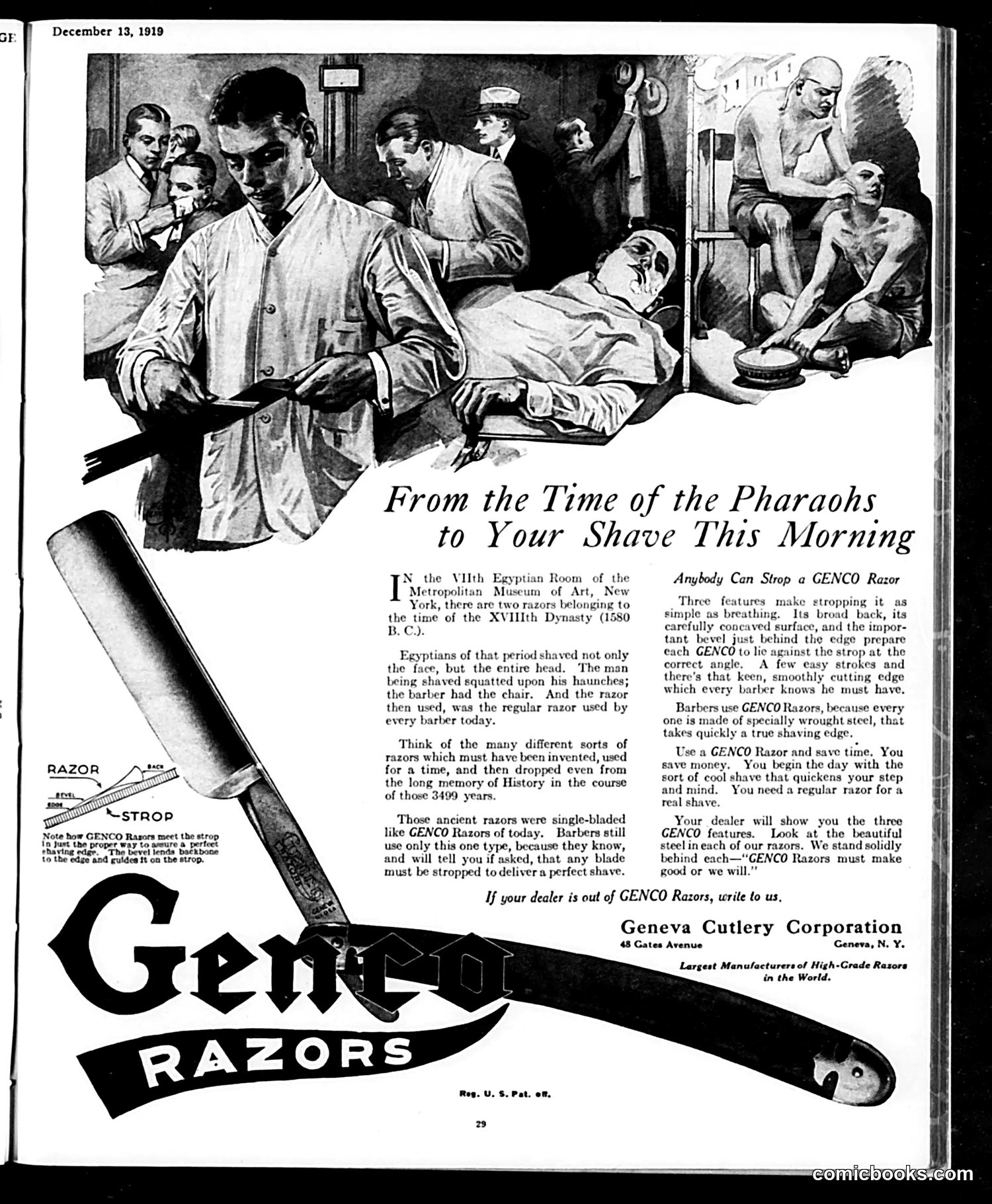
This is primarily a **razor advertisement**, not a political cartoon. The page from *Judge* magazine (December 13, 1919) promotes GENCO Razors by the Geneva Cutlery Corporation. The advertisement uses a historical hook: Egyptian razors from the XVIIIth Dynasty (circa 1580 B.C.), displayed at New York's Metropolitan Museum. The copywriter notes these ancient razors were single-bladed—like modern GENCO razors—and argues that this design's persistence across 3,500 years proves its superiority. The illustration depicts barbers at work across different eras, visually connecting ancient and modern shaving practices. The satirical angle is modest: the headline "From the Time of the Pharaohs to Your Shave This Morning" humorously positions a simple morning grooming routine within grand historical sweep. The ad emphasizes that GENCO razors are professional-grade, require proper stropping technique, and remain the choice of experienced barbers—thereby justifying the product's premium position to middle-class male consumers.
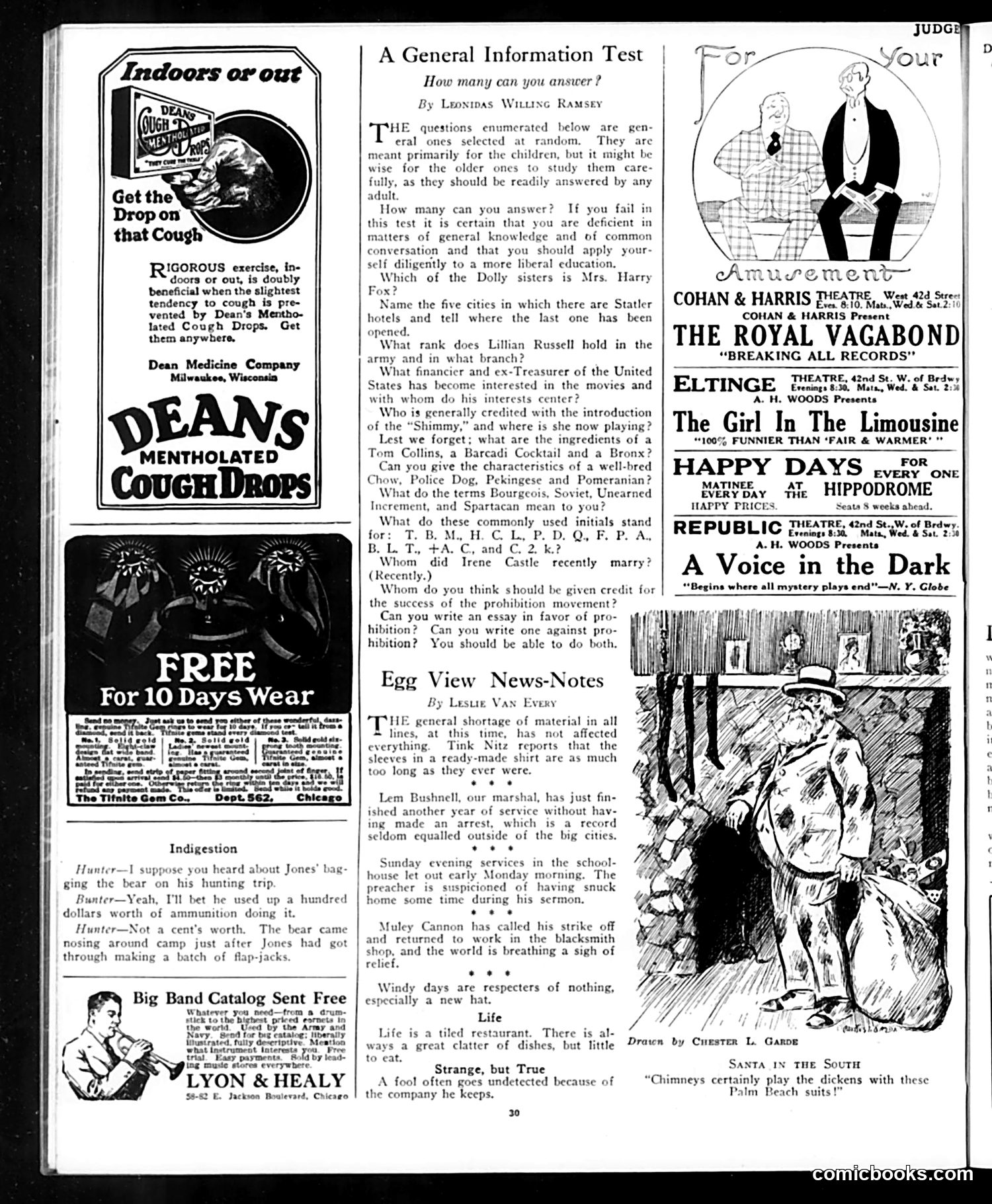
This is primarily an **advertising and entertainment page** from Judge magazine, with limited satirical content. The main feature is "A General Information Test" by Leonidas Willing Ramsey—a quiz ostensibly for children but framed as exposing adults' ignorance. The questions reference contemporary 1920s celebrities and cultural figures: the Dolly Sisters (famous entertainers), Lillian Russell (actress), Irene Castle (dancer), and the "Shimmy" dance craze. The test's tone is gently mocking—suggesting readers lack "general knowledge and common conversation" if they fail. The "Egg View News-Notes" column offers mild rural humor: a marshal with no arrests, a preacher sneaking out during services, and philosophical quips ("A fool often goes undetected because of the company he keeps"). The cartoons are minimal; the page is dominated by **advertisements** for Dean's cough drops, theaters (Cohan & Harris, Eltinge, Republic), and a band catalog. The satire is light and inoffensive—poking fun at common knowledge gaps and small-town life rather than political targets.
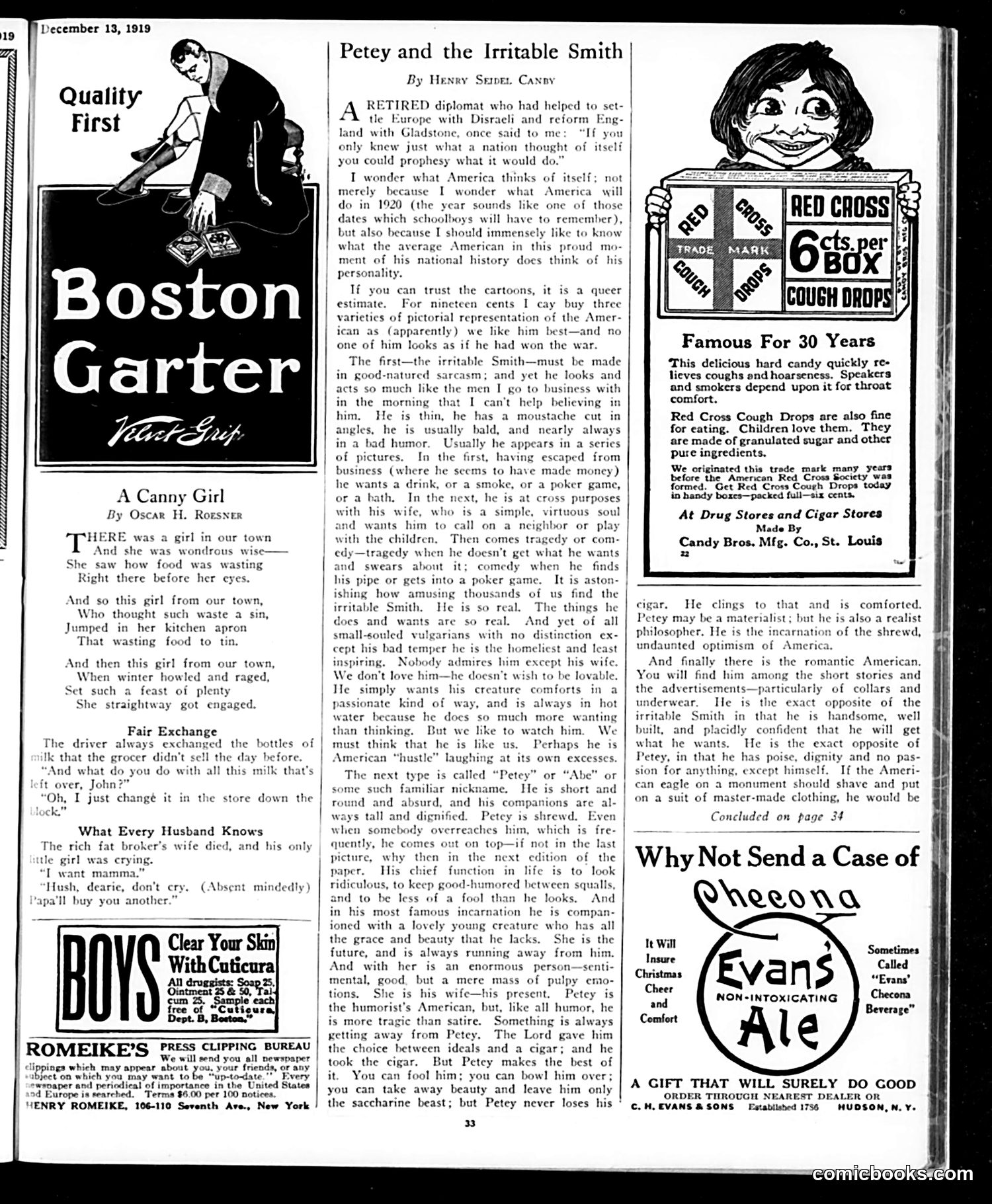
This article analyzes American national character through popular cartoon archetypes. The author, a retired diplomat, argues that a nation's self-image predicts its future—wondering what America will do in 1920. He identifies two cartoon types representing how Americans see themselves: 1. **"The Irritable Smith"**: A thin, mustached, perpetually grumpy businessman obsessed with personal comfort (drinks, smokes, poker). He's real and relatable to readers, yet small-minded and uninspiring—loved only by his wife. The satire suggests Americans recognize themselves in this mediocre, comfort-seeking figure. 2. **"Petey"** (described incompletely in the OCR): Apparently another archetypal character, contrasting with Smith. The piece satirizes that average Americans identify with these unflattering caricatures, questioning what this says about national character on the eve of the 1920s. It's essentially sophisticated social commentary masked as entertainment—using cartoon criticism to examine American values and self-perception post-WWI.
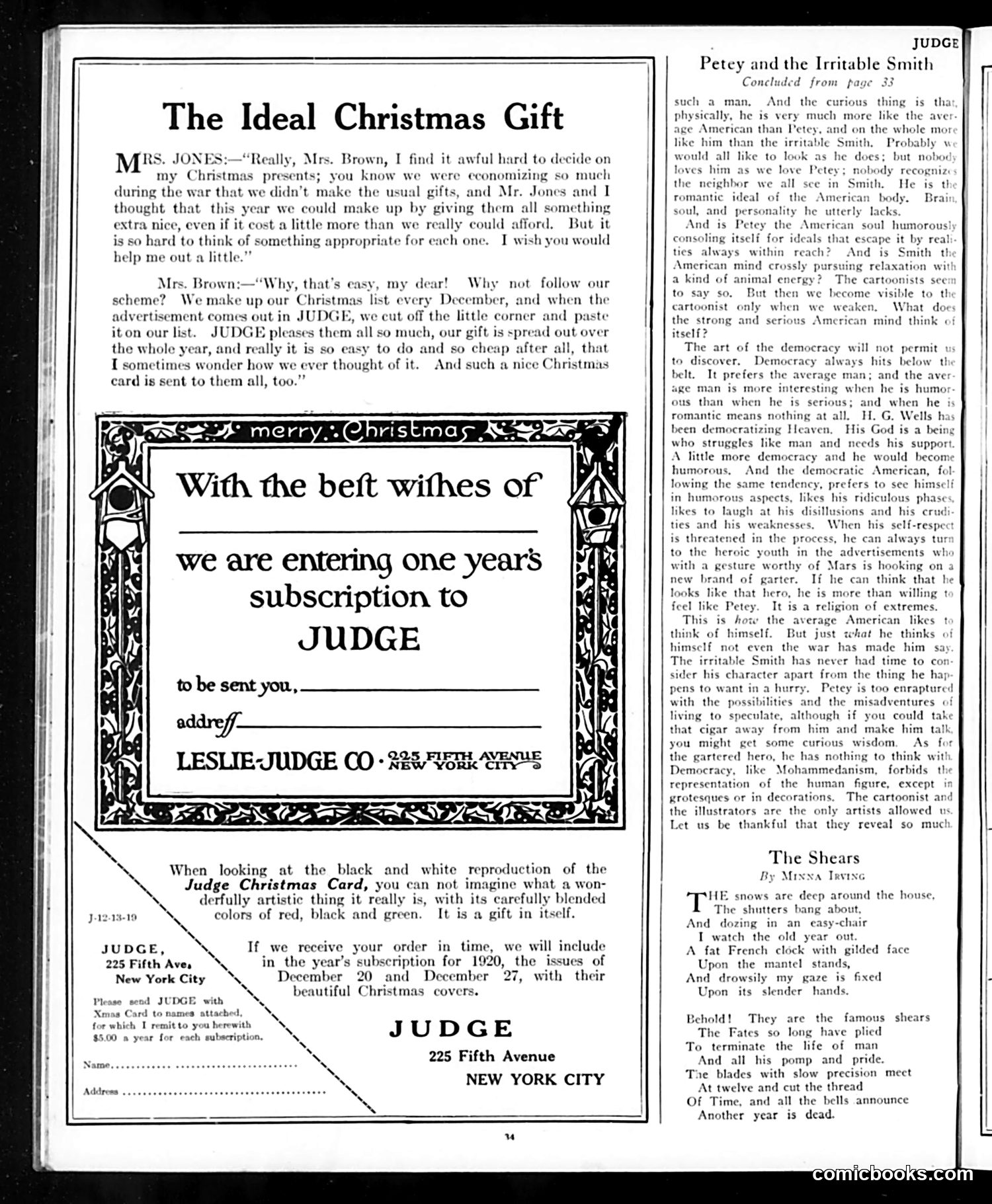
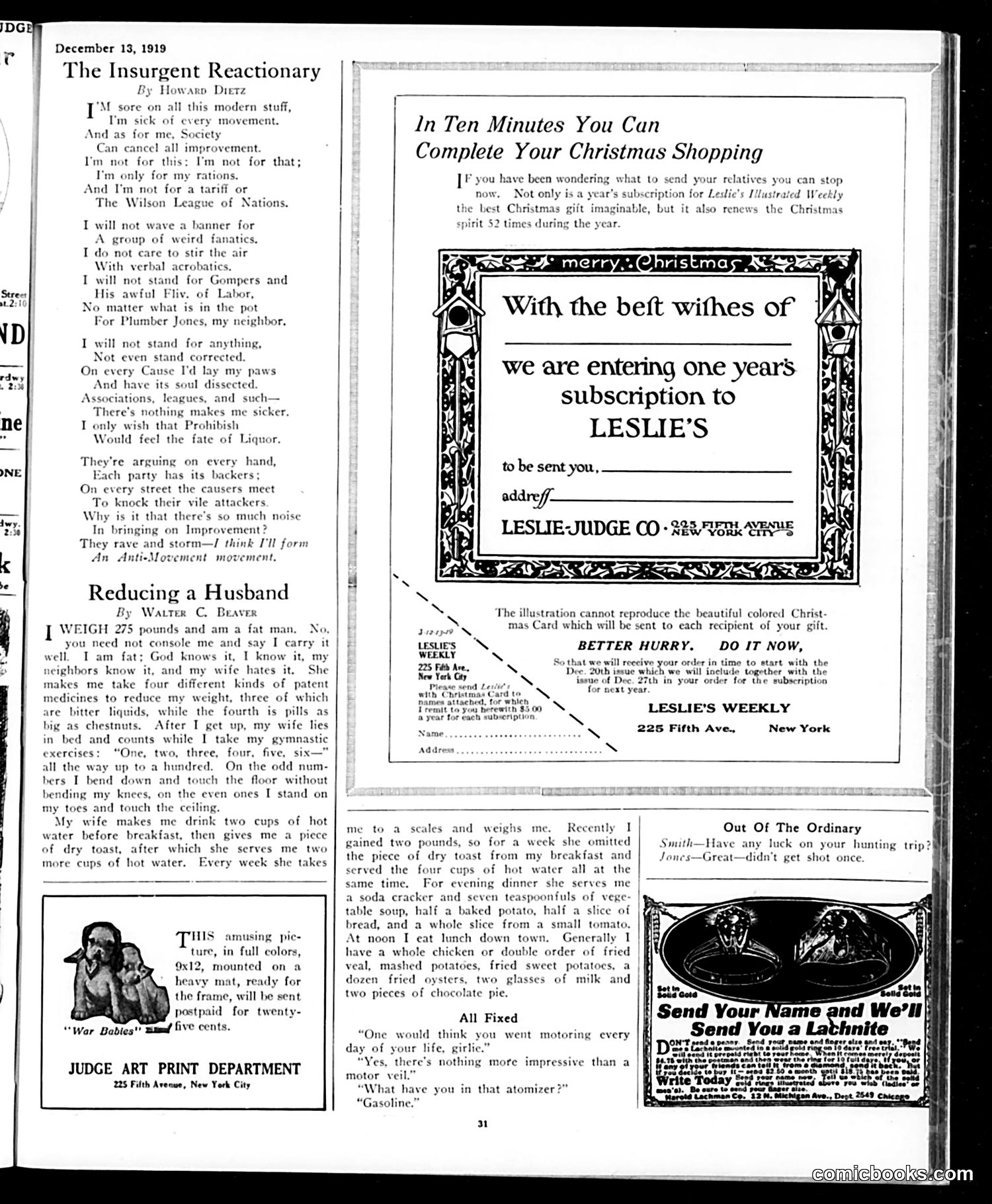
This page is primarily **advertising for Judge magazine itself**, framed as editorial content about gift-giving. **The Main Content:** Mrs. Jones and Mrs. Brown discuss Christmas gift problems. Mrs. Brown proposes an ingenious solution: subscribe friends to *Judge* magazine. She claims the subscription itself serves as a "gift," and Judge's beautiful Christmas cards (with "carefully blended colors of red, black and green") make the whole package worthwhile. The ad emphasizes economy—spreading one modest cost across recipients—while appearing generous. **The Satire:** The humor lies in the **transparent self-interest**: presenting a magazine subscription as an elegant solution to gift-giving reveals how Americans rationalize convenient, inexpensive presents as thoughtful ones. Mrs. Brown's enthusiasm masks the fact that she's essentially giving people a magazine she presumably enjoys, not individualized gifts. **Context:** This appears post-WWI (references to wartime economizing). The right column contains unrelated fiction content about characters "Petey" and "Smith." The ad works by making the magazine subscription seem like clever wisdom rather than marketing.
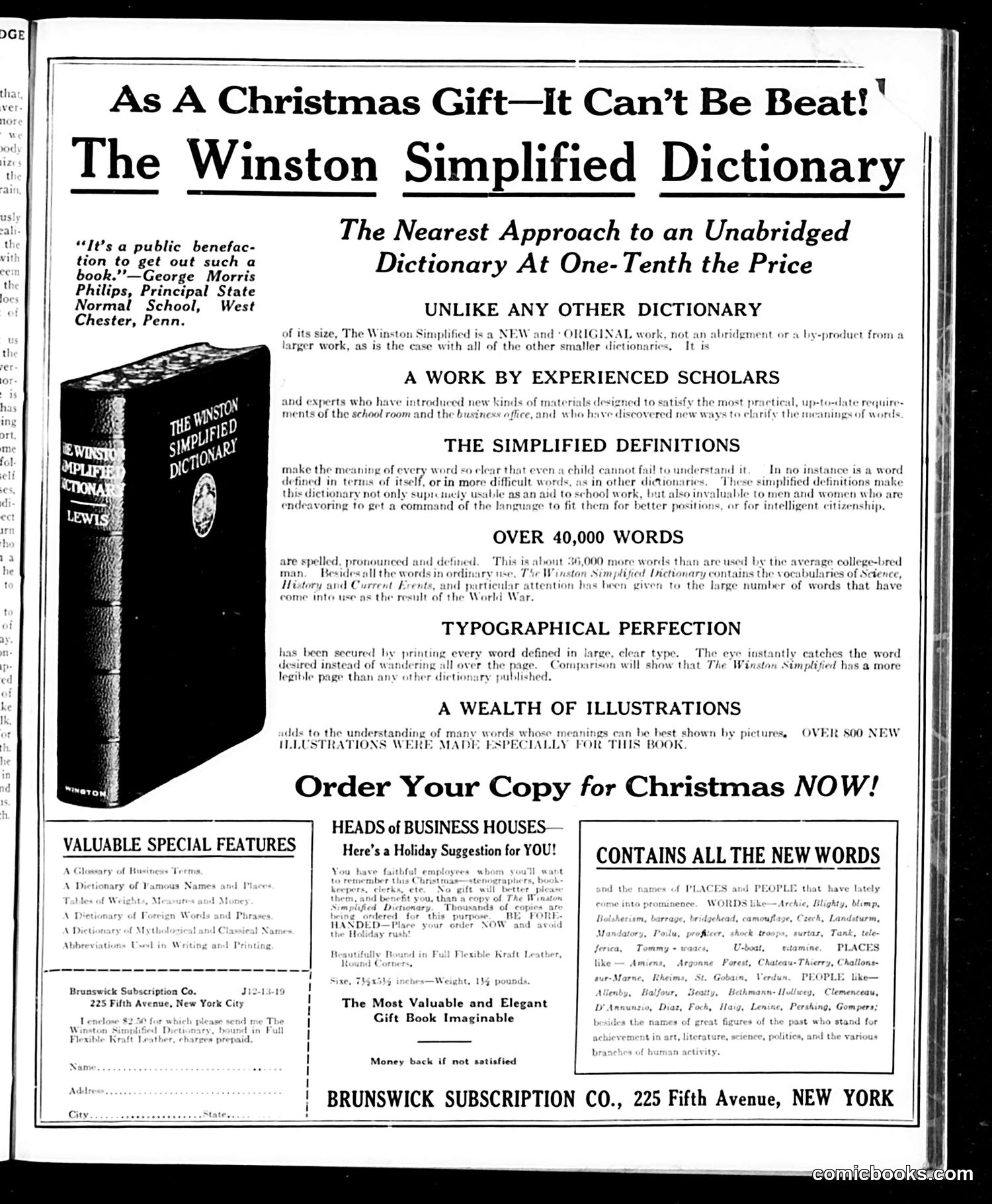
This page is primarily a **product advertisement**, not a political cartoon. It advertises *The Winston Simplified Dictionary* as a Christmas gift, published by Brunswick Subscription Co. The ad emphasizes the dictionary's practical value: it contains 40,000 words (more than average college-educated people use), includes over 800 new illustrations, and uses simplified definitions accessible to schoolchildren and working adults—all at "one-tenth the price" of an unabridged dictionary. The appeal targets both individual consumers and "heads of business houses" seeking holiday gifts for employees. A testimonial from a Pennsylvania school principal lends authority. There is **no political satire or social commentary** here. This is straightforward early-20th-century advertising exploiting the holiday shopping season and the era's democratic aspirations—making educational resources affordable and accessible to ordinary Americans, not just the wealthy.
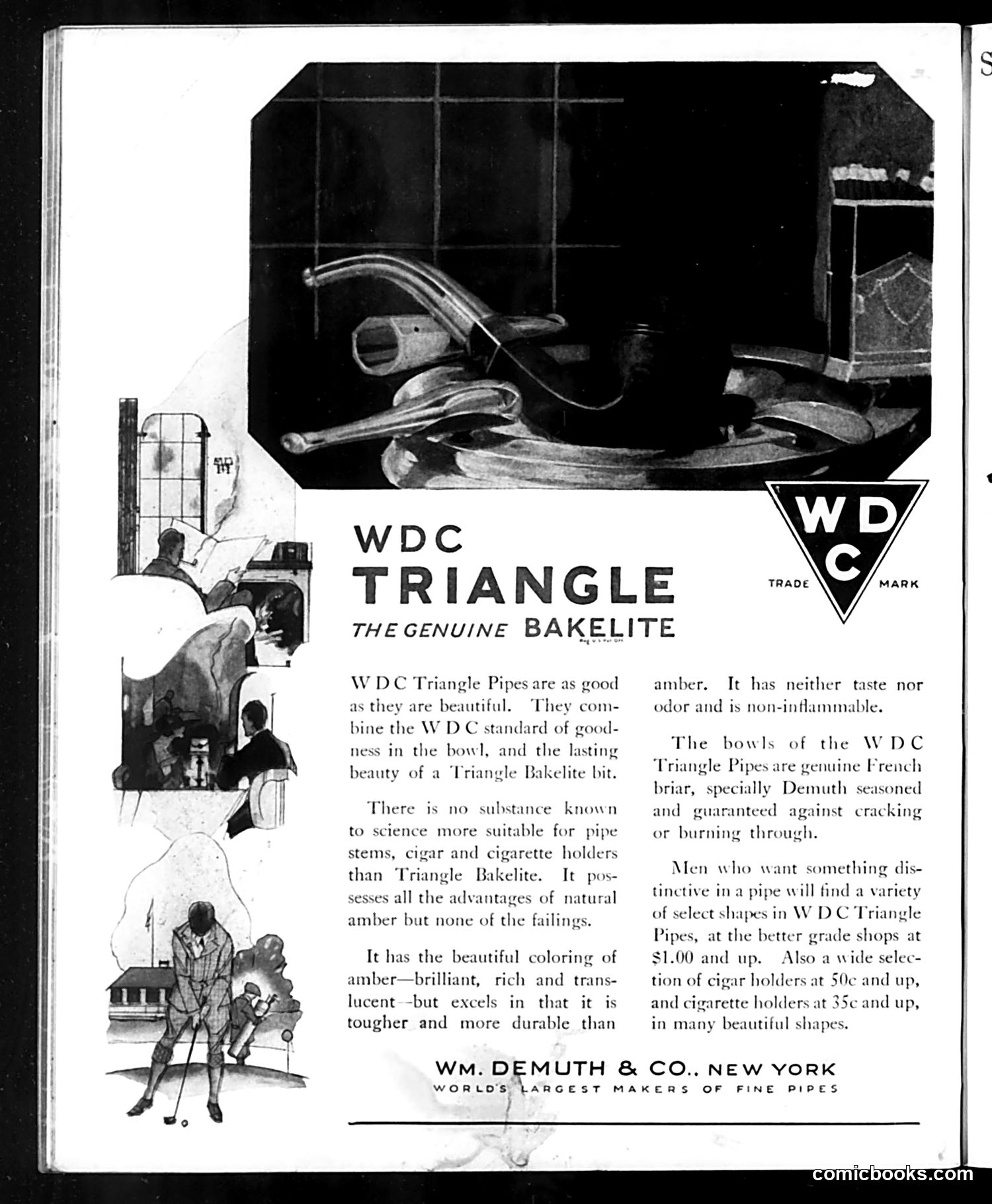
This page is primarily **advertising, not political satire**. It's a product advertisement for WDC Triangle Pipes, manufactured by Wm. Demuth & Co. of New York. The top image shows the pipes and smoking accessories themselves. The left side depicts illustrations of men in various settings (appears to be leisure/social scenes), used to market the product to male consumers as a desirable luxury item. The advertising copy emphasizes that Triangle Bakelite—a synthetic material—offers advantages of natural amber (color, appearance) without its drawbacks (brittleness, flammability). The pipes feature genuine French briar bowls and are positioned as upscale products ("better grade shops," $1.00 and up). **For modern readers**: This represents early 20th-century consumer marketing normalizing smoking as sophisticated leisure, with no health warnings. The "Judge" magazine context suggests this appeared among satirical content, though the advertisement itself contains no satire or political commentary.