
Judge, 1919-12-13 · page 5 of 36
Judge — December 13, 1919 — page 5: what you’re looking at
What you’re looking at
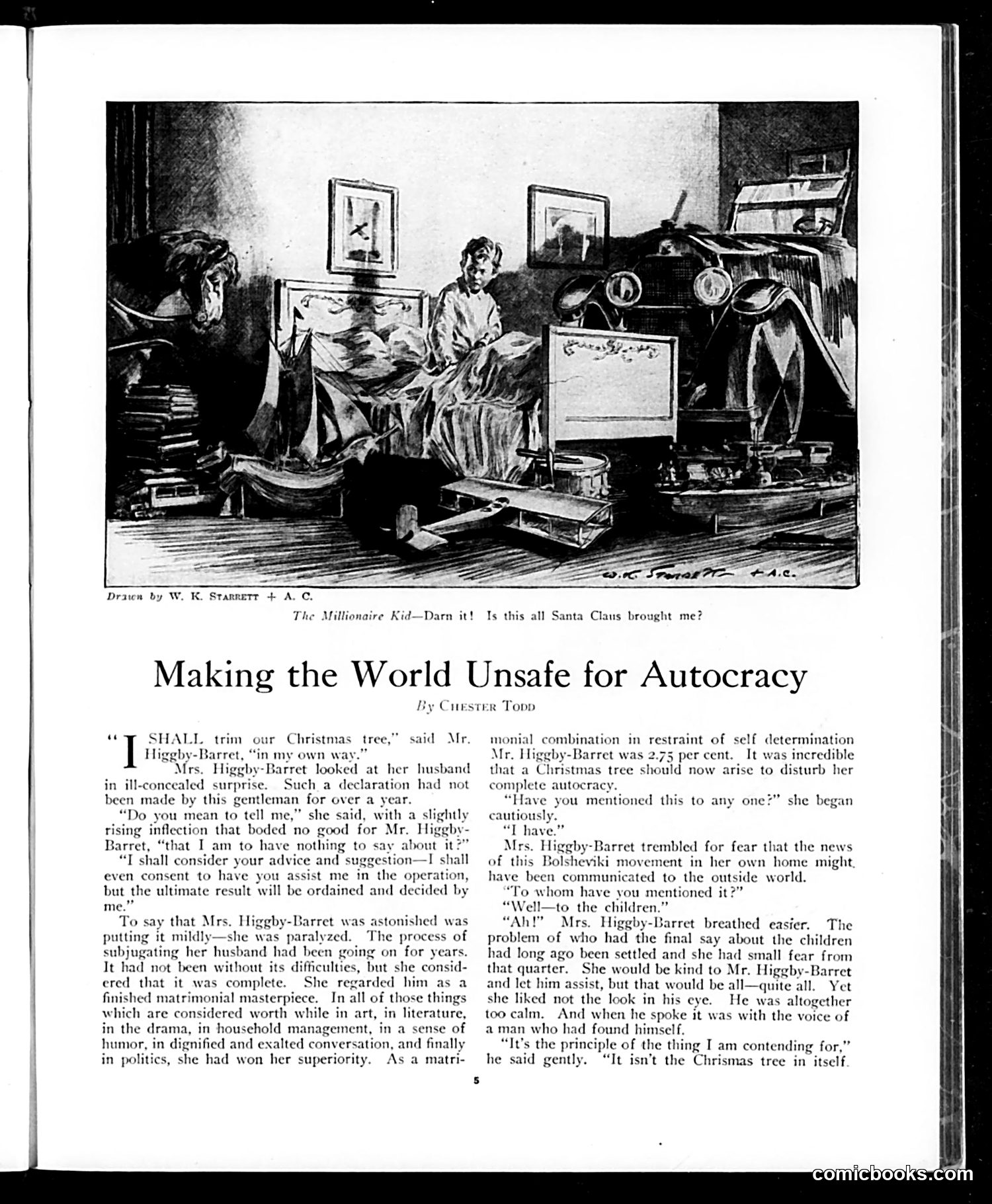
This satirical story by Chester Todd critiques wealthy industrialists' authoritarianism in domestic life. The illustration shows a wealthy household scene where Mr. Higgby-Barrett insists on absolute control—even dictating how the family Christmas tree should be decorated, against his wife's wishes. The title's irony is sharp: while America fought World War I against autocracy abroad (referencing Woodrow Wilson's rhetoric about making "the world safe for democracy"), wealthy men like Higgby-Barrett practiced domestic autocracy at home, controlling their wives' autonomy completely. Mrs. Higgby-Barrett has long resisted this control. The story satirizes how privilege and patriarchal authority reinforce each other, suggesting that true democratic values require challenging "autocracy" within the household itself.
📄 Transcribed text from this page (OCR, searchable)
Machine-transcribed from the original scan — historical spelling and the odd misread are preserved.
Starrett + A. C. The Millionaire Kid—Darn it! Draten by W. K. Is this all Santa Claus brought me? Making the World Unsafe for Autocracy By Cuester Topp “ SHALL trim our Christmas tree,” said Mr Higgby-Barret, “in my own way.” Mrs. Higgby-Barret looked at her husband in ill-concealed surprise. Such a declaration had not been made by this gentleman for over a year. “Do you mean to tell me,” she said, with a slightly rising inflection that boded no good for Mr. Higgby- Barret, “that I am to have nothing to say about it?” “T shall consider your advice and suggestion—I shall even consent to have you assist me in the operation, but the ultimate result will be ordained and decided by me.” To say that Mrs. Higgby putting it mildly—she wa alyzed. The process of subjugating her husband had | bing on for ye: It had not been without its difficulties, but she consid- ered that it was complet She regarded him as a finished matrimonial masterpiece. In all of those things which are considered worth while in art, in literature, in the drama, in household management, in a sense of humor, in dignified and exalted conversation, and finally in politics, she had won her superiority. As a matri- rret was astonished was monial combination in restraint of self determination Mr. Higgby-Barret was 2.75 per cent. It was incredible that a Christmas tree should now arise to disturb her complete autocracy. “Have you me cautiously. “T have.” Mrs. Higgby-Barret trembled for fear that the news of this Bolsheviki movement in her own home might have been communicated to the outside world. whom have you mentioned it?” “Well—to the children.” “Ah!” Mrs. Higgby-Barret breathed easier. The problem of who had the final say about the children had long ago been settled and she had small fear from that quarter. She would be kind to Mr. Higgby-Barret and Iect him assist, but that would be all—quite all. Yet she liked not the look in his eye. He was altogether too calm. And when he spoke it was with the voice of aman who had found himself. “It’s the principle of the thing I am contending for,” he said gently. “It isn’t the Chrismas tree in itself ned this to any one?” she began