
A complete issue · 36 pages · 1919
Judge — November 29, 1919
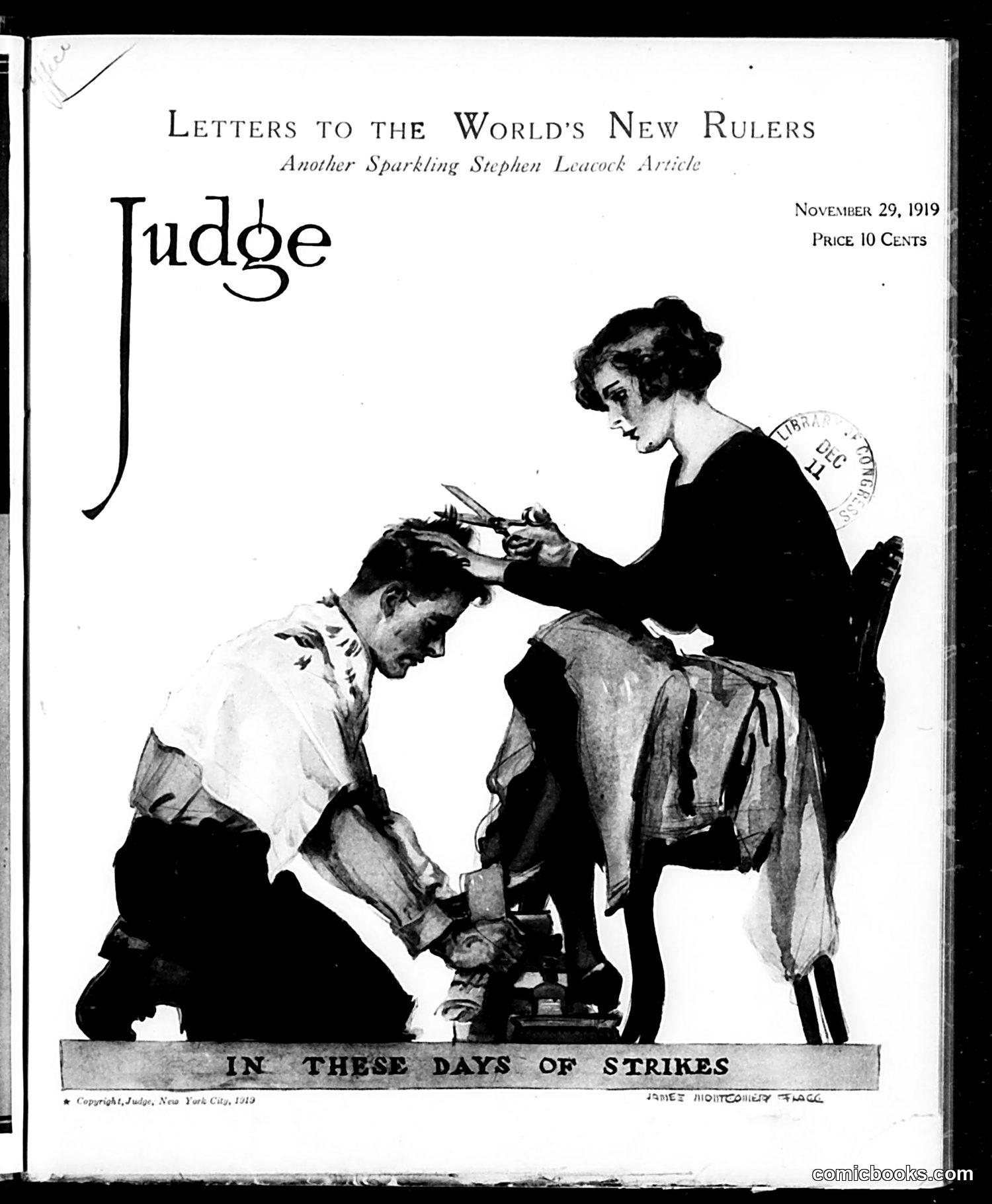
This satirical cover illustrates labor unrest during the post-WWI period. The image shows a woman (representing justice or authority) examining or "judging" a man being fitted with shackles or restraints by another figure. The caption "IN THESE DAYS OF STRIKES" indicates commentary on contemporary labor disputes. The satire appears critical of strikes themselves—suggesting they warrant punishment or judicial scrutiny. The 1919 date places this during major U.S. labor actions, including the Seattle General Strike and steel strikes. The "Judge" magazine typically represented conservative, pro-business viewpoints, so this likely mocks strikers as lawbreakers deserving restraint rather than sympathizing with workers' grievances.
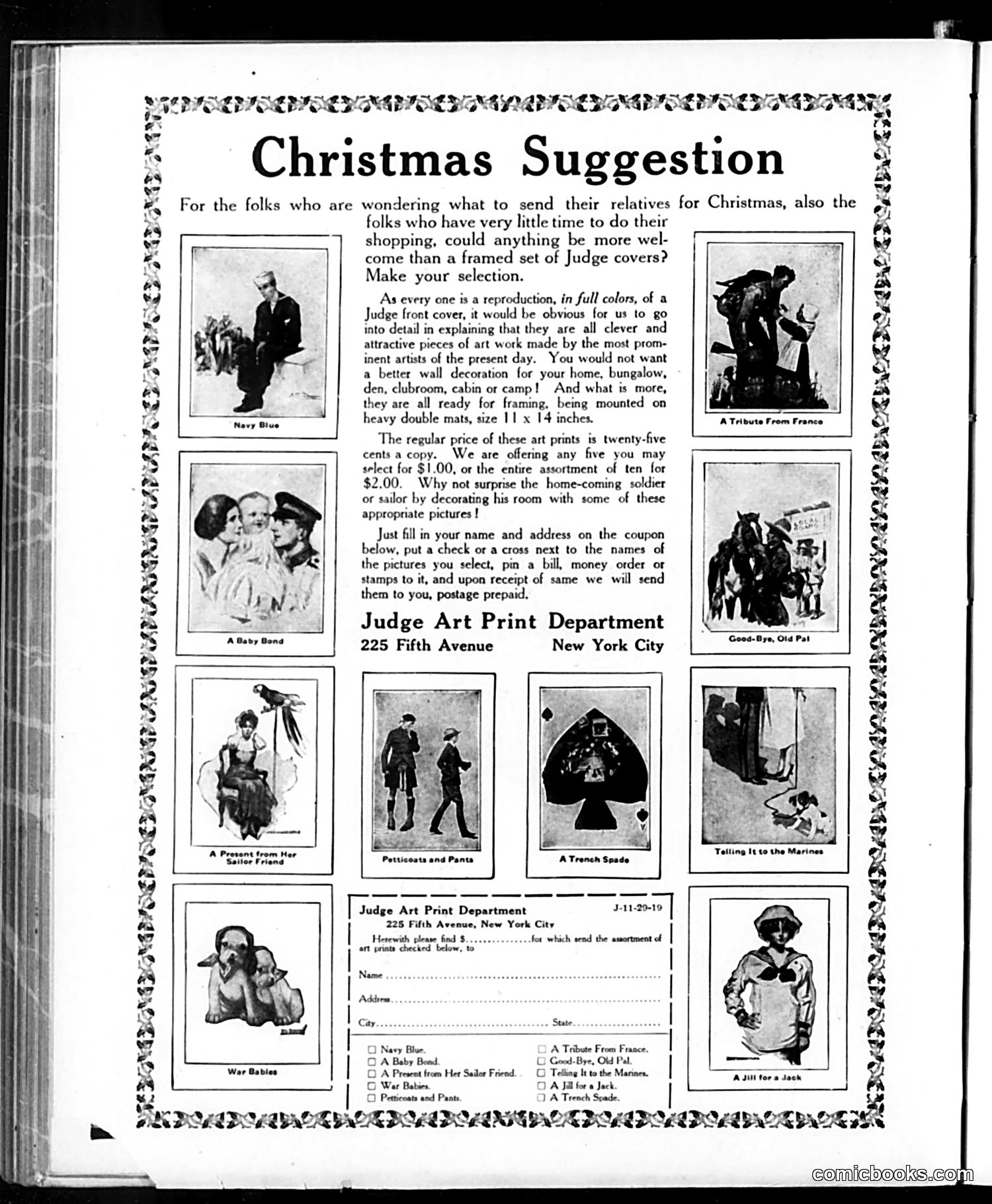
This is primarily a **Christmas gift advertisement** for Judge Art Print Department, not political satire. The page showcases framed art prints available for purchase at 25 cents each or discounted bulk orders. The images depict **WWI-related themes**—consistent with Judge's era. Titles include "Navy Blue," "A Baby Bond," "War Babies," "A Peasant from Her Sailor Friend," "Patriotic and Penis" [likely "Patriotic and Pants"], "A Trench Spade," "Telling It to the Marines," "Good-Bye, Old Pal," and "A Jill for a Jack." The advertisement targets those buying gifts for **soldiers and home-front family members**, suggesting these prints would appeal to military personnel or serve as patriotic home decoration. The framing format (11x14 inches) and pricing reflect early-20th-century print merchandising rather than satirical commentary.
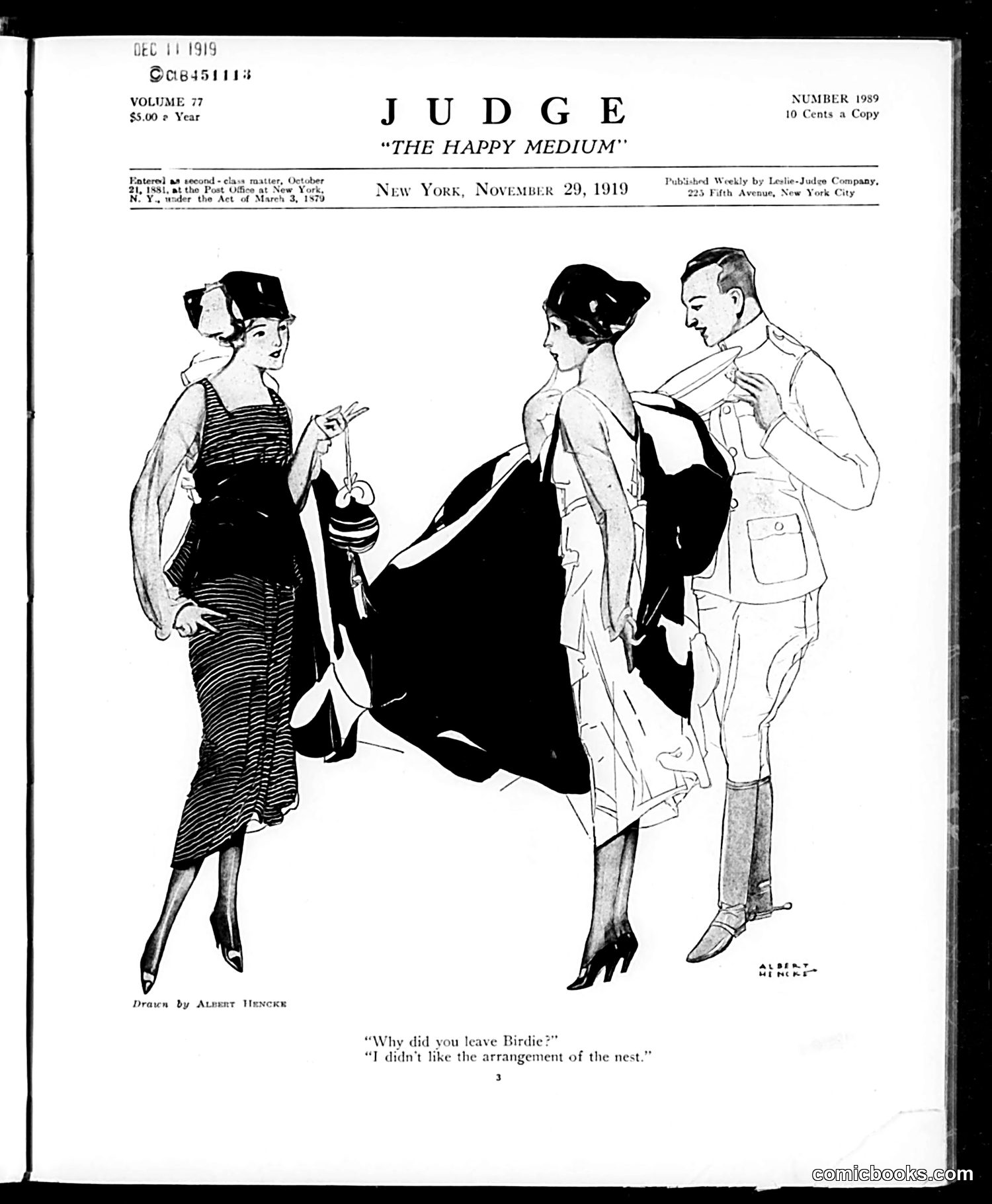
This is a single-panel cartoon from *Judge* magazine (November 29, 1919) drawn by Albert Hencke. It depicts three fashionably dressed figures in 1919 attire: two women and a man in military uniform. The caption reads: "Why did you leave Birdie?" / "I didn't like the arrangement of the nest." The joke appears to be a domestic humor piece playing on bird terminology. "Birdie" is likely a nickname for a wife or romantic partner, while "the nest" is a metaphor for the home/domestic life. The woman's departure over dissatisfaction with domestic "arrangements" suggests marital discord or relationship conflict—a common satirical subject in 1919 magazines. The cartoon satirizes post-WWI social dynamics, where returning soldiers (indicated by the uniform) encountered changing social attitudes and relationship tensions among women, possibly reflecting women's increased independence during and after the war.
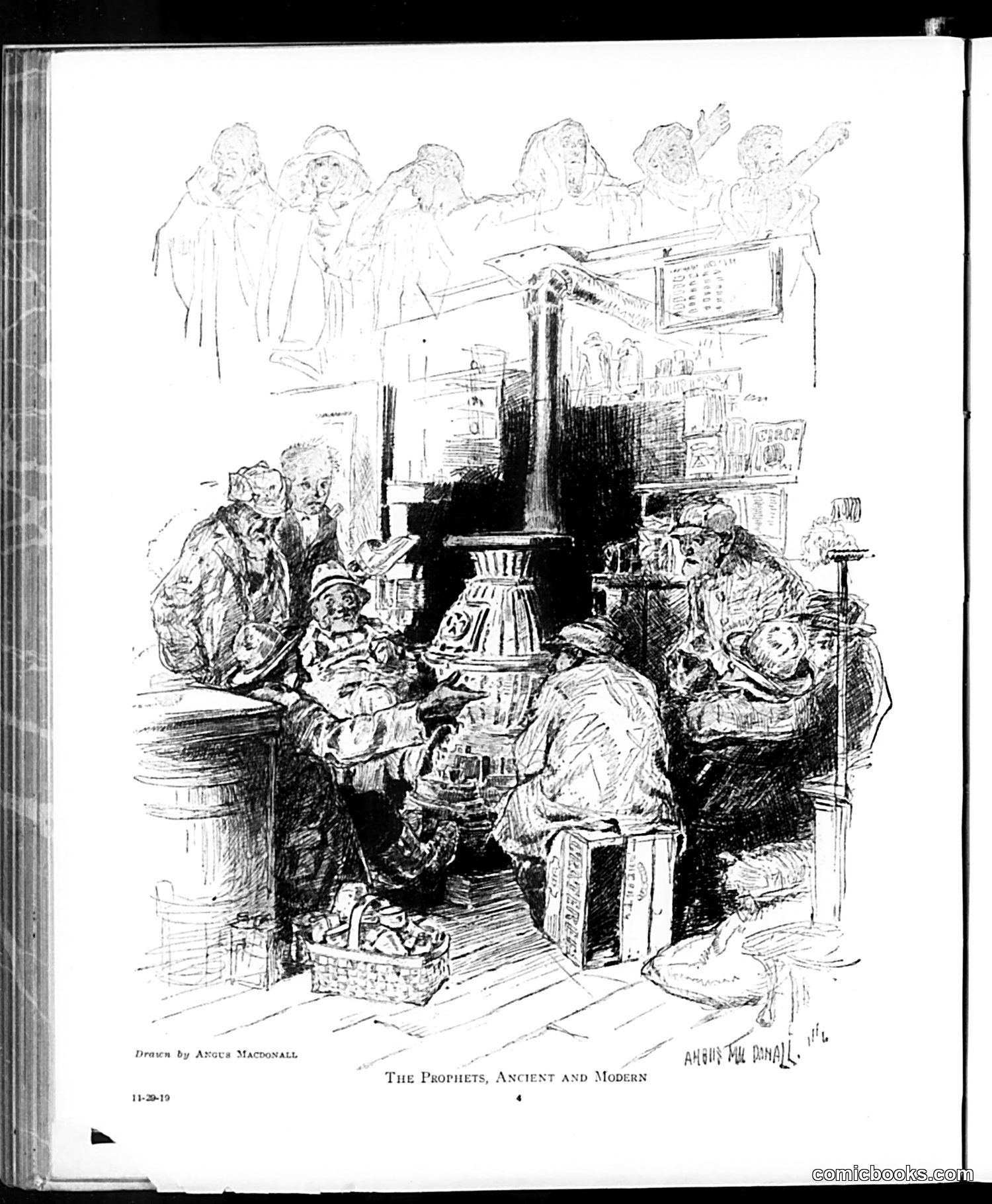
This cartoon by Angus Macdonnall satirizes contemporary fortune-tellers and spiritualists by comparing them to biblical prophets. The image shows a séance or spiritualist gathering around a central stove or heating device, with figures seated in a circle and ghostly apparitions floating above—a visual reference to the popular spiritualist belief in communicating with spirits. The satire likely critiques the spiritualist movement's proliferation in late 19th/early 20th-century America, when fraudulent mediums and séances were common entertainment exploiting people's grief and credulity. By juxtaposing "ancient" (legitimate) prophets with "modern" (charlatan) ones, Macdonnall mocks contemporary spiritualists as false prophets peddling superstition rather than genuine spiritual insight.
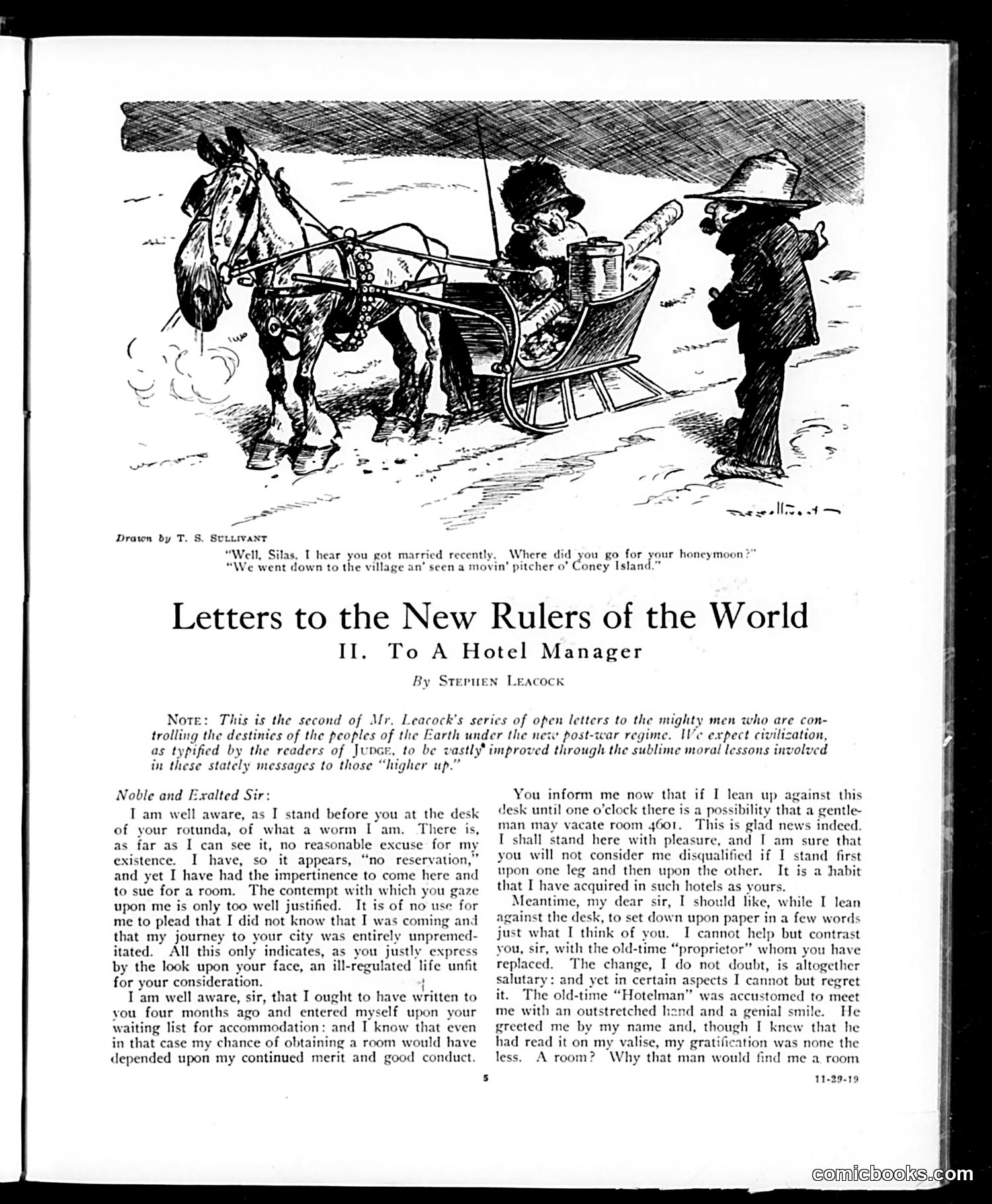
**The Cartoon:** The top illustration shows a couple in a horse-drawn sleigh being stopped by a man on a snowy road. The couple claims they went to "the village an' seen a movin' pitcher o' Coney Island" for their honeymoon—a joke about how modest/inexpensive their honeymoon was (viewing a movie instead of traveling to the actual Coney Island resort). **The Article:** "Letters to the New Rulers of the World II: To a Hotel Manager" is a satirical open letter by Stephen Leacock. The sender complains about the hotel's arbitrary rules—being required to stand on one leg or vacate rooms by 1 PM—mocking how hotels (and post-WWI institutions generally) impose unreasonable, petty authority over guests. It's social satire about bureaucratic overreach and the loss of civility in modern management.
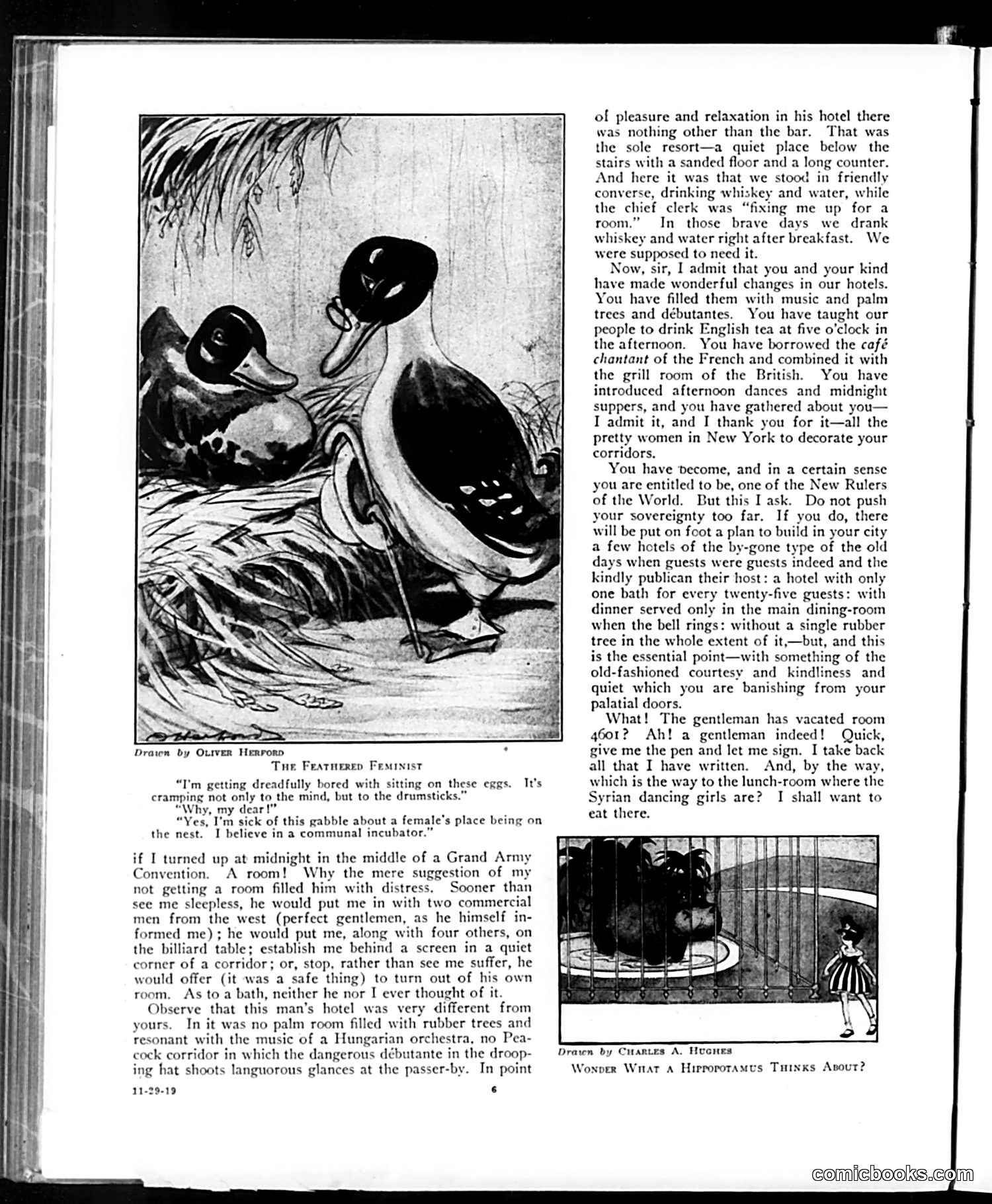
**"The Feathered Feminist"** (top cartoon by Oliver Herford) depicts a bird sitting on eggs, complaining about boredom and dismissing women's traditional domestic roles. The bird sarcastically rejects the notion that a female's "place" should be confined to homemaking, calling it "a communist incubator." **"Wonder What a Hippopotamus Thinks About?"** (bottom cartoon by Charles A. Hughes) shows a hippo observing a fashionably-dressed woman, likely satirizing either women's fashion choices or the absurdity of wondering about animal perspectives on human behavior. Both cartoons appear to address gender roles and women's rights—the top one directly critiquing traditional domesticity through absurdist humor, the bottom offering social commentary through animal observation. The date shown is 11-29-19 (likely November 1919).
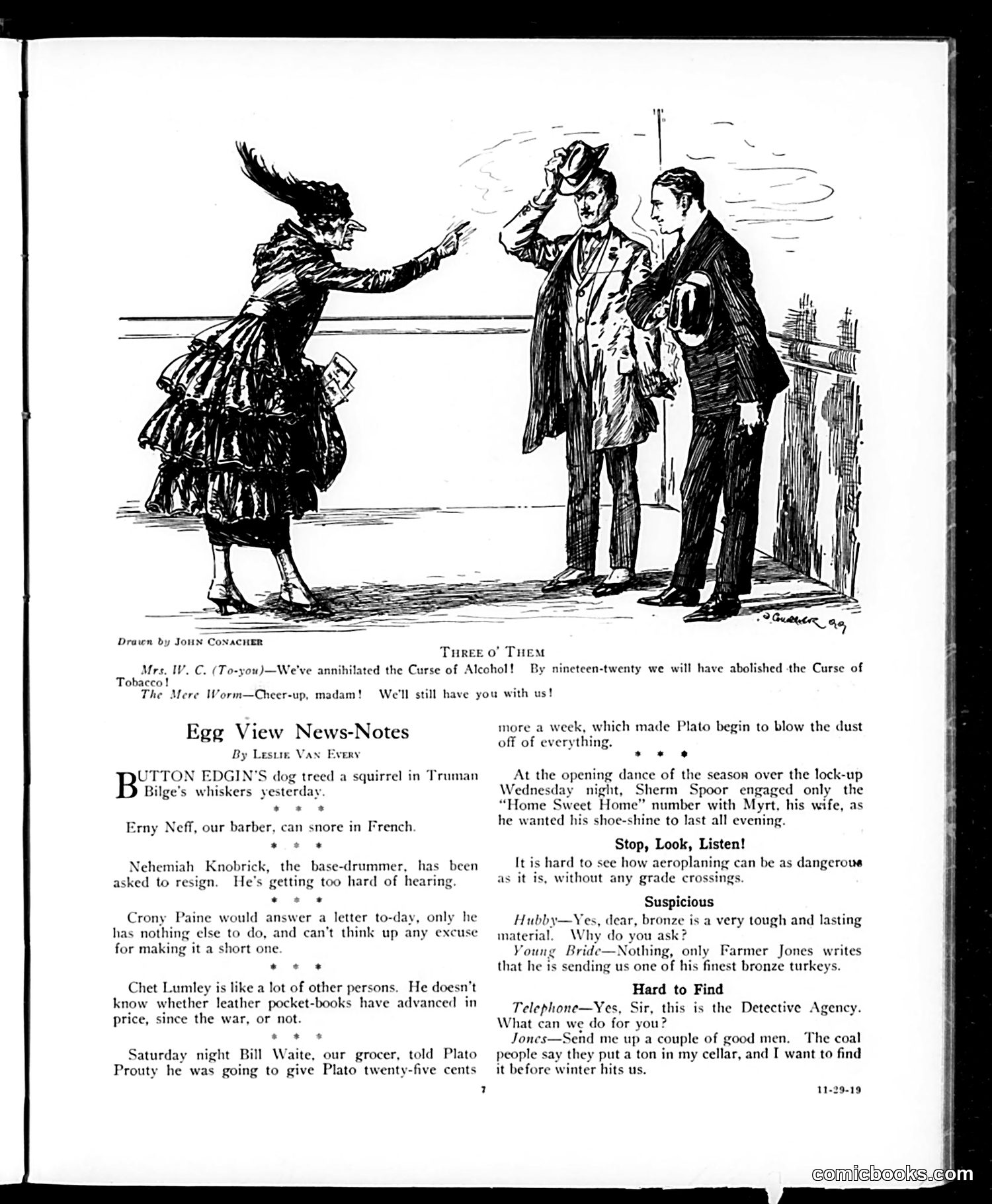
The main cartoon satirizes early 20th-century Prohibition efforts. A woman proclaims she's "annihilated the Curse of Alcohol" and "Tobacco," but a skeletal "Mere Worm" (representing vice or human weakness itself) cheerfully responds that it will persist—she can't actually eliminate these vices despite her moral crusade. The page is dominated by "Egg View News-Notes," humorous local gossip items poking fun at small-town characters and their quirks: a barber who snores in French, a drummer getting deaf, people's laziness or obliviousness. The bottom section contains brief jokes, including one mocking aeronautics safety and another about wartime scarcity—a man hired a detective to locate a ton of coal allegedly delivered to his cellar, suggesting dishonest fuel dealers were a known problem during winter shortages. The satirical thrust targets both temperance zealotry and everyday human foibles.
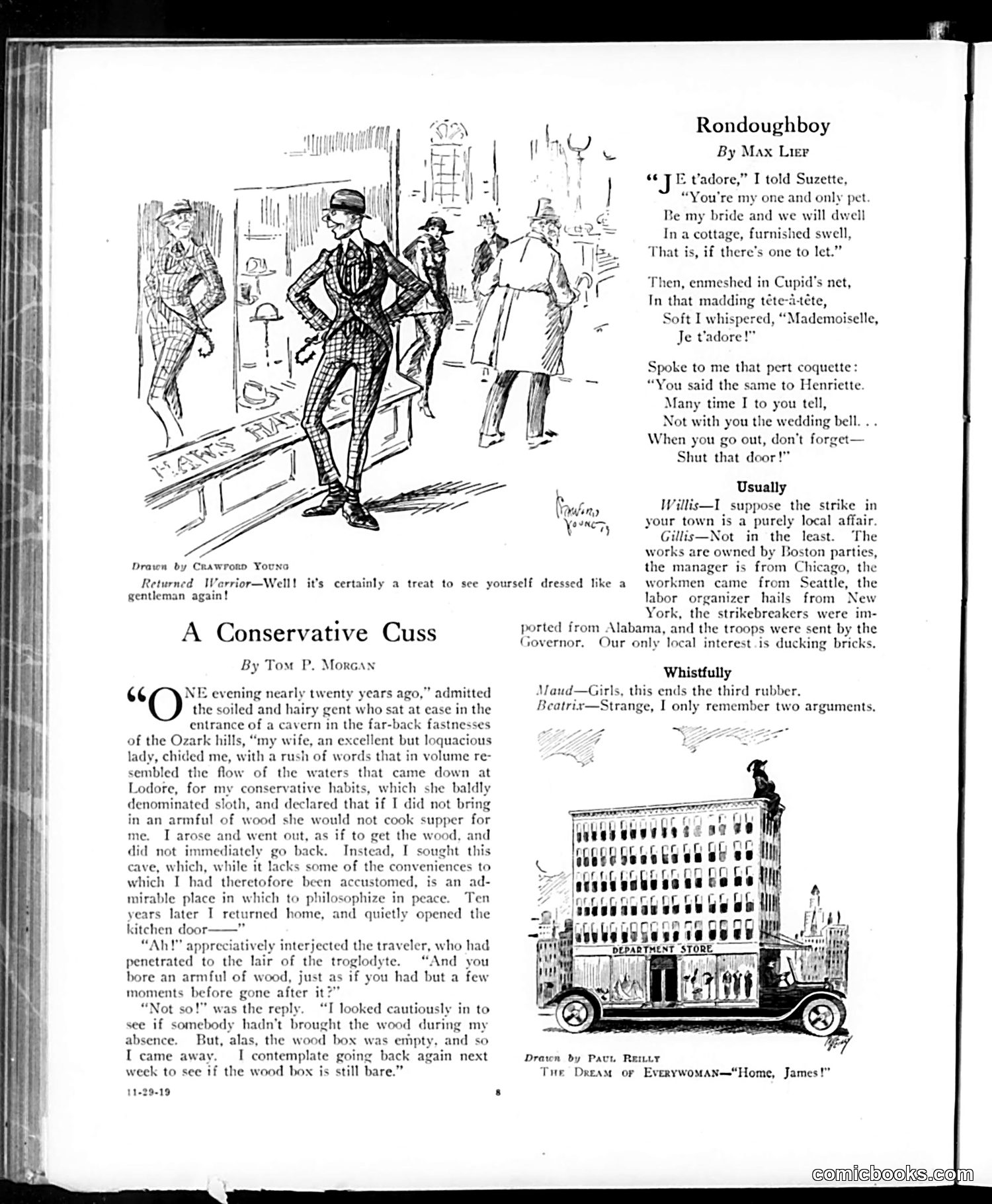
This page contains three satirical pieces: **"A Conservative Cuss"** mocks male laziness disguised as principle. A man avoids chopping wood by hiding in a cave for ten years, returning home only to check—unsuccessfully—if someone else had done it. The satire targets men who rationalize shirking domestic responsibilities. **"Rondoughboy"** ridicules a philandering suitor who makes identical romantic declarations to multiple women (Suzette, Henriette). When confronted, his romantic interest dissolves into nagging about closing doors—satirizing shallow male flirtation. **"Usually"** critiques labor strikes as having become nationalized rather than local affairs. Workers, management, strikebreakers, and troops all come from different states, making the strike's "local interest" merely dodging violence—satire on how industrialization and national capital have removed labor disputes from community control. The illustrations support these themes with exaggerated character types typical of Judge's humorous social commentary.
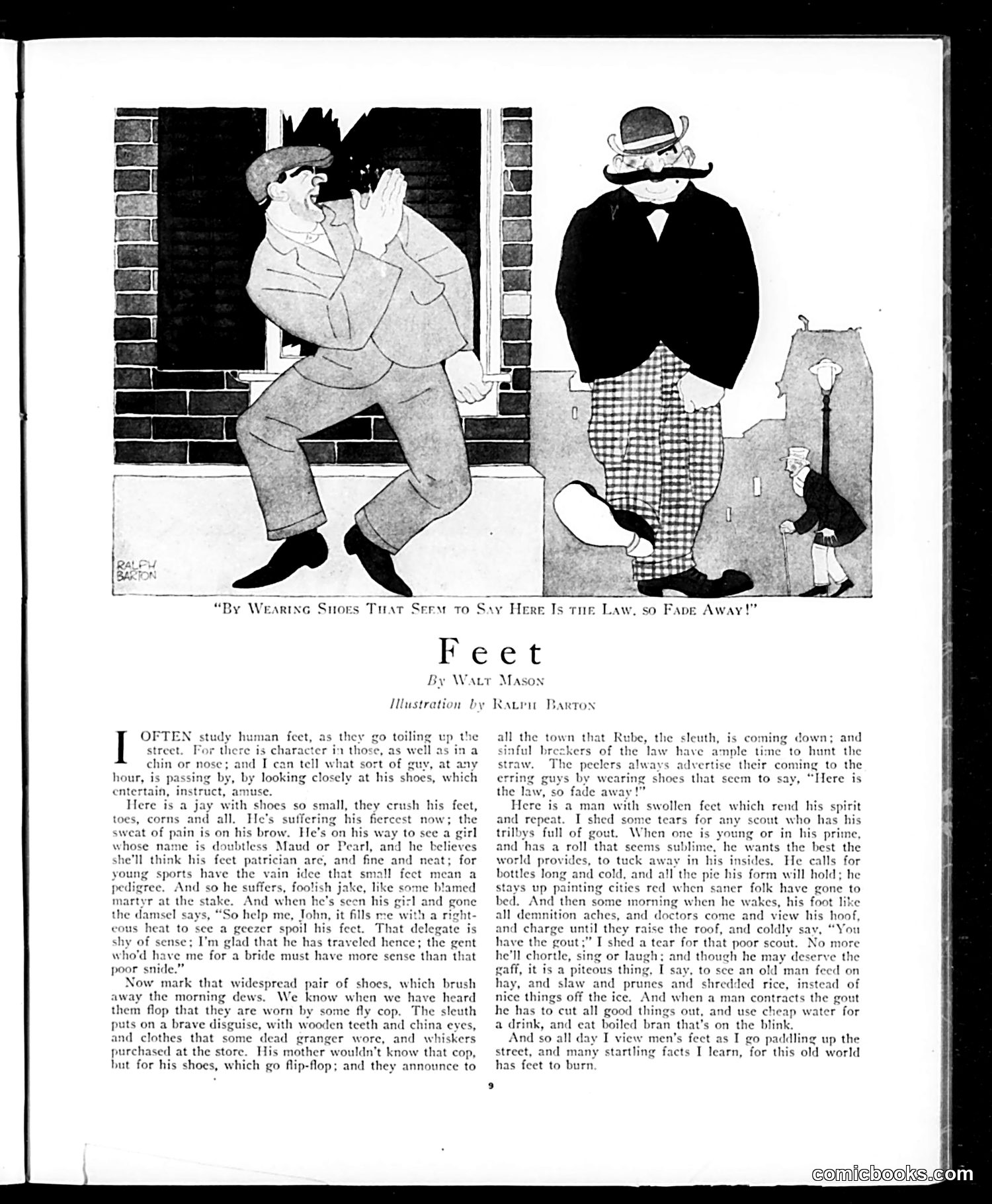
This is a humorous social commentary illustrated by Ralph Barton. The cartoon depicts three figures whose footwear reveals their character or circumstances: 1. **The young man in small, fashionable shoes** suffering from pinched feet while courting a girl—vain sacrifice for appearance's sake. 2. **The police officer** ("fly cop") identifiable only by his distinctive "flip-flop" shoes, wearing a ridiculous disguise with false teeth and glass eyes. 3. **The man with gout**, whose swollen feet are consequence of youthful excess (rich food, late nights). Mason's verse laments how this affliction forces him to abandon life's pleasures for boiled bran and cheap water. Mason's satire suggests that feet—and shoes—reveal truth about people that they try to hide. The broader point: vanity, deception, and indulgence all leave their mark, literally showing in one's footwear and physical condition. It's lighthearted social observation about human nature and consequences.
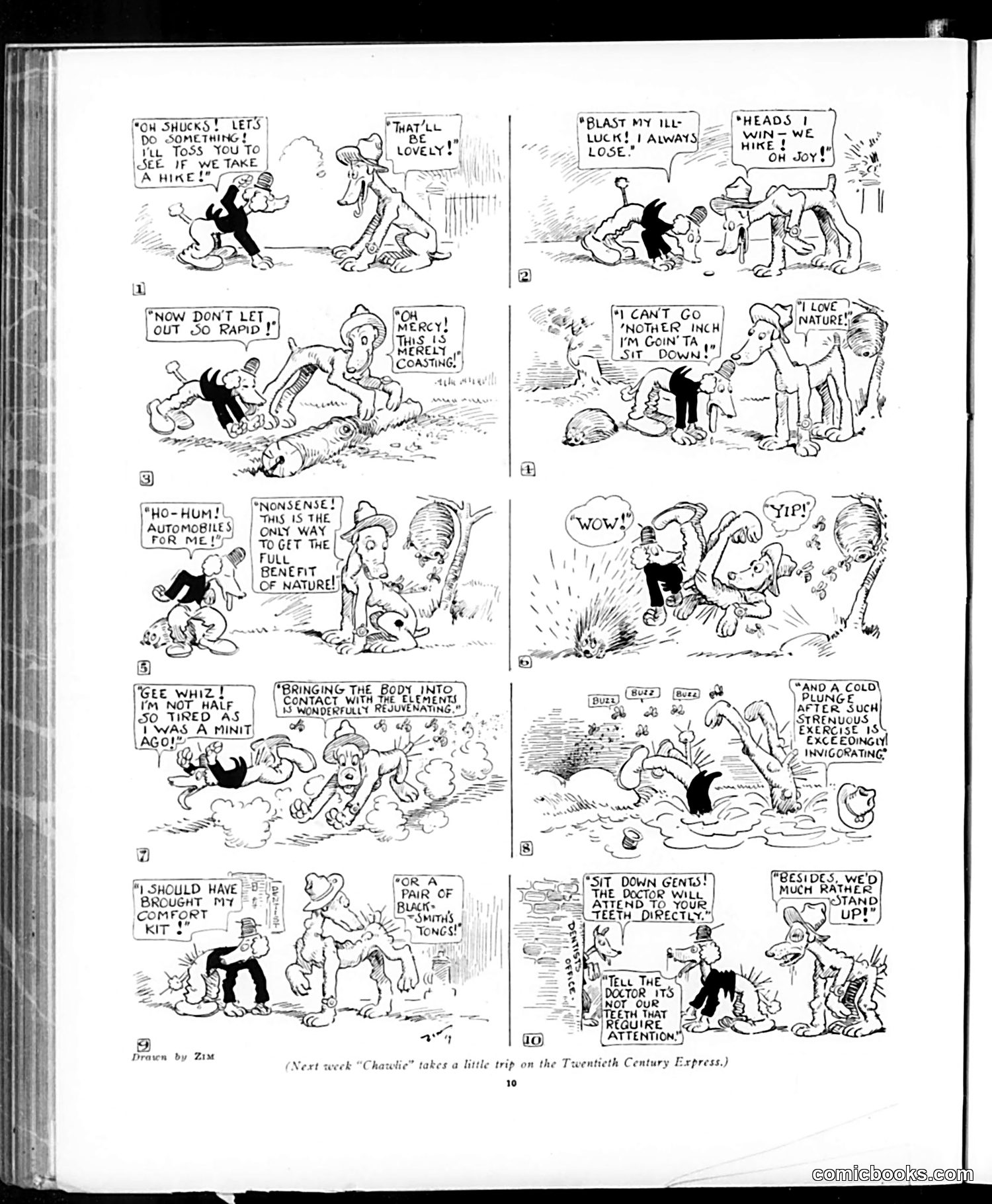
This is a single-panel comic strip following a character named Charlie through a series of misadventures during an outdoor excursion. The narrative shows Charlie and companions attempting various "healthful" activities—climbing, rolling in mud, swimming, and exercising—each presented as beneficial for one's constitution. The satire targets early 20th-century health fads and the era's obsession with "nature cure" movements and strenuous exercise trends popularized by figures like Theodore Roosevelt. Each panel shows the characters enduring increasingly uncomfortable or ridiculous situations while citing supposed health benefits, only to abandon them in favor of comfortable automobiles. The joke: despite fashionable rhetoric about nature and vigor, modern urbanites prefer mechanical convenience to actual exertion. The final caption promises next week's installment will feature Charlie on a train journey, suggesting continuation of this humorous contrast between health ideals and practical comfort-seeking.
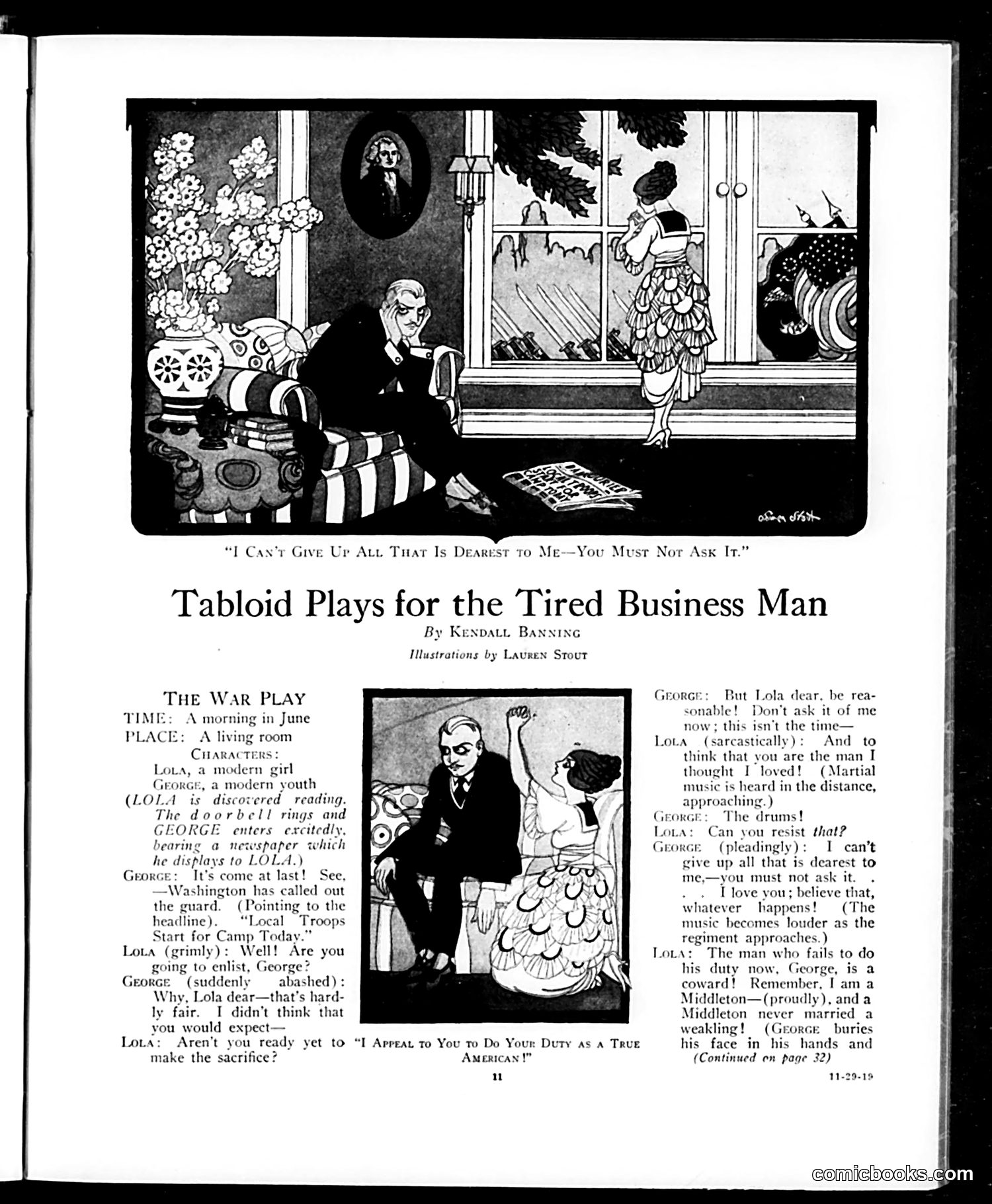
This is a satirical theatrical sketch parodying WWI-era domestic drama. The piece mocks the emotional manipulation of patriotic pressure during wartime. **The Setup:** George, a young man, shows his girlfriend Lola a newspaper announcing local troops are being called to military service. She immediately pressures him to enlist, invoking patriotic duty and masculine honor. **The Satire:** The sketch ridicules both the overwrought sentimentality of period melodrama and the coercive patriotism used on reluctant soldiers. Lola's escalating emotional appeals—questioning his manhood, evoking martial music, referencing her aristocratic family pride ("Middleton never married a weakling")—represent the social pressure civilians placed on men to volunteer. **The Title's Irony:** "I Can't Give Up All That Is Dearest to Me" captures the emotional blackmail: George must choose between his girlfriend and his life/freedom. Dated 11-29-19, this likely reflects post-WWI satirical commentary on how the war's emotional and social machinery worked on the home front, targeting tired businessmen seeking escapist entertainment through these compressed domestic dramas.
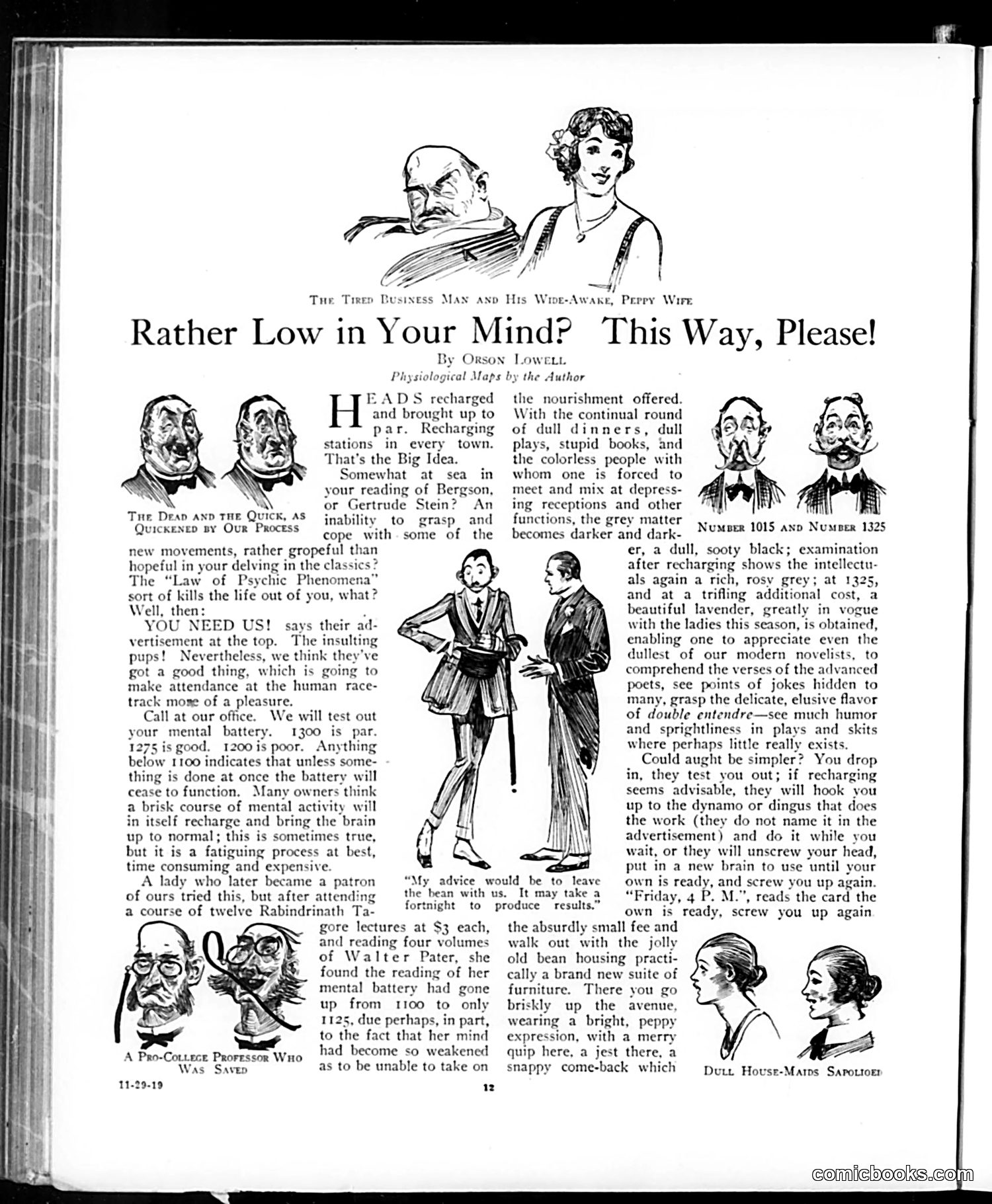
This satirical piece mocks the early 20th-century craze for self-improvement schemes and pseudo-scientific "mental recharging" services. The cartoon depicts a fictional business offering to boost customers' intellectual capacity through dubious treatments—measuring mental "battery" levels (numbered 1300 = par), offering recharging stations, or even replacing brains entirely. The satire targets intellectually exhausted elites worn down by tedious social obligations, difficult modernist literature (Bergson, Gertrude Stein, Walter Pater), and dull cultural events. The joke: desperate people will pay for absurd solutions promising quick mental refreshment—restored wit, humor appreciation, and social sparkle. By illustrating caricatured "before and after" faces and depicting this as a genuine service, author Orson Lowell ridicules both the gullibility of the wealthy and the era's obsession with quantifying and mechanically "fixing" human intelligence and personality.
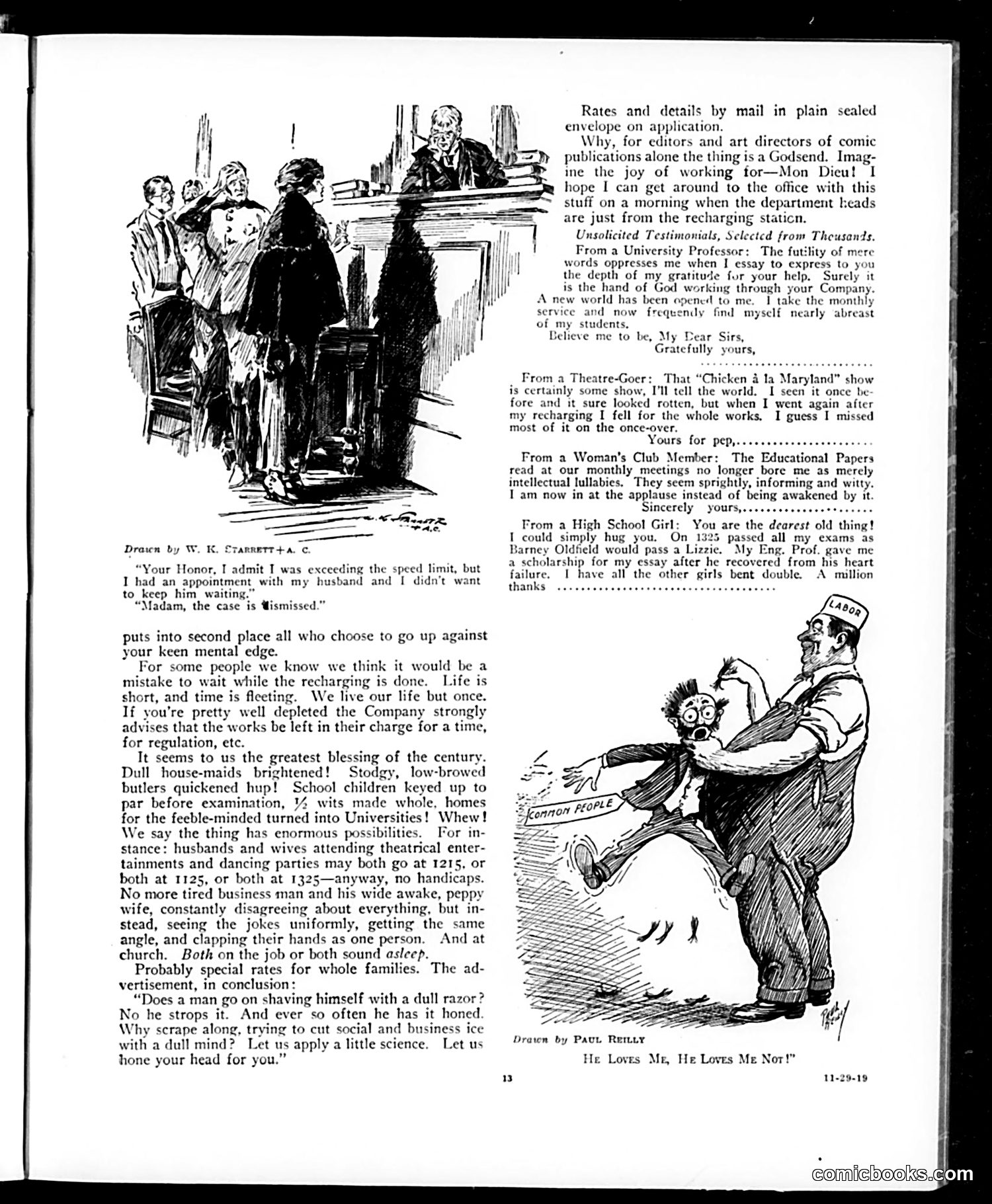
This page satirizes a fictional "mind-recharging" service—a pseudoscientific invention that supposedly revitalizes dull intellects. The top cartoon shows a woman speeding in traffic; dismissed by a judge who assumes she needed haste to keep her husband waiting, the satire mocks gender expectations. The main text ridicules the recharging scheme through mock testimonials. It suggests the service could synchronize couples' energy levels for entertainment and marriage harmony, make servants more efficient, and boost students' academic performance. The razor-stropping metaphor ("hone your head") underscores the absurdity of treating minds like tools needing mechanical maintenance. The bottom cartoon shows "Common People" being literally pumped up—physical comedy reinforcing the ridiculous premise. The satire targets both emerging corporate pseudo-psychology and post-war American optimism about technology solving social problems. It's also gendered commentary: women's "dullness" and marital discord are prime targets for this bogus innovation.
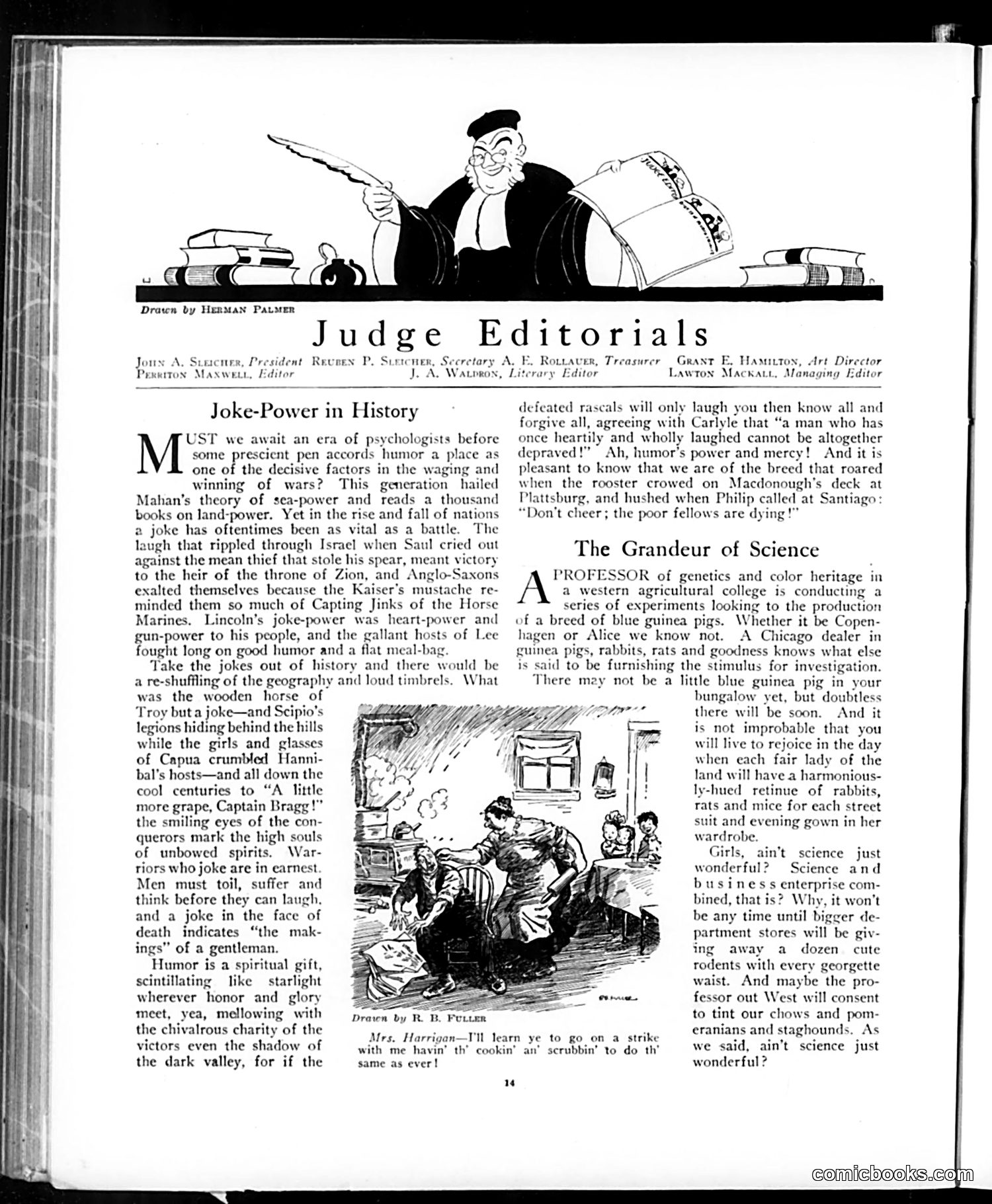
This editorial page from Judge magazine contains two satirical pieces: **"Joke-Power in History"** argues that humor has been underestimated as a decisive military and historical force. The author cites historical examples—the Trojan Horse, Scipio's tactics, Lincoln's wit—suggesting that laughter and morale matter as much as strategy. The piece celebrates humor as a mark of gentlemen and moral superiority, even toward defeated enemies. **"The Grandeur of Science"** mocks the commercialization of scientific advancement. A professor's genetics experiments breeding colored guinea pigs become absurd when imagined as consumer products—department stores giving away matching rodents to coordinate with women's wardrobes. The satire targets the marriage of scientific research and commercial enterprise, suggesting that profit-driven marketing trivializes genuine scientific achievement into frivolous luxury goods. The cartoon by R.B. Foller depicts a domestic scene, likely illustrating working-class life (Mrs. Harrigan references cooking and scrubbing), grounding the satire in everyday reality.
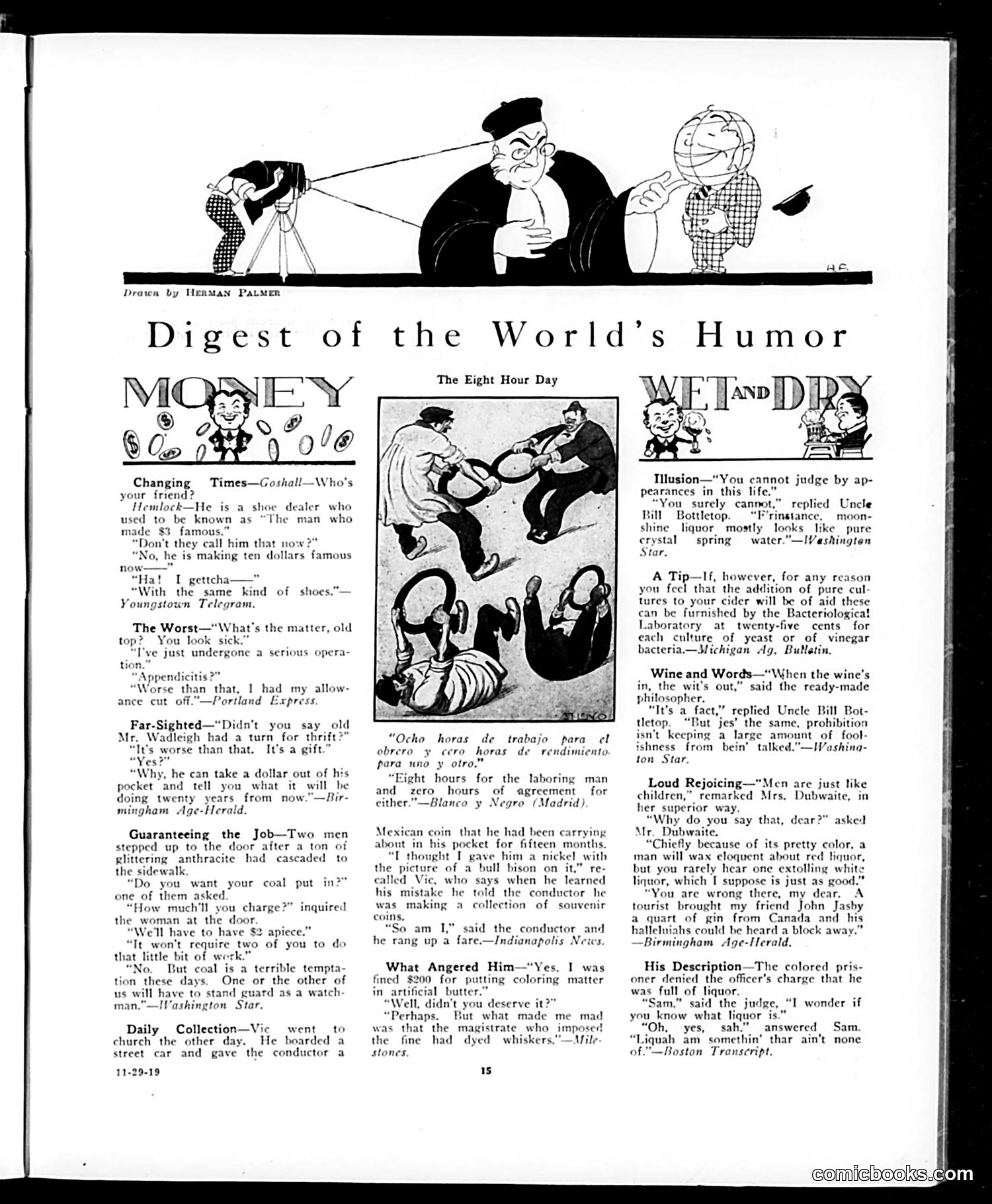
This is a humor digest page featuring short jokes and anecdotes, drawn by Herman Palmer. The cartoons and text are largely non-political social satire typical of 1919. **Key content includes:** - "The Eight Hour Day" central cartoon: Spanish caption about eight hours of work producing zero hours of agreement—satirizing labor disputes and the difficulty of labor-management compromise during the post-WWI era of labor unrest. - Multiple jokes about Prohibition-era liquor and substitutes (moonshine, "pure crystal spring water"), reflecting the 1919 context just before alcohol prohibition took effect. - "Daily Collection" joke: A man mistakenly gives a streetcar conductor a Mexican coin instead of U.S. currency—playing on post-WWI economic confusion and currency exchange. - "His Description" joke: A racial stereotype dialogue between a Black prisoner and judge about liquor definitions. The humor targets labor relations, Prohibition enforcement, economic disruption, and contains period-typical ethnic humor. It's largely apolitical domestic satire.
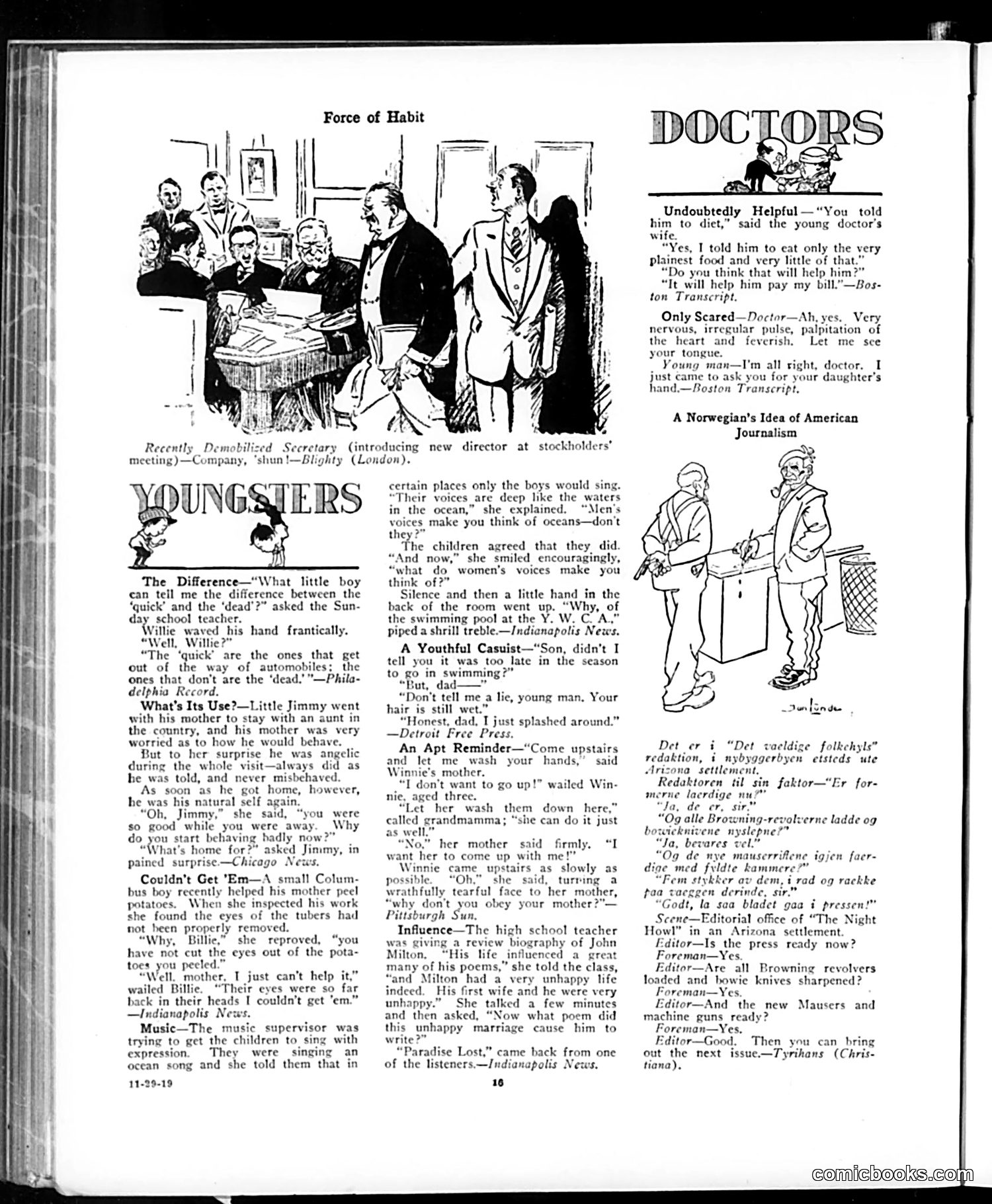
The main cartoon depicts a "Recently Demobolised Secretary" introducing a new company director at a stockholders' meeting. The satire reflects post-WWI anxieties: the newly demobilized (discharged military personnel) were entering civilian workforces, and this cartoon mocks the awkward social dynamics—the secretary appears flustered presenting someone from outside the established business hierarchy. The page's other content consists of humorous anecdotes about children's literal interpretations and innocent observations: a boy defines "quick" and "dead" by reference to automobiles (reflecting early 20th-century traffic concerns), children mishearing instructions, and a child's comment about women's voices resembling a swimming pool. The bottom section includes what appears to be a Norwegian-language item about American journalism in an Arizona settlement—likely ethnic humor targeting Norwegian immigrants' perspectives on American newspapers.
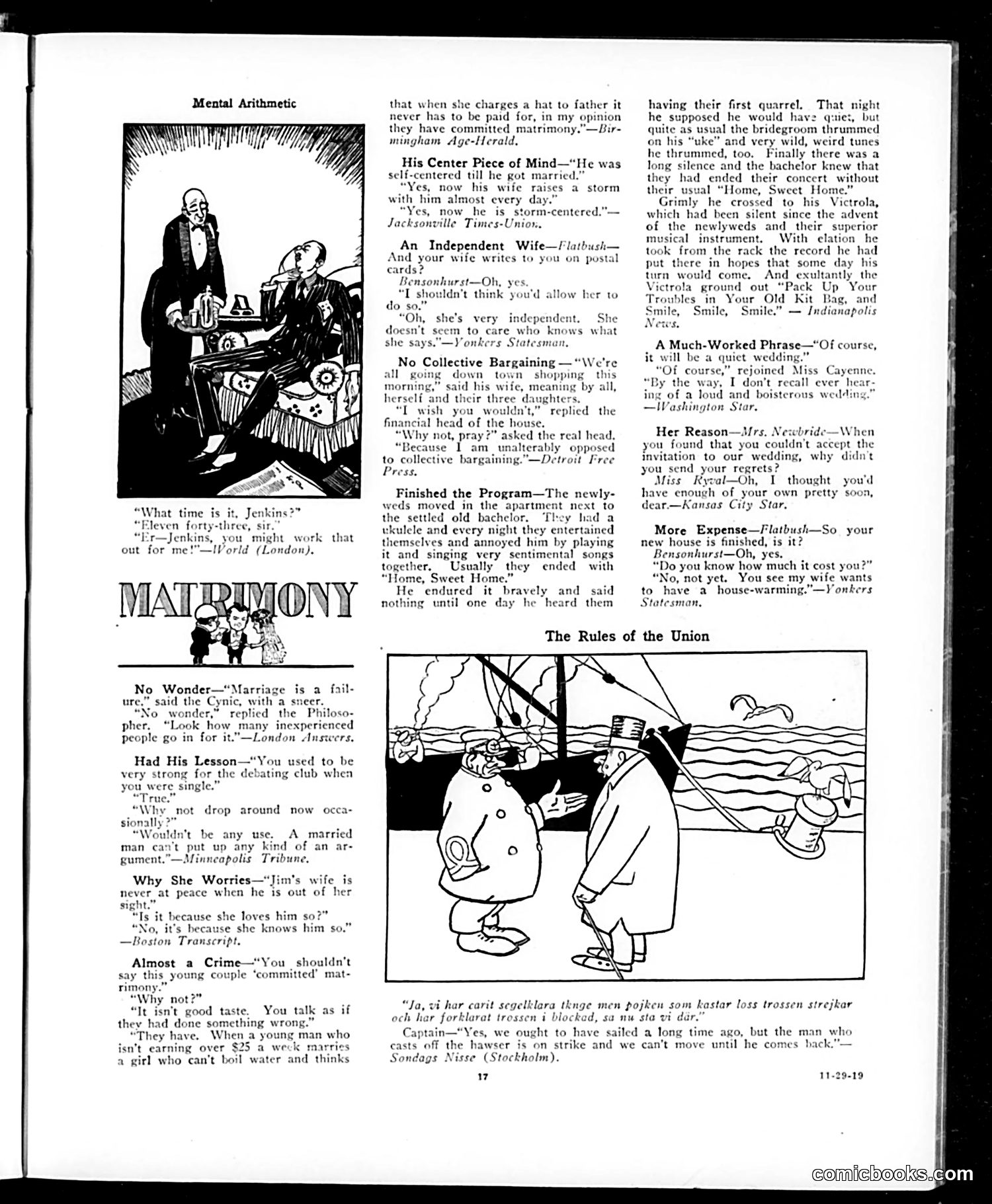
This page contains humor about marriage and labor disputes, reflecting post-WWI American concerns. **"Mental Arithmetic" and marriage jokes** satirize newlywed domestic life and gender relations. Multiple quips mock wives who spend money irresponsibly, lack cooking skills, or dominate their husbands' peace. The "Finished the Program" cartoon shows newlyweds annoying a bachelor neighbor with sentimental songs until their first quarrel—when the bachelor resignedly plays patriotic music instead, suggesting marital discord is inevitable. **"The Rules of the Union" cartoon** references contemporary labor strikes. A ship captain explains they cannot sail because the worker responsible for casting off the hawser is on strike. This reflects the 1919 Seattle General Strike and widespread labor unrest of that year, mocking how strikes could paralyze commerce and daily life. The humor targets both married women (as spendthrifts and poor homemakers) and organized labor (as unreasonably obstructive). Both were contentious social issues in 1919—women had just gained voting rights, and labor movements were increasingly powerful and confrontational.
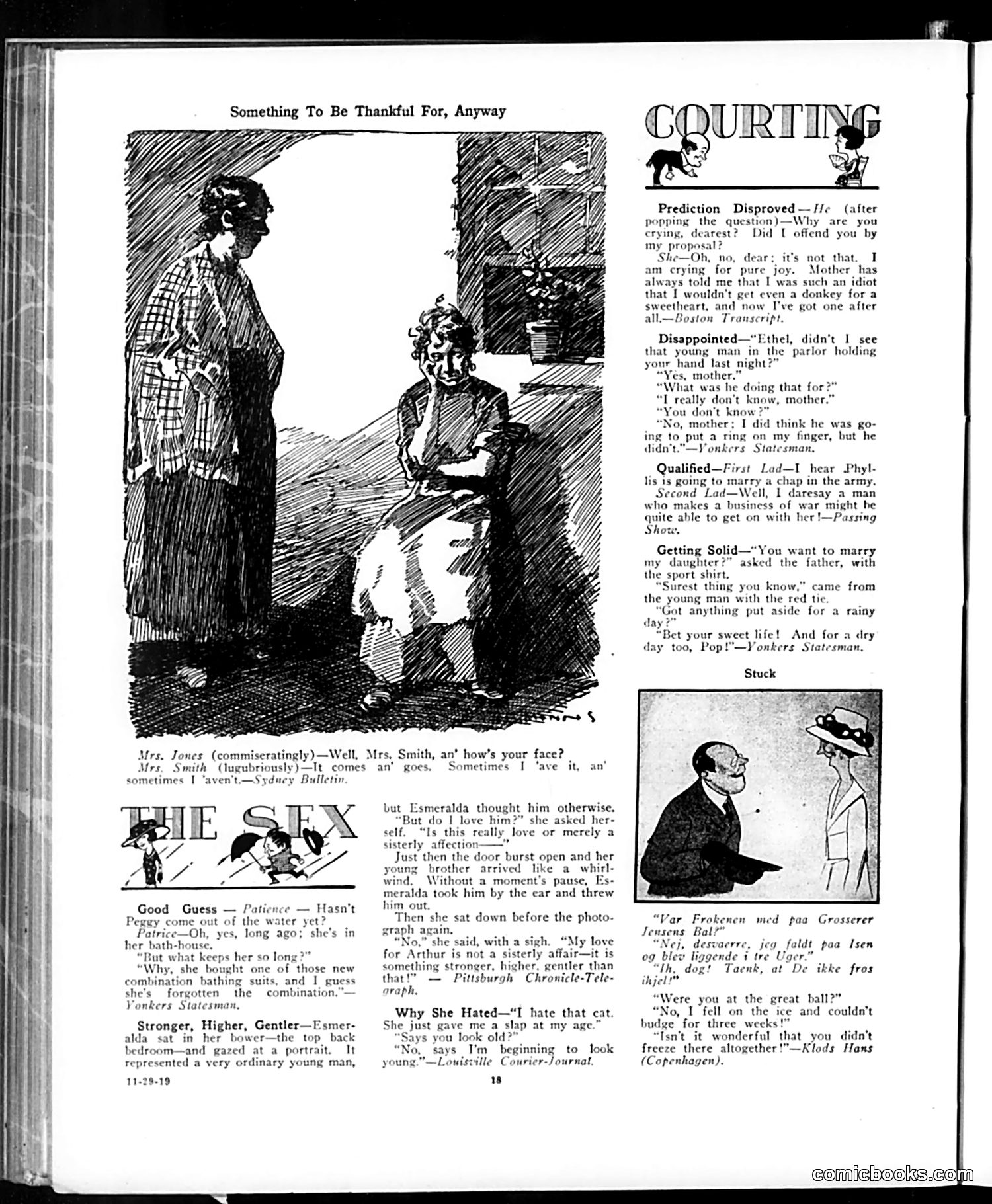
This page from Judge (dated 11-29-19) contains multiple brief comic anecdotes and one cartoon, all satirizing courtship and romance conventions of the era. **The Main Cartoon** ("Something To Be Thankful For, Anyway") depicts two working-class women—Mrs. Jones and Mrs. Smith—in conversation. Mrs. Smith, appearing bruised or injured, explains her face comes and goes depending on whether she has it "or sometimes I 'aven't." This is dark humor about domestic violence, presented as a matter-of-fact complaint. **The Other Items** are short humorous scenarios poking fun at: - A woman forgetting the combination to her "combination bathing suit" - A young woman discovering she doesn't have sisterly feelings for her suitor (after throwing her brother out the door) - Various courtship mishaps and misunderstandings The page reflects early-20th-century attitudes toward gender, marriage, and social propriety—treating domestic hardship, bathing suit complications, and romantic confusion as light entertainment for Judge's educated, satirically-minded readership.
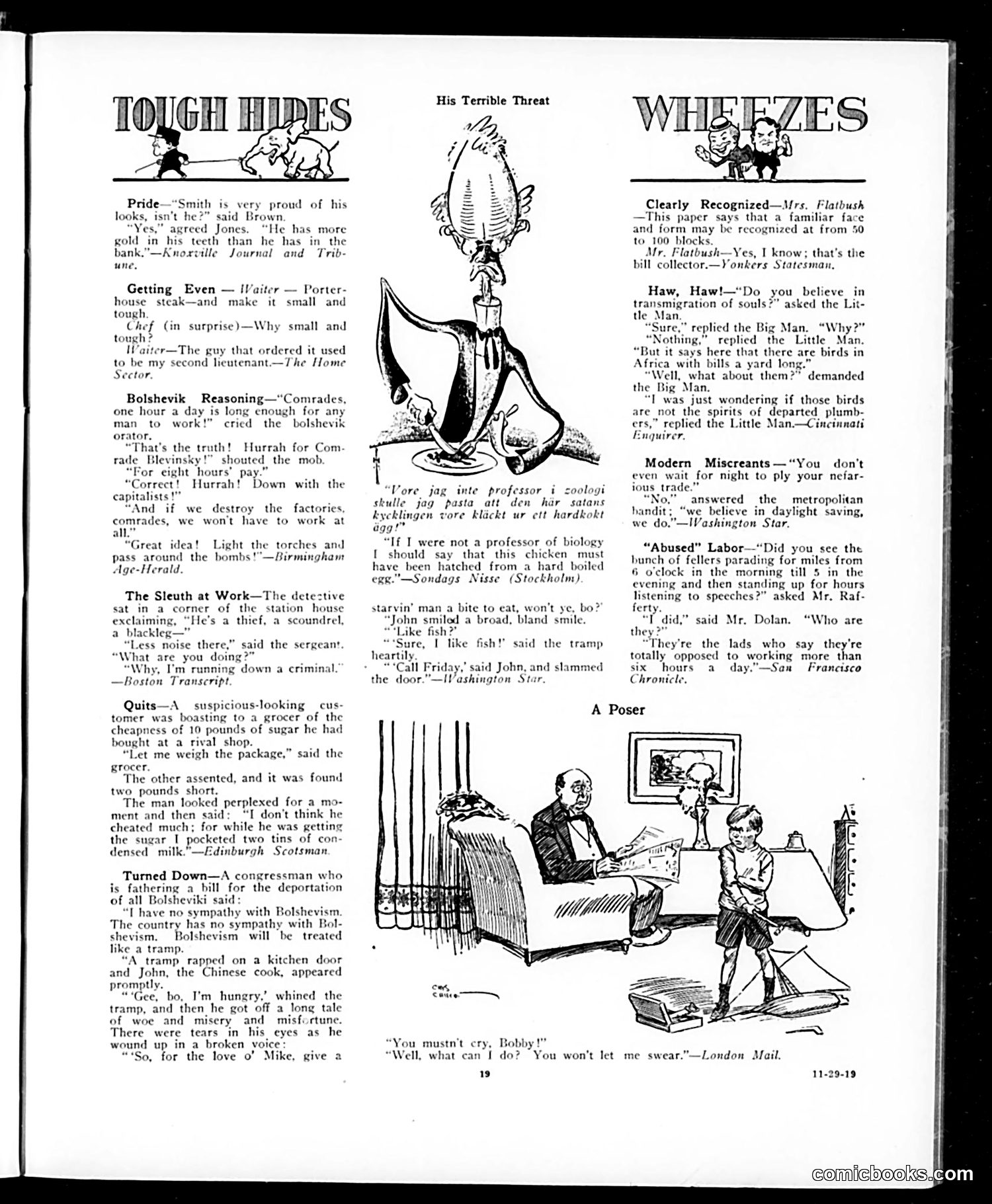
This page collects brief humorous anecdotes and jokes typical of Judge's satirical format. Key content includes: **Political references:** - Multiple "Bolshevik" jokes mocking communist rhetoric and the recent Russian Revolution, portraying Bolsheviks as illogical (demanding one hour's work for eight hours' pay, suggesting destroying factories eliminates work) - A congressman's bill to deport Bolsheviks **Social satire:** - "Abused Labor" mocks labor activists parading for long hours while claiming opposition to long workdays - "Getting Even" depicts class resentment (a waiter seeking revenge on a former officer) - "The Sleuth at Work" jokes about incompetent police work - "A Poser" cartoon shows a child unable to express himself without swearing—commenting on modern manners **Recurring themes:** Working-class grievances, immigration concerns, and post-WWI anxieties dominate. The humor targets both labor organizers and Bolshevism, reflecting 1919's Red Scare atmosphere and American anti-communist sentiment.
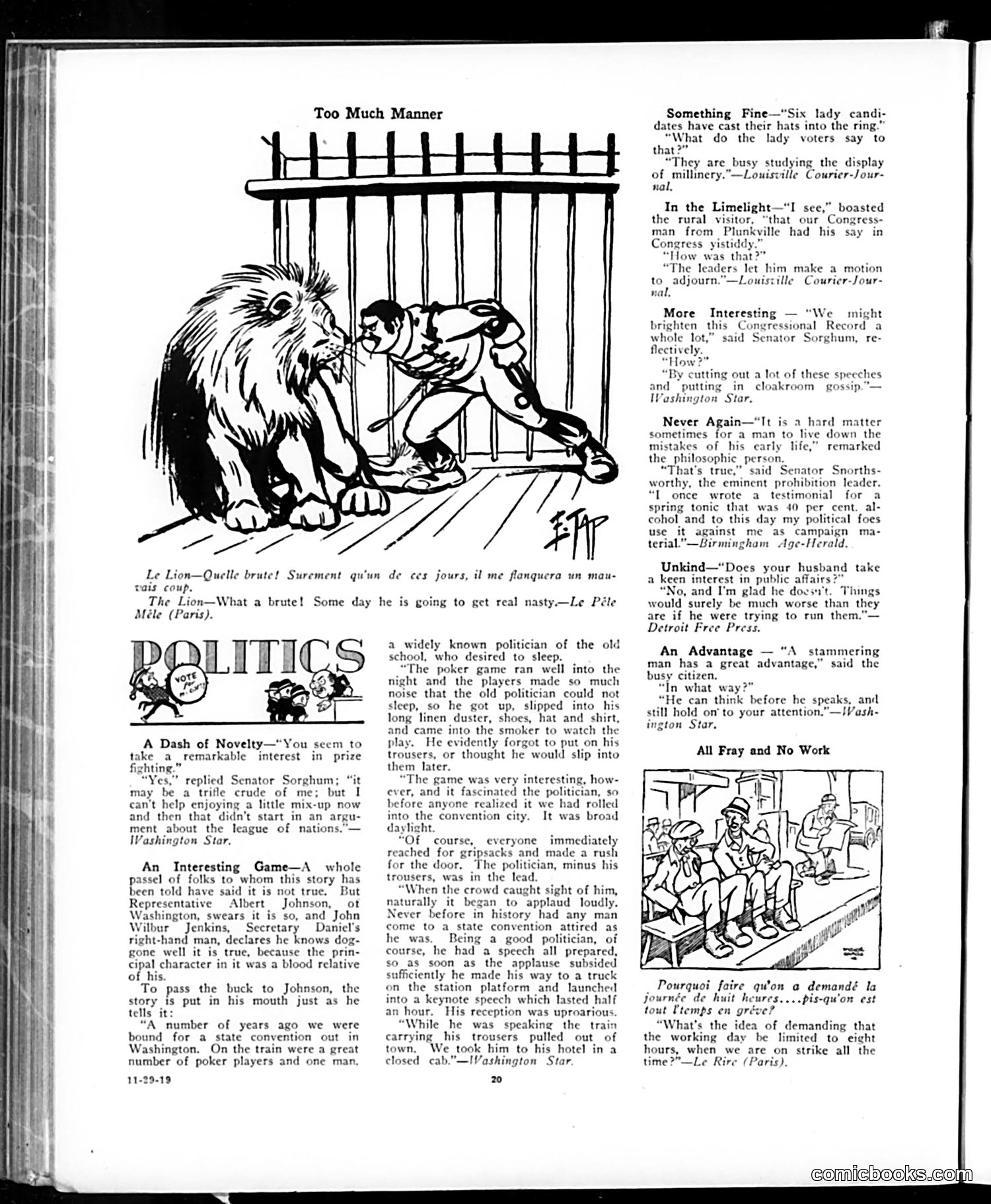
The main cartoon depicts a lion (representing a powerful political figure, likely a European leader) being prodded by smaller figures—a visual metaphor for how even the mighty can be provoked or manipulated by persistent antagonists. The accompanying text pieces are political humor targeting American politicians: - **Senator Sorghum** enjoys prize fights because they don't involve arguments about the League of Nations (a contentious post-WWI political issue). - **Representative Albert Johnson's** anecdote ridicules a pompous politician who arrives at a state convention accidentally pantsless but delivers a rousing speech anyway—satirizing political vanity and speechmaking. - Various quips mock Congressional procedures, female political candidates, and **Senator Snorthsworthy**, a prohibition leader whose past endorsement of alcohol tonic undermines his credibility. The satire targets political hypocrisy, grandstanding, and the absurdities of early 20th-century American politics during debates over prohibition and international involvement.
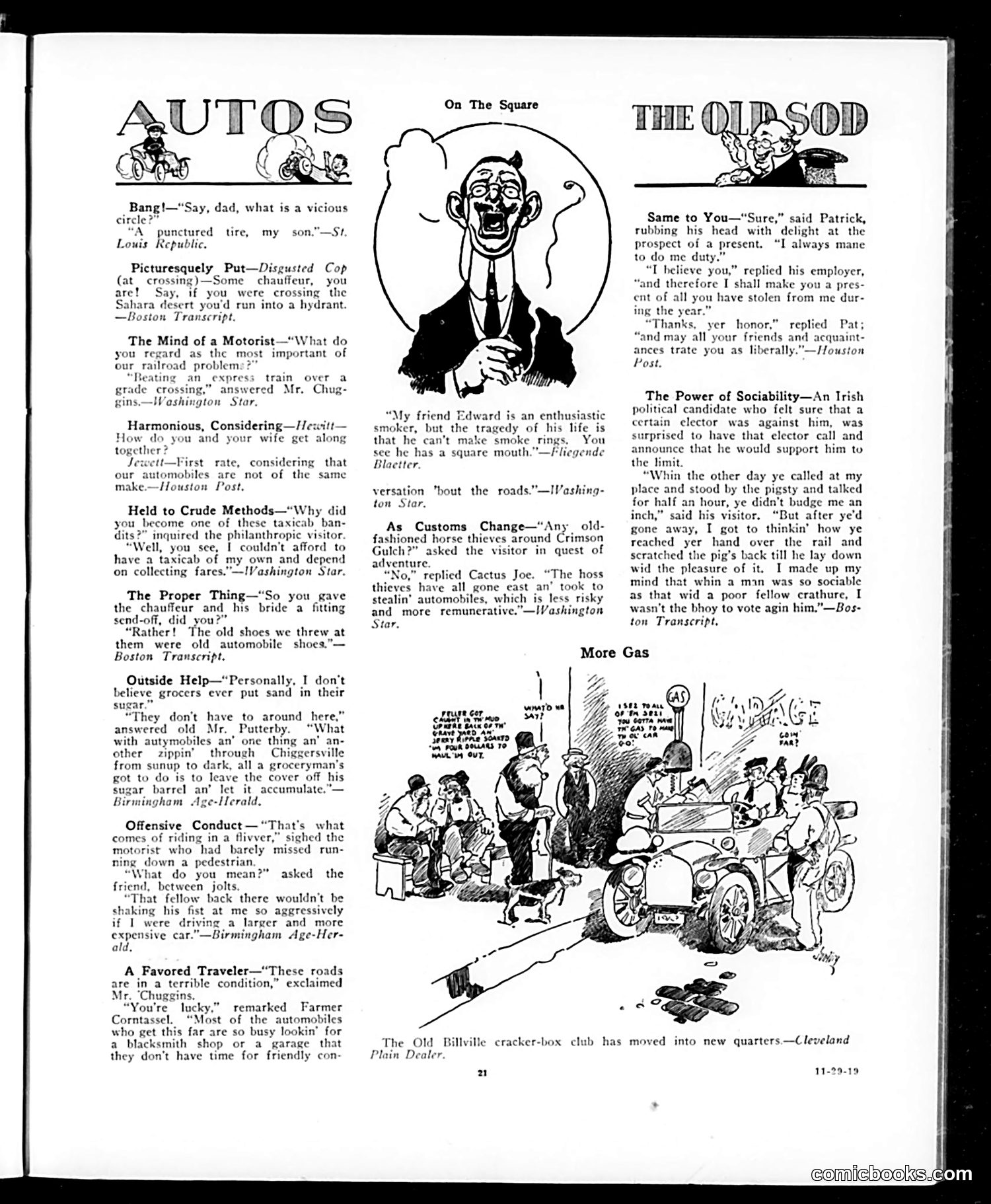
This page contains early-20th-century automobile humor, reflecting anxieties about the then-novel motorcar's impact on society. **"AUTOS" section:** Short jokes mock motorists as reckless and foolish. They run over pedestrians, ignore railroad crossings, and cause general chaos. One joke suggests automobile tires are as fragile as St. Louis Republic (political reference unclear). Another notes that poor people resort to "taxicab banditry" because they can't afford actual cars. **"THE OILSOD" section:** Unrelated humor about Irish laborers and politicians, featuring ethnic stereotypes typical of the era. **"More Gas" cartoon:** Shows a traffic jam of early automobiles and pedestrians in comical chaos—satirizing urban congestion caused by rapid automobile adoption. **Overall message:** The satire reflects 1919 concerns about automobiles disrupting traditional life: they endanger pedestrians, pollute the air (hence "gas"), create traffic, and change social behavior. The humor targets both motorists (portrayed as arrogant) and society's struggle adapting to this technology.
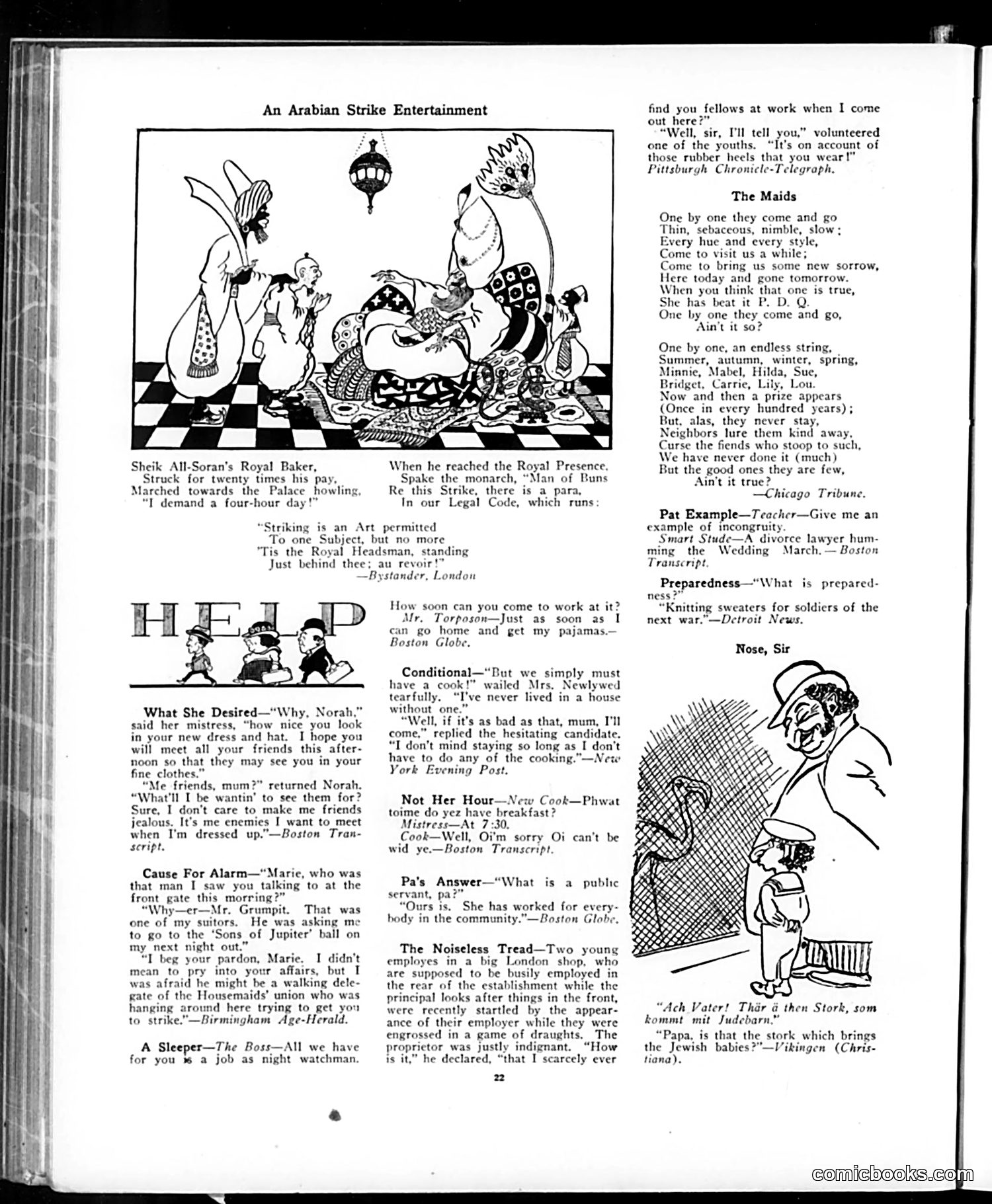
This page satirizes labor strikes and domestic servant problems common in early 20th-century America. The main cartoon depicts "Sheik Ali-Soran's Royal Baker" demanding a four-hour workday and twenty-times pay at the palace—only to be threatened with execution by the monarch's headsman. The joke: in an absolute monarchy, strike demands are literally fatal, contrasting sharply with workers' growing rights in democratic America. The surrounding humor pieces mock servants and household help: maids constantly quitting, cooks refusing to work certain hours, and employees shirking duties. One piece even jokes about a "walking delegate" (union organizer) potentially recruiting housemaids to strike. Collectively, these items reflect anxieties about labor unrest, unionization, and the difficulty of maintaining domestic help—class tensions presented through lighthearted ridicule rather than serious analysis.
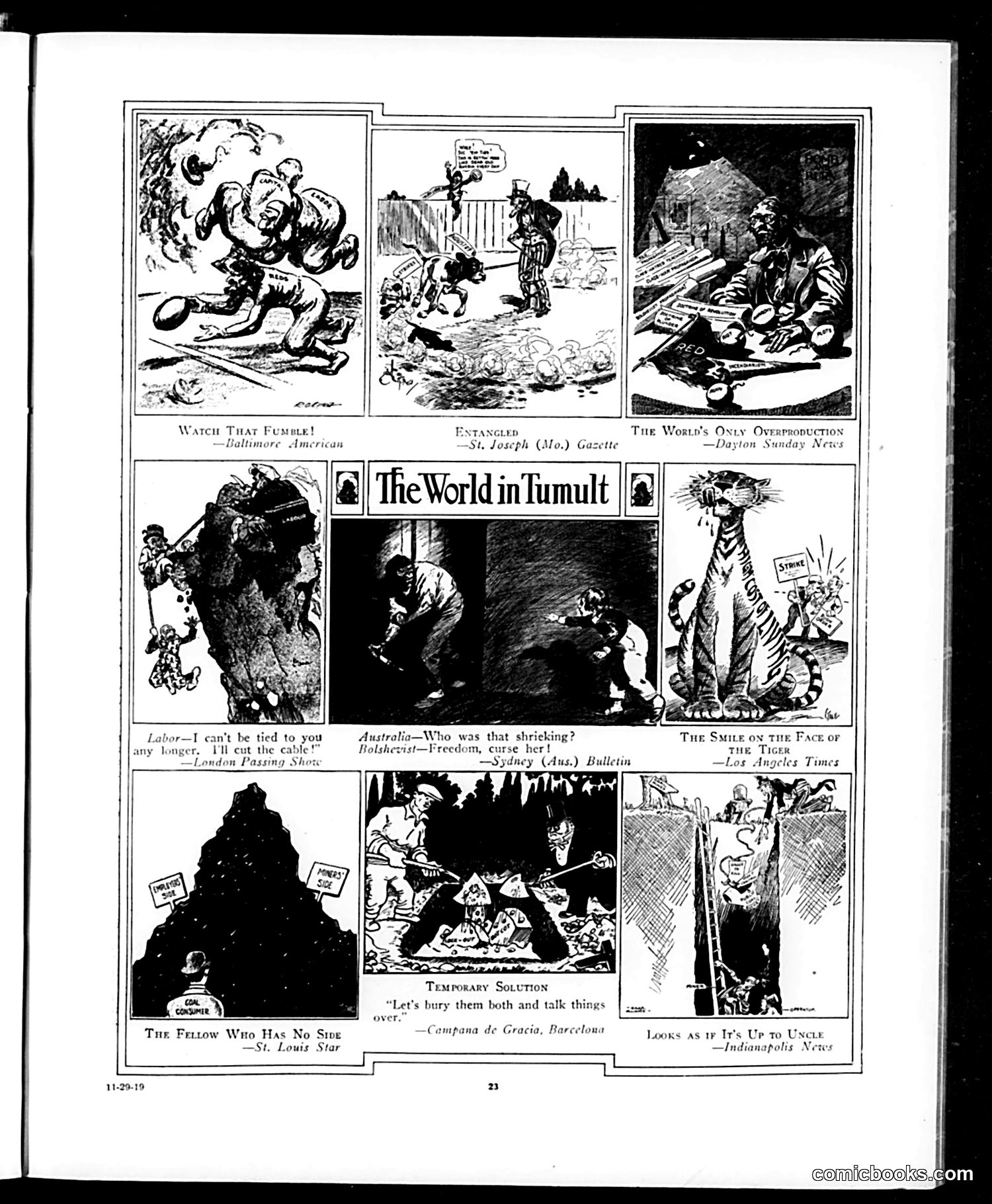
This page collects editorial cartoons addressing post-WWI chaos and labor unrest, circa 1919-1920. Key themes: **Labor disputes**: "Labor" shows a figure cutting ties, reflecting American labor strikes and the tension between workers demanding independence and employers resisting. **International instability**: "Australia" and "Bolshevism" reference the Red Scare—fears of communist revolution spreading globally after the Russian Revolution. **The "Fellow with No Side"** (St. Louis Star) depicts a figure caught between opposing forces—likely representing moderate citizens overwhelmed by polarized political factions. **"Temporary Solution"** (Barcelona) sardonically suggests burying both labor and capital's problems—mocking failed peace efforts and ongoing class conflict. **"The Smile on the Face of the Tiger"** (Los Angeles) uses a menacing tiger to represent uncontrolled radicalism or chaos. The overall message: post-war society faces unprecedented social upheaval—labor militancy, communist threat, and political paralysis—that conventional solutions cannot resolve. The cartoons reflect widespread American anxiety about social breakdown.
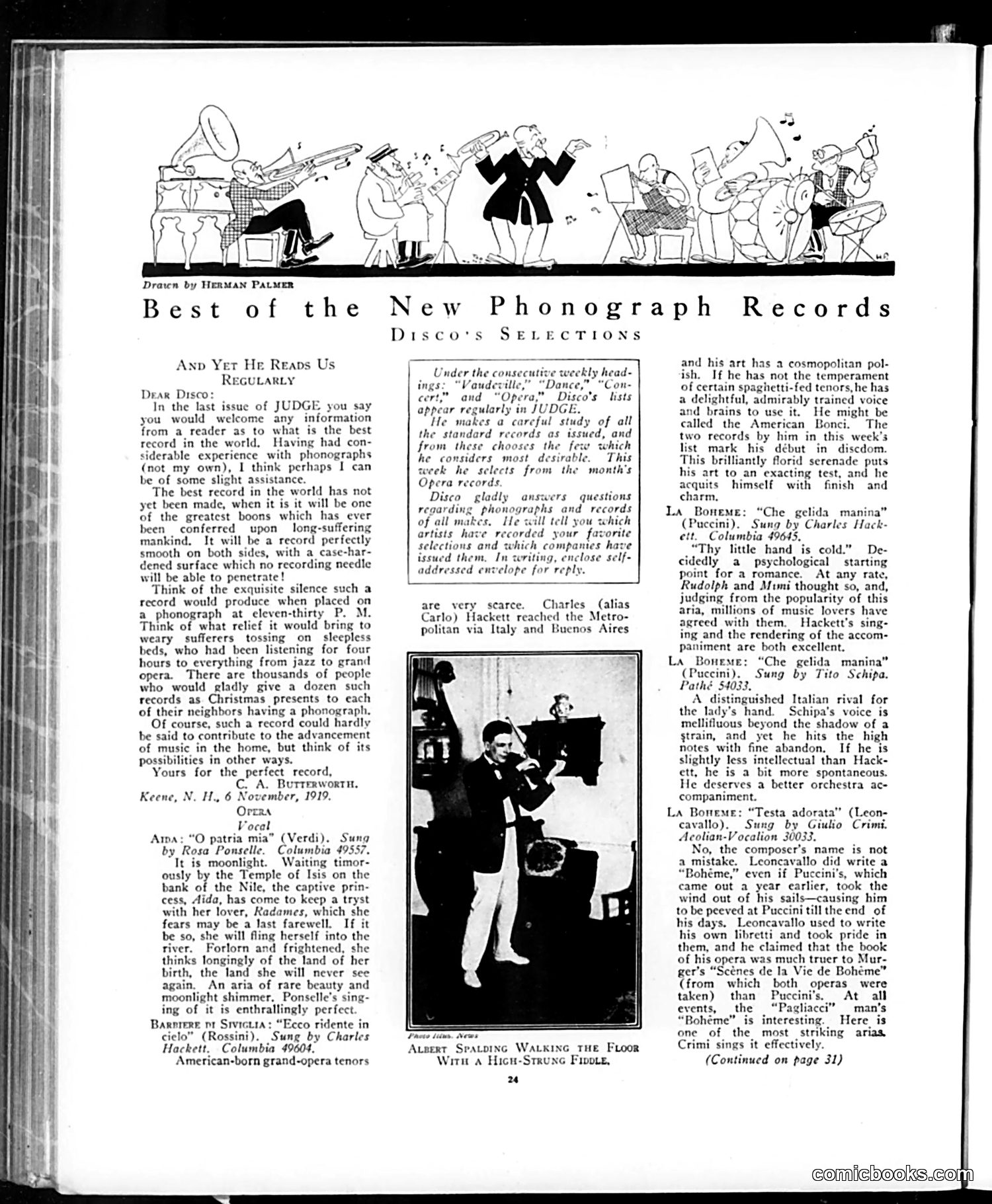
This page from *Judge* magazine (November 1919) discusses phonograph record reviews, not political satire. The top contains Herman Palmer's decorative illustration of an orchestra and conductor—purely ornamental for a music column. The content is a reader's letter praising phonograph technology, followed by a music critic's ("Disco's") reviews of opera recordings. The writer humorously imagines the "perfect record"—one so silent it would provide blessed quiet to exhausted listeners enduring hours of "everything from jazz to grand opera." The reviews discuss tenor Charles Hackett and others performing Puccini's *La Bohème* in various versions. The photograph shows what appears to be recording or performance activity. This is essentially a music appreciation column with light humor about modern recording technology and opera singing—not political commentary or satirical critique.
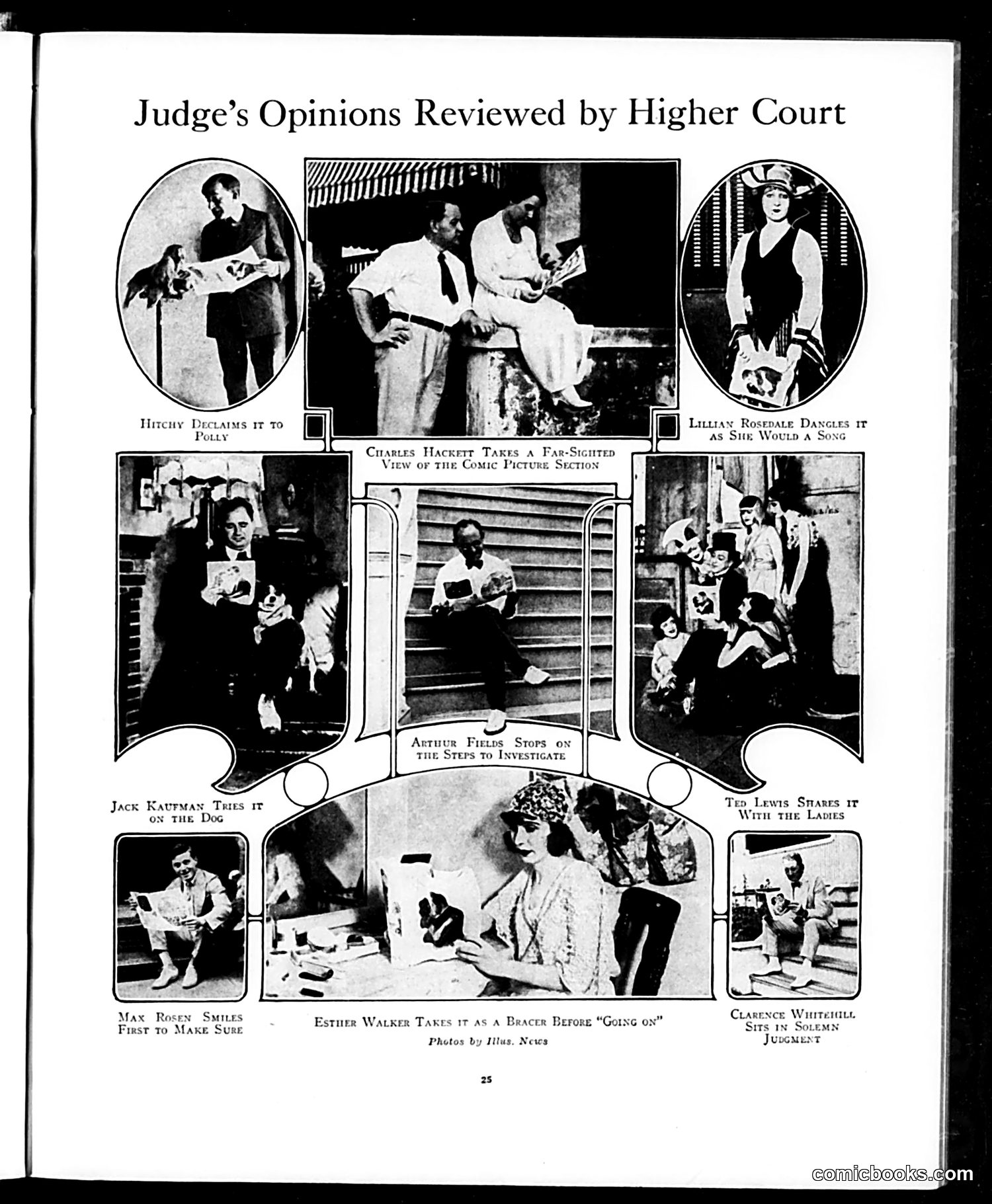
This Judge magazine page satirizes how celebrities and public figures respond to viewing the magazine's comic picture section. The layout presents a "court" theme where various entertainers "review" Judge's opinions through their reactions. The page features silent-film and vaudeville performers of the era—including names like Charles Hackett, Jack Kaufman, Ted Lewis, and others—each shown reacting differently to the comics. Their captions suggest humorous responses: one "tries it on the dog," another "takes it as a bracer before going on," and so forth. The satire mocks both the celebrities' vanity (being featured) and Judge's self-promotion. By showing famous performers ostensibly endorsing the magazine through their varied, comedic reactions, Judge playfully claims cultural authority while simultaneously poking fun at celebrity endorsement culture and the performers themselves. The "Higher Court" framing suggests Judge positions itself as arbiter of entertainment quality.
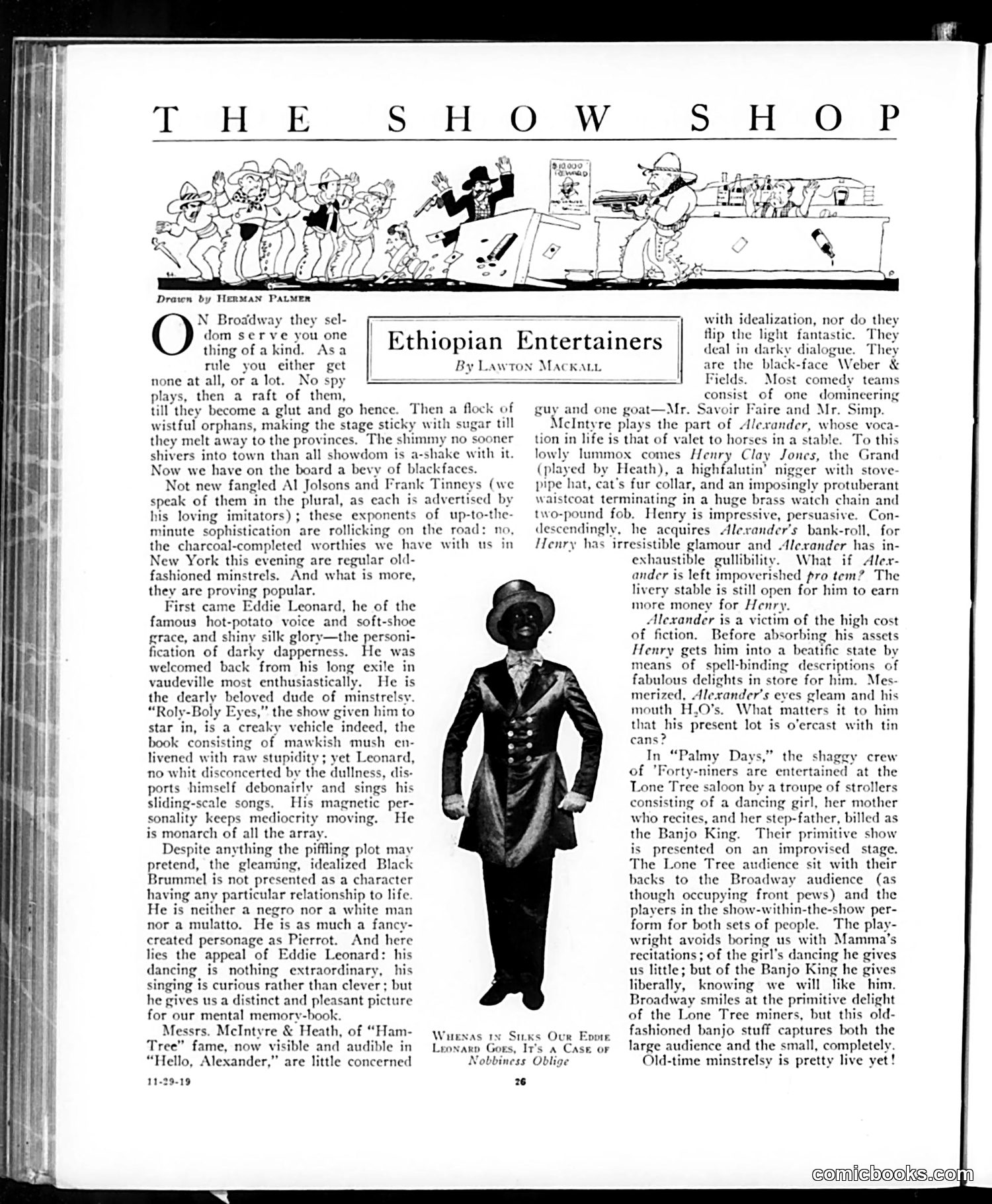
This Judge magazine article reviews blackface minstrel shows then popular on Broadway. The writer discusses three productions featuring white performers in blackface makeup: 1. **Eddie Leonard** in "Roly-Boly Eyes" - praised for his "hot-potato voice" and soft-shoe dancing, though the plot is dismissed as "mawkish mush" 2. **McIntyre & Heath** in "Hello, Alexander" - their act features crude racial stereotypes (a valet character and a wealthy "nigger" in exaggerated dress who cons the protagonist) 3. **"Palmy Days"** - miners entertained by performers including a dancing girl and "Banjo King" The review treats blackface minstrelsy as established entertainment, noting these are "old-fashioned" acts proving unexpectedly popular. The casual, dehumanizing language reflects the era's casual racism. Modern readers should understand this represents mainstream entertainment that relied on racist caricature and dialect comedy, presented here without critical disapproval.
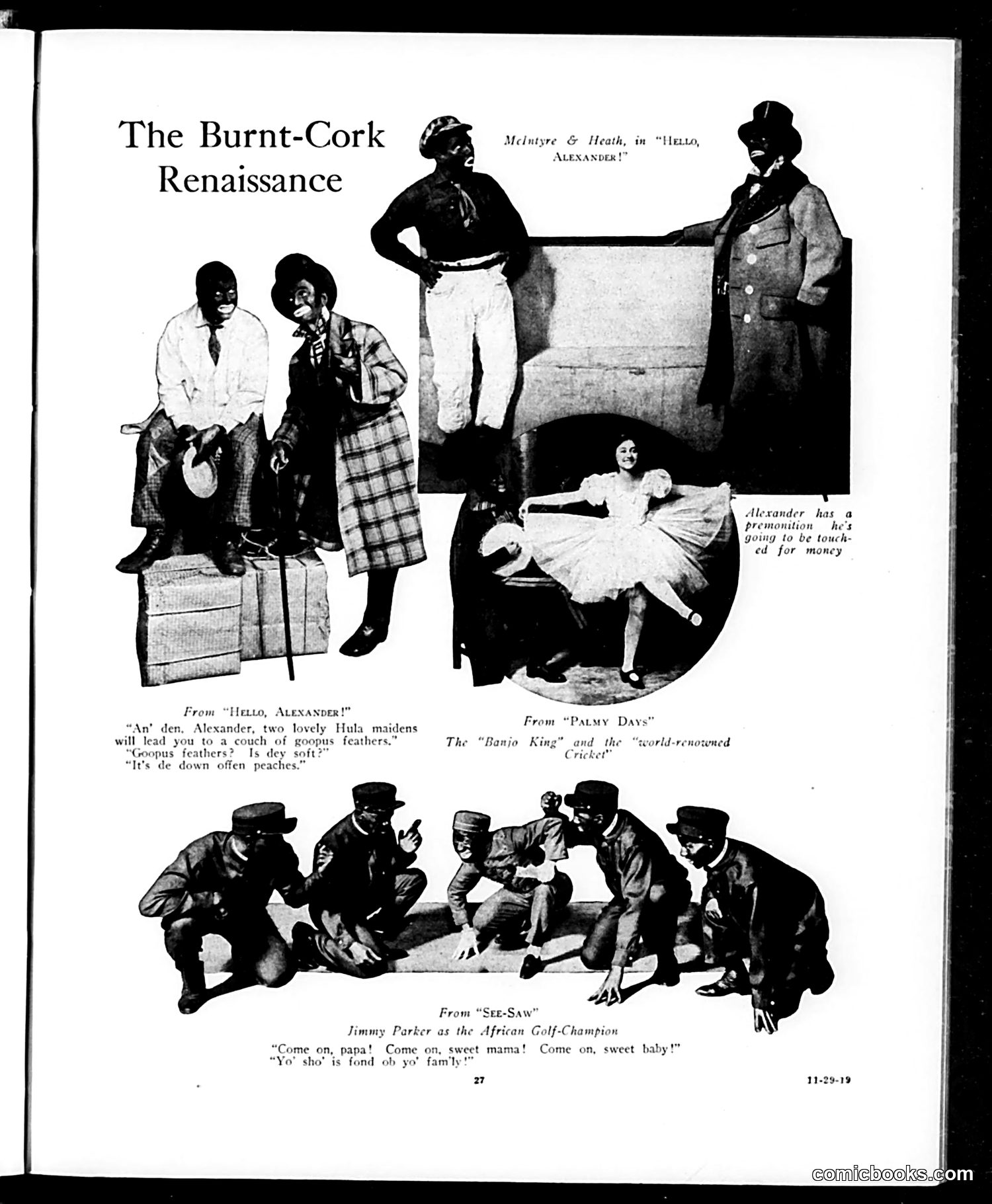
This page satirizes white entertainers performing in blackface—a racist practice common in early 20th-century American theater. The title mocks a supposed "renaissance" of such performances. Four scenes show characters from different theatrical productions, all featuring performers in blackface caricature portraying Black people with exaggerated dialect and stereotypical behavior: Hawaiian "hula maidens," a banjo player, a golf champion, and family scenes using phonetic dialect ("Yo' sho' is fond ob yo' fam'ly"). The satire appears to criticize both the prevalence of blackface entertainment and its stereotypical depictions—suggesting this was a degrading trend dominating American popular theater circa 1919. The "renaissance" reference is ironic, implying such performances represented cultural regression rather than progress. This represents Judge magazine's commentary on entertainment industry racism of the era.
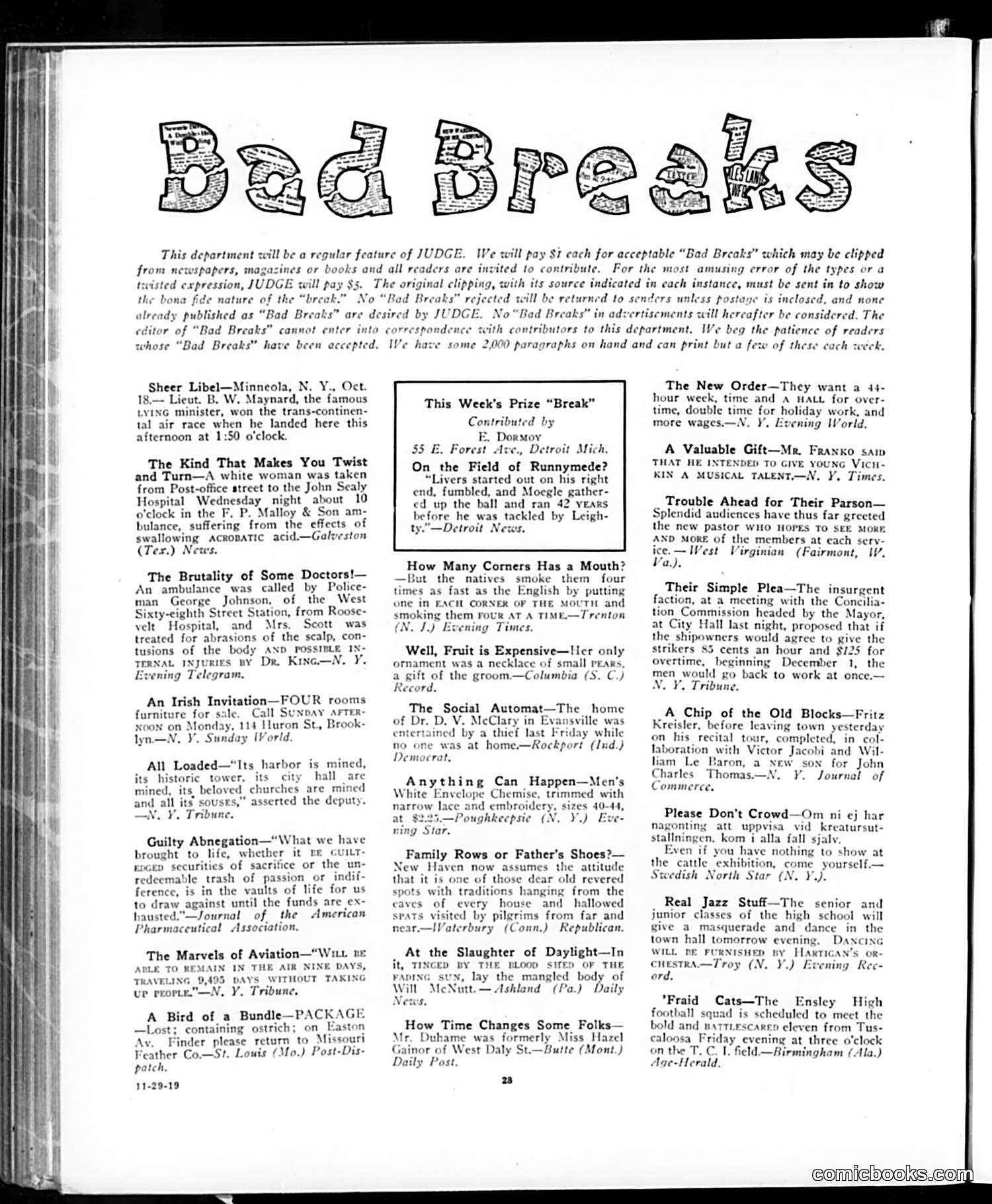
This page presents Judge magazine's ongoing department showcasing unintentionally funny newspaper typos and grammatical errors, offering readers $1 per submitted error or $3 for the week's best. The "breaks" are newspaper publishing mistakes that create comic absurdity: a minister is called an "air minister" (actually "living minister"), someone suffers from "acropatic acid" instead of "acrostic," and a football player ran for "42 years" instead of presumably "42 yards." Other errors include nonsensical descriptions like natives smoking pipes in multiple mouth corners simultaneously, or a "white envelope chemise" clothing item. The humor relies on readers' ability to spot the original mistake—usually resulting from hasty typesetting or transcription errors—and appreciate the unintentional comedic effect. This was a regular feature demonstrating the lighter side of journalism's imperfections during the 1919 era.
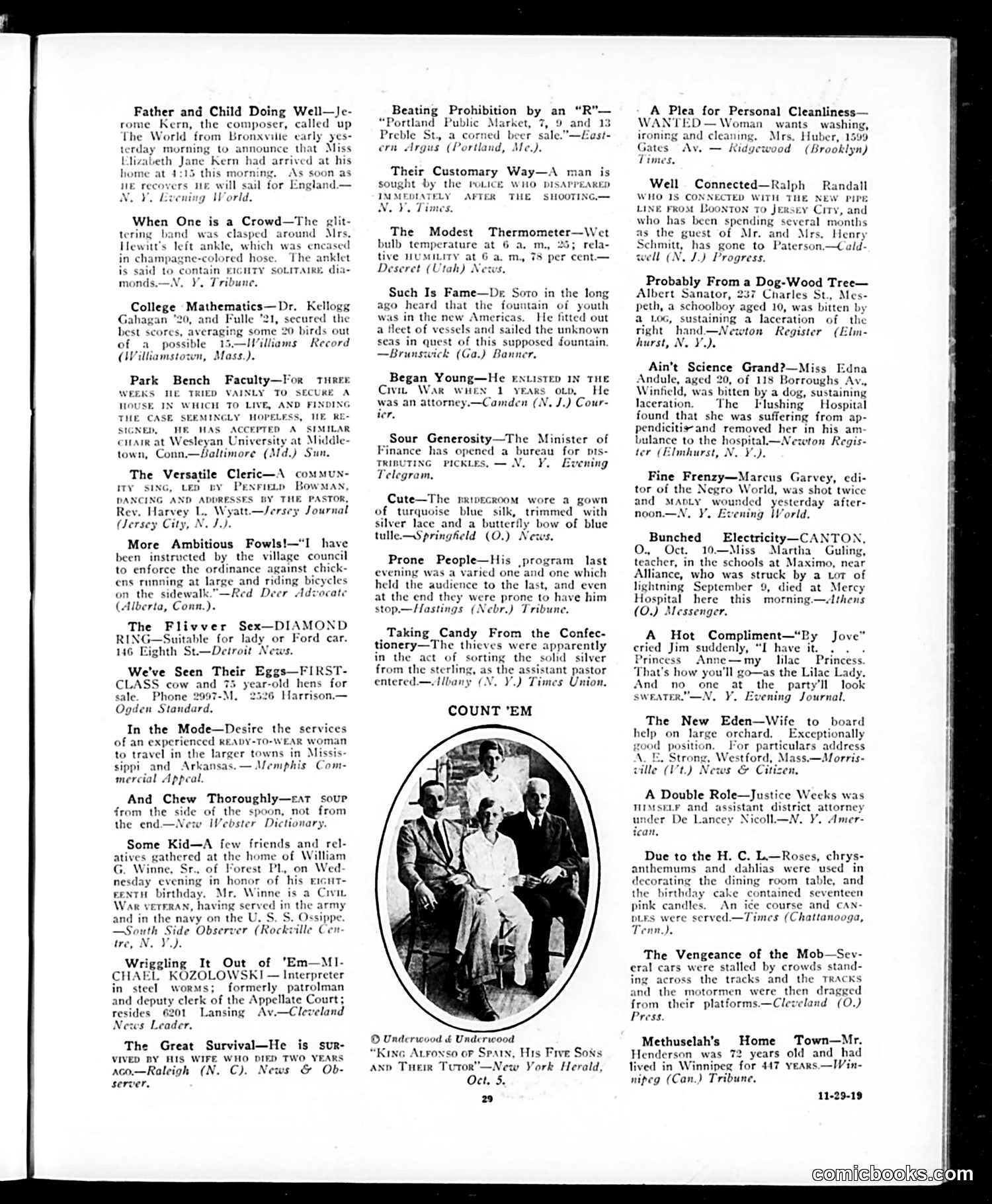
This page is primarily a compilation of humorous newspaper clippings—absurd, contradictory, or grammatically confused short items from various American newspapers. The cartoons are brief jokes rather than political satire. The central photograph shows "King Alfonso of Spain, His Five Sons and Their Tutor" alongside the caption "COUNT 'EM"—the satire being that the visual doesn't clearly show five sons, creating an ironic "count them yourself" challenge to readers. The surrounding text clippings contain unintentional humor: contradictions ("survived by his wife who died two years ago"), logically impossible statements ("20 birds out of 15 possible"), and absurd municipal situations (enforcing anti-bicycle ordinances on chickens). These represent early 20th-century *paraprosdokian* humor—readers enjoyed the incongruity and incompetence of newspaper writing itself. The magazine targeted educated readers amused by linguistic and logical absurdities in popular media.
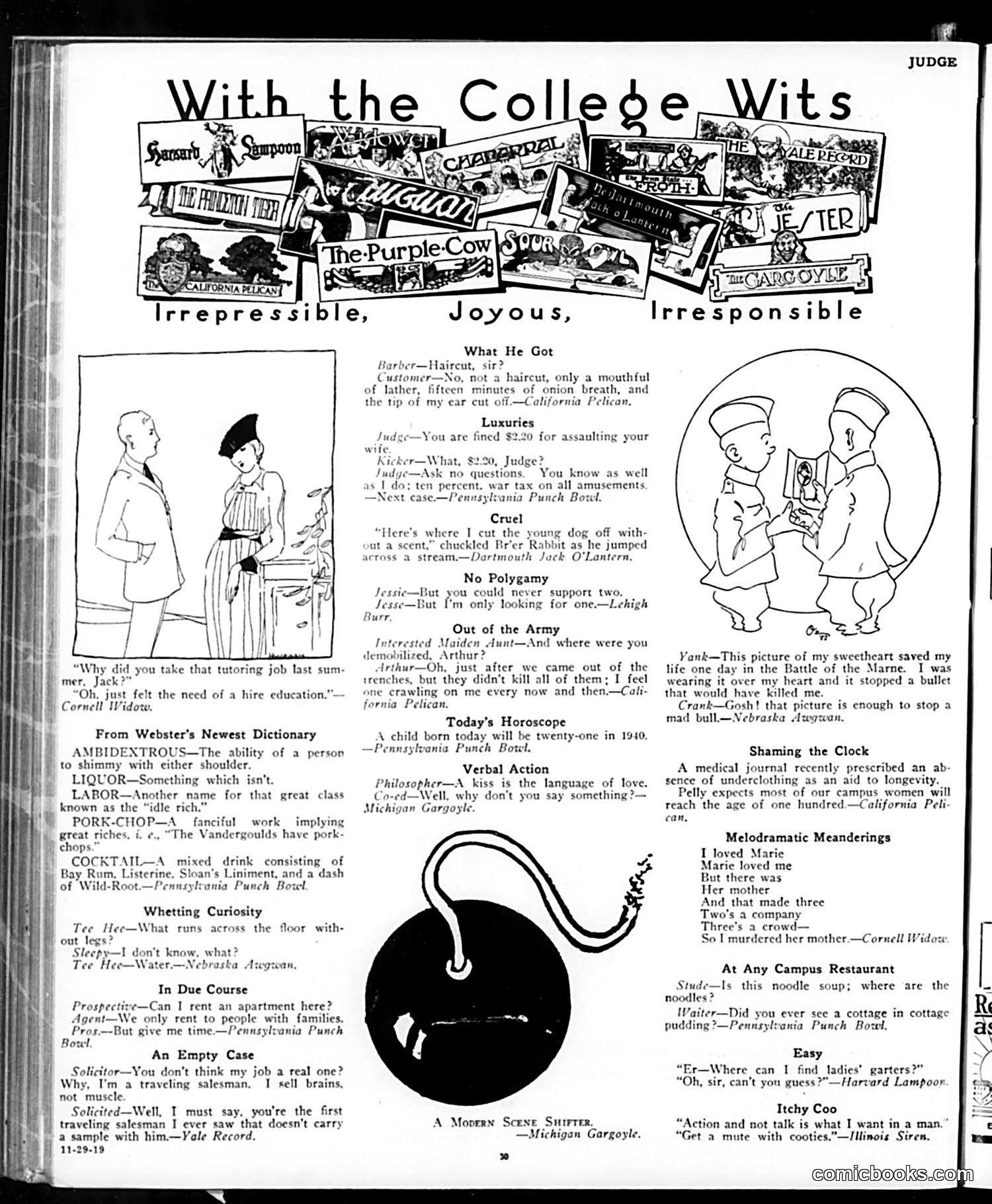
This is a humor compilation page from Judge magazine (dated 11-29-19, so November 1919) featuring jokes sourced from various college publications and humor magazines of the era. The page satirizes post-WWI American life through college-humor lens: - **Dictionary definitions** mock Prohibition ("LIQUOR—Something which isn't"), wartime excess taxes on entertainment, and modern social behaviors ("AMBIDEXTROUS—The ability of a person to shimmy with either shoulder") - **Military jokes** reference recent WWI demobilization, with soldiers complaining about lingering trench conditions - **Social commentary** includes jabs at apartment rental discrimination ("We only rent to people with families"), underclothing and longevity claims, and dating dynamics - **The cartoons** (left: couple with luggage/tutoring reference; right: soldiers in oval frame) illustrate typical college romantic scenarios The overall tone reflects 1920s campus culture: irreverent, slightly risqué (garter jokes, "cooties"), and obsessed with modern absurdities—what educated young Americans found funny during the Jazz Age transition.
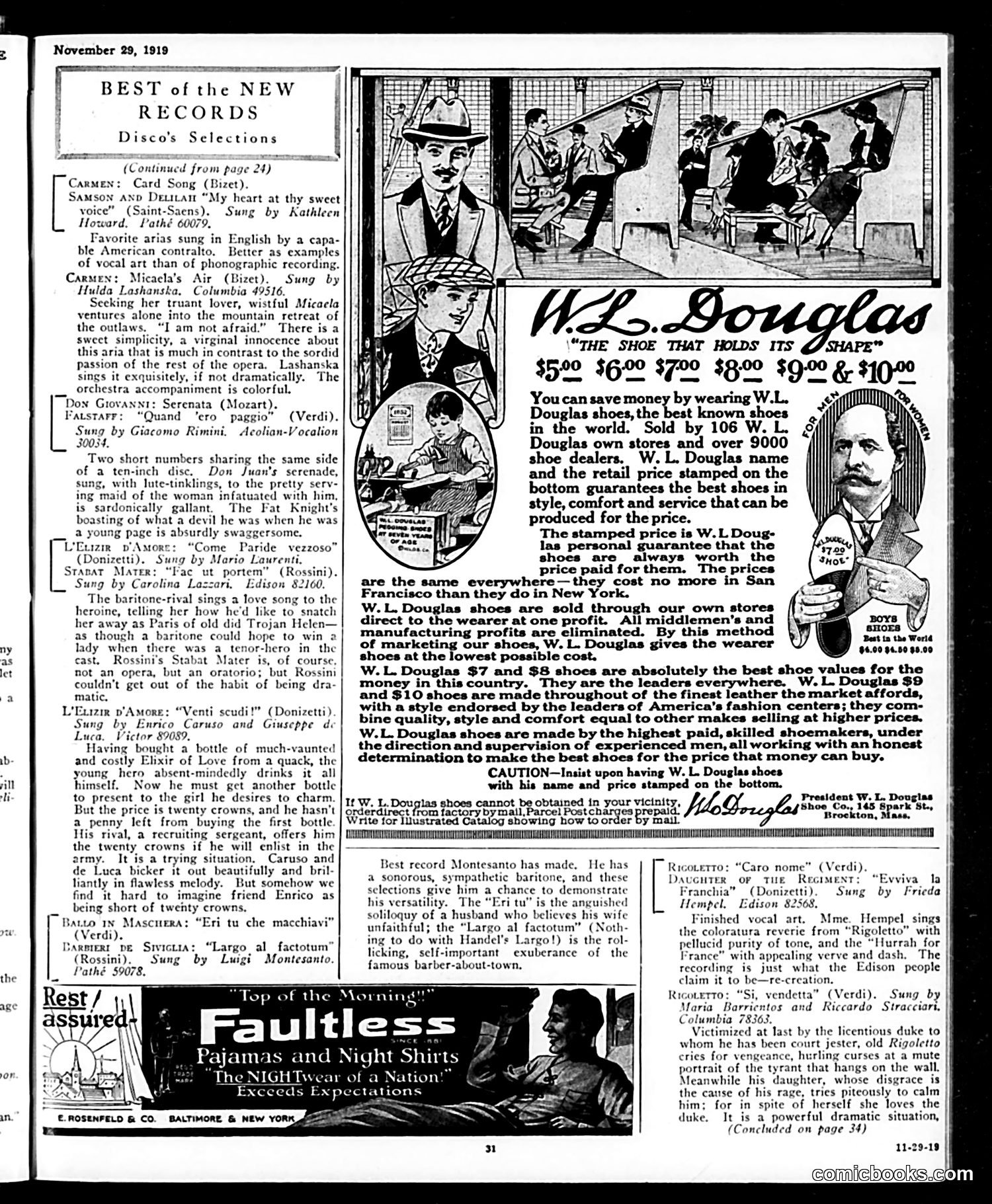
This page is primarily **advertising and music reviews**, not political satire. The dominant content is a large W.L. Douglas Shoes advertisement featuring the company founder's portrait and detailed sales pitch about shoe quality and direct-to-consumer pricing. The left column contains music reviews for phonograph records—operatic arias and songs from classical operas (Carmen, Don Juan, etc.), evaluating their vocal and recording quality. These are consumer recommendations for the Judge readership. The only additional advertisement is a "Faultless Pajamas" notice at bottom. There is **no political cartoon or satirical content** visible on this page. It represents Judge's mixed commercial function: a satirical magazine that also carried substantial advertising and consumer reviews to support its publication. The shoe ad's emphasis on fair pricing and quality reflects 1919 consumer concerns post-WWI.
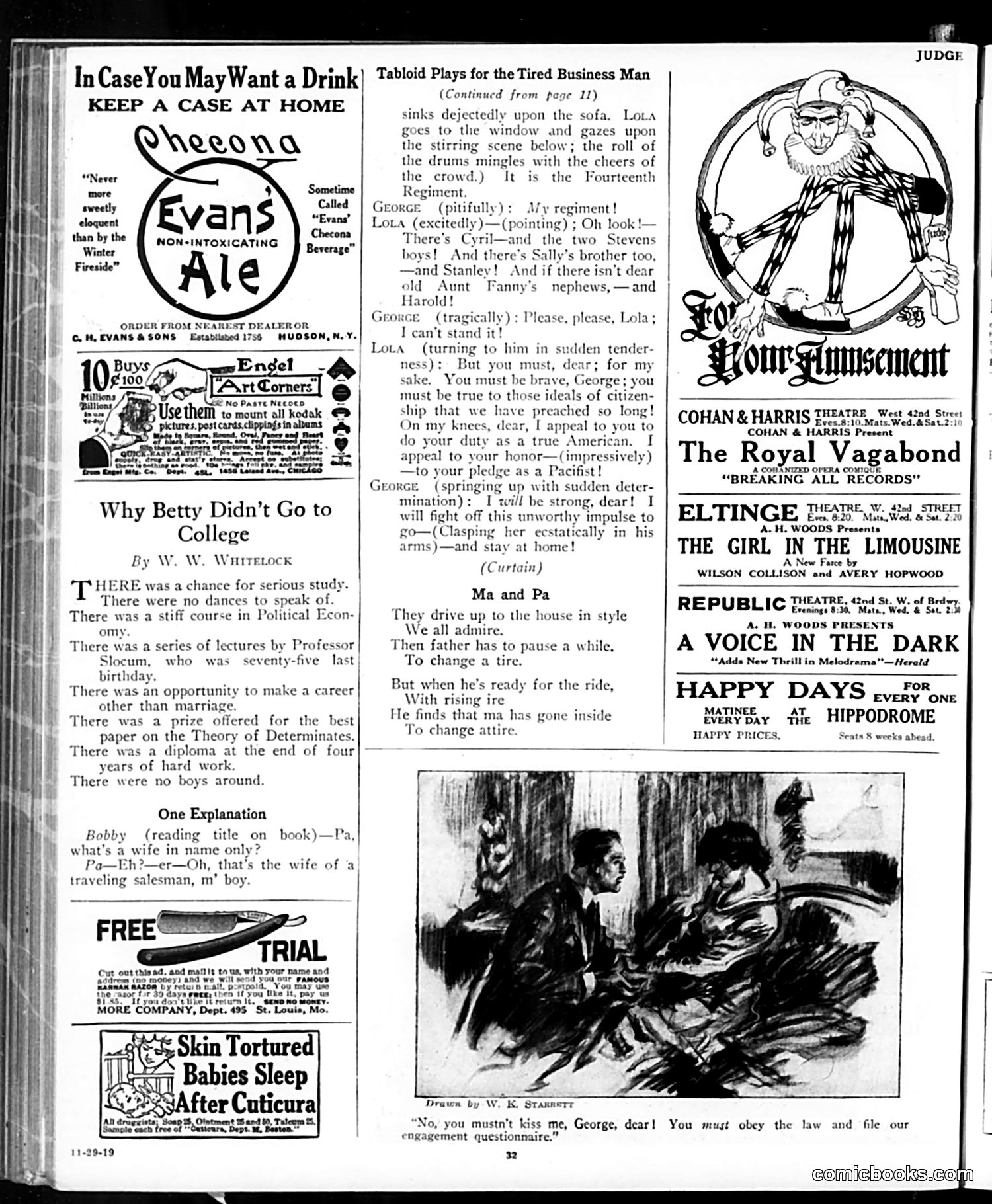
This page mixes advertisements, humor pieces, and theatrical listings typical of the era. The main satirical content includes: **"Why Betty Didn't Go to College"** — A humorous commentary on women's education, listing serious academic opportunities (Political Economy, rigorous coursework, a diploma) but revealing the real obstacle: "There were no boys around." The punchline implies women prioritize marriage over education, satirizing contemporary attitudes about female ambition. **"Ma and Pa"** — A domestic comedy sketch about a couple's car trouble and clothing changes, poking fun at everyday married life frustrations. **"Tabloid Plays for the Tired Business Man"** — A theatrical sketch featuring a patriotic woman (Lola) convincing her wavering suitor (George) to stay home rather than enlist, despite his regiment marching past. It satirizes both romantic melodrama and pacifist sentiment during the WWI era. The advertisements promote Evans Ale and various Broadway shows, reflecting 1919 consumer culture and theatrical entertainment. The overall tone targets urban, middle-class readers with gentle social satire.
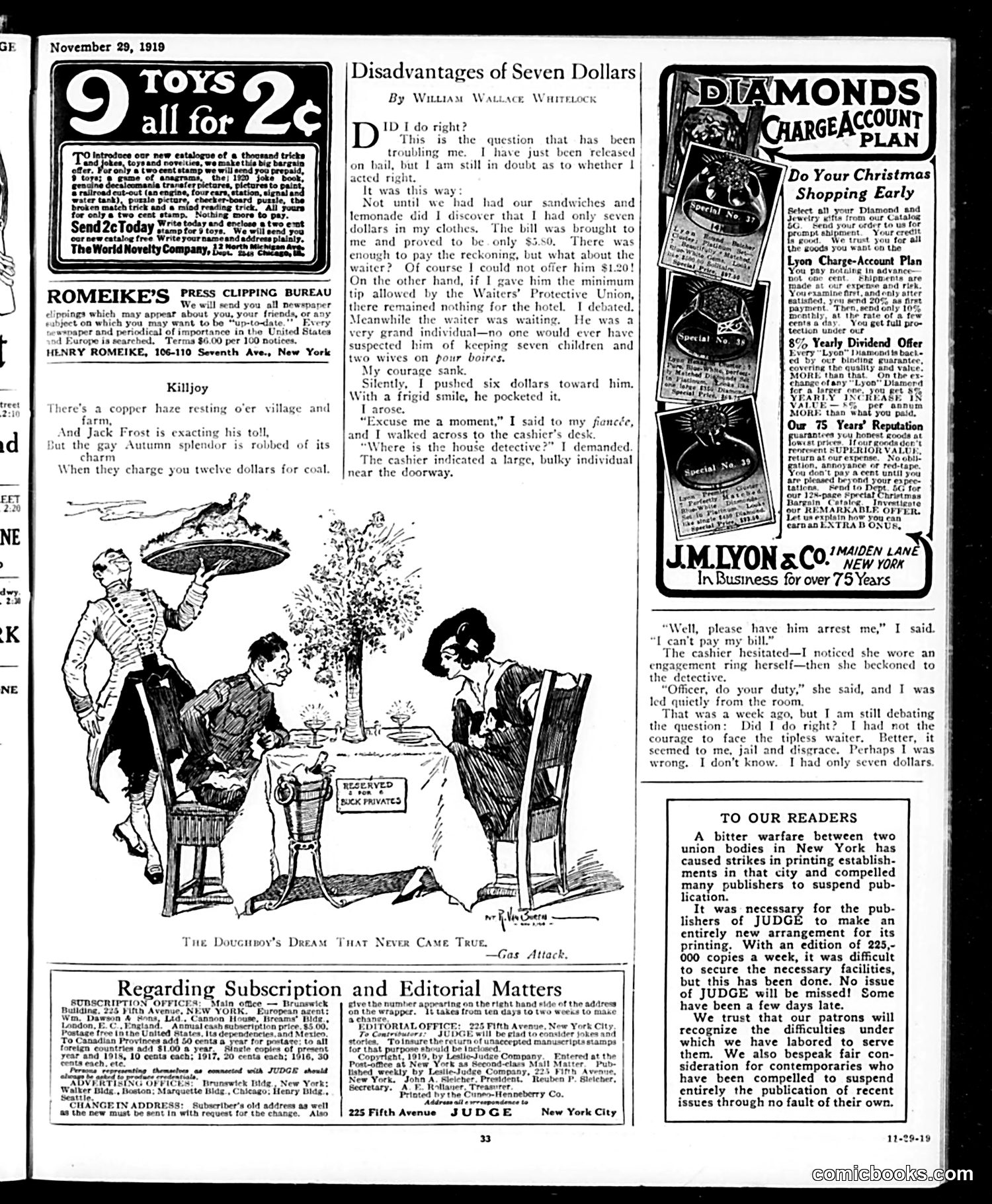
This page features two distinct pieces of satirical content: **"Killjoy" (illustrated poem):** A brief, cynical observation about autumn's loss of beauty and the universal hardship of coal costs during winter—likely referencing post-WWI fuel shortages and inflation affecting ordinary households. **"Disadvantages of Seven Dollars" (short story by William Wallace Whitlock):** The main narrative mocks the rigid class system of tipping etiquette. A diner discovers his bill is only $3.80, leaving him $7 unaccounted for. The ethical dilemma satirizes the impossible position of lower-middle-class patrons: unable to afford both the required union-minimum tip and his hotel bill simultaneously. His "solution"—giving the waiter $6—leaves him short everywhere. The story ridicules both the formal tipping conventions and the economic precarity of 1919 America. The satire targets post-war economic anxiety and the inflexible social protocols that trapped people between conflicting financial and social obligations.
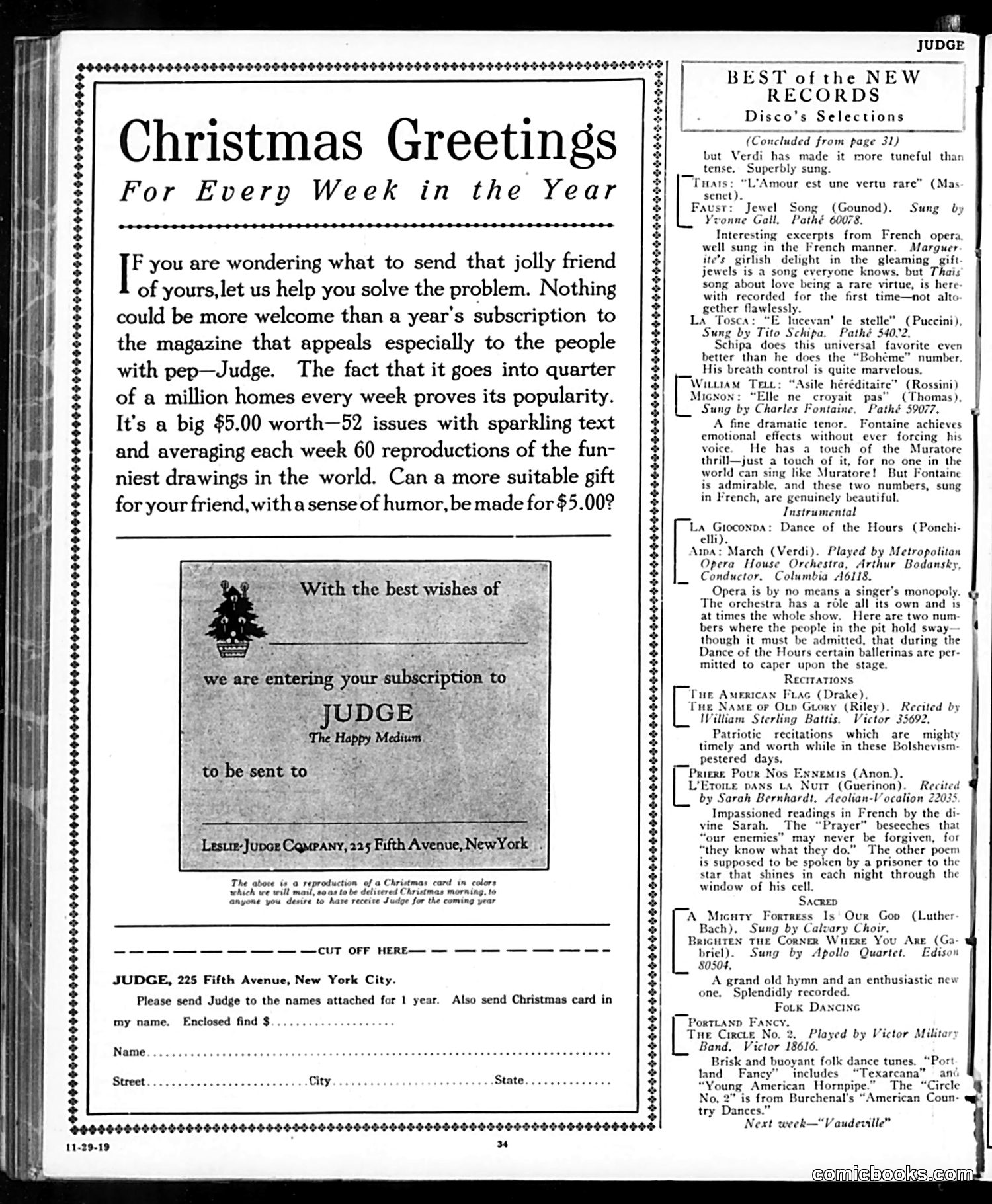
This page is primarily **advertising and record reviews**, not political satire. The left half promotes Judge magazine subscriptions as Christmas gifts ($5.00 for 52 issues), emphasizing its humor and cartoons. A mock Christmas card shows a gift basket with text from "Leslie-Judge Company" at 225 Fifth Avenue, New York. The right column contains "Best of the New Records"—Disco's selections of recent opera, classical, and vocal recordings with brief reviews. Artists mentioned include Verdi, Puccini, Sarah Bernhardt, and various opera singers and choirs. The only potential social reference is in the recitations section, which notes patriotic pieces are "timely and worth while in these Bolshevism-pestered days"—a 1919 reference to anti-communist sentiment during the first Red Scare. Otherwise, this is a straightforward advertisement and entertainment guide with no discernible cartoon or satirical commentary.
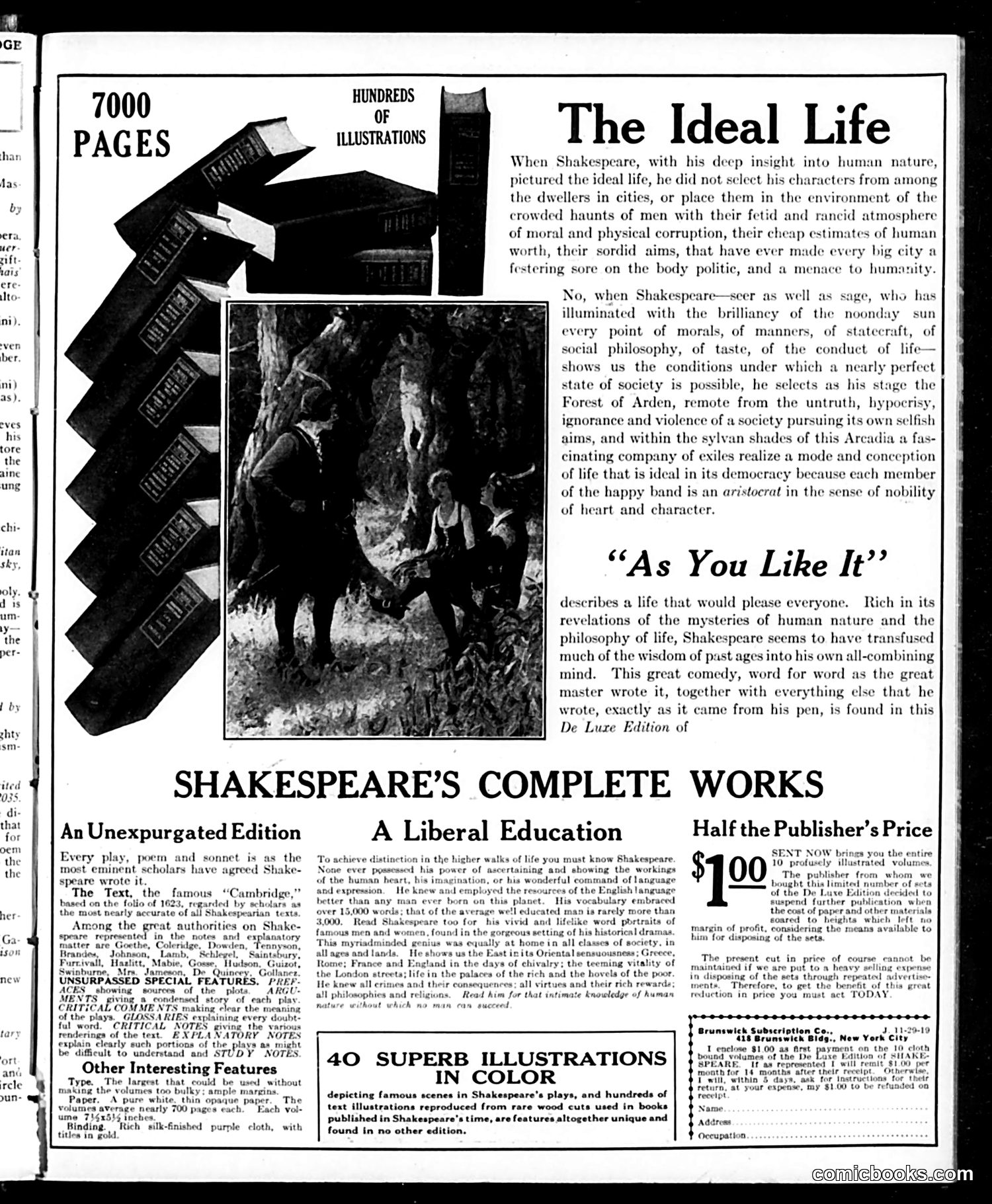
This is primarily a **book advertisement**, not a political cartoon. It promotes a "De Luxe Edition" of Shakespeare's complete works, priced at $1.00 (half the publisher's price). The page argues that **Shakespeare offers an "ideal life"** through literature—specifically praising *As You Like It*, which depicts characters in the Forest of Arden, removed from corrupt city society. The text contrasts Shakespeare's pastoral idealism with urban moral corruption, suggesting reading Shakespeare provides "a liberal education." The marketing emphasizes the edition's features: 7,000 pages, hundreds of illustrations, 40 color illustrations, unexpurgated text based on the 1623 folio, glossaries, and scholarly apparatus. **No specific political satire is evident.** This appears to be a genuine educational/commercial appeal using Shakespeare's idealized depiction of nature and rural life to market the book—likely from the early 20th century, when Shakespeare was promoted as improving and culturally elevating for middle-class readers.
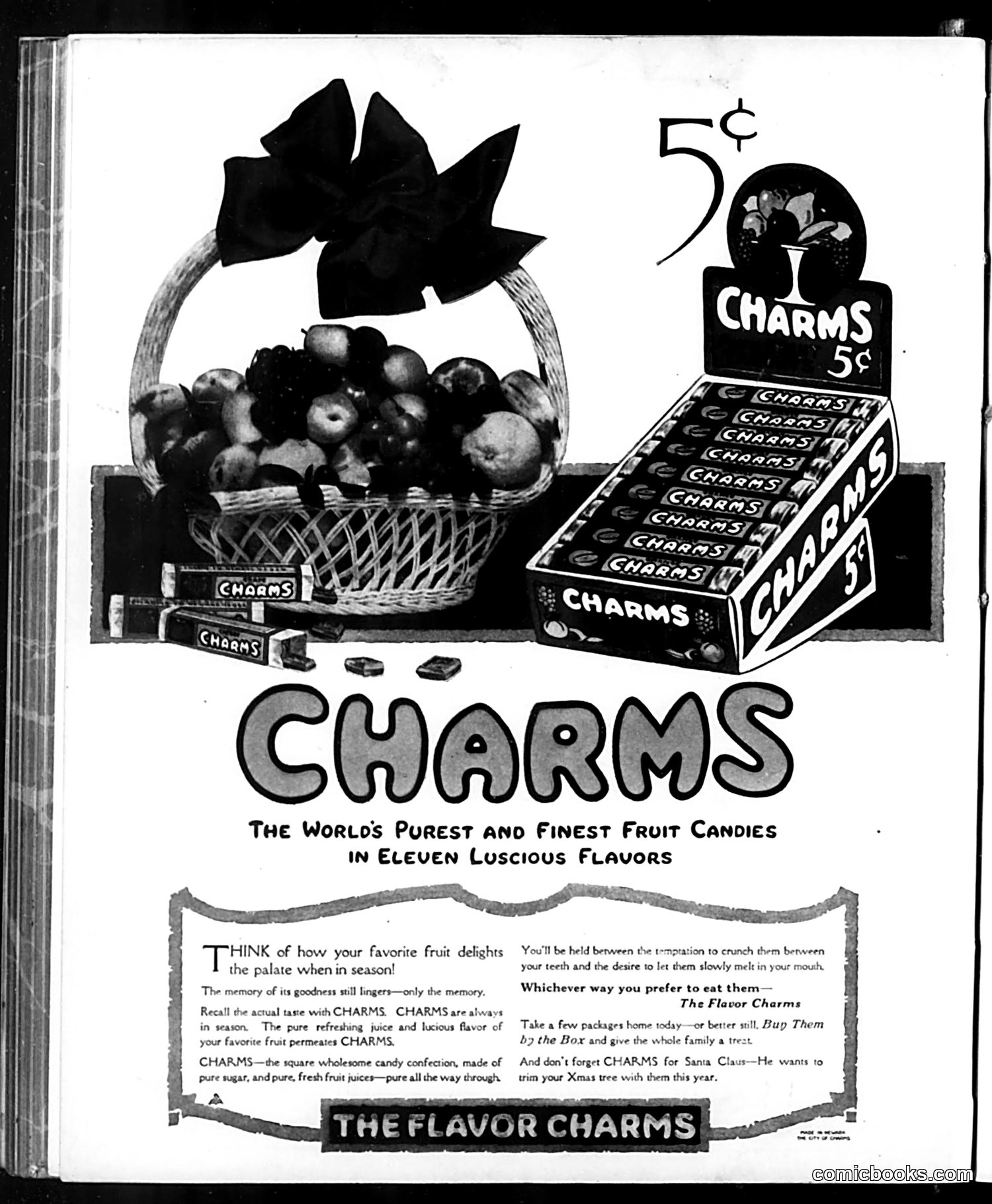
This is not a political cartoon but a **product advertisement** for Charms fruit candies, positioned as a full-page ad in Judge magazine. The page uses nostalgic marketing language—appealing to consumers' memories of fresh seasonal fruit while promoting Charms as a year-round substitute. The visual hierarchy showcases the product prominently: a decorative basket of fruit, display boxes, and individual candies. The text emphasizes the candy's purity ("purest and finest") and promises authentic fruit flavor despite being made from "pure sugar and pure, fresh fruit juices." Notable is the Christmas pitch at the end—suggesting consumers buy Charms "by the box" as holiday gifts or tree decorations. This reflects early-20th-century advertising conventions: aspirational imagery, health/purity claims, and seasonal gift-giving appeals. The ad targets middle-class families seeking affordable treats that evoke luxury (fresh fruit) at modest prices (5¢).