
A complete issue · 36 pages · 1919
Judge — September 13, 1919
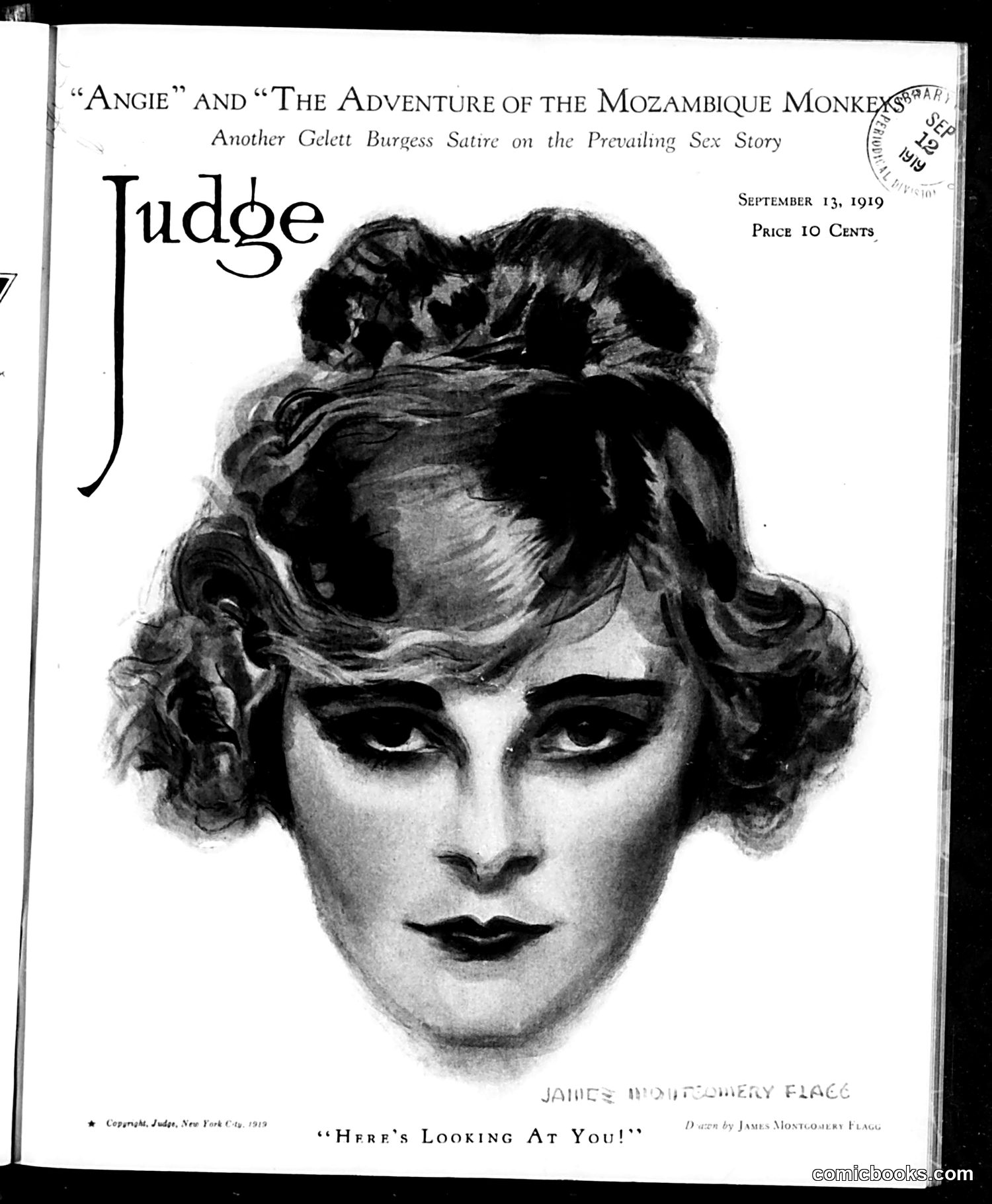
This is the cover of Judge magazine from September 13, 1919. The main image is a glamorous portrait illustration by James Montgomery Flagg showing a woman's face with styled 1920s hair and makeup, captioned "HERE'S LOOKING AT YOU!" The header references two stories: "Angie" and "The Adventure of the Mozambique Monkeys," described as "Another Gelett Burgess Satire on the Prevailing Sex Story." This suggests the issue satirizes contemporary fiction trends—likely the popular romantic and adventure stories of the era, and possibly evolving attitudes toward sexuality and gender roles in the post-WWI period. The cover's glamorous woman imagery and the "sex story" reference indicate satire directed at pulp fiction conventions and changing social mores of the era.
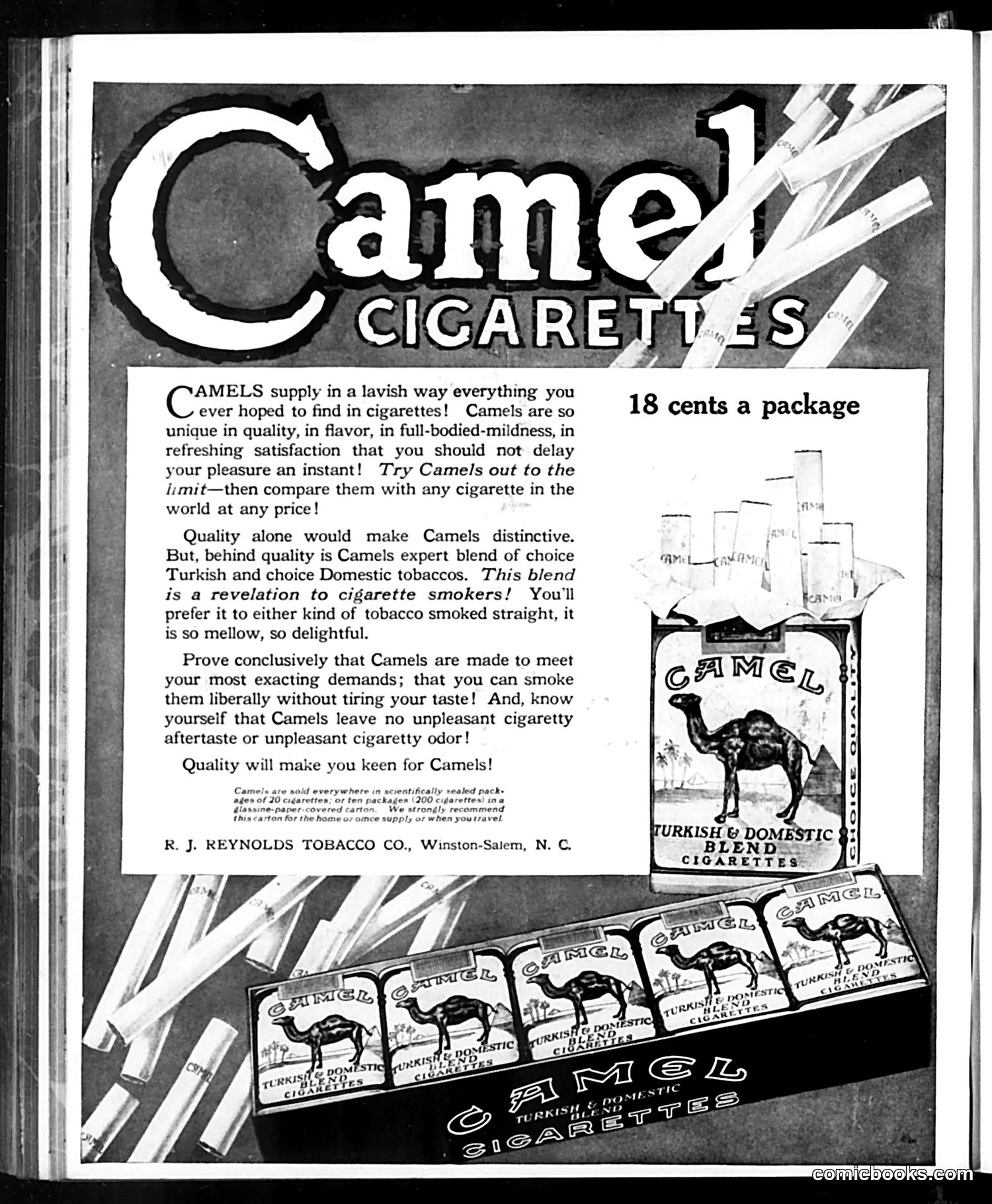
This is **not a cartoon or satire page**—it's a straightforward **cigarette advertisement** for Camel brand cigarettes, published in *Judge* magazine. The ad promotes Camels as a premium product at 18 cents per package, emphasizing their blend of Turkish and domestic tobaccos. Key selling points include: superior quality, full-bodied mildness, refreshing satisfaction, and crucially, **lack of unpleasant aftertaste or odor**. The camel logo and product packaging are displayed prominently. The advertiser is R.J. Reynolds Tobacco Co., based in Winston-Salem, North Carolina. There is no political or social satire here—merely a period tobacco advertisement reflecting early-20th-century marketing practices, before health warnings existed.
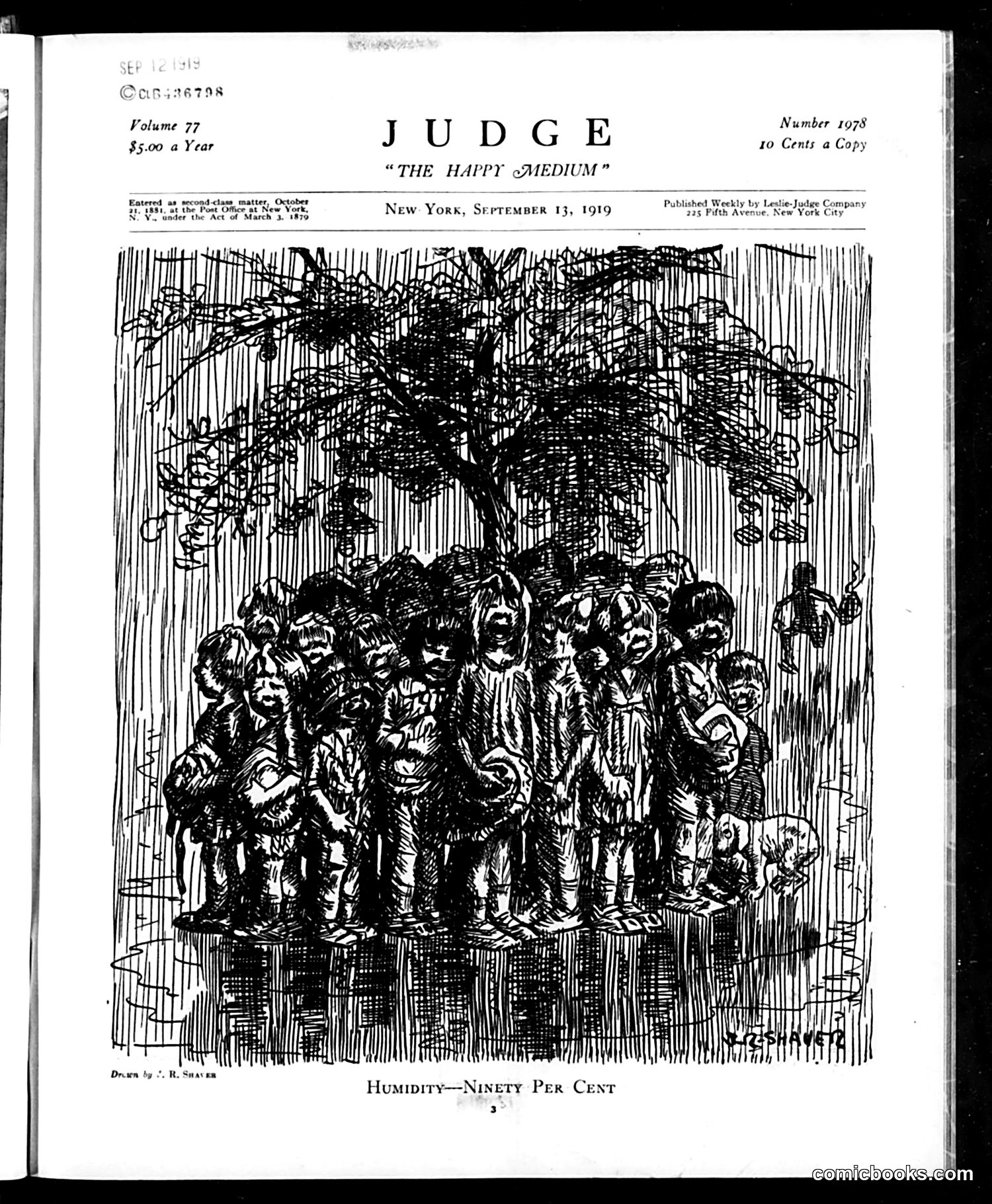
This cartoon by H. Souers (September 13, 1919) depicts a group of children huddled together beneath a large tree during oppressively humid weather. The drawing's title references 90% humidity—an extreme weather condition. The satire appears to target how people, particularly children, endure unbearable summer heat and humidity in New York City. The crowded, uncomfortable positioning of the figures and the heavily shadowed, claustrophobic composition convey the physical misery of the season. The tree offers minimal relief. This is social commentary on urban living conditions during hot weather rather than political satire—mocking how city dwellers must cope with dangerous heat, likely reflecting genuine public concern about health hazards during humid summers in densely populated areas.
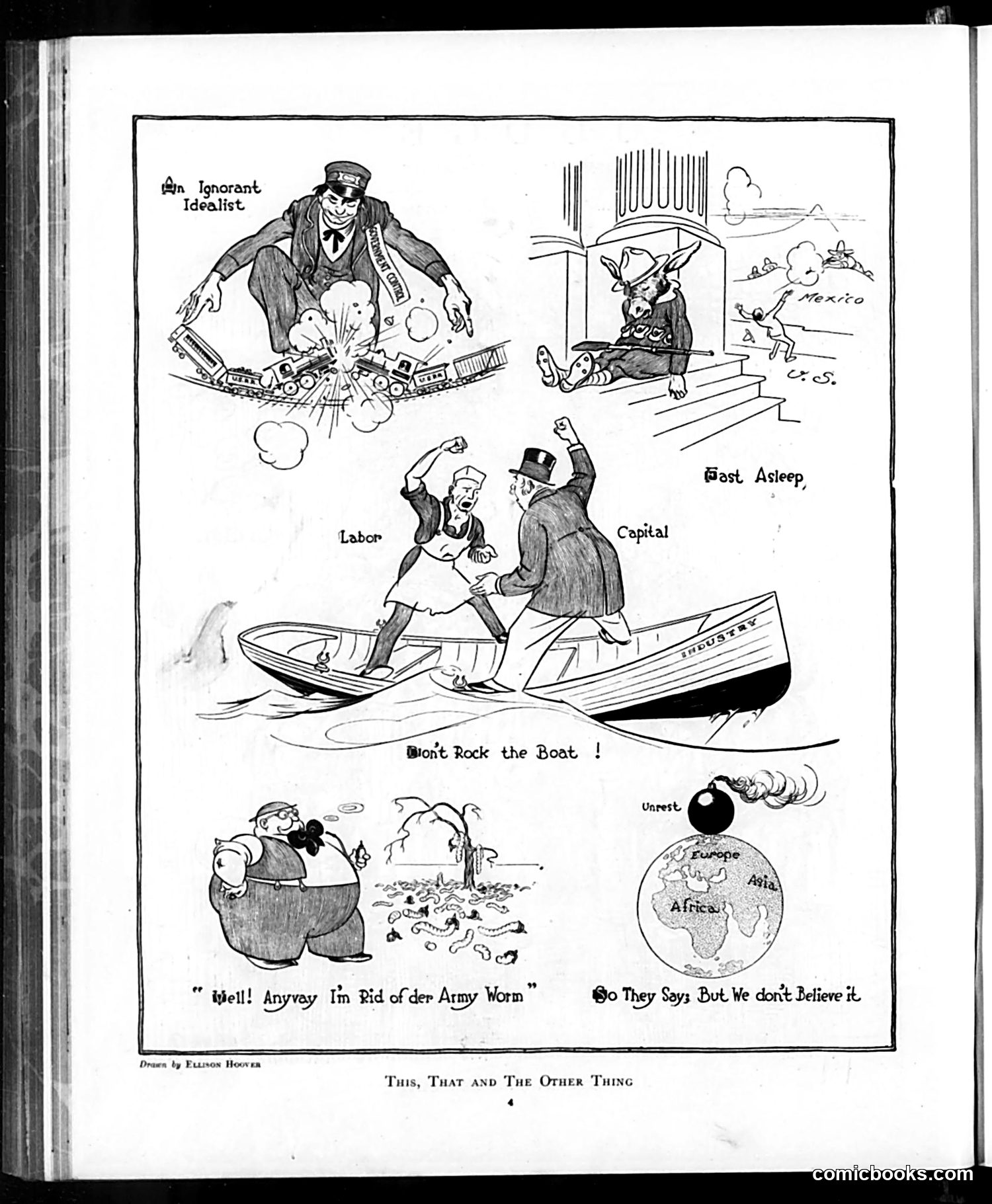
This satirical page critiques an "Ignorant Idealist" (top left)—likely a pacifist or anti-war advocate—whose naive philosophy is shown failing in practice. The cartoons illustrate consequences of this idealism: "Don't Rock the Boat" depicts Labor and Capital in a boat labeled "Industry," suggesting that pacifist non-resistance prevents necessary conflict resolution. "Best Asleep" shows someone oblivious while danger (Mexico, possibly referencing border conflict) looms. The final panels mock the idealist's claim about "Army Worms" and suggest skepticism about pacifist claims that "We don't Believe it"—implying idealists deny real threats. The overall message: pacifism and non-confrontation are dangerous fantasies that ignore genuine conflicts requiring action. The cartoons appear pre-WWI or interwar era.
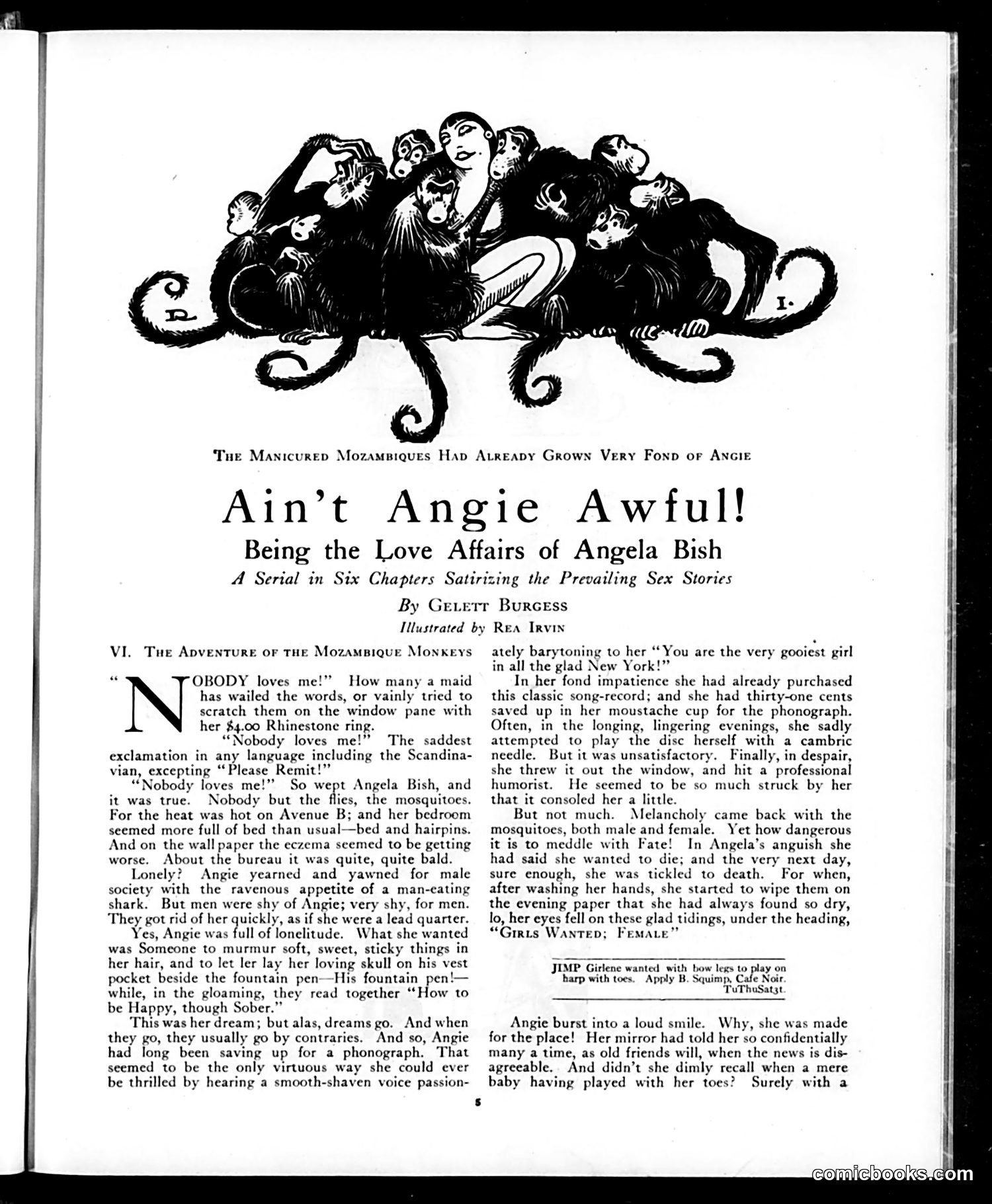
This page satirizes a serialized story called "Ain't Angie Awful! Being the Love Affairs of Angela Bish" by Gelert Burgess, illustrated by Rea Irvin. The masthead illustration shows monkeys in formal dress, suggesting the piece mockingly compares the characters to animals or primitive behavior—a common satirical device of the era. The text ("VI. The Adventure of the Mozambique Monkeys") indicates this is the sixth installment of a serial that ridicules romantic melodrama and female loneliness. The story follows Angela Bish, a lonely woman seeking male companionship, depicted as pathetically yearning for love while surrounded by urban isolation and minor catastrophes (mosquitoes, domestic troubles). The satire targets sentimental romance narratives and the desperation of single women in contemporary society.
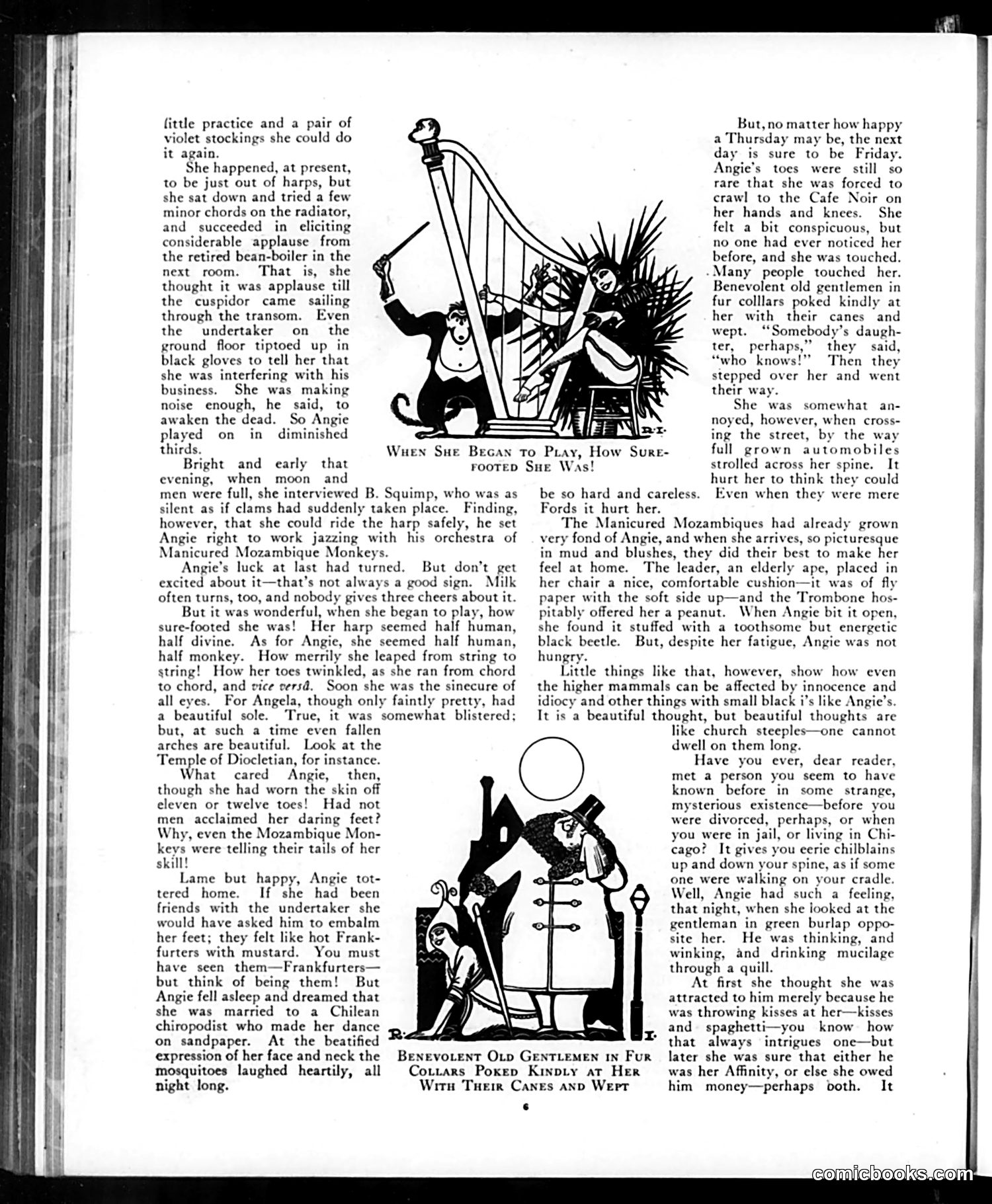
This page is primarily **literary fiction**, not political satire. It tells the story of "Angie," a talented but poor harpist in Paris who performs at the Café Noir and attracts attention from wealthy gentlemen. The two illustrations depict scenes from the narrative: the upper cartoon shows Angie playing her harp energetically; the lower shows "Benevolent Old Gentlemen in Fur Collars" poking kindly at her with their canes. The text explores themes of **female poverty, charity, and male attention**—suggesting the precarious position of working-class women entertainers dependent on patronage from wealthy men. There are no clear political references or satirical targets visible; this appears to be a serialized romantic story rather than social commentary or political humor.
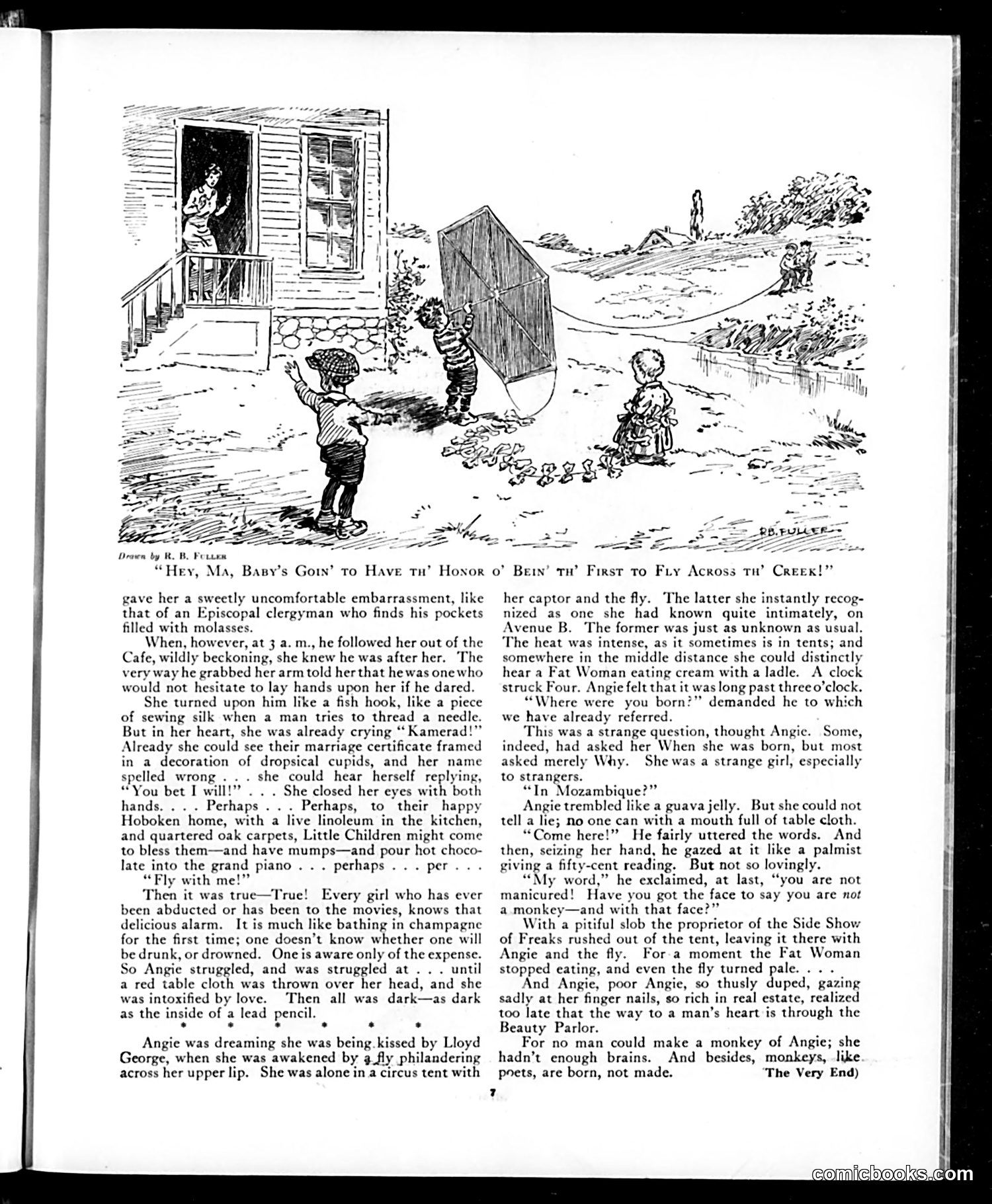
This page contains an absurdist satirical story with accompanying illustration mocking romantic melodrama and contemporary social pretensions. **The Setup:** The cartoon caption depicts children playing by a creek, with the joke that a baby will be "first to fly across" — innocent wordplay on aviation enthusiasm. **The Story's Satire:** The lengthy narrative parodies overwrought romantic fiction popular in early 20th-century magazines. It mocks: - **Female stereotypes**: Angie is portrayed as vapid and easily seduced ("hadn't enough brains") - **Male predation**: Her captor represents dangerous masculine entitlement - **Class anxiety**: References to "Hoboken home" and manicures satirize working-class aspirations - **Modern superficiality**: The punchline — "the way to a man's heart is through the Beauty Parlor" — ridicules women's obsession with appearance over substance **The Humor**: Judge employs exaggeration and absurdism (Lloyd George kisses, circus tents, Fat Women with ladles) to deflate both sentimental romance narratives and contemporary vanity culture. The story suggests women are simultaneously victims of manipulation and complicit in their own objectification through beauty obsession.
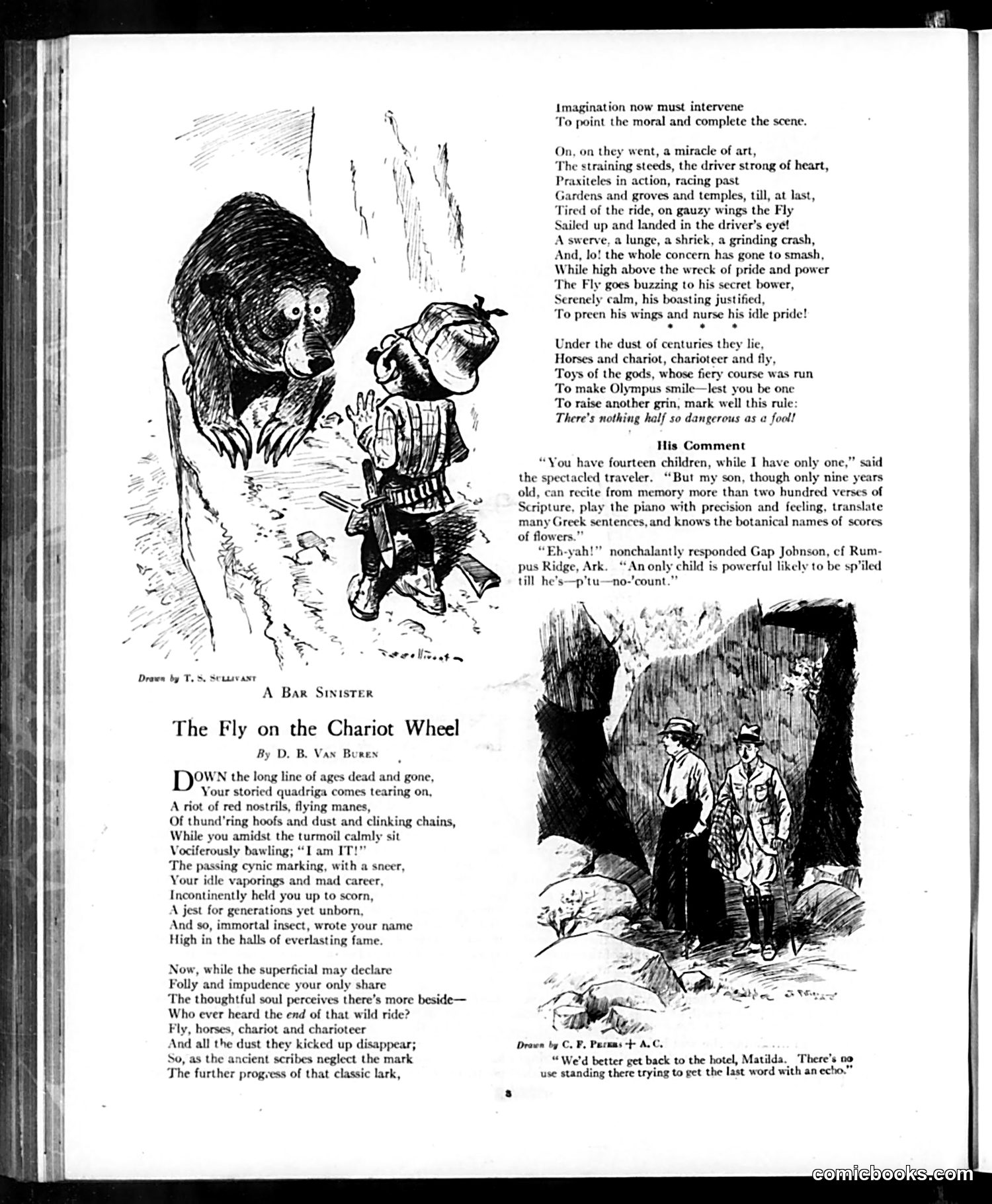
This page contains two distinct satirical pieces: **"The Fly on the Chariot Wheel"** (main poem): A mock-epic allegory where a tiny fly causes a magnificent chariot to crash, destroying horses, charioteer, and all. The moral: "There's nothing half so dangerous as a fool!" The satire mocks human pride and self-importance—even the grandest achievements can be undone by insignificant foolishness. **"A Bar Sinister"** (brief dialogue): A rural character named Gap Johnson from Arkansas dismissively responds to a traveler's boasting about his precocious son's accomplishments. Johnson suggests an only child becomes "sp'iled" and worthless. The satire targets both parental bragging and the folk-wisdom dismissal of education and refinement. **"His Comment"** (bottom cartoon): Shows two men at a cave entrance with the caption about getting "the last word with an echo"—a visual pun on futile stubbornness. All three pieces satirize human vanity, foolishness, and the futility of pride.
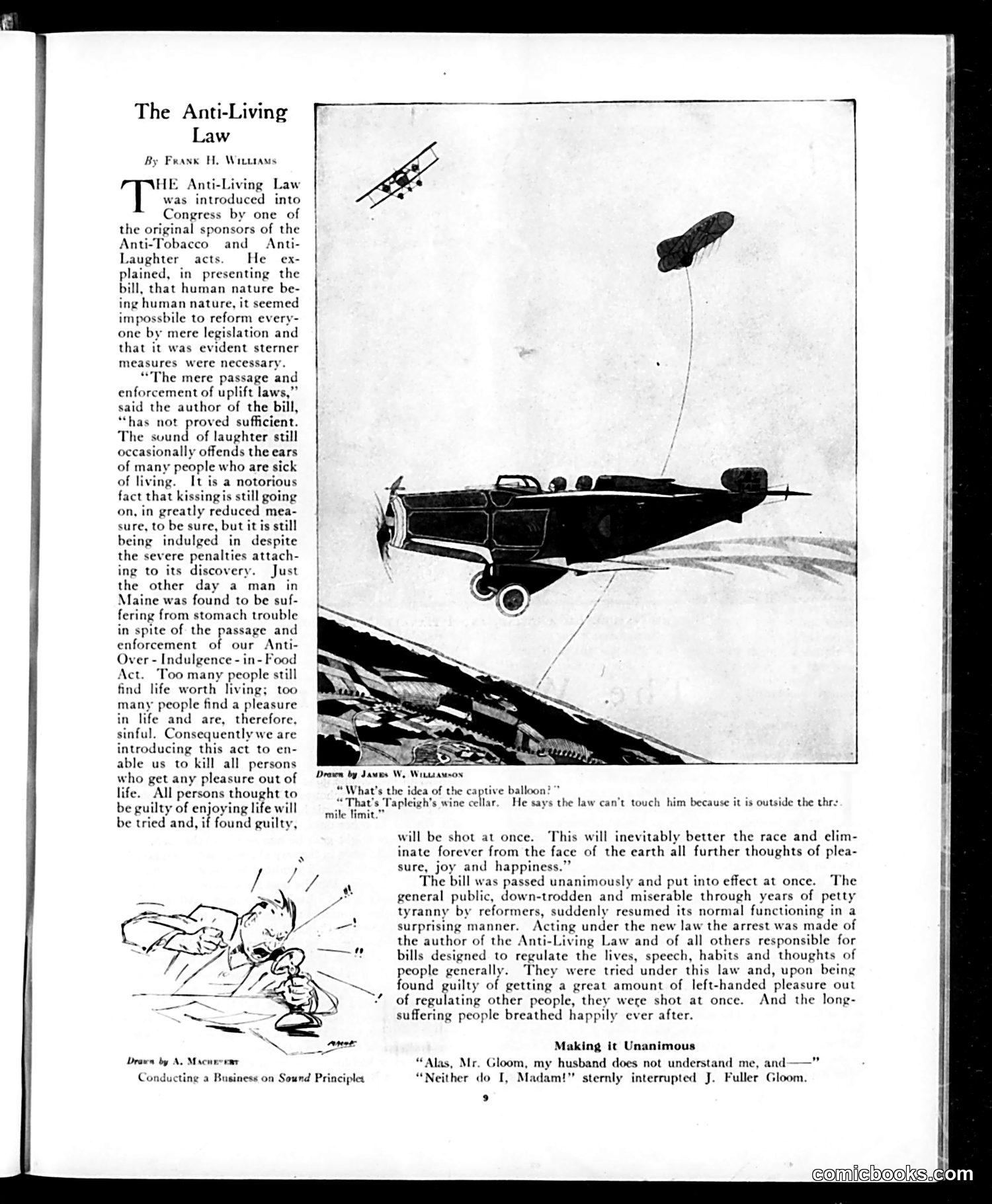
This is a satirical attack on *excessive moral legislation* and "reform" movements of the early 20th century. The story proposes an absurd "Anti-Living Law" that would execute anyone who enjoys life's pleasures—a hyperbolic critique of real anti-vice laws (Anti-Tobacco, Anti-Laughter acts mentioned) that the author views as joyless overreach. The satire's point: reformers who obsessively regulate others' behavior are themselves guilty of deriving pleasure from control, making them hypocrites deserving punishment under their own logic. When the law is applied impartially, the reformers are executed instead, and "long-suffering people" finally find peace. The cartoon shows an airplane dropping a wine cellar ("Tapleigh's") with the joke that it's anchored offshore to escape the law's jurisdiction—illustrating how absurd prohibition becomes when people find workarounds. The page mocks puritanical social engineering as tyrannical, defending ordinary pleasures (drinking, kissing, eating, laughter) against intrusive legislation.
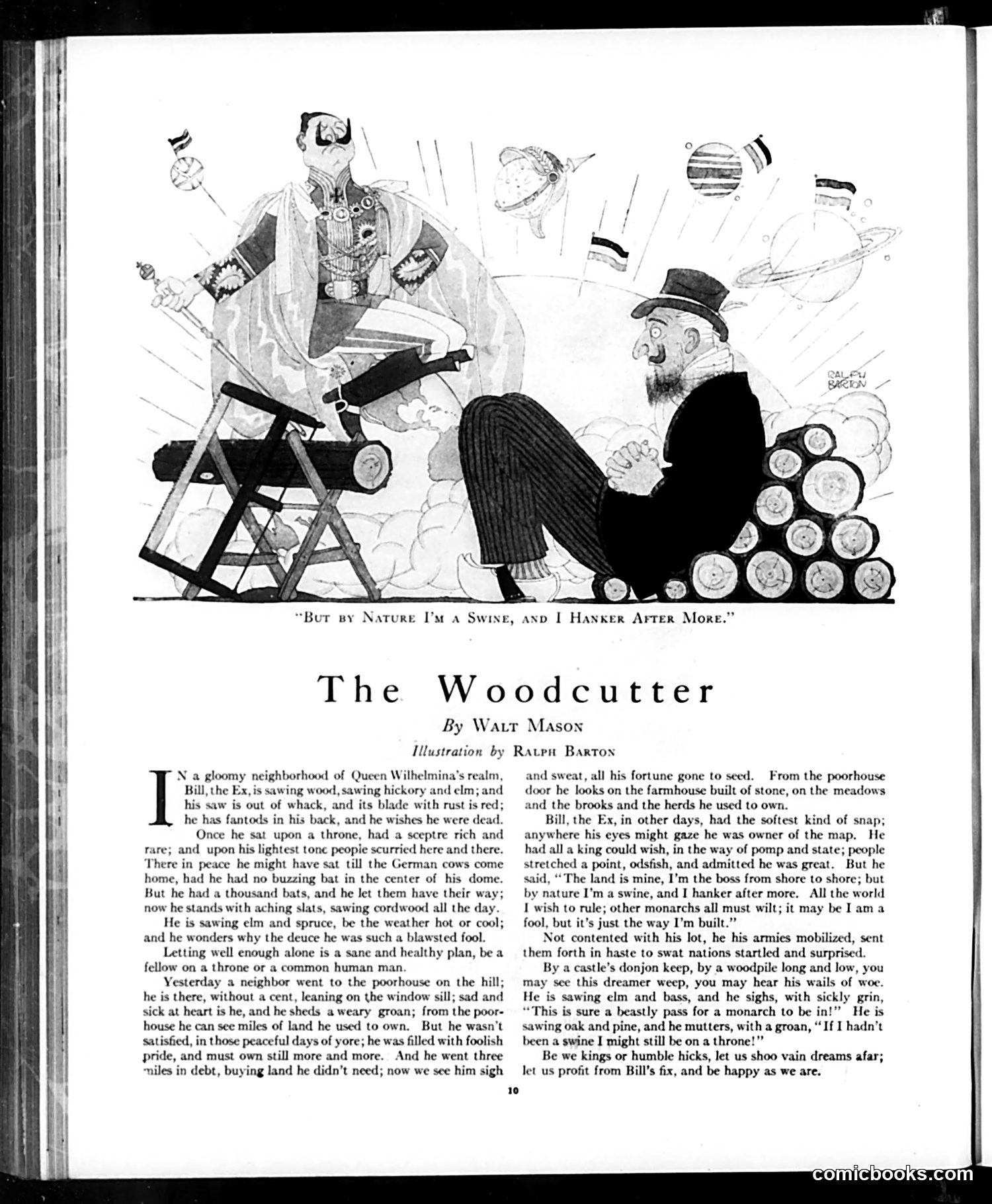
This is a cautionary tale about a deposed European monarch, likely **Kaiser Wilhelm II of Germany** (indicated by "Queen Wilhelmina's realm"—the Netherlands, where Wilhelm abdicated in 1918). The cartoon illustrates the consequences of unchecked ambition and greed. "Bill, the Ex" once ruled with absolute power but, driven by endless desire for more territory and dominion, mobilized armies and conquered neighboring nations. His greed destroyed him: he lost everything and now saws wood for survival, watching from poverty the lands he once owned. The moral is explicitly stated in the caption and poem: even those with supreme power should recognize limits. Wilhelm's real-world parallel was his aggressive expansionism during WWI, which resulted in Germany's defeat, his exile, and loss of his throne. For modern readers: this reflects post-WWI disillusionment with autocratic ambition and warns against the dangers of imperial overreach—a directly relevant critique to contemporary audiences witnessing the war's devastating consequences.
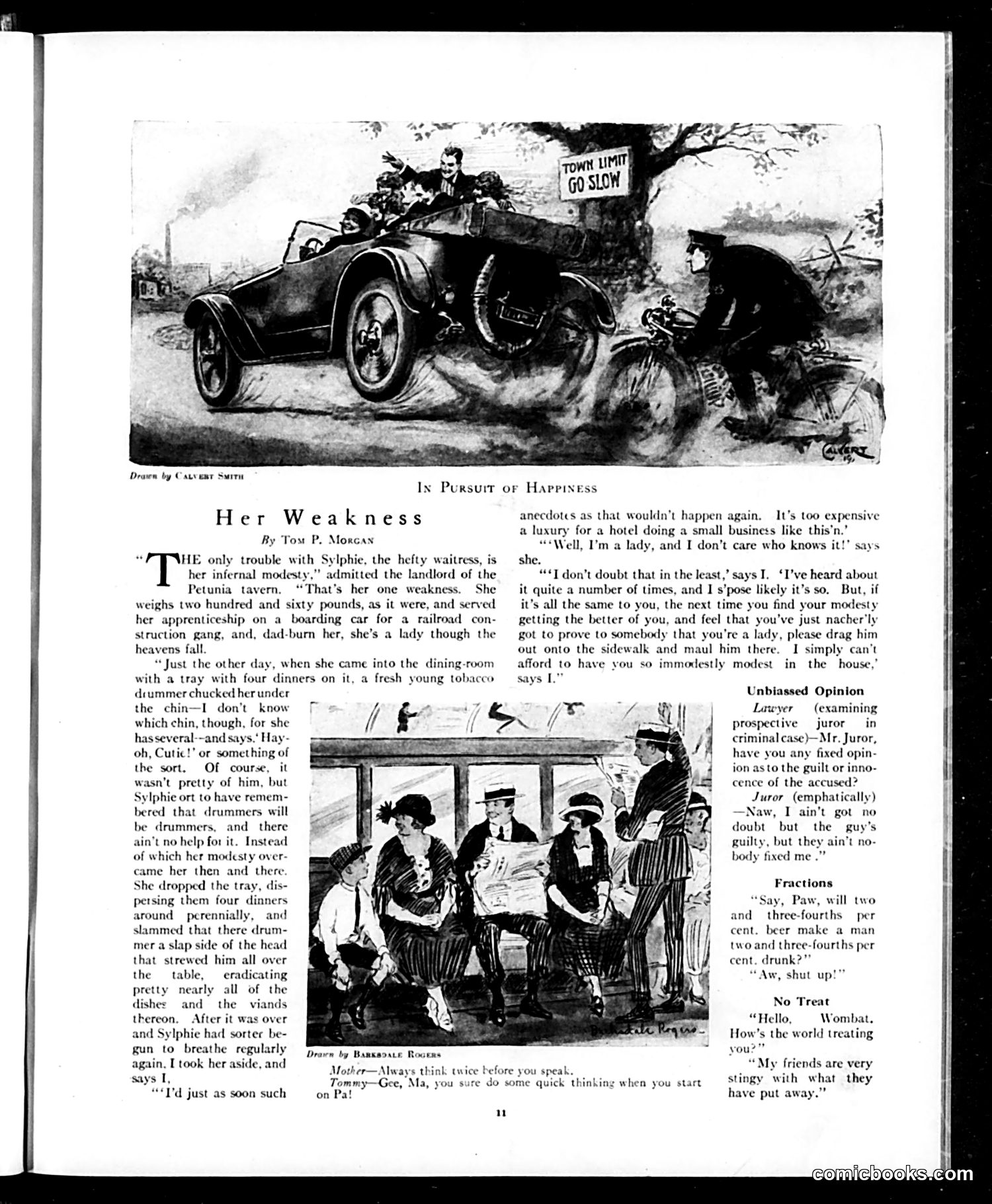
The page contains three separate humorous pieces typical of early-20th-century Judge magazine: **"Her Weakness"** (main story): A tavern waitress named Sylphie, described as weighing 260 pounds, demonstrates excessive modesty by violently attacking a traveling salesman ("drummer") who familiarly chucks her under the chin. The satire targets the contradiction between her rough appearance/job and her insistence on being treated as a "lady." The joke mocks both her disproportionate reaction and the genteel pretense of working-class women. **The smaller cartoons** use brief comedic scenarios: one about a mother advising quick thinking before speaking; another mocking jury selection where a prospective juror admits bias; and jokes about fractions and stingy friends. The artwork style is period-appropriate line drawing. The humor relies on class-based stereotypes and the incongruity between Sylphie's physical presence and her claims to ladylike dignity—typical of era satire that often ridiculed working-class pretension.
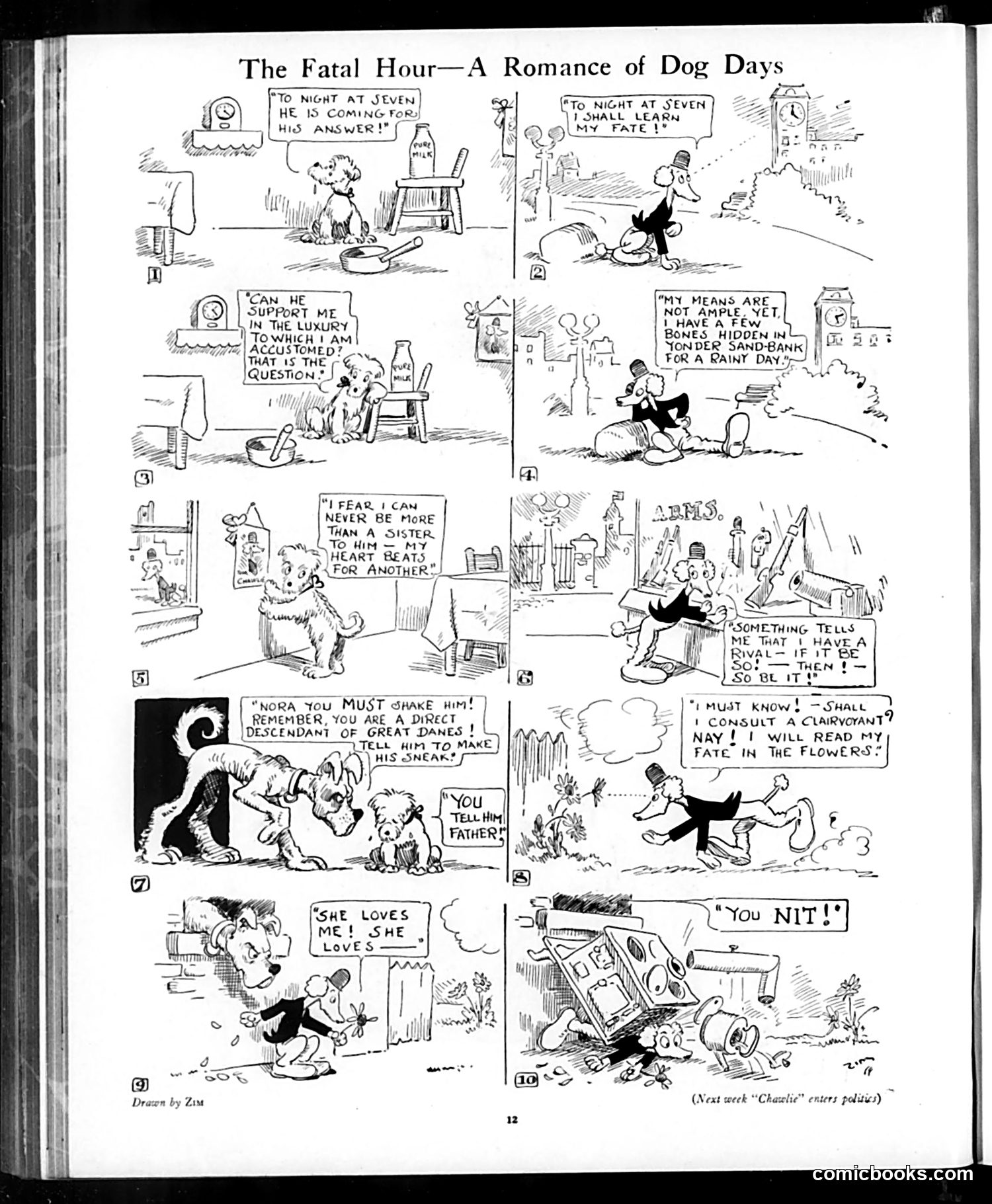
This is a humorous comic strip (not political satire) that anthropomorphizes dogs as characters in a melodramatic romantic narrative. The story follows a male dog arriving at seven o'clock to propose to a female dog, while she worries about their compatibility and social standing. Key plot points: The female character questions whether he can support her (panel 3), fears she's only a "sister" to him (panel 5), expresses doubts about their rival (panel 6), and seeks supernatural guidance about their fate through flowers and a clairvoyant (panels 8-9). The final panel shows comic chaos, suggesting the proposal goes awry. The satire mocks Victorian melodrama conventions—overwrought emotional declarations, class anxiety, and fortune-telling—by presenting them through dogs' perspectives. The joke relies on the absurdity of dogs speaking in flowery romantic language typical of sentimental popular fiction of the era.
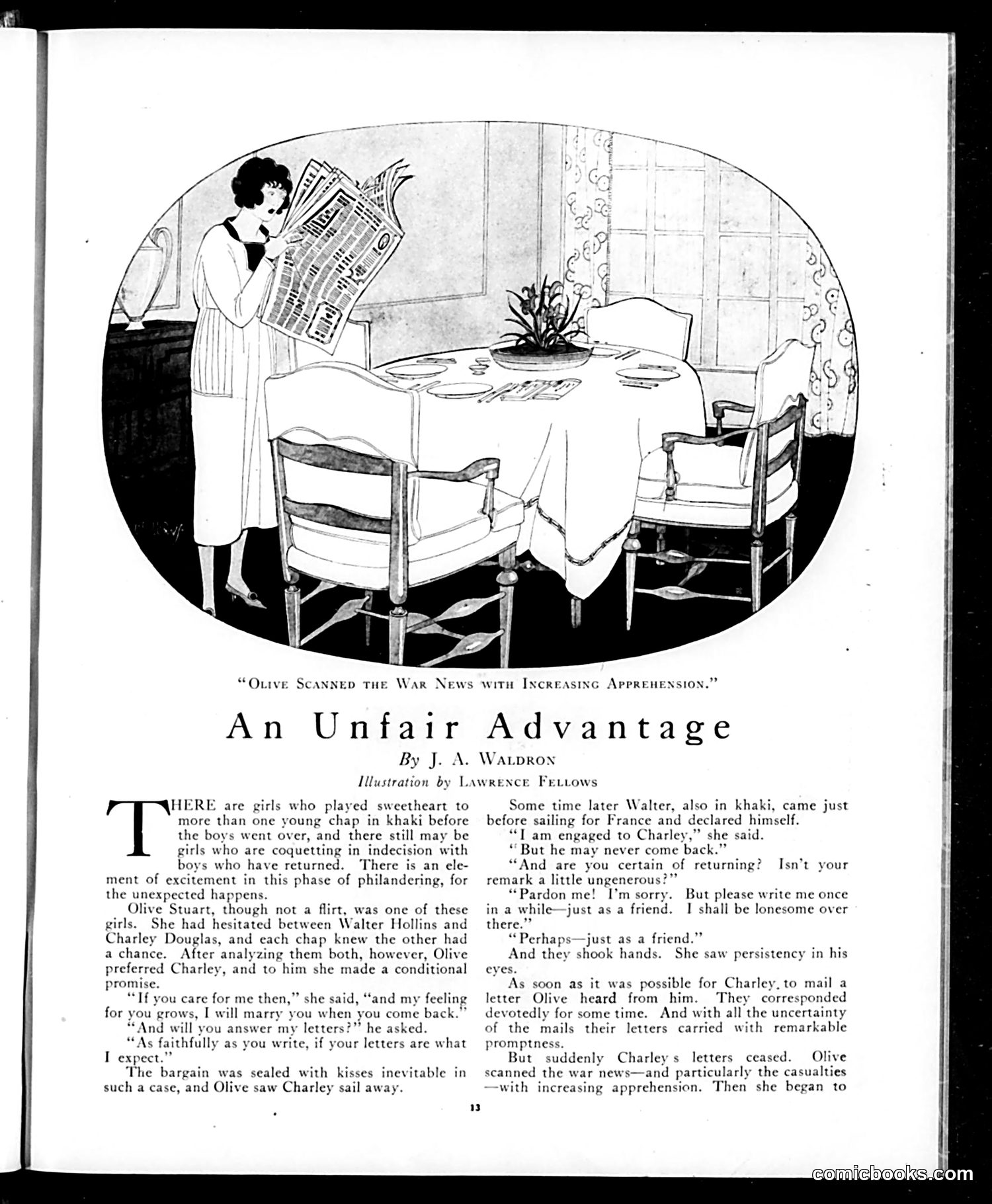
This WWI-era story illustrates the social anxiety surrounding soldiers and romantic commitment. Olive Stuart has conditionally promised to marry Charley Douglas when he returns from France, while another soldier, Walter Hollins, also declares his feelings before deployment. The satire's "unfair advantage" becomes clear: Walter, still in regular contact with Olive through letters, cultivates his position while Charley's correspondence mysteriously stops. Olive anxiously scans casualty lists, fearing the worst. The story critiques how wartime uncertainty and distance created romantic vulnerability—a woman could lose her fiancé either to death or to a rival who simply maintained better communication. The title suggests Walter exploits Charley's silence to win Olive's affection through persistent letter-writing and presence, gaining unfair romantic advantage over an absent (possibly deceased) soldier. This reflects genuine WWI-era concerns about fidelity, loss, and how prolonged separation tested wartime relationships.
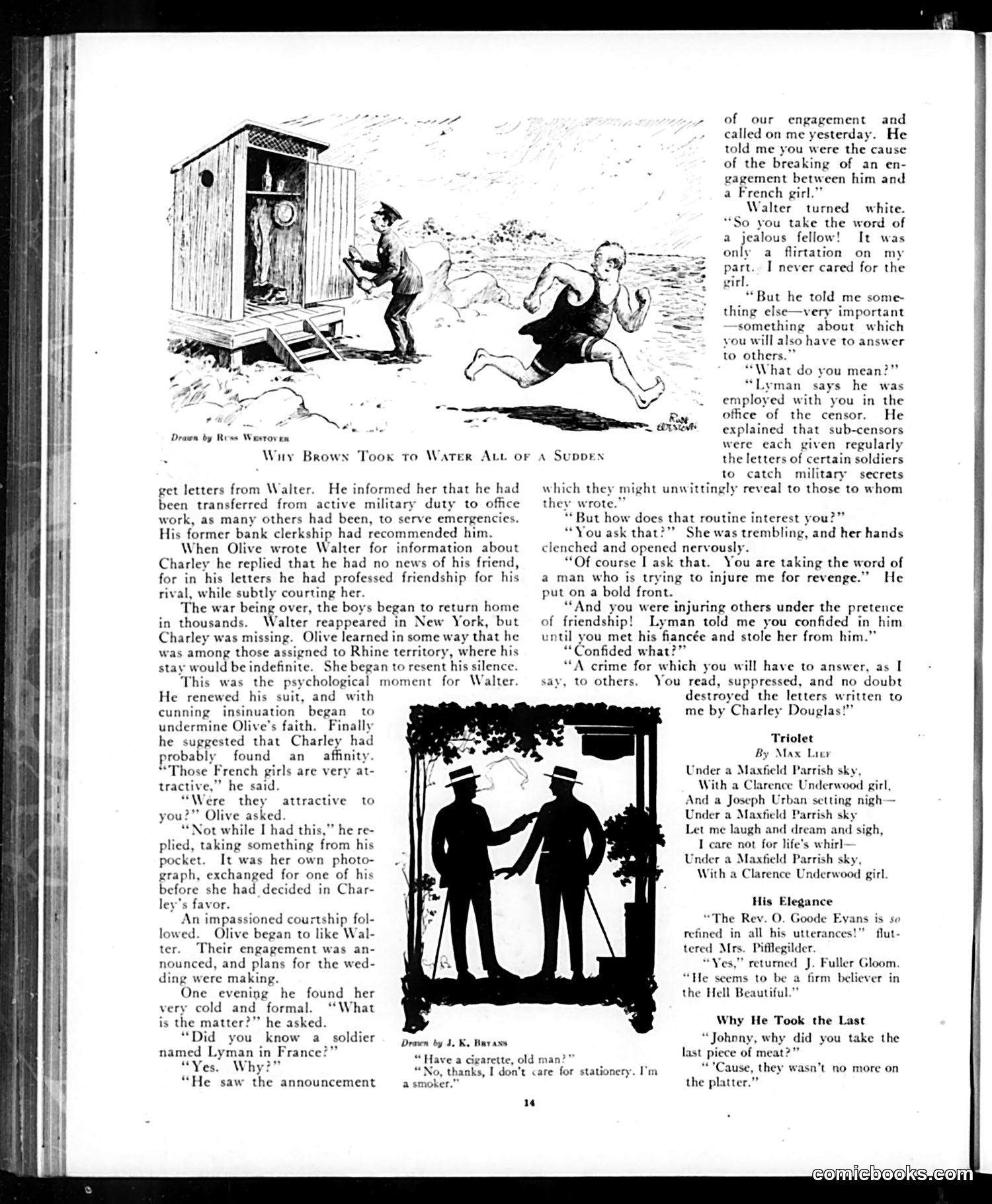
This page contains a post-WWI romance story exposing wartime censorship corruption. The main narrative follows Walter, who exploited his position as a military censor to suppress letters from soldier Charley to his fiancée Olive—apparently to clear the romantic field for himself. Walter also interfered in Charley's relationship with a French woman. The satire targets abuse of wartime emergency powers: censors were given access to soldiers' private letters ostensibly to prevent security leaks, but Walter weaponized this authority for personal gain. When exposed by Lyman (Charley's friend, also formerly a censor), Walter's duplicity unravels. The cartoons and poems on the page appear unrelated—typical magazine filler. The "old man" cigarette joke plays on the word "stationery," while other pieces showcase illustrators like Maxfield Parrish and Joseph Urban, common Judge contributors. The core satire: wartime secrecy measures created opportunities for personal corruption, a genuine postwar concern.
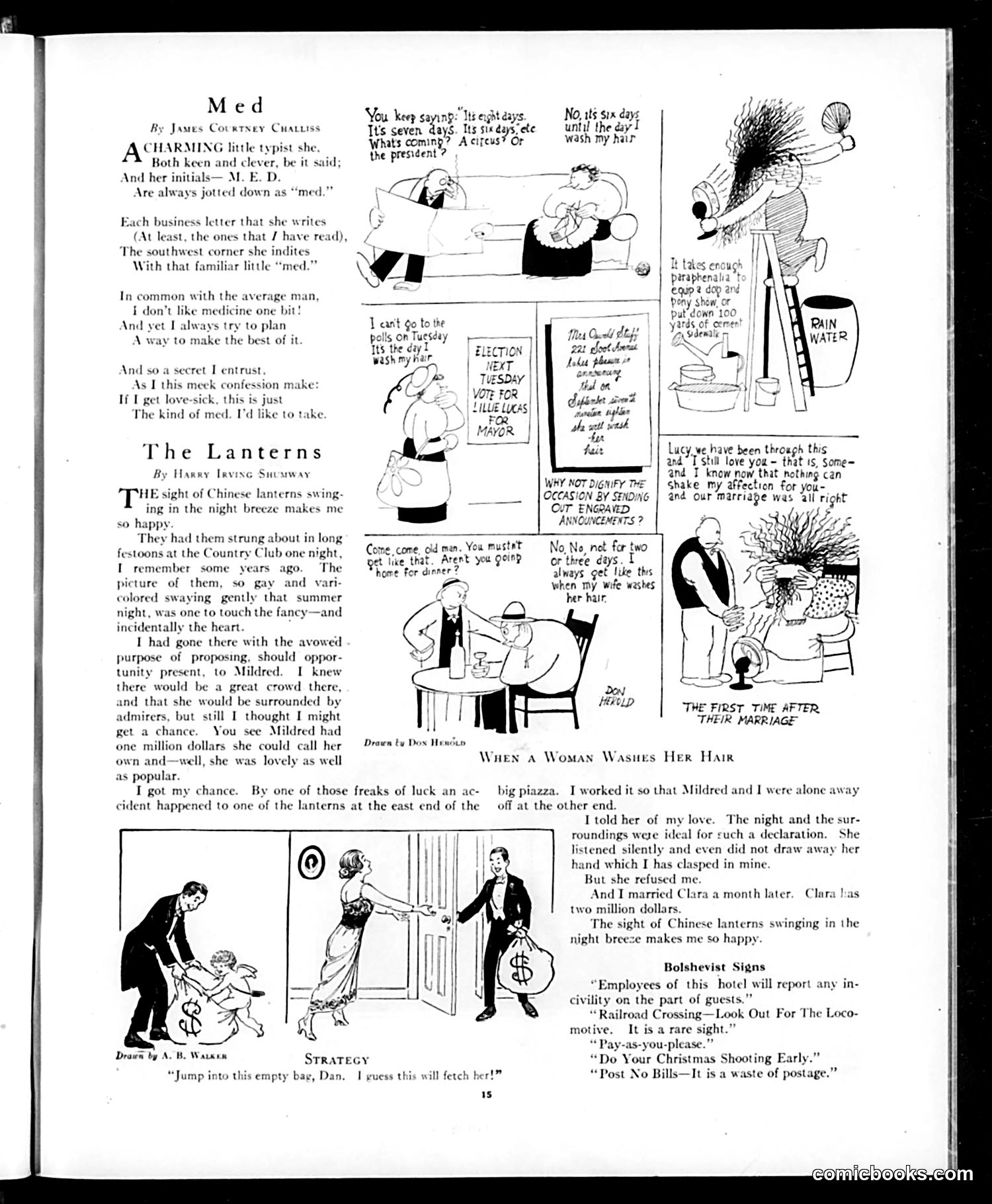
This page contains multiple humorous pieces satirizing early 20th-century American life: **"Med"** (top left) jokes about a typist whose initials spell "med"—she signs business letters this way, and the author confesses he'd like romantic "medicine" from her. **"The Lanterns"** is a sentimental romance story where a man proposes to wealthy Mildred at a Country Club party but is rejected. He later marries Clara (worth two million dollars instead). **"When a Woman Washes Her Hair"** satirizes domestic life: a husband cannot attend social events or manage basic tasks on days his wife washes her hair—presented as an inexplicable but absolute rule of marriage. **"Strategy"** (bottom) shows a man trying to seduce a woman by offering money. **"Bolshevist Signs"** lists absurd hotel and public notices mocking post-WWI American paranoia about radical communism and social disorder—treating mundane rules as evidence of revolutionary chaos. The humor targets gender relations, class anxiety, and contemporary political fears in a lighthearted satirical style typical of Judge magazine.
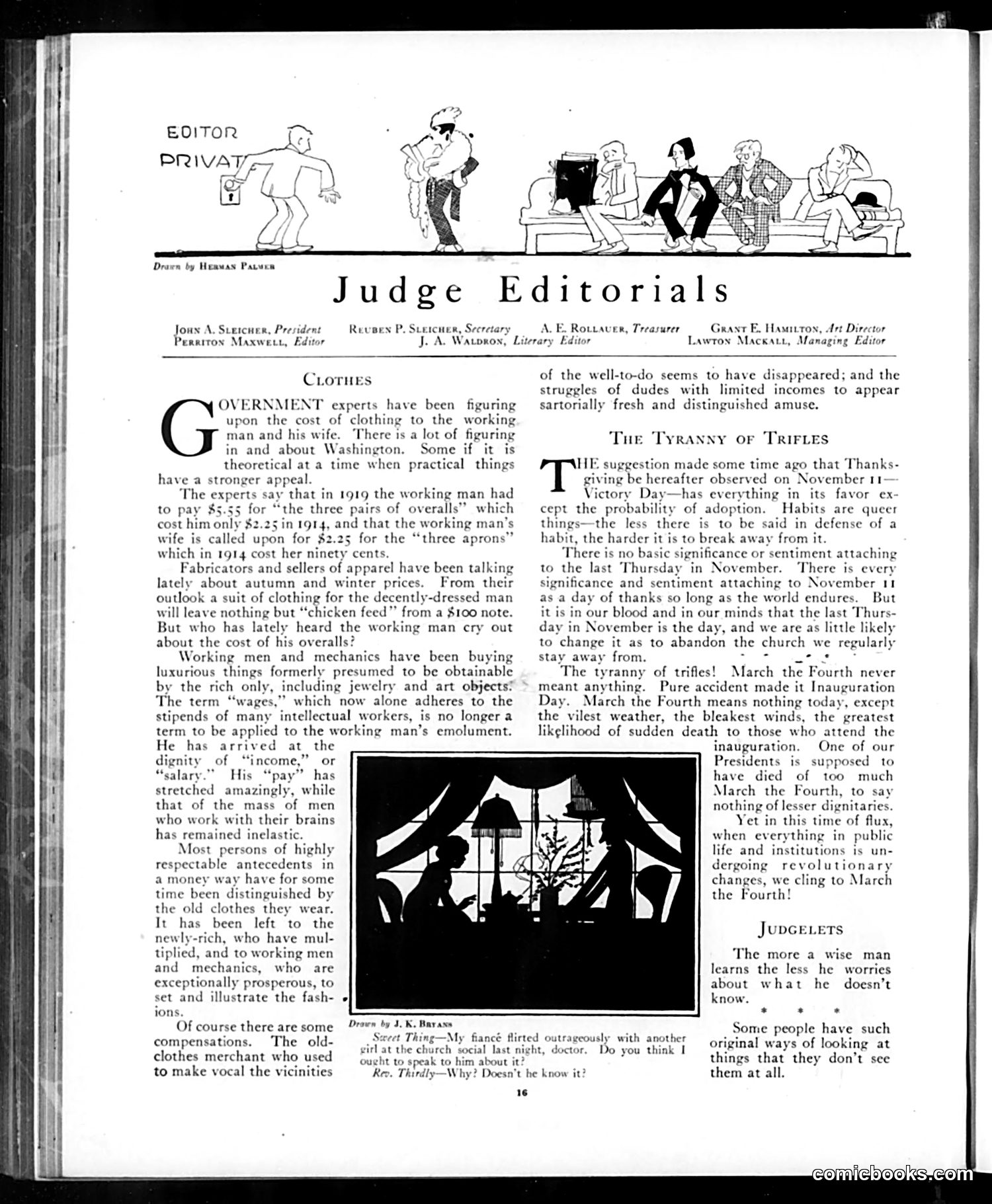
This page from Judge magazine contains three separate editorial pieces critiquing American society circa 1919-1920. **"Clothes"** satirizes the disconnect between working-class wage increases and middle-class decline. The editorial notes that working men's pay has stretched dramatically (overalls and aprons cost 4-5x more than 1914), yet they now buy luxuries formerly reserved for the wealthy. Meanwhile, the old-money "well-to-do" wear shabby clothes while newly-rich workers set fashion trends. The satire targets both government economic analysis and social mobility anxieties. **"The Tyranny of Trifles"** attacks Americans' irrational attachment to traditions. It argues Thanksgiving should move to November 11 (Victory Day/Armistice Day) for logical reasons, yet habits persist unchanged. Similarly, Inauguration Day (March 4th) has no significance except "vilest weather" and historical accident, yet people cling to it even as "public life undergoes revolutionary changes." **"Judgelets"** offers brief witticisms about human nature and perception. The cartoons (by J.K. Barvan and Herman Palmer) provide visual accompaniment to these social critiques.
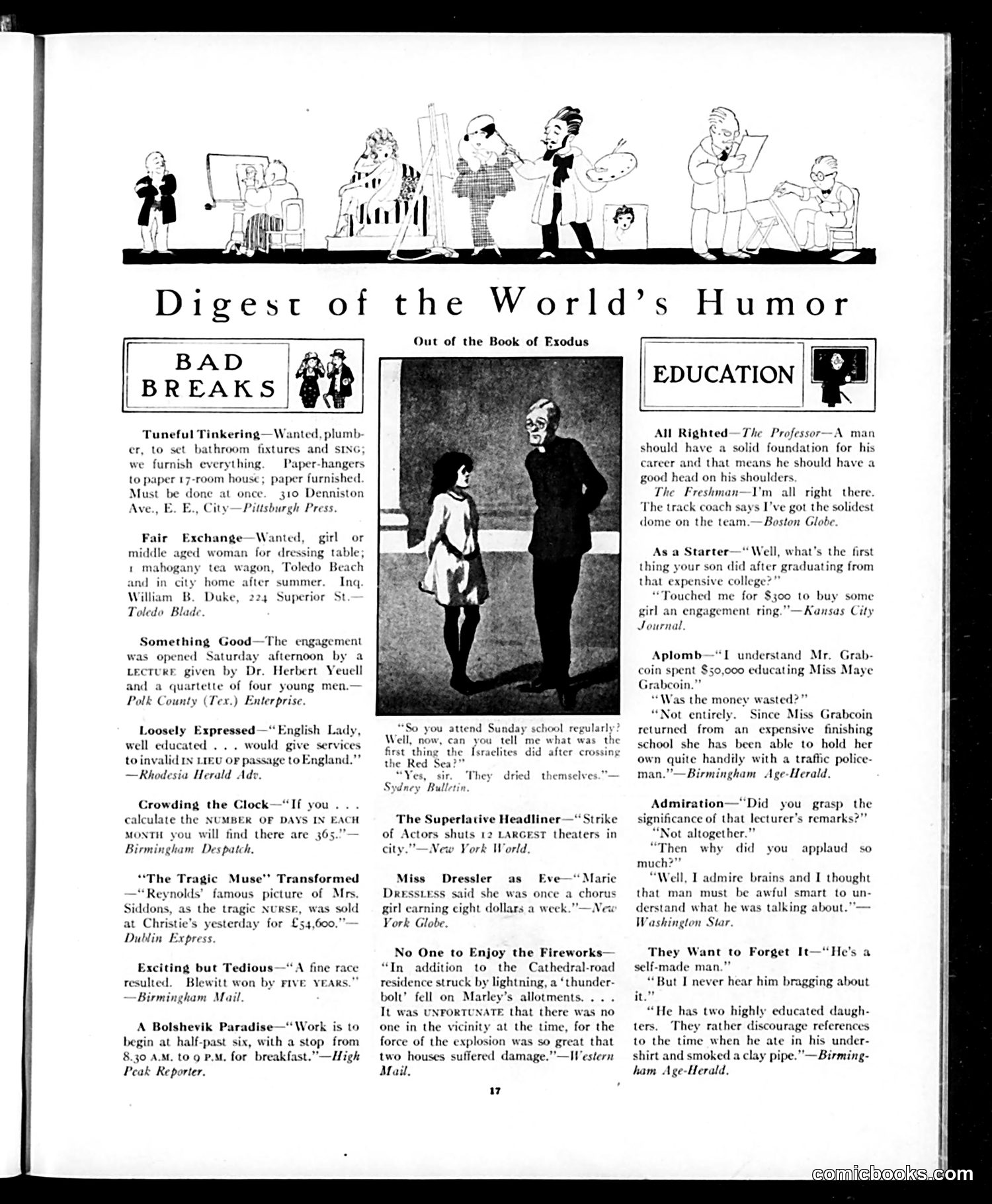
This is a humor digest page compiling funny classified ads and jokes from newspapers worldwide. The content satirizes through absurdity and double meanings rather than political cartooning. Key examples: A classified ad for a plumber ironically appears alongside one seeking a "girl or middle aged woman for dressing table"—the ambiguous phrasing suggests either domestic help or furniture. A lecture described as "opened" like a package. A math error claiming 365 days exist in each month. A reference to "Bolshevik Paradise" mocking Soviet working conditions (8:30 AM to 10 PM with breaks). The education section jokes about wealthy parents wasting tuition money on daughters who gain no practical skills, and about nouveau riche men embarrassed by uneducated origins. One joke plays on a Sunday school student misunderstanding the Exodus narrative. The humor relies on newspaper errors, class anxieties, and linguistic confusion typical of early 20th-century American satire.
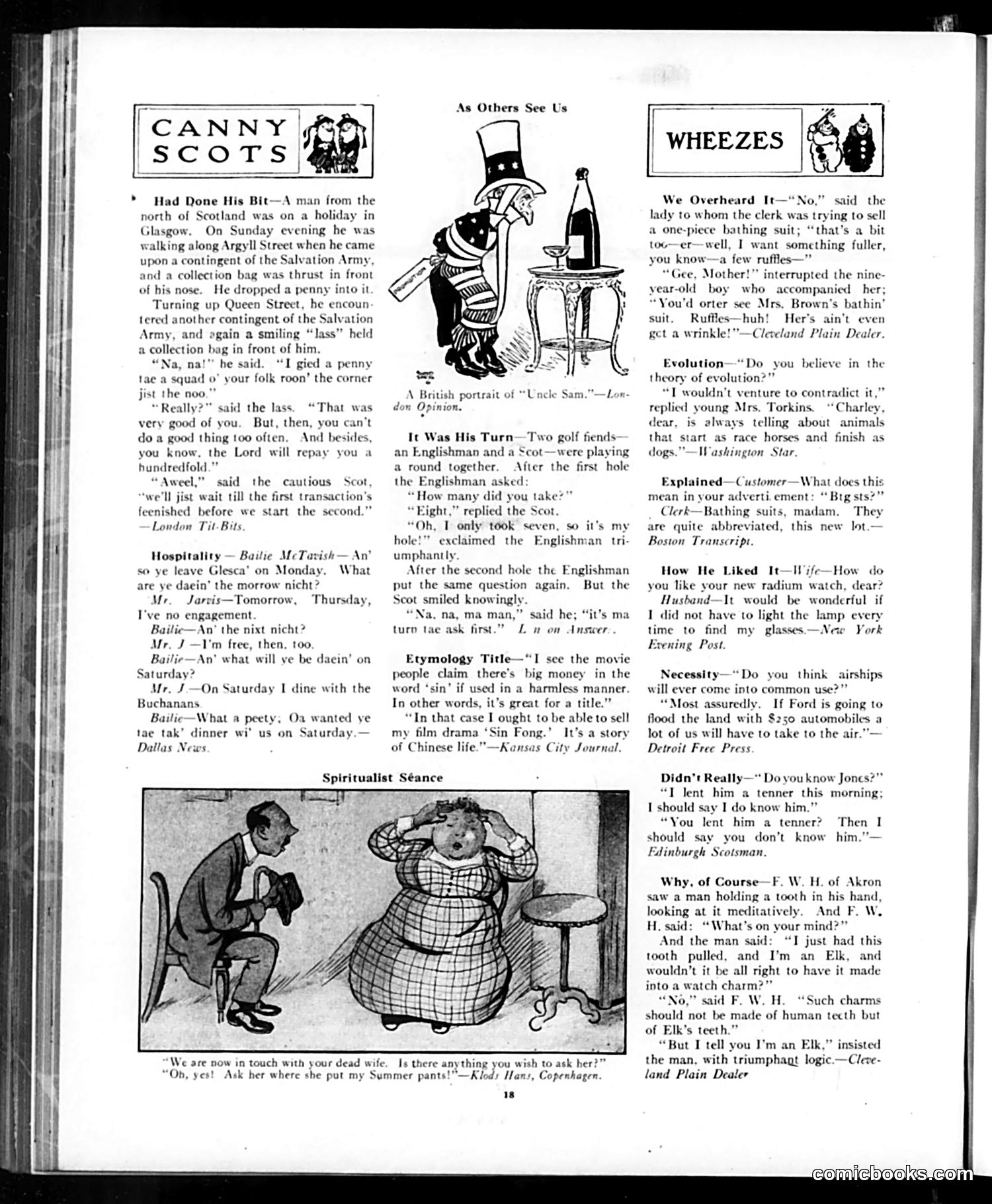
This page from Judge magazine contains multiple short humor pieces and one cartoon, reflecting early 20th-century American and British satirical sensibilities. **The Cartoon ("Spiritualist Séance"):** A séance scene mocks spiritualism fraud. A medium claims contact with a dead wife while the widower asks where she hid his summer pants—deflating the supernatural pretense with mundane domestic comedy. **The Humor Pieces** use ethnic/regional stereotypes common to the era: - "Canny Scots" section ridicules Scottish frugality and parsimony - "Wheezes" contains brief jokes about bathing suits, evolution, and Ford automobiles - Multiple pieces feature Scottish dialect and penny-pinching jokes **Social References:** The radium watch joke references early 1900s fascination with radioactive products marketed as health products. Ford automobile references suggest mass-production anxiety. The spiritualism cartoon satirizes the period's popular séance culture. These pieces rely on now-dated ethnic caricature and period-specific consumer anxieties, typical of Judge's approach to satirizing contemporary society and human follies.
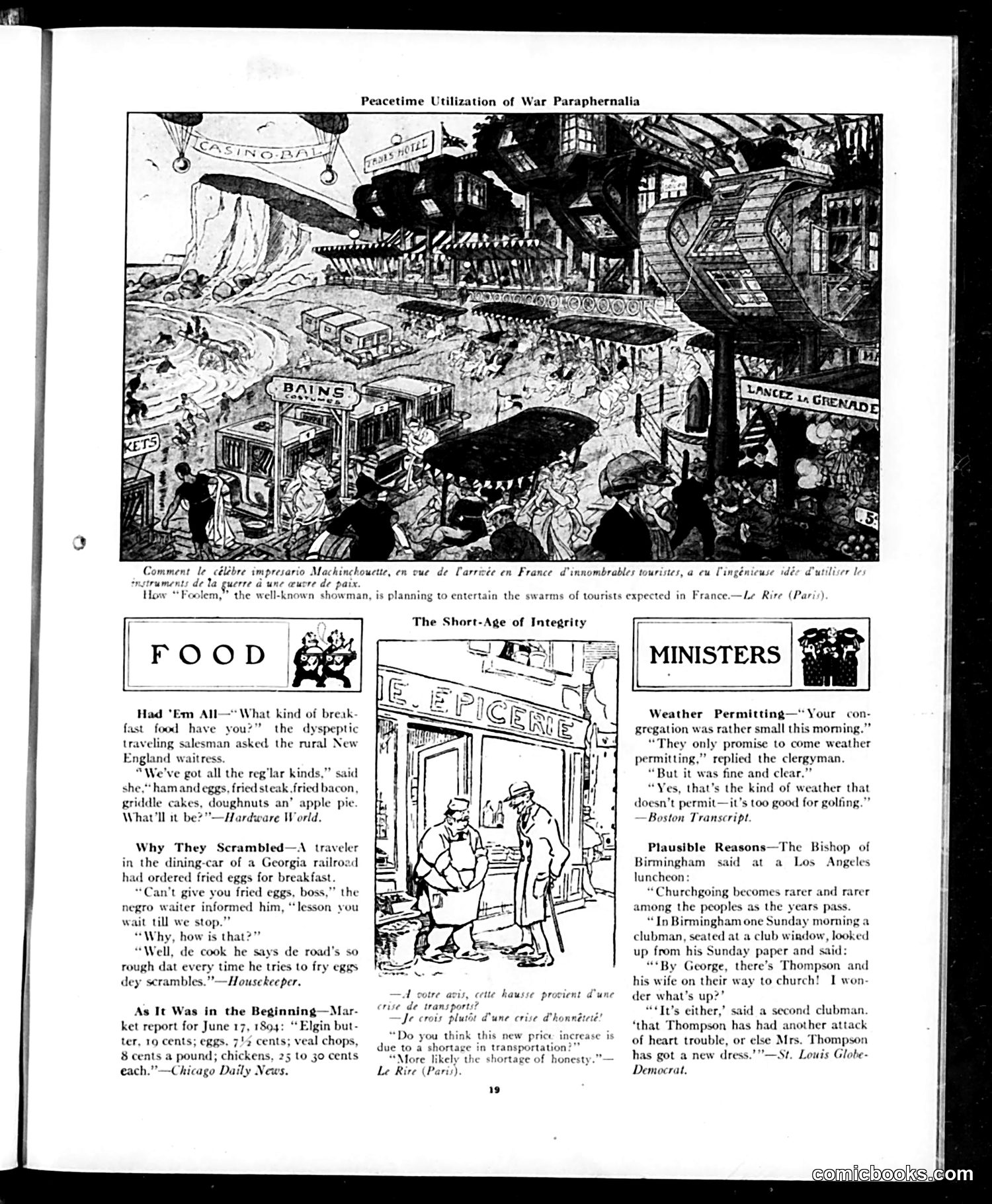
The top illustration satirizes postwar economic conversion—showing a bustling seaside resort transforming military equipment into tourist attractions. The French caption indicates a famous impresario plans to entertain swarms of expected tourists in France, repurposing wartime infrastructure for peacetime entertainment. Below are humorous anecdotes about food and services. "The Short-Age of Integrity" (center) is the key political satire: a French dialogue questions whether rising prices stem from transportation shortages or *dishonesty*—implying profiteering and fraud by merchants exploiting postwar conditions. The "MINISTERS" section contains social commentary about churchgoing decline. One anecdote mocks affluent clubmen whose skepticism about church attendance reveals cynicism: they assume Thompson's attendance signals either health crisis or his wife acquiring a new dress—suggesting religion has become optional for the wealthy, tied only to necessity or materialism rather than genuine faith.
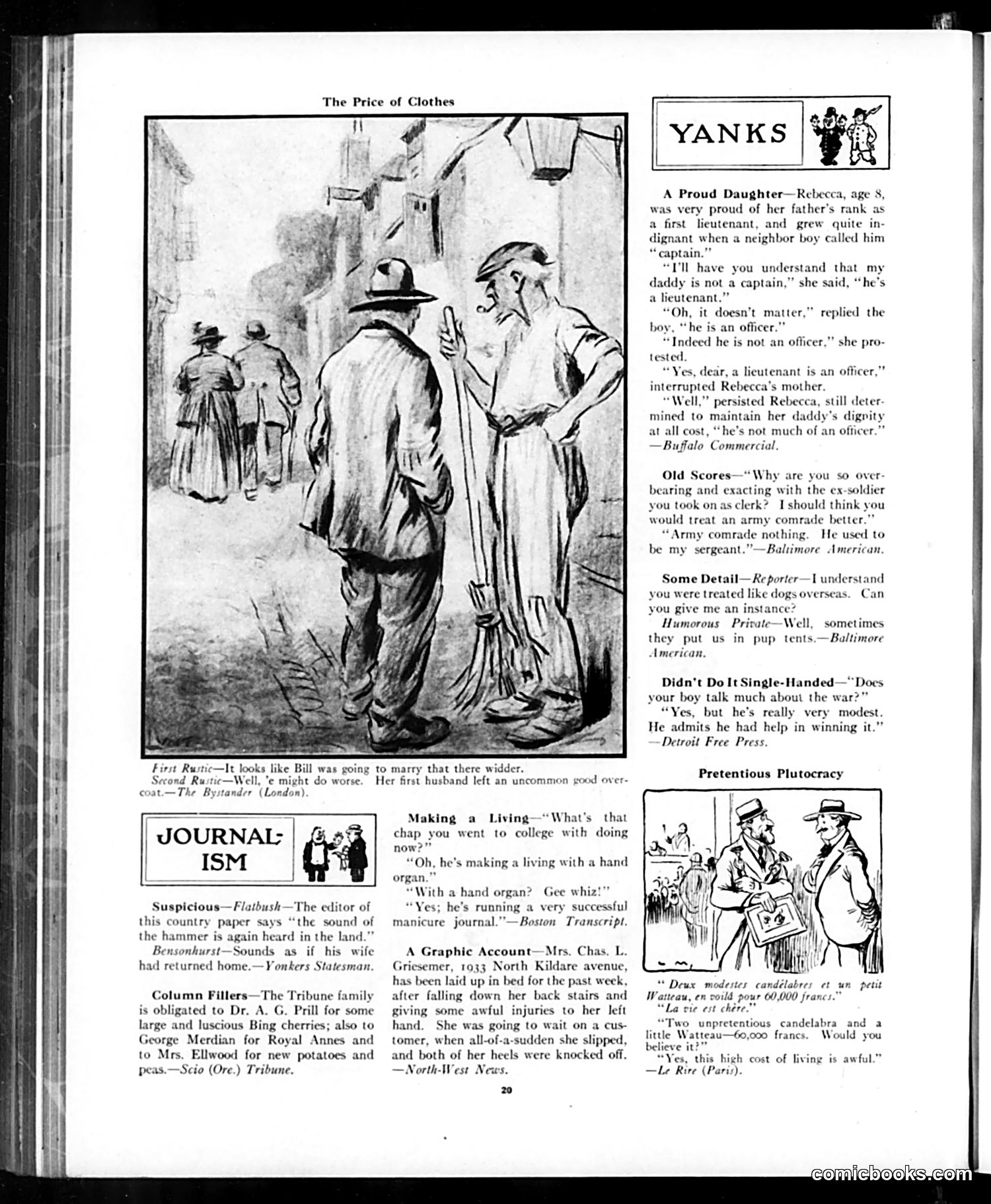
This page collects brief humorous anecdotes and one cartoon, all satirizing social pretension and post-WWI attitudes. **The main cartoon** shows a soldier in uniform conversing with a woman, likely illustrating a rural romance ("Bill was going to marry that there widder"). The humor plays on class differences—the woman's late husband left "an uncommon good overcoat," suggesting modest means. **The text pieces mock:** - **Military rank confusion**: A child insists her father is "not much of an officer" despite being a lieutenant—satirizing civilian misunderstanding of military hierarchy - **Class resentment**: An employer mistreats a former sergeant, reversing wartime hierarchy - **Soldier modesty**: A boy admits needing "help" winning the war—poking fun at false humility about WWI service - **French extravagance**: The final piece (from *Le Rire*, a French publication) ridicules expensive decorative items during economic hardship—satirizing pretentious wealth amid the post-war "high cost of living" Overall, the page reflects post-WWI American and European anxieties about class, military service, and economic disparity.
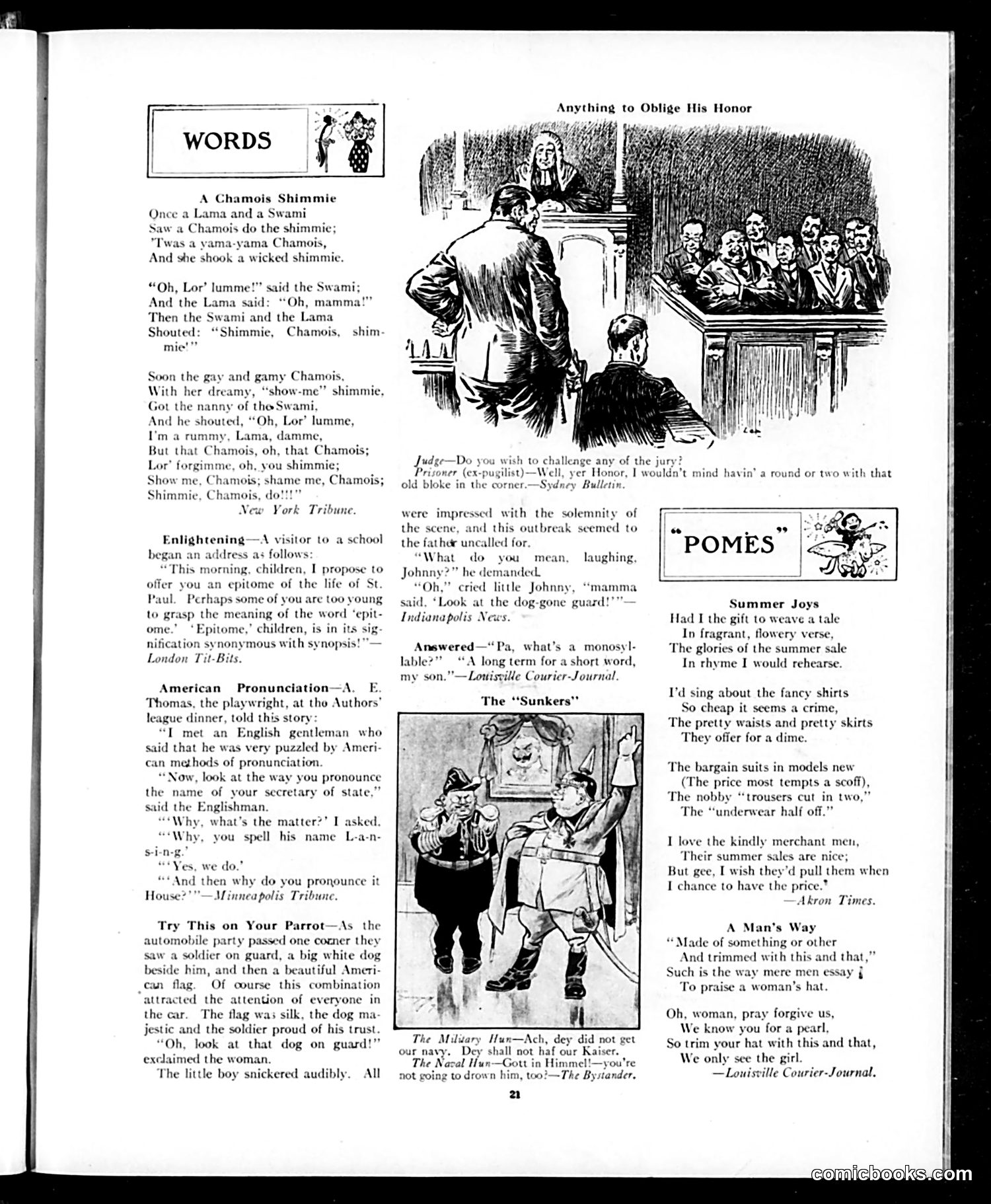
This page contains humor pieces typical of early 20th-century American satire. The main cartoon, "Anything to Oblige His Honor," depicts a courtroom scene where a prisoner (identified as "ex-pugilist," suggesting a boxer) offers to fight a judge. The joke plays on the prisoner's casual disrespect for legal authority and willingness to brawl. "The Sunkers" cartoon shows two German military figures debating naval matters, likely referencing WWI-era tensions between Germany and Allied naval forces. The verbal humor pieces mock pronunciation differences between British and American English (playing on "Lansing" vs. "House"), and include puns about religious terminology and double meanings. The poems satirize consumer culture, particularly summer sales and fashion marketing directed at women. The final poem gently mocks men's inability to meaningfully discuss women's hats beyond surface appreciation. Overall, the page reflects typical Judge content: light political references, wordplay, and social observation rather than pointed partisan commentary.
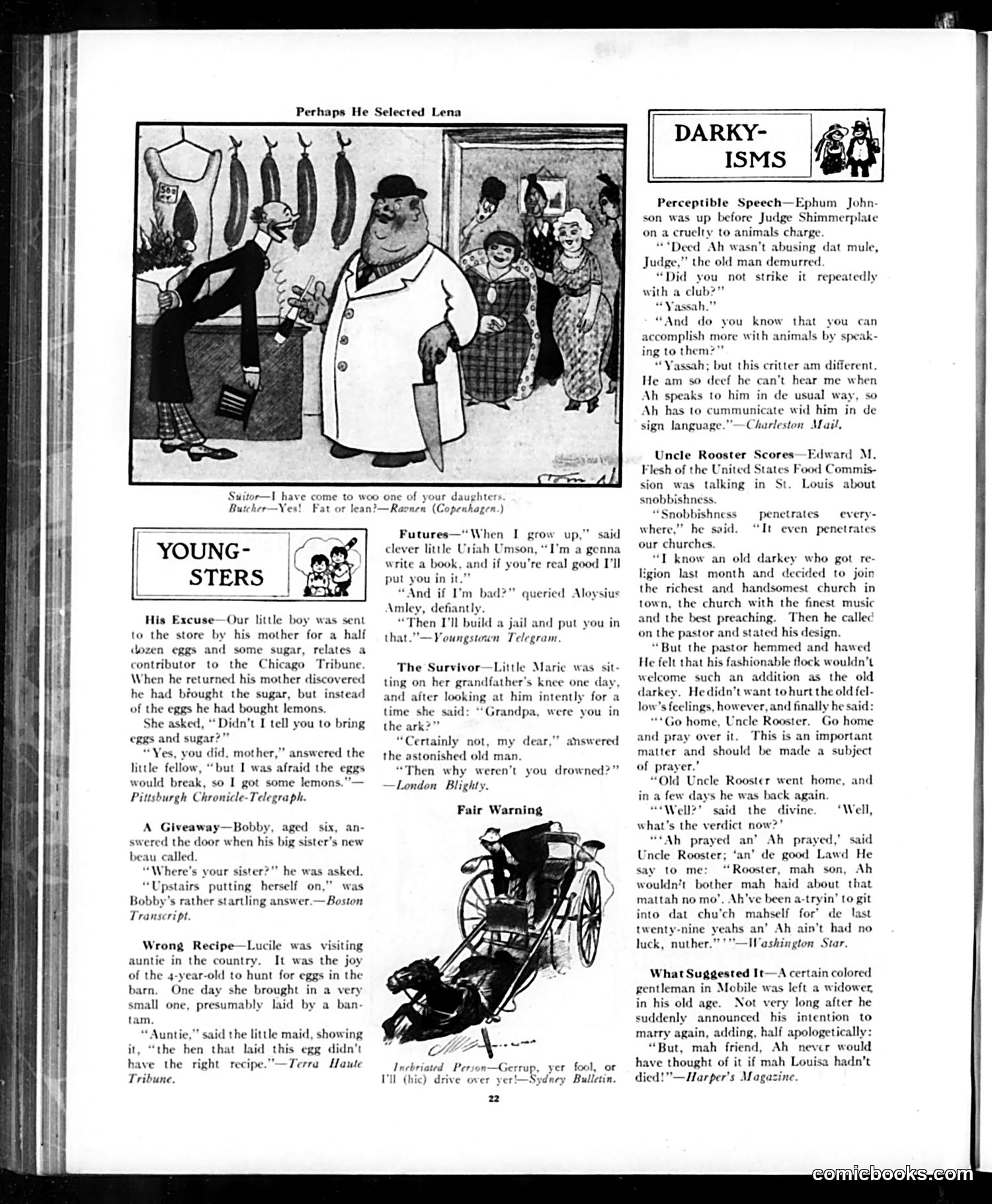
This page from Judge magazine contains several short humorous anecdotes targeting working-class figures and racial stereotypes typical of early 20th-century American satire. The main cartoon, "Perhaps He Selected Lena," depicts a butcher (drawn with exaggerated features) greeting a suitor. The joke plays on the butcher's daughter's name, suggesting a ethnic caricature. The text sections include multiple "darkly" comedic stories featuring African American dialect characters ("Ah," "dat," "chu'ch"). These appear designed to mock Black speech patterns and portray Black individuals as simple or foolish—standard for Judge's era. Notable examples include "Perceptible Speech" (a court case about animal cruelty) and "Uncle Rooster Scores" (a longer anecdote about church rejection). Other brief items mock children's misunderstandings and spousal relationships. **Modern context:** This represents casual, normalized racial mockery typical of American humor magazines before mid-20th century civil rights movements made such content widely recognized as offensive.
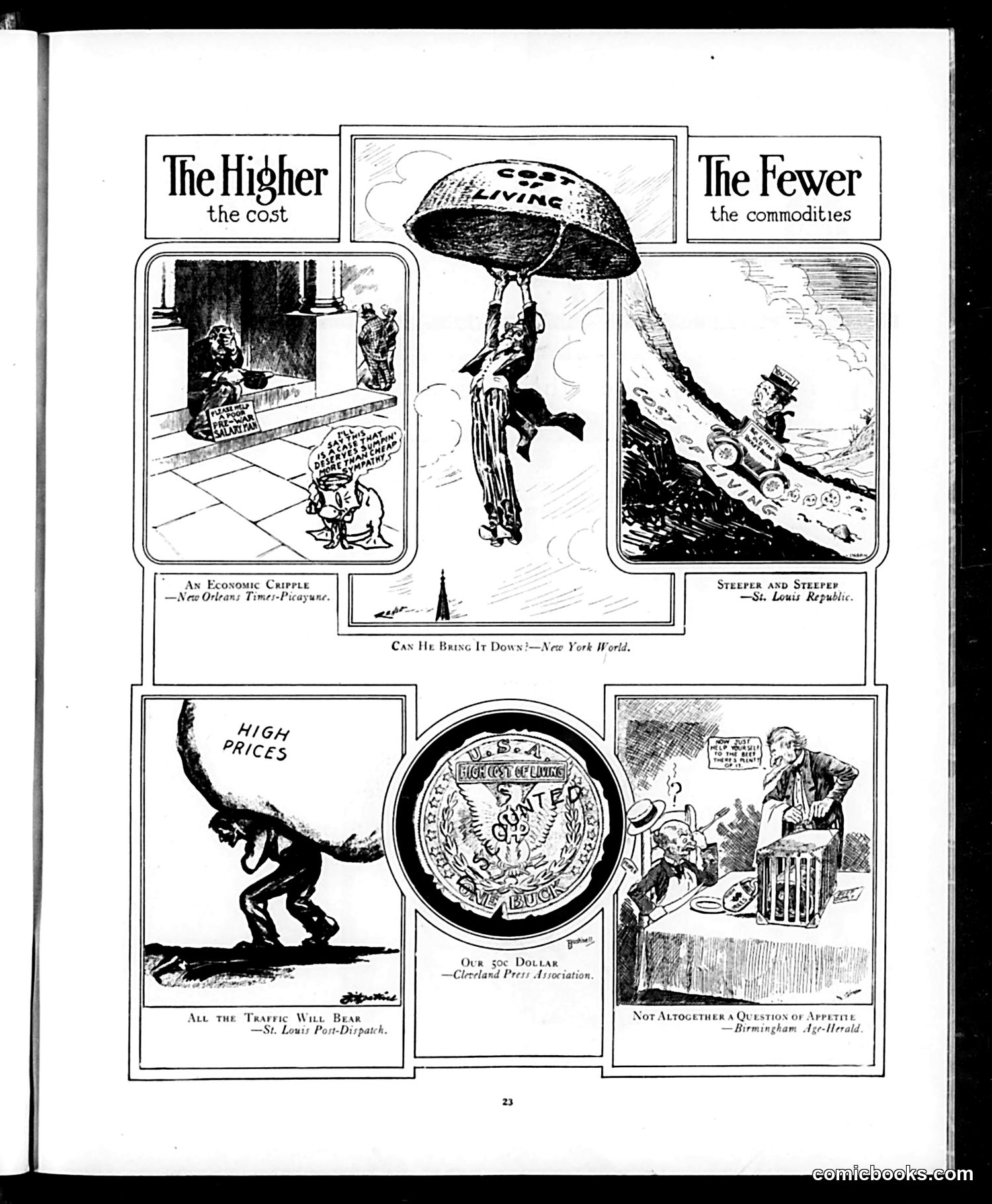
This page presents a political cartoon addressing early 20th-century economic hardship, likely around WWI or the 1920s. The central image shows a figure struggling to hold up a parachute labeled "MINING," satirizing economic collapse. **Left side** ("Higher the cost"): Shows inflation hitting ordinary people, referenced as "An Economic Cripple" from New Orleans papers. **Right side** ("Fewer the commodities"): Depicts scarcity and hoarding, titled "Steeper and Steeper" from St. Louis Republic. **Bottom panels** illustrate consequences: - A bear labeled "High Prices" (left) - likely symbolizing market forces crushing citizens - The U.S. dollar coin (center) - representing currency devaluation - A family unable to afford food (right) - showing appetite/starvation concerns The cartoon criticizes how economic policies simultaneously created inflation and scarcity, leaving ordinary Americans worse off. The sourced quotes from regional newspapers suggest this was a widespread, documented crisis.
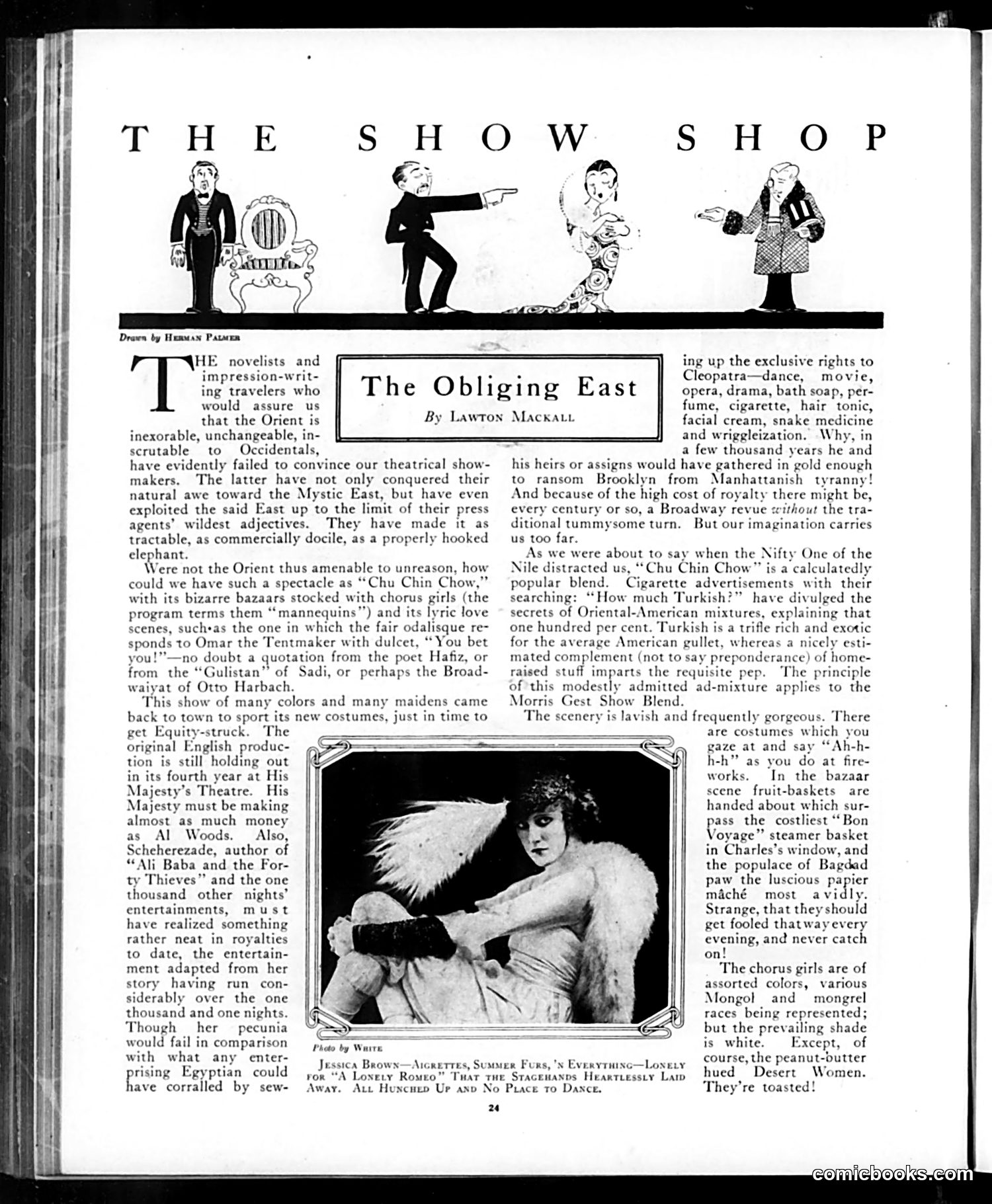
This is a theatrical review of "Chu Chin Chow," a Broadway musical. The satirist's central joke: Western producers have rendered the "inscrutable Orient" completely tractable and commercialized—turning Eastern mystique into a profitable, predictable commodity. The article mocks how Broadway has: - Stripped the East of authenticity, packaging it for mass consumption like any commercial product - Cast predominantly white chorus girls as "Oriental" performers - Mixed genuine Eastern elements with crude American additions (comparing it to cigarette blends mixing Turkish tobacco with cheaper domestic varieties) - Reduced ancient cultural traditions (referencing the Persian "One Thousand and One Nights") to spectacle The cartoon header shows theatrical stereotypes: a mustachioed villain, a chorus girl in "Oriental" costume, performers in period dress—visual shorthand for the exoticized East as entertainment. The satire critiques not morality but artistic laziness: Broadway has reduced profound cultural difference to decorative scenery and pretty women, making the mysterious East boringly domesticated and commercially manageable.
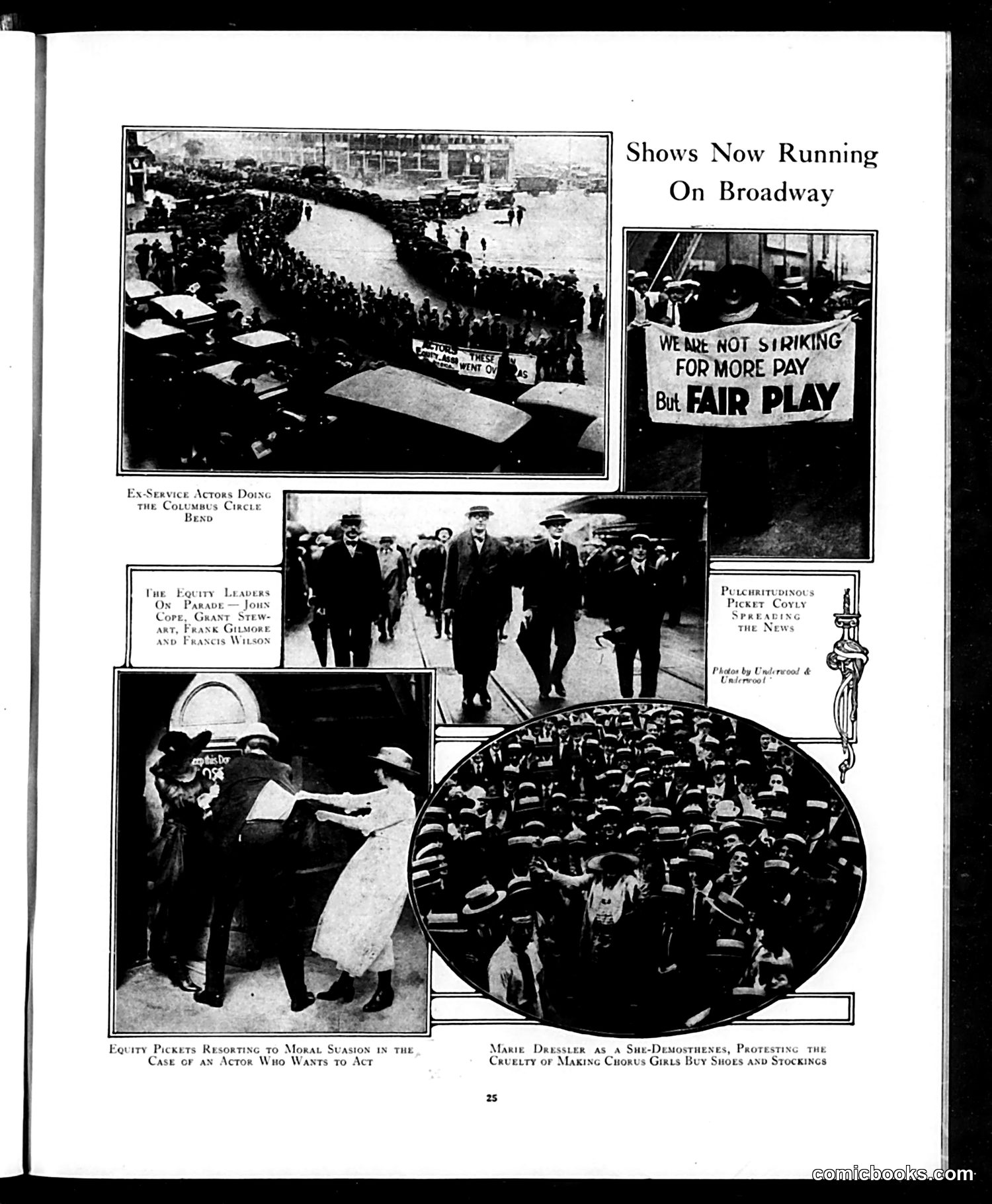
This page documents an Actors' Equity strike on Broadway, showing various protest activities. The headline "We are not striking for more pay / But FAIR PLAY" indicates the strikers' primary demand was equitable working conditions rather than wage increases. The photos show: - Large crowds of striking actors doing the "Columbus Circle Bend" (a protest march) - Union leaders (John Cope, Grant Stewart, Frank Gilmore, Francis Wilson) on parade - Picketers using "moral suasion" to convince actors to join the strike - Marie Dressler as a "she-Demosthenes" (female orator) protesting the cruel treatment of chorus girls forced to buy shoes and stockings The satire criticizes both management's labor practices and the theatrical industry's exploitation of performers, particularly women. The magazine presents the strike sympathetically, emphasizing "fair play" as a legitimate grievance beyond simple wage demands.
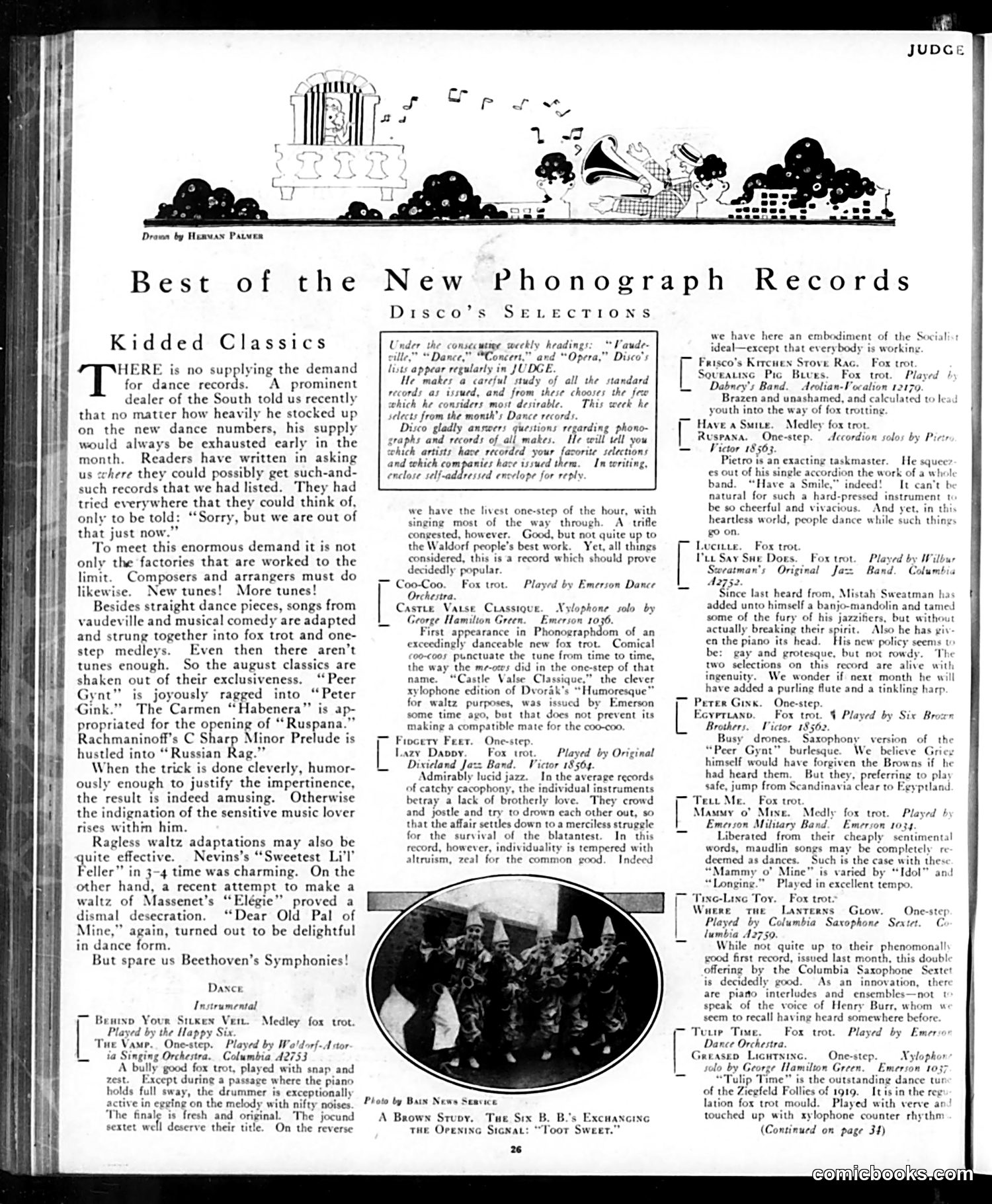
This page is primarily **music criticism and advertising** rather than political satire. It reviews dance records—fox trots, one-steps, and waltzes—reflecting the 1920s craze for jazz and dance music. The opening section discusses how phonograph dealers cannot keep dance records in stock due to overwhelming demand. Judge notes that composers are forced to adapt classical pieces (Rachmaninoff, Massenet, even Carmen) into ragtime and jazz arrangements to meet the appetite for new dance music. The critic "Disco" (Judge's music columnist) selects weekly records across three categories: Dance, Concert, and Opera. The reviews discuss specific recordings and orchestras, offering judgments on quality and musical merit. **The satire is implicit**: Judge gently mocks both the public's insatiable demand for novelty and the desperate commercial scramble to repurpose high art into lowbrow entertainment. The plea "But spare us Beethoven's Symphonies!" expresses anxiety about classical music being vulgarized through dance adaptations—a cultural concern of the era.
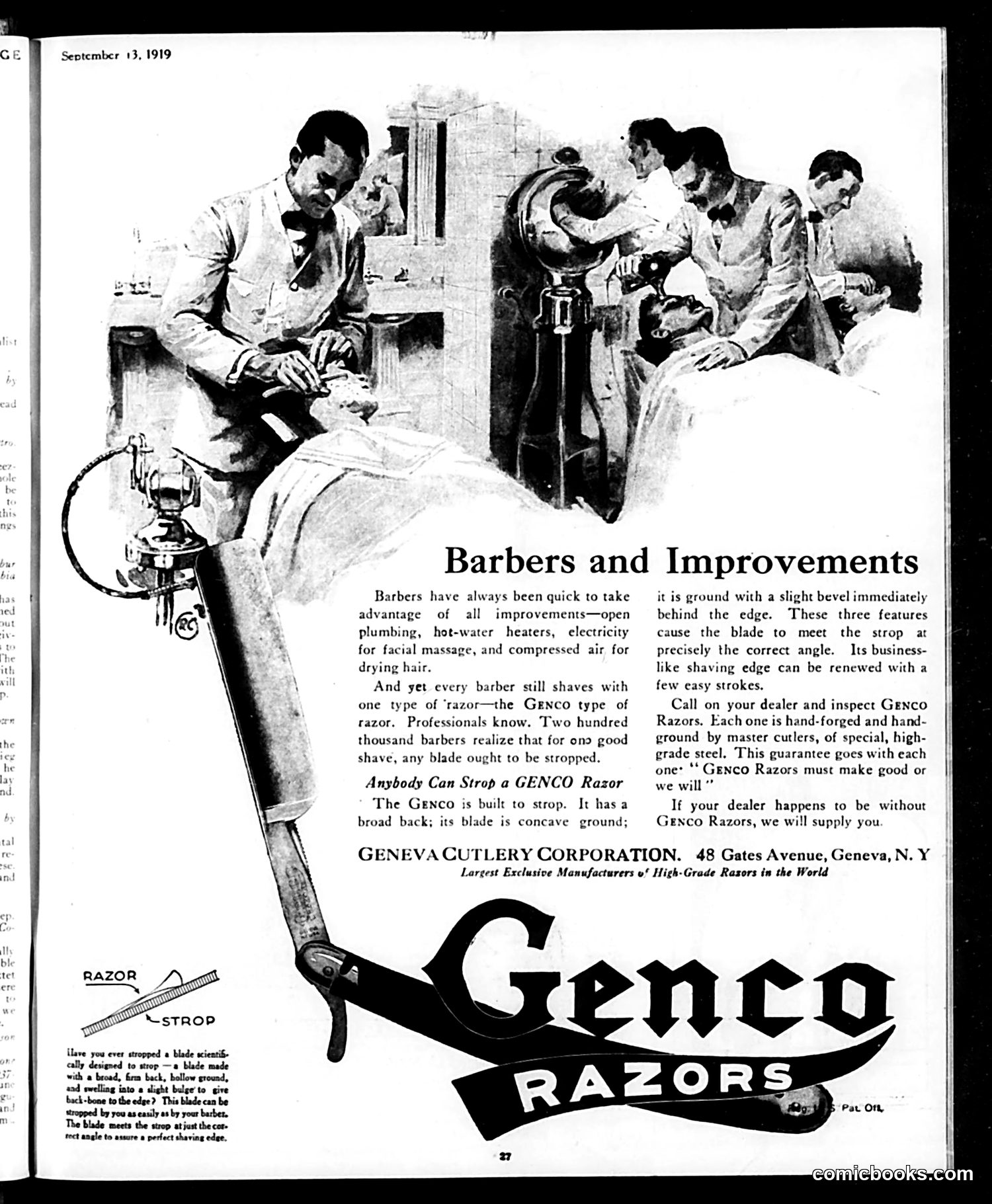
This is a full-page advertisement for Genco Razors from September 13, 1919—not a political cartoon. The upper illustration depicts barbers using various modern conveniences (electricity, hot water, compressed air) in their shops, contrasting with the text's point: despite adopting all these improvements, barbers still rely on the same traditional razor type. The ad's central claim is that Genco Razors are specifically engineered to be stropped (sharpened on a leather strop) easily by anyone—a key selling point. The design details (broad back, concave blade, beveled edge) are presented as scientifically superior for proper stropping angle. This reflects early-20th-century consumer culture: positioning a product as both tradition-honoring (barbers trust this type) and modern (scientifically designed). The recurring guarantee ("*Genco Razors must make good or we will*") emphasizes brand confidence and consumer assurance.
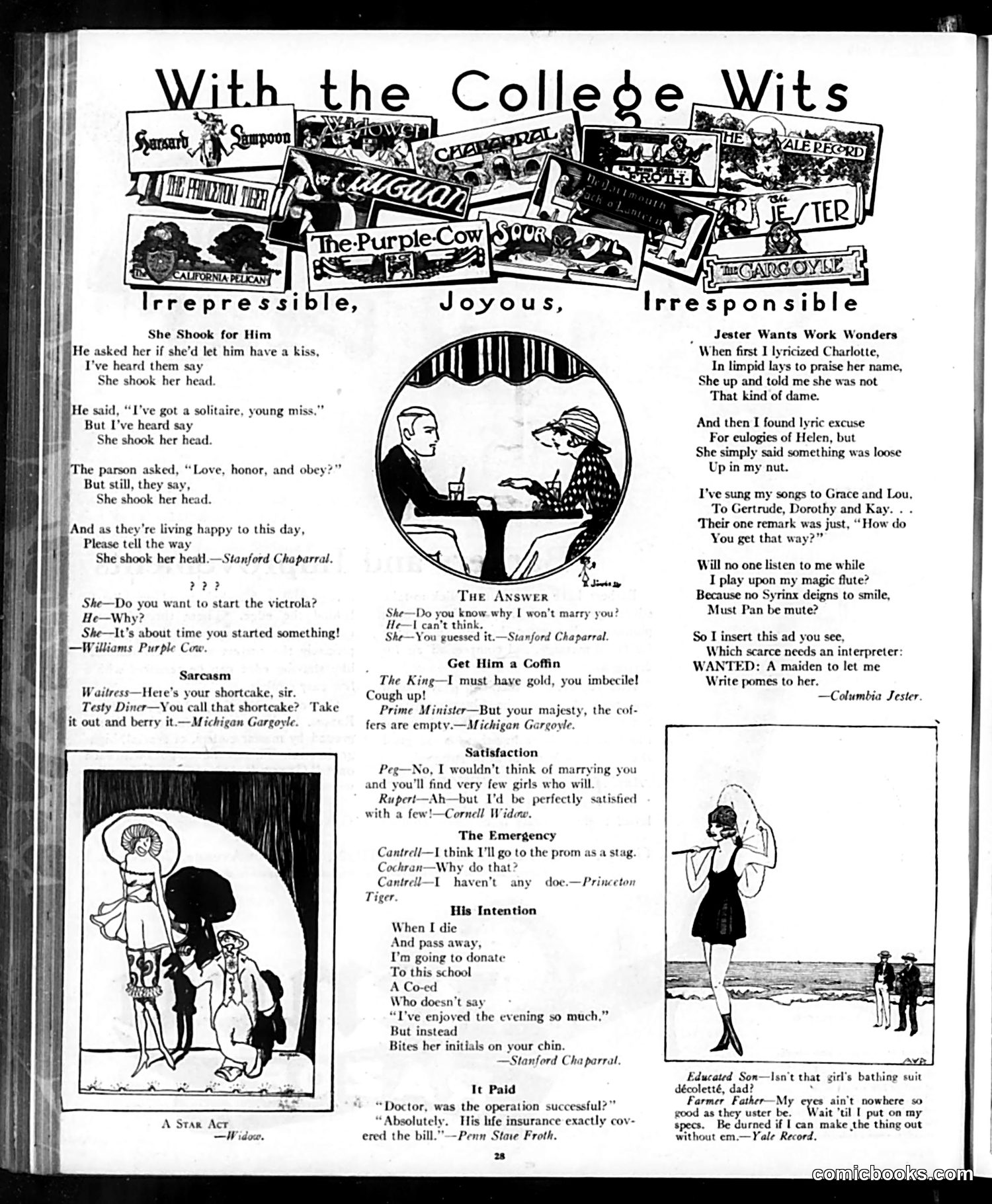
This page collects humorous verses and jokes from college humor magazines (Stanford Chaparral, Michigan Gargoyle, Princeton Tiger, Yale Record, etc.). The content reflects 1920s collegiate humor targeting college-age readers. The jokes center on relatable youth themes: romantic rejection ("She Shook for Him"), marriage hesitation, prom attendance, and generational misunderstandings (the "Educated Son" cartoon showing a father unable to see his daughter's scanty bathing suit without glasses). The satire is gentle and self-deprecating—college poets lament their inability to impress women; students make wisecracks about courtship and commitment. The "Irresponsible Jester" section mocks rejected suitors and their failed romantic poetry. There's also light social commentary: one joke about a king's empty treasury during apparent wartime, and dated gender humor about women's behavior and dress. The overall tone is lighthearted collegiate ribaldry—nothing politically charged, mainly poking fun at dating, marriage, and youthful pretension.
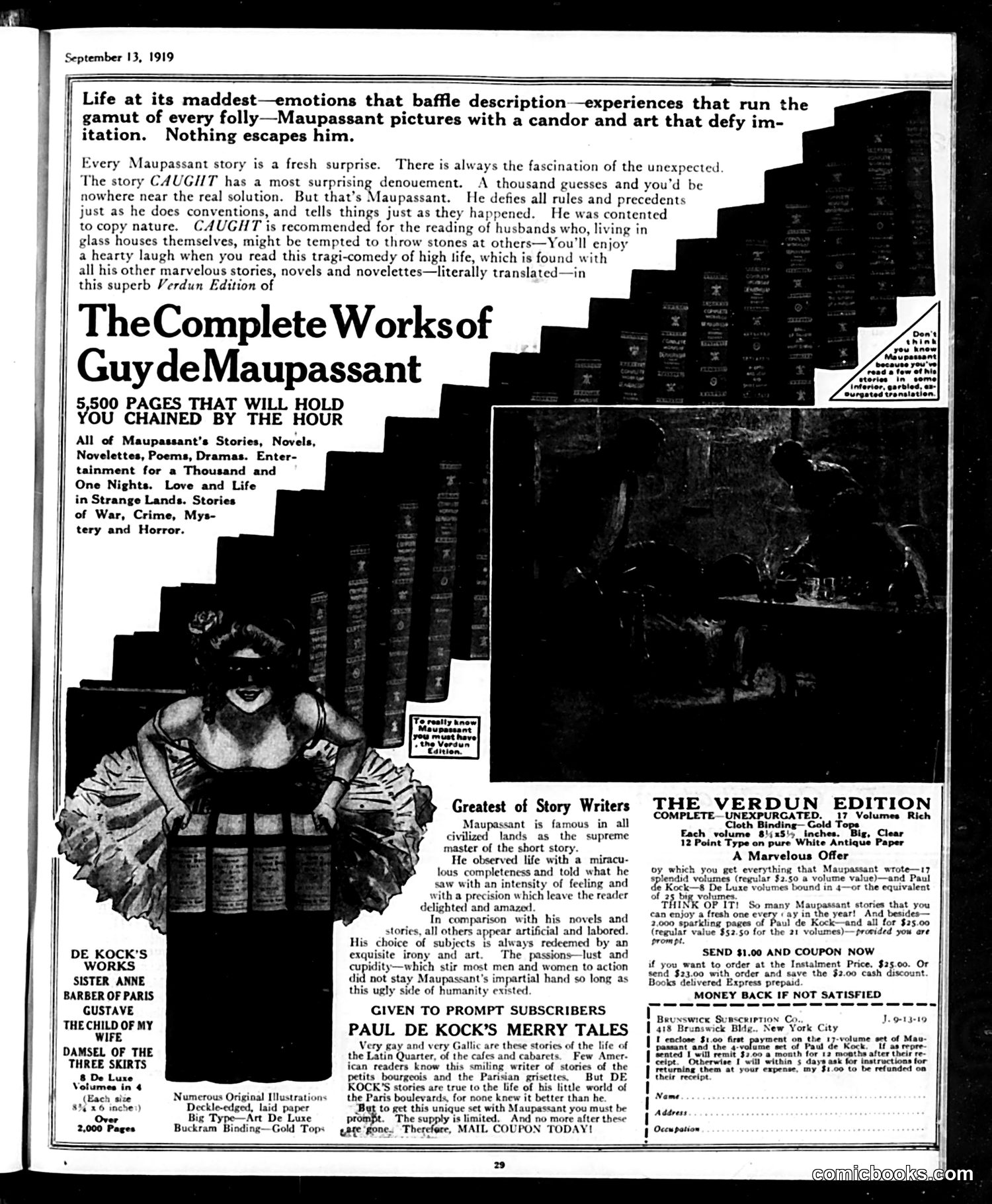
This is **primarily a book advertisement**, not a political cartoon. The page promotes "The Complete Works of Guy de Maupassant" in the "Verdun Edition"—a 17-volume, 5,500-page collection offered through subscription. The advertisement uses Maupassant's reputation as a satirist of human folly to appeal to readers seeking sophisticated entertainment. The text particularly recommends his story "Caught" for husbands "living in glass houses" who might be tempted to judge others—a playful reference to the proverb about not throwing stones when you're vulnerable yourself. The inclusion of Paul de Kock's works as a bonus gift reflects early 20th-century marketing strategy: bundling complementary "risqué" French literature appealed to American readers seeking urbane, slightly scandalous content. The "Verdun Edition" name references the costly WWI battle, suggesting premium quality through association with sacrifice. The illustration shows stacked books, emphasizing sheer volume as value. This is subscription-era advertising, not satire.
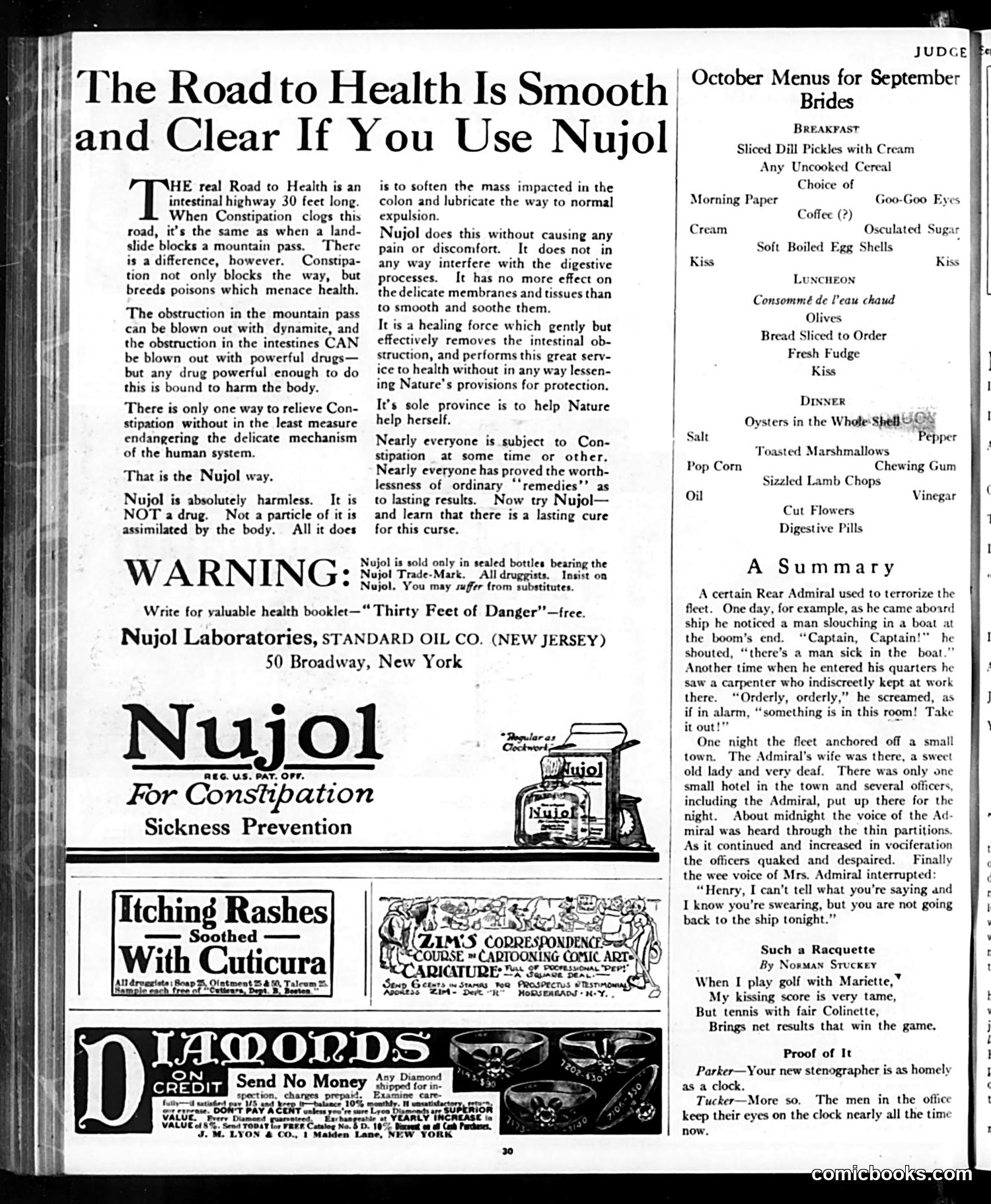
This page contains **primarily advertisements** rather than editorial cartoons. The dominant content is a large Nujol advertisement promoting a mineral oil laxative by using medical metaphor—comparing constipation to a mountain pass blockage requiring gentle clearing rather than "powerful drugs." The satirical content appears in the right column: **"October Menus for September Brides"** mocks newlywed wives by listing absurd "meals" (pickles with cream, cereal, "goo-goo eyes," "osculated sugar," digestive pills). This reflects period anxieties about young wives' domestic incompetence. Below that, **"A Summary"** satirizes a tyrannical Naval Admiral who overreacts to minor situations, finally interrupted by his deaf elderly wife's matter-of-fact response—humor derived from her imperviousness to his theatrical outbursts. Additional small ads appear (Cuticura, Zim's, Diamonds), typical of Judge's revenue model. The page reflects early 20th-century concerns: digestive health, marriage role expectations, and military hierarchy.
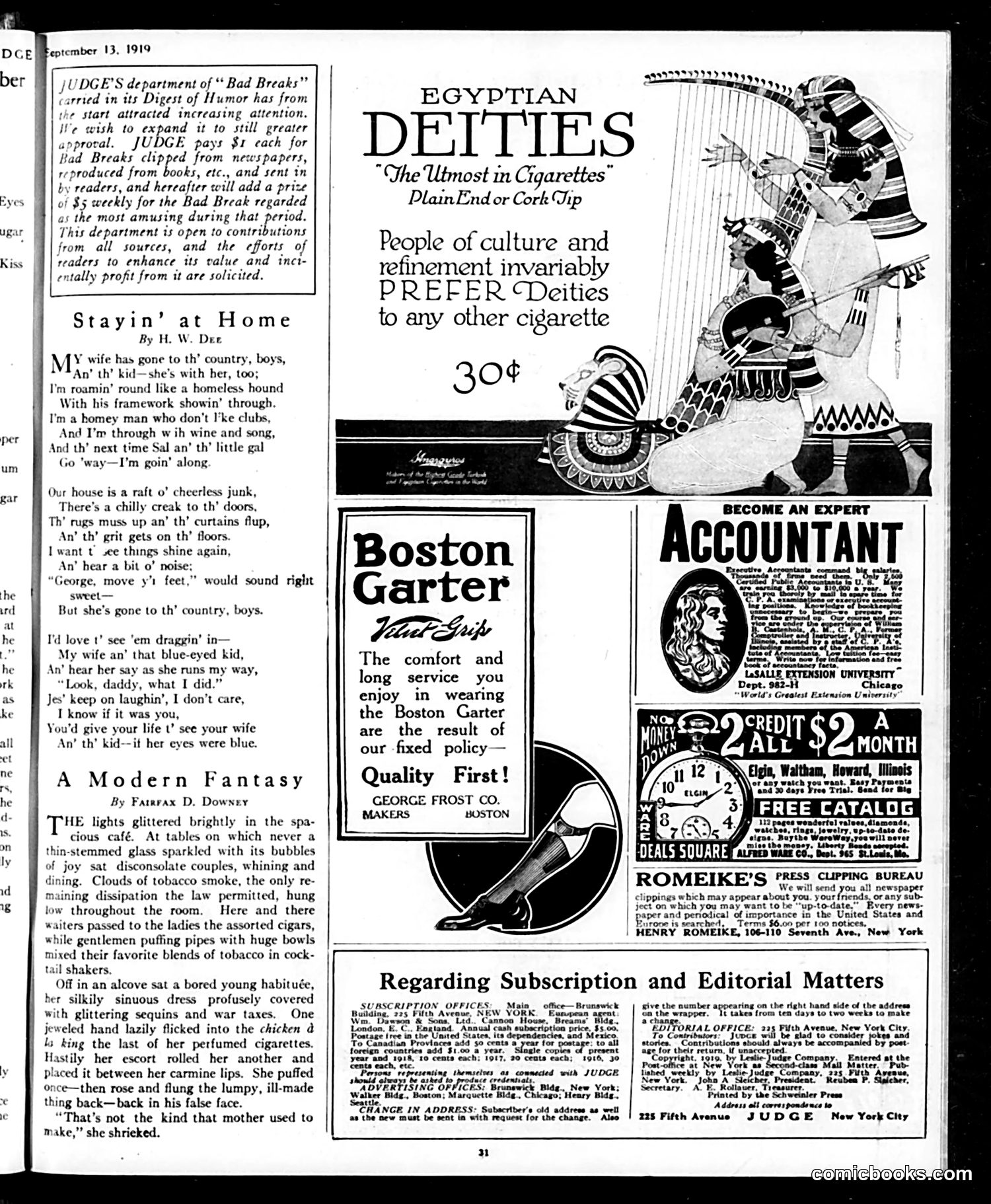
This page from *Judge* (September 13, 1919) is primarily **advertising and miscellaneous content** rather than political satire. The main elements: **"A Modern Fantasy"** is a satirical short story imagining a post-Prohibition future (Prohibition began January 1920). It depicts a nightclub where alcohol is banned, so patrons smoke cigars and mix tobacco in "cocktail shakers" as substitute entertainment. A woman rejects her escort's poorly-rolled cigarette, saying it's not like "mother used to make"—a joke about women's domestic skills and the absurdity of tobacco replacing alcohol. **The advertisements** (Egyptian Deities cigarettes, Boston Garter stockings, accounting school, clipping bureau) are typical magazine filler. **The poetry** "Stayin' at Home" is sentimental doggerel about a husband missing his absent family—unrelated to satire. The page reflects 1919's impending Prohibition era, when alcohol consumption would soon be illegal, making the cigarette-as-substitute joke timely.
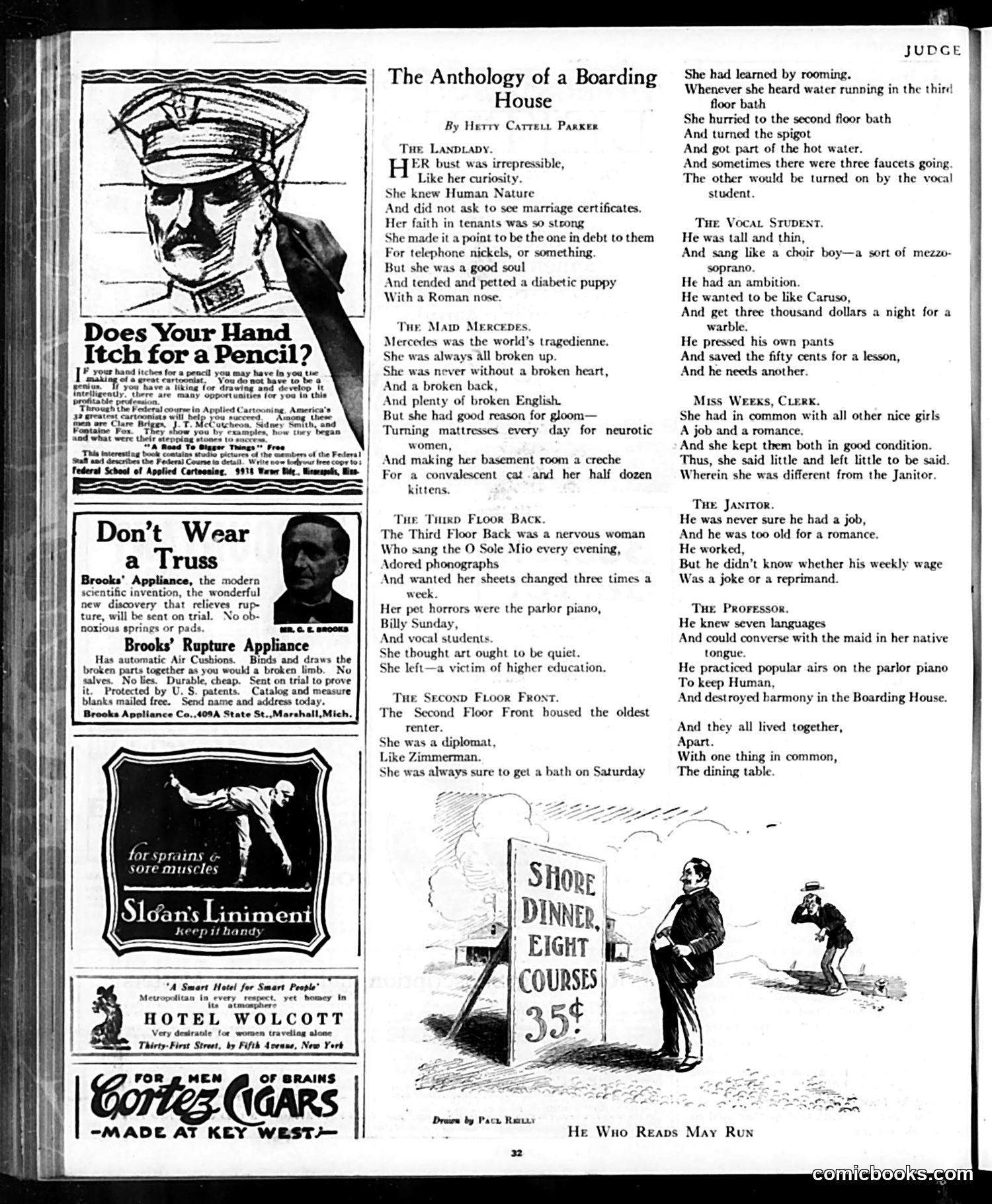
This is a satirical sketch by Henry Cottrell Parker describing inhabitants of a typical American boarding house—a common middle-class housing arrangement of the era. Each character is a social type: the oblivious but kindhearted landlady; Mercedes, a maid prone to melodrama; neurotic renters; an aspiring opera singer struggling financially; and a polyglot professor seducing the housemaid. The humor targets boarding-house life's absurdities: petty theft of hot water, pretentious artistic ambitions, janitor job insecurity, and the professor's casual exploitation. The final image shows a "shore dinner" advertisement—an ironic contrast to the boarding house's modest realities. This reflects early 20th-century American urban housing dynamics and class anxieties, where boarding houses served transient workers and immigrants. The satire gently mocks residents' delusions and the intimate, sometimes uncomfortable communal living arrangements.
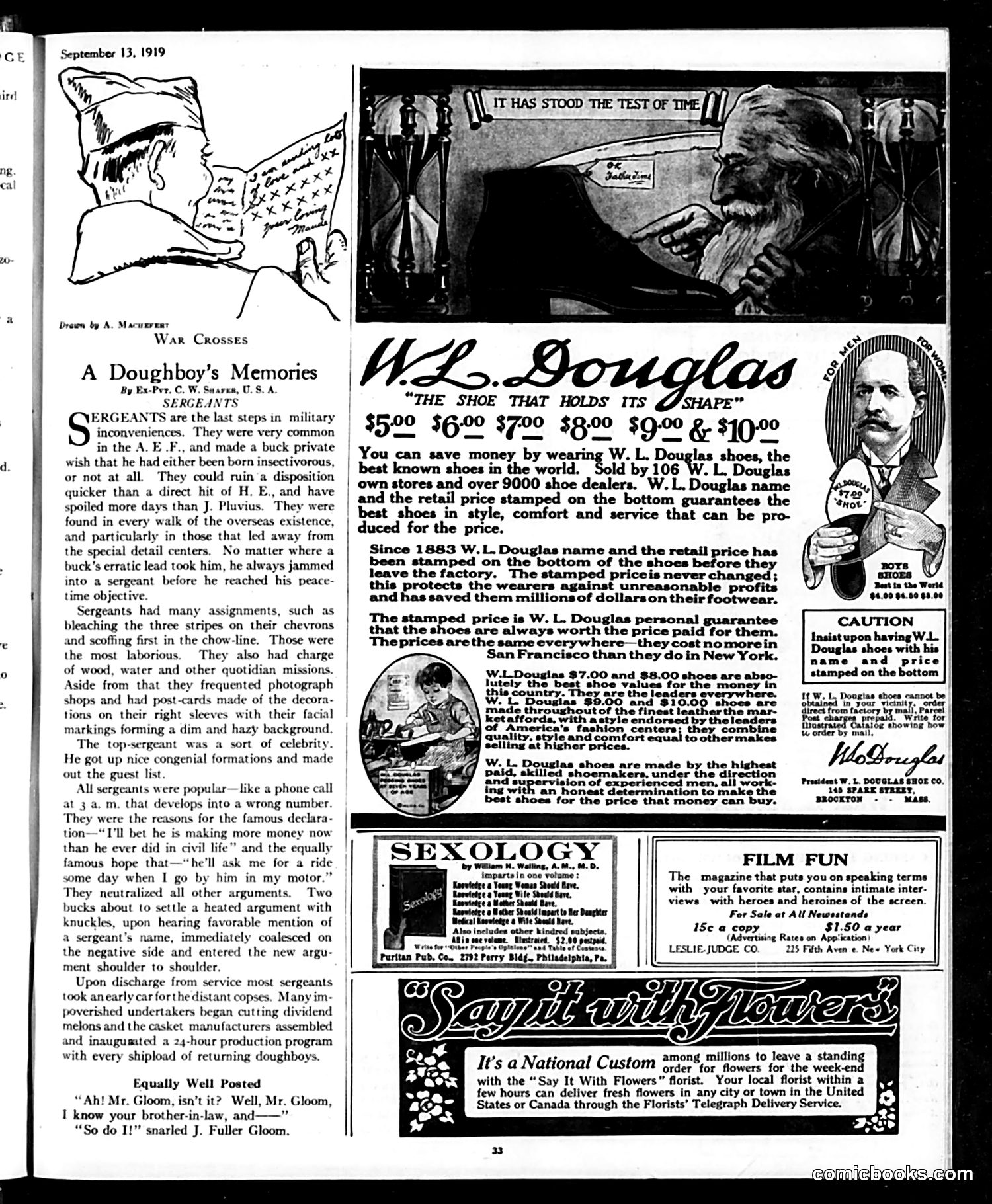
This page primarily features a satirical article about military sergeants by a WWI veteran (Ex-Pvt. C.W. Shafer). **The Main Cartoon/Article:** The left side contains "War Crosses: A Doughboy's Memories," which mocks sergeants as universally disliked figures in the American Expeditionary Forces. The piece humorously portrays them as petty, vain tyrants obsessed with maintaining their chevrons and taking photographs with their decorations—yet paradoxically, soldiers resented them so much that even sworn enemies would unite against someone speaking negatively of a sergeant's name. The article concludes darkly with a grim joke: upon discharge, sergeants return home and die so frequently that undertakers and casket manufacturers prosper enormously. **Context:** Published just months after WWI's November 1918 armistice, this reflects the bitter humor veterans harbored toward the military hierarchy that had controlled them. The satire targets the absurdity of sergeant authority and the widespread resentment toward military rank in post-war America. The remainder of the page contains product advertisements (W.L. Douglas shoes, "Sexology" book, "Say It with Flowers").
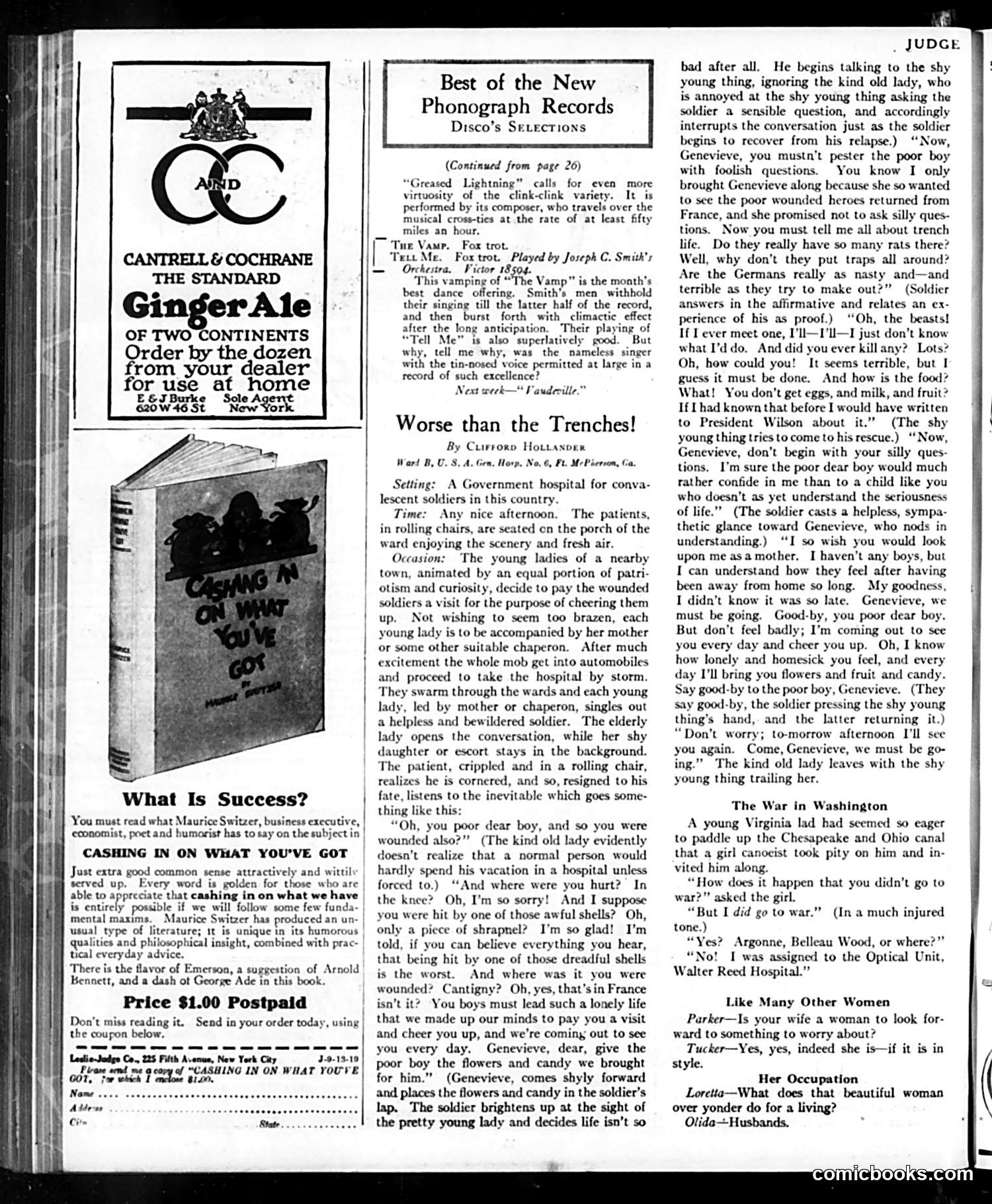
This page contains a mix of advertisements and satirical fiction. The main satirical content is "Worse than the Trenches!" by Clifford Hollander, a sketch mocking well-intentioned patriotic women visiting wounded soldiers in a hospital. The satire targets the oblivious chattiness of older female chaperones accompanying shy young women on morale-boosting visits. The joke is that wounded soldiers—already suffering physical trauma—are "cornered" by elderly ladies who ask repetitive, tactless questions ("And so you were wounded also?") and make obvious observations about soldiers' loneliness. The piece suggests these visits are actually *worse* than combat itself. The humor derives from the awkward social situation: wounded men trapped in rolling chairs, forced to endure well-meaning but intrusive interrogation about their injuries. It's commentary on how civilian enthusiasm for "cheering up" servicemen can become burdensome rather than comforting. The page also advertises Maurice Switzer's self-help book "Cashing In On What You've Got" and reviews phonograph records—typical Judge content of the WWI era.
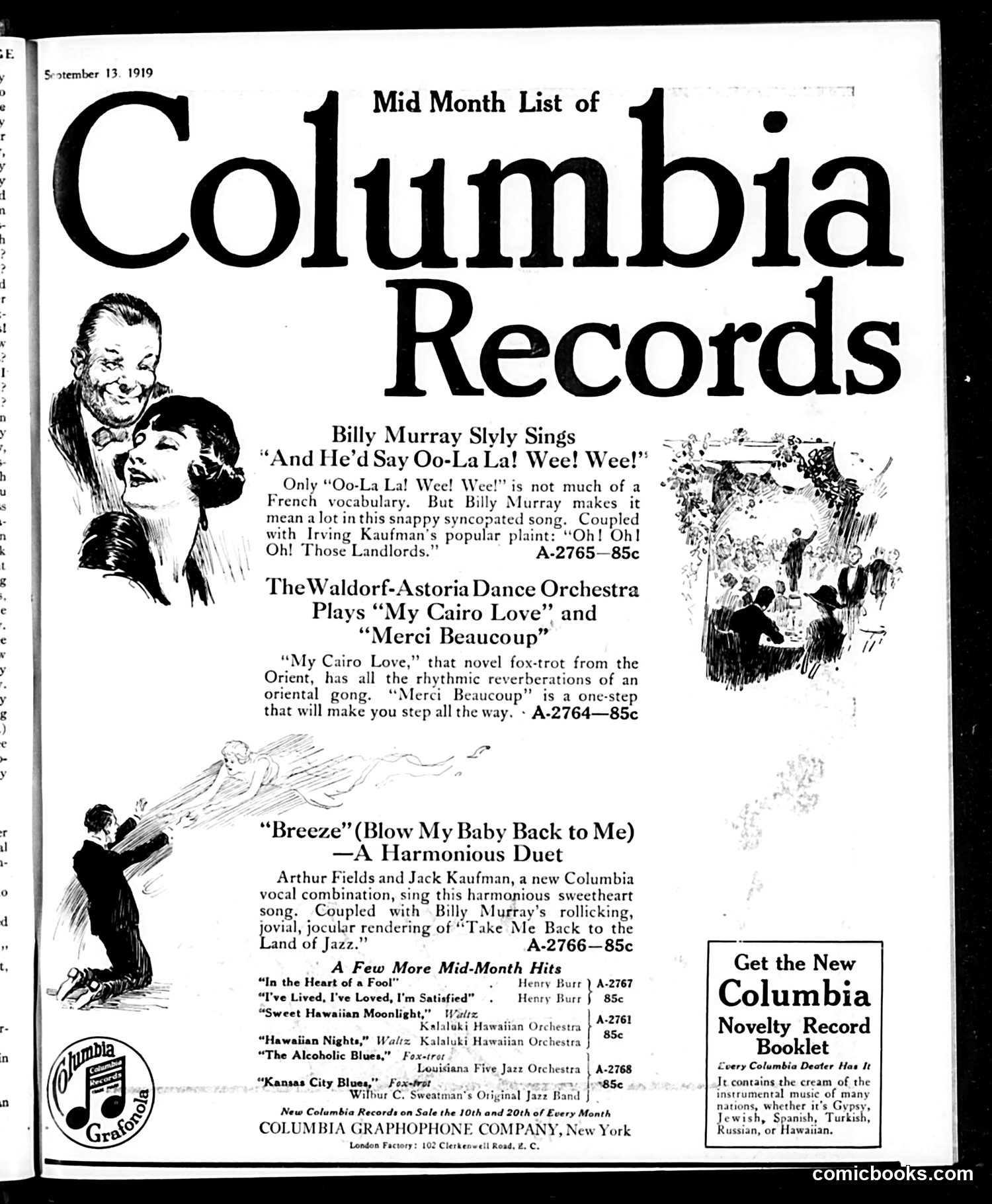
This is primarily a **music advertisement**, not political satire. It promotes Columbia Records' mid-month releases, featuring popular vocalists and dance orchestras of the era. The page showcases Jazz Age and post-WWI music trends: Billy Murray performing French-inflected syncopated songs, Hawaiian and Oriental-themed fox-trots, and jazz numbers. Notably, one song references "Those Landlords"—likely reflecting 1919's housing shortage and rental disputes following World War I. The illustrations depict performers in period style. The content reflects America's fascination with exotic musical genres (Hawaiian, Oriental, Spanish) and the emerging popularity of jazz and syncopated dance music during the Jazz Age. The advertisement emphasizes Columbia's diverse catalog of "novelty records" spanning multiple national traditions, appealing to immigrant communities and cosmopolitan urban listeners in 1919.
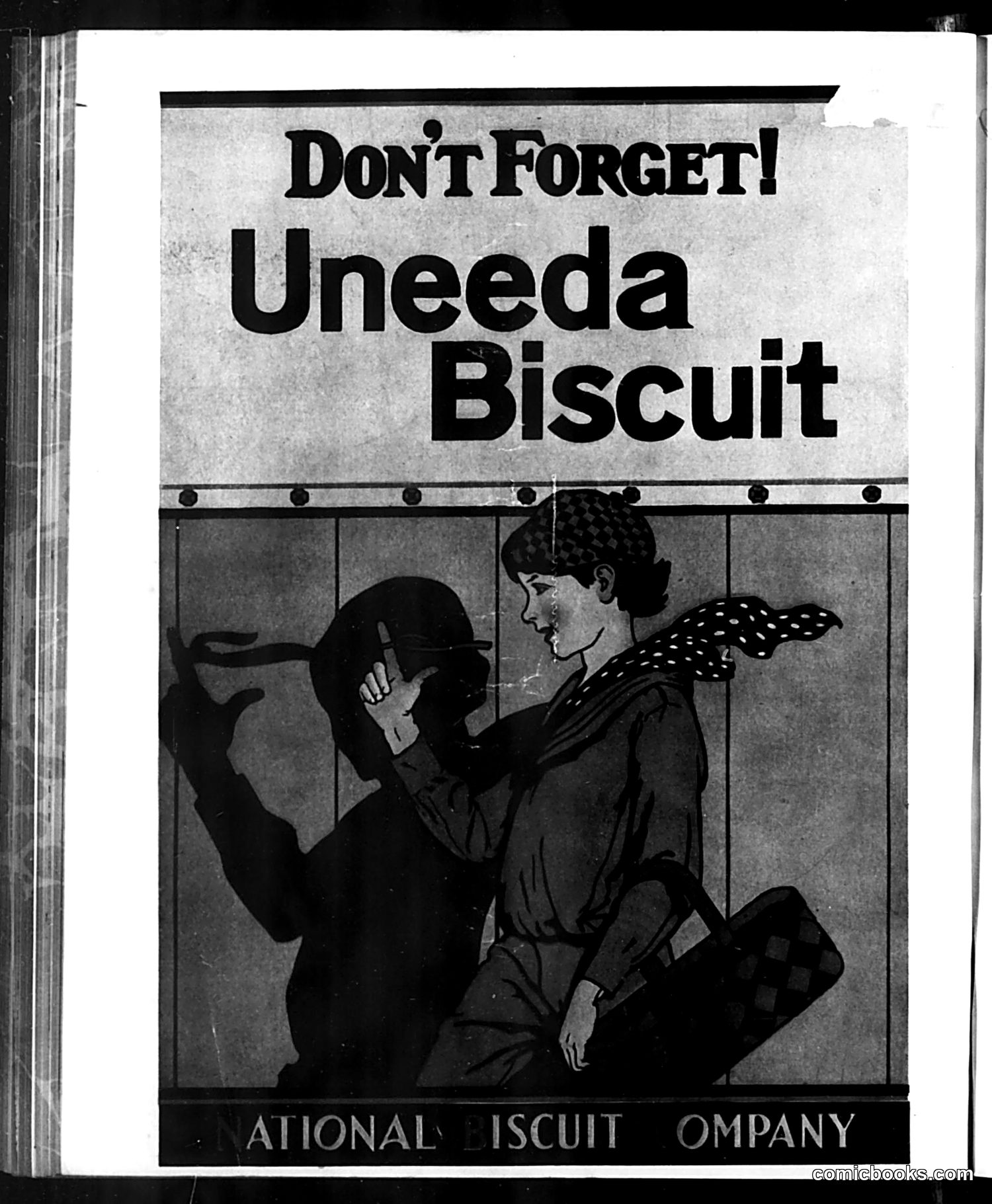
This is a **advertisement**, not political satire. It promotes Uneeda Biscuits, a real product manufactured by the National Biscuit Company (later Nabisco). The visual shows a stylishly dressed woman in 1920s fashion presenting or holding the product. The ad uses the phrase "Don't Forget!" as a memorable sales hook, appealing to consumers to remember the brand name when shopping. The polka-dotted coat and fashionable styling reflect 1920s consumer culture, targeting middle-class buyers—likely women who did household shopping. There is no political content or satire present; this appears in *Judge* simply as a paid advertisement among the magazine's editorial content.