
Judge, 1919-09-13 · page 13 of 36
Judge — September 13, 1919 — page 13: what you’re looking at
What you’re looking at
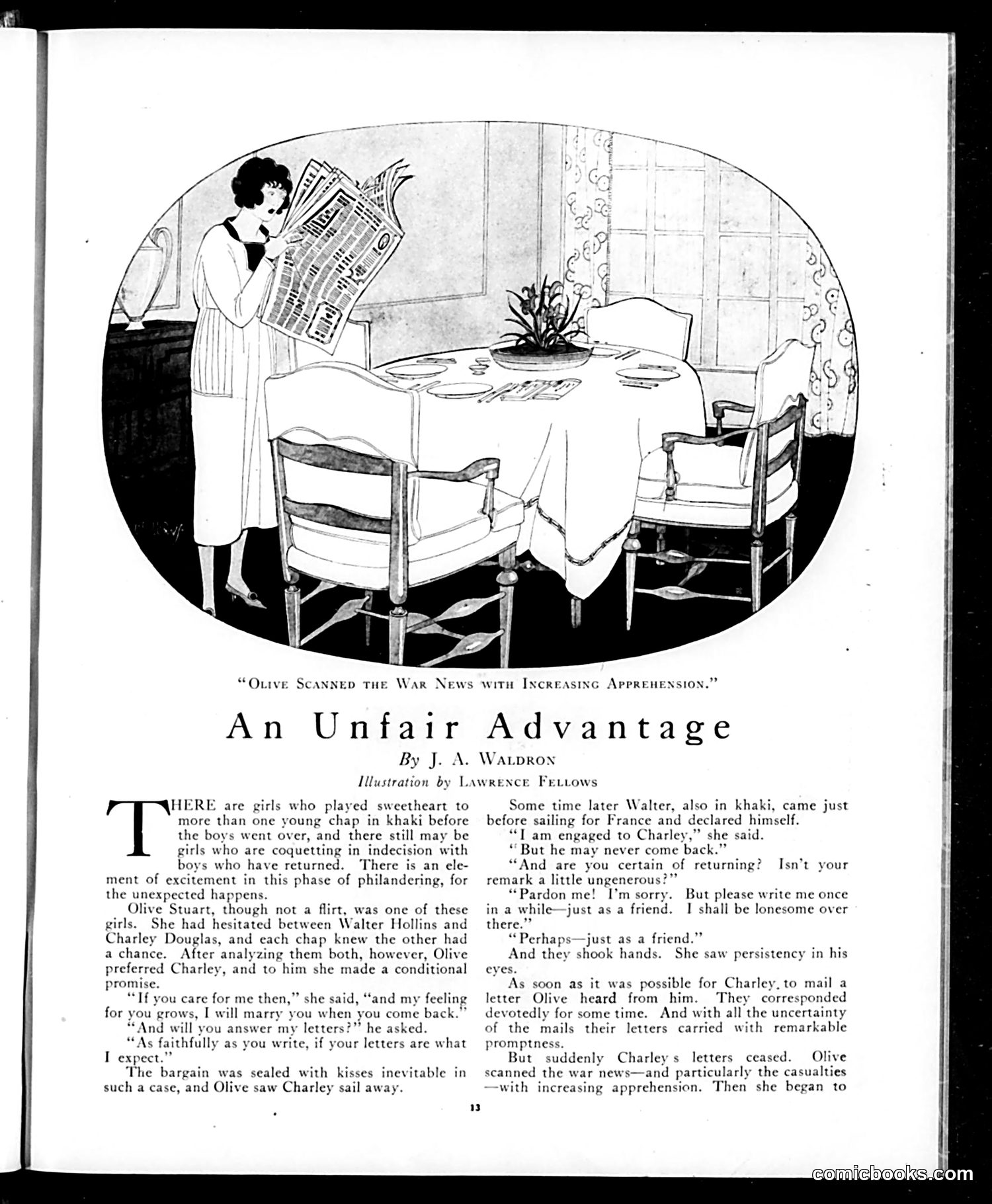
This WWI-era story illustrates the social anxiety surrounding soldiers and romantic commitment. Olive Stuart has conditionally promised to marry Charley Douglas when he returns from France, while another soldier, Walter Hollins, also declares his feelings before deployment. The satire's "unfair advantage" becomes clear: Walter, still in regular contact with Olive through letters, cultivates his position while Charley's correspondence mysteriously stops. Olive anxiously scans casualty lists, fearing the worst. The story critiques how wartime uncertainty and distance created romantic vulnerability—a woman could lose her fiancé either to death or to a rival who simply maintained better communication. The title suggests Walter exploits Charley's silence to win Olive's affection through persistent letter-writing and presence, gaining unfair romantic advantage over an absent (possibly deceased) soldier. This reflects genuine WWI-era concerns about fidelity, loss, and how prolonged separation tested wartime relationships.
📄 Transcribed text from this page (OCR, searchable)
Machine-transcribed from the original scan — historical spelling and the odd misread are preserved.
“Outve Scan An Unfair By J. A. Illustration by 1. HERE are girls who played sweetheart to more than one young chap in khaki before the boys went over, and there still may be girls who are coquetting in indecision with boys who have returned. There n ele- ment of excitement in this phase of philandering, for the unexpected happens. Olive Stuart, though not a flirt, was one of these girls. She had hesitated between Walter Hollins and Charley Douglas, and each chap knew the other had a chance. After analyzing them both, however, Olive preferred Charley, and to him she made a conditional promise. “Tf you care for me then,” she said, ‘“‘and my feeling for you grows, I will marry you when you come back.” “And will you answer my letters?” he asked. “As faithfully as you write, if your letters are what I expect.” The bargain was sealed with kisses inevitable in such a case, and Olive saw Charley sail away. p tHe War News wit Ixcreasinc APPREHENSION.” Advantage Wa.pRon AWRENCE FELLows Some time later Walter, also in khaki, came just before sailing for France and declared himself. “T am engaged to Charley,” she said. “But he may never come back.” “And are you certain of returning? remark a little ungenerous?”” “Pardon me! I’m sorry. in a while—just as a friend. there.” “Perhaps And they shook hands. Isn’t_ your But please write me once I shall be lonesome over just as a friend.” She saw persistency in his As soon as it was possible for Charley, to mail a letter Olive heard from him. They corresponded devotedly for some time. And with all the uncertainty of the mails their letters carried with remarkable promptness. But suddenly Charley s letters ceased. Olive scanned the war news—and particularly the casualties with increasing apprehension. Then she began to