
Judge, 1919-09-13 · page 6 of 36
Judge — September 13, 1919 — page 6: what you’re looking at
What you’re looking at
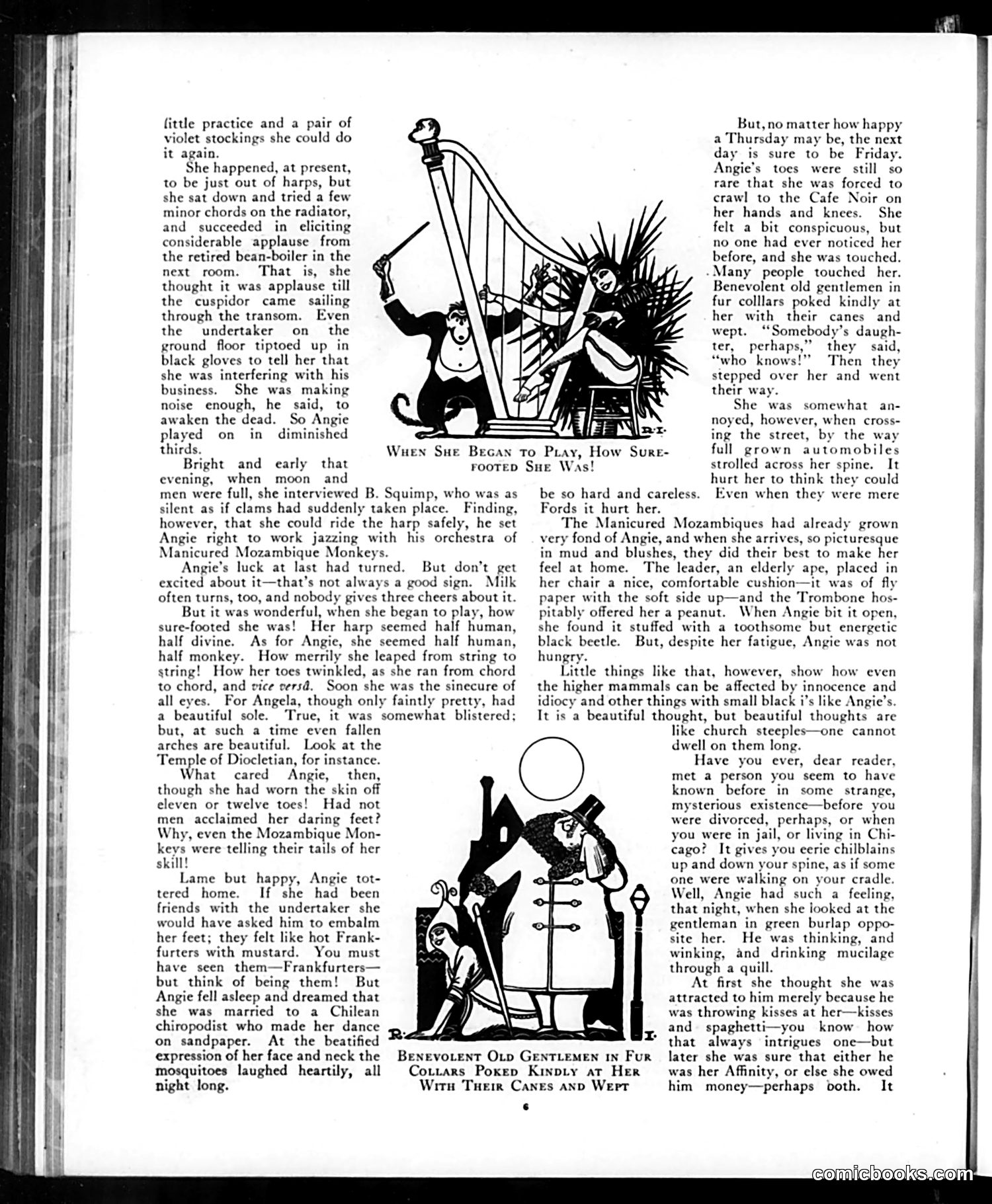
This page is primarily **literary fiction**, not political satire. It tells the story of "Angie," a talented but poor harpist in Paris who performs at the Café Noir and attracts attention from wealthy gentlemen. The two illustrations depict scenes from the narrative: the upper cartoon shows Angie playing her harp energetically; the lower shows "Benevolent Old Gentlemen in Fur Collars" poking kindly at her with their canes. The text explores themes of **female poverty, charity, and male attention**—suggesting the precarious position of working-class women entertainers dependent on patronage from wealthy men. There are no clear political references or satirical targets visible; this appears to be a serialized romantic story rather than social commentary or political humor.
📄 Transcribed text from this page (OCR, searchable)
Machine-transcribed from the original scan — historical spelling and the odd misread are preserved.
little practice and a pair of violet stockings she could do it again. She happened, at present, to be just out of harps, but she sat down and tried a few minor chords on the radiator, and succeeded in eliciting considerable applause from the retired bean-boiler in the next room. That is, she thought it was applause till the cuspidor came. sailing through the transom. Even the undertaker on the ground floor tiptoed up in black gloves to tell her that she was interfering with his business. She was making noise enough, he said, to awaken the dead. So Angie played on in diminished thirds. Bright and early that evening, when moon and men were full, she interviewed B. Squimp, who was as silent as if clams had suddenly taken place. Finding, however, that she could ride the harp safely, he set Angie right to work jazzing with his orchestra of Manicured Mozambique Monkeys. Angie’s luck at last had turned. excited about it—that’s not always a good sign. But don’t get Milk often turns, too, and nobody gives three cheers about it. But it was wonderful, when she began to play, how sure-footed she was! Her harp seemed half human, half divine. As for Angie, she seemed half human, half monkey. How merrily she leaped from string to string! How her toes twinkled, as she ran from chord to chord, and vice versa. Soon she was the sinecure of all eyes. For Angela, though only faintly pretty, had a beautiful sole. True, it was somewhat blistered; but, at such a time even fallen arches are beautiful. Look at the Temple of Diocletian, for instance. What cared Angie, then, though she had worn the skin off eleven or twelve toes! Had not men acclaimed her daring feet? Why, even the Mozambique Mon- keys were telling their tails of her skill! Lame but happy, Angie tot- tered home. If she had been friends with the undertaker she would have asked him to embalm her feet; they felt like hot Frank- furters with mustard. You must have seen them—Frankfurters— but think of being them! But Angie fell asleep and dreamed that she was married to a Chilean chiropodist who made her dance on sandpaper. At the beatified expression of her face and neck the mosquitoes laughed heartily, all night long. Wuen Sue Becan to Pray, How Sure- rootep Sue Was! Benevotent Orp GenTLemeN IN Fur Cottars Poxep Kinpty at Her Wrrn Tuerr Canes ano Wert But, no matter how happy a Thursday may be, the next day sure to be Friday. Angie’s toes were still so rare that she was forced to crawl to the Cafe ir on her hands and knees. She felt a bit conspicuous, but no one had ever noticed her before, and she was touched. -Many people touched her. Benevolent old gentlemen in fur colllars poked kindly at her with their canes and wept. “Somebody’s daugh- ter, perhaps,” they said, “who knows!" Then they stepped over her and went their way. She was somewhat an- noyed, however, when cross- ing the street, by the way full grown automobiles strolled across her spine. It hurt her to think they could be so hard and careless. Even when they were mere Fords it hurt her. The Manicured Mozambiques had already grown very fond of Angie, and when she arrives, so picturesque in mud and blushes, they did their best to make her feel at home. The leader, an elderly ape, placed in her chair a nice, comfortable cushion—it was of fly paper with the soft side up—and the Trombone hos- pitably offered her a peanut. When Angie bit it open, she found it stuffed with a toothsome but energetic black beetle. But, despite her fatigue, Angie was not hungry. Little things like that, however, show how even the higher mammals can be affected by innocence and idiocy and other things with small black i’s like Angie’s. It is a beautiful thought, but beautiful thoughts are like church steeples—one cannot dwell on them long. Have you ever, dear reader, met a person you seem to have known before in some strange, mysterious existence—before you were divorced, perhaps, or when you were in jail, or living in Chi- cago? It gives you eerie chilblains up and down your spine, as if some one were walking on your cradle. Well, Angie had such a feeling, that night, when she looked at the gentleman in green burlap oppo- site her. He was thinking, and winking, and drinking mucilage through a quill. At first she thought she was attracted to him merely because he was throwing kisses at her—kisses and spaghetti—you know how that always intrigues one—but later she was sure that either he was her Affinity, or else she owed him money—perhaps both. It