
Judge, 1919-09-13 · page 34 of 36
Judge — September 13, 1919 — page 34: what you’re looking at
What you’re looking at
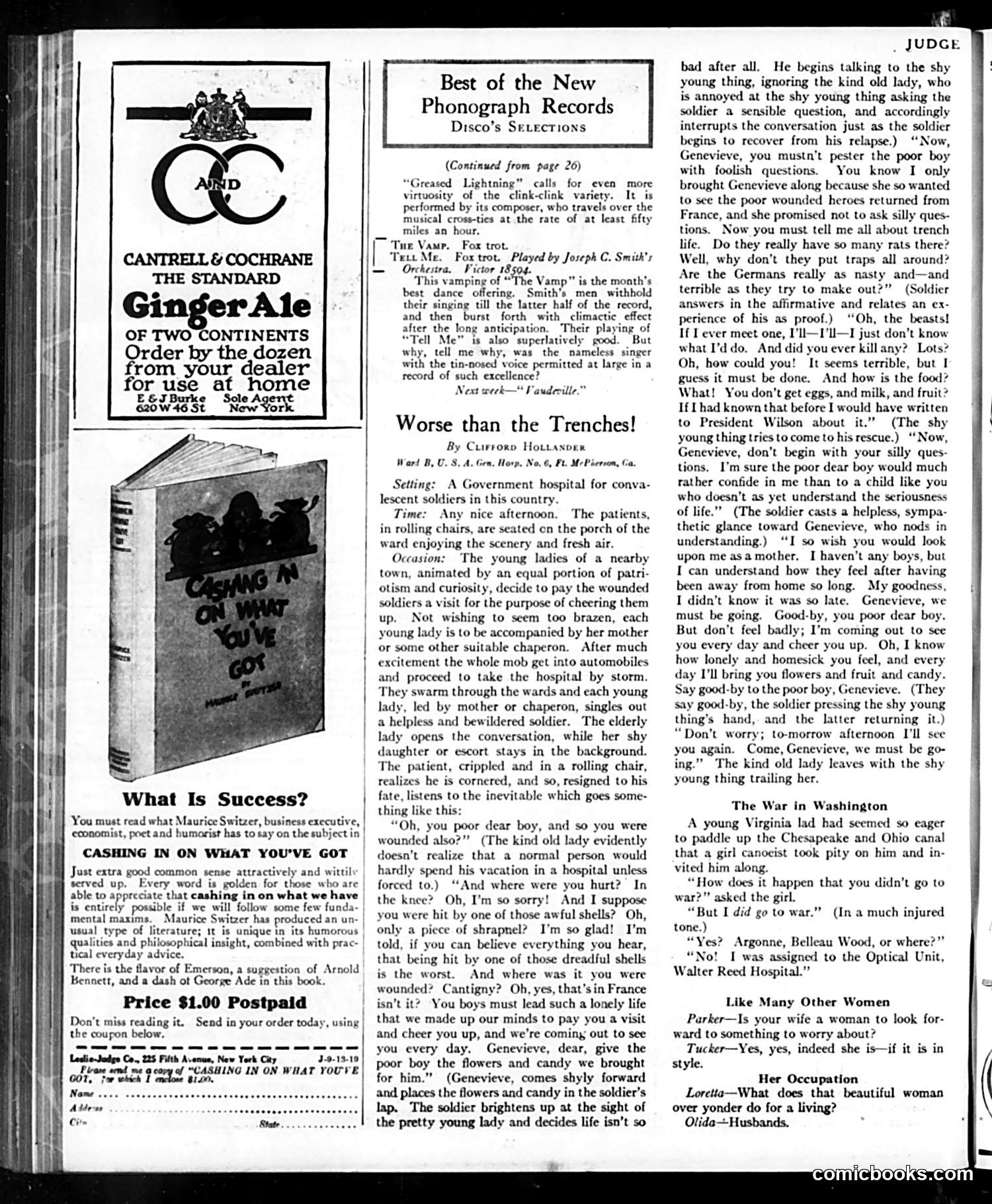
This page contains a mix of advertisements and satirical fiction. The main satirical content is "Worse than the Trenches!" by Clifford Hollander, a sketch mocking well-intentioned patriotic women visiting wounded soldiers in a hospital. The satire targets the oblivious chattiness of older female chaperones accompanying shy young women on morale-boosting visits. The joke is that wounded soldiers—already suffering physical trauma—are "cornered" by elderly ladies who ask repetitive, tactless questions ("And so you were wounded also?") and make obvious observations about soldiers' loneliness. The piece suggests these visits are actually *worse* than combat itself. The humor derives from the awkward social situation: wounded men trapped in rolling chairs, forced to endure well-meaning but intrusive interrogation about their injuries. It's commentary on how civilian enthusiasm for "cheering up" servicemen can become burdensome rather than comforting. The page also advertises Maurice Switzer's self-help book "Cashing In On What You've Got" and reviews phonograph records—typical Judge content of the WWI era.
📄 Transcribed text from this page (OCR, searchable)
Machine-transcribed from the original scan — historical spelling and the odd misread are preserved.
4 oor, OF TWO CONTINENTS Order by the dozen from your dealer for use at home Sie donk. E&J Burke 620 W 46 St What Is Success? You must read what Maurice Switzer, business executive, economist, poet and humorist has to say on the subject in CASHING IN ON WHAT YOU'VE GOT Just extra good common sense attractively and wittily served up. Every word is golden for those who are able to appreciate that cashing in on what we have is entirely possible if we will follow some few funda- mental maxims. Maurice Switzer has produced an un- usual type of literature; it is unique in its humorous qualities and philosophical insight, combined with prac- tical everyday advice. There is the flavor of Emerson, a suggestion of Arnold Bennett, and a dash ot George Ade in this book. Price $1.00 Postpaid ! Don’t miss reading it. Send in your order today, using | the coupon below. Leslie-Jadige Co., 225 Filth Avenue, New York City 4-9-13-19 Pirase send “CASHING IN ON WHAT YOUVE jerenen Tens pron NO IN ON WHAT YOU Name .... Aidres Cie Best of the New Phonograph Records Disco’s SELections (Continued from page 26) “Greased Lightning” calls for even more virtuosity of the clink-clink variety. It is performed by its composer, who travels over the musical cross-ties at the rate of at least fifty __miles an hour. ‘Tue Vamr. Fox trot. Teit Me. Fox trot. Played by Joseph C. Smith's Orchestra, Victor 18504. This vamping of “The Vamp” is the month’s best dance offering. Smith’s men withhold their singing till the latter half of the record, and then burst forth with climactic effect after the long anticipation. ‘Their playing of “Tell Me” is also superlatively good. But why, tell me why, was the nameless singer with the tin-nosed voice permitted at large in a record of such excellence? Next week—" Vaudeville.” Worse than the Trenches! By Curroro Houtanper Wert B,U. 8. A. Gen. Horp. No. 6, Ft. McPherson, Ca. Setting: A Government hospital for conva- lescent soldiers in this country. Time: Any nice afternoon. The patients, in rolling chairs, are seated on the porch of the ward enjoying the scenery and fresh air. Occasion: The young ladies of a nearby town, animated by an equal portion of patri- otism and curiosity, decide to pay the wounded soldiers a visit for the purpose of cheering them up. Not wishing to seem too brazen, each young lady is to be accompanied by her mother or some other suitable chaperon. After much excitement the whole mob get into automobiles and proceed to take the hospital by storm. They swarm through the wards and each young lady, led by mother or chaperon, singles out a helpless and bewildered soldier. The elderly lady opens the conversation, while her shy daughter or escort stays in the background. The patient, crippled and in a rolling chair, realizes he is cornered, and so, resigned to his fate, listens to the inevitable which goes some- thing like this: “Oh, you poor dear boy, and so you were wounded also?” (The kind old lady evidently doesn’t realize that a normal person would hardly spend his vacation in a hospital unless forced to.) ‘And where were you hurt? In the knee? Oh, I’m so sorry! And I suppose you were hit by one of those awful shells? Oh, only a piece of shrapnel? I’m so glad! I’m told, if you can believe everything you hear, that being hit by one of those dreadful shells is the worst. And where was it you were wounded? Cantigny? Oh, yes, that’s in France isn’t it? You boys must lead such a lonely life that we made up our minds to pay you a visit and cheer you up, and we're coming out to see you every day, Genevieve, dear, give the poor boy the flowers and candy we brought for him.” (Genevieve, comes shyly forward and places the flowers and candy in the soldier’s lap. The soldier brightens up at the sight of the pretty young lady and decides life isn’t so _ JUDGE bad after all. He begins talking to the shy young thing, ignoring the kind old lady, who is annoyed at the shy young thing asking the soldier a sensible question, and accordingly interrupts the conversation just as the soldier begins to recover from his relapse.) ‘Now, Genevieve, you mustn’t pester the poor boy with foolish questions. You know I only brought Genevieve along because she so wanted to see the poor wounded heroes returned from France, and she promised not to ask silly ques- tions. Now you must tell me all about trench life. Do they really have so many rats there? Well, why don’t they put traps all around? Are the Germans really as nasty and—and terrible as they try to make out?” (Soldier answers in the affirmative and relates an ex- perience of his as proof.) ‘Oh, the beasts! If I ever meet one, I’ll—I'll—I just don’t know what I’d do. And did you ever killany? Lots? Oh, how could you! It seems terrible, but I guess it must be done. And how is the food? What! You don’t get eggs, and milk, and fruit? If [had known that before I would have written to President Wilson about it.” (The shy young thing tries to come to his rescue.) “Now, Genevieve, don't begin with your silly ques- tions. I’m sure the poor dear boy would much rather confide in me than to a child like you who doesn’t as yet understand the seriousness of life.” (The soldier casts a helpless, sympa- thetic glance toward Genevieve, who nods in understanding.) “I so wish you would look upon me asa mother. I haven't any boys, but I can understand how they feel after having been away from home so long. My goodness, I didn’t know it was so late. Genevieve, we must be going. Good-by, you poor dear boy. But don’t feel badly; I’m coming out to see you every day and cheer you up. Oh, I know how lonely and homesick you feel, and every day I'll bring you flowers and fruit and candy. Say good-by to the poor boy, Genevieve. (They say good-by, the soldier pressing the shy young thing’s hand, and the latter returning it.) “Don’t worry; to-morrow afternoon I'll see you again. Come, Genevieve, we must be go- ing.” The kind old lady leaves with the shy young thing trailing her. The War in Washington A young Virginia lad had seemed so eager to paddle up the Chesapeake and Ohio canal that a girl canocist took pity on him and in- vited him along. “How does it happen that you didn’t go to war?” asked the girl. “But I did go to war.” tone.) “Yes? Argonne, Belleau Wood, or where?” “No! I was assigned to the Optical Unit, Walter Reed Hospital.” (In a much injured Like Many Other Women Parker—Is your wife a woman to look for- ward to something to worry about? Tucker—Yes, yes, indeed she is—if it is in style. Her Occupation Loretta—What does that beautiful woman over yonder do for a living? Olida—Husbands.