
Judge, 1919-09-13 · page 5 of 36
Judge — September 13, 1919 — page 5: what you’re looking at
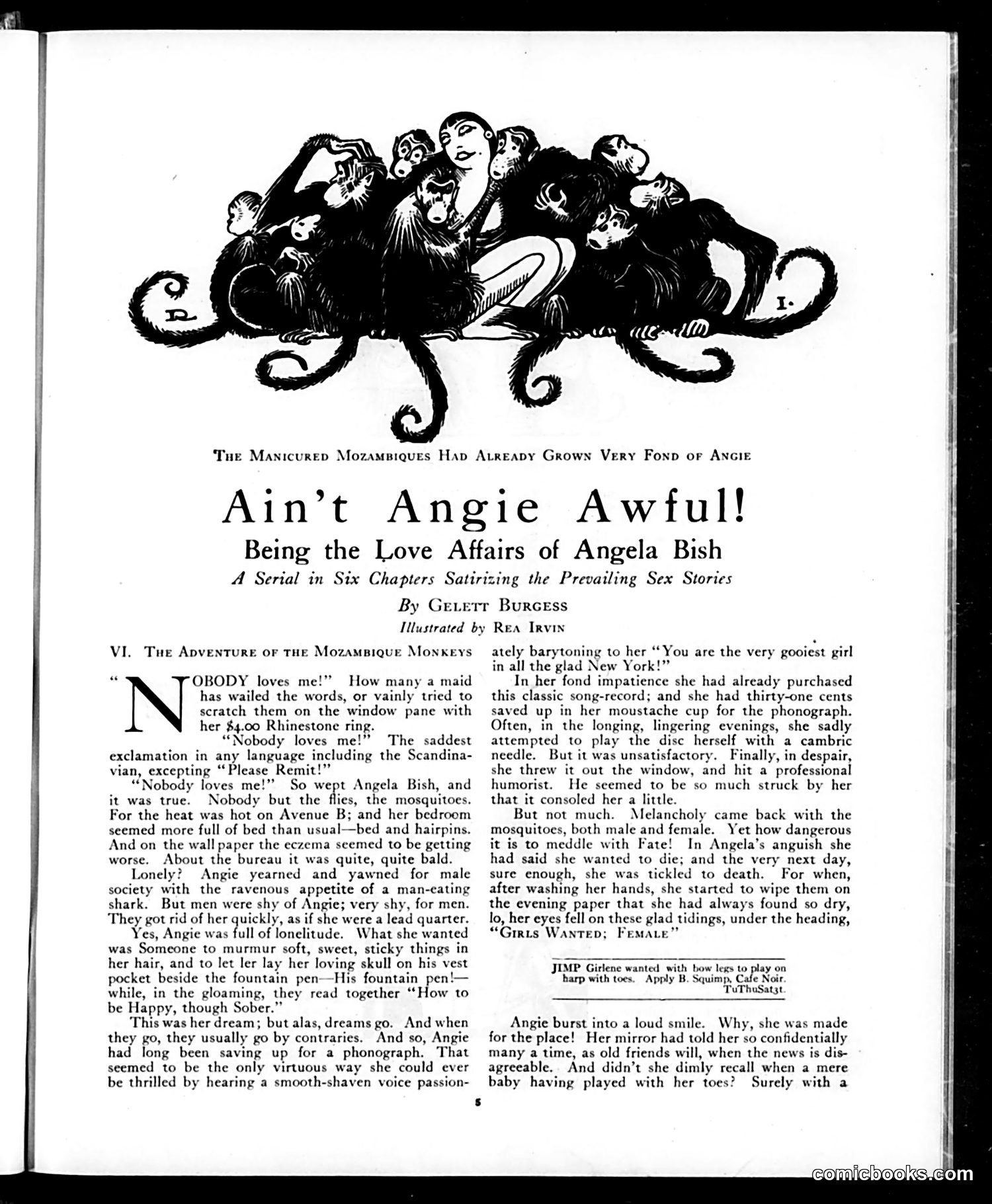
What you’re looking at
This page satirizes a serialized story called "Ain't Angie Awful! Being the Love Affairs of Angela Bish" by Gelert Burgess, illustrated by Rea Irvin. The masthead illustration shows monkeys in formal dress, suggesting the piece mockingly compares the characters to animals or primitive behavior—a common satirical device of the era. The text ("VI. The Adventure of the Mozambique Monkeys") indicates this is the sixth installment of a serial that ridicules romantic melodrama and female loneliness. The story follows Angela Bish, a lonely woman seeking male companionship, depicted as pathetically yearning for love while surrounded by urban isolation and minor catastrophes (mosquitoes, domestic troubles). The satire targets sentimental romance narratives and the desperation of single women in contemporary society.
📄 Transcribed text from this page (OCR, searchable)
Machine-transcribed from the original scan — historical spelling and the odd misread are preserved.
Tue Manicureo Mozampiques Hap Atreapy Grown Very Fonp or ANGIE Ain’t Angie Awful! Being the Love Affairs of Angela Bish A Serial in Six Chapters Satirizing the Prevailing Sex Stories By GE Tr BuRGEss Illustrated by Rea Irvin VI. Tue Apventure or THE MozamBique Monkeys “ OBODY loves me!" How many a maid has wailed the words, or vainly tried to scratch them on the window pane with her $4.00 Rhinestone ring. “Nobody loves me!” The saddest exclamation in any language including the Scandina- vian, excepting “Please Remit!’ “Nobody loves me!” So wept Angela Bish, and it was true. Nobody but the flies, the mosquitoes. For the heat was hot on Avenue B; and her bedroom seemed more full of bed than usual—bed and hairpins. And on the wall paper the eczema seemed to be getting worse. About the bureau it was quite, quite bald. Lonel Angie yearned and yawned for male society with the ravenous appetite of a man-eating shark. But men were shy of Angie; very shy, for men. They got rid of her quickly, as if she were a lead quarter. Yes, Angie was full of lonelitude. What she wanted was Someone to murmur soft, sweet, sticky things in her hair, and to let ler lay her loving skull on his vest pocket beside the fountain pen—His fountain pen!— while, in the gloaming, they read together “How to be Happy, though Sober.” ‘This was her dream; but alas, dreams go. And when they go, they usually go by contraries. And so, Angie had long been saving up for a phonograph. That seemed to be the only virtuous way she could ever be thrilled by hearing a smooth-shaven voice passion- ately barytoning to her “‘You are the very gooiest girl in all the glad New York!” In her fond impatience she had already purchased this classic song-record; and she had thirty-one cents saved up in her moustache cup for the phonograph. Often, in the longing, lingering evenings, she sadly attempted to play the disc herself with a cambric needle. But it was unsatisfactory. Finally, in despair, she threw it out the window, and hit a professional humorist. He seemed to be so much struck by her that it consoled her a little. But not much. Melancholy came back with the mosquitoes, both male and female. Yet how dangerous it is to meddle with Fate! In Angela’s anguish she had said she wanted to die; and the very next day, sure enough, she was tickled to death. For when, after washing her hands, she started to wipe them on the evening paper that she had always found so dry, lo, her eyes fell on these glad tidings, under the heading, “Girts Wantep; Femace” JIM Girlene wanted with bow legs to play on harp with toes. Apply B. Squimp, Cafe Noir. TuThuSatgt Angie burst into a loud smile. Why, she was made for the place! Her mirror had told her so confidentially many a time, as old friends will, when the news is dis- agreeable. And didn’t she dimly recall when a mere baby having played with her toes? Surely with a