
A complete issue · 32 pages · 1919
Judge — January 25, 1919
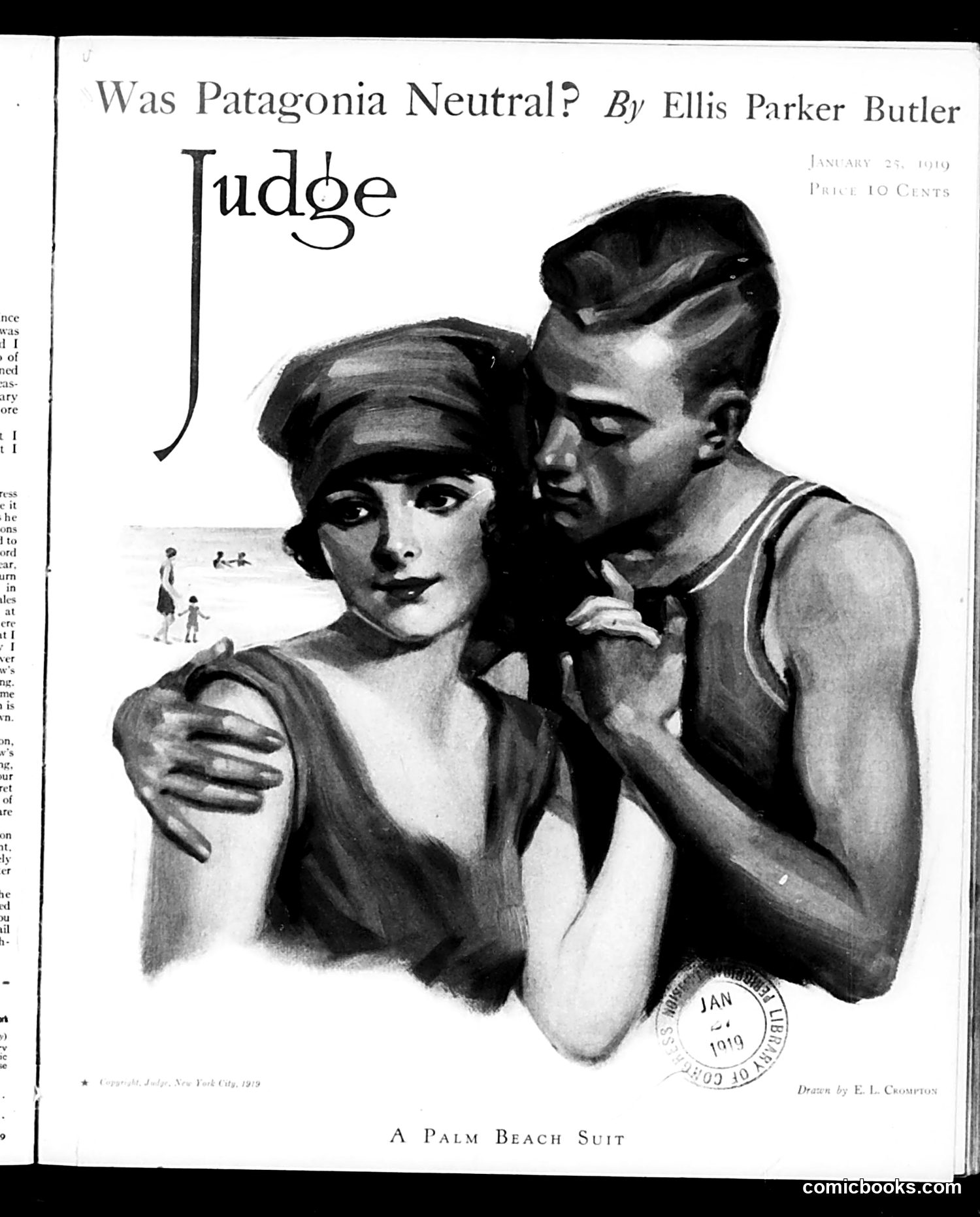
This is a Judge magazine cover from January 25, 1919, titled "Was Patagonia Neutral?" by Ellis Parker Butler, subtitled "A Palm Beach Suit." The image shows two figures in an intimate embrace on a beach—a woman in a headwrap and a man in a sleeveless shirt. The satire likely references Argentina (which borders Patagonia), which maintained official neutrality during World War I despite German submarine activity in its waters and pressure from the Allies. The "Palm Beach Suit" caption suggests this is commentary on wealthy Americans vacationing in South America while geopolitical tensions simmered. The intimate scene appears to satirize Argentina's ambiguous diplomatic position—outwardly neutral yet entangled with various international interests. The cartoon mocks both Argentina's supposed neutrality and American leisure-class indifference to wartime concerns.
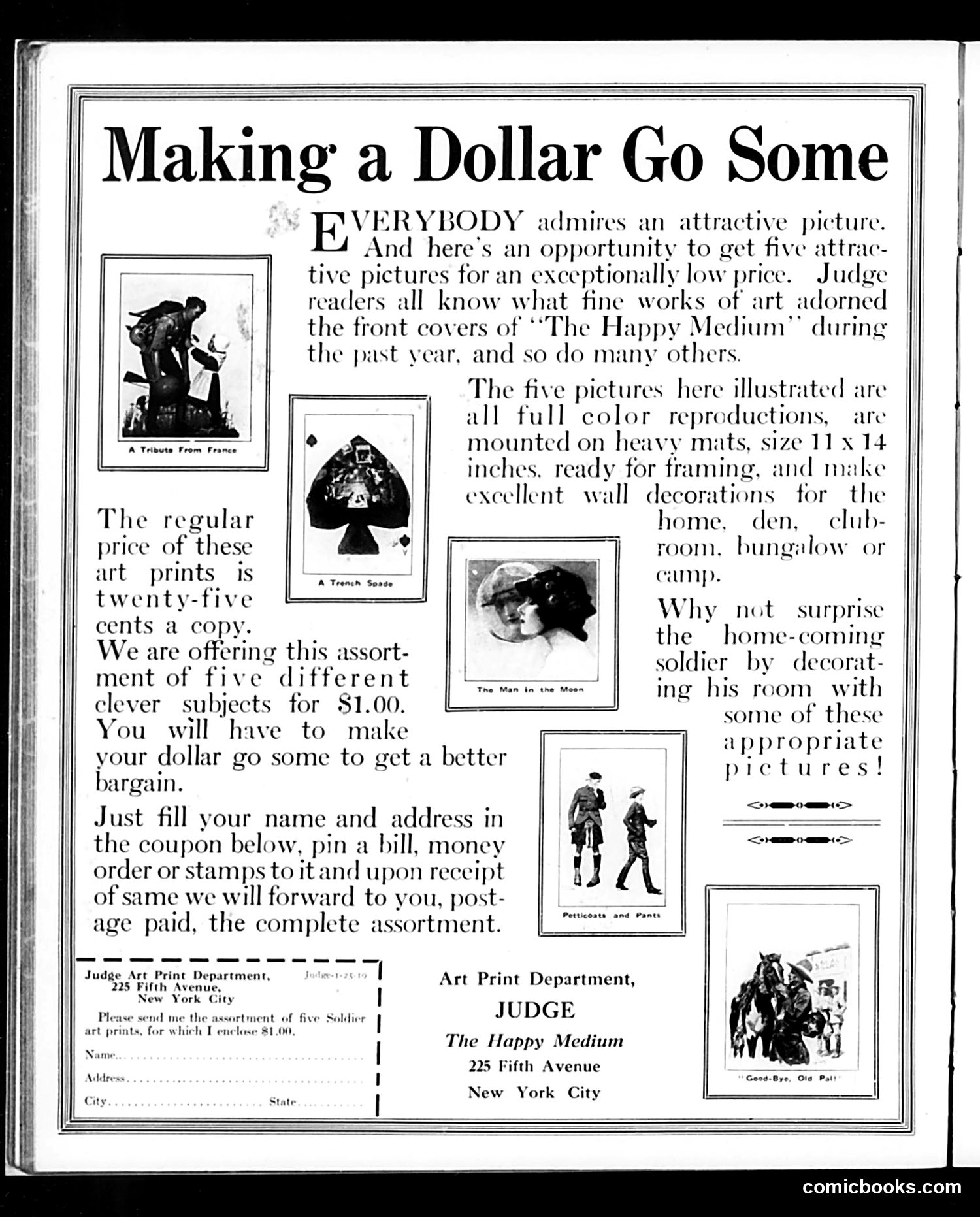
This page is primarily **advertising**, not political satire. The Judge Art Print Department offers five soldier-themed art prints for $1.00—a bargain compared to the regular 25-cent-per-copy price. The five prints shown feature military subjects: "A Tribute from France," "A French Salute," "The Man in the Moon," "Pettigans and Pants," and "Good-Bye, Old Pal." These appear to be **WWI-related imagery**, given the soldier figures and patriotic themes visible in the illustrations. The advertisement targets home decorators and those sending gifts to soldiers, suggesting this ran during or shortly after World War I when such patriotic prints were popular gifts and room decorations. The copy emphasizes affordability and sentimental appeal rather than satirical commentary.
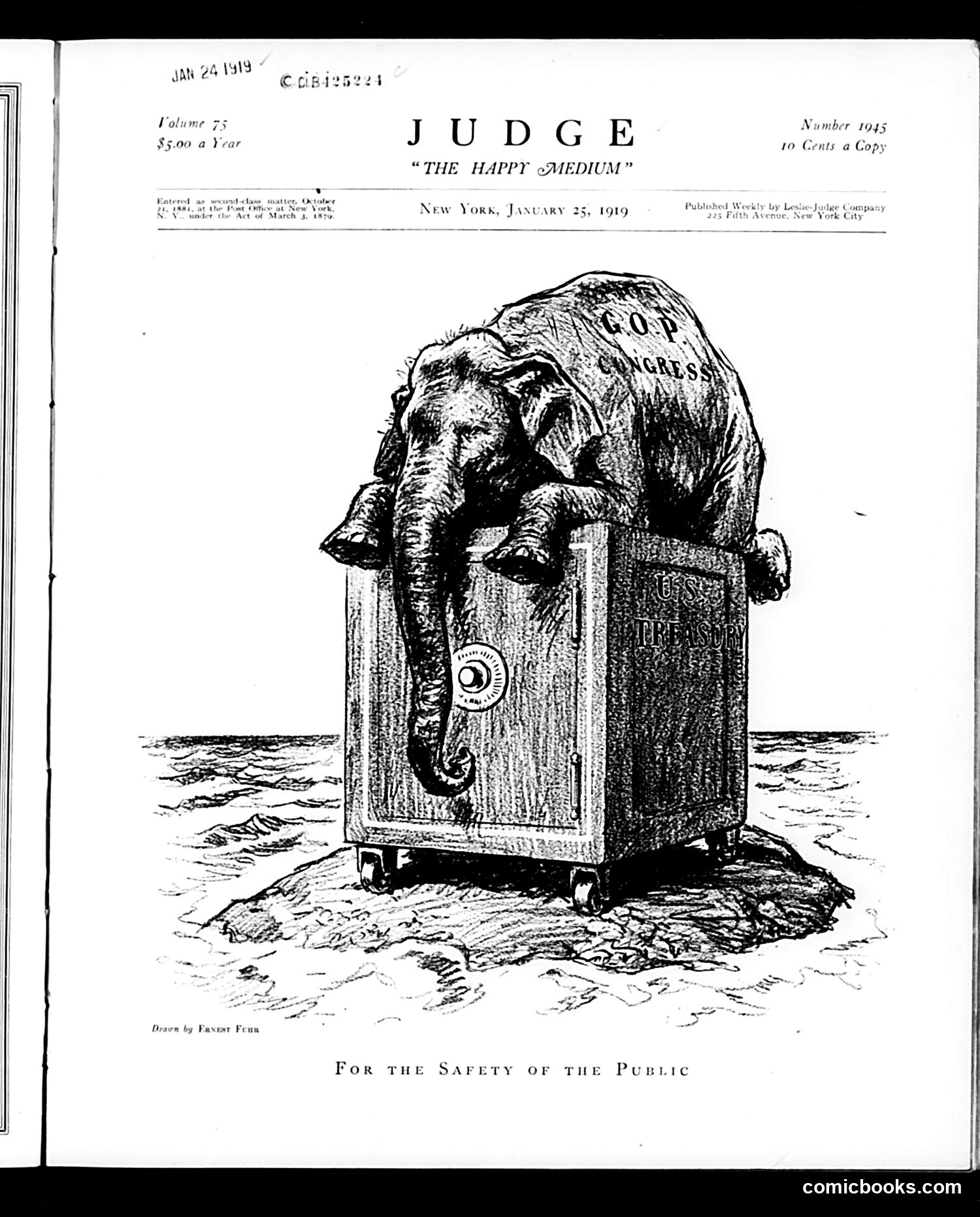
This satirical cover depicts an elephant (the Republican Party symbol) trapped in a trash bin labeled "CONGRESS" and "WASTE," with text reading "FOR THE SAFETY OF THE PUBLIC." The cartoon appears to criticize congressional Republicans as wasteful or obstructive during the post-World War I period. The "safety" caption is ironic—the image suggests Republicans themselves pose a danger requiring containment. The timing (January 1919) places this during debates over the League of Nations treaty and Wilson's peace negotiations, when Republicans opposed aspects of Democratic foreign policy. The cartoon satirizes Republicans as garbage that must be disposed of for public welfare, reflecting the partisan tensions of that era.
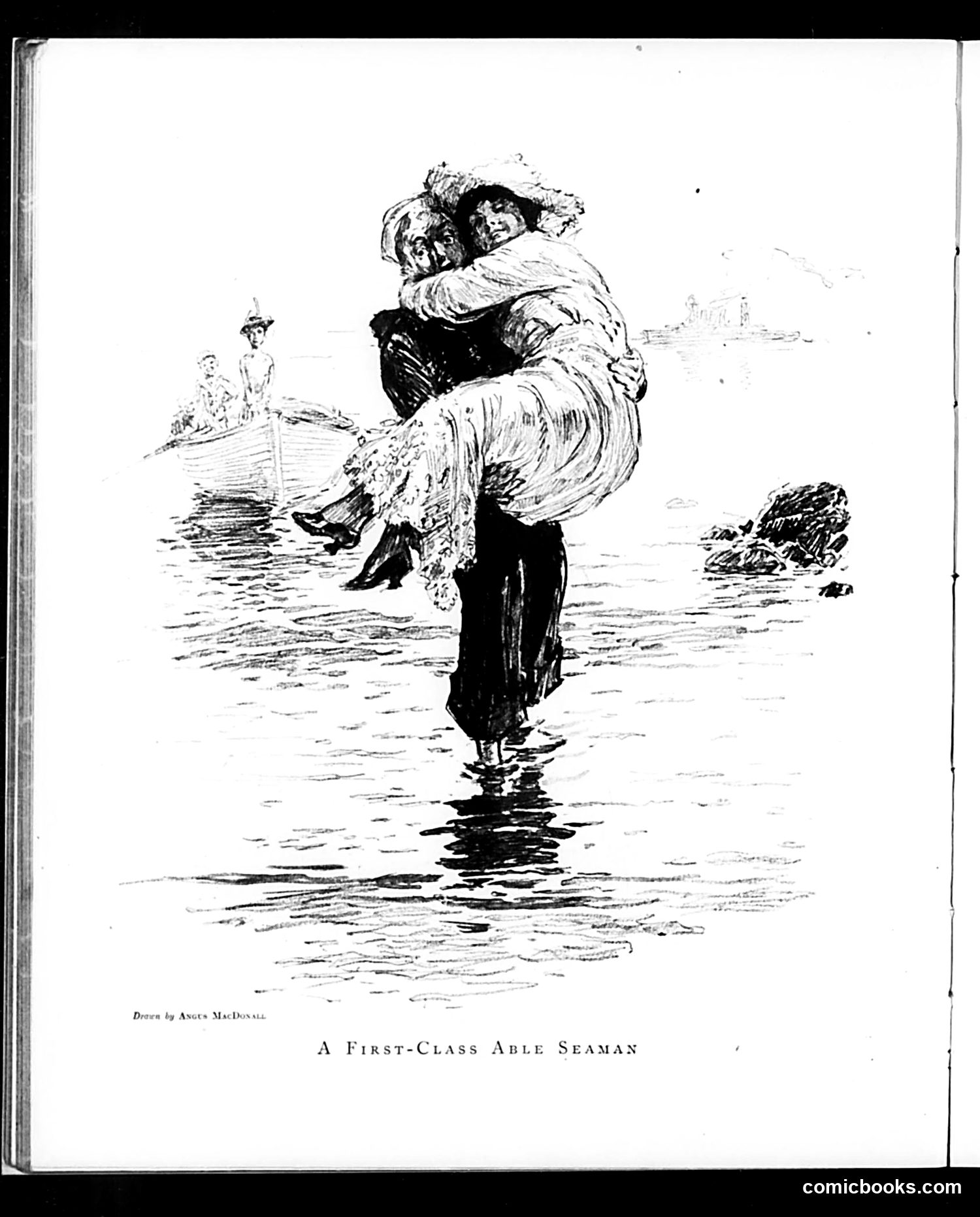
This illustration by Angus MacDonald depicts a sailor in the water carrying a woman, with a boat and other figures visible in the background. The title "A First-Class Able Seaman" suggests satirical commentary on maritime competence or naval personnel. The image likely references a specific contemporary incident—possibly a rescue or maritime mishap—but without additional context about Judge magazine's publication date or surrounding articles, I cannot definitively identify the specific event, figures, or individuals being satirized. The cartoon appears to be commenting ironically on seamanship or naval service, though the precise political or social criticism remains unclear from the image alone.
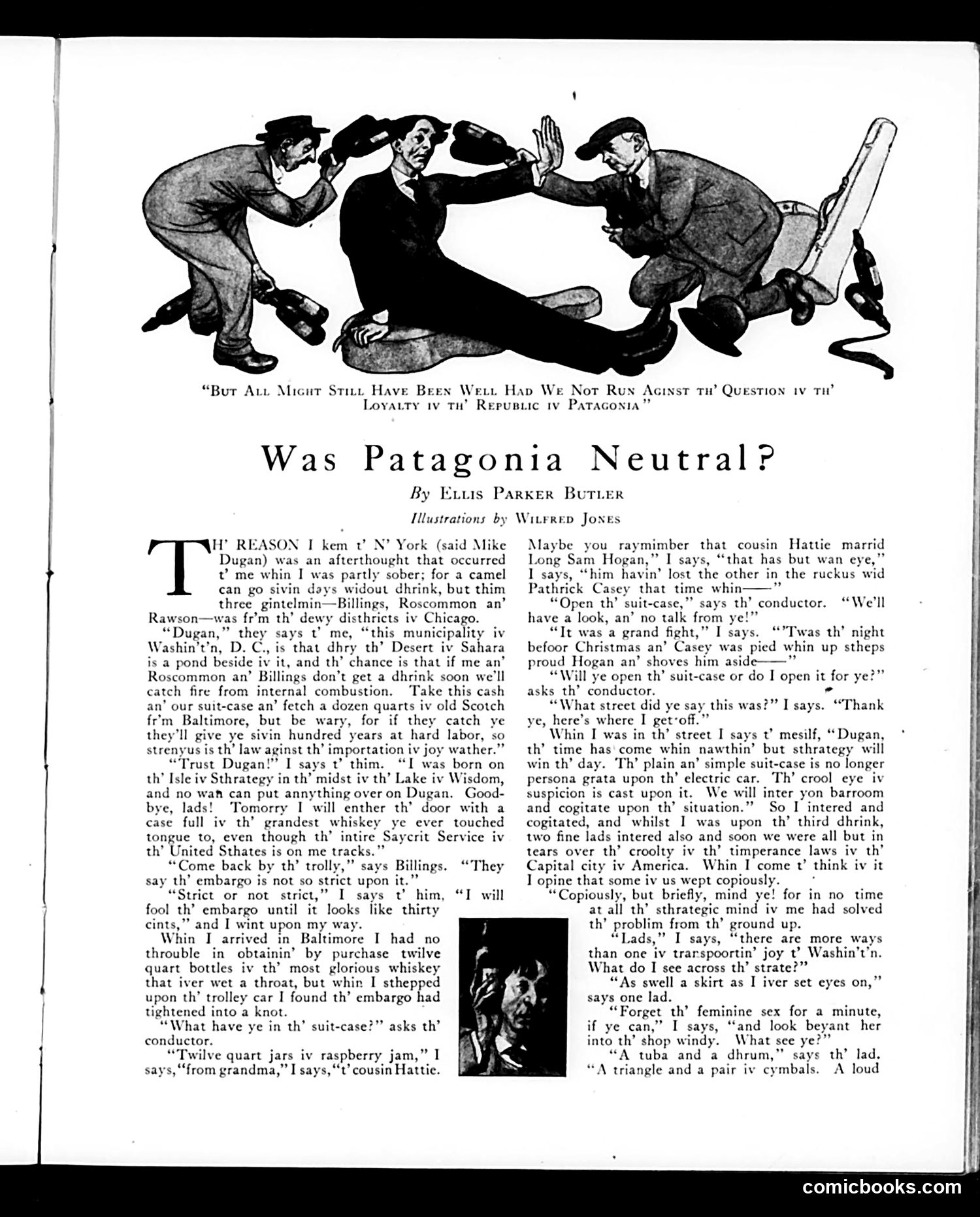
This satirical piece by Ellis Parker Butler mocks American political neutrality during what appears to be an early 20th-century conflict involving Patagonia (a region in South America). The illustration shows men being physically thrown or ejected, suggesting violence disguised as diplomatic neutrality. The text is a humorous monologue describing how American officials claimed neutrality while actually supporting one side—using euphemisms like "suit-case" to hide contraband weapons and supplies. The joke satirizes the hypocrisy of declaring neutrality while covertly aiding preferred parties. Without knowing the specific historical event, the cartoon criticizes how governments publicly maintain "neutral" positions while privately engaging in partisan interference—a timeless political theme.
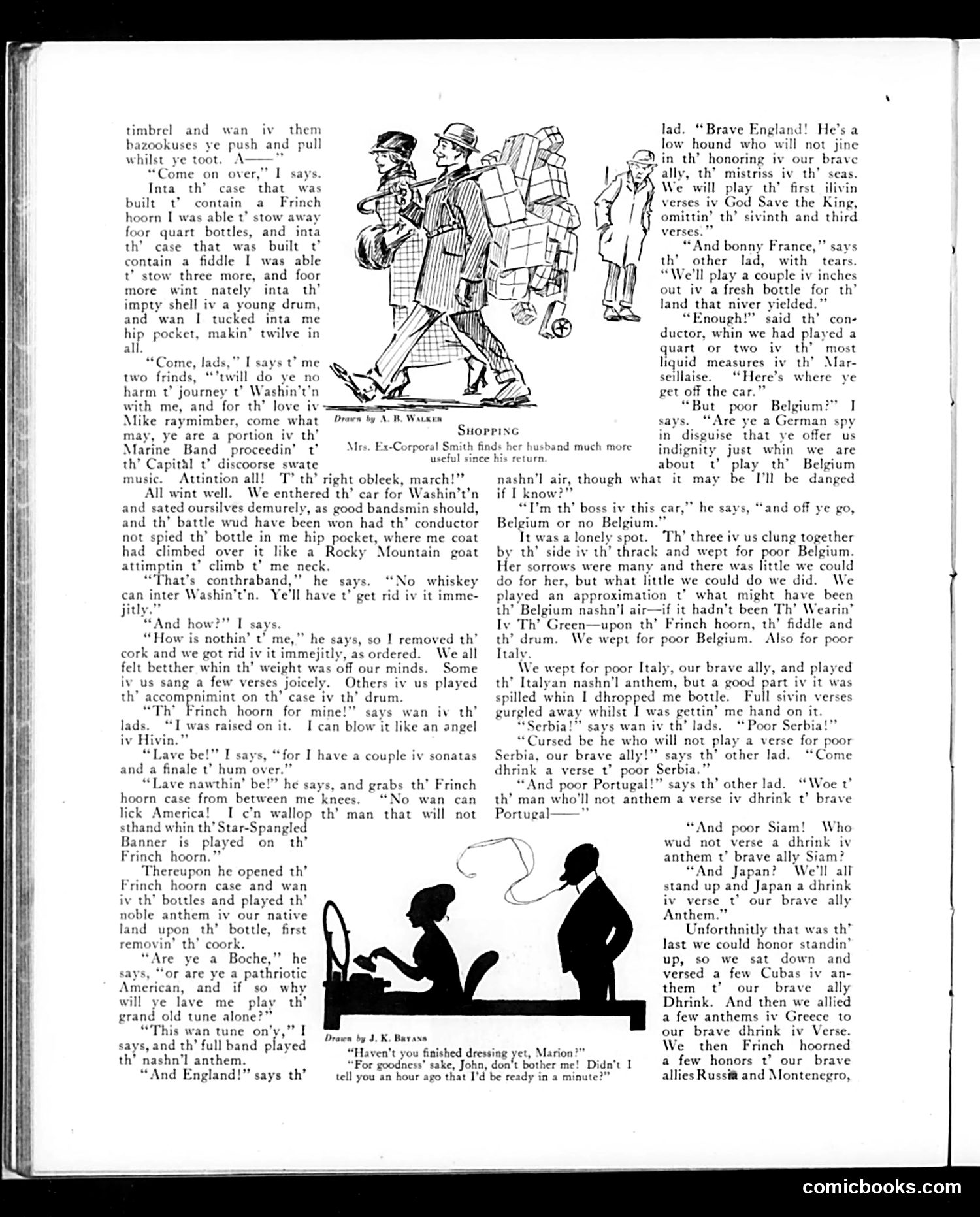
This page satirizes Allied soldiers' behavior during World War I. The narrative describes servicemen from various nations (French, British, Belgian, Italian, Portuguese, Japanese, and others) improvising musical instruments from war materials and playing national anthems to boost morale. The top cartoon ("Shopping") depicts soldiers laden with bottles, apparently scavenging for alcohol. The text jokes about officers turning a blind eye to looting and drinking. The bottom illustration shows a domestic scene with the caption about a wife questioning her husband's readiness, likely contrasting civilian life with soldiers' activities abroad. The satire targets military discipline and soldiers' creative opportunism during wartime—making light of both looting and morale-building efforts among the Allied forces.
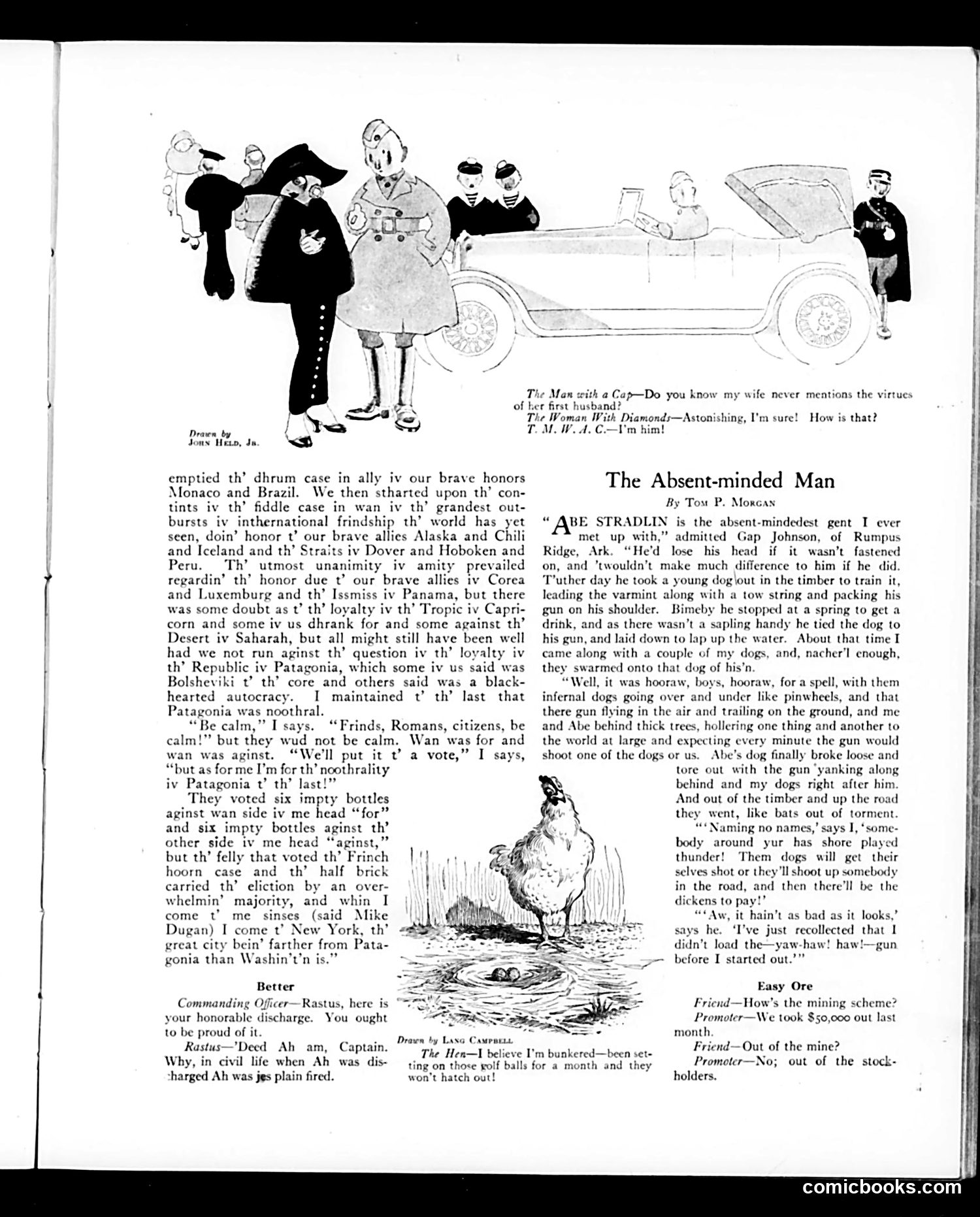
This page contains three satirical pieces: **"The Absent-minded Man"** (main story): A tall tale about an extremely forgetful man named Abe Stradlin who ties his hunting dog to his gun while drinking from a spring. When other dogs attack, the gun goes flying with the dog attached, creating chaos. The humor culminates when Abe reveals he never loaded the gun in the first place—the entire panic was unnecessary. This plays on rural/frontier character types common in early 20th-century American humor. **"Better"** (brief joke): A racist dialogue between a white officer and a Black soldier ("Rastus") making a pun about discharge—in civilian life he was "fired," but now he's being honorably discharged. The joke relies on demeaning dialect and stereotypes prevalent in period magazines. **"Easy Ore"** (bottom): A stock-market swindle joke where a promoter admits taking $50,000 "out of the stockholders" rather than from the mine itself—satirizing investment fraud and financial schemes of the era.
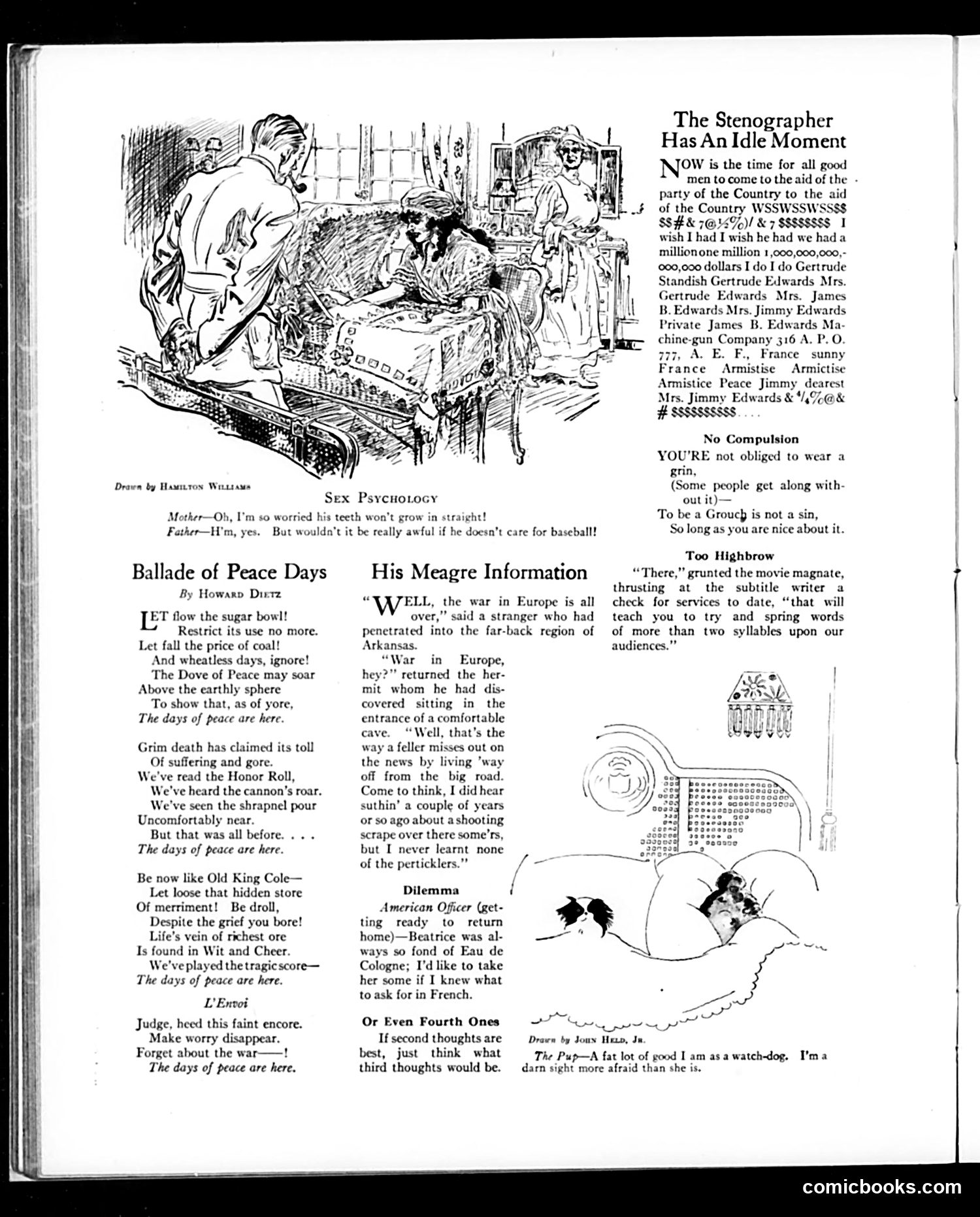
This page from Judge (likely post-WWI, given references to the armistice) contains several satirical pieces: **"Sex Psychology"**: Mocks parental priorities—a mother worries about her child's teeth alignment while the father considers it catastrophic if the boy doesn't care for baseball, reflecting absurd gender-role expectations of the era. **"Ballade of Peace Days"**: A poem celebrating post-war return to normalcy—lifting sugar rationing, coal price controls, and "wheatless days," urging citizens to abandon wartime sacrifice and worry. **"His Meagre Information"**: Satirizes rural isolation. An Arkansas hermit, living far from civilization, only vaguely recalls hearing about "a shooting scrape" in Europe years ago—poking fun at how disconnected remote communities were from major world events. **Other sketches** mock Hollywood subtitle writing pretension, romantic complications involving French cologne, and pessimistic self-awareness in a watchdog. The overall tone emphasizes post-war adjustment, American regionalism, and social absurdities of the period.
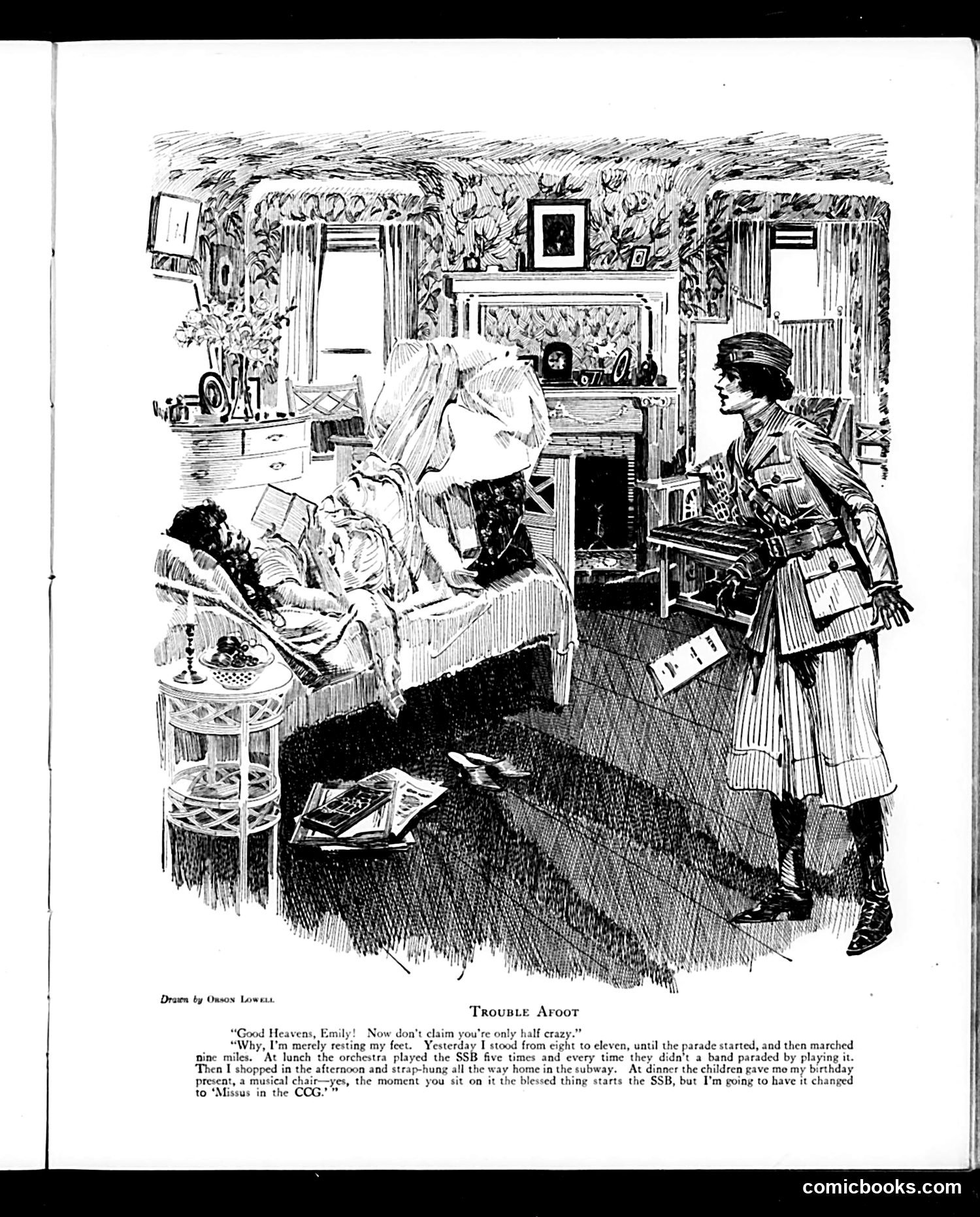
This satirical cartoon mocks the exhaustion caused by an apparently omnipresent popular song. A woman, sitting with her feet up, defends her rest to her husband (Emily) by cataloging a day consumed by a tune referred to as "SSB" — likely a contemporary hit song that played constantly in 1910s-20s public spaces. The joke targets how this song infiltrated every aspect of urban life: parades, orchestras, street bands, even a novelty musical chair as a birthday gift. The woman's exasperation—wanting to change the chair to play "Missus in the COG" instead—reflects public frustration with relentless, inescapable popular music in modern city life. The cartoon satirizes both the song's ubiquity and the era's emerging mass-media culture, where a single tune could dominate public consciousness through new technologies and commercial promotion.
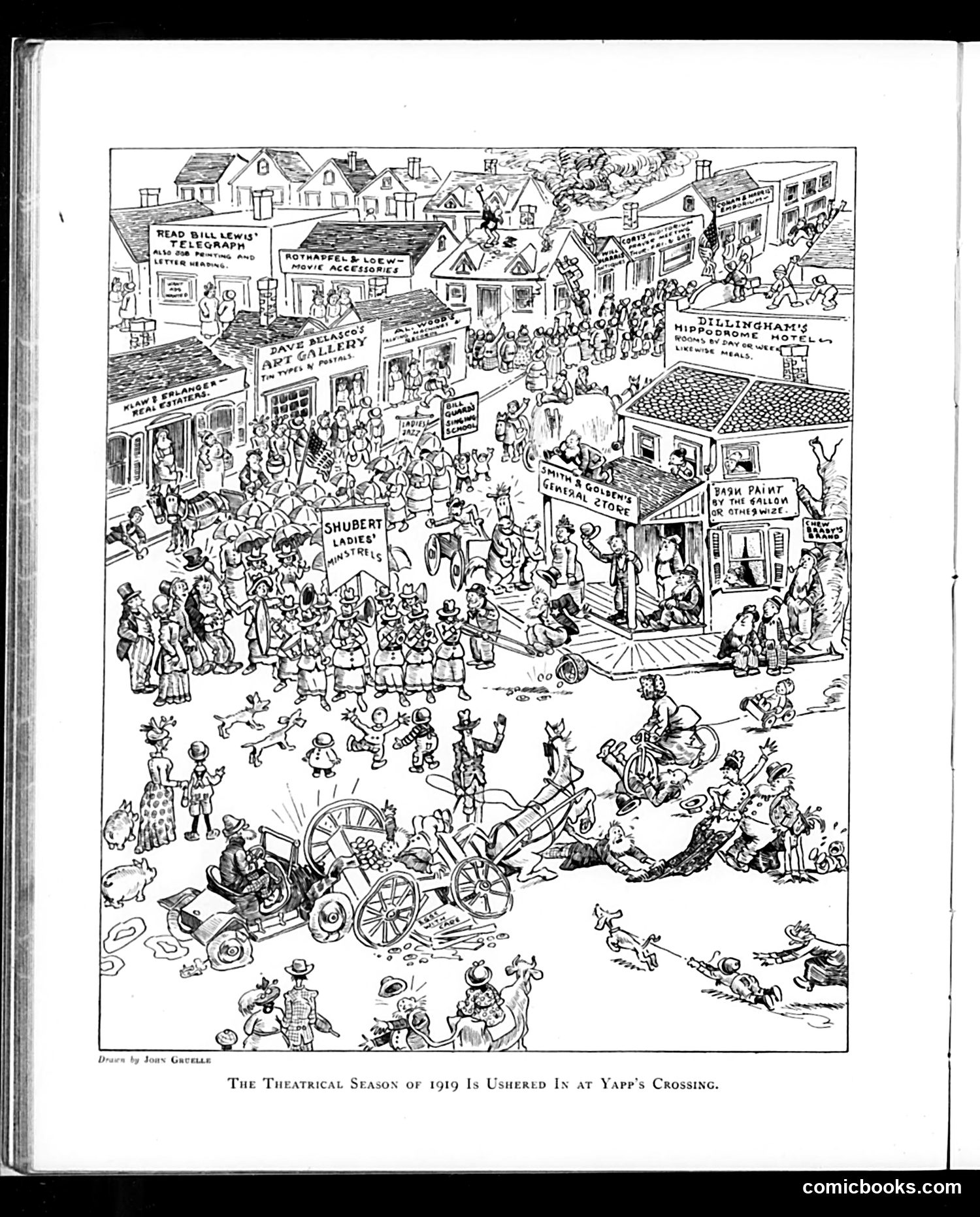
This is a crowded street scene satirizing the opening of the 1919 theatrical season. The cartoon depicts chaos at "Yapp's Crossing"—a busy intersection packed with crowds, children, vehicles, and various commercial establishments. Visible business signs include Bill Lewis's Telegraph office, a ladies' tailoring shop (Shubert), Dillingham's Hippodrome Hotel, and various other storefronts. The humor stems from the frenzied, disorderly nature of the scene—suggesting the theatrical season's arrival creates pandemonium rather than orderly excitement. The caption's reference to "Yapp's Crossing" appears to be a real location, possibly in a theatrical district. The crowding, accidents with carriages and bicycles, and general mayhem satirize how major cultural events—particularly Broadway's theatrical season—disrupted normal city life and attracted massive, unruly crowds. The satire targets both the theater industry's self-importance and urban disorder.
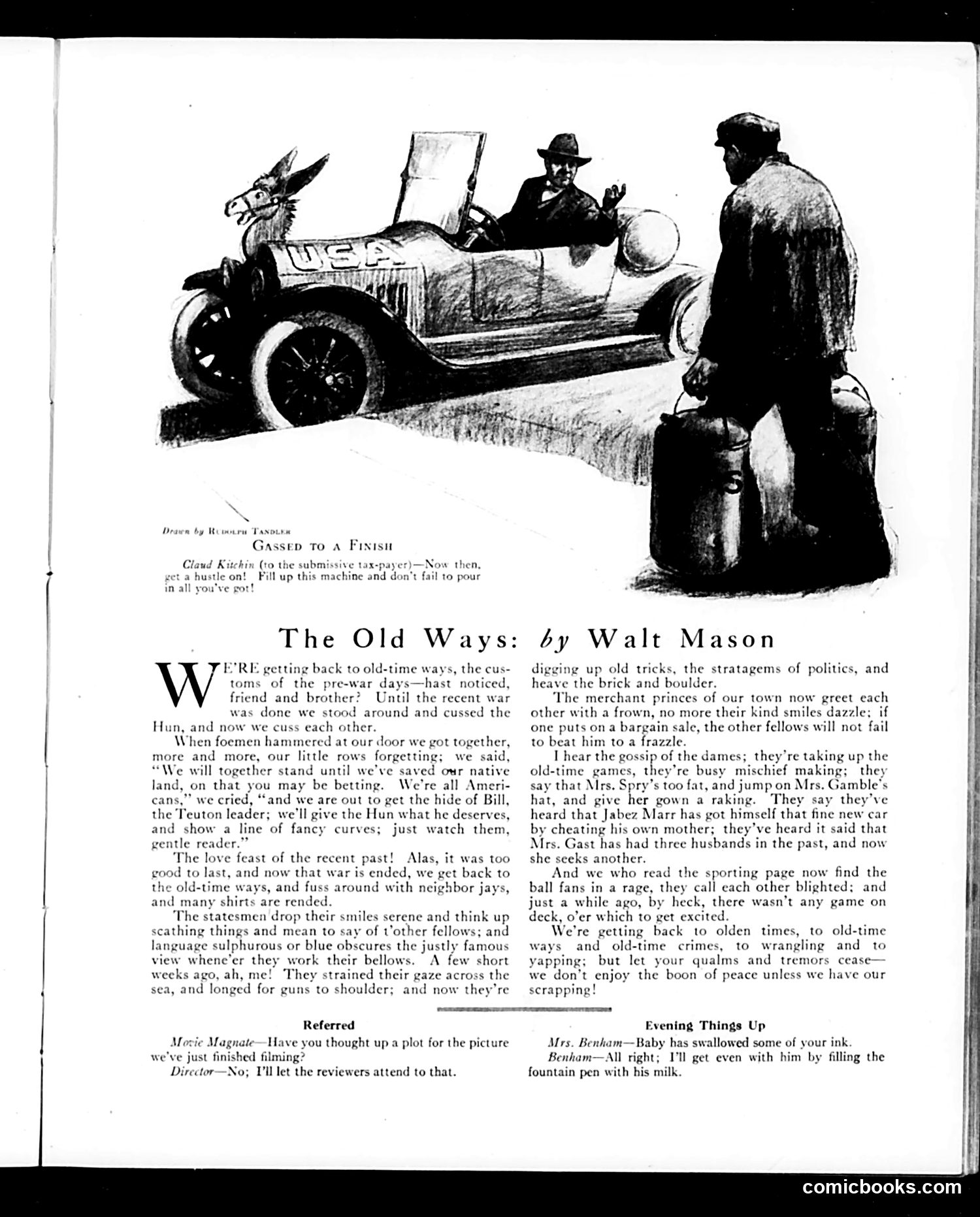
This page contains a satirical poem by Walt Mason lamenting America's return to peacetime discord after World War I. The cartoon at top shows a wealthy man in a car (labeled "U.S.A.") being approached by a working man—likely representing post-war class tensions and economic inequality. Mason's poem argues that during the war, Americans united against a common enemy (the Hun/Germans), but now that peace has arrived, they've reverted to petty feuding: politicians scheme, merchants undercut each other, society women gossip and mock each other's appearance, sports fans quarrel, and neighbors squabble. The author sardonically suggests Americans prefer conflict to genuine peace. The brief comic exchanges below satirize Hollywood filmmaking and domestic absurdity—typical Judge humor filler. The overall message reflects post-WWI disillusionment about whether wartime national unity could create lasting social improvement.
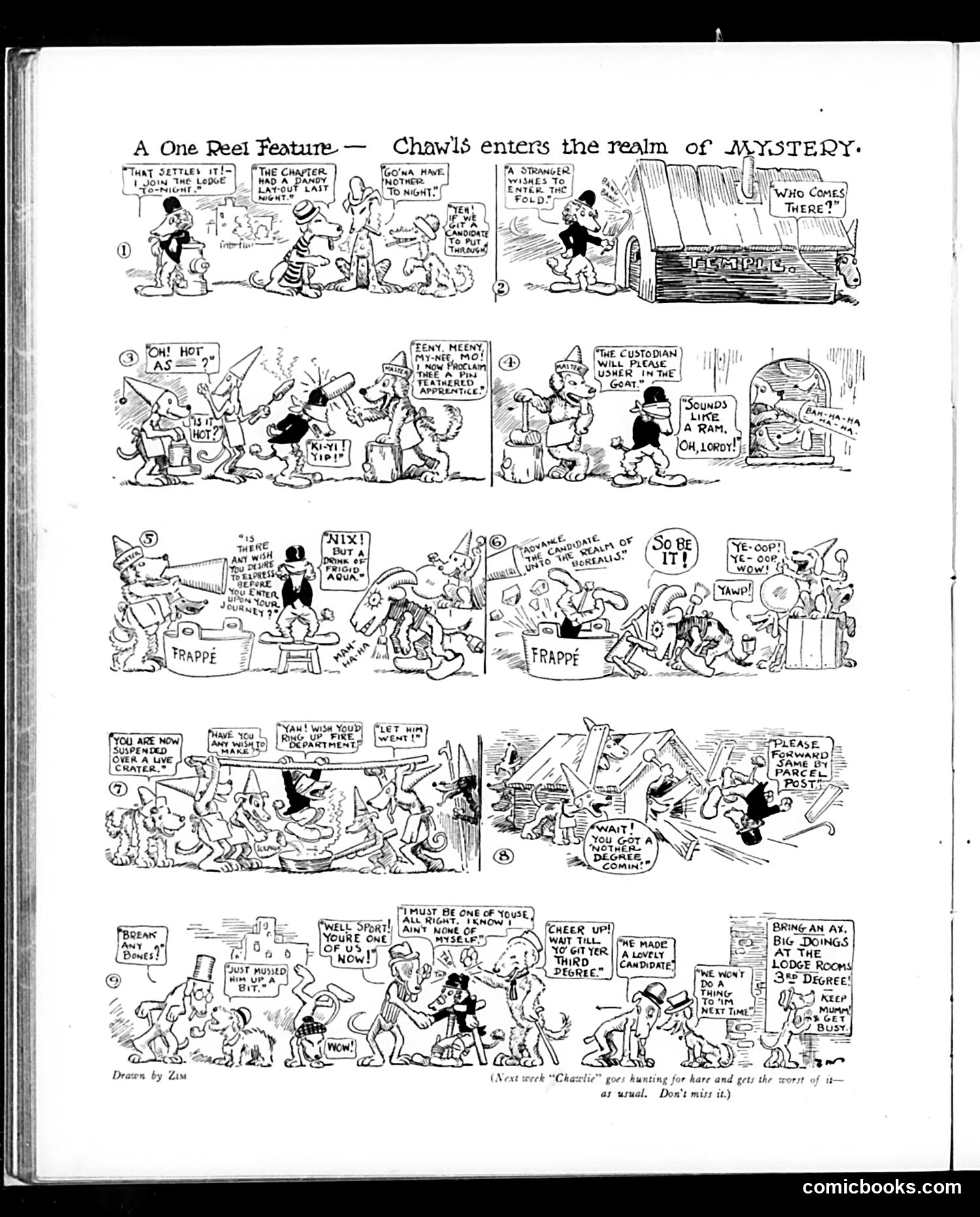
This is a slapstick silent-film parody titled "A One Reel Feature," mimicking early cinema comedies. The protagonist "Chawl's" (appears to be a working-class character type) attempts to join a fraternal lodge or secret society, encountering increasingly absurd obstacles: a mysterious door, confused gatekeepers asking riddles ("Eeny Meeny"), a custodian and usher creating chaos, and ultimately a trapdoor that dumps him repeatedly. The satire targets fraternal organizations (Masons, Odd Fellows, etc.) popular in early 20th-century America—their secretive rituals, elaborate initiation ceremonies, and pompous formality. The comic ridicules both the organizations' pretensions and initiates' desperation for membership. The final panels show lodge members engaged in chaotic indoor "doings," reinforcing the joke that these supposedly dignified organizations are actually absurd. Drawn by Zim, this reflects Judge magazine's typical satirical humor about American institutions and social climbing.
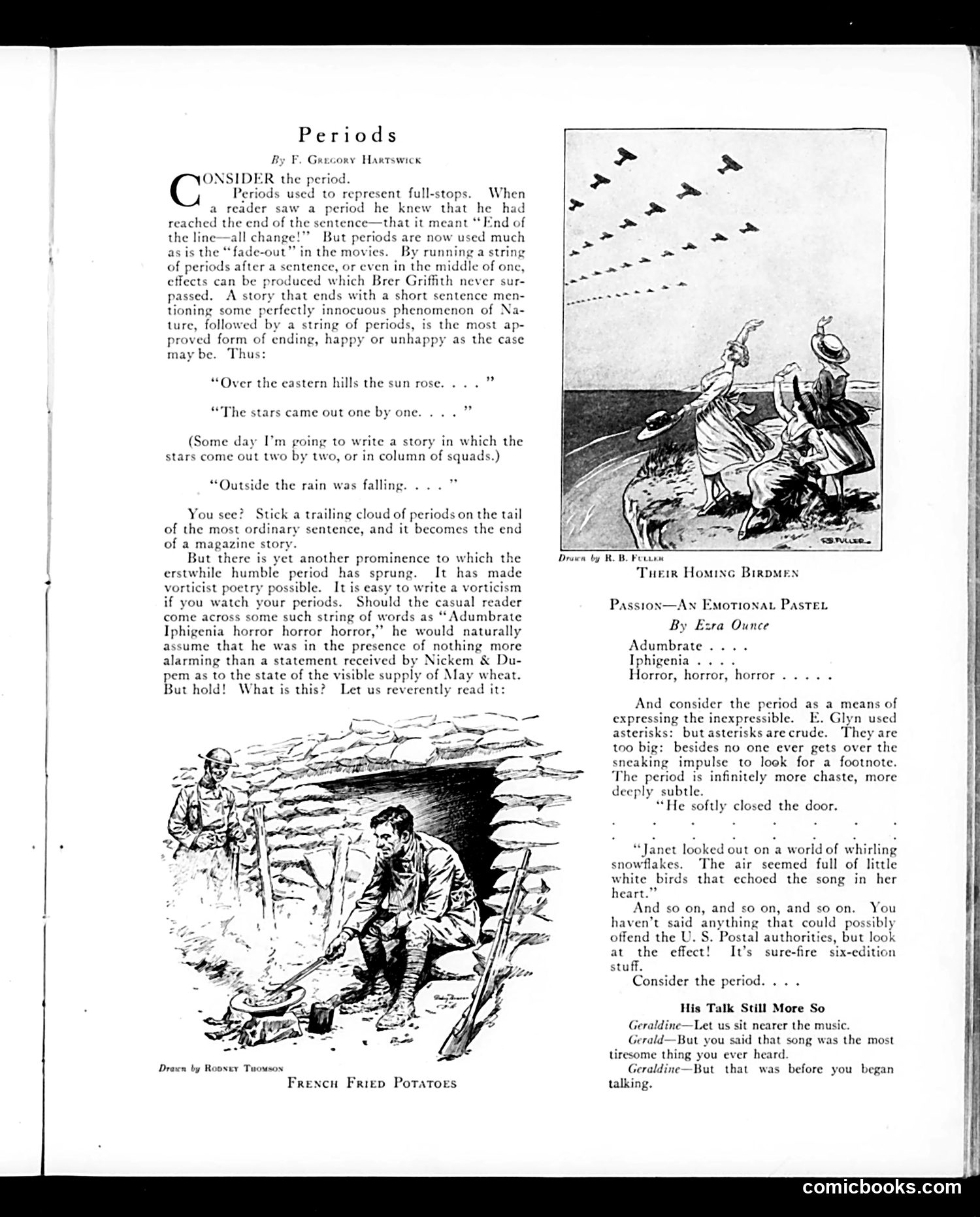
This is a humorous essay by F. Gregory Hartswick mocking contemporary literary trends, particularly modernist writing styles. The piece satirizes how the period punctuation mark has become a literary device mimicking the "fade-out" effect in cinema—trailing ellipses (...) create artificial dramatic effect on ordinary sentences. Hartswick ridicules "vorticist poetry" (referencing the avant-garde Vorticism movement), suggesting that strings of random words like "Adumbrate Iphigenia horror horror horror" become profound when followed by periods, fooling readers into thinking they've encountered deep meaning rather than nonsense. The accompanying illustrations are unrelated vignettes: "Three Homing Birdmen" (top right), "French Fried Potatoes" (bottom left showing soldiers), and "His Talk Still More So" (a brief domestic joke about a woman finding her boyfriend's conversation more tiresome than music). The satire targets pretentious modern literary experimentation and reader gullibility.
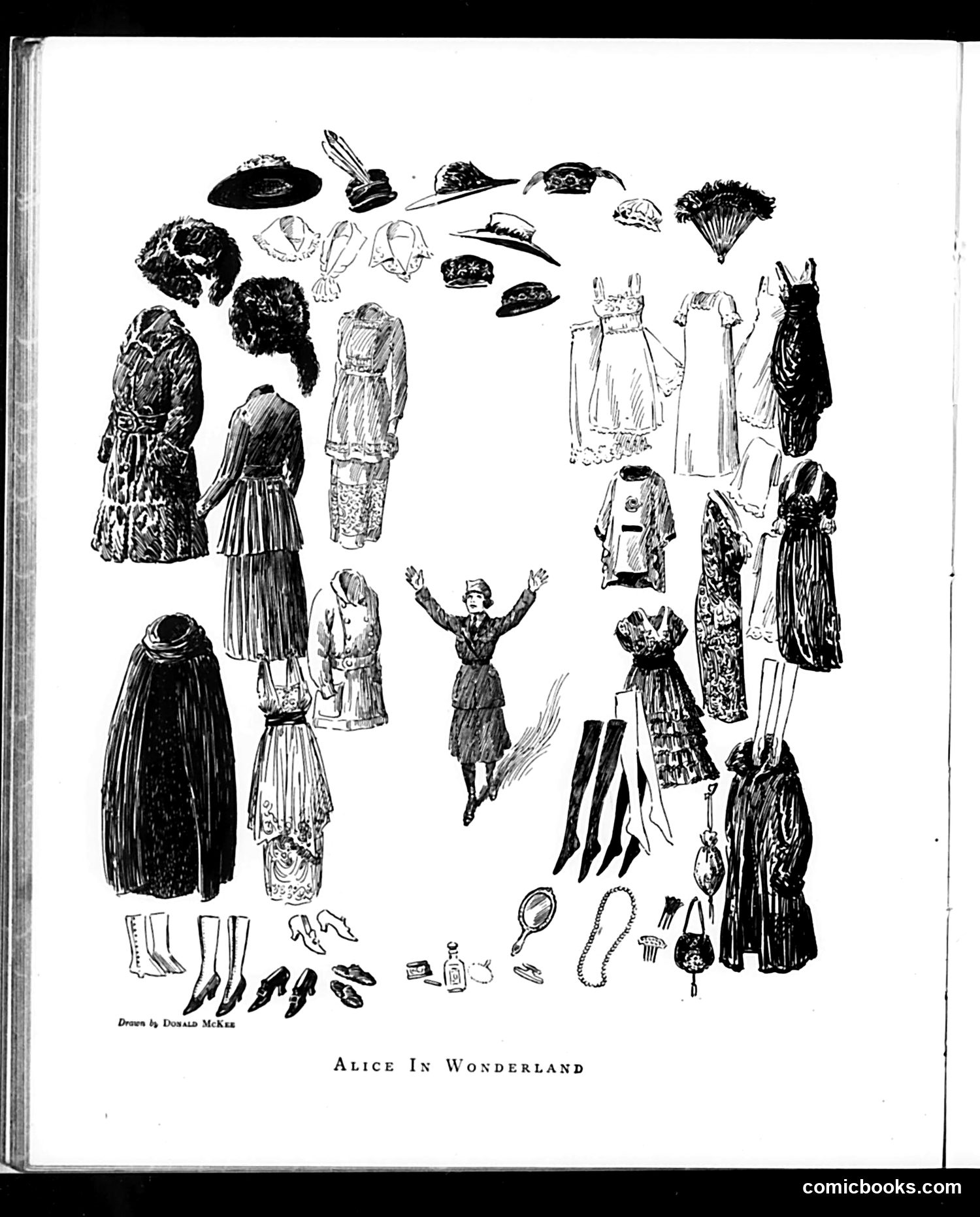
This is a costume and fashion illustration page titled "Alice in Wonderland," drawn by Donald McKee. Rather than a political cartoon, it's a design reference sheet showing clothing and accessories—likely for a theatrical production or costume guide of Lewis Carroll's classic story. The page displays various women's outfits from the early 20th century, including coats, dresses, hats, shoes, and accessories. A central figure with raised arms appears to represent Alice herself. The illustration demonstrates period fashion details and styling options, serving as practical reference material for costume designers or seamstresses rather than satirical commentary. This appears to be educational or instructional content rather than political satire typical of Judge magazine.
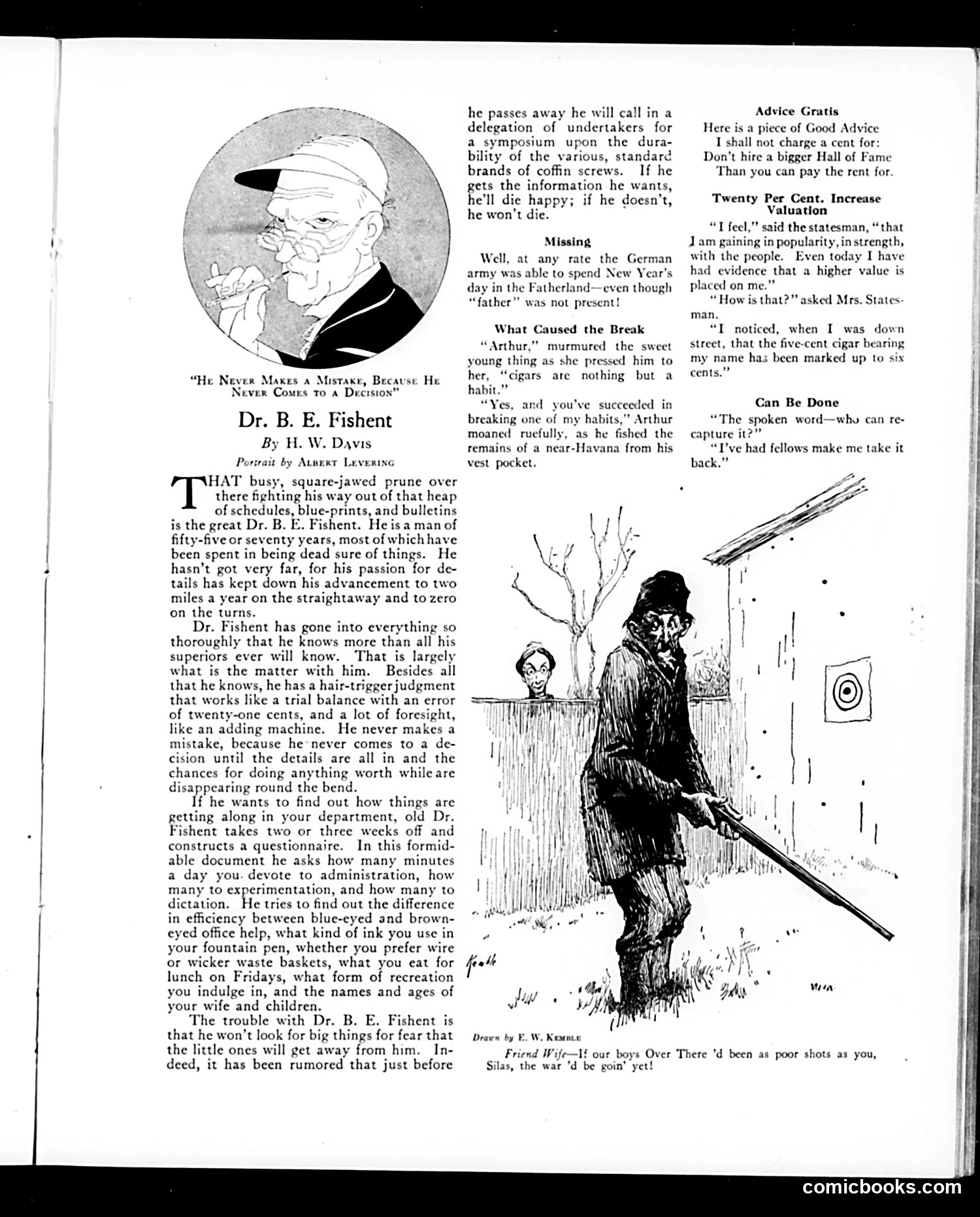
This page contains a satirical profile of **Dr. B. E. Fishent**, a bureaucratic administrator characterized as obsessively detail-oriented to the point of paralysis. The central critique: he's so consumed with minutiae (coffee screws, ink types, office helper eye color) that he avoids making substantive decisions. The title joke—"He Never Makes a Mistake, Because He Never Comes to a Decision"—captures the satire: by refusing to commit, he never fails, but accomplishes nothing. The page also includes unrelated wartime jokes referencing WWI (a "German army" reference and mention of "boys Over There"), and humorous anecdotes about cigars and political self-promotion. For modern readers: this is primarily **workplace satire** targeting the emerging bureaucratic culture of early 20th-century American business—the frustration with administrators who prioritize procedure over progress. Fishent represents the absurdity of institutional bloat.
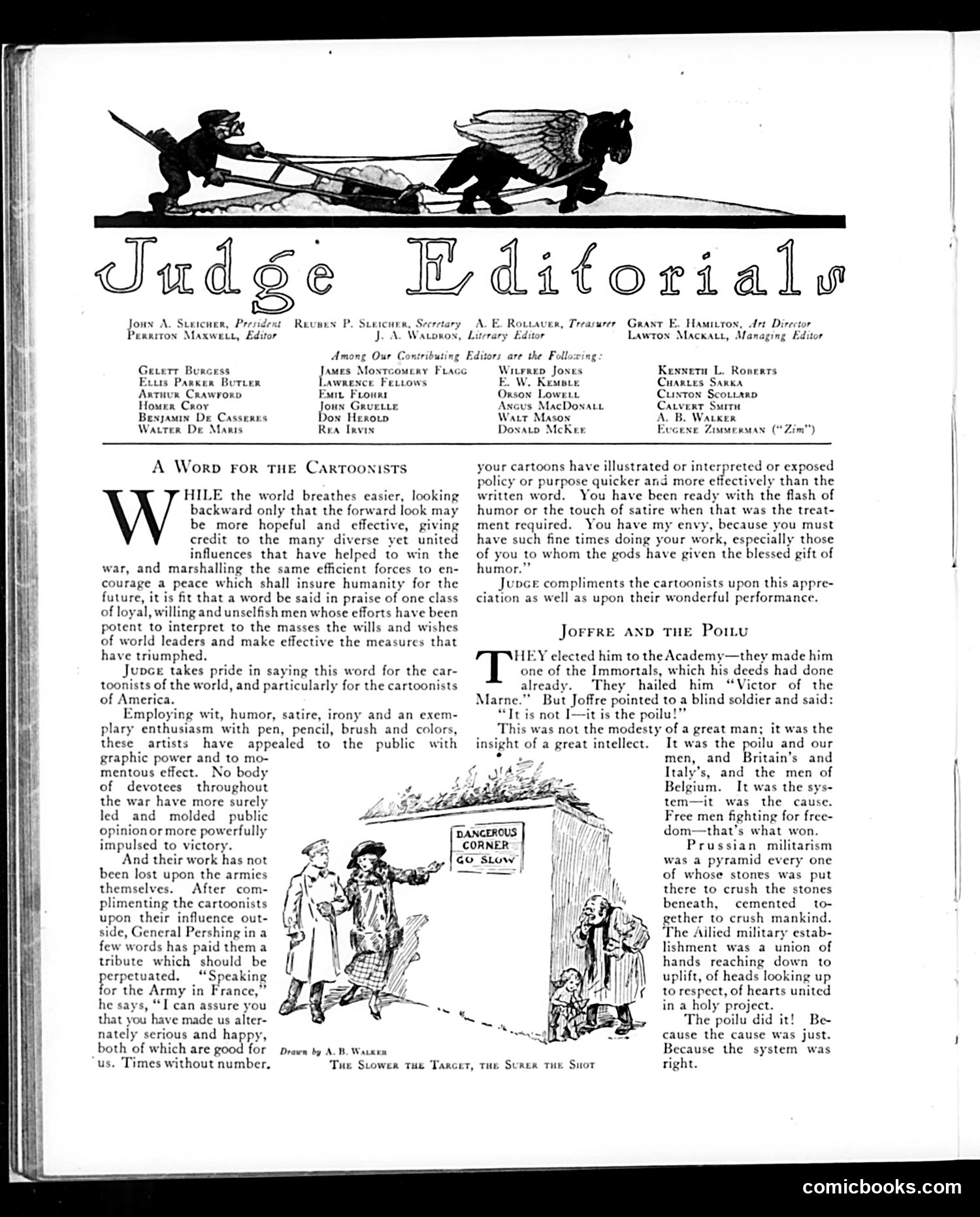
This is primarily a **tribute to wartime cartoonists**, not a political cartoon itself. The main content is an editorial praising cartoonists' contributions to Allied victory in World War I. Judge credits them with effectively mobilizing public opinion and morale—even General Pershing is quoted praising their ability to make soldiers "alternately serious and happy." The page includes one small cartoon by A.B. Walker titled "The Slower the Target, the Surer the Shot," depicting what appears to be civilians at a "Dangerous Corner"—likely a safety warning. The secondary article celebrates **French General Joffre**, who credits the victory not to himself but to "the poilu" (French infantry soldiers). The piece contrasts the **Allied system**—described as democratic hands "reaching down to uplift"—with **Prussian militarism**, depicted as a pyramid designed to "crush" those beneath it. This reflects post-WWI propaganda celebrating democratic values over autocratic systems. The page emphasizes how Allied victory stemmed from just causes and unified effort, not individual genius.
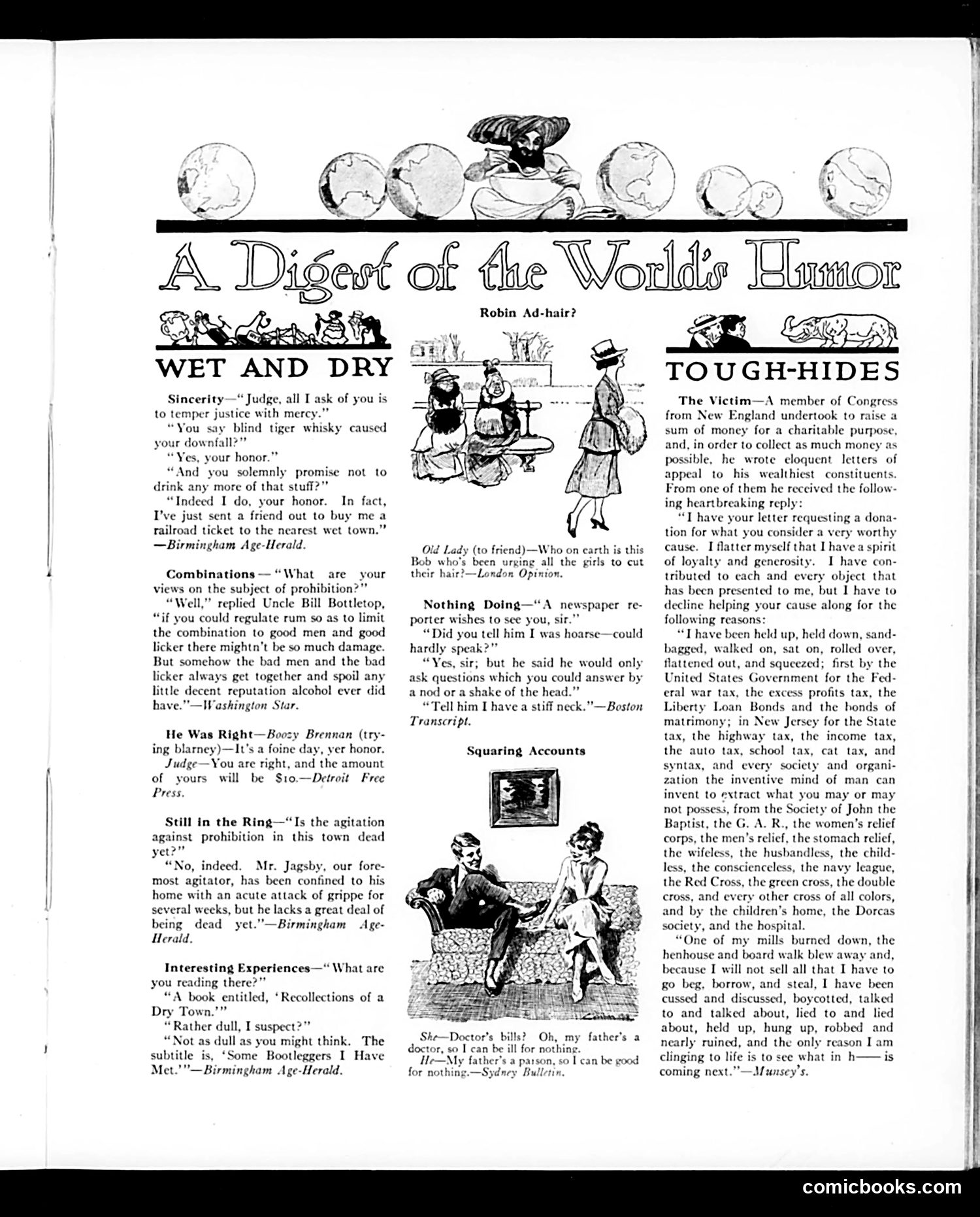
This page collects humorous anecdotes mocking prohibition's ineffectiveness and hypocrisy. The recurring joke is that despite legal bans on alcohol, people continue drinking through "blind tigers" (illegal bars) and bootleggers. The satire targets: 1. **Judicial futility**: A judge accepts a defendant's promise to stop drinking, then learns the man immediately bought a ticket to a "wet town"—implying prohibition simply relocates the problem. 2. **Congressional corruption**: The "Tough-Hides" piece shows a wealthy constituent refusing to donate to charity, listing exhaustive taxes and obligations (federal war tax, Liberty Bonds, state taxes, various charitable organizations). The satire suggests donors are already squeezed dry by government and institutions. 3. **Prohibition's unpopularity**: Multiple jokes present alcohol restrictions as ongoing public resistance rather than accepted policy. The humor reflects early-prohibition-era (likely 1920s) skepticism about the policy's enforceability and broader frustration with government overreach and taxation.
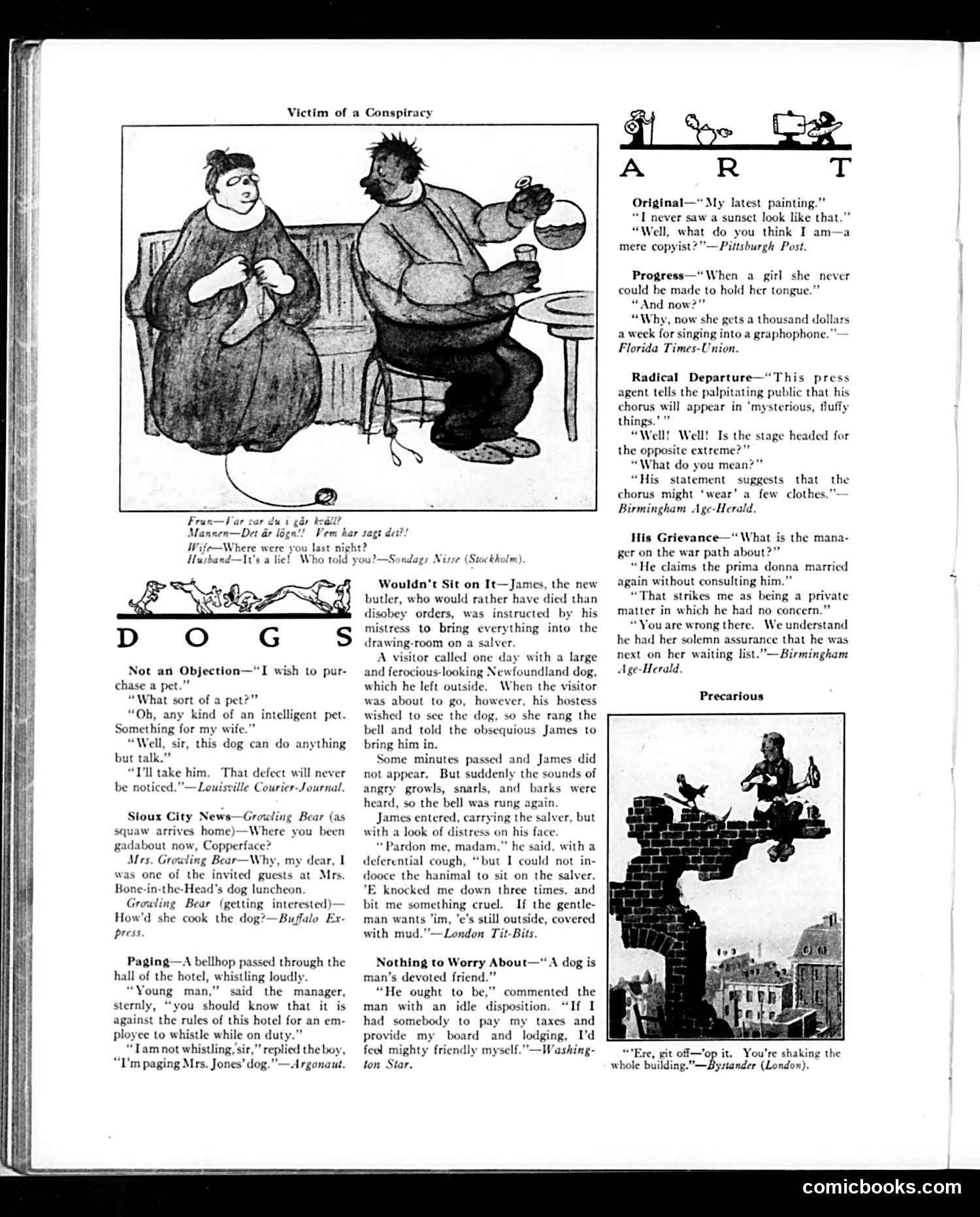
This page collects brief comic anecdotes from various newspapers, mostly centered on domestic disputes and absurd situations. The main cartoon shows a husband denying he was out late while his wife confronts him—the joke being marital distrust and the husband's transparent lie. The surrounding humor pieces feature similar themes: a man buying a dog specifically because it *can't* talk (implying his wife talks too much), a butler literally obeying orders to carry a large dog on a serving tray, and a press agent claiming chorus girls will wear "mysterious, fluffy things" (mocking theatrical pretense about modesty). The page reflects early-20th-century gender humor stereotypes—nagging wives, talkative women, marital conflict. One piece references a woman earning money singing into early recording technology, showing contemporary fascination with new media. The cartoons assume male readers will recognize and laugh at recognizable domestic frustrations and the absurdities of literal obedience.
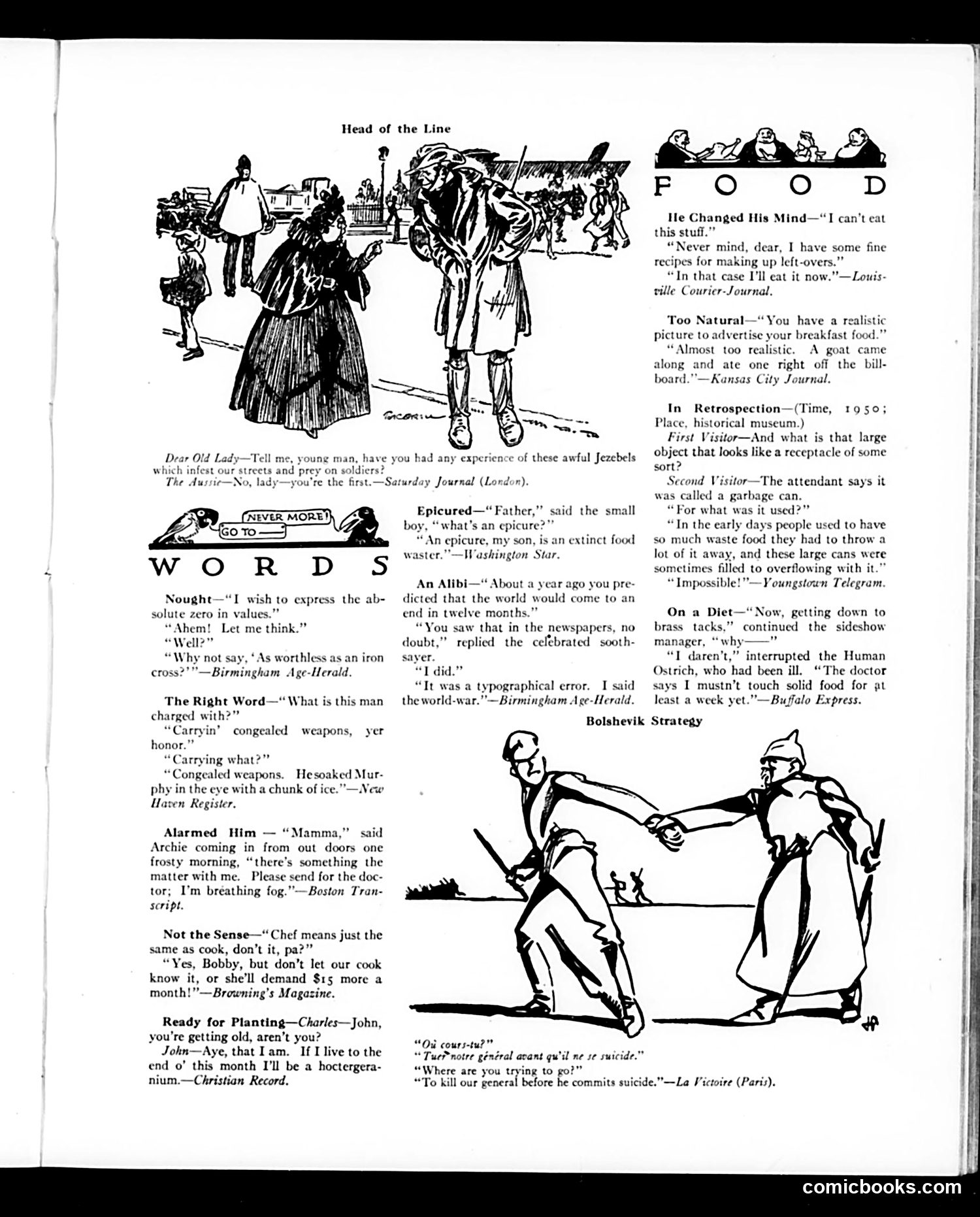
This page contains humorous short jokes and two political cartoons from Judge magazine, likely from WWI era (references to "world-war" and the "Bolshevik Strategy" cartoon). **The jokes** are wordplay and domestic humor: a man wanting to express "worthlessness," a chef demanding higher pay than a "cook," a boy breathing fog on a frosty morning, etc. One notable joke predicts 1950 as a time when garbage cans are museum pieces—satirizing food waste concerns. **"Bolshevik Strategy"** cartoon depicts two military figures. The French caption reveals dark satire: one soldier asks where the other is going; the answer is "to kill our general before he commits suicide." This mocks Allied leadership during WWI, suggesting generals were so incompetent or pessimistic that soldiers felt compelled to prevent their surrender. **The "Head of the Line"** illustration at top appears to show street scenes with various characters, though its specific satirical point is unclear from the visible text. Overall, the page reflects post-WWI American humor about war, food rationing, and social change.
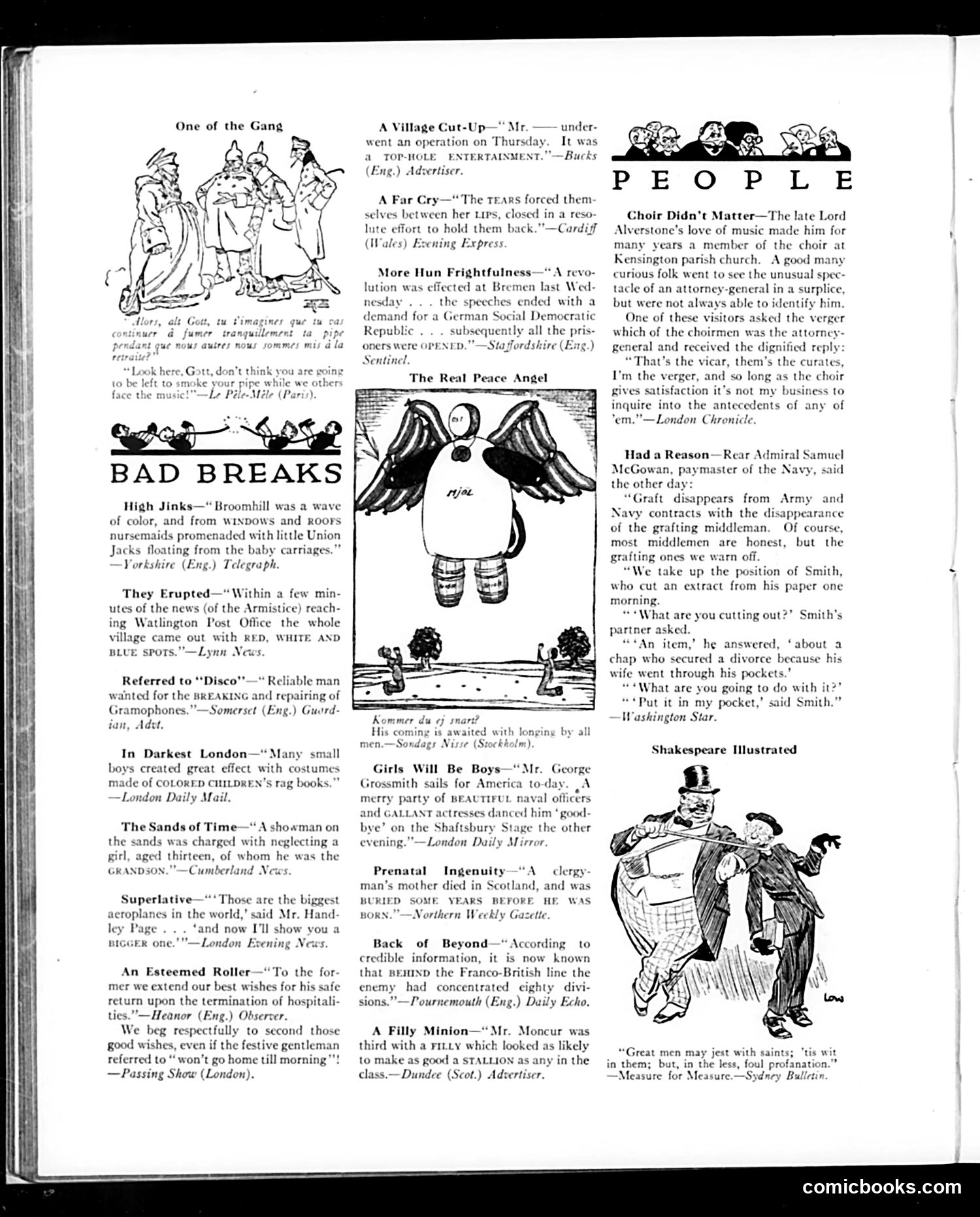
This page collects brief satirical anecdotes from British newspapers under the heading "Bad Breaks"—humorous snippets about absurdities and malapropisms in wartime Britain (appears to be post-WWI, given Armistice references). The jokes exploit **newspaper printing errors and awkward phrasing**: a man promenading with Union Jacks from "baby carriages" (likely "perambulators"), a clergyman's mother buried before he was born, an airplane dealer claiming to have a "bigger" plane than the world's biggest. The cartoon "The Real Peace Angel" (center) depicts a cherub-like figure, likely symbolizing post-war optimism or peace, though the caption's meaning is unclear from the visible text. **Right side "People" section** contains society gossip about a Lord's choir membership and a naval paymaster anecdote about military contracts—typical light satirical coverage of public figures and bureaucratic absurdities. The overall tone is gentle mockery of newspaper language and wartime news, targeting linguistic mishaps rather than serious political critique.
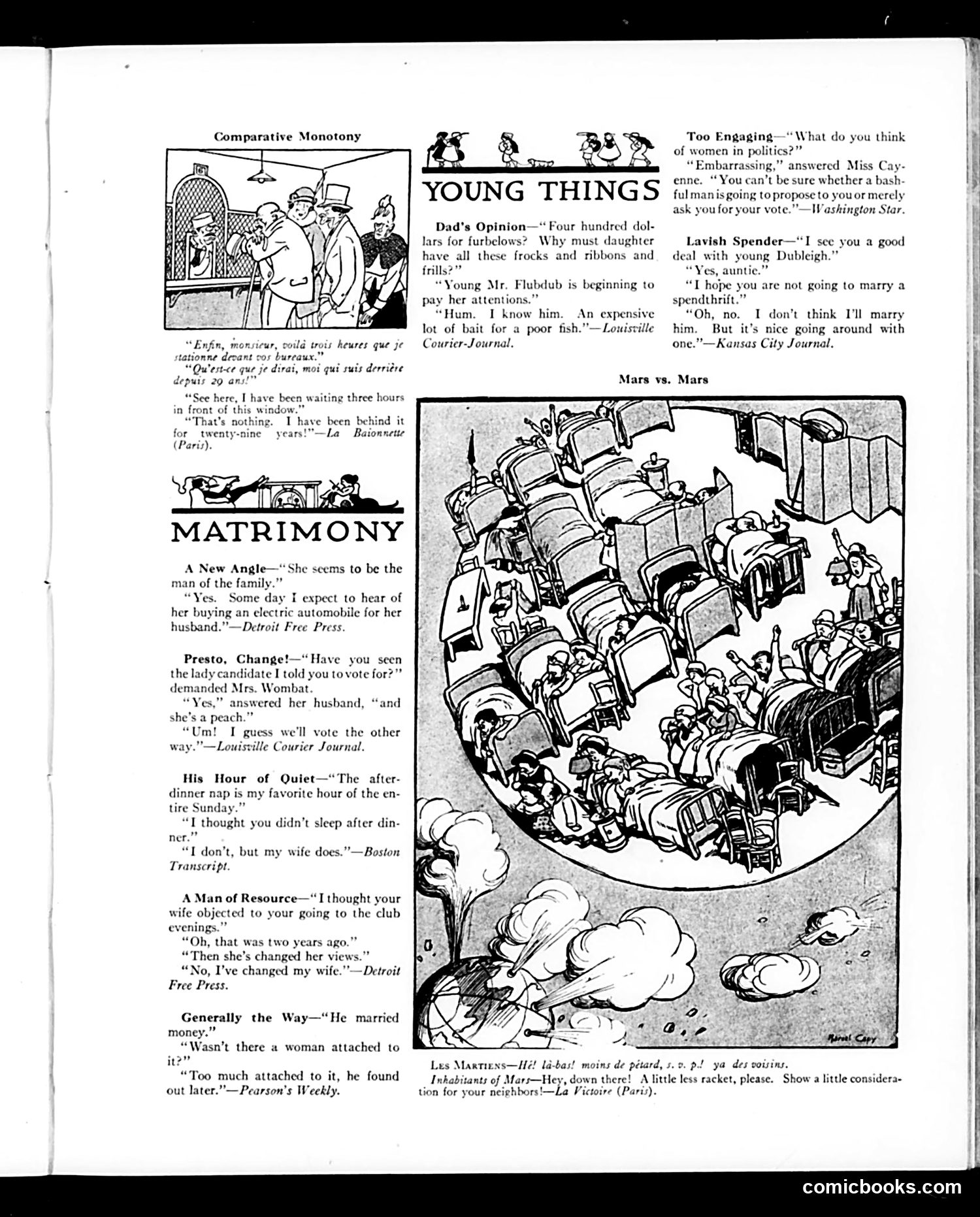
This page from Judge magazine contains several short humor pieces satirizing early 20th-century American domestic life and gender relations. **"Young Things"** and **"Matrimony"** sections mock courtship and marriage through brief anecdotes: fathers' concerns about daughters' expenses, young women's uncertainty about men's intentions (marriage vs. political votes), and married men's strategies for maintaining their independence (claiming to have "changed wives" rather than reformed). **"Mars vs. Mars"** is a cartoon captioned in French, depicting inhabitants of Mars complaining about noise from their neighbors—an absurdist joke about universal domestic annoyance transcending planets. The humor reflects period anxieties: female participation in politics (referenced as "embarrassing"), young women's materialism, and men's loss of autonomy in marriage. The cartoons assume middle-class readership familiar with courtship rituals and marital power dynamics of the era. The satire gently mocks both genders' predictable behaviors within these social conventions.
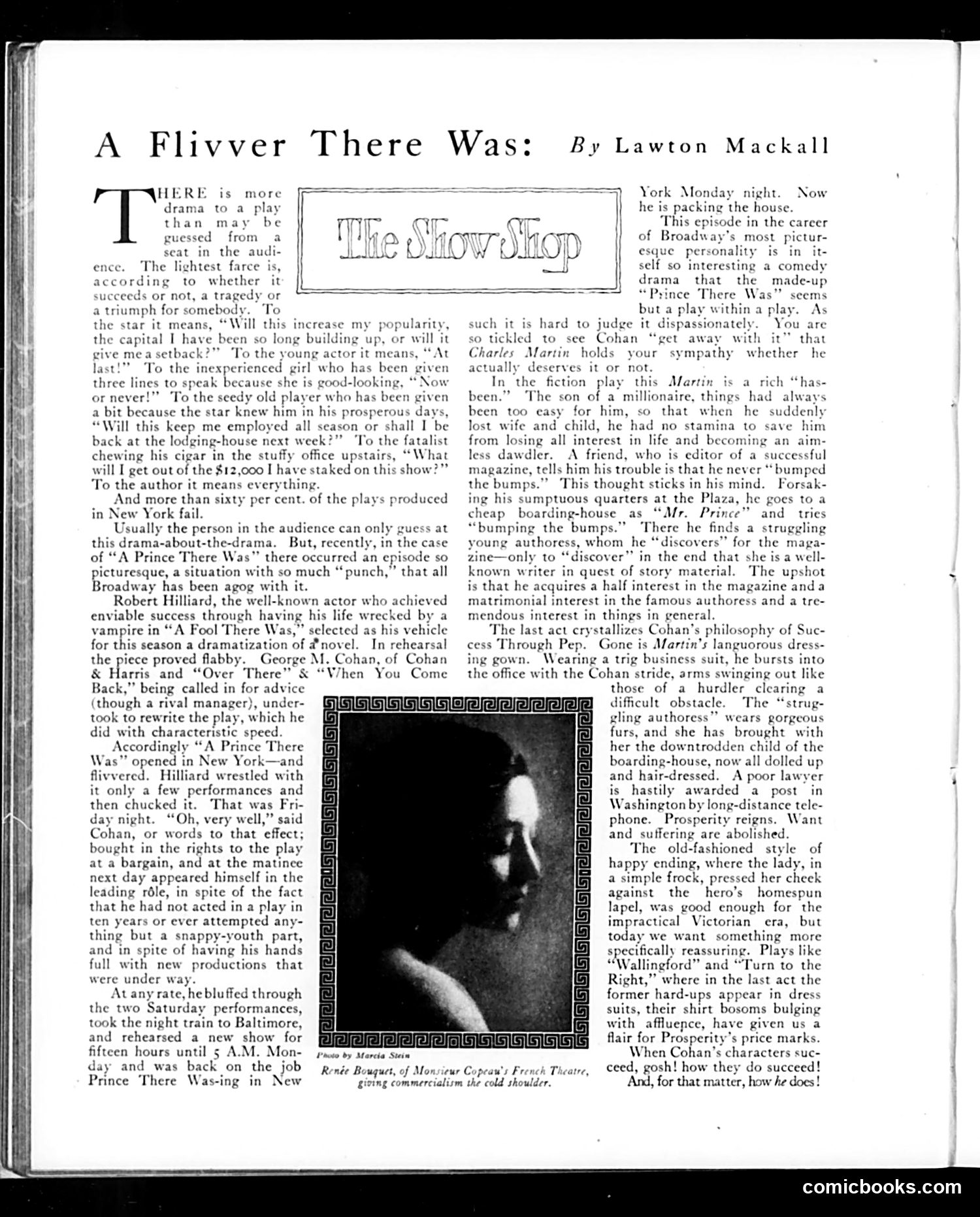
This article by Lawton Mackall discusses actor Robert Hilliard's failed play "A Prince There Was" and George M. Cohan's dramatic intervention. The piece emphasizes Broadway's behind-the-scenes stakes: financial risk, career survival, and artistic ego. The key drama: Hilliard's play "flivvered" (failed) after opening in New York. Cohan, called in as script doctor, rewrote it, then—when Hilliard abandoned it after a few performances—bought the rights himself. Despite not having acted in a decade, Cohan stepped into the lead role that Friday night, performed weekend matinees, took an overnight train to Baltimore to rehearse another show, and returned Monday to continue the role. The accompanying photograph shows **Renée Bouguet** from Cohan's French Theatre company, illustrating the theatrical world being discussed. The satire highlights show business's precariousness and ego: Cohan's willingness to rescue (and profit from) a sinking production reflects both his confidence and the industry's desperation to recover investments.
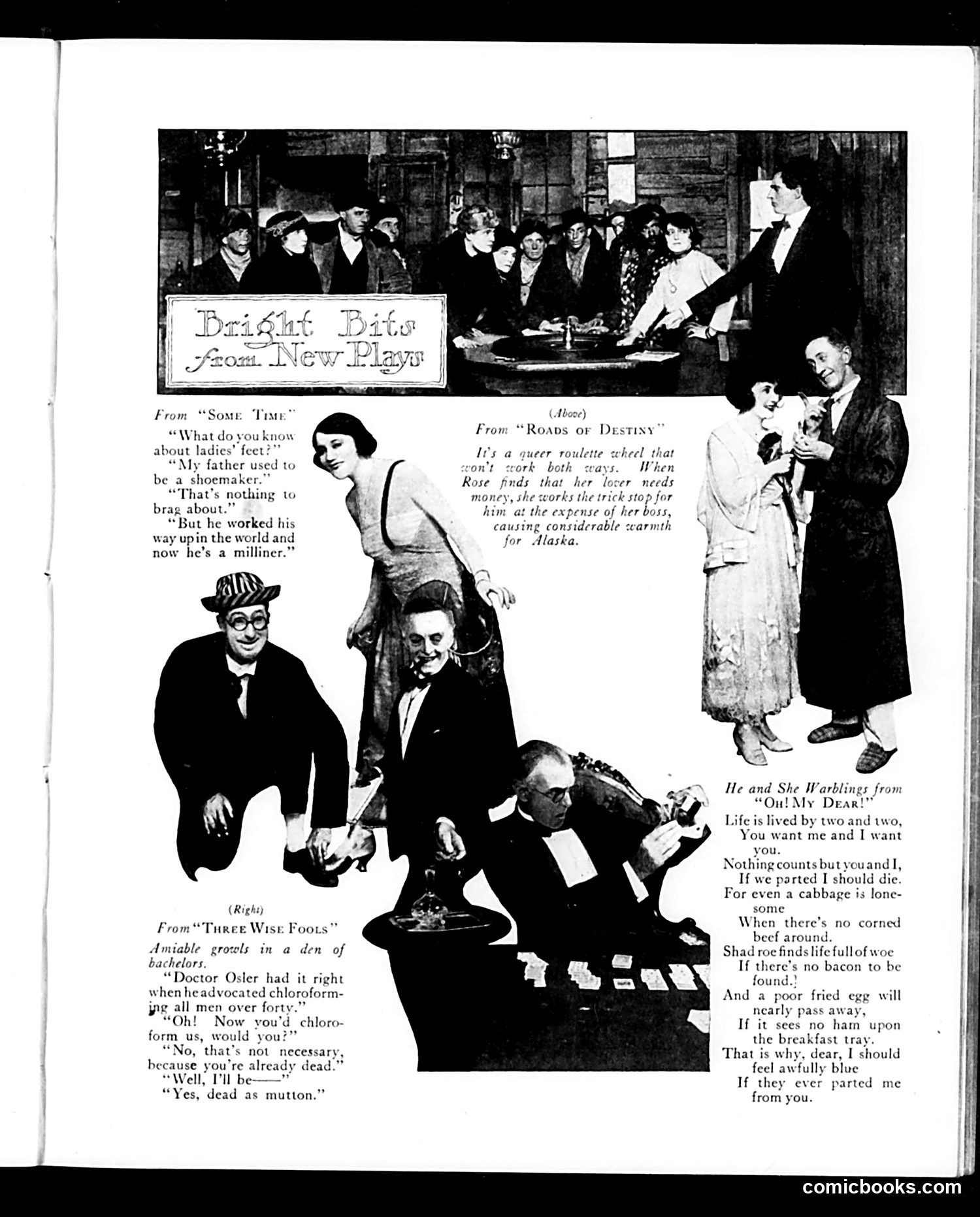
This page contains three separate comedic sketches typical of early 20th-century satirical humor: **"Some Time"** (top left): A joke about social mobility. A man boasts his father rose from shoemaker to milliner (hat maker)—a modest occupational climb, mocking aspirational bragging about minor class advancement. **"Roads of Destiny"** (top): A scenario where a woman manipulates her employer to fund her lover's expenses, with romantic consequences. This appears to satirize workplace dynamics and romantic entanglements. **"Three Wise Fools"** (bottom left): Bachelors joke darkly about Dr. Osler's (a real physician) advocacy for euthanasia of men over forty. One suggests they're "already dead"—a sardonic comment on aging bachelor life. **"Oh! My Dear"** (right): Sentimental verse humorously comparing romantic devotion to food pairings (cabbage needing corned beef, eggs needing ham), deflating romantic ideals through domestic culinary absurdity. The page exemplifies Judge's blend of social commentary, workplace satire, and gentle mockery of contemporary life and attitudes.
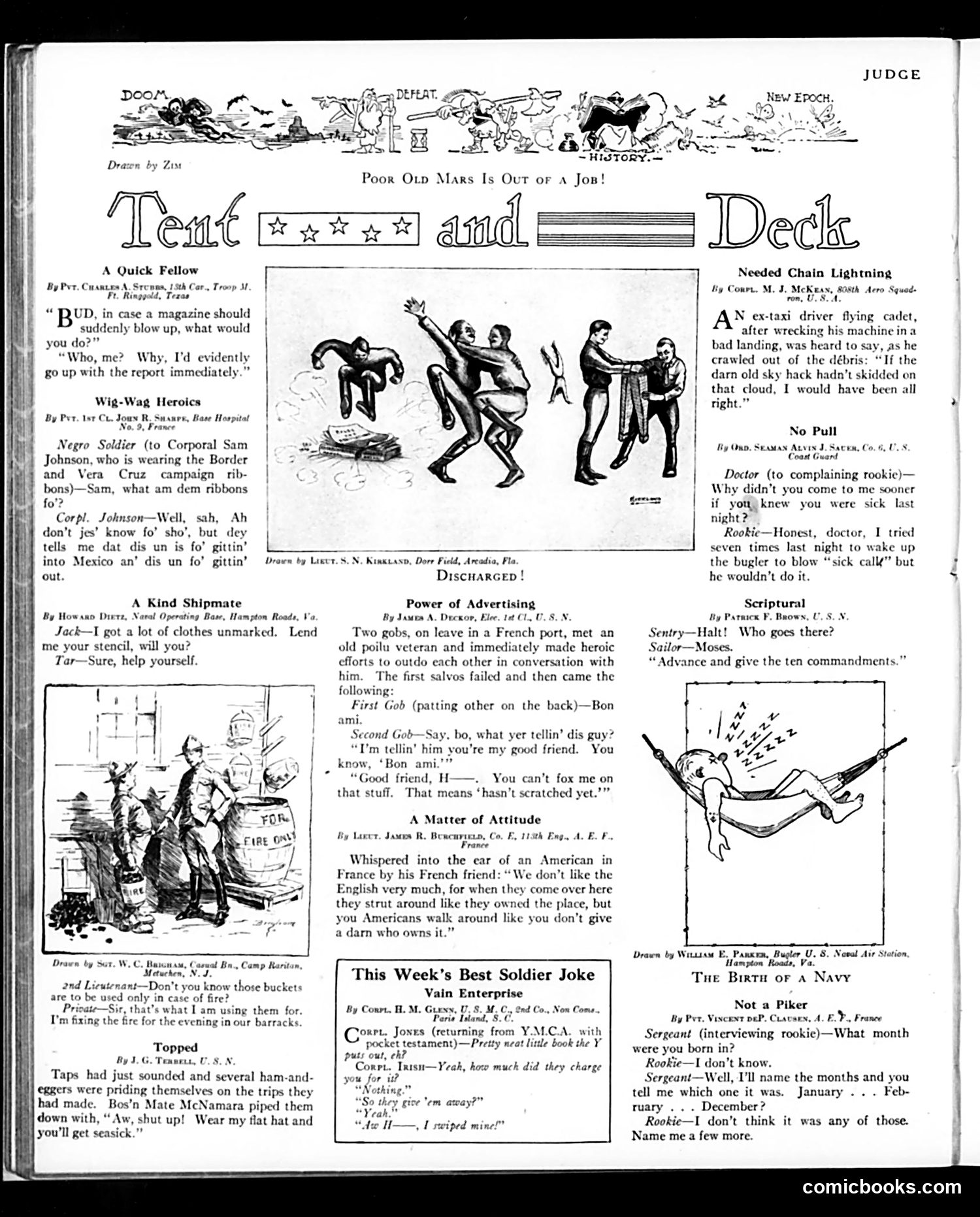
This is a WWI-era humor page from *Judge* magazine, featuring short jokes and cartoons submitted by servicemen. The content reflects military life during the Great War: **Key themes:** - **Soldier incompetence**: Jokes mock recruits' ignorance (the rookie who doesn't know his birth month; the private misusing fire buckets for cooking) - **Military hierarchy humor**: Officers and NCOs interact with inexperienced soldiers in absurd situations - **Language barriers**: American soldiers in France struggle with French ("Bon Ami" soap brand confused for a greeting; "Moses" as a password) - **War-related anxiety**: Dark humor about explosions, crashes, and illness **The satire targets:** - Military bureaucracy and rigid rules applied stupidly - Young, undisciplined recruits - Cultural misunderstandings between Allied forces - The gap between enlisted men's actual competence and military expectations The drawings are crude but clear, accompanying anecdotal jokes. This represents how soldiers themselves satirized military life—a safety valve for wartime frustrations. The humor is gentle rather than political, focusing on everyday military absurdities.
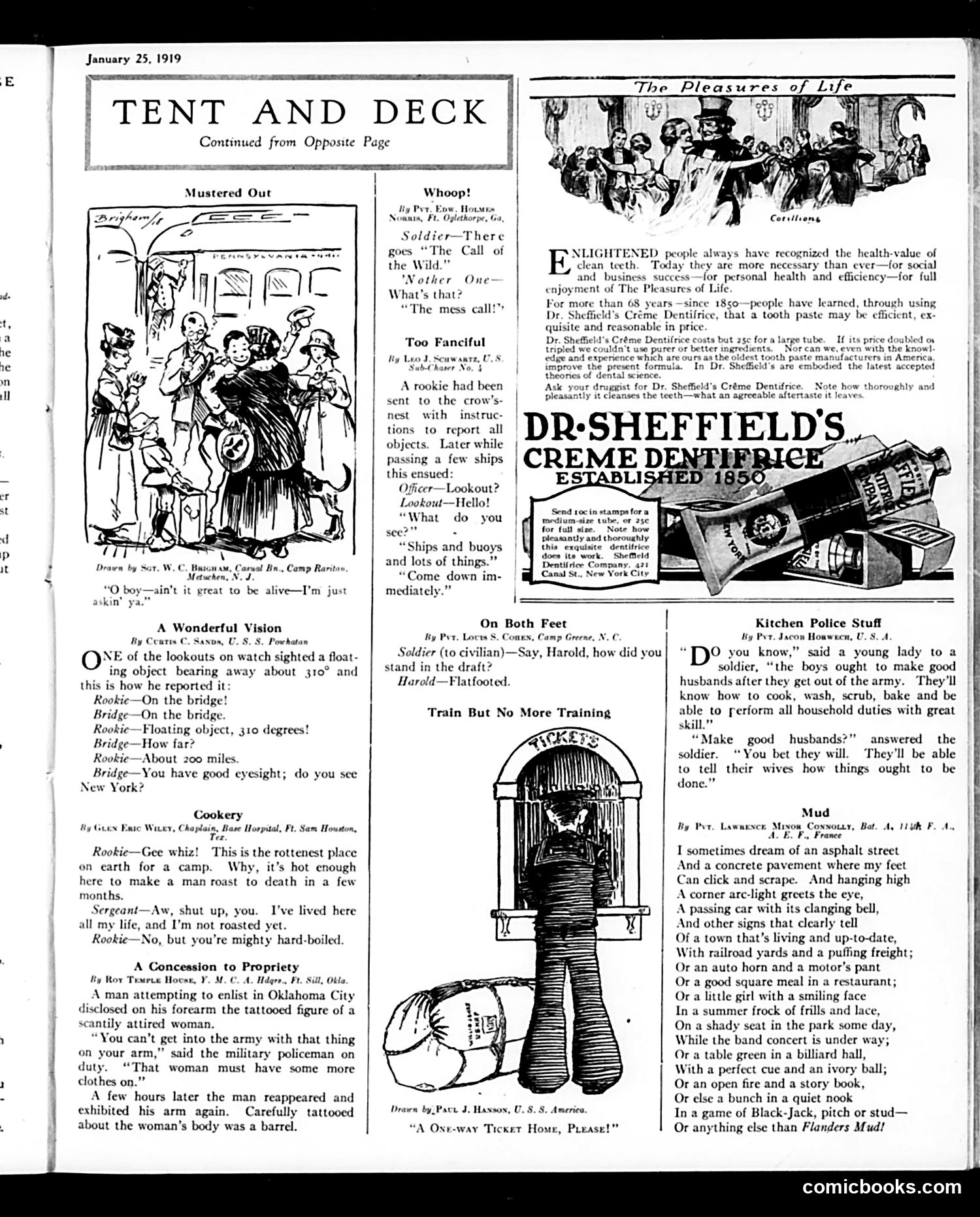
This page contains military humor from *Judge* magazine, published just after World War I's armistice. The cartoons and jokes feature soldiers and sailors recounting their camp experiences. **Key content:** - **"Mustered Out"** depicts military personnel in humorous situations - **"A Wonderful Vision"** jokes about a rookie's absurd ship observation report (spotting New York from 200 miles away) - **"Cookery"** satirizes camp food as dangerously hot - **"A Concession to Propriety"** mocks military regulations: a recruit's tattoo of a scantily-clad woman is only approved after someone paints a barrel around her - **"On Both Feet"** puns on "flatfooted" (military draft exemption excuse) - **"Kitchen Police Stuff"** jokes that soldiers will make good husbands because army kitchen duty teaches cooking and housework The humor targets military absurdities, camp conditions, and the cultural adjustment of soldiers returning to civilian life. The page also includes a toothpaste advertisement, typical for the era.
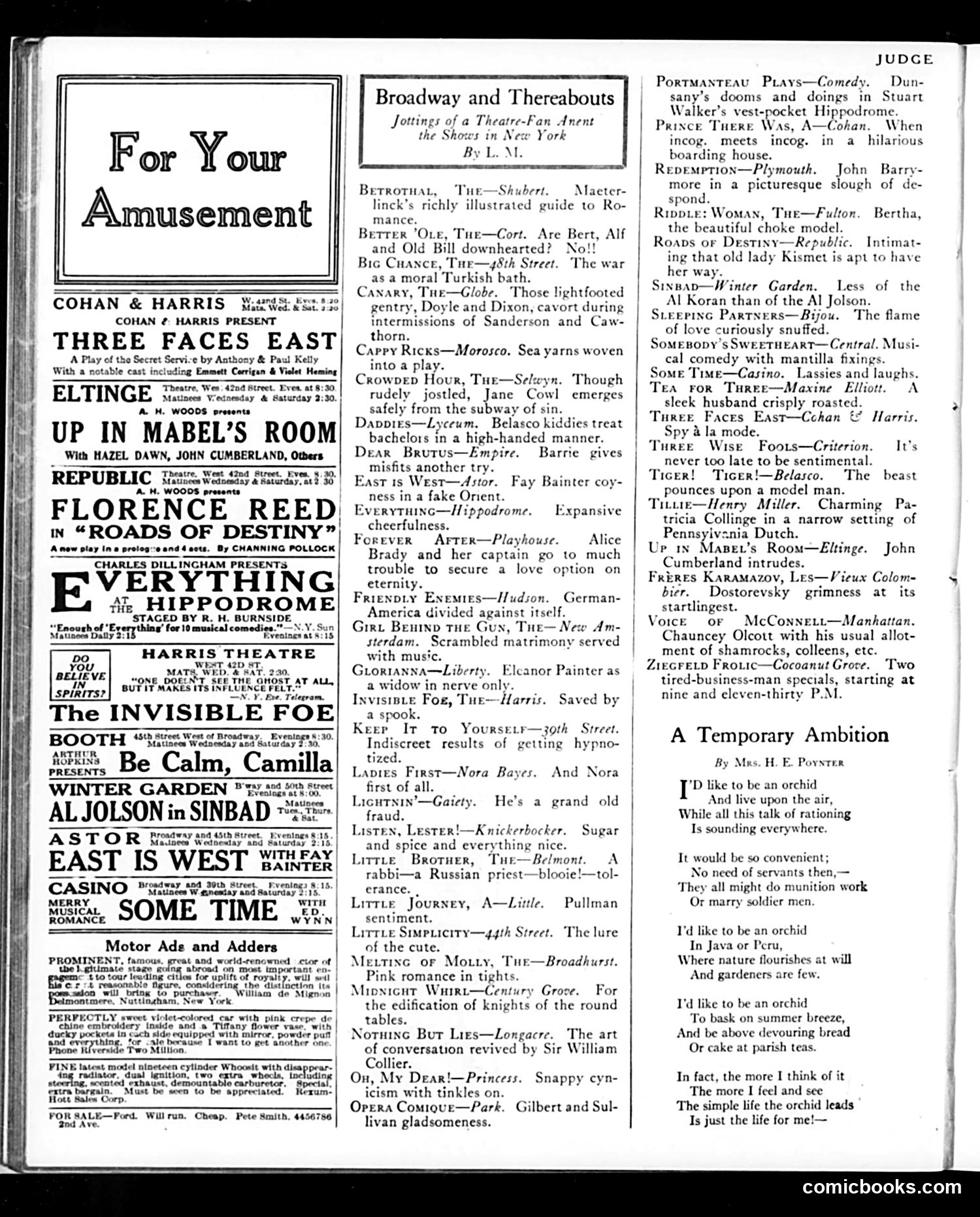
This page is primarily **theatrical advertisements and reviews** rather than political satire. The left side features Broadway theater ads from the 1920s era, listing shows like "Three Faces East," "Up in Mabel's Room," and "Roads of Destiny" with their casts and showtimes. The right side contains **"Portmanteau Plays"**—brief, witty capsule reviews of current Broadway productions by L.M., typical of Judge's theater criticism. These are comedic synopses: for example, "Prince There Was" is described as a Cohan play where "incog. meets incog. in a hilarious boarding house." At the bottom right is a **poem titled "A Temporary Ambition"** by Mrs. H.E. Poynter expressing a desire to be an orchid in exotic locations rather than dealing with mundane domestic life. The page reflects Judge's focus on entertainment coverage and satirical theater commentary for its educated, urban readership interested in Broadway culture. No political figures or major social satire are evident here.
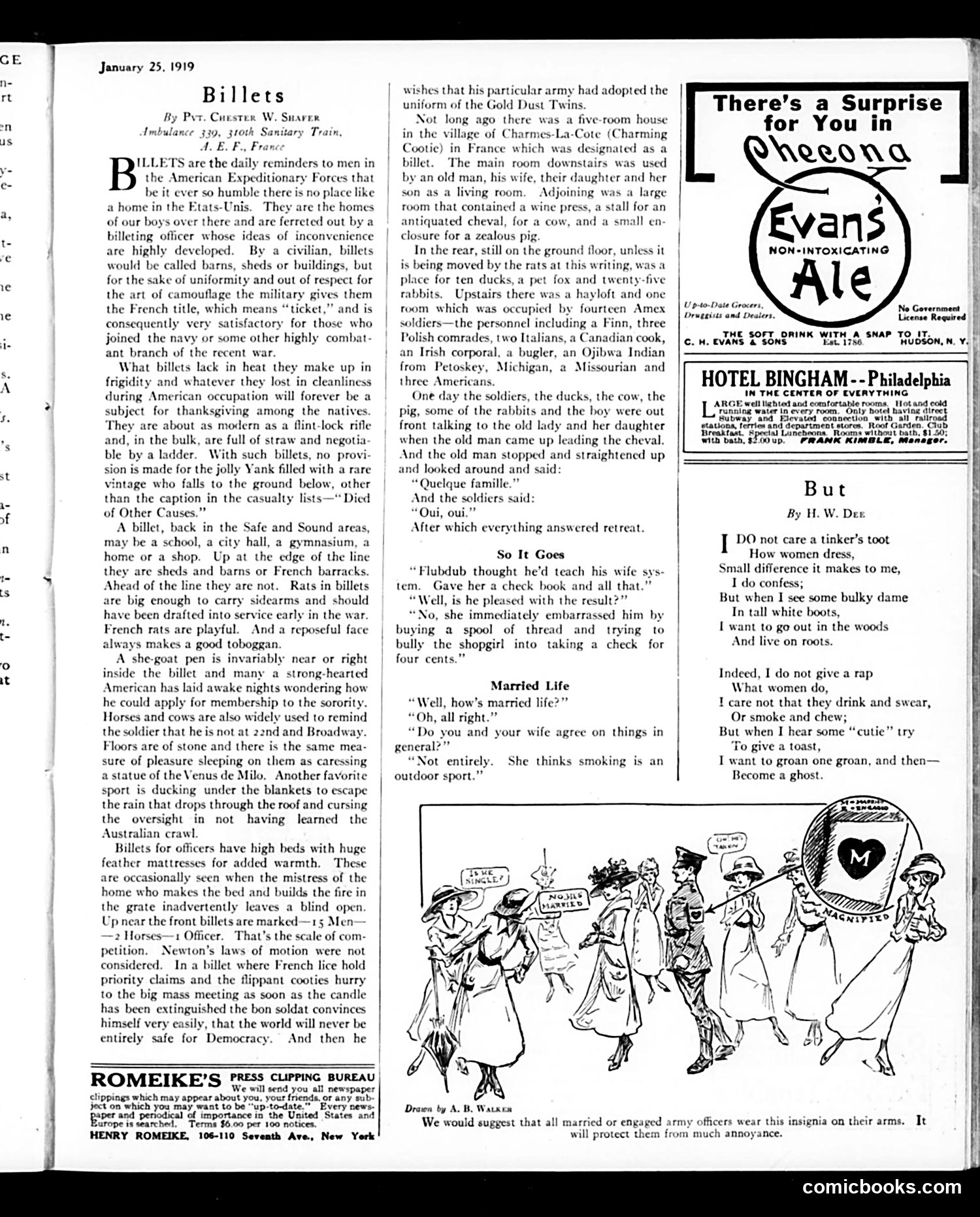
This is a humorous article about American soldiers' living quarters ("billets") in France during WWI occupation. The satirical point: soldiers are housed in absurdly primitive, uncomfortable accommodations—barns, sheds, and dilapidated buildings that officers cynically give French military names for "camouflage." The author (identified as Pvt. Chester W. Shafer) catalogs the indignities: freezing conditions, filth, rat infestations large enough to "carry sidearms," lice and fleas, stone floors, leaking roofs, and promiscuous animal cohabitation (goats, horses, cows sharing space with soldiers). The joke's edge: officers get feather beds while enlisted men sleep on stone floors. The darkest humor appears in casualty lists recording deaths from falls through rotten floorboards as "Died of Other Causes." The cartoon's caption (not fully visible but referenced) likely reinforces the matrimonial complaint theme running through the magazine's other content on this page.
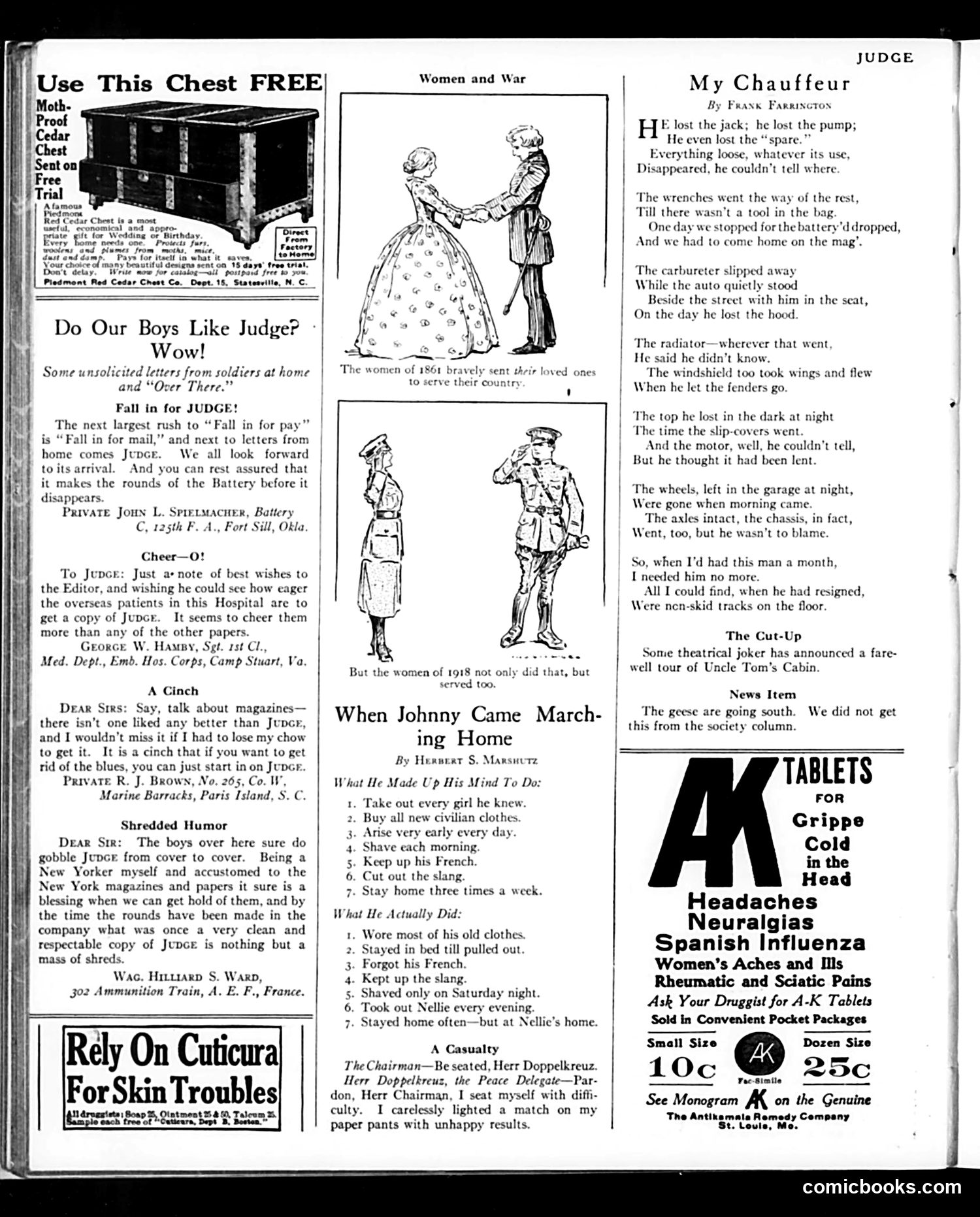
This page combines **WWI-era patriotic advertising with social satire**. The main content showcases *Judge* magazine's appeal to soldiers overseas—letters from servicemen praising how the humor magazine boosts morale "Over There" and in camps. This reflects how humor publications were considered important for troop welfare during World War I. The "Women and War" section contrasts 1861 and 1918 women—establishing that WWI-era women not only sent loved ones to war (like Civil War women) but "served too," likely referring to their wartime labor and support roles. "When Johnny Came Marching Home" satirizes soldiers' unrealistic postwar plans versus reality: Johnny intends to date multiple girls, buy new clothes, and stay home frequently—but actually wears old clothes, forgets his French, and visits only his girlfriend Nellie at her home. "My Chauffeur" is a humorous poem about a hapless driver who loses every car component imaginable, with the punch line that he resigned leaving only "tire tracks." The page is primarily **promotional content reinforcing Judge's value to soldiers**, wrapped in gentle domestic humor.
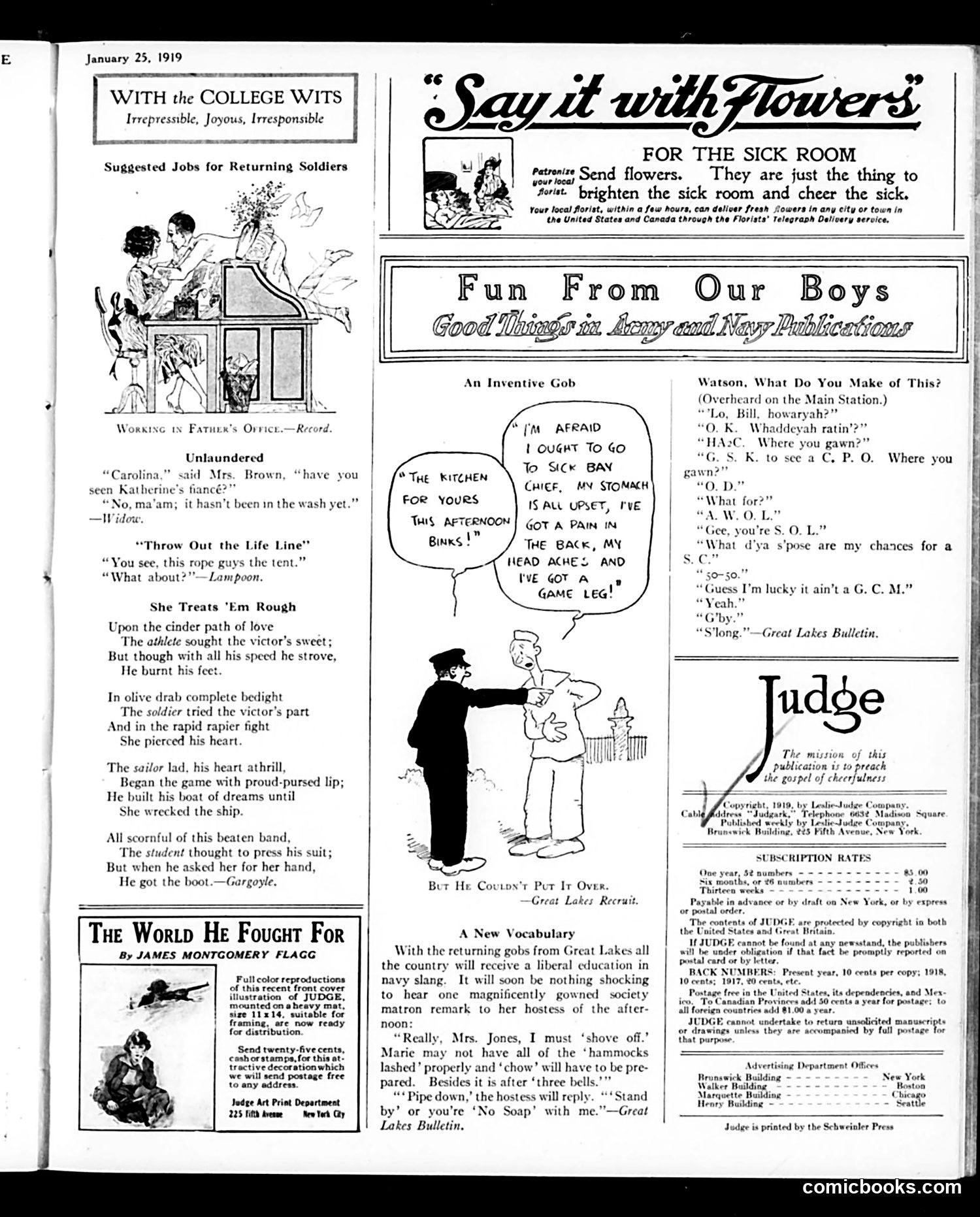
This page contains humor aimed at American servicemen returning from World War I. The main cartoon shows a naval officer ("gob") complaining to a superior about various ailments—stomach upset, back pain, headaches, and a game leg—using military/naval slang abbreviations (S.O.L., C.P.O., A.W.O.L., G.C.M.). The joke appears to be that the sailor is listing so many complaints he seems to be malingering. The "New Vocabulary" section satirizes how returning sailors' navy slang will influence civilian society, imagining upper-class women adopting terms like "shove off," "hammocks lashed," and "chow" in everyday conversation—depicting the cultural collision between military and polite society. Other content includes romantic poems about soldiers being rejected in courtship ("She Treats 'Em Rough") and advertisements for flowers for sick rooms. The overall theme celebrates the servicemen while gently mocking their mannerisms and slang.
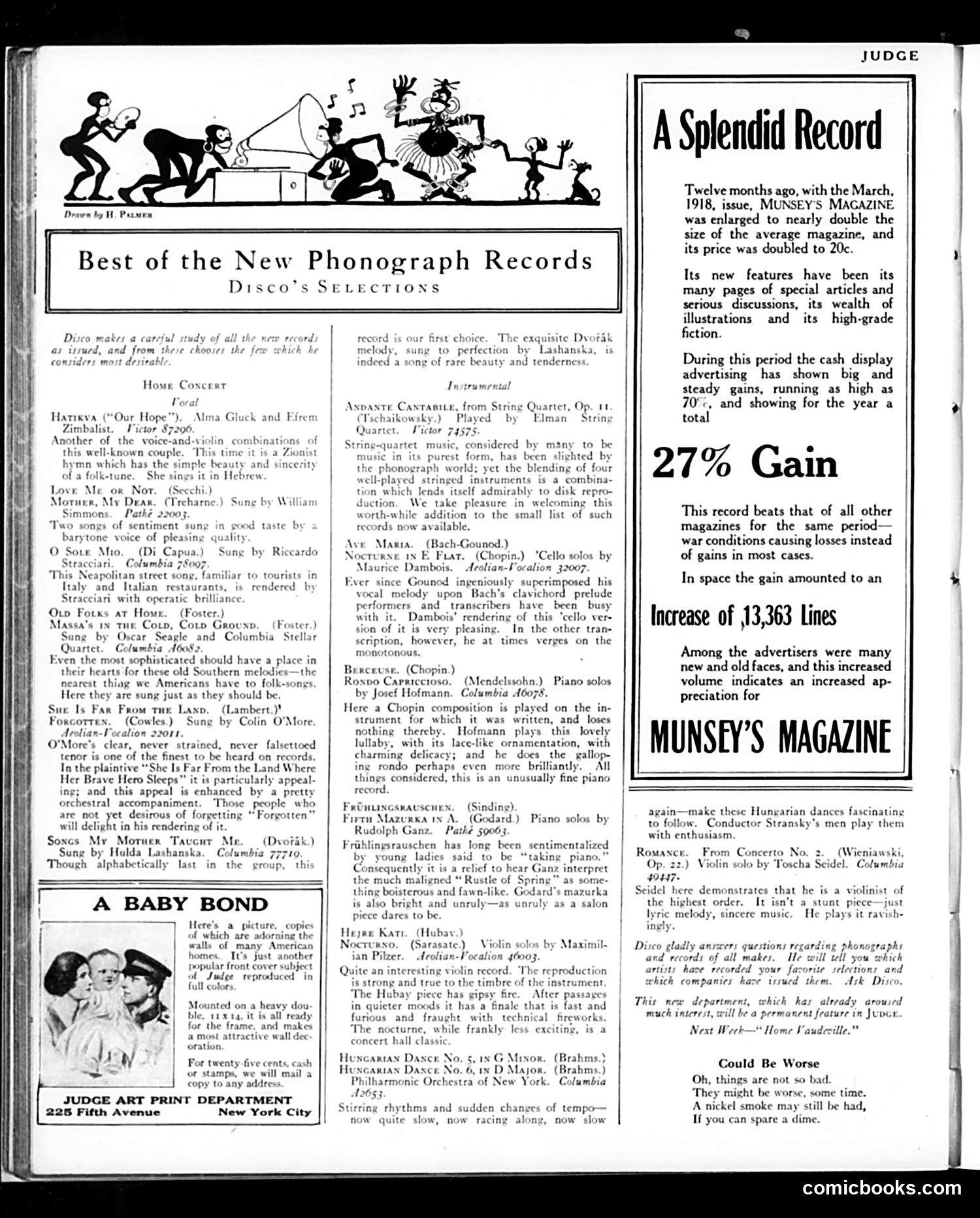
This page is primarily **advertising and product promotion**, not political satire. The top cartoon (credited to H. Pulsifer) depicts musicians and entertainers around a phonograph—a visual pun celebrating the "new phonograph records" being reviewed below. The main content consists of **record reviews** for Disco phonograph selections, featuring classical and operatic performances by artists like Zimbalist and Stracciari. These were luxury consumer products for affluent households. The right sidebar promotes **Munsey's Magazine**, highlighting its "27% Gain" in advertising revenue during wartime (the March 1918 issue mentioned). This advertises the magazine's commercial success and increased circulation to potential advertisers. The bottom features a "Baby Bond" print offer—a patriotic visual merchandise tie-in, likely connected to WWI Liberty Bond fundraising campaigns of that era. Overall, this is a **commercial/consumer-focused page** rather than political commentary, reflecting Judge's blend of entertainment, culture, and advertising.
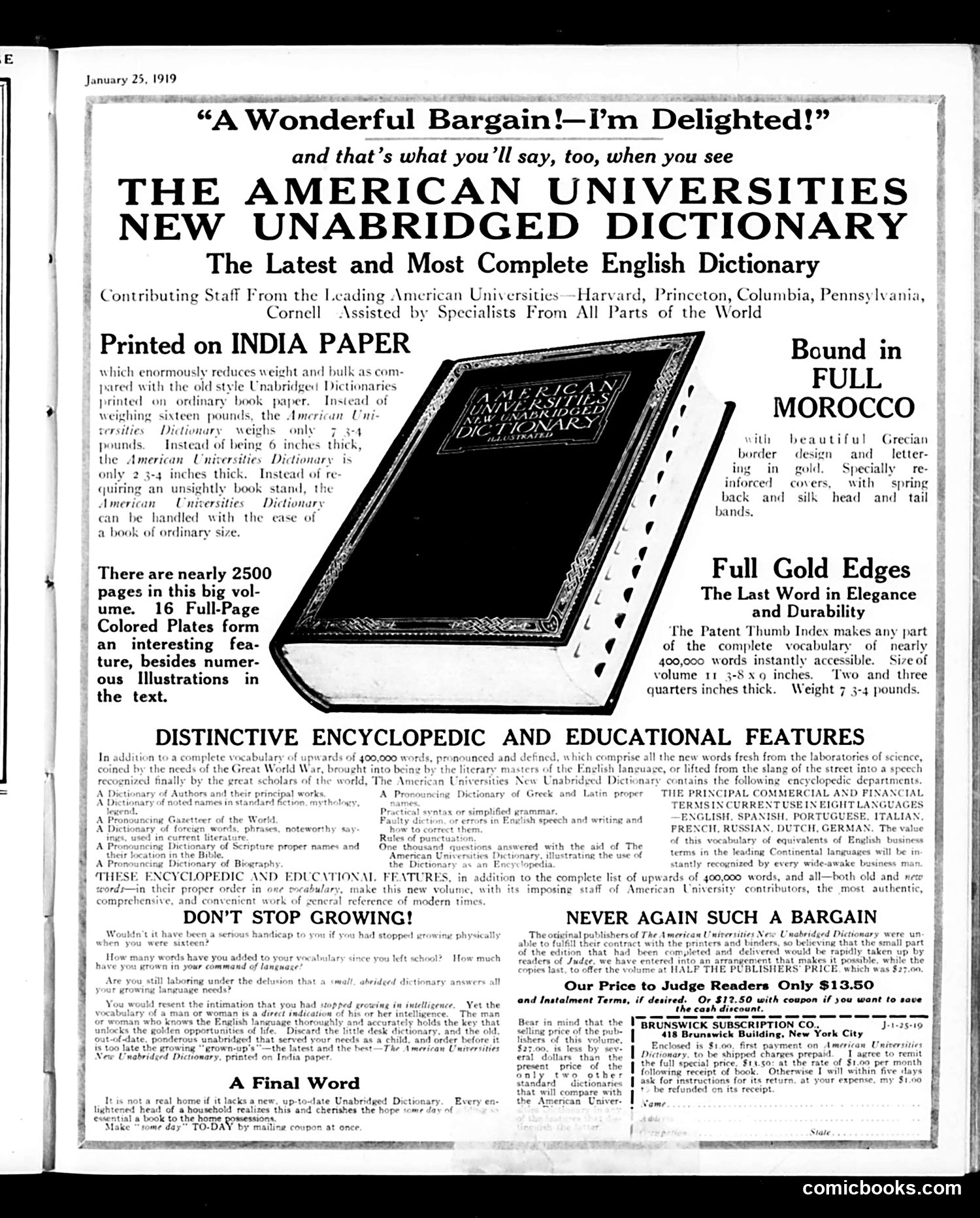
This is **not a cartoon or satirical commentary** — it's a full-page advertisement for "The American Universities New Unabridged Dictionary," published in *Judge* magazine on January 25, 1919. The ad emphasizes the dictionary's practical advantages: lightweight India paper (7¾ pounds vs. 16 for competitors), compact size (2¾ inches thick), nearly 2,500 pages, 16 colored plates, and contributions from Harvard, Princeton, Columbia, and other major universities. It features a patent thumb index for quick word lookup and Morocco leather binding with gold edges. The opening quote—"A Wonderful Bargain! I'm Delighted!"—is marketing copy designed to appeal to readers. The special offer targets *Judge* subscribers with a discounted price of $13.50 (or $12.50 with coupon), with installment payment options available. This represents early 20th-century advertising in a satirical magazine, using the publication's audience to sell educational products.
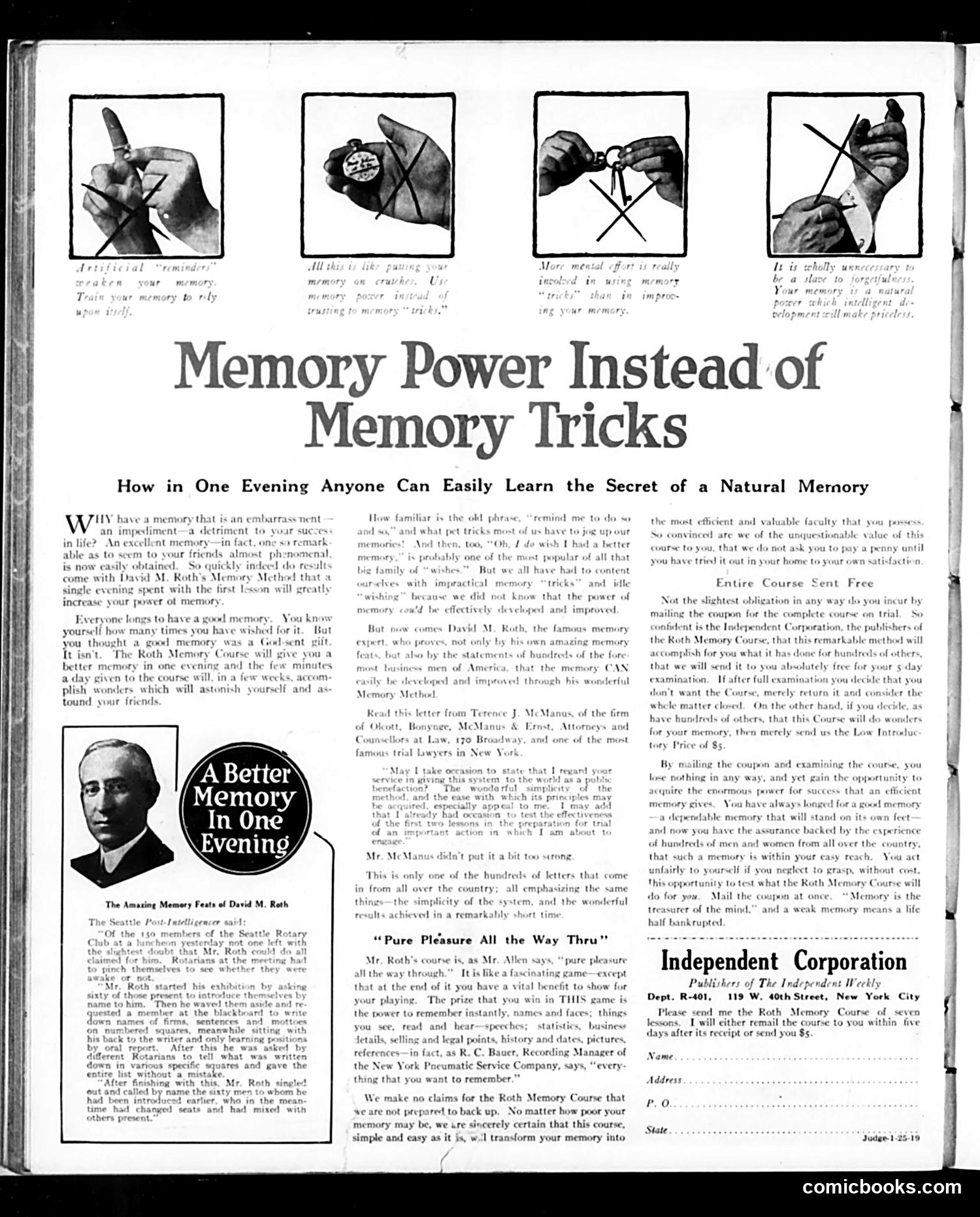
This page is primarily **advertising disguised as editorial content**—a common early 20th-century practice. It promotes David M. Roth's "Memory Course," a correspondence school program promising to dramatically improve memory in "one evening." The four hand-gesture illustrations at the top demonstrate purported memory techniques (artificial mnemonics using hand positions). The center features a photograph of David M. Roth himself. **The satire/critique:** The page mocks the proliferation of mail-order self-improvement schemes that were ubiquitous in this era. By framing it within *Judge* magazine's satirical format, the content ironically highlights the exaggerated claims and manipulative marketing tactics of such courses—the endless testimonials, the "free trial" offer, and promises of transformation "in one evening" that clearly required weeks of study. The repeated reassurances ("we make no claims we are not prepared to back up") actually underscore the skepticism these schemes deserved. This represents early consumer culture's dubious mail-order advertising landscape.