
Judge, 1919-01-25 · page 30 of 32
Judge — January 25, 1919 — page 30: what you’re looking at
What you’re looking at
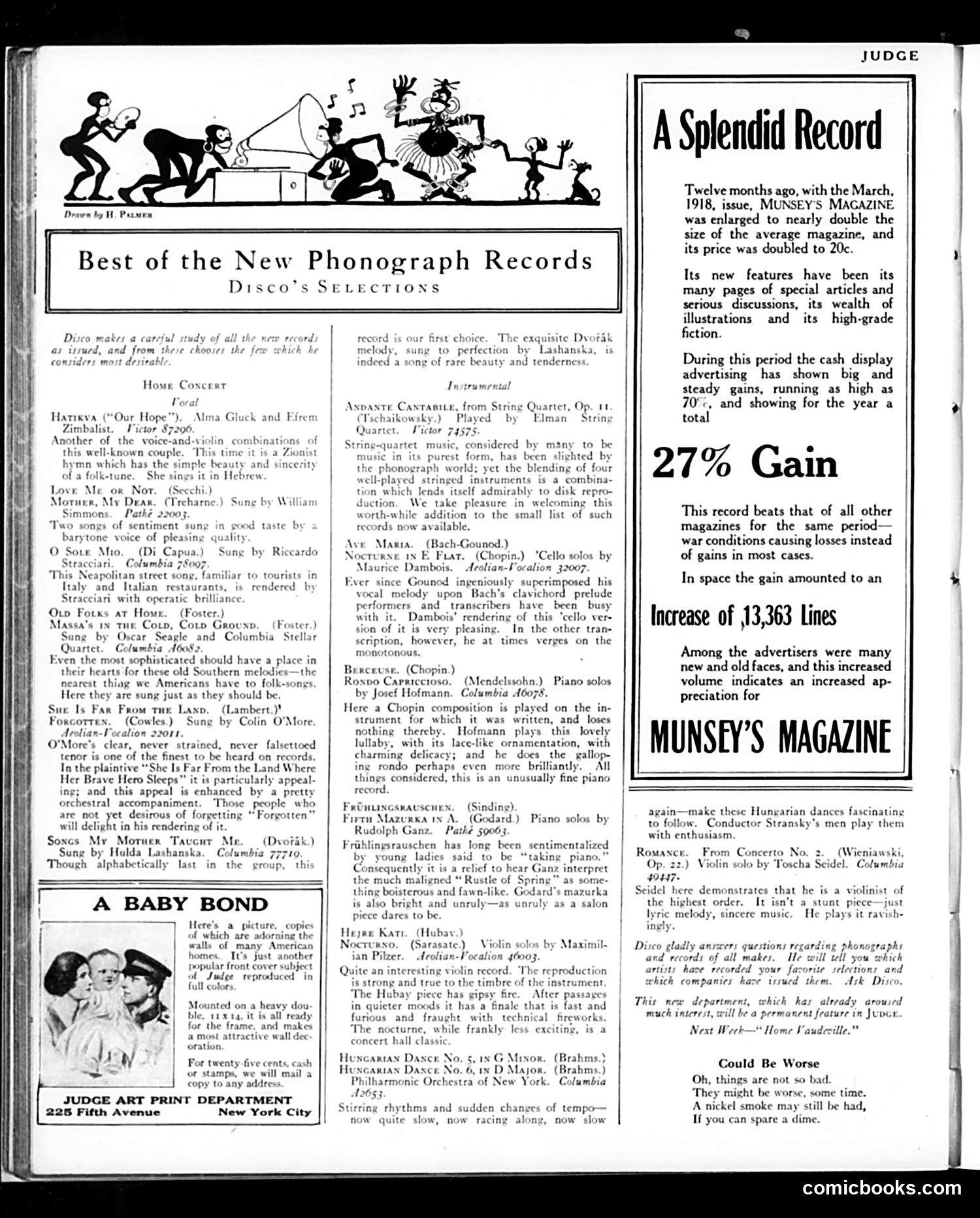
This page is primarily **advertising and product promotion**, not political satire. The top cartoon (credited to H. Pulsifer) depicts musicians and entertainers around a phonograph—a visual pun celebrating the "new phonograph records" being reviewed below. The main content consists of **record reviews** for Disco phonograph selections, featuring classical and operatic performances by artists like Zimbalist and Stracciari. These were luxury consumer products for affluent households. The right sidebar promotes **Munsey's Magazine**, highlighting its "27% Gain" in advertising revenue during wartime (the March 1918 issue mentioned). This advertises the magazine's commercial success and increased circulation to potential advertisers. The bottom features a "Baby Bond" print offer—a patriotic visual merchandise tie-in, likely connected to WWI Liberty Bond fundraising campaigns of that era. Overall, this is a **commercial/consumer-focused page** rather than political commentary, reflecting Judge's blend of entertainment, culture, and advertising.
📄 Transcribed text from this page (OCR, searchable)
Machine-transcribed from the original scan — historical spelling and the odd misread are preserved.
Best of the New Phonograph Records Disco’s SE Howe Coxceer Vocal | Harixva (“Our Hope”) 1 Zimbalist. Victor 8 Another of the voi this well-known couple. hymn which has the of a folk-tune. She nd-violin ¢ This time beauty and sincerity Love Me on Nor. (Secch Morner, My Dear. (Tre Sung by Willia Simme Pathé 2200 Two 5 of sentiment su barytone voice of pleasin O Sote Mio. (Di Cai Stracciari. Columbia This Neapolitan street s | Italy and Italian restaurants, | Stracciari with operatic brilliance Oxo Forxs at Hose. (Foster.) Massa’s 1x tue Coto, Coro Grovso. Sung by Oscar and Columbia Quartet. Columbia A6082. Even the most sophisticated should have a place in their hearts for these old Southern melodie z we Americans have to folk-so Here they are sung just as they should be Sue Is Far From tur Laxn. (Lambert.)* Foxcortrex. (Cowles.) Sung by Colin O'More. Aeolian-V'oe mn 22011 O’More’s clear, never strained, never falsettoed tenor is one of the finest to be heard on records. In the plaintive “She Is Far From the Land Where Her Brave Hero Sleeps” it is particularly appeal- ing; and this appeal is enhanced by a pretty orchestral accompaniment. Those people who are not yet desirous of forgetting “Forgotten” will delight in his rendering of it Soxcs My Morwex Tavour Me Sung by Hulda Lashanska. Colum Though alphabetically last in the (Dvorak.) TA BABY BOND Here's a pic of which are full colors. Mounted on a heavy dou. ble, 11x14. it is all ready for th ne, and makes a most att II dec oration For twenty-five cents, cash |] ps. we will mail a ny address. JUDGE ART PRINT DEPARTMENT 225 Fifth Avenue New York City LECTIONS The exquisite Dvorak hanska, is erness st choice. to perfection b rare beauty and Axpante Cantapite, from String Quartet, Op. 11 (Tschaikowsky.) Played by Elman’ String Quartet. Victor 74575 to be slighted by ding of four ents is a co - ich lends itself admirably to disk repro- ductis We take pleasure welcoming this worth-while addition to the small list of such records now available. Ave Maria. Nocturne ix E Frat. Maurice Dambois. (Bach-Gounod.) (Chopin.) *Cello solos by Acolian-Vocalion 32007. Ever since Gounod ingeniously superimposed his vocal melody upon Bach's clavichord prelude performers and. transcribers have been busy with it. Dambois’ rendering of this ‘cello ver= n of it is very pleasing. In the other tran- scription, however, he at times verges on the monotonous, Bexceuse. (Chopin.) Roxpo Carniccioso. (Mendelssohn.) by Josef Hofmann. Columbia 46078. Here a Chopin composition is played on the in- strument for which it was written, and loses nothing thereby. Hofmann plays this lovely lullaby, with its lace-like ornamentation, with charming delicacy; and he does the gallop- ing rondo perhaps even more brilliantly. All things considered, this is an unusually fine piano record Piano solos Frinuncseauscnuen. (Sinding). Firru Mazurka tx A. (Godard.) Rudolph Ganz. Pathé 59063 Frablingsrauschen has long been sentimentalized by young said to be “taking piano.” Consequently it is a relief to hear Ganz interpret the much maligned “ Rustle of Spring ning boisterous and fawn-like. Godarc also bright and unruly—as unruly piece dares to be (Hubav.) (Sarasate,) Violin solos Acolian-Vocalion 46003 Piano solos by ladies as a salon Here Kati Nocrvrxo. ian Pilzer. Quite an interesting violin record. ‘The reproduction is strong and true to the timbre of the instrument Maximil- ‘The Hubay piece has gipsy fire. After passaves in quieter moods it has a finale that is fast and furious and fraught with technical fireworks. The nocturne, while frankly less concert hall cla: exciting, is a Huncartan Dance No. 5, 1x G Minor. (Brahms.} Houncanian Dasxce No. 6, 1x D Major. (Brahms.) Philharmonic Orchestra of New York. Columbia 53. s and sudden ch racing a ing rhyth: now of tempo— quite slow, now A Splendid Record Twelve months ago, with the March, 1918, issue, MUNSEY’S MAGAZINE was enlarged to nearly double the size of the average magazine, and its price was doubled to 20c. Its new features have been its many pages of special articles and serious discussions, its wealth of illustrations and its high-grade fiction. During this period the cash display advertising has shown big and steady gains, running as high as 70°, and showing for the year a total 27% Gain This record beats that of all other magazines for the same period— war conditions causing losses instead of gains in most cases. In space the gain amounted to an Increase of 13,363 Lines Among the advertisers were many new and old faces, and this increased volume indicates an increased ap- preciation for MUNSEY’S MAGAZINE again—make these Hungarian dances fascinating to follow. Conductor Stransky’s men play them with enthusiasm Roaaxce. From Concerto No. Op. 22.) Violin solo by Toscha Sei 49447 Seidel here demonstrates that he is a v the highest order. It isn’t a stunt pi lyric melody, sincere music. ingly. (Wieniawski, el. Columbia linist of He plays it ravis Disco gladly answers questions regarding phon and records of all makes. He will tell you artists have recorded your favorite selections and which companies haze issued them. Ask Disco. This new department, which has already aroused much interest, will be a permanent feature in JuvGH Next Week—" Home Vaudeville.” Could Be Worse Oh, things are not so bad. They might be worse, some time. A nickel smoke may still be had, If you can spare a dime. comicbooks.com