
Judge, 1919-01-25 · page 13 of 32
Judge — January 25, 1919 — page 13: what you’re looking at
What you’re looking at
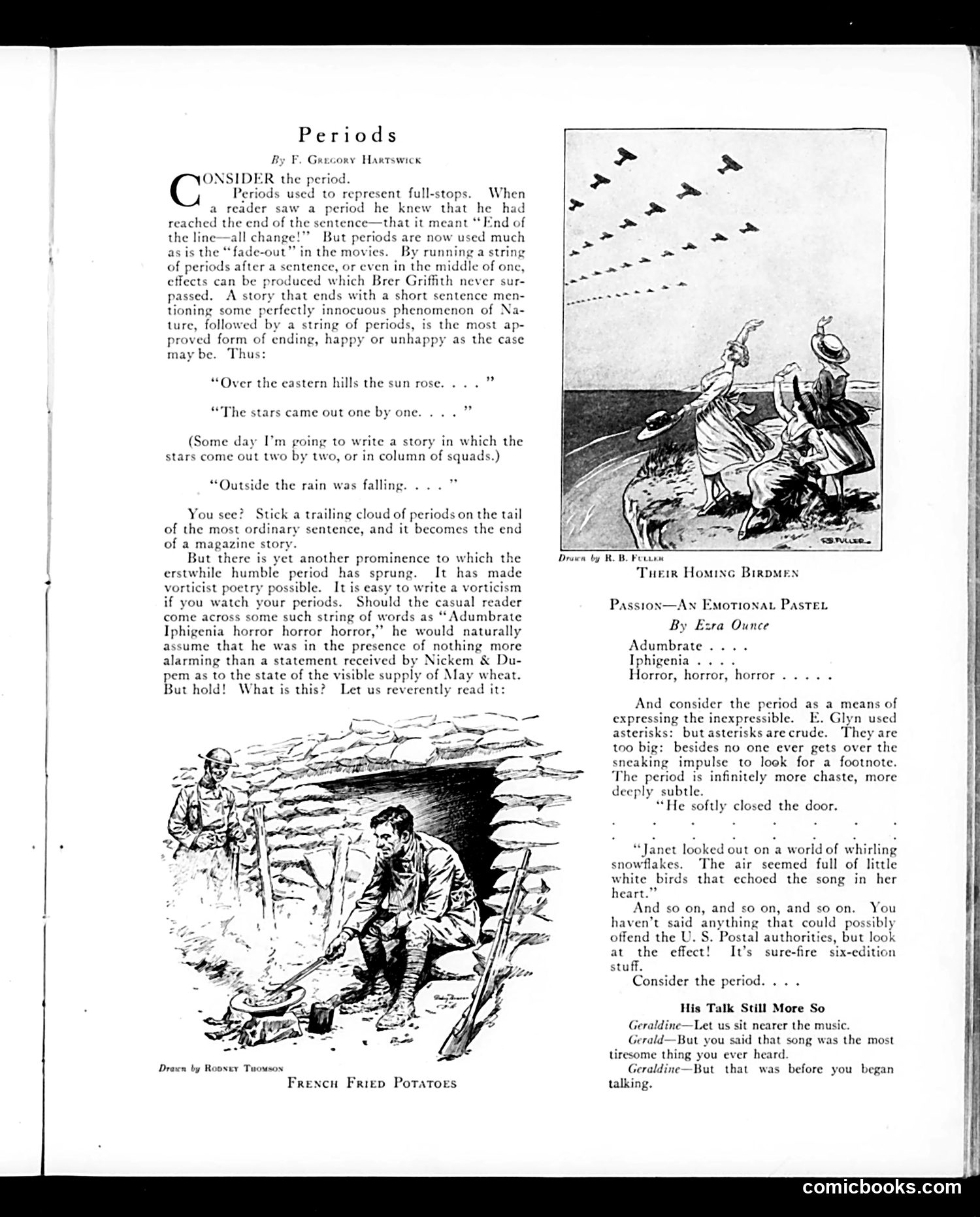
This is a humorous essay by F. Gregory Hartswick mocking contemporary literary trends, particularly modernist writing styles. The piece satirizes how the period punctuation mark has become a literary device mimicking the "fade-out" effect in cinema—trailing ellipses (...) create artificial dramatic effect on ordinary sentences. Hartswick ridicules "vorticist poetry" (referencing the avant-garde Vorticism movement), suggesting that strings of random words like "Adumbrate Iphigenia horror horror horror" become profound when followed by periods, fooling readers into thinking they've encountered deep meaning rather than nonsense. The accompanying illustrations are unrelated vignettes: "Three Homing Birdmen" (top right), "French Fried Potatoes" (bottom left showing soldiers), and "His Talk Still More So" (a brief domestic joke about a woman finding her boyfriend's conversation more tiresome than music). The satire targets pretentious modern literary experimentation and reader gullibility.
📄 Transcribed text from this page (OCR, searchable)
Machine-transcribed from the original scan — historical spelling and the odd misread are preserved.
Periods By F. Gaecory Hartswick ONSIDER the period. Periods used to represent full-stops. When a reader saw a period he knew that he had reached the end of the sentence—that it meant “End of the line—all change But periods are now used much as is the “fade-out” in the movies. By running a string of periods after a sentence, or even in the middle of one, effects can be produced which Brer Griffith never sur- passed. A story that ends with a short sentence men- tioning some perfectly innocuous phenomenon of Na- ture, followed by a string of periods, is the most ap- roved form of ending, happy or unhappy as the case may be. Thus: “Over the castern hills the sun rose. . “The stars came out one by one. . . « (Some day I’m going to write a story in which the stars come out two by two, or in column of squads.) “Outside the rain was falling... . ” You see? Stick a trailing cloud of periods on the tail of the most ordinary sentence, and it becomes the end of a magazine story. But there is yet another prominence to which the erstwhile humble period has sprung. It has made vorticist poetry possible. It is easy to write a vorticism if you watch your periods. Should the casual reader come across some such string of words as ‘‘Adumbrate Iphigenia horror horror horror,’ he would naturally assume that he was in the presence of nothing more alarming than a statement received by Nickem & Du- pem as to the state of the visible supply of May wheat. But hold! What is this? Let us reverently read it: ey Tuomsox Drawn by R Frencu Friep Potatoes Drown by RB. Tuer Hominc BirpMen Passion—Awn Emotionat Paster By Ezra Ounce Adumbrate .... Iphigenia... Horror, horror, horror... « And consider the period as a means of expressing the inexpressible. E. Glyn used asterisks: butasterisks arecrude. They are too big: besides no one ever gets over the sneaking impulse to look for a footnote. The period is infinitely more chaste, more deeply subtle. “He softly closed the door. “Janet looked out on a world of whirling snowflakes. The air seemed full of little white birds that echoed the song in her heart.” And so on, and so on, and so on. You haven't said anything that could possibly offend the U. S. Postal authorities, but look at the effect! It’s sure-fire six-edition stuff. Consider the period. . . . His Talk Still More So Geraldine—Let us sit nearer the music. Gerald—But you said that song was the most tiresome thing you ever heard. Geraldine—But that was before you began talking. comicbooks.com