
A complete issue · 32 pages · 1918
Judge — September 28, 1918
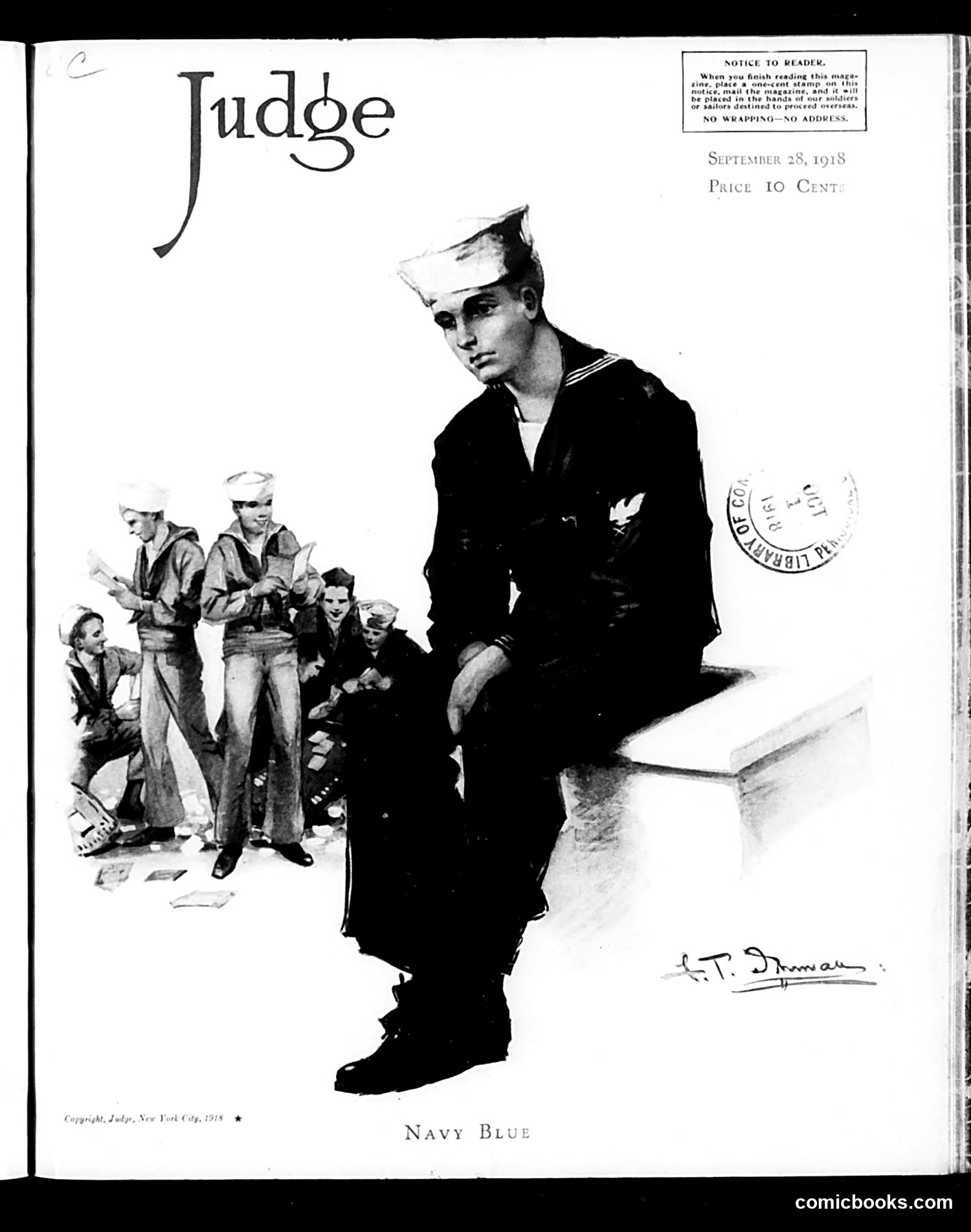
This cover illustration, titled "Navy Blue," depicts a tall U.S. Navy sailor in uniform as the dominant figure, with smaller civilian figures (appearing to include women and children) gathered behind him in admiration or dependency. Published during World War I's final weeks (the war ended November 1918), this appears to be patriotic propaganda celebrating American naval power and military strength. The composition suggests the Navy as protector of the American home front and civilian population. The artist's signature reads "T. Dorman." The illustration uses scale and positioning to convey the Navy's importance to national security during this critical wartime moment.
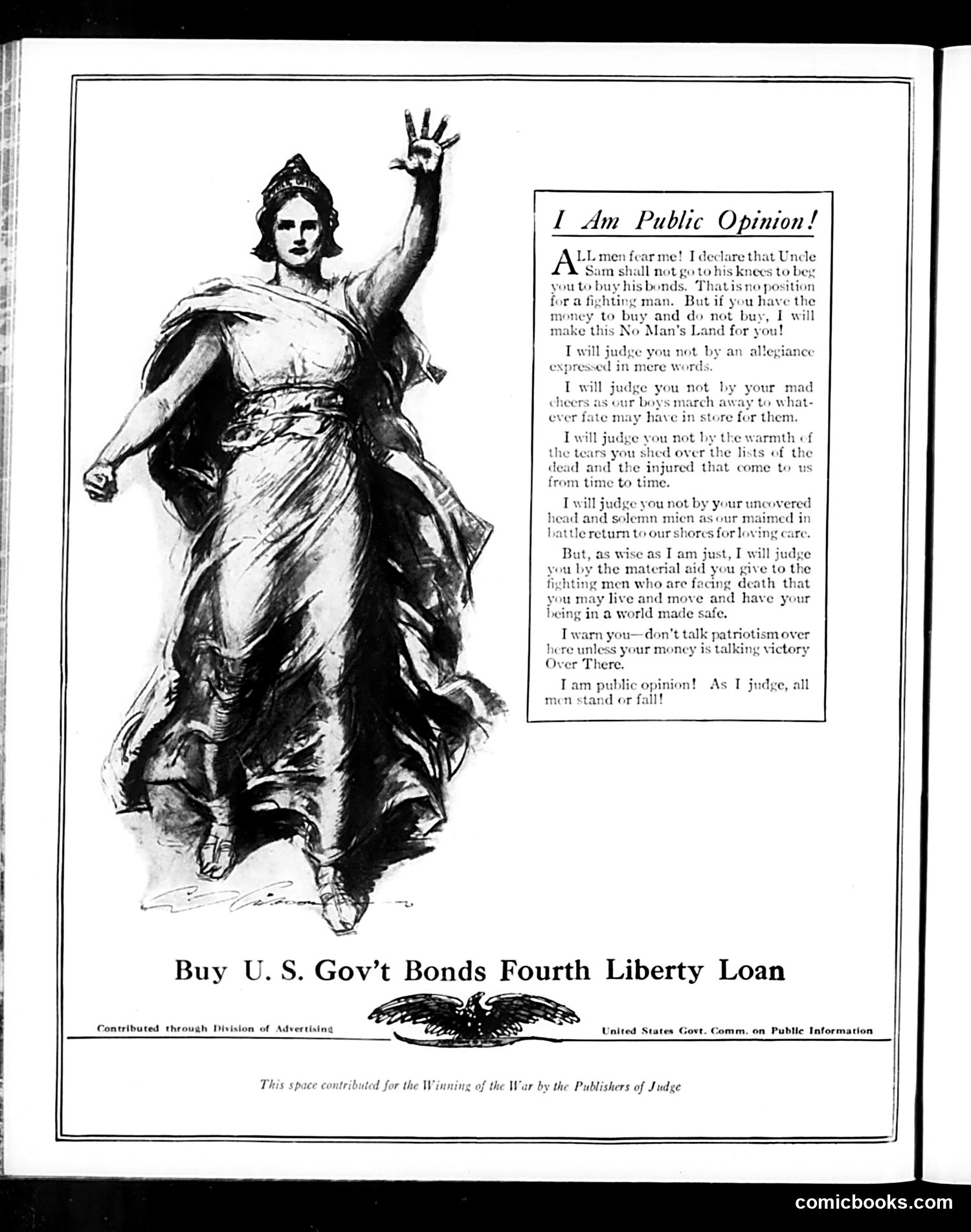
This is a **World War I-era bond drive advertisement** from *Judge* magazine, not a political cartoon. The classical female figure representing "Liberty" or "Public Opinion" serves as the spokeswoman for purchasing Fourth Liberty Loan bonds. The text personifies public opinion as a judge of patriotism, warning Americans that she will evaluate them not by patriotic rhetoric alone, but by concrete financial support for the war effort—specifically buying government bonds. The message is blunt: money talks; words don't matter. The classical imagery (crown, torch, flowing robes) invokes traditional Liberty iconography to lend moral authority to the fundraising appeal. This is propaganda encouraging citizens to purchase bonds as their patriotic duty during WWI.
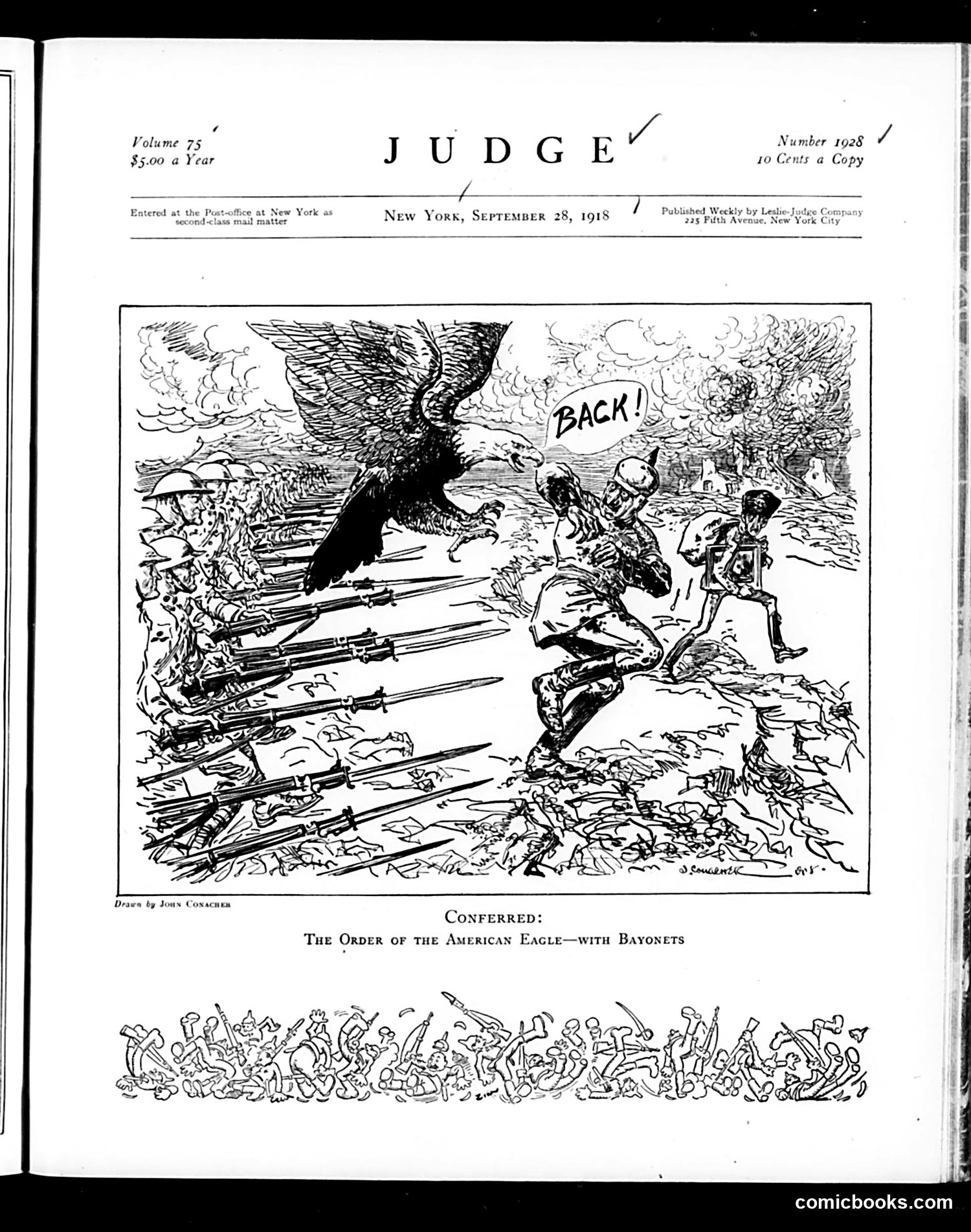
**Title:** "The Order of the American Eagle—with Bayonets" **Context:** Published during World War I's final weeks, this cartoon depicts American soldiers driving back an eagle—representing Germany—with bayoneted rifles. The eagle, drawn menacingly large, appears to be retreating despite its size and aggression. **Meaning:** The satire celebrates American military prowess, suggesting U.S. forces are forcing Germany into retreat. The "Order of the American Eagle" is a mock-serious title for what is essentially martial combat. The bayonets symbolize direct, close-quarters fighting effectiveness. **Point:** The cartoon bolsters American morale during the war's final offensive, portraying U.S. soldiers as dominant and victorious against the German war machine, presented as a dark predatory bird being driven backward.
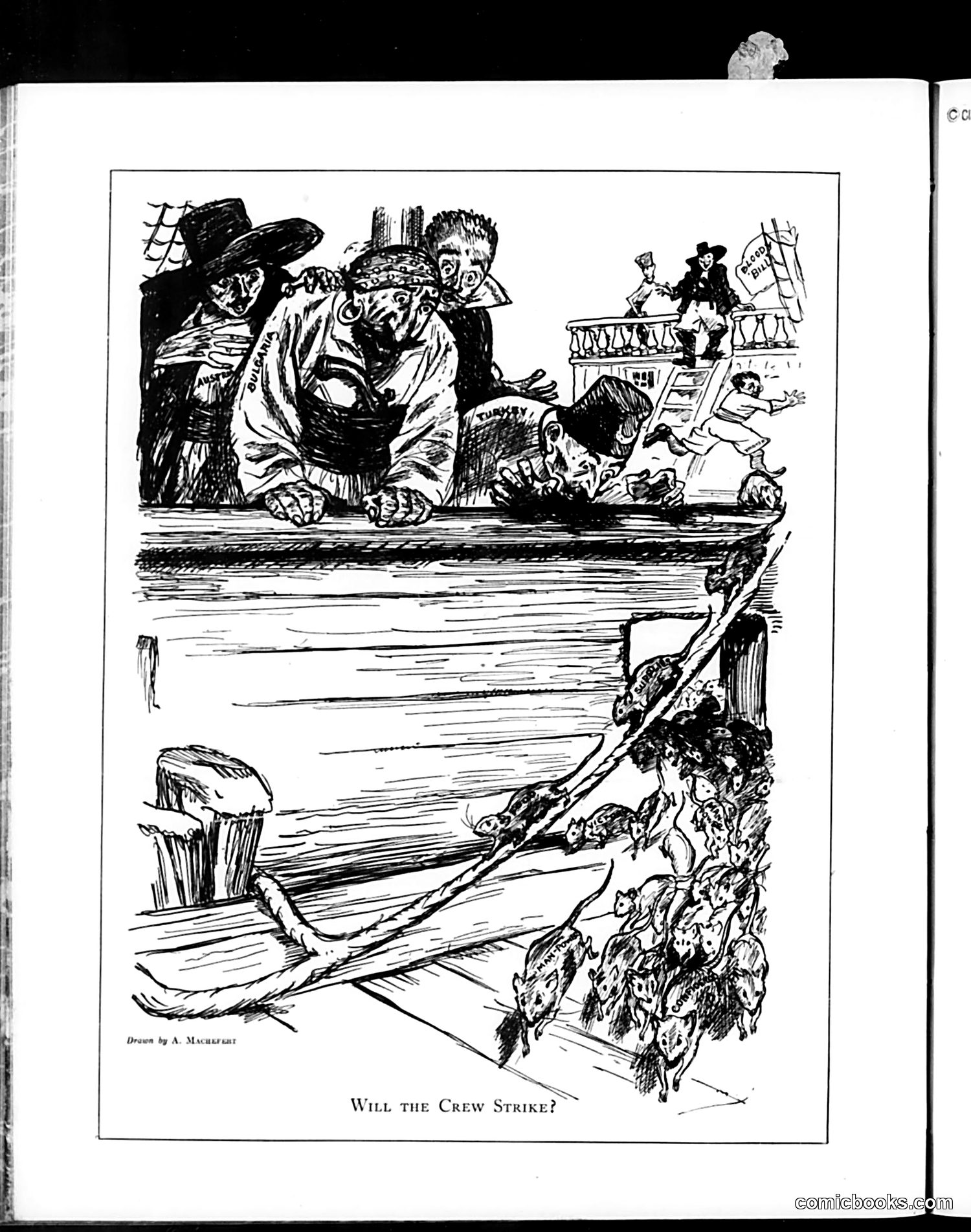
This political cartoon satirizes labor unrest aboard a ship, likely depicting a maritime strike threat. The drawing shows ship officers (identifiable by their uniforms and authority) confronting crew members below deck. The captain and officers appear aggressive or intimidating, while the crew members seem subdued or intimidated. The cartoon's caption poses the central question: will workers organize and strike? This reflects early 20th-century labor tensions between maritime workers and ship management. The humor lies in depicting the power dynamics—officers literally positioned above crew members—suggesting the imbalance of power and the crew's difficult decision about whether to risk striking against their employers.
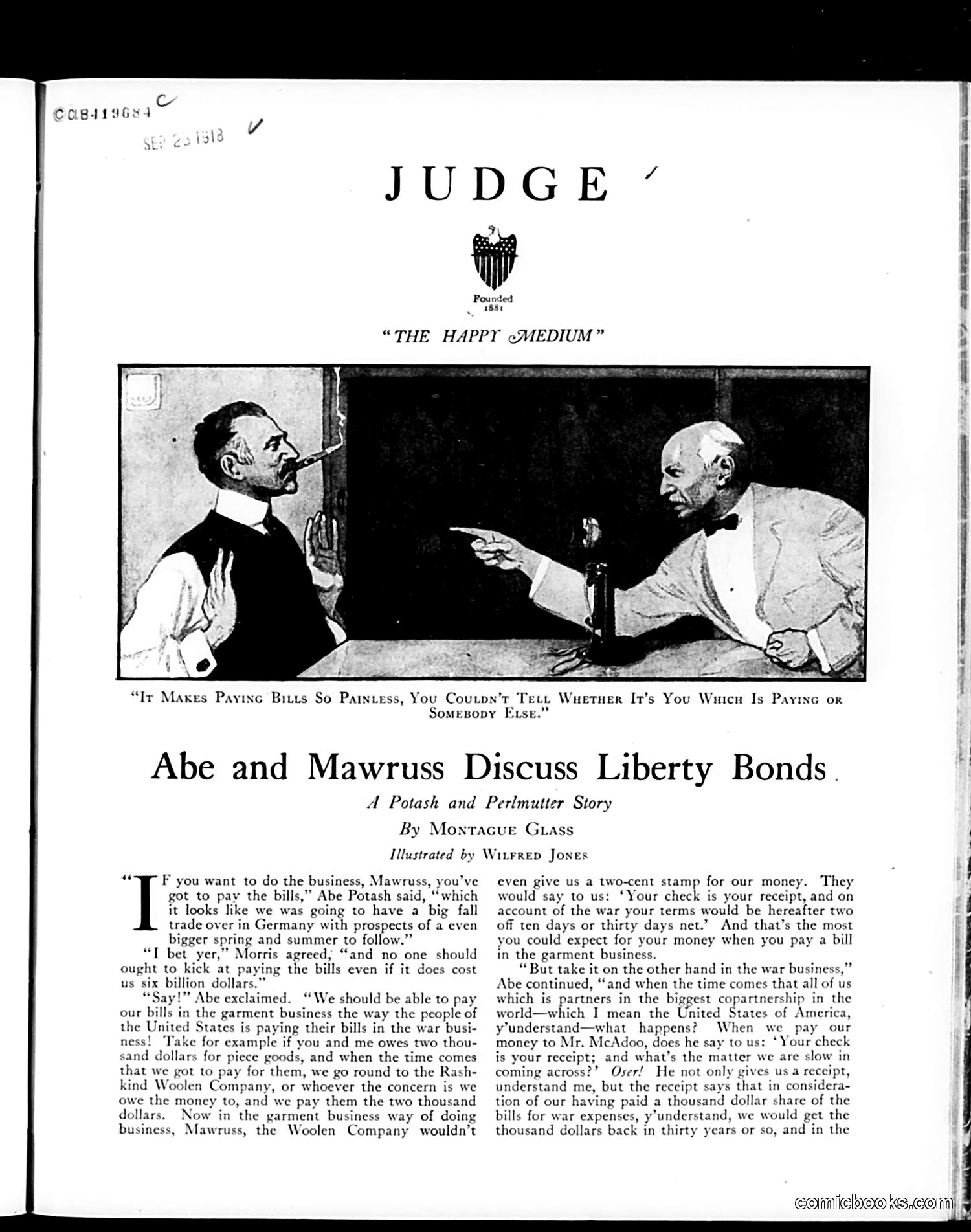
This satirical piece titled "Abe and Mawruss Discuss Liberty Bonds" is a "Potash and Perlmutter Story"—referencing popular Yiddish-American comic characters from the era. The dialogue depicts two businessmen debating how to pay bills during wartime, specifically regarding Liberty Bonds (U.S. government bonds sold to finance World War I). The satire mocks the disconnect between patriotic bond-selling rhetoric and practical business concerns. "Abe" argues that in America's partnership, war expenses should be shared; "Mawruss" counters that paying bills requires actual cash flow, not just receipts—highlighting how small businesses struggled with delayed government reimbursement for war-related costs. The caption's pun about "paying bills so painless" undercuts the serious financial strain wartime created for ordinary businessmen.
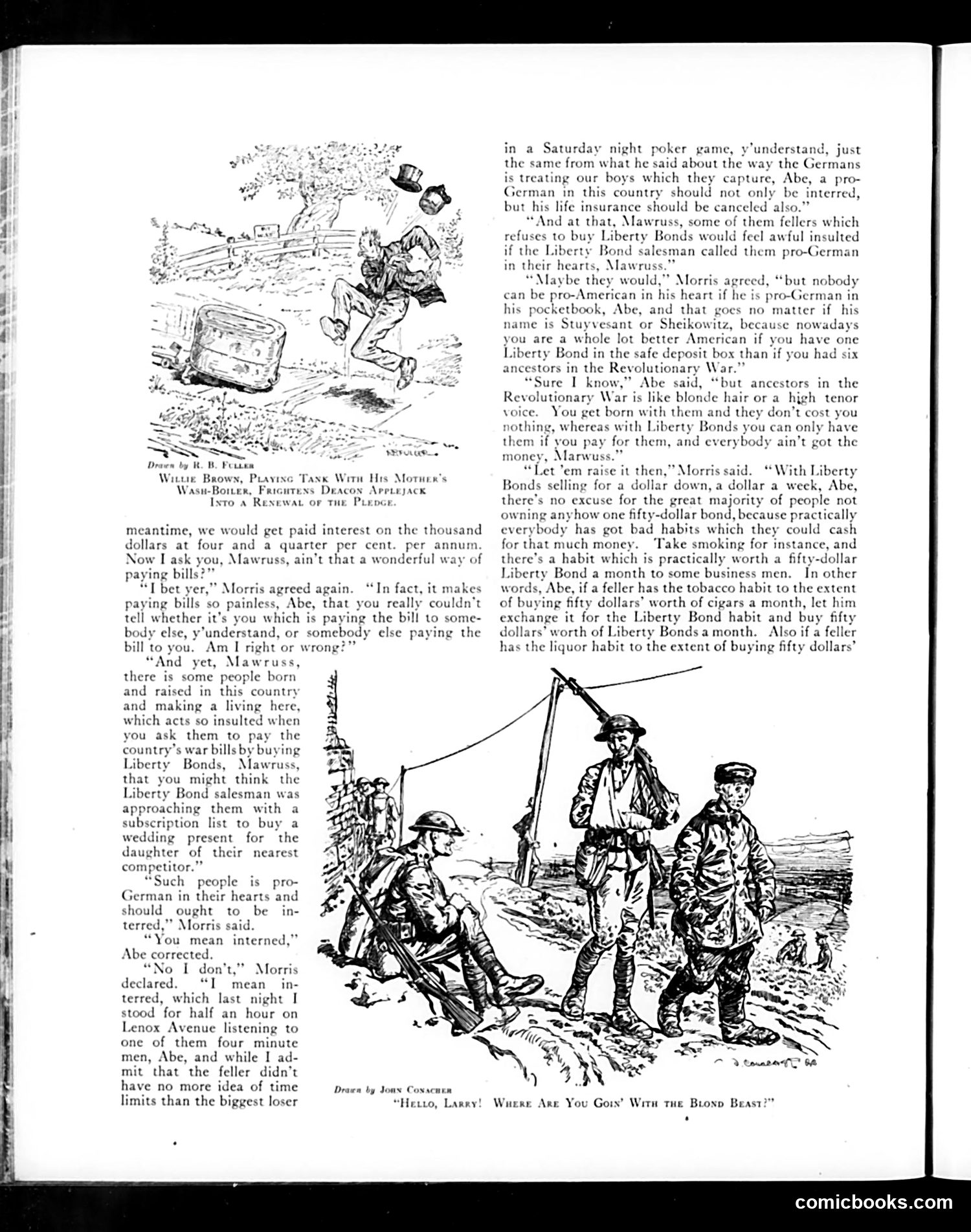
This page satirizes Americans of German descent during World War I, specifically their patriotism and financial commitment to the war effort through Liberty Bond purchases. The top cartoon shows a man being chased by his mother's washtub and washboard—a visual pun on the name "Willie Browns" (a play on "German"). The debate in the text centers on whether German-Americans can be truly patriotic. Characters named Abe and Morris argue that owning Liberty Bonds proves American loyalty better than ancestry alone. The satire mocks the era's suspicion of German-Americans' patriotism while ironically suggesting that financial compliance (buying bonds) substitutes for genuine belonging. The lower cartoon's caption "Hello, Larry! Where Are You Going? With the Blond Beast?" references German militarism stereotypes while depicting soldiers, likely commentary on American anti-German propaganda during the war.
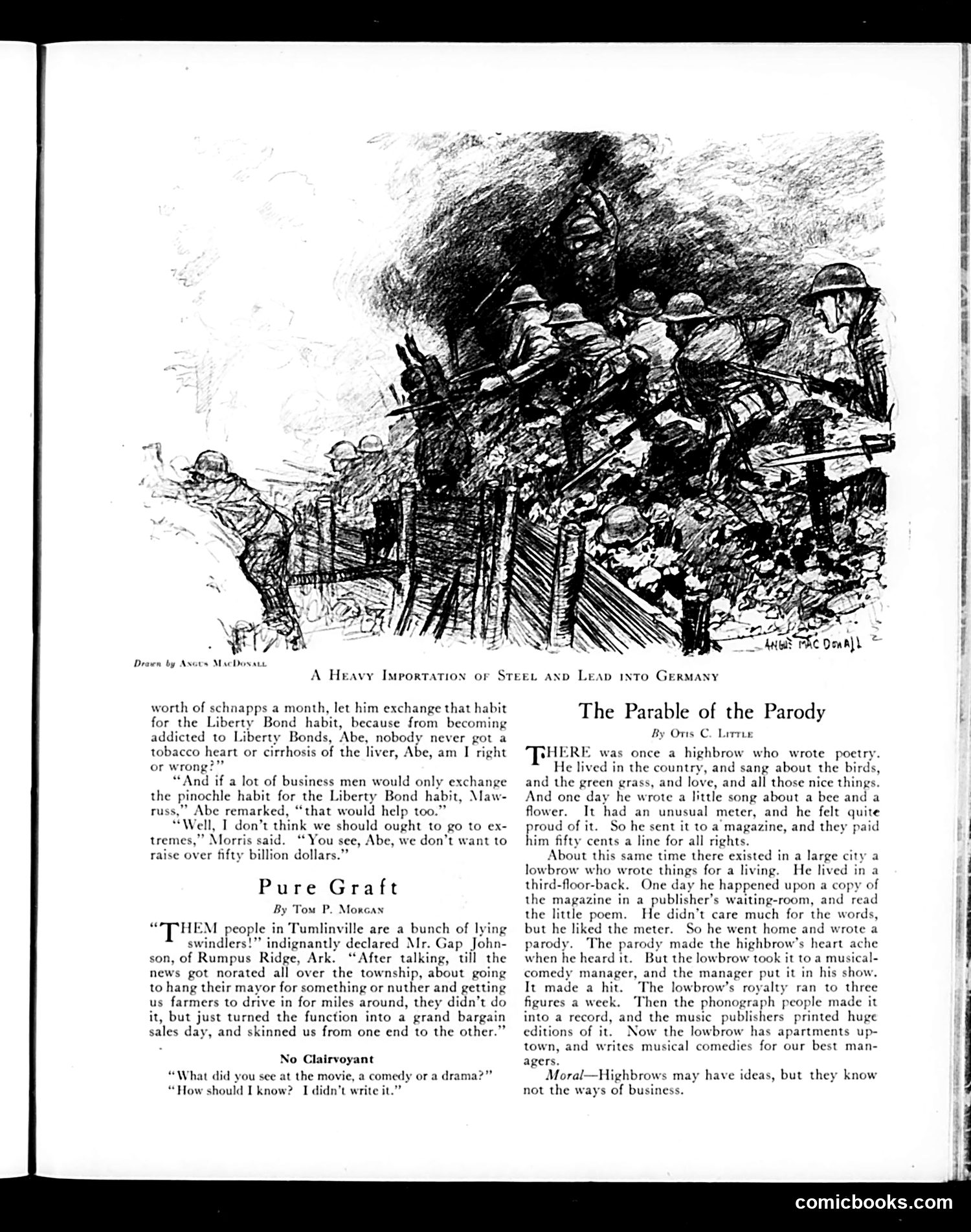
The page contains three separate pieces of satire: **"A Heavy Importation of Steel and Lead into Germany"** (top illustration): A WWI-era cartoon depicting soldiers in trenches. The title's dark humor equates weaponry with "imports"—referencing actual military supplies sent to combat Germany. **"Pure Graft"** and **"No Clairvoyant"**: Brief comedic anecdotes mocking small-town American corruption and con artists. A rural politician cancels a promised lynching and instead holds a "bargain sales day" to exploit farmers who traveled to witness it. **"The Parable of the Parody"**: A satirical fable contrasting a highbrow poet (paid modestly for original work) with a lowbrow commercial writer who plagiarizes the poet's meter, turns it into a musical comedy hit, and becomes wealthy. The moral critiques artistic merit versus commercial success—implying that business acumen matters more than talent in America's entertainment industry. All three pieces mock different American hypocrisies: wartime profiteering, rural swindling, and the devaluation of genuine artistic work.
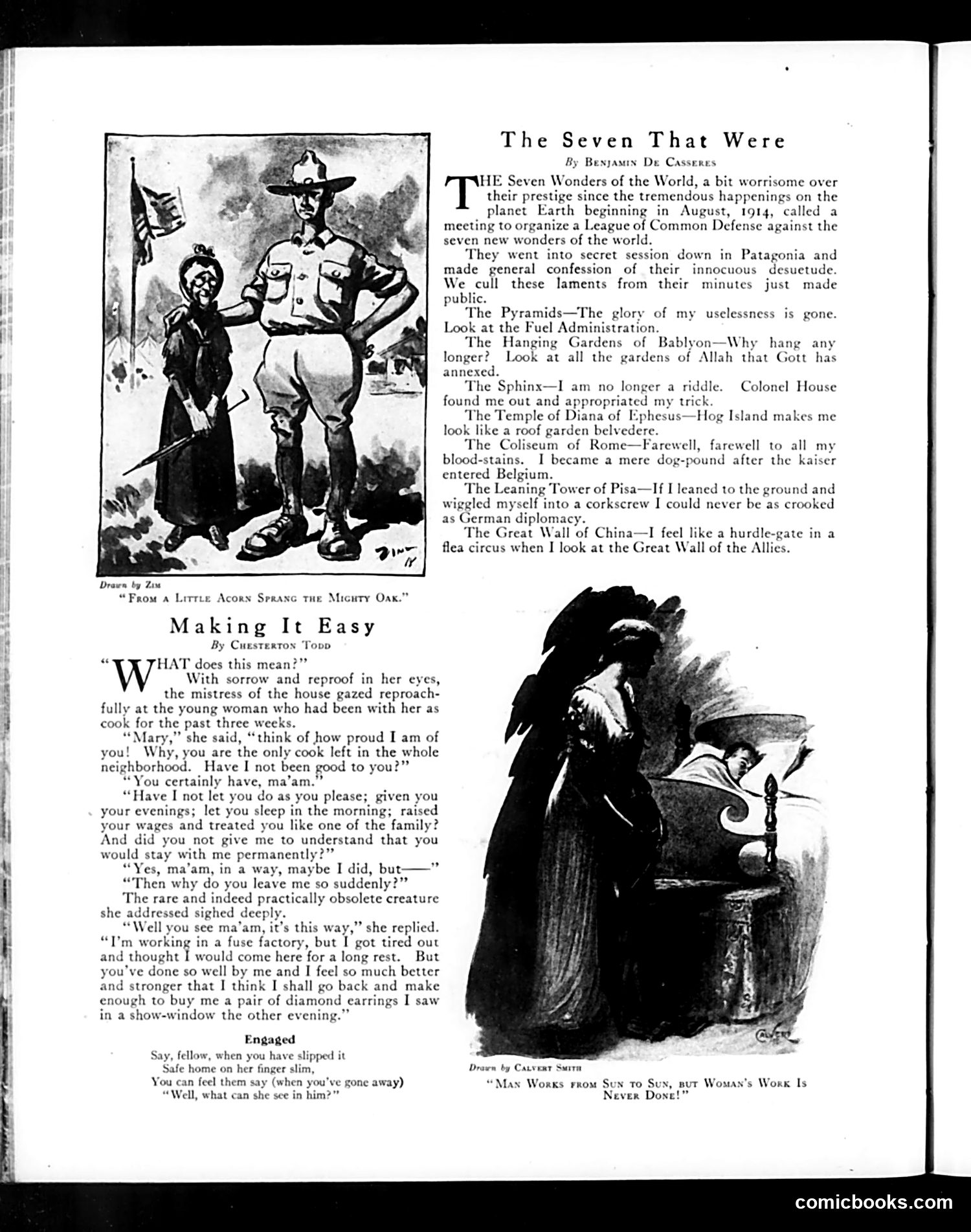
**"The Seven That Were"** satirizes the obsolescence of ancient monuments in light of World War I (begun August 1914). The Seven Wonders of the World metaphorically "confess" that modern wartime developments have superseded them: - The Pyramids pale beside the Fuel Administration - Hanging Gardens versus Allah's annexed gardens - The Sphinx outdone by Colonel House's diplomacy - Ancient structures rendered insignificant by wartime industrial/military scale The final jabs mock Germany ("crooked as German diplomacy") and celebrate Allied fortifications as superior to the Great Wall of China. **"Making It Easy"** addresses the acute domestic labor shortage during WWI. A cook quits her employer to work in a munitions factory (fuse manufacturing), returning only temporarily to "rest." She plans to earn enough for luxury goods—reframing factory work as economically preferable to domestic service. The satire critiques how wartime labor demands have overturned traditional household hierarchies and servant relationships. Both pieces reflect 1914-1918 anxieties about war's disruption of normal life.
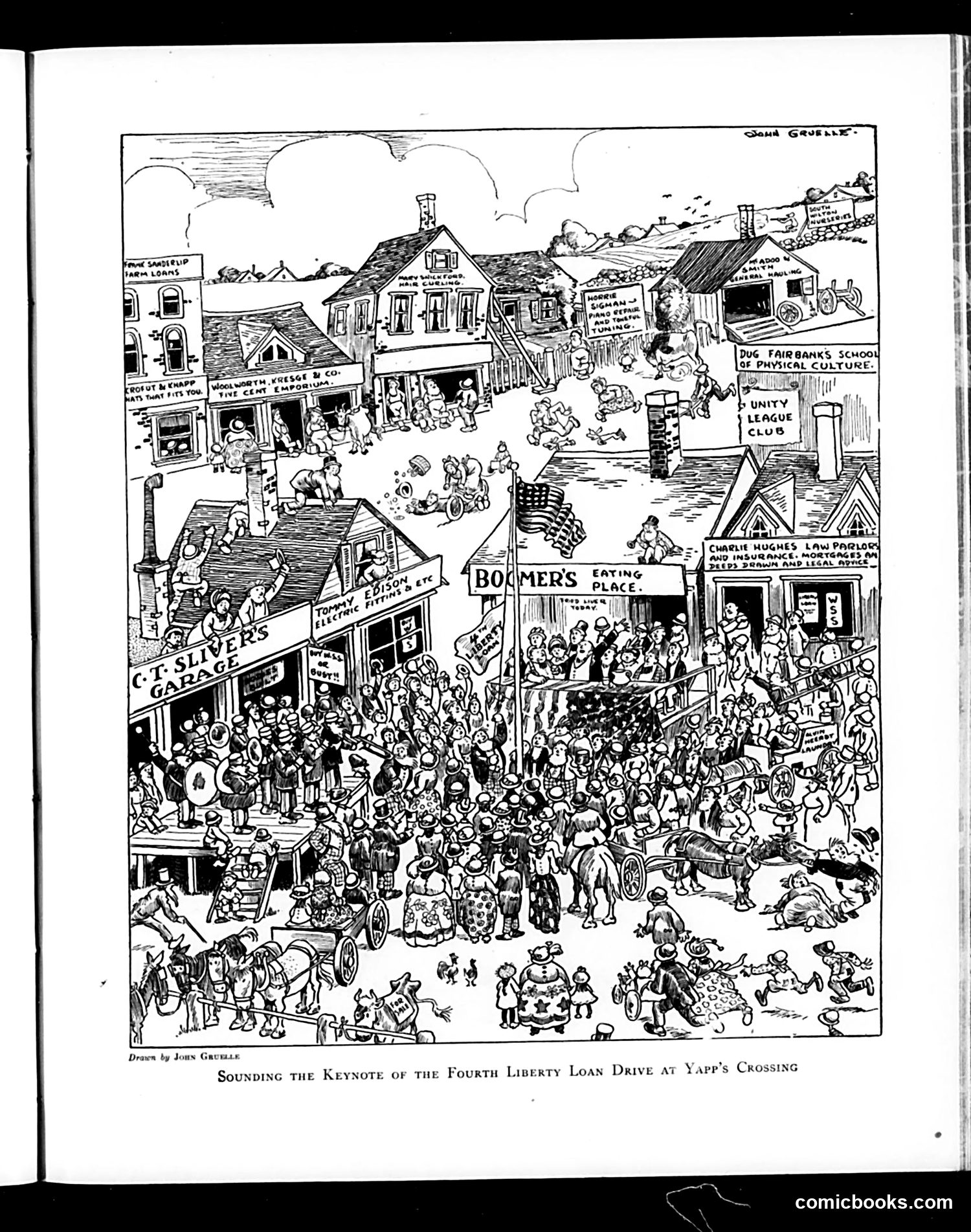
This is a densely packed satirical illustration depicting a small-town community rally for the Fourth Liberty Loan Drive (a WWI-era government bond campaign). The cartoon celebrates American civic participation through exaggerated detail: crowds throng around "Boomer's Eating Place" and "C.T. Sliver's Garage," while various establishments—a school, law office, insurance agency—line the streets. The illustration satirizes small-town enthusiasm and commercialism surrounding the patriotic bond drive, showing how the war effort mobilized everyday American institutions and businesses. The "keynote" event appears to be a public gathering meant to encourage bond purchases, depicted as a bustling, almost chaotic community event. The cartoon humorously captures both genuine civic engagement and the commercial opportunism accompanying the fundraising campaign.
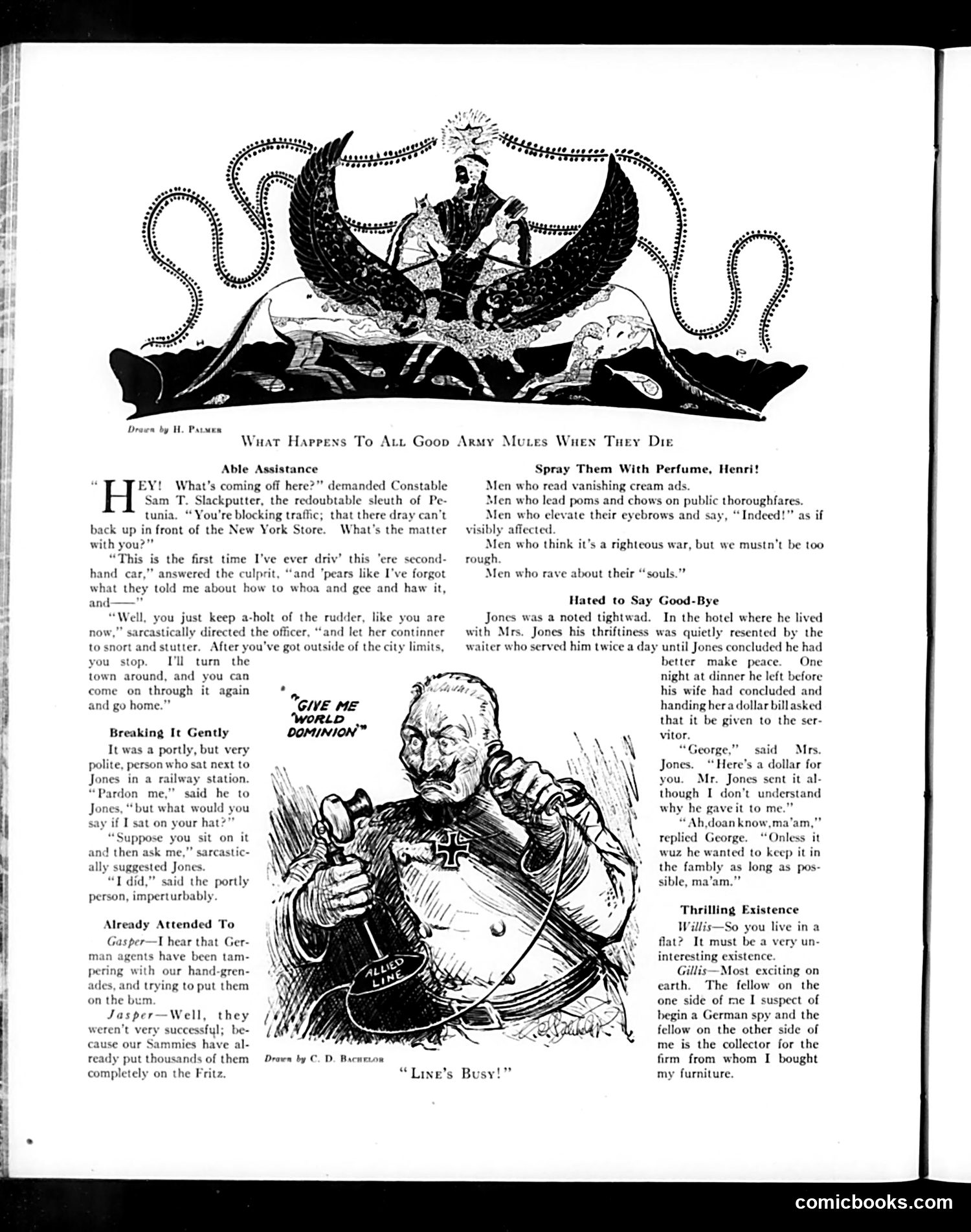
This Judge magazine page contains WWI-era satirical humor (likely 1917-1918): **Top cartoon**: Shows a military figure (likely Kaiser Wilhelm II, identifiable by the spiked helmet and "GIVE ME WORLD DOMINION" speech bubble) as a bloated, aggressive caricature. The title "What Happens to All Good Army Mules When They Die" is a dark joke suggesting German militarism leads to damnation. **Text sections** are humorous vignettes poking fun at American domestic life and attitudes: - "Able Assistance": Small-town incompetence - "Breaking It Gently": Polite society's awkwardness - "Already Attended To": Celebrates American soldiers ("Sammies") successfully destroying German grenades - "Spray Them With Perfume, Henri": Mocks overly refined or insufficiently patriotic men - Remaining stories joke about cheapskates and urban apartment living The overall tone reflects American wartime sentiment—mocking Germans while gently satirizing American social pretensions and domestic quirks. The humor assumes readers' familiarity with WWI patriotic fervor and contemporary slang.
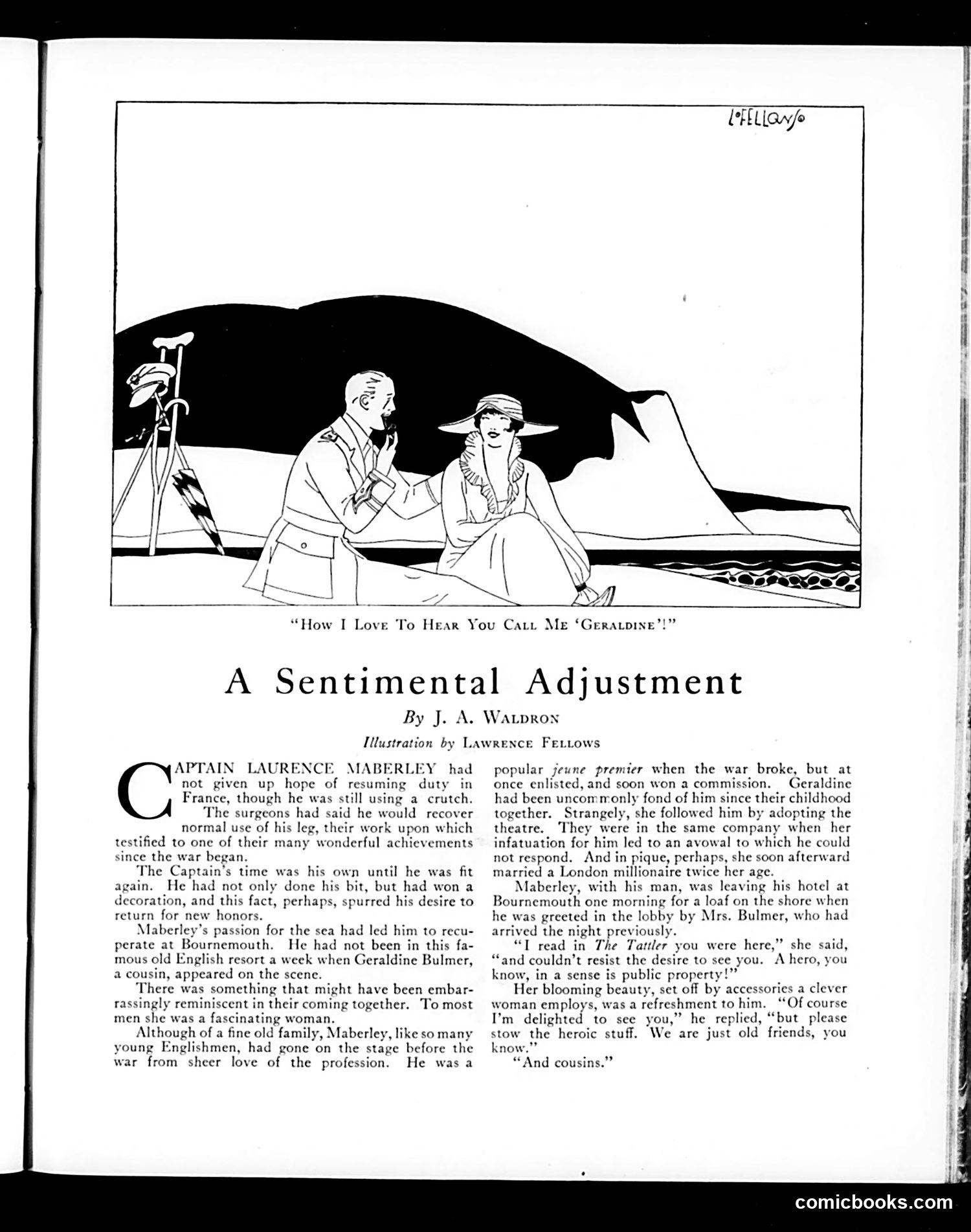
This is a short romantic story, not political satire. It depicts Captain Laurence Maberley, a wounded WWI officer recuperating at the English seaside resort of Bournemouth, unexpectedly encountering his cousin Geraldine Bulmer—a woman he once knew in theater before the war, who had previously confessed romantic feelings he couldn't reciprocate. She subsequently married a wealthy older man. The story's title refers to their emotional "adjustment" to meeting again: she romanticizes him as a war hero ("public property"), while he deflects with humor, insisting they're "just old friends." The illustration shows them on a beach with a phonograph, capturing the sentimental mood. The piece reflects post-WWI literature's fascination with wartime separations and rekindled connections.
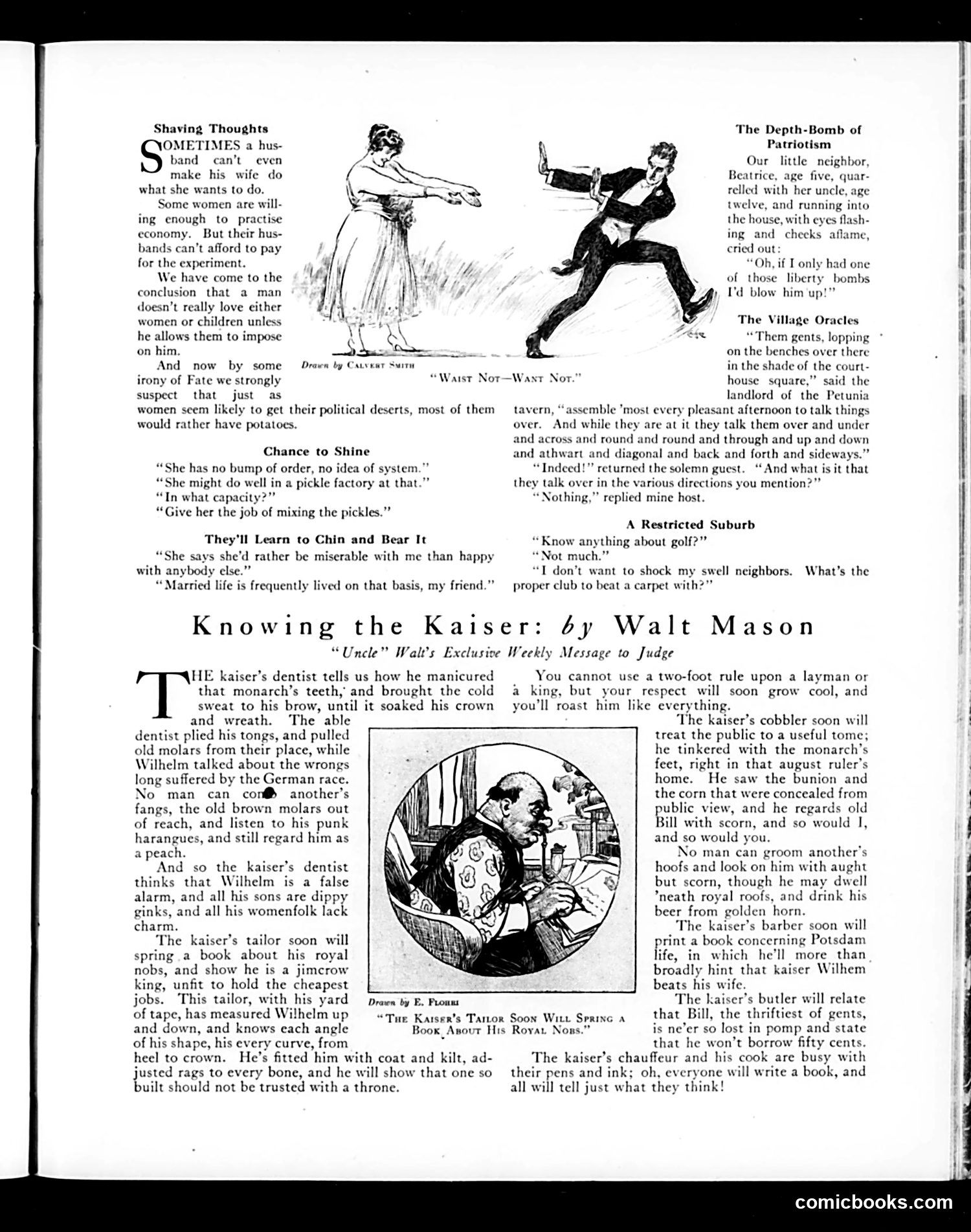
This satirical article mocks Kaiser Wilhelm II through humorous accounts of his various tradesmen (dentist, tailor, cobbler, barber). The joke relies on a wartime propaganda strategy: by describing Wilhelm's servants witnessing his physical imperfections and bodily vulnerabilities—decaying teeth, ill-fitting clothes, bunions, corns—Mason suggests the kaiser is unfit to rule. The piece uses comedic exaggeration: each tradesman supposedly plans to publish exposés revealing Wilhelm's unflattering physical details. The underlying message attacks German militarism by portraying their leader as ridiculously human and flawed, not the powerful figure his regime claimed. This reflects American WWI-era anti-German sentiment, designed to undermine confidence in enemy leadership through satire rather than direct political argument.
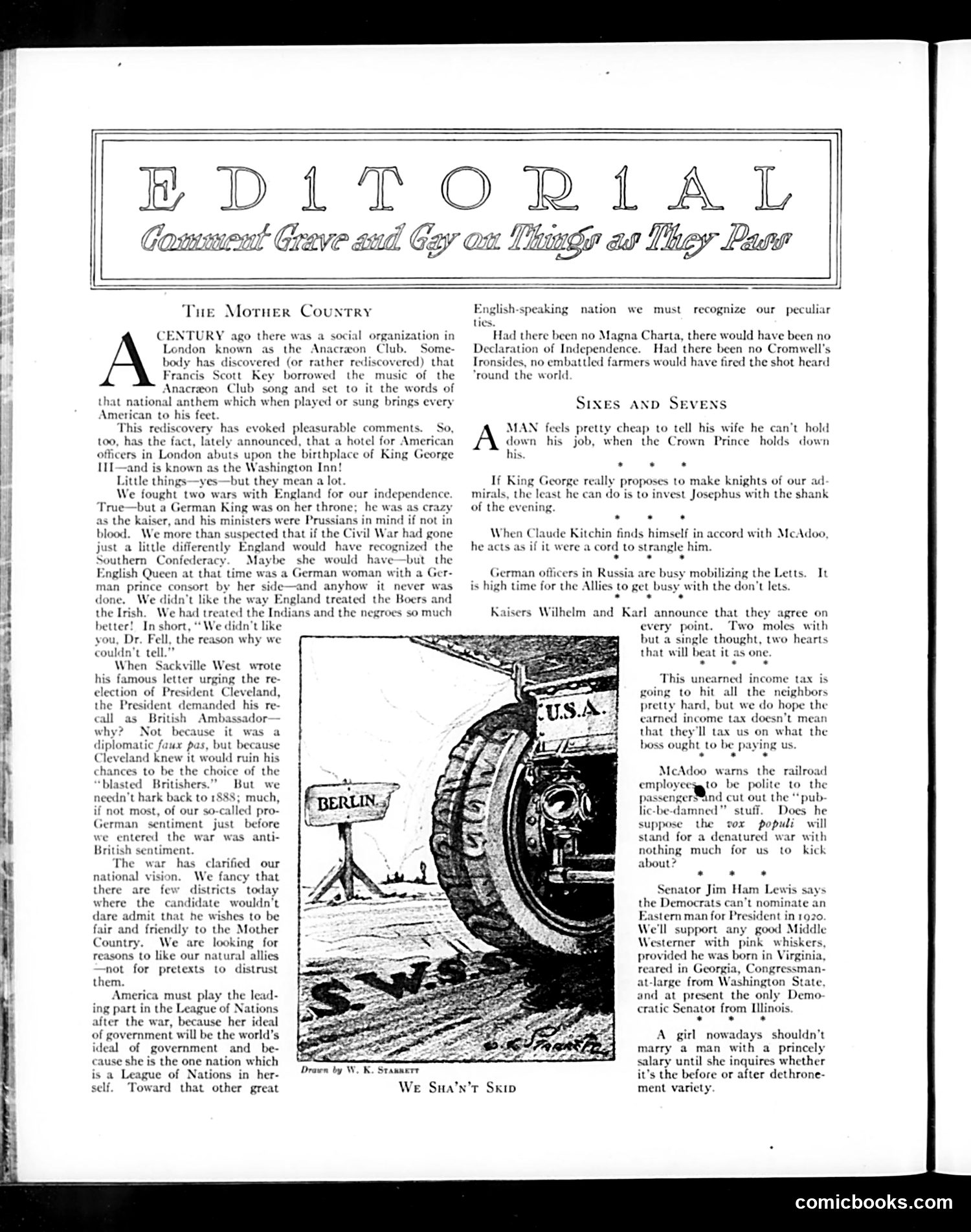
This editorial page addresses Anglo-American relations during World War I. The main cartoon by W.K. Staxnert depicts a road sign pointing toward Berlin, with what appears to be a vehicle or military obstacle blocking the path to the U.S.A.—symbolizing America's commitment to the Allied cause against Germany. The accompanying editorial argues that historical American animosity toward Britain (stemming from wars of independence, Civil War sympathy, and Irish/Boer treatment) should now be overcome. The author contends that shared democratic ideals—citing the Magna Carta's influence on the Declaration of Independence—make Britain America's "natural ally." The satirical "Sixes and Sevens" section contains brief political jabs at contemporary figures: references to King George III, Secretary Josephus Daniels, and various wartime officials. The humor relies on readers recognizing these names and their current political relevance during the war effort.
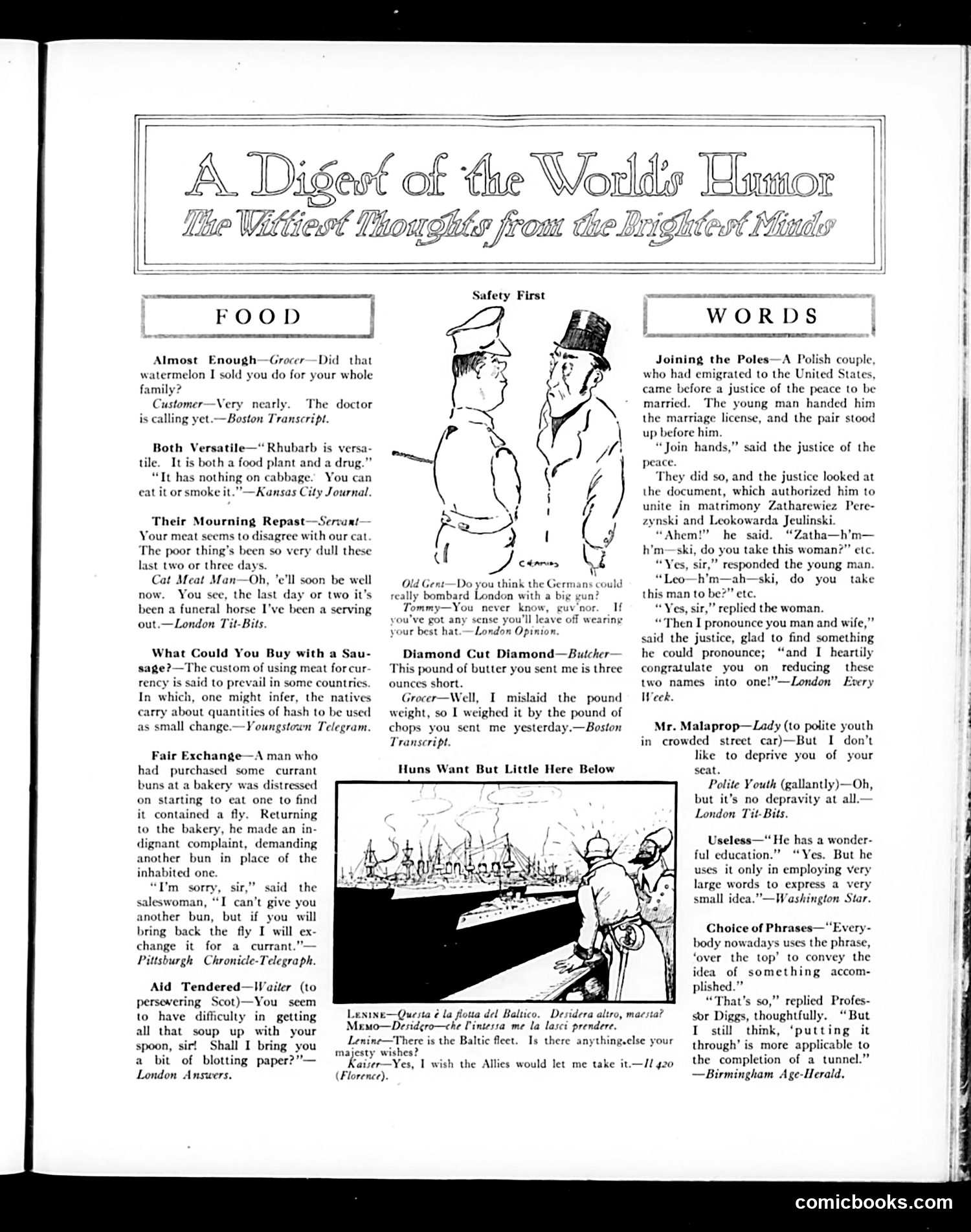
This page from the satirical magazine **Judge** collects brief humor pieces typical of WWI-era American comedy. The content reflects concerns and attitudes of that period: **Main Cartoon**: "Huns Want But Little Here Below" depicts Kaiser Wilhelm II and Lenin discussing the German Baltic Fleet, with Lenin desiring it. This references real WWI naval competition and Germany's military ambitions—"Huns" being contemporary American slur for Germans. **Humor Pieces**: The "Food" section includes jokes about meat quality, suggesting wartime food scarcity anxieties. "Aid Tendered" mocks Scottish frugality (a common ethnic stereotype). "Joining the Poles" jokes about Polish immigrants' unpronounceable names—reflecting American attitudes toward Eastern European immigration. **Overall Tone**: The page reflects 1917-1918 American perspectives: military anxiety, ethnic stereotyping presented as innocent humor, and anxieties about food supply during wartime rationing. What appears as lighthearted wordplay carried underlying social assumptions now recognized as prejudicial.
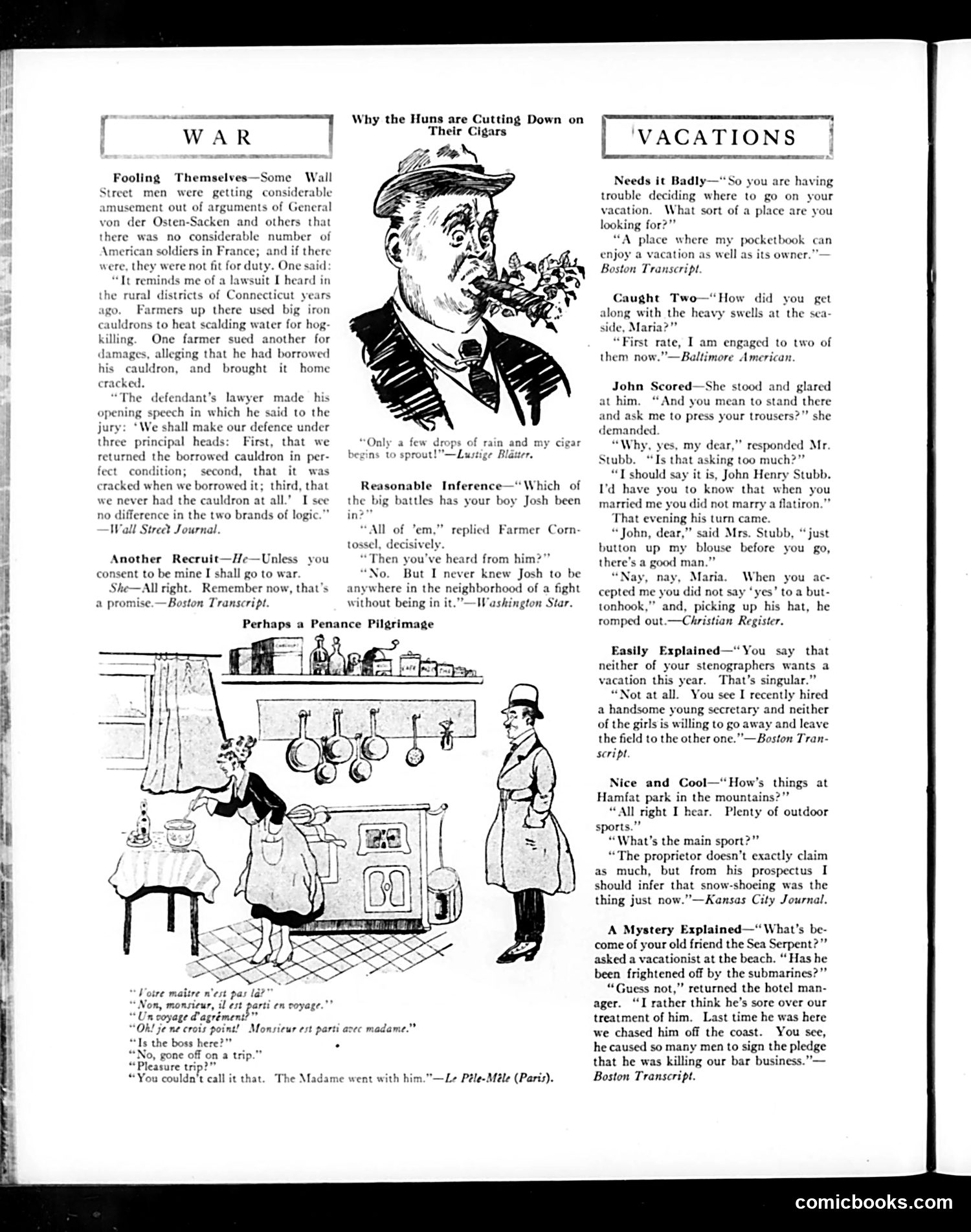
This Judge magazine page contains WWI-era satirical content. The central cartoon "Why the Huns are Cutting Down on Their Cigars" shows a German military figure (identifiable by the spiked helmet) with cigars sprouting from his mouth, suggesting Germany was suffering material shortages due to the war. The "War" section includes anecdotes mocking German generals' claims that few American soldiers were in France—satire dismissing propaganda denials of U.S. military presence in WWI. The "Vacations" section offers humorous domestic vignettes unrelated to war, including jokes about marriage (a husband refusing to press trousers; wives monopolizing young secretaries), vacation affordability, and a running gag about the "Sea Serpent" legend scaring men into sobriety. The bottom cartoon depicts a French domestic scene, likely satirizing European wartime life. Overall, the page balances wartime mockery of enemies with lighthearted civilian humor typical of American humor magazines during WWI.
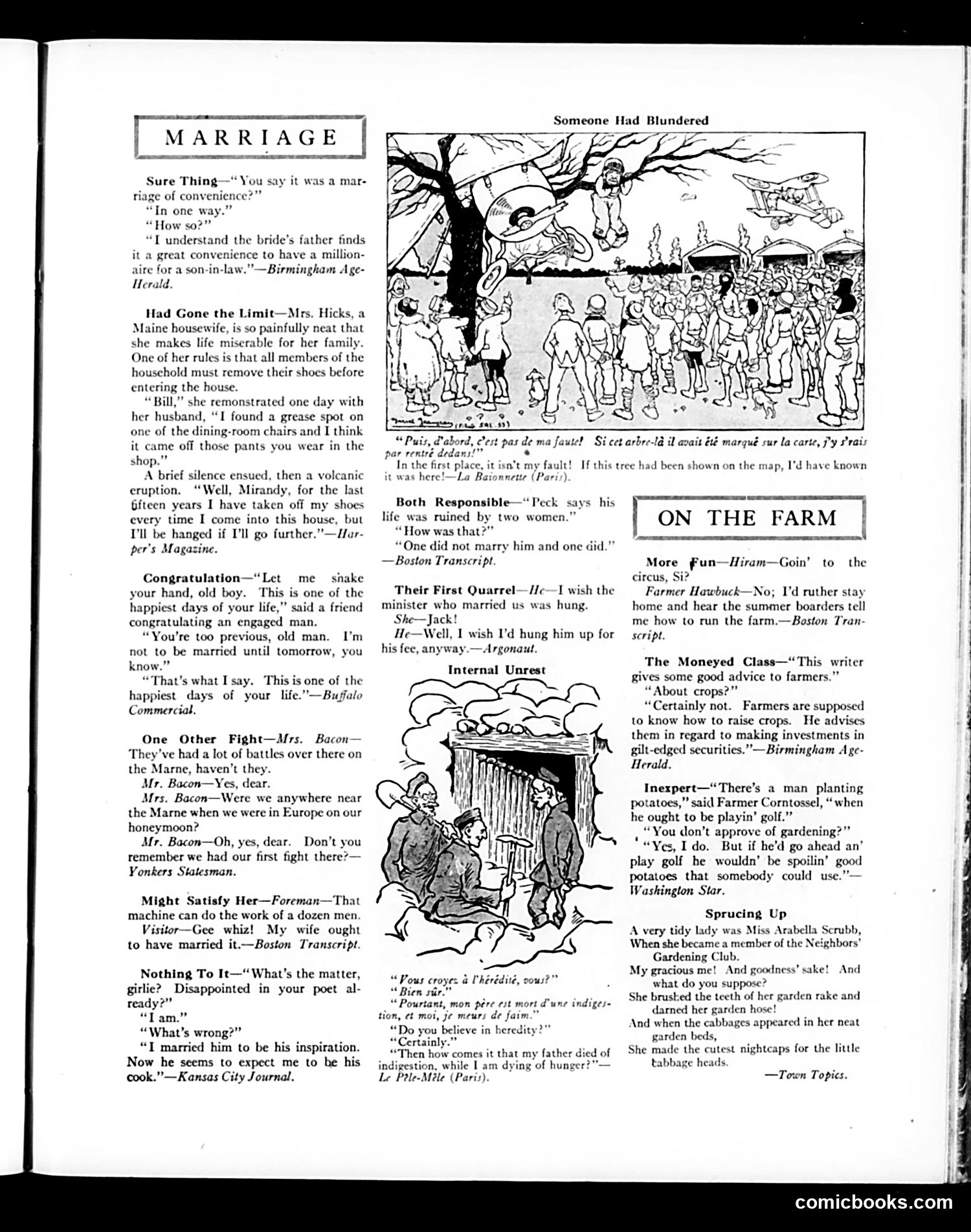
This page collects brief humorous anecdotes about **marriage and farm life**, typical of Judge's satirical humor circa early-to-mid 20th century. ## Marriage Section The jokes mock matrimony's realities: marriages of financial convenience (wealthy suitors marrying into money), wives' domestic tyranny (the shoe-removal rule), and disappointed romantic expectations (the poet husband who must cook). The humor targets both spouses—husbands for marrying for money, wives for unrealistic expectations or excessive household control. ## "Someone Had Blundered" Cartoon Shows a large crowd gathered at a tree, with the caption implying someone's poor map-reading caused confusion during wartime (likely WWI, given Marne River references in the text). The satire blames military incompetence for casualties. ## Farm Section These jokes mock rural life: farmers resisting advice from summer tourists, wealthy investors misunderstanding farming, and a farmer preferring golf to gardening—satirizing both rural simplicity and urban pretension about rural matters. The overall tone is light, domestically focused satire reflecting early 20th-century American attitudes toward marriage, class, and rural-urban divides.
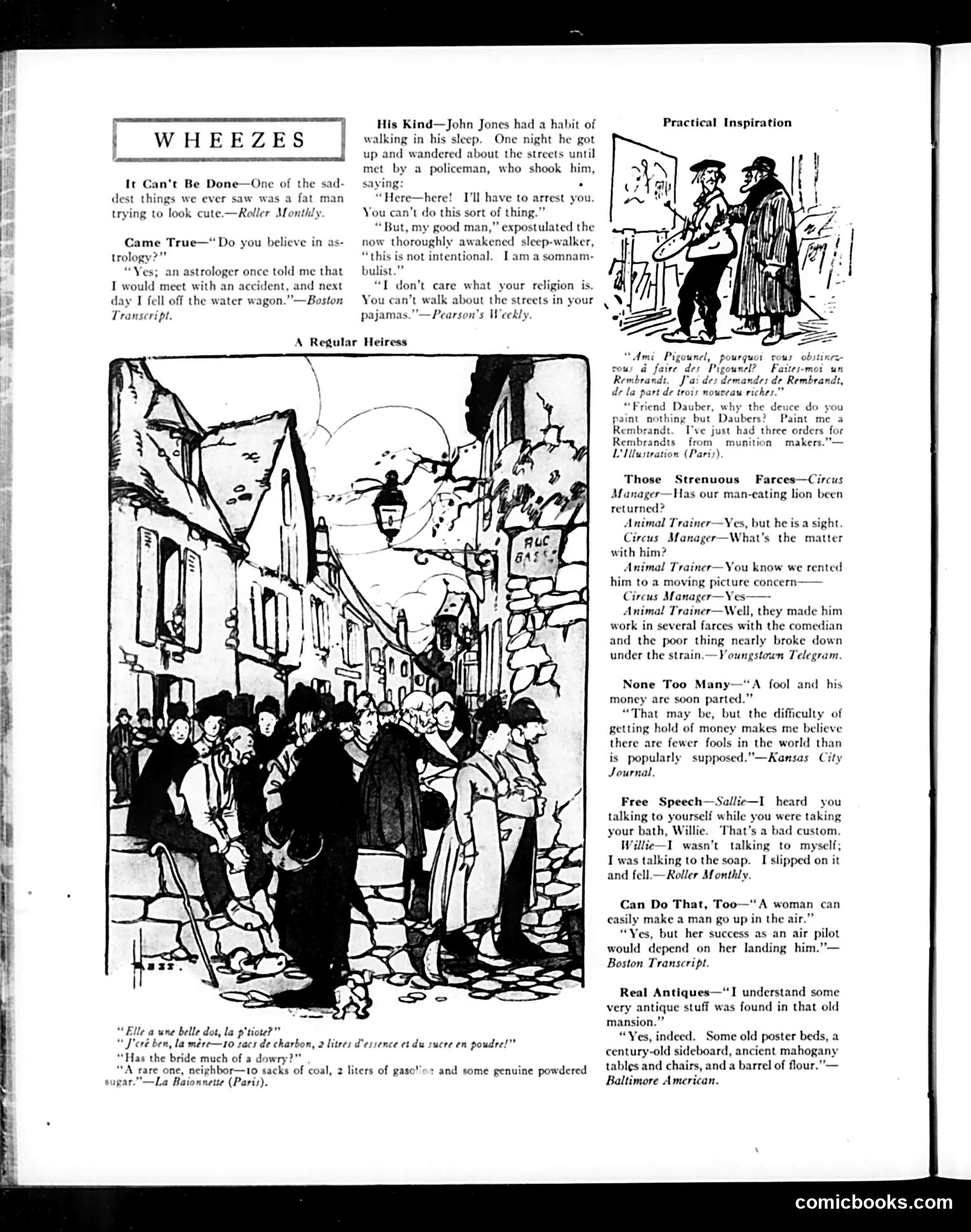
This page from *Judge* collects brief humorous anecdotes and jokes on various topics: **"A Regular Heiress"** (center cartoon): A French dialogue joke mocking post-WWI poverty. When asked about a bride's dowry, the response lists essentials—coal, gasoline, and powdered sugar—rather than money or valuables. This satirizes how wartime scarcity made basic commodities more valuable than traditional wealth. **Other jokes** target common human follies: a sleepwalker arrested for wearing pajamas in public; an astrologer's prediction ironically fulfilled; fat men trying to appear cute; a circus lion exhausted from movie farces; fools and money; bathroom etiquette; women pilots; and discovering flour as an "antique." The humor relies on wordplay, irony, and mild social observation—typical of early-20th-century American humor magazines. Most jokes are apolitical, focusing on everyday absurdities and character types rather than serious satire.
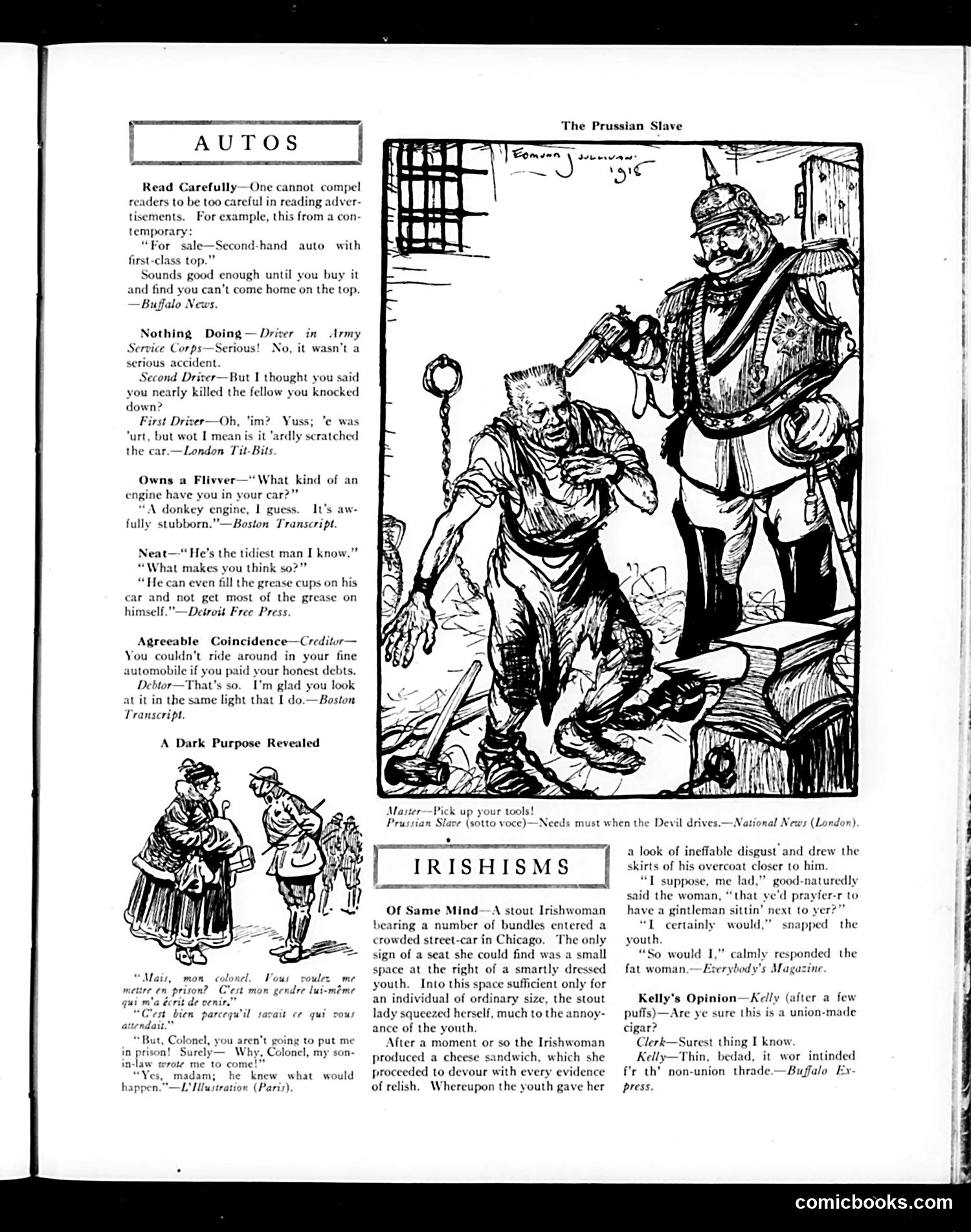
This page contains several short humor pieces and one significant political cartoon. **"The Prussian Slave"** (main illustration): The large woodcut depicts a German military officer (identifiable by the spiked Prussian helmet and uniform) holding chains attached to a brutalized, enslaved worker. The caption reads "Pick up your tools! Prussian Slave (sotto voce): Needs must when the Devil drives." This is WWI-era anti-German propaganda, portraying Prussian militarism as inherently enslaving and brutal. The "devil drives" reference suggests the German military state compels its people toward destruction. **Other content**: The page primarily features brief auto-related jokes (satirizing early car ownership's frustrations) and ethnic humor pieces, including an "Irishisms" section that trades on stereotypical Irish dialect and behavior for comedic effect—standard for early-20th-century American satire magazines. The political cartoon dominates editorially, positioning Judge's stance against German imperial power during the war period.
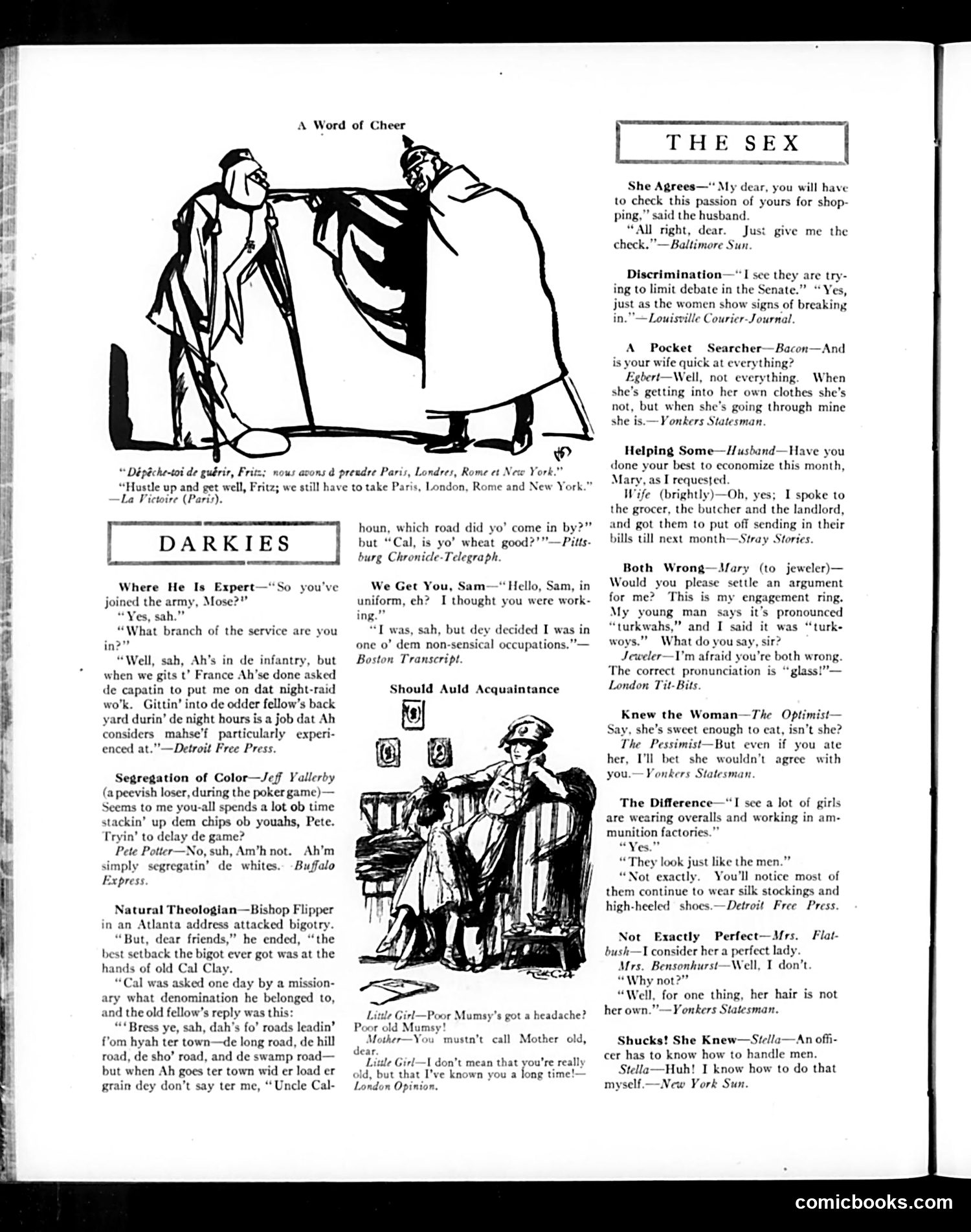
This page contains two main sections: **"Darkies"** and **"The Sex,"** typical of Judge's early 20th-century humor format. ## "Darkies" Section A collection of jokes using racist stereotypes and dialect humor featuring African American characters. These rely on caricatured speech patterns and reinforce segregation-era attitudes. One joke references WWI ("night-raid work" in France), while others mock Black soldiers' military service and perpetuate stereotypes about gambling and religion. ## "The Sex" Section Domestic humor satirizing gender relations and marriage. Jokes mock wives' shopping habits, their ability to search husbands' pockets, and marital economies. One references women's wartime factory work (ammunition factories), suggesting these comics were published during or shortly after WWI when women entered industrial labor. ## Overall Context This represents Judge's typical approach: crude racial caricature alongside conventional middle-class anxieties about gender, economics, and social change. The humor assumes a white male readership amused by both Black stereotyping and gentle domestic satire about wives' spending and autonomy.
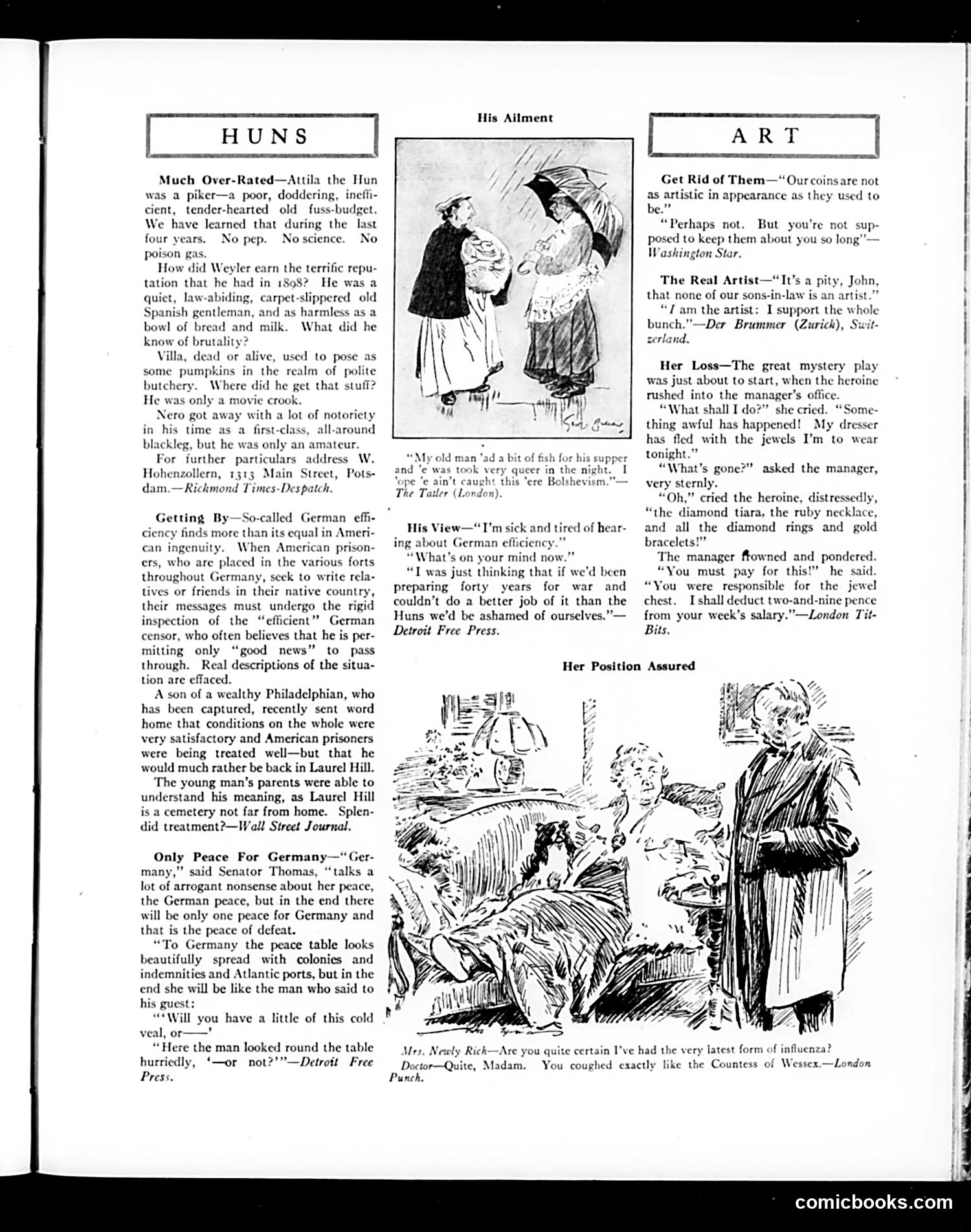
This page contains satirical commentary on **World War I**, targeting Germany and its leadership (Kaiser Wilhelm II, referenced as "W. Hohenzollern"). **The "HUNS" section** mocks German brutality by sarcastically comparing historical figures (Attila, Weyler, Villa, Nero) unfavorably to modern Germans—implying German atrocities during WWI exceeded even history's worst villains. The address to "Hohenzollern" directly names the German Kaiser. **Other pieces** criticize German "efficiency" (actually censorship of prisoners' letters), German peace negotiations (depicted as greedy), and German military preparedness (suggesting they wasted 40 years preparing yet still performed poorly). **The "ART" section** contains unrelated humor about coins, artists, theater, and society—typical Judge magazine content with no political connection. The overall message: Germany and its leadership are brutally incompetent warmongers undeserving of sympathy in peace negotiations.
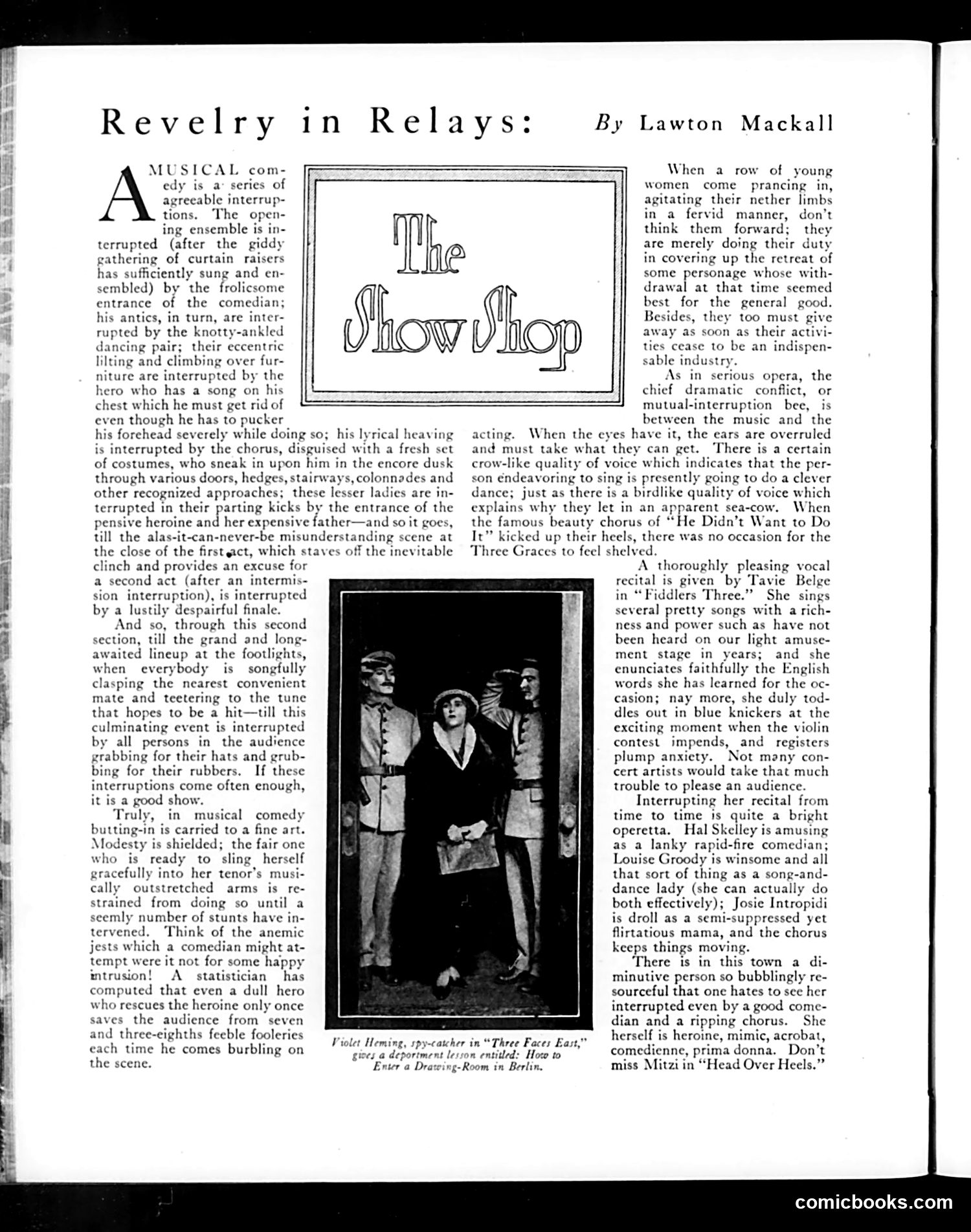
This is not a political cartoon but a theater review by Lawton Mackall analyzing musical comedy as a dramatic form. The accompanying photograph shows actress Violet Heming in "Three Faces East," a spy-themed play. Mackall argues that musical comedy succeeds through *interruption*—the constant stopping and starting of musical numbers, dances, and dialogue keeps audiences engaged and masks weak material. He claims even dull comedians and heroes become tolerable when their scenes are interrupted by dancers, chorus girls, or romantic moments. The piece is essentially a meta-commentary on stagecraft: rather than criticize poor performances, the author explains the *structural purpose* of seemingly frivolous elements (chorus girls, dance breaks) as narrative devices that provide comedic relief and delay inevitable romantic climaxes. This reflects early 20th-century theatrical conventions where spectacle and interruption substituted for substantive comedy.
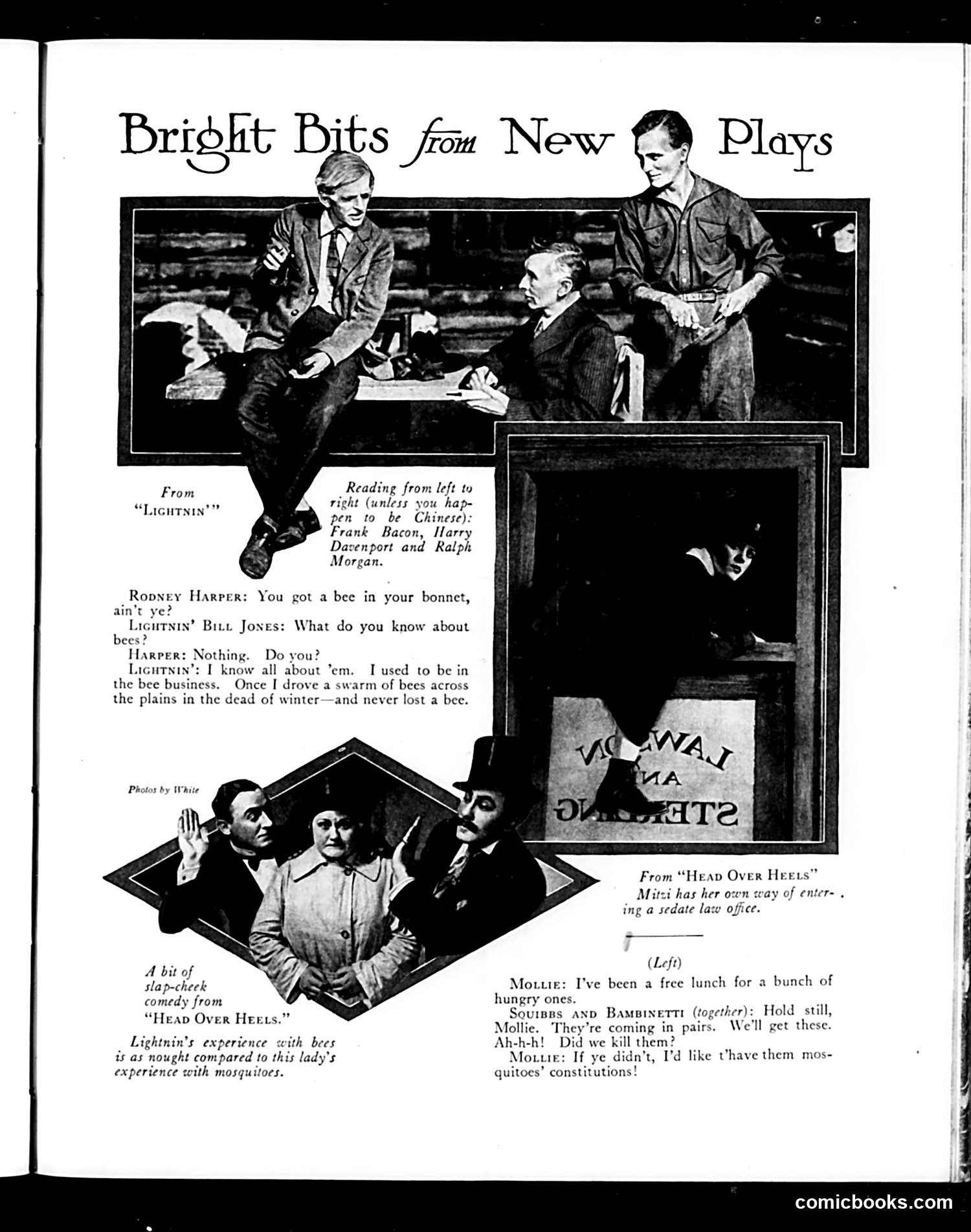
This is a theatrical humor page featuring scenes from contemporary stage productions. The top image shows a dialogue from the play "Lightnin'" between characters Rodney Harper and Lightnin' Bill Jones, where Jones boasts of his expertise with bees—having once driven a swarm across winter plains without losing a single bee. The joke plays on the character's exaggerated tall-tale persona. The bottom section excerpts "Head Over Heels," featuring slapstick comedy where a woman named Mollie complains of being bitten by mosquitoes indoors. Her companions Souriss and Bambinetti attempt to swat them, with Mollie wishing the mosquitoes had human constitutions so she could kill them outright. These appear to be lighthearted comedic moments meant to entertain readers with theatrical snippets—humor based on character types and physical comedy rather than political satire.
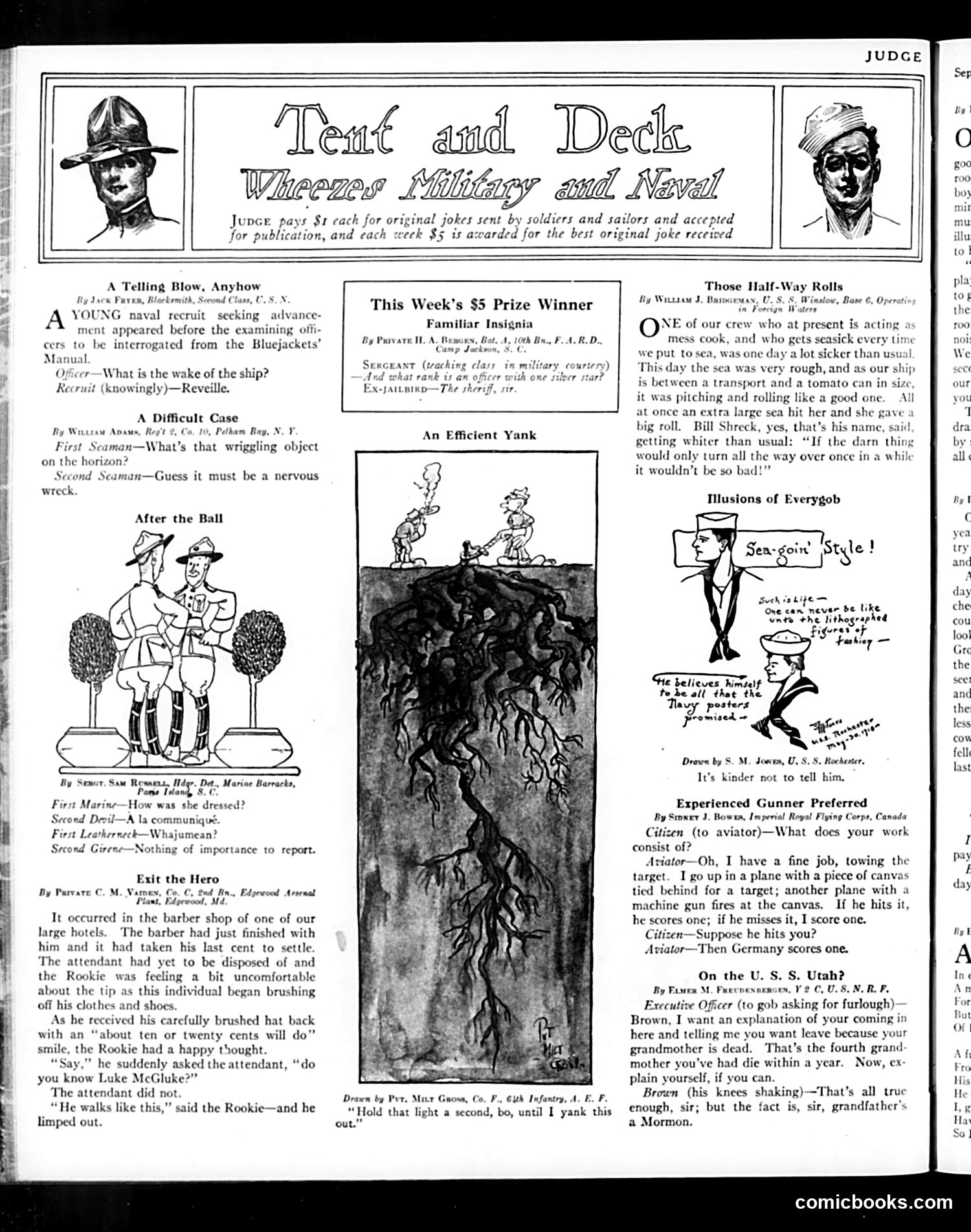
This page collects humorous anecdotes and cartoons submitted by military personnel during World War I, with Judge awarding $5 weekly prizes for the best original jokes. The humor relies on military incompetence, miscommunication, and the absurdities of wartime service. "A Telling Blow" mocks a recruit who confuses naval terminology (answering "Reveille" for "wake of the ship"). "Exit the Hero" depicts a soldier avoiding a tip by mimicking a limp. The cartoons poke fun at seasickness, nervous recruits, and bureaucratic communications ("nothing of importance to report"). The final joke about "four grandmothers" dying in one year makes sense only through a contemporary reference: Mormons practicing polygamy, so a man with multiple wives would have multiple mothers-in-law—allowing plausible (if suspicious) multiple deaths. This reflects anti-Mormon sentiment common in early 20th-century American humor. Overall, these are light morale-boosting jokes aimed at servicemen, emphasizing humor found in ordinary military life rather than combat.
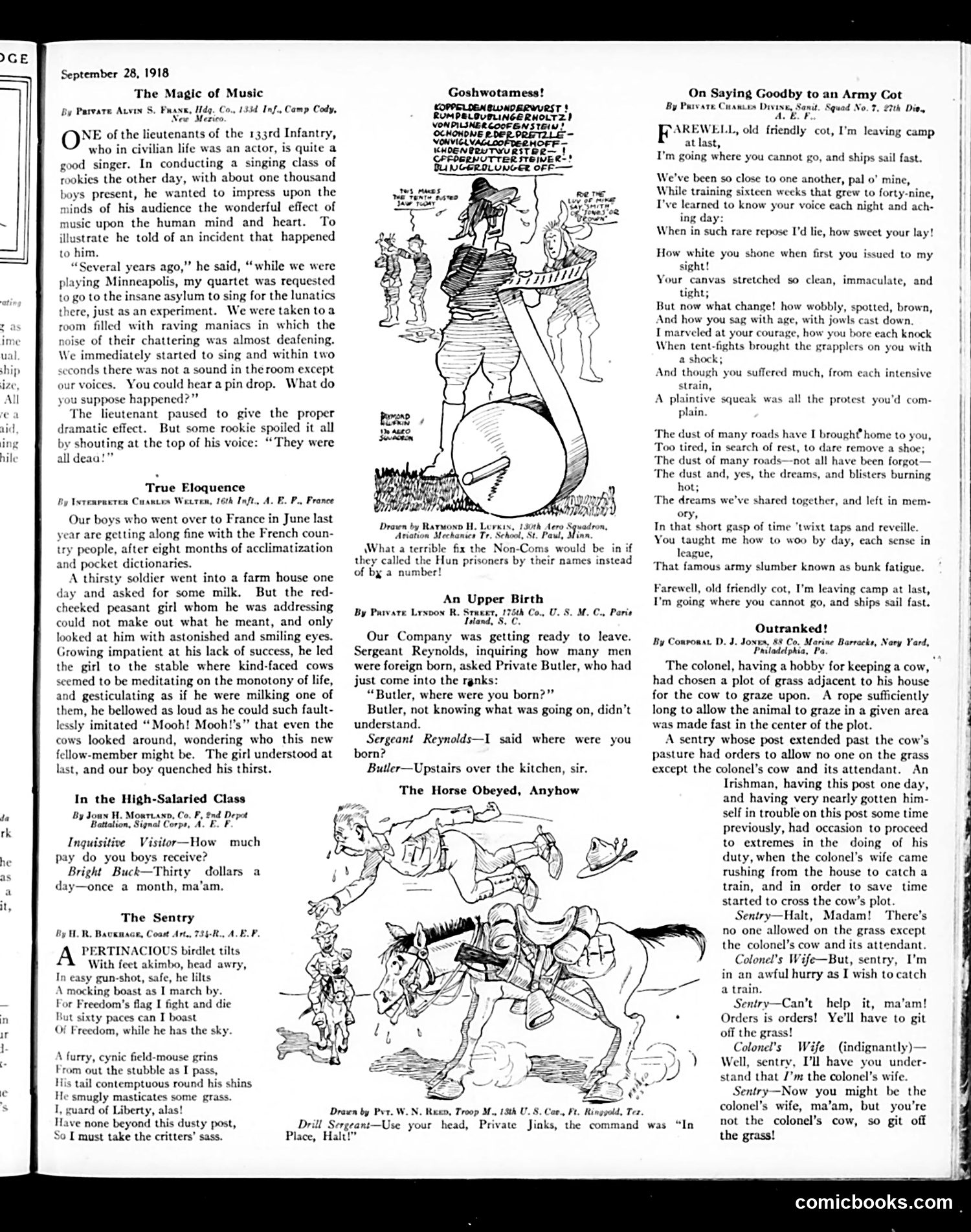
This page collects humorous anecdotes and poems from American soldiers serving in World War I. The satire targets military life's absurdities rather than political enemies. **Key pieces:** "The Magic of Music"—A lieutenant's dramatic story about music's civilizing effect on asylum patients is undercut by a recruit's blunt interruption: they were all deaf. Satire of pompous officer storytelling. "True Eloquence"—An American soldier unable to communicate with a French farm girl succeeds by mooing like a cow. Gentle mockery of linguistic barriers and American soldiers' resourcefulness (or desperation). "Goshwotamess!"—A cartoon mocking the unpronounceable German names of captured prisoners, suggesting military bureaucracy's absurdity in numbering them instead. "The Sentry"—A poem contrasting the freedom of birds and mice with a soldier's confinement, presenting bittersweet irony about fighting for liberty while losing personal freedom. These pieces reflect soldiers' dark humor about military life, discipline, and the gap between civilian and military experience.
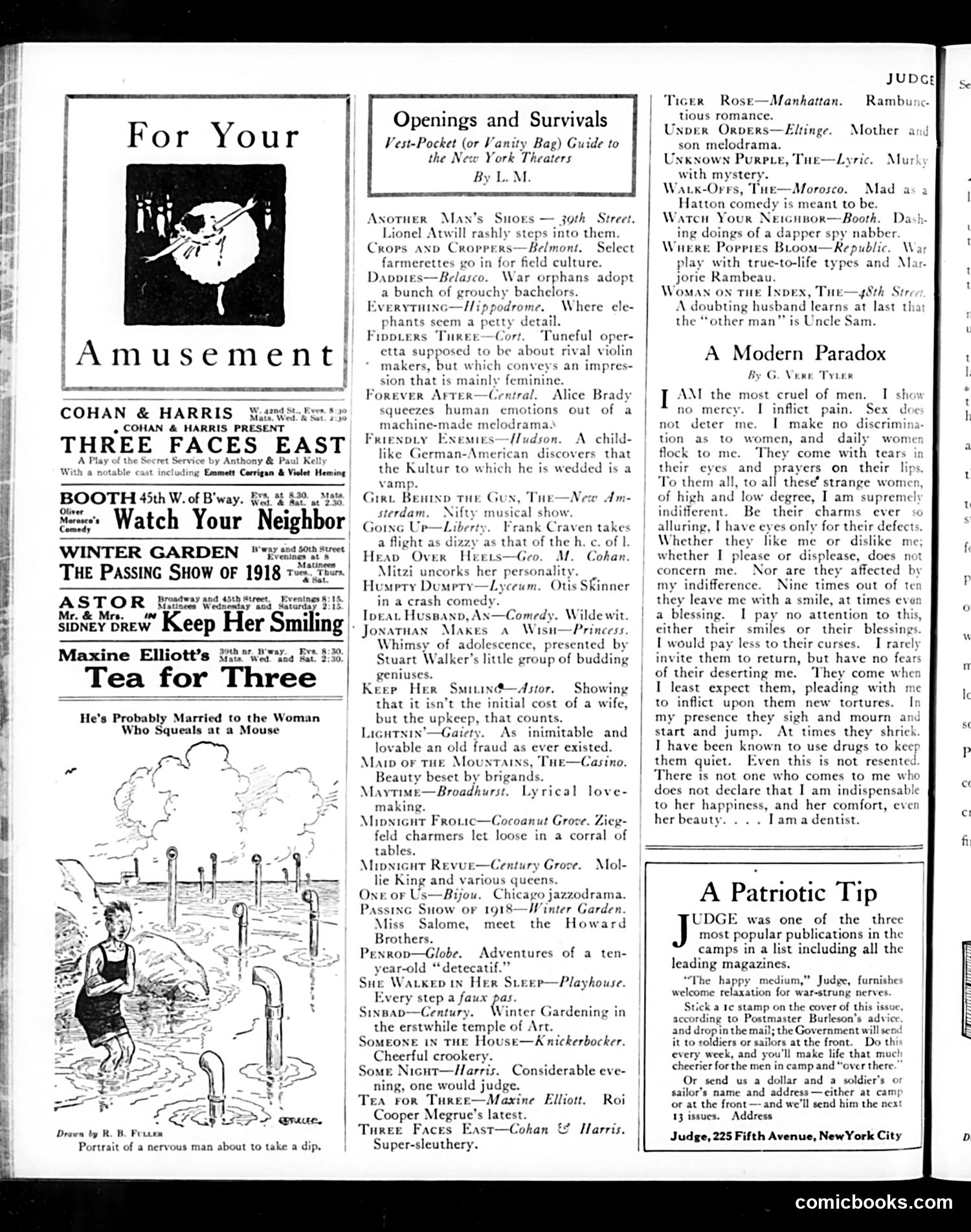
This page from Judge magazine contains theatrical advertisements and reviews alongside satirical content typical of the publication. **The Main Cartoon:** The large illustration depicts a man standing in water surrounded by mousecaps (traps), titled "He's Probably Married to the Woman Who Squeals at a Mouse." This is a domestic humor joke playing on the stereotype of women shrieking at mice—suggesting the man's marital troubles stem from his wife's nervousness, forcing him literally into difficult circumstances. **The Theatrical Section:** Lists New York theater productions from what appears to be 1918 (referenced in "The Passing Show of 1918"). Many shows address WWI themes—"War orphans," "farmerettes," German-American characters—reflecting wartime America's preoccupations. **"A Modern Paradox":** A short story or essay about a cruel man indifferent to women's affections, yet paradoxically attractive to them despite his callousness. This satirizes contemporary attitudes about male-female relationships. The page primarily serves as entertainment and cultural commentary on early-20th-century American society, with emphasis on theater, gender relations, and wartime concerns.
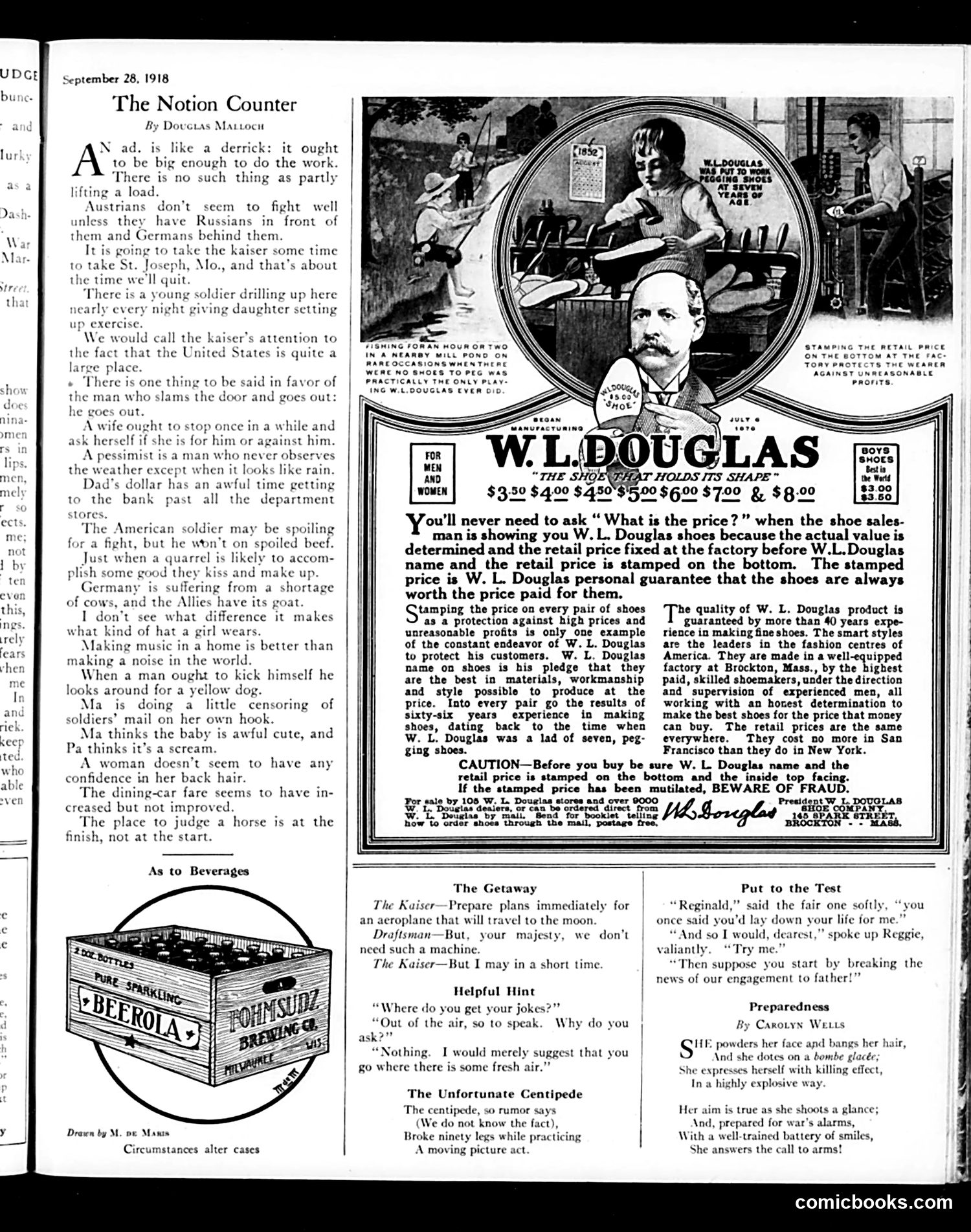
This page contains satirical commentary on World War I home front issues by Douglas Malloch, alongside a major W.L. Douglas shoe advertisement. **The Satire:** Malloch's column offers brief, caustic observations on American life during wartime. Key targets include: the Kaiser's inability to conquer America ("take St. Joseph, Mo."), Austrian military weakness without Russian or German support, material shortages in Germany ("shortage of cows"), and domestic absurdities. References to soldiers drilling nightly and mothers censoring soldiers' mail reflect 1918 wartime conditions. **The Advertisement:** The W.L. Douglas shoe company emphasizes its factory-stamped retail prices as protection against wartime price gouging and "unreasonable profits"—a direct appeal to consumers wary of inflation. The company guarantees consistent pricing nationwide and highlights 60+ years of quality manufacturing in Brockton, Massachusetts. **Context:** Published near war's end (armistice was November 1918), the page reflects American frustration with both enemy powers and domestic economic pressures.
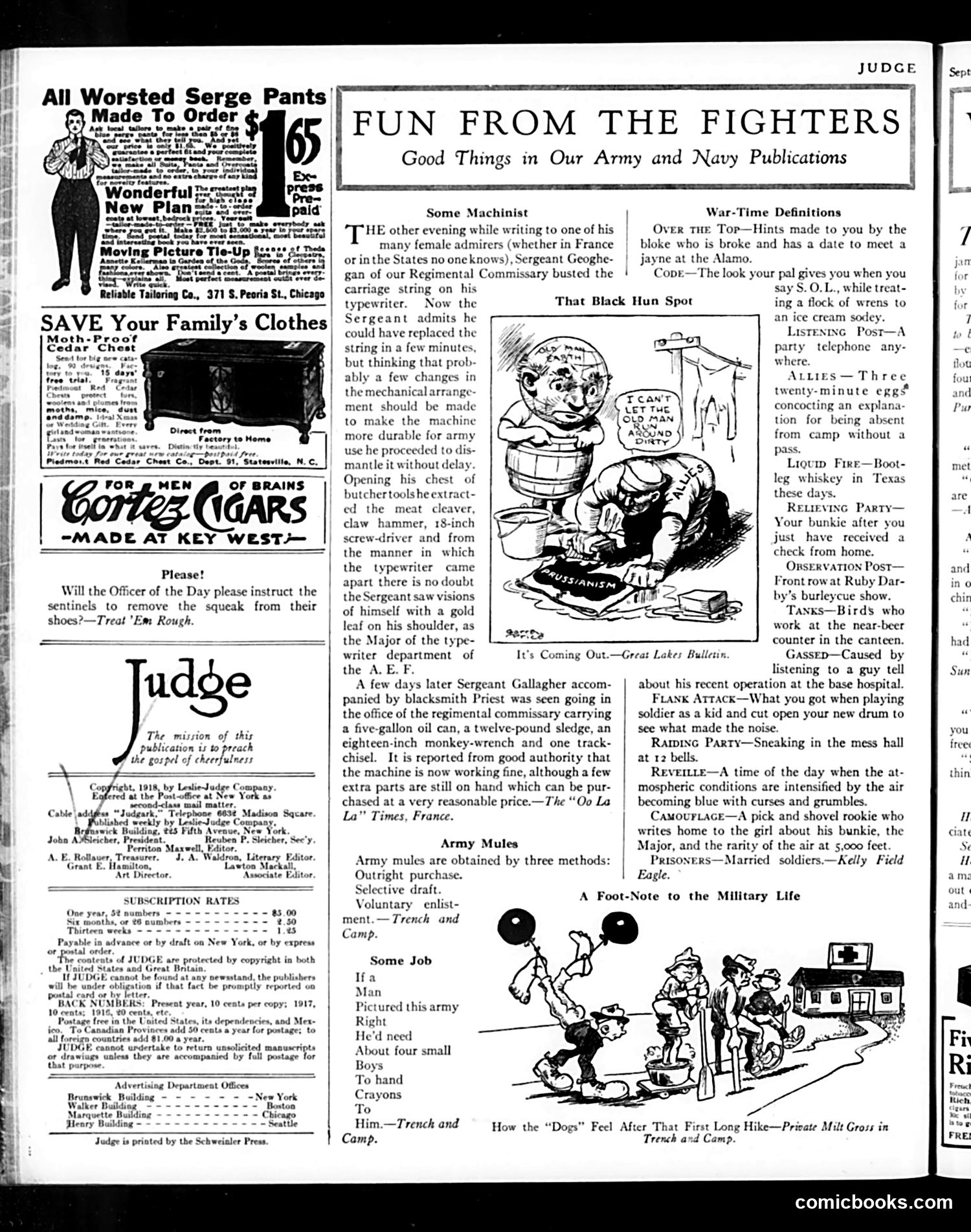
This page from *Judge* (1918) combines wartime humor with advertising. The main content, "Fun From the Fighters," reprints amusing anecdotes and jokes from Army and Navy publications. **Key content:** - **"Some Machinist"**: A sergeant, attempting repairs to a typewriter, completely dismantles it using inappropriate tools (meat cleaver, sledge hammer), treating a simple task as major engineering. The satire mocks soldiers improvising beyond their competence during WWI. - **"That Black Hun Spot"** cartoon: Shows a soldier with a dark spot, implying venereal disease—a serious concern for military leadership during wartime. - **"War-Time Definitions"**: Humorous military slang definitions ("Over the Top," "Allies," "Relieving Party") that mock soldier experiences and hardships. - **"Army Mules"** and **"Some Job"**: Brief jokes about military logistics and the complexity of army operations. The page satirizes both soldier incompetence and the absurdities of military bureaucracy during World War I, reflecting *Judge*'s tradition of irreverent commentary.
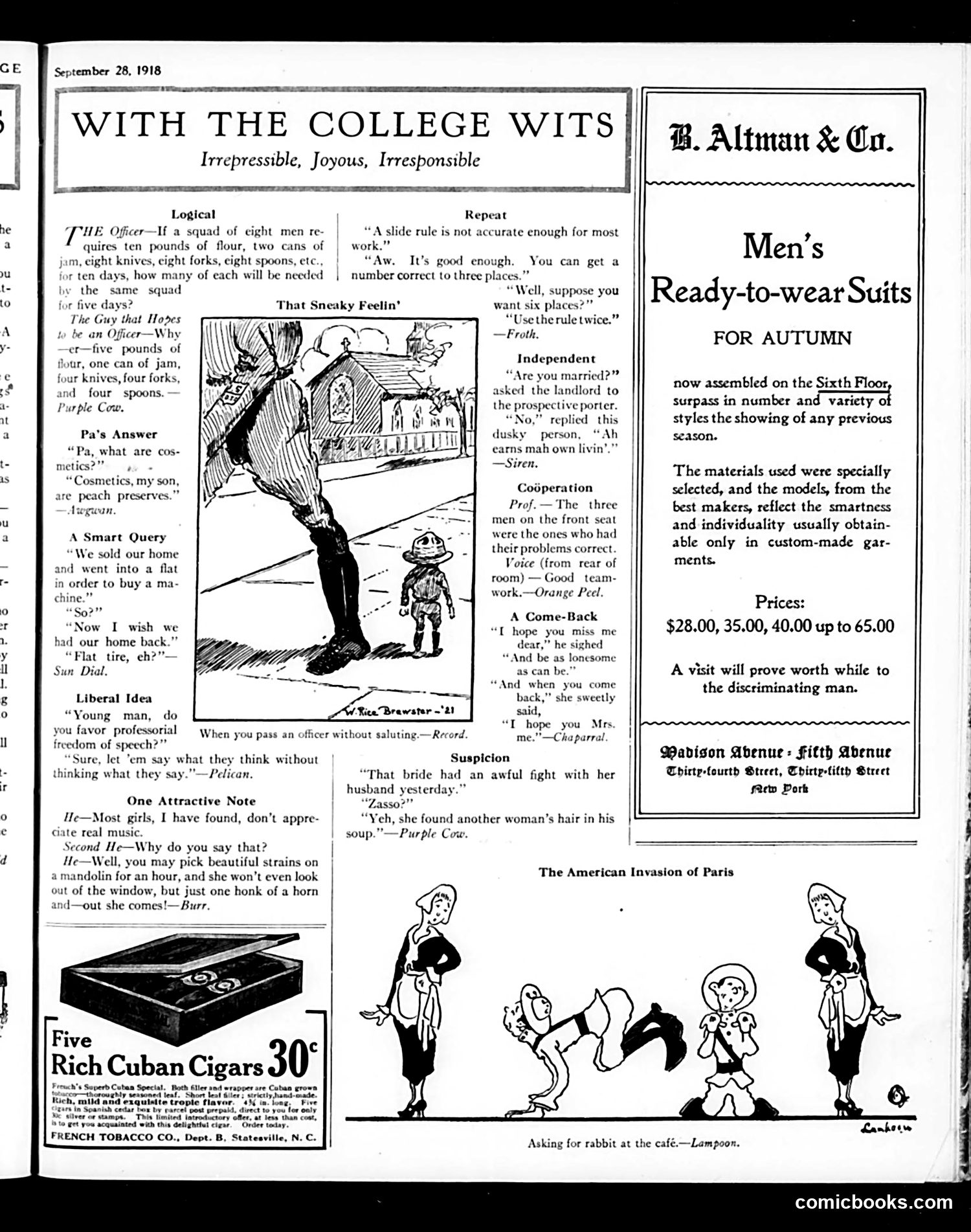
This page contains mostly humor pieces ("With the College Wits") and advertisements, with one notable political cartoon titled "The American Invasion of Paris." **The Main Cartoon:** "The American Invasion of Paris" depicts American soldiers (identifiable by their uniforms) interacting with Parisian women in exaggerated, comedic fashion. The caption "Asking for rabbit at the café" suggests American servicemen causing confusion or cultural mishaps through language barriers or awkward behavior. The humor derives from Americans abroad appearing unsophisticated or comically out of place in European settings. **Historical Context:** This references American Expeditionary Forces deployed to France during World War I (which ended weeks after this publication). The cartoon plays on a common satirical theme: American soldiers as naive, bumbling outsiders in sophisticated French culture. **The Humor:** The joke relies on depicting Americans as culturally inferior or socially awkward compared to refined Parisians—a typical early-20th-century American magazine trope mocking American tourists and soldiers abroad. The rest of the page comprises college humor jokes and advertisements for men's suits and cigars.
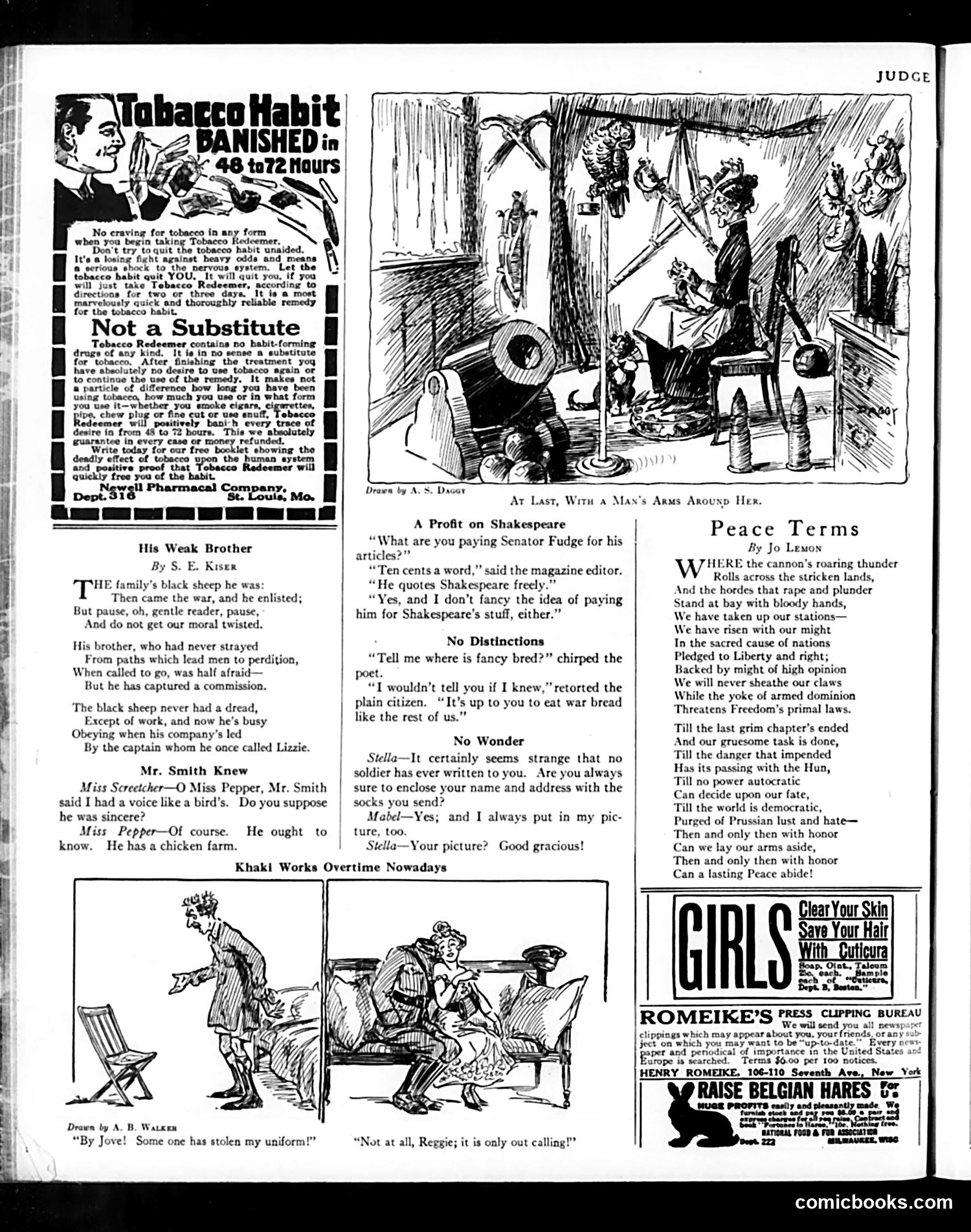
This is a World War I-era satirical magazine page mixing humor with wartime messaging. **Key Content:** The **Tobacco Redeemer advertisement** claims to eliminate tobacco cravings in 48-72 hours—typical early 20th-century patent medicine marketing with unsubstantiated promises. **"His Weak Brother"** presents ironic commentary: the family "black sheep" enlists willingly in WWI, while his morally upright brother, initially reluctant, only accepts a commission (officer rank). The satire suggests character isn't predictable and that war reveals unexpected courage. **Shorter jokes** mock wartime conditions—poets quoting Shakespeare while rationed to "war bread," soldiers' uniforms being "out calling" (worn by girlfriends), and soldiers mysteriously failing to receive mail from women who included their pictures. **"Peace Terms"** by Jo Lemon is a serious patriotic poem declaring the Allies won't surrender until democracy prevails over "Prussian" (German) autocracy—reflecting 1917-1918 American wartime ideology. The page balances advertisements, light humor, and earnest propaganda supporting the war effort and democratic ideals.
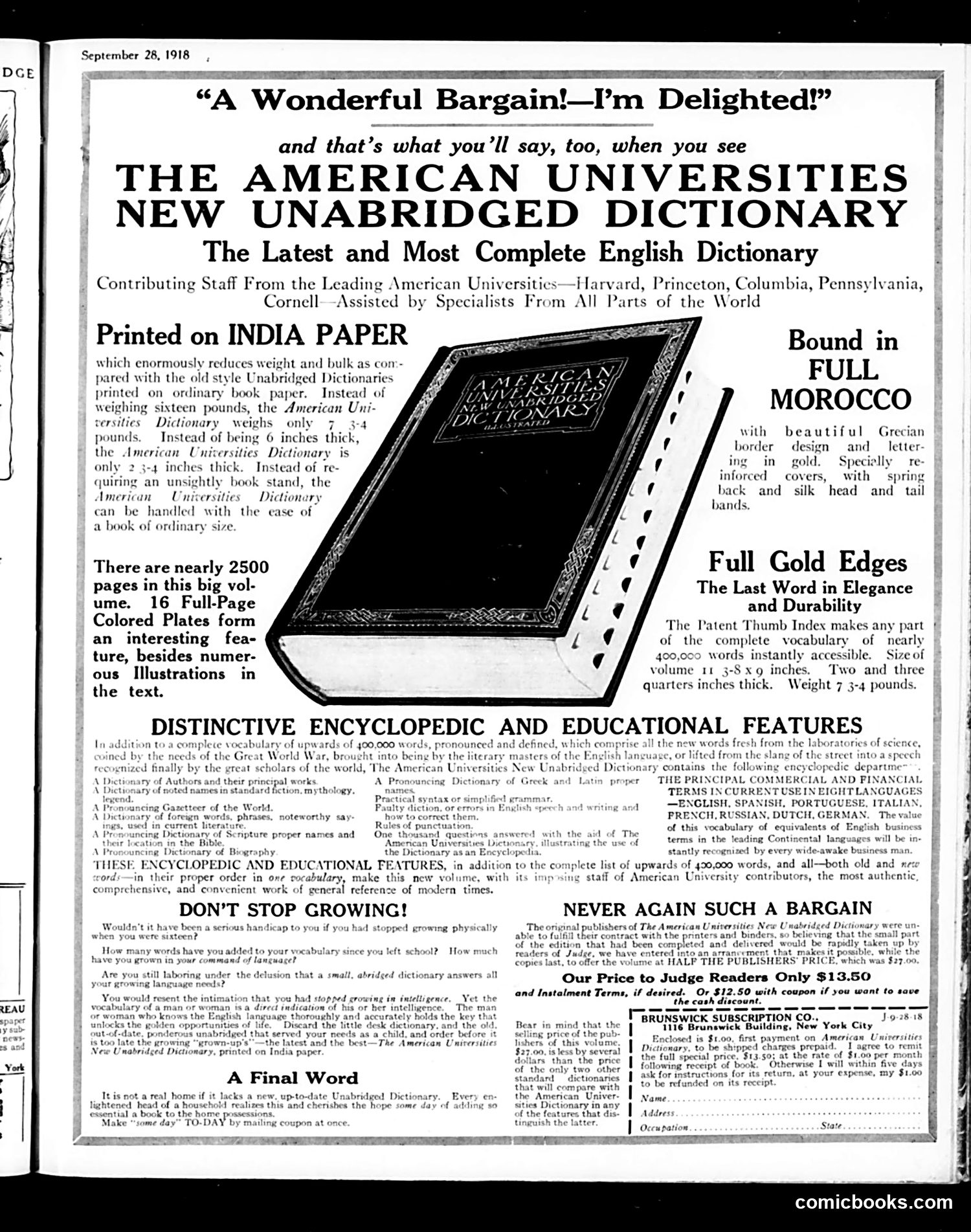
This page is **not a cartoon or satirical editorial content**—it's a full-page advertisement for *The American Universities New Unabridged Dictionary*, published September 28, 1918. The ad uses persuasive marketing rather than satire. It appeals to middle-class self-improvement by emphasizing the dictionary's prestigious contributors (Harvard, Princeton, Columbia, etc.) and practical features: lightweight India paper, morocco binding, gold edges, and a patent thumb index for quick word access. The rhetorical strategy targets educated readers' anxieties about intellectual growth. A section titled "DON'T STOP GROWING!" asks: "How much have you added to your vocabulary since you left school?"—implying that readers should continue self-education through this authoritative reference work. The pricing ($13.50, or $12.50 with coupon) and subscription payment options suggest marketing to middle-income households during World War I. The emphasis on containing 400,000 words reflects early 20th-century pride in comprehensive, "modern" reference materials.
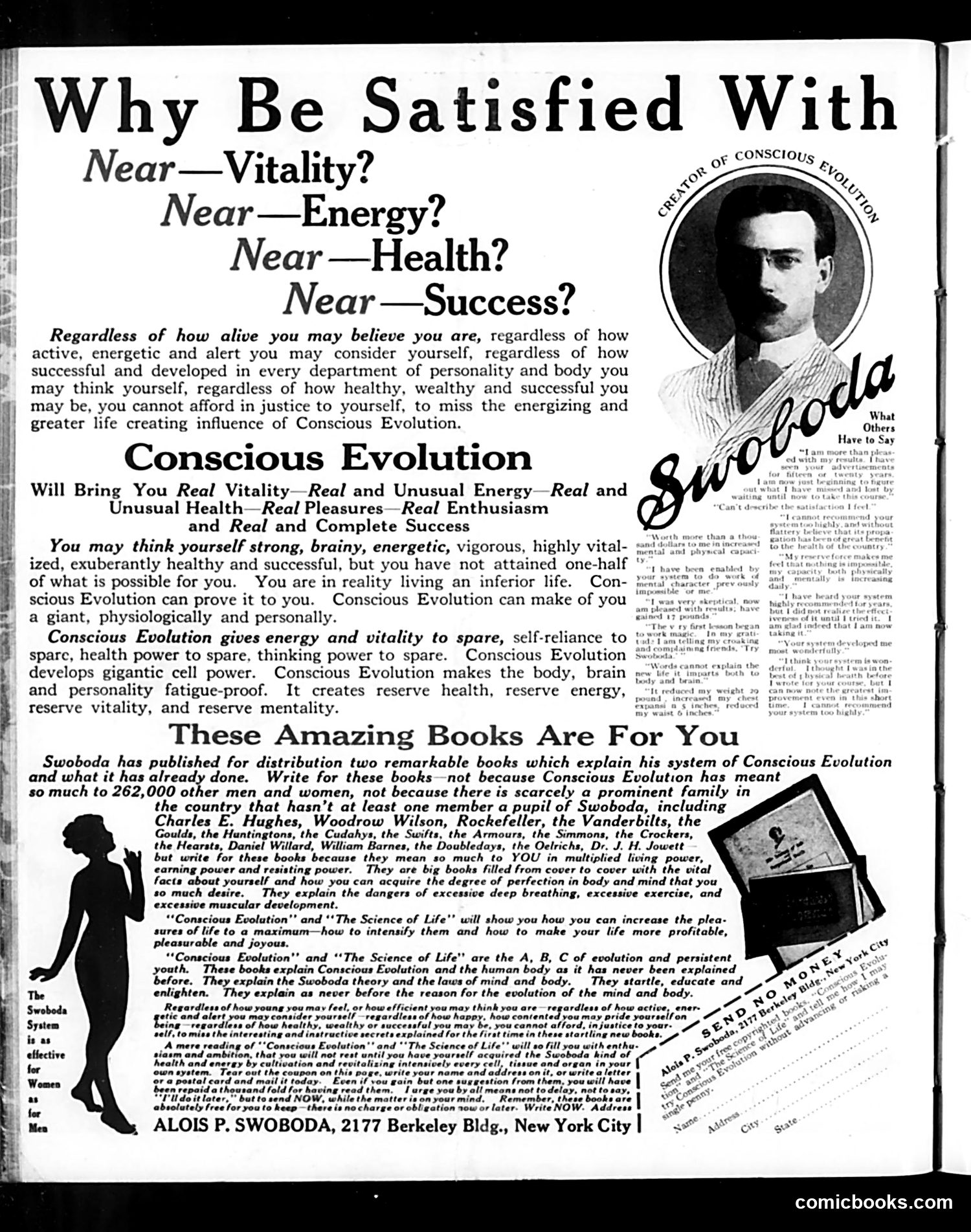
This is primarily a **full-page advertisement**, not satire or cartoon content. It promotes Alois P. Swoboda's "Conscious Evolution" self-improvement system. The ad uses inflated claims typical of early 20th-century pseudoscientific wellness marketing: promises of superhuman vitality, energy, and success through Swoboda's method. The rhetoric employs manipulative phrasing ("You may think yourself strong...but you have not attained one-half of what is possible"). **Notable claims:** The ad lists prominent wealthy figures—Rockefeller, Vanderbilts, Goulds, Woodrow Wilson, Charles E. Hughes—as supposed pupils, lending false credibility. This was a common advertising tactic: association with the famous and successful. The two books advertised ("Conscious Evolution" and "The Science of Life") claim to explain human potential and proper physical training, warning against "excessive deep breathing" and "excessive exercise"—oddly cautious for a vitality-promoting system. For modern readers: this exemplifies early-1900s snake-oil marketing disguised as scientific self-help—exploiting readers' aspirations while making vague, unmeasurable promises.