
Judge, 1918-09-28 · page 7 of 32
Judge — September 28, 1918 — page 7: what you’re looking at
What you’re looking at
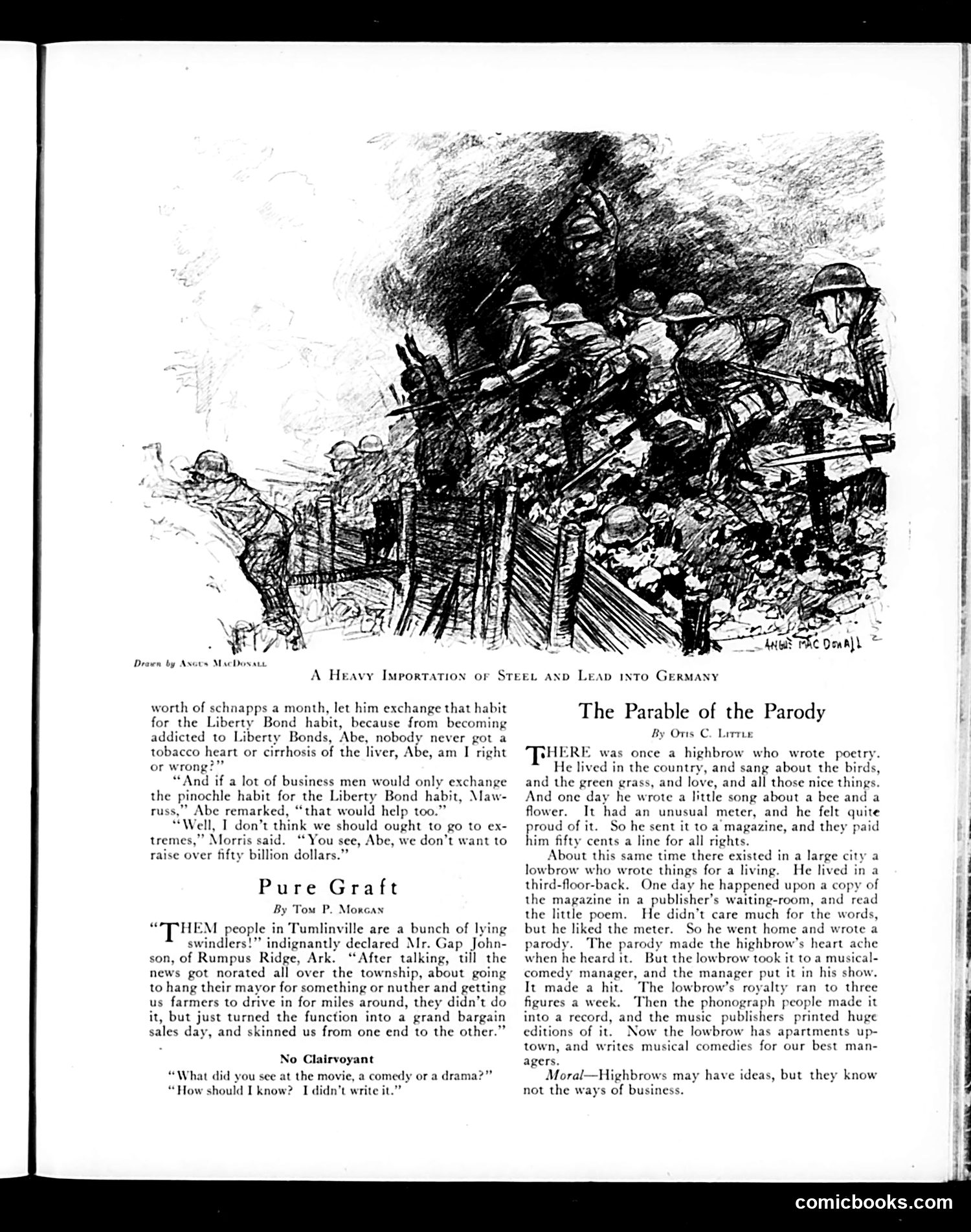
The page contains three separate pieces of satire: **"A Heavy Importation of Steel and Lead into Germany"** (top illustration): A WWI-era cartoon depicting soldiers in trenches. The title's dark humor equates weaponry with "imports"—referencing actual military supplies sent to combat Germany. **"Pure Graft"** and **"No Clairvoyant"**: Brief comedic anecdotes mocking small-town American corruption and con artists. A rural politician cancels a promised lynching and instead holds a "bargain sales day" to exploit farmers who traveled to witness it. **"The Parable of the Parody"**: A satirical fable contrasting a highbrow poet (paid modestly for original work) with a lowbrow commercial writer who plagiarizes the poet's meter, turns it into a musical comedy hit, and becomes wealthy. The moral critiques artistic merit versus commercial success—implying that business acumen matters more than talent in America's entertainment industry. All three pieces mock different American hypocrisies: wartime profiteering, rural swindling, and the devaluation of genuine artistic work.
📄 Transcribed text from this page (OCR, searchable)
Machine-transcribed from the original scan — historical spelling and the odd misread are preserved.
Drown by Axos MreDovaus A Heavy Importation of worth of schnapps a month, let him exchange that habit for the Liberty Bond habit, because from becoming addicted to Liberty Bonds, Abe, nobody never got a tobacco heart or cirrhosis of the liver, Abe, am I right or wrong? “And if a lot of business men would only exchange the pinochle habit for the Liberty Bond habit, Maw- russ,” Abe remarked, “that would help too.” “Well, I don’t think we should ought to go to ex- tremes,” Morris said. ‘You see, Abe, we don’t want to raise over fifty billion dollars.” Pure Graft By Tos P. Morcan “THEM people in Tumlinville are a bunch of lying swindlers!” indignantly declared Mr. Gap John- son, of Rumpus Ridge, Ark. “After talking, till the news got norated all over the township, about going to hang their mayor for something or nuther and getting us farmers to drive in for miles around, they didn’t do it, but just turned the function into a grand bargain sales day, and skinned us from one end to the other.” No Clairvoyant “What did you see at the mov “ How should I know? , a comedy or a drama?” I didn’t write it.” STEE tL and Leap into GerMANY The Parable of the Parody By Ons C. Lirrie sHERE was once a highbrow who wrote poetry. He lived in the country, and sang about the birds, and the green grass, and love, and all those nice things. And one day he wrote a little song about a bee and a flower. It had an unusual meter, and he felt quite proud of it. So he sent it to a magazine, and they paid him fifty cents a line for all right About this same time there existed in a large city a lowbrow who wrote things for a living. He lived in a third-floor-back. One day he happened upon a copy of the magazine in a publisher’s waiting-room, and read the little poem. He didn’t care much for the words, but he liked the meter. So he went home and wrote a parody. The parody made the highbrow’s heart ache when he heard it. But the lowbrow took it to a musical- comedy manager, and the manager put it in his show. It made a hit. The lowbrow’s royalty ran to three figures a week. Then the phonograph people made it into a record, and the music publishers printed huge editions of it. Now the lowbrow has apartments up- town, and writes musical comedies for our best man- agers. Moral—Highbrows may have ideas, but they know not the ways of business. comicbooks.com