
Judge, 1918-09-28 · page 17 of 32
Judge — September 28, 1918 — page 17: what you’re looking at
What you’re looking at
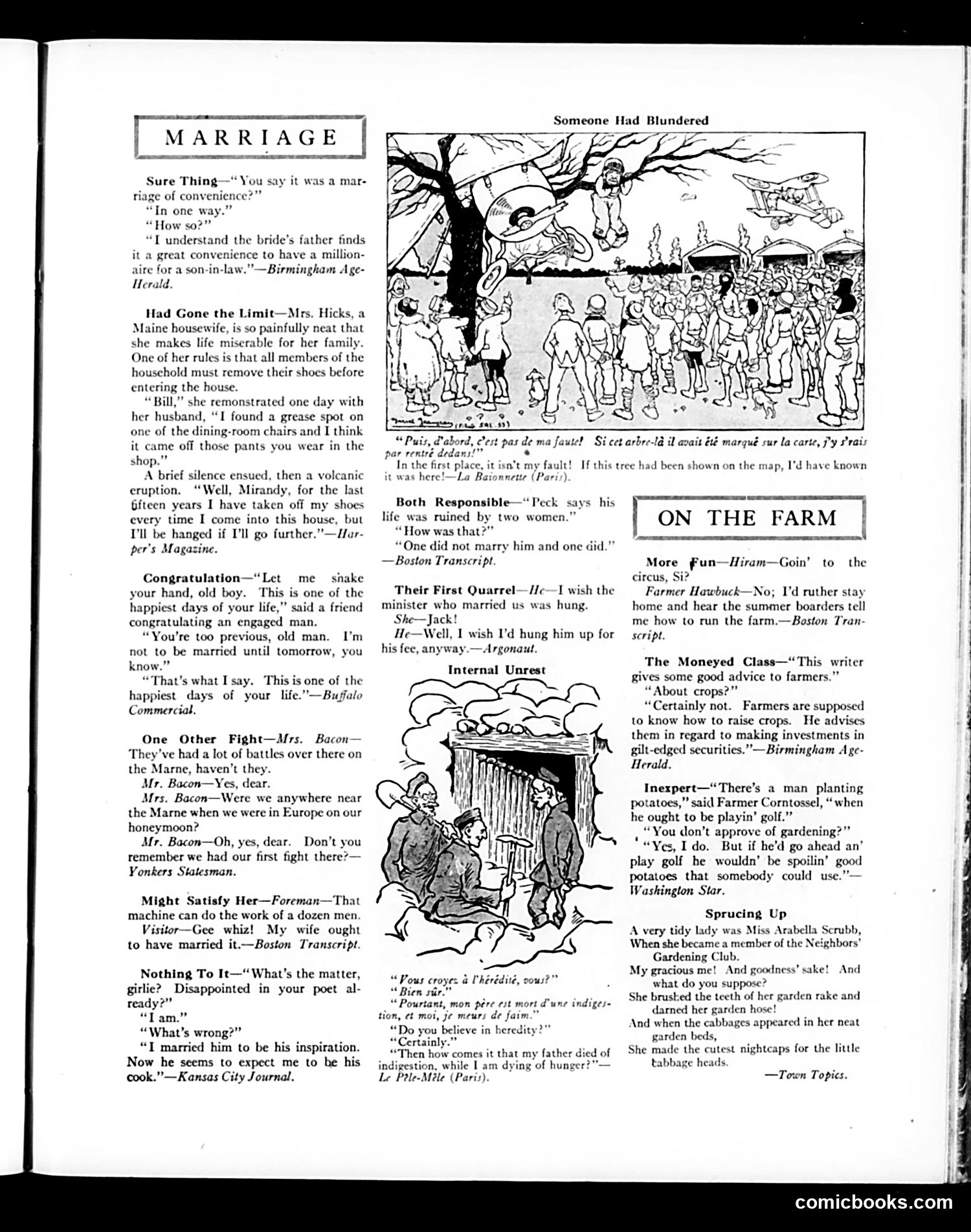
This page collects brief humorous anecdotes about **marriage and farm life**, typical of Judge's satirical humor circa early-to-mid 20th century. ## Marriage Section The jokes mock matrimony's realities: marriages of financial convenience (wealthy suitors marrying into money), wives' domestic tyranny (the shoe-removal rule), and disappointed romantic expectations (the poet husband who must cook). The humor targets both spouses—husbands for marrying for money, wives for unrealistic expectations or excessive household control. ## "Someone Had Blundered" Cartoon Shows a large crowd gathered at a tree, with the caption implying someone's poor map-reading caused confusion during wartime (likely WWI, given Marne River references in the text). The satire blames military incompetence for casualties. ## Farm Section These jokes mock rural life: farmers resisting advice from summer tourists, wealthy investors misunderstanding farming, and a farmer preferring golf to gardening—satirizing both rural simplicity and urban pretension about rural matters. The overall tone is light, domestically focused satire reflecting early 20th-century American attitudes toward marriage, class, and rural-urban divides.
📄 Transcribed text from this page (OCR, searchable)
Machine-transcribed from the original scan — historical spelling and the odd misread are preserved.
at |} MARRIAGE Vane ee ns ae ee Sure Thing—“ You say it was a mar- riage of convenience?” “In one way.” “ How so?” “T understand the bride’s father finds it a great convenience to have a million- aire for a son-in-law.” —Birmingham A ge- Herald. Had Gone the Limit—Mrs. Hicks, a Maine housewife, is so painfully neat that she makes life miserable for her family. One of her rules is that all members of the houschold must remove their shoes before entering the house. “Bill,” she remonstrated one day with her husband, “I found a grease spot on one of the dining-room chairs and I think it came off those pants you wear in the shop.” A brief silence ensued, then a volcanic eruption, “Well, Mirandy, for the last Gfteen years I have taken off my shoes every time I come into this house, but I'll be hanged if I'll go further.”—Har- per's Magazine. Congratulation—“Let me snake your hand, old boy. This is one of the happiest days of your life,” said a friend congratulating an engaged man. “You're too previous, old man. I’m not to be married until tomorrow, you know.” “That's what I say. This is one of the happiest days of your life.”—Buffalo Commercial. One Other Fight—Mrs. Bacon— They've had a lot of battles over there on the Marne, haven’t they. Mr. Bacon—Yes, dear. Mrs. Bacon—Were we anywhere near the Marne when we were in Europe on our honeymoon? Mr. Bacon—Oh, yes, dear. Don’t you remember we had our first fight there7— Yonkers Statesman. Might Satisfy Her—Foreman—That machine can do the work of a dozen men. Visitor—Gee whiz! My wife ought to have married it.—Boston Transcript. Nothing To It—“ What’s the matter, girlie? Disappointed in your poet al- ready?” “Tam.” “What's wrong?” “T married him to be his inspiration. Now he seems to expect me to be his cook.” —Kansas City Journal. Someone Had Blundered i, ws 1) eo? ? et es rs 099) par rentré dedans! In the first plac it was here!—La onnette (Paris) Both Responsible—“Peck says his life was ruined by two women.” “How was that?” “One did not marry him and one did.” —Boston Transcript Their First Quarrel—Hc—I wish the minister who married us was hung. She—Jack! He—Well, 1 wish I'd hung him up for his fee, anyway.—Argonaut. Internal Unrest “Vous croyes & Uhérédité, cows?” “Bien sir.” “Pourtant, mon pére est mort d'une indiges- tion, et moi, je meurs de faim.” “Do you believe in heredity “Certainly.” “Then how comes it that my father indigestion, while | am dying of hung Le Pele-Miéle (Paris). 38 “Puis, Pabord, est pas de ma faute? Si cet arbre-ld il avait été marqué sur la carte, jy Prais ry it isn’t my fault! If this tree had been shown on the map, I'd have known ON THE FARM Fun—Hiram—Goin’ to the Farmer Hawbuck—No; Vd ruther stay home and hear the summer boarders tell me how to run the farm.—Boston Tran- script. The Moneyed Class—‘“ This writer gives some good advice to farmers.” “About crops?” Certainly not. Farmers are supposed to know how to raise crops. He advises them in regard to making investments in gilt-edged securities.” —Birmingham A ge- Herald. Inexpert—“There’s a man planting potatoes,” said Farmer Corntossel, “when he ought to be playin’ golf.” ; “You don’t approve of gardening?” “Yes, Ido. But if he’d go ahead an’ play golf he wouldn’ be spoilin’ good potatoes that somebody could use.’’— Washington Star. Sprucing Up A very tidy lady was Miss Arabella Scrubb, When she became a member of the Neighbors’ Gardening Club. My gracious me! And goodness’ sake! And what do you suppose? She brushed the teeth of her garden rake and darned her garden hose! And when the cabbages appeared in her neat garden beds, She made the cutest nightcaps for the little tabbage heads. —Town Topics. comicbooks.com