
Judge, 1918-09-28 · page 5 of 32
Judge — September 28, 1918 — page 5: what you’re looking at
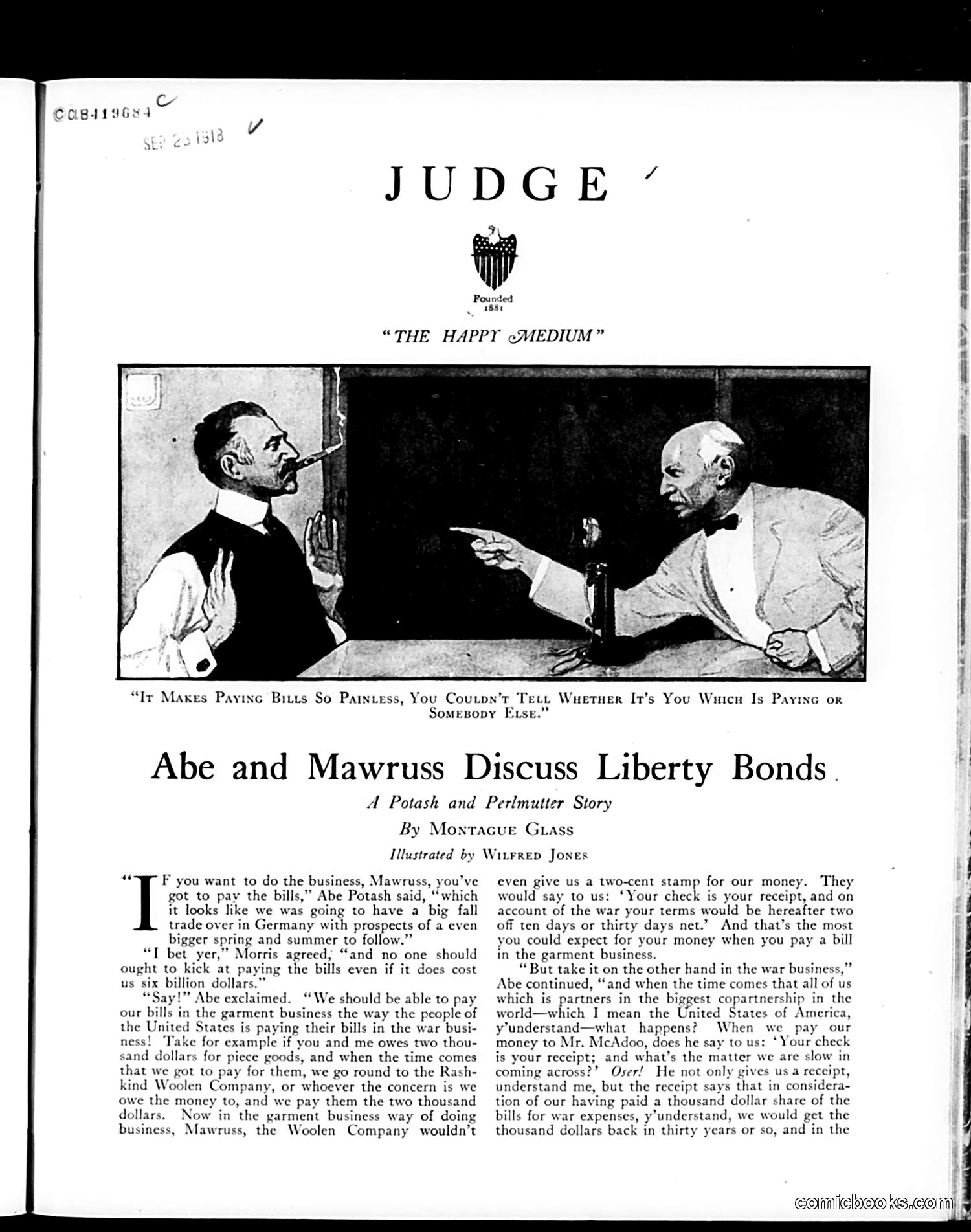
What you’re looking at
This satirical piece titled "Abe and Mawruss Discuss Liberty Bonds" is a "Potash and Perlmutter Story"—referencing popular Yiddish-American comic characters from the era. The dialogue depicts two businessmen debating how to pay bills during wartime, specifically regarding Liberty Bonds (U.S. government bonds sold to finance World War I). The satire mocks the disconnect between patriotic bond-selling rhetoric and practical business concerns. "Abe" argues that in America's partnership, war expenses should be shared; "Mawruss" counters that paying bills requires actual cash flow, not just receipts—highlighting how small businesses struggled with delayed government reimbursement for war-related costs. The caption's pun about "paying bills so painless" undercuts the serious financial strain wartime created for ordinary businessmen.
📄 Transcribed text from this page (OCR, searchable)
Machine-transcribed from the original scan — historical spelling and the odd misread are preserved.
CCOBAINGS4 Pounded 1881 JUDGE ’ “THE HAPPY eMEDIUM” “Ir Makes Payinc Bitts So Paintess, You Coutpn’t Tett Wuetuer It’s You Wuaicu Is Payinc or Somesopy Exse.” Abe and Mawruss Discuss Liberty Bonds. A Potash and Perlmutter Story By Mon AGUE GLass Illustrated by Witrrep Jones “ F you want to do the business, Mawruss, you’ve got to pay the bills,” Abe Potash said, “which it looks like we was going to have a big fall trade over in Germany with prospects of a even bigger spring and summer to follow.” “T bet yer,” Morris agreed, “and no one should ought to kick at paying the bills even if it does cost us six billion dollars.” “Say!” Abe exclaimed. “We should be able to pay our bills in the garment business the way the people of the United States is paying their bills in the war busi- ness! ‘Take for example if you and me owes two thou- sand dollars for piece goods, and when the time comes that we got to pay for them, we go round to the Rash- kind Woolen Company, or whoever the concern is we owe the money to, and we pay them the two thousand dollars. Now in the garment business way of doing business, Mawruss, the Woolen Company wouldn’t even give us a two-cent stamp for our money. They would say to us: ‘Your check is your receipt, and on account of the war your terms would be hereafter two off ten days or thirty days net.’ And that’s the most you could expect for your money when you pay a bill in the garment business. “But take it on the other hand in the war busine: Abe continued, “and when the time comes that all of us which is partners in the biggest copartnership in the world—which I mean the United States of America, y’understand—what happens? When we pay our moncy to Mr. McAdoo, does he say to us: * Your check is your receipt; and what’s the matter we are slow in coming acros: Oser! He not only gives us a receipt, understand me, but the receipt says that in considera- tion of our having paid a thousand dollar share of the bills for war expenses, y’understand, we would get the thousand dollars back in thirty years or so, and in the _ 2A Cy ae ee es ne LE be comichooks.comn}