
Judge, 1918-09-28 · page 15 of 32
Judge — September 28, 1918 — page 15: what you’re looking at
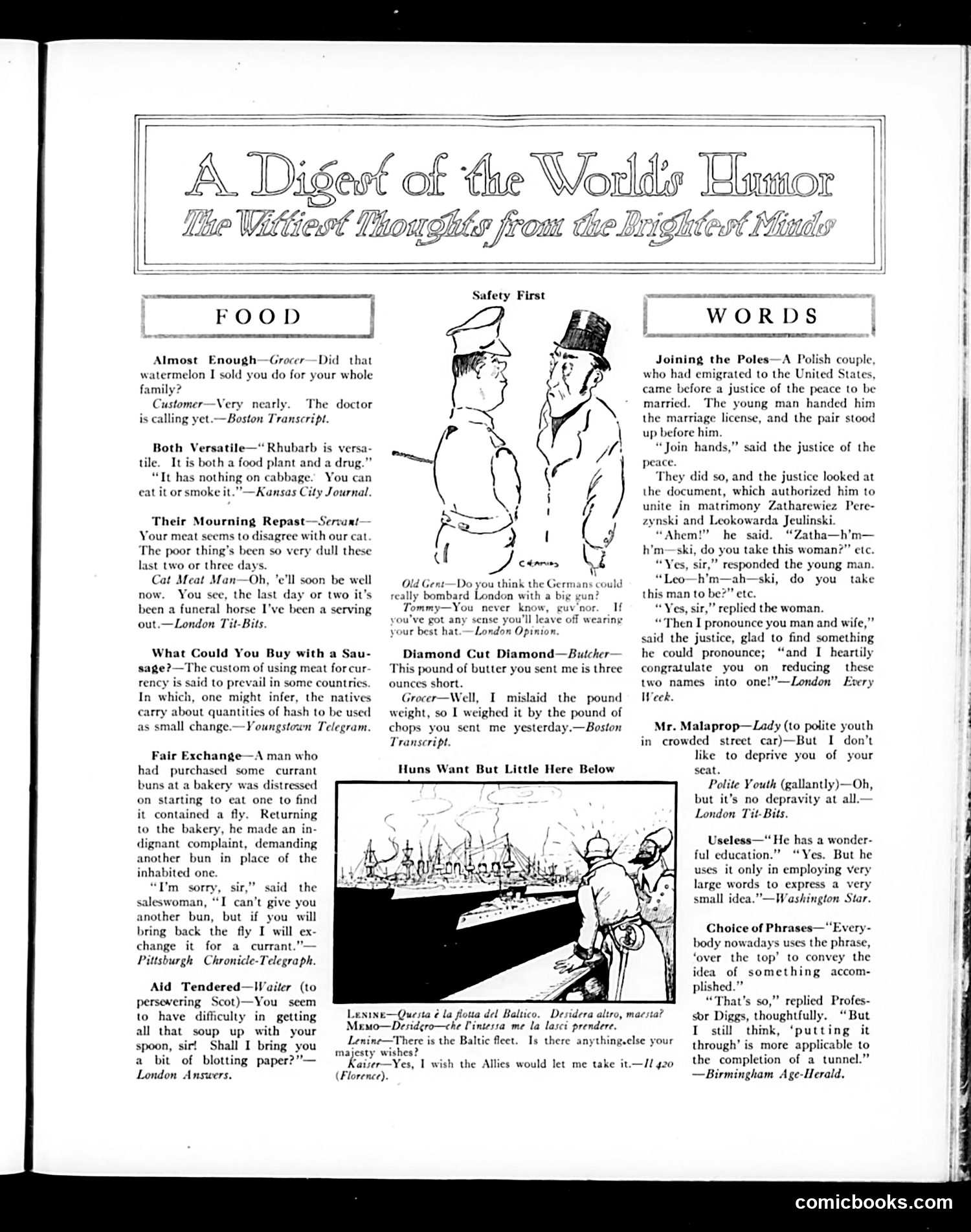
What you’re looking at
This page from the satirical magazine **Judge** collects brief humor pieces typical of WWI-era American comedy. The content reflects concerns and attitudes of that period: **Main Cartoon**: "Huns Want But Little Here Below" depicts Kaiser Wilhelm II and Lenin discussing the German Baltic Fleet, with Lenin desiring it. This references real WWI naval competition and Germany's military ambitions—"Huns" being contemporary American slur for Germans. **Humor Pieces**: The "Food" section includes jokes about meat quality, suggesting wartime food scarcity anxieties. "Aid Tendered" mocks Scottish frugality (a common ethnic stereotype). "Joining the Poles" jokes about Polish immigrants' unpronounceable names—reflecting American attitudes toward Eastern European immigration. **Overall Tone**: The page reflects 1917-1918 American perspectives: military anxiety, ethnic stereotyping presented as innocent humor, and anxieties about food supply during wartime rationing. What appears as lighthearted wordplay carried underlying social assumptions now recognized as prejudicial.
📄 Transcribed text from this page (OCR, searchable)
Machine-transcribed from the original scan — historical spelling and the odd misread are preserved.
D Vi} Py the Lrig Aly y cet f ou Minde FOOD ! Almost Enough—Grocer—Did that watermelon I sold you do for your whole family? Customer—Very i is calling yet.—Boston 1 ly. The doctor anscript. Both Versatile—‘“ Rhubarb is versa- tile. It is both a food plant and a drug.” “Tt has nothing on cabbage. You can eat it or smoke it.” —Kansas City Journal. Their Mourning Repast—Servaat Your meat seems to disagree with our cat The poor thing’s been so very dull these last two or three days. Cat Meat Man—Oh, 'e'll soon be well now. You see, the last day or two it’s been a funeral horse I've been a serving out.—London Tit-Bits. What Could You Buy with a Sau- sage?—The custom of using meat forcur. rency is said to prevail in some countries. In which, one might infer, the natives carry about quantities of hash to be used as small change.—Youngstown Telegram. Fair Exchange—A man who had purchased some currant buns at a bakery was distressed on starting to eat one to find it contained a fly. Returning to the bakery, he made an in- dignant complaint, demanding another bun in place of the inhabited one. “I'm. sorry, said the saleswoman, “I can’t gi another bun, but if you will bring back the fly I will ex- change it for a currant.”— Pittsburgh Chronicle-Telegraph. Aid Tendered—Waiter (to persevering Scot)—You seem to have difficulty in getting all that soup up with your spoon, sir! Shall I bring you a bit of blotting paper?”— London Answers. Lenine: Lenine—There is the Baltic fleet. majesty wishes? Caiser—Yes, I wish the Allies would let me take it.—/l 420 (Florence). Old Gent—Do you think the Gern really bombard London with a t rommy—You never know, guv’ ve got any sense you'll leave off wearing your best hat.—London Opinion. Diamond Cut Diamond—Butcher— This pound of butter you sent me is three ounces short. Grocer—Well, I mislaid the pound weight, so I weighed it by the pound of chops you sent me yesterday.—Boston Transcript. Huns Want But Little Here Below —Questa é la flota del Baltico. Desidera altro, macsta? Memo—Desidgro—che Pintessa me la lasci prendere. Is there anythingselse your WORDS Joining the Poles—A Polish couple, who had emigrated to the United States, came before a justice of the peace to be married. The young man handed him the marriage license, and the pair stood up before him “Join hands, peace. They did so, and the justice looked at the document, which authorized him to unite in matrimony Zatharewiez Pere- zynski and Leokowarda Jeulinski “Ahem!” he said. Zatha—h'm— h'm—ski, do you take this woman?” etc. “Yes, sir,” responded the young man. “Leo—h’m—ah—ski, do you take this man to be?” ete. “Yes, sir,” replied the woman. “Then I pronounce you man and wife,” said the justice, glad to find something he could pronounce; “and I heartily congratulate you on reducing these two names into one!’—London Every Week. said the justice of the Mr. Malaprop—Lady (to polite youth in crowded street car)—But I don’t like to deprive you of your seat. Polite Youth (gallantly)—Oh, but it’s no depravity at all. London Tit-Bits. Useless—“ He has a wonder- ful education.” “Yes. But he uses it only in employing very large words to express a very small idea.”—Washington Star. Choice of Phrases—‘‘Every- body nowadays uses the phrase, ‘over the top’ to convey the idea of something accom- plished.” “That's so,” replied Profes- sor Diggs, thoughtfully, “But I still think, ‘putting it through’ is more applicable to the completion of a tunnel.” —Birmingham Age-Herald. comicbooks.com