
Judge, 1918-09-28 · page 11 of 32
Judge — September 28, 1918 — page 11: what you’re looking at
What you’re looking at
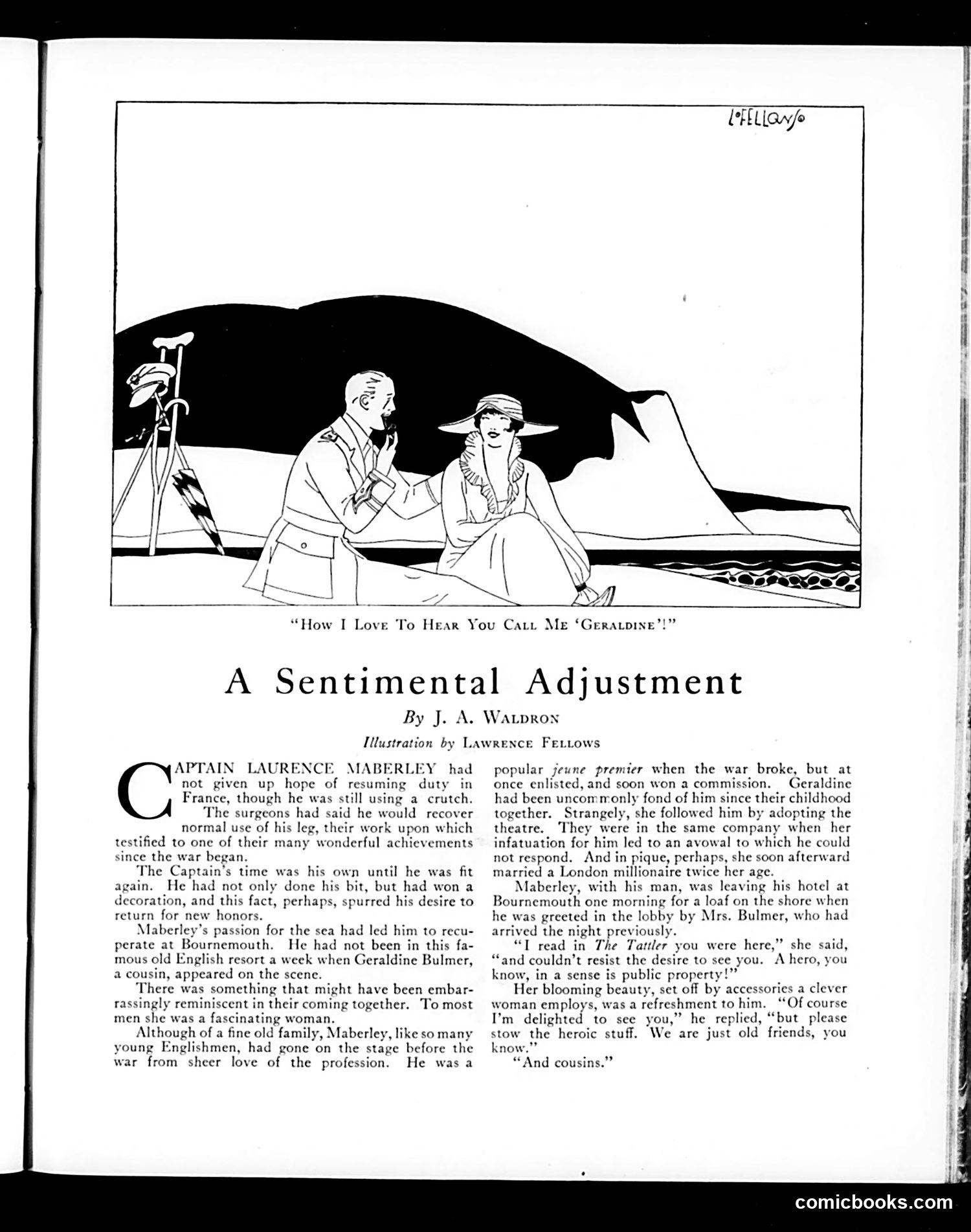
This is a short romantic story, not political satire. It depicts Captain Laurence Maberley, a wounded WWI officer recuperating at the English seaside resort of Bournemouth, unexpectedly encountering his cousin Geraldine Bulmer—a woman he once knew in theater before the war, who had previously confessed romantic feelings he couldn't reciprocate. She subsequently married a wealthy older man. The story's title refers to their emotional "adjustment" to meeting again: she romanticizes him as a war hero ("public property"), while he deflects with humor, insisting they're "just old friends." The illustration shows them on a beach with a phonograph, capturing the sentimental mood. The piece reflects post-WWI literature's fascination with wartime separations and rekindled connections.
📄 Transcribed text from this page (OCR, searchable)
Machine-transcribed from the original scan — historical spelling and the odd misread are preserved.
LELLaw/e “How I Love To Hear You Catt Me ‘Geratpine’! A Sentimental Adjustment By J. A. Watpron Illustration by Lawrence Fe APTAIN LAURENCE MABERLEY had not given up hope of resuming duty in France, though he was still using a crutch. The surgeons had said he would recover normal use of his leg, their work upon which testified to one of their many wonderful achievements since the war began. The Captain’s time was his own until he was fit again. He had not only done his bit, but had won a decoration, and this fact, perhaps, spurred his desire to return for new honors. Maberley’s passion for the sea had led him to recu- perate at Bournemouth. He had not been in this fa- mous old English resort a week when Geraldine Bulmer, a cousin, appeared on the scene. There was something that might have been embar- rassingly reminiscent in their coming together. To most men she was a fascinating woman. Although of a fine old family, Maberley, like so many young Englishmen, had gone on the stage before the war from sheer love of the profession. He was a ows popular jeune premier when the war broke, but at once enlisted, and soon won a commission. Geraldine had been uncommonly fond of him since their childhood together. Strangely, she followed him by adopting the theatre. They were in the same company when her infatuation for him led to an avowal to which he could not respond. And in pique, perhaps, she soon afterward married a London millionaire twice her age. Maberley, with his man, was leaving his hotel at Bournemouth one morning for a loaf on the shore when he was greeted in the lobby by Mrs. Bulmer, who had arrived the night previously. “LT read in The Tattler you were here,” she said, “and couldn’t resist the desire to see you. A hero, you know, in a sense is public property!” Her blooming beauty, set off by accessories a clever woman employs, was a refreshment to him. “Of course I’m delighted to see you,” he replied, “but please stow the heroic stuff. We are just old friends, you know.”” “And cousins.” comicbooks.com