
Judge, 1918-09-28 · page 22 of 32
Judge — September 28, 1918 — page 22: what you’re looking at
What you’re looking at
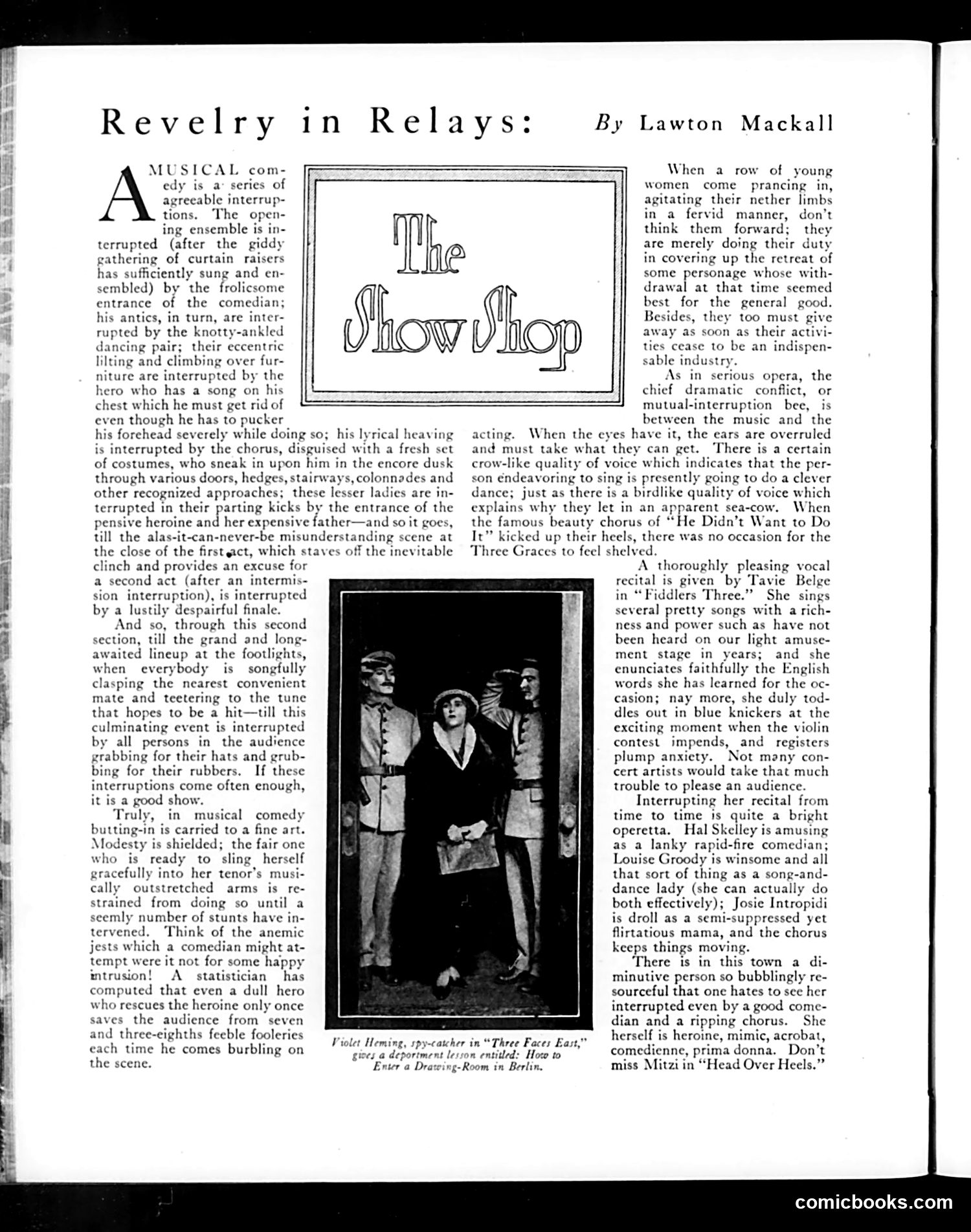
This is not a political cartoon but a theater review by Lawton Mackall analyzing musical comedy as a dramatic form. The accompanying photograph shows actress Violet Heming in "Three Faces East," a spy-themed play. Mackall argues that musical comedy succeeds through *interruption*—the constant stopping and starting of musical numbers, dances, and dialogue keeps audiences engaged and masks weak material. He claims even dull comedians and heroes become tolerable when their scenes are interrupted by dancers, chorus girls, or romantic moments. The piece is essentially a meta-commentary on stagecraft: rather than criticize poor performances, the author explains the *structural purpose* of seemingly frivolous elements (chorus girls, dance breaks) as narrative devices that provide comedic relief and delay inevitable romantic climaxes. This reflects early 20th-century theatrical conventions where spectacle and interruption substituted for substantive comedy.
📄 Transcribed text from this page (OCR, searchable)
Machine-transcribed from the original scan — historical spelling and the odd misread are preserved.
Revelry in Rela By Lawton Mackall ys: edy is a: series of agreeable interrup- tions. The open- ing ensemble is in- terrupted (after the giddy gathering of curtain raisers has sufficiently sung and en- sembled) by the frolicsome entrance of the comedian; his antics, in turn, are inte rupted by the knotty-ankled dancing pair; their eccentric lilting and climbing over fur- niture are interrupted by the hero who has a song on his MUSICAL com- When a row of young women come prancing in, agitating their nether limbs in a fervid manner, don’t think them forward; they are merely doing their duty in covering up the retreat of some personage whose with- drawal at that time seemed best for the general good. Besides, they too must give away as soon as their activi- ties cease to be an indispen- sable industry. As in serious opera, the chief dramatic conflict, or chest which he must get rid of even though he has to pucker his forehead severely while doing so; his lyrical heaving is interrupted by the chorus, disguised with a fresh set of costumes, who sneak in upon him in the encore dusk through various doors, hedges, stairways, colonnades and other recognized approaches; these lesser ladies are in- terrupted in their parting kicks by the entrance of the pensive heroine and her expensive father—and so it goes, till the alas-it-can-never-be misunderstanding scene at the close of the first act, which staves off the inevitable clinch and provides an excuse for a second act (after an intermis- sion interruption), is interrupted by a lustily despairful finale. And so, through this second section, till the grand and long- awaited lineup at the footlights, when everybody is songfully clasping the nearest convenient mate and teetering to the tune that hopes to be a hit—till this culminating event is interrupted by all persons in the audience grabbing for their hats and grub- bing for their rubbers. If these interruptions come often enough, it is a good show. Truly, in musical comedy butting-in is carried to a fine art. Modesty is shielded; the fair one who is ready to sling herself gracefully into her tenor’s musi- cally outstretched arms is re- strained from doing so until a seemly number of stunts have in- tervened. Think of the anemic jests which a comedian might at- tempt were it not for some happy imtrusion! <A statistician has computed that even a dull hero who rescues the heroine only once saves the audience from seven and three-eighths feeble fooleries each time he comes burbling on the scene. 5 a deportment les Enter a Drat Violet Heming, spy-catcher in “Three Faces Ea on entitled: Horo to g-Room in Berlin, mutual-interruption bee, is between the music and the acting. When the eyes have it, the ears are overruled and must take what they can get. There is a certain crow-like quality of voice which indicates that the per- son endeavoring to sing is presently going to do a clever dance; just as there is a birdlike quality of voice which xplains why they let in an apparent sea-cow. When the famous beauty chorus of “He Didn’t Want to Do It” kicked up their heels, there was no occasion for the Three Graces to feel shelved. A thoroughly pleasing vocal recital is given by Tavie Belge in “Fiddlers Three.” She sings several pretty songs with a rich- ness and power such as have not been heard on our light amuse- ment stage in year: and she enunciates faithfully the English words she has learned for the oc- casion; nay more, she duly tod- dles out in blue knickers at the exciting moment when the violin contest impends, and registers plump anxiety. Not many con- cert artists would take that much trouble to please an audience. Interrupting her recital from time to time is quite a bright operetta. Hal Skelley is amusing as a lanky rapid-fire comedian; Louise Groody is winsome and all that sort of thing as a song-and- dance lady (she can actually do both effectively); Josie Intropidi is droll as a semi-suppressed yet flirtatious mama, and the chorus keeps things moving. There is in this town a di- minutive person so bubblingly re- sourceful that one hates to see her interrupted even by a good com dian and a ripping chorus. She herself is heroine, mimic, acrobat, comedienne, prima donna. Don’t miss Mitzi in “Head Over Heels.” comicbooks.com