
A complete issue · 36 pages · 1918
Judge — July 27, 1918
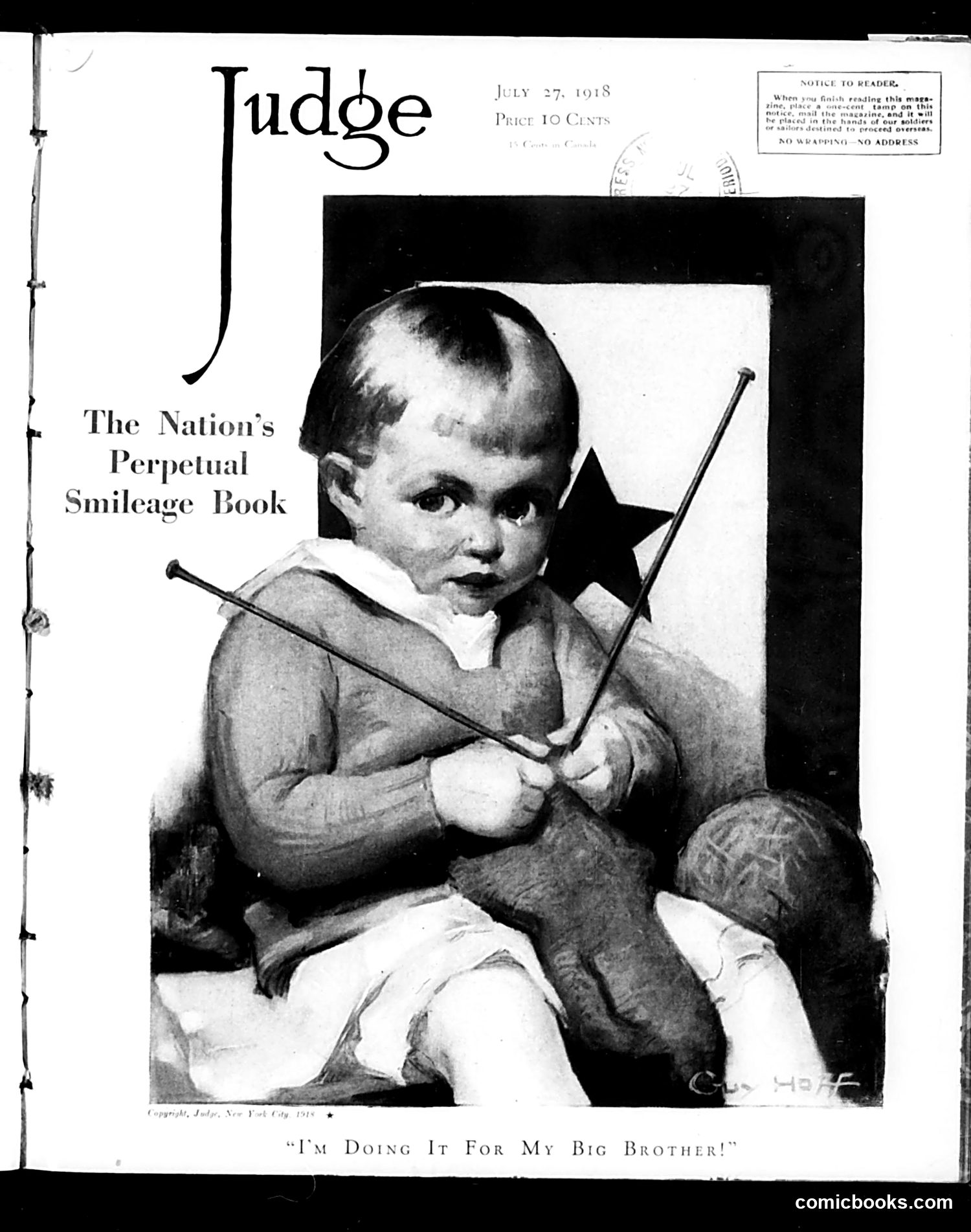
This cover features a toddler holding golf clubs with the caption "I'm Doing It For My Big Brother!" The image is a wartime morale piece. In 1918, the U.S. was actively fighting in World War I. The "big brother" reference likely means American soldiers overseas. The child playing golf—a leisure activity—suggests civilians should support the war effort and make sacrifices, even in small ways. The golf clubs may symbolize recreation being set aside for the war. The cover functions as patriotic propaganda, encouraging American citizens (represented by the innocent child) to contribute to military victory for their "big brothers" fighting abroad. It's typical of home-front messaging that framed civilian participation and sacrifice as familial duty.
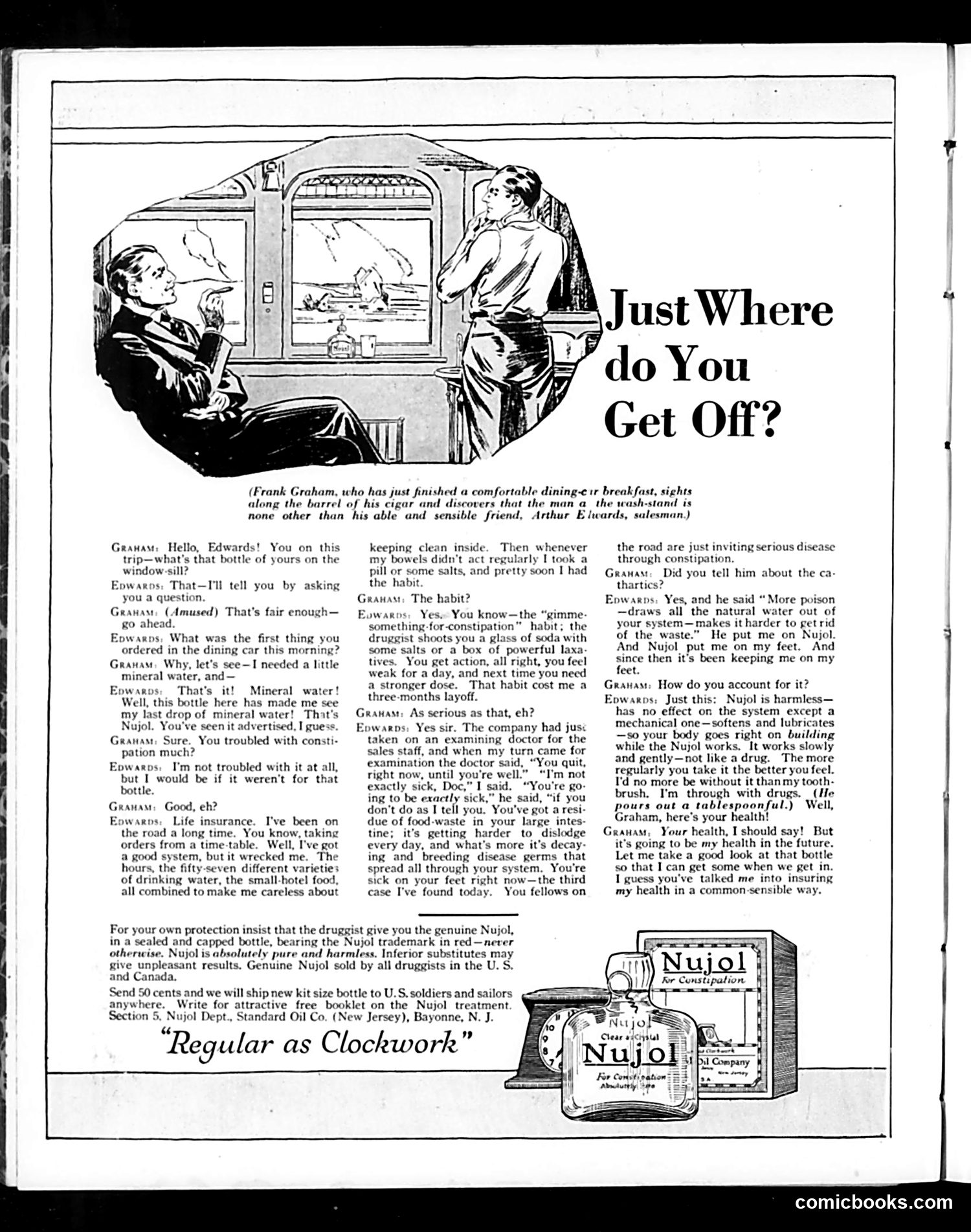
This is primarily a **Nujol laxative advertisement** disguised as satirical content. The framing device—two men in a dining car discussing constipation—allows the ad to present a pseudo-editorial conversation about digestive health. The satire targets the era's ubiquitous "patent medicine" marketing. One character (Frank Graham) initially attributes his digestive troubles to mineral water, then learns from "Edward" that the real culprit is constipation caused by food waste accumulation. The dialogue humorously escalates medical concerns—mentioning disease, "poison," and even life insurance—to justify the product. The humor lies in how earnestly the ad presents Nujol as a solution to America's obsession with digestive regularity, a common health concern in early 20th-century advertising. The tagline "Regular as Clockwork" reinforces the product's appeal to order-minded consumers.
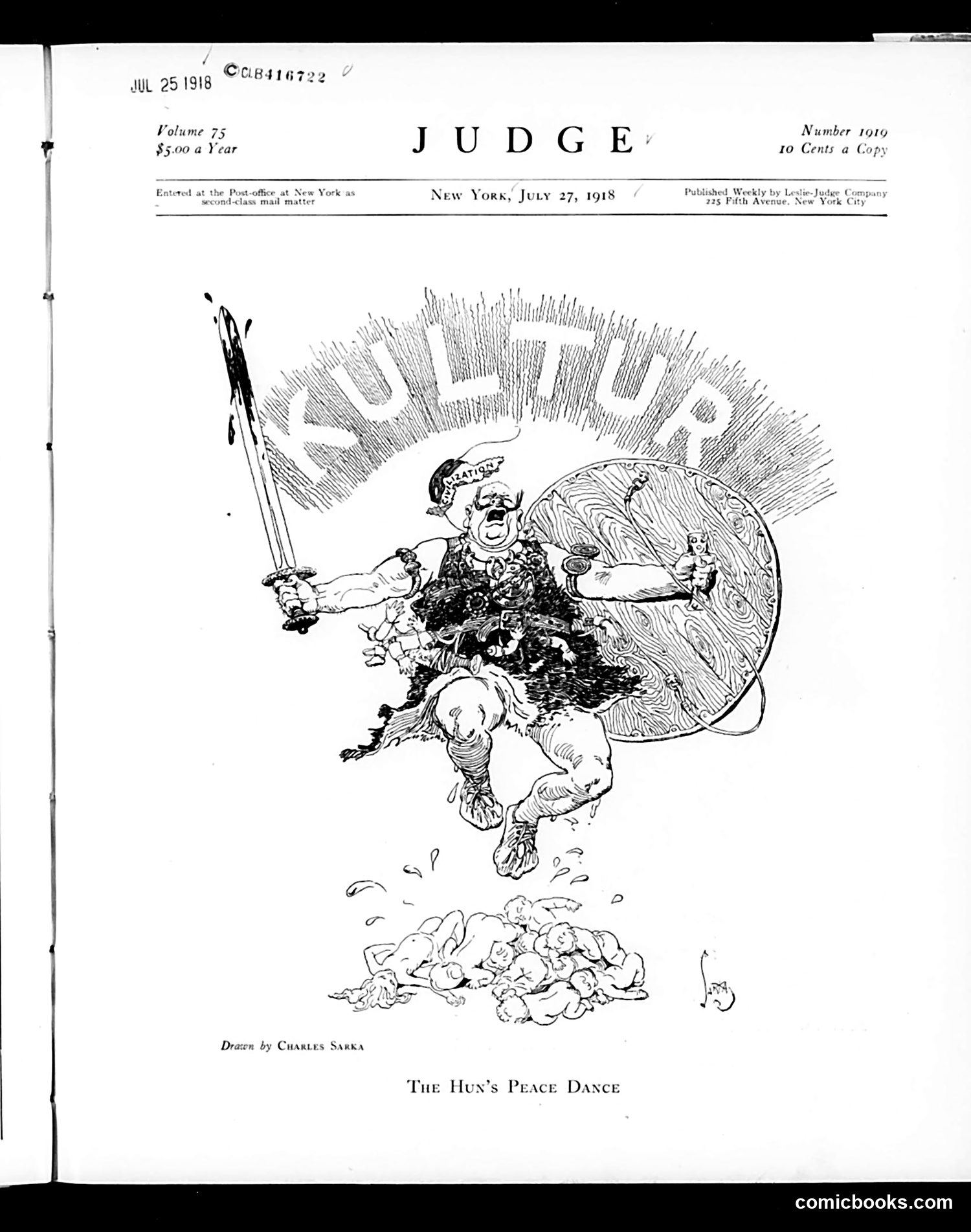
This July 1918 cartoon by Charles Sarks depicts "The Hun" (a dehumanizing WWI-era term for Germans) as a grotesque, demonic figure performing a grotesque dance atop a shield. The caricature wields a sword while appearing triumphant, surrounded by radiating lines spelling "KULTUR"—likely mocking German claims of cultural superiority. Below the figure lies a pile of corpses and destruction, suggesting the human cost of German militarism. The cartoon equates German "peace" proposals with barbarism and continued violence rather than genuine reconciliation. Published in July 1918, near WWI's end, this reflects American propaganda portraying Germany as inherently aggressive and uncivilized, delegitimizing German peace initiatives before the armistice in November.
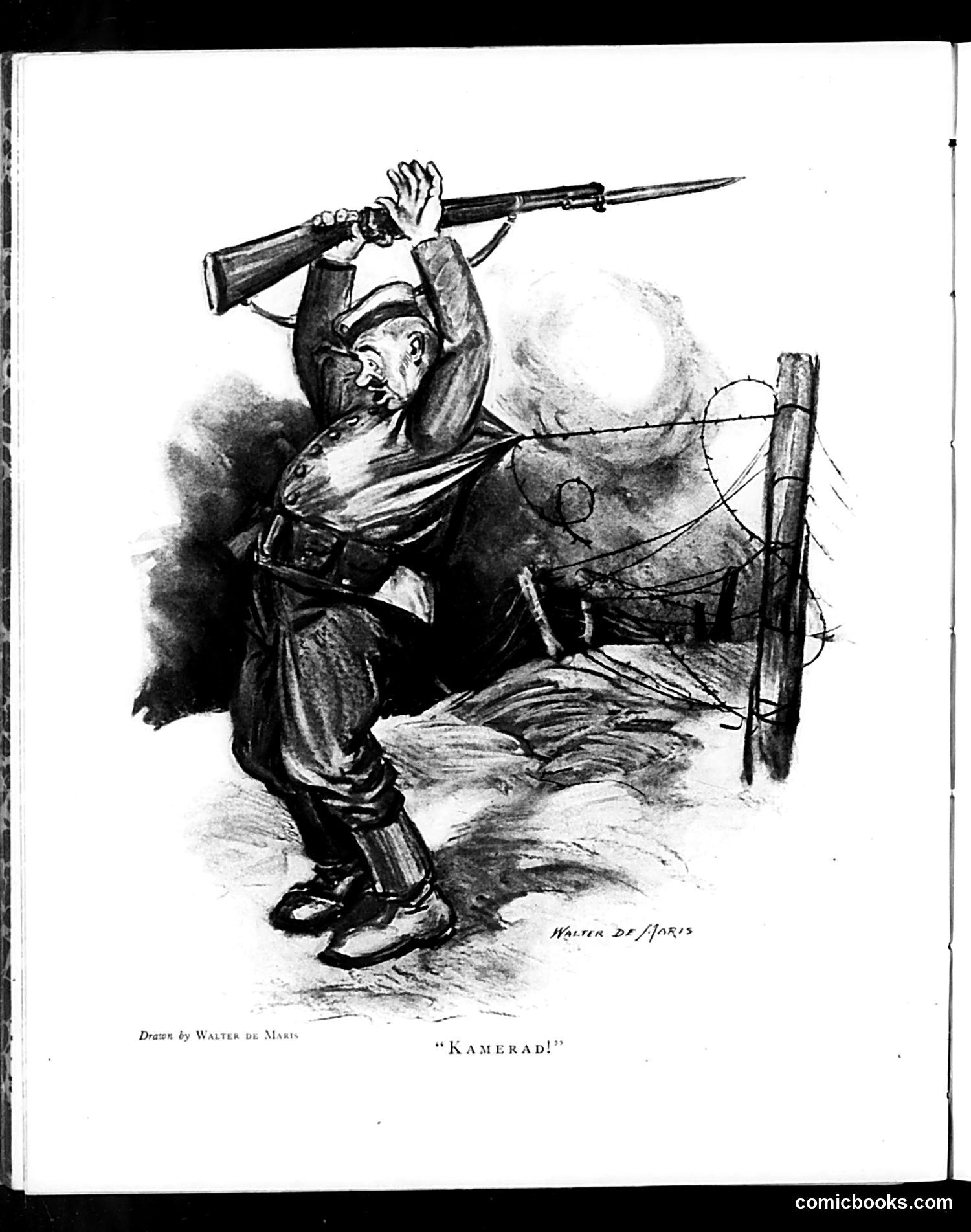
This political cartoon depicts a German soldier surrendering during World War I, holding his rifle aloft with one hand while raising the other in surrender. The German word "Kamerad!" (comrade) was historically used by German soldiers as a plea for mercy when surrendering to Allied forces. The cartoon, drawn by Walter de Maris for *Judge* magazine, appears to satirize German military surrender or capitulation. Given the context of American satirical magazines during WWI, this likely mocks German defeat or the German military's weakening position. The exaggerated caricature emphasizes the desperation of the surrender gesture, using satire to celebrate or ridicule the enemy's capitulation to American and Allied forces.
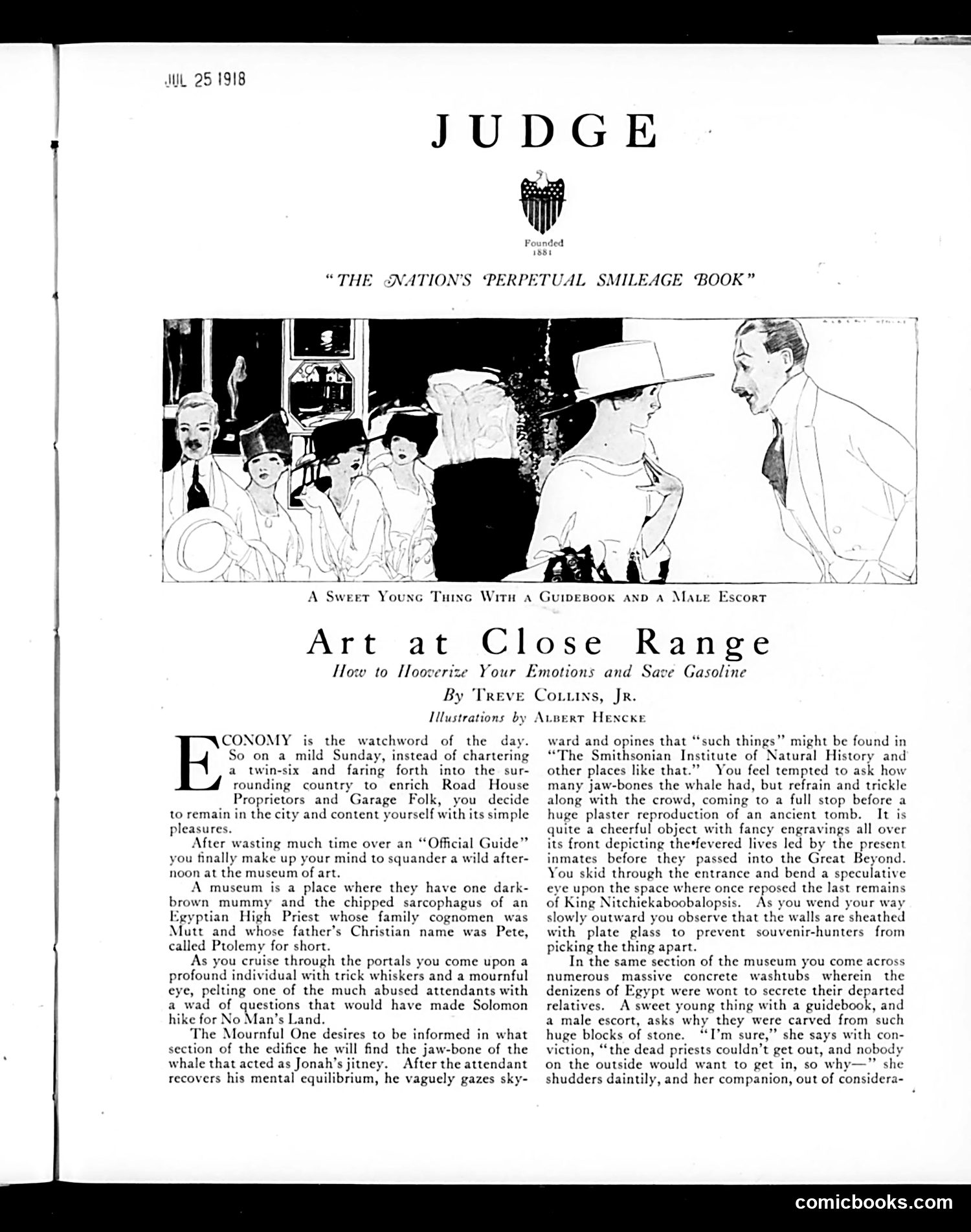
This page contains a humorous article titled "Art at Close Range: How to Hooverize Your Emotions and Save Gasoline" by Treve Collins Jr., illustrated by Albert Hencke. The cartoon depicts a young woman with a guidebook and male escort visiting a museum, specifically examining Egyptian mummies and artifacts. The satire mocks the practice of "Hooverizing"—wartime rationing and economizing named after Herbert Hoover—by suggesting one could entertain oneself cheaply by visiting museums instead of engaging in expensive leisure activities like auto touring. The illustration shows the awkwardness and stuffiness of such museum visits: the young woman appears uncomfortable examining corpses and carved stones, while her male escort maintains proper decorum. The joke targets both wartime austerity culture and the pretentious nature of cultural tourism during economically constrained times.
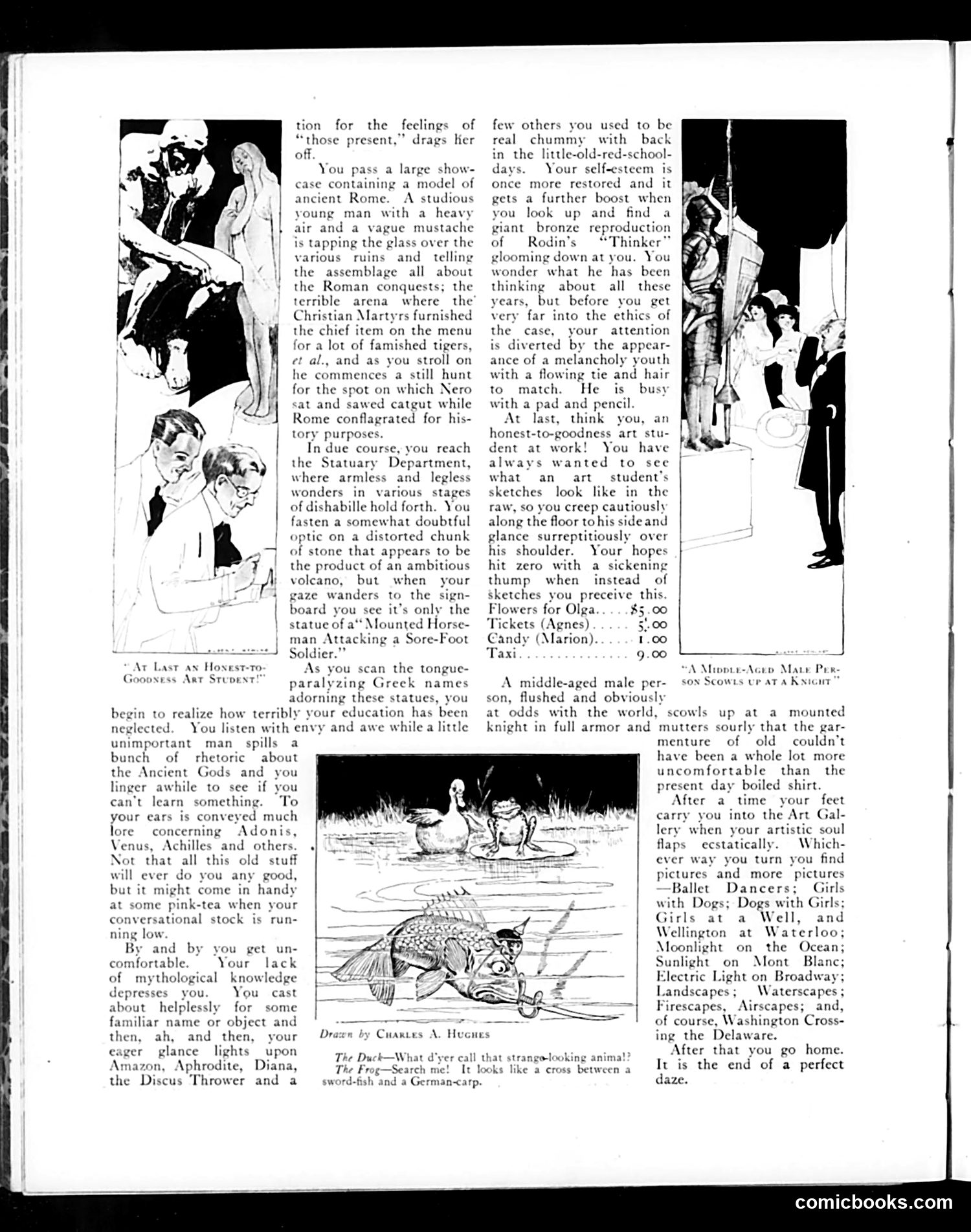
This page contains satirical commentary on art education and museum culture, likely from the early 20th century. **"At Last an Honest-to-Goodness Art Student"** mocks pretentious art students visiting classical museums. The cartoon ridicules those who claim cultural sophistication while lacking genuine knowledge—they memorize Greek names and affect boredom with classical statuary, yet remain fundamentally ignorant about art history and aesthetics. The text uses biting humor to critique how students perform intellectualism without substance, discussing "Adonis, Venus, Achilles" superficially while being unable to articulate why these works matter. **"A Middle-aged Man Discovers Washington Square at a Knight"** appears to be a separate satirical piece about discovering bohemian art culture, suggesting naive discovery of avant-garde scenes. The magazine demonstrates Judge's typical approach: mocking cultural pretension and educational posturing through caricature and exaggerated dialogue.
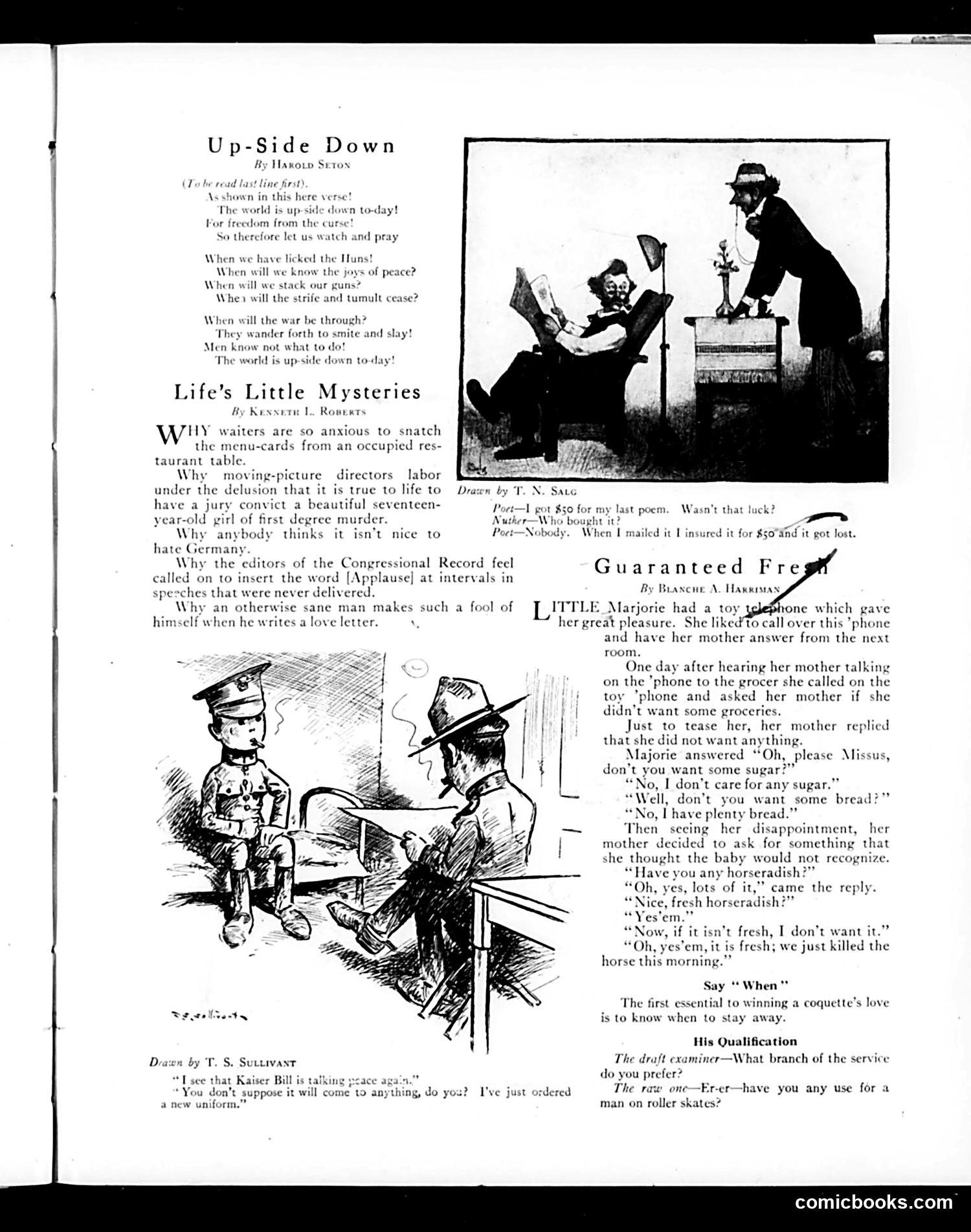
This page contains WWI-era satirical content reflecting American anxieties about the war with Germany. **"Up-Side Down"** is a poem questioning when the war will end and peace return—expressing public weariness with the conflict and uncertainty about post-war life ("When will the war be through?"). **"Life's Little Mysteries"** mocks everyday absurdities, including a cartoon showing two soldiers discussing Kaiser Bill (the German emperor) ordering "a new uniform"—satirizing the enemy leader during active combat. **"Guaranteed Fresh"** is a humorous domestic story where a child plays grocer with a toy phone, culminating in absurdist humor about "fresh" horseradish ("we just killed the horse this morning"). **"His Qualification"** jokes about draft examination, with a recruit asking if the military needs "a man on roller skates"—poking fun at unfit or unsuitable conscripts. The overall tone reflects 1917-1918 wartime America: anxious about war's duration, satirizing the enemy, and using humor to process national tensions.
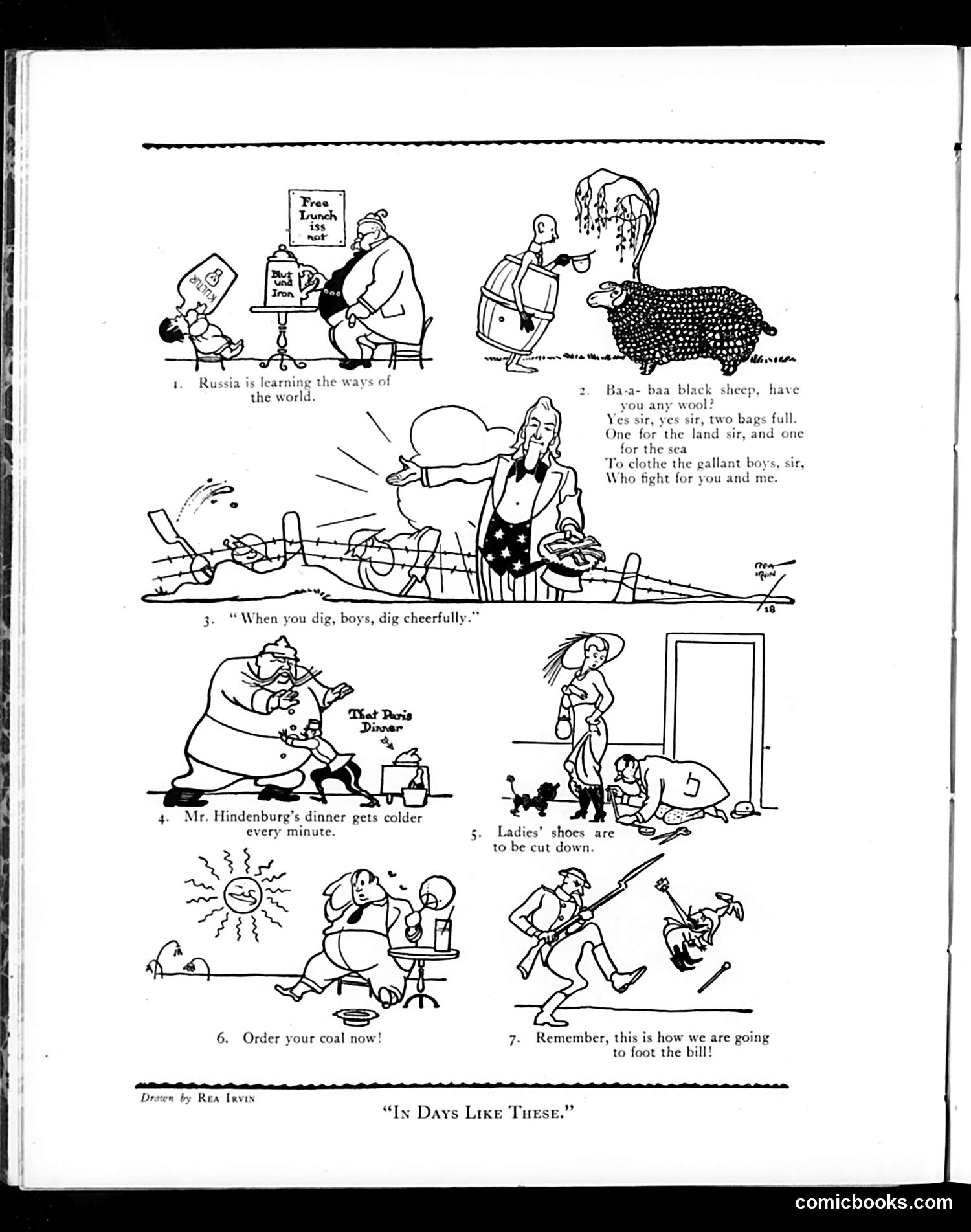
This Judge magazine page satirizes American home-front conditions during World War I. The seven panels mock wartime hardships and government responses: Panel 1 references Russia "learning the ways of the world"—likely mocking Russia's early WWI involvement or political instability. Panel 2 uses the "Baa Baa Black Sheep" nursery rhyme to address wool rationing for soldiers' uniforms. Panel 4 jokes that "Mr. Hindenburg's dinner gets colder"—Hindenburg was the German military commander; the satire suggests German supply problems or cold conditions. Panel 5 mocks women's fashion restrictions (shoe rationing/reduction). Panel 6 warns readers to "order your coal now," reflecting fuel shortages. Panel 7's caption "how we are going to foot the bill" pairs with people literally running/fleeing, suggesting financial burden from the war effort. The overall message: American civilians face mounting privations and costs supporting the war.
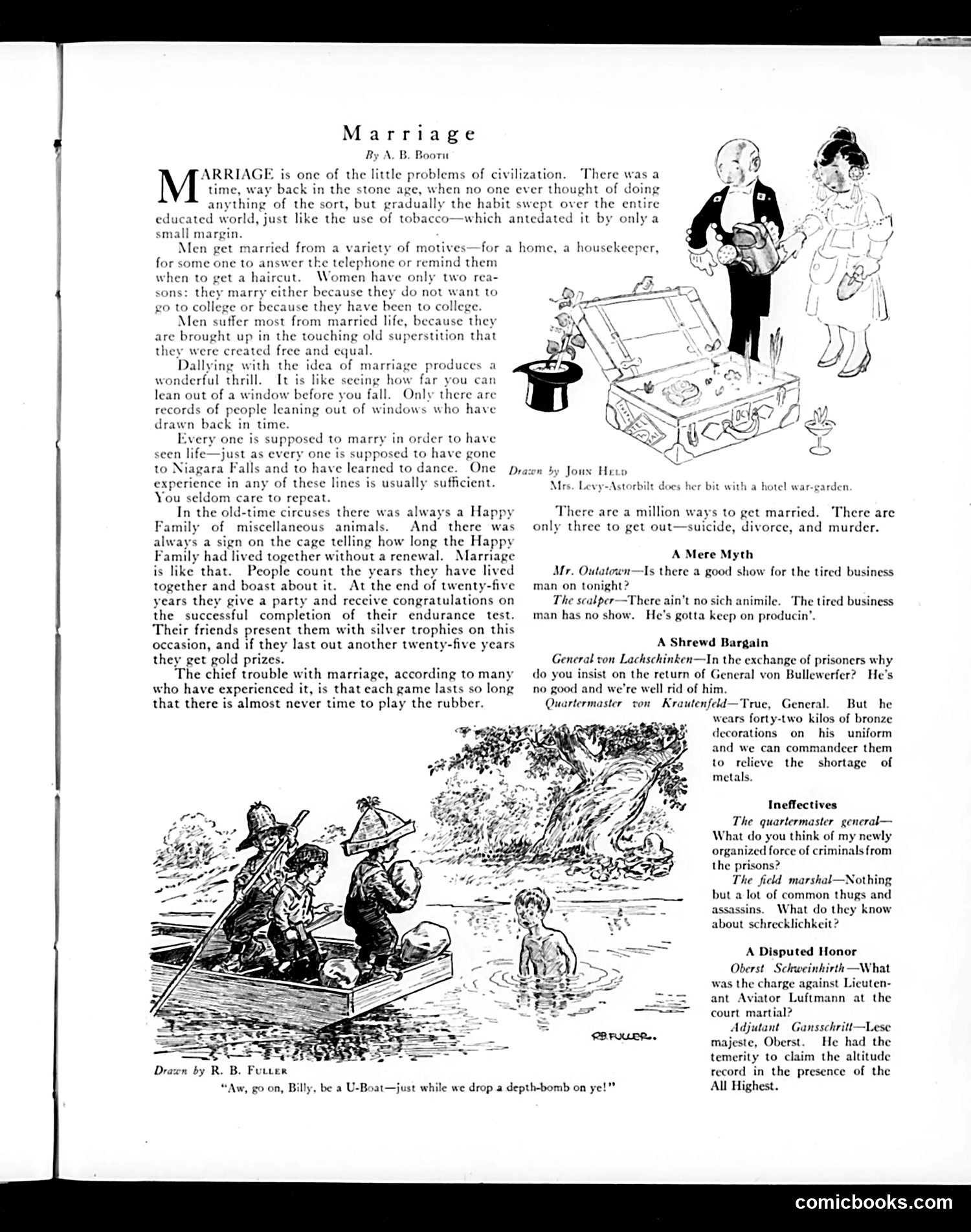
This *Judge* magazine page satirizes marriage and wartime absurdities through multiple cartoons and brief comedic dialogues. **Main Essay ("Marriage" by A.B. Boob):** A cynical commentary on marriage as a civilizational habit. It mocks men's motives (domestic service) versus women's (avoiding college), compares marriages to circus "Happy Families" (animals caged together), and jokes that the institution lasts so long couples never finish a card game ("rubber"). **The cartoons** include: - A domestic scene showing a couple with luggage, captioned about hotel war-gardens (unclear reference) - A WWI scene of soldiers and a child, joking about U-boats and depth-bombs—darkly treating combat as children's play **The brief dialogues** mock wartime absurdities: a German general refusing to return a worthless officer because his bronze decorations can be melted for metal shortage; military officials questioning a criminal conscript force's effectiveness; an officer court-martialed for claiming an altitude record before the Kaiser. The page blends marital cynicism with WWI-era German military satire, typical of American wartime humor.
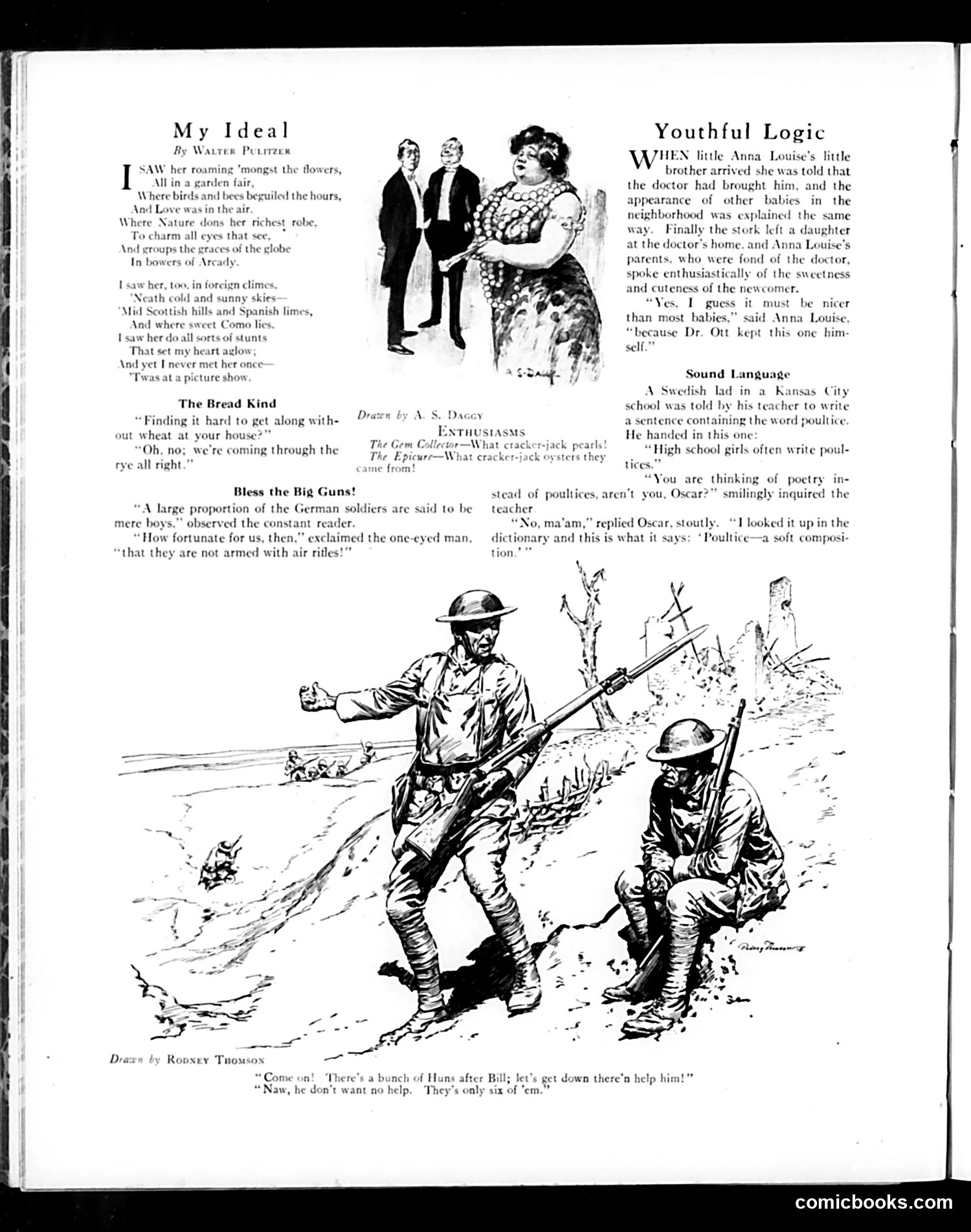
This page contains several satirical pieces typical of Judge's early-20th-century humor: **"My Ideal"** (top left): A sentimental poem by Walter Pultzer, likely mocking the flowery romantic verse popular in the era. The joke—he's describing an idealized woman he "never met.../'Twas at a picture show"—satirizes men's fantasies about actresses. **"Youthful Logic"** (top right): Child's innocent reasoning about babies. A doctor delivered her brother, then kept a daughter born at his own home—so she assumes he preferred that one. Simple humor from children misunderstanding adult explanations. **"The Bread Kind"** and **"Bless the Big Guns!"**: Brief humor pieces about wartime shortages and German soldiers (likely referencing WWI), with the latter's joke about young soldiers lacking rifles being darkly comedic commentary on military readiness. **"Sound Language"**: A Swedish student misinterprets "poultice" (medical poultice) as "poultice" (soft composition), creating an unintended innuendo about "high school girls." Ethnic humor was typical of the era. The bottom illustration shows soldiers in trench warfare, likely WWI context.
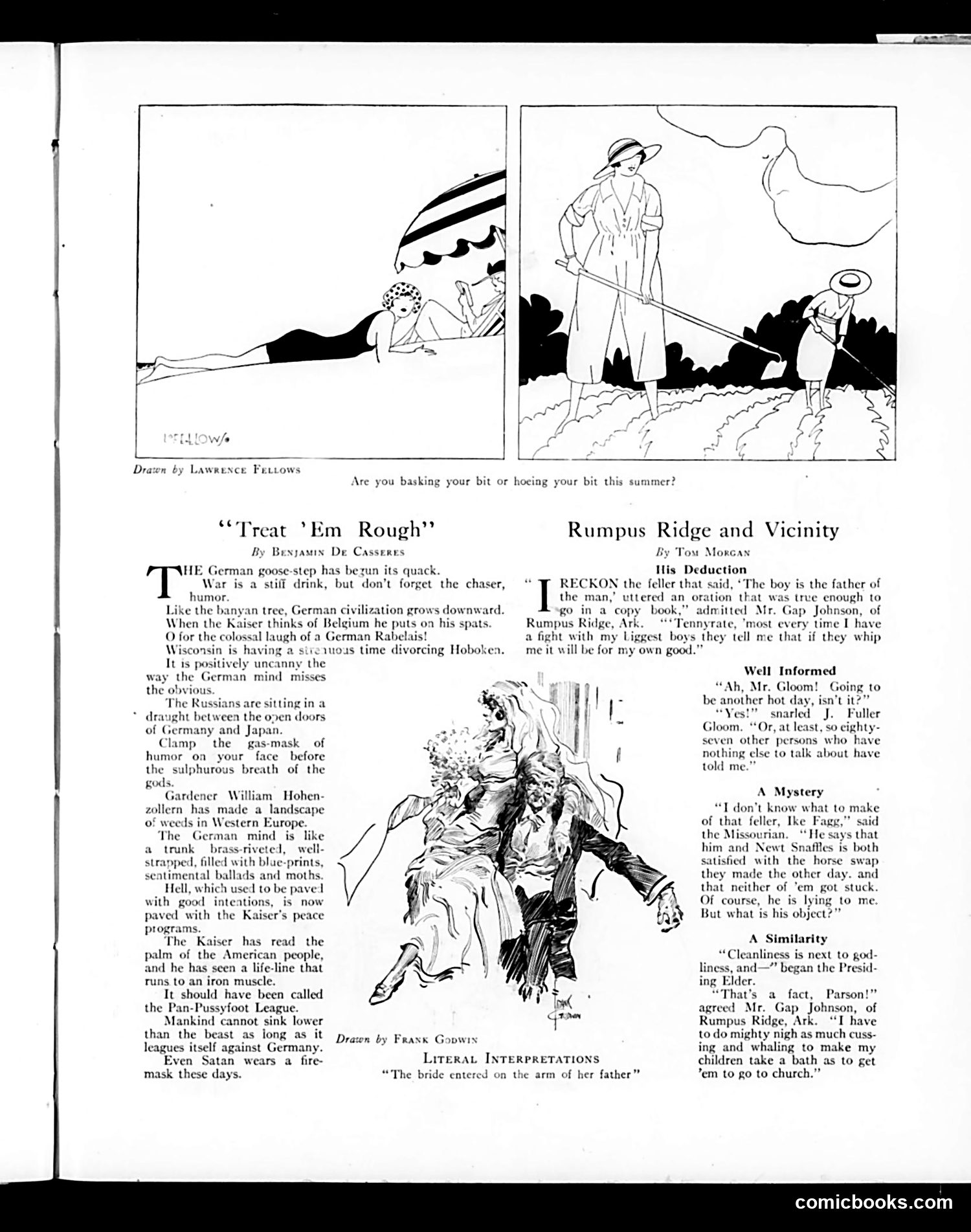
This page contains WWI-era American political humor targeting Germany and Kaiser Wilhelm II. **"Treat 'Em Rough"** (left) is a series of satirical one-liners mocking German culture and war conduct. References include: the Kaiser's invasion of Belgium ("When the Kaiser thinks of Belgium he puts on his spats"), German militarism ("goose-step"), and the character of German civilization itself. The humor relies on absurdist comparisons—Germany's mind "misses the obvious," its culture "grows downward like a banyan tree." This reflects American anti-German sentiment during WWI, portraying Germans as mechanically rigid yet fundamentally foolish. **"Rumpus Ridge and Vicinity"** (right) is a rural humor feature unrelated to the war, featuring small-town characters like J. Fuller Gloom and Gap Johnson with folksy anecdotes about summer heat, horse trading, and religious hypocrisy. The top illustration asks readers: "Are you basking your bit or hoeing your bit this summer?"—encouraging civilian participation in wartime agricultural production.
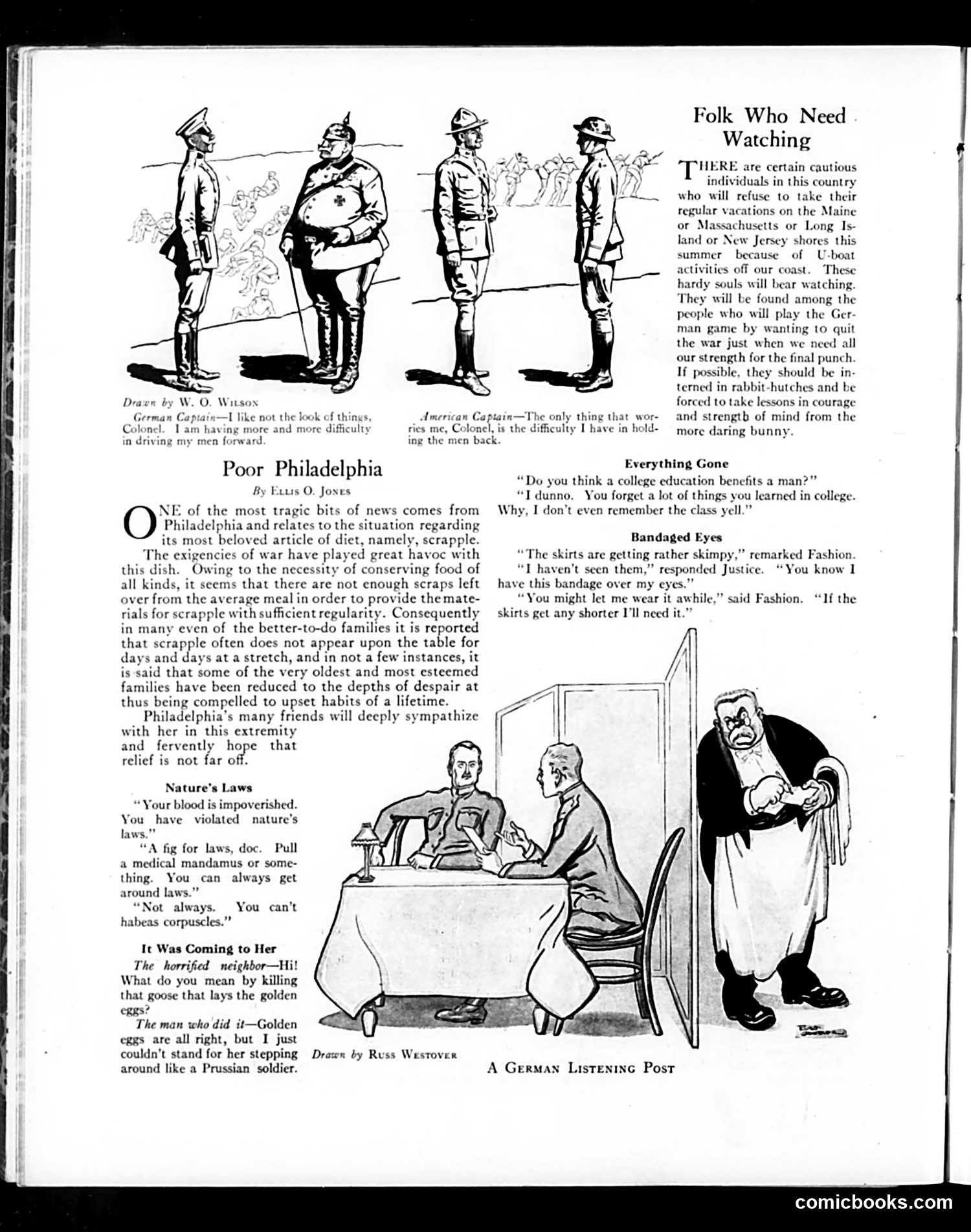
This WWI-era satirical page contains multiple cartoons attacking domestic dissent and German conduct: **"Folk Who Need Watching"** targets Americans opposing continued war effort, calling them traitors who should be "interned." The four military figures represent vigilance against defeatists. **"Poor Philadelphia"** uses food rationing as satire—Philadelphians' distress over scrapple shortage mocks civilian complaints during wartime sacrifice. **"Everything Gone"** jokes about education's uselessness; "Bandaged Eyes" satirizes Justice as blind while Fashion increasingly exposes herself (critiquing women's hemlines during wartime). **"A German Listening Post"** depicts espionage fears; the caricatured figure eavesdrops on military discussions. **"It Was Coming to Her"** compares a goose's "Prussian" military bearing to justifying its killing—anti-German propaganda suggesting Germans deserved their fate. Overall, the page reflects WWI-era suspicion of pacifists, anxieties about spying, and demonization of Germans through domestic satirical commentary.
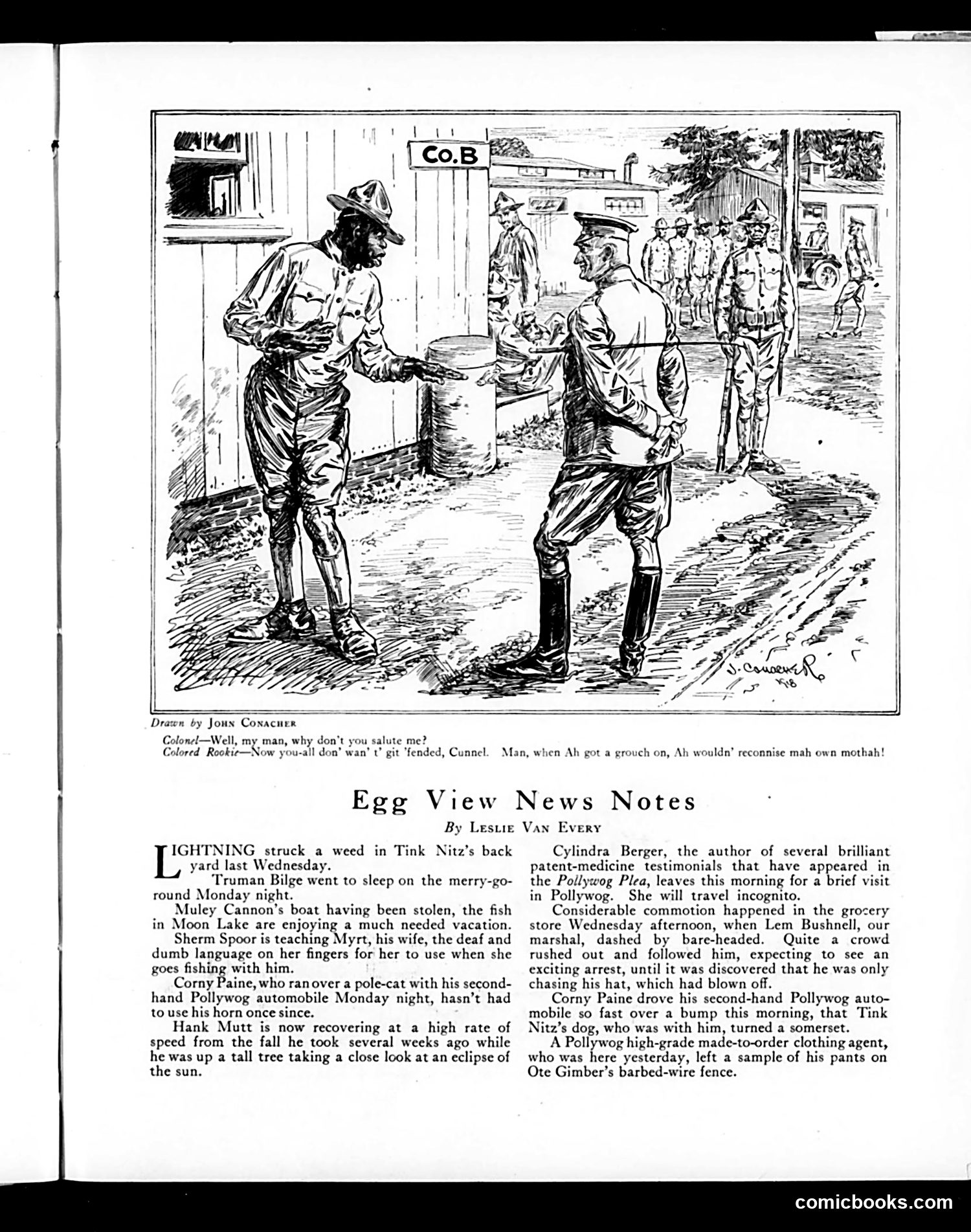
The cartoon depicts a military interaction between a white Colonel and a Black soldier ("Colored Rookie"). The Colonel complains about not receiving a salute; the soldier responds in exaggerated dialect that he's in a bad mood and wouldn't recognize his own mother. This reflects **early 20th-century racial stereotyping**. The cartoon uses: - Phonetic dialect spelling ("you-all," "Ah," "mothah") to demean the soldier - A caricatured premise that a Black soldier is insubordinate or emotionally unstable - The implication that military discipline doesn't apply equally The satire targets the *soldier's* behavior rather than critiquing segregation or racism—the cartoon assumes the audience will find humor in military insubordination framed through racial stereotypes. Below the cartoon, "Egg View News Notes" is local humor about a fictional town called Pollywog, featuring absurdist anecdotes unrelated to the cartoon. **Historical context**: This reflects the segregated U.S. military of the WWI era, when such racist depictions were common in mainstream publications.
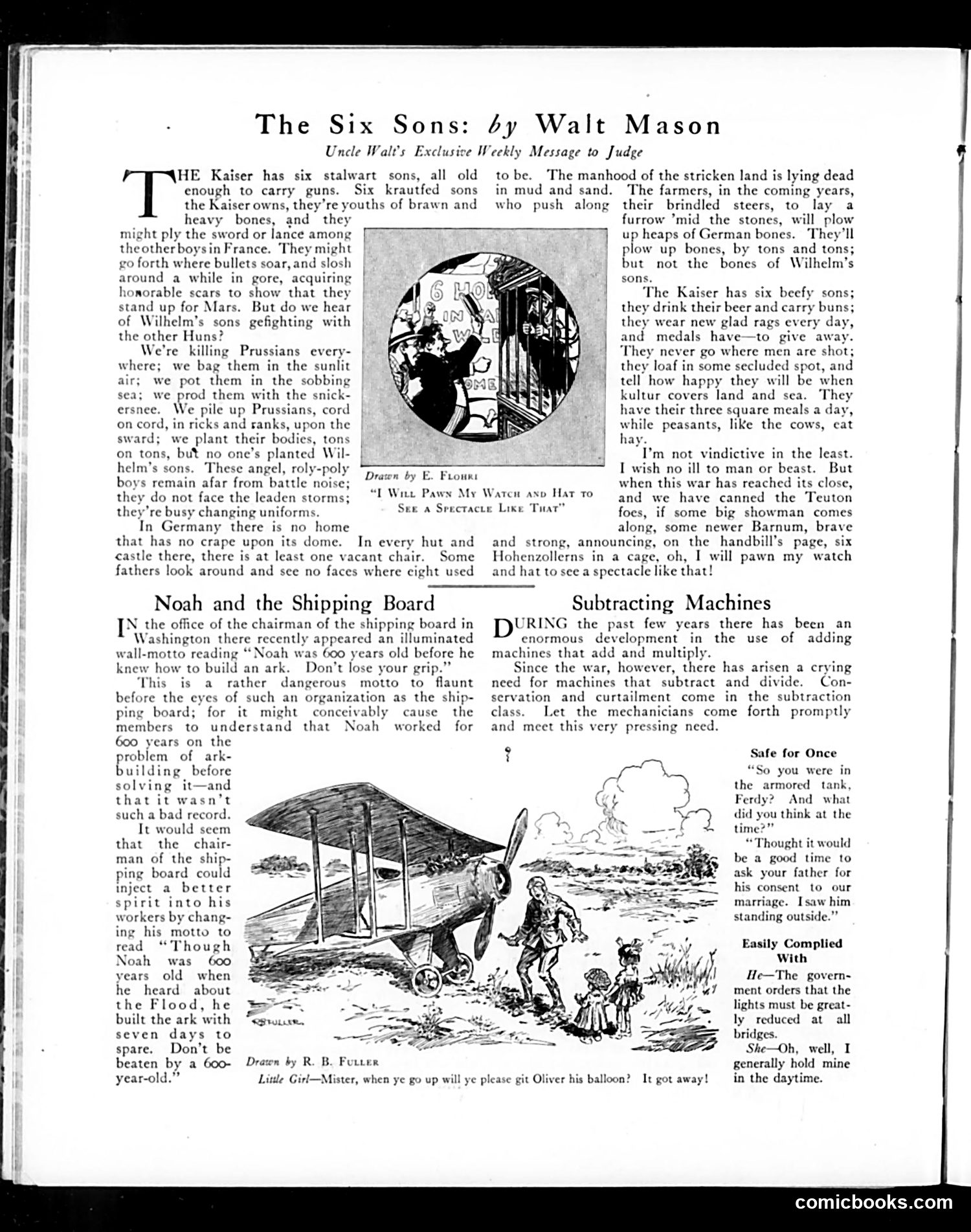
**"The Six Sons"** is Walt Mason's wartime propaganda poem attacking Kaiser Wilhelm II's sons for avoiding combat while German and Allied soldiers die en masse. Mason contrasts the Kaiser's six "angel, roly-poly boys" who "remain afar from battle noise" and "busy changing uniforms" with ordinary soldiers and German civilians suffering losses. The satirical climax fantasizes about displaying the Hohenzollerns "in a cage" like circus attractions—a darkly humorous revenge fantasy. This reflects WWI-era American outrage at perceived German aristocratic privilege and cowardice. **"Noah and the Shipping Board"** mocks the U.S. Shipping Board's motivational motto comparing modern shipbuilding delays to Noah's centuries of ark-preparation. Mason sarcastically argues the motto actually excuses bureaucratic incompetence, suggesting instead they should celebrate Noah's efficiency: building in seven days during wartime urgency. Both pieces are patriotic morale-boosters typical of Judge's WWI-era content, targeting German leadership and American wartime inefficiency.
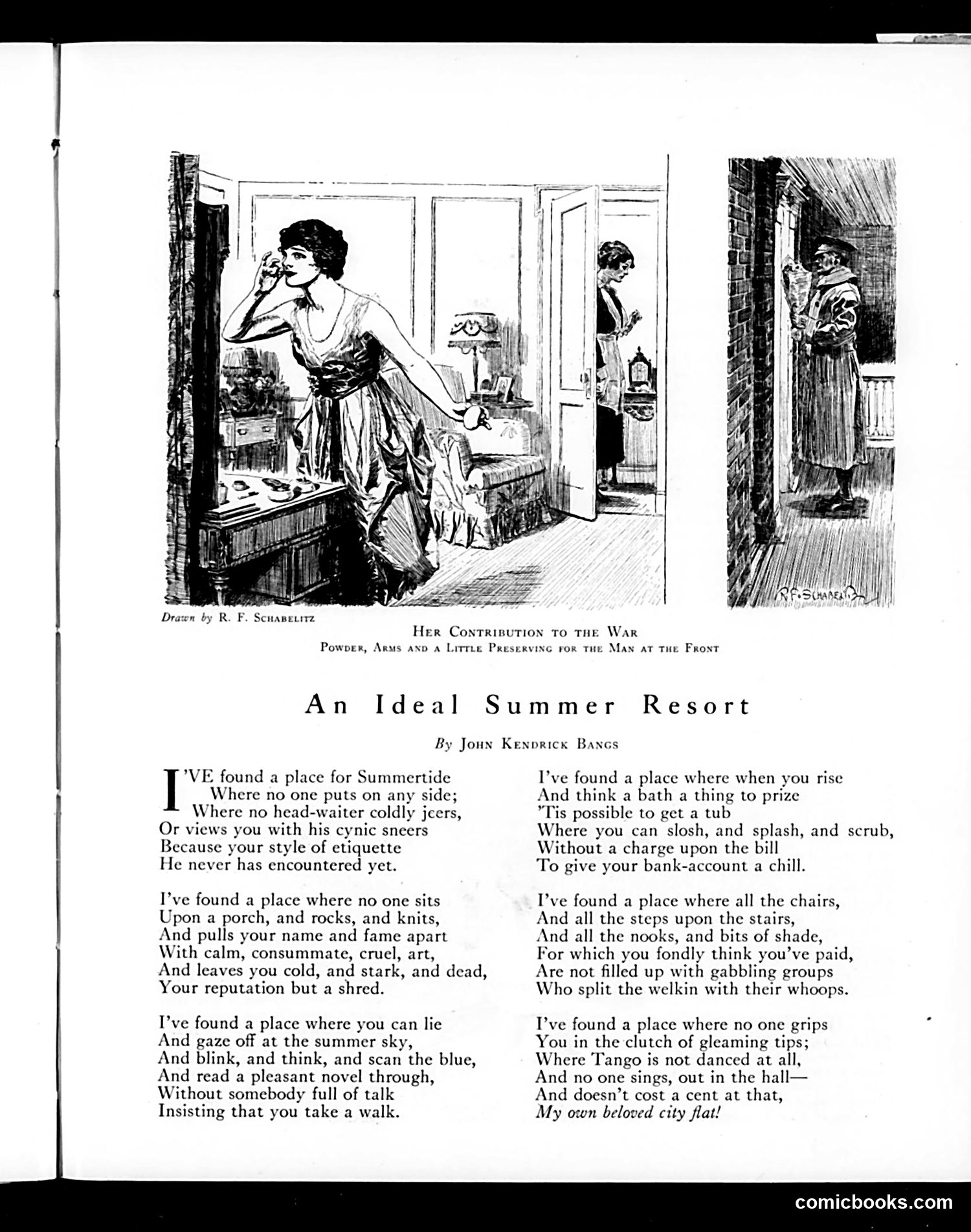
The page contains two distinct items: **Top illustration:** Titled "Her Contribution to the War," this cartoon satirizes women's wartime efforts. It depicts a woman at her vanity mirror, primping and grooming while a maid serves her. The caption notes she's providing "Powder, Arms and a Little Preserving for the Man at the Front"—a sarcastic jab suggesting that upper-class women's contribution to WWI amounts merely to cosmetics and self-care rather than substantive war work. The side panels show other women, possibly servants or working-class figures, implying a class commentary. **Bottom poem:** "An Ideal Summer Resort" by John Kendrick Bangs is satirical verse mocking expensive vacation destinations. The speaker describes a perfect retreat—until the final stanza reveals the "ideal" place is actually his own city apartment. It mocks summer resorts' excessive costs, social pretension, noisy guests, and hidden charges ("gleaming tips"), suggesting that leisure and relaxation are overpriced luxuries when your own modest flat offers better value and peace.
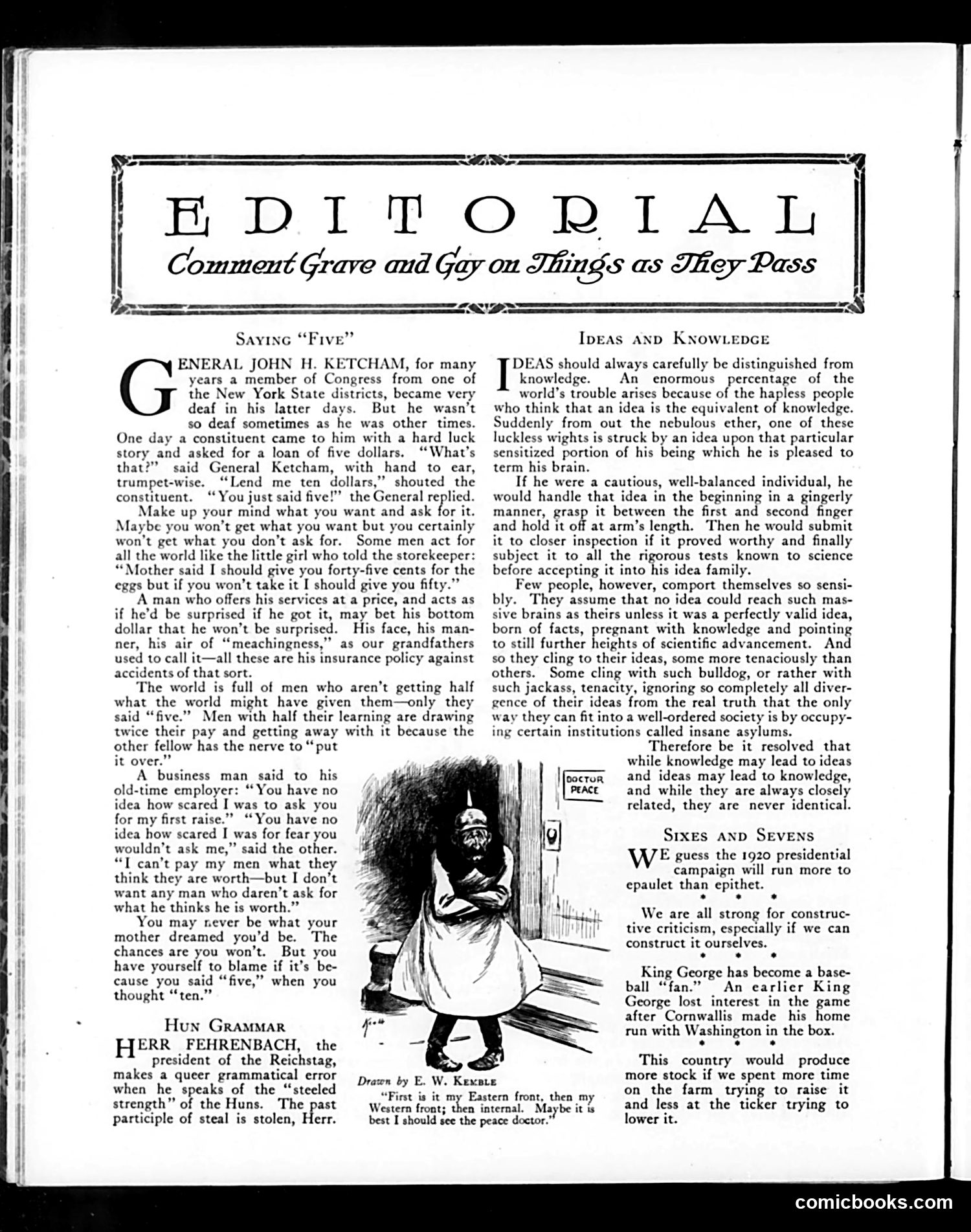
This page contains three satirical pieces from Judge magazine: **"Saying 'Five'"** mocks General John H. Ketcham, a deaf congressman who selectively heard what he wanted. The anecdote illustrates that people who lack confidence in their own worth—who "ask for five when they mean ten"—sabotage themselves. The editorial advises assertiveness in negotiation and self-advocacy. **"Hun Grammar"** ridicules Herr Fehrenbach, president of Germany's Reichstag, for grammatically misusing "steeled strength" (the past participle of "steal" is "stolen"). The accompanying cartoon shows a German military figure confused about his internal versus external "fronts," sarcastically suggesting he needs a "peace doctor." This post-WWI mockery portrays Germans as both grammatically and strategically incompetent. **"Ideas and Knowledge"** criticizes people who confuse having an idea with possessing actual knowledge, claiming this causes world problems. It warns against clinging dogmatically to unexamined notions.
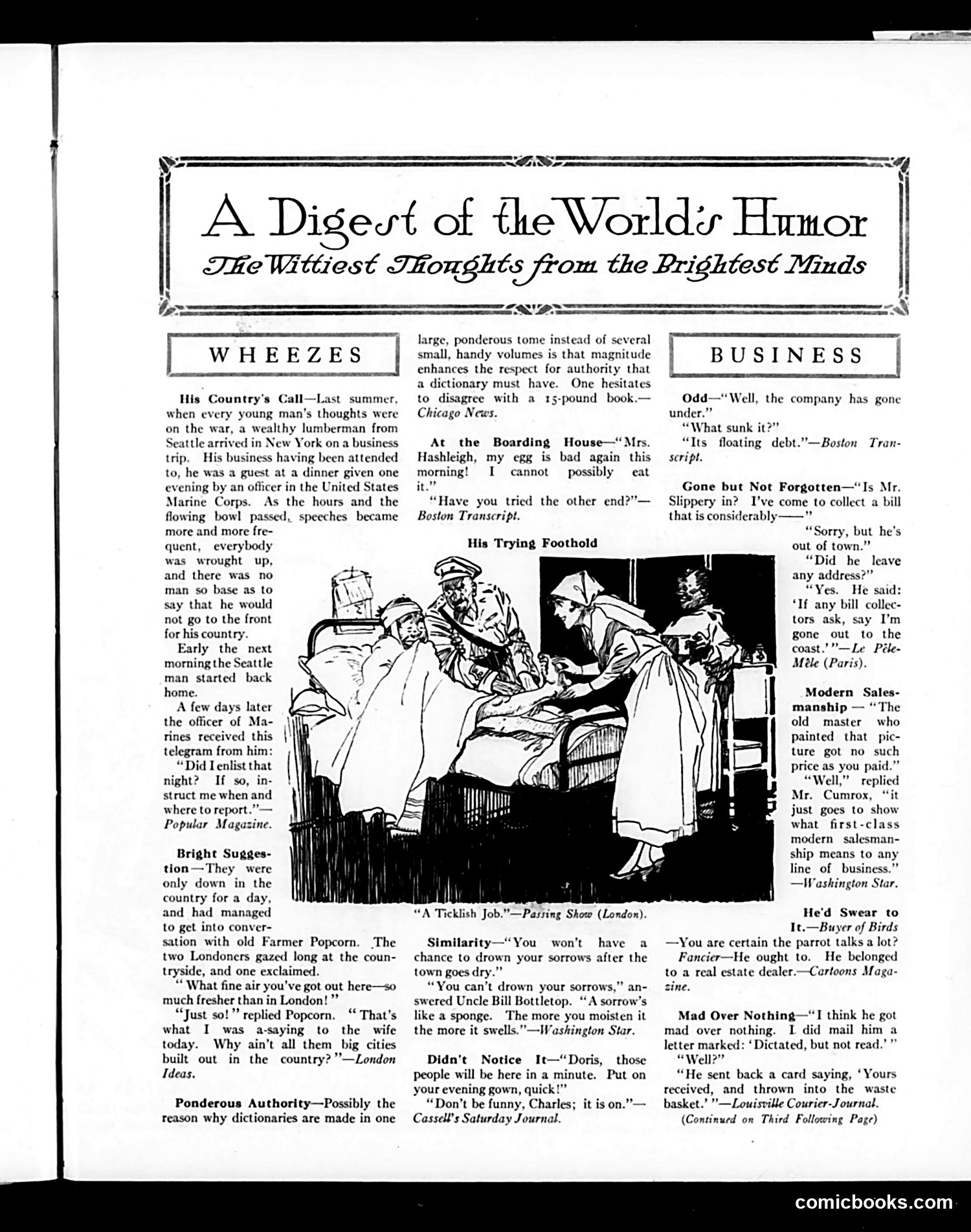
This page collects humorous anecdotes and jokes organized by category (Wheezes, Business). The main cartoon, "A Ticklish Job," depicts a nurse or caregiver attending to a bedridden patient—likely satirizing the delicate, uncomfortable nature of certain medical or domestic care situations. The jokes mostly target early-20th-century social anxieties: wartime patriotism (a wealthy businessman caught up in patriotic fervor but sobering up), Prohibition (references to "town goes dry"), and business incompetence (debtors fleeing, con artists pricing inflated art). One anecdote mocks rural simplicity—a farmer's confused suggestion that cities relocate to the countryside for fresh air. The humor relies on wordplay and irony typical of the era: a parrot learned to talk from a real estate dealer (implying dishonest chatter), and someone sarcastically marked a letter "dictated, but not read" to mock modern business affectation. The page reflects period concerns about modernization, commerce, and social change.
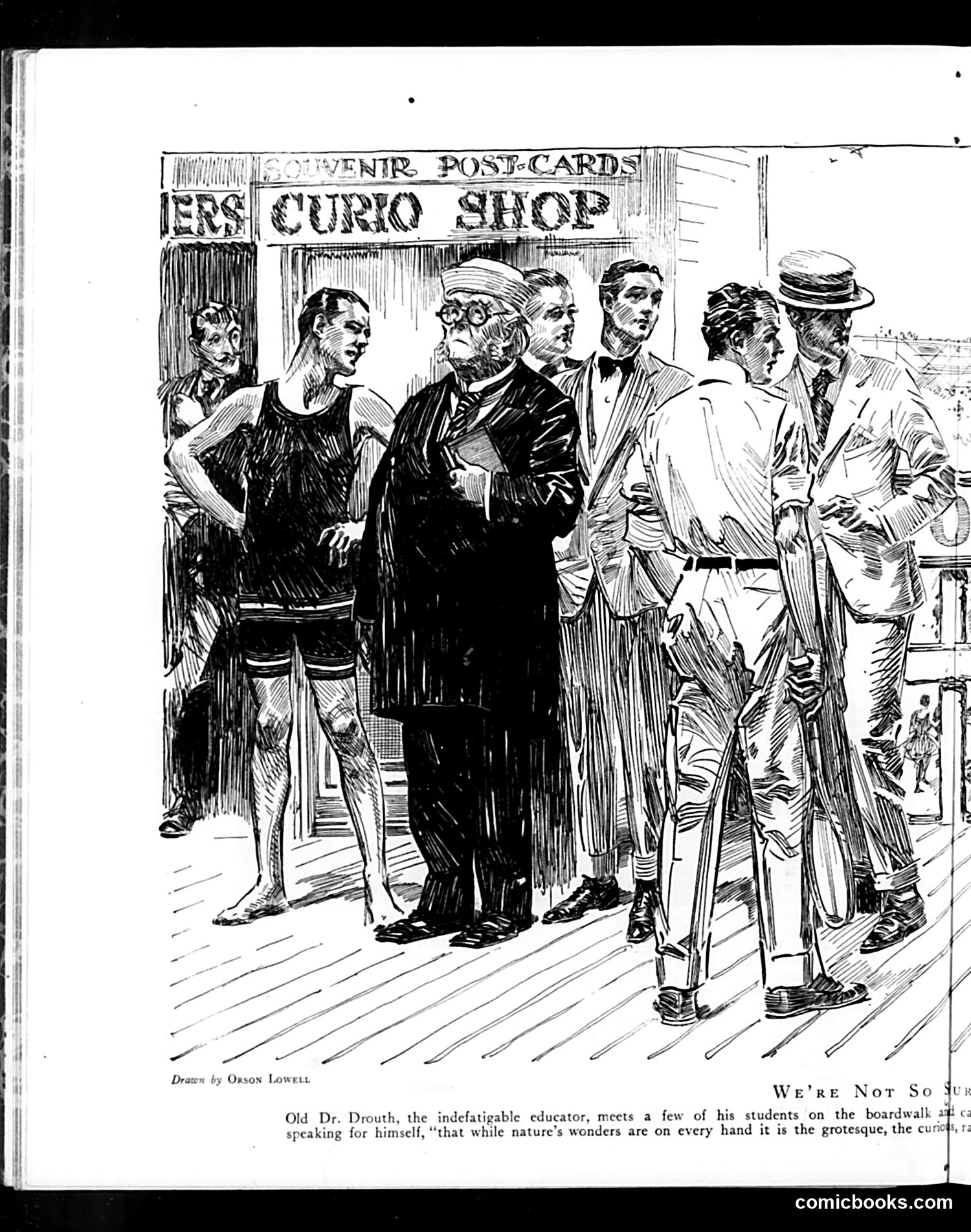
This satirical illustration by Orson Lowell depicts "Old Dr. Drouth," characterized as an "indefatigable educator," encountering several of his students outside a "Curio Shop" on a boardwalk. The caption's incomplete text suggests the joke centers on the doctor's philosophical observation about nature's wonders versus the grotesque curiosities visible around him—likely implying that the students themselves, or their behavior/appearance, represent the "grotesque" elements he's remarking upon. The cartoon appears to mock pretentious educational figures who pontificate about natural wonders while surrounded by human oddities. The formal dress contrast between the professorial figure and the casually-dressed students emphasizes the social satire typical of Judge magazine's humor.
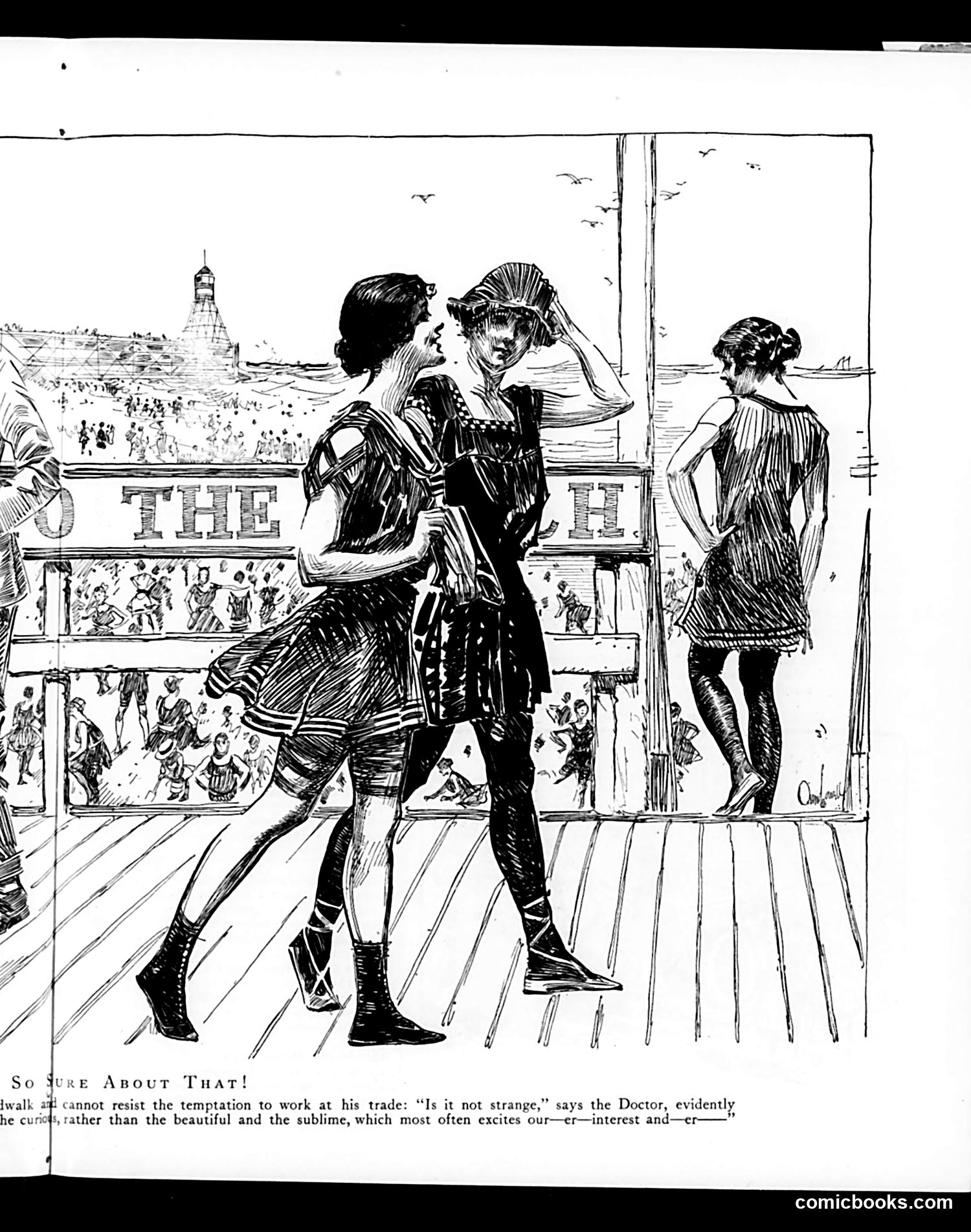
This cartoon depicts a scene at what appears to be a seaside resort or public venue, with figures observing from an elevated platform overlooking crowds below. The central figure is identified as "the Doctor," who is making a philosophical statement about human nature—claiming that the "curious" rather than "the beautiful and sublime" excites interest. The satire appears to target the Doctor's hypocrisy: while pontificating about refined aesthetic interests, he's visibly distracted by something below (suggested by his hesitant "er—er—" speech pattern), implying his actual interest lies in something more base or inappropriate. The cartoon mocks the gap between stated principles and actual behavior, a common Judge magazine theme of social commentary on pretension and human nature.
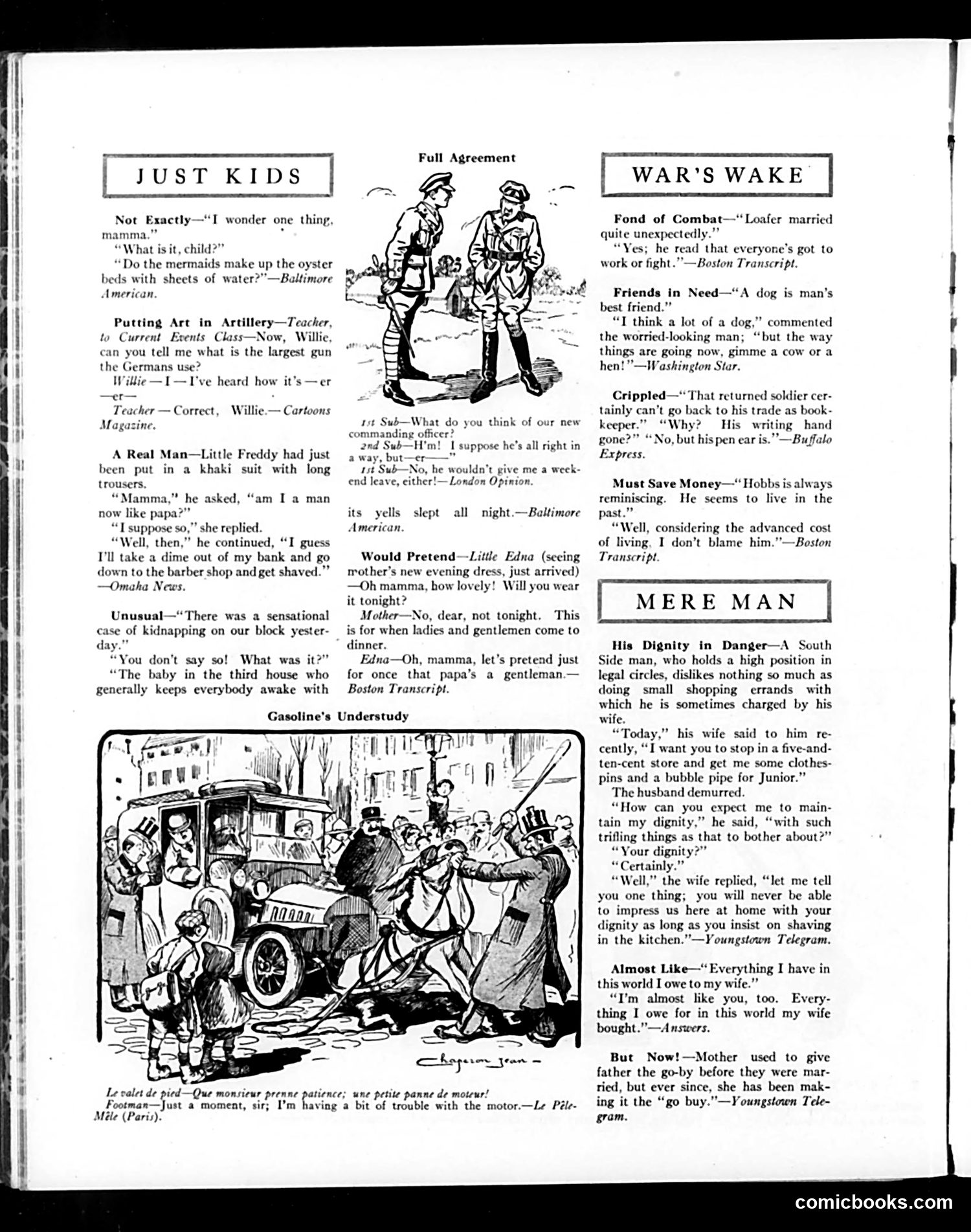
This page contains humor columns and cartoons reflecting WWI-era American life and attitudes: **"Just Kids"** presents children's innocent misunderstandings—a child asking if mermaids use water as bed sheets, or mistaking a large German artillery gun for art. **"War's Wake"** section offers social commentary on wartime impacts: a soldier unable to return to bookkeeping, changing attitudes toward work and fighting, and economic hardship affecting daily life. **"Mere Man"** satirizes gender dynamics—a husband refuses to shop for clothespins and bubble pipes, claiming it threatens his dignity, while his wife retorts that his kitchen shaving habits already undermine it. The **"Gasoline's Understudy"** cartoon (in French) depicts a car breakdown, likely commenting on wartime automotive shortages or mechanical failures—a recurring frustration of the era. Overall, the page uses humor to address WWI anxieties, economic strain, and shifting social roles, particularly how the war disrupted traditional masculinity and domestic expectations.
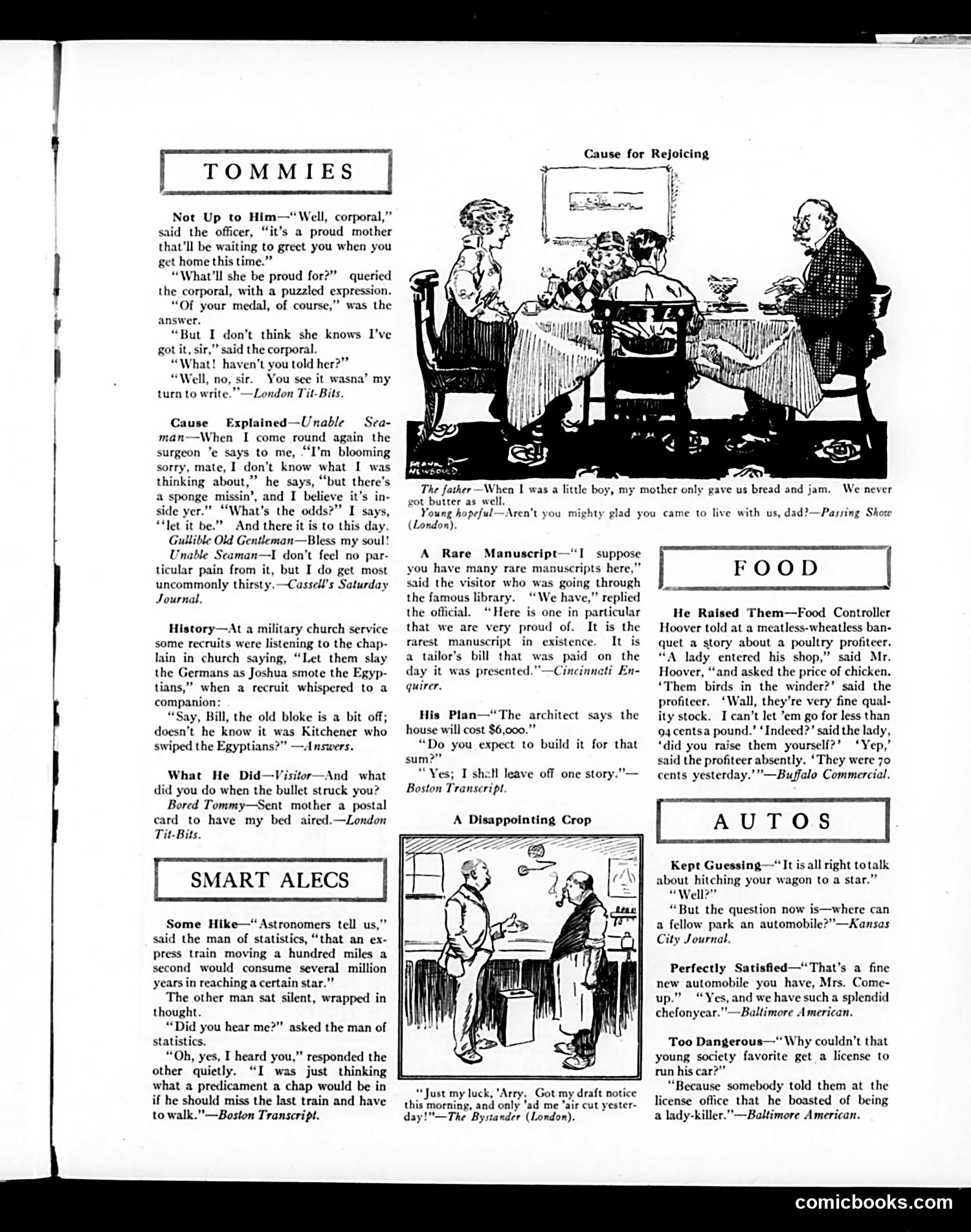
This page from Judge magazine contains humorous anecdotes and cartoons from the World War I era, organized by topic. **"Tommies"** section mocks British soldiers with jokes about their naïveté and poor communication—a corporal hasn't told his mother he won a medal because "it wasn't his turn to write," and a sailor unknowingly has a surgical sponge left inside him. **"Smart Alecs"** features jokes about obtuse reasoning, including a man worried about missing the last train after learning about vast astronomical distances. **"Food" and "Autos"** sections contain wartime rationing humor and automobile jokes. The "Food Controller" anecdote references Herbert Hoover's real role managing American food supplies during WWI, satirizing profiteers exploiting shortages by inflating chicken prices. The cartoons use simple line drawings to illustrate these brief comedic scenarios. Overall, the page reflects early-20th-century American humor sensibilities—puns, ironic misunderstandings, and gentle mockery of contemporary figures like Hoover and military life.
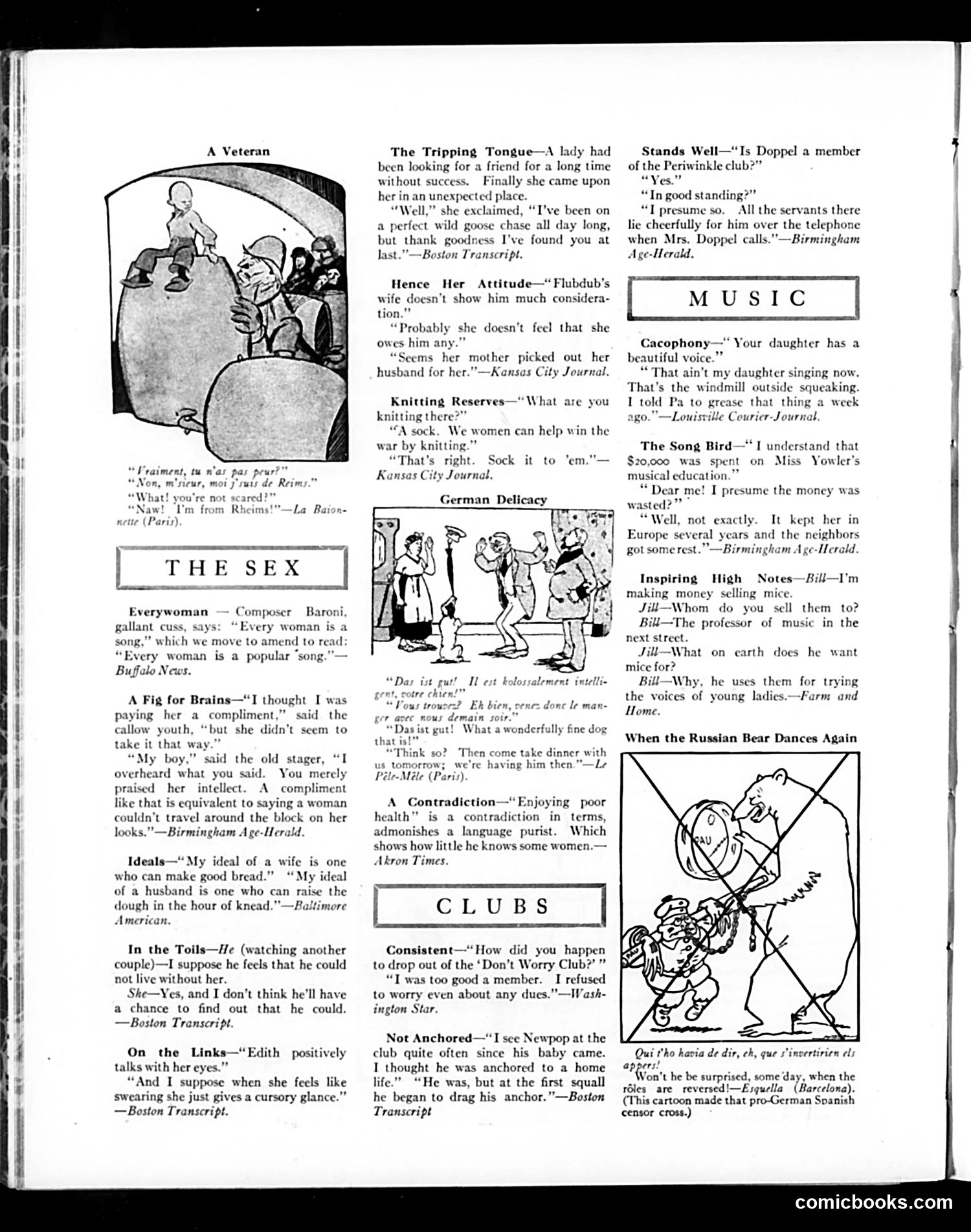
This page contains satirical humor pieces typical of Judge's early 20th-century format. Most content concerns domestic life and gender relations rather than politics. **Key Content:** The large cartoon titled "A Veteran" (upper left) depicts WWI, showing soldiers in a trench with French dialogue about fear and the ruins of Rheims—referencing the real destruction of that French city during the war. **"The Sex" section** mocks contemporary attitudes toward women through short anecdotes: women reduced to "songs," complimented only on looks not intellect, valued for domestic skills (bread-making). **"Music" and "Clubs"** sections offer light social satire about pretension and hypocrisy—members lying for each other, people claiming membership in "worry clubs" while avoiding actual worry. **"When the Russian Bear Dances Again"** (bottom cartoon, with Spanish caption) appears to reference shifting power dynamics, possibly post-WWI geopolitical expectations—the "surprised" reversal of roles suggests anticipated future conflict or status change. The page reflects pre-1920s American attitudes toward gender, war, and social class through humor.
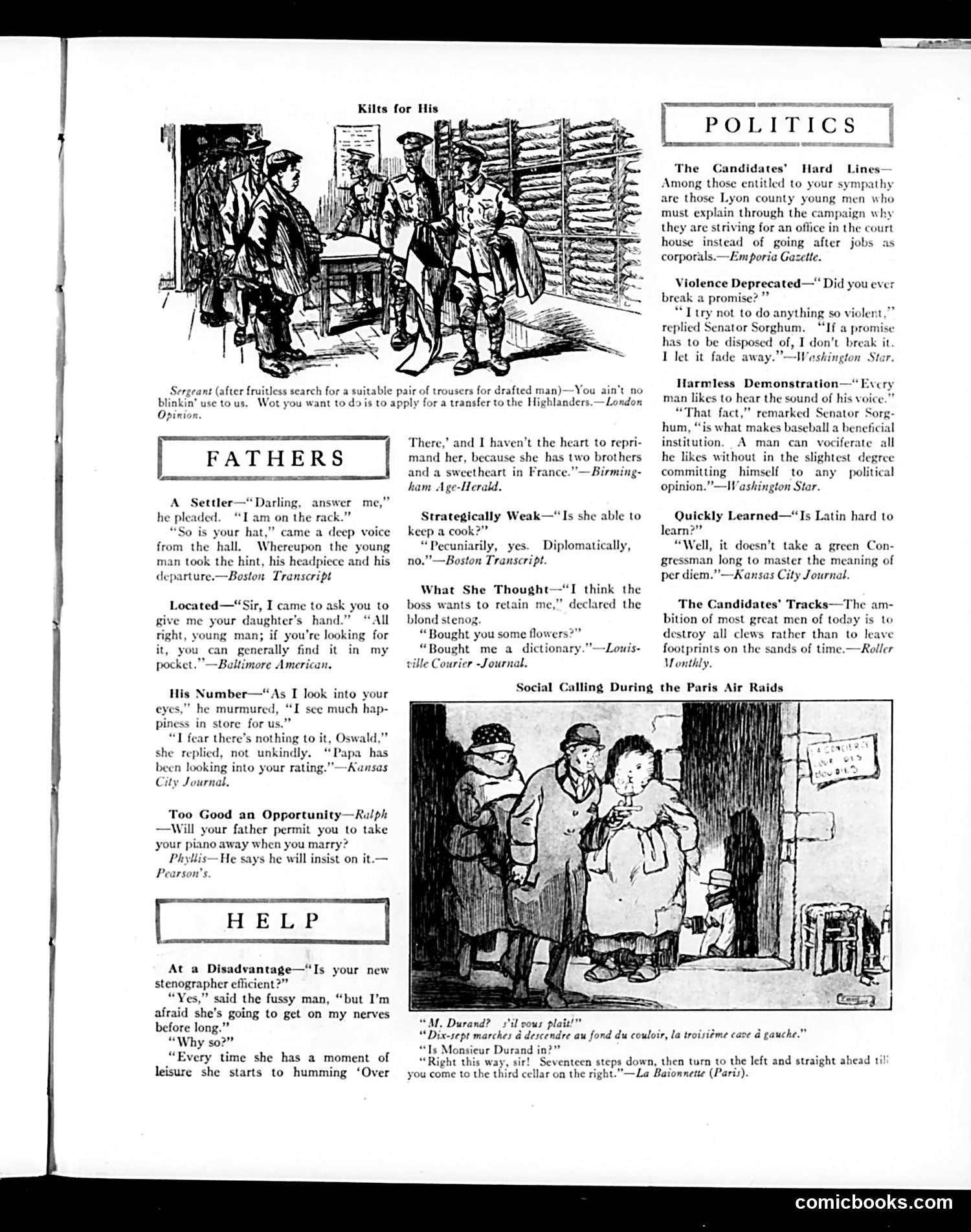
This page from Judge magazine contains **WWI-era political and domestic humor** rather than a single cartoon. Key elements: **"Politics" Section**: Satirizes political candidates and Senator Sorghum (a recurring Judge character), mocking politicians who: - Avoid military service while urging others to enlist - Break promises without admitting it ("let it fade away") - Use empty rhetoric (baseball analogy for harmless speech) - Master loopholes like "per diem" pay rather than principle **"Kilts for His"**: A WWI joke about a drafted soldier unsuitable for service, humorously told to apply to the Highlanders (Scottish regiment wearing kilts rather than trousers). **"Fathers" & "Help" Sections**: Domestic humor about courtship, stenographers, and marriage—lighter fare contrasting the political commentary. **Bottom Cartoon**: "Social Calling During the Paris Air Raids"—depicts Parisians navigating underground shelters during German bombing raids, treating it as mundane social navigation. The overall tone reflects American WWI attitudes: mocking draft-dodging politicians while normalizing civilian wartime disruption.
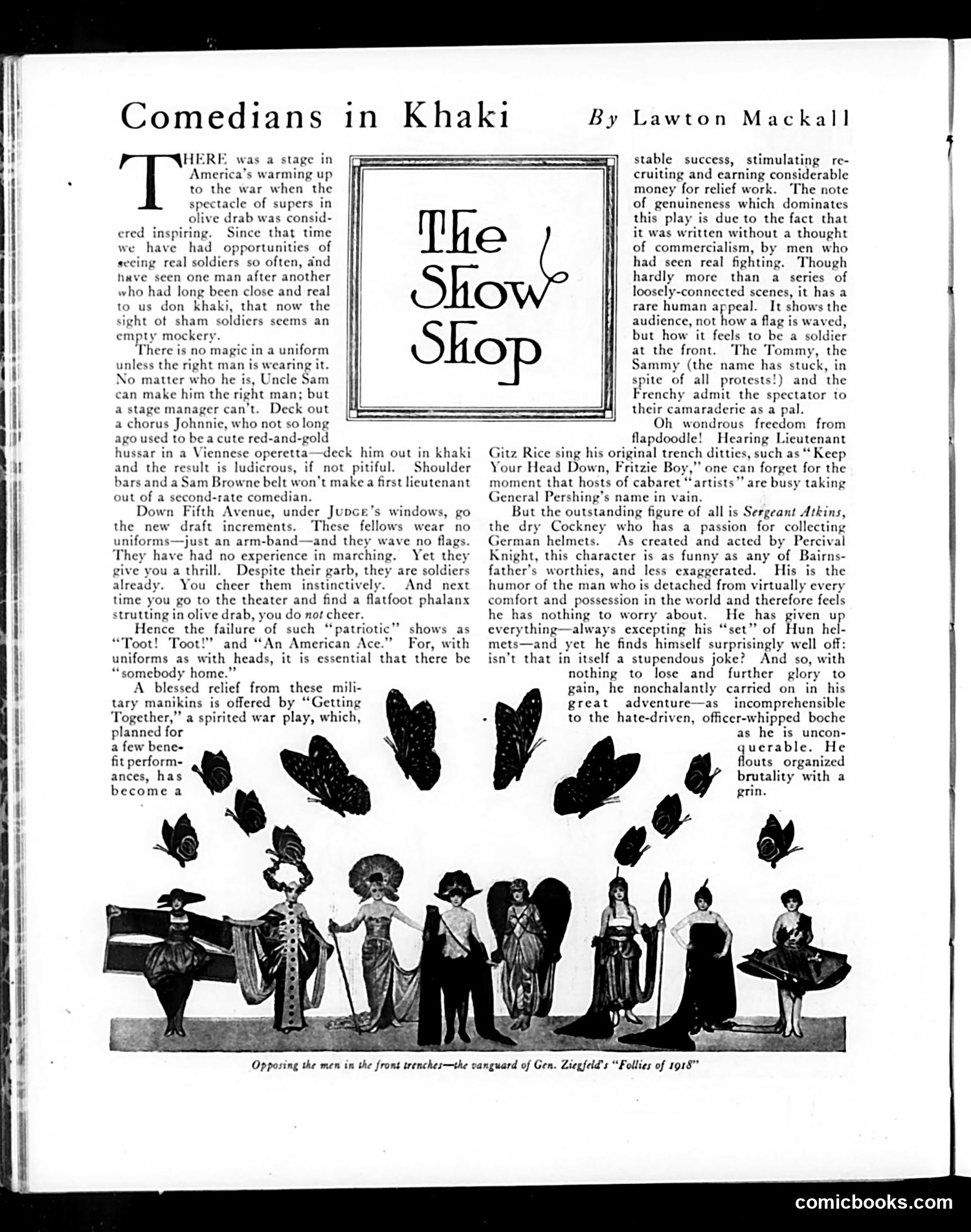
This 1918 *Judge* magazine article by Lawton Mackall critiques frivolous Broadway war-themed theatrical productions. The author distinguishes between genuine soldiers (real men drafted or enlisting) and actors in uniforms performing patriotic shows like "Toot! Toot!" and "An American Ace." Mackall argues these theatrical productions are hollow mockery—uniforms cannot make mediocre performers into credible soldiers. He praises "Getting Together," a genuine war play written by men who'd actually seen combat (including performer Gitz Rice), and especially praises Sergeant Atkins, a character based on real soldier experiences. The caption's reference to General Ziegfeld's "Follies of 1918" sarcastically equates Broadway's elaborate patriotic spectacles with the actual enemy facing soldiers in trenches. The satire targets: theatrical exploitation of wartime patriotism, casting unqualified entertainers as soldiers, and prioritizing commercial spectacle over authenticity.
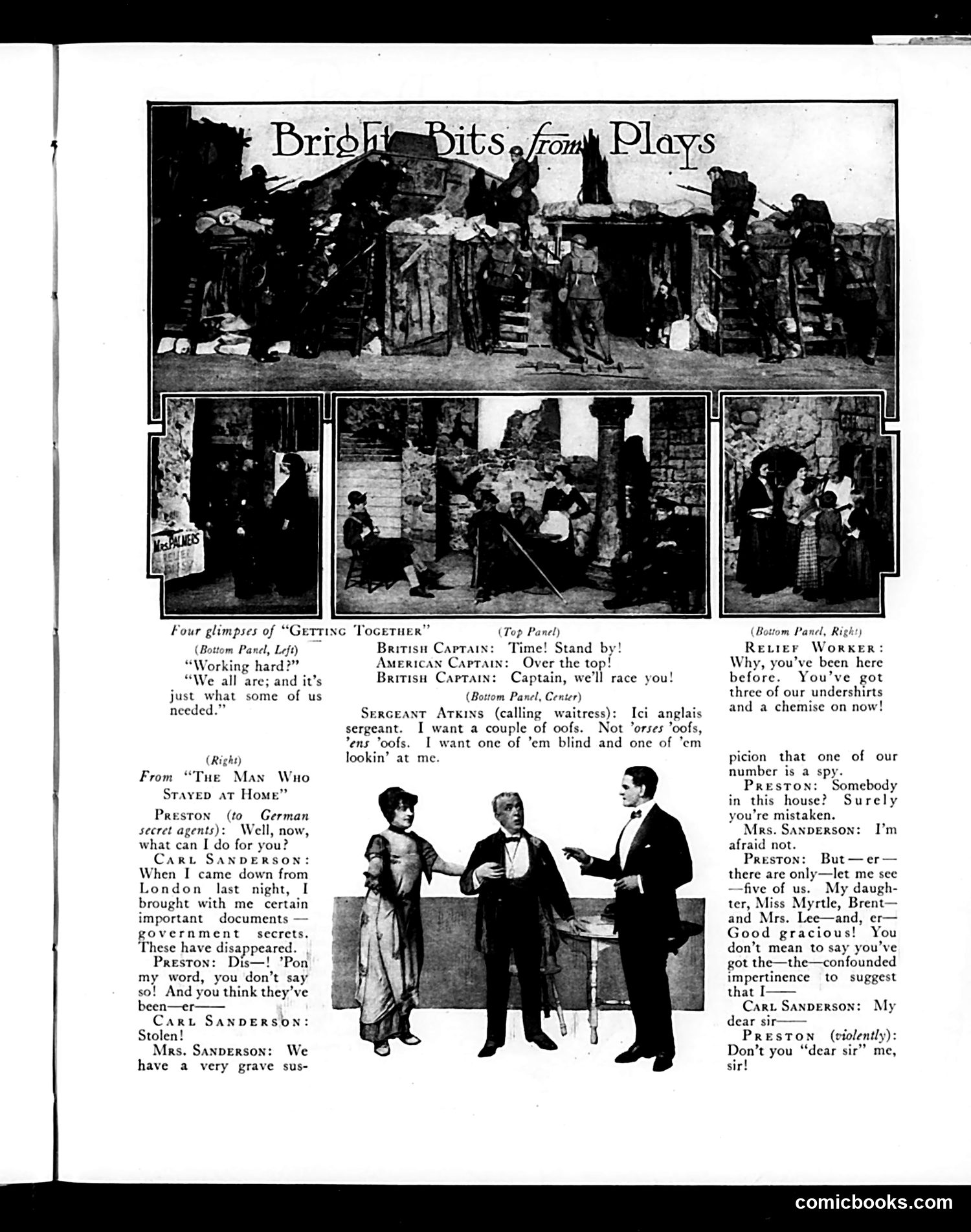
This page presents theatrical sketches satirizing WWI-era anxieties. The top panel shows soldiers from British and American armies competing in a trench charge—likely mocking the competitive nationalism between Allied forces. The central sketch, "The Man Who Stayed at Home," satirizes spy paranoia. A government official (Preston) discusses stolen "government secrets" with Carl Sanderson, who suspects a spy lurks among five household members. The humor derives from the absurdity: Preston becomes indignant at the *suggestion* of espionage in his own home, his outrage masking possible guilt or obliviousness to actual threats. Lower panels show comedic vignettes: a sergeant's fractured English ordering "oofs" (hooves), and a relief worker confronting someone repeatedly stealing undershirts—mocking wartime resource hoarding or military supply theft. The overall theme appears to be satirizing home-front anxieties about espionage, resource scarcity, and the gap between official reassurance and actual danger during WWI.
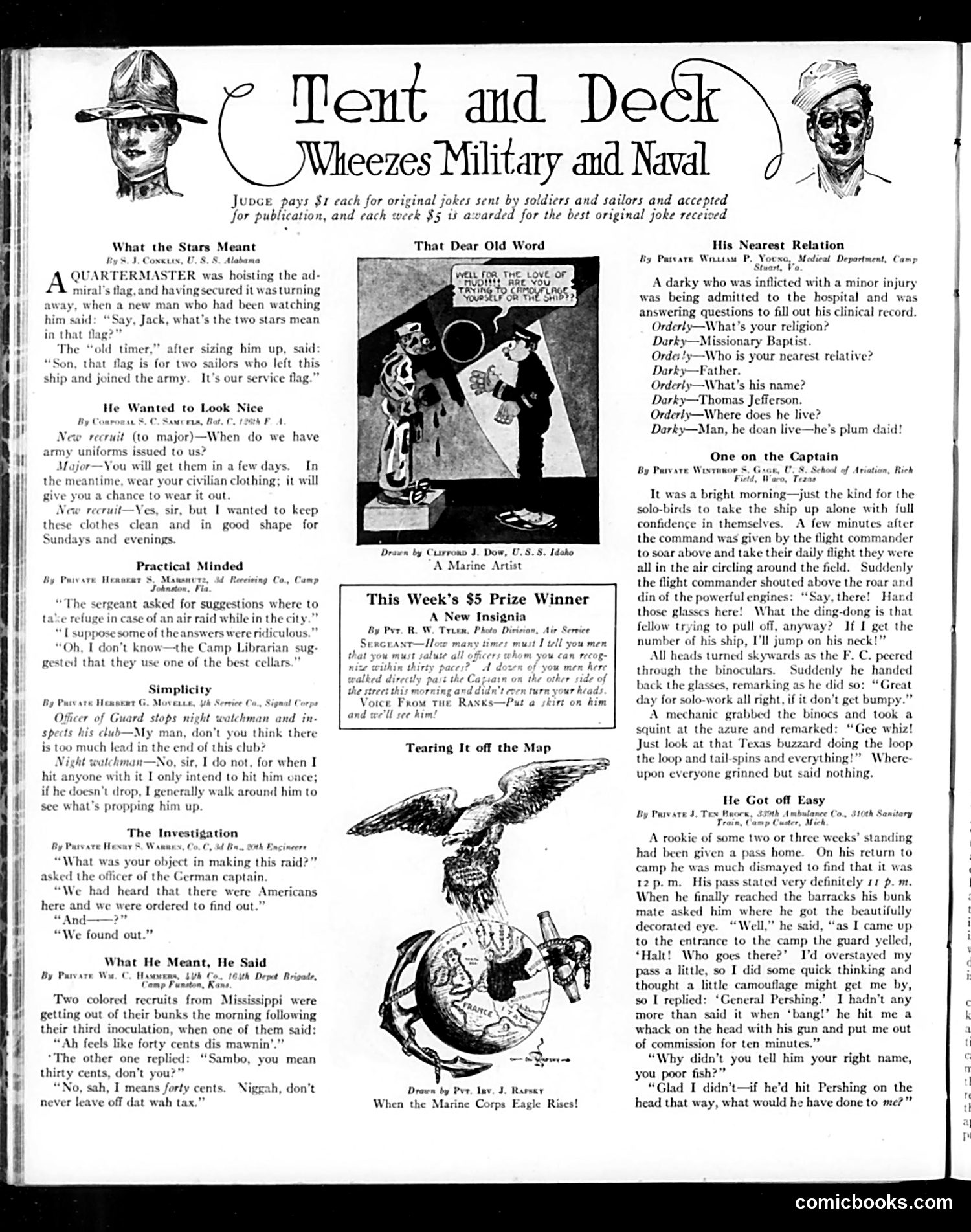
This page collects brief jokes from WWI-era soldiers and sailors. The humor reflects trench life: a recruit wanting to preserve civilian clothes for Sundays, a night watchman's logic about hitting someone once with a weighted club, and soldiers debating whether an air raid shelter should be a cellar. One recurring element uses offensive racial stereotypes—a dialect-heavy joke about Black recruits discussing their physical condition after inoculations, and another about a Black soldier listing "Thomas Jefferson" as his father's name (implying ancestry from the founding father). These reflect the casual racism of the era. The central cartoon (by Pvt. J. Barney) shows a Marine Corps eagle rising from what appears to be a globe or map, titled "When the Marine Corps Eagle Rises!"—likely celebrating Marine Corps pride or military expansion. The $5 prize winner, "A New Insignia," appears incomplete in the OCR but likely involved military insignia humor. Overall, the page uses military service as a vehicle for ethnic and racial humor common to early 20th-century American comedy magazines.
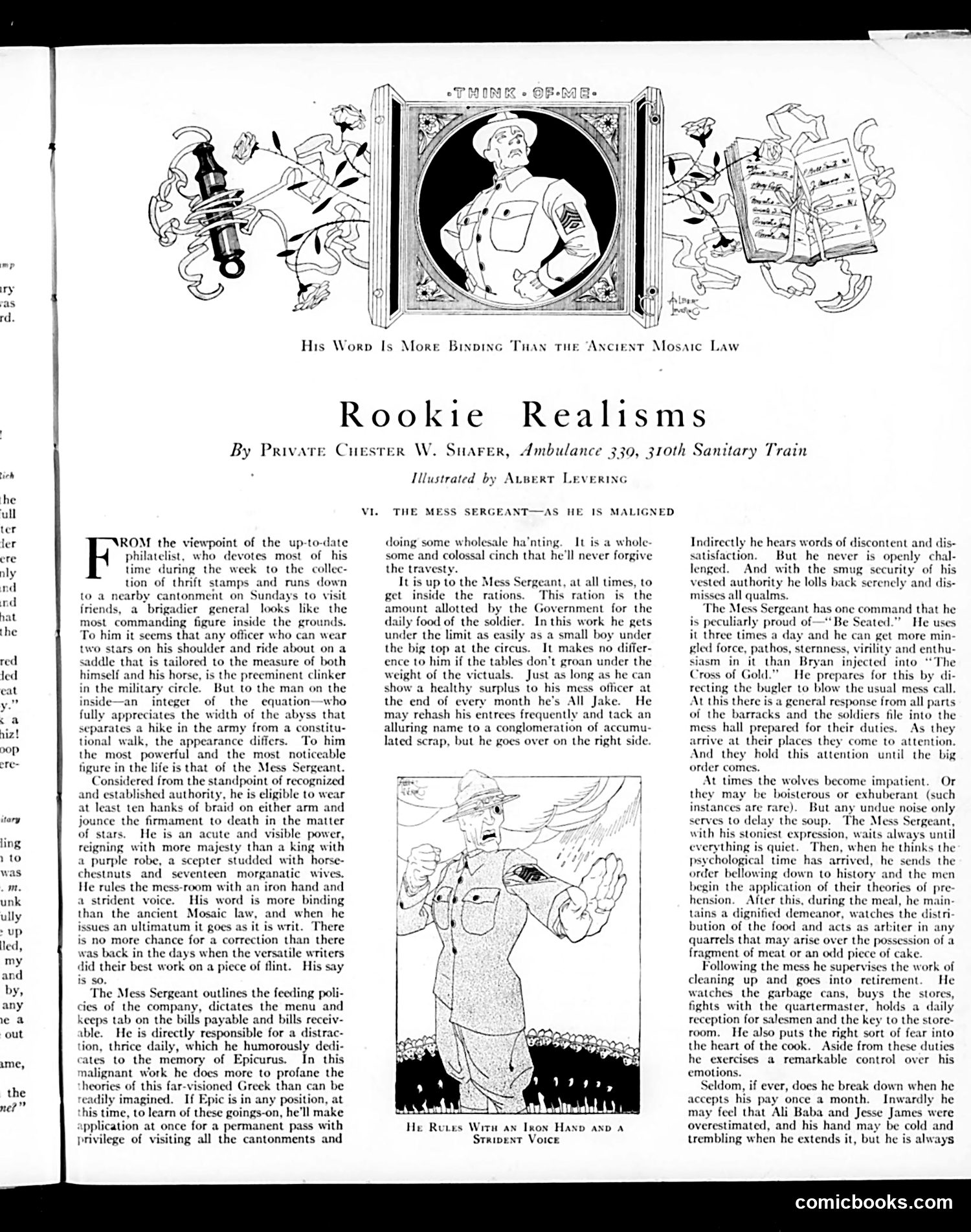
This WWI-era piece satirizes military hierarchy by elevating the Mess Sergeant—the soldier responsible for food and supplies—to absurd importance. The joke: While officially subordinate to generals and officers with fancy uniforms and ranks, the Mess Sergeant wields actual power over soldiers' daily lives through control of meals and rations. His authority is "more binding than the ancient Mosaic law." The satire targets military bureaucracy: the Sergeant cheats the food budget ("shows healthy surplus") by reusing scraps under fancy names, yet soldiers never challenge him. The reference to Bryan's "Cross of Gold" speech mockingly compares the Sergeant's command "Be Seated!" to grand oratory. For modern readers: this exposes how real power in institutions often rests with unglamorous functionaries rather than titled leaders—a timeless organizational truth. The piece gently mocks both military absurdity and the soldier's powerless acceptance of petty tyranny.
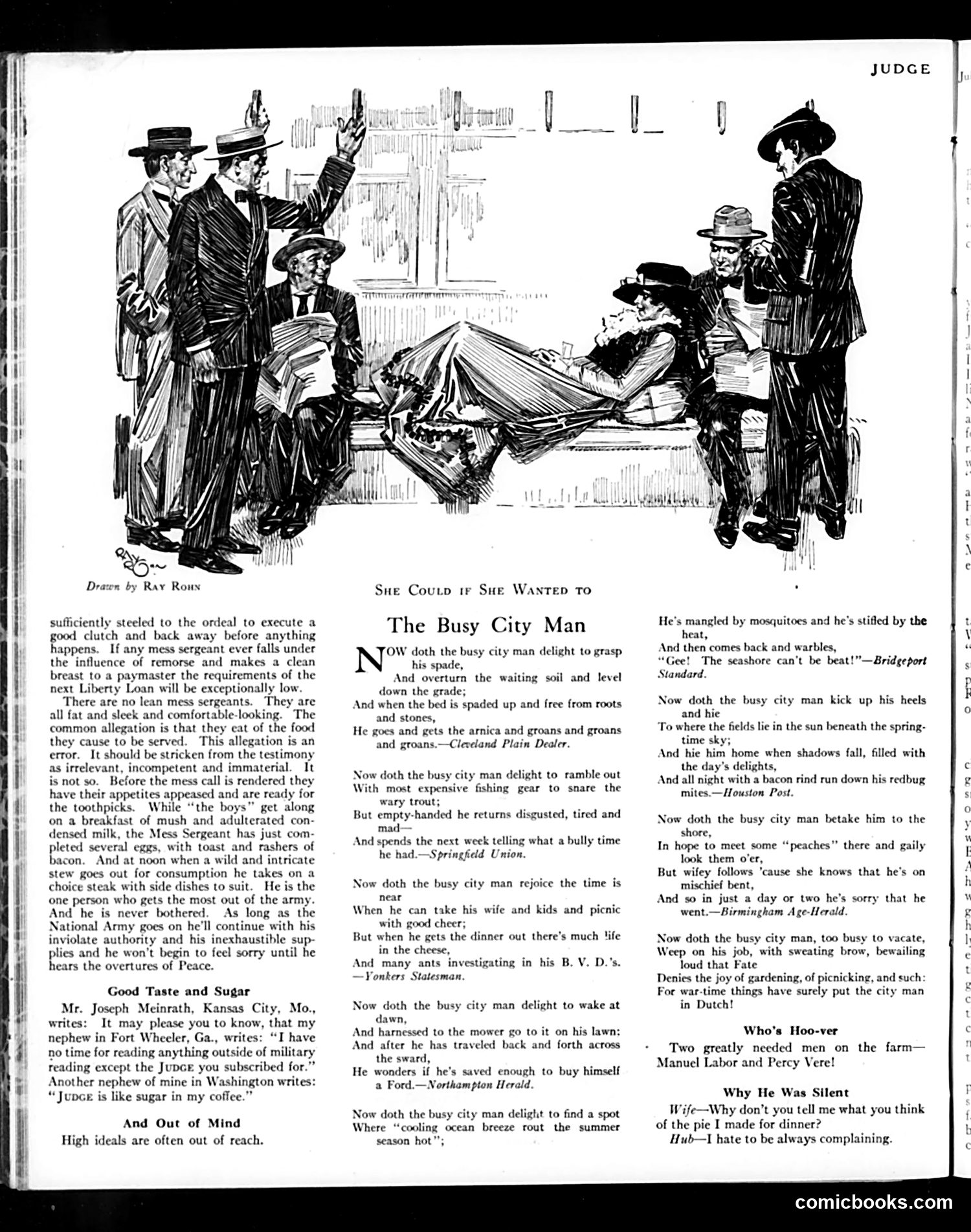
This Judge magazine page contains humorous poetry about urban leisure failures, drawn by Ray Roux. "The Busy City Man" is a satirical poem (assembled from various newspaper sources) mocking middle-class men who romanticize outdoor recreation but consistently experience disappointment. The cartoon above depicts such a man comically entangled or exhausted, surrounded by other figures—illustrating the poem's theme. Each stanza describes a leisure activity (gardening, fishing, picnicking, lawn-mowing, beach trips, countryside visits) that inevitably goes wrong: mosquitoes attack, ants invade food, he can't afford a car, his wife follows him, or bugs plague him. The satire targets the gap between urban workers' vacation fantasies and reality. The page also includes filler content praising Judge magazine and complaining about mess sergeants and Liberty Loans, referencing WWI-era military concerns. The humor relies on readers recognizing their own failed attempts at leisure—a timeless, relatable complaint.
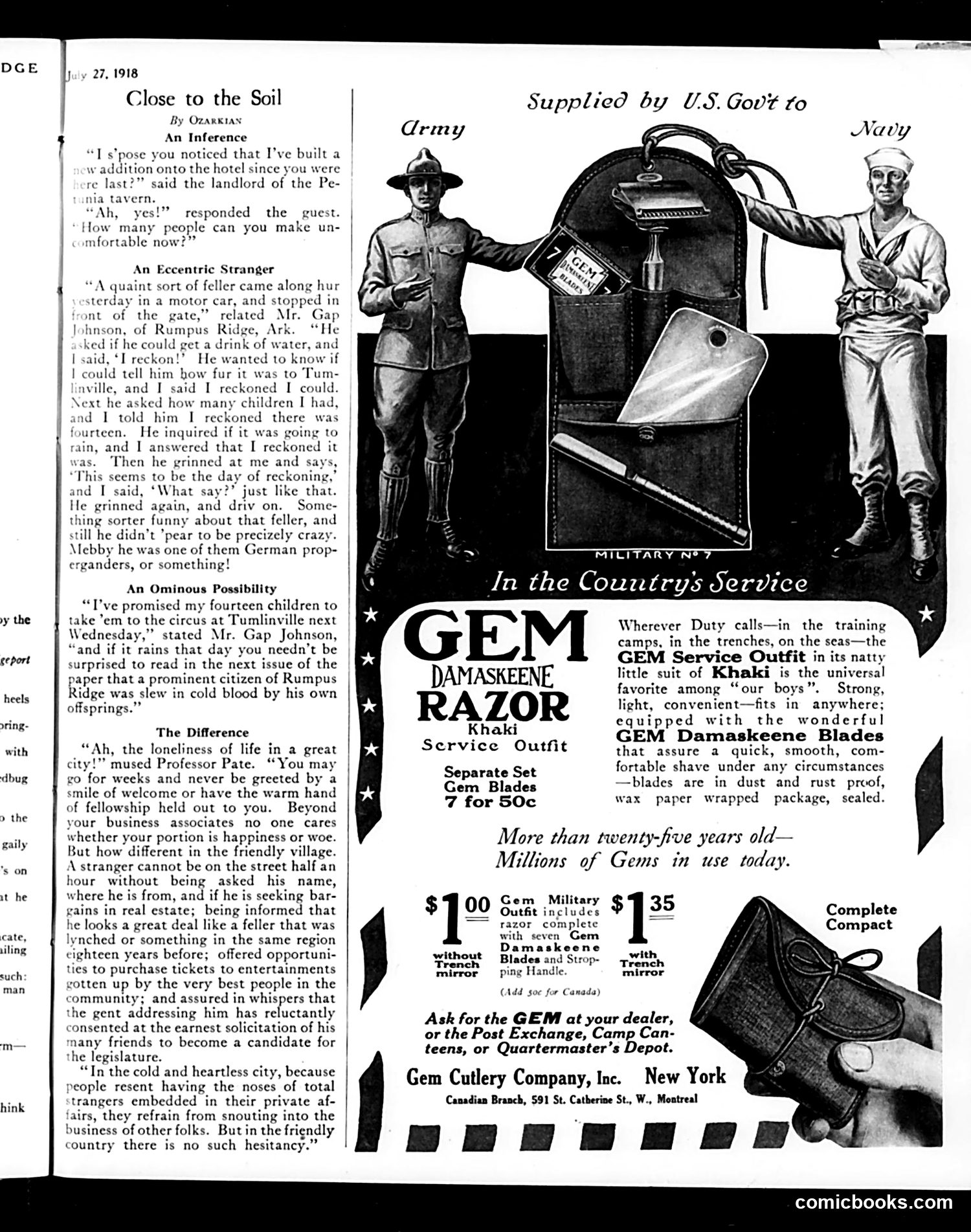
This page contains **satirical short stories** rather than traditional political cartoons. The humor targets rural American attitudes and small-town social dynamics during World War I. **"Close to the Soil"** comprises four vignettes mocking rural life: 1. **"An Inference"**: A hotel owner's guest sarcastically asks how many people he can now make uncomfortable—satirizing poor hospitality in rural establishments. 2. **"An Eccentric Stranger"**: A visitor's repeated use of "I reckon" leads a backwoods farmer to suspect he's a German propagandist—reflecting WWI-era paranoia about foreign spies. 3. **"An Ominous Possibility"**: Dark humor about a father threatening to be murdered by his fourteen children if rain cancels the circus. 4. **"The Difference"**: Professor Pate contrasts city anonymity favorably with rural nosiness—satirizing the intrusive, gossip-filled nature of small-town communities. The page also contains a **GEM Razor advertisement** marketed to servicemen, featuring Army and Navy illustrations—timely given the 1918 publication date during American military mobilization.
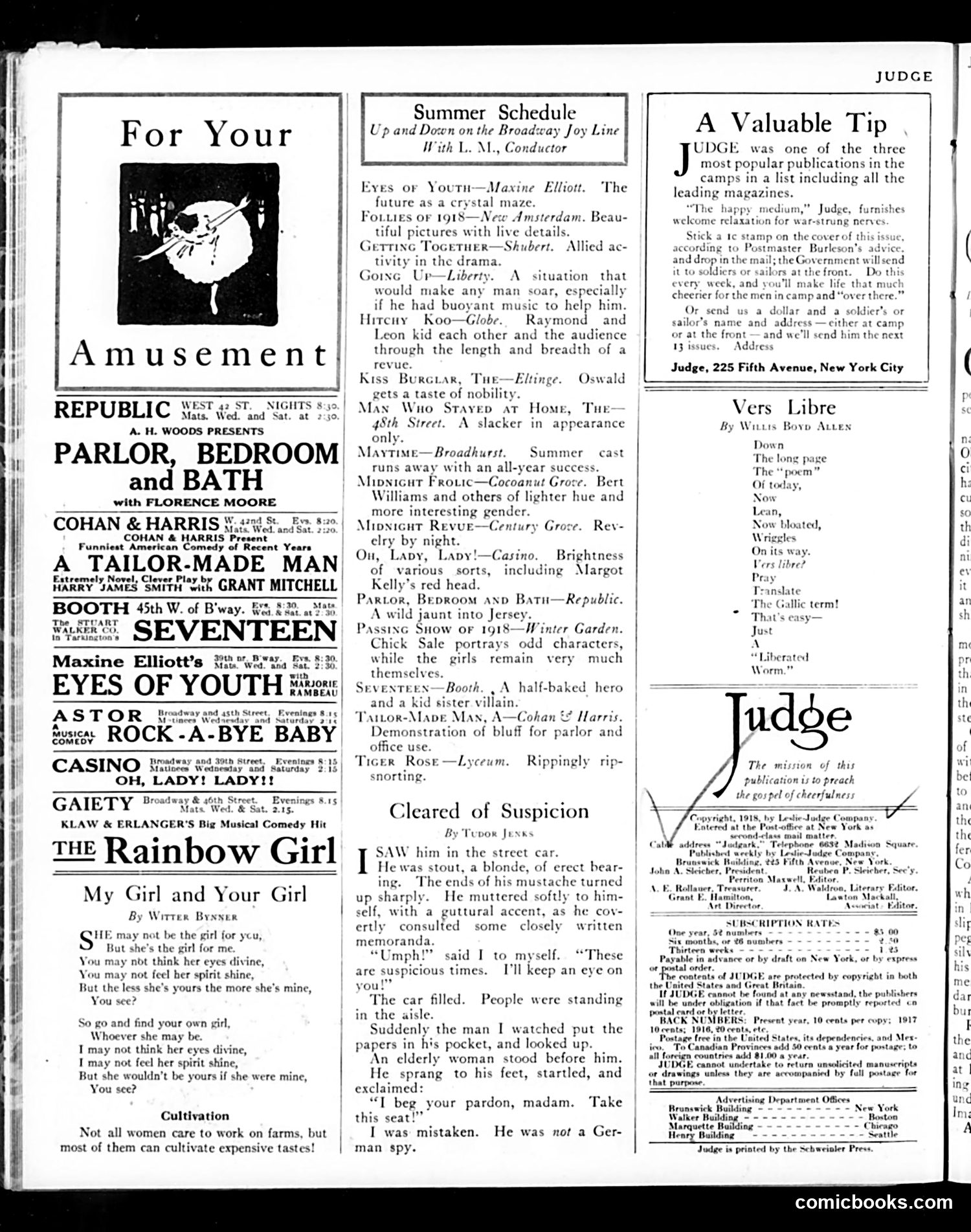
This page is primarily **theatrical advertisements and entertainment listings** from Judge magazine's summer schedule of Broadway shows (1918). The satire is minimal on this particular page. The notable content includes: **"Cleared of Suspicion"** — A brief story satirizing **wartime paranoia**. A narrator suspects a man on a streetcar of being a German spy based on his appearance (blond, stout, guttural accent, consulting written notes). The "joke" reveals the man is innocent—he simply stands to offer his seat to an elderly woman, proving he's an honorable gentleman, not an enemy agent. This reflects actual WWI-era suspicion of German immigrants and spies in America. **"A Valuable Tip"** — Advertisement encouraging soldiers in training camps to subscribe to Judge magazine, promising it aids morale and suggesting they send copies to soldiers at the front. The poem **"Cultivation"** mildly jokes that women may not care for farm work but readily embrace expensive tastes—mild gender satire typical of the era. The page reflects 1918 American concerns: wartime vigilance, troop morale, and entertainment as patriotic service.
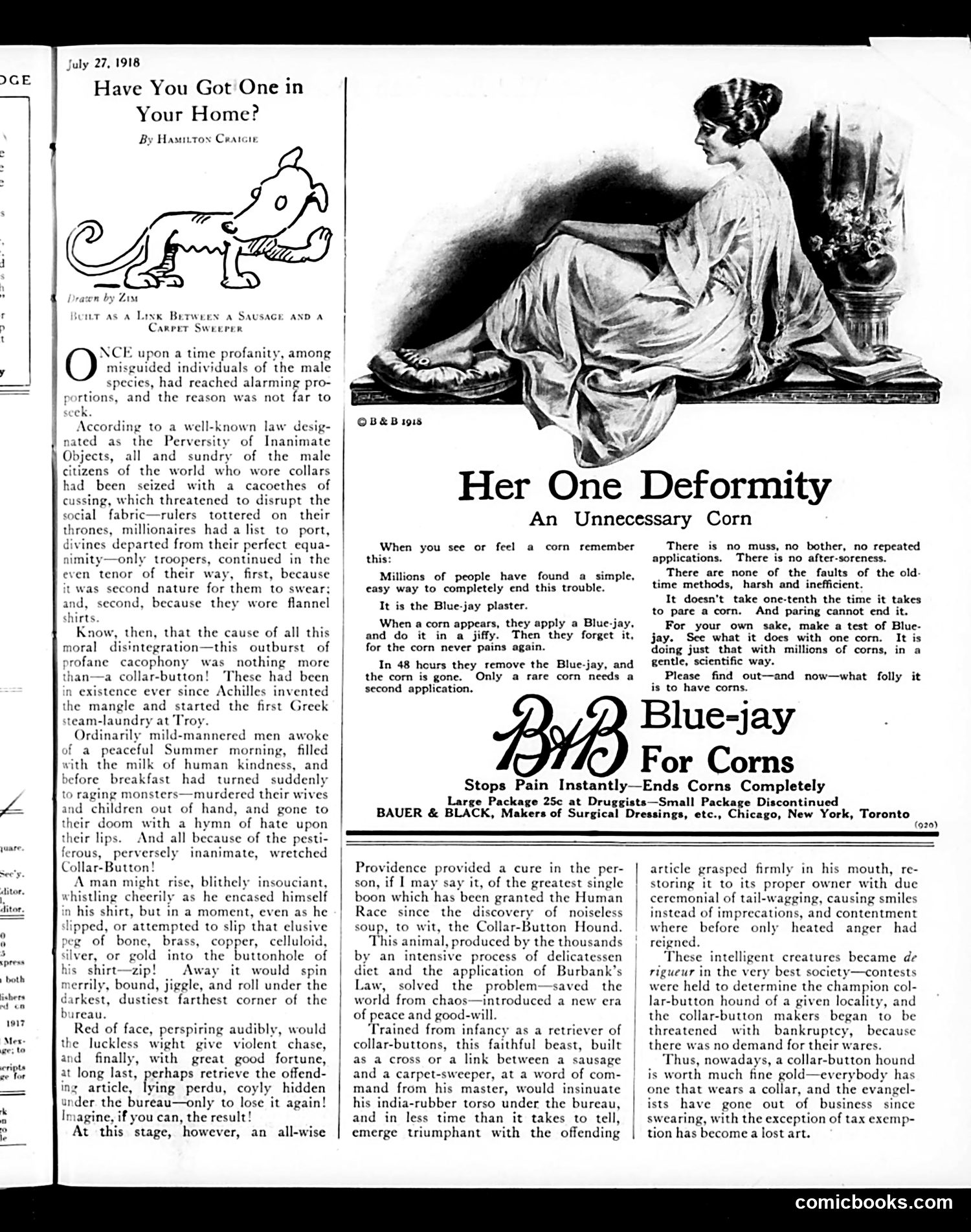
**The Main Cartoon:** The left side features a humorous essay by Hamilton Craige about the "Collar-Button"—a small fastener for detachable collars common in early 20th-century menswear. The piece satirizes how this mundane object supposedly caused widespread moral chaos: respectable men would lose their collar-buttons, become enraged searching for them, and descend into profanity and violence. The absurdist joke exaggerates the object's social impact, blaming it for moral "disintegration" and suggesting even troop discipline depended on soldiers wearing flannel shirts (which didn't require collar-buttons). The satire mocks both the fragility of male composure and society's tendency to blame trivial objects for larger problems. **The Right Side:** A medical advertisement for "Blue-jay" corn plaster—a genuine contemporary product. The accompanying illustration is unrelated to the collar-button story; it's standard advertising copy promising pain relief and cure. The page combines satirical commentary with commercial advertising, typical of Judge magazine's format.
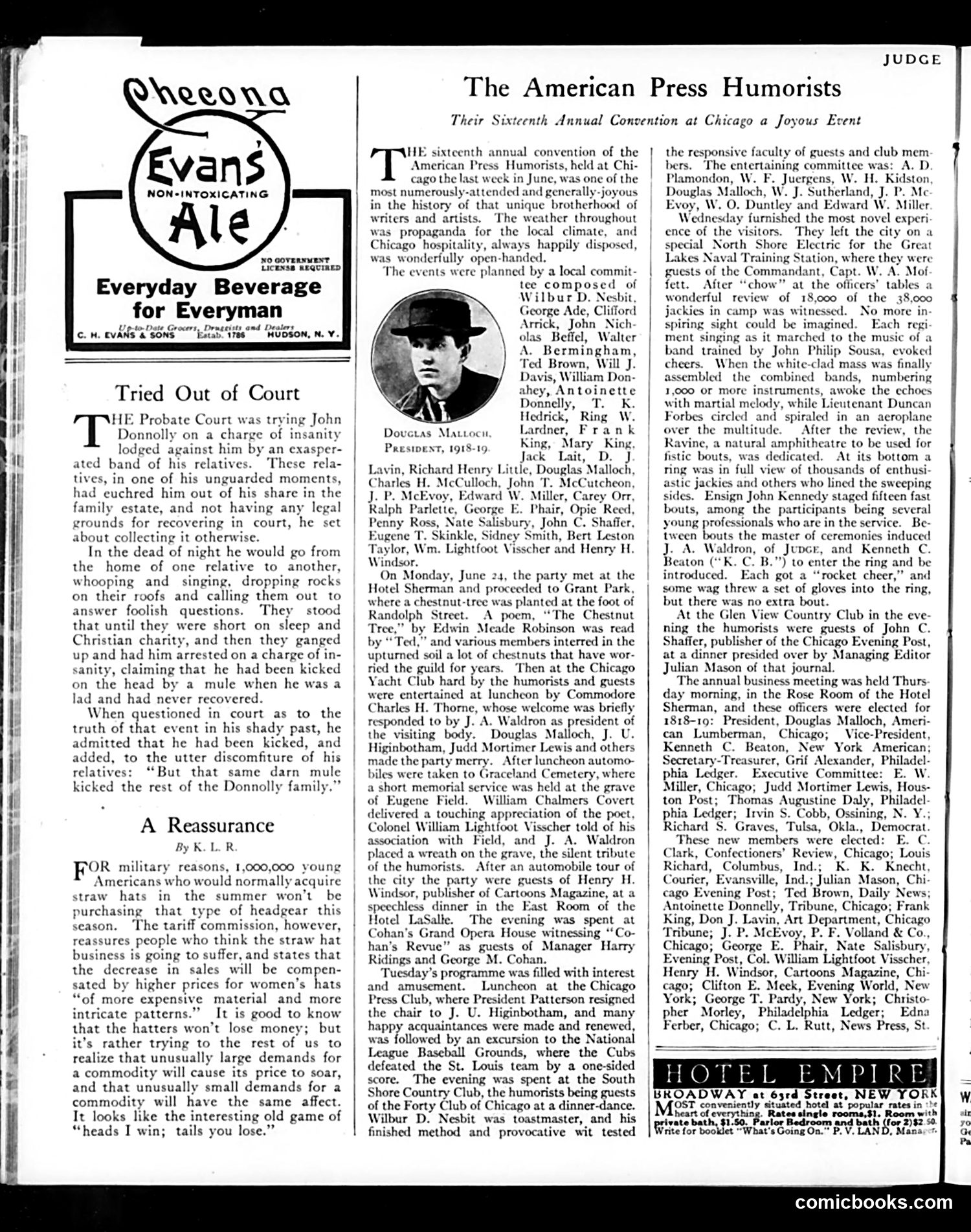
This page contains two satirical pieces from Judge magazine. **"Tried Out of Court"** mocks a man named John Donnolly who, after his relatives cheated him out of his inheritance, retaliates by disturbing them nightly—singing, whooping, and throwing rocks on their roofs. When they have him arrested for insanity, claiming a childhood mule kick damaged him, he responds that the same mule kicked "the rest of the Donnolly family," suggesting they're all equally mad. The satire targets the absurdity of using mental-illness charges to cover up fraud. **"A Reassurance"** ironically comments on wartime economics: during WWI, 1,000,000 young men won't buy straw hats for military reasons, but the tariff commission claims this loss will be "compensated" by higher prices on women's hats. The piece satirizes this economic doublethink—arguing that decreased demand somehow offsets decreased supply—calling it the old game of "heads I win; tails you lose," exposing how ordinary people lose either way.
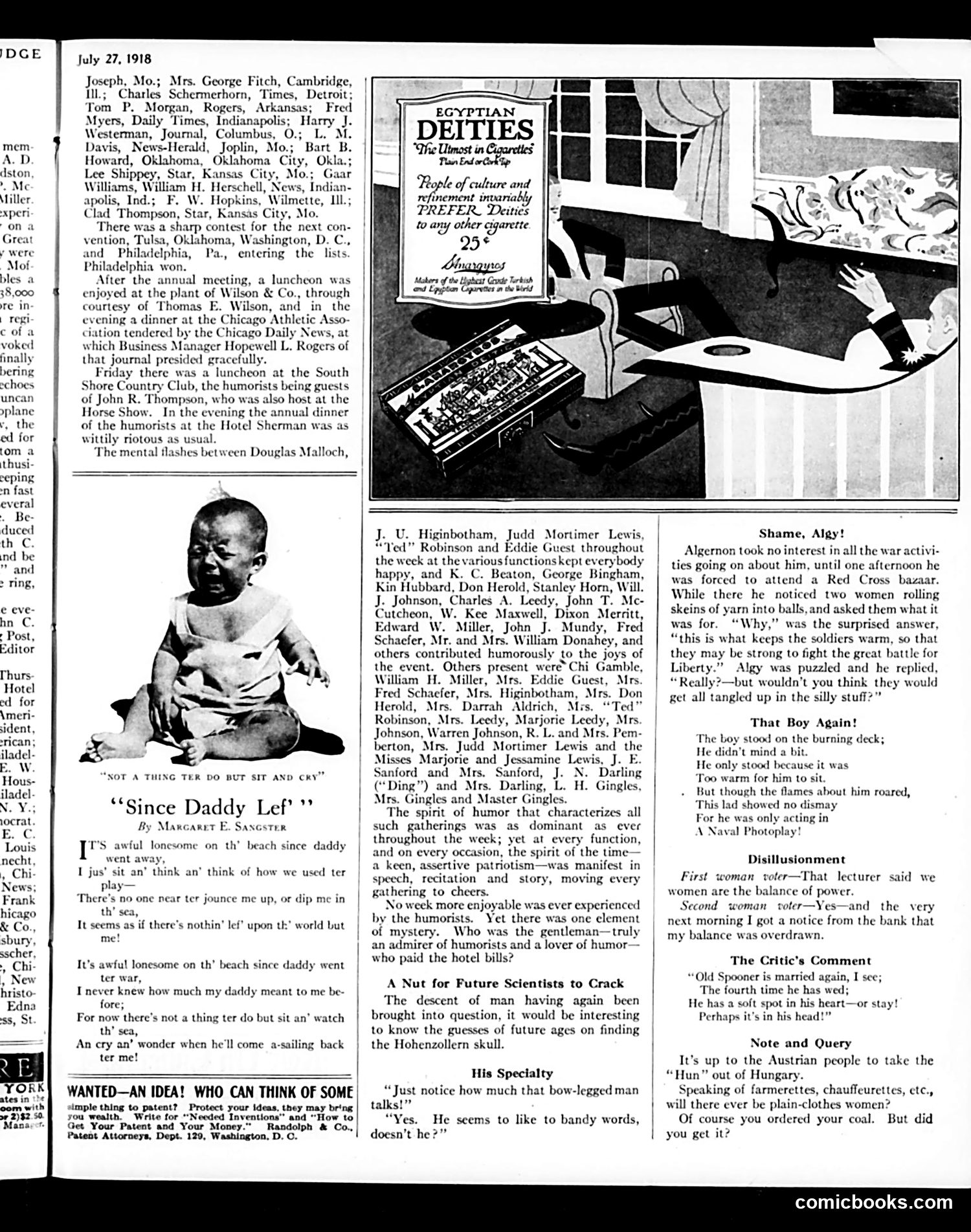
This Judge magazine page from July 27, 1918 contains several distinct elements: **Main Content:** A sentimental poem titled "Since Daddy Lef'" by Margaret E. Sangster depicts a child's loneliness after her father departed for World War I. The melancholic tone—"It's awful lonesome on th' beach since daddy went away"—reflects American home-front emotional costs of the war. **Advertisement:** An "Egyptian Deities" cigarette ad emphasizes "culture and refinement," typical of early 20th-century luxury marketing. **Conference Coverage:** Text describes a gathering of American humorists and newspaper cartoonists, mentioning figures like Kin Hubbard and J.N. Darling ("Ding"), with emphasis on patriotic sentiment permeating their discussions. **Patent Advertisement:** A generic "Wanted—An Idea!" patent solicitation. The page blends wartime sentiment with commercial content and industry news—characteristic of Judge's mix of satire, humor, and advertising for educated, middle-class readers during WWI.
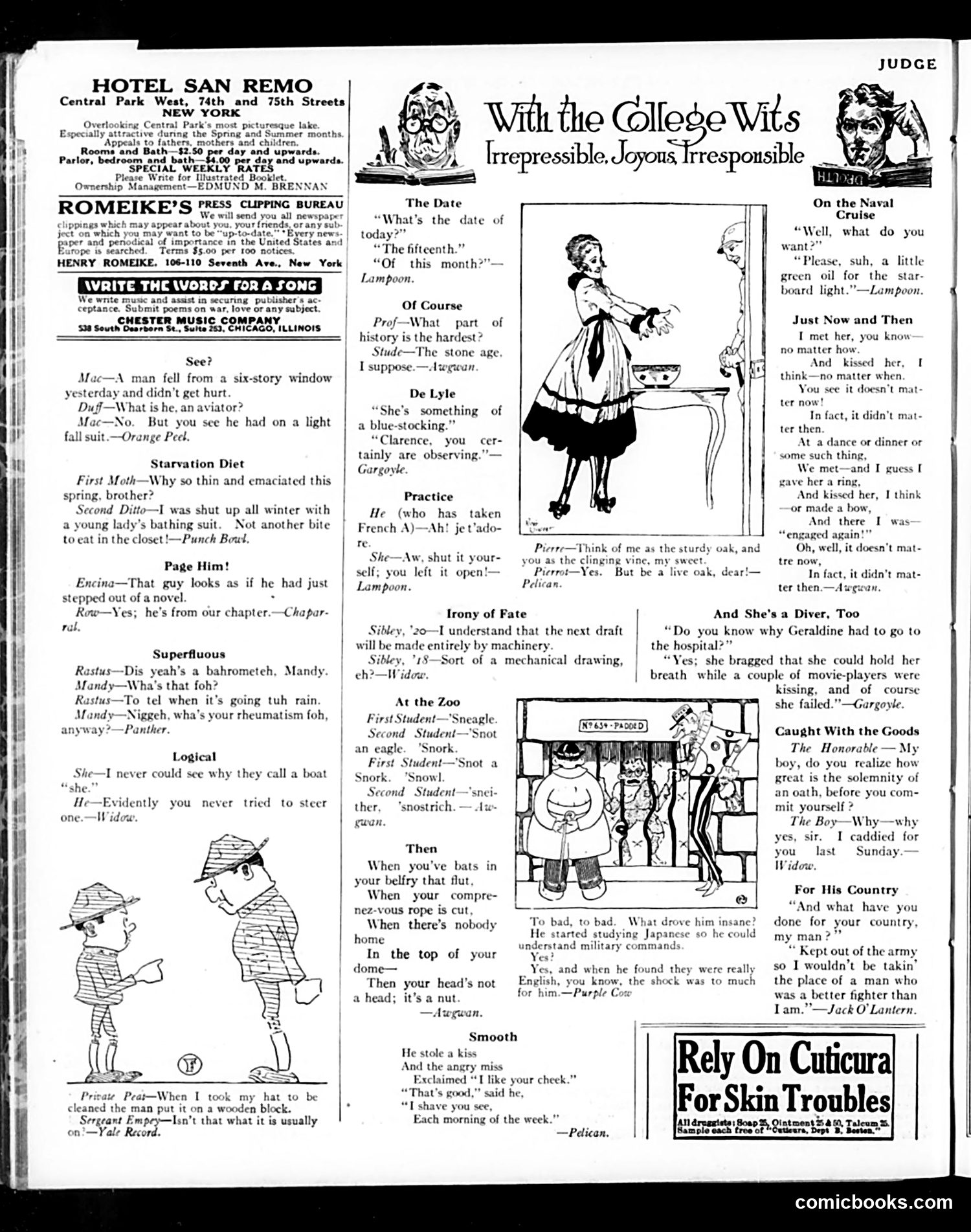
This page from Judge (a satirical publication) consists primarily of **advertisements and humorous college jokes** rather than political commentary. The main content features "With the College Wits"—a section of brief, witty exchanges from college humor magazines (Lampoon, Gargoyle, etc.). These jokes reflect early 20th-century college culture: references to French language classes, "bathing suits," draft notices (suggesting WWI era), and romantic encounters. **The humor relies on**: - Puns and wordplay ("'Sneagle"/"'Snork" at the zoo) - Double meanings ("blue-stocking" as intellectual) - Period slang and campus references The page also includes advertisements for a hotel, music company, and press clipping bureau—typical Judge filler content. There are no identifiable political figures or caricatures. The cartoons are generic illustrations accompanying the jokes. This appears to be a standard humor page from Judge's college-focused section, not satirical political commentary.
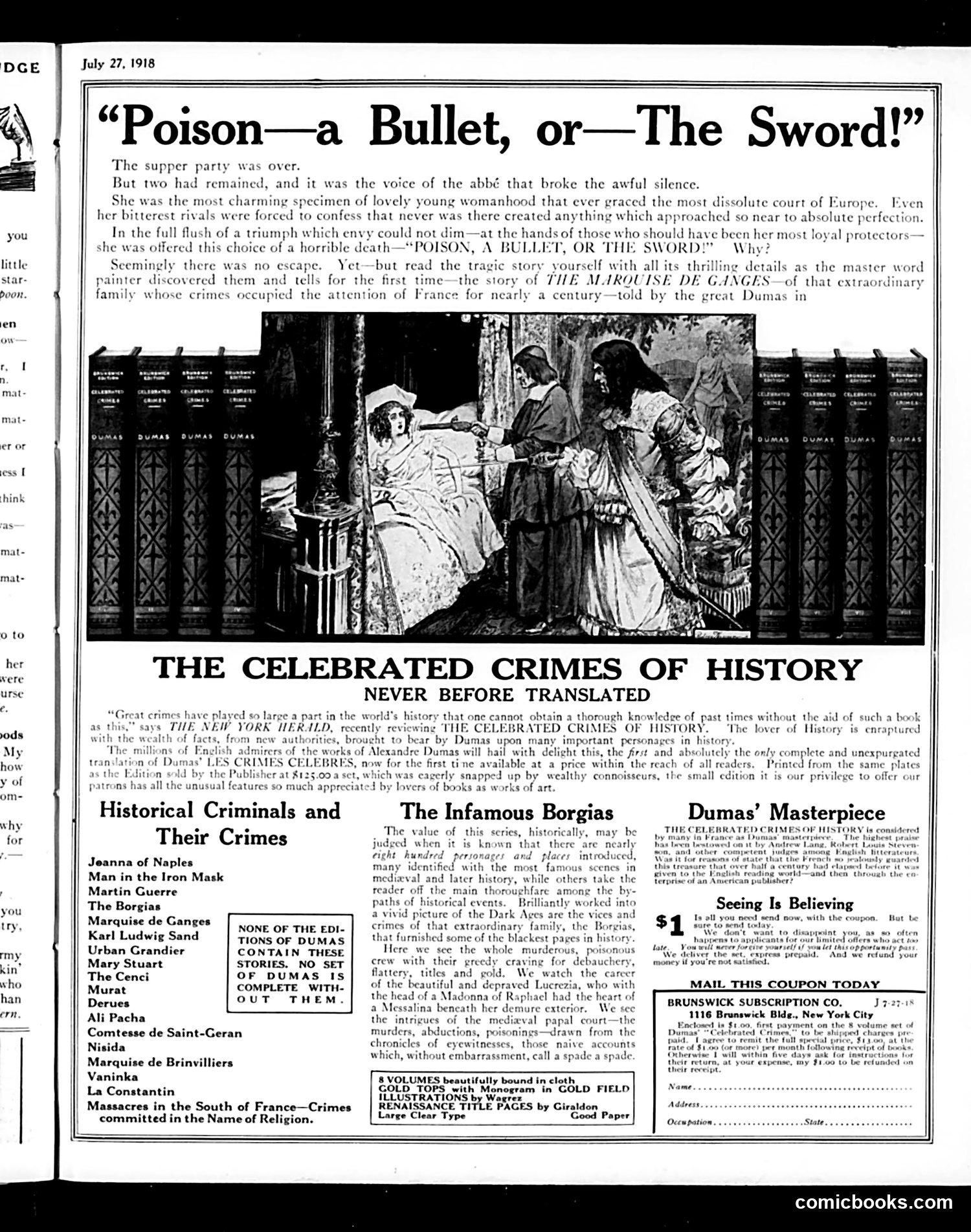
This page is primarily **advertising disguised as editorial content**, promoting Alexandre Dumas's *Les Crimes Célèbres* (The Celebrated Crimes of History). The header narrative describes a dramatic scene—a young noblewoman offered a horrific choice of death—which sets up the publication's appeal: sensational historical crime stories. The illustration depicts what appears to be a period scene with figures in 18th-century dress in a palace interior. The bulk of the page lists famous historical criminals and crimes (the Borgias, the Man in the Iron mask, etc.) to showcase the book's scope. Marketing language emphasizes this is the "first time" an "unexpurgated" translation is available at affordable prices, appealing to readers seeking "unusual features" and artistic merit. The coupon at bottom allows mail orders. This represents typical **early-20th-century magazine advertising**—blending aspirational cultural content with commercial sales pitch, targeting literate, educated readers interested in history and true crime.
This page is primarily **advertising, not satire**. It promotes Alois P. Swoboda's "Conscious Evolution" self-help system and two accompanying books. The content satirizes the **pseudoscientific self-improvement racket** of the early 20th century. The repetitive promise of "Energy Stressing" to intensify every human faculty—thinking, earning, scheming, health—parodies the grandiose claims typical of such programs. The phrase "Why Live the Feeble Life?" mocks the guilt-based marketing pitch common to dubious wellness schemes. Swoboda's advertisement claims his system has attracted prominent clients (Hughes, Wilson, Rockefeller, Vanderbilts), a typical strategy to lend false credibility. The page's breathless enumeration of benefits—more money, more energy, more joy—represents the exaggerated promises endemic to contemporary pseudoscience marketing. The satirical intent appears implicit rather than explicit—Judge is documenting and implicitly ridiculing contemporary hucksterism through the advertiser's own overwrought language.