
Judge, 1918-07-27 · page 23 of 36
Judge — July 27, 1918 — page 23: what you’re looking at
What you’re looking at
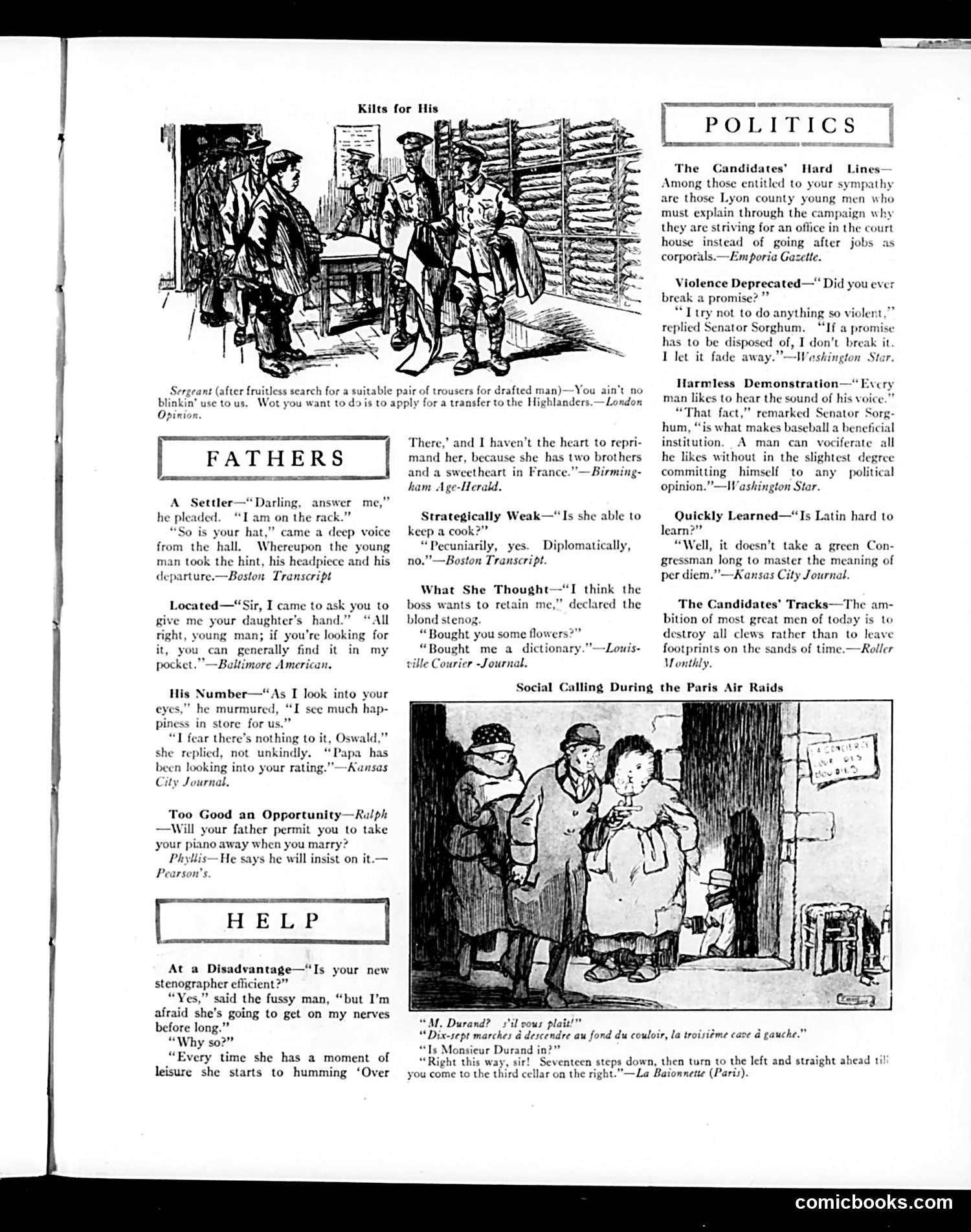
This page from Judge magazine contains **WWI-era political and domestic humor** rather than a single cartoon. Key elements: **"Politics" Section**: Satirizes political candidates and Senator Sorghum (a recurring Judge character), mocking politicians who: - Avoid military service while urging others to enlist - Break promises without admitting it ("let it fade away") - Use empty rhetoric (baseball analogy for harmless speech) - Master loopholes like "per diem" pay rather than principle **"Kilts for His"**: A WWI joke about a drafted soldier unsuitable for service, humorously told to apply to the Highlanders (Scottish regiment wearing kilts rather than trousers). **"Fathers" & "Help" Sections**: Domestic humor about courtship, stenographers, and marriage—lighter fare contrasting the political commentary. **Bottom Cartoon**: "Social Calling During the Paris Air Raids"—depicts Parisians navigating underground shelters during German bombing raids, treating it as mundane social navigation. The overall tone reflects American WWI attitudes: mocking draft-dodging politicians while normalizing civilian wartime disruption.
📄 Transcribed text from this page (OCR, searchable)
Machine-transcribed from the original scan — historical spelling and the odd misread are preserved.
Kilts for His Sergeant (after fruitless search for a suitable pair of trousers for drafted man)—You ain't no blinkin’ use to us. Wot you want to dois to apply for a transfer to the Highlanders. —London Opinion. [FaTHeRs | A’ Settler—“ Darling, answer me,” “Tam on the rack.” ‘our hat,” came a deep voice from the hall. Whereupon the young man took the hint, his headpiece and his departure.—Boston Transcript Located—Sir, I came to ask you to give me your daughter’s hand.” “All right, young man; if you're looking for it, you can generally find it in my pocket.” —Baltimore American. His Number—“As I look into your eyes,” he murmured, “I see much hap- piness in store for us.” “TI fear there’s nothing to it, Oswald,” she replied, not unkindly. “Papa has been looking into your rating.” —Aansas City Journal. Too Good an Opportunity—Rulph —Will your father permit you to take your piano away when you marry? Phyllis—He says he will insist on it.— Pearson's. HELP At a Disadvantage—“Is your new stenographer efficient?” “Yes,” said the fussy man, “but I’m afraid she’s going to get on my nerves before long.’”” “Why so?” “Every time she has a moment of leisure she starts to humming ‘Over There,’ and I haven't the heart to repri- mand her, because she has two brothers and a sweetheart in France.”—Birming- ham Age-Herald. Strategically Weak—“Is she able to keep a cook?” “Pecuniarily, yes. Diplomatically, no.” —Boston Transcript. What She Thought—“TI think the boss wants to retain me,” declared the blond stenog. “Bought you some flowers?” “Bought me a dictionary.” —Louis- ville Courier -Journal. “M, Durand? s'il vous plait!” POLITICS The Candidates’ Hard Lines Among those entitled to your sympathy are those Lyon county young men who must explain through the campaign why they are striving for an office in the court house instead of going after jobs as corporals.—Em poria Gazette. Violence Deprecated—" Did you ever break a promise?” try not to do anything so violent,”’ replied Senator Sorghum. “If a promise has to be disposed of, I don't break it. I let it fade away.”—Weshington Star. Harmless Demonstration—“ Every man likes to hear the sound of his voice.” “That fact,” remarked Senator Sorg- hum, “is what makes baseball a beneficial institution. A man can vociferate all he likes without in the slightest degree committing himself to any political opinion.” —Iashington Star. Quickly Learned—“Is Latin hard to learn?” “Well, it doesn’t take a green Con- gressman long to master the meaning of per diem.”’—Kansas City Journal. The Candidates’ Tracks—The am- bition of most great men of today is to destroy all clews rather than to leave footprints on the sands of tim ‘oller Monthly, “ Dix-sept marches é descendre au fond du couloir, la troisiéme cave d gauche.” “Is Monsieur Durand in?” “Right this way, sir! Seventeen steps down, then turn to the left and straight ahead til you come to the third cellar on the right."—La Baionnette (Paris). comicbooks.com