
Judge, 1918-07-27 · page 5 of 36
Judge — July 27, 1918 — page 5: what you’re looking at
What you’re looking at
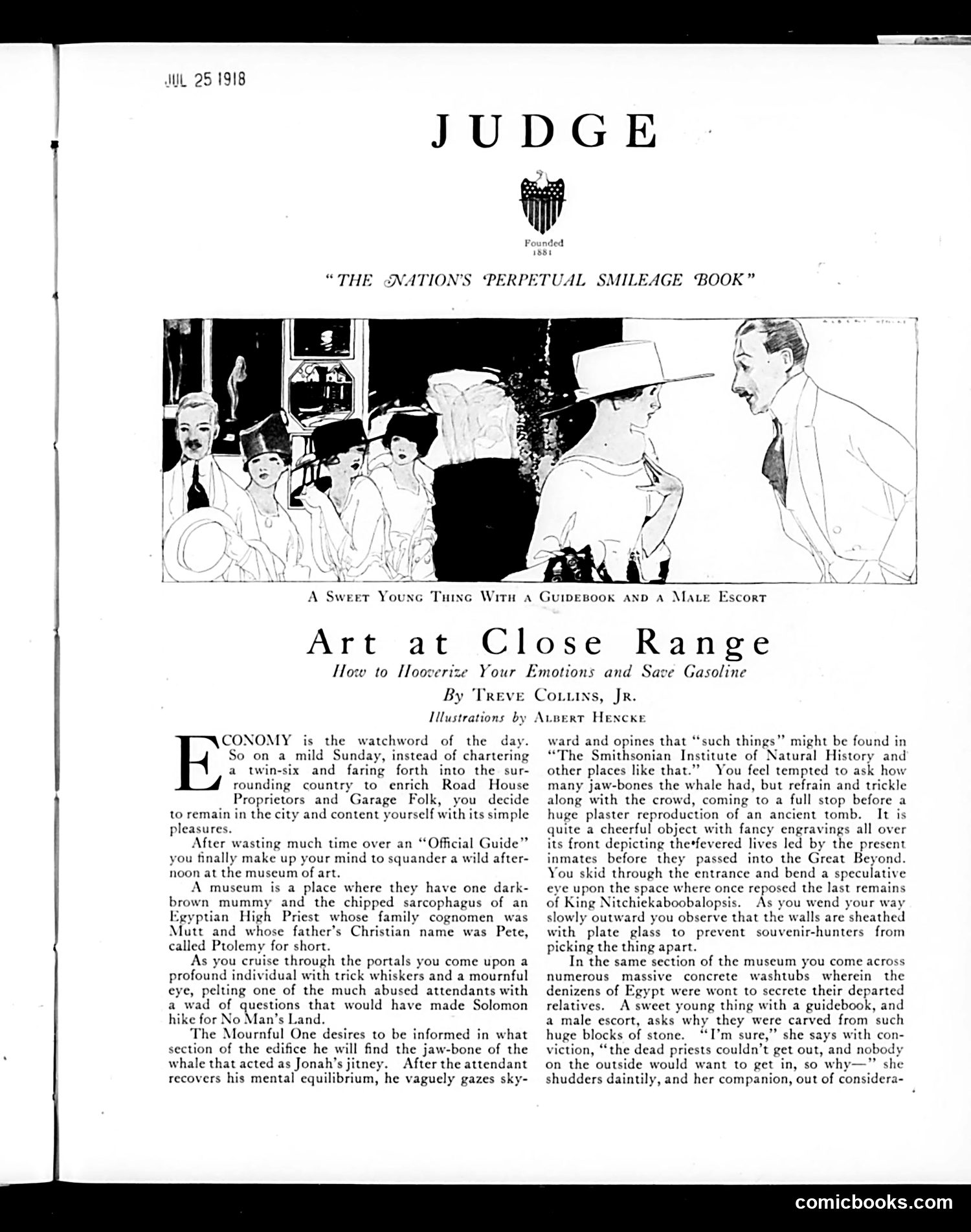
This page contains a humorous article titled "Art at Close Range: How to Hooverize Your Emotions and Save Gasoline" by Treve Collins Jr., illustrated by Albert Hencke. The cartoon depicts a young woman with a guidebook and male escort visiting a museum, specifically examining Egyptian mummies and artifacts. The satire mocks the practice of "Hooverizing"—wartime rationing and economizing named after Herbert Hoover—by suggesting one could entertain oneself cheaply by visiting museums instead of engaging in expensive leisure activities like auto touring. The illustration shows the awkwardness and stuffiness of such museum visits: the young woman appears uncomfortable examining corpses and carved stones, while her male escort maintains proper decorum. The joke targets both wartime austerity culture and the pretentious nature of cultural tourism during economically constrained times.
📄 Transcribed text from this page (OCR, searchable)
Machine-transcribed from the original scan — historical spelling and the odd misread are preserved.
—EE 25 1918 “THE NATION'S ‘PERPETUAL SMILEAGE BOOK” Art at Close Range How to Hooverize Your Emotions and Save Gasoline By Treve Couns, JR. Illustrations by Apert Hencxe CONOMY is the watchword of the day. So on a mild Sunday, instead of chartering a twin-six and faring forth into the sur- rounding country to enrich Road House Proprietors and Garage Folk, you decide to remain in the city and content yourself with its simple pleasures. After wasting much time over an “Official Guide” you finally make up your mind to squander a wild after- noon at the museum of art. A museum is a place where they have one dark- brown mummy and the chipped sarcophagus of an Egyptian High Priest whose family cognomen was Mutt and whose father’s Christian name was Pete, called Ptolemy for short. As you cruise through the portals you come upon a profound individual with trick whiskers and a mournful eye, pelting one of the much abused attendants with a wad of questions that would have made Solomon ike for No Man’s Land. The Mournful One desires to be informed in what section of the edifice he will find the jaw-bone of the whale that acted as Jonah’s jitney. After the attendant recovers his mental equilibrium, he vaguely gazes sky- such things” might be found in “The Smithsonian Institute of Natural History and other places like that You feel tempted to ask how many jaw-bones the whale had, but refrain and trickle along with the crowd, coming to a full stop before a huge plaster reproduction of an ancient tomb. It is quite a cheerful object with fancy engravings all over its front depicting the*fevered lives led by the present inmates before they passed into the Great Beyond. You skid through the entrance and bend a speculative eye upon the space where once reposed the last remains of King Nitchiekaboobalopsis. As you wend your way slowly outward you observe that the walls are sheathed with plate glass to prevent souvenir-hunters from picking the thing apart. In the same section of the museum you come across numerous massive concrete washtubs wherein the denizens of Egypt were wont to secrete their departed relatives. sweet young thing with a guidebook, and a male escort, asks why they were carved from such huge blocks of stone. “I’m sure,” she says with con- viction, “the dead priests couldn’t get out, and nobody on the outside would want to get in, so why—” she shudders daintily, and her companion, out of conside ward and opines that comicbooks.com