
Judge, 1918-07-27 · page 17 of 36
Judge — July 27, 1918 — page 17: what you’re looking at
What you’re looking at
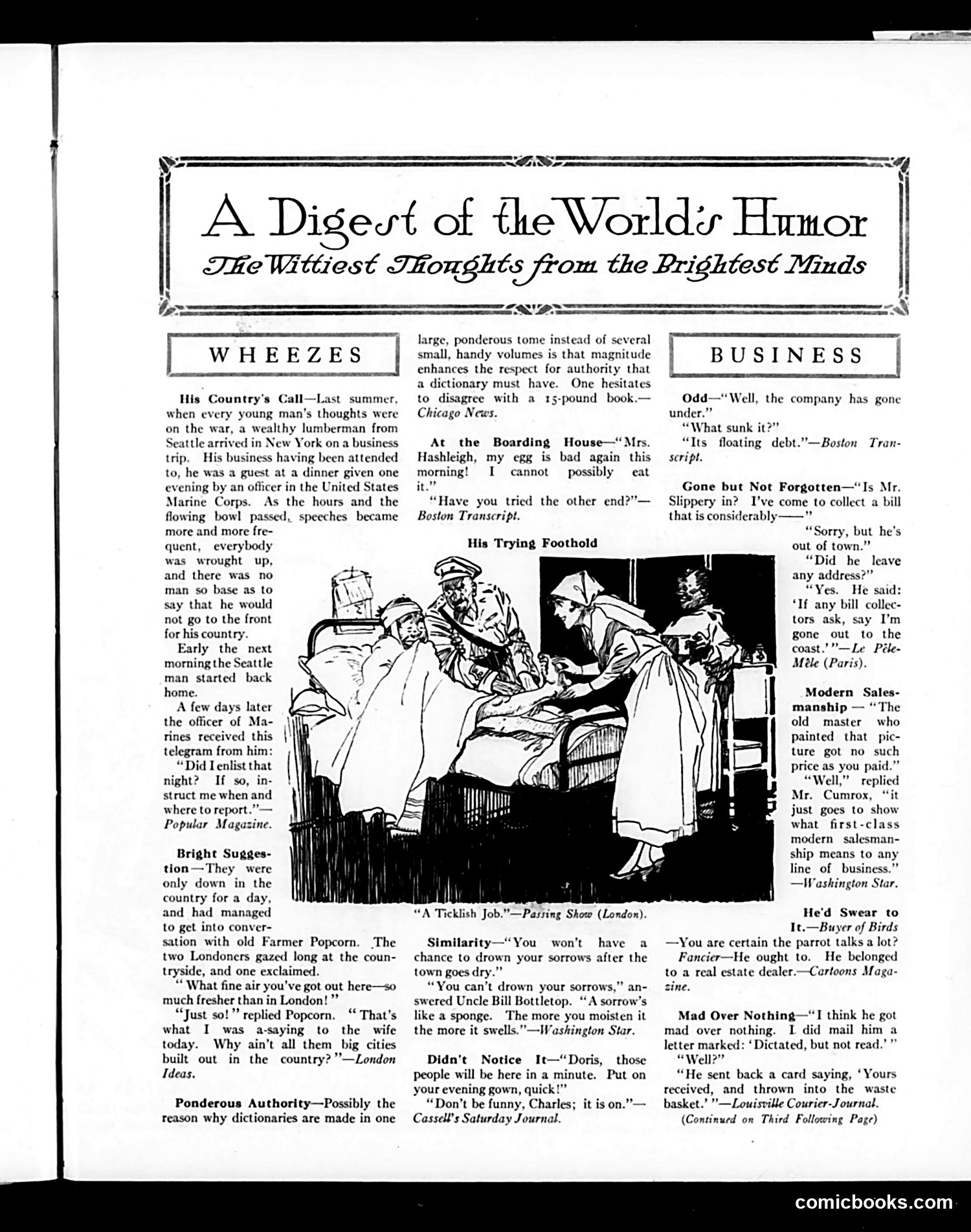
This page collects humorous anecdotes and jokes organized by category (Wheezes, Business). The main cartoon, "A Ticklish Job," depicts a nurse or caregiver attending to a bedridden patient—likely satirizing the delicate, uncomfortable nature of certain medical or domestic care situations. The jokes mostly target early-20th-century social anxieties: wartime patriotism (a wealthy businessman caught up in patriotic fervor but sobering up), Prohibition (references to "town goes dry"), and business incompetence (debtors fleeing, con artists pricing inflated art). One anecdote mocks rural simplicity—a farmer's confused suggestion that cities relocate to the countryside for fresh air. The humor relies on wordplay and irony typical of the era: a parrot learned to talk from a real estate dealer (implying dishonest chatter), and someone sarcastically marked a letter "dictated, but not read" to mock modern business affectation. The page reflects period concerns about modernization, commerce, and social change.
📄 Transcribed text from this page (OCR, searchable)
Machine-transcribed from the original scan — historical spelling and the odd misread are preserved.
\ or | A Digeut of the Worldir Humor “4 The Wittiest Thoughts from the Prightest Minds 7s box | WHEEZES | His Country's Call—Last summer, when every young man’s thoughts were on the war, a wealthy lumberman from Seattle arrived in New York on a business trip. His business having been attended to, he was a guest at a dinner given one evening by an officer in the United States Marine Corps. As the hours and the flowing bowl passed, speeches became more and more fre- quent, everybody was wrought up, and there was no man so base as to say that he would not go to the front for his country. Early the next morning the Seattle man started back home. A few days later the officer of Ma- : rines received this |'}} telegram from him: “Did Tenlist that night? If so, in- struct me when and where to report.”-— Popular Magazine. Bright Sugges- tion—They were only down in the country for a day, and had managed to get into conver- sation with old Farmer Popcorn. The two Londoners gazed long at the coun- tryside, and one exclaimed. “What fine air you've got out here—so much fresher than in London! ” “Just so!” replied Popcorn. ‘‘ That's what I was a-saying to the fe today. Why ain’t all them big cities built out in the country? ’—London Ideas. Ponderous Authority—Possibly the reason why dictionaries are made in one NY ma large, ponderous tome instead of several small, handy volumes is that magnitude enhances the respect for authority that a dictionary must have. One hesitates to disagree with a 15-pound book.— Chicago News. At the Boarding House—‘ Mrs. Hashleigh, my egg is bad again this morning! I cannot possibly eat it2 “Have you tried the other end?”— Boston Transcript. His Trying Foothold | {ti “A Ticklish Job.”—Passing Show (London). Similarity—“ You won't have a chance to drown your sorrows after the town goes dry.” “You can’t drown your sorrows,” an- swered Uncle Bill Bottletop. “A sorrow’s like a sponge. The more you moisten it the more it swells.” —Washington Star. Didn't Notice It—Doris, those people will be here in a minute. Put on your evening gown, quick!” “Don’t be funny, Charles; it is on.”— Casselt’s Saturday Journal. | BUSINESS Odd—"Well, the company has gone under.” “What sunk it?” “Its floating debt.”—Boston script. Tran- Gone but Not Forgotten—“Is Mr. Slippery in? I’ve come to collect a bill that is considerably —” “Sorry, but he’s out of town.” “Did he leave any address?” “Yes. He said: ‘If any bill collec- tors ask, say I’m gone out to the coast.’""—Le Péle- Mile (Paris). Modern Sales- manship — “The old master who painted that pic- ture got no such price as you paid.” “Well,” replied Mr. Cumrox, “it just goes to show what first-class modern salesman- ship means to any line of business.” —Washington Star. He'd Swear to It.—Buyer of Birds —You are certain the parrot talks a lot? Fancier—He ought to. He belonged to a real estate dealer.—Cartoons Maga- sine. Mad Over Nothing—“I think he got mad over nothing. I did mail him a letter marked: ‘Dictated, but not read.’ ” “Well?” “He sent back a card saying, ‘Yours received, and thrown into the waste basket.’ "—Louisville Courier-Journal. (Continued on Third Following Page) comicbooks.com