
Judge, 1918-07-27 · page 24 of 36
Judge — July 27, 1918 — page 24: what you’re looking at
What you’re looking at
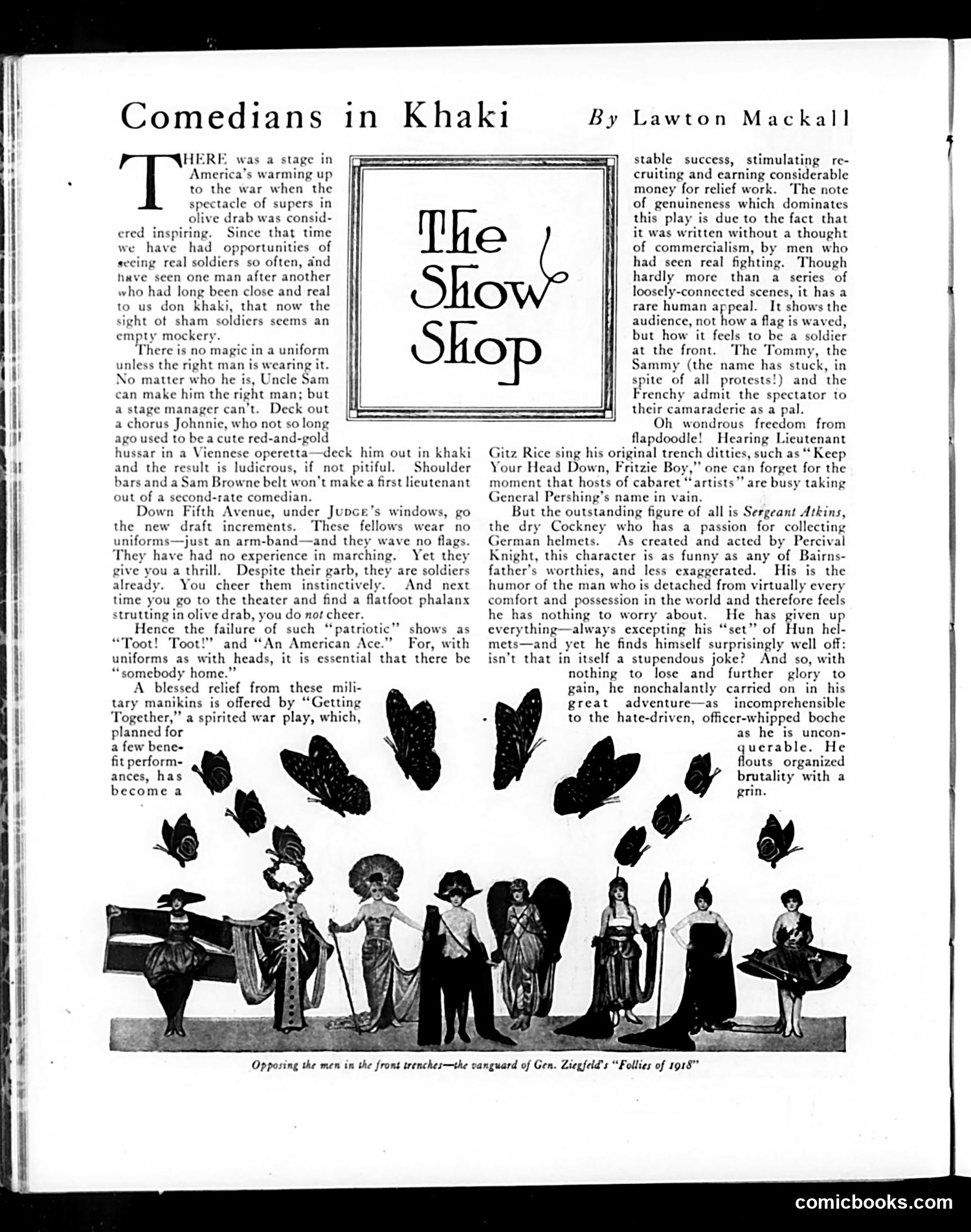
This 1918 *Judge* magazine article by Lawton Mackall critiques frivolous Broadway war-themed theatrical productions. The author distinguishes between genuine soldiers (real men drafted or enlisting) and actors in uniforms performing patriotic shows like "Toot! Toot!" and "An American Ace." Mackall argues these theatrical productions are hollow mockery—uniforms cannot make mediocre performers into credible soldiers. He praises "Getting Together," a genuine war play written by men who'd actually seen combat (including performer Gitz Rice), and especially praises Sergeant Atkins, a character based on real soldier experiences. The caption's reference to General Ziegfeld's "Follies of 1918" sarcastically equates Broadway's elaborate patriotic spectacles with the actual enemy facing soldiers in trenches. The satire targets: theatrical exploitation of wartime patriotism, casting unqualified entertainers as soldiers, and prioritizing commercial spectacle over authenticity.
📄 Transcribed text from this page (OCR, searchable)
Machine-transcribed from the original scan — historical spelling and the odd misread are preserved.
Comedians in Khaki Lawton Mackall HERE was a stage in stable success, stimulating re- America’s warming up to the war when the spectacle of supers in olive drab was cons ered inspiring. Since that time we have had opportunities of secing real soldiers so often, and have seen one man after another who had long been close and real to us don khaki, that now the sight ot sham soldiers seems an empty mockery. ‘There is no magic in a uniform unless the right man is wearing it. No matter who he is, Uncle Sam can make him the right man; but d- cruiting and earning considerable money for relief work. The note of genuineness which dominates this play is due to the fact that it was written without a thought of commercialism, by men who had seen real fighting. Though hardly more than a series of loosely-connected scenes, it has a rare human appeal. It shows the audience, not how a flag is waved, but how it feels to be a soldier at the front. The Tommy, the Sammy (the name has stuck, in spite of all protests!) and the Frenchy admit the spectator to a stage manager can’t. Deck out their camaraderie as a pal. a chorus Johnnie, who not so long ago used to be acute red-and-gold hussar in a Viennese operetta—deck him out in khaki and the result is ludicrous, if not pitiful. houlder bars and a Sam Browne belt won't make a first lieutenant out of a second-rate comedian. Down Fifth Avenue, under Jupce’s windows, go the new draft increments. These fellows wear no uniforms—just an arm-band—and they wave no flags. They have had no experience in marching. Yet they give you a thrill. Despite their garb, they are soldiers already. You cheer them instinctively. And next time you go to the theater and find a flatfoot phalanx strutting in olive drab, you do not cheer. Hence the failure of such “patriotic” shows as “Toot! Toot!’ and “An American Ace.” For, with uniforms as with heads, it is essential that there be “somebody home.” A blessed relief from these mili- tary manikins is offered by “Getting Together,” a spirited war play, which, planned for a few bene- fit perform- ances, has become a y Oh wondrous freedom from flapdoodle! Hearing Lieutenant Gitz Rice sing his original trench ditties, such as “ Keep Your Head Down, Fritzie Boy,” one can forget for the moment that hosts of cabaret “artists” are busy taking General Pershing’s name in vain. But the outstanding figure of all is Sergeant Atkins, the dry Cockney who has a passion for collecting German helmets. As created and acted by Percival Knight, this character is as funny as any of Bairns- father’s worthies, and less exaggerated. His is the humor of the man who is detached from virtually every comfort and possession in the world and therefore feels he has nothing to worry about. He has given up everything—always excepting his “set”? of Hun hel- mets—and yet he finds himself surprisingly well o: isn’t that in itself a stupendous joke? And so, with nothing to lose and further glory to gain, he nonchalantly carried on in his great adventure—as incomprehensible to the hate-driven, officer-whipped boche as he is uncon- querable. He doute organized brutality with a grin. Opposing the men in the front trenches—the vanguard of Gen. Ziegfeld’s “Follies of 1918” comicbooks.com Pc