
Judge, 1918-07-27 · page 16 of 36
Judge — July 27, 1918 — page 16: what you’re looking at
What you’re looking at
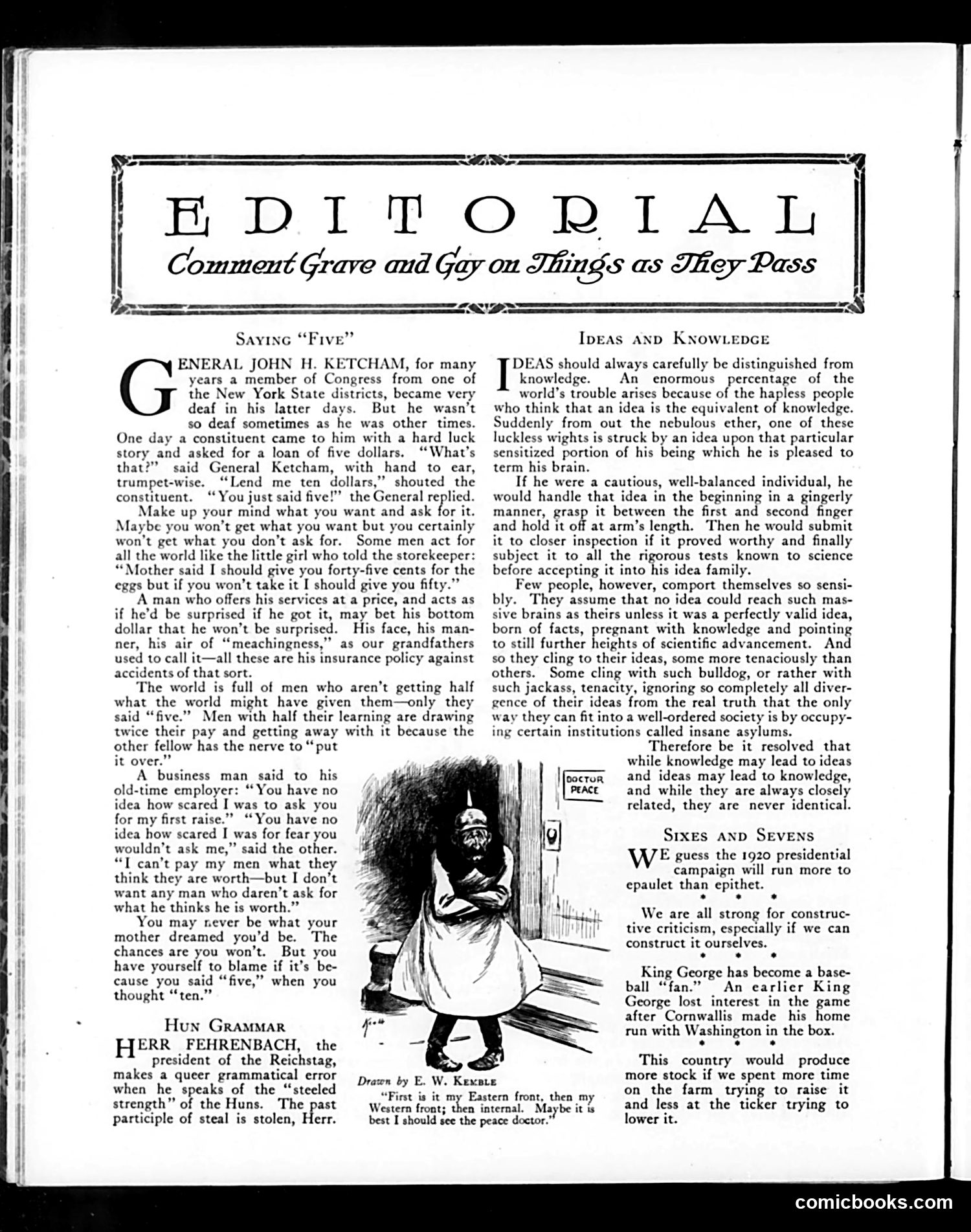
This page contains three satirical pieces from Judge magazine: **"Saying 'Five'"** mocks General John H. Ketcham, a deaf congressman who selectively heard what he wanted. The anecdote illustrates that people who lack confidence in their own worth—who "ask for five when they mean ten"—sabotage themselves. The editorial advises assertiveness in negotiation and self-advocacy. **"Hun Grammar"** ridicules Herr Fehrenbach, president of Germany's Reichstag, for grammatically misusing "steeled strength" (the past participle of "steal" is "stolen"). The accompanying cartoon shows a German military figure confused about his internal versus external "fronts," sarcastically suggesting he needs a "peace doctor." This post-WWI mockery portrays Germans as both grammatically and strategically incompetent. **"Ideas and Knowledge"** criticizes people who confuse having an idea with possessing actual knowledge, claiming this causes world problems. It warns against clinging dogmatically to unexamined notions.
📄 Transcribed text from this page (OCR, searchable)
Machine-transcribed from the original scan — historical spelling and the odd misread are preserved.
pe A 'RDITOPRIAL| Comment Grave aud Gay ou Things as They Pass ——— LO2= Sayinc “Five” VERAL JOHN H. KETCHAM, for many years a member of Congress from one of the New York State districts, became very deaf in his latter days. But he wasn’t so deaf sometimes as he was other times. One day a constituent came to him with a hard luck story and asked for a loan of five dollars. ‘What's that?” said General Ketcham, with hand to ear, trumpet-wise. “Lend me ten dollars,” shouted the constituent. ‘You just said five!” the General replied. Make up your mind what you want and ask for it. Maybe you won’t get what you want but you certainly won't get what you don’t ask for. Some men act for all the world like the little girl who told the storekeeper: “Mother said I should give you forty-five cents for the eggs but if you won’t take it I should give you fifty.” A man who offers his services at a price, and acts as if he’d be surprised if he got it, may bet his bottom dollar that he won't be surprised. His face, his man- ner, his air of “‘meachingness,” as our grandfathers used to call it—all these are his insurance policy against accidents of that sort. The world is full of men who aren’t getting half what the world might have given them—only they said “five.” Men with half their learning are drawing twice their pay and getting away with it because the other fellow has the nerve to “put it over.” A business man said to his old-time employer: “You have no idea how scared I was to ask you for my first raise.” “You have no idea how scared I was for fear you wouldn’t ask me,” said the other. “T can’t pay my men what they think they are worth—but I don’t want any man who daren’t ask for what he thinks he is worth.” You may never be what your mother dreamed you’d be. The chances are you won’t. But you have yourself to blame if it’s be- cause you said “five,” when you thought “ten.” Hun Grammar HERR FEHRENBACH, the president of the Reichstag, makes a queer grammatical error when he speaks of the “steeled strength” of the Huns. The past ngt Nt Western front; participle of steal is stolen, Herr. Drawn by E. W. Kexere “First is it my Eastern front, then my en internal. Maybe it is best I should see the peace doctor.” IpEAs AND KNOWLEDGE DEAS should always carefully be distinguished from knowledge. An enormous percentage of the world’s trouble arises because of the hapless people who think that an idea is the equivalent of knowledge. Suddenly from out the nebulous ether, one of these luckless wights is struck by an idea upon that particular sensitized portion of his being which he is pleased to term his brain. If he were a cautious, well-balanced individual, he would handle that idea in the beginning in a gingerly manner, grasp it between the first and second finger and hold it of at arm’s length. Then he would submit it to closer inspection if it proved worthy and finally subject it to all the rigorous tests known to science before accepting it into his idea family. Few people, however, comport themselves so sensi- bly. They assume that no idea could reach such mas- sive brains as theirs unless it was a perfectly valid idea, born of facts, pregnant with knowledge and pointing to still further eights of scientific advancement. And so they cling to their ideas, some more tenaciously than others. Some cling with such bulldog, or rather with such jackass, tenacity, ignoring so completely all diver- gence of their ideas from the real truth that the only way they can fit into a well-ordered society is by occupy- ing certain institutions called insane asylums. Therefore be it resolved that while knowledge may lead to ideas and ideas may lead to knowledge, and while they are always closely related, they are never identical. Stxes anD SEVENS WE guess the 1920 presidential campaign will run more to epaulet than epithet. sate tune We are all strong for construc- tive criticism, especially if we can construct it ourselves. oper is King George has become a base- ball “fan.” An earlier King George lost interest in the game after Cornwallis made his home run with Washington in the box. ona ere This country would produce more stock if we spent more time on the farm trying to raise it and less at the ticker trying to lower it. comicbooks.com