
A complete issue · 32 pages · 1918
Judge — March 23, 1918
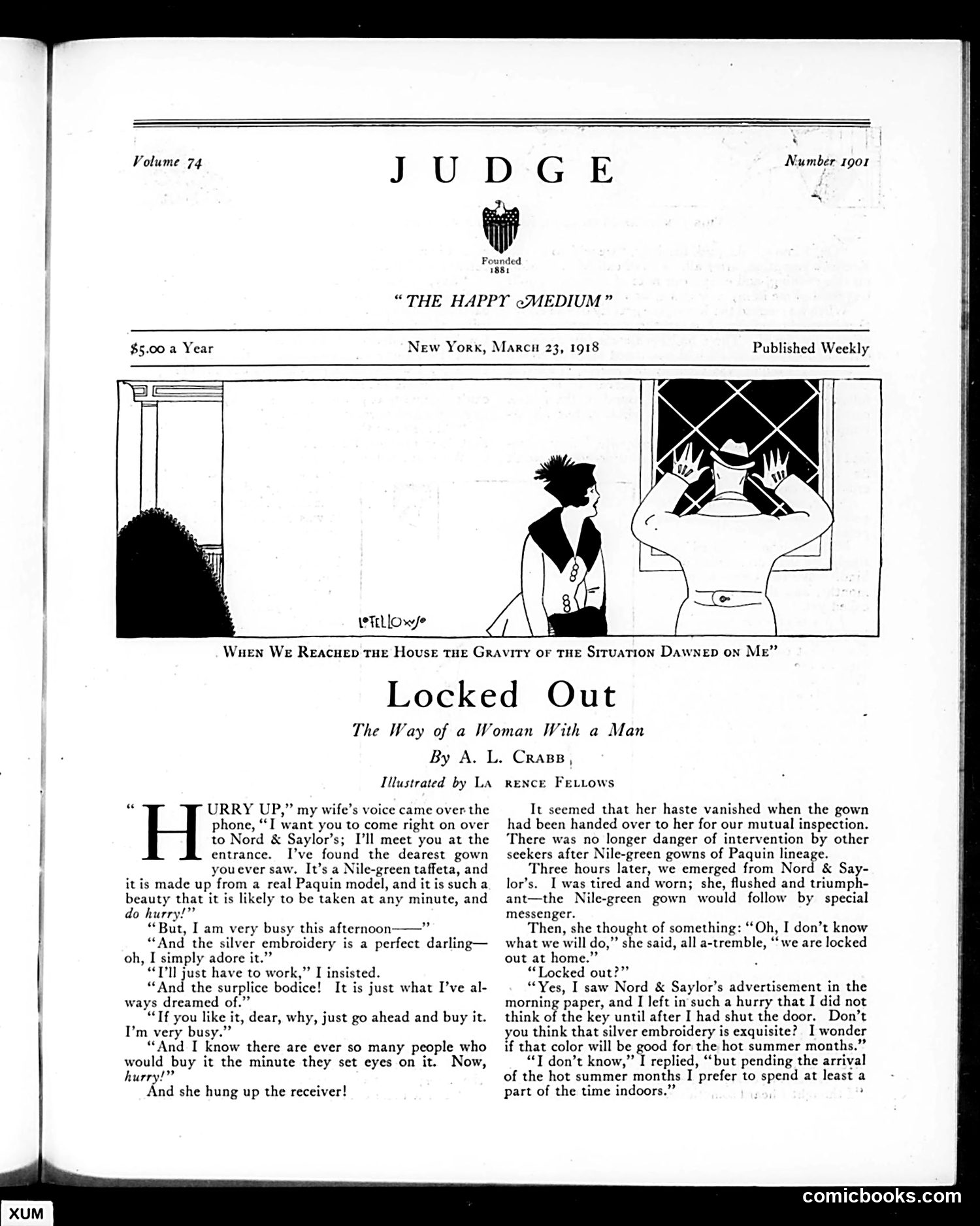
This page contains a short story titled "Locked Out: The Way of a Woman With a Man" by A.L. Crabb, illustrated by Laurence Fellows. The narrative satirizes marital dynamics of the era. A husband pressures his wife to purchase an expensive Nile-green taffeta dress from Nord & Saylor's department store. After she buys it, he becomes unavailable, forcing her to leave it at the store for alteration. When she returns home, she discovers she's locked out—the husband has forgotten his key. The satire targets both spouses: the husband's impulsive materialism and subsequent irresponsibility, and the wife's frustration at being trapped outside. The cartoon above illustrates this domestic predicament, depicting the locked-out scenario. The humor reflects 1918 middle-class anxieties about consumerism and marital expectations.
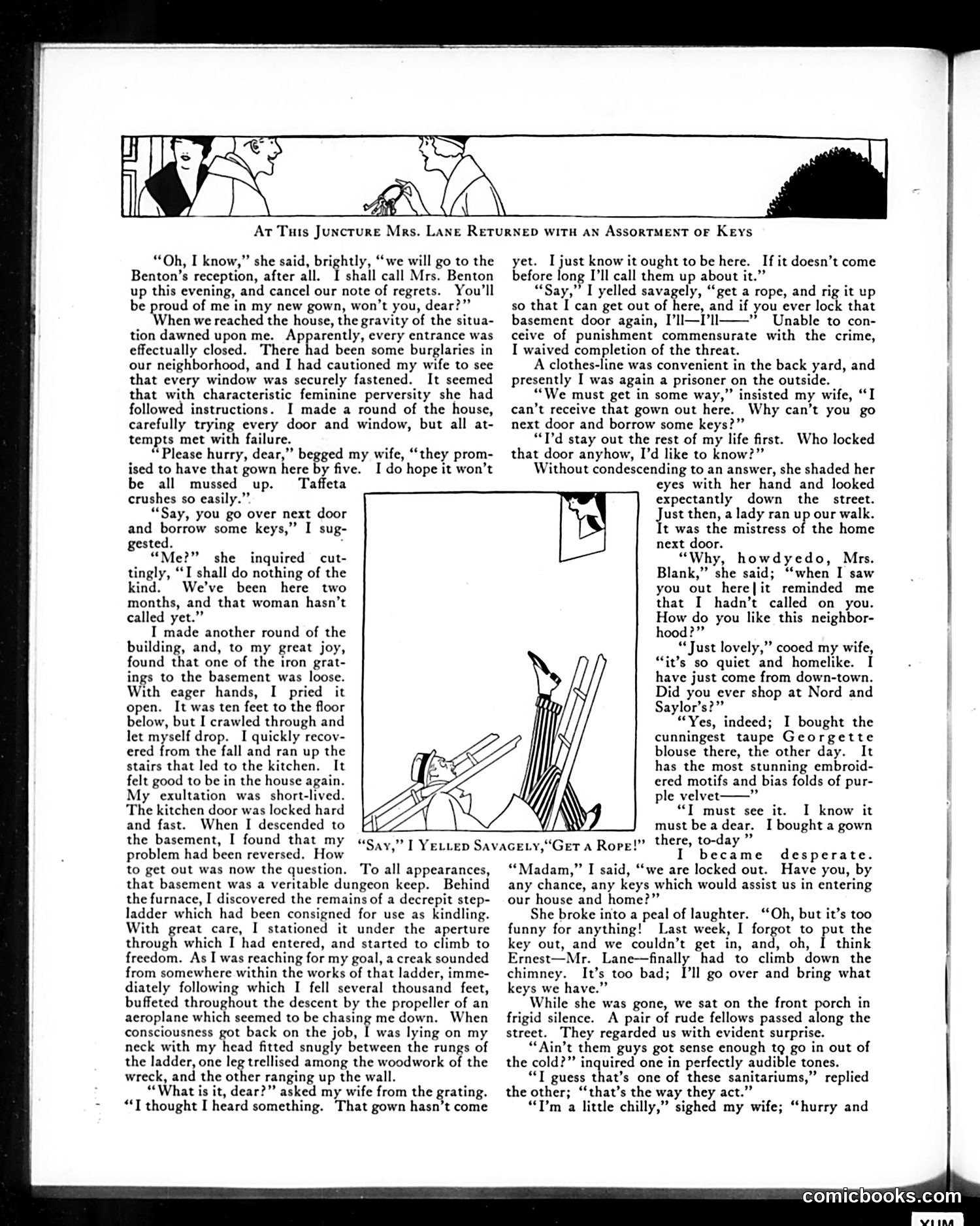
This page contains a humorous short story titled "At This Juncture Mrs. Lane Returned with an Assortment of Keys," illustrated with three small cartoon panels showing domestic scenes. The narrative depicts a husband and wife locked out of their basement, frantically trying different keys to regain entry. The comedy derives from the wife's escalating frustration and the husband's increasingly desperate attempts, including discovering a loose iron grating and attempting to climb through it—resulting in a fall. The satire targets domestic incompetence and marital friction over household management. The wife's persistence ("I shall call them up about it"), the husband's reluctant compliance, and their encounters with neighbors form the humorous backbone. This reflects early 20th-century anxieties about middle-class home ownership and the complications of urban apartment living, common themes in Judge magazine's social commentary.
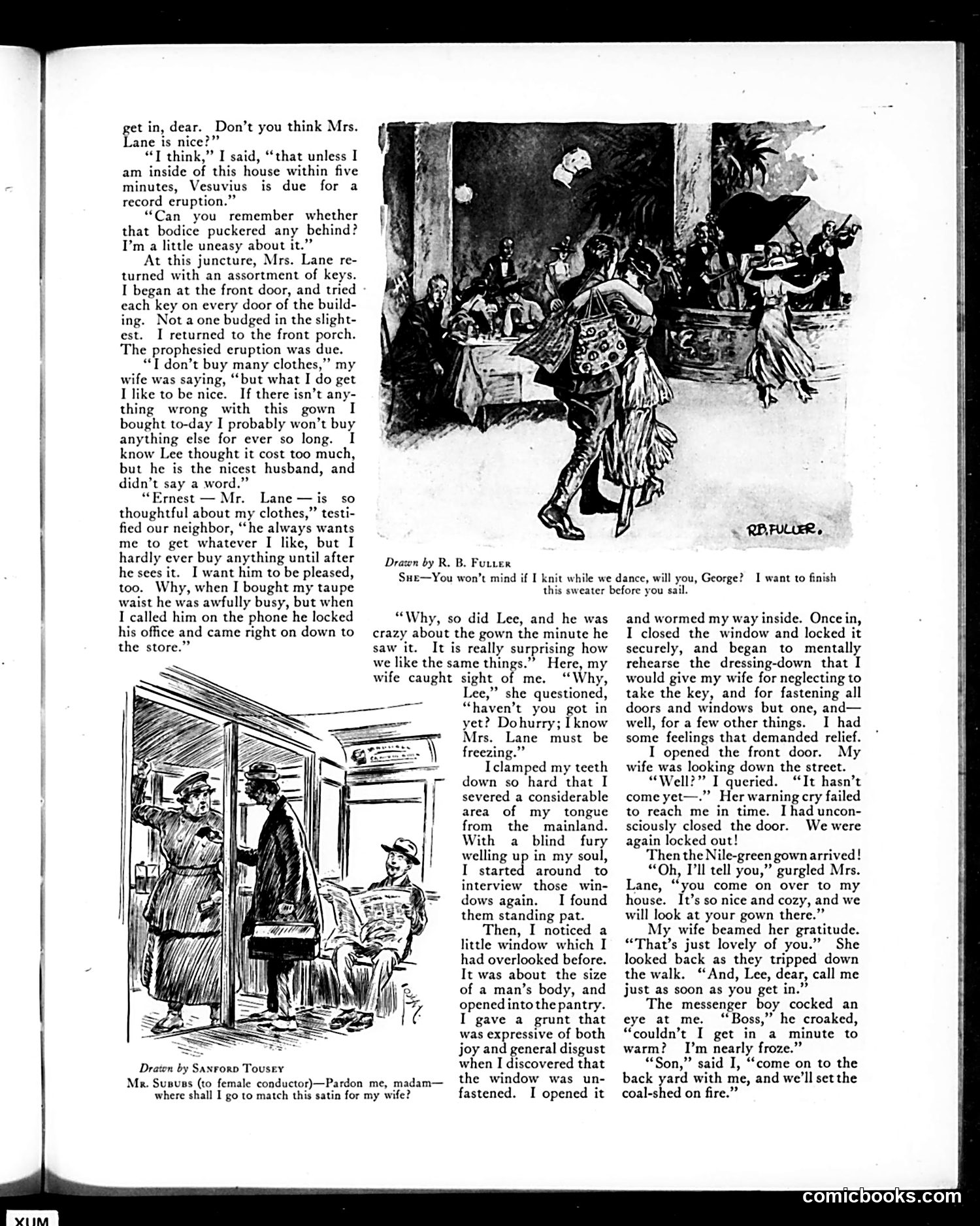
This page contains two separate illustrated stories rather than political cartoons. The top illustration by R.B. Fuller depicts a domestic scene where a husband interrupts his wife's knitting to ask if she'll finish a sweater before he sails. The accompanying text humorously explores marital negotiation—the wife wants to buy an expensive gown, leveraging her willingness to complete the sweater as bargaining power. The lower illustration by Sanford Tousey shows a conductor addressing a female passenger about matching satin for her wife's dress, illustrating a comedic misunderstanding or awkward social interaction. Both are lighthearted domestic humor pieces typical of early-20th-century Judge magazine, focusing on marriage dynamics and gender relations rather than political satire. The jokes rely on everyday domestic scenarios rather than contemporary events.
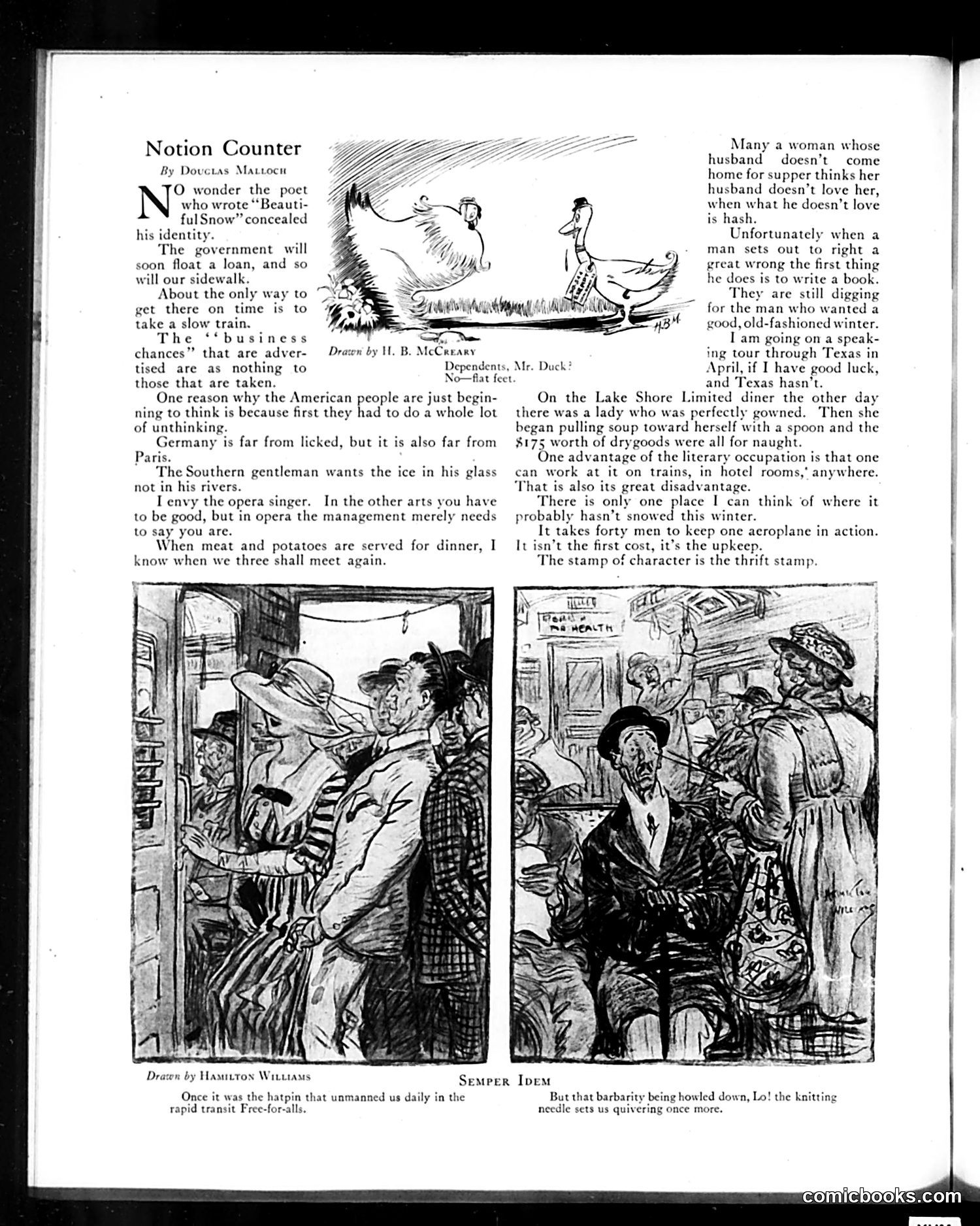
This page contains three distinct satirical pieces: 1. **"Notion Counter"** by Douglas Malloch: A humorous essay critiquing various national characteristics—Germans, Southerners, opera singers, and Americans generally. It's observational social satire rather than political. 2. **Top cartoon** (by H.B. McCrackan): Titled "Dependents, Mr. Duck? No—flat feet," depicting a duck with ducklings. The joke plays on "dependents" as tax/financial obligations versus the duck's flat feet (a WWI military exemption reason), suggesting the duck avoids responsibilities. 3. **Bottom cartoons** (by Hamilton Williams): "Semper Idem" shows transit scenes satirizing urban rudeness and public behavior—the batpin reference and knitting needle suggest women defending themselves in crowded transit, reflecting period concerns about civility and safety. The page reflects early 20th-century American anxieties about urbanization and social manners.
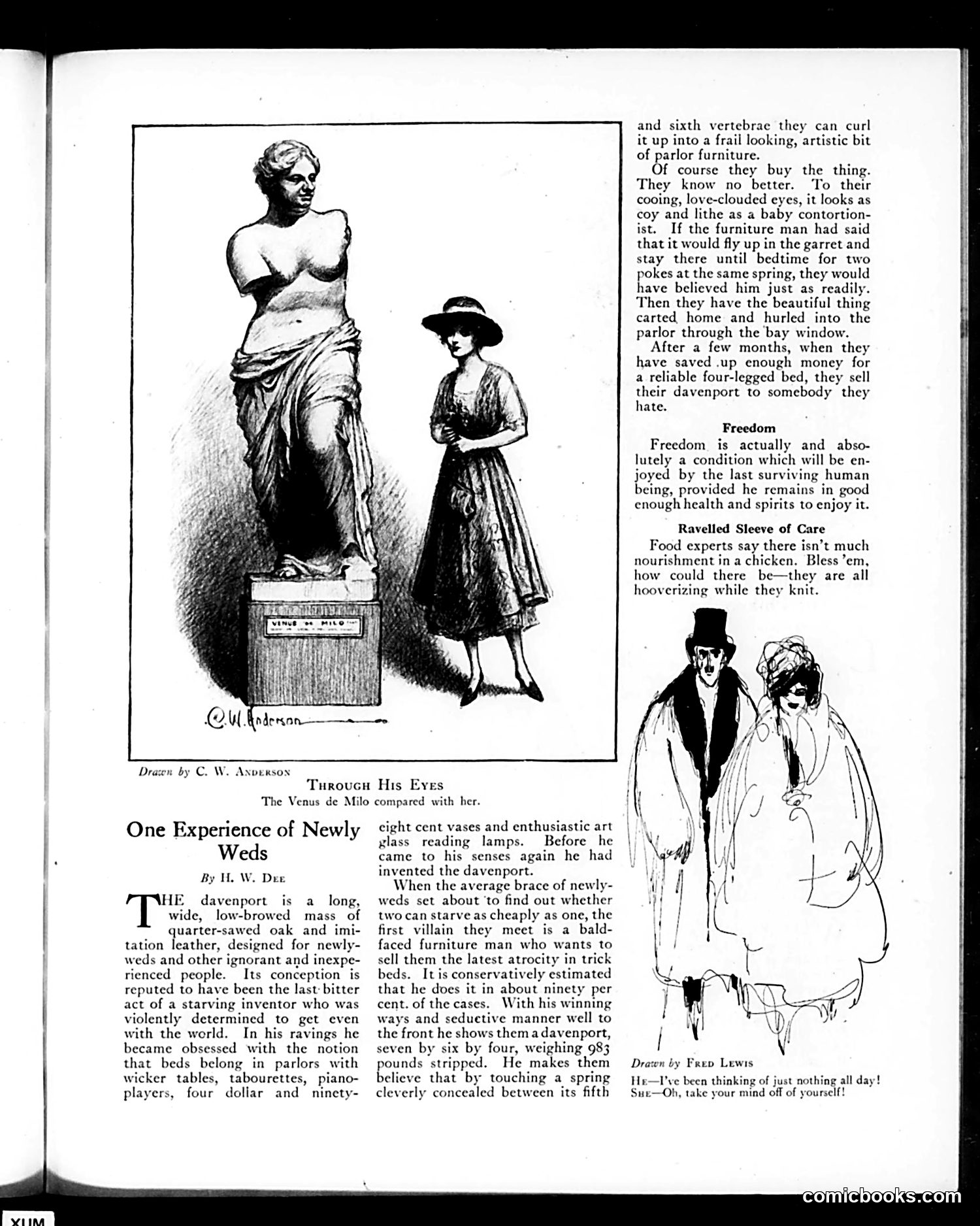
This satirical story mocks newly married couples' susceptibility to furniture salesmen's tricks. The main cartoon shows a classical Venus de Milo statue beside a young woman—comparing her unfavorably to the ideal. The text describes how naive newlyweds purchase a "davenport" (a convertible sofa-bed), believing a furniture man's claim it serves multiple purposes and will "fit up in the garret" until needed. After months of struggling financially, they eventually sell the davenport to recoup costs. The satire targets young couples' gullibility, consumerism, and financial irresponsibility during the early marriage period. Secondary jokes mock women for knitting ("hooverizing"—rationing during WWI) while discussing furniture.
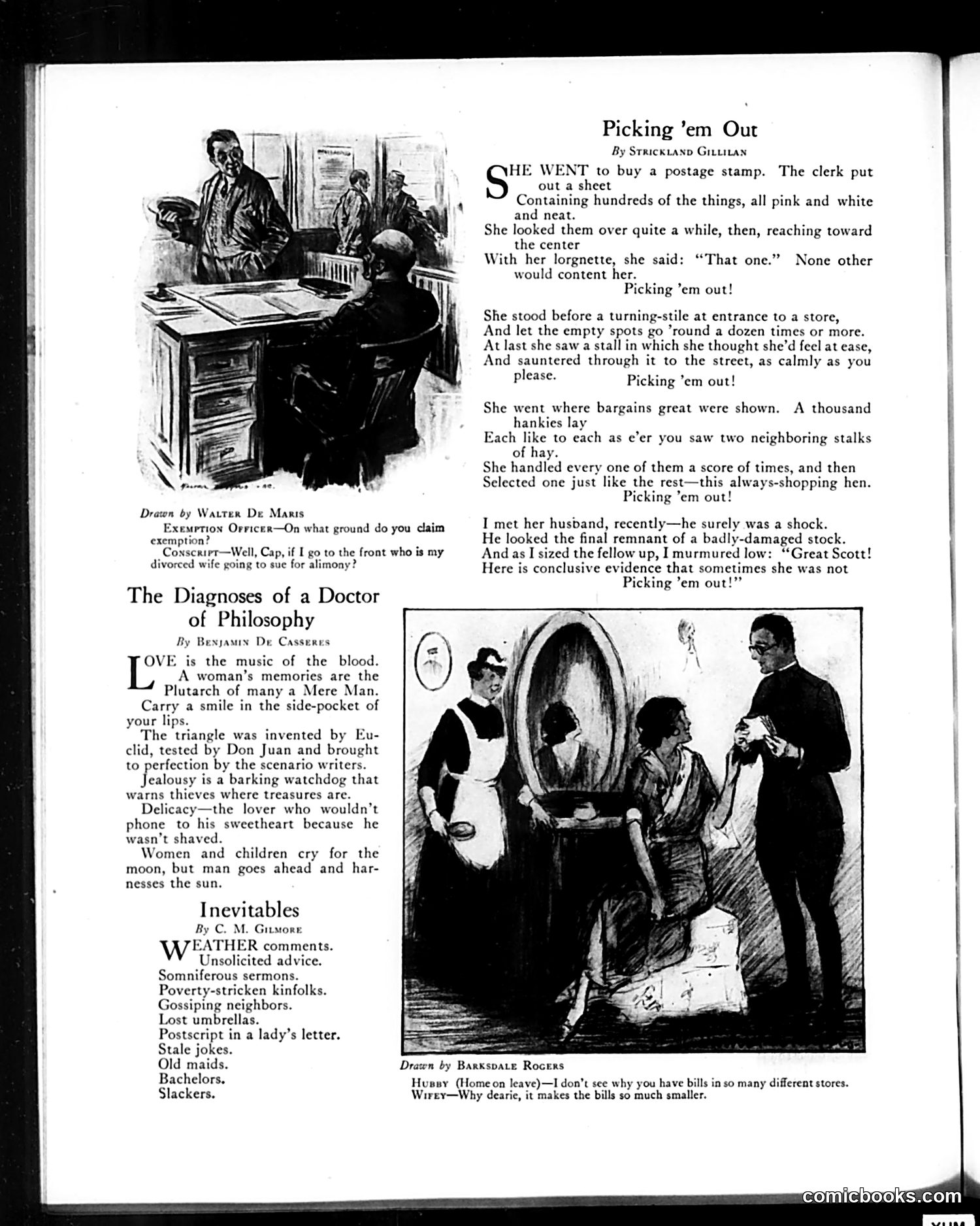
**"Picking 'em Out"** (top): A humorous poem about a woman choosing a single postage stamp from hundreds. The joke satirizes indecisiveness—she spends excessive time selecting one identical item from many identical options. The accompanying illustration shows her at a post office counter with a clerk. The satire mocks the deliberative shopping habits of certain consumers, particularly women. **"The Diagnoses of a Doctor of Philosophy"** (left): A philosophical poem listing life observations in a mockingly pompous style, presenting commonplace truths as profound wisdom. **Bottom cartoon**: Depicts a couple discussing household bills. The husband questions why bills come from multiple stores; the wife responds it makes individual bills appear smaller—satirizing domestic financial dishonesty or self-deception about spending habits.
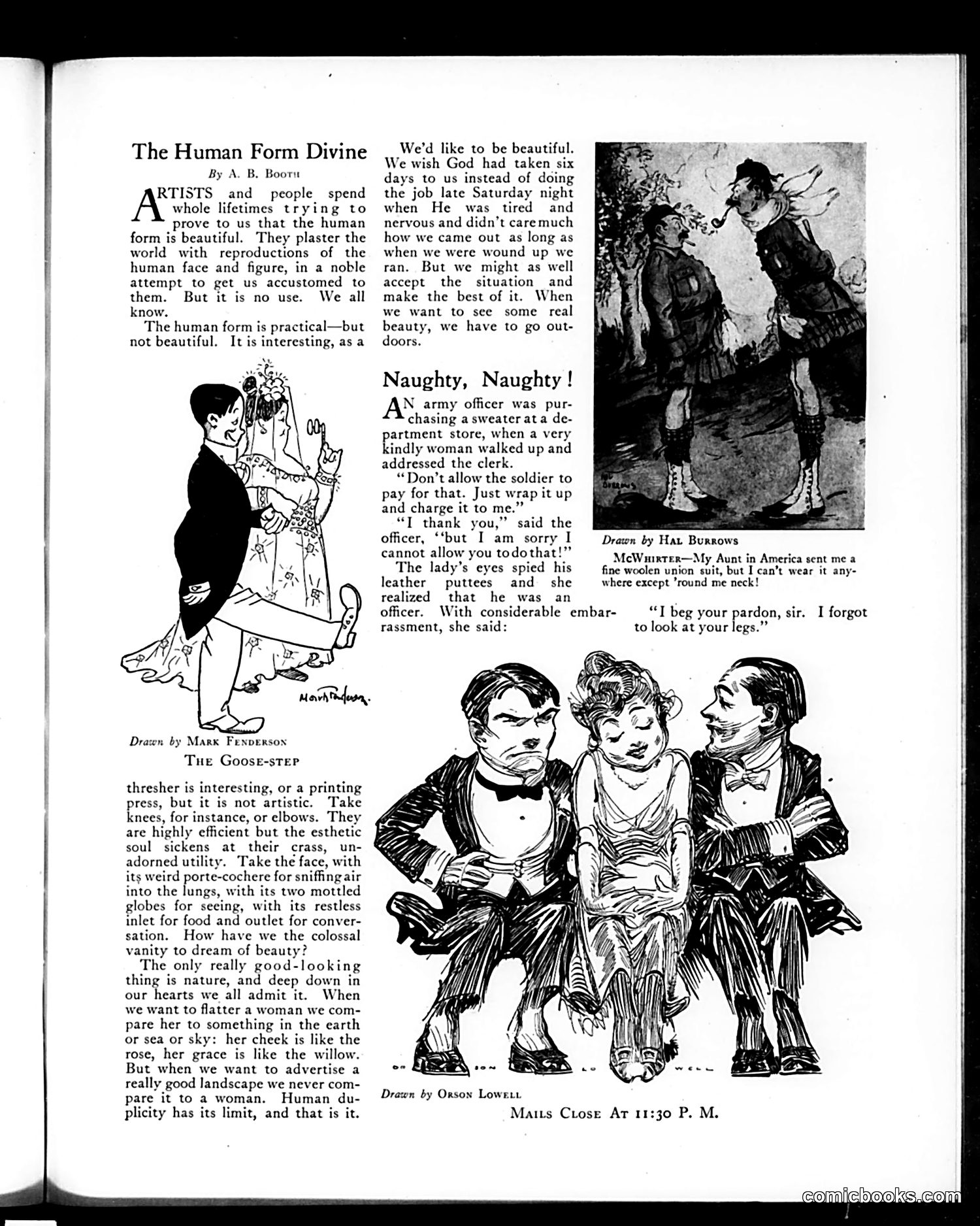
**"The Human Form Divine"** (main essay by A.B. Booth) is a humorous philosophical piece arguing that the human body is *practical but not beautiful*—that artists waste effort trying to convince us otherwise. It uses absurdist examples (knees, elbows, the "weird porte-cochere" for a nose) to mock our vanity. The point: nature is genuinely beautiful; humans are functionally designed, not aesthetically pleasing. **"The Goose-Step"** cartoon by Mark Fenderson shows a man admiring a woman's elaborate dress, satirizing how men judge women primarily on fashion rather than actual appearance. **"Naughty, Naughty!"** depicts a woman at a department store offering to pay for a soldier's sweater, then embarrassedly retracting when she notices his puttees (leg wrappings indicating officer rank), implying she was being inappropriately forward with an enlisted man but respects officer status. **"Mails Close at 11:30 P.M."** is a brief joke about a man unable to wear thermal underwear except around his neck—a pun on impracticality.
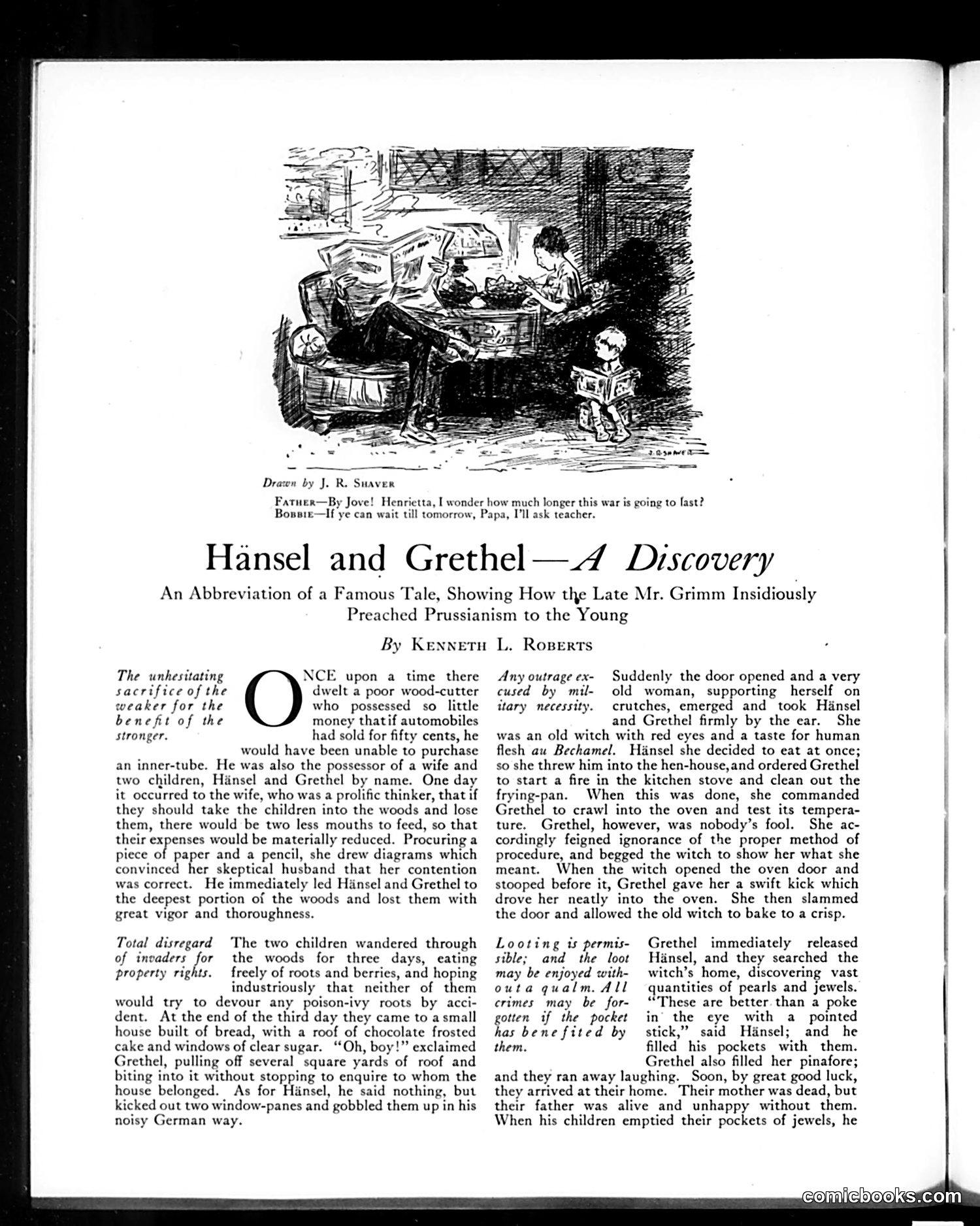
This is a **WWI-era anti-German propaganda piece** disguised as a fairy tale retelling. The subtitle explicitly states it exposes how the Brothers Grimm "insidiously preached Prussianism to the young." The satire works by annotating the Hansel and Gretel story with damning Prussian principles: - **"Unhesitating sacrifice of the weaker for the stronger"** — the parents abandon their children - **"Total disregard of invaders for property rights"** — the children steal the candy house - **"Any outrage excused by military necessity"** — justifying theft and murder - **"Looting is permissible...All crimes may be forgotten if the pocket has benefited"** — moral relativism masked as practical wisdom The opening cartoon mocks German militarism: a child tells her father worried about war's duration, "I'll ask teacher"—suggesting German schools indoctrinate youth into accepting endless warfare. The piece argues German folklore deliberately taught children amoral, militaristic values justifying conquest, theft, and violence as natural survival tactics.
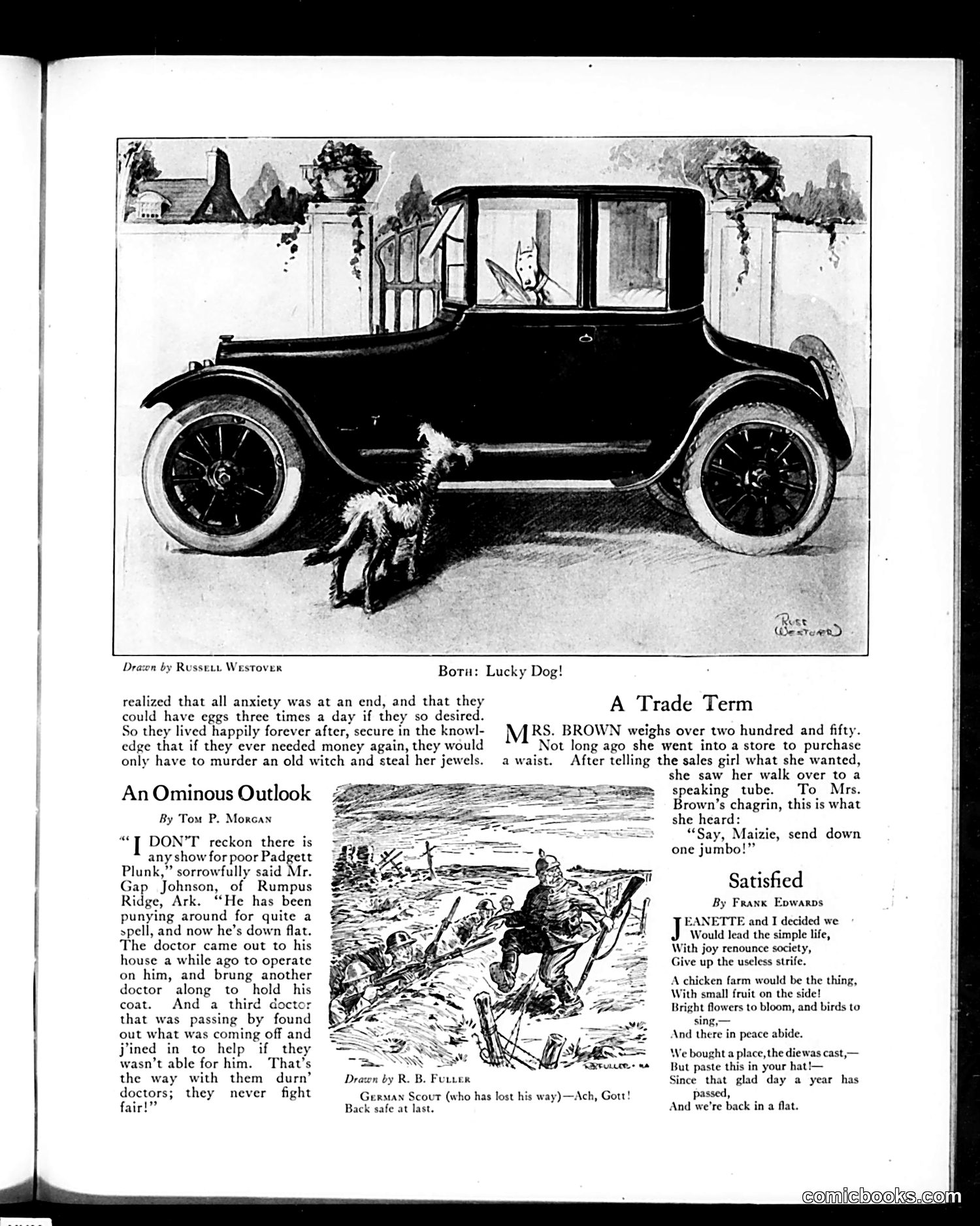
**Top Cartoon ("Both: Lucky Dog!")** by Russell Westover shows a well-dressed couple with their dog admiring an automobile. The accompanying text describes newlyweds who've murdered an old witch and stolen her jewels—a darkly humorous fairy-tale ending about securing wealth for comfortable married life. The cartoon illustrates this newfound prosperity through the fashionable car, the symbol of modern wealth and leisure. **"An Ominous Outlook"** satirizes rural American medical practice. A poor Arkansas man named Padgett Plunk faces surgery with multiple doctors arriving to help—the joke being that doctors are parasitic and will exploit any situation, ganging up on vulnerable patients. **"A Trade Term"** mocks department-store culture and coded language about women's bodies. A heavy-set customer is humiliated when a sales clerk uses the euphemism "jumbo" over a speaking tube—exposing how retail workers privately mock customers. **"Satisfied"** presents an ironic poem about a couple's failed attempt at rural simplicity; after one year of chicken farming, they've retreated to city apartment life.
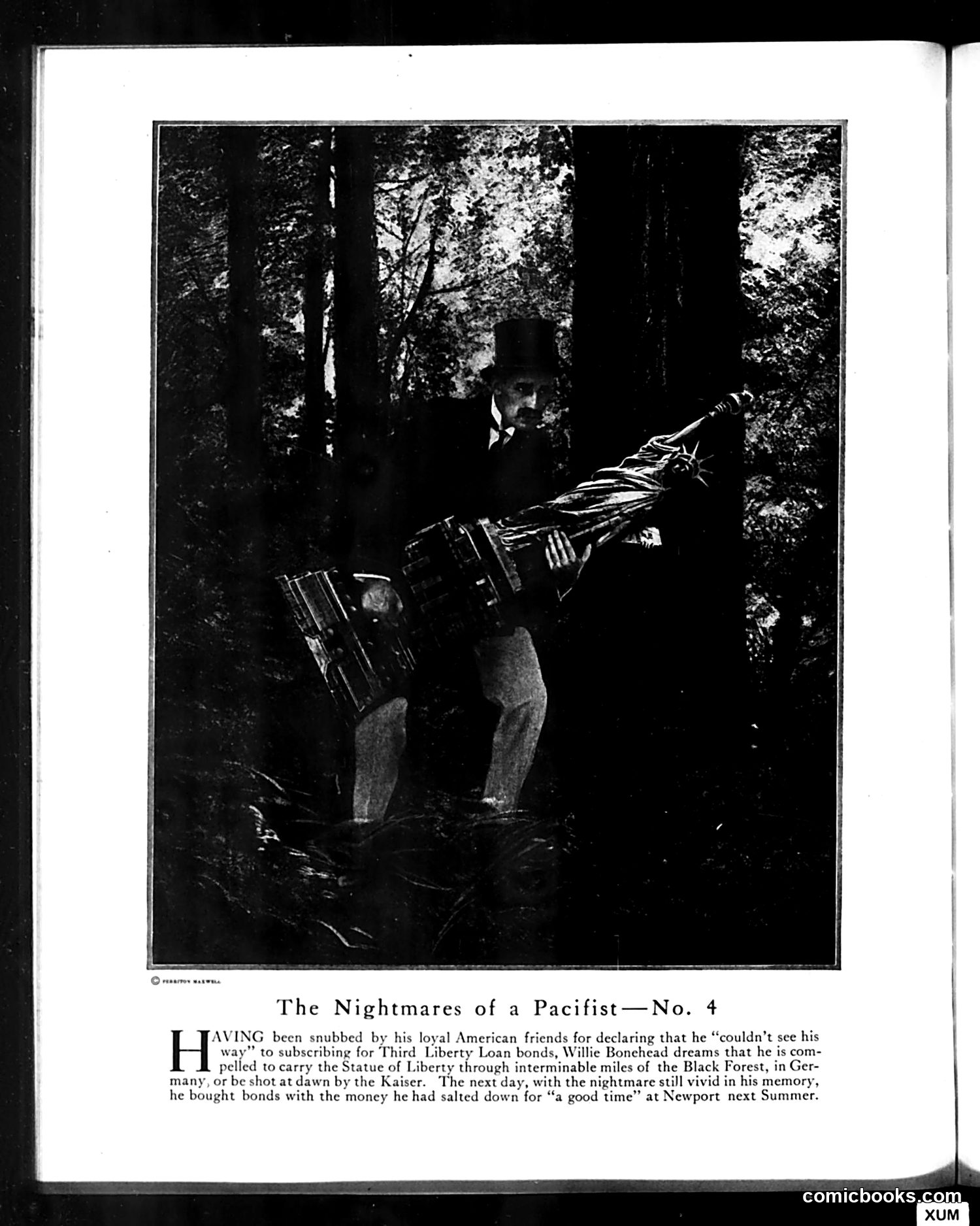
This is WWI-era propaganda satire targeting draft resisters and bond-drive opponents. "Willie Bonehead" (a deliberately unflattering name) is a pacifist who refuses to buy Third Liberty Loan bonds. The cartoon depicts his nightmare: being forced to carry the Statue of Liberty through German territory or face execution by the Kaiser. The satire's point: refusing to support the war effort is cowardly and unpatriotic. The nightmare is so terrifying that Willie reverses course and buys bonds with money he'd saved for leisure in Newport. This represents Judge magazine's pro-war stance and reflects the intense social pressure and shaming directed at Americans who didn't enthusiastically support bond purchases and military involvement during 1917-1918.
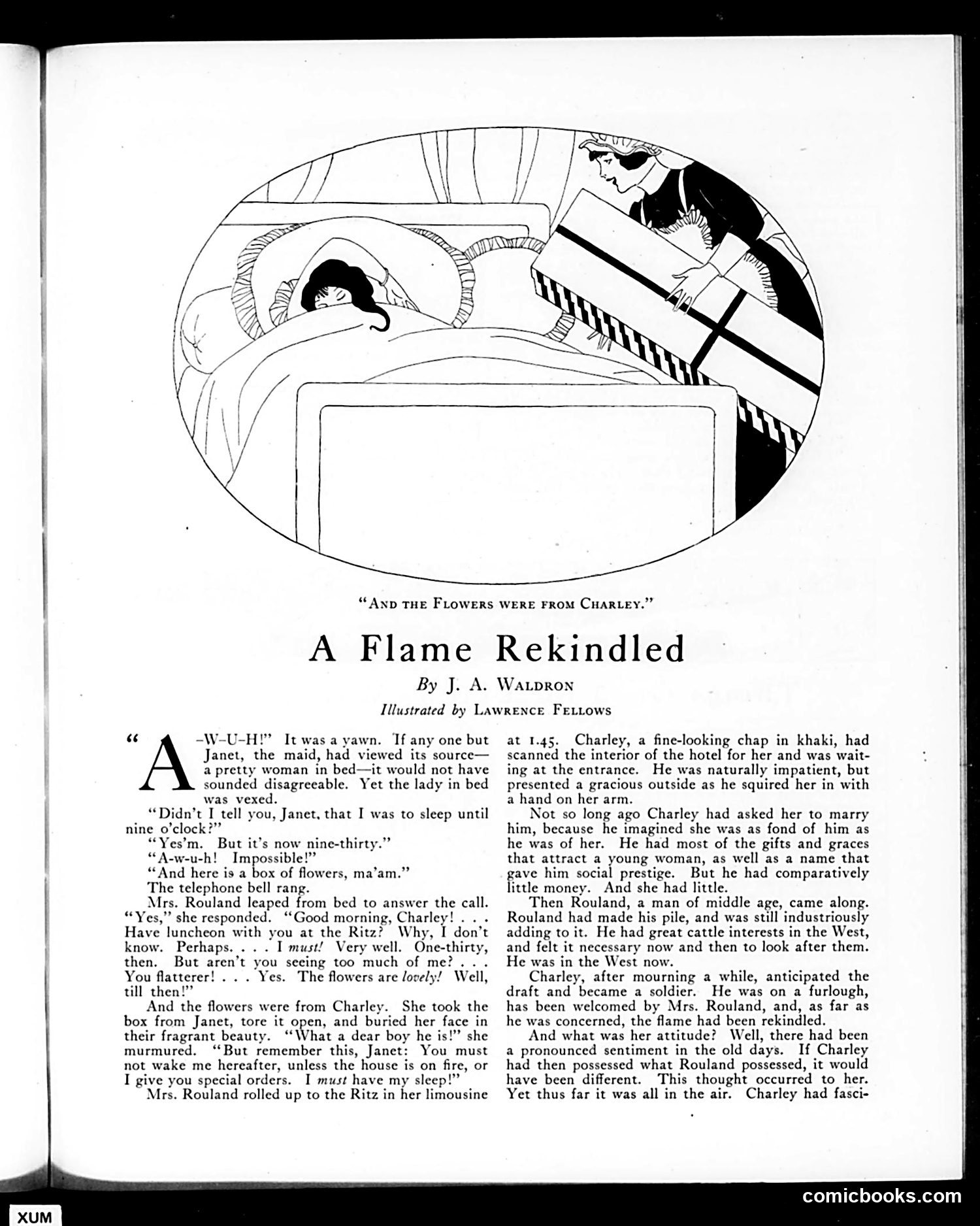
This is a serialized romantic story, not political satire. It depicts a love triangle involving Mrs. Rouland, her current wealthy husband (absent in the West on business), and Charley, a soldier on furlough whom she previously rejected for lack of money. The narrative explores early 20th-century class anxiety: Mrs. Rouland chose the wealthy, older Rouland over the charming but poor Charley. Now, with Charley back in uniform (likely WWI-era, given the khaki reference), her old feelings resurface through flowers and lunch dates. The story's irony—suggested by the caption and her sleeping late while eagerly awaiting his call—is that sentiment and rekindled romance cannot override her original mercenary calculation. The illustration shows her in bed receiving flowers, establishing the domestic/romantic tone of this Judge serialized fiction.
This page contains two distinct pieces: **Top section:** A romantic drama about a soldier (Charley) and a married woman (Mrs. Rouland) arranging a secret breakfast meeting. The satire targets wartime social conventions—a soldier's imminent deployment to the front creates an excuse for impropriety, while the woman's servant forgets to deliver a telegram that might have prevented the assignation. The joke appears to be about how wartime disruption and danger serve as convenient covers for marital infidelity. **Bottom section:** "Betty's Question" is a child's innocent joke about replacement. When told the Smiths have a new baby, Betty asks what was wrong with the old one—applying the household's replacement logic (worn-out items get replaced with new ones) to human babies. It's gentle satire on consumerism and materialism. **"Things Good for Us":** Walt Mason's essay humorously recounts childhood "medicines" (senna tea, castor oil, beatings) presented as beneficial, contrasting with modern pleasures doctors now forbid. It satirizes how each generation justifies its hardships as character-building while the next generation wants comfort.
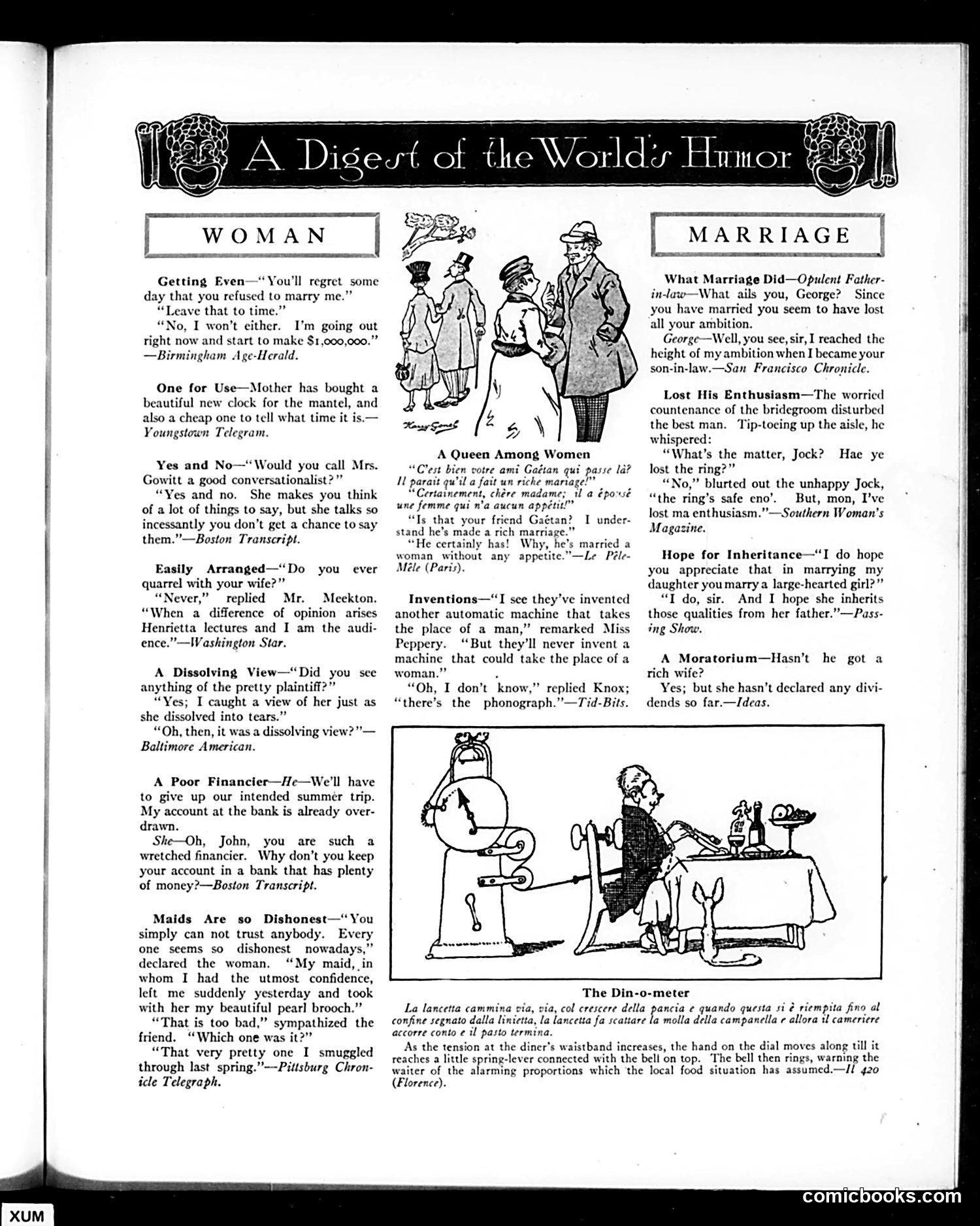
This page from *Judge* magazine contains period humor about gender relations and marriage, reflecting early 20th-century attitudes. **The humor:** The left column ("Woman") mocks women as poor conversationalists, dishonest servants, and bad financial advisors. One joke celebrates a man who smuggled his maid through immigration—treating her as contraband. The right column ("Marriage") depicts husbands as fortune-hunters who lose ambition after marrying wealthy women, or as disappointed grooms. One joke suggests wives are only valuable as potential inheritors of their fathers' money. **The main cartoon ("The Din-o-meter")** depicts a mechanical device attached to a diner's waistband that rings a bell when the wearer's stomach expands to capacity, signaling the meal's end. It satirizes both overeating and the era's obsession with mechanical solutions to human problems. The magazine's consistent theme: women are inferior managers, conversation partners, and financial actors, while marriage traps men. This reflects period attitudes toward women's roles and capabilities.
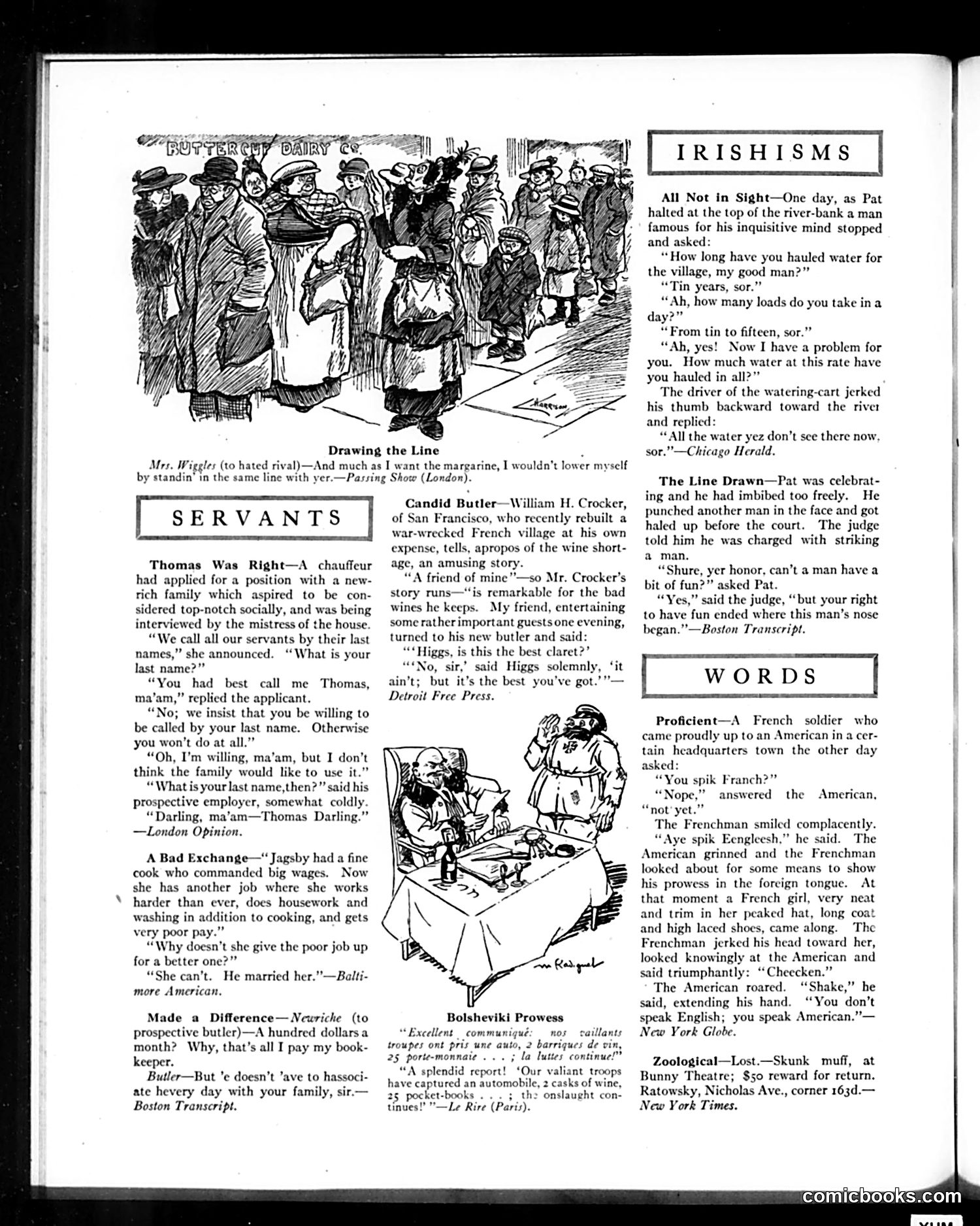
This page collects brief humorous anecdotes organized by theme. The main satirical content includes: **"Drawing the Line"** (top): A class-conscious British woman refuses to stand in line with a rival, even for margarine—satirizing snobbery during wartime rationing. **Servants/Butler Stories**: Multiple jokes mock the pretensions of newly wealthy Americans ("new-rich") who ape upper-class British servant protocols. The humor lies in servants' honest reactions exposing their employers' absurdity—a butler frankly tells his master the wine is poor quality; another refuses to be called by his last name "Darling" to spare the family embarrassment. **"Bolsheviki Prowess"**: A French military communiqué satirizes the Russian Revolution's chaos by suggesting Bolshevik "victories" consist merely of looting cars, wine, and wallets while claiming the "struggle continues." **Irishisms & Other Sections**: Stereotypical Irish dialect humor; WWI-era Franco-American soldier miscommunication jokes. The overall tone reflects post-WWI American attitudes: mocking class pretension, satirizing revolutionary chaos, and trading in ethnic stereotypes.
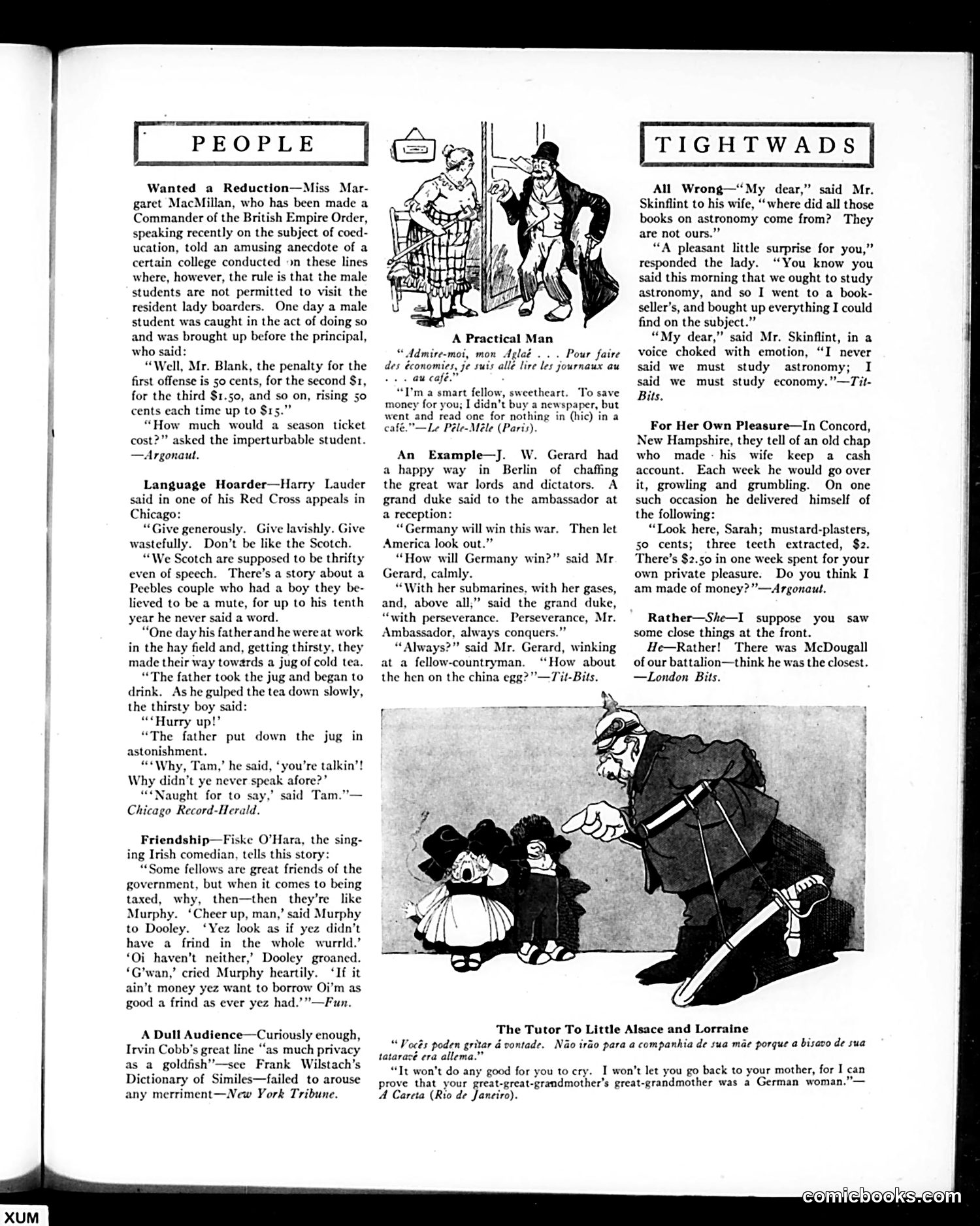
This page contains humorous anecdotes and a cartoon from *Judge* magazine. The main visual shows "The Tutor To Little Alsace and Lorraine"—a stern figure forcibly instructing two small children labeled as French territories. The caption references a German quote, satirizing Germany's harsh treatment of occupied French regions (Alsace-Lorraine) during WWI. The tutor's aggressive posture and the children's distress critique German militarism and imperialism. The text stories mock various social behaviors: miserly husbands, Scottish thriftiness, government hypocrisy about taxation, and marital finances. References to "J. W. Gerard" appear to relate to WWI-era diplomatic commentary. Overall, the page reflects early 20th-century concerns about war, class economics, and gender relations in marriage, using light satire and ethnic stereotypes typical of the era.
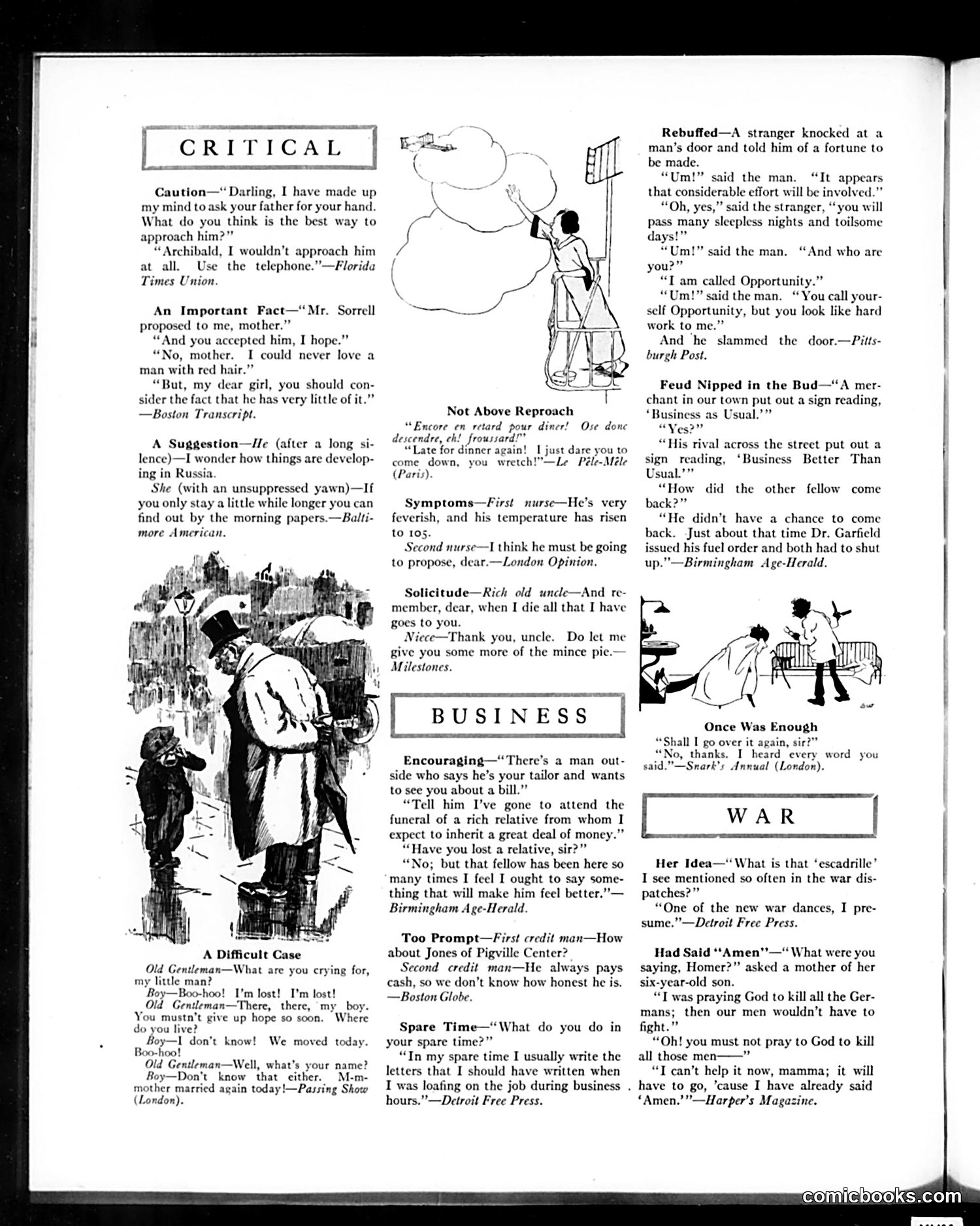
This page from *Judge* magazine contains brief humorous anecdotes organized under "Critical," "Business," and "War" headings, typical of early-20th-century American comic magazines. The jokes lampoon marriage proposals, courtship awkwardness, and dating—common themes—but the "War" section references World War I. The "Escadrille" joke appears to misidentify a military aviation unit as a "war dance," satirizing American unfamiliarity with European military terminology. The "Amen" anecdote, where a child prays for German deaths, reflects anti-German sentiment common during WWI. The "Feud Nipped in the Bud" joke references a "Dr. Garfield" fuel order, likely alluding to Harry Garfield's WWI-era fuel rationing policies. Overall, the page uses gentle satire about everyday life while subtly incorporating contemporary war anxieties into American humor. The cartoons are simple line drawings accompanying the text-based jokes—typical *Judge* format.
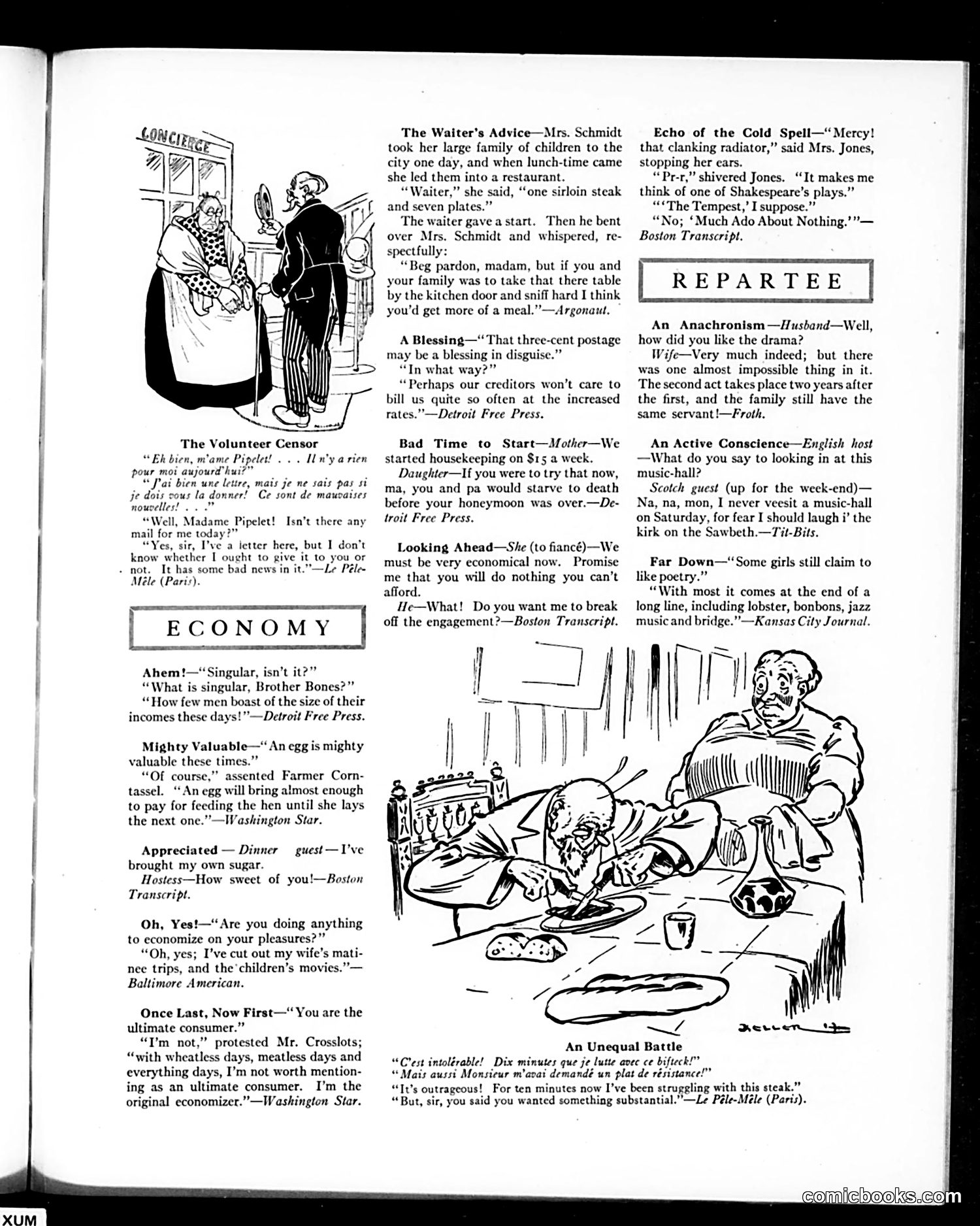
This page from *Judge* presents wartime humor, likely from WWI era, centered on **economic hardship and rationing**. The cartoons mock domestic austerity measures: families struggling with "wheatless days" and "meatless days"; a waiter sarcastically suggesting a poor family simply *smell* food rather than buy it; a couple economizing so severely they consider breaking an engagement. **"An Unequal Battle"** (bottom right) shows a diner fighting with an impossibly tough steak—a visual pun on meat scarcity making poor cuts expensive. The French caption confirms this: the diner demanded "something substantial," so he got inedible toughness. The humor targets both **wartime privation** and **consumer behavior**—people claiming poverty while maintaining small luxuries, or bargain-hunting so aggressively they sabotage their own comfort. **"The Volunteer Censor"** references wartime mail censorship (a French example), suggesting this is WWI-period satire about how economic anxiety pervades daily life.
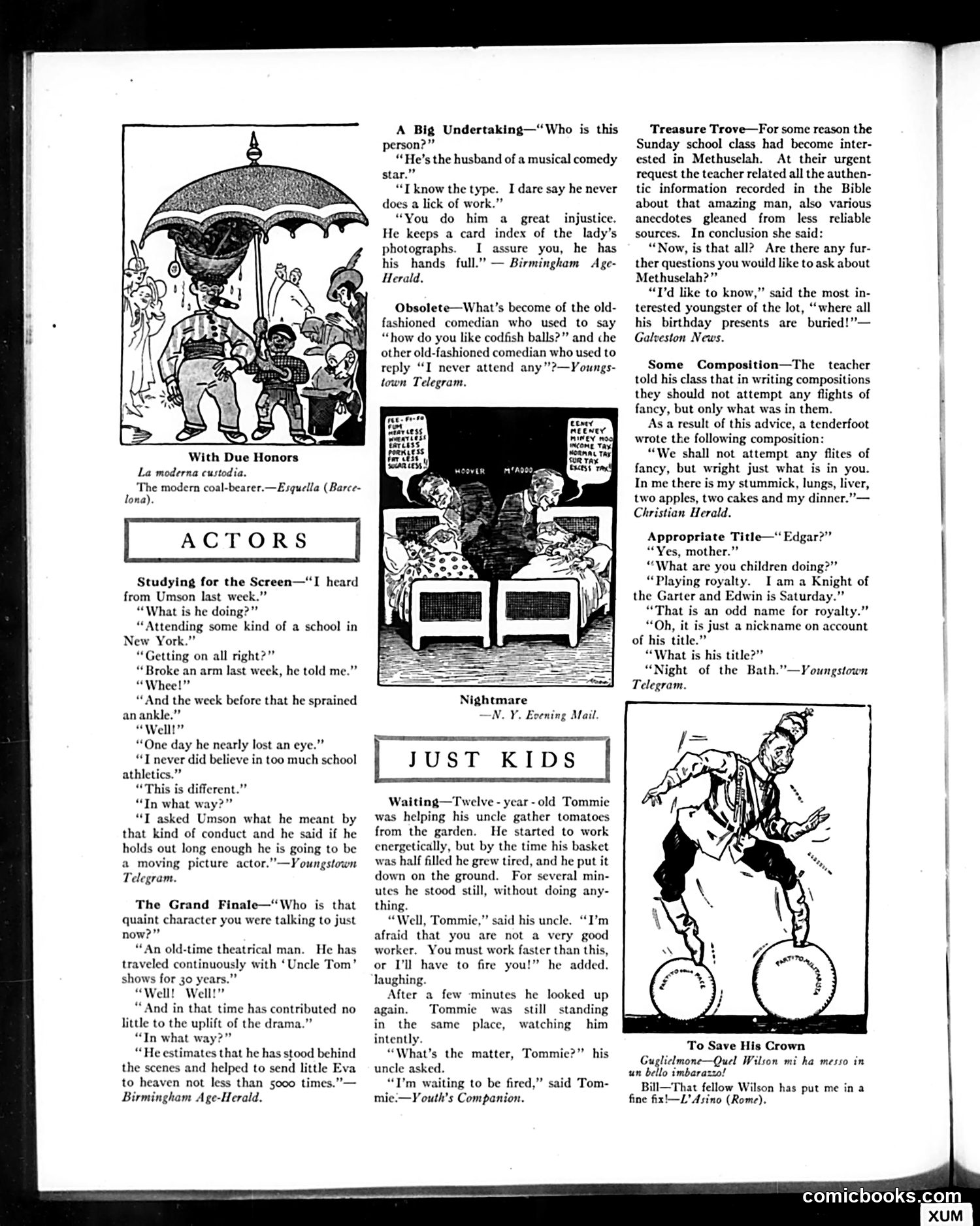
This page from Judge contains several short humorous anecdotes satirizing early 20th-century American life and entertainment: **"With Due Honors"** mocks the ambitious but accident-prone aspiring film actor attending acting school in New York—the joke being that his repeated injuries are presented as legitimate "training" for movies. **"The Grand Finale"** jokes about old theatrical men performing in traveling "Uncle Tom's Cabin" productions (a minstrel staple), sarcastically crediting them with sending child actors to "heaven" thousands of times—dark humor about the melodrama's emotional excess. **"A Big Undertaking"** satirizes musical comedy stars' husbands as idle hangers-on, reduced to managing their wives' photograph collections. **"Just Kids"** features a boy deliberately working slowly to get "fired" from farm labor—innocent childhood logic subverting adult expectations. The page primarily targets entertainment industry pretensions, theatrical mediocrity, and the absurdities of show business life rather than overt political commentary.
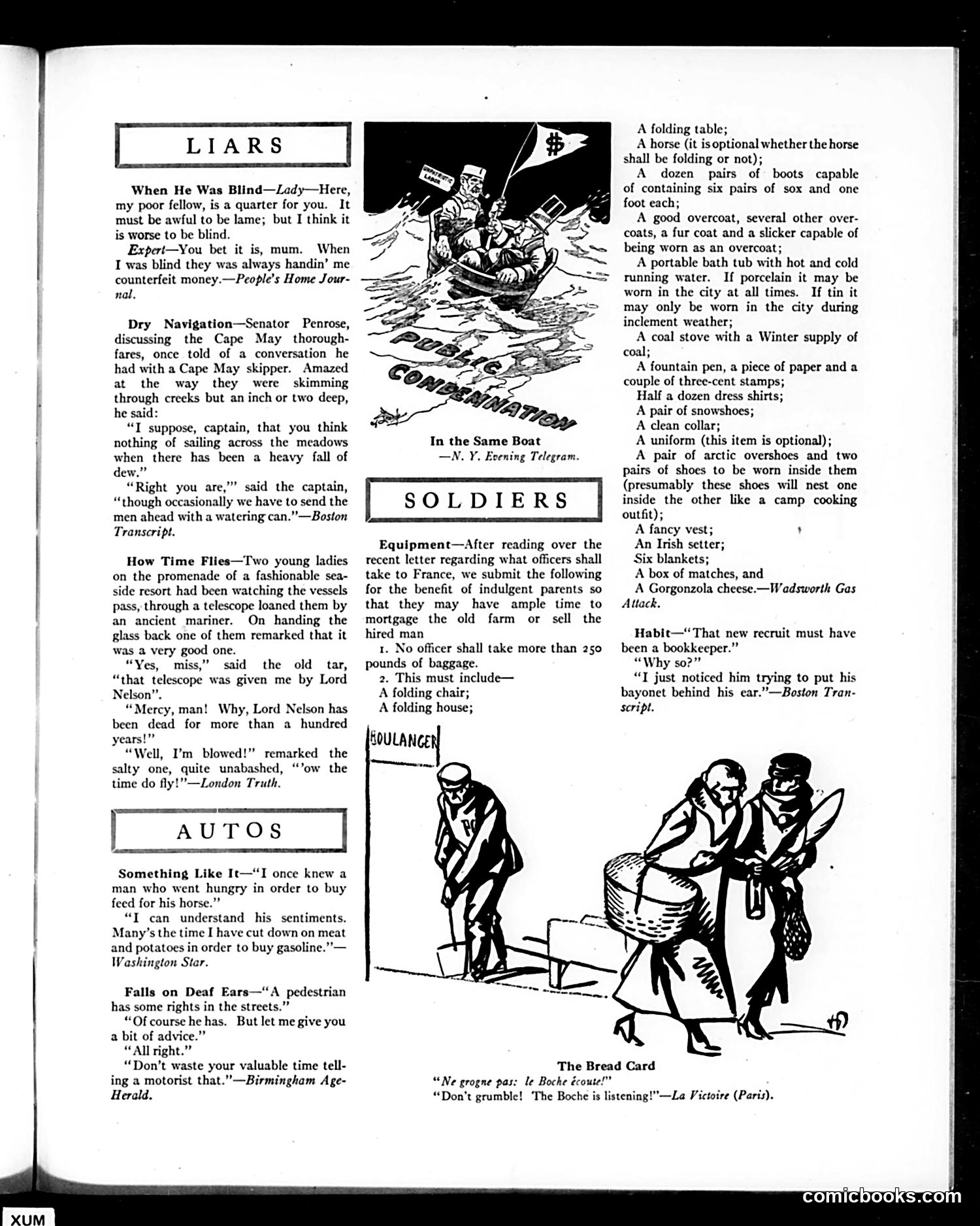
This Judge magazine page contains satirical humor from World War I era (likely 1917-18, given France deployment references). **"Liars" section**: Three brief jokes mocking exaggeration and tall tales—a blind beggar claiming counterfeit money, a sailor claiming a telescope from the long-dead Lord Nelson, and a sea captain joking about sailing through meadows during dew. **"Autos" section**: Humor about early automobile culture—men sacrificing food for gasoline, and motorists ignoring pedestrians' rights. **"Soldiers" section**: The main satire. Officers preparing for France face a 250-pound baggage limit, yet the list absurdly includes "folding" furniture (with a joke that a horse is "optional whether folding or not"), multiple coats, coal stoves, and a Gorgonzola cheese. This mocks military bureaucracy and officers' perceived entitlement. The recruit "bayonet behind his ear" jokes about bookkeeper habits. **"The Bread Card" cartoon**: Shows French rationing during wartime; the caption warns against complaining because "the Boche [German] is listening"—reflecting wartime propaganda and food shortages.
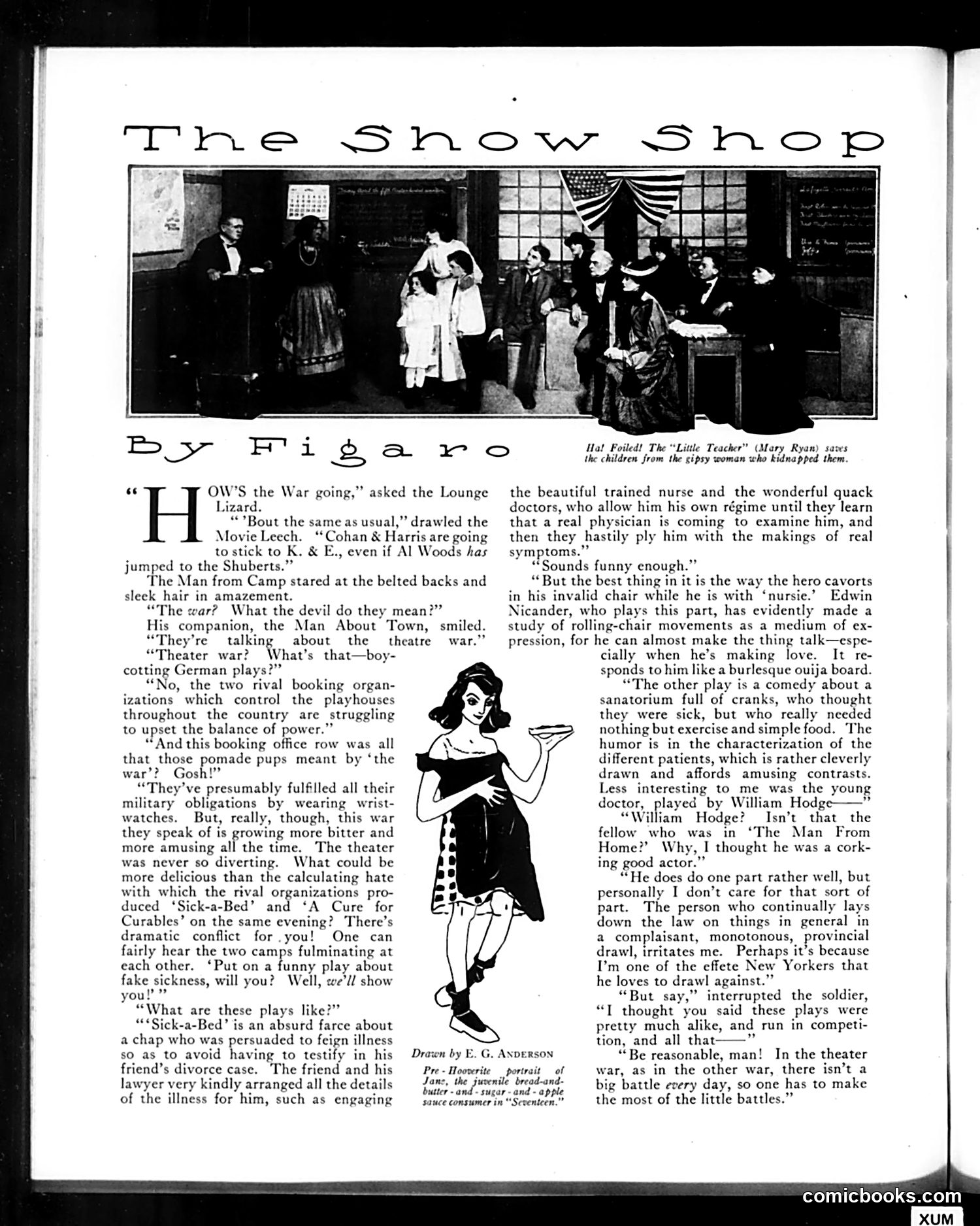
This page satirizes the "theater war" between two rival booking organizations (theater chains) competing for control of American playhouses during what appears to be the World War I era. The dialogue mocks theater people who discuss their industry competition using military terminology borrowed from the actual war ("theater war," "battle," "camps"). The characters—a "Lounge Lizard," "Movie Leech," and "Man About Town"—represent shallow theater-world types more concerned with industry rivalries than the real war. The satire targets two competing plays: "Sick-a-Bed" and "A Cure for Curables," which the rival organizations produced simultaneously as aggressive competitive moves. The piece ridicules both the plays' similarities and the petty nature of theatrical competition dressed up in wartime language. The accompanying illustration shows a scene from "The Show Shop," featuring a plot involving a trained nurse, while the E.G. Anderson illustration depicts a character from "Seventeen." The overall message: while soldiers fought abroad, New York theater people obsessed over trivial industry disputes.
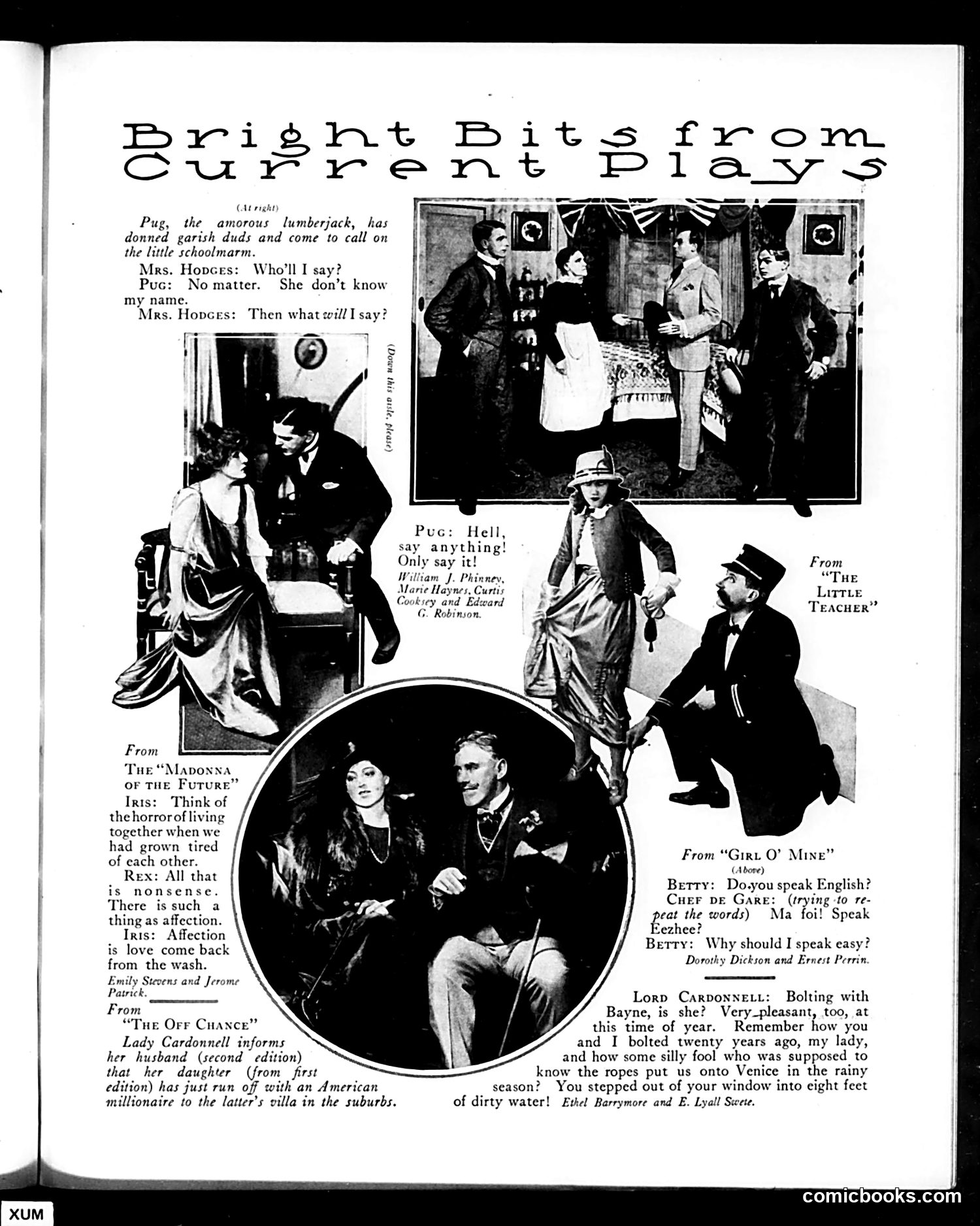
This page excerpts witty dialogue from contemporary theatrical productions, presented as satirical commentary on modern life and relationships. The sketches mock romantic and marital conventions: "The Little Teacher" jokes about a crude suitor's anonymity; "Girl O' Mine" satirizes language barriers in courtship; "The Off Chance" presents a cynical view of love as something that deteriorates like laundry; and "The Madonna of the Future" contrasts idealistic notions of companionship with practical realities. The final excerpt, from "The Off Chance," uses Lady Cardonnell's anecdote about her own youthful elopement to Venice—which ended disastrously in a canal—to mock her daughter's similar escape with an American millionaire. The humor relies on recognizing theatrical stars (Ethel Barrymore is credited) and the period's fascination with wealthy Americans marrying British aristocrats' daughters, a genuine social phenomenon of the era.
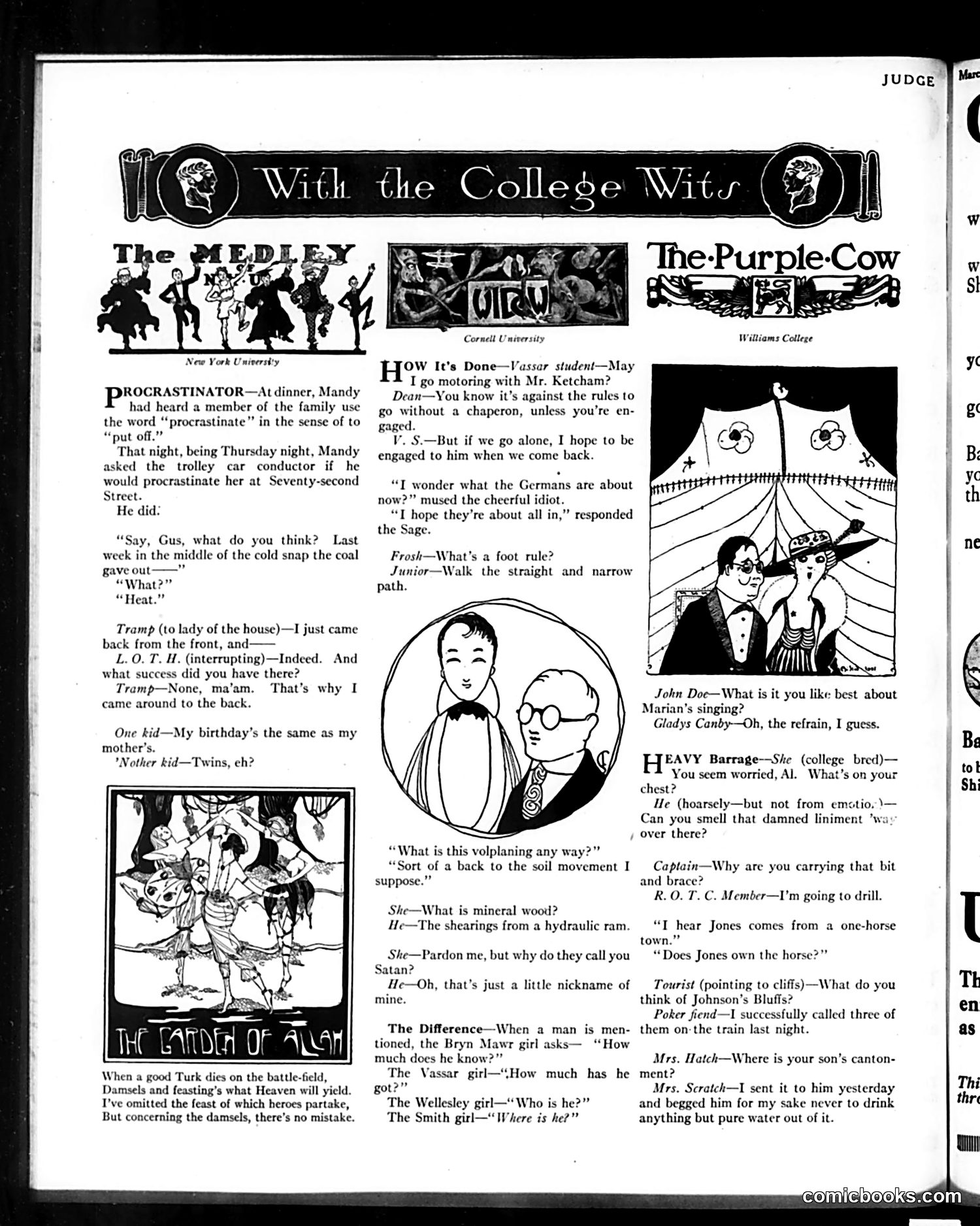
This page collects humorous anecdotes from different American colleges (NYU, Cornell, Williams, Vassar, Bryn Mawr, Wellesley, Smith). The jokes target typical college student behavior and anxieties of the era. Key themes include: **dating rules** (Vassar girl hoping to get "engaged" to bypass chaperone restrictions); **class consciousness** (different colleges stereotyped by what they ask about men—Bryn Mawr girls value intelligence, Vassar girls money, Wellesley girls identity, Smith girls location); **WWI military context** (references to "R.O.T.C." drilling, "cantonment," German concerns, and a mother sending supplies to her son's military camp). The humor assumes readers recognize colleges as distinct social institutions with recognizable student types. The cartoons and quips satirize youthful pretension, rule-breaking, and the collision between wartime concerns and campus social life. Most jokes rely on wordplay or ironic reversals of expected responses.
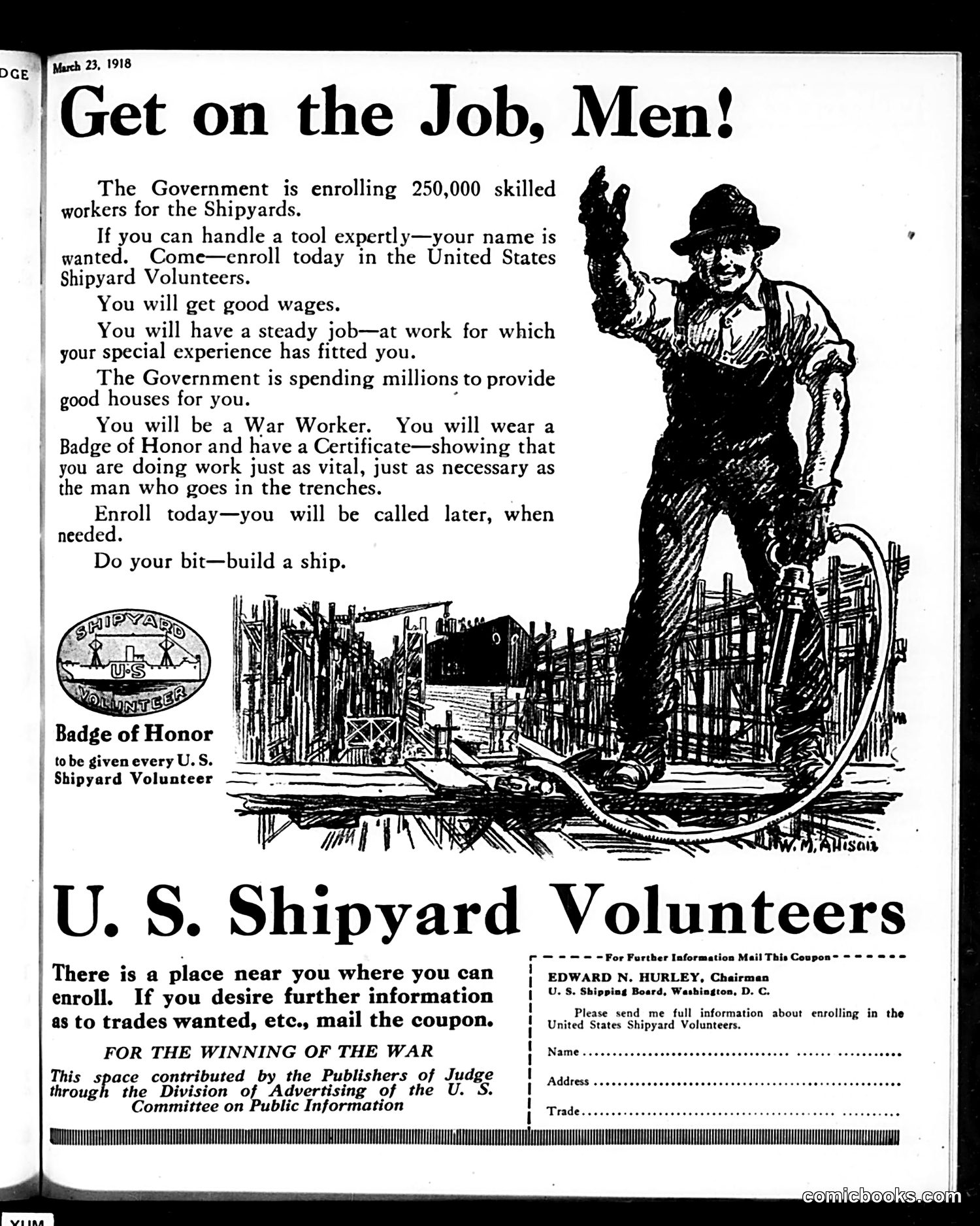
This is a **World War I recruitment advertisement**, not satire. Published during America's involvement in WWI (1917-1918), it appeals to skilled workers to enroll in shipyard work. The illustration shows a patriotic worker in a hat, fist raised triumphantly, standing atop a shipyard full of construction. The message frames shipyard labor as equally vital to combat—workers receive a "Badge of Honor" and certificate equating their contribution to soldiers "in the trenches." Key appeals include: good wages, steady employment suited to skilled trades, government-provided housing, and patriotic duty ("Do your bit—build a ship"). The advertisement represents the U.S. government's mobilization strategy: civilian industrial work was reframed as military service to justify demanding labor and attract volunteers. This appeared in *Judge*, a satirical magazine, likely as paid advertising space contributed by the Committee on Public Information (the government's WWI propaganda agency).
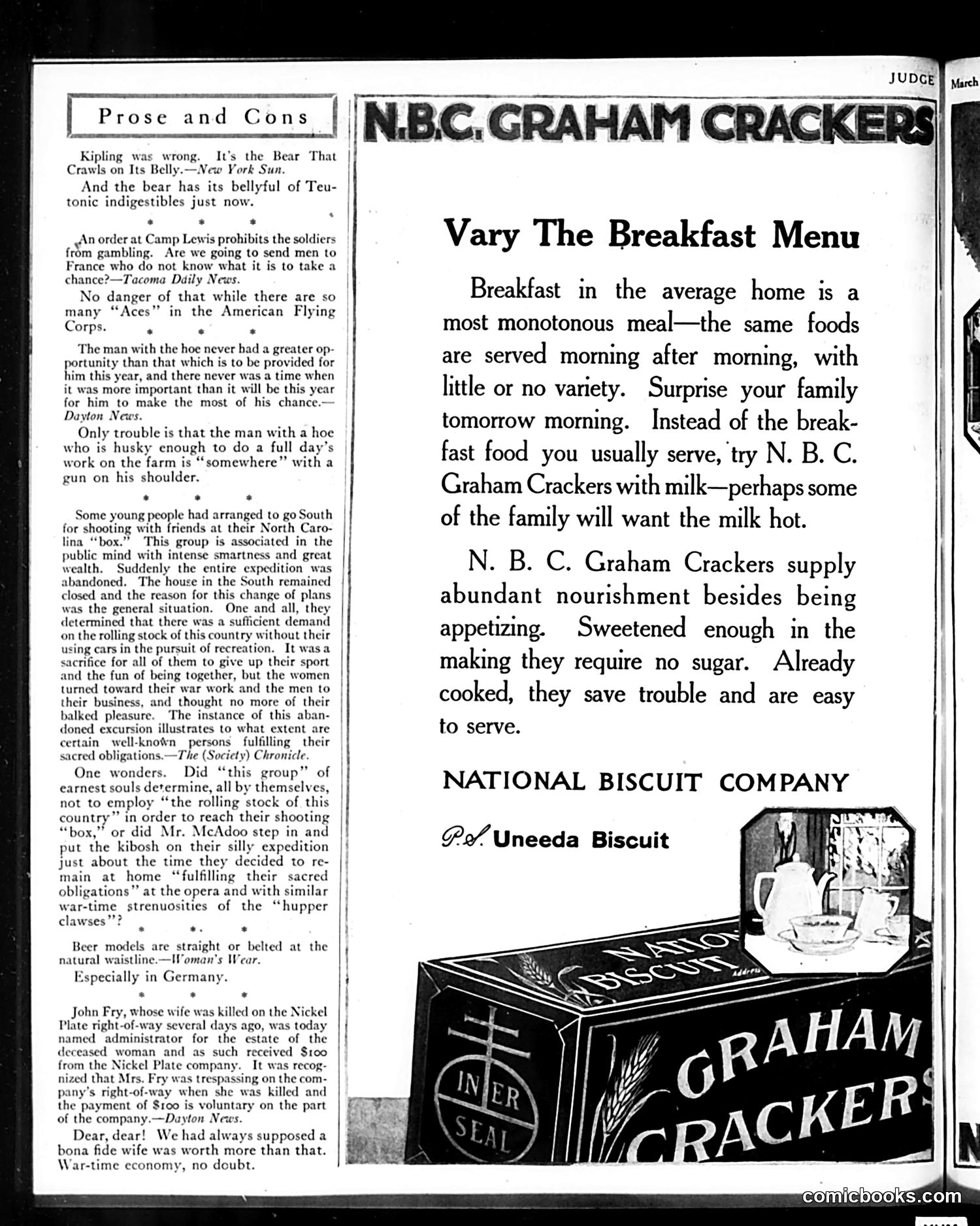
This is primarily an **advertising page** for N.B.C. Graham Crackers, but the left column contains satirical commentary on WWI-era American life. ## The Satire Section ("Prose and Cons") The short pieces mock various contradictions and hypocrisies of wartime America: - **Kipling reference**: A dig at Rudyard Kipling, suggesting Germany ("the Bear") is overwhelmed by indigestible "Teutonic" problems - **Camp Lewis gambling ban**: Sarcastic observation that soldiers are being prohibited from gambling, yet are being sent to France where taking chances with their lives is required - **The man with the hoe**: Ironic commentary that able-bodied farm workers needed domestically are instead "somewhere" fighting in the war - **The wealthy shooting party**: Satirizes the upper classes' performative patriotism—wealthy people canceling a recreational trip to North Carolina and crediting their own virtue, when the satire suggests Secretary McAdoo may have forced the decision - **Mrs. Fry's settlement**: Bitter final note: a woman killed by a train receives only $100 compensation, called "war-time economy" The page reflects wartime sacrifice rhetoric versus actual class-based behavior.
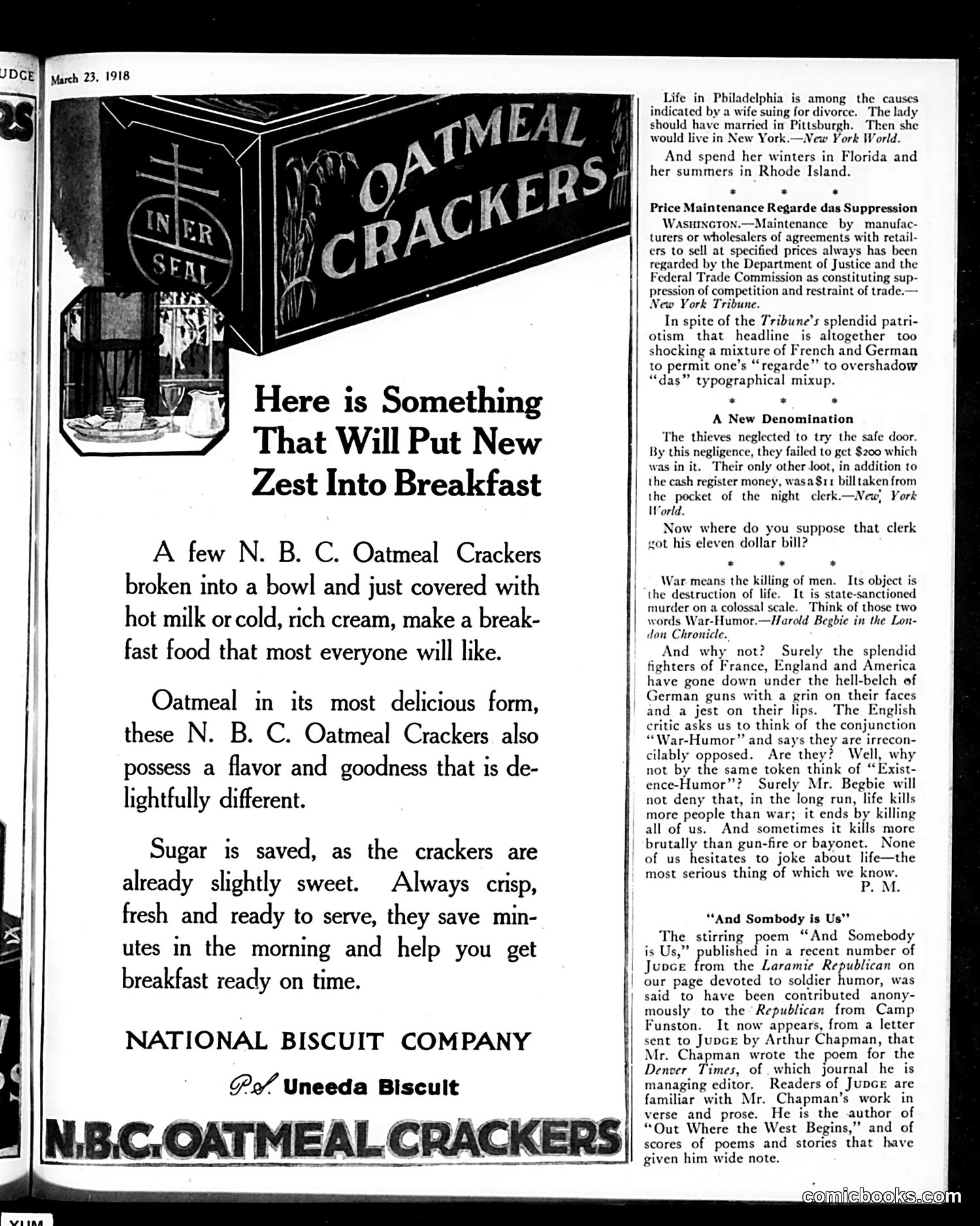
This page is **primarily advertising** (N.B.C. Oatmeal Crackers occupy the left half) alongside **brief satirical snippets** on the right. The satirical items mock: 1. **Divorce/Geography**: A woman divorcing in Philadelphia should have married in Pittsburgh to live in New York and winter in Florida—mocking the wealthy's seasonal migration patterns. 2. **Linguistic Absurdity**: A headline mixing French ("Regarde") and German ("das") about price maintenance is ridiculed as patriotically inappropriate during WWI. 3. **The "Eleven Dollar Bill" Joke**: A thief steals only an $11 bill from a night clerk, prompting the sarcastic question of where a clerk got such an odd denomination—implying petty theft or desperation. 4. **War-Humor Paradox**: An essay argues that joking about war isn't incongruous, since life itself kills everyone eventually, so humor about serious matters is philosophically defensible. The page reflects 1918 wartime sensibilities: jingoism, class observation, and dark humor about mortality.
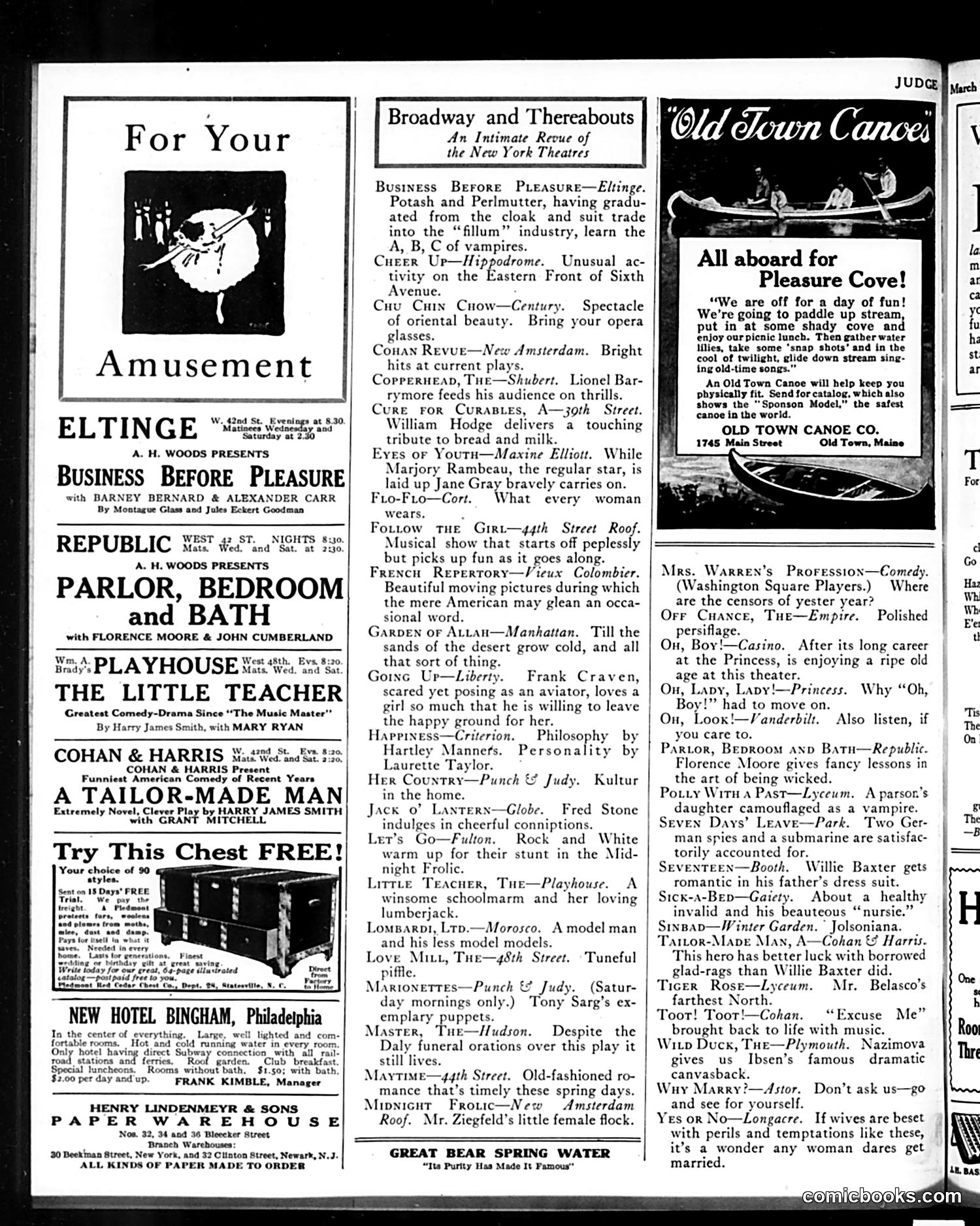
This page is primarily **theatrical advertising and criticism**, not political satire. The left side features Broadway theatre advertisements for plays like "Business Before Pleasure" and "Parlor, Bedroom and Bath." The center column, titled "Broadway and Thereabouts," provides brief witty reviews of current New York theatrical productions. The humor is theatrical rather than political—quick, punchy critiques of shows and their stars. For example, it jokes about Lionel Barrymore "feeding his audience on thrills" and describes "Maytime" as "old-fashioned romance that's timely these spring days." The right side advertises an "Old Town Canoe" company promoting recreational boating. There is **no significant political cartoon or satire visible** on this page. It's essentially a theatre section mixing advertisements, reviews, and consumer goods marketing typical of early 20th-century magazine layouts.
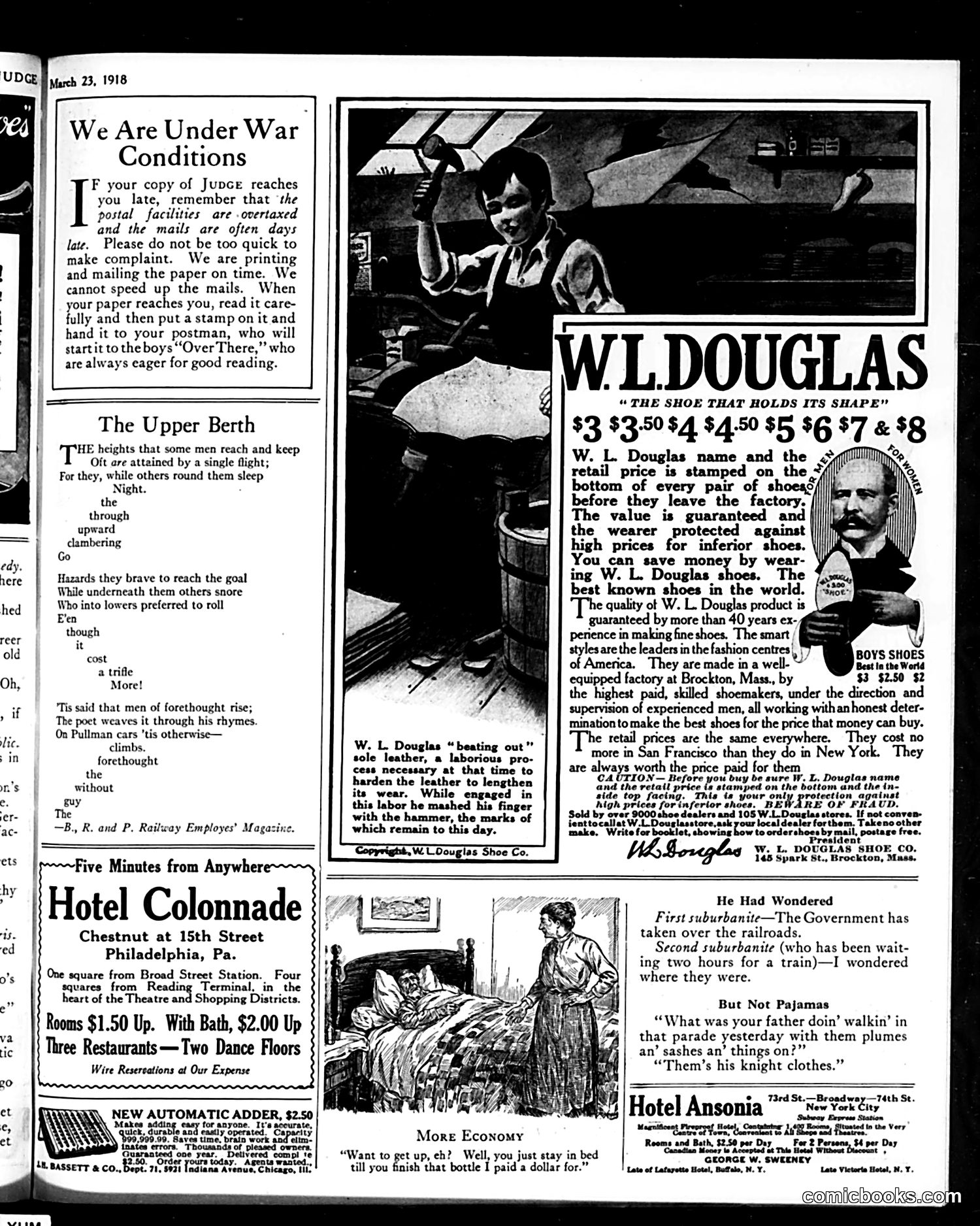
This page is primarily **advertising and filler content** rather than political satire. The main elements are: **"We Are Under War Conditions"** - An editorial note explaining postal delays due to WWI disruptions. Judge reassures readers the magazine is printing on time; delays are the mail system's fault. This reflects genuine wartime infrastructure strain America experienced after entering WWI in 1917. **"The Upper Berth"** - A humorous poem about Pullman train sleeping arrangements, contrasting ambitious men who climb to upper berths versus lazy men who prefer lower ones. It's a metaphor for success requiring effort. **Advertisements** dominate: Hotel Colonnade (Philadelphia), a New Automatic Adder calculator, and extensive W.L. Douglas shoe ads emphasizing quality and fair pricing. **Humor snippets** ("He Had Wondered," "But Not Pajamas") are brief, lighthearted jokes unrelated to war or politics. The page reflects 1918 America: wartime postal problems, consumer goods advertising, and light entertainment rather than sharp political commentary typical of Judge's satirical tradition.
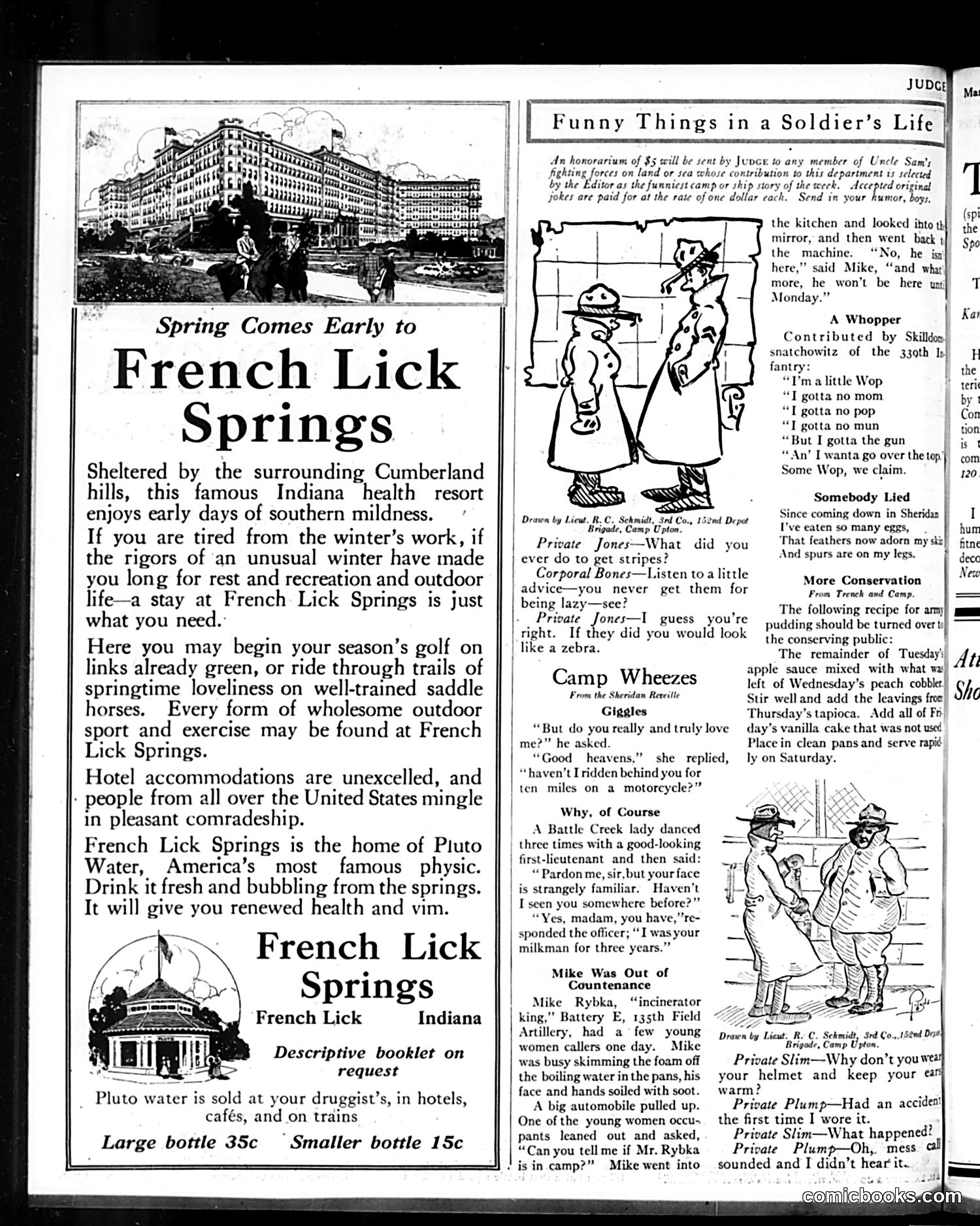
This page collects humorous anecdotes submitted by World War I soldiers, with Judge offering $5 payment for published contributions. The jokes depict camp life and soldier experiences. The cartoons mock military situations: one shows a soldier asking about stripes (promotion), another features a lady dancing with an officer who recognizes him as her former milkman, and a third depicts "Mike," a soldier whose face has become familiar to female visitors to his camp. A recurring joke—"A Whopper"—mocks a soldier's broken English and immigrant status, using offensive stereotyping common to the era. Another cartoon satirizes how soldiers' marriages deteriorate through absence ("Somebody Lied"). The page reflects WWI-era humor that often targeted immigrants and lower-class soldiers while celebrating military service. The content reveals contemporary attitudes toward ethnicity and military life that modern readers would find crude.
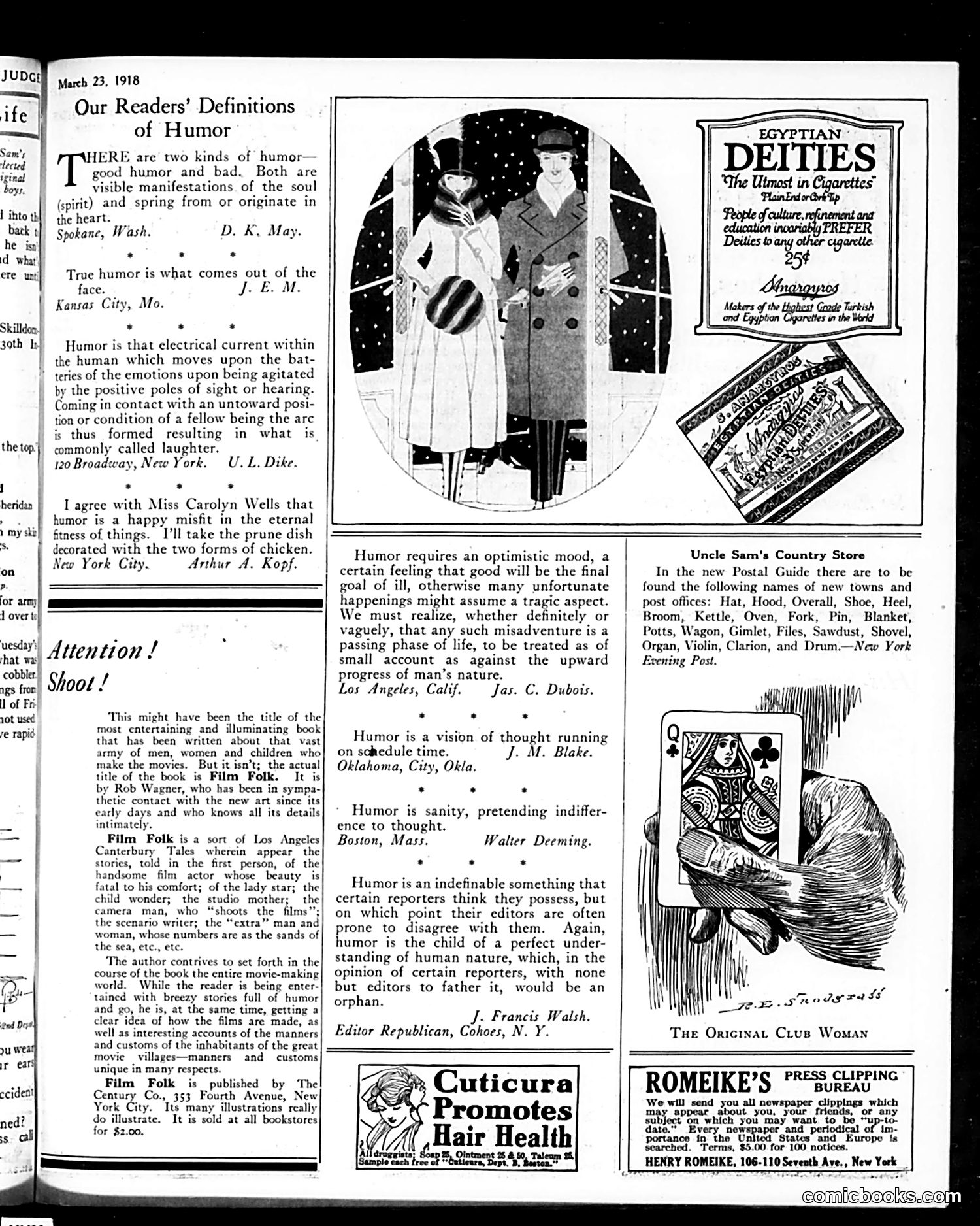
This page is primarily a **reader-submitted feature** on humor definitions, popular in early 20th-century magazines. The central content consists of short, witty definitions of "humor" from readers across America (Spokane, Kansas City, New York, Boston, Oklahoma City, etc.), offering philosophical and satirical takes on what constitutes humor. Notable contributions include U.L. Dike's electrical-current metaphor, Arthur Kopf's "happy misfit" concept, and J. Francis Walsh's ironic definition portraying humor as something reporters claim to possess while editors disagree—a gentle jab at journalism's internal culture. The page also advertises **Film Folk**, a book about Hollywood culture by Rob Wagner, positioning cinema as a novel, gossipy subject worthy of literary treatment. The surrounding **advertisements** (Egyptian Deities cigarettes, Cuticura soap) and a cartoon titled "The Original Club Woman" appear incidental to the main humor-definition feature.
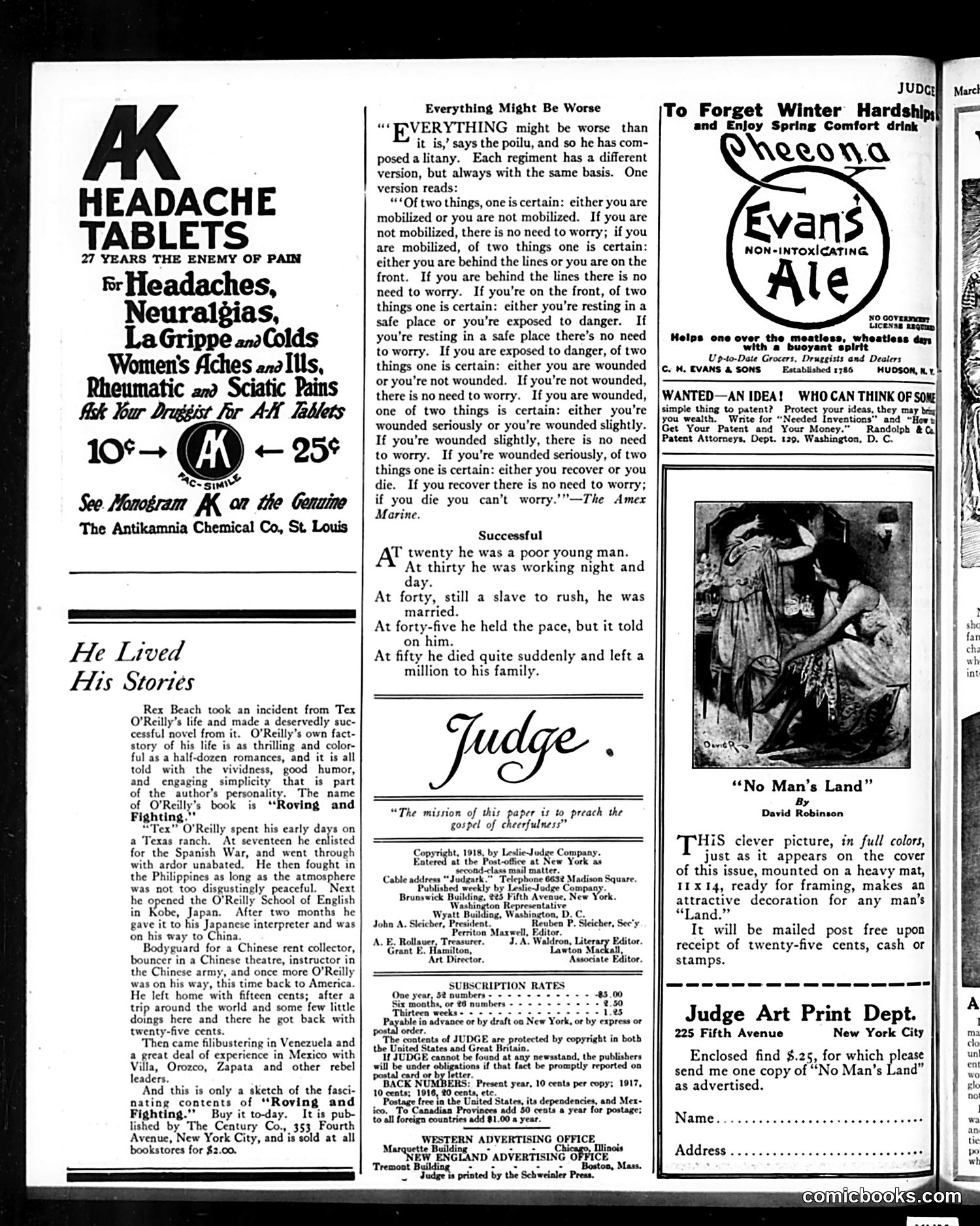
This page contains primarily **advertising and editorial content** rather than political satire requiring historical context. The main non-advertising section, "Everything Might Be Worse," reproduces a **French WWI soldier's ("poilu's") philosophical litany** that uses circular logic to argue that any circumstance, no matter how dire, can be rationalized as acceptable. The joke reflects soldiers' gallows humor during World War I—each outcome (mobilized/unmobilized, front/rear, wounded/unwounded) is deemed worrisome or not, ultimately concluding one cannot worry if dead. Below that, "Successful" presents a brief social satire: a poor young man climbs the economic ladder through constant labor, achieves wealth and marriage, but dies at fifty—leaving his fortune to his family rather than enjoying it. This critiques capitalist "success" as ultimately hollow and self-defeating. The page otherwise features advertisements for **AK Headache Tablets** and **Cheona Evans Ale**, plus editorial promotion for author Rex Beach's book "Roving and Fighting."
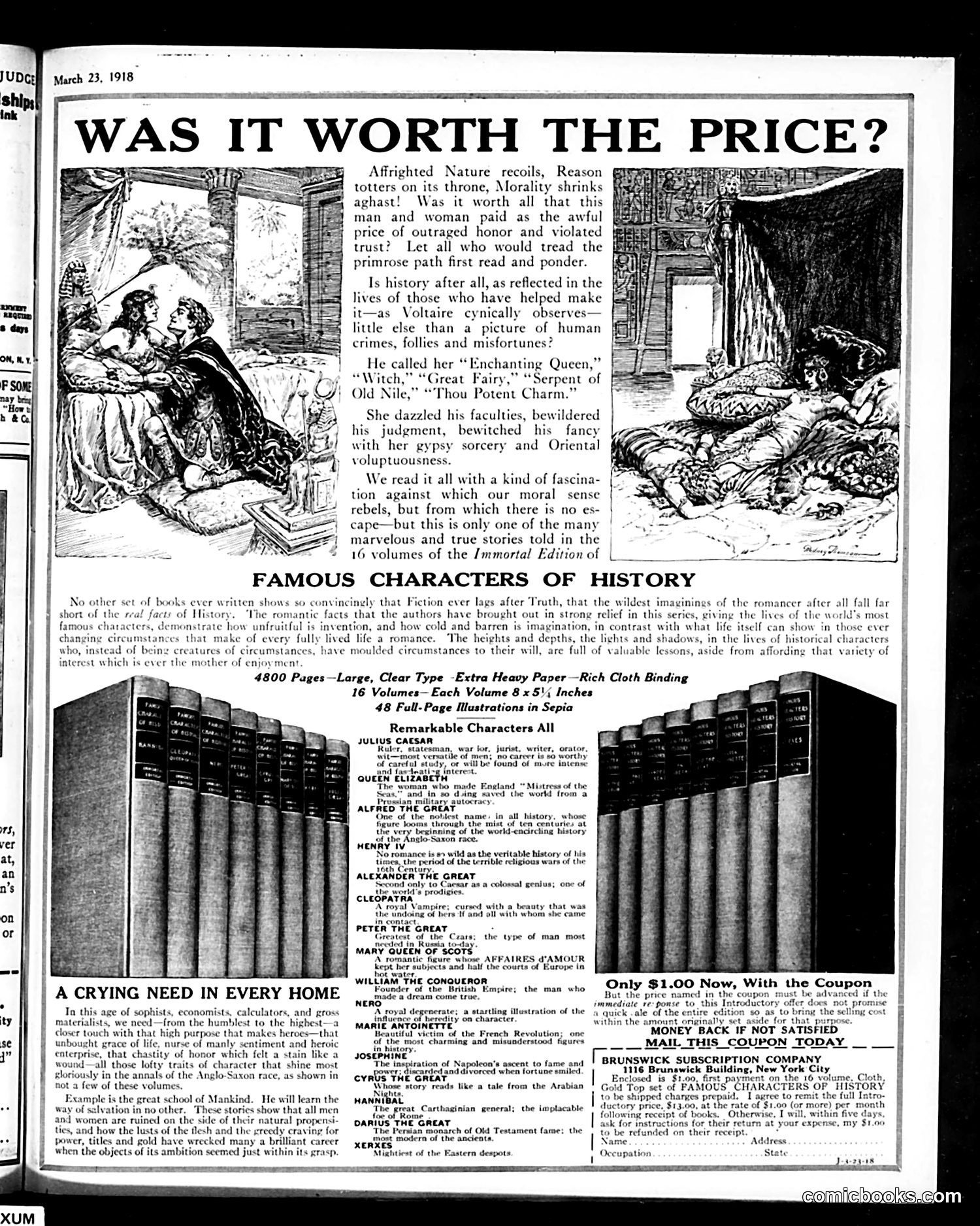
This page advertises a 16-volume encyclopedia called "Famous Characters of History" through a morality-focused narrative. The two illustrations depict a cautionary tale: the left image shows an intimate encounter between a man and woman, while the right shows the woman's apparent death or ruin—suggesting consequences of illicit romance. The text frames this as a lesson about moral danger, referencing a historical figure (likely Cleopatra, given the "Enchanting Queen" and "Old Nile" epithets) who "bewitched" a man through "gypsy sorcery and Oriental voluptuousness." The advertisement uses this narrative to argue that historical biography teaches valuable moral lessons better than fiction—that real lives demonstrate how "lusts of the flesh and greedy craving for power...have wrecked many a brilliant career." This reflects early-20th-century didactic publishing: marketing educational works by emphasizing their moral instruction value to readers concerned about social propriety and character-building.
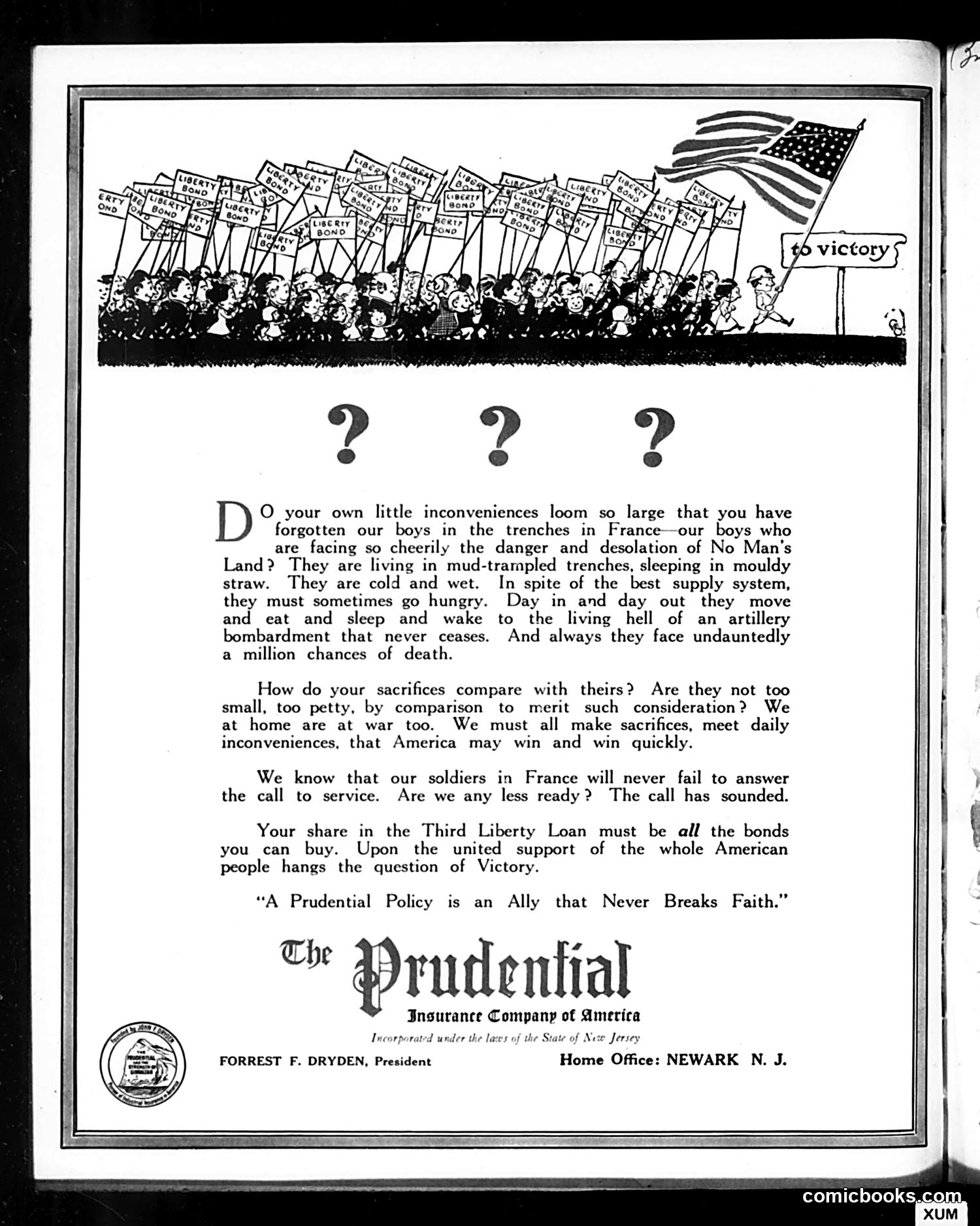
This is a **World War I propaganda advertisement** masquerading as editorial content. The illustration shows a crowd of civilians with Liberty Loan bonds marching toward victory, an American flag flying. The text employs **guilt-based persuasion**: it contrasts the supposed minor "inconveniences" of American civilians at home with the grueling conditions faced by soldiers in France's trenches—mud, mold, cold, hunger, and constant artillery bombardment with "a million chances of death." The message is explicitly manipulative: civilians' personal sacrifices are "too small, too petty" by comparison, so they should feel obligated to purchase **Third Liberty Loan bonds** to maximum capacity. The final tagline—"A Prudential Policy is an Ally that Never Breaks Faith"—attempts to associate the insurance company with patriotic duty, conflating financial investment with national loyalty. This represents typical **WWI-era American propaganda**, using emotional appeals and shaming tactics to pressure public financial support for the war effort.